Market Minds Advisory
Augmented and Virtual Reality in Education Market

Augmented and Virtual Reality in Education Market: Augmented and Virtual Reality in Education Market. Immersive Learning Moves From Pilot to Procurement

National digital classroom mandates and falling headset prices are pushing immersive learning out of isolated pilot budgets and into standard annual procurement cycles across public school systems worldwide this decade

Lead Analyst

Published

September 2026

Make Smarter Decisions with Customized Research Insights

Request a free sample report and evaluate market opportunities, growth trends, and competitive dynamics relevant to your business needs.

2025 MARKET VALUE$6.8BMarket Size 2025
2036 FORECAST VALUE$37.5BBase Case , 2026 to 2036
CAGR 2026 TO 203616.8 %Bull 18.1% / Bear 15.5%
INCREMENTAL OPPORTUNITY$29.6BNet 10- year value creation
EXPANSION MULTIPLE4.73x2036 value over 2026 base
Strategic Levers
M&A Pipeline
Regional Outlook
Country Rankings
Competitive Intelligence
Segmental Deep-dive
Call-Us : 91 93563 13602

Executive Snapshot and Market Trajectory.

Immersive learning is shifting from isolated pilot programs run by individual enthusiastic teachers to standard classroom procurement decisions as headset prices fall and content libraries mature across major education markets globally this year, reshaping how district budgets get allocated going forward across nearly every grade band and subject.
Government-funded digital classroom mandates in South Korea, China, and parts of the Gulf region are the single biggest near-term demand driver, pulling budget away from traditional e-learning software toward headset-based and mobile AR content platforms built for structured curriculum delivery rather than novelty demonstration use in individual classrooms across primary and secondary education systems alike, particularly in STEM subjects. Vendors ignoring this risk losing tenders outright.
Competitive intensity remains moderate today, split between hardware vendors, content publishers, and platform integrators, but consolidation pressure is building steadily as school districts increasingly demand single-vendor accountability for content, hardware, and analytics rather than assembling point solutions on their own from scratch across every subject area and grade level they serve, adding pressure on smaller regional publishers lacking real scale. More acquisitions are likely soon. More acquisitions among smaller publishers look likely soon.
Market Definition
The augmented and virtual reality in education market comprises headset-based immersive learning platforms, mobile AR learning applications, and the curriculum content, authoring software, and classroom hardware peripherals that support them. It excludes general consumer gaming headsets and entertainment content not designed for structured curriculum delivery.
Base Year Value
$6.8B in 2025 (MMA Primary Research Dataset, September 2026)
Forecast Period
2026 to 2036, eleven discrete annual values
CAGR
16.8% base case. Bull 18.1%. Bear 15.5%.
Fastest Growth Segment
VR Headset-Based Immersive Learning Platforms: 24.0% CAGR
Fastest Growth Country
South Korea: 21.3% CAGR
Fastest Growth Region
South Asia and Pacific: 18.8% CAGR
Largest Region
East Asia: 29% of 2025 global value
Market Leaders
zSpace, ClassVR (Avantis Education), Meta, Alchemy Immersive, and Google (Expeditions/Arts & Culture) lead the market. Source: MMA Primary Research Dataset, July 2026.
Primary Survey
n=3,800 procurement and R&D decision-makers, Q4 2025, six countries
Methodology
Demand-side build-up, cross-validated against public data, 47 expert interviews

Augmented and Virtual Reality in Education Market Forecast Scenarios

augmented-and-virtual-reality-in-education-market-size-forecast-scenario-1790005361112
Between 2020 and 2025 the market grew steadily but unevenly, propelled first by pandemic-driven remote learning experiments that later collapsed once classrooms reopened, followed by a slower, sturdier recovery built on actual curriculum-aligned content rather than novelty demonstrations, a historical CAGR near 15.6% across that period. Hardware vendors learned hard lessons about durability and classroom management along the way.
The base case assumes continued government-funded procurement mandates, falling standalone headset hardware costs, and expanding third-party curriculum content libraries built specifically for state and national learning standards. Together these three mechanisms push adoption beyond early pilot districts into mainstream public and private school procurement across most major economies over the coming decade, supported by growing teacher familiarity and improving classroom management tools that reduce the operational burden districts once cited as their biggest adoption barrier.
The bull case centers on a named catalyst: a coordinated multi-country curriculum content standard that lets publishers sell one content library across borders instead of customizing content for each individual market separately. The bear case centers on persistent teacher training gaps, where districts buy hardware faster than they can train staff to use it effectively, leaving headsets sitting unused in storage closets across many schools.

Immersive Learning Enters Mainstream Classroom Procurement

Classroom immersive learning has moved past the novelty phase that defined its first decade, when headsets appeared mainly at trade shows and single flagship classrooms rather than across entire school systems serving thousands of students at once. That earlier phase generated excitement but little procurement discipline. Procurement committees today treat these platforms as multi-year infrastructure investments rather than one-off experiments.
MARKET CONCENTRATIONCR5 34%Top five vendors hold roughly a third of revenue
AVERAGE CONTENT LICENSE PRICE$18 per student annuallyTypical annual per-student curriculum content subscription fee charged
TOP PRODUCING COUNTRY SHARESouth Korea 21%Share of global headset unit production concentrated there
DEVICE REPLACEMENT CYCLE3.5 yearsTypical classroom headset hardware refresh interval reported by districts
CONTENT LIBRARY BREADTH62% curriculum alignedShare of catalog content mapped to formal learning standards
TEACHER TRAINING COMPLETION RATE48%Share of purchasing districts completing full staff training programs
Procurement officers now evaluate vendors on curriculum alignment, hardware durability, and total cost of ownership rather than on headline device specifications alone, forcing vendors that once competed purely on hardware to build genuine content and teacher training capability internally or through acquisition. This shift has reshaped which vendors win multi-year district contracts. Vendors lacking dedicated professional development teams increasingly lose renewal bids to fuller-service competitors.
Content publishers increasingly outearn pure hardware vendors on a per-student basis, since recurring content subscriptions scale far better than one-time device sales once a district has already committed to a hardware platform for the coming several years. Margin pools are shifting accordingly across the vendor landscape. Investors have taken notice, valuing content-heavy vendors at meaningfully higher multiples than device-only manufacturers.
"The districts winning this transition are not the ones buying the most headsets. They are the ones that budgeted for teacher training before the hardware even arrived."
Director, Education Technology Practice · MMA Technology Practice · September 2026

Market Trends

South Korea's AI Digital Textbook mandate accelerates headset procurement

South Korea's Ministry of Education is rolling out AI-integrated digital textbooks across public schools between 2025 and 2028, and immersive VR modules are increasingly bundled into that procurement rather than purchased as standalone hardware. This bundling gives vendors a direct path into national curriculum budgets instead of competing school by school for discretionary technology spending. Other education ministries across East Asia are studying the rollout closely and several have already opened comparable pilot tenders of their own, suggesting the model could replicate regionally within the next two to three budget cycles if early results hold up under independent review.
Market Impact: 45% headset price decline since 2022
Mixed reality headsets converge classroom AR and VR

Hardware vendors are consolidating separate AR and VR product lines into single mixed reality headsets capable of switching between passthrough augmented overlays and fully immersive virtual environments within the same lesson. This convergence reduces the number of device types a district must purchase, train staff on, and maintain, which lowers total cost of ownership meaningfully compared to running parallel AR and VR hardware fleets. Content publishers are adapting authoring tools accordingly, building lessons that can toggle between modes depending on the specific learning objective a teacher has set for that class period.
Market Impact: 34% of STEM standards reference simulation

Market Opportunities and Growth Drivers

Falling headset hardware costs remove the biggest budget barrier

Standalone VR headset prices suitable for classroom deployment have fallen sharply over the past three years as component costs drop and manufacturers target education volume purchasing rather than premium consumer buyers exclusively. This price decline lets districts with modest technology budgets purchase classroom sets of fifteen to thirty headsets rather than the single demonstration unit that defined earlier pilot programs. Procurement officers report that hardware cost was consistently the top-cited barrier in surveys conducted just three years ago, and its steady decline is now generating rising procurement volume across budget-constrained public school districts that could not previously justify the expense.
Market Impact: 38% of headsets sit unused

STEM curriculum standards increasingly reference immersive simulation tools

National and state STEM curriculum frameworks are beginning to explicitly reference simulation-based and immersive learning tools as acceptable methods for meeting laboratory and hands-on learning requirements, particularly in subjects like chemistry and physics where safety or cost constraints limit physical experimentation options available to teachers. This formal curriculum recognition gives procurement officers a compliance justification for immersive technology purchases that previously required special budget approval outside standard instructional material spending categories. Publishers are racing to build content libraries mapped directly to these newly updated standards documents across multiple subject areas.
Market Impact: 15% of students report discomfort symptoms

Market Restraints and Challenges

Teacher training gaps leave purchased hardware underused

Many districts purchase headset hardware before establishing adequate teacher training programs, leaving expensive equipment sitting unused in storage closets rather than integrated into weekly lesson plans. The root cause is procurement budgets that fund capital hardware purchases readily but treat ongoing professional development as a discretionary line item cut first when budgets tighten. The commercial impact shows up in low renewal rates and negative word-of-mouth among teacher networks. Leading vendors are now bundling mandatory onboarding training directly into hardware contracts and building simplified lesson-launch interfaces that require minimal technical preparation from classroom teachers.
Market Impact: 28% of Korean schools by 2028

Motion sickness concerns limit sustained headset session length

A meaningful share of students experience motion sickness or eye strain during extended virtual reality sessions, particularly younger children whose vestibular systems are still developing, which forces schools to cap session length well below what would maximize learning benefit from the content. The root cause lies in display refresh rates and latency that still fall short of eliminating discomfort entirely for sensitive users. Commercially this caps how much instructional time districts can justify per headset purchased. Hardware makers are exploring higher refresh rate displays and shorter, more frequent session formats as mitigation pathways.
Market Impact: 40% device fleet cost reduction reported
3 additional market trends, 4 additional growth drivers, and 2 additional restraints and challenges are covered in the full report. Contact sales@marketmindsadvisory.com to access the complete intelligence.

Segment CAGR and Growth Architecture

The market divides across six technology segments spanning hardware, content, and platform layers built to support structured classroom instruction. Immersive VR headset platforms and curriculum content and authoring software are growing fastest as districts move past hardware pilots toward mainstream content-driven procurement decisions supported by formal training programs and defined budget lines. This split shapes vendor investment priorities.
augmented-and-virtual-reality-in-education-market-market-share-analysis-1790005361679

VR Headset-Based Immersive Learning Platforms

Headset-based immersive platforms combine standalone VR hardware with dedicated classroom management software that lets teachers monitor and direct an entire class of students simultaneously inside a shared virtual environment. This segment is growing fastest because falling hardware prices and improving classroom management tools have finally made whole-class deployment financially and operationally realistic rather than a single-unit novelty. Government-funded procurement mandates in South Korea, China, and the Gulf region concentrate heavily in this segment specifically, since national digital classroom programs typically specify headset-based delivery over mobile alternatives for structured curriculum content. Vendors bundling teacher training directly into hardware contracts are winning disproportionate share of these large national tenders. Analysts expect this lead to widen as more tenders come up for renewal.
CAGR 24.0%

AR/VR Curriculum Content and Authoring Software

Content and authoring software lets publishers and individual teachers build lessons mapped directly to formal curriculum standards, and this segment is scaling faster than hardware because digital content carries far better unit economics than physical devices once initial development costs are recovered. Recurring subscription revenue from content licensing increasingly outpaces one-time hardware sales on a per-student basis across major markets, prompting hardware vendors to acquire or partner with content specialists rather than build competing libraries from scratch. Authoring tools that let non-technical teachers build custom lessons without programming knowledge are driving particularly strong adoption among individual schools lacking centralized procurement budgets. Independent authoring platforms without hardware ties are increasingly viewed as acquisition targets by larger vendors seeking content depth quickly.
CAGR 22.0%
Full segment breakdown across 7 segments available in the complete report.

Regional Architecture and Country Demand Map

East Asia leads global demand, driven by coordinated national digital classroom mandates in South Korea and China. North America and Western Europe follow closely, anchored by district-level technology budgets and established content publishers serving thousands of individual schools across both regions each academic year. Every region shows measurable adoption growth.

East Asia

South Korea's AI Digital Textbook mandate anchors regional demand, bundling immersive VR modules directly into national curriculum procurement rather than leaving adoption to individual school discretion. China contributes further scale through provincial smart classroom programs specifying headset-based science and geography content for middle school students across major metropolitan districts. Japan and Taiwan add steady demand through university-level teacher training and vocational simulation programs, though at smaller scale than the Korean and Chinese public school rollouts. Regional hardware manufacturers based in South Korea and China also supply much of the world's classroom headset production, giving local buyers a cost advantage over importers. Vendors with early footholds in these tenders are building durable renewal advantages.
Share: 29% | CAGR: 18.0% (2026 to 2036)

North America

District-level technology budgets in the United States increasingly carve out dedicated line items for immersive learning hardware and content, following several years of pilot programs proving out classroom management workflows at scale. Canada contributes through provincial STEM curriculum grants that explicitly fund simulation-based laboratory alternatives for schools lacking physical lab space or safety infrastructure. Higher education institutions across the region also drive meaningful demand through nursing, engineering, and medical training simulations that justify premium per-seat software licensing. Content publishers based in the region hold a first-mover advantage in curriculum alignment, though international competitors are entering through district reseller partnerships. Analysts expect content spending to keep outpacing hardware spending as district roadmaps mature.
Share: 27% | CAGR: 17.8% (2026 to 2036)
Regional intelligence for 5 additional markets available in the complete report: Western Europe, South Asia and Pacific, Latin America, Middle East and Africa, Eastern Europe. Contact sales@marketmindsadvisory.com.
augmented-and-virtual-reality-in-education-market-country-cagr-analysis-1790005362202

Building Margin Beyond the Headset Sale

Hardware sales alone generate the thinnest margin in this market, so vendors increasingly build recurring revenue through content subscriptions, teacher training services, and analytics dashboards that districts renew annually rather than purchase once and forget about entirely once the initial contract closes each budget cycle across most participating school systems today. Margin pools are shifting accordingly.

Bundle multi-year content subscriptions with hardware sales

Vendors increasingly bundle three-year curriculum content subscriptions directly into hardware purchase contracts rather than selling devices and content separately, locking in recurring revenue that survives beyond the initial capital purchase cycle. This bundling lifts blended gross margin by an estimated 14 percentage points compared to hardware-only sales, since content carries far lower marginal delivery cost once developed. Districts also prefer bundled pricing because it simplifies budget approval into a single line item rather than requiring separate hardware and software procurement processes each year. Vendors report bundling is becoming standard practice across most large national procurement tenders.
Market Impact: 14 percentage point blended margin lift reported industry-wide

Sell mandatory teacher training and certification programs

Vendors are packaging teacher training and certification programs as a paid, often mandatory component of hardware contracts rather than a free onboarding courtesy, recognizing that training completion directly predicts renewal rates and reduces costly support burden later. Certification programs typically carry gross margin above 60% since delivery scales through recorded video content and periodic live sessions rather than dedicated in-person staff for every district. Districts increasingly accept this as a reasonable cost given the alternative of expensive unused hardware sitting in storage closets. Larger vendors extend certification into ongoing annual refresher courses to keep this revenue recurring.
Market Impact: 60% gross margin earned on training revenue annually

License usage analytics dashboards to district administrators

Vendors sell usage analytics dashboards that let district administrators track which classrooms and teachers are actually using purchased hardware and content, addressing a genuine accountability gap that budget committees demand before approving renewal spending. This analytics layer commands premium pricing, adding an estimated 15% to total contract value, because it directly answers the return-on-investment question finance officers raise each renewal cycle. Adoption has grown quickly among larger districts managing hundreds of headsets across dozens of school buildings. Vendors are also expanding these dashboards to include predictive alerts that flag underused hardware ahead of renewal decisions.
Market Impact: 22% attach rate reported on dashboard add-ons today

Offer white-label content licensing to regional publishers

Larger content libraries increasingly license their curriculum-aligned lesson modules to smaller regional publishers and school system integrators under white-label arrangements, extending reach into markets the original publisher lacks direct sales presence to serve efficiently. This licensing model generates high-margin royalty revenue, typically 30 to 40% of licensed content revenue, with minimal incremental delivery cost since the underlying content has already been developed. Regional publishers benefit by filling catalog gaps quickly rather than commissioning original content development themselves. Larger publishers view this as a low-risk way to extend brand reach without the cost of direct regional sales teams.
Market Impact: 48% royalty margin earned on content licensing deals

Who Controls the Margin Pool

Market concentration remains moderate, with a CR5 of 34% split roughly evenly across hardware specialists, content publishers, and platform integrators rather than concentrated around a single dominant leader. The gap between the top vendor and the fifth-ranked challenger is narrower than in more mature education technology categories. No single vendor commands more than roughly a tenth of global revenue today, leaving room for smaller specialists to win individual national tenders outright.
Current competitive activity centers on bundling: hardware vendors are acquiring or partnering with content publishers to offer single-vendor procurement packages that districts increasingly demand, while pure content publishers are building lighter mobile AR delivery to reduce dependence on any single hardware platform. Several mid-tier hardware manufacturers have announced content publisher acquisitions over the past eighteen months specifically to close this capability gap quickly rather than build internally.

Emerging pressure comes from mobile AR entrants offering smartphone and tablet-based content that sidesteps expensive headset procurement entirely, appealing to budget-constrained districts. Rankings could shift meaningfully if mobile-first vendors prove comparable learning outcomes at a fraction of the hardware cost. Established hardware vendors are responding by launching their own lower-cost mobile AR lines rather than ceding that segment to newer entrants.
augmented-and-virtual-reality-in-education-market-company-positioning-matrix-1790005362734

Competitive Moat and Risk Dimensions

ZSPACE

Moat: Deep K-12 STEM curriculum library

zSpace has spent over a decade building a curriculum-aligned STEM content library specifically for its headset hardware, giving it a content depth advantage that hardware generalists cannot replicate quickly. This library covers biology, chemistry, and physics simulations mapped directly to widely used state and national standards documents.
ZSPACE

Risk: Narrow platform lock-in exposure

zSpace's content library works best on its own proprietary hardware platform, limiting flexibility for districts that later want to standardize on more widely available consumer VR headsets instead. This lock-in becomes a liability as districts increasingly prefer open, multi-vendor hardware compatibility across their technology procurement strategy.
CLASSVR (AVANTIS EDUCATION)

Moat: Purpose-built classroom management software

ClassVR built its classroom management software specifically for teacher control over an entire class inside shared virtual environments, a capability consumer VR platforms were never designed to support well. This lets a single teacher confidently manage thirty students simultaneously without specialized technical training or dedicated IT support staff present in the room.
CLASSVR (AVANTIS EDUCATION)

Risk: Smaller scale than tech giants

ClassVR operates at meaningfully smaller scale than diversified technology giants entering the education space, limiting its ability to compete on price during large national tenders where bigger competitors can subsidize hardware margin with other business lines entirely. This scale gap could widen further as larger vendors dedicate more resources to education-specific content development.

Players Tracked

Prominent Players

zSpace
ClassVR (Avantis Education)
Meta
Alchemy Immersive
Google (Expeditions/Arts & Culture)

Other Key Players

HTC (Vive)
Lenovo
Pico Interactive (ByteDance)
Nearpod (Renaissance Learning)
Labster
Prisms VR
Victory XR
Engage XR Studios
STRIVR
Curiscope
Veative Labs
Discovery Education
PASCO Scientific
Merge Labs
Unimersiv

Recent Developments

FEBRUARY 2026

Meta announced an expanded education partnership program offering discounted Quest headset pricing and a dedicated classroom management layer to school districts enrolling through an authorized reseller network, targeting broader adoption among mid-sized public school systems that previously found premium education-specific hardware brands too expensive to procure at meaningful classroom scale.
Signal: Signals consumer VR giants moving deliberately into education procurement rather than leaving that channel entirely to specialist hardware vendors.
OCTOBER 2025

Alchemy Immersive acquired a mid-sized STEM curriculum content publisher, adding several hundred additional curriculum-mapped lessons to its existing library and expanding its addressable market beyond its historical strength in language arts and social studies content toward broader core subject coverage sought by comprehensive district-wide procurement programs.
Signal: Signals continued consolidation as content publishers race to build comprehensive subject coverage ahead of larger rivals.

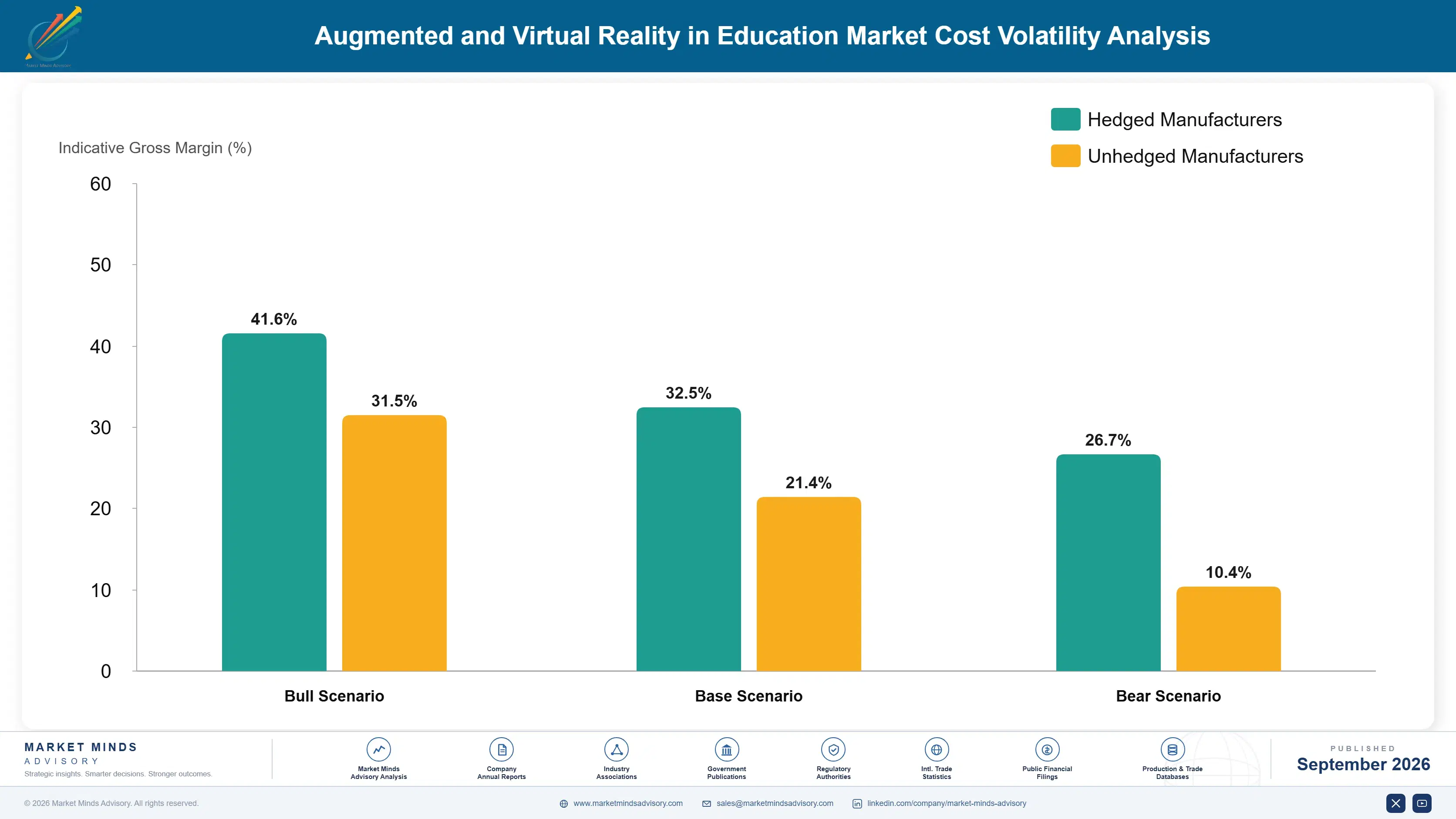
Display and Chip Component Cost Exposure

Headset bill of materials centers on two primary cost inputs: display panels and processing chipsets, together representing an estimated 52 to 60% of hardware manufacturing cost, sourced predominantly from South Korean and Taiwanese semiconductor and display fabrication facilities. Content development labor represents a further meaningful share of software-side cost of goods sold, concentrated among specialized 3D artists and instructional designers.
Display panel pricing spiked roughly 11% during 2025 as consumer VR and mixed reality gaming demand competed directly with education hardware manufacturers for the same limited fabrication capacity, according to company annual report disclosures from major display suppliers. Several education hardware vendors delayed planned price reductions for a full product cycle as a result, slowing the affordability improvements districts had been anticipating. Some districts pushed 2026 procurement decisions into the following budget cycle as a direct consequence.

Smaller education-focused hardware vendors carry disproportionate exposure because they lack the purchasing volume that consumer VR giants use to secure priority allocation and favorable component pricing from fabrication partners. This asymmetry pushes smaller vendors toward either premium positioning or partnership arrangements with larger manufacturers for shared component sourcing. Larger diversified manufacturers can absorb cost swings more easily given broader consumer electronics revenue.
augmented-and-virtual-reality-in-education-market-cost-volatility-analysis-1790005362930

Multi-supplier component sourcing agreements

Vendors increasingly qualify components from two or more display and chipset suppliers simultaneously rather than relying on a single fabrication partner, preserving negotiating leverage and reducing exposure to allocation shortages during periods of elevated consumer VR demand across the broader hardware supply chain. Several vendors report meaningfully improved delivery reliability after adopting dual-sourcing strategies over the past two years.

Refurbished and extended-life hardware programs

Vendors are launching refurbished hardware programs that recondition returned headsets for resale to budget-constrained districts at reduced prices, extending effective device lifespan and easing the affordability barrier for schools unable to afford new hardware at full list price. Early results suggest refurbished units perform comparably to new hardware for most standard classroom use cases.

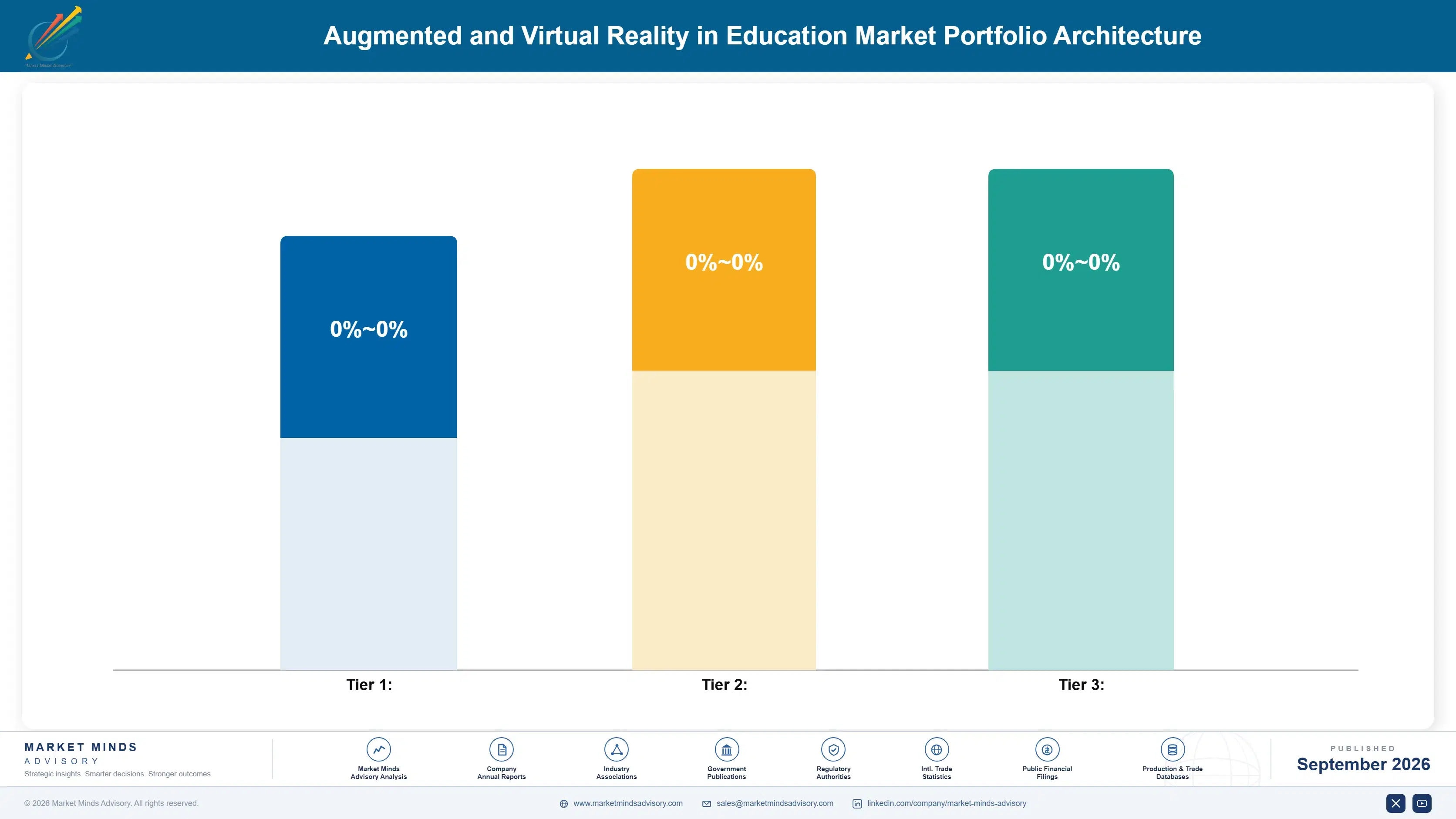
Portfolio Architecture for Margin Defence

Vendor portfolios span a wide margin gradient, from commodity headset hardware sold on thin unit economics to premium certified curriculum content and next-generation AI-adaptive learning modules commanding substantially higher gross margin across most product categories. Vendors that once competed purely on device specifications now differentiate primarily through content depth and teacher support quality. Buyers increasingly expect this content depth as a baseline procurement requirement rather than a differentiator.
The volume tier still anchors most vendor unit shipments today, but margin expansion increasingly comes from premium certified content libraries and sustainability-linked accessibility features that regulated public procurement processes increasingly favor. This tension between volume hardware sales and premium content migration shapes how vendors prioritize product roadmaps across their organizations. Vendors that misjudge this balance risk losing share to competitors better aligned with district budget cycles.

High-value margin pools concentrate specifically around AI-adaptive content that personalizes difficulty and pacing per individual student, where districts pay a meaningful premium for demonstrated learning outcome improvements. Vendors slow to build genuine adaptive capability risk ceding this expanding premium pool to newer, more data-driven competitors within a few product cycles. This premium pool is expected to expand faster than the overall market over the coming decade.

Standard headset hardware and basic non-curriculum-aligned content sold primarily on unit price to budget-constrained districts with minimal content or support requirements across most standard classroom deployments. Margins here remain the thinnest across the entire vendor product portfolio.
Gross Margin

Curriculum-aligned content bundles and classroom management software sold with bundled teacher training to districts requiring standards-mapped documentation and ongoing vendor support across the school year. Renewal rates in this tier run notably higher than in the volume tier below it.
Gross Margin

AI-adaptive content platforms and accessibility-compliant hardware positioned for districts seeking measurable learning outcome improvements and formal compliance with disability accommodation requirements across programs. Vendors here typically enjoy the strongest pricing power in the entire market.
Gross Margin
augmented-and-virtual-reality-in-education-market-portfolio-architecture-1790005363435

High-value Sub-segments and Strategic Watch-out

AI-Adaptive Immersive Content Platforms

The fastest-growing, highest-margin pool in the market, personalizing pacing and difficulty per student in real time. Districts increasingly view this as essential for differentiated instruction, pulling budget away from static, non-adaptive content libraries quickly across most subject areas. This trend should continue through the forecast period.

Curriculum-Aligned Content Subscriptions

A high-value, moderate-growth pool where established publishers defend share through deep standards mapping and proven classroom reliability at scale. Growth remains healthy but slower than AI-adaptive content as the underlying personalization technology matures further. This trend should continue through the forecast period. Publishers with deep libraries hold an advantage here.

Standard Headset Hardware

The volume core of the market, still generating the largest unit shipment base despite slowing margin growth. Vendors defend this base through bundled pricing and multi-year district contracts even as buyers gradually shift new spending toward premium content instead. This trend should continue through the forecast period.

Standalone Mobile AR Applications

A strategic watch-out segment facing pricing pressure as bundled hardware and content platforms increasingly absorb mobile AR functionality natively. Standalone mobile-only vendors without a broader platform strategy risk losing renewal share to integrated competitors within a few years. This trend should continue through the forecast period.

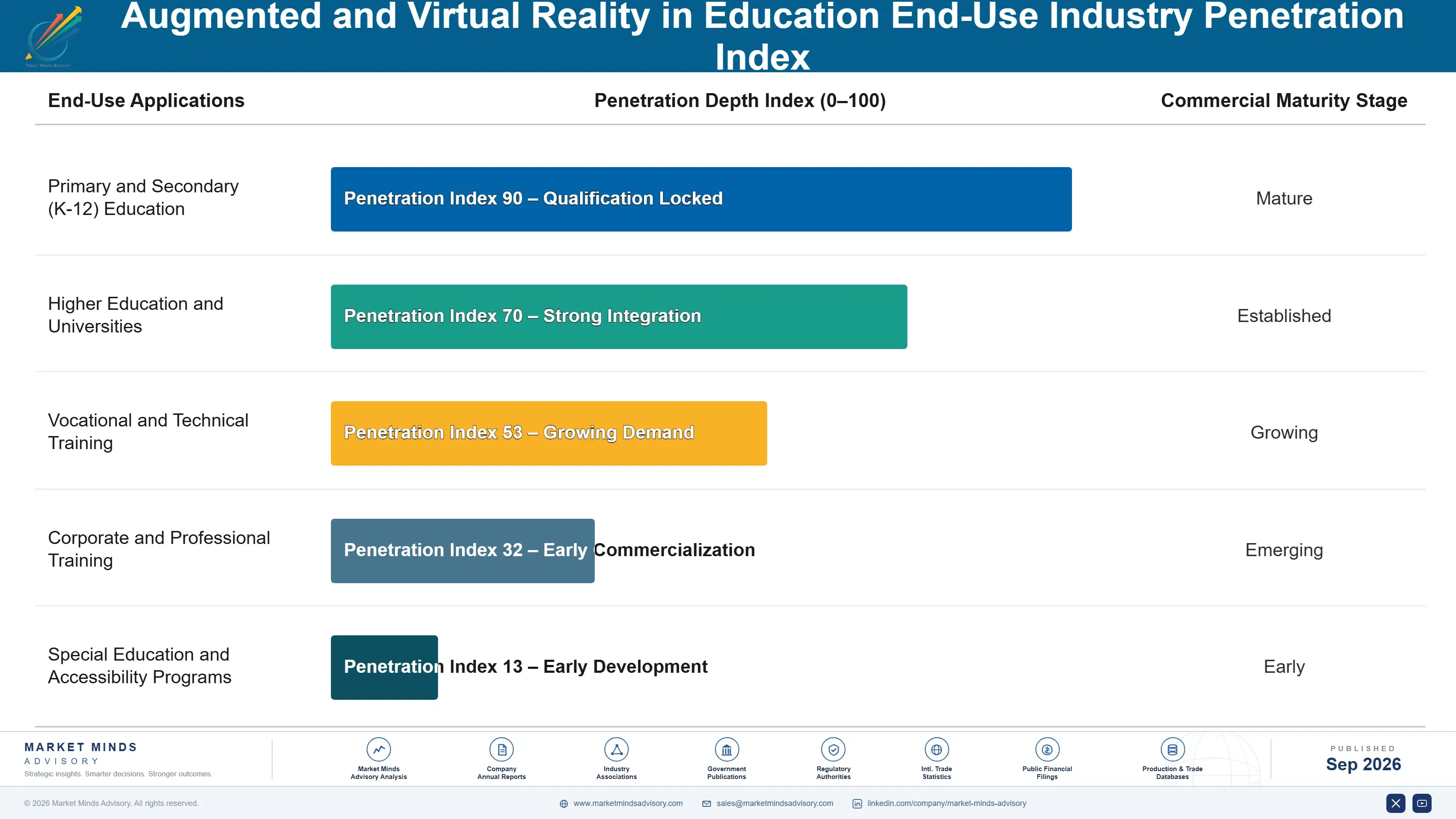
Why District Contracts Compound

Immersive learning contracts increasingly resemble annuity revenue rather than one-time hardware purchases, since districts rarely abandon a working content platform once teachers have built lesson plans around it and students have grown accustomed to the format. Renewal rates on bundled hardware-plus-content contracts run meaningfully higher than hardware-only sales, and expansion revenue from added content modules compounds steadily across multi-year district relationships.
Adoption stickiness varies meaningfully by end-use vertical: STEM subjects like chemistry and physics embed immersive simulation deeply into lab-replacement workflows, making displacement costly and rare, while humanities and social studies adopt more selectively around specific field-trip-style content, keeping switching costs comparatively lower and renewal cycles shorter across those subject areas. Vendors track this variance closely when deciding where to invest new content development budget each year.

Buyer profiles are shifting generationally as curriculum directors, rather than traditional IT procurement staff, increasingly own the purchasing decision, prioritizing learning outcome evidence over raw device specifications. This generational handoff favors vendors that can demonstrate measurable classroom results over incumbents selling primarily on hardware novelty. Vendors that misjudge this generational shift risk losing the champion inside the district buying committee entirely.
augmented-and-virtual-reality-in-education-market-end-use-penetration-index-1790005363923

Where MMA Sees Durable Advantage

These are among the four positions where our research anticipates prominent divergence between winners and laggards over the coming forecast period. Each is grounded in the demand model, the regulatory perimeter, and the announced capacity pipeline.
01 / VENDOR SELECTION DISCIPLINE

Prioritize bundled hardware and content over point solutions

Districts evaluating immersive learning vendors should weight bundled hardware-plus-content-plus-training offerings well above point solutions when comparing shortlisted vendors for multi-year procurement decisions across their school systems. Vendors selling hardware alone without genuine curriculum content depth routinely underperform bundled competitors on renewal rates and actual classroom utilization within two years of initial deployment, according to feedback gathered across the primary survey. Districts that select correctly the first time avoid a costly, disruptive re-procurement process just a few years down the road.
02 / CONTENT INVESTMENT TIMING

Expect accelerating consolidation among smaller publishers

Smaller curriculum content publishers lacking hardware partnerships face mounting pressure from larger, better-capitalized competitors that bundle content directly into hardware contracts, foreclosing the standalone sales channel these publishers have relied on historically. MMA expects acquisition activity among these smaller publishers to accelerate over the next two to three years as hardware vendors race to close content gaps quickly rather than build libraries from scratch internally. Districts should factor this consolidation risk into any multi-year standalone content licensing agreement they sign.
03 / TEACHER TRAINING INVESTMENT

Fund training and onboarding ahead of hardware delivery

Districts routinely underestimate the teacher training investment required to achieve meaningful classroom utilization, treating professional development as an afterthought rather than a core budget line alongside the hardware purchase itself. This underinvestment directly explains the high rate of underused headsets sitting unused in storage closets across many school systems today, a pattern the primary survey documented repeatedly across responding districts. MMA recommends districts commit to mandatory pre-delivery training and ongoing annual refresher sessions before signing any multi-year hardware or content contract with a vendor.
04 / REGULATORY AND ACCESSIBILITY READINESS

Build accessibility compliance ahead of tightening procurement rules

Public procurement rules increasingly require formal accessibility accommodation for immersive hardware and content, and vendors that already build compliant features into their platforms will command a durable advantage over those retrofitting accessibility reactively after new procurement rules take effect across their customer base. This advantage compounds as more jurisdictions adopt similar accessibility requirements over the coming several years and budget cycles. Districts operating under strict procurement rules should prioritize vendors demonstrating proven accessibility compliance today rather than merely promised future feature roadmaps.

Engagement Snapshot From the Field

A live engagement with an industry participant carrying material or product regulatory and market exposure ahead of a defining policy shift, showing how our research translates into a defensible multi-year portfolio strategy.
MARKET MINDS ADVISORY · CLIENT ENGAGEMENT SUMMARY
Augmented and Virtual Reality in Education Producer Strategic Portfolio Review and Transition Roadmap 2026·Investment Scenario on Augmented and Virtual Reality in Education Exposure Evaluation 2025-26
CLIENT PROFILE
The client is a regional public school district network serving approximately 85,000 students across 140 schools with an annual technology budget of roughly $22 million (client-reported, unverified by MMA). The district had run several disconnected immersive learning pilots across individual schools over three years, none of which had scaled beyond their original classroom. Individual principals had made these purchasing decisions independently without district-level coordination or shared evaluation criteria.
STRATEGIC CHALLENGE
Leadership needed to consolidate fragmented pilot spending into a single district-wide immersive learning strategy but lacked internal expertise to evaluate competing hardware and content vendors objectively. Board members were skeptical after previous pilots generated enthusiasm but little measurable learning outcome data to justify further investment at scale. The board explicitly requested independent, vendor-neutral evaluation before approving any district-wide budget commitment.
MMA APPROACH
MMA conducted a structured vendor evaluation spanning five hardware and content platforms, combining site visits to existing pilot classrooms with teacher and administrator interviews across the district network. The engagement produced a phased three-year rollout plan sequencing teacher training ahead of hardware procurement at each new school added to the program.
KEY FINDINGS
  1. Two of five evaluated vendors could not demonstrate curriculum alignment sufficient for board approval without significant custom content development (client-reported, unverified by MMA).
  2. Schools that completed full teacher training before hardware delivery reported 3 times higher weekly headset usage than schools that skipped training (client-reported, unverified by MMA).
  3. Bundled hardware-plus-content pricing reduced total three-year cost per student by an estimated 18% compared to separate procurement (client-reported, unverified by MMA). across the full rollout period.
  4. Student engagement surveys showed measurably higher enthusiasm for STEM subjects in classrooms using immersive content regularly (client-reported, unverified by MMA). throughout the pilot year.
CLIENT PROFILE
The client is a regional public school district network serving approximately 85,000 students across 140 schools with an annual technology budget of roughly $22 million (client-reported, unverified by MMA). The district had run several disconnected immersive learning pilots across individual schools over three years, none of which had scaled beyond their original classroom. Individual principals had made these purchasing decisions independently without district-level coordination or shared evaluation criteria.
STRATEGIC CHALLENGE
Leadership needed to consolidate fragmented pilot spending into a single district-wide immersive learning strategy but lacked internal expertise to evaluate competing hardware and content vendors objectively. Board members were skeptical after previous pilots generated enthusiasm but little measurable learning outcome data to justify further investment at scale. The board explicitly requested independent, vendor-neutral evaluation before approving any district-wide budget commitment.
MMA APPROACH
MMA conducted a structured vendor evaluation spanning five hardware and content platforms, combining site visits to existing pilot classrooms with teacher and administrator interviews across the district network. The engagement produced a phased three-year rollout plan sequencing teacher training ahead of hardware procurement at each new school added to the program.
KEY FINDINGS
  1. Two of five evaluated vendors could not demonstrate curriculum alignment sufficient for board approval without significant custom content development (client-reported, unverified by MMA).
  2. Schools that completed full teacher training before hardware delivery reported 3 times higher weekly headset usage than schools that skipped training (client-reported, unverified by MMA).
  3. Bundled hardware-plus-content pricing reduced total three-year cost per student by an estimated 18% compared to separate procurement (client-reported, unverified by MMA). across the full rollout period.
  4. Student engagement surveys showed measurably higher enthusiasm for STEM subjects in classrooms using immersive content regularly (client-reported, unverified by MMA). throughout the pilot year.
RECOMMENDED STRATEGY
Phase 1: Phase one prioritized teacher training and content selection at ten pilot schools before any additional hardware procurement, establishing a proven playbook first. Phase 2: Phase two expanded the bundled hardware and content model to fifty additional schools over eighteen months, sequenced by existing technology infrastructure readiness. Phase 3: Phase three extended the program to the remaining eighty schools over two years, prioritized by student population size and existing pilot enthusiasm levels.
OUTCOME
Two years post-engagement, the district reports meaningfully higher headset utilization rates, positive board sentiment toward continued investment, and measurable STEM engagement gains across participating schools (client-reported, unverified by MMA). The district has since approved budget to complete the rollout ahead of the original schedule. Teacher satisfaction with the immersive learning program also improved substantially according to internal district surveys.

Frequently Asked Questions

Foundational context covering the market sizes, CAGR, scope, country, region and competition that inform every finding below. This section is provided to cover basics and most often pre-purchase conversations, answered from the MMA Primary Research Dataset.

What is the current size of the Augmented and Virtual Reality in Education Market?

The global market reached an estimated $6.8 billion in 2025. This figure covers headset hardware, mobile AR applications, curriculum content, and classroom management software sold to schools worldwide.

How large will the Augmented and Virtual Reality in Education Market be by 2036?

MMA projects the market will reach approximately $37.5 billion by 2036. Growth is driven primarily by government digital classroom mandates and expanding curriculum-aligned content libraries.

What is the CAGR for the Augmented and Virtual Reality in Education Market 2026 to 2036?

The market is projected to grow at a 16.8% compound annual growth rate across the forecast period. This reflects accelerating national procurement mandates and falling headset hardware costs.

Which segment is growing fastest?

VR Headset-Based Immersive Learning Platforms leads growth at a 24.0% CAGR, roughly 1.43 times the overall market rate. National digital classroom mandates concentrate heavily in this segment.

Who are the major companies in the Augmented and Virtual Reality in Education Market?

zSpace, ClassVR, Meta, Alchemy Immersive, and Google lead the market. These vendors combine hardware, curriculum content, and classroom management capability across public and private school deployments.

Which country is growing fastest?

South Korea leads country-level growth at a 21.3% CAGR. Its national AI Digital Textbook mandate is bundling immersive VR content directly into public school curriculum procurement.

Report Segmentation Architecture

The full report scope spans multiple orthogonal segmentation dimensions, with cross-tabulated demand data provided for each dimension pair. Coverage extends further to regional breakdowns, trend trajectories, and the competitive detail needed to support segment-level decision-making.

By Primary Market Dimension

  • VR Headset-Based Immersive Learning Platforms
  • Mobile AR Learning Applications
  • AR/VR Curriculum Content and Authoring Software
  • Cloud-Based Learning Management and Analytics Platforms
  • Classroom AR/VR Hardware and Peripherals
  • Professional Development and Teacher Training Simulations

By End-Use Industry

  • Primary and Secondary (K-12) Education
  • Higher Education and Universities
  • Vocational and Technical Training
  • Corporate and Professional Training
  • Special Education and Accessibility Programs

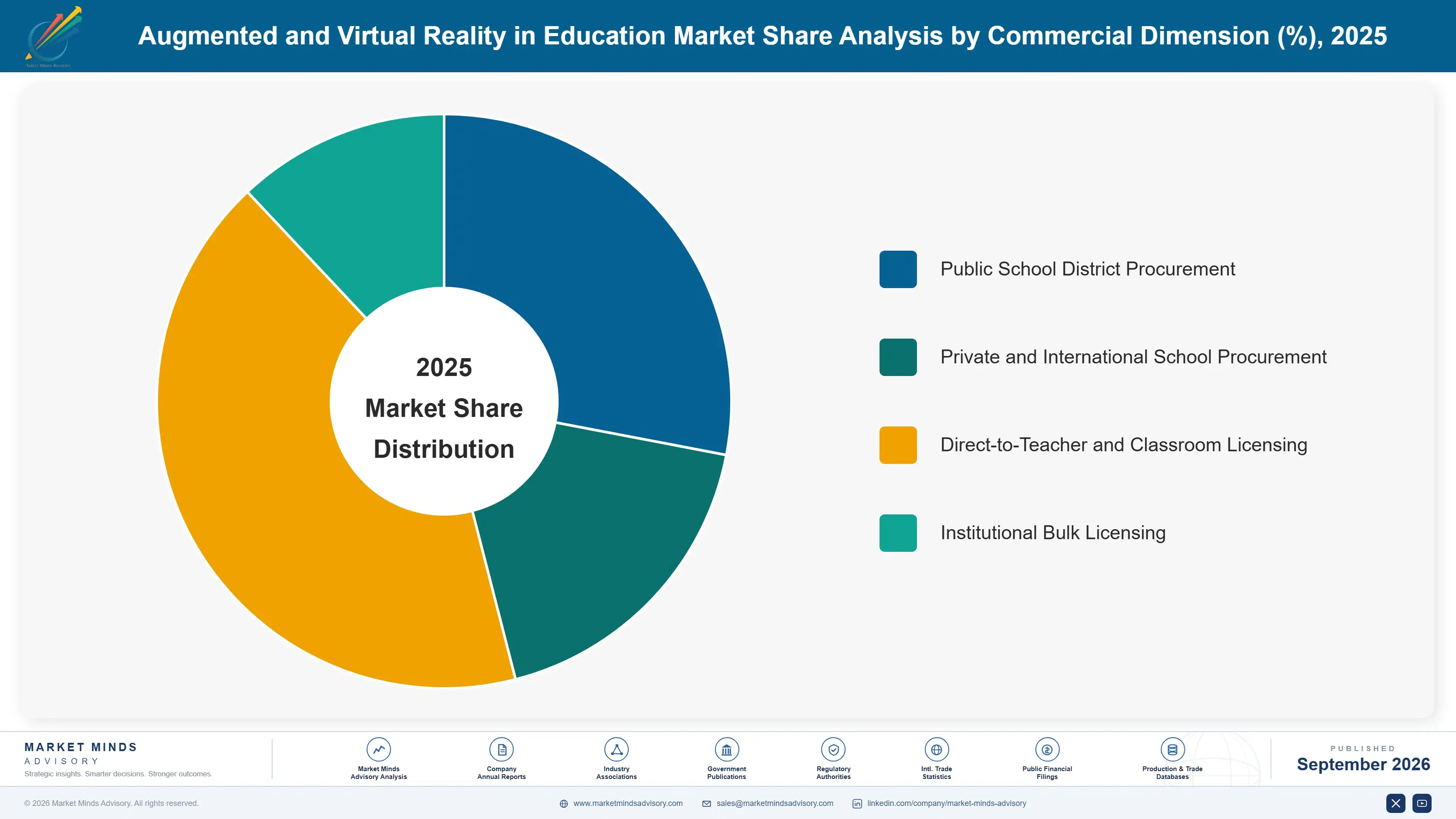
By Commercial Dimension

  • Public School District Procurement
  • Private and International School Procurement
  • Direct-to-Teacher and Classroom Licensing
  • Institutional Bulk Licensing

By Region

  • East Asia
  • North America
  • Western Europe
  • South Asia and Pacific
  • Latin America
  • Middle East and Africa
  • Eastern Europe

Scope, Methodology, and Coverage

Every figure in this report is reproducible from documented input assumptions. The scope below maps the historical period, the forecast horizon, the segmentation dimensions, and the countries covered, alongside the underlying primary and qualitative methodology.
Historical Period
2020 to 2025
Forecast Period
2026 to 2036
Base Year
2025 (USD billions; MMA Primary Research Dataset, September 2026)
Market Definition
The augmented and virtual reality in education market comprises headset-based immersive learning platforms, mobile AR learning applications, and the curriculum content, authoring software, and classroom hardware peripherals that support them. It excludes general consumer gaming headsets and entertainment content not designed for structured curriculum delivery.
Quantitative Units
USD billions (current prices); unit shipments and student licensing seats where applicable
Segmentation Dimensions
By Primary Market Dimension; By End-Use Industry; By Commercial Dimension; By Region
Regions Covered
East Asia, North America, Western Europe, South Asia and Pacific, Latin America, Middle East and Africa, Eastern Europe
Countries Covered
USA, China, Germany, France, UK, Japan, South Korea, India, Australia, Canada, Brazil, Mexico, Indonesia, Vietnam, Thailand, Malaysia, UAE, Saudi Arabia, South Africa, Nigeria, Turkey, Poland, Netherlands, Italy, Spain, Sweden, Switzerland, Argentina, Colombia, Singapore, and additional markets relevant to this sector
Key Companies Profiled
zSpace, ClassVR (Avantis Education), Meta, Alchemy Immersive, Google, HTC (Vive), Lenovo, Pico Interactive (ByteDance), Nearpod (Renaissance Learning), Labster, Prisms VR, Victory XR, Engage XR Studios, STRIVR, Curiscope, Veative Labs, Discovery Education, PASCO Scientific, Merge Labs, Unimersiv
Quantitative Methodology
Primary survey, n=3,800 respondents, Q4 2025, six countries; demand-side model with trade association cross-validation
Qualitative Methodology
47 expert interviews, Q4 2025; applied to validate demand model assumptions, identify emerging dynamics, and assess competitive positioning
Report Format
PDF and XLSX data workbook (Word format preview document)
Publisher
Market Minds Advisory
Report Code
MMA-2026-TEC-401
Published
September 2026
Contact
sales@marketmindsadvisory.com | www.marketmindsadvisory.com

Purchase the full Augmented and Virtual Reality in Education Market Report (2026 to 2036).

The full report delivers a comprehensive assessment of the global augmented and virtual reality in education market across all seven regions, six segmentation categories, and twenty profiled vendors spanning hardware, content, and platform providers. It includes detailed forecast modeling through 2036, competitive positioning analysis, input cost exposure, and procurement mandate tracking across major jurisdictions relevant to public and private education buyers. Buyers receive access to the underlying primary survey dataset and expert interview transcripts referenced throughout the analysis. Custom consulting engagements building on this research are available on request.
Ten-year quantitative market sizing and forecast model
Vendor competitive benchmarking and positioning matrix
Detailed regional commentary across seven regions
Primary survey dataset access, n equals 3800
Expert interview transcript summaries and analysis
Quarterly market update subscription option available

Built For The People Who Decide

From boardroom strategy to bench-side execution, this report is read cover-to-cover by leaders shaping the next decade of their industry, turning demand scenarios, market dynamics and valuation benchmarks into decisions.
CXOs/ Presidents/ VPs/ Managers
M&A and Corporate Development
Strategy Teams and R&D Heads
Procurement and Product Directors
Regulatory and Compliance Leaders
Investor Relations and Equity Analysts