Market Minds Advisory
Auger Filler Market

Auger Filler Market: Multi-Lane Speed Race and Net Weight Accuracy Demands

Rising packaged powder and nutraceutical volumes are pushing food and pharma processors toward multi-lane auger filling lines, while tightening net content enforcement and difficult-flow ingredient formulations determine which filler platforms win new packaging line specifications.

Lead Analyst

David Horsley

Published

September 2026

Make Smarter Decisions with Customized Research Insights

Request a free sample report and evaluate market opportunities, growth trends, and competitive dynamics relevant to your business needs.

2025 MARKET VALUE$0.7BMarket Size 2025
2036 FORECAST VALUE$1.3BBase Case , 2026 to 2036
CAGR 2026 TO 20366.8 %Bull 8.0% / Bear 5.5%
INCREMENTAL OPPORTUNITY$0.6BNet 10- year value creation
EXPANSION MULTIPLE1.93x2036 value over 2026 base
Strategic Levers
M&A Pipeline
Regional Outlook
Country Rankings
Competitive Intelligence
Segmental Deep-dive
Call-Us : 91 93563 13602

Executive Snapshot and Market Trajectory

Auger filling has moved from a commodity packaging step to a line-defining specification decision. Processors now weigh fill accuracy and changeover speed as heavily as throughput, and plant engineers increasingly select fillers around difficult-flow ingredient compatibility rather than treating augers as an interchangeable commodity component.
Multi-head auger filling systems are growing at roughly 1.4x the market average as processors expand high-speed production lines for powdered nutraceuticals, spices, and protein products beyond what single-head units can economically handle. East Asia has extended its lead in both installed base and forecast growth, anchored by China's expanding food and pharmaceutical packaging capacity, while labor cost pressure pushes North American and European processors toward automated multi-lane filling faster than prior capital cycles.
Competitive intensity concentrates among five established filler manufacturers that increasingly bundle auger hardware with weigh verification and changeover software, leaving smaller regional builders to compete on price for basic single-head units. Fill accuracy consistency and rapid product changeover, not raw fill speed alone, determine which suppliers win multi-year packaging line contracts from major processors. Insurers are beginning to treat verified fill data as a standard due-diligence item.
Market Definition
The auger filler market covers volumetric and net weight filling machines that use a rotating helical screw to dispense powders, granules, and fine particulates into containers, spanning single-head, multi-head, and retrofit upgrade configurations. It serves food, nutraceutical, pharmaceutical, and industrial chemical packaging applications. Liquid and paste filling equipment, along with standalone weigh scales sold apart from an auger mechanism, are excluded.
Base Year Value
$0.7B in 2025 (MMA Primary Research Dataset, August 2026)
Forecast Period
2026 to 2036, eleven discrete annual values
CAGR
6.8% base case. Bull 8.0%. Bear 5.5%.
Fastest Growth Segment
Multi-Head Auger Filling Systems: 9.5% CAGR
Fastest Growth Country
India: 10.2% CAGR
Fastest Growth Region
South Asia and Pacific: 9.0% CAGR
Largest Region
East Asia: 27% of 2025 global value
Market Leaders
All-Fill Inc, Spee-Dee Packaging, IMA Group, Syntegon Technology, Yamato Corporation. Source: MMA Analysis based on company annual reports.
Primary Survey
n=3,800 procurement and R&D decision-makers, Q4 2025, six countries
Methodology
Demand-side build-up, cross-validated against public data, 47 expert interviews

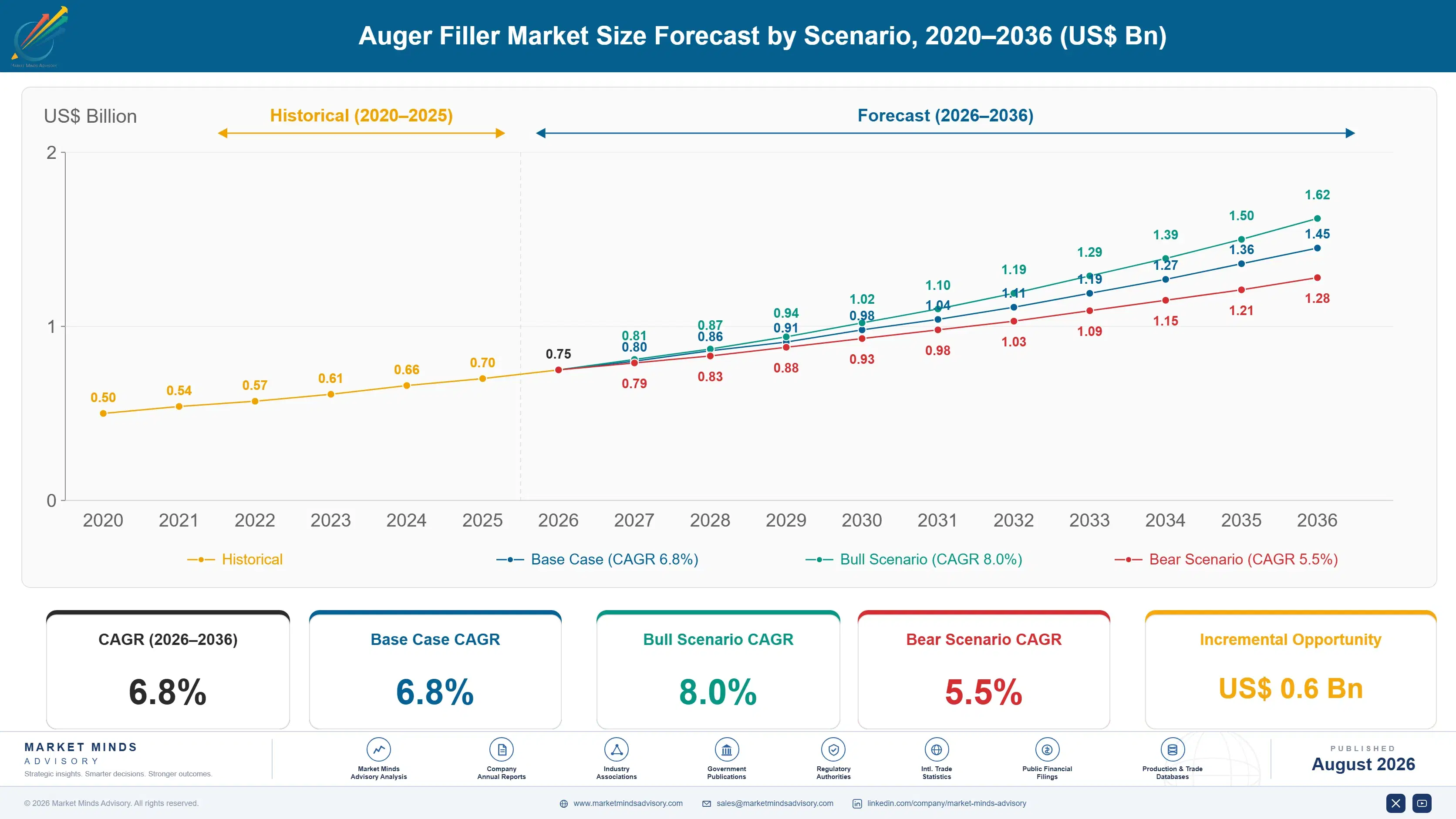
Auger Filler Market Forecast Scenarios

auger-filler-market-size-forecast-scenario-1787302222300
Between 2020 and 2025 the market grew at an estimated 5.8% historical CAGR, recovering from pandemic-era packaging line disruptions before accelerating as nutraceutical and protein powder demand expanded packaging capacity requirements across food and supplement manufacturers. Labor shortages at manual and semi-automated fill stations from 2022 onward pushed processors toward automated multi-lane systems sooner than most equipment roadmaps anticipated.
The base case assumes 6.8% CAGR through 2036, anchored in three mechanisms: expanding powdered nutraceutical and protein product packaging requiring multi-head system throughput, pharmaceutical manufacturers adopting net weight auger systems to meet tightening fill accuracy enforcement, and aging single-head machine fleets across mature markets reaching replacement age simultaneously. Retrofit upgrade kits add a reinforcing tailwind as processors add weigh verification and changeover automation without replacing entire filling lines outright, extending the useful life of existing capital investment considerably.
A bull scenario, near 8.0% CAGR, assumes faster nutraceutical category growth and accelerated pharmaceutical fill accuracy enforcement pull equipment orders forward. The bear case, near 5.5%, assumes food and pharma capital spending slows and processors extend aging filler fleets by two to three years rather than replacing them on the standard equipment cycle, deferring capital outlays until financing conditions improve.

Fill Accuracy Enforcement Meets Multi-Lane Speed Demand

Three forces are converging on this market at once: expanding powdered nutraceutical and protein product volumes requiring multi-lane throughput, a generational replacement wave among single-head machines installed during the 2010s packaging modernization cycle, and tightening net content accuracy enforcement pushing processors toward integrated weigh verification. Processors that once bought augers as isolated mechanical components now specify them as connected nodes feeding line-level quality
MARKET CONCENTRATION44%Combined revenue share held by top five manufacturers
MULTI-HEAD SYSTEM ASP$185,000Blended selling price for a standard multi-lane unit
REPLACEMENT CYCLE10-12 yrsTypical service life before mandated machine replacement occurs
WEIGH VERIFICATION ATTACH RATE36%Share of new systems shipped with integrated weigh checking
TOP PRODUCTION COUNTRYUnited StatesLeading country for finished auger filler manufacturing volume
FILL ACCURACY TOLERANCE0.3%Typical deviation allowed under standard net content regulation
Commercially, the market behaves less like a pure equipment category and more like a packaging line design decision bundled with changeover software and accuracy verification services. Hardware margins remain steady but face pressure at the entry tier as regional manufacturers compete on price, so established vendors increasingly recover margin through calibration service contracts, changeover automation upgrades, and difficult-flow ingredient qualification support sold alongside the physical machine.
Over the next decade, expect continued share gains for multi-head systems as powder packaging spreads beyond food into pharmaceutical and industrial chemical applications, consolidation among regional filler builders unable to fund weigh verification software development, and rising scrutiny of fill accuracy as regulators expand net content enforcement into e-commerce and direct-to-consumer supplement packaging.
"Buyers used to ask how fast an auger could cycle. Now the first question is how quickly it can be cleaned and requalified for the next ingredient, because changeover time is what actually limits a modern powder packaging line's daily output."
Director, Food and Pharmaceutical Packaging Equipment Practice · MMA Powder and

Market Trends

Multi-Lane Systems Displace Single-Head Units in High-Speed Lines

Food and nutraceutical processors are increasingly adopting multi-head auger filling systems to handle rising powder packaging volumes that single-head machines process too slowly to remain cost competitive at production scale. Each multi-lane system can fill multiple containers simultaneously across parallel auger heads, delivering throughput improvements that single-head sequential filling cannot economically match on high volume lines. Processors expanding protein and nutraceutical powder production report multi-head adoption is now a default specification for new lines rather than a premium option, and the trend is spreading into spice and industrial powder packaging.
Market Impact: Adds 1,200 new packaging lines year
Integrated Weigh Verification Becomes Standard Specification

Processors are increasingly specifying auger fillers with integrated in-line weigh verification that checks every filled container against target weight, catching underfill and overfill conditions before packages leave the production line. This capability reduces regulatory compliance risk and giveaway cost simultaneously, since verified accuracy lets processors run closer to target weight without the wide safety margin unverified systems require. Processors completing weigh verification retrofits report meaningfully reduced giveaway costs and fewer compliance flags during net content audits, reinforcing integrated verification as a standard specification across new food and pharmaceutical packaging line purchases.
Market Impact: Covers 3,400 additional production

Market Opportunities and Growth Drivers

Nutraceutical and Protein Powder Category Growth Expands Demand

Rising consumer demand for protein powders, nutraceutical supplements, and functional food additives is expanding the addressable base for auger filling equipment well beyond traditional dry food packaging into a fast-growing supplement manufacturing category. Each new nutraceutical packaging line typically requires one or more multi-head auger systems to handle the fine, often difficult-flow powder formulations these products demand, a packaging challenge single-head machines handle less efficiently at scale. Contract manufacturers expanding nutraceutical production report equipment procurement now happens alongside formulation development from the outset, giving early-specifying suppliers a durable design-in advantage over later-entering competitors across the category.
Market Impact: Delays qualification 4 to 8 weeks

Tightening Net Content Accuracy Enforcement Drives Upgrades

Regulators across major food and pharmaceutical markets are increasingly enforcing stricter net content accuracy requirements, pushing processors still running older volumetric-only auger systems toward net weight and integrated verification upgrades. Processors report that a single net content violation discovered during a regulatory audit can trigger costly product recalls and reputational damage far exceeding the cost of upgrading to verified filling equipment. This enforcement pressure is pulling forward equipment replacement decisions that might otherwise have waited for the next standard capital cycle, since processors increasingly view compliance risk as justifying earlier capital deployment than originally budgeted for filling line upgrades.
Market Impact: Erodes 6% of entry tier margin

Market Restraints and Challenges

Difficult-Flow Ingredient Formulations Complicate Filler Qualification

Many modern powder formulations, particularly fine nutraceutical blends and moisture-sensitive ingredients, exhibit poor flow characteristics that standard auger designs struggle to dispense accurately, and the root cause is that these formulations were often developed without early consultation on packaging line compatibility. The commercial impact falls hardest on contract manufacturers handling a wide variety of customer formulations, since qualifying a new auger configuration for each difficult-flow ingredient can take weeks of trial runs and adjustment. Manufacturers are mitigating this exposure by offering specialized auger geometries and agitation systems engineered specifically for poor-flow powder characteristics common in nutraceutical applications.
Market Impact: Adds 9.5% CAGR to multi-head segmen

Price Competition From Regional Manufacturers Compresses Entry Tier Margins

Lower cost regional manufacturers, particularly across China and India, are undercutting established brands on single-head and basic multi-head machines by a meaningful margin, and the root cause is a combination of lower labor cost and simpler product designs that skip advanced weigh verification features many smaller buyers do not yet require. The commercial impact falls hardest on entry tier hardware sales for established vendors, since price sensitive contract packagers increasingly substitute regional machines for basic filling tasks. Established vendors are mitigating this by shifting entry tier focus toward service network density rather than matching import pricing directly.
Market Impact: Lifts verification attach rate to 3
3 additional market trends, 3 additional growth drivers, and 2 additional restraints and challenges are covered in the full report. Contact sales@marketmindsadvisory.com to access the complete intelligence.

Segment CAGR and Growth Architecture

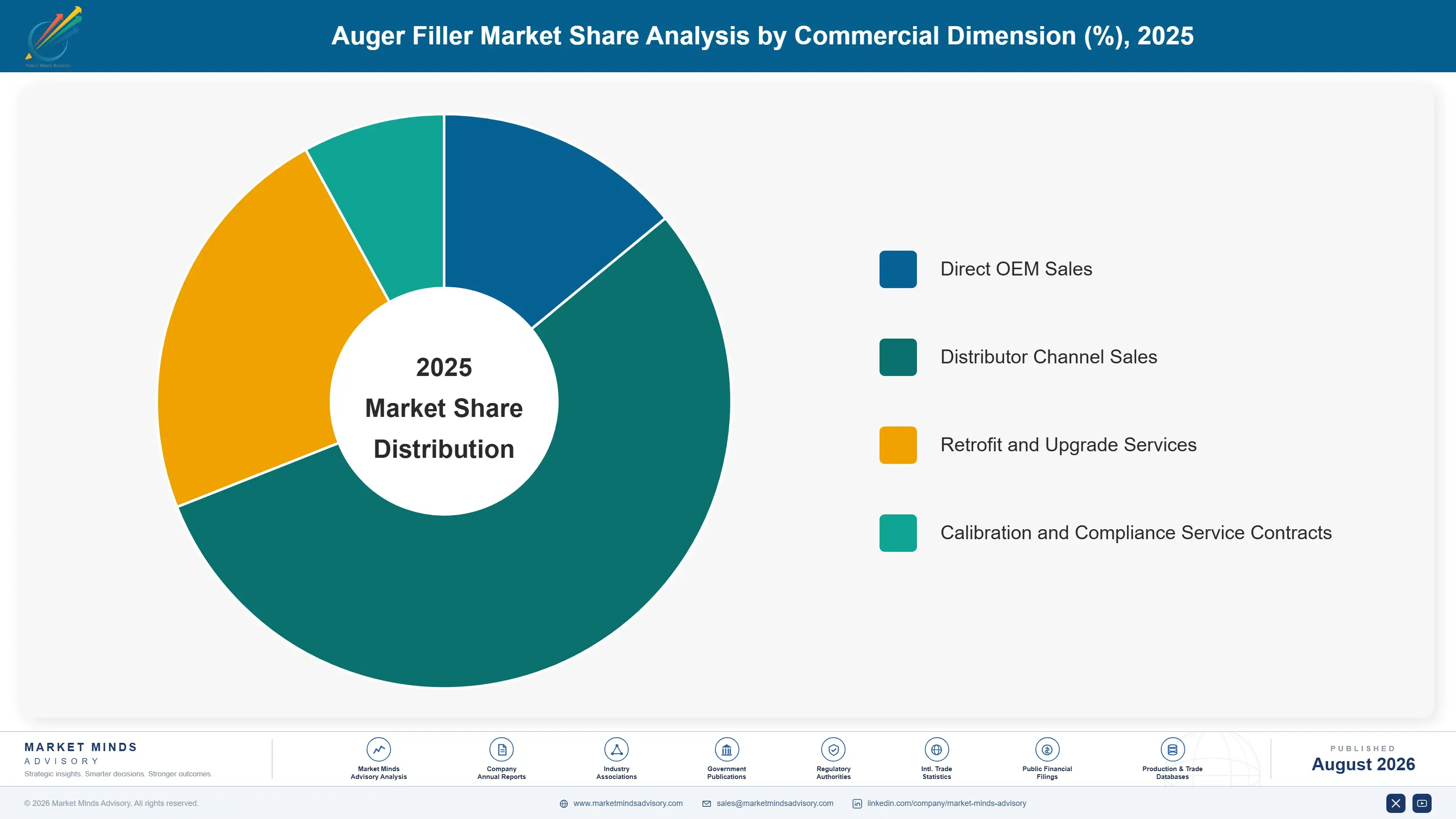
Segmentation follows filler architecture, the single dimension processors specify against when designing a packaging line around throughput and accuracy requirements. Single-head, multi-head, volumetric, net weight, and retrofit upgrade configurations each serve a distinct fill task, keeping mechanical dispensing and verification software dimensions separate across every product family, application, and customer segment served today across the industry.
auger-filler-market-market-share-analysis-1787302222832

Multi-Head Auger Filling Systems

Multi-head systems fill multiple containers simultaneously across parallel auger heads, delivering throughput far beyond what sequential single-head filling can economically achieve on high volume production lines. Adoption is concentrated among processors packaging protein powders, nutraceutical supplements, and spice blends where line speed and consistent fill accuracy across parallel heads directly determine production economics. Growth outpaces the broader market by roughly 1.4x as nutraceutical and functional food packaging expands beyond the largest processors into mid-sized contract manufacturers seeking comparable throughput advantages. Suppliers with proven multi-head reliability across difficult-flow ingredient formulations are capturing outsized share, since qualifying a new supplier for a high-speed packaging line requires validation testing most processors are reluctant to repeat without compelling reason to switch established relationships.
CAGR 9.5%

Net Weight Auger Filling Systems

Net weight systems integrate in-line weigh verification directly into the filling cycle, checking and adjusting fill accuracy in real time rather than relying on volumetric consistency alone to hit target weight. Adoption is concentrated among pharmaceutical and regulated food processors facing tightening net content accuracy enforcement that volumetric-only systems cannot reliably satisfy at scale. Growth remains strong as regulatory scrutiny expands into e-commerce and direct-to-consumer supplement packaging channels previously subject to lighter enforcement. Processors upgrading to net weight systems report meaningfully reduced giveaway costs alongside improved compliance confidence, a combination increasingly viewed as justifying the incremental capital cost over volumetric-only alternatives across most new packaging line specifications written today across the industry.
CAGR 8.0%
Full segment breakdown across 5 segments available in the complete report.

Regional Architecture and Country Demand Map

East Asia leads on both production and installed base as China's expanding food and pharmaceutical packaging capacity outpaces other regions, while North America and Western Europe accelerate replacement demand as fill accuracy enforcement and labor cost pressure push processors toward automated multi-lane filling systems today.

North America

United States food and nutraceutical manufacturers are accelerating multi-head auger adoption as labor shortages at manual fill stations persist across multiple regions, pushing processors to invest in automated filling faster than their standard replacement schedule would otherwise dictate. Canadian pharmaceutical and supplement packagers continue steady replacement of aging single-head machines tied to tightening net content enforcement across both countries. Nutraceutical and protein powder packaging expansion among contract manufacturers is adding new multi-head system demand across distribution and co-packing facilities nationwide. Growth trails East Asia because the region's installed base is already comparatively mature, meaning current demand mostly reflects replacement and verification retrofit rather than first-time installation across a still-expanding food and pharma footprint elsewhere in the forecast.
Share: 26% | CAGR: 7.5% (2026 to 2036)

Western Europe

German and Italian food and pharmaceutical machinery manufacturers, home to several leading auger filler brands, sustain steady domestic demand tied to decades of precision packaging engineering leadership predating most regional competitors' entry into the category. United Kingdom and French processors continue expanding nutraceutical and functional food packaging lines, adding incremental multi-head system demand tied to private label and supplement category growth. Regional net content enforcement remains among the strictest globally, sustaining steady replacement demand as aging volumetric-only machines reach mandated upgrade or recertification age. Regional growth trails the global rate as the market's already high penetration of net weight and verification systems limits the incremental upside further enforcement can provide relative to less mature markets.
Share: 22% | CAGR: 5.3% (2026 to 2036)
Regional intelligence for 5 additional markets available in the complete report: East Asia, South Asia and Pacific, Latin America, Middle East and Africa, Eastern Europe. Contact sales@marketmindsadvisory.com.
auger-filler-market-country-cagr-analysis-1787302223336

Monetizing Verification Software and Changeover Support

Manufacturers are shifting commercial models toward weigh verification subscriptions, calibration service contracts, and ingredient qualification support rather than one-time hardware sales, since processor demand for compliance confidence now rivals raw fill speed as a purchase criterion. This mirrors a broader shift across packaging equipment toward relationship-based commercial structures rather than transactional annual pricing negotiations.

Weigh Verification and Compliance Reporting Subscriptions

Manufacturers are increasingly selling cloud-hosted weigh verification and compliance reporting subscriptions that let processors demonstrate net content accuracy automatically during regulatory audits rather than compiling manual calibration records. This converts what was historically a one-time software configuration into recurring annual revenue tied directly to the size of a processor's connected filler fleet. Manufacturers report subscription attach rates above 42% among processors operating multi-head systems in regulated pharmaceutical and food categories, reflecting how compliance confidence has become a core purchase driver rather than a secondary convenience feature many buyers once treated as optional.
Market Impact: Lifts recurring revenue share to ro

Scheduled Calibration and Preventive Maintenance Contracts

Manufacturers are increasingly bundling scheduled calibration visits and preventive maintenance into multi-year service contracts, converting a previously ad hoc maintenance task into predictable recurring revenue while reducing unplanned downtime risk for processors running continuous packaging lines. Contracts typically include priority response commitments for machines flagged as running out of tolerance, a service level that meaningfully reduces the risk of a costly line stoppage during peak production periods. Manufacturers report calibration contract attach rates rising fastest among large multi-site food and pharmaceutical manufacturers, with roughly 40% of new fleet contracts now including scheduled calibration bundled in.
Market Impact: Adds $210 per unit in annual servic

Offering Specialized Difficult-Flow Ingredient Qualification Support

Manufacturers are increasingly offering dedicated ingredient qualification services that test a customer's specific powder formulation against auger geometry and agitation settings before a full production line commitment, reducing the risk of costly trial-and-error adjustment after installation. This qualification service shortens customer line startup timelines by an estimated 3 to 5 weeks versus independent in-house testing, a meaningful advantage for processors racing to launch a new product formulation. Manufacturers offering qualification support are increasingly positioned as the trusted default for difficult-flow ingredient packaging decisions across the nutraceutical and specialty food categories.
Market Impact: Cuts line startup timelines by 3 to

Multi-Head Retrofit and Throughput Upgrade Packages

Manufacturers are increasingly offering retrofit packages that add multi-head capability or weigh verification to existing single-head packaging lines without requiring a full line replacement, giving processors a lower cost path to higher throughput and compliance confidence. This retrofit path typically costs meaningfully less than a full multi-head system replacement while still delivering most of the throughput and accuracy improvement processors need, with retrofit orders now representing roughly 19% of total unit shipments. Manufacturers report retrofit attach rates rising fastest among processors expanding into nutraceutical packaging for the first time without wanting to commit to an entirely new line.
Market Impact: Cuts upgrade capital cost by roughl

Who Controls the Margin Pool

The top five manufacturers hold roughly 44% combined share, a moderate concentration reflecting both the mechanical simplicity that allows regional manufacturers to compete credibly at the entry tier and the technical specialization required for multi-head and verified net weight systems serving regulated industries. The gap between the leading verification-capable manufacturers and smaller regional builders is widening as processors specify compliance software as a core requirement.
Current competitive activity centers on three fronts: multi-head throughput and accuracy improvements for high-speed nutraceutical and food lines, weigh verification software depth for regulated pharmaceutical and food customers, and difficult-flow ingredient qualification support differentiating suppliers beyond basic mechanical reliability. Several regional manufacturers are pursuing partnerships with weigh scale providers rather than building verification capability in house, a faster but margin-diluting route to feature parity.

Emerging pressure comes from Chinese and Indian manufacturers moving up the value chain from basic single-head machines into verified multi-head systems sold initially to domestic processors but increasingly targeting export markets as certification credentials accumulate. Rankings among the top five could shift if a leader fails to close its verification software gap, since processors evaluate platform completeness ahead of fill speed specifications.
auger-filler-market-company-positioning-matrix-1787302223856

Competitive Moat and Risk Dimensions

ALL-FILL INC

Moat: Difficult-flow engineering expertise

All-Fill's decades of specialized engineering experience with difficult-flow powder formulations gives it strong incumbency among nutraceutical and specialty food processors handling the most challenging ingredient characteristics, a niche where reliability track record matters more than headline pricing. That expertise compounds with every new formulation qualified.
ALL-FILL INC

Risk: Limited multinational service reach

All-Fill's service network remains more concentrated in North America relative to larger diversified competitors with established global service infrastructure, occasionally limiting its competitiveness for multinational processors requiring consistent support across many countries simultaneously. That reach gap is unlikely to close quickly without meaningful additional investment.
SYNTEGON TECHNOLOGY

Moat: Full pharmaceutical line integration

Syntegon's ability to bundle auger filling with broader pharmaceutical packaging line automation gives it a design-in advantage with regulated customers seeking a single accountable equipment partner rather than piecemeal component sourcing across multiple specialized vendors. That integration advantage compounds with every additional line module sold.
SYNTEGON TECHNOLOGY

Risk: Limited entry tier reach

Syntegon's positioning toward premium, fully integrated pharmaceutical packaging lines leaves it less competitive on price among smaller food processors and contract packagers, ceding entry tier and mid-market share to lower cost regional manufacturers competing primarily on hardware cost alone. That gap is unlikely to close soon.

Players Tracked

Prominent Players

All-Fill Inc
Spee-Dee Packaging
IMA Group
Syntegon Technology
Yamato Corporation

Other Key Players

Viking Masek
Serac Group
Matrix Packaging Machinery
Package Machinery Company
Accutek Packaging Equipment
JLS Automatic Systems
Nichrome India
Wenger Manufacturing
PAC Machinery
Filamatic
Tecnomeccanica Srl
CTM Packaging Systems
Adelphi Manufacturing
Coesia
Romaco Group

Recent Developments

OCTOBER 2025

All-Fill Launches Difficult-Flow Multi-Head Platform for Nutraceuticals

All-Fill introduced a new multi-head auger platform engineered specifically for difficult-flow nutraceutical powder formulations, integrating adjustable agitation and specialized auger geometry directly into its standard product line. The launch targets contract manufacturers expanding supplement packaging capacity seeking reduced formulation qualification time and lower rejection rates.
Signal: Confirms difficult-flow ingredient handlin
JANUARY 2026

Syntegon Signs Multi-Year Supply Agreement With Global Pharma Manufacturer

Syntegon signed a multi-year auger filling and calibration service agreement with a major global pharmaceutical manufacturer, covering equipment supply and verification software across several production facilities. The agreement is a supply arrangement rather than a joint venture or acquisition, extending Syntegon's regulated customer relationships considerably.
Signal: Highlights service contract bundling as th
APRIL 2026

IMA Group Acquires Indian Auger Filler Manufacturer

IMA Group completed the acquisition of a privately held Indian auger filler manufacturer, adding regional manufacturing capacity and distribution reach to its existing global packaging equipment portfolio. The deal strengthens IMA's positioning to compete against domestic Indian and Chinese manufacturers across expanding South Asian markets.
Signal: Signals continued consolidation as establi

Precision Steel and Servo Component Exposure

Precision stainless steel for auger screws and product contact surfaces, servo motors and drive components, and weigh cell sensors together represent an estimated 40 to 50% of auger filler cost of goods sold. Stainless steel price volatility flows directly into machine cost given the material's central role in food and pharmaceutical grade contact surfaces, while precision servo component supply remains concentrated among a small number of specialty manufacturers.
Stainless steel prices rose meaningfully during 2021 and 2022 amid broader industrial and construction demand, a trend several manufacturers flagged as a persistent cost pressure across food-grade equipment. Several manufacturers disclosed in annual reports that precision servo component lead times stretched beyond sixteen weeks during the peak of the demand surge, forcing some filler makers to delay production or substitute costlier secondary market components to maintain delivery commitments.

Smaller regional manufacturers carry disproportionate exposure to these input swings since they lack the purchasing scale to negotiate multi-year fixed pricing directly with steel and servo component suppliers that the top five manufacturers secure. This gap is widest for manufacturers reliant on single-source servo suppliers, leaving them vulnerable to margin compression during shortages that diversified competitors absorb by shifting specifications.
auger-filler-market-cost-volatility-analysis-1787302224053

Multi-Sourcing Precision Servo Components

Leading manufacturers now qualify at least two servo drive suppliers per product line, avoiding the single-source exposure that stretched lead times beyond sixteen weeks during peak demand periods and protecting delivery commitments on multi-year customer contracts signed with major food and pharmaceutical processors across regions and continents worldwide, even during periods of broader component scarcity.

Long-Term Stainless Steel Supply Contracts

Top five manufacturers increasingly lock multi-year pricing with stainless steel producers and mills, smoothing machine input costs and insulating margin from the spot price volatility smaller regional manufacturers remain exposed to directly, a practice that has become standard procurement policy since 2022 across the industry broadly and consistently among leading suppliers operating globally today.

Modular Auger Head Designs Across Product Lines

Standardizing auger head architecture across single-head, multi-head, and net weight product families lets manufacturers shift production toward whichever component sourcing path has the most favorable pricing in a given quarter without redesigning entire product lines from scratch or requalifying finished machines already approved for sale across major regulated markets worldwide today and going forward.

Portfolio Architecture for Margin Defence

Portfolio architecture splits across three tiers: entry priced single-head volumetric machines competing largely on cost, certified multi-head and net weight systems carrying application engineering value that commands a durable price premium, and next generation verified platforms bundled with compliance software and ingredient qualification services. Gross margins widen meaningfully moving up this ladder as hardware commoditization pressure concentrates hardest at the entry tier.
The volume versus premium tension is sharpest in single-head machines, where regional import competition has compressed prices fastest, pushing established vendors to defend share through calibration service bundling rather than matching import pricing directly on hardware alone. Multi-head and net weight systems retain pricing power because application engineering complexity and difficult-flow qualification cost carry meaningful requalification burden for buyers switching suppliers mid contract.

High value margin pools concentrate in verified platforms paired with compliance software and ingredient qualification services, where recurring revenue and high switching costs together support gross margins well above the portfolio average. Vendors are consequently prioritizing capital and engineering investment toward this tier even though it remains a minority of total unit volume shipped across the broader portfolio today, betting the mix shifts decisively within the decade.

Volume / Commodity-Adjacent Tier

Basic single-head volumetric machines competing primarily on unit price against regional imports, with limited service attach and thin per-unit margins across most transactions worldwide today across every channel and account type.
Gross Margin: 22-30%

Premium / Certified Tier

Multi-head and net weight systems serving complex variable-formulation packaging applications, where application engineering and certification support durable pricing across the industry and its major regulated accounts globally and consistently over time.
Gross Margin: 36-44%

Sustainability / Regulatory / Next-Generation Tier

Verified platforms bundled with compliance software, calibration, and ingredient qualification services, sold on recurring service and accuracy confidence value rather than hardware alone today across every deployment and account served.
Gross Margin: 48-56%
auger-filler-market-portfolio-architecture-1787302224558

Calibration Contracts Anchor Recurring Revenue

Machine economics function increasingly like an annuity once a verified fleet is installed, since calibration contracts, compliance software subscriptions, and periodic servo component replacement generate recurring revenue for years after the initial hardware sale closes. This recurring layer now represents a growing share of total category revenue and is the primary reason suppliers compete aggressively on initial fleet placement even at thin entry tier margins, treating the first sale as a fo
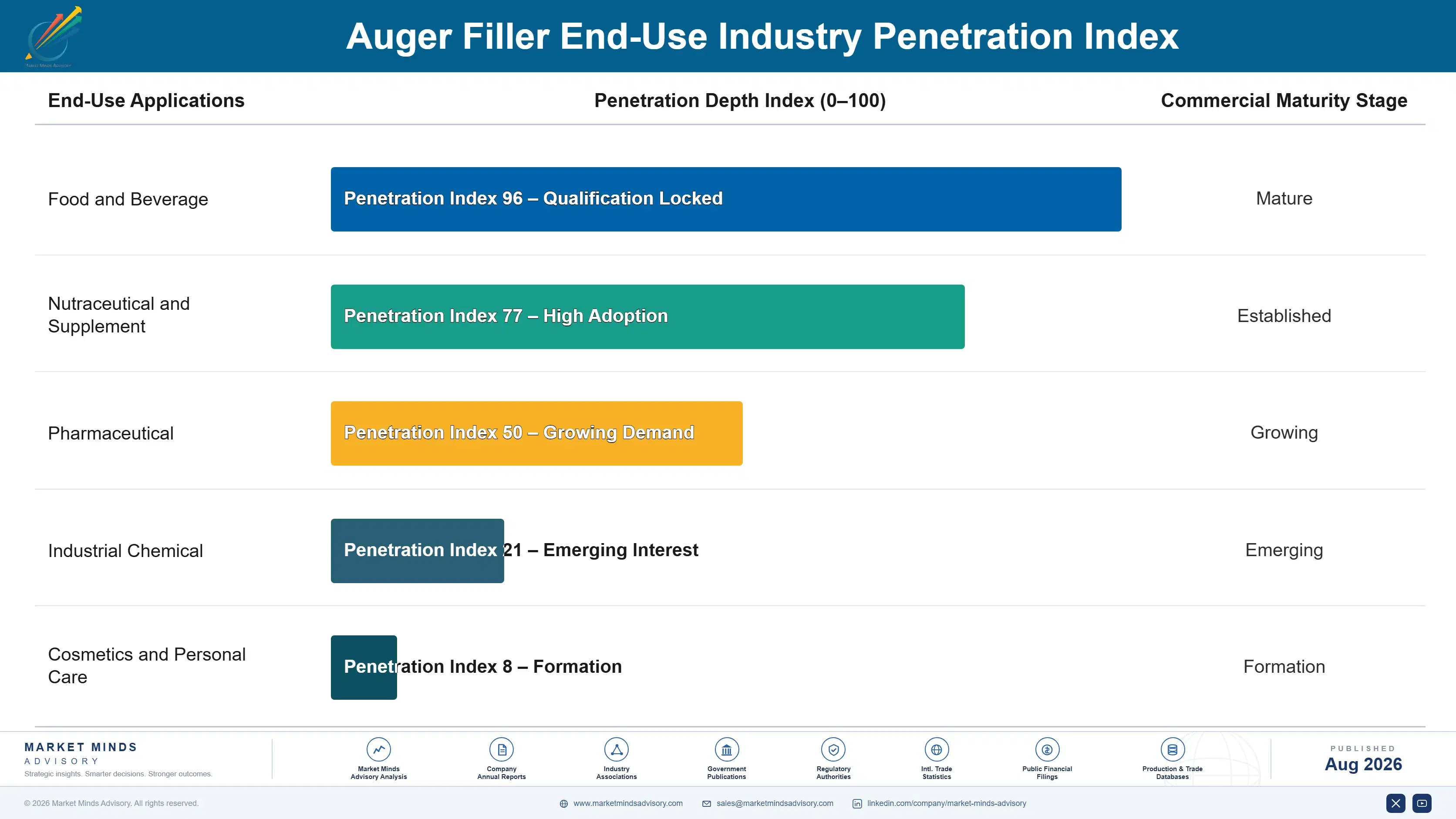
Adoption depth varies sharply by end use vertical. Nutraceutical and pharmaceutical processors run near saturated verified filling coverage and generate mostly replacement and upgrade demand, while emerging market food and supplement manufacturers are still building out first time multi-head coverage, generating a different mix of new installation revenue layered on top of the maturing replacement base across older, already well-instrumented industrial verticals.

Buyer profiles are shifting generationally as quality assurance engineers, often younger and more comfortable with cloud compliance dashboards than traditional plant floor supervisors, increasingly influence vendor selection alongside packaging line managers. This is accelerating demand for platforms with strong software usability even among buyers who historically evaluated auger fillers purely on mechanical fill accuracy and throughput specifications alone.
auger-filler-market-end-use-penetration-index-1787302225045

Where the Category Is Headed

These are among the four positions where our research anticipates prominent divergence between winners and laggards over the coming forecast period. Each is grounded in the demand model, the regulatory perimeter, and the announced capacity pipeline.
01 / VERIFICATION PLATFORM INVESTMENT

Prioritize compliance software over raw fill speed claims

Fill accuracy has become table stakes across certified manufacturers, no longer a meaningful differentiator in vendor selection for regulated food and pharmaceutical processors. Buyers now evaluate compliance software depth and audit readiness ahead of marginal throughput gains that once justified a premium on their own. Vendors that continue competing primarily on heads-per-minute specifications risk losing share to platform focused rivals bundling hardware, calibration service, and compliance software into a single recurring revenue relationship that is far harder for a customer to unwind once enrolled.
02 / DIFFICULT-FLOW ENGINEERING FOCUS

Build specialized capability for nutraceutical ingredient formulations

Nutraceutical and specialty food formulations increasingly drive category growth, and their difficult-flow characteristics reward manufacturers who invest early in specialized auger geometry and agitation engineering. Suppliers without this capability risk losing design-in opportunities to competitors who can qualify difficult formulations faster and more reliably. The commercial value of this expertise persists across a customer's full production life, often a decade or more, making early investment durably valuable for suppliers willing to commit engineering resources now rather than later once demand has already peaked.
03 / SERVICE MONETIZATION STRATEGY

Shift commercial models toward subscription and calibration revenue

Hardware margins will keep compressing as regional imports gain share at the entry tier of the category. Suppliers that convert compliance software access, calibration scheduling, and ingredient qualification support into contracted recurring revenue will outperform peers still pricing primarily around one-time hardware sales alone. This shift also raises customer switching costs meaningfully, since replacing a verified fleet requires displacing an entrenched, multi-year compliance and qualification relationship built over years of accumulated trust, documentation, and audit history few competitors can quickly replicate.
04 / REGIONAL GROWTH PRIORITIZATION

Weight investment toward South and East Asia over mature markets

South Asia and East Asia are compounding faster than North America and Western Europe on both share and CAGR, driven by organized food and pharmaceutical manufacturing expansion and first time equipment installation. Vendors weighting sales and service investment toward these regions ahead of competitors will capture a disproportionate share of first time installation revenue. Mature markets, running mostly on replacement cycles, simply cannot replicate that category of demand at comparable scale or growth rate over the coming decade of the forecast.

Engagement Snapshot From the Field

A live engagement with an industry participant carrying material or product regulatory and market exposure ahead of a defining policy shift, showing how our research translates into a defensible multi-year portfolio strategy.
MARKET MINDS ADVISORY · CLIENT ENGAGEMENT SUMMARY
Auger Filler Producer Strategic Portfolio Review and Transition Roadmap 2026·Investment Scenario on Auger Filler Exposure Evaluation 2025-26
CLIENT PROFILE
The client operates a multinational nutraceutical contract manufacturing business with production facilities across North America and Europe, generating revenue in the low single digit billions from co-packing operations (client-reported, unverified by MMA). Its filling fleet spanned nearly two decades of legacy single-head machines from multiple vendors, managed without centralized fill accuracy visibility for corporate quality assurance leadership across its distributed facility network.
STRATEGIC CHALLENGE
Following repeated fill accuracy audit flags traced to aging volumetric-only equipment, corporate leadership sought a unified verified multi-head platform across all facilities within eighteen months, while minimizing production disruption during the phased rollout across continuously operating packaging lines, product changeovers, seasonal demand peaks, and multiple concurrent customer contracts spanning several product categories.
MMA APPROACH
MMA benchmarked five candidate suppliers against difficult-flow ingredient qualification capability, weigh verification reliability, and total cost of ownership over a ten year horizon, then modeled rollout sequencing to minimize simultaneous facility-level disruption across the client's highest volume production sites during the phased installation programme currently under active review across every candidate facility considered.
KEY FINDINGS
  1. Three of five suppliers evaluated could not demonstrate reliable qualification across the client's most difficult-flow ingredient formulations at scale reliably enough for production.
  2. Multi-head retrofit reduced projected installation cost by 34% versus full line replacement across comparable production facilities reviewed carefully (client-reported, unverified by MMA).
  3. Centralizing compliance software access was projected to cut corporate audit preparation time by roughly forty percent across all facilities combined together nationwide.
  4. Facilities with the oldest machine generations carried the highest near term compliance risk, reprioritizing the client's original rollout sequence considerably ahead of schedule.
CLIENT PROFILE
The client operates a multinational nutraceutical contract manufacturing business with production facilities across North America and Europe, generating revenue in the low single digit billions from co-packing operations (client-reported, unverified by MMA). Its filling fleet spanned nearly two decades of legacy single-head machines from multiple vendors, managed without centralized fill accuracy visibility for corporate quality assurance leadership across its distributed facility network.
STRATEGIC CHALLENGE
Following repeated fill accuracy audit flags traced to aging volumetric-only equipment, corporate leadership sought a unified verified multi-head platform across all facilities within eighteen months, while minimizing production disruption during the phased rollout across continuously operating packaging lines, product changeovers, seasonal demand peaks, and multiple concurrent customer contracts spanning several product categories.
MMA APPROACH
MMA benchmarked five candidate suppliers against difficult-flow ingredient qualification capability, weigh verification reliability, and total cost of ownership over a ten year horizon, then modeled rollout sequencing to minimize simultaneous facility-level disruption across the client's highest volume production sites during the phased installation programme currently under active review across every candidate facility considered.
KEY FINDINGS
  1. Three of five suppliers evaluated could not demonstrate reliable qualification across the client's most difficult-flow ingredient formulations at scale reliably enough for production.
  2. Multi-head retrofit reduced projected installation cost by 34% versus full line replacement across comparable production facilities reviewed carefully (client-reported, unverified by MMA).
  3. Centralizing compliance software access was projected to cut corporate audit preparation time by roughly forty percent across all facilities combined together nationwide.
  4. Facilities with the oldest machine generations carried the highest near term compliance risk, reprioritizing the client's original rollout sequence considerably ahead of schedule.
RECOMMENDED STRATEGY
Phase 1: Phase 1 (Months 1-6): Pilot verified multi-head installation at the two highest audit risk facilities identified through careful prior review. Phase 2: Phase 2 (Months 7-14): Scale the validated platform across remaining North American and European facilities in strict priority order determined. Phase 3: Phase 3 (Months 15-18): Integrate all facilities into a single corporate compliance dashboard with automated reporting fully enabled throughout the network.
OUTCOME
The client completed verified multi-head installation across all priority facilities within the eighteen month window and reported a meaningful reduction in fill accuracy audit flags during subsequent quality reviews (client-reported, unverified by MMA). Corporate quality leadership gained real time compliance visibility previously unavailable under the prior fragmented equipment fleet.

Frequently Asked Questions

Foundational context covering the market sizes, CAGR, scope, country, region and competition that inform every finding below. This section is provided to cover basics and most often pre-purchase conversations, answered from the MMA Primary Research Dataset.

What is the current size of the Auger Filler Market?

The global auger filler market reached an estimated $0.65 billion in 2025. Growth is driven by nutraceutical packaging expansion and tightening net content accuracy enforcement.

How large will the Auger Filler Market be by 2036?

The market is projected to reach approximately $1.33 billion by 2036, roughly 1.93 times its 2026 value. Multi-head systems and verification retrofits drive most of the added value.

What is the CAGR for the Auger Filler Market 2026 to 2036?

The base case CAGR is 6.8% through 2036. Bull and bear scenarios range from roughly 5.5% to 8.0%, depending on nutraceutical category growth and regulatory enforcement pace.

Which segment is growing fastest?

Multi-head auger filling systems lead at a 9.5% CAGR, about 1.4x the overall market rate. Growth is concentrated in nutraceutical and protein powder packaging expansion across processors.

Who are the major companies in the Auger Filler Market?

All-Fill Inc, Spee-Dee Packaging, IMA Group, Syntegon Technology, and Yamato Corporation lead the category. Combined, the top five suppliers hold roughly 44% of global revenue.

Which country is growing fastest?

India leads country level growth at an estimated 10.2% CAGR. Rapid organized food and pharmaceutical manufacturing expansion is driving first time installation across previously unserved facilities.

Report Segmentation Architecture

The full report scope spans multiple orthogonal segmentation dimensions, with cross-tabulated demand data provided for each dimension pair. Coverage extends further to regional breakdowns, trend trajectories, and the competitive detail needed to support segment-level decision-making.

By Product and Filler Architecture

  • Single-Head Auger Fillers
  • Multi-Head Auger Filling Systems
  • Volumetric Auger Fillers
  • Net Weight Auger Filling Systems
  • Retrofit and Upgrade Kits

By End-Use Industry

  • Food and Beverage
  • Nutraceutical and Supplement
  • Pharmaceutical
  • Industrial Chemical
  • Cosmetics and Personal Care

By Commercial Dimension

  • Direct OEM Sales
  • Distributor Channel Sales
  • Retrofit and Upgrade Services
  • Calibration and Compliance Service Contracts

By Region

  • North America
  • Western Europe
  • East Asia
  • South Asia and Pacific
  • Latin America
  • Middle East and Africa
  • Eastern Europe

Scope, Methodology, and Coverage

Every figure in this report is reproducible from documented input assumptions. The scope below maps the historical period, the forecast horizon, the segmentation dimensions, and the countries covered, alongside the underlying primary and qualitative methodology.
Historical Period
2020 to 2025
Forecast Period
2026 to 2036
Base Year
2025 (USD billions; MMA Primary Research Dataset, August 2026)
Market Definition
The auger filler market covers volumetric and net weight filling machines that use a rotating helical screw to dispense powders, granules, and fine particulates into containers, spanning single-head, multi-head, and retrofit upgrade configurations. It serves food, nutraceutical, pharmaceutical, and industrial chemical packaging applications.
Quantitative Units
USD billions (current prices); unit shipment volume where disclosed
Segmentation Dimensions
By Product and Filler Architecture; By End-Use Industry; By Commercial Dimension; By Region
Regions Covered
North America, Western Europe, East Asia, South Asia and Pacific, Latin America, Middle East and Africa, Eastern Europe
Countries Covered
USA, China, Germany, France, UK, Japan, South Korea, India, Australia, Canada, Brazil, Mexico, Indonesia, Vietnam, Thailand, Malaysia, UAE, Saudi Arabia, South Africa, Nigeria, Turkey, Poland, Netherlands, Italy, Spain, Sweden, Switzerland, Argentina, Colombia, Singapore, and additional markets relevant to this sector
Key Companies Profiled
All-Fill Inc, Spee-Dee Packaging, IMA Group, Syntegon Technology, Yamato Corporation, Viking Masek, Serac Group, Matrix Packaging Machinery, Package Machinery Company, Accutek Packaging Equipment, JLS Automatic Systems, Nichrome India, Wenger Manufacturing, PAC Machinery, Filamatic, Tecnomeccanica Srl, CTM Packaging Systems, Adelphi Manufacturing, Coesia, Romaco Group
Quantitative Methodology
Primary survey, n=3,800 respondents, Q4 2025, six countries; demand-side model with trade association cross-validation
Qualitative Methodology
47 expert interviews, Q4 2025; applied to validate demand model assumptions, identify emerging dynamics, and assess competitive positioning
Report Format
PDF and XLSX data workbook (Word format preview document)
Publisher
Market Minds Advisory
Report Code
MMA-2026-PAC-107
Published
August 2026
Contact
sales@marketmindsadvisory.com | www.marketmindsadvisory.com

Purchase the full Auger Filler Market Report (2026 to 2036).

The full report delivers a complete quantitative and qualitative assessment of the global auger filler market through 2036. It includes detailed segmentation by filler architecture, end use industry, and commercial channel, alongside country level sizing across thirty markets covering every major food and pharmaceutical demand center. Competitive profiles cover twenty companies with capability, accuracy, and service network benchmarking assessed on a consistent revenue basis. Buyers also receive access to the underlying primary survey and expert interview datasets referenced throughout the analysis, along with editable data tables.
Segment level CAGR and sizing tables
Regional and country level market breakdowns
Twenty company competitive profiles and benchmarks
Detailed verification platform capability benchmarking matrix
Input cost and supply chain risk analysis
Primary survey and expert interview datasets

Built For The People Who Decide

From boardroom strategy to bench-side execution, this report is read cover-to-cover by leaders shaping the next decade of their industry, turning demand scenarios, market dynamics and valuation benchmarks into decisions.
CXOs/ Presidents/ VPs/ Managers
M&A and Corporate Development
Strategy Teams and R&D Heads
Procurement and Product Directors
Regulatory and Compliance Leaders
Investor Relations and Equity Analysts