Market Minds Advisory
Atypical Hemolytic Uremic Syndrome Treatment Market

Atypical Hemolytic Uremic Syndrome Treatment Market: Complement Inhibition Economics Ahead of the Biosimilar Cliff

Biosimilar entrants are finally challenging a decade of near-monopoly complement inhibitor pricing, even as next-generation subcutaneous and oral candidates threaten to reset the competitive map before the originator franchise can fully defend it.

Lead Analyst

Alice Ballenger

Published

September 2026

Make Smarter Decisions with Customized Research Insights

Request a free sample report and evaluate market opportunities, growth trends, and competitive dynamics relevant to your business needs.

2025 MARKET VALUE$3.6BMarket Size 2025
2036 FORECAST VALUE$11.9BBase Case , 2026 to 2036
CAGR 2026 TO 203611.5 %Bull 12.8% / Bear 10.3%
INCREMENTAL OPPORTUNITY$7.9BNet 10- year value creation
EXPANSION MULTIPLE2.97x2036 value over 2026 base
Strategic Levers
M&A Pipeline
Regional Outlook
Country Rankings
Competitive Intelligence
Segmental Deep-dive
Call-Us : 91 93563 13602

Executive Snapshot and Market Trajectory

Atypical hemolytic uremic syndrome treatment has moved from a single-franchise monopoly into a genuine competitive market, as biosimilar C5 inhibitors finally reach patients while next-generation subcutaneous and oral candidates race to prove they can match established efficacy on a far more convenient dosing schedule.
Next-generation subcutaneous and oral complement inhibitors are pulling demand fastest, since physicians and payers increasingly reward reduced infusion burden without sacrificing complement blockade depth. North America anchors the largest share of global demand, driven by the earliest diagnosis rates and broadest orphan drug reimbursement coverage, while East Asia is expanding fastest as genetic testing access and rare disease reimbursement policy improve, further reinforcing the region's role as a genuine growth engine across the wider industry.
Competitive position tracks regulatory approval breadth and physician switching confidence more than manufacturing scale, since a complement inhibitor franchise built on trial data and label breadth is difficult for a biosimilar alone to displace. AstraZeneca and Roche lead on approved indication depth, but biosimilar entrants are winning share fastest in cost-sensitive reimbursement systems willing to accept switching risk for meaningfully lower list prices, a pattern regulators increasingly encourage.
Market Definition
The atypical hemolytic uremic syndrome treatment market covers complement inhibitor therapies, including intravenous and subcutaneous C5 inhibitors, biosimilar C5 inhibitors, and emerging oral complement pathway inhibitors, alongside plasma exchange and supportive renal therapy used specifically to manage this rare, complement-mediated thrombotic microangiopathy. It excludes treatments for typical Shiga toxin-associated HUS and unrelated thrombotic microangiopathies.
Base Year Value
$3.6B in 2025 (MMA Primary Research Dataset, August 2026)
Forecast Period
2026 to 2036, eleven discrete annual values
CAGR
11.5% base case. Bull 12.8%. Bear 10.3%.
Fastest Growth Segment
Subcutaneous and Oral Next-Generation Complement Inhibitors: 19.0% CAGR
Fastest Growth Country
China: 14.8% CAGR
Fastest Growth Region
South Asia and Pacific: 13.5% CAGR
Largest Region
North America: 31% of 2025 global value
Market Leaders
AstraZeneca plc, Roche Holding AG, Novartis AG, Apellis Pharmaceuticals, Inc., Omeros Corporation. Source: MMA Analysis based on company annual reports.
Primary Survey
n=3,800 procurement and R&D decision-makers, Q4 2025, six countries
Methodology
Demand-side build-up, cross-validated against public data, 47 expert interviews

Atypical Hemolytic Uremic Syndrome Treatment Market Forecast Scenarios

atypical-hemolytic-uremic-syndrome-treatment-marke-size-forecast-scenario-1787301419088
Between 2020 and 2025 the market grew at an estimated 10.4% CAGR, a period shaped by geographic expansion of diagnosis and reimbursement access for the originator complement inhibitor franchise, followed by the first biosimilar approvals late in the period. Growth remained steady, reflecting the category's status as a small but durable orphan drug franchise with limited competitive disruption until recently.
The base case assumes 11.5% CAGR through 2036, driven by three mechanisms: continued diagnosis rate expansion in underdiagnosed regions as genetic testing access improves, biosimilar-driven price competition that expands patient access even as it compresses originator revenue per patient, and adoption of next-generation complement inhibitors that reduce treatment burden and expand the addressable pool of eligible patients. Together these mechanisms sustain growth above what a mature, single-franchise orphan disease market would typically generate.
The bull case, 12.8% CAGR, assumes faster next-generation product launches expand diagnosed and treated patient populations more quickly than expected. The bear case, 10.3% CAGR, reflects the risk that biosimilar price erosion outpaces volume growth from new patient diagnosis and next-generation product adoption combined. Both scenarios assume the originator franchise continues facing biosimilar substitution regardless of which growth path materializes across the forecast period.

Complement Inhibition Economics Ahead of the Biosimilar Cliff

Atypical hemolytic uremic syndrome treatment behaves less like a typical specialty pharmaceutical category and more like a slow-motion patent cliff unfolding across a decade, since the originator franchise built durable physician trust over years that biosimilars and next-generation entrants must now overcome one prescriber relationship at a time. Manufacturers with established diagnosis pathways and payer relationships currently hold real commercial advantage that clinical non-inferiority data
MARKET CONCENTRATION (CR5)71%Still meaningfully concentrated despite recent biosimilar market entry
AVERAGE ANNUAL TREATMENT COST$420K/patientReflects premium orphan drug pricing across originator therapies
TOP TREATING COUNTRY SHAREUnited States, 34%Reflects the country's earliest diagnosis and reimbursement scale
DIAGNOSED PATIENT TREATMENT RATE68%Share of diagnosed patients currently receiving complement therapy
BIOSIMILAR PENETRATION14% of volumeShare of treated patients now on biosimilar therapy
R&D COST SHARE31%Clinical development spending relative to total industry revenue
Commercially, the category splits between the established intravenous complement inhibitor franchise serving the majority of currently diagnosed patients, and a smaller but faster-growing subcutaneous and oral segment sold on meaningfully reduced treatment burden. Manufacturers exposed to both segments manage genuinely different physician conversations, since the intravenous franchise competes primarily on trial data depth and reimbursement history while next-generation products compete on convenience and quality of life.
The next decade favors manufacturers who can pair strong clinical data with genuinely differentiated dosing convenience, since payers increasingly cite total cost of care, not just list price, as a primary factor in formulary placement decisions. This shift is already visible in how the largest payers structure step-therapy and biosimilar substitution policy.
"This looked like an unshakeable monopoly for a decade, and now it's a genuine three-way fight between the originator, biosimilars, and whoever launches the best subcutaneous option first. Physicians are more willing to switch than payers expected."
Director, Rare Disease and Specialty Pharmaceuticals Practice · MMA Healthcare /

Market Trends

Subcutaneous Self-Administration Meaningfully Reduces Treatment Burden

Next-generation complement inhibitors formulated for subcutaneous self-administration are entering the market, offering patients meaningful relief from the recurring infusion center visits that intravenous therapy has required for over a decade. This is reshaping prescriber conversations around quality of life, since patients and caregivers increasingly ask about self-administration options even when clinical efficacy between formulations is broadly comparable. Manufacturers with approved subcutaneous options are capturing disproportionate share of newly diagnosed patients, while manufacturers still limited to intravenous formulations face growing pressure to accelerate their own next-generation development programs, particularly in the largest reimbursement markets.
Market Impact: Adds 1,200 new diagnoses annually

Biosimilar Approvals Reshape Originator Pricing Power

Regulatory approval of the first biosimilar C5 inhibitors is directly challenging pricing power the originator franchise held for more than a decade without meaningful competition, particularly in reimbursement systems where payers can mandate or strongly incentivize biosimilar substitution. This is prompting the originator manufacturer to defend share through extended-interval dosing advantages and bundled service offerings rather than price alone, since matching biosimilar pricing directly would meaningfully compress its remaining branded revenue base. Payers in cost-constrained health systems are moving fastest to adopt biosimilars once available, ahead of more conservative reimbursement systems.
Market Impact: Expands reimbursed access by 22 per

Market Opportunities and Growth Drivers

Expanding Genetic Testing Access Lifts Diagnosis Rates

Broader availability of complement genetic panel testing, increasingly covered by national health systems and private insurers, is helping physicians correctly diagnose atypical hemolytic uremic syndrome faster and more often than the historical pattern of prolonged misdiagnosis as more common thrombotic microangiopathies. This creates a direct, quantifiable expansion of the treatable diagnosed patient pool beyond historical estimates, since many patients previously went undiagnosed or were treated for the wrong condition entirely. Health systems investing most aggressively in genetic testing infrastructure are seeing diagnosis rates rise fastest, expanding the addressable patient population meaningfully ahead of prior projections.
Market Impact: Excludes 40 percent of diagnosed pa

Rare Disease Reimbursement Expansion Across Emerging Markets

National health systems across China, the Gulf states, and parts of Latin America are expanding orphan drug reimbursement frameworks specifically to cover complement inhibitor therapy, reflecting growing government recognition that untreated atypical hemolytic uremic syndrome carries substantial downstream renal failure and dialysis cost. Manufacturers with established regulatory approval and local distribution partnerships are capturing this newly reimbursed demand fastest, and each new reimbursement approval typically opens access for a meaningful cohort of previously undiagnosed or untreated patients. This sustains growth well beyond what developed-market diagnosis rate expansion alone could generate across multiple national health systems each year.
Market Impact: Delays biosimilar uptake by 18 mont

Market Restraints and Challenges

Extremely High Per-Patient Treatment Cost Limits Access

Annual per-patient treatment cost remains extremely high across all currently approved complement inhibitor therapies, creating genuine affordability barriers in health systems without comprehensive orphan drug reimbursement frameworks in place. The cause is that clinical development and manufacturing of complex biologic therapies for a genuinely rare patient population require pricing sufficient to recoup investment across a small treated population relative to typical pharmaceutical categories. Manufacturers are mitigating this through patient assistance programs and outcomes-based reimbursement agreements with payers, though these programs still leave meaningful numbers of diagnosed patients without practical treatment access in lower-income health systems.
Market Impact: Cuts infusion visits by 80 percent

Physician Switching Hesitancy Slows Biosimilar Adoption

Physicians managing atypical hemolytic uremic syndrome patients on stable originator therapy remain hesitant to switch to biosimilar alternatives, given the severe consequences of any treatment interruption or efficacy gap in a life-threatening complement-mediated condition. The cause is that the rarity of the disease means most physicians have limited direct switching experience to draw confidence from, unlike biosimilar adoption in higher-volume therapeutic categories with extensive real-world switching data. Manufacturers and payers are mitigating this through structured switching support programs and extended monitoring protocols, though meaningful biosimilar uptake still takes considerably longer than in more common disease categories.
Market Impact: Cuts treatment cost by 35 percent
3 additional market trends, 3 additional growth drivers, and 2 additional restraints and challenges are covered in the full report. Contact sales@marketmindsadvisory.com to access the complete intelligence.

Segment CAGR and Growth Architecture

MMA segments the atypical hemolytic uremic syndrome treatment market by product class and route of administration, the dimension that determines treatment burden, pricing tier, and where a therapy fits within a physician's step-therapy and switching decisions. This framing separates established intravenous originator therapy from biosimilars and next-generation subcutaneous and oral candidates commanding differentiated positioning.
atypical-hemolytic-uremic-syndrome-treatment-marke-market-share-analysis-1787301419621

Subcutaneous and Oral Next-Generation Complement Inhibitors

Subcutaneous and oral next-generation complement inhibitors, offering patients meaningful relief from recurring infusion center visits, are growing fastest as physicians and patients increasingly prioritize treatment convenience alongside clinical efficacy. This segment commands the steepest pricing premium in the category, since demonstrating non-inferiority to established intravenous therapy while achieving self-administration convenience requires substantial clinical development investment not every manufacturer has completed. Roche and emerging pipeline entrants currently hold some of the most advanced next-generation development programs, having invested years building the clinical evidence base required for approval. Adoption remains concentrated among newly diagnosed patients for now, though established patients are increasingly switching once approval and physician comfort expand. MMA expects this convenience premium to persist for several years.
CAGR 19.0%

Biosimilar C5 Inhibitors

Biosimilar C5 inhibitors form the second-fastest-growing segment, pulled by payer cost pressure and recent regulatory approvals that finally allow meaningful price competition against the long-dominant originator franchise. These products compete primarily on price rather than differentiated clinical positioning, since demonstrating biosimilarity requires matching, not improving upon, established originator efficacy and safety data. Growth concentrates in cost-constrained reimbursement systems willing to accept switching risk for substantially lower list prices, including several European and Latin American markets. Regional adoption varies, with cost-sensitive health systems moving fastest while more conservative reimbursement systems favor established originator therapy for now. MMA expects biosimilar penetration to accelerate further as additional manufacturers secure approval and payers gain confidence in switching safety data.
CAGR 16.0%
Full segment breakdown across 6 segments available in the complete report.

Regional Architecture and Country Demand Map

Atypical hemolytic uremic syndrome treatment demand concentrates where diagnosis rates and orphan drug reimbursement are most developed. North America leads on its early diagnosis infrastructure and reimbursement coverage, Western Europe follows on national health system coverage, and East Asia grows fastest as China expands reimbursement policy.

North America

North America's substantial treatment demand is anchored by its early diagnosis infrastructure, including broad genetic testing access, and comprehensive orphan drug reimbursement coverage across both commercial and government payers. AstraZeneca and Roche maintain their deepest physician relationships and clinical trial infrastructure in this market, reflecting years of investment establishing diagnosis pathways alongside major nephrology and hematology centers. Biosimilar adoption is advancing more cautiously here than in cost-constrained markets, given the region's less price-sensitive reimbursement structure and physicians' switching hesitancy on a life-threatening condition. Canada's smaller patient population contributes additional steady regional demand, tracking broadly similar diagnosis and treatment trends as the larger US market, particularly across major metropolitan nephrology referral centers.
Share: 31% | CAGR: 12.3% (2026 to 2036)

Western Europe

Western Europe's demand centers on established national health system coverage, with German, French, and UK health authorities representing the largest concentration of regional treatment spending and reimbursement decision-making. European biosimilar manufacturers, including several regional specialty pharmaceutical companies, are advancing biosimilar substitution more aggressively here than in North America, reflecting national health systems' stronger cost-containment mandates. Diagnosis rates remain high given decades of established nephrology referral networks across major teaching hospitals. Growth trails North America and East Asia's faster-expanding diagnosis and reimbursement environments, but Western Europe's biosimilar adoption pace keeps overall treated patient volume expanding steadily across most member states. Regional reimbursement authorities increasingly negotiate direct pricing agreements with manufacturers ahead of formal biosimilar substitution mandates taking effect nationally.
Share: 20% | CAGR: 10.0% (2026 to 2036)
Regional intelligence for 5 additional markets available in the complete report: East Asia, South Asia and Pacific, Latin America, Middle East and Africa, Eastern Europe. Contact sales@marketmindsadvisory.com.
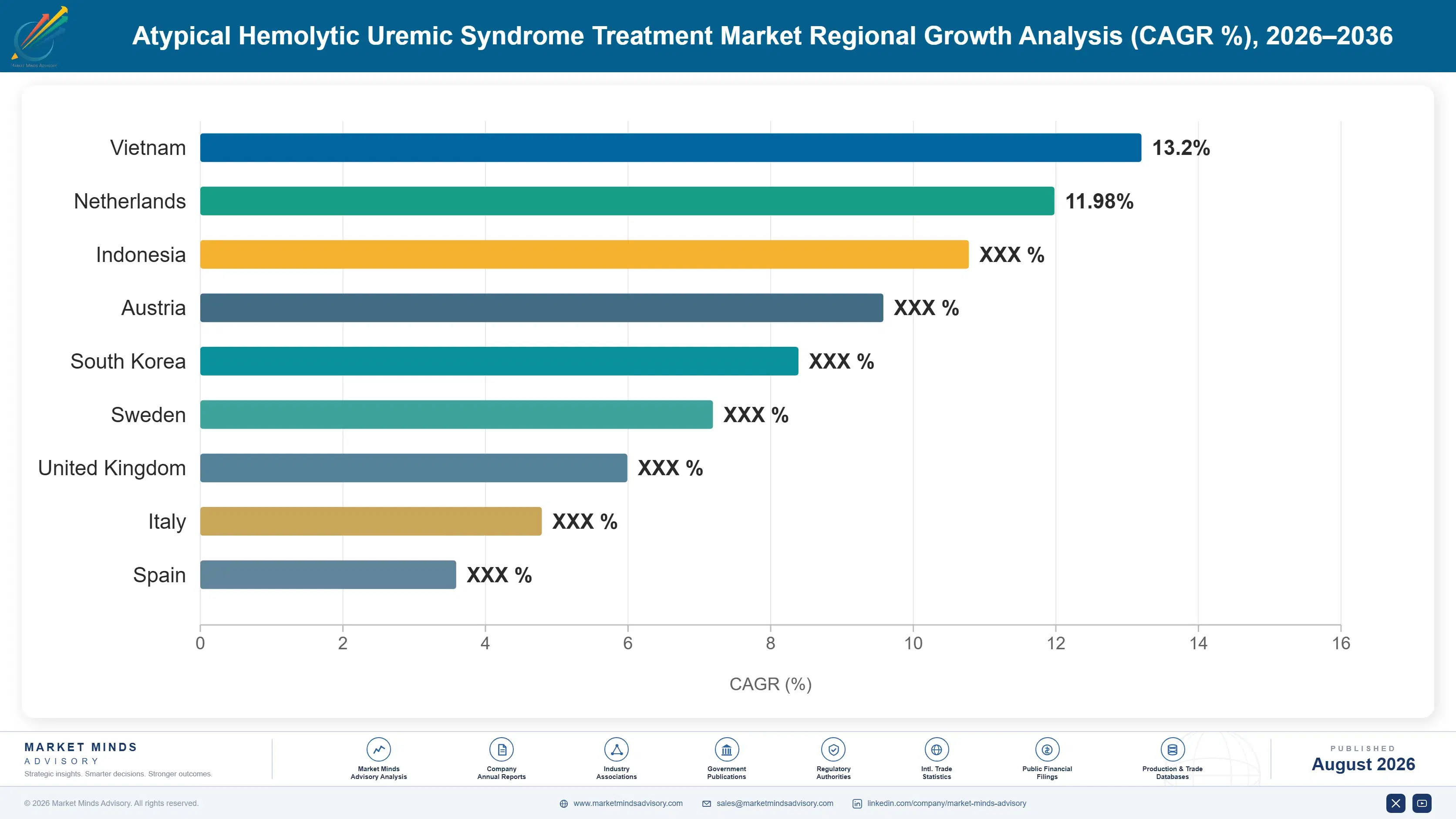
atypical-hemolytic-uremic-syndrome-treatment-marke-country-cagr-analysis-1787301420149

Monetizing Convenience and Reimbursement Access

Manufacturers are shifting from pure volume-based specialty pharmaceutical sales toward access-and-convenience-led commercial models: patient support programs that secure diagnosis and reimbursement pathways, premium pricing for next-generation subcutaneous formulations, outcomes-based reimbursement agreements that share risk with payers, and biosimilar defense strategies that protect originator share through service depth, across an increasingly competitive, multi-manufacturer commercial landsc

Patient Support Programs Securing Diagnosis Pathways

Manufacturers increasingly fund comprehensive patient support programs, including genetic testing subsidies and reimbursement navigation assistance, that help physicians identify and correctly diagnose atypical hemolytic uremic syndrome patients faster than they otherwise would without dedicated support. This model requires real clinical education investment and favors larger, better-capitalized manufacturers over smaller biosimilar entrants lacking comparable diagnosis-support infrastructure built over years of physician relationship development. AstraZeneca's patient support program illustrates this approach, typically identifying more than 300 new diagnoses annually across its largest markets, generating predictable treated patient growth that materially aids long-term revenue planning.
Market Impact: Identifies more than 300 new diagno

Premium Pricing for Subcutaneous Dosing Convenience

Manufacturers increasingly price next-generation subcutaneous formulations at a meaningful premium over established intravenous therapy, reflecting both the real clinical development investment required and payers' willingness to pay for meaningfully reduced infusion center burden and improved patient quality of life. This premium is most defensible where manufacturers can demonstrate reduced total cost of care through fewer infusion center visits and hospitalizations, since payers increasingly demand supporting economic data beyond convenience claims alone. Subcutaneous formulations currently command premiums of 15 to 25 percent over comparable intravenous therapy across most developed reimbursement systems.
Market Impact: Commands a 15 to 25 percent price p

Outcomes-Based Reimbursement Agreements That Share Risk

Manufacturers increasingly negotiate outcomes-based reimbursement agreements that tie a portion of payment to demonstrated clinical response, converting a portion of what would otherwise be pure list-price risk into a shared-risk relationship that reassures payers facing genuine budget constraints. This model requires real confidence in clinical data and administrative capability to track outcomes that smaller manufacturers often cannot match without dedicated infrastructure. Manufacturers offering outcomes-based agreements report formulary access rates roughly 20 percent higher than those offering only standard list-price contracts, a gap payers increasingly cite when evaluating new manufacturer partnerships.
Market Impact: Improves formulary access by roughl

Biosimilar Defense Through Extended Service Depth

The originator manufacturer increasingly defends share against biosimilar price competition by bundling extended nursing support, home infusion coordination, and dedicated patient hotline access that biosimilar manufacturers, focused primarily on price, typically do not replicate at comparable depth. This model requires sustained commercial infrastructure investment that favors the establishment franchise over newer biosimilar entrants still building comparable service capability from a much smaller revenue base. Manufacturers offering this service depth report patient retention roughly 25 percent higher than biosimilar competitors offering price alone, a gap that has widened further as service expectations continue rising across payer negotiations.
Market Impact: Improves patient retention by rough

Who Controls the Margin Pool

CR5 sits at 71 percent, high concentration reflecting the category's orphan drug economics and the clinical trial and reimbursement barriers that continue favoring established manufacturers over new entrants. AstraZeneca and Roche lead on approved indication breadth and physician trust, and the gap to biosimilar and next-generation challengers is real, though it is narrowing faster than most industry observers expected only a few years ago.
Current activity centers on three fronts: defending originator share through service depth and outcomes-based contracting, advancing next-generation subcutaneous and oral candidates through late-stage clinical development, and expanding biosimilar manufacturing and distribution capacity to capture newly opened cost-sensitive reimbursement markets. Manufacturers pursuing multiple fronts simultaneously are generally best positioned to defend share as the competitive landscape continues shifting away from a single-franchise structure toward genuine multi-player competition.

Emerging pressure comes from biosimilar manufacturers extending regulatory approval and distribution reach across cost-constrained reimbursement systems, competing aggressively on price in markets where established originator pricing has historically gone largely unchallenged. Expect ranking shifts as these challengers capture a growing share of newly treated patients, gradually pushing established leaders to defend share through deeper clinical differentiation and service depth rather than pricing power alone.
atypical-hemolytic-uremic-syndrome-treatment-marke-company-positioning-matrix-1787301420678

Competitive Moat and Risk Dimensions

ASTRAZENECA PLC

Moat: Physician Trust and Label Breadth

AstraZeneca's Alexion franchise holds the deepest physician relationships and broadest approved indication label in the category, built through more than a decade as the near-exclusive treatment option for this rare, life-threatening condition. This trust gives AstraZeneca real pricing power and switching resistance that biosimilar and next-generation entrants must overcome one prescriber relationship at a time.
ASTRAZENECA PLC

Risk: Biosimilar Erosion of Core Franchise

AstraZeneca's originator franchise faces direct biosimilar price competition for the first time in over a decade, particularly in cost-constrained reimbursement systems willing to mandate substitution. Competitors argue this creates genuine long-term revenue risk that extended-interval dosing and service differentiation can only partially offset, though AstraZeneca's label breadth still gives it real advantage in complex or treatment-experienced patients.
ROCHE HOLDING AG

Moat: Differentiated Subcutaneous Dosing Convenience

Roche's next-generation complement inhibitor offers genuinely differentiated subcutaneous self-administration convenience that directly addresses the treatment burden patients have tolerated under intravenous therapy for over a decade. This convenience advantage gives Roche a credible entry point into a category long dominated by a single intravenous originator franchise.
ROCHE HOLDING AG

Risk: Later Market Entry Than Incumbent

Roche entered this category considerably later than the established originator franchise, meaning it must overcome years of accumulated physician trust and clinical experience with the incumbent therapy. Competitors argue this creates a genuine adoption curve challenge that convenience alone may not fully resolve, though Roche's differentiated dosing still gives it real advantage among newly diagnosed patients.

Players Tracked

Prominent Players

AstraZeneca plc
Roche Holding AG
Novartis AG
Apellis Pharmaceuticals, Inc.
Omeros Corporation

Other Key Players

Sandoz Group AG
Samsung Bioepis Co., Ltd.
Amgen Inc.
Biocon Biologics Limited
Chugai Pharmaceutical Co., Ltd.
BioCryst Pharmaceuticals, Inc.
Regeneron Pharmaceuticals, Inc.
Ionis Pharmaceuticals, Inc.
Akari Therapeutics plc
Silence Therapeutics plc
UCB S.A.
CSL Behring
Kira Pharmaceuticals
Celltrion, Inc.
STADA Arzneimittel AG

Recent Developments

FEBRUARY 2025

Sandoz Launches Biosimilar C5 Inhibitor in Key European Markets

Sandoz launched its biosimilar C5 complement inhibitor across several major European reimbursement systems, offering a substantial list price discount against the originator therapy. The launch expands treatment access in cost-constrained health systems that had previously restricted originator therapy to the most severe diagnosed cases due to budget limitations.
Signal: Signals biosimilar competition has now def
JUNE 2025

Roche Reports Positive Late-Stage Data for Subcutaneous Complement Inhibitor

Roche reported positive late-stage clinical trial data demonstrating non-inferiority of its subcutaneous complement inhibitor against established intravenous therapy, supporting a planned regulatory submission across major markets. The data specifically highlighted meaningful reductions in infusion center visits without compromising complement blockade depth across the treated patient population.
Signal: Shows the next-generation convenience race
OCTOBER 2025

AstraZeneca Expands Patient Support Program Into Additional Markets

AstraZeneca expanded its patient support and genetic testing subsidy program into additional Latin American and Southeast Asian markets, aiming to accelerate diagnosis rates and secure early treatment relationships ahead of anticipated biosimilar entry in those reimbursement systems. The expansion reinforces AstraZeneca's diagnosis-pathway strategy amid intensifying competitive pressure.
Signal: Extends the originator's defensive strateg

Clinical Development and Manufacturing Cost Exposure

Biologic manufacturing and clinical development costs, including complex cell culture production and mandatory long-term safety monitoring required for rare disease therapies, account for an estimated 31 percent of total industry revenue reinvested into R&D, well above typical pharmaceutical category norms. This cost structure concentrates among a small number of manufacturers with the specialized biologics manufacturing infrastructure required to produce complement inhibitor therapies at pharma
Biologic manufacturing input costs, including specialized cell culture media and purification consumables, rose meaningfully through 2021 and 2022 following broader biopharmaceutical supply chain disruption, according to FDA manufacturing quality reporting, before stabilizing through 2023 and 2024 as supply chains normalized. Manufacturers without diversified manufacturing capacity absorbed the earlier cost pressure directly into compressed margins, while larger manufacturers with multiple qualified production sites smoothed the impact across their broader manufacturing base.

Exposure varies by manufacturer type: large diversified biopharmaceutical companies with multiple manufacturing sites absorbed input cost volatility better than smaller specialty biosimilar manufacturers dependent on single contract manufacturing relationships. Exposure also differs by product type, since biosimilar manufacturers competing primarily on price face tighter margin pressure from any input cost inflation than originator manufacturers still commanding premium branded pricing.
atypical-hemolytic-uremic-syndrome-treatment-marke-cost-volatility-analysis-1787301420872

Diversified Biologics Manufacturing Capacity

Larger manufacturers are qualifying multiple manufacturing sites for complement inhibitor production, reducing dependence on any single facility and smoothing supply continuity even during periods of localized manufacturing disruption. This requires substantial regulatory qualification investment that smaller biosimilar manufacturers often cannot absorb given their comparatively limited capital relative to larger diversified competitors across multiple geographies.

Long-Term Supply Agreements With Contract Manufacturers

Several manufacturers now secure multi-year supply agreements with qualified contract biologics manufacturers, smoothing input cost volatility even though this requires committing to minimum production volumes most smaller entrants cannot guarantee. This has become a differentiator during recent supply disruption, letting committed manufacturers maintain steadier product availability than competitors facing capacity constraints for their patients.

Outcomes-Based Contracts to Offset Development Cost

Several manufacturers are structuring outcomes-based reimbursement agreements that help recoup clinical development investment more predictably over a therapy's commercial life, reducing exposure to pure list-price volatility while simultaneously building payer trust in a single contracting shift. This partially offsets the high fixed cost of rare disease clinical development across a genuinely small treated patient population.

Portfolio Architecture for Margin Defence

The category splits into three tiers with margin profiles. Established intravenous originator therapy, serving the majority of currently diagnosed patients, generates strong margins despite facing new biosimilar competition after a decade of dominance. Biosimilar C5 inhibitors command thinner margins tied to their price-competitive positioning rather than differentiated clinical value. The next-generation subcutaneous and oral tier carries the highest margins alongside the steepest clinical deve
Established and next-generation tiers pull manufacturers toward different capability investments. Originator franchise defense rewards service depth and payer relationship management, favoring manufacturers who can spread commercial infrastructure costs across an already-established patient base. Next-generation and biosimilar tiers reward different investments entirely, one in clinical differentiation and the other in manufacturing cost efficiency, favoring manufacturers willing to commit years to building the specific capability each approach requires.

High-value pools concentrate overwhelmingly in next-generation subcutaneous and oral therapy purchased by payers and patients under direct convenience and quality-of-life pressure, where clinical differentiation, not manufacturing scale, increasingly sets pricing power. Manufacturers positioned in this segment capture disproportionate margin relative to their patient volume share, a pattern MMA expects to persist while genuine dosing convenience remains the binding differentiator across the broader category.

Volume / Commodity-Adjacent Tier

Biosimilar C5 inhibitors competing primarily on price within cost-constrained reimbursement systems where clinical differentiation does not command a meaningful premium over the lowest-cost approved therapy. Manufacturers here compete largely on manufacturing efficiency and distribution reach.
Gross Margin: 22-26%

Premium / Certified Tier

Established intravenous originator therapy sold into physician relationships built over years of clinical trust, commanding continued premium pricing despite new biosimilar competition across most developed reimbursement markets. Margins here reflect accumulated physician trust more than current clinical differentiation.
Gross Margin: 58-64%

Sustainability / Regulatory / Next-Generation Tier

Subcutaneous and oral complement inhibitors developed for patients and payers prioritizing reduced treatment burden, carrying the steepest clinical development investment and the highest achievable margins in the category. These products require the longest approval timelines industry-wide.
Gross Margin: 62-68%
atypical-hemolytic-uremic-syndrome-treatment-marke-portfolio-architecture-1787301421394

Lifelong Complement Therapy Economics

Once a patient begins complement inhibitor therapy, the treatment relationship typically extends across the patient's remaining lifetime, since discontinuation carries meaningful relapse risk in this life-threatening condition that physicians and patients rarely choose to accept without compelling reason. This gives manufacturers who win the initial treatment relationship durable, multi-year revenue that is difficult for competitors to dislodge without a clinical, convenience, or cost advantage.
Adoption depth varies by patient segment. Newly diagnosed patients are the primary battleground for next-generation and biosimilar manufacturers, since switching an already-stable patient carries real clinical risk physicians are reluctant to accept without strong justification. Established patients on long-term originator therapy adopt alternatives more selectively, often continuing existing treatment where physicians see no compelling clinical reason to introduce switching risk into a stable, life-threatening condition.

Buyer profiles are shifting generationally as payer medical directors, increasingly staffed by professionals hired for value-based and outcomes-based contracting expertise, gain influence over formulary decisions that pure list-price negotiation previously controlled on budget grounds alone. This is opening doors for manufacturers who can demonstrate strong outcomes data and total cost of care advantages, even against incumbents with physician relationships that carry less weight with these newer payer decision-makers.
atypical-hemolytic-uremic-syndrome-treatment-marke-end-use-penetration-index-1787301422001

Where Convenience and Access Create Value

These are among the four positions where our research anticipates prominent divergence between winners and laggards over the coming forecast period. Each is grounded in the demand model, the regulatory perimeter, and the announced capacity pipeline.
01 / SUBCUTANEOUS LAUNCH TIMING

Launch subcutaneous therapy now before rivals close the convenience gap

Payers and patients are increasingly rewarding genuine dosing convenience over pure clinical non-inferiority alone, and manufacturers who launch differentiated subcutaneous or oral therapy first are positioned to capture years of newly diagnosed patient share before rivals catch up. Roche currently holds the most advanced next-generation development program underway, drawing on clinical data investment that smaller entrants cannot always match on comparable timelines. MMA expects manufacturers who delay next-generation launch now to find themselves locked out of the fastest-growing segment this category has produced in over a decade.
02 / DIAGNOSIS INFRASTRUCTURE INVESTMENT

Build diagnosis pathways before biosimilar competition arrives

Genetic testing access and rare disease reimbursement policy are expanding the diagnosed patient population faster than at any point historically, and manufacturers without credible diagnosis-pathway investment risk losing newly identified patients to competitors who reach them first. Manufacturers with established patient support and genetic testing subsidy programs are capturing disproportionate share of diagnosed patients, drawing on years of accumulated physician relationship investment newer entrants cannot easily replicate. MMA expects manufacturers who delay this investment to find themselves excluded from the fastest-growing source of new patient volume in this category.
03 / BIOSIMILAR ACCESS STRATEGY

Expand biosimilar reach before originator service defense hardens

Biosimilar manufacturers are capturing meaningful share in cost-constrained reimbursement systems willing to mandate substitution for substantially lower list prices, and manufacturers who expand distribution and regulatory approval fastest capture durable early share before originator service defense fully hardens. Sandoz and other biosimilar entrants are advancing distribution fastest in European and Latin American reimbursement systems with the strongest cost-containment mandates. MMA views early biosimilar market entry as one of the most durable share-capture opportunities available in this category before service-based defense fully matures.
04 / EMERGING MARKET REIMBURSEMENT

Secure emerging reimbursement approvals before rivals establish presence

Rare disease reimbursement expansion across China, the Gulf states, and Latin America continues meaningfully outpacing developed-market diagnosis growth, and manufacturers who secure regulatory approval and distribution partnerships fastest capture durable first-mover advantage in these newly reimbursed markets. Manufacturers who delay establishing local presence risk ceding the fastest-growing diagnosed patient volume to competitors who understand local reimbursement requirements more intimately. MMA expects the next several years to determine which manufacturers successfully capture this reimbursement expansion wave versus ceding it to competitors permanently.

Engagement Snapshot From the Field

A live engagement with an industry participant carrying material or product regulatory and market exposure ahead of a defining policy shift, showing how our research translates into a defensible multi-year portfolio strategy.
MARKET MINDS ADVISORY · CLIENT ENGAGEMENT SUMMARY
Atypical Hemolytic Uremic Syndrome Treatment Producer Strategic Portfolio Review and Transition Roadmap 2026·Investment Scenario on Atypical Hemolytic Uremic Syndrome Treatment Exposure Evaluation 2025-26
CLIENT PROFILE
The client is a national health system payer overseeing pharmaceutical reimbursement decisions for a population of several million covered lives (client-reported, unverified by MMA), facing mounting budget pressure to expand orphan drug access while managing a constrained specialty pharmaceutical budget. The payer had historically restricted complement inhibitor access to the most severe diagnosed cases given the extremely high per-patient treatment cost.
STRATEGIC CHALLENGE
Facing patient advocacy pressure to expand treatment access alongside genuine budget constraints, the payer needed to determine whether newly available biosimilar options could safely expand coverage to a broader diagnosed patient population without compromising clinical outcomes or exceeding its constrained specialty pharmaceutical budget allocation for the coming fiscal year, within a market still adjusting to genuine multi-manufacturer competition.
MMA APPROACH
MMA conducted a comparative clinical and economic assessment across originator, biosimilar, and next-generation therapy options, benchmarking real-world switching outcomes, total cost of care, and patient support program depth across each manufacturer. The engagement produced a tiered formulary strategy expanding biosimilar access for newly diagnosed patients while preserving originator therapy continuity for already-stable existing patients to minimize clinical switching risk.
KEY FINDINGS
  1. Real-world biosimilar switching outcomes among newly diagnosed patients showed no meaningful clinical difference from originator therapy in the available published evidence base.
  2. Switching already-stable existing patients carried meaningfully higher perceived clinical risk among treating physicians than initiating newly diagnosed patients directly on biosimilar therapy.
  3. Total cost of care modeling showed biosimilar adoption for newly diagnosed patients could meaningfully expand overall treated patient volume within the existing budget envelope.
  4. Patient support program depth varied considerably between manufacturers, directly affecting which biosimilar options the payer could confidently recommend to treating physicians and adopt within its formulary.
CLIENT PROFILE
The client is a national health system payer overseeing pharmaceutical reimbursement decisions for a population of several million covered lives (client-reported, unverified by MMA), facing mounting budget pressure to expand orphan drug access while managing a constrained specialty pharmaceutical budget. The payer had historically restricted complement inhibitor access to the most severe diagnosed cases given the extremely high per-patient treatment cost.
STRATEGIC CHALLENGE
Facing patient advocacy pressure to expand treatment access alongside genuine budget constraints, the payer needed to determine whether newly available biosimilar options could safely expand coverage to a broader diagnosed patient population without compromising clinical outcomes or exceeding its constrained specialty pharmaceutical budget allocation for the coming fiscal year, within a market still adjusting to genuine multi-manufacturer competition.
MMA APPROACH
MMA conducted a comparative clinical and economic assessment across originator, biosimilar, and next-generation therapy options, benchmarking real-world switching outcomes, total cost of care, and patient support program depth across each manufacturer. The engagement produced a tiered formulary strategy expanding biosimilar access for newly diagnosed patients while preserving originator therapy continuity for already-stable existing patients to minimize clinical switching risk.
KEY FINDINGS
  1. Real-world biosimilar switching outcomes among newly diagnosed patients showed no meaningful clinical difference from originator therapy in the available published evidence base.
  2. Switching already-stable existing patients carried meaningfully higher perceived clinical risk among treating physicians than initiating newly diagnosed patients directly on biosimilar therapy.
  3. Total cost of care modeling showed biosimilar adoption for newly diagnosed patients could meaningfully expand overall treated patient volume within the existing budget envelope.
  4. Patient support program depth varied considerably between manufacturers, directly affecting which biosimilar options the payer could confidently recommend to treating physicians and adopt within its formulary.
RECOMMENDED STRATEGY
Phase 1: Phase 1 (Months 1-3): Benchmark real-world switching outcomes and total cost of care across originator, biosimilar, and next-generation therapy options available. Phase 2: Phase 2 (Months 4-8): Implement tiered formulary policy directing newly diagnosed patients toward biosimilar therapy while preserving stable patient continuity on existing treatment. Phase 3: Phase 3 (Months 9-12): Expand patient support program partnerships with preferred biosimilar manufacturers to strengthen physician confidence and reporting compliance.
OUTCOME
The payer expanded treated patient volume meaningfully within its existing specialty pharmaceutical budget allocation within one year, ahead of its original internal timeline (client-reported, unverified by MMA). The tiered formulary approach reportedly maintained stable clinical outcomes across both newly diagnosed and existing patient populations while achieving meaningful budget savings (client-reported, unverified by MMA).

Frequently Asked Questions

Foundational context covering the market sizes, CAGR, scope, country, region and competition that inform every finding below. This section is provided to cover basics and most often pre-purchase conversations, answered from the MMA Primary Research Dataset.

What is the current size of the Atypical Hemolytic Uremic Syndrome Treatment Market?

The global atypical hemolytic uremic syndrome treatment market is valued at $3.6 billion in 2025. It is forecast to reach $4.01 billion in 2026 as diagnosis rates continue expanding.

How large will the Atypical Hemolytic Uremic Syndrome Treatment Market be by 2036?

MMA forecasts the market will reach $11.92 billion by 2036, roughly 2.97 times its 2026 value. Next-generation therapy adoption and expanding diagnosis rates both drive that expansion.

What is the CAGR for the Atypical Hemolytic Uremic Syndrome Treatment Market 2026 to 2036?

The base case CAGR is 11.5 percent across the 2026 to 2036 forecast period. Bull and bear scenarios range from 10.3 to 12.8 percent depending on next-generation launch timing.

Which segment is growing fastest?

Subcutaneous and oral next-generation complement inhibitors are growing fastest at a 19.0 percent CAGR, well ahead of established therapy. That is roughly 1.65 times the overall market growth rate.

Who are the major companies in the Atypical Hemolytic Uremic Syndrome Treatment Market?

Leading manufacturers include AstraZeneca, Roche, Novartis, Apellis, and Omeros. Together they hold an estimated 71 percent of a still-concentrated global market, despite growing biosimilar competition.

Which country is growing fastest?

China is the fastest-growing major market, expanding at an estimated 14.8 percent CAGR. Growth is driven by expanding rare disease reimbursement policy and genetic testing access.

Report Segmentation Architecture

The full report scope spans multiple orthogonal segmentation dimensions, with cross-tabulated demand data provided for each dimension pair. Coverage extends further to regional breakdowns, trend trajectories, and the competitive detail needed to support segment-level decision-making.

By Product Class and Route of Administration

  • Intravenous C5 Complement Inhibitors
  • Long-Acting Extended-Interval C5 Inhibitors
  • Biosimilar C5 Inhibitors
  • Subcutaneous and Oral Next-Generation Complement Inhibitors
  • Plasma Exchange and Plasma Infusion Therapy
  • Supportive and Adjunctive Renal Replacement Therapy

By End-Use Treatment Setting

  • Hospital Infusion Centers
  • Specialty Nephrology Clinics
  • Home Infusion and Self-Administration
  • Pediatric Treatment Centers

By Commercial Dimension

  • Originator Branded Therapy
  • Biosimilar Substitution Contracts
  • Outcomes-Based Reimbursement Agreements
  • Patient Assistance Program Access

By Region

  • North America
  • Western Europe
  • East Asia
  • South Asia and Pacific
  • Latin America
  • Middle East and Africa
  • Eastern Europe

Scope, Methodology, and Coverage

Every figure in this report is reproducible from documented input assumptions. The scope below maps the historical period, the forecast horizon, the segmentation dimensions, and the countries covered, alongside the underlying primary and qualitative methodology.
Historical Period
2020 to 2025
Forecast Period
2026 to 2036
Base Year
2025 (USD billions; MMA Primary Research Dataset, August 2026)
Market Definition
This report defines the atypical hemolytic uremic syndrome treatment market as complement inhibitor therapies, including intravenous and subcutaneous C5 inhibitors, biosimilar C5 inhibitors, and emerging oral complement pathway inhibitors, alongside plasma exchange and supportive renal therapy used specifically for this rare, complement-mediated condition. It excludes treatments for typical Shiga toxin-associated HUS and unrelated thrombotic microangiopathies.
Quantitative Units
USD billions (current prices); number of diagnosed and treated patients where applicable
Segmentation Dimensions
By Product Class and Route of Administration; By End-Use Treatment Setting; By Commercial Dimension; By Region
Regions Covered
North America, Western Europe, East Asia, South Asia and Pacific, Latin America, Middle East and Africa, Eastern Europe
Countries Covered
USA, China, Germany, France, UK, Japan, South Korea, India, Australia, Canada, Brazil, Mexico, Indonesia, Vietnam, Thailand, Malaysia, UAE, Saudi Arabia, South Africa, Nigeria, Turkey, Poland, Netherlands, Italy, Spain, Sweden, Switzerland, Argentina, Colombia, Singapore, and additional markets relevant to this sector
Key Companies Profiled
AstraZeneca plc, Roche Holding AG, Novartis AG, Apellis Pharmaceuticals, Inc., Omeros Corporation, Sandoz Group AG, Samsung Bioepis Co., Ltd., Amgen Inc., Biocon Biologics Limited, Chugai Pharmaceutical Co., Ltd., BioCryst Pharmaceuticals, Inc., Regeneron Pharmaceuticals, Inc., Ionis Pharmaceuticals, Inc., Akari Therapeutics plc, Silence Therapeutics plc, UCB S.A., CSL Behring, Kira Pharmaceuticals, Celltrion, Inc., STADA Arzneimittel AG
Quantitative Methodology
Primary survey, n=3,800 respondents, Q4 2025, six countries; demand-side model with trade association cross-validation
Qualitative Methodology
47 expert interviews, Q4 2025; applied to validate demand model assumptions, identify emerging dynamics, and assess competitive positioning
Report Format
PDF and XLSX data workbook (Word format preview document)
Publisher
Market Minds Advisory
Report Code
MMA-2026-HLT-203
Published
August 2026
Contact
sales@marketmindsadvisory.com | www.marketmindsadvisory.com

Purchase the full Atypical Hemolytic Uremic Syndrome Treatment Market Report (2026 to 2036).

The full report provides a comprehensive assessment of the global atypical hemolytic uremic syndrome treatment market, including detailed sizing and ten-year forecasts across all seven regions and six product segments. It profiles twenty leading manufacturers, benchmarking clinical differentiation, biosimilar positioning, and patient support program depth across the five largest players in particular. The analysis includes primary research drawn from MMA's Q4 2025 survey of 3,800 payer and physician respondents across six countries and 47 expert interviews with nephrology and rare disease reimbursement leaders. Regional sections cover diagnosis infrastructure, biosimilar adoption pace, and competitive dynamics specific to each market, supported by a standalone input cost and mitigation framework.
Ten-year market sizing and growth forecasts
Profiles of twenty leading rare disease manufacturers
Biosimilar and next-generation therapy positioning analysis
Diagnosis infrastructure and reimbursement access mapping
Primary survey data from 3,800 industry respondents
Forty-seven expert interviews with rare disease leaders

Built For The People Who Decide

From boardroom strategy to bench-side execution, this report is read cover-to-cover by leaders shaping the next decade of their industry, turning demand scenarios, market dynamics and valuation benchmarks into decisions.
CXOs/ Presidents/ VPs/ Managers
M&A and Corporate Development
Strategy Teams and R&D Heads
Procurement and Product Directors
Regulatory and Compliance Leaders
Investor Relations and Equity Analysts