Market Minds Advisory
Attribution Software Market

Attribution Software Market: Attribution Software Market. Cookie Deprecation Forces Attribution Model Rebuilds

Third-party cookie deprecation and expanding privacy regulation are forcing marketers to rebuild attribution infrastructure around first-party data, as measurement accuracy becomes a genuine competitive advantage in tightening advertising budget environments.

Lead Analyst

Published

September 2026

Make Smarter Decisions with Customized Research Insights

Request a free sample report and evaluate market opportunities, growth trends, and competitive dynamics relevant to your business needs.

2025 MARKET VALUE$2.8BMarket Size 2025
2036 FORECAST VALUE$12.4BBase Case , 2026 to 2036
CAGR 2026 TO 203614.5 %Bull 15.8% / Bear 13.2%
INCREMENTAL OPPORTUNITY$9.2BNet 10- year value creation
EXPANSION MULTIPLE3.87x2036 value over 2026 base
Strategic Levers
M&A Pipeline
Regional Outlook
Country Rankings
Competitive Intelligence
Segmental Deep-dive
Call-Us : 91 93563 13602

Executive Snapshot and Market Trajectory.

Marketers are abandoning cookie-dependent attribution models entirely, since Google's phased third-party cookie deprecation eliminated the data foundation most measurement platforms relied upon for over a decade of digital advertising practice across nearly every industry vertical tracked in this full report.
Brands facing shrinking measurement visibility as browsers restrict tracking are the primary commercial force behind attribution platform rebuilding, since marketing budget allocation decisions worth billions of dollars depend directly on knowing which channels actually drive conversions. Privacy-compliant first-party data attribution platforms have become the fastest-growing product category as marketers rebuild measurement infrastructure around owned customer data rather than third-party tracking signals, while adoption concentrates among large advertisers with dedicated analytics teams and paid media budgets.
Competition centers on a small group of established marketing analytics vendors expanding into privacy-compliant attribution alongside a growing group of specialized measurement startups built purpose-first for the cookieless era. Brazilian and other Latin American advertisers are adopting modern attribution tools fastest as digital ad spend growth outpaces measurement infrastructure investment there. Retail media networks, an entirely new advertising channel, are broadening the addressable attribution market considerably beyond traditional digital advertising.
Market Definition
This market covers software platforms that measure and attribute marketing campaign performance across digital and offline channels, including multi-touch attribution modeling, marketing mix modeling, and first-party data measurement infrastructure. It excludes general web analytics platforms and customer relationship management software not specifically built for cross-channel marketing attribution.
Base Year Value
$2.8B in 2025 (MMA Primary Research Dataset, September 2026)
Forecast Period
2026 to 2036, eleven discrete annual values
CAGR
14.5% base case. Bull 15.8%. Bear 13.2%.
Fastest Growth Segment
Privacy-Compliant First-Party Data Attribution Platforms: 19.5% CAGR
Fastest Growth Country
Brazil: 18.0% CAGR
Fastest Growth Region
South Asia and Pacific: 16.5% CAGR
Largest Region
North America: 32% of 2025 global value
Market Leaders
Adobe, Salesforce, HubSpot, Rockerbox, Northbeam
Primary Survey
n=3,800 procurement and R&D decision-makers, Q4 2025, six countries
Methodology
Demand-side build-up, cross-validated against public data, 47 expert interviews

Attribution Software Market Forecast Scenarios

attribution-software-market-size-forecast-scenario-1789980586311
Attribution software demand grew unevenly from 2020 through 2025 as privacy regulation and browser tracking restrictions steadily eroded the third-party cookie infrastructure that most measurement platforms had relied upon since the early 2010s, accelerating sharply once Google confirmed its own deprecation timeline for the widely used Chrome browser specifically after years of repeated public delay.
The base case assumes continued cookie deprecation across major browsers, expanding retail media network advertising requiring new measurement approaches distinct from traditional digital channels, and growing marketer willingness to invest in first-party data infrastructure as a genuine strategic priority rather than a deferred technology upgrade postponed indefinitely for years. Vendors combining multi-touch attribution with marketing mix modeling capture disproportionate new contract value as marketers consolidate their measurement vendor relationships into fewer platforms overall each cycle.
A bull scenario assumes accelerating privacy regulation and platform tracking restrictions force broader first-party data investment across previously cookie-reliant advertisers facing significant measurement visibility gaps in their reporting; a bear scenario assumes marketing budget cuts during economic uncertainty delay measurement infrastructure investment, confining growth mostly to the largest advertisers who genuinely cannot afford unmeasured marketing spend.

Where Privacy Regulation Meets Budget Accountability

Attribution software has evolved from a nice-to-have marketing analytics tool into essential budget accountability infrastructure as advertisers face intensifying pressure to justify every dollar of spend against measurable business outcomes rather than vanity engagement metrics that never translated into actual revenue growth over time, particularly as marketing budgets face renewed scrutiny from finance leadership during uncertain macroeconomic conditions and much tighter corporate spending discipline overall each year.
MARKET CONCENTRATION (CR5)34%Fragmented market split among established analytics vendors and startups
AVERAGE IMPLEMENTATION COST$65,000Typical annual enterprise deployment cost for multi-touch attribution
FIRST-PARTY DATA ADOPTION RATE41%Share of large advertisers rebuilding measurement around owned data
RETAIL MEDIA AD SHARE16%Growing share of total digital advertising flowing through retail networks
AVERAGE CONTRACT LENGTH18 monthsTypical multi-year commitment length among enterprise marketing customers
ATTRIBUTION MODEL ACCURACY GAIN22%Typical improvement using first-party over cookie-based measurement models
First-party data adoption is expanding fastest among large advertisers with substantial paid media budgets, where measurement accuracy directly determines whether budget flows toward effective channels or continues supporting underperforming campaigns that cookie-based attribution never properly identified across multiple advertising platforms, channels, and geographic markets simultaneously, a gap that grows more expensive to ignore every single quarter that passes without correction.
Competitive dynamics increasingly favor vendors who combine multi-touch attribution with marketing mix modeling under one platform, since advertisers prefer consolidating measurement vendor relationships rather than reconciling conflicting numbers from separate tools built on incompatible methodologies and differing underlying assumptions about channel effectiveness, confusion that erodes trust in measurement data broadly across marketing organizations, finance teams, and executive leadership.
"Every brand still running attribution on cookie logic that Chrome no longer fully supports is making budget decisions on data that is quietly becoming less true every quarter."
Practice Lead, Marketing Technology and Measurement Infrastructure · MMA Multi-Touch Marketing Attribution and Analytics Software Platforms Practice · September 2026

Market Trends

First-Party Data Attribution Displaces Cookie-Based Tracking

Advertisers are rebuilding measurement infrastructure around owned customer data, including email addresses and logged-in identifiers, since third-party cookie deprecation eliminated the cross-site tracking signal that traditional attribution models depended upon for over a decade, reflecting a documented 22 percent accuracy improvement using first-party data models compared to legacy cookie-based approaches according to industry measurement benchmarking studies. Vendors that can demonstrate measurement accuracy under privacy-compliant data collection are winning larger, longer contracts as advertisers demand evidence before committing capital budget. This shift is reshaping vendor selection criteria across the entire marketing technology industry.
Market Impact: CFOs demand measurable ROI 3x more

Retail Media Networks Create Entirely New Measurement Challenge

Retail media networks, where retailers sell advertising placements within their own e-commerce properties, now represent roughly 16 percent of total digital advertising spend and continue growing rapidly, creating an entirely new measurement challenge distinct from traditional open-web digital advertising channels advertisers previously relied upon. Advertisers spending across dozens of retail media networks simultaneously need attribution tools capable of normalizing measurement methodology across platforms that each report performance using different proprietary metrics and reporting standards. This expanding channel broadens the addressable market for attribution software well beyond traditional search and social advertising measurement.
Market Impact: New restrictions added since 2023

Market Opportunities and Growth Drivers

Marketing Budget Scrutiny Demands Measurable Return

Chief financial officers increasingly demand marketing teams justify budget allocation with measurable return on investment data, a scrutiny level that has intensified considerably as overall corporate cost discipline tightened across most industries facing uncertain macroeconomic conditions in recent years and quarters. This creates direct pressure on marketing leaders to invest in attribution infrastructure capable of demonstrating channel-level performance with confidence, rather than relying on vanity engagement metrics that finance teams increasingly discount or ignore entirely. Marketing technology budget increasingly flows toward measurement infrastructure specifically rather than campaign execution tools alone.
Market Impact: Adds 6 to 12 months trust-building

Expanding Privacy Regulation Accelerates Infrastructure Investment

Expanding privacy regulation, including state-level US privacy laws and the EU's General Data Protection Regulation, increasingly restricts the cross-site tracking data that traditional attribution models historically relied upon, forcing advertisers toward first-party data collection and consent-based measurement infrastructure years ahead of what voluntary technology upgrade cycles would have otherwise produced across the broader industry landscape. Several major browsers have introduced additional tracking restrictions since 2023 beyond cookie deprecation alone, compounding measurement disruption further for advertisers. This regulatory pressure shows no sign of easing as additional jurisdictions introduce comparable privacy frameworks.
Market Impact: Creates discrepancies across 3+ platforms

Market Restraints and Challenges

First-Party Data Collection Requires Genuine Customer Trust

Building first-party data collection infrastructure requires advertisers to convince customers to share personal information directly, a genuine trust-building challenge that many brands lack the customer relationship depth to accomplish quickly regardless of how much they invest in collection technology itself. The root cause is that first-party data collection depends on customer willingness to log in, share email addresses, or accept tracking consent, behaviors that vary considerably by brand category and cannot simply be purchased through software investment alone. Some brands now redesign loyalty programs specifically to incentivize the data sharing that effective attribution ultimately requires.
Market Impact: Improves accuracy 22 percent over cookies

Cross-Platform Measurement Standardization Remains Fully Unresolved

Different advertising platforms and retail media networks each report performance using proprietary measurement methodologies that do not reconcile cleanly with one another, creating persistent measurement discrepancies that undermine advertiser confidence in any single unified attribution number across their entire marketing mix and channel portfolio. The root cause is that each platform has commercial incentive to report favorable attribution results for its own channel, creating persistent disagreement that no single vendor can fully resolve through technology alone. Some advertisers now maintain independent third-party measurement specifically to arbitrate these cross-platform discrepancies objectively and consistently.
Market Impact: Reaches 16 percent of ad spend
3 additional market trends, 4 additional growth drivers, and 2 additional restraints and challenges are covered in the full report. Contact sales@marketmindsadvisory.com to access the complete intelligence.

Segment CAGR and Growth Architecture

Attribution software segments by core measurement methodology, spanning privacy-compliant first-party data attribution platforms, multi-touch attribution modeling software, marketing mix modeling tools, retail media measurement platforms, incrementality testing software, and cross-channel reporting dashboards, each addressing a genuinely distinct approach to measuring marketing campaign performance across every advertising channel and platform tracked closely in this report.
attribution-software-market-market-share-analysis-1789980586873

Privacy-Compliant First-Party Data Attribution Platforms

Privacy-compliant first-party data attribution platforms build measurement infrastructure around owned customer data, including email addresses and logged-in identifiers, rather than the third-party cookie tracking that traditional attribution models depended upon for over a decade before browser restrictions eliminated that data source entirely from most digital advertising workflows and reporting systems. Growth reflects urgent advertiser need to rebuild measurement capability following cookie deprecation, alongside expanding privacy regulation that makes consent-based first-party collection the only durable long-term measurement foundation available going forward for most brands. Rockerbox and Northbeam have both built their entire platform architecture around first-party data specifically to compete against legacy vendors retrofitting older cookie-dependent systems for a privacy-first advertising environment.
CAGR 19.5%

Multi-Touch Attribution Modeling Software

Multi-touch attribution modeling software assigns fractional credit for a conversion across every marketing touchpoint a customer encountered along their path to purchase, using statistical models to weight each channel's actual contribution rather than crediting only the first or last interaction alone as older, simpler methods did for many years across most advertising organizations and agencies. Growth reflects continued advertiser demand for granular channel-level performance data even as the underlying data sources feeding these models shift from third-party cookies toward first-party and probabilistic modeling approaches entirely across the industry. Adobe and Salesforce have both expanded multi-touch attribution capability specifically to serve advertisers demanding channel-level budget allocation guidance beyond simple last-click measurement.
CAGR 15.0%
Full segment breakdown across 6 segments available in the complete report.

Regional Architecture and Country Demand Map

North America leads given the concentration of martech vendor headquarters and the largest digital advertising market globally, while South Asia and Pacific posts the fastest regional growth as digital ad spend expands rapidly across the region's growing and increasingly connected consumer base each passing year.

North America

The United States hosts the world's largest concentration of attribution and marketing analytics vendors, reflecting both the origin of most major digital advertising platforms and the largest single national digital advertising market by total spend anywhere in the entire world today. Large US retailers and consumer brands with substantial paid media budgets represent the primary customer base driving vendor product development priorities and feature roadmaps across the industry. Canadian advertisers follow similar adoption patterns given closely integrated North American media buying practices and shared vendor relationships across the border. Google's phased cookie deprecation rollout, concentrated first in Chrome's largest user base, has accelerated urgency specifically among US advertisers. This shift is proceeding faster in the US than nearly anywhere else.
Share: 32% | CAGR: 14.5% (2026 to 2036)

Western Europe

European advertisers face earlier and more stringent privacy regulation than US counterparts, since the EU's General Data Protection Regulation predates comparable US state privacy laws by several years and established consent-based data collection norms advertisers now apply globally across nearly every market they currently operate in. UK and German advertisers lead regional attribution software adoption, often driven by sophisticated in-house marketing analytics teams at large consumer brands and retailers. French and Nordic advertisers show growing interest in privacy-compliant measurement given consistently strict national data protection enforcement practices. Manufacturing presence for attribution software itself remains modest regionally, with most platforms developed in North America and licensed to European advertisers. This regulatory-first posture increasingly shapes global measurement standards.
Share: 24% | CAGR: 13.0% (2026 to 2036)
Regional intelligence for 5 additional markets available in the complete report: East Asia, South Asia and Pacific, Latin America, Middle East and Africa, Eastern Europe. Contact sales@marketmindsadvisory.com.
attribution-software-market-country-cagr-analysis-1789980587402

Measurement Accuracy Margin Expansion Paths

Attribution vendors capture disproportionate margin not from basic reporting dashboards alone but from first-party data integration, cross-platform reconciliation, and incrementality testing layered directly on top, since advertisers increasingly value measurement accuracy over simple visualization of data that other tools already provide freely across every advertising channel and platform they actively use each single day.

Offering Incrementality Testing Alongside Attribution Reporting

Vendors that bundle incrementality testing, which measures actual causal lift from advertising rather than correlational attribution alone, capture 20 to 28 percent higher total contract value than reporting-only platforms sold without this capability included. This requires statistical testing expertise and experiment design capability that most basic attribution dashboards lack entirely, creating genuine differentiation opportunity that competitors struggle to replicate quickly without years of dedicated investment. Northbeam and several specialized vendors have expanded incrementality testing capability specifically to capture this growing higher-margin segment of enterprise advertiser demand facing budget scrutiny each fiscal quarter.
Market Impact: Adds 20 to 28 percent to contract value

Bundling Cross-Platform Measurement Reconciliation Services Today

Vendors that reconcile conflicting performance numbers across dozens of advertising platforms and retail media networks into one unified attribution view capture budget that would otherwise require dedicated internal analytics staff, adding 15 to 22 percent to average contract value across the entire account relationship. Advertisers increasingly prefer a single vendor covering cross-platform reconciliation, rather than manually resolving conflicting numbers from separate platform-reported dashboards that each favor their own channel's performance metrics and reporting standards. Several vendors have expanded reconciliation capability specifically to capture this bundled opportunity across enterprise accounts each contract cycle.
Market Impact: Adds 15 to 22 percent to contract value

Expanding Into Marketing Mix Modeling Coverage

Vendors that extend beyond multi-touch attribution into marketing mix modeling, which measures channel effectiveness using aggregate statistical methods that do not depend on individual-level tracking data, capture consolidated contract value rather than competing separately for each measurement methodology individually and repeatedly over time and full annual budget cycles. This cross-methodology expansion typically lifts total account revenue by 22 to 32 percent once both capabilities are fully established for a given advertiser account and long-term relationship. Adobe has pursued this expansion aggressively across its existing analytics customer base and product suite.
Market Impact: Lifts total account revenue 22 to 32 percent

Providing Retail Media Measurement Normalization Services

Vendors offering normalized measurement across dozens of retail media networks, each reporting performance using different proprietary metrics, capture recurring subscription revenue that advertisers view as essential given how quickly retail media ad spend continues expanding across their overall marketing mix and annual budget allocation strategy. This service typically adds 18 to 25 percent to annual recurring revenue once established as a standard contract component for advertisers spending across multiple retail media networks simultaneously and consistently every year. Several vendors have expanded retail media normalization capability specifically to capture this growing opportunity.
Market Impact: Adds 18 to 25 percent recurring revenue yearly

Who Controls the Margin Pool

Attribution software shows moderate concentration at a cr5 of 34 percent, reflecting a market split between large enterprise marketing cloud vendors and specialized measurement-focused startups. Adobe and Salesforce lead on combined platform breadth and enterprise customer relationships, while the gap to challengers like HubSpot and Rockerbox has narrowed as first-party data capability becomes the primary competitive battleground rather than reporting dashboard features alone.
Current competitive activity centers on rebuilding measurement infrastructure around first-party data, since cookie deprecation forced every vendor to fundamentally rearchitect their underlying data collection approach simultaneously. Several vendors have expanded incrementality testing and marketing mix modeling capability to differentiate beyond basic multi-touch attribution reporting. Partnership activity between attribution vendors and retail media networks continues, as advertisers demand normalized measurement across an expanding set of platforms.

Emerging pressure comes from retail media networks building proprietary measurement tools directly into their own advertising platforms, potentially disintermediating third-party attribution vendors for advertisers spending primarily within a single retail network. Smaller specialists focused narrowly on incrementality testing or specific verticals could still defend niche positions where statistical expertise matters more than platform breadth. Rankings among today's top five look durable through 2030, but the mid-tier challenger segment faces genuine consolidation pressure.
attribution-software-market-company-positioning-matrix-1789980587929

Competitive Moat and Risk Dimensions

ADOBE

Moat: Integrated Marketing Cloud Platform

Adobe sells attribution as part of a broader marketing cloud suite spanning content management, analytics, and advertising, giving it deep installed-base relationships with enterprise marketers that pure attribution vendors lack entirely, since customers already trust Adobe for adjacent marketing technology infrastructure, workflows, and creative tooling.
ADOBE

Risk: Slower Innovation Pace Than Startups

Adobe's large diversified organization moves more slowly on attribution-specific innovation than venture-backed startups focused exclusively on measurement, potentially ceding the most advanced first-party data capability to smaller competitors who iterate faster without managing a broader marketing cloud product portfolio simultaneously across many separate business units.
SALESFORCE

Moat: Deep Customer Relationship Data Access

Salesforce's ownership of customer relationship management data for many enterprise marketers gives it uniquely direct access to first-party customer data that pure attribution vendors must integrate through separate technical connections, a durable advantage in the post-cookie measurement environment that most competitors cannot easily replicate quickly.
SALESFORCE

Risk: Attribution Remains Secondary Product Focus

Salesforce's core business remains customer relationship management rather than marketing attribution specifically, potentially limiting the depth of investment and product development speed it commits to attribution relative to vendors for whom this category represents their entire core business focus, priority, identity, and daily central mission.

Players Tracked

Prominent Players

Adobe
Salesforce
HubSpot
Rockerbox
Northbeam

Other Key Players

Triple Whale
Hyros
Wicked Reports
Ruler Analytics
Dreamdata
Funnel.io
Windsor.ai
Improvado
AppsFlyer
Branch
Kochava
Nielsen
Kantar
Measured
Recast

Recent Developments

MARCH 2026

Adobe Launches First-Party Data Attribution Module

Adobe introduced a new first-party data attribution module built specifically to replace cookie-dependent measurement within its existing marketing cloud suite, extending its analytics capability beyond traditional multi-touch attribution into genuine privacy-compliant measurement for enterprise marketers navigating the post-cookie advertising environment and rapidly evolving regulatory landscape today.
Signal: Signals incumbent investment in privacy-compliant measurement beyond traditional cookie-dependent attribution systems today and well into the future.
OCTOBER 2025

Rockerbox Acquires Incrementality Testing Startup

Rockerbox acquired a specialized incrementality testing startup to add causal lift measurement capability to its existing first-party attribution platform, extending coverage beyond correlational attribution into genuine experiment-based measurement increasingly demanded by advertisers facing intensifying budget scrutiny from finance leadership and much broader executive oversight today.
Signal: Signals continued industry consolidation as incumbents acquire specialized incrementality testing capability directly rather than building it.
JUNE 2025

HubSpot Signs Retail Media Measurement Partnership

HubSpot signed a multi-year measurement partnership with a major retail media network to normalize attribution reporting for advertisers spending across both HubSpot-managed campaigns and the retail network's advertising placements, addressing measurement fragmentation that advertisers increasingly cite as a persistent and quite costly daily frustration overall.
Signal: Signals growing vendor expansion into retail media measurement partnerships beyond traditional digital channels today and well into tomorrow.

Data Engineering Talent and Cloud Costs

Data engineering and statistical modeling talent together account for roughly 40 to 50 percent of vendor cost of goods sold, reflecting the data-pipeline-intensive nature of first-party attribution platforms rather than a standard software licensing cost structure built around simple dashboard visualization and basic reporting tools alone for most enterprise marketing customers today and going forward.
Demand for data engineers with marketing measurement expertise spiked sharply during 2023 and 2024 as vendors simultaneously rebuilt attribution infrastructure following Google's confirmed cookie deprecation timeline, competing for a talent pool that had never needed to build privacy-compliant first-party pipelines at this scale before. This talent shortage forced vendors to pay meaningfully higher compensation to retain specialists capable of building consent-based data collection and statistical modeling systems under active scrutiny.

Smaller attribution startups face more acute talent cost pressure than larger vendors like Adobe, which can redeploy existing data engineering talent from adjacent analytics product lines rather than hiring entirely new specialized talent from a thin external market. This gives larger vendors a durable cost and hiring advantage during the current talent shortage, even though smaller specialists often maintain deeper focus on specific measurement methodologies.
attribution-software-market-cost-volatility-analysis-1789980588125

Building Internal Data Engineering Training Programs

Larger vendors are building internal training programs to develop data engineers from existing software engineering staff already employed at the firm for the long-term future ahead, reducing dependence on hiring scarce external talent directly from a thin competitive market and building institutional measurement expertise over time across every engineering and analytics team involved directly.

Using Cloud-Native Managed Data Services

Vendors increasingly build data pipelines atop managed cloud data platforms rather than maintaining custom infrastructure entirely in-house from scratch each and every single time it is needed, reducing the specialized data engineering hours required per client deployment and lowering overall infrastructure operating costs meaningfully across the entire account base and every product line supported directly.

Partnering With Universities for Talent Pipeline Development

Vendors increasingly partner with university statistics and data science programs to build talent pipelines specifically tailored to marketing measurement applications and other closely related use cases nationwide and internationally as well, reducing reliance on the highly competitive general technology hiring market where compensation continues climbing steadily each year without any meaningful pause whatsoever occurring anywhere.

Portfolio Architecture for Margin Defence

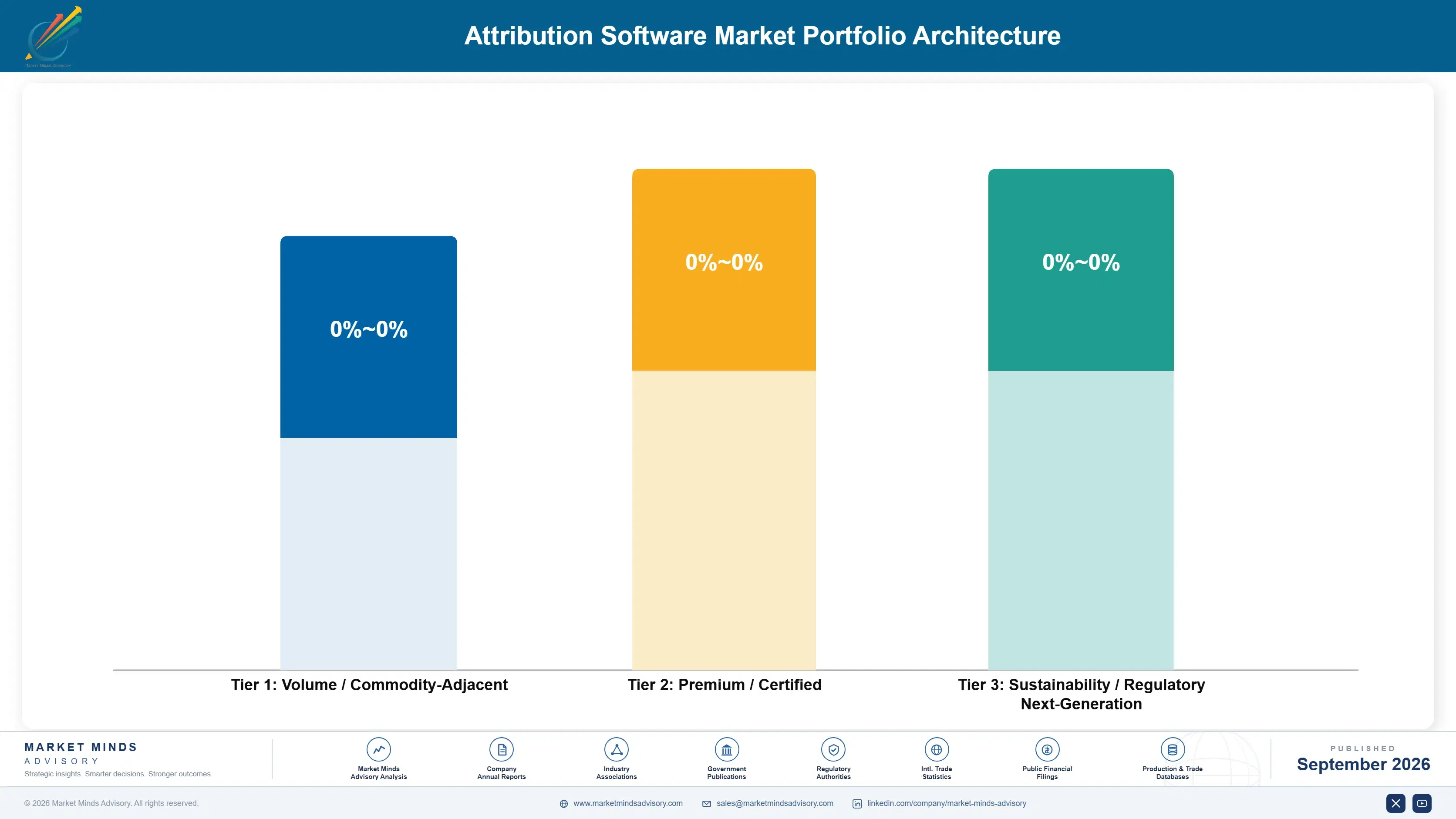
Attribution vendors operate across three margin tiers, from standardized reporting dashboards sold at volume with thin margin to premium incrementality testing and first-party data infrastructure commanding substantially better economics. Tier separation reflects statistical sophistication and measurement rigor rather than raw software feature differences alone, since a basic reporting dashboard and a fully validated incrementality testing platform can share similar underlying cloud infrastructure at the technical level.
Volume tension is sharpest in standardized reporting dashboards, where price-sensitive smaller advertisers push toward commodity pricing while vendors would prefer premium measurement add-ons. Large advertisers and retail media network partners behave oppositely, valuing measurement rigor and cross-platform reconciliation over unit price, which is why the highest-value revenue pools concentrate in incrementality testing and first-party data infrastructure rather than basic reporting tools.

Marketing mix modeling sits between these extremes: growing steadily but priced closer to standard reporting tiers than premium incrementality testing, since mix-modeling-focused buyers remain more cost-conscious than advertisers evaluating causal lift measurement claims directly. Vendors positioned across all three tiers simultaneously capture the broadest addressable revenue base, though few manage the operational complexity of serving such differently motivated advertiser segments well.

Volume / Commodity-Adjacent

Standardized reporting dashboards sold at volume to smaller advertisers with minimal statistical customization or measurement depth included in the base subscription price offered to every account regardless of overall size.
Gross Margin: 18 to 26%

Premium / Certified

Incrementality testing and first-party data infrastructure requiring statistical expertise and experiment design justifying substantially higher enterprise pricing than commodity reporting alone could ever command in the broader market today and tomorrow.
Gross Margin: 36 to 46%

Sustainability / Regulatory / Next-Generation

Marketing mix modeling and retail media measurement normalization tools serving evolving advertiser demand at margins between commodity and premium tiers, growing steadily as retail media continues expanding rapidly each year.
Gross Margin: 28 to 38%
attribution-software-market-portfolio-architecture-1789980588633

High-value Sub-segments and Strategic Watch-out

Privacy-Compliant First-Party Data Platforms

Privacy-compliant first-party data platforms combine high growth with premium accuracy-driven pricing, representing the clearest high-value high-growth opportunity as advertisers rebuild measurement infrastructure following cookie deprecation and expanding privacy regulation across every major advertising market worldwide today, tomorrow, and for many years to come across nearly every industry.
Gross Margin: high

Incrementality Testing Software

Incrementality testing software combines strong margins with steady growth tied to budget accountability pressure, representing a high-value moderate-growth pool anchored by statistical rigor rather than simple reporting visualization or basic dashboard aesthetics alone entirely across the broader market, industry, and enterprise advertiser base worldwide today.
Gross Margin: high

Standardized Reporting Dashboards

Standardized reporting dashboards form the volume core of the market, generating steady revenue at compressed margins as smaller advertisers negotiate aggressively on price given tight marketing technology budgets and quite limited internal analytics resources, staff, and specialized expertise overall each year without any real exception.
Gross Margin: moderate

Retail Media Network Proprietary Tools

Retail media networks building proprietary measurement tools directly into their own platforms represent the clearest strategic watch-out, since they threaten to disintermediate third-party attribution vendors entirely over the coming years and entire decade still further ahead than most currently expect or even forecast today and tomorrow.
Gross Margin: uncertain

Recurring Measurement Infrastructure Economics

Attribution platforms generate durable recurring revenue through multi-year advertiser contracts, since switching measurement infrastructure mid-relationship requires rebuilding historical performance baselines and retraining internal teams on new reporting methodology across the entire marketing organization. Vendors that demonstrate measurable budget optimization within the first renewal cycle convert this into multi-year relationships worth considerably more than any single contract term alone.
Adoption stickiness varies sharply by end-use vertical. Large consumer brands and retailers show the deepest engagement, integrating attribution data into broader budget planning and finance reporting infrastructure that makes switching costly and operationally disruptive. Mid-sized advertisers show comparable stickiness once onboarded, though initial adoption often lags given smaller dedicated analytics teams. Smaller advertisers, being more price-sensitive, show the shallowest platform loyalty, frequently switching vendors as pricing or features shift.

Buyer profiles are shifting generationally as data-focused marketing analysts, rather than traditional brand managers, increasingly drive vendor selection decisions, prioritizing measurement rigor and statistical validity over the simple dashboard aesthetics that dominated marketing technology sales a decade ago. This generational shift favors vendors offering genuine statistical expertise and incrementality testing capability over vendors whose value proposition rests primarily on visually appealing reporting rather than measurement accuracy.
attribution-software-market-end-use-penetration-index-1789980589123

Where MMA Sees the Opportunity

These are among the four positions where our research anticipates prominent divergence between winners and laggards over the coming forecast period. Each is grounded in the demand model, the regulatory perimeter, and the announced capacity pipeline.
01 / FIRST-PARTY DATA INVESTMENT

Build first-party data attribution ahead of cookie-dependent rivals

Privacy-compliant first-party data attribution is growing at 19.5 percent versus the market's 14.5 percent overall rate, and cookie deprecation is not a temporary disruption but a permanent architectural shift in how measurement must work going forward. Vendors still built primarily around legacy cookie-dependent tracking risk losing contracts entirely to competitors offering genuine first-party measurement that advertisers can trust under current and future privacy regulation. Building this capability now, before competitors fully close the gap, protects long-term program relevance and pricing power.
02 / INCREMENTALITY TESTING EXPANSION

Invest in incrementality testing to defend against budget scrutiny

Chief financial officers increasingly demand marketing teams justify budget allocation with measurable causal return rather than correlational attribution alone, a scrutiny level that shows no sign of easing given ongoing corporate cost discipline across most industries. Vendors building genuine incrementality testing capability capture 20 to 28 percent higher contract value than reporting-only platforms, since this capability directly addresses the budget accountability pressure driving vendor selection decisions today. Waiting to build this capability until competitors establish it fully will already be too late.
03 / BRAZILIAN MARKET ENTRY TIMING

Expand into Brazil ahead of full-scale international competition

Brazil is growing at 18.0 percent annually as digital advertising spend expands rapidly while measurement infrastructure investment lags well behind current advertising volume, yet most established vendors remain concentrated in North America and Europe with minimal regional presence. Vendors that establish local partnerships and Portuguese-language support now secure preferred positioning before international competitors recognize the scale of this underserved opportunity and arrive with comparable resources and ambition. This window will not stay open indefinitely as global vendors increasingly look toward Latin American growth.
04 / RETAIL MEDIA COMPETITIVE RESPONSE

Partner with retail media networks before disintermediation accelerates

Retail media networks are building proprietary measurement tools directly into their own advertising platforms, threatening to disintermediate third-party attribution vendors for advertisers spending primarily within a single retail network going forward and expanding budget. Vendors should pursue measurement normalization partnerships with retail media networks now, positioning as the neutral cross-platform reconciliation layer rather than competing directly against each network's own proprietary reporting tools and dashboards. Waiting until retail media networks fully build out competing measurement capability will already be too late.

Engagement Snapshot From the Field

A live engagement with an industry participant carrying material or product regulatory and market exposure ahead of a defining policy shift, showing how our research translates into a defensible multi-year portfolio strategy.
MARKET MINDS ADVISORY · CLIENT ENGAGEMENT SUMMARY
Attribution Software Producer Strategic Portfolio Review and Transition Roadmap 2026·Investment Scenario on Attribution Software Exposure Evaluation 2025-26
CLIENT PROFILE
The client is a mid-sized direct-to-consumer apparel retailer with annual paid media spend in the range of 40 to 55 million dollars (client-reported, unverified by MMA). The company had relied almost entirely on cookie-based last-click attribution and faced growing uncertainty about true channel performance as browser tracking restrictions steadily eroded measurement visibility over recent quarters.
STRATEGIC CHALLENGE
Leadership needed an independent assessment of which attribution vendors could realistically rebuild measurement capability around first-party data, given internal uncertainty about how much historical channel performance data could be trusted going forward under the new measurement constraints the company now faced across its entire marketing organization and budget planning process.
MMA APPROACH
MMA conducted a comparative assessment of three attribution vendors, evaluating first-party data integration capability, incrementality testing methodology, and realistic implementation timelines against the client's existing e-commerce and customer data infrastructure. The engagement included interviews with the client's marketing analytics team and a review of two years of historical channel performance data.
KEY FINDINGS
  1. Roughly 35 percent of previously reported conversions under the old attribution model could not be validated using first-party data alone (client-reported, unverified by MMA).
  2. Only one of three evaluated vendors offered incrementality testing methodology validated against the client's specific direct-to-consumer apparel business model and customer base.
  3. Rebuilding measurement infrastructure around first-party data was projected to take five months, faster than the client's original internal estimate of nine months.
  4. Two previously top-performing channels under the old attribution model showed meaningfully weaker incrementality once properly tested using rigorous causal experimental testing methods.
CLIENT PROFILE
The client is a mid-sized direct-to-consumer apparel retailer with annual paid media spend in the range of 40 to 55 million dollars (client-reported, unverified by MMA). The company had relied almost entirely on cookie-based last-click attribution and faced growing uncertainty about true channel performance as browser tracking restrictions steadily eroded measurement visibility over recent quarters.
STRATEGIC CHALLENGE
Leadership needed an independent assessment of which attribution vendors could realistically rebuild measurement capability around first-party data, given internal uncertainty about how much historical channel performance data could be trusted going forward under the new measurement constraints the company now faced across its entire marketing organization and budget planning process.
MMA APPROACH
MMA conducted a comparative assessment of three attribution vendors, evaluating first-party data integration capability, incrementality testing methodology, and realistic implementation timelines against the client's existing e-commerce and customer data infrastructure. The engagement included interviews with the client's marketing analytics team and a review of two years of historical channel performance data.
KEY FINDINGS
  1. Roughly 35 percent of previously reported conversions under the old attribution model could not be validated using first-party data alone (client-reported, unverified by MMA).
  2. Only one of three evaluated vendors offered incrementality testing methodology validated against the client's specific direct-to-consumer apparel business model and customer base.
  3. Rebuilding measurement infrastructure around first-party data was projected to take five months, faster than the client's original internal estimate of nine months.
  4. Two previously top-performing channels under the old attribution model showed meaningfully weaker incrementality once properly tested using rigorous causal experimental testing methods.
RECOMMENDED STRATEGY
Phase 1: Phase one: select a vendor with validated incrementality testing methodology and begin core data integration within the first two months. Phase 2: Phase two: run parallel incrementality tests on the two previously top-performing channels to validate their true business impact directly and thoroughly. Phase 3: Phase three: reallocate marketing budget based on validated incrementality results once the new measurement platform is fully operational and trusted.
OUTCOME
The client selected a vendor and began data integration within one month of the engagement's conclusion (client-reported, unverified by MMA). Budget reallocation results based on validated incrementality testing were not yet available for independent verification at the time of this report's original scheduled publication date.

Frequently Asked Questions

Foundational context covering the market sizes, CAGR, scope, country, region and competition that inform every finding below. This section is provided to cover basics and most often pre-purchase conversations, answered from the MMA Primary Research Dataset.

What is the current size of the Attribution Software Market?

The global attribution software market is valued at 2.8 billion dollars in 2025, the report's base year. This reflects spending on multi-touch attribution, marketing mix modeling, and first-party data measurement combined across all advertisers.

How large will the Attribution Software Market be by 2036?

MMA projects the market will reach 12.43 billion dollars by 2036, a 3.87 times expansion from 2026's forecast value. Growth is driven mainly by cookie deprecation and first-party data infrastructure investment.

What is the CAGR for the Attribution Software Market 2026 to 2036?

The market is forecast to grow at a 14.5 percent compound annual rate between 2026 and 2036. Bull and bear scenarios range from 15.8 percent to 13.2 percent depending on advertising budget conditions.

Which segment is growing fastest?

Privacy-compliant first-party data attribution platforms lead at a 19.5 percent CAGR, roughly 1.34 times the overall market rate. Demand is driven by advertisers rebuilding measurement infrastructure following cookie deprecation.

Who are the major companies in the Attribution Software Market?

Adobe, Salesforce, HubSpot, Rockerbox, and Northbeam lead the market on combined platform breadth and enterprise customer relationships. Together they hold a combined cr5 of 34 percent.

Which country is growing fastest?

Brazil leads at an 18.0 percent forecast CAGR, driven by rapid digital advertising spend growth outpacing measurement infrastructure investment. This outpaces the broader Latin America regional average considerably.

Report Segmentation Architecture

The full report scope spans multiple orthogonal segmentation dimensions, with cross-tabulated demand data provided for each dimension pair. Coverage extends further to regional breakdowns, trend trajectories, and the competitive detail needed to support segment-level decision-making.

By Measurement Methodology

  • Privacy-Compliant First-Party Data Attribution Platforms
  • Multi-Touch Attribution Modeling Software
  • Marketing Mix Modeling Tools
  • Retail Media Measurement Platforms
  • Incrementality Testing Software
  • Cross-Channel Reporting Dashboards

By End-Use Industry

  • Retail and E-Commerce
  • Consumer Packaged Goods
  • Financial Services
  • Media and Entertainment
  • Technology and Software

By Commercial Dimension

  • Direct Advertiser Purchase
  • Agency-Managed Channel
  • Retail Media Network Partnership Channel
  • System Integrator Channel

By Region

  • North America
  • Western Europe
  • East Asia
  • South Asia and Pacific
  • Latin America
  • Middle East and Africa
  • Eastern Europe

Scope, Methodology, and Coverage

Every figure in this report is reproducible from documented input assumptions. The scope below maps the historical period, the forecast horizon, the segmentation dimensions, and the countries covered, alongside the underlying primary and qualitative methodology.
Historical Period
2020 to 2025
Forecast Period
2026 to 2036
Base Year
2025 (USD billions; MMA Primary Research Dataset, September 2026)
Market Definition
This market covers software platforms that measure and attribute marketing campaign performance across digital and offline channels, including multi-touch attribution modeling, marketing mix modeling, and first-party data measurement infrastructure. It excludes general web analytics platforms and customer relationship management software not specifically built for cross-channel marketing attribution.
Quantitative Units
USD billions (current prices); per-advertiser implementation cost where applicable
Segmentation Dimensions
By Measurement Methodology; By End-Use Industry; By Commercial Dimension; By Region
Regions Covered
North America, Western Europe, East Asia, South Asia and Pacific, Latin America, Middle East and Africa, Eastern Europe
Countries Covered
USA, China, Germany, France, UK, Japan, South Korea, India, Australia, Canada, Brazil, Mexico, Indonesia, Vietnam, Thailand, Malaysia, UAE, Saudi Arabia, South Africa, Nigeria, Turkey, Poland, Netherlands, Italy, Spain, Sweden, Switzerland, Argentina, Colombia, Singapore, and additional markets relevant to this sector
Key Companies Profiled
Adobe, Salesforce, HubSpot, Rockerbox, Northbeam, Triple Whale, Hyros, Wicked Reports, Ruler Analytics, Dreamdata, Funnel.io, Windsor.ai, Improvado, AppsFlyer, Branch, Kochava, Nielsen, Kantar, Measured, Recast
Quantitative Methodology
Primary survey, n=3,800 respondents, Q4 2025, six countries; demand-side model with trade association cross-validation
Qualitative Methodology
47 expert interviews, Q4 2025; applied to validate demand model assumptions, identify emerging dynamics, and assess competitive positioning
Report Format
PDF and XLSX data workbook (Word format preview document)
Publisher
Market Minds Advisory
Report Code
MMA-2026-TEC-174
Published
September 2026
Contact
sales@marketmindsadvisory.com | www.marketmindsadvisory.com

Purchase the full Attribution Software Market Report (2026 to 2036).

The full report delivers a comprehensive assessment of the global attribution software market across measurement methodology, end-use industry, and commercial channel dimensions through 2036. It includes detailed competitive profiles of twenty companies, seven regional demand analyses, and input cost risk modeling tied to data engineering talent and cloud infrastructure costs. Analysts receive segment-level CAGR forecasts, portfolio margin benchmarking, and a strategic verdict section identifying where near-term investment should concentrate across the industry. The report also includes an anonymized client case study illustrating real-world measurement rebuild decisions.
Seven-region demand and CAGR growth forecasts
Twenty-company competitive profiling and moat analysis
Six-dimension segmentation with detailed growth rates
Data engineering talent input cost risk modeling
Portfolio margin tier benchmarking analysis framework
Anonymized client measurement rebuild case study

Built For The People Who Decide

From boardroom strategy to bench-side execution, this report is read cover-to-cover by leaders shaping the next decade of their industry, turning demand scenarios, market dynamics and valuation benchmarks into decisions.
CXOs/ Presidents/ VPs/ Managers
M&A and Corporate Development
Strategy Teams and R&D Heads
Procurement and Product Directors
Regulatory and Compliance Leaders
Investor Relations and Equity Analysts