Market Minds Advisory
Atomic System Clocks Market

Atomic System Clocks Market: Atomic System Clocks Market. Network Synchronization Demand Drives Precision Timing

Telecom operators and data center owners are adopting atomic system clocks for network timing synchronization, as 5G infrastructure and financial trading systems push accuracy requirements beyond what quartz oscillators can reliably sustain.

Lead Analyst

Published

September 2026

Make Smarter Decisions with Customized Research Insights

Request a free sample report and evaluate market opportunities, growth trends, and competitive dynamics relevant to your business needs.

2025 MARKET VALUE$0.7BMarket Size 2025
2036 FORECAST VALUE$1.9BBase Case , 2026 to 2036
CAGR 2026 TO 20369.5 %Bull 10.8% / Bear 8.2%
INCREMENTAL OPPORTUNITY$1.1BNet 10- year value creation
EXPANSION MULTIPLE2.48x2036 value over 2026 base
Strategic Levers
M&A Pipeline
Regional Outlook
Country Rankings
Competitive Intelligence
Segmental Deep-dive
Call-Us : 91 93563 13602

Executive Snapshot and Market Trajectory.

Telecom operators and data center owners worldwide are increasingly deploying atomic system clocks to meet network timing synchronization requirements that quartz oscillators can no longer sustain given tightening 5G infrastructure and financial trading accuracy standards across every network layer, node, edge deployment, and data center.
Chip-scale atomic clock modules are growing fastest as miniaturization breakthroughs make atomic-grade timing accuracy practical for compact base station and edge computing deployments that could not accommodate larger rack-mounted units previously used exclusively. Telecommunications and financial services sector customers drive the largest current share of demand, reflecting their disproportionate exposure to synchronization requirements where microsecond-level timing errors carry substantial regulatory or financial consequences across trading floors and networks.
Competitive intensity remains moderate as established precision timing manufacturers defend defense and telecom customer relationships while newer chip-scale specialists compete on size, power consumption, and integration simplicity rather than raw accuracy alone or brand recognition. GPS-independent timing requirements driven by signal jamming and spoofing concerns are shaping which vendors can credibly win critical infrastructure contracts requiring demonstrated resilience and redundancy. Vendors demonstrating clear GPS-independent resilience increasingly win over cost-conscious critical infrastructure procurement teams.
Market Definition
This market covers atomic clock systems including chip-scale atomic clocks, rubidium and cesium standards, and rack-mounted timing systems used for network synchronization, navigation, and scientific applications. It excludes quartz-based oscillators without atomic reference elements and GPS receivers sold without an integrated atomic timing standard.
Base Year Value
$0.7B in 2025 (MMA Primary Research Dataset, September 2026)
Forecast Period
2026 to 2036, eleven discrete annual values
CAGR
9.5% base case. Bull 10.8%. Bear 8.2%.
Fastest Growth Segment
Chip-Scale Atomic Clock Modules: 13.0% CAGR
Fastest Growth Country
China: 11.5% CAGR
Fastest Growth Region
South Asia and Pacific: 11.5% CAGR
Largest Region
North America: 31% of 2025 global value
Market Leaders
Microchip Technology, Frequency Electronics, Excelitas Technologies, Orolia, Jackson Labs Technologies
Primary Survey
n=3,800 procurement and R&D decision-makers, Q4 2025, six countries
Methodology
Demand-side build-up, cross-validated against public data, 47 expert interviews

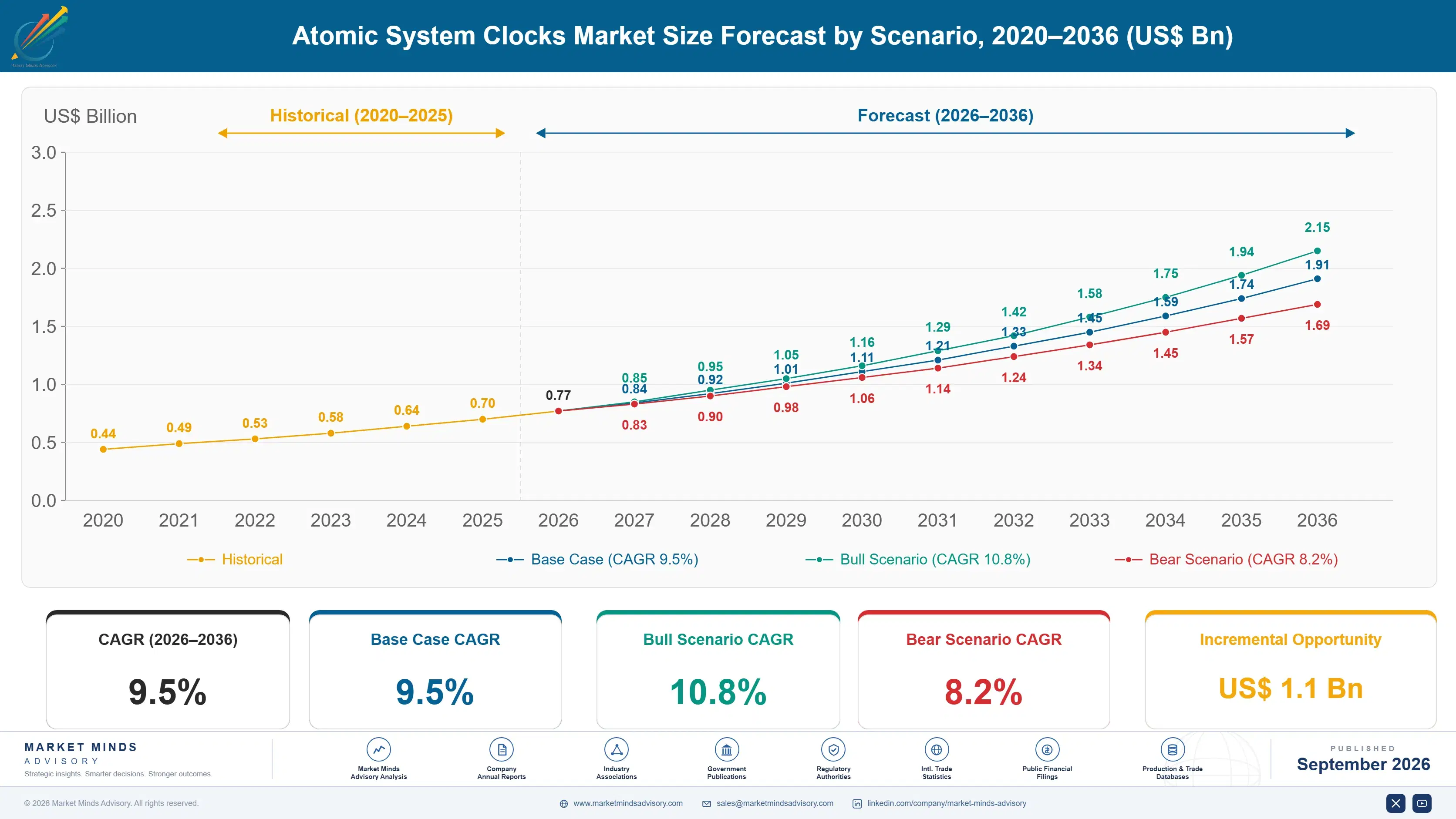
Atomic System Clocks Market Forecast Scenarios

atomic-system-clocks-market-size-forecast-scenario-1788677487514
Atomic system clock demand between 2020 and 2025 grew steadily as 5G network rollout accelerated and financial regulators tightened timing accuracy requirements for high-frequency trading systems across major exchanges. Chip-scale atomic clock miniaturization breakthroughs during this period expanded the addressable market considerably beyond traditional rack-mounted rubidium and cesium standards, opening new applications in compact edge computing and mobile base station deployments previously unable to accommodate atomic timing.
The base case assumes continued expansion driven by three commercial mechanisms: telecom operators deploying denser 5G and eventual 6G network infrastructure requiring proportionally more precise synchronization points across distributed base stations, financial services firms expanding regulatory-driven timing accuracy compliance beyond current high-frequency trading applications into broader transaction reporting, and defense and critical infrastructure customers adopting GPS-independent atomic timing to reduce jamming and spoofing vulnerability. Data center operators are also specifying atomic timing for distributed computing coordination.
A bull scenario centers on accelerated GPS-independent timing adoption driven by escalating satellite signal jamming and spoofing concerns across critical infrastructure sectors globally. The bear risk is chip-scale atomic clock component costs failing to decline as quickly as currently modeled, which would slow adoption among cost-sensitive edge computing and mobile applications driving most incremental unit growth.

Where Precision Timing Meets Network Density

Atomic system clocks sit at the intersection of precision physics instrumentation and network infrastructure, delivering timing stability that quartz oscillators cannot sustain over extended operating periods without meaningful drift accumulation. The category expanded from specialized scientific and defense applications into mainstream telecom and financial infrastructure as chip-scale miniaturization made atomic timing accessible beyond dedicated laboratory settings. This shift is reshaping how network engineers think about synchronization architecture and redundancy planning.
MARKET CONCENTRATIONCR5 62%Top five manufacturers hold a dominant combined revenue share
AVERAGE SYSTEM PRICE$500 to $50KTypical price range across chip-scale and rack-mounted systems
TOP PRODUCING COUNTRY SHAREUnited States leadsSingle country contributes the largest share of unit production
TIMING ACCURACY STANDARD~1 nanosecondTypical drift tolerance required for premium telecom applications
CHIP-SCALE ADOPTION SHARE~35% of unitsPortion of total unit shipments using chip-scale module formats
PRODUCT LIFESPAN~10 to 15 yearsTypical operating life before a unit requires full replacement
Chip-scale atomic clocks increasingly substitute for larger rubidium and cesium standards in space-constrained deployments, trading some accuracy performance for dramatically reduced size, weight, and power consumption that mobile network base stations require. GPS-independent timing increasingly differentiates vendors from GPS-disciplined alternatives, since customers value resilience against satellite signal jamming and spoofing that increasingly threatens critical infrastructure timing sources.
Competitive advantage increasingly rests on timing stability validation and defense-grade certification credentials rather than raw specification sheets alone, since customers weigh long-term reliability heavily when timing errors carry substantial financial or safety consequences. Vendors lacking demonstrated field reliability data face growing difficulty winning critical infrastructure contracts requiring extensive qualification testing before deployment approval. Vendors investing early in transparent field reliability reporting increasingly gain a meaningful trust advantage with cautious buyers.
"Nobody buys an atomic clock because they need to know what time it is. They buy it because their network falls apart if two towers disagree by more than a few nanoseconds."
Principal Analyst, Precision Timing and Network Infrastructure Practice · MMA Chip-Scale and Rack-Mounted Atomic Clock Systems for Timing and Synchronization Practice · September 2026

Market Trends

GPS-Independent Timing Gains Critical Infrastructure Priority

Critical infrastructure operators increasingly specify GPS-independent atomic timing sources given rising concern about satellite signal jamming and spoofing that could disrupt GPS-disciplined timing systems during a genuine security incident or geopolitical conflict. Microchip Technology and Frequency Electronics have both expanded their GPS-independent product lines specifically to address this growing customer demand for resilience against satellite signal disruption. This shift matters because it creates a genuine differentiation opportunity for vendors demonstrating measurable holdover accuracy during extended periods without external timing reference, capturing premium pricing from security-conscious defense and financial infrastructure customers.
Market Impact: Adds 3 timing sources per cell
Chip-Scale Miniaturization Continues Expanding Addressable Applications

Chip-scale atomic clock manufacturers continue shrinking module size and power consumption, expanding the addressable application base beyond traditional rack-mounted deployments into compact mobile base stations and edge computing installations that previously could not accommodate atomic timing capability. This miniaturization trend matters because it converts atomic timing from a specialized, expensive component reserved for critical infrastructure into an increasingly mainstream component for mid-tier telecom and industrial applications. Vendors achieving the smallest form factors while maintaining meaningful accuracy performance increasingly capture disproportionate share of this rapidly expanding application category. Vendors report smaller module footprints increasingly determine competitive wins in space-constrained applications.
Market Impact: Compliance-driven demand rose 18 percent

Market Opportunities and Growth Drivers

5G Network Density Requires Proportionally More Timing Sources

Dense 5G network deployments require substantially more synchronization points across distributed base stations than earlier generation cellular networks, directly increasing the number of atomic timing units telecom operators must deploy per unit of network coverage area. This density requirement compounds as operators deploy increasingly small cell architectures in urban areas, multiplying the addressable market for compact, cost-effective atomic timing modules considerably beyond what macro cell deployments alone would require. Telecom operators increasingly specify atomic timing as a baseline network requirement rather than an optional accuracy upgrade for premium service tiers only.
Market Impact: Adds 25 to 35 percent

Financial Regulators Tighten Trading System Timing Requirements

Financial regulators in major markets increasingly mandate microsecond-level timing accuracy and documented traceability for high-frequency trading systems, directly driving demand for atomic timing sources capable of satisfying these increasingly stringent regulatory compliance requirements across trading infrastructure. This regulatory pressure extends beyond pure high-frequency trading into broader transaction reporting and market surveillance systems requiring documented, auditable timing accuracy. Financial services customers increasingly view atomic timing infrastructure as a mandatory compliance investment rather than an optional performance enhancement reserved for the most sophisticated trading operations. Vendors serving this compliance segment increasingly build dedicated regulatory documentation and audit support capability.
Market Impact: Adds 12 to 24 months

Market Restraints and Challenges

High Unit Cost Limits Smaller Operator Adoption

Atomic timing systems carry substantially higher unit costs than quartz-based alternatives, creating a meaningful adoption barrier for smaller telecom operators and industrial customers who cannot easily justify the premium pricing against uncertain future accuracy requirement growth. The root cause is that atomic clock manufacturing requires specialized physics expertise and precision component assembly that quartz oscillator manufacturing does not demand, keeping unit costs meaningfully elevated despite chip-scale miniaturization progress achieved to date. This cost barrier concentrates adoption among larger, well-capitalized operators serving demanding customer segments. Some vendors are mitigating this by offering leasing and subscription-based access models.
Market Impact: GPS-independent demand grew 22 percent yearly

Long Qualification Cycles Delay Defense Contract Revenue

Defense and critical infrastructure customers typically require extensive qualification testing spanning one to two years before approving a new atomic timing vendor for production deployment, delaying vendor revenue recognition considerably compared to less regulated commercial telecom applications with shorter approval timelines. The root cause is that defense applications carry safety and security consequences that require exhaustive environmental and reliability testing before any production commitment can be made by procurement officials. This lengthy cycle disadvantages smaller vendors lacking capital to sustain extended qualification investment without near-term revenue. Larger vendors mitigate this by pursuing platform-level qualification spanning multiple defense programs.
Market Impact: Module size shrank roughly 40 percent
3 additional market trends, 4 additional growth drivers, and 2 additional restraints and challenges are covered in the full report. Contact sales@marketmindsadvisory.com to access the complete intelligence.

Segment CAGR and Growth Architecture

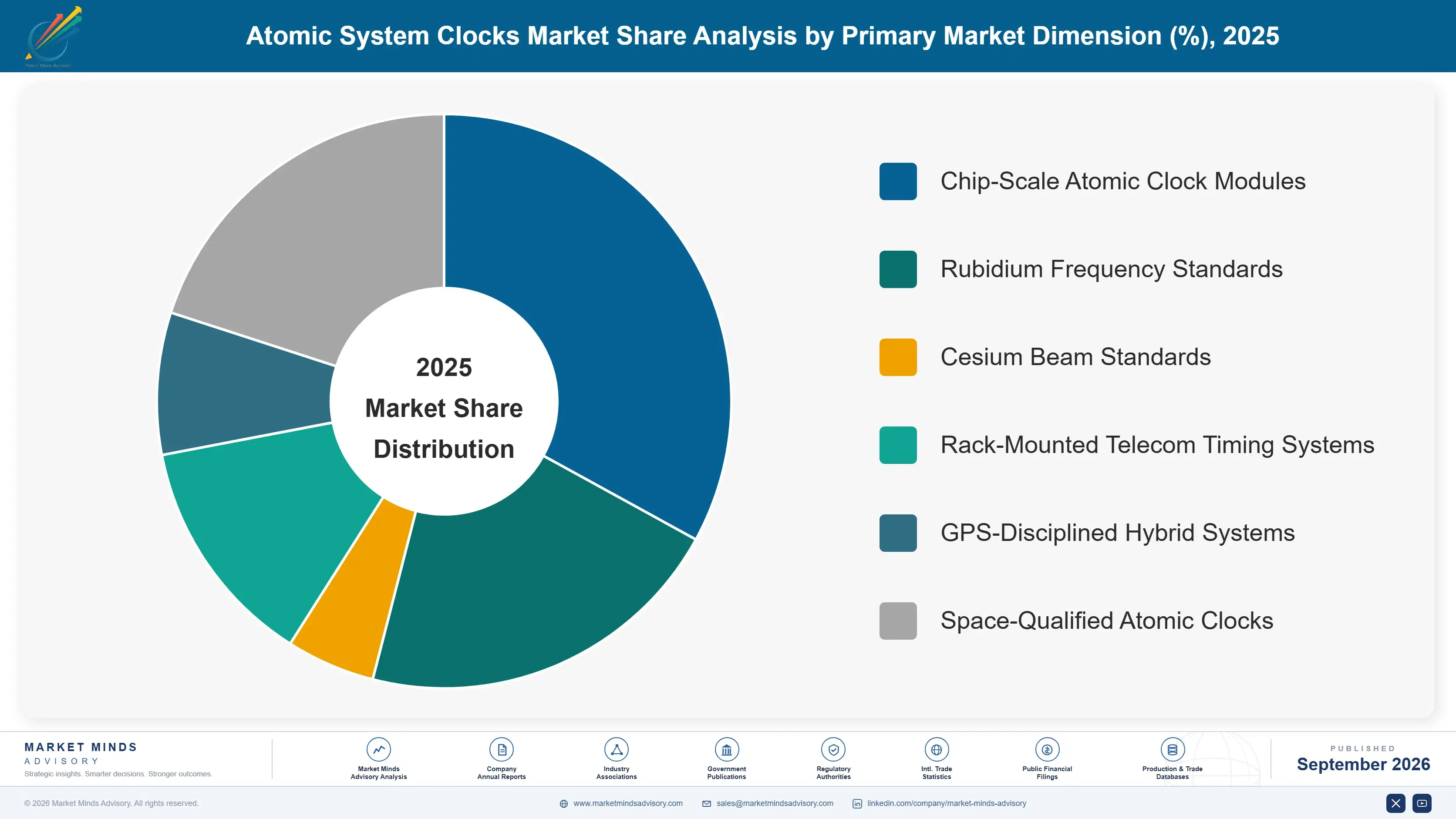
Atomic system clocks segment by the core timing technology and form factor, spanning chip-scale atomic clock modules, rubidium frequency standards, cesium beam standards, rack-mounted telecom timing systems, GPS-disciplined hybrid systems, and space-qualified atomic clocks serving satellite, navigation, defense, and scientific research customer applications across every geography, market, industry vertical, and deployment scale globally today.
atomic-system-clocks-market-market-share-analysis-1788677488103

Chip-Scale Atomic Clock Modules

Chip-scale atomic clock modules deliver atomic-grade timing accuracy in a dramatically reduced size and power footprint compared to traditional rubidium and cesium standards, making atomic timing practical for space-constrained mobile base station and edge computing deployments that could never accommodate larger rack-mounted systems. Growth outpaces the broader market because this segment essentially opens an entirely new addressable customer base beyond traditional telecom and defense infrastructure, extending atomic timing into industrial and mobile network applications that previously relied exclusively on quartz oscillators lacking comparable long-term stability. Microchip Technology and Jackson Labs Technologies both report accelerating adoption as component costs continue declining alongside sustained miniaturization progress. Financial trading customers increasingly evaluate chip-scale modules for edge deployment given their compact footprint advantages.
CAGR 13.0%

Rubidium Frequency Standards

Rubidium frequency standards deliver a favorable balance of accuracy, cost, and power consumption that has made them the workhorse timing technology for telecom network synchronization and mid-tier defense applications for several decades of continuous deployment. This segment grows more slowly than chip-scale modules because it represents an already mature market with well-established vendor relationships and deployment patterns built up over many years of telecom infrastructure investment cycles. Vendors in this segment increasingly differentiate through extended holdover performance and GPS-independent operation capability that addresses growing customer concern about satellite signal disruption and jamming vulnerability. Defense customers particularly value this holdover performance given mission requirements that cannot tolerate any timing signal interruption.
CAGR 8.0%
Full segment breakdown across 6 segments available in the complete report.

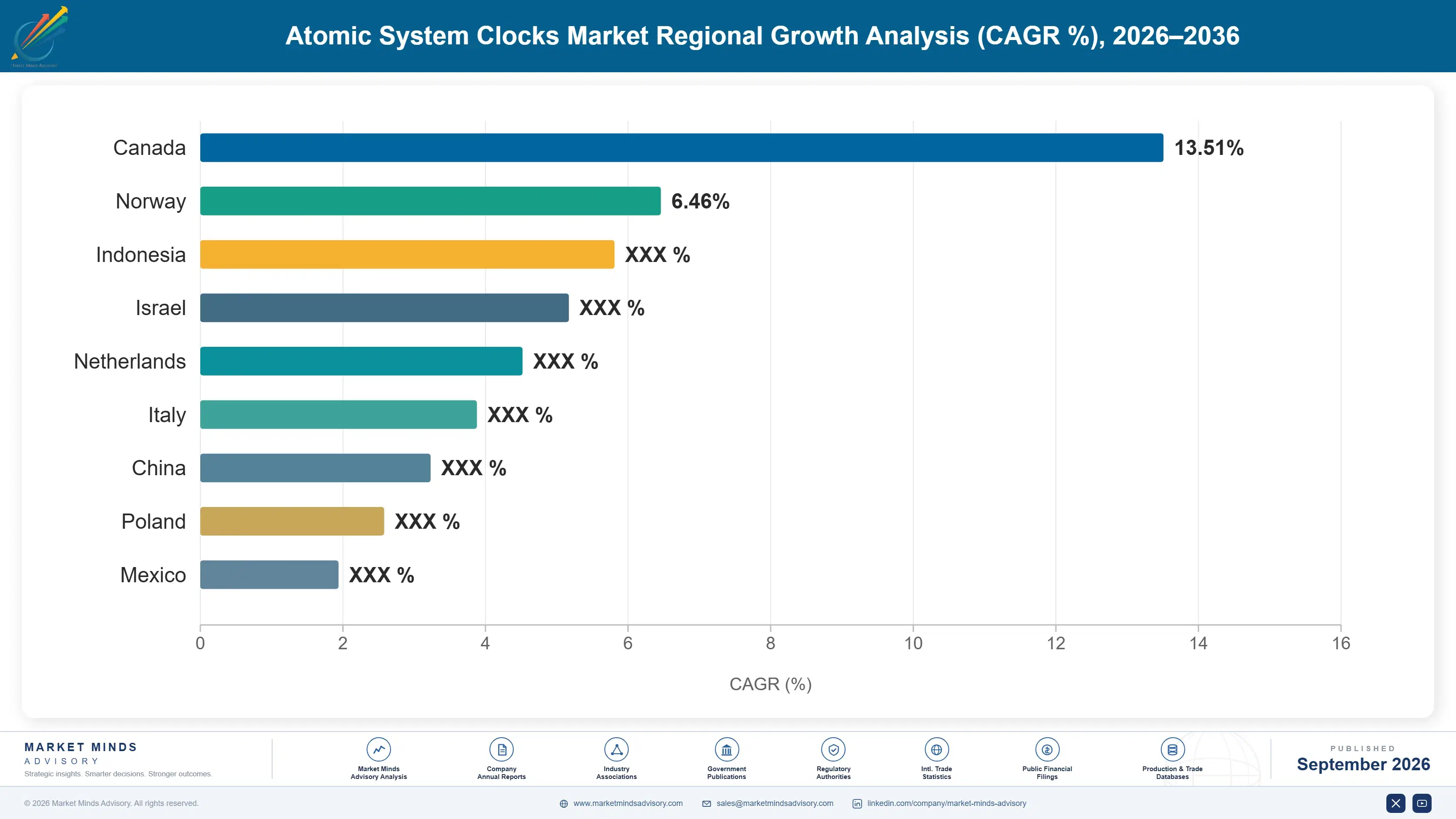
Regional Architecture and Country Demand Map

North America leads given Microchip, Frequency Electronics, and Jackson Labs headquarters concentration and deep defense procurement spending among all tracked global markets today, while South Asia and Pacific posts the fastest overall growth as regional 5G network buildout accelerates rapidly across every expanding coverage area.

North America

The United States hosts the deepest concentration of atomic clock manufacturers, with Microchip Technology, Frequency Electronics, Excelitas Technologies, and Jackson Labs Technologies all headquartered domestically and serving substantial defense and telecom procurement demand. American defense and financial services customers generate the highest per-unit spending among tracked markets, reflecting both stringent qualification requirements and sufficient capital budgets to fund premium GPS-independent timing systems. Canada's growing technology sector also contributes meaningfully to regional demand, particularly around telecom network synchronization given its expanding 5G infrastructure investment. Mexico's growing telecom equipment manufacturing sector also contributes modestly to this broader regional grouping's demand. Growing government agency adoption of GPS-independent timing systems further reinforces this steady regional demand base.
Share: 31% | CAGR: 10.5% (2026 to 2036)

Western Europe

French and German precision instrumentation manufacturers drive substantial regional demand, with Orolia and Spectratime both maintaining substantial European headquarters presence serving telecom and defense customers across the continent. The United Kingdom hosts a growing cluster of timing technology firms building GPS-independent systems for both domestic and broader European market distribution. Growth trails North America and East Asia somewhat, reflecting the region's more conservative telecom infrastructure investment timelines compared to American and Chinese network operators currently. France and the Nordic countries contribute additional demand through their growing telecom infrastructure investment programs. Regional telecom operators increasingly view multi-vendor timing sourcing as standard procurement practice going forward. This trend continues expanding steadily across the region.
Share: 21% | CAGR: 8.0% (2026 to 2036)
Regional intelligence for 5 additional markets available in the complete report: East Asia, South Asia and Pacific, Latin America, Middle East and Africa, Eastern Europe. Contact sales@marketmindsadvisory.com.
atomic-system-clocks-market-country-cagr-analysis-1788677488655

Where Timing Vendors Build Recurring Revenue

Beyond one-time system sale price, atomic clock manufacturers build durable revenue through mechanisms that deepen customer dependency and demonstrate measurable reliability value over multi-year deployment lifecycles, rewarding vendors that invest early in GPS-independent holdover capability, defense-grade certification depth, and service contract structuring rather than pure specification competition across every customer segment and geography served.

Selling GPS-Independent Holdover Capability as a Premium Tier

Vendors increasingly charge separately for extended GPS-independent holdover capability that maintains timing accuracy during periods without external satellite reference, beyond the standard GPS-disciplined tier that requires continuous satellite connectivity. This holdover tier typically commands 25 to 35 percent premium pricing over standard GPS-disciplined systems, reflecting the genuine security value of resilience against satellite signal jamming and spoofing. Defense and critical infrastructure customers overwhelmingly purchase this premium tier given their heightened security requirements and documented resilience mandates. Larger defense contractors with strict security policies increasingly demand this holdover tier by default.
Market Impact: Holdover capability commands roughly 25 to 35pp premium

Structuring Multi-Year Preventive Maintenance Service Contracts

Vendors are structuring multi-year preventive maintenance contracts that guarantee timing drift calibration and component replacement, converting what was once occasional reactive repair revenue into predictable recurring service income tied directly to system uptime requirements. Telecom and financial services customers particularly value this predictability given the production disruption that unplanned timing system downtime causes across dependent network and trading infrastructure. Service contract attach rates typically reach 65 percent of new system sales, demonstrating genuine customer willingness to pay for uptime assurance. Larger vendors increasingly bundle remote diagnostics into these preventive maintenance offerings by default.
Market Impact: Service attach rate reaches roughly 65 percent yearly

Offering Defense-Grade Certification and Documentation Support

Vendors increasingly sell dedicated defense-grade certification documentation and qualification testing support services that help customers satisfy stringent procurement requirements before approving a new timing vendor for production deployment. This certification support revenue captures incremental value from an existing customer relationship while addressing genuine procurement bottlenecks that historically extended qualification timelines considerably beyond initial vendor estimates. Certification support engagements typically generate 10 to 15 percent additional revenue per defense customer relationship beyond standard system sales alone. Vendors report this certification support meaningfully strengthens win rates in competitive defense procurement processes. Customers increasingly view this support as essential.
Market Impact: Certification support adds roughly 10 to 15pp yearly

Building Long-Term Telecom Network Upgrade Partnerships

Vendors increasingly build long-term upgrade partnerships with telecom operators, providing dedicated technical support and roadmap coordination beyond standard system sales that helps operators plan atomic timing deployment across multi-year network densification and 5G expansion programs. This partnership-level engagement captures larger, more predictable contract values than standard transactional system sales alone, since operators value coordinated planning beyond pure equipment procurement. Larger telecom operators increasingly prefer this deeper partnership model over transactional point-solution purchasing arrangements that leave coordination gaps. Vendors report these partnerships also meaningfully improve long-term contract renewal likelihood considerably across accounts.
Market Impact: Network partnerships add roughly 20 to 30pp value

Who Controls the Margin Pool

Concentration among the top five atomic clock manufacturers sits at roughly sixty-two percent, reflecting the category's meaningful barriers to entry around specialized physics engineering and defense qualification credentials built over decades. Microchip Technology and Frequency Electronics lead on defense and telecom contract breadth, while the gap separating them from mid-tier challengers like Excelitas Technologies remains wide enough that displacing an incumbent typically requires a genuinely differentiated technology approach rather than incremental improvement.
Current competitive activity centers on chip-scale miniaturization and GPS-independent holdover capability expansion, since both directly address the size, power, and resilience requirements that increasingly determine enterprise and defense customer selection decisions. Several vendors have also launched dedicated defense-grade certification support services, deepening customer relationships beyond simple system sales arrangements alone. GPS-independent holdover accuracy in particular has become a key differentiator vendors highlight prominently.

Emerging pressure comes from Chinese domestic manufacturers scaling production to serve the country's rapidly growing 5G and BeiDou navigation infrastructure, threatening established American and European incumbents on price within that specific market. Ranking shifts are most likely among mid-tier manufacturers lacking either GPS-independent capability or demonstrated defense qualification credentials, since both dimensions increasingly separate durable market leaders from vulnerable niche competitors.
atomic-system-clocks-market-company-positioning-matrix-1788677489183

Competitive Moat and Risk Dimensions

MICROCHIP TECHNOLOGY

Moat: Broad Defense and Telecom Portfolio

Microchip Technology maintains the broadest portfolio of qualified atomic timing products spanning defense, telecom, and industrial applications among independent manufacturers, giving it cross-selling opportunities and accumulated qualification credentials that smaller competitors cannot easily replicate. This portfolio breadth compounds each renewal cycle as customers reference existing satisfied deployments.
MICROCHIP TECHNOLOGY

Risk: Broad Portfolio Focus Dilution

Microchip Technology's broader semiconductor portfolio beyond pure atomic timing means this specific product line receives less dedicated research and development investment than pure-play timing specialists focused entirely on this single application category. Microchip Technology has responded by expanding dedicated timing product management resources and staff somewhat.
FREQUENCY ELECTRONICS

Moat: Deep Defense Qualification Credibility

Frequency Electronics built its reputation over decades specifically around defense-grade timing qualification, giving it credibility with defense procurement officials that generalist commercial timing manufacturers without comparable specialized focus have not developed to the same degree. This credibility advantage has historically translated into faster procurement cycles for qualified defense leads.
FREQUENCY ELECTRONICS

Risk: Defense Budget Cycle Dependence

Frequency Electronics remains meaningfully dependent on defense procurement budget cycles, exposing the company to revenue volatility during periods of government spending constraint or shifting defense modernization priorities beyond its direct control. Frequency Electronics has responded by expanding into commercial telecom markets to diversify this exposure.

Players Tracked

Prominent Players

Microchip Technology
Frequency Electronics
Excelitas Technologies
Orolia
Jackson Labs Technologies

Other Key Players

Stanford Research Systems
Spectratime
Oscilloquartz (ADVA)
Rakon
Vectron International
Bliley Technologies
Accubeat
AccuTime Systems
Chronos Technology
SpectraDynamics
IQD Frequency Products
CTS Corporation
Wenzel Associates
Vremya-Ch
Kernco

Recent Developments

FEBRUARY 2026

Microchip Technology Launches Chip-Scale GPS-Independent Module

Microchip Technology launched a new chip-scale atomic clock module with extended GPS-independent holdover capability designed for compact telecom and defense edge deployment applications. The launch represents an internal product development effort rather than an acquisition of external technology or another company. Early customers report meaningful footprint and power draw reductions.
Signal: Demonstrates the chip-scale miniaturization pattern this report identifies as a central future revenue differentiator ahead of rivals
OCTOBER 2025

Frequency Electronics Signs Multi-Year Contract With Defense Agency

Frequency Electronics signed a multi-year supply contract with a defense agency covering atomic timing systems for critical navigation and communication infrastructure across military branches. The agreement is a supply contract rather than an acquisition or joint venture between the two organizations involved. Terms were not disclosed by either party.
Signal: Extends established vendor reach into a large multi-branch global government defense customer relationship directly and meaningfully
JULY 2025

Excelitas Technologies Acquires Timing Software Startup

Excelitas Technologies acquired a smaller timing management software startup to accelerate remote monitoring and diagnostics capability within its atomic clock product portfolio serving telecom customers. The acquisition brought in specialized software algorithms that Excelitas plans to integrate directly into its offerings. Terms were not disclosed by either company.
Signal: Signals continued vendor investment in remote monitoring as a key long-term competitive differentiator across the market

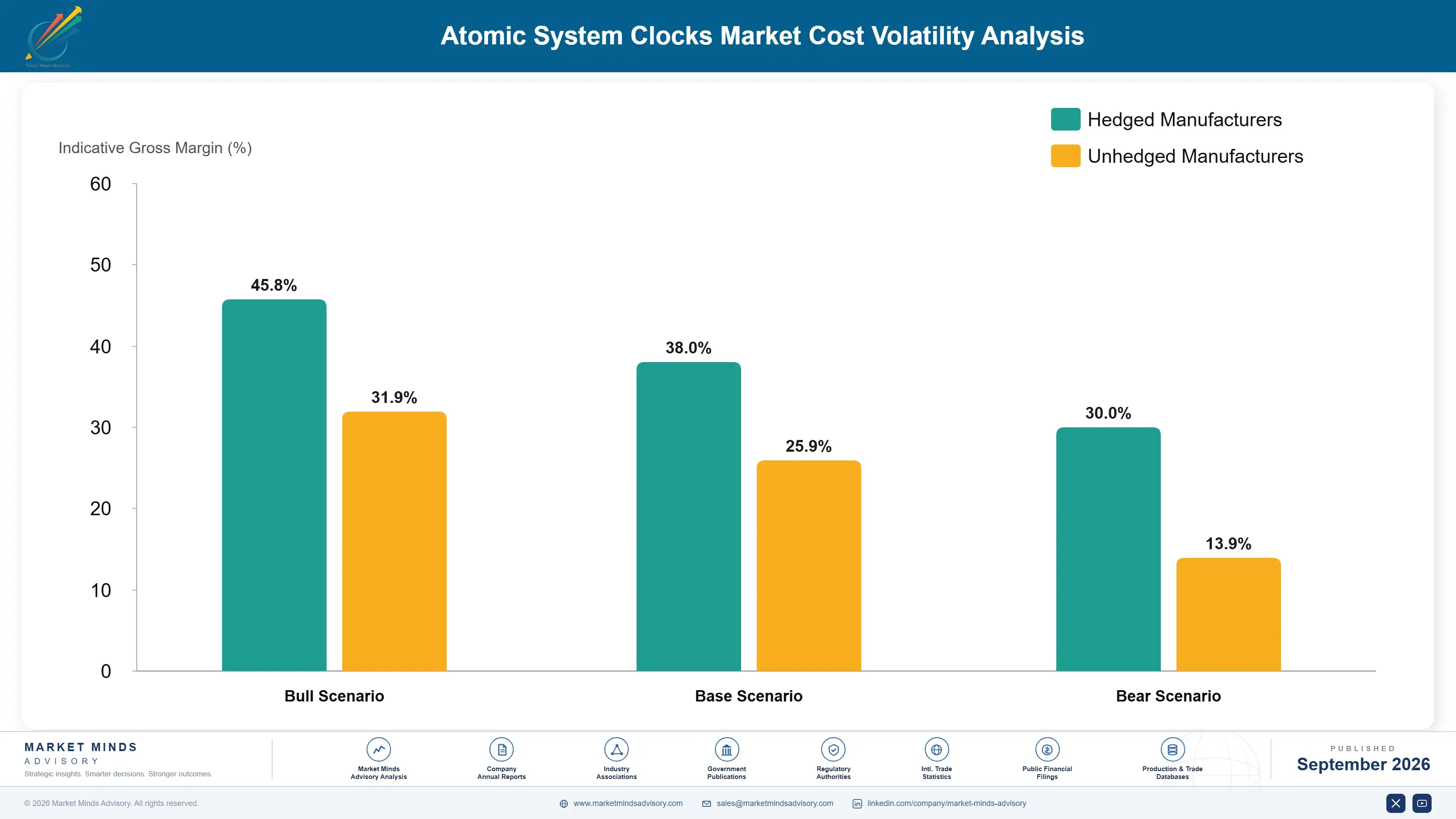
Precision Component Cost Exposure

Atomic clock cost structures are dominated by precision physics components including rubidium and cesium vapor cells, specialized crystal resonators, and precision-machined vacuum enclosures, rather than commodity electronic parts or bulk materials. These specialized components require semiconductor-grade fabrication precision and rare vapor cell materials, concentrating supply among a limited number of qualified precision component manufacturers primarily located in the United States, Japan, and Switzerland.
Rubidium vapor cell material prices rose meaningfully during 2022 and 2023 amid broader rare material supply chain disruptions, according to industry pricing data and manufacturer annual reports discussing rising component procurement costs across the sector during that period. Manufacturers without diversified rubidium sourcing relationships absorbed a larger share of this cost increase directly, while others expanded qualified supplier networks to reduce single-source dependency risk going forward.

Smaller manufacturers lacking established relationships with precision component suppliers face a genuine competitive disadvantage versus larger competitors able to negotiate volume-based pricing agreements directly with vapor cell and resonator manufacturers at scale. This exposure varies by player type: manufacturers with long-standing supplier relationships weathered the 2022 to 2023 component cost increases more smoothly than smaller regional competitors lacking comparable purchasing scale and negotiating leverage across multiple component categories.
atomic-system-clocks-market-cost-volatility-analysis-1788677489379

Vertically Integrate Vapor Cell Production Capability

Manufacturers are vertically integrating rubidium and cesium vapor cell production internally rather than relying entirely on external suppliers, capturing margin previously paid to component vendors while gaining more direct control over quality and delivery timelines for system assembly. This integration also shortens development cycles for new products requiring custom vapor cell specifications not readily available externally.

Diversify Precision Component Sourcing Relationships

Manufacturers are qualifying multiple precision component suppliers for critical parts like vapor cells and resonators rather than depending on a single source, reducing exposure to any individual supplier's capacity constraints or pricing changes during periods of tight material supply. This diversification strategy has proven especially valuable during periods of geopolitical trade tension affecting specific producing countries.

Negotiate Multi-Year Component Supply Agreements

Manufacturers are negotiating multi-year supply agreements with key precision component manufacturers, locking in pricing and delivery commitments that reduce exposure to spot market price volatility while providing suppliers with useful demand visibility for capacity planning purposes. Manufacturers report these agreements have meaningfully reduced unplanned cost increases compared to spot market purchasing during periods of tight supply.

Portfolio Architecture for Margin Defence

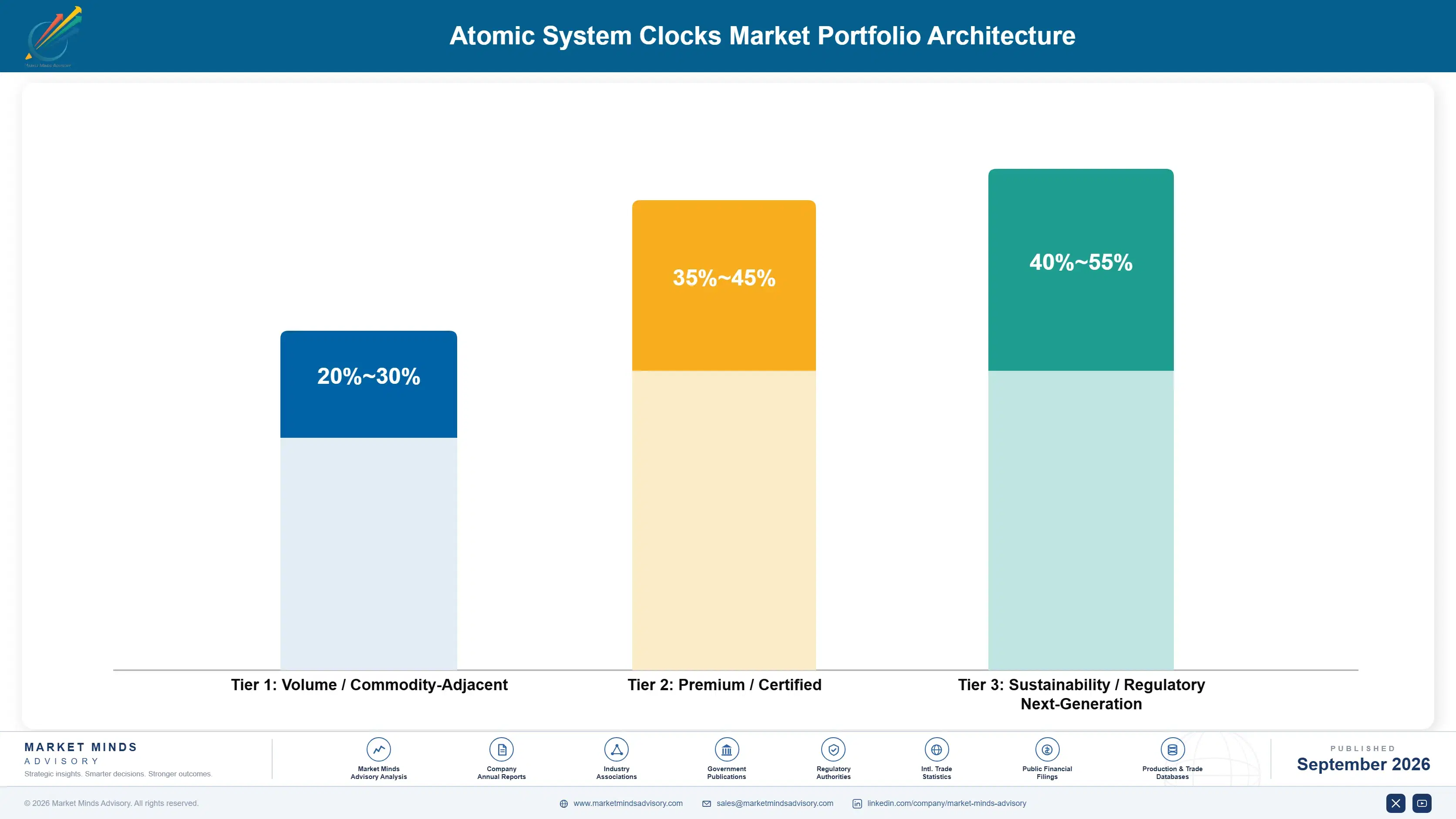
Portfolio economics across atomic clock manufacturers split between standard commercial telecom systems competing largely on price, and premium defense-grade or GPS-independent offerings commanding meaningfully higher margins given specialized qualification and certification expertise sold alongside core timing functionality across every customer segment and product tier served today, from small telecom operators to large defense contractors.
The tension between volume and premium positioning shows clearly in customer segment served: commercial telecom systems compete on baseline accuracy and per-unit pricing, while defense and GPS-independent tiers command substantially higher effective margins justified by extensive qualification investment and documented resilience against satellite signal disruption threats across every deployment context and geography.

High-value margin pools concentrate around GPS-independent holdover capability and defense-grade certification services, both requiring specialized engineering and qualification expertise that smaller manufacturers cannot easily replicate without years of dedicated investment, customer trust, and accumulated qualification history. Manufacturers positioned purely as commercial telecom timing suppliers will struggle to capture this premium tier without meaningful, sustained investment in defense qualification and holdover engineering capability. Larger manufacturers with established qualification track records increasingly capture this premium tier ahead of smaller specialized competitors.

Volume / Commodity-Adjacent

Standard commercial telecom timing systems competing largely on price against similar undifferentiated offerings from established competitors serving less demanding applications outside defense-grade or GPS-independent requirements and their formal certifications entirely.
Gross Margin: 20-30%

Premium / Certified

GPS-independent holdover systems and financial trading-grade timing sold to enterprise customers requiring documented resilience and regulatory compliance certification beyond what standard commercial systems can reliably deliver at any real scale.
Gross Margin: 35-45%

Sustainability / Regulatory / Next-Generation

Defense-grade certified systems and space-qualified atomic clocks requiring specialized qualification expertise smaller manufacturers cannot easily replicate quickly, commanding the entire category's strongest and most defensible overall margin position available currently.
Gross Margin: 40-55%
atomic-system-clocks-market-portfolio-architecture-1788677489869

High-value Sub-segments and Strategic Watch-out

Chip-Scale Atomic Clock Modules

The fastest-growing, highest-value segment as miniaturization breakthroughs make atomic timing practical for compact mobile network and edge computing deployments that could never accommodate larger rack-mounted rubidium and cesium systems previously used exclusively across telecom infrastructure and defense applications alike worldwide across every deployment scenario tracked.
Gross Margin: 35-45%

GPS-Independent Holdover Systems

High-value and steadily growing as critical infrastructure operators increasingly demand resilience against satellite signal jamming and spoofing threats, rewarding vendors that invest early in extended holdover accuracy engineering capability across every deployment context, geography, industry vertical, customer type, and contract structure served worldwide today and going forward.
Gross Margin: 40-55%

Standard Commercial Telecom Timing

The volume core of the market, generating steady unit revenue but facing margin pressure from increasingly capable Chinese domestic manufacturers, requiring efficient operations to sustain acceptable margins as competition intensifies across every served geography, application category, customer size, contract type, and product configuration tracked closely.
Gross Margin: 20-30%

Chinese Domestic Manufacturer Scaling

A strategic watch-out category where rapidly scaling Chinese manufacturers could meaningfully compress pricing across standard commercial timing categories globally, potentially reshaping which manufacturers capture the premium defense and GPS-independent opportunity this report identifies as the category's central near-term growth driver and primary future margin source.
Gross Margin: N/A, emerging

How Qualification Cycles Compound Value

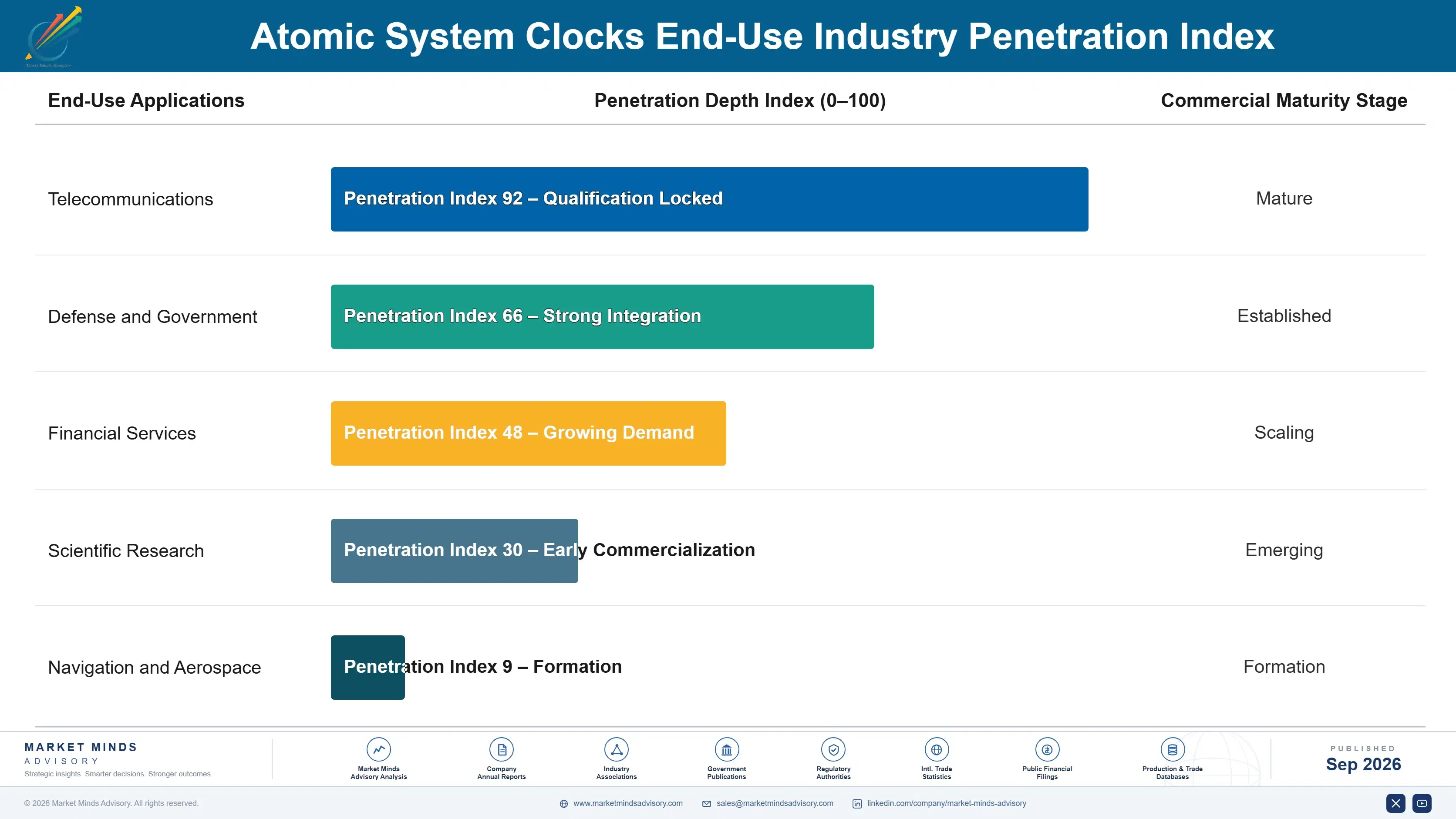
Defense and critical infrastructure timing contracts function like an annuity once a supplier completes lengthy qualification testing, since switching vendors mid-relationship requires repeating the extensive environmental and reliability testing that historically consumed one to two years before initial production approval, adding real switching cost and risk that most procurement teams avoid without a compelling reason once a qualified supplier relationship is established and performing reliably.
Adoption stickiness varies by end-use vertical: defense and financial services customers show the deepest lock-in given regulatory documentation requirements tied to specific qualified vendor relationships and audit trails, while smaller telecom operators switch more readily given shorter procurement cycles and less formal qualification requirements tied to any single vendor's specific timing technology across a typical deployment lifecycle. Switching costs also extend to documented qualification history required for defense procurement audits.

Generational shifts in network engineering expectations are reshaping buyer profiles, as newer telecom and defense engineers entering the workforce now expect GPS-independent resilience as a baseline procurement requirement rather than a specialized upgrade reserved for the most security-conscious deployments only. This mindset shift accelerates vendor evaluation cycles considerably compared to prior engineering generations accustomed to purely GPS-disciplined timing systems.
atomic-system-clocks-market-end-use-penetration-index-1788677490363

MMA Verdict on Atomic System Clocks

These are among the four positions where our research anticipates prominent divergence between winners and laggards over the coming forecast period. Each is grounded in the demand model, the regulatory perimeter, and the announced capacity pipeline.
01 / GPS INDEPENDENCE INVESTMENT

Invest in GPS-independent holdover capability now

Manufacturers still limited to GPS-disciplined timing systems risk losing ground to competitors demonstrating extended holdover accuracy that maintains synchronization during satellite signal jamming or spoofing incidents across critical infrastructure and defense deployments worldwide. Investing in this capability now, even at meaningful engineering cost, positions a manufacturer to capture disproportionate share of the fastest-growing security-conscious customer segment tracked in this report and its regional breakdown. Manufacturers delaying this investment risk permanently ceding this opportunity to faster-moving competitors already building this capability.
02 / CHIP-SCALE MINIATURIZATION PUSH

Accelerate chip-scale miniaturization for edge applications

Manufacturers still limited to larger rack-mounted formats risk ceding the fastest-growing addressable applications to competitors offering compact modules suitable for mobile base stations and edge computing deployments that previously could not accommodate atomic timing capability at all in any meaningful or practical way. This expansion captures demand from customers building distributed network infrastructure that require timing accuracy without the space and power budget larger systems traditionally require. Manufacturers delaying this expansion risk losing ground to more comprehensive competitors already active.
03 / DEFENSE CERTIFICATION DEPTH

Build defense certification depth as a differentiator

Manufacturers lacking comprehensive defense-grade certification support increasingly lose enterprise contracts to competitors who can demonstrate documented qualification credentials satisfying stringent government procurement requirements across multiple defense programs and agencies simultaneously and consistently over time and geography. Building this certification capability captures incremental revenue from existing customer relationships while addressing genuine procurement bottlenecks that historically extended qualification timelines well beyond initial vendor estimates and expectations. Manufacturers should prioritize this investment ahead of pure specification improvements that matter less to defense buyers.
04 / CHINESE COMPETITION RESPONSE

Differentiate against Chinese scaling through specialization

Established Western manufacturers ceding ground to rapidly scaling Chinese domestic competitors without a clear differentiated value proposition risk gradual market share erosion as lower-cost alternatives capture increasing commercial telecom mindshare through pricing convenience alone and existing local relationships already firmly established. Explicit specialization around GPS-independent holdover depth and defense certification credentials that domestic Chinese competitors cannot easily offer gives Western manufacturers a durable differentiation angle worth defending vigorously. Manufacturers should lean into this positioning rather than competing purely on price.

Engagement Snapshot From the Field

A live engagement with an industry participant carrying material or product regulatory and market exposure ahead of a defining policy shift, showing how our research translates into a defensible multi-year portfolio strategy.
MARKET MINDS ADVISORY · CLIENT ENGAGEMENT SUMMARY
Atomic System Clocks Producer Strategic Portfolio Review and Transition Roadmap 2026·Investment Scenario on Atomic System Clocks Exposure Evaluation 2025-26
CLIENT PROFILE
The client is a regional telecom operator deploying dense 5G network infrastructure across multiple metropolitan markets, previously relying on GPS-disciplined quartz oscillators but facing rising concern about network synchronization vulnerability to satellite signal jamming incidents reported in neighboring markets. The company had no prior experience with atomic timing systems and needed guidance on vendor selection, expected accuracy performance, and deployment cost.
STRATEGIC CHALLENGE
Leadership needed to select an atomic timing vendor capable of providing GPS-independent holdover accuracy across a dense urban 5G network without requiring capital expenditure that could compete with other pressing network expansion priorities across the broader deployment roadmap, rollout timeline, and multi-year capital budget cycle currently already well underway today.
MMA APPROACH
MMA conducted a structured vendor evaluation across four atomic timing vendors, assessing chip-scale form factor availability, GPS-independent holdover accuracy, and total deployment cost against the client's existing base station density and network architecture, supplementing vendor-provided data with reference calls to comparable regional telecom operators already using each evaluated vendor's systems.
KEY FINDINGS
  1. Two of four evaluated vendors lacked chip-scale form factors compact enough for the client's dense small-cell base station deployment architecture and design.
  2. The selected vendor's holdover accuracy exceeded the client's minimum synchronization requirements during extended simulated satellite signal loss testing conducted very thoroughly overall.
  3. Reference telecom operator clients reported meaningful network resilience improvement after deploying comparable GPS-independent atomic timing systems broadly, consistently, and quite reliably overall.
  4. The selected vendor's service contract structure allowed phased deployment that matched the client's existing network expansion budget cycles very closely overall and consistently.
CLIENT PROFILE
The client is a regional telecom operator deploying dense 5G network infrastructure across multiple metropolitan markets, previously relying on GPS-disciplined quartz oscillators but facing rising concern about network synchronization vulnerability to satellite signal jamming incidents reported in neighboring markets. The company had no prior experience with atomic timing systems and needed guidance on vendor selection, expected accuracy performance, and deployment cost.
STRATEGIC CHALLENGE
Leadership needed to select an atomic timing vendor capable of providing GPS-independent holdover accuracy across a dense urban 5G network without requiring capital expenditure that could compete with other pressing network expansion priorities across the broader deployment roadmap, rollout timeline, and multi-year capital budget cycle currently already well underway today.
MMA APPROACH
MMA conducted a structured vendor evaluation across four atomic timing vendors, assessing chip-scale form factor availability, GPS-independent holdover accuracy, and total deployment cost against the client's existing base station density and network architecture, supplementing vendor-provided data with reference calls to comparable regional telecom operators already using each evaluated vendor's systems.
KEY FINDINGS
  1. Two of four evaluated vendors lacked chip-scale form factors compact enough for the client's dense small-cell base station deployment architecture and design.
  2. The selected vendor's holdover accuracy exceeded the client's minimum synchronization requirements during extended simulated satellite signal loss testing conducted very thoroughly overall.
  3. Reference telecom operator clients reported meaningful network resilience improvement after deploying comparable GPS-independent atomic timing systems broadly, consistently, and quite reliably overall.
  4. The selected vendor's service contract structure allowed phased deployment that matched the client's existing network expansion budget cycles very closely overall and consistently.
RECOMMENDED STRATEGY
Phase 1: Phase one: deploy the selected vendor's atomic timing systems across a single metropolitan market to validate performance thoroughly and first. Phase 2: Phase two: expand deployment to additional metropolitan markets once initial resilience and accuracy metrics clear defined internal thresholds fully set. Phase 3: Phase three: standardize atomic timing specification across all future network expansion projects once initial deployment proves reliably successful overall broadly.
OUTCOME
The client deployed atomic timing systems across its first metropolitan market, reporting successful synchronization performance during the initial deployment period without measurable service disruption across its network (client-reported, unverified by MMA). Leadership credited the phased rollout with limiting deployment risk during the initial vendor relationship.

Frequently Asked Questions

Foundational context covering the market sizes, CAGR, scope, country, region and competition that inform every finding below. This section is provided to cover basics and most often pre-purchase conversations, answered from the MMA Primary Research Dataset.

What is the current size of the Atomic System Clocks Market?

The Atomic System Clocks Market is valued at 0.7 billion dollars in 2025. It is expected to reach 0.77 billion dollars by 2026 as network timing accuracy demand rises.

How large will the Atomic System Clocks Market be by 2036?

The market is projected to reach 1.91 billion dollars by 2036, up from 0.77 billion dollars in 2026. That represents a 2.48 times expansion over the forecast period.

What is the CAGR for the Atomic System Clocks Market 2026 to 2036?

The market is forecast to grow at a 9.5 percent compound annual growth rate between 2026 and 2036. This reflects steady demand tied to 5G network densification.

Which segment is growing fastest?

Chip-Scale Atomic Clock Modules lead at a 13.0 percent CAGR, roughly 1.37 times the overall market rate. Miniaturization breakthroughs are driving this rapid industry-wide adoption.

Who are the major companies in the Atomic System Clocks Market?

Leading manufacturers include Microchip Technology, Frequency Electronics, Excelitas Technologies, Orolia, and Jackson Labs Technologies. Together these five hold an estimated 62 percent combined market share.

Which country is growing fastest?

China leads at an 11.5 percent CAGR, driven by its massive 5G network buildout and domestic BeiDou navigation satellite system development. Reduced GPS dependence is also accelerating adoption further.

Report Segmentation Architecture

The full report scope spans multiple orthogonal segmentation dimensions, with cross-tabulated demand data provided for each dimension pair. Coverage extends further to regional breakdowns, trend trajectories, and the competitive detail needed to support segment-level decision-making.

By Primary Market Dimension

  • Chip-Scale Atomic Clock Modules
  • Rubidium Frequency Standards
  • Cesium Beam Standards
  • Rack-Mounted Telecom Timing Systems
  • GPS-Disciplined Hybrid Systems
  • Space-Qualified Atomic Clocks

By End-Use Industry

  • Telecommunications
  • Defense and Government
  • Financial Services
  • Scientific Research
  • Navigation and Aerospace

By Commercial Dimension

  • Standard Commercial Sales
  • GPS-Independent Premium Tiers
  • Defense Certification Services
  • Long-Term Maintenance Contracts

By Region

  • North America
  • Western Europe
  • East Asia
  • South Asia and Pacific
  • Latin America
  • Middle East and Africa
  • Eastern Europe

Scope, Methodology, and Coverage

Every figure in this report is reproducible from documented input assumptions. The scope below maps the historical period, the forecast horizon, the segmentation dimensions, and the countries covered, alongside the underlying primary and qualitative methodology.
Historical Period
2020 to 2025
Forecast Period
2026 to 2036
Base Year
2025 (USD billions; MMA Primary Research Dataset, September 2026)
Market Definition
This market covers atomic clock systems including chip-scale atomic clocks, rubidium and cesium standards, and rack-mounted timing systems used for network synchronization, navigation, and scientific applications. It excludes quartz-based oscillators without atomic reference elements and GPS receivers sold without an integrated atomic timing standard.
Quantitative Units
USD billions, market share percentages, CAGR percentages
Segmentation Dimensions
Timing technology type, end-use industry, commercial dimension, region
Regions Covered
North America, Western Europe, East Asia, South Asia and Pacific, Latin America, Middle East and Africa, Eastern Europe
Countries Covered
United States, Germany, France, Japan, China, South Korea, India, Brazil, United Arab Emirates, and 30 additional countries across all seven global regions
Key Companies Profiled
Microchip Technology, Frequency Electronics, Excelitas Technologies, Orolia, Jackson Labs Technologies, and 15 additional manufacturers
Quantitative Methodology
Primary survey, n=3,800 respondents, Q4 2025, six countries; demand-side model with trade association cross-validation
Qualitative Methodology
47 expert interviews, Q4 2025; applied to validate demand model assumptions, identify emerging dynamics, and assess competitive positioning
Report Format
PDF and XLSX data workbook (Word format preview document)
Publisher
Market Minds Advisory
Report Code
MMA-2026-TEC-168
Published
September 2026
Contact
sales@marketmindsadvisory.com | www.marketmindsadvisory.com

Purchase the full Atomic System Clocks Market Report (2026 to 2036).

This report examines the Atomic System Clocks Market across its full 2026 to 2036 forecast horizon, covering market sizing, segmentation, competitive dynamics, and regional demand patterns in depth. It draws on primary survey data from 3,800 respondents and 47 expert interviews conducted in the fourth quarter of 2025. The analysis profiles twenty leading manufacturers and quantifies revenue levers, component cost exposure, and portfolio economics across the category's major segments, applications, and geographies. Strategic recommendations address GPS independence, miniaturization, and defense certification for manufacturers and investors.
Full 2026-2036 market sizing and forecast data
Seven-region demand and growth rate breakdown
Twenty-company competitive profiles and moat analysis
Segment-level CAGR and market share detail
Revenue lever and component cost exposure analysis
Anonymised client case study with strategy recommendations

Built For The People Who Decide

From boardroom strategy to bench-side execution, this report is read cover-to-cover by leaders shaping the next decade of their industry, turning demand scenarios, market dynamics and valuation benchmarks into decisions.
CXOs/ Presidents/ VPs/ Managers
M&A and Corporate Development
Strategy Teams and R&D Heads
Procurement and Product Directors
Regulatory and Compliance Leaders
Investor Relations and Equity Analysts