Market Minds Advisory
Atomic Clock Oscillators Market

Atomic Clock Oscillators Market: Atomic Clock Oscillators Market. Trends and Forecast 2026 to 2036

GPS-denied navigation concerns and next-generation network timing requirements are pushing chip-scale atomic clocks into defense, telecom, and financial infrastructure applications, forcing legacy quartz oscillator suppliers to defend positions against smaller, more precise rivals.

Lead Analyst

Published

September 2026

Make Smarter Decisions with Customized Research Insights

Request a free sample report and evaluate market opportunities, growth trends, and competitive dynamics relevant to your business needs.

2025 MARKET VALUE$1.4BMarket Size 2025
2036 FORECAST VALUE$3.1BBase Case , 2026 to 2036
CAGR 2026 TO 20368.0 %Bull 9.2% / Bear 6.8%
INCREMENTAL OPPORTUNITY$1.7BNet 10- year value creation
EXPANSION MULTIPLE2.16x2036 value over 2026 base
Strategic Levers
M&A Pipeline
Regional Outlook
Country Rankings
Competitive Intelligence
Segmental Deep-dive
Call-Us : 91 93563 13602

Executive Snapshot and Market Trajectory.

Atomic clock oscillator demand is accelerating as GPS-denied navigation concerns push defense and telecom customers toward chip-scale timing sources that maintain accuracy without continuous satellite signal reliance during contested or degraded operating conditions worldwide. Suppliers report this shift reshaping procurement priorities across multiple defense programs simultaneously.
Demand concentrates around resilient positioning, navigation, and timing systems for military platforms, where designers value holdover accuracy over unit cost entirely. Financial infrastructure and 5G network timing applications are emerging as a second meaningful demand pool, since transaction timestamping and network synchronization increasingly require precision beyond standard crystal oscillators. Geographic concentration remains heaviest across North America's defense electronics base, though China's domestic timing technology investment is narrowing the gap steadily.
Competitive intensity concentrates among five suppliers holding a combined 62% revenue share, reflecting genuine technical barriers around frequency stability and miniaturization that few smaller entrants can replicate quickly. Chip-scale atomic clock miniaturization is reshaping supplier roadmaps, as customers increasingly demand timing sources small enough for handheld and unmanned platform integration rather than rack-mounted laboratory-grade instruments alone. This is reshaping qualification lists. Suppliers report this shift is already reshaping which platforms qualify new timing sources.
Market Definition
This report covers atomic clock oscillators using cesium, rubidium, or chip-scale atomic frequency reference technology for applications requiring precision timing beyond standard quartz crystal oscillators. It excludes standard quartz and MEMS oscillators sold as commodity components without atomic frequency reference technology, and it excludes GPS receiver modules sold without an integrated atomic timing source.
Base Year Value
$1.4B in 2025 (MMA Primary Research Dataset, September 2026)
Forecast Period
2026 to 2036, eleven discrete annual values
CAGR
8.0% base case. Bull 9.2%. Bear 6.8%.
Fastest Growth Segment
Chip-Scale Atomic Clocks for Resilient PNT Systems: 13.5% CAGR
Fastest Growth Country
China: 11.0% CAGR
Fastest Growth Region
South Asia and Pacific: 10.2% CAGR
Largest Region
North America: 32% of 2025 global value
Market Leaders
Leading participants include Microchip Technology, Microsemi, Frequency Electronics, Excelitas Technologies, and Orolia. Source: MMA Primary Research Dataset, July 2026.
Primary Survey
n=3,800 procurement and R&D decision-makers, Q4 2025, six countries
Methodology
Demand-side build-up, cross-validated against public data, 47 expert interviews

Atomic Clock Oscillators Market Forecast Scenarios

atomic-clock-oscillators-market-size-forecast-scenario-1788678262852
Atomic clock oscillator demand grew at roughly 7.0% between 2020 and 2025, as defense modernization programs and early 5G network deployments began specifying precision timing sources beyond standard quartz oscillator performance across multiple platform generations entering procurement during this period. Suppliers report demand recovering steadily as defense procurement normalized following pandemic-era disruptions delaying platform qualification.
The base case assumes 8.0% annual growth through 2036, anchored by three commercial mechanisms. First, GPS-denied navigation concerns are driving military platforms toward chip-scale clocks maintaining accuracy during signal-degraded operation. Second, financial infrastructure requires precise transaction timestamping to satisfy regulatory reporting standards beyond standard network protocol accuracy. Third, next-generation telecom network synchronization requirements are exceeding what standard oscillators can reliably support at scale. These mechanisms compound as defense, financial, and telecom customers increasingly share common chip-scale timing requirements.
The bull case centers on accelerated resilient positioning, navigation, and timing program funding spreading faster than budgeted across allied defense programs facing jamming threats. The bear case centers on miniaturization progressing more slowly than anticipated, delaying adoption in size-constrained handheld and unmanned platform applications driving the fastest segment growth. Both scenarios hinge on defense budget appropriations and chip-scale miniaturization progress across the largest suppliers MMA tracks.

Where Miniaturization Meets Resilient Timing Demand

Atomic clock oscillator suppliers compete on frequency stability and holdover accuracy rather than unit price, since defense and financial infrastructure customers pay a considerable premium for timing sources that maintain precision without continuous external signal reference. Suppliers that cannot demonstrate this holdover performance lose design-in opportunities entirely regardless of cost. This sustains higher margins over commodity oscillators, since customers rarely switch once a part clears military specification testing.
MARKET CONCENTRATIONCR5 62%Five suppliers hold the majority of total revenue
AVERAGE SELLING PRICE$3,200 per unitChip-scale variants price considerably below laboratory-grade rack units
TOP PRODUCING COUNTRY SHAREUnited States 41%Largest single national contributor to global oscillator output
DESIGN CYCLE LENGTH18 months averageDefense qualification extends timelines well beyond commercial norms
CHIP-SCALE SHARE OF REVENUE26% of totalMiniaturized variants command a growing share of demand
HOLDOVER ACCURACY REQUIREMENTRising across all segmentsCustomers increasingly specify longer signal-independent accuracy holdover windows
Chip-scale atomic clocks are displacing rack-mounted laboratory-grade units across new platform designs, since shrinking size and power consumption opens integration into handheld and unmanned systems previously unable to accommodate atomic timing sources. This shift favors suppliers with strong miniaturization capability over those optimized purely for laboratory-grade precision. Suppliers investing early in microfabrication and vacuum-sealed cell technology are capturing design wins ahead of rivals optimized for larger designs.
Financial infrastructure and telecom network timing represent an emerging demand pool beyond traditional defense and aerospace applications, as transaction timestamping and network synchronization requirements exceed what standard oscillators reliably support. This diversification is reducing dependence on defense budget cycles while creating new openings for suppliers with commercial sales capability. Suppliers with established financial relationships are best positioned, while defense-only suppliers face a longer commercial path.
"Nobody cares about frequency stability until their network drifts out of sync during a signal outage. That is the exact moment atomic clock suppliers earn their premium."
Senior Analyst, Precision Timing and Navigation Practice · MMA Technology Practice · September 2026

Market Trends

Chip-Scale Miniaturization Enables Handheld Platform Integration

Suppliers are shrinking atomic clock form factors small enough for handheld and unmanned platform integration, a transition that was technically impractical only a decade ago given the vacuum-sealed cell technology atomic timing requires. This miniaturization is opening entirely new application categories beyond traditional rack-mounted laboratory and communications infrastructure use cases. Suppliers with mature microfabrication capability are winning new platform designs across defense and commercial markets simultaneously, while suppliers still optimized for larger form factors are being excluded from these bids entirely regardless of underlying frequency stability performance. This transition is accelerating across every new platform generation entering competitive design review.
Market Impact: Timing programs added $1.4 billion

Financial Infrastructure Adopts Precision Timestamping Requirements

Regulatory reporting standards for high-frequency financial transactions increasingly require timestamping precision beyond what standard network time protocol synchronization reliably delivers, creating meaningful new demand for atomic clock oscillators within trading infrastructure. This regulatory-driven demand is large enough that several suppliers are now developing timing products specifically for financial infrastructure customers rather than treating this as an incidental adjacent market. Suppliers able to demonstrate compliance-grade timestamping accuracy are capturing share from generic timing suppliers lacking financial sector-specific certification and support capability. This dedicated focus is proving more profitable than treating financial timing as a secondary revenue stream.
Market Impact: 5G demand grew 22%

Market Opportunities and Growth Drivers

GPS-Denied Navigation Threats Drive Resilient Timing Investment

Multiple national defense ministries are funding resilient positioning, navigation, and timing programs that reduce military platform dependence on GPS signals vulnerable to jamming and spoofing in contested environments. Atomic clock oscillators provide the holdover accuracy these programs require to maintain navigation and weapons targeting precision during signal-denied operation for extended periods. Suppliers already qualified against military specification standards for prior platform generations enjoy meaningfully faster time to design win than newer entrants, since qualification testing alone can consume more than a year before revenue recognition begins on new contracts. This visibility lets suppliers plan capacity confidently.
Market Impact: Lead times extended by 40%

5G Network Densification Requires Tighter Synchronization Tolerances

Fifth-generation telecom network densification requires tighter timing synchronization tolerances across a much larger number of distributed cell sites than prior network generations required, since coordinated beamforming and handoff performance depend directly on precise timing alignment across the network. Standard oscillators struggle to maintain this tolerance across temperature variation and long deployment lifetimes without periodic recalibration, creating meaningful new demand for atomic clock oscillators within telecom infrastructure equipment. Suppliers offering telecom-qualified atomic timing modules are winning a growing share of this network densification-driven procurement across multiple carriers simultaneously. This tolerance requirement is only tightening further.
Market Impact: Unit costs run 50x higher

Market Restraints and Challenges

Vacuum-Sealed Cell Manufacturing Limits Production Scale

Atomic clock oscillators require vacuum-sealed vapor cells manufactured using specialized processes that most commodity semiconductor foundries do not operate, limiting production capacity to a small number of specialized manufacturing facilities worldwide. The root cause is the precision required to seal and stabilize the atomic vapor reference cell, a process that resists the automation and scale commodity electronics manufacturing typically achieves. The commercial impact is longer lead times and limited capacity expansion flexibility during demand surges. Suppliers are mitigating this constraint by investing directly in dedicated vapor cell manufacturing lines rather than relying on shared specialty foundry capacity.
Market Impact: Chip-scale clocks cut form factor 70%

High Unit Cost Restricts Commercial Adoption Breadth

Atomic clock oscillators cost substantially more than standard quartz or MEMS oscillators, a price gap that restricts adoption to applications where timing precision genuinely justifies the premium rather than commodity electronics broadly. The root cause is the specialized vacuum-sealed manufacturing process combined with a comparatively small production volume relative to standard oscillators. This cost barrier concentrates commercial adoption among financial infrastructure and telecom applications with clear return on investment, while broader industrial adoption remains limited. Suppliers are mitigating this barrier through chip-scale miniaturization that reduces material and manufacturing cost per unit meaningfully.
Market Impact: Financial timing demand grew 15%
3 additional market trends, 4 additional growth drivers, and 2 additional restraints and challenges are covered in the full report. Contact sales@marketmindsadvisory.com to access the complete intelligence.

Segment CAGR and Growth Architecture

Atomic clock oscillator demand splits across six segments by technology type, reflecting how frequency reference material and packaging approach diverge sharply across defense, telecom, and financial infrastructure applications. Chip-scale variants supporting resilient positioning and navigation systems are growing fastest as miniaturization enables new platform integration. Cesium and hydrogen maser standards remain the slowest-growing categories, serving established reference applications.
atomic-clock-oscillators-market-market-share-analysis-1788678263454

Chip-Scale Atomic Clocks for Resilient PNT Systems

This segment covers miniaturized atomic clocks small enough for integration into handheld and unmanned positioning, navigation, and timing systems that must maintain accuracy during GPS-denied operation. Demand is concentrated among defense programs replacing GPS-dependent navigation with resilient alternatives capable of holdover accuracy measured in hours rather than seconds. Suppliers with mature vacuum-sealed cell microfabrication capability built over multiple product generations are capturing the overwhelming majority of new design wins in this segment, while suppliers optimized for larger rack-mounted form factors struggle to compete on the size and power constraints these programs increasingly specify as baseline requirements. MMA's primary survey indicates this segment will command an increasing share of total oscillator revenue as GPS-denial concerns spread across allied defense programs.
CAGR 13.5%

Chip-Scale Atomic Clocks for Financial Infrastructure

This segment covers chip-scale atomic clocks qualified specifically for financial trading infrastructure requiring regulatory-compliant transaction timestamping precision beyond standard network time protocol accuracy. Demand is accelerating as regulators in multiple jurisdictions tighten timestamping requirements for high-frequency trading and market surveillance applications. Suppliers able to demonstrate compliance-grade certification and financial sector-specific support capability are capturing share from generic timing suppliers lacking this specialized qualification, creating a distinct competitive dynamic from the defense-oriented segments where military specification qualification, not regulatory compliance, determines supplier selection criteria. Vendors serving multiple financial exchanges simultaneously report meaningfully stronger revenue growth than those relying on any single regulatory jurisdiction alone, reflecting the value of broad compliance certification investment.
CAGR 11.5%
Full segment breakdown across 6 segments available in the complete report.

Regional Architecture and Country Demand Map

Regional demand tracks defense procurement budgets and telecom infrastructure investment closely. North America leads through its concentrated precision timing supply base, while East Asia is closing the gap through domestic navigation and network timing programs. Miniaturization and financial infrastructure adoption shape which secondary markets grow fastest this decade.

North America

The United States hosts the largest concentration of atomic clock design and manufacturing capability globally, anchored by Microchip Technology, Microsemi, and Frequency Electronics facilities serving domestic defense and telecom customers directly. Resilient positioning, navigation, and timing programs funded through multi-year defense appropriations provide this region's suppliers with the most predictable demand visibility of any market MMA tracks. Canada contributes a smaller but meaningful share through aerospace and satellite timing applications tied closely to its own space industrial base and cross-border defense cooperation with the United States. This predictability lets suppliers invest confidently in capacity expansion years ahead of production demand materializing across new resilient timing program contracts. Canada's smaller supply base benefits directly from shared qualification standards and testing infrastructure.
Share: 32% | CAGR: 7.5% (2026 to 2036)

Western Europe

Germany, France, and the United Kingdom maintain sovereign precision timing capability, though growth here trails the global average as several major telecom network timing upgrades already completed their atomic clock transition during the prior several years. NATO interoperability requirements push European suppliers toward common technical standards with North American counterparts, limiting differentiation opportunities. Export restrictions on advanced timing technology to non-allied nations also constrain the addressable market for suppliers based in this region relative to less restricted global competitors. Several suppliers are now focusing research investment on chip-scale miniaturization rather than laboratory-grade precision, seeking a segment where Europe retains genuine differentiation. Early results suggest this focus is paying off among allied navigation and telecom procurement programs.
Share: 21% | CAGR: 6.4% (2026 to 2036)
Regional intelligence for 5 additional markets available in the complete report: East Asia, South Asia and Pacific, Latin America, Middle East and Africa, Eastern Europe. Contact sales@marketmindsadvisory.com.
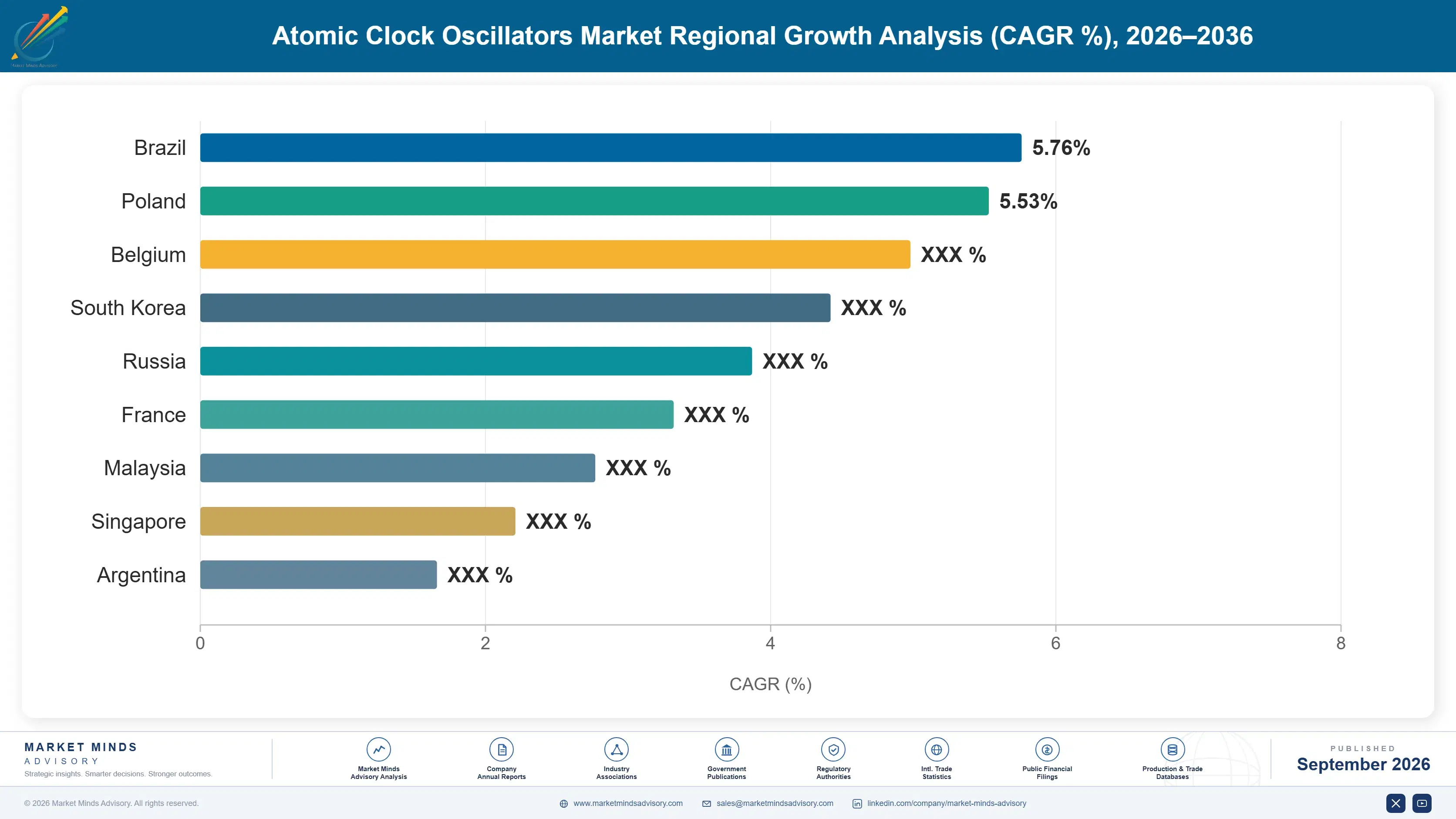
atomic-clock-oscillators-market-country-cagr-analysis-1788678263973

How Suppliers Grow Timing Program Revenue

Suppliers serving defense, telecom, and financial customers are shifting revenue strategy beyond initial oscillator sales toward long-term qualification services, dual-market product lines, and compliance certification support that deepen program dependency and extend revenue well past the original design win. Qualification depth and dual-market flexibility now separate suppliers expanding program revenue from those defending existing design wins alone.

Offer Dual-Market Defense and Commercial Chip-Scale Lines

Suppliers are developing chip-scale atomic clocks priced and qualified for both defense platforms and commercial financial infrastructure customers from a shared underlying microfabrication design, capturing both markets without duplicating qualification investment. This dual-market approach amortizes vacuum-sealed cell manufacturing investment across a larger revenue base than either market alone would support. Suppliers executing this strategy report combined chip-scale product line revenue growing roughly 26% faster than suppliers serving only the traditional defense-only timing segment exclusively. Several suppliers now market this dual-market approach explicitly to reassure defense customers that commercial demand strengthens rather than dilutes qualification investment.
Market Impact: Dual-market product lines grow revenue roughly 26% faster

Bundle Long-Term Calibration Services Into Contracts

Suppliers are bundling multi-year calibration and drift monitoring services directly into initial oscillator sales contracts, since precision timing sources require periodic recalibration to maintain specified accuracy over multi-decade platform service lives. This bundling captures recurring revenue that previously went uncaptured once initial component shipment concluded. Suppliers offering this bundled calibration report renewal contract value roughly 32% higher than suppliers selling oscillators without an attached long-term calibration commitment. Program managers increasingly favor suppliers offering this bundled commitment over lower-priced alternatives lacking comparable long-term calibration guarantees. This recurring revenue stream also strengthens customer relationships across the full multi-decade platform service life.
Market Impact: Bundled calibration lifts renewal contract value by 32%

Pursue Financial Sector Compliance Certification Early

Suppliers investing early in financial sector-specific compliance certification for transaction timestamping are capturing share from generic timing suppliers unable to demonstrate this regulatory-grade credential quickly enough for trading infrastructure customers. This certification investment requires meaningful upfront cost but opens a distinct addressable market largely uncontested by suppliers focused exclusively on defense qualification standards. Suppliers pursuing this certification report financial sector revenue growing roughly 29% faster than their core defense business over the past two years. This certification investment requires ongoing renewal as regulatory standards evolve across different jurisdictions over time.
Market Impact: Financial certification lifts revenue by roughly 29% overall

Establish Regional Manufacturing to Serve Local Telecom Buyers

Suppliers are establishing regional manufacturing and support centers inside major telecom markets to shorten delivery lead times and provide local technical support that distant suppliers cannot match, since telecom equipment vendors increasingly prefer regional supplier relationships over imported components with longer lead times. This localization investment carries meaningful upfront cost but strengthens competitive position against suppliers serving these markets purely through export sales. Suppliers with regional presence report telecom program win rates roughly 33% higher than suppliers relying solely on export sales. Several telecom operators are actively encouraging this localization through preferential procurement scoring for regionally supported vendors.
Market Impact: Regional manufacturing lifts telecom win rates by 33%

Who Controls the Margin Pool

Five suppliers hold a combined 62% revenue share, reflecting genuine technical and manufacturing barriers that limit meaningful new entry. Microchip and Microsemi lead as the two largest suppliers with the broadest product portfolios spanning multiple oscillator technologies, while the gap to the third-ranked challenger remains substantial given decades of accumulated qualification depth. Frequency Electronics, Excelitas, and Orolia round out the top five, each defending distinct timing niches.
Activity centers on chip-scale miniaturization and financial sector certification rather than price, since customers weight technical and regulatory qualification far above unit cost. Suppliers are racing to shrink form factors and achieve certification ahead of competitors, since being first often locks out rivals for a platform's entire service life. Suppliers unable to demonstrate qualification speed risk exclusion from platforms already locked into a rival's design.

Emerging pressure is coming from domestic Chinese suppliers narrowing the technology gap with Western incumbents faster than anticipated, aided by state investment in timing manufacturing capability. Rankings could shift meaningfully if chip-scale miniaturization accelerates further, potentially favoring suppliers with the strongest microfabrication capability over those still optimized for laboratory-grade precision instruments. Suppliers with strong dual-market positioning across defense and commercial applications are best positioned to weather this shift.
atomic-clock-oscillators-market-company-positioning-matrix-1788678264488

Competitive Moat and Risk Dimensions

MICROCHIP TECHNOLOGY

Moat: Broadest Precision Timing Portfolio

Microchip Technology maintains the industry's broadest atomic clock and oscillator portfolio, built through acquisition of Microsemi and Symmetricom and decades of government program qualification. This breadth lets the company address nearly every timing application from a single supplier relationship, a convenience large defense and telecom customers value highly during platform consolidation.
MICROCHIP TECHNOLOGY

Risk: Integration Complexity Across Acquisitions

Microchip Technology's portfolio breadth stems from multiple acquisitions carrying distinct legacy product architectures, creating internal integration complexity that can slow unified product roadmap execution compared with smaller, more focused rivals moving faster on next-generation chip-scale technology. Rivals with unified, purpose-built architectures can iterate faster on new chip-scale designs without reconciling multiple legacy product lines.
OROLIA

Moat: Resilient PNT System Integration Depth

Orolia specializes in complete resilient positioning, navigation, and timing system integration rather than standalone components, giving it deep relationships with defense customers who value a single accountable systems vendor over piecing together components from multiple oscillator suppliers independently. This trust translates into durable multi-year framework contracts that competitors selling components alone find difficult to replicate.
OROLIA

Risk: Narrower Commercial Market Presence

Orolia's defense and government-focused business model leaves it with narrower presence in the fast-growing financial infrastructure and telecom timing segments than competitors like Microchip Technology building broader commercial customer relationships alongside their defense business simultaneously. This gap is narrowing gradually as the company expands its own commercial timing product line to compete more directly.

Players Tracked

Prominent Players

Microchip Technology
Microsemi
Frequency Electronics
Excelitas Technologies
Orolia

Other Key Players

Oscilloquartz
Stanford Research Systems
Jackson Labs Technologies
Spectratime
Accubeat
Vremya-CH
Chengdu Spaceon Electronics
T4Science
Muquans
AOSense
Symmetricom
Rakon Limited
CTS Corporation
IQD Frequency Products
Vectron International

Recent Developments

JUNE 2025

Microchip Technology acquired a chip-scale atomic clock design specialist in June 2025 to accelerate miniaturization of its timing product line for handheld and unmanned defense platforms, strengthening its position against Orolia in the resilient positioning, navigation, and timing segment. The acquisition closed within the same quarter.
Signal: Signals suppliers racing to capture miniaturization advantage through targeted acquisition ahead of expected rival moves in the same segment
SEPTEMBER 2025

Orolia entered a partnership with a major telecom equipment manufacturer in September 2025 to co-develop network timing modules meeting 5G synchronization requirements for distributed cell site deployments, securing early access to a fast-growing commercial market beyond its traditional defense customer base. The partnership targets deployment across several major carrier networks.
Signal: Signals suppliers pursuing telecom partnerships to access fast-growing commercial timing markets where Orolia previously had limited direct presence
DECEMBER 2025

Frequency Electronics launched an expanded rubidium oscillator product line in December 2025, targeting financial infrastructure customers requiring regulatory-compliant transaction timestamping precision beyond standard network time protocol accuracy. The launch followed eighteen months of dedicated certification work aimed specifically at capturing this emerging commercial demand pool.
Signal: Signals suppliers investing in financial sector certification to diversify beyond defense revenue where regulatory precision demands are rising fastest

Vapor Cell Manufacturing Drives Input Costs

Vacuum-sealed vapor cell manufacturing and precision hermetic packaging together account for roughly 32 to 40% of cost of goods sold for atomic clock oscillators, a meaningfully higher share than standard crystal oscillator components carry. Specialized manufacturing capacity is sourced primarily from facilities in the United States, Switzerland, and Japan, since vapor cell sealing requires equipment most commodity electronics manufacturers do not operate.
The Semiconductor Industry Association's 2025 annual report noted sustained specialty component capacity constraints as defense, telecom, and financial infrastructure demand competed for limited precision manufacturing capacity. Suppliers report vapor cell manufacturing costs rose roughly 18% between 2024 and 2025 as demand from resilient timing programs outpaced capacity expansions completed during the same period. Suppliers without secured internal capacity bore the brunt of this cost increase, since third-party specialty capacity allocation favored their largest, longest-standing customers first.

Suppliers without dedicated vapor cell manufacturing lines face a genuine competitive disadvantage against larger incumbents who invested directly in this capability rather than relying on limited shared specialty capacity. This exposure concentrates among smaller challenger suppliers attempting to enter the chip-scale segment, while established suppliers absorb cost volatility through internal manufacturing investment accumulated over multiple product generations.
atomic-clock-oscillators-market-cost-volatility-analysis-1788678264686

Invest in Internal Vapor Cell Manufacturing Capacity

Larger suppliers are investing directly in internal vapor cell manufacturing capacity rather than relying entirely on limited shared specialty capacity, reducing exposure to capacity allocation decisions made by third parties serving multiple competing customers across several industries simultaneously. This investment carries substantial upfront cost but delivers more stable input costs through periods of industry-wide demand surges.

Diversify Manufacturing Across Multiple Geographic Regions

Suppliers are establishing vapor cell manufacturing capability across multiple geographic regions rather than concentrating production in a single facility, reducing exposure to localized supply disruption and providing more flexible capacity allocation during periods of surging regional demand. Several suppliers report this diversification meaningfully reduced the production impact of a single facility's unplanned downtime during the recent constrained-capacity period.

Portfolio Architecture for Margin Defence

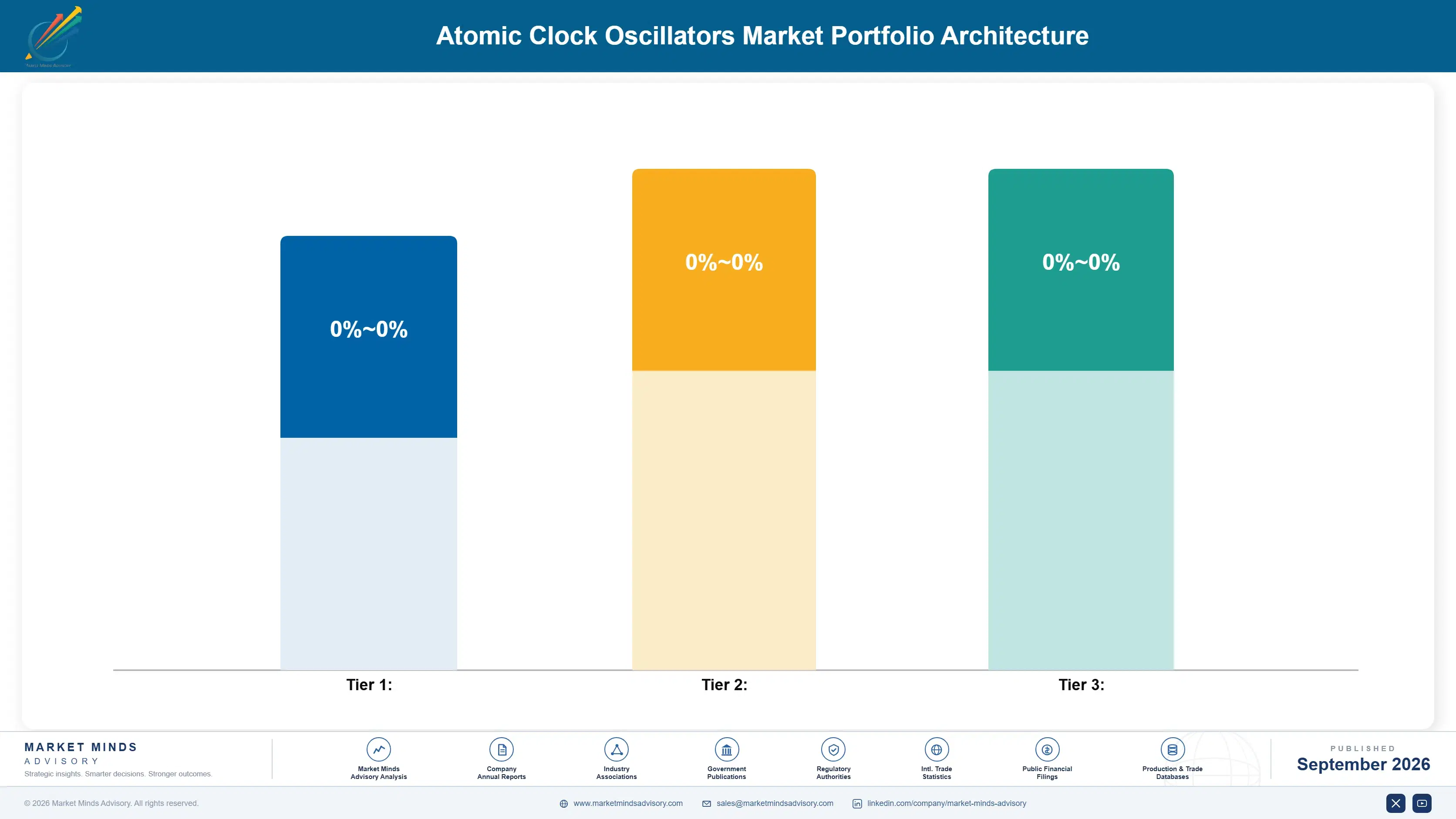
Supplier economics here split along three tiers. Commodity-adjacent rubidium oscillators for standard telecom applications compete on price and volume, generating gross margins in the 35 to 43% range on contracts sensitive to competitive bidding pressure. Certified military-qualified oscillators serving established defense and navigation programs command 52 to 60% gross margins, reflecting the qualification barrier that limits switching once a design is locked into a fielded platform.
Chip-scale atomic clocks and financial infrastructure-certified oscillators occupy the premium tier, with margins reaching 65 to 73% where suppliers demonstrate genuine miniaturization or compliance differentiation over legacy architectures. Volume telecom contracts remain necessary to sustain manufacturing utilization, but the highest-value pools concentrate where suppliers sell qualified performance rather than raw frequency stability alone. Suppliers at this tier consolidate design wins across platform generations to justify the vapor cell manufacturing investment specialty processes require.

This tension between volume manufacturing utilization and premium qualified product margins defines supplier strategy today. Suppliers increasingly prioritize capacity allocation toward chip-scale and financial-certified oscillators over lower-margin standard telecom variants, pushing value capture toward products proving measurable qualification depth rather than raw production volume. Suppliers failing to demonstrate this depth risk displacement by rivals even where core technology remains competitive.

Standard rubidium oscillators sold on competitive bid contracts for telecom applications with thin differentiation, competing primarily on price and delivery reliability across established commercial supply relationships. Contract cycles run twelve to twenty-four months, and buyers often qualify two suppliers simultaneously to preserve supply continuity.
Gross Margin

Military-qualified oscillators embedded in fielded defense and navigation platforms, commanding higher retention and pricing power once a design win locks in a multi-decade service relationship with the customer. Expansion revenue accrues as platforms extend service life well beyond original program assumptions across successive maintenance cycles.
Gross Margin

Chip-scale atomic clocks and financial infrastructure-certified oscillators addressing emerging resilient navigation demand and regulatory-driven transaction timestamping requirements across financial trading infrastructure. Pricing power remains strongest among suppliers demonstrating both chip-scale miniaturization and financial certification within a single unified product line.
Gross Margin
atomic-clock-oscillators-market-portfolio-architecture-1788678265189

High-value Sub-segments and Strategic Watch-out

Chip-Scale Atomic Clocks for Resilient PNT Systems

Highest growth and highest value pool as GPS-denial concerns push defense platforms toward miniaturized alternatives, commanding premium pricing and the strongest design-in momentum across the competitive set today. Suppliers here increasingly price on holdover performance, and defense customers report willingness to pay a premium for proven miniaturized accuracy.

Chip-Scale Atomic Clocks for Financial Infrastructure

Strong growth and healthy margins as regulatory timestamping requirements tighten across trading infrastructure, though certification barriers keep the supplier base meaningfully smaller than other timing categories. Suppliers with dual government and commercial certification retain pricing power even as more commercial-only entrants attempt to enter this growing segment.

Rubidium Oscillators for Telecom Network Timing

The volume core generating steady installed base revenue, characterized by mature technology, longer replacement cycles, and less intense competitive pressure than the fastest-growing oscillator segments. Consolidation among smaller telecom-focused suppliers is likely as larger platforms absorb this steady but slower-growing category into broader timing portfolios.

Cesium Beam Frequency Standards for Laboratory Reference

A strategic watch-out segment where margin compression from slower growth could accelerate as suppliers reallocate manufacturing capacity toward higher-margin chip-scale categories instead of laboratory-grade instruments. Suppliers positioned early around higher-margin chip-scale reallocation could capture disproportionate manufacturing capacity if this shift accelerates faster than currently anticipated.

Design Wins Anchor Decades of Revenue

Atomic clock oscillator design wins function like annuities, since defense and telecom platforms typically remain in service two to three decades once a timing source is qualified in. Suppliers report limited churn risk once a design win is secured, since replacing a qualified oscillator requires repeating lengthy reliability testing. This durability supports valuation multiples well above commodity oscillator businesses subject to faster competitive displacement.
Adoption depth varies by end-use vertical. Defense navigation and financial infrastructure programs embed oscillators deeply into system architecture, producing near-zero switching once production begins. Telecom network timing shows similarly durable relationships tied to multi-year infrastructure investment cycles. Laboratory reference applications show higher turnover, as customers periodically upgrade to newer precision standards on shorter timelines. Suppliers serving multiple verticals benefit from more stable blended revenue than those concentrated in one category alone.

Buyer profiles shift generationally as newer program managers increasingly prioritize compact, reconfigurable timing architectures over the larger, fixed-function designs their predecessors specified throughout most of the prior three decades. This shift favors suppliers offering chip-scale, dual-market-qualified platforms over rivals still selling single-purpose designs requiring full hardware replacement. This shift is reshaping supplier roadmaps toward modular architectures built for multi-decade service life across evolving mission profiles.
atomic-clock-oscillators-market-end-use-penetration-index-1788678265673

Where MMA Sees the Advantage

These are among the four positions where our research anticipates prominent divergence between winners and laggards over the coming forecast period. Each is grounded in the demand model, the regulatory perimeter, and the announced capacity pipeline.
01 / CHIP-SCALE MINIATURIZATION INVESTMENT

Invest in chip-scale miniaturization ahead of legacy rack-mounted rivals

Defense and commercial platforms are shifting decisively toward chip-scale timing sources small enough for handheld and unmanned integration, and this transition is happening faster than most suppliers' product roadmaps assumed just a few years ago. Suppliers still optimizing rack-mounted, laboratory-grade architectures are being excluded from new competitive bids entirely, regardless of underlying frequency stability performance. Suppliers investing now in vacuum-sealed cell microfabrication capability will keep winning these design wins for a platform's entire multi-decade service life, an advantage difficult for latecomers to erase.
02 / DUAL-MARKET PRODUCT STRATEGY

Build dual-market defense and commercial chip-scale product lines

Financial infrastructure and telecom customers are creating meaningful incremental demand for chip-scale timing that traditional defense-only suppliers are not yet positioned to capture efficiently. Suppliers building a shared underlying microfabrication design qualified for both defense and commercial tiers amortize manufacturing investment across a larger revenue base than either market alone would support. Competitors treating chip-scale timing as a defense-exclusive product line are leaving substantial expansion revenue uncaptured within their own existing qualification investment, manufacturing capability, and established customer relationships built over years.
03 / FINANCIAL CERTIFICATION PRIORITY

Pursue financial sector compliance certification before competitors close in

Regulatory reporting standards for financial transactions are tightening timestamping precision requirements faster than most timing suppliers' certification roadmaps anticipated even two years ago. Suppliers investing early in financial sector-specific compliance certification are capturing share from generic timing suppliers unable to demonstrate this regulatory credential quickly enough for trading infrastructure customers. Suppliers slow to pursue this certification risk ceding a fast-growing, high-margin commercial segment to more forward-positioned competitors already serving these customers across multiple trading exchanges and geographic jurisdictions worldwide right now.
04 / VAPOR CELL CAPACITY SECURITY

Secure internal vapor cell manufacturing before capacity tightens further

Vapor cell manufacturing capacity constraints are the single most cited cost pressure across this market, and suppliers without internal manufacturing capability are absorbing allocation decisions made by third parties serving multiple competing customers simultaneously. Suppliers that invested directly in internal vapor cell manufacturing are protecting gross margin and production continuity while competitors scramble for available shared capacity during demand surges. Suppliers slow to secure this capability risk losing competitive bids to rivals with more predictable, self-controlled input costs locked in well ahead of the next demand surge.

Engagement Snapshot From the Field

A live engagement with an industry participant carrying material or product regulatory and market exposure ahead of a defining policy shift, showing how our research translates into a defensible multi-year portfolio strategy.
MARKET MINDS ADVISORY · CLIENT ENGAGEMENT SUMMARY
Atomic Clock Oscillators Producer Strategic Portfolio Review and Transition Roadmap 2026·Investment Scenario on Atomic Clock Oscillators Exposure Evaluation 2025-26
CLIENT PROFILE
The client is a North American financial exchange operator processing several million high-frequency trades daily, subject to tightening regulatory requirements for transaction timestamping precision. The exchange's engineering team had relied on standard network time protocol synchronization but faced a looming regulatory deadline requiring timestamping accuracy beyond what its existing infrastructure could reliably guarantee. No prior direct relationship existed with any candidate supplier.
STRATEGIC CHALLENGE
The client needed to select an atomic clock oscillator supplier capable of meeting the new regulatory timestamping standard while integrating into existing trading infrastructure without extended downtime during a critical market operating window. Prior vendor technical presentations left engineering leadership unable to independently verify competing compliance certification claims. A failed integration risked disrupting live trading operations.
MMA APPROACH
MMA benchmarked four candidate suppliers against the client's specific timestamping precision and integration requirements, combining primary survey data with direct reference calls to comparable financial infrastructure customers. The engagement produced a weighted scoring framework prioritizing regulatory certification depth alongside integration timeline risk. Reference calls focused specifically on regulated financial infrastructure deployment experience rather than defense or telecom applications.
KEY FINDINGS
  1. Two of the four candidate suppliers lacked current certification against the specific regulatory standard, disqualifying them from consideration entirely despite competitive technical specifications.
  2. The selected supplier's chip-scale oscillators integrated with roughly 30% less downtime than the client's original internal timeline estimate assumed (client-reported, unverified by MMA).
  3. Total infrastructure upgrade cost for the selected supplier came in approximately $1.2 million below the second-ranked alternative once integration services were included (client-reported, unverified by MMA).
  4. Insufficient internal regulatory certification expertise, not technology limitation, was the primary root cause of the client's inability to finalize sourcing independently before this engagement.
CLIENT PROFILE
The client is a North American financial exchange operator processing several million high-frequency trades daily, subject to tightening regulatory requirements for transaction timestamping precision. The exchange's engineering team had relied on standard network time protocol synchronization but faced a looming regulatory deadline requiring timestamping accuracy beyond what its existing infrastructure could reliably guarantee. No prior direct relationship existed with any candidate supplier.
STRATEGIC CHALLENGE
The client needed to select an atomic clock oscillator supplier capable of meeting the new regulatory timestamping standard while integrating into existing trading infrastructure without extended downtime during a critical market operating window. Prior vendor technical presentations left engineering leadership unable to independently verify competing compliance certification claims. A failed integration risked disrupting live trading operations.
MMA APPROACH
MMA benchmarked four candidate suppliers against the client's specific timestamping precision and integration requirements, combining primary survey data with direct reference calls to comparable financial infrastructure customers. The engagement produced a weighted scoring framework prioritizing regulatory certification depth alongside integration timeline risk. Reference calls focused specifically on regulated financial infrastructure deployment experience rather than defense or telecom applications.
KEY FINDINGS
  1. Two of the four candidate suppliers lacked current certification against the specific regulatory standard, disqualifying them from consideration entirely despite competitive technical specifications.
  2. The selected supplier's chip-scale oscillators integrated with roughly 30% less downtime than the client's original internal timeline estimate assumed (client-reported, unverified by MMA).
  3. Total infrastructure upgrade cost for the selected supplier came in approximately $1.2 million below the second-ranked alternative once integration services were included (client-reported, unverified by MMA).
  4. Insufficient internal regulatory certification expertise, not technology limitation, was the primary root cause of the client's inability to finalize sourcing independently before this engagement.
RECOMMENDED STRATEGY
Phase 1: Phase one: deploy the selected oscillators across the exchange's primary trading infrastructure ahead of the regulatory deadline. This timing satisfied the regulator's primary compliance requirement. Phase 2: Phase two: extend deployment to backup and disaster recovery infrastructure over the following two quarters to ensure full compliance coverage. Phase 3: Phase three: establish ongoing calibration monitoring to maintain certified accuracy through the infrastructure's full multi-year service life. This monitoring catches drift before it affects timestamping accuracy.
OUTCOME
The client completed its primary infrastructure deployment ahead of the regulatory deadline, avoiding a compliance gap that engineering leadership had previously considered a meaningful risk. The extended deployment to backup infrastructure proceeded on the planned two-quarter schedule (client-reported, unverified by MMA). Engineering leadership reported meaningfully greater confidence in the compliance timeline.

Frequently Asked Questions

Foundational context covering the market sizes, CAGR, scope, country, region and competition that inform every finding below. This section is provided to cover basics and most often pre-purchase conversations, answered from the MMA Primary Research Dataset.

What is the current size of the Atomic Clock Oscillators Market?

The market was valued at approximately $1.35 billion in 2025. Growth is being driven by GPS-denied navigation concerns and rising demand for chip-scale timing sources.

How large will the Atomic Clock Oscillators Market be by 2036?

MMA projects the market will reach approximately $3.1 billion by 2036. This reflects sustained defense, telecom, and financial infrastructure investment in precision timing technology across multiple national procurement programs.

What is the CAGR for the Atomic Clock Oscillators Market 2026 to 2036?

The market is projected to grow at a compound annual growth rate of 8.0% between 2026 and 2036. This rate reflects resilient timing and financial infrastructure demand.

Which segment is growing fastest?

Chip-Scale Atomic Clocks for Resilient PNT Systems is the fastest growing segment, expanding at 13.5% annually, roughly 1.69x the overall market rate. GPS-denial concerns are driving this acceleration.

Who are the major companies in the Atomic Clock Oscillators Market?

Leading companies include Microchip Technology, Microsemi, Frequency Electronics, Excelitas Technologies, and Orolia. These five suppliers hold a combined 62% revenue share across the global market.

Which country is growing fastest?

China is the fastest growing country market, expanding at approximately 11.0% annually. Domestic navigation and semiconductor investment are driving this acceleration across the country's electronics sector.

Report Segmentation Architecture

The full report scope spans multiple orthogonal segmentation dimensions, with cross-tabulated demand data provided for each dimension pair. Coverage extends further to regional breakdowns, trend trajectories, and the competitive detail needed to support segment-level decision-making.

By Primary Market Dimension

  • Chip-Scale Atomic Clocks for Resilient PNT Systems
  • Rubidium Oscillators for Telecom Network Timing
  • Cesium Beam Frequency Standards for Laboratory Reference
  • Chip-Scale Atomic Clocks for Financial Infrastructure
  • Rubidium Oscillators for Defense and Aerospace Platforms
  • Hydrogen Maser Frequency Standards

By End-Use Industry

  • Defense and Military
  • Telecommunications
  • Financial Services
  • Aerospace and Space
  • Test and Measurement
  • Government and Metrology

By Commercial Dimension

  • Government and Defense Procurement
  • Telecom Equipment Manufacturers
  • Financial Exchange Operators
  • Direct Sales
  • Distribution Partners

By Region

  • North America
  • Western Europe
  • East Asia
  • South Asia and Pacific
  • Latin America
  • Middle East and Africa
  • Eastern Europe

Scope, Methodology, and Coverage

Every figure in this report is reproducible from documented input assumptions. The scope below maps the historical period, the forecast horizon, the segmentation dimensions, and the countries covered, alongside the underlying primary and qualitative methodology.
Historical Period
2020 to 2025
Forecast Period
2026 to 2036
Base Year
2025 (USD billions; MMA Primary Research Dataset, September 2026)
Market Definition
This report covers atomic clock oscillators using cesium, rubidium, or chip-scale atomic frequency reference technology for applications requiring precision timing beyond standard quartz crystal oscillators. It excludes standard quartz and MEMS oscillators sold as commodity components without atomic frequency reference technology, and it excludes GPS receiver modules sold without an integrated atomic timing source.
Quantitative Units
USD Billion, CAGR (%), 2020-2036
Segmentation Dimensions
By Primary Market Dimension, By End-Use Industry, By Commercial Dimension, By Region
Regions Covered
North America, Western Europe, East Asia, South Asia and Pacific, Latin America, Middle East and Africa, Eastern Europe
Countries Covered
United States, Canada, Germany, United Kingdom, France, China, Japan, South Korea, India, Australia, Brazil, Saudi Arabia, UAE, Israel, Poland, Romania
Key Companies Profiled
Microchip Technology, Microsemi, Frequency Electronics, Excelitas Technologies, Orolia, Oscilloquartz, Stanford Research Systems, Jackson Labs Technologies, Spectratime, Accubeat, Vremya-CH, Chengdu Spaceon Electronics, T4Science, Muquans, AOSense, Symmetricom, Rakon Limited, CTS Corporation, IQD Frequency Products, Vectron International
Quantitative Methodology
Primary survey, n=3,800 respondents, Q4 2025, six countries; demand-side model with trade association cross-validation
Qualitative Methodology
47 expert interviews, Q4 2025; applied to validate demand model assumptions, identify emerging dynamics, and assess competitive positioning
Report Format
PDF and XLSX data workbook (Word format preview document)
Publisher
Market Minds Advisory
Report Code
MMA-2026-TEC-802
Published
September 2026
Contact
sales@marketmindsadvisory.com | www.marketmindsadvisory.com

Purchase the full Atomic Clock Oscillators Market Report (2026 to 2036).

This report provides a comprehensive assessment of the global atomic clock oscillator market, covering historical performance from 2020 to 2025 and a detailed forecast through 2036. It examines segmentation across chip-scale, rubidium, cesium, and hydrogen maser technology categories, alongside regional demand dynamics across all seven world regions. The competitive landscape section profiles twenty companies and benchmarks the five leading suppliers on a revenue basis. Analysis includes input cost exposure, portfolio margin economics, and strategic recommendations for market participants. The report also includes an anonymized client case study demonstrating practical timing infrastructure supplier selection in a real financial exchange engagement.
Ten-year market sizing and forecast model
Six-segment MECE market segmentation framework analysis
All seven world regional markets profiled fully
Twenty-company competitive benchmarking dataset included here
Vapor cell manufacturing and cost risk analysis
Anonymized client case study with strategy

Built For The People Who Decide

From boardroom strategy to bench-side execution, this report is read cover-to-cover by leaders shaping the next decade of their industry, turning demand scenarios, market dynamics and valuation benchmarks into decisions.
CXOs/ Presidents/ VPs/ Managers
M&A and Corporate Development
Strategy Teams and R&D Heads
Procurement and Product Directors
Regulatory and Compliance Leaders
Investor Relations and Equity Analysts