

Market Minds Advisory
Athletic Socks Market

Athletic Socks Market: Athletic Socks Market: The Cotton Default, Friction Rather Than Cushioning and Where The Knitting Machines Are

Blisters come from shear between sock and skin rather than from insufficient padding, and the industry has spent thirty years selling thicker cushioning against a problem that cushioning does not solve.

Lead Analyst

Published

September 2026

Make Smarter Decisions with Customized Research Insights

Request a free sample report and evaluate market opportunities, growth trends, and competitive dynamics relevant to your business needs.

2025 MARKET VALUE$11.2BMarket Size 2025
2036 FORECAST VALUE$20.3BBase Case , 2026 to 2036
CAGR 2026 TO 20365.6 %Bull 6.8% / Bear 4.4%
INCREMENTAL OPPORTUNITY$8.5BNet 10- year value creation
EXPANSION MULTIPLE1.72x2036 value over 2026 base
Strategic Levers
M&A Pipeline
Regional Outlook
Country Rankings
Competitive Intelligence
Segmental Deep-dive
Call-Us : 91 93563 13602

Executive Snapshot and Market Trajectory.

Most athletic socks sold anywhere are still cotton-blend, and cotton is the one fibre that holds moisture against skin instead of moving it away. It feels soft in the pack, costs least to knit, and is the single largest reason people get blisters. It knits easily and photographs well.
Merino and wool-blend socks grow at 8.4%, half again the market rate of 5.6%, as buyers work out that wool manages moisture and odour in a way synthetics only partly match. Synthetic technical socks follow at 7.1%. Cotton-blend everyday socks grow slowest at 3.2%, still holding roughly 58% of what actually sells. Odour rather than warmth is the reason buyers actually give for switching.
Knitting machine capability rather than brand decides what can be made. Closed toe toe closure, zone knitting and fine gauge all require specific machinery built almost entirely in Italy and installed almost entirely in Asia. Concentration is very low at 19% held by the top five, and India is growing fastest of any country covered at 8.9%. A brand without access to current generation machinery cannot make the product regardless of what it specifies.
Market Definition
This market covers socks designed and sold for athletic and active use, spanning merino and wool-blend, synthetic technical, toe and double-layer, compression and graduated, sport-specific padded, and cotton-blend everyday athletic constructions. Sizing is at wholesale shipment value. Dress and formal hosiery, medical-grade compression prescribed for venous conditions, tights and leggings, and footwear insoles are excluded from scope.
Base Year Value
$11.2B in 2025 (MMA Primary Research Dataset, September 2026)
Forecast Period
2026 to 2036, eleven discrete annual values
CAGR
5.6% base case. Bull 6.8%. Bear 4.4%.
Fastest Growth Segment
Merino And Wool-Blend Socks: 8.4% CAGR
Fastest Growth Country
India: 8.9% CAGR
Fastest Growth Region
South Asia and Pacific: 7.7% CAGR
Largest Region
East Asia: 30% of 2025 global value
Market Leaders
Hanesbrands, Gildan Activewear, Renfro Brands, Nike, Adidas. Source: MMA Primary Research Dataset, July 2026.
Primary Survey
n=3,800 procurement and R&D decision-makers, Q4 2025, six countries
Methodology
Demand-side build-up, cross-validated against public data, 47 expert interviews

Athletic Socks Market Forecast Scenarios

athletic-socks-market-share-analysis-size-forecast-scenario-1790024426008
Growth of 4.5% between 2020 and 2025 reflects a participation surge that partly stuck. Running and walking took in enormous numbers of new participants through 2020 and 2021, and socks sold with the shoes that went on those feet. Much of that cohort stopped, but those who continued had learned the difference between a cotton multipack and a technical sock, and buy differently now.
Three mechanisms carry the base case. Merino grows at 8.4% as moisture and odour management becomes a purchase criterion rather than a claim. Indian demand expands at 8.9% on running participation and a domestic knitting base that is moving upmarket. Footwear retail attach rates are rising as specialist stores learn that a sock recommendation at the till is worth more margin than the shoe underneath it. None depends on participation changing.
The bull case is friction education reaching mainstream retail. If buyers understood that blisters come from shear rather than thin padding, toe and double-layer constructions would move from niche to standard the way closed toe toes did. The bear case is merino supply. Australian and New Zealand clip volumes have fallen for a decade, and further contraction would price the fastest segment out of growth.

What Actually Causes Blisters

The category sells cushioning against a problem that cushioning does not fix. Blisters form from repeated shear between sock and skin, not from impact, which is why double-layer and toe constructions work and why a thicker pad frequently makes things worse by adding bulk that slides. Moisture makes shear worse, and cotton holds it. Around 58% of athletic socks sold still use cotton as the primary fibre. It is cheaper and knits easily, which is most of why the default persists.
TOP FIVE CONCENTRATION19%Combined shipment value share held by five largest participants
COTTON BLEND SHARE58%Portion of athletic socks sold with cotton as primary fibre
AVERAGE PAIR PRICEUSD 9Weighted retail price for a single pair of socks
FOOTWEAR ATTACH RATE23%Share of athletic shoe purchases including socks in basket
MULTIPACK VOLUME SHARE64%Share of pairs sold in packs rather than individually
CLOSED TOE PENETRATION41%Products knitted with a closed rather than sewn toe
What a factory can produce is set by its machines rather than by its designers. Closed toe toe closure, zone-specific knit density and fine gauge all require particular circular knitting equipment, built almost entirely by a small group of Italian manufacturers and installed almost entirely across China, Turkey, Vietnam and India. A brand without access to that machinery cannot make the product regardless of what it specifies.
Attach rate at footwear purchase runs about 23% and it is the most valuable number in the category. A sock recommended at the till carries higher margin than the shoe it was sold alongside, and very few retailers work the moment properly. Structured attach selling nearly doubles it where staff are trained.
"This industry has spent three decades adding foam to the bottom of a sock to stop blisters that are caused by something else entirely. The fix is a second layer that slides against itself, it has been known for years, and it is still shelved as a novelty."
Director, Apparel and Performance Textiles Practice · MMA Consumer and Industrial Goods Practice · September 2026

Market Trends

Merino Displaces Synthetic On Odour Rather Than Warmth

Merino and wool-blend socks grow at 8.4% against 5.6% for the category, and the reason buyers give is not warmth, which is what the fibre is usually marketed on. Wool suppresses odour because its structure limits the bacterial activity that produces it, and it continues managing moisture when damp rather than holding it against skin. Synthetics match the moisture transport and lose on odour decisively. Price remains the barrier, since merino yarn costs several times what polyester does per kilogram. Blending with synthetic spreads that exposure and improves abrasion resistance at the heel.
Market Impact: India grows at 8.9% annually

Closed toe Toe Closure Becomes A Baseline Expectation

Closed toe knitting has reached around 41% of products and is moving toward the point where a sewn toe seam reads as a defect rather than as a cost saving. The ridge a sewn seam creates sits directly across the toes and is a common pressure point on long efforts. Adoption is a machine question rather than a design one, since closure requires specific equipment. That has consolidated production toward factories with recent capital investment and squeezed those running older machines. A sewn seam now reads as a cost saving rather than as a neutral construction choice.
Market Impact: Attach rate sits at 23%

Market Opportunities and Growth Drivers

Indian Running Participation Meets A Domestic Knitting Base

India grows fastest of any country covered at 8.9%, and it is unusual in combining rapidly rising running participation with a domestic knitting industry that is moving upmarket at the same time. Tiruppur and Ludhiana hosiery clusters have invested in newer circular knitting capacity capable of closed toe closure and zone knitting, which lets domestic brands offer technical construction at prices imported product cannot reach. Event participation in city half marathons has grown steeply and pulls specification awareness with it. Domestic brands are moving from contract knitting into their own labels on the back of that capability.
Market Impact: Cotton holds 58% of sales

Footwear Retail Discovers What The Attach Sale Earns

Socks carry considerably higher gross margin than the athletic shoes they are sold beside, and attach rate at footwear purchase runs only about 23% across specialist retail. Stores that train staff to fit socks alongside shoes, rather than leaving them on a wall by the door, convert a meaningful share of every shoe sale into a second higher-margin item. The practice requires staff time rather than inventory investment, and it is spreading through specialist running retail first. Structured attach selling lifts the rate to nearly double where staff are actually trained on it. Very few chains have made the investment.
Market Impact: Clip volumes fell over 10 years

Market Restraints and Challenges

Cotton Remains The Default Against The Evidence

Around 58% of athletic socks sold use cotton as the primary fibre despite it being the one common option that holds moisture against skin and raises blister risk. The root cause is commercial rather than technical: cotton is cheaper to buy, knits easily, feels soft through packaging and photographs well, and multipack buyers compare price rather than fibre content. Commercially it keeps the category anchored to a low price point. Participants addressing it print fibre percentages prominently and explain why. The comparison only becomes possible once content sits on the front of the pack.
Market Impact: Merino grows 2.8 points faster

Merino Supply Has Contracted For A Decade

Australian and New Zealand wool clip volumes have fallen steadily as sheep numbers decline and producers shift toward meat, which constrains the fibre underpinning the fastest-growing segment. The root cause is farm economics rather than demand, since lamb returns have outperformed wool for years. Commercially it means merino yarn prices move on agricultural decisions no sock brand influences. Mitigation runs to wool-synthetic blending, contracted clip purchasing and recycled wool recovery from garment waste streams. None of the three restores the supply, and blending dilutes the odour advantage that drives the purchase in the first place.
Market Impact: Closed toe reaches 41% penetration
3 additional market trends, 4 additional growth drivers, and 2 additional restraints and challenges are covered in the full report. Contact sales@marketmindsadvisory.com to access the complete intelligence.

Segment CAGR and Growth Architecture

Segmentation follows sock construction, the dimension on which fibre cost, machine requirement, price realisation and performance claim all divide together. Six constructions are assessed at wholesale shipment value. Dress and formal hosiery, prescribed medical compression, tights and leggings, and footwear insoles sit outside the defined scope throughout this report. Machine capability separates them more sharply than design does.
athletic-socks-market-share-analysis-market-share-analysis-1790024426572

Merino And Wool-Blend Socks

Merino and wool-blend socks grow at 8.4%, half again the market rate of 5.6%, and the purchase reason buyers actually give is odour rather than warmth. Wool's structure limits the bacterial activity that produces smell, and it keeps managing moisture when damp instead of holding it against skin the way cotton does. Synthetics match the moisture transport and lose clearly on odour, which is why multi-day users converge on wool. The constraint is fibre cost, since merino yarn runs several times polyester per kilogram, and clip volumes across Australia and New Zealand have been falling for a decade. Contracting clip ahead of a season is the only real defence against that.
CAGR 8.4%

Synthetic Technical Socks

Synthetic technical socks grow at 7.1% and remain the volume answer for anyone who wants moisture management without paying merino prices. Polyester, nylon and elastane blends transport moisture efficiently, dry quickly, hold their shape through many washes and cost a fraction of wool per kilogram. They also accept zone knitting and compression structures more readily than wool blends do, which makes them the default for sport-specific construction. The weakness is odour, which builds faster than in wool and is the single most common complaint from users wearing the same pair across consecutive days. That complaint is precisely what pushes multi-day users across to wool, and it is the one gap engineered synthetics have never properly closed.
CAGR 7.1%
Full segment breakdown across 6 segments available in the complete report.

Regional Architecture and Country Demand Map

Shares record where athletic socks are sold rather than where they are knitted. Every region sits inside its standard band, which is unusual for a category whose manufacturing concentrates as heavily as this one does across Asia. No regional deviation or justification note is required on this file.

East Asia

At 30% this is the largest region and it sits at the top of its standard band, carried by Chinese domestic sportswear consumption that has expanded very quickly alongside the manufacturing base that supplies most of the world. Zhuji in Zhejiang produces socks at a scale no other location approaches. Japanese demand is distinctive and technically demanding, with toe socks and fine-gauge construction accepted as normal rather than novel, and Tabio and domestic specialists hold positions global brands have not taken. Growth of 6.5% reflects participation and premiumisation together. Korean demand is smaller but technically informed, concentrated around running and hiking. Chinese domestic brands now knit technical construction for themselves rather than only for export, which is a recent change.
Share: 30% | CAGR: 6.5% (2026 to 2036)

North America

The 27% position sits inside the standard band and carries the highest per-pair prices anywhere, with specialist running retail willing to sell socks at prices that would not clear in most markets. Running and walking participation is deep and the technical sock category is well established, particularly merino, where Darn Tough and Smartwool hold genuine positions. Attach rate at footwear purchase is where the commercial opportunity sits and it remains around 23%. Growth of 4.9% reflects a mature base trading up rather than expanding. Lifetime durability guarantees have become a competitive device here in a way they have nowhere else, converting a worn pair into a reason to stay rather than to switch. Canadian demand behaves identically at smaller scale.
Share: 27% | CAGR: 4.9% (2026 to 2036)
Regional intelligence for 5 additional markets available in the complete report: Western Europe, South Asia and Pacific, Latin America, Middle East and Africa, Eastern Europe. Contact sales@marketmindsadvisory.com.
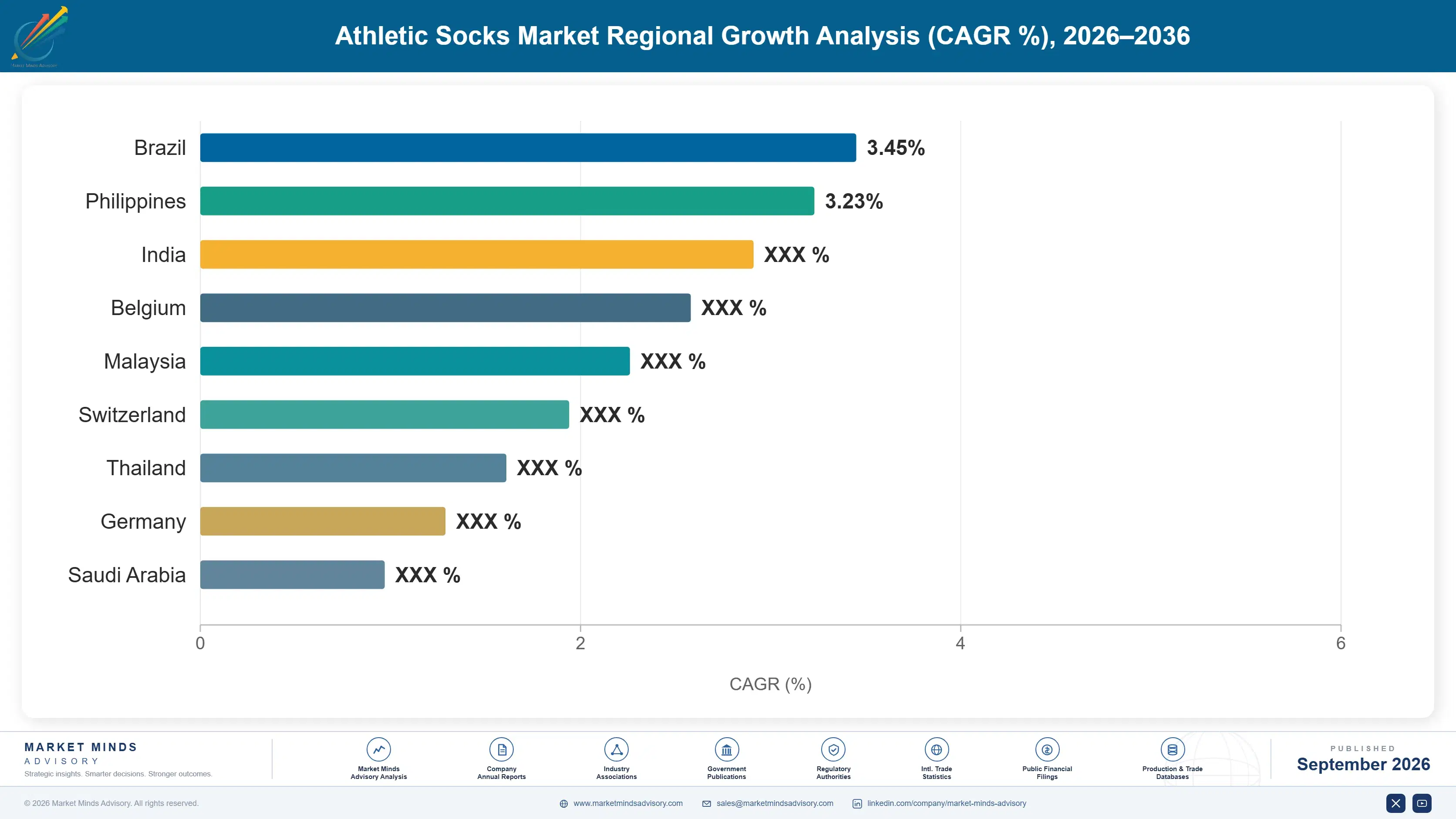
athletic-socks-market-share-analysis-country-cagr-analysis-1790024427133

Four Moves Worth Making Now

These four address a category where the dominant fibre is the wrong one, the blister mechanism is misunderstood, and the most profitable sale happens next to a shoe that somebody else made. Each has been executed by at least one participant with results that were measured rather than asserted. Two of the four cost nothing beyond a decision.

Print Fibre Percentages On The Front

Around 58% of athletic socks sold use cotton as the primary fibre and almost nothing states the split where a buyer comparing two multipacks would see it. Moving fibre content to the front of pack costs an artwork revision and converts an invisible performance difference into a visible one. Participants who did it report technical construction sell-through rising roughly 1.6 times against the same product with content printed on the reverse, because the comparison finally becomes possible at shelf. Nothing about the product changes; only what the buyer can see about it does.
Market Impact: Technical construction sell-through rises roughly 1.6 times higher

Train Footwear Retail To Fit Socks Together

Attach rate at athletic shoe purchase runs about 23% and socks carry considerably higher gross margin than the shoes beside them. Training staff to fit a sock with the shoe, rather than leaving a wall of packs by the door, costs staff time rather than inventory. Specialist retailers who implemented structured attach selling report the rate reaching roughly 41%, which adds more gross profit per transaction than any footwear price increase they could realistically take. The sock is also a smaller decision than the shoe, which means the customer says yes more readily once somebody actually asks them.
Market Impact: Footwear attach rate reaches roughly 41% of transactions

Build A Double-Layer Anti-Blister Sock Range

Blisters form from shear between sock and skin, and a construction where two layers slide against each other absorbs that movement instead of transferring it. The mechanism is well established and the segment is still merchandised as a novelty. Participants who built proper double-layer ranges report repeat purchase rates around 2.2 times their single-layer equivalents, because the product solves the problem it was bought for and they notice within one long effort. The mechanism has been understood for years and the category still shelves it as novelty. Japanese retail treats toe construction as normal, which shows the education is possible.
Market Impact: Repeat purchase rates reach roughly 2.2 times higher

Contract Merino Clip Ahead Of Each Season

Australian and New Zealand clip volumes have fallen for a decade on farm economics that favour meat over wool, and merino yarn prices move on decisions no sock brand influences. Contracting clip ahead of a season secures both volume and price on the input underpinning the fastest-growing segment. Participants contracting forward report merino input cost variance falling roughly 54% against spot purchasing, which matters more than average price because it lets them hold retail pricing. Blending with synthetic spreads the exposure further, at some cost to the odour advantage that drives the purchase.
Market Impact: Cuts merino input cost variance roughly 54% overall

Who Controls the Margin Pool

Concentration is very low at 19% held by the top five, measured consistently on wholesale shipment value rather than pairs shipped, which would overweight cotton multipacks sold in enormous quantities at very low prices. The leader to challenger gap is narrow, and this remains a category where a small brand with a genuine construction advantage holds ground against far larger competitors with much bigger marketing budgets.
Competition runs on three dimensions currently. Retail distribution decides multipack volume, where the purchase is habitual and brand recognition carries it entirely. Construction capability decides the technical tiers, and it is a function of which knitting machines a supplier runs rather than of design intent. Durability reputation decides repeat purchase in specialist retail, where customers who found a sock that lasted return to it deliberately.

Pressure is building from two directions and positions will shift on both. Indian and Turkish manufacturers with recent machine investment are moving from contract knitting into branded technical product, and they hold a cost position that Western brands sourcing from the same factories cannot match. Meanwhile direct-to-consumer specialists built on durability guarantees are taking the high-value end, where the customer researches and traditional distribution matters very little.
athletic-socks-market-share-analysis-company-positioning-matrix-1790024427657

Competitive Moat and Risk Dimensions

HANESBRANDS

Moat: Retail Distribution And Volume

Shelf presence across mass, grocery and department retail places multipacks in front of buyers making a habitual low-consideration purchase, and manufacturing scale produces unit costs that specialist competitors cannot approach at comparable quality on cotton-blend construction. Habit does most of the work in a purchase this small, and habit follows whatever is reliably on the shelf when somebody needs socks.
HANESBRANDS

Risk: Cotton Blend Category Weighting

Revenue concentrated in cotton-blend multipacks sits in the segment growing slowest at 3.2% while merino and synthetic technical grow at more than double that rate. Moving upmarket requires knitting capability and a retail conversation that a volume operation has to acquire rather than assume. Machines cannot be bought quickly.
NIKE

Moat: Footwear Attach And Brand

Owning the shoe the sock is bought alongside gives an attach position no sock specialist can replicate, since the brand is already in the transaction and the recommendation costs nothing to make. Retail and direct channels reinforce that at every point of sale. No sock specialist gets that opening.
NIKE

Risk: Outsourced Construction Capability

Socks are contract knitted rather than made in owned facilities, which means construction advantages are available to whoever else uses the same suppliers and machines. Differentiation therefore rests on brand and on design specification rather than on anything a competitor cannot order from the same factory.

Players Tracked

Prominent Players

Hanesbrands
Gildan Activewear
Renfro Brands
Nike
Adidas

Other Key Players

Thorlo
Smartwool
Darn Tough Vermont
Balega
Feetures
Stance
Bombas
Injinji
X-Socks
Falke
CEP
2XU
Tabio
Wigwam Mills
Drymax

Recent Developments

MARCH 2025

Darn Tough Vermont expands domestic knitting capacity

The company added circular knitting capacity at its Vermont facility to support merino production volumes under its lifetime guarantee programme. This was organic capital investment funded internally, with no acquisition, joint venture or contract manufacturing arrangement involved in the expansion. Existing contract production relationships continued unchanged alongside it.
Signal: Domestic capacity is added where durability guarantees make returns predictable. Guarantees work only when product outlasts warranty.
OCTOBER 2024

Renfro Brands acquires performance sock manufacturer

The company completed the acquisition of a technical performance sock manufacturer, adding zone knitting and closed toe closure capability to its existing production base. This was a completed acquisition rather than a merger or joint venture, with manufacturing retained at existing sites. Existing customer relationships transferred with the acquired operation.
Signal: Construction capability is bought because it lives in machinery, not design. Machine vintage decides which tiers a supplier reaches.
JUNE 2025

Injinji signs East Asian distribution agreement for toe socks

The toe sock specialist agreed distribution terms covering Japanese and Korean specialist retail, entering markets where toe construction is already accepted as normal rather than unusual. This was a distribution agreement with no equity component, joint venture or acquisition involved. Distribution runs through specialist rather than general sporting retail.
Signal: Toe construction needs no education in markets that already accept it. That avoids the hardest cost.

What A Pair Costs To Make

Yarn dominates and the figure swings hard by fibre. Yarn runs roughly 44% of manufacturing cost across the category, considerably higher on merino and lower on cotton-blend. Knitting machine time and depreciation take about 17%, toe closure and finishing labour around 14%, and packaging a further 8%. Logistics and overhead absorb the remainder. Machines come almost entirely from a small group of Italian builders.
Polyester and nylon yarn prices rose sharply through 2021 and 2022 on petrochemical feedstock and energy costs, a movement the EIA documents across its feedstock reporting for the period, while merino auction prices moved separately on Australian clip volumes recorded by the Australian Bureau of Statistics. Brands holding a single fibre absorbed one or the other in full. Several mid-tier ranges were reformulated toward blends rather than repriced.

Exposure divides by fibre weighting and by machine vintage rather than by size. Merino-weighted participants carry an agricultural input that responds to farm economics rather than to demand. Synthetic-weighted participants carry petrochemical exposure that is volatile but hedgeable. Older machines cannot produce closed toe closure or zone knitting at all, which is a capability gap rather than a cost one and cannot be fixed by buying yarn.
athletic-socks-market-share-analysis-cost-volatility-analysis-1790024427852

Contract merino clip ahead of the production season

Merino supply responds to farm decisions about meat against wool rather than to what sock brands need, and auction pricing moves accordingly without warning. Contracting clip ahead of a season secures volume and price on the input behind the fastest segment. The commitment lands well before the selling season generates cash, which deters smaller brands from making it.

Blend wool with synthetic to spread fibre exposure

Merino and polyester price on completely unrelated cycles, one agricultural and one petrochemical, so a blended construction is exposed to both partially rather than to either fully. Blending also improves durability, since wool alone abrades faster at the heel and toe. The trade is a slight loss of the odour advantage that drives merino purchasing in the first place.

Invest in current generation circular knitting machinery

Closed toe toe closure and zone-specific knit density are machine capabilities rather than design choices, and older equipment simply cannot produce them at any cost. Current generation machines open the technical tiers entirely. The barrier is capital, since machines come from a small group of Italian builders with long lead times and limited alternatives. Lead times run to many months.

Portfolio Architecture for Margin Defence

Margin architecture divides by whether the buyer reads the fibre content, which is not what a price list would suggest. Cotton-blend multipacks sold through mass and grocery retail run at gross margins in the mid twenties to mid thirties, bought habitually on price by shoppers who compare pair counts rather than construction and for whom the category is close to a commodity.
Synthetic technical and sport-specific padded socks hold gross margins in the low forties to high forties. The spread reflects how differently branded and private label product carry development and marketing cost. This is where most technical volume sits and where Indian and Turkish manufacturers with recent machine investment compete hardest, since their cost base and their capability now overlap with the brands they knit for.

The highest-value pool is merino, compression and double-layer anti-blister construction, at margins in the low fifties to high fifties. Those buyers researched the problem, chose on construction and pay accordingly for something that works. Cotton multipacks hold the volume and the shelf space. They defend nothing against a retailer brand knitted in the same factory. Shelf space and volume are the argument for keeping them.

Volume / Commodity-Adjacent

Cotton-blend multipacks through mass and grocery retail, bought habitually on price by shoppers comparing pair counts rather than construction. The ten point range reflects how differently scale positions absorb yarn cost.
Gross Margin: 25 to 35%

Premium / Certified

Synthetic technical and sport-specific padded construction. This is where most technical volume sits and where Indian and Turkish manufacturers with recent machine investment now compete directly against the brands they knit for.
Gross Margin: 41 to 49%

Sustainability / Regulatory / Next-Generation

Merino, compression and double-layer anti-blister construction. Buyers researched the problem, chose on construction rather than on brand, and pay accordingly for something that measurably works. Repeat purchase in this tier runs far above anything below it.
Gross Margin: 51 to 59%
athletic-socks-market-share-analysis-portfolio-architecture-1790024428357

High-value Sub-segments and Strategic Watch-out

Merino And Wool-Blend Socks

High value and fastest growth at 8.4%, driven by odour management rather than warmth. The constraint is clip supply, which has contracted for a decade on farm economics that no sock brand influences at all. Contracting clip ahead of each season is the only real defence available.
Gross Margin: 52 to 59%

Toe And Double-Layer Construction

High value and strong growth. The construction addresses the shear mechanism that actually causes blisters, yet it is still merchandised as a novelty in every market except Japan, where it reads as entirely normal. Buyers who try it once notice the difference inside a single long effort.
Gross Margin: 50 to 57%

Synthetic Technical Socks

Volume core, growing at 7.1% and carrying most technical demand on cost and construction flexibility. Odour is the recurring complaint, and it is the single thing merino answers that synthetics have not matched. Zone knitting and compression structures also work better in synthetic than in wool.
Gross Margin: 41 to 48%

Cotton-Blend Everyday Socks

Strategic watch-out. Still 58% of sales while growing slowest at 3.2%, anchored to a price point the category cannot escape. The fourteen point range reflects how differently branded and private label multipacks price. Retailer brands knit in the same factories compete on identical terms here.
Gross Margin: 24 to 38%

How Buyers Actually Repeat

Repeat behaviour here splits cleanly between two customers who share a shelf. The multipack buyer replaces on wear or loss, compares price and pair count, and switches brand without noticing. The technical buyer who found a sock that survived a long effort without blistering returns to that model deliberately and buys several pairs. The second customer is worth many times the first and receives no distinct marketing.
Stickiness varies sharply by whether the product solved a specific problem. A sock bought to stop a recurring blister and which actually stopped it produces the strongest loyalty in the category, because the customer has a before and after they can feel. Durability guarantees reinforce it, since replacing a worn pair converts a failure into a reason to stay. Cotton multipack buyers have no comparable attachment.

Buyer profiles shifted with the participation surge and then partly reverted. The cohort that took up running in 2020 and stayed had by 2023 learned what fibre content means, and now buys technical construction and replaces it on performance rather than wear. Those who stopped returned to cotton multipacks. What remains is a smaller, better informed buyer that specialist retail serves and mass retail barely reaches.
athletic-socks-market-share-analysis-end-use-penetration-index-1790024428848

Where The Margin Sits

These are among the four positions where our research anticipates prominent divergence between winners and laggards over the coming forecast period. Each is grounded in the demand model, the regulatory perimeter, and the announced capacity pipeline.
01 / FIBRE CONTENT DISCLOSURE

Put the fibre split on the front

Around 58% of athletic socks sold use cotton as the primary fibre, and almost nothing states that split where a buyer comparing two multipacks at shelf would actually see it. Moving fibre content to the front of pack costs an artwork revision and converts an invisible performance difference into a visible comparison. Participants who did it report technical construction sell-through rising roughly 1.6 times against identical product with content printed on the reverse, because the comparison finally becomes possible where somebody is standing.
02 / FOOTWEAR ATTACH SELLING

Fit the sock with the shoe

Attach rate at athletic shoe purchase runs only about 23% across specialist retail, and socks carry considerably higher gross margin than the footwear they sit beside on the floor. Training staff to fit a sock as part of the shoe fitting costs staff time rather than any inventory investment at all. Specialist retailers who implemented structured attach selling report the rate reaching roughly 41%, adding more gross profit per transaction than a footwear price rise would, and the customer agrees more readily to a smaller decision anyway.
03 / ANTI-BLISTER CONSTRUCTION DESIGN

Build for shear, not for padding

Blisters form from repeated shear between sock and skin rather than from impact, which is why double-layer construction works and why thicker cushioning frequently makes the problem worse by adding bulk. The mechanism is well established and the segment is still merchandised as a novelty almost everywhere. Participants who built proper double-layer ranges report repeat purchase around 2.2 times their single-layer equivalents, because customers notice within a single long effort, and Japanese retail already treats the construction as entirely normal.
04 / MERINO SUPPLY CONTRACTING

Secure the clip before the season

Australian and New Zealand clip volumes have contracted for a decade on farm economics favouring meat over wool, and merino yarn prices move on agricultural decisions that no sock brand influences in any way. Contracting clip ahead of a season secures volume and price on the input behind the fastest-growing segment. Participants contracting forward report merino input cost variance falling roughly 54% against spot purchasing, which lets them hold published retail pricing, which matters more than the average price achieved across a season.

Engagement Snapshot From the Field

A live engagement with an industry participant carrying material or product regulatory and market exposure ahead of a defining policy shift, showing how our research translates into a defensible multi-year portfolio strategy.
MARKET MINDS ADVISORY · CLIENT ENGAGEMENT SUMMARY
Athletic Socks Producer Strategic Portfolio Review and Transition Roadmap 2026·Investment Scenario on Athletic Socks Exposure Evaluation 2025-26
CLIENT PROFILE
A European sock manufacturer with athletic revenue near USD 58 million (client-reported, unverified by MMA), weighted approximately 69% to cotton-blend multipacks, 24% to synthetic technical and 7% to merino. Two of its four knitting lines could not produce closed toe knitting. Distribution ran principally through grocery and mass retail with minimal specialist presence. No attach selling programme existed.
STRATEGIC CHALLENGE
Revenue had been flat for three years while the technical segments grew at more than double the category rate, and management attributed the gap to private label pricing pressure in grocery. A cost reduction programme targeting yarn specification had been approved. Nobody had examined what the older knitting lines were preventing the company from selling.
MMA APPROACH
MMA mapped product capability against each knitting line rather than against the design catalogue, establishing what the installed machine base could and could not produce. Margin was rebuilt by construction rather than by brand. Attach selling was tested with three specialist retail partners over two quarters against matched control stores.
KEY FINDINGS
  1. Two of four knitting lines could not produce closed toe closure, excluding the company from 41% of the market by product type regardless of what its designers specified.
  2. Merino at 7% of revenue delivered 21% of gross profit, and the proposed yarn cost reduction would have moved the remaining technical range toward cotton content.
  3. Specialist retail partners running structured attach selling lifted sock attach from 22% to 44% within two quarters against 23% in matched control stores.
  4. Front-of-pack fibre disclosure raised technical range sell-through by 58% in a six-store test with no change to price or placement. across two full trading quarters.
CLIENT PROFILE
A European sock manufacturer with athletic revenue near USD 58 million (client-reported, unverified by MMA), weighted approximately 69% to cotton-blend multipacks, 24% to synthetic technical and 7% to merino. Two of its four knitting lines could not produce closed toe knitting. Distribution ran principally through grocery and mass retail with minimal specialist presence. No attach selling programme existed.
STRATEGIC CHALLENGE
Revenue had been flat for three years while the technical segments grew at more than double the category rate, and management attributed the gap to private label pricing pressure in grocery. A cost reduction programme targeting yarn specification had been approved. Nobody had examined what the older knitting lines were preventing the company from selling.
MMA APPROACH
MMA mapped product capability against each knitting line rather than against the design catalogue, establishing what the installed machine base could and could not produce. Margin was rebuilt by construction rather than by brand. Attach selling was tested with three specialist retail partners over two quarters against matched control stores.
KEY FINDINGS
  1. Two of four knitting lines could not produce closed toe closure, excluding the company from 41% of the market by product type regardless of what its designers specified.
  2. Merino at 7% of revenue delivered 21% of gross profit, and the proposed yarn cost reduction would have moved the remaining technical range toward cotton content.
  3. Specialist retail partners running structured attach selling lifted sock attach from 22% to 44% within two quarters against 23% in matched control stores.
  4. Front-of-pack fibre disclosure raised technical range sell-through by 58% in a six-store test with no change to price or placement. across two full trading quarters.
RECOMMENDED STRATEGY
Phase 1: Phase one: cancel the yarn reduction programme and commit capital to replacing the two obsolete knitting lines. Lead times run close to a year. Phase 2: Phase two: move fibre content to front of pack across every range and expand merino capacity substantially. Clip contracting begins the same season. Phase 3: Phase three: build specialist retail distribution with attach selling training supplied as part of the terms. Grocery distribution stays in place throughout.
OUTCOME
Gross margin improved by eight points across five quarters as mix shifted toward technical construction (client-reported, unverified by MMA). The replaced knitting lines opened the closed toe segment within two quarters, and specialist distribution reached 14% of revenue at the highest margin anywhere in the portfolio.

Frequently Asked Questions

Foundational context covering the market sizes, CAGR, scope, country, region and competition that inform every finding below. This section is provided to cover basics and most often pre-purchase conversations, answered from the MMA Primary Research Dataset.

What is the current size of the Athletic Socks Market?

The market was valued at USD 11.2 billion in 2025, rising to USD 11.8 billion in 2026. Sizing is at wholesale shipment value across six construction types.

How large will the Athletic Socks Market be by 2036?

MMA forecasts USD 20.3 billion by 2036, an increase of USD 8.5 billion over the 2026 base. That represents expansion of 1.72 times across the forecast period.

What is the CAGR for the Athletic Socks Market 2026 to 2036?

The base case CAGR is 5.6%, with a bull case of 6.8% and a bear case of 4.4%. Historical growth between 2020 and 2025 ran at 4.5%.

Which segment is growing fastest?

Merino and wool-blend socks grow at 8.4%, half again the market rate, driven by odour management rather than warmth. Synthetic technical socks follow at 7.1%.

Who are the major companies in the Athletic Socks Market?

Hanesbrands, Gildan Activewear, Renfro Brands, Nike and Adidas lead on shipment value, holding a combined 19%. Concentration is unusually low, and construction capability rather than brand separates participants.

Which country is growing fastest?

India grows fastest at 8.9%, combining rapidly rising running participation with hosiery clusters investing in closed toe and zone knitting capability domestically. City half marathon participation has grown steeply there.

Report Segmentation Architecture

The full report scope spans multiple orthogonal segmentation dimensions, with cross-tabulated demand data provided for each dimension pair. Coverage extends further to regional breakdowns, trend trajectories, and the competitive detail needed to support segment-level decision-making.

By Sock Construction

  • Merino and Wool-Blend Socks
  • Synthetic Technical Socks
  • Toe and Double-Layer Socks
  • Compression and Graduated Socks
  • Sport-Specific Padded Socks
  • Cotton-Blend Everyday Socks

By End-Use Activity

  • Running and Road Training
  • Hiking and Trail Use
  • Football and Field Sports
  • Gym and Studio Training
  • Cycling and Endurance Events
  • Everyday Casual Athletic Wear

By Commercial Dimension

  • Specialist Running and Outdoor Retail
  • Mass and Grocery Retail
  • Sporting Goods Chain Retail
  • Brand Direct and Online
  • Marketplace and E-Commerce
  • Team and Institutional Supply

By Region

  • East Asia
  • North America
  • Western Europe
  • South Asia and Pacific
  • Latin America
  • Middle East and Africa
  • Eastern Europe

Scope, Methodology, and Coverage

Every figure in this report is reproducible from documented input assumptions. The scope below maps the historical period, the forecast horizon, the segmentation dimensions, and the countries covered, alongside the underlying primary and qualitative methodology.
Historical Period
2020 to 2025
Forecast Period
2026 to 2036
Base Year
2025 (USD billions; MMA Primary Research Dataset, September 2026)
Market Definition
This market covers socks designed and sold for athletic and active use, spanning merino and wool-blend, synthetic technical, toe and double-layer, compression and graduated, sport-specific padded, and cotton-blend everyday athletic constructions. Sizing is at wholesale shipment value across specialist, mass, chain, direct, marketplace and institutional channels. Dress and formal hosiery, prescribed medical-grade compression for venous conditions, tights and leggings, and footwear insoles are excluded from scope throughout this report.
Quantitative Units
USD billions at wholesale shipment value; volume in millions of pairs shipped; price in USD per pair at retail.
Segmentation Dimensions
Sock construction, end-use activity, commercial dimension, and geographic region.
Regions Covered
East Asia, North America, Western Europe, South Asia and Pacific, Latin America, Middle East and Africa, Eastern Europe
Countries Covered
China, United States, India, Germany, Japan, Brazil
Key Companies Profiled
Hanesbrands, Gildan Activewear, Renfro Brands, Nike, Adidas, Thorlo, Smartwool, Darn Tough Vermont, Balega, Feetures, Stance, Bombas, Injinji, X-Socks, Falke, CEP, 2XU, Tabio, Wigwam Mills, Drymax
Quantitative Methodology
Primary survey, n=3,800 respondents, Q4 2025, six countries; demand-side model with trade association cross-validation
Qualitative Methodology
47 expert interviews, Q4 2025; applied to validate demand model assumptions, identify emerging dynamics, and assess competitive positioning
Report Format
PDF and XLSX data workbook (Word format preview document)
Publisher
Market Minds Advisory
Report Code
MMA-2026-CON-801
Published
September 2026
Contact
sales@marketmindsadvisory.com | www.marketmindsadvisory.com

Purchase the full Athletic Socks Market Report (2026 to 2036).

The full report sizes the athletic socks market across six construction types, six end-use activities and six commercial dimensions for all seven global regions through 2036. It maps product capability against installed knitting machine base rather than against design catalogues, establishing what each supplier can physically produce. Attach selling effects are measured in specialist retail against matched control stores. Front-of-pack fibre disclosure is tested for sell-through impact at constant price and placement. Competitive assessment covers 20 participants on a consistent wholesale shipment value basis across every region.
Product capability mapped against installed knitting machine base
Attach selling measured against matched control stores
Fibre disclosure tested at constant price and placement
Merino and synthetic input cycles compared directly
Six construction types sized through 2036
Twenty participants assessed on wholesale shipment value

Built For The People Who Decide

From boardroom strategy to bench-side execution, this report is read cover-to-cover by leaders shaping the next decade of their industry, turning demand scenarios, market dynamics and valuation benchmarks into decisions.
CXOs/ Presidents/ VPs/ Managers
M&A and Corporate Development
Strategy Teams and R&D Heads
Procurement and Product Directors
Regulatory and Compliance Leaders
Investor Relations and Equity Analysts