

Market Minds Advisory
At-Home Cancer Testing Market

At-Home Cancer Testing Market: Liquid Biopsy Screening Meets a Maturing Colorectal Testing Base

Multi-cancer early detection blood tests are moving from research pilots into physician-ordered clinical practice, forcing an established stool-based colorectal screening industry to defend its reimbursement position against a genuinely new detection technology.

Lead Analyst

Alice Ballenger

Published

September 2026

Make Smarter Decisions with Customized Research Insights

Request a free sample report and evaluate market opportunities, growth trends, and competitive dynamics relevant to your business needs.

2025 MARKET VALUE$3.8BMarket Size 2025
2036 FORECAST VALUE$15.2BBase Case , 2026 to 2036
CAGR 2026 TO 203613.4 %Bull 14.6% / Bear 12.2%
INCREMENTAL OPPORTUNITY$10.8BNet 10- year value creation
EXPANSION MULTIPLE3.52x2036 value over 2026 base
Strategic Levers
M&A Pipeline
Regional Outlook
Country Rankings
Competitive Intelligence
Segmental Deep-dive
Call-Us : 91 93563 13602

Executive Snapshot and Market Trajectory

GRAIL's Galleri test has turned multi-cancer early detection from a research concept into a genuine physician-ordered clinical product, and the entire at-home cancer testing category is now organising itself around whether liquid biopsy can eventually displace single-cancer screening kits entirely across every major indication and patient population nationwide.
Exact Sciences still commands the largest single share of the category through its Cologuard colorectal screening kit, a product built on fifteen years of clinical validation and payer relationships that liquid biopsy entrants have not yet matched at comparable scale. The FDA's 2024 approval of HPV self-collection kits opened an entirely new commercial category almost overnight, pulling new competitors into cervical screening ahead of anyone's expectations.
Five companies still account for roughly half of category revenue, but the competitive order is shifting fast as liquid biopsy developers burn through capital to build clinical evidence while established stool-based and cervical screening incumbents defend reimbursement codes built over years of payer negotiation. Regulatory clarity on multi-cancer detection reimbursement, still evolving at the Centers for Medicare and Medicaid Services, will determine which companies survive this transition and which run out of capital first.
Market Definition
This market covers cancer screening and detection tests designed for at-home sample collection or physician-ordered blood-based liquid biopsy analysis, including colorectal, cervical, prostate, and multi-cancer detection products. It excludes in-clinic imaging-based cancer screening and treatment monitoring tests ordered after an existing cancer diagnosis has already been made.
Base Year Value
$3.8B in 2025 (MMA Primary Research Dataset, August 2026)
Forecast Period
2026 to 2036, eleven discrete annual values
CAGR
13.4% base case. Bull 14.6%. Bear 12.2%.
Fastest Growth Segment
Multi-Cancer Early Detection Liquid Biopsy Tests: 24.6% CAGR
Fastest Growth Country
United States: 15.8% CAGR
Fastest Growth Region
South Asia and Pacific: 15.4% CAGR
Largest Region
North America: 31% of 2025 global value
Market Leaders
Exact Sciences Corporation, GRAIL LLC, Natera Inc., Guardant Health, Myriad Genetics. Source: MMA Analysis based on company annual reports.
Primary Survey
n=3,800 procurement and R&D decision-makers, Q4 2025, six countries
Methodology
Demand-side build-up, cross-validated against public data, 47 expert interviews

At-Home Cancer Testing Market Forecast Scenarios

at-home-cancer-testing-market-size-size-forecast-scenario-1787332395318
Between 2020 and 2025, the market grew at a historical rate near 11.4 percent, carried mainly by steady Cologuard colorectal screening adoption as liquid biopsy multi-cancer detection remained largely confined to clinical trials and limited commercial pilot launches rather than broad physician adoption across mainstream primary care practices nationwide throughout most of this five-year period.
The base case assumes 13.4 percent annual growth through 2036, built on three mechanisms: expanding multi-cancer early detection adoption as clinical evidence accumulates and payer coverage gradually broadens, the FDA's 2024 approval of HPV self-collection kits opening cervical screening to an entirely new distribution channel reaching previously underserved patients, and rising colorectal cancer incidence among adults under fifty pulling screening guidelines toward earlier starting ages across multiple countries and health systems worldwide.
A bull case near 14.6 percent depends on Medicare granting broad multi-cancer detection coverage faster than currently expected by most industry participants and analysts covering the sector closely. The bear case near 12.2 percent reflects continued reimbursement uncertainty for liquid biopsy tests, since several major payers still classify multi-cancer detection as investigational pending further outcomes data from ongoing prospective studies.

Stool-Based Screening Meets Liquid Biopsy Disruption

At-home and physician-ordered cancer testing has split into two genuinely different businesses operating under one category label. Stool-based and self-collection screening kits are a mature, reimbursement-backed volume business, while liquid biopsy multi-cancer detection remains an unproven, capital-intensive bet on evidence that has not yet fully convinced every major payer to commit to broad coverage decisions nationwide and across every eligible patient population.
TOP 5 CONCENTRATION48% CR5revenue share held by five largest test developers
AVERAGE TEST LIST PRICE$650 per testtypical cash-pay price across major screening categories tracked
LEADING PRODUCING COUNTRYUSA, 34%share of global test volume, by home country
PHYSICIAN ORDERING SHARE72% of volumeshare of tests ordered through a physician relationship
STAGE I SENSITIVITY16% to 40%typical detection rate range across leading liquid biopsy tests
REAGENT AND ASSAY COST31% of COGSinput cost weight from reagents and assay components
Commercial behaviour splits sharply by test type and clinical maturity. Colorectal and cervical screening kits move through established primary care ordering pathways with predictable reimbursement, while multi-cancer detection tests still require direct-to-physician education and, in many cases, out-of-pocket payment from patients willing to pay for detection technology ahead of full insurance coverage becoming available nationwide across every major payer network and health system operating today.
The next decade turns on evidence generation speed. Companies that can demonstrate mortality reduction, not just early detection, in large prospective trials will secure broad payer coverage; those relying on detection rate alone risk remaining a cash-pay niche product regardless of how promising their underlying technology performs in smaller, less conclusive earlier studies conducted by academic researchers at leading cancer research institutions nationwide.
"A test that finds cancer early is only half the product. The other half is convincing an insurer to pay for it, and that half takes years longer."
Director, Diagnostics and Precision Medicine Practice · MMA Healthcare and Diagn

Market Trends

Multi-Cancer Early Detection Moves Into Physician Ordering

GRAIL's Galleri test has expanded from limited early-access programmes into mainstream physician ordering across thousands of clinics nationwide, screening for signals shared across more than fifty cancer types from a single blood draw taken during a routine office visit. The company has enrolled participants in the ongoing PATHFINDER 2 study specifically to build the prospective outcomes evidence that Medicare and major private payers have said they require before granting broad coverage. Guardant Health and Exact Sciences have both launched competing programmes, signalling the technology has moved from single-company bet to race.
Market Impact: Adds 19M newly eligible adults

FDA Approval Opens HPV Self-Collection as a New Channel

The FDA's 2024 approval of at-home HPV self-collection kits for cervical cancer screening created an entirely new commercial channel almost overnight, letting women collect their own sample and mail it to a laboratory rather than requiring an in-clinic pelvic examination appointment. Roche Diagnostics and Hologic both moved quickly to launch compatible self-collection offerings, targeting the estimated 20 million eligible women in the United States who are currently overdue for cervical cancer screening according to CDC surveillance data. Early adoption has concentrated among younger patients and those in rural areas facing longer travel distances to in-clinic screening appointments.
Market Impact: Affects 65M Medicare beneficiaries

Market Opportunities and Growth Drivers

Rising Early-Onset Colorectal Cancer Drives Earlier Screening

Colorectal cancer incidence among adults under fifty has risen considerably over the past decade, prompting the American Cancer Society to lower its recommended screening start age from fifty to forty-five, a change that expanded the addressable screening population by an estimated 19 million adults in the United States alone. Exact Sciences and other stool-based test developers have responded with expanded marketing specifically targeting this newly eligible younger cohort, who show meaningfully higher preference for at-home testing over invasive colonoscopy compared to older patients accustomed to traditional in-clinic screening procedures and established physician relationships.
Market Impact: Detects 16 to 40%

Medicare Coverage Expansion Pressure Builds for Liquid Biopsy

Congressional legislation requiring Medicare to establish a coverage pathway for multi-cancer early detection tests once FDA-approved has created sustained pressure on the Centers for Medicare and Medicaid Services to finalise reimbursement criteria, even though full approval and coverage remain pending as of this report's publication. GRAIL and competing developers have invested heavily in outcomes studies specifically designed to meet whatever evidentiary bar Medicare ultimately sets, anticipating that coverage decisions affecting 65 million Medicare beneficiaries will substantially determine which multi-cancer detection companies reach commercial sustainability and which run out of investor patience first.
Market Impact: Limits 100% to self-pay

Market Restraints and Challenges

Low Stage I Sensitivity Limits Liquid Biopsy Clinical Value

Multi-cancer early detection tests currently detect stage I cancers at meaningfully lower rates than later-stage disease, with published sensitivity for the earliest, most treatable stage ranging from roughly 16 to 40 percent depending on cancer type. The root cause is that early-stage tumours shed far less detectable tumour DNA into the bloodstream than advanced disease, a biological constraint current assay chemistry has not fully overcome. This limits the tests' ability to deliver on their promise for cancers where early intervention matters most. Developers are investing in sequencing depth and machine learning to narrow this gap.
Market Impact: Screens for 50-plus cancer types

Reimbursement Uncertainty Slows Liquid Biopsy Commercial Scale

Most major private payers and Medicare currently classify multi-cancer early detection tests as investigational, meaning patients typically pay several hundred dollars out of pocket rather than receiving insurance coverage comparable to established colorectal and cervical screening tests. This restricts adoption primarily to patients able and willing to self-pay, a considerably smaller addressable population than the fully reimbursed screening market developers ultimately need to reach for sustainable commercial scale. Companies have responded by offering payment plans and philanthropic access programmes while continuing to generate the prospective outcomes evidence payers have said they require before broadening coverage decisions.
Market Impact: Reaches 20M overdue women
3 additional market trends, 4 additional growth drivers, and 3 additional restraints and challenges are covered in the full report. Contact sales@marketmindsadvisory.com to access the complete intelligence.

Segment CAGR and Growth Architecture

Segmentation follows test technology and cancer type, the classification physicians and payers already use to distinguish stool-based, self-collection, and blood-based liquid biopsy products across every screening category this report covers, from established colorectal kits through emerging multi-cancer detection platforms still generating clinical evidence and payer coverage support across every major national market this report tracks in detail.
at-home-cancer-testing-market-size-market-share-analysis-1787332395848

Multi-Cancer Early Detection Liquid Biopsy Tests

Multi-cancer early detection tests are the fastest-growing category as GRAIL's Galleri test and competing products move from limited clinical pilots into mainstream physician ordering across thousands of clinics nationwide. The technology analyses cell-free DNA shed into the bloodstream by tumours, screening for signals shared across dozens of cancer types from a single blood draw rather than requiring separate tests for each cancer individually. GRAIL, Guardant Health, and Exact Sciences all now compete directly in this segment, each pursuing distinct prospective outcomes studies designed to eventually satisfy Medicare and private payer evidentiary requirements. Growth concentrates among self-pay early adopters and employer-sponsored wellness programmes today, though the segment's trajectory depends almost entirely on when broad insurance coverage decisions arrive across major payers.
CAGR 24.6%

HPV Self-Collection Cervical Screening Kits

HPV self-collection kits grow fastest among established screening categories following the FDA's landmark 2024 approval, which let women collect their own cervical sample at home rather than requiring an in-clinic pelvic examination appointment with a physician. Roche Diagnostics and Hologic lead commercial deployment, both applying existing HPV testing laboratory infrastructure built over years of in-clinic testing volume to rapidly scale self-collection sample processing capacity. The approval specifically targets the estimated 20 million women in the United States currently overdue for cervical cancer screening, many citing appointment access, discomfort, or scheduling difficulty as barriers to traditional in-clinic testing. Growth concentrates in rural and underserved areas where in-clinic screening access has historically been most constrained by geography and provider availability.
CAGR 18.2%
Full segment breakdown across 6 segments available in the complete report.

Regional Architecture and Country Demand Map

North America and East Asia together account for more than half of global at-home cancer testing revenue, while South Asia and Pacific posts the fastest regional growth on expanding screening guideline adoption and rising diagnostic awareness across multiple developing consumer healthcare markets this report tracks closely.

North America

The United States drives the overwhelming majority of regional demand through Exact Sciences' Cologuard franchise, GRAIL's Galleri commercial rollout, and the FDA's 2024 HPV self-collection approval, together creating the world's most developed at-home cancer testing market across every major screening category. Lowered American Cancer Society colorectal screening guidelines, now recommending screening from age forty-five rather than fifty, have meaningfully expanded the addressable patient population nationwide. Canada contributes a smaller but growing share, with provincial health systems gradually incorporating stool-based screening into publicly funded programmes following patterns established south of the border. Manufacturing and laboratory processing capacity concentrates around major diagnostic hubs including Madison, Wisconsin, where leading test developers maintain both innovation and commercial production infrastructure.
Share: 31% | CAGR: 14.2% (2026 to 2036)

Western Europe

Germany anchors regional demand through its well-established organised cancer screening programmes and growing private-pay interest in multi-cancer early detection technology among patients seeking testing beyond nationally mandated screening protocols. The United Kingdom follows closely, with the National Health Service running large-scale pilot programmes evaluating multi-cancer detection technology for potential future integration into its national screening framework. France and the Netherlands contribute meaningful shares tied to established organised colorectal and cervical screening infrastructure built over decades of public health investment. Regional growth trails North America and East Asia because most Western European countries rely on centralised, publicly funded screening programmes that adopt new testing technology considerably more cautiously than the United States private insurance and cash-pay market allows.
Share: 20% | CAGR: 11.8% (2026 to 2036)
Regional intelligence for 5 additional markets available in the complete report: East Asia, South Asia and Pacific, Latin America, Middle East and Africa, Eastern Europe. Contact sales@marketmindsadvisory.com.
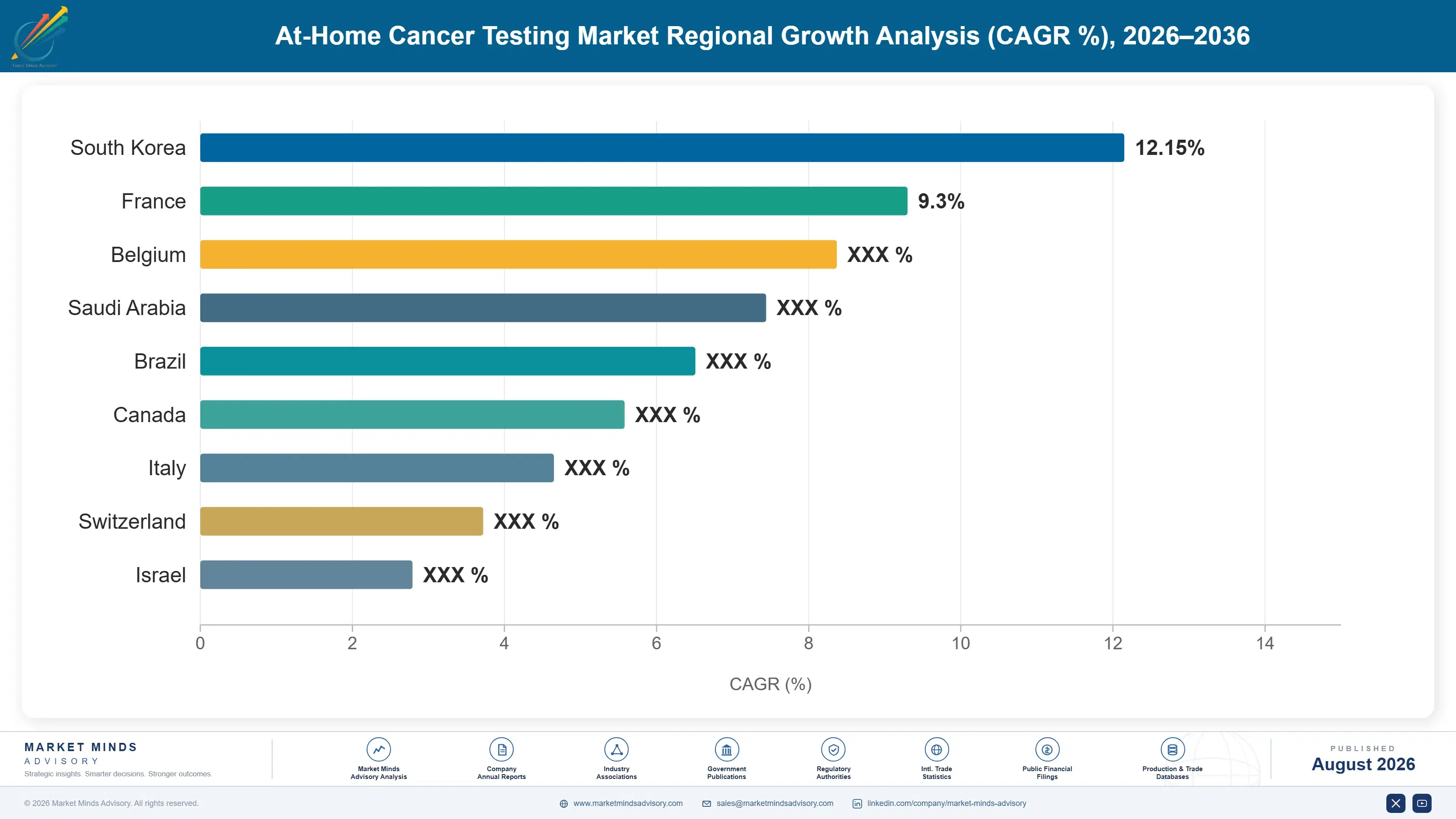
at-home-cancer-testing-market-size-country-cagr-analysis-1787332396358

Where Cancer Testing Margin Concentrates

Margin follows clinical evidence and payer coverage, not testing volume alone. Companies who secure broad reimbursement capture durable, recurring revenue that self-pay competitors racing on detection rate alone simply cannot match at comparable scale or durability, particularly once coverage decisions begin reshaping which developers can afford to fund large prospective evidence programmes at real scale.

Established Reimbursement Codes for Screening Tests

Test developers holding established Category I CPT reimbursement codes and broad payer coverage capture predictable, recurring revenue that newer liquid biopsy entrants without comparable coverage cannot yet access at meaningful commercial scale. Exact Sciences built Cologuard's reimbursement position over roughly a decade of clinical evidence generation and payer negotiation, a moat that continues protecting its category-leading revenue even as competing colorectal screening technologies enter the market. This reimbursement advantage supports gross margins 15 to 20 percentage points above comparable self-pay liquid biopsy products still awaiting broad coverage decisions from major national payers.
Market Impact: Adds 15 to 20 margin points overall

Prospective Outcomes Studies for Payer Evidence

Companies investing early in large prospective outcomes studies, rather than relying solely on retrospective detection-rate data, position themselves to satisfy Medicare and private payer evidentiary requirements considerably faster than competitors starting comparable studies later. GRAIL's PATHFINDER 2 study and comparable programmes run by Guardant Health represent multi-year, multi-hundred-million-dollar investments specifically structured around anticipated coverage decision criteria set by regulators. Companies with mature prospective data typically reach coverage decisions 18 to 24 months faster than competitors relying on retrospective evidence alone, according to MMA Primary Research interviews with payer policy specialists.
Market Impact: Cuts coverage timeline by 18 to 24

Employer Wellness Programme Distribution Strategy Build

Test developers who secure inclusion in large employer wellness and executive health programmes capture meaningful self-pay volume ahead of broad insurance coverage, since employers increasingly view early cancer detection benefits as a competitive recruitment and retention tool worth funding directly. GRAIL and Exact Sciences have both built dedicated employer sales teams specifically targeting Fortune 500 wellness benefit programmes as a revenue channel independent of traditional insurance reimbursement timelines. This channel has generated an estimated 12 to 18 percent of multi-cancer detection revenue for leading developers according to recent investor disclosures reviewed.
Market Impact: Generates 12 to 18% of total MCED r

Laboratory Infrastructure Scale for Sample Processing

Companies operating large, centralised laboratory processing infrastructure capture meaningful cost advantages over smaller competitors sending samples to third-party reference laboratories, since in-house processing eliminates margin paid to external partners and shortens result turnaround time considerably. Exact Sciences and Natera have both invested heavily in proprietary laboratory automation specifically to control this cost structure at scale across millions of processed samples annually and every reporting quarter. This vertical integration supports per-test processing costs roughly 20 to 30 percent below comparable outsourced laboratory arrangements used by smaller, less capitalised competitors still reliant on third-party reference labs.
Market Impact: Cuts processing cost by 20 to 30% o

Who Controls the Margin Pool

CR5 sits at 48 percent, moderate for a diagnostics category, reflecting the split between Exact Sciences' dominant, reimbursement-backed colorectal screening franchise and a still-fragmenting liquid biopsy segment where GRAIL, Guardant Health, and Natera each compete for distinct clinical and commercial positioning ahead of broad coverage decisions still pending across major national payers.
Current competitive activity centres on three fronts: liquid biopsy developers racing to complete prospective outcomes studies ahead of anticipated Medicare coverage decisions, established screening test makers defending reimbursement positions while launching their own multi-cancer detection programmes, and newer entrants targeting the freshly opened HPV self-collection channel following 2024's FDA approval and the resulting shift in patient demand.

Emerging pressure comes from Chinese liquid biopsy developers, who have moved from domestic-only clinical validation toward international expansion ambitions as their home market generates substantial testing volume and clinical evidence at considerable scale. Rankings shift most at the technology and evidence level rather than globally: a company's dominant position in stool-based screening carries little weight in multi-cancer detection, where prospective outcomes data and payer relationships built specifically for liquid biopsy reset the competitive order entirely each cycle.
at-home-cancer-testing-market-size-company-positioning-matrix-1787332396878

Reagents and Sequencing Consumables

Reagents, sequencing consumables, and assay components together represent roughly 31 percent of cancer testing manufacturing COGS, sourced from a concentrated base of life sciences suppliers including Illumina and Thermo Fisher Scientific serving both diagnostics and broader genomics research end markets simultaneously across the industry and its many downstream applications and product lines developed for both clinical and research customers worldwide.
Sequencing reagent pricing has remained comparatively stable in recent years as Illumina's platform dominance kept per-sample sequencing costs on a steady downward trajectory, though specialised liquid biopsy library preparation reagents documented in supplier annual reports have seen periodic supply tightness during periods of surging clinical trial demand across multiple concurrent developer programmes competing for the same capacity. Antibody and enzyme reagent costs for stool-based immunochemical tests have shown less volatility given a more mature, established supplier base.

Exposure varies by test technology. Liquid biopsy developers remain most exposed to sequencing reagent cost and supply availability given their reliance on next-generation sequencing platforms, while stool-based test manufacturers face comparatively more stable input costs tied to mature immunochemical assay chemistry that has changed relatively little over the past decade of commercial production at meaningful scale across the industry.
at-home-cancer-testing-market-size-cost-volatility-analysis-1787332397074

Long-Term Sequencing Reagent Supply Agreements

Larger liquid biopsy developers now lock in multi-year sequencing reagent and consumables supply agreements with fixed volume commitments, insulating clinical trial and commercial testing costs from short-term supply tightness that previously delayed trial enrollment timelines and commercial sample processing schedules considerably across multiple concurrent development programmes competing for identical, limited manufacturing capacity industry-wide each and every quarter.

In-House Library Preparation Capability

Several leading developers have built internal library preparation and reagent formulation capability specifically to reduce dependence on external suppliers for specialised liquid biopsy components, trading higher fixed capital investment for greater supply certainty during periods of industry-wide sequencing demand and constrained third-party manufacturing capacity across the broader diagnostics reagent supply chain and its many participants.

Dual-Sourcing Antibody and Enzyme Suppliers

Stool-based test manufacturers increasingly qualify two antibody and enzyme suppliers per assay component rather than one, adding validation cost upfront but avoiding single-supplier exposure during periods of raw material tightness affecting the broader diagnostics reagent supply chain simultaneously across multiple concurrent production and commercial testing programmes operating at meaningful scale nationwide and internationally each year.

Portfolio Architecture for Margin Defence

Portfolio economics split across three tiers. Established, reimbursed screening tests compete mainly on physician relationships and payer contracting in a mature, predictable-margin business built over many years, while emerging multi-cancer detection and self-pay liquid biopsy products command the highest theoretical margins, reflecting the premium early adopters pay for detection technology still awaiting broad insurance coverage decisions from major national payers nationwide and abroad.
The tension between volume and premium plays out starkly across the category's two halves. Reimbursed screening tests generate predictable, high-volume revenue at moderate margins built on years of payer negotiation, while liquid biopsy developers burn considerable capital pursuing evidence generation and coverage decisions that may take years longer to materialise than current investor expectations assume across the sector, its many participants, and their respective boards of directors.

High-value margin pools concentrate in employer-sponsored wellness channels and cash-pay early adopter segments during this pre-coverage phase, where limited competing supply keeps pricing power intact well past what reimbursed, price-negotiated screening tests retain after years of established payer contracting across the broader industry, its many established suppliers, and their respective distribution partners operating nationwide and abroad.
at-home-cancer-testing-market-size-portfolio-architecture-1787332397569

Screening Interval Renewal Economics

Cancer testing demand behaves like a recurring screening-interval annuity rather than a one-time purchase, since guideline-recommended tests repeat on fixed schedules, typically annually for stool-based colorectal screening and every three to five years for cervical screening, generating predictable recurring demand from an enrolled patient base over many years of continued eligibility and ongoing care.
Adoption depth varies considerably by test category and clinical maturity. Established, reimbursed screening tests see broad, consistent adoption across eligible populations once physicians incorporate them into routine care protocols followed at every visit. Multi-cancer detection tests show far more variable adoption, concentrated among health-conscious, higher-income patients willing to pay out of pocket ahead of broad insurance coverage becoming available to the general population.

A generational shift is underway in primary care ordering behaviour. Physicians trained after 2015 show meaningfully more comfort discussing liquid biopsy and multi-cancer detection options with patients than predecessors trained purely on traditional single-cancer screening protocols, a shift that should widen adoption further as this cohort becomes a larger share of practising primary care physicians over the next decade of continued clinical evidence accumulation, payer negotiation, and medical school curriculum change.
at-home-cancer-testing-market-size-end-use-penetration-index-1787332398057

Positioning for the Coverage Decision Wave

These are among the four positions where our research anticipates prominent divergence between winners and laggards over the coming forecast period. Each is grounded in the demand model, the regulatory perimeter, and the announced capacity pipeline.
01 / EVIDENCE GENERATION TIMING

Complete prospective outcomes studies before capital runs out

Liquid biopsy developers racing toward Medicare coverage decisions face a genuine capital runway risk if prospective outcomes studies take longer than currently planned to generate conclusive evidence. GRAIL's early PATHFINDER 2 investment reflects a bet that evidence generation speed matters more than near-term profitability during this pre-coverage phase of the category's development. Companies that under-invest in prospective evidence now risk running out of capital before regulators and payers reach the coverage decisions their entire commercial model ultimately depends on reaching.
02 / REIMBURSEMENT DEFENCE STRATEGY

Protect established coverage while competitors chase new evidence

Established screening test makers holding broad reimbursement face a different strategic challenge than liquid biopsy entrants: defending existing coverage and physician relationships while simultaneously investing in next-generation multi-cancer detection technology that could eventually cannibalise their own core franchise. Exact Sciences illustrates this tension directly, balancing continued Cologuard investment against meaningful multi-cancer detection spending across several concurrent programmes. Companies that neglect either side of this balance risk losing ground to focused single-strategy competitors on either front of the business over time.
03 / DISTRIBUTION CHANNEL DIVERSIFICATION

Build employer and self-pay channels ahead of full coverage

Multi-cancer detection developers who build employer wellness and self-pay distribution channels ahead of broad insurance coverage capture meaningful revenue during the extended pre-coverage period most industry observers expect to persist for several more years. Companies relying entirely on future insurance reimbursement without cultivating these alternative channels risk running short of commercial revenue during a coverage-decision timeline that has already extended well beyond what most early industry forecasts originally anticipated when the category first emerged several years ago. Building both channels simultaneously has proven the more resilient strategy so far.
04 / INPUT COST RESILIENCE PLANNING

Secure sequencing reagent supply ahead of the next demand surge

Sequencing reagent and consumables tightness during periods of surging clinical trial demand has previously delayed enrollment timelines for developers relying entirely on spot-market procurement rather than committed long-term supply agreements. Developers still buying reagents without multi-year commitments remain exposed to the same risk as multiple concurrent trial programmes compete for limited specialised manufacturing capacity industry-wide. Long-term supply agreements and in-house library preparation capability have already proven their value for developers who adopted them early in their programme timelines and budgets.

Engagement Snapshot From the Field

A live engagement with an industry participant carrying material or product regulatory and market exposure ahead of a defining policy shift, showing how our research translates into a defensible multi-year portfolio strategy.
MARKET MINDS ADVISORY · CLIENT ENGAGEMENT SUMMARY
At-Home Cancer Testing Producer Strategic Portfolio Review and Transition Roadmap 2026·Investment Scenario on At-Home Cancer Testing Exposure Evaluation 2025-26
CLIENT PROFILE
The client is a regional health system operating twelve primary care clinics, with annual patient population reported in the 400,000 to 600,000 range (client-reported, unverified by MMA), evaluating whether to incorporate multi-cancer early detection testing into its physician-recommended screening protocols alongside established colorectal and cervical programmes already in place across its network of affiliated clinics and specialist referral partners.
STRATEGIC CHALLENGE
The health system's clinical leadership was divided between recommending multi-cancer detection testing broadly to interested patients now, ahead of full insurance coverage, or waiting for clearer reimbursement guidance given concerns about recommending an out-of-pocket test that could create financial burden or unequal access across its diverse patient population and referral network.
MMA APPROACH
MMA benchmarked comparable health system multi-cancer detection adoption decisions made over the prior eighteen months, analysing patient uptake, physician sentiment, and financial access considerations across early-adopter and wait-and-see approaches. The team conducted primary interviews with clinical leaders and payer relations staff at three comparable regional health systems that had already implemented comparable screening protocol decisions.
KEY FINDINGS
  1. Two of three benchmarked health systems that adopted early reported meaningful patient demand exceeding initial clinical capacity projections within six months of launch.
  2. Financial access concerns proved manageable through structured payment plans, which most self-pay patients ultimately accepted without significant enrollment friction or documented complaint.
  3. Physician comfort discussing multi-cancer detection varied considerably by provider age and training background across the benchmarked comparable health systems reviewed closely during the engagement.
  4. Systems offering the test alongside clear patient education materials reported meaningfully fewer follow-up questions and billing complaints than systems without structured materials in place.
CLIENT PROFILE
The client is a regional health system operating twelve primary care clinics, with annual patient population reported in the 400,000 to 600,000 range (client-reported, unverified by MMA), evaluating whether to incorporate multi-cancer early detection testing into its physician-recommended screening protocols alongside established colorectal and cervical programmes already in place across its network of affiliated clinics and specialist referral partners.
STRATEGIC CHALLENGE
The health system's clinical leadership was divided between recommending multi-cancer detection testing broadly to interested patients now, ahead of full insurance coverage, or waiting for clearer reimbursement guidance given concerns about recommending an out-of-pocket test that could create financial burden or unequal access across its diverse patient population and referral network.
MMA APPROACH
MMA benchmarked comparable health system multi-cancer detection adoption decisions made over the prior eighteen months, analysing patient uptake, physician sentiment, and financial access considerations across early-adopter and wait-and-see approaches. The team conducted primary interviews with clinical leaders and payer relations staff at three comparable regional health systems that had already implemented comparable screening protocol decisions.
KEY FINDINGS
  1. Two of three benchmarked health systems that adopted early reported meaningful patient demand exceeding initial clinical capacity projections within six months of launch.
  2. Financial access concerns proved manageable through structured payment plans, which most self-pay patients ultimately accepted without significant enrollment friction or documented complaint.
  3. Physician comfort discussing multi-cancer detection varied considerably by provider age and training background across the benchmarked comparable health systems reviewed closely during the engagement.
  4. Systems offering the test alongside clear patient education materials reported meaningfully fewer follow-up questions and billing complaints than systems without structured materials in place.
RECOMMENDED STRATEGY
Phase 1: Phase 1 (Months 1 to 4): Develop structured patient education materials and physician training addressing coverage and cost expectations clearly. Phase 2: Phase 2 (Months 5 to 9): Launch a limited pilot programme across three clinics to validate demand and operational workflow before full rollout. Phase 3: Phase 3 (Months 10 to 18): Expand successful pilot elements system-wide, incorporating lessons learned into broader protocol documentation and staff training materials.
OUTCOME
The health system launched a phased pilot programme reaching an estimated 3,200 patients in its first year, with patient satisfaction scores exceeding internal targets by a meaningful margin (client-reported, unverified by MMA). The structured education approach reduced billing-related patient complaints considerably compared to the unstructured rollout observed at one benchmarked comparison system.

Frequently Asked Questions

Foundational context covering the market sizes, CAGR, scope, country, region and competition that inform every finding below. This section is provided to cover basics and most often pre-purchase conversations, answered from the MMA Primary Research Dataset.

What is the current size of the At-Home Cancer Testing Market?

The global market reached an estimated 3.8 billion dollars in 2025, anchored by established colorectal screening. Growth is concentrated in multi-cancer detection and HPV self-collection testing.

How large will the At-Home Cancer Testing Market be by 2036?

MMA projects the market will reach approximately 15.16 billion dollars by 2036 under the base-case forecast scenario. This reflects expanding liquid biopsy adoption and coverage.

What is the CAGR for the At-Home Cancer Testing Market 2026 to 2036?

The base-case compound annual growth rate is 13.4 percent across the full ten-year forecast period. Bull and bear scenarios range from 12.2 to 14.6 percent.

Which segment is growing fastest?

Multi-cancer early detection liquid biopsy tests lead at a 24.6 percent CAGR, roughly 1.84 times the overall market rate. HPV self-collection kits follow as the second-fastest segment.

Who are the major companies in the At-Home Cancer Testing Market?

Exact Sciences Corporation, GRAIL LLC, Natera Inc., Guardant Health, and Myriad Genetics hold the top five positions by revenue. Reimbursement status increasingly separates category leaders.

Which country is growing fastest?

The United States leads at an estimated 15.8 percent CAGR, driven by GRAIL's commercial rollout and the 2024 HPV self-collection approval. Established reimbursement infrastructure supports rapid adoption.

Report Segmentation Architecture

The full report scope spans multiple orthogonal segmentation dimensions, with cross-tabulated demand data provided for each dimension pair. Coverage extends further to regional breakdowns, trend trajectories, and the competitive detail needed to support segment-level decision-making.

By Test Technology

  • Fecal Immunochemical Test Kits
  • HPV Self-Collection Kits
  • Multi-Cancer Early Detection Liquid Biopsy
  • PSA At-Home Test Kits
  • Genetic Risk Assessment Kits
  • Other At-Home Cancer Tests

By Cancer Type Screened

  • Colorectal Cancer
  • Cervical Cancer
  • Prostate Cancer
  • Breast Cancer
  • Multi-Cancer Panel Screening

By Commercial Dimension

  • Physician-Ordered Testing
  • Direct-to-Consumer Self-Pay
  • Employer Wellness Programmes
  • Health System Screening Protocols

By Region

  • North America
  • Western Europe
  • East Asia
  • South Asia and Pacific
  • Latin America
  • Middle East and Africa
  • Eastern Europe

Scope, Methodology, and Coverage

Every figure in this report is reproducible from documented input assumptions. The scope below maps the historical period, the forecast horizon, the segmentation dimensions, and the countries covered, alongside the underlying primary and qualitative methodology.
Historical Period
2020 to 2025
Forecast Period
2026 to 2036
Base Year
2025 (USD billions; MMA Primary Research Dataset, August 2026)
Market Definition
This market covers cancer screening and detection tests designed for at-home sample collection or physician-ordered blood-based liquid biopsy analysis, including colorectal, cervical, prostate, and multi-cancer detection products. It excludes in-clinic imaging-based cancer screening and treatment monitoring tests ordered after diagnosis.
Quantitative Units
USD billions (current prices); test volume in millions of units where applicable
Segmentation Dimensions
By Test Technology; By Cancer Type Screened; By Commercial Dimension; By Region
Regions Covered
North America, Western Europe, East Asia, South Asia and Pacific, Latin America, Middle East and Africa, Eastern Europe
Countries Covered
USA, China, Germany, France, UK, Japan, South Korea, India, Australia, Canada, Brazil, Mexico, Indonesia, Vietnam, Thailand, Malaysia, UAE, Saudi Arabia, South Africa, Nigeria, Turkey, Poland, Netherlands, Italy, Spain, Sweden, Switzerland, Argentina, Colombia, Singapore, and additional markets relevant to this sector
Key Companies Profiled
Exact Sciences Corporation, GRAIL LLC, Natera Inc., Guardant Health, Myriad Genetics, Quest Diagnostics, Labcorp Holdings, QIAGEN, Hologic Inc., Freenome Holdings, Everlywell, LetsGetChecked, Roche Diagnostics, Abbott Laboratories, bioMerieux, Illumina Inc., Burning Rock Biotech, Delfi Diagnostics, Adaptive Biotechnologies, Foundation Medicine
Quantitative Methodology
Primary survey, n=3,800 respondents, Q4 2025, six countries; demand-side model with trade association cross-validation
Qualitative Methodology
47 expert interviews, Q4 2025; applied to validate demand model assumptions, identify emerging dynamics, and assess competitive positioning
Report Format
PDF and XLSX data workbook (Word format preview document)
Publisher
Market Minds Advisory
Report Code
MMA-2026-HLT-402
Published
August 2026
Contact
sales@marketmindsadvisory.com | www.marketmindsadvisory.com

Purchase the full At-Home Cancer Testing Market Report (2026 to 2036).

The full report delivers a company-by-company clinical evidence tracker covering prospective outcomes studies for every major multi-cancer detection developer through 2030 with disclosed enrollment timelines and anticipated regulatory milestones. It includes a reimbursement policy tracker mapping Medicare and major private payer coverage decisions across every profiled test category and geography. Physician adoption survey data is provided from MMA's primary research programme, alongside employer wellness channel benchmarking data drawn from comparable developer disclosures. Buyers also receive a company-level financial and regulatory-milestone model updated quarterly throughout the full subscription period each year.
Company-by-company clinical evidence and enrollment tracker
Medicare and payer reimbursement policy database
Physician adoption survey data and benchmark reports
Quarterly competitor financial and milestone model updates
Employer wellness channel benchmark data set
Custom market entry and reimbursement strategy workshops

Built For The People Who Decide

From boardroom strategy to bench-side execution, this report is read cover-to-cover by leaders shaping the next decade of their industry, turning demand scenarios, market dynamics and valuation benchmarks into decisions.
CXOs/ Presidents/ VPs/ Managers
M&A and Corporate Development
Strategy Teams and R&D Heads
Procurement and Product Directors
Regulatory and Compliance Leaders
Investor Relations and Equity Analysts