Market Minds Advisory
Astragalus Root Extract Market

Astragalus Root Extract Market: Clinical Validation Reshapes a Traditional Botanical

Astragalus root extract manufacturing is shifting toward standardized astragaloside IV grades as clinical research, immune health supplement demand, and premium cosmetics formulation push buyers away from unstandardized whole root powder toward pharmaceutical-grade, traceable extraction.

Lead Analyst

Lisa Gevelber

Published

September 2026

Make Smarter Decisions with Customized Research Insights

Request a free sample report and evaluate market opportunities, growth trends, and competitive dynamics relevant to your business needs.

2025 MARKET VALUE$0.4BMarket Size 2025
2036 FORECAST VALUE$0.9BBase Case , 2026 to 2036
CAGR 2026 TO 20368.5 %Bull 9.8% / Bear 7.2%
INCREMENTAL OPPORTUNITY$0.5BNet 10- year value creation
EXPANSION MULTIPLE2.26x2036 value over 2026 base
Strategic Levers
M&A Pipeline
Regional Outlook
Country Rankings
Competitive Intelligence
Segmental Deep-dive
Call-Us : 91 93563 13602

Executive Snapshot and Market Trajectory

Astragalus root extract demand is splitting between standardized, high-potency astragaloside IV grades for nutraceutical and pharmaceutical applications and lower-cost whole root powder for traditional Chinese medicine and mainstream supplement channels worldwide today. Clinical research validating immune and cardiovascular benefits is accelerating premium grade adoption considerably across most markets.
Dietary supplement and traditional Chinese medicine applications anchor volume demand, but standardized astragaloside IV extract is the fastest-expanding segment as nutraceutical brands chase documented potency claims and pharmaceutical-grade traceability across every major market. East Asia hosts the overwhelming majority of global cultivation and extraction capacity, concentrated almost entirely in China, while North American and European buyers pay substantial premiums for standardized, third-party-tested extract grades sold into premium supplement and cosmetics retail channels nationwide.
Competition splits between large diversified botanical extract houses with pharmaceutical-grade standardization capability and numerous smaller Chinese processors competing mainly on price for unstandardized powder grades. Regulatory scrutiny around botanical supplement labeling and potency claims is tightening in the United States and European Union, while research investment into astragaloside IV clinical validation is accelerating as premium brands seek differentiated positioning ahead of mainstream nutraceutical retail expansion.
Market Definition
The Astragalus Root Extract Market comprises extracts derived from Astragalus membranaceus root, including standardized astragaloside IV grades, polysaccharide fractions, and whole root powder, used in dietary supplements, traditional medicine, cosmetics, and functional food and beverage applications. It excludes fresh or dried whole root sold without extraction processing and excludes unrelated astragalus species not used commercially.
Base Year Value
$0.4B in 2025 (MMA Primary Research Dataset, August 2026)
Forecast Period
2026 to 2036, eleven discrete annual values
CAGR
8.5% base case. Bull 9.8%. Bear 7.2%.
Fastest Growth Segment
Standardized Astragaloside IV Extract: 13.5% CAGR
Fastest Growth Country
China: 10.2% CAGR
Fastest Growth Region
South Asia and Pacific: 10.5% CAGR
Largest Region
East Asia: 36% of 2025 global value
Market Leaders
Indena, Sabinsa, Naturex, Martin Bauer Group, and Xi'an Sgonek Biological Technology lead by global standardized extract production volume and clinical research depth. Source: MMA Analysis based on company annual reports.
Primary Survey
n=3,800 procurement and R&D decision-makers, Q4 2025, six countries
Methodology
Demand-side build-up, cross-validated against public data, 47 expert interviews

Astragalus Root Extract Market Forecast Scenarios

astragalus-root-extract-market-trends-size-forecast-scenario-1787461781734
Between 2020 and 2025, astragalus root extract volumes grew at an estimated 7.5% compound rate as post-pandemic immune health supplement demand surged sharply across North America and Western Europe and well beyond. Standardized astragaloside IV extract adoption accelerated from a small base, while whole root powder demand grew more steadily alongside traditional Chinese medicine consumption.
The base case assumes continued expansion as three mechanisms compound: growing clinical research validating astragaloside IV cardiovascular and immune benefits, premium nutraceutical brands standardizing formulations around documented potency grades, and functional beverage manufacturers incorporating astragalus extract into mainstream wellness product lines nationwide and abroad. Cosmetics formulators are expected to expand anti-aging applications steadily, while extraction technology improvements lower the cost of achieving pharmaceutical-grade standardization across a broader base of processors globally.
The bull case turns on major clinical trials confirming astragaloside IV cardiovascular benefits, pulling premium extract volumes sharply higher as mainstream pharmaceutical brands enter the category. The bear case centers on cultivation supply concentration: a poor harvest or export policy shift in China, which supplies the overwhelming majority of global root, could strand extraction capacity and push formulators toward substitute botanical ingredients.

Standardization Economics and the Clinical Validation Race

Astragalus root extract sits at the intersection of two converging forces: centuries of traditional Chinese medicine use and an emerging nutraceutical mandate to validate specific bioactive compounds like astragaloside IV through modern clinical research. Extract houses that once treated the botanical as a commodity powder ingredient are now investing in standardization and clinical validation to serve premium nutraceutical demand, betting that documented potency claims will command durable premiums over unstandardized powder within the next decade.
MARKET CONCENTRATIONCR5 34%Leading five suppliers hold roughly a third of supply
AVERAGE SELLING PRICE$180 per kgStandardized potency grades command substantial price above powder
TOP PRODUCING COUNTRY SHAREChina 90%+Single country cultivation and processing anchors overwhelming supply concentration
CAPACITY UTILIZATION68%Processing plants run below optimal rates amid demand growth
FEEDSTOCK SHARE OF COGS42%Raw root cultivation costs dominate total production expense heavily
EXPORT TRADE INTENSITY55%Meaningful cross border shipment volume links producers to distant buyers
Commercially, the market still behaves partly like an agricultural commodity: whole root powder trades on delivered price and cultivation cost, with thin margins and long-standing supplier relationships across traditional Chinese medicine channels. Standardized astragaloside IV extract commands a distinctly different economics, priced on documented potency and clinical validation rather than raw material cost, giving suppliers who master extraction and standardization a genuinely differentiated margin position across premium nutraceutical channels.
Looking ahead, the decade's defining forces are scientific and regulatory: how quickly clinical research validates astragaloside IV specific health benefits will determine the pace of premium grade adoption, while cultivation concentration in China keeps overall supply exposed to harvest and export policy risk regardless of downstream demand growth.
"Astragalus has fifteen centuries of traditional use behind it and about five years of real clinical data. Closing that gap, not finding new applications, is what will actually determine who wins this category."
Director, Botanical and Nutraceutical Ingredients Practice · MMA Botanical and Nutraceutical Ingredients Practice · August 2026

Market Trends

Clinical Research Validates Astragaloside IV Health Benefits

Nutraceutical brands across North America and Western Europe are commissioning clinical trials specifically validating astragaloside IV cardiovascular and immune modulation benefits, moving beyond traditional Chinese medicine anecdotal use toward evidence-based marketing claims acceptable to regulators and skeptical consumers. Several university and contract research organizations have published or initiated peer-reviewed trials during 2024 and 2025 examining standardized extract dosing protocols. This research investment is compressing the credibility gap between astragalus and more clinically established botanicals, pushing premium brands to standardize formulations around documented astragaloside IV content rather than generic root powder inclusion rates.
Market Impact: Immune-health demand stays up 25% post-pandemic

Adaptogenic Beverages Expand Astragalus Extract Demand

Functional beverage manufacturers are incorporating astragalus extract into wellness-positioned drinks, energy shots, and adaptogenic blends as consumer interest in immune support ingredients broadens beyond capsule and tablet supplement formats into everyday beverage occasions. Category sales data from specialty and mainstream grocery retailers show adaptogenic beverage lines growing meaningfully faster than the conventional supplement aisle overall, pushing extract suppliers to develop water-soluble and flavor-neutral extract formats specifically. This shift is compressing development timelines for beverage brand launches, rewarding suppliers who can deliver pre-validated, beverage-compatible extract systems rather than standard supplement-grade powder.
Market Impact: Cosmetic-grade demand grows roughly 12% yearly

Market Opportunities and Growth Drivers

Sustained Immune Health Focus Drives Botanical Demand

Post-pandemic consumer focus on immune health has sustained elevated demand for botanical immune-support ingredients well beyond the initial pandemic period, with astragalus benefiting from centuries of traditional Chinese medicine use as an immune tonic that lends credibility absent from newer synthetic alternatives. Supplement brands report that immune health remains among the top purchase drivers in category surveys, ahead of general wellness positioning for many botanical ingredient buyers. This directly expands addressable demand for astragalus extract beyond what pre-pandemic supplement category growth alone would have supported, benefiting both premium and standard grade suppliers.
Market Impact: Single country supplies over 90% root

Cosmetics Formulators Expand Astragalus Extract Applications

Anti-aging and skin barrier cosmetics formulators are incorporating astragalus extract for its antioxidant and collagen-supporting properties, a category expansion beyond oral supplement use that broadens the addressable customer base for extract suppliers considerably across premium beauty retail channels. Every incremental cosmetics product launch incorporating astragalus requires cosmetic-grade extract meeting different purity and formulation standards than oral supplement grades, creating a distinct premium sub-market suppliers are racing to serve well. This expands addressable demand for specialized cosmetic-grade extraction beyond what oral supplement volume alone would support, rewarding suppliers with dedicated cosmetics formulation expertise and regulatory knowledge.
Market Impact: Standardization delays adoption nearly 12 months

Market Restraints and Challenges

Cultivation Concentrated In China Raises Supply Risk

China supplies the overwhelming majority of global astragalus root cultivation and processing capacity, concentrated in Shanxi and Gansu provinces, leaving the entire market exposed to a single country's weather patterns, export policy, and domestic demand fluctuations. This concentration is rooted in astragalus's specific soil and climate requirements, which limit commercially viable cultivation to a narrow set of growing regions that cannot be easily replicated elsewhere. A poor harvest or export restriction could strand extraction capacity globally, pushing buyers toward substitute botanicals or synthetic alternatives despite lacking equivalent traditional credibility or research validation.
Market Impact: Clinical trials expand roughly 40% yearly

Standardization Complexity Slows Smaller Processor Adoption

Standardized astragaloside IV extraction requires more precise process control and quality testing than simple root powder production, since active compound content varies with root age, growing conditions, and extraction method in ways that basic powder processing does not address, a gap rooted in the inherent variability of agricultural raw material. This technical complexity slows adoption among smaller regional processors lacking analytical testing capability, risking inconsistent potency claims if standardization is not rigorously verified per batch. Larger extract houses are investing in analytical testing infrastructure to narrow this technical adoption gap over time.
Market Impact: Beverage category grows 2 times faster
2 additional market trends, 4 additional growth drivers, and 3 additional restraints and challenges are covered in the full report. Contact sales@marketmindsadvisory.com to access the complete intelligence.

Segment CAGR and Growth Architecture

Astragalus Root Extract Market segments by product form and standardization level rather than end-use application, since the extraction and purification method determines cost structure, potency claims, and regulatory positioning across nutraceutical, cosmetic, and traditional medicine channels. Six forms span basic powder and newer standardized, application-specific extract systems, each carrying distinct margin profiles and demand growth across manufacturers and customer segments.
astragalus-root-extract-market-trends-market-share-analysis-1787461782605

Standardized Astragaloside IV Extract

Standardized astragaloside IV extract is processed and tested to guarantee a specific minimum content of the compound most closely linked to astragalus's cardiovascular and immune-modulating properties in clinical research, distinguishing it sharply from unstandardized root powder sold across traditional channels. This is the fastest-growing form, expanding at an estimated 13.5 percent annually as premium nutraceutical and pharmaceutical brands demand documented potency claims that regulators and sophisticated consumers increasingly expect from every supplier. Extract houses with analytical testing infrastructure and clinical research partnerships are capturing outsized share of this segment's growth, while smaller regional processors without standardization capability struggle to access premium contracts requiring guaranteed compound content and batch-level documentation nationwide.
CAGR 13.5%

Functional Beverage and Food Fortification Extract

Functional beverage and food fortification extract is formulated for water solubility and flavor neutrality, enabling incorporation into wellness drinks, adaptogenic beverages, and fortified foods without the bitter, earthy notes characteristic of standard astragalus preparations sold through conventional retail channels worldwide today. This is the second-fastest form, expanding at an estimated 11.2 percent annually as consumer interest in immune support ingredients broadens beyond capsule and tablet formats into everyday beverage and food occasions worldwide. Suppliers with beverage-compatible extract technology are winning brand development contracts fastest, since beverage manufacturers increasingly prefer proven, pre-validated ingredient systems over custom formulation development for every individual product launch across their expanding portfolios and growing store networks.
CAGR 11.2%
Full segment breakdown across 6 segments available in the complete report.

Regional Architecture and Country Demand Map

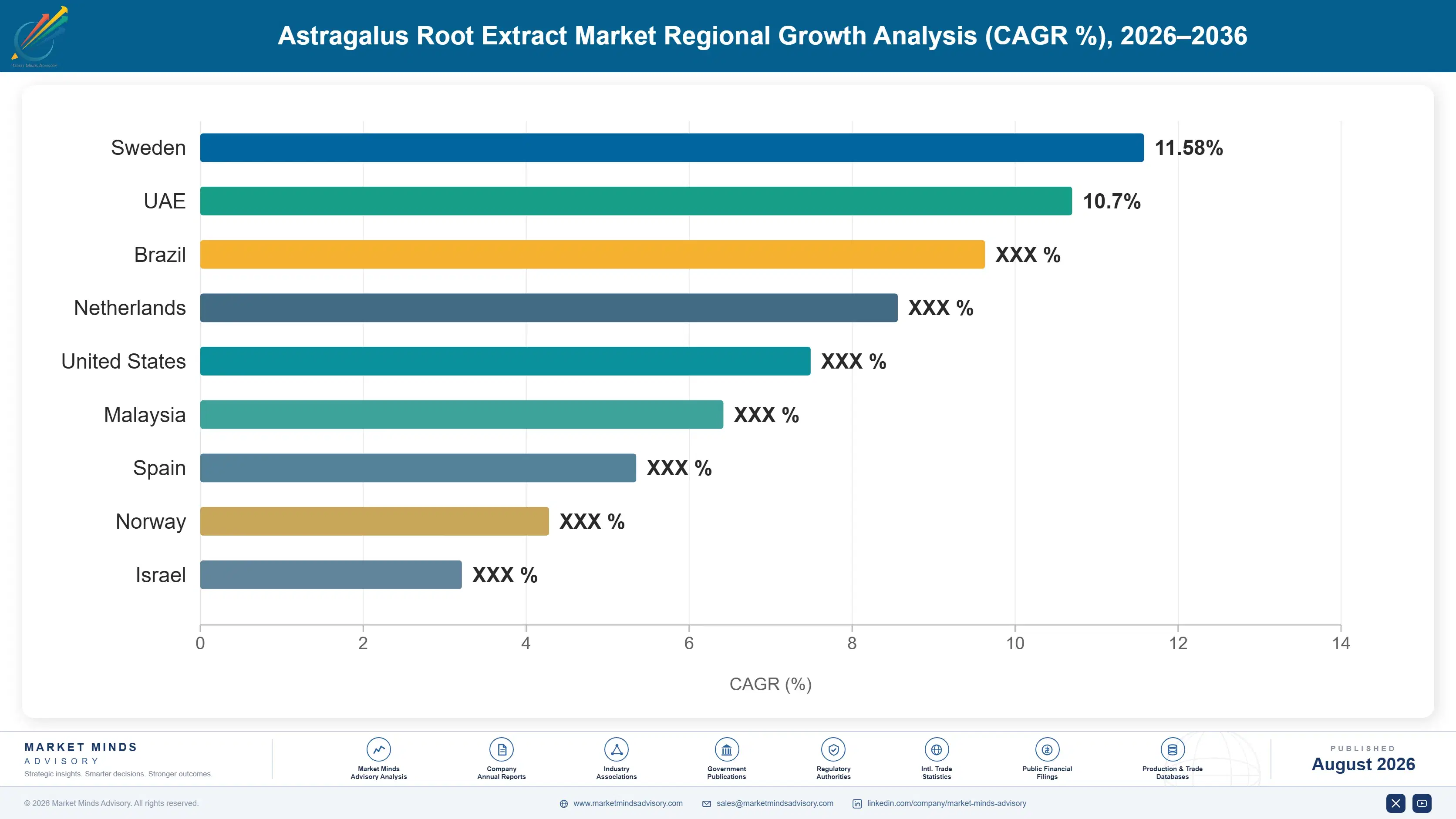
Astragalus root extract demand spans all major regions, with East Asia overwhelmingly dominant on cultivation and processing given China's near-total control of global root supply, while North America and Western Europe drive premium standardized extract demand for nutraceutical and cosmetics applications across major retail markets worldwide.

North America

US nutraceutical brands increasingly demand standardized astragaloside IV extract with documented clinical validation, driving substantial premium grade adoption across the country's large dietary supplement manufacturing base and export network spanning multiple retail channels nationwide and beyond. The region imports the overwhelming majority of its root and extract supply from China, since domestic astragalus cultivation remains negligible given the crop's specific soil and climate requirements that limit viable growing regions considerably. Canada's supplement manufacturers follow similar sourcing patterns and premium grade adoption trends on a smaller scale. Demand concentrates in capsule and tablet supplements, functional beverages, and premium cosmetics categories where documented potency claims support price positioning above generic botanical alternatives nationwide.
Share: 24% | CAGR: 8.0% (2026 to 2036)

Western Europe

Germany and the United Kingdom anchor European astragalus extract demand given their large nutraceutical and cosmetics manufacturing sectors, both increasingly favoring standardized extract grades with documented clinical research support behind every formulation sold at retail nationwide and increasingly well beyond. France follows closely, where premium cosmetics formulators have expanded astragalus-based anti-aging product lines faster than the broader botanical extract category overall this cycle across most channels. The European Union's novel food and botanical supplement regulations are pushing suppliers toward better-documented standardization and traceability across the entire supply chain. Growth trails East Asia given the region's complete dependence on imported Chinese root and extract supply for essentially all commercial volume nationwide.
Share: 18% | CAGR: 7.0% (2026 to 2036)
Regional intelligence for 5 additional markets available in the complete report: East Asia, South Asia and Pacific, Latin America, Middle East and Africa, Eastern Europe. Contact sales@marketmindsadvisory.com.
astragalus-root-extract-market-trends-country-cagr-analysis-1787461783462

Where Astragalus Extract Margins Concentrate

Margin expansion in astragalus extract flows through four distinct commercial levers: standardization premiums charged over unstandardized powder, exclusive cosmetic-grade formulation contracts, clinical research partnerships that validate premium health claims, and beverage-compatible extract technology that opens entirely new application categories beyond traditional capsule and tablet supplement formats sold at retail across every major market worldwide.

Standardization Premium Over Unstandardized Powder Grades

Standardized astragaloside IV extract commands a price premium of roughly 3 to 5 times unstandardized whole root powder, reflecting both analytical testing costs and the clinical credibility documented potency content provides to nutraceutical brand customers seeking regulatory defensibility. Suppliers who develop rigorous standardization capability capture pricing power that basic powder producers competing purely on cultivation cost cannot access at all. This premium has proven durable because standardization and testing infrastructure is expensive to replicate quickly, giving early movers a multi-year head start over competitors still building comparable analytical capability from scratch across their operations.
Market Impact: Standardized extract prices 3 to 5 times powder

Securing Exclusive Cosmetic-Grade Formulation Development Contracts

Cosmetics brands increasingly fund exclusive formulation development for astragalus-based anti-aging and skin barrier products rather than purchasing standardized supplement-grade extract, with cosmetic-grade specifications commanding roughly 40 percent higher prices than oral supplement equivalents sold through conventional retail channels worldwide. Extract houses that win these formulation contracts secure both development fees and longer-term exclusive supply positions difficult for competitors to displace once a cosmetics brand's product has launched at retail nationwide. This lever favors suppliers with dedicated cosmetics chemistry expertise and regulatory knowledge that smaller regional processors often lack entirely across their operations.
Market Impact: Cosmetic-grade specifications command a 40 percent price premium

Clinical Research Investment Builds Scientific Credibility Moat

Extract houses that fund or co-sponsor clinical research validating astragaloside IV specific health benefits gain first-mover credibility and marketing rights to cite published trial data, a scientific moat that unstandardized powder competitors cannot access regardless of price point offered. This research investment typically costs roughly 300,000 dollars per trial but returns durable premium positioning once results are published in peer-reviewed journals accessible to regulators and sophisticated consumers alike across every major market. Building this capability requires patience and capital that smaller regional processors typically cannot commit given limited balance sheets and resources.
Market Impact: Clinical trials typically cost roughly 300,000 dollars each

Beverage-Compatible Extract Technology Opens New Channels

Extract houses developing water-soluble, flavor-neutral extract formats specifically engineered for beverage incorporation capture a growing customer base among functional beverage brands that standard bitter, earthy extract preparations cannot serve without extensive additional formulation work and added reformulation cost entirely. Suppliers with this beverage-compatible technology are winning brand development contracts at a pace roughly 2 times faster than the broader supplement-grade extract market, since beverage manufacturers strongly prefer pre-validated ingredient systems over costly custom formulation efforts. This lever requires specialized processing investment that most traditional powder-focused processors have not yet made.
Market Impact: Beverage-compatible contracts grow roughly 2 times as fast

Who Controls the Margin Pool

Astragalus Root Extract Market concentration sits at a CR5 of 34 percent, evaluated on global standardized extract production volume, with Indena and Sabinsa holding the largest positions built on analytical testing infrastructure and clinical research partnerships spanning nutraceutical and cosmetics applications. The gap between these established leaders and numerous smaller Chinese processors remains wide on standardization capability, though narrower on delivered cost position for basic powder categories.
Current competitive activity concentrates in three areas: clinical research investment to validate astragaloside IV specific health claims ahead of mainstream nutraceutical retail expansion, cosmetic-grade formulation partnerships with premium beauty brands, and beverage-compatible extract technology development to capture functional beverage category growth.

Rankings are most likely to shift as clinical research validation becomes a prerequisite for premium nutraceutical retail placement, a dynamic that could let extract houses with the strongest research partnerships pull meaningfully ahead of Chinese processors competing purely on cultivation cost. Smaller regional processors without analytical testing and standardization capability face the greatest pressure, and several are pursuing supply partnership arrangements with larger extract houses rather than building clinical research capability internally, a defensive posture that could reshape the competitive leaderboard within the next five years.
astragalus-root-extract-market-trends-company-positioning-matrix-1787461784324

Competitive Moat and Risk Dimensions

INDENA

Moat: Pharmaceutical-Grade Standardization Depth

Indena operates extensive botanical extraction and standardization infrastructure across multiple facilities, supported by decades of pharmaceutical-grade phytochemical research applicable to astragalus and comparable botanicals. This depth lets Indena offer documented, clinically validated extract grades that smaller regional processors focused purely on cultivation and basic processing cannot match at comparable scale.
INDENA

Risk: Weaker Commodity Price Position

Indena's pharmaceutical-grade positioning and research-intensive cost structure leave it less competitive on price in basic unstandardized powder applications, ceding volume share to lower-cost Chinese processors in price-sensitive traditional medicine channels. Sustained competition from domestic Chinese standardization investment could narrow Indena's technical differentiation meaningfully over time.
SABINSA

Moat: Established Brand Credibility

Sabinsa's decades of botanical ingredient standardization experience across a broad portfolio of herbal extracts gives it distinctive credibility with nutraceutical brand customers seeking documented, third-party-tested astragalus grades. This established reputation and existing brand relationships give Sabinsa a durable position in the premium standardized segment specifically.
SABINSA

Risk: Diluted Category Strategic Priority

Sabinsa's broad botanical portfolio means astragalus represents a smaller strategic priority relative to competitors more narrowly focused on this one specific botanical, potentially slowing dedicated investment pace considerably. Intensifying competition from astragalus-focused Chinese specialists could erode Sabinsa's share in this particular high-growth category over time.

Players Tracked

Prominent Players

Indena
Sabinsa
Naturex
Martin Bauer Group
Xi'an Sgonek Biological Technology

Other Key Players

Nutra Green Biotechnology
Shaanxi Undersun Biomedtech
Xi'an Realin Biotechnology
Changsha Sunfull Bio-Tech
Xi'an Aogubio Tech
Naturalin Bio-Resources
NOW Foods
Nuherbs
Blue California
Euromed S.A.
Nexira
Synthite Industries
AIDP Inc.
Bioway (Xi'an) Organic Ingredients
Kingherbs Limited

Recent Developments

FEBRUARY 2025

Sabinsa Launches Standardized Astragaloside IV Extract Line

Sabinsa launched a new standardized astragaloside IV extract line with documented potency guarantees, targeting premium nutraceutical brands seeking regulatory-defensible active compound claims for their products. The launch includes third-party analytical testing certification and batch-level traceability documentation supporting marketing claims across North American and European retail channels.
Signal: Signals established botanical extract houses are prioritizing standardization investment ahead of anticipated mainstream nutraceutical retail expansion.
OCTOBER 2024

Indena Expands Botanical Extraction Capacity In Italy

Indena expanded its botanical extraction capacity in Italy to process additional imported astragalus root volume, responding to sustained demand from European nutraceutical and cosmetics customers across multiple product categories. The expansion adds meaningful annual processing capacity at an existing facility rather than building an entirely new site.
Signal: Signals European extract houses are prioritizing processing capacity ahead of anticipated premium nutraceutical and cosmetics demand growth.
APRIL 2025

Xi'an Sgonek Opens New Astragalus Processing Facility In Gansu

Xi'an Sgonek opened a new astragalus processing facility in Gansu province to expand standardized extract output much closer to primary cultivation regions, reducing raw material transport costs significantly. The facility includes dedicated analytical testing infrastructure supporting export-grade documentation requirements for international nutraceutical and cosmetics customers.
Signal: Signals Chinese processors are investing in standardization capability to compete directly with established Western botanical extract houses.

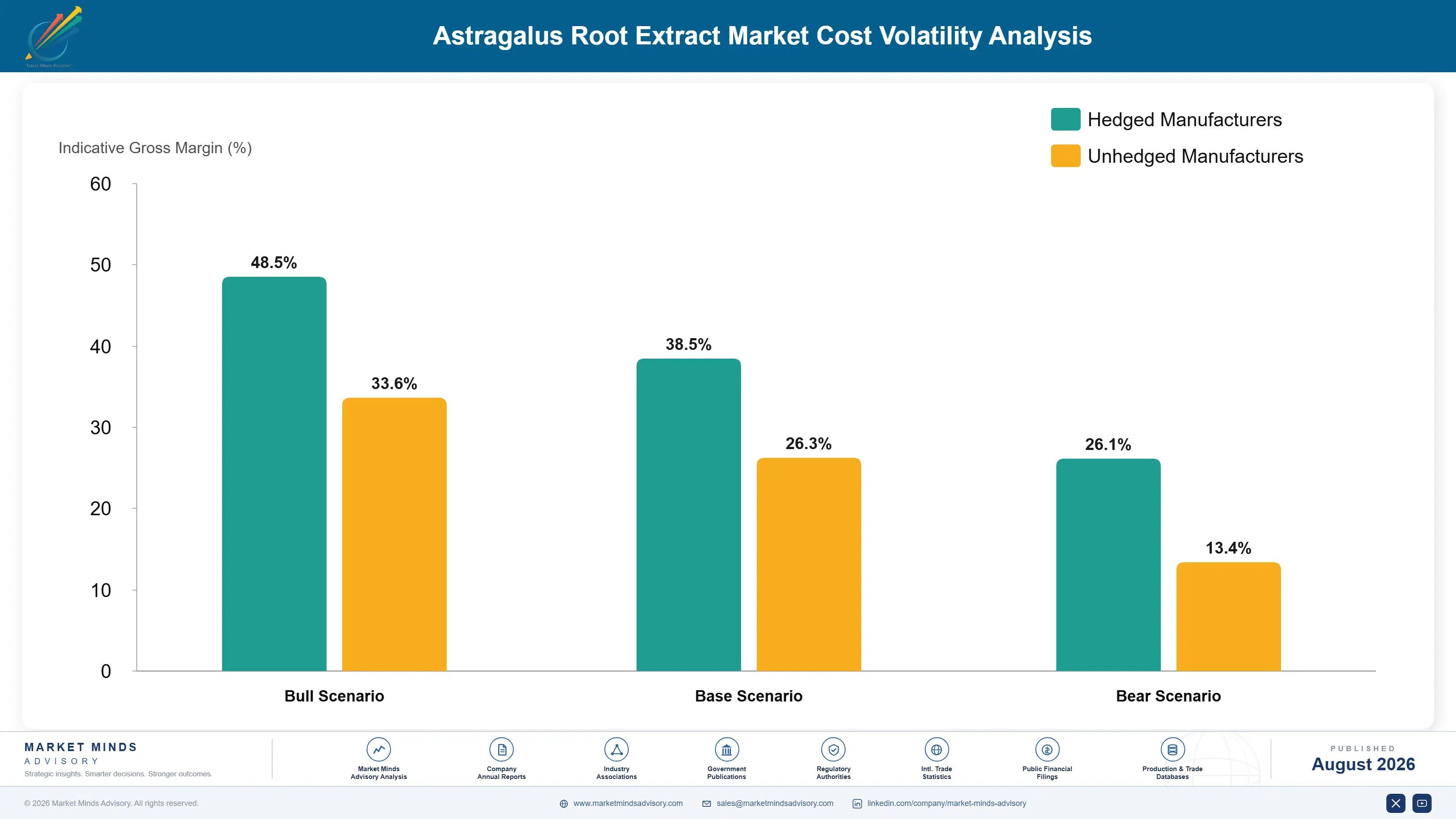
Cultivation And Standardization Input Costs

Raw astragalus root cultivation and harvesting costs account for an estimated 38 to 45 percent of cost of goods sold for basic powder production, while analytical testing and standardization processes represent a growing input category for premium extract grades sold worldwide. Root feedstock originates almost entirely from cultivation regions in Shanxi and Gansu provinces, China.
Chinese astragalus root prices rose sharply during 2023 following reduced planted acreage in key growing counties and stronger domestic traditional medicine demand, according to China Ministry of Commerce agricultural market reporting, squeezing margins for extract producers who could not pass costs through mid-contract. Several extract houses disclosed cultivation-linked cost inflation as a specific pressure on segment margins in recent reporting periods, prompting wider adoption of indexed pricing clauses.

Producers without diversified sourcing relationships across multiple Chinese growing counties face a persistent cost disadvantage during price spikes, since the crop's specific soil and climate requirements prevent meaningful cultivation diversification outside China entirely. Exposure concentrates most heavily among smaller processors who lack the balance sheet to hold buffer inventory that larger diversified competitors maintain across multiple sourcing relationships and extract technology platforms.
astragalus-root-extract-market-trends-cost-volatility-analysis-1787461784726

Diversify Cultivation Sourcing Across Chinese Growing Counties

Producers are qualifying additional cultivation partnerships across multiple counties within Shanxi and Gansu provinces, reducing single-county dependence even though cultivation remains entirely concentrated within China given the crop's soil and climate requirements. This diversification adds sourcing complexity but meaningfully lowers the probability that a single county-level harvest disruption disrupts total production volume across a producer's portfolio.

Accelerate Standardization Investment To Offset Cost Volatility

Capital allocation is shifting toward analytical testing and standardization infrastructure precisely because documented potency content commands durable premiums that offset raw material cost volatility more effectively than basic powder production can. Producers pursuing this path reduce margin sensitivity to root price swings, even though standardization systems still carry higher upfront capital cost than simple grinding and packaging processes.

Negotiate Indexed Cost Pass-Through Clauses In Contracts

Producers are increasingly building indexed cost pass-through mechanisms into multi-year supply agreements, tying pricing to published Chinese agricultural cost benchmarks rather than fixed unit prices negotiated years in advance. This protects margins during volatility events but requires buyers accustomed to fixed pricing to accept periodic adjustment clauses, a negotiation that favors suppliers with strong bargaining position and standardization credentials.

Portfolio Architecture for Margin Defence

Astragalus Root Extract Market splits into three commercial tiers with different margin economics: a volume tier built on unstandardized whole root powder sold into mainstream traditional medicine channels, a premium standardized tier commanding documented potency premiums, and a next-generation tier built on cosmetic-grade and beverage-compatible chemistry still scaling toward full commercial economics. Gross margins range from roughly 14 percent at the volume end to over 34 percent for differentiated cosmetic-grade systems sold under exclusive agreements.
Volume-tier producers compete primarily on price and reliable delivery into commodity powder formulations, where documented potency matters less than consistent supply at the lowest deliverable cost. Premium-tier producers instead compete on standardization sophistication and clinical research credentials for brand owners unwilling to compromise on regulatory defensibility, accepting materially higher testing costs in exchange for pricing power volume-tier competitors cannot access.

High-value margin pools concentrate in cosmetic-grade and clinical research-backed extract contracts sold under exclusive multi-year agreements to premium nutraceutical and beauty brands, where buyers pay for both documented potency and formulation partnership simultaneously. Unstandardized powder remains the volume backbone of the market, but its margin ceiling is capped by an increasingly competitive set of Chinese processors entering the segment.

Volume / Commodity-Adjacent Tier

Unstandardized whole root powder sold into mainstream traditional Chinese medicine and basic supplement channels at competitive pricing, prioritizing reliable volume delivery over documented potency, serving private label and mid-tier branded manufacturers across mature botanical supplement categories.
Gross Margin: 12-15%

Premium / Certified Tier

Standardized astragaloside IV extract with documented potency certification sold to premium nutraceutical and pharmaceutical customers requiring verified active compound content, commanding materially higher unit prices than basic powder equivalents under multi-year supply contracts.
Gross Margin: 24-27%

Sustainability / Regulatory / Next-Generation Tier

Cosmetic-grade and beverage-compatible extract chemistry marketed on formulation exclusivity and clinical research backing, targeting premium beauty and wellness brands pursuing product differentiation, commanding the highest margins as extraction technology continues improving compound bioavailability.
Gross Margin: 32-35%
astragalus-root-extract-market-trends-portfolio-architecture-1787461785555

High-value Sub-segments and Strategic Watch-out

Cosmetic-Grade And Clinical Research-Backed Extract

Cosmetic-grade and clinical research-backed extract systems are both the highest-margin and fastest-growing segment as premium brands fund exclusive formulations to differentiate wellness and beauty product lines, attracting the bulk of all new research investment from leading global botanical extract houses worldwide during this current growth cycle.
Gross Margin: 32-35%

Standardized Conventional Nutraceutical Extract

Standardized astragaloside IV extract for conventional nutraceutical applications continues generating strong margins even as growth moderates relative to cosmetic-grade co-development, supported by established customer relationships and testing capability that newer entrants still need many long years to replicate credibly with major supplement buyers globally today.
Gross Margin: 24-27%

Unstandardized Powder Core Volume

Unstandardized whole root powder sold at competitive volume pricing into mainstream traditional medicine channels remains the market's core revenue base even as margins compress under rising competition from lower-cost regional processors entering the segment at a meaningful scale across many quite different geographies worldwide still.
Gross Margin: 12-15%

Chinese Cultivation Supply Concentration Risk

Chinese cultivation supply concentration tied to a narrow set of growing provinces represents the segment producers and investors should watch most closely, since a sustained multi-year harvest disruption could strand extraction capacity and force very costly substitution across the entire global industry all at once.
Gross Margin: 8-11%

Why Astragalus Extract Contracts Renew Reliably

Once a nutraceutical brand qualifies an astragalus extract supplier against its potency and documentation benchmarks, the relationship tends to persist for years rather than being re-tendered annually, since re-qualification carries real cost and regulatory risk for the buyer. This qualification stickiness gives incumbent suppliers reliable, repeat revenue once a contract is won, a dynamic that rewards established testing relationships more than aggressive price competition alone.
Adoption runs deepest in premium nutraceutical capsules and cosmetics, where documented potency is a defining determinant of brand credibility that manufacturers cannot easily substitute without risking regulatory or consumer pushback, and shallowest in traditional medicine powder formats, where practitioners retain more sourcing flexibility. Functional beverages and mainstream supplements sit between these extremes, adopting standardized extract selectively across premium product lines while retaining simpler powder formulations for value-tier products within the same portfolio.

A younger cohort of product development managers at nutraceutical and cosmetics brands, now negotiating extract supply contracts, treats documented clinical validation as a baseline launch requirement rather than a differentiator their predecessors debated case by case. This generational shift is compressing the development timeline for new standardized formulations at brands that previously relied on traditional use claims alone.
astragalus-root-extract-market-trends-end-use-penetration-index-1787461786396

Where To Place Astragalus Extract Bets

These are among the four positions where our research anticipates prominent divergence between winners and laggards over the coming forecast period. Each is grounded in the demand model, the regulatory perimeter, and the announced capacity pipeline.
01 / EXTRACT STANDARDIZATION INVESTMENT

Back Standardization Infrastructure Before Mainstream Adoption Hits

Standardized astragaloside IV extract is growing faster than any other segment as premium nutraceutical brands demand documented potency claims that regulators and consumers increasingly expect from every supplier. Extract houses that invest in analytical testing and standardization infrastructure now will lock in preferential access to premium contracts before mainstream brands complete their own transitions away from unstandardized powder. Waiting for standardization technology to mature before investing risks ceding the most defensible long-term position to competitors who moved earlier and already control the strongest testing and documentation capability.
02 / CULTIVATION SUPPLY DIVERSIFICATION

Diversify Chinese Sourcing Before The Next Disruption

China's near-total control of global astragalus cultivation means any harvest disruption or export policy shift concentrates risk across the entire industry simultaneously, with no meaningful alternative growing region available anywhere in the world today. Producers that diversify sourcing relationships across multiple Chinese provinces and counties now protect margin during the next inevitable disruption rather than scrambling for alternative supply after prices have already moved sharply higher across every channel. This diversification is a comparatively low-cost hedge relative to the downside it protects against.
03 / CLINICAL RESEARCH INVESTMENT

Fund Clinical Validation Trials Ahead Of Rivals

Clinical research validating astragaloside IV specific health benefits is becoming a prerequisite for premium nutraceutical retail placement, and extract houses that fund or co-sponsor trials now capture first-mover credibility that unstandardized competitors cannot access regardless of price point offered. This investment requires patience and meaningful capital but offers a genuine differentiation path relative to competitors selling standardized products without any published research support behind their claims. Early movers in this specific category will likely retain preferred-supplier status as validation requirements tighten across major nutraceutical markets worldwide.
04 / BEVERAGE TECHNOLOGY DEVELOPMENT

Develop Beverage-Compatible Extract Technology Now

Beverage-compatible extract technology opens an entirely new application category beyond capsule and tablet supplement formats, and suppliers who develop water-soluble, flavor-neutral formulations now capture brand development contracts ahead of competitors still selling standard bitter extract preparations unsuited to beverage incorporation. This capability requires specialized processing investment that most traditional powder-focused processors have not yet made, creating a meaningful window for early movers. Building this technology takes time, making it a strategic priority best pursued well ahead of mainstream beverage category expansion.

Engagement Snapshot From the Field

A live engagement with an industry participant carrying material or product regulatory and market exposure ahead of a defining policy shift, showing how our research translates into a defensible multi-year portfolio strategy.
MARKET MINDS ADVISORY · CLIENT ENGAGEMENT SUMMARY
Astragalus Root Extract Producer Strategic Portfolio Review and Transition Roadmap 2026·Investment Scenario on Astragalus Root Extract Exposure Evaluation 2025-26
CLIENT PROFILE
The client is a multinational nutraceutical supplement manufacturer generating approximately 620 million dollars (client-reported, unverified by MMA) in annual branded product revenue across North America and Western Europe. The company had committed publicly to reformulating its flagship immune health product line around clinically validated, standardized astragaloside IV extract within an eighteen-month timeline tied to a major retail relaunch.
STRATEGIC CHALLENGE
The client's existing formulation used unstandardized whole root powder without documented potency claims, limiting its ability to compete against emerging premium brands citing published clinical research. Management needed an independent assessment of standardized extract suppliers to determine which could realistically deliver both documented potency and regulatory-defensible marketing claims within the required timeline.
MMA APPROACH
MMA conducted primary interviews with research and quality leadership across five standardized extract suppliers, benchmarking analytical testing infrastructure, clinical research partnerships, and prior premium brand reformulation experience against the client's timeline and regulatory requirements. The analysis included third-party laboratory data review and stress-tested each candidate's supply scale-up timeline against the client's product launch schedule.
KEY FINDINGS
  1. Two of five evaluated suppliers had prior commercial experience supplying standardized astragaloside IV extract to comparably sized nutraceutical brands within an eighteen-month reformulation window.
  2. Third-party laboratory data showed meaningful potency variance across candidate suppliers, ranging from 0.3 to 1.2 percent astragaloside IV content depending on extraction method used.
  3. Supply scale-up timelines across candidates ranged from six to fourteen months, with the fastest candidate requiring meaningfully less lead time before commercial volume readiness.
  4. Clinical research partnership terms varied significantly across candidates, with arrangements ranging from simple data licensing access to full co-sponsorship of new dedicated validation trials.
CLIENT PROFILE
The client is a multinational nutraceutical supplement manufacturer generating approximately 620 million dollars (client-reported, unverified by MMA) in annual branded product revenue across North America and Western Europe. The company had committed publicly to reformulating its flagship immune health product line around clinically validated, standardized astragaloside IV extract within an eighteen-month timeline tied to a major retail relaunch.
STRATEGIC CHALLENGE
The client's existing formulation used unstandardized whole root powder without documented potency claims, limiting its ability to compete against emerging premium brands citing published clinical research. Management needed an independent assessment of standardized extract suppliers to determine which could realistically deliver both documented potency and regulatory-defensible marketing claims within the required timeline.
MMA APPROACH
MMA conducted primary interviews with research and quality leadership across five standardized extract suppliers, benchmarking analytical testing infrastructure, clinical research partnerships, and prior premium brand reformulation experience against the client's timeline and regulatory requirements. The analysis included third-party laboratory data review and stress-tested each candidate's supply scale-up timeline against the client's product launch schedule.
KEY FINDINGS
  1. Two of five evaluated suppliers had prior commercial experience supplying standardized astragaloside IV extract to comparably sized nutraceutical brands within an eighteen-month reformulation window.
  2. Third-party laboratory data showed meaningful potency variance across candidate suppliers, ranging from 0.3 to 1.2 percent astragaloside IV content depending on extraction method used.
  3. Supply scale-up timelines across candidates ranged from six to fourteen months, with the fastest candidate requiring meaningfully less lead time before commercial volume readiness.
  4. Clinical research partnership terms varied significantly across candidates, with arrangements ranging from simple data licensing access to full co-sponsorship of new dedicated validation trials.
RECOMMENDED STRATEGY
Phase 1: Phase 1 (0 to 3 months): Complete third-party laboratory testing across shortlisted suppliers and select a partner based on potency and timeline fit. Phase 2: Phase 2 (3 to 12 months): Reformulate the flagship product line around standardized extract, running consumer taste and efficacy validation panels throughout. Phase 3: Phase 3 (12 to 18 months): Launch the reformulated product with documented potency marketing claims, finalizing long-term exclusive supply pricing terms.
OUTCOME
Within sixteen months, the client launched its reformulated immune health product line with documented astragaloside IV potency claims, reporting a 28 percent (client-reported, unverified by MMA) increase in premium channel sell-through versus the prior formulation. The supplier relationship now operates under a long-term exclusive supply agreement.

Frequently Asked Questions

Foundational context covering the market sizes, CAGR, scope, country, region and competition that inform every finding below. This section is provided to cover basics and most often pre-purchase conversations, answered from the MMA Primary Research Dataset.

What is the current size of the Astragalus Root Extract Market?

The Astragalus Root Extract Market was valued at approximately 0.38 billion dollars in 2025. Growth is driven by clinical research validation and rising immune health supplement demand across North America and Europe.

How large will the Astragalus Root Extract Market be by 2036?

The market is projected to reach approximately 0.93 billion dollars by 2036, up from 0.41 billion dollars in 2026. That represents roughly a 2.26 times expansion over the ten-year forecast window.

What is the CAGR for the Astragalus Root Extract Market 2026 to 2036?

The market is forecast to expand at a compound annual growth rate of 8.5 percent between 2026 and 2036. Bull and bear scenarios range from 9.8 percent to 7.2 percent depending on clinical validation pace.

Which segment is growing fastest?

Standardized astragaloside IV extract is the fastest-growing segment, expanding at an estimated 13.5 percent annually, roughly 1.6 times the overall market rate. Functional beverage and food fortification extract follows at 11.2 percent.

Who are the major companies in the Astragalus Root Extract Market?

Indena, Sabinsa, Naturex, Martin Bauer Group, and Xi'an Sgonek Biological Technology lead the market by global standardized extract production volume. Combined, the top five suppliers hold a CR5 of approximately 34 percent.

Which country is growing fastest?

China is the fastest-growing single country and dominates global supply, expanding at an estimated 10.2 percent annually as domestic standardization and processing capacity scales rapidly. No other country cultivates the crop at comparable scale.

Report Segmentation Architecture

The full report scope spans multiple orthogonal segmentation dimensions, with cross-tabulated demand data provided for each dimension pair. Coverage extends further to regional breakdowns, trend trajectories, and the competitive detail needed to support segment-level decision-making.

By Product Form and Standardization Level

  • Standardized Astragaloside IV Extract
  • Astragalus Polysaccharide Extract
  • Whole Root Powder Extract
  • Cosmetic-Grade Extract
  • Functional Beverage and Food Fortification Extract
  • Animal Feed and Veterinary Extract

By End-Use Industry

  • Dietary Supplements
  • Traditional Chinese Medicine
  • Cosmetics and Personal Care
  • Functional Beverages and Foods
  • Animal Feed and Veterinary

By Commercial Dimension

  • Direct Brand Contracts
  • Distributor Supply
  • Private Label Co-Development
  • Export Trade

By Region

  • North America
  • Western Europe
  • East Asia
  • South Asia and Pacific
  • Latin America
  • Middle East and Africa
  • Eastern Europe

Scope, Methodology, and Coverage

Every figure in this report is reproducible from documented input assumptions. The scope below maps the historical period, the forecast horizon, the segmentation dimensions, and the countries covered, alongside the underlying primary and qualitative methodology.
Historical Period
2020 to 2025
Forecast Period
2026 to 2036
Base Year
2025 (USD billions; MMA Primary Research Dataset, August 2026)
Market Definition
The Astragalus Root Extract Market comprises extracts derived from Astragalus membranaceus root, including standardized astragaloside IV grades, polysaccharide fractions, and whole root powder, used in dietary supplements, traditional medicine, cosmetics, and functional food and beverage applications. It excludes fresh or dried whole root sold without extraction processing.
Quantitative Units
USD billions (current prices); metric tons of production volume where disclosed
Segmentation Dimensions
Product Form and Standardization Level; End-Use Industry; Commercial Dimension; By Region
Regions Covered
North America, Western Europe, East Asia, South Asia and Pacific, Latin America, Middle East and Africa, Eastern Europe
Countries Covered
USA, China, Germany, France, UK, Japan, South Korea, India, Australia, Canada, Brazil, Mexico, Indonesia, Vietnam, Thailand, Malaysia, UAE, Saudi Arabia, South Africa, Nigeria, Turkey, Poland, Netherlands, Italy, Spain, Sweden, Switzerland, Argentina, Colombia, Singapore, and additional markets relevant to this sector
Key Companies Profiled
Indena, Sabinsa, Naturex, Martin Bauer Group, Xi'an Sgonek Biological Technology, Nutra Green Biotechnology, Shaanxi Undersun Biomedtech, Xi'an Realin Biotechnology, Changsha Sunfull Bio-Tech, Xi'an Aogubio Tech, Naturalin Bio-Resources, NOW Foods, Nuherbs, Blue California, Euromed S.A., Nexira, Synthite Industries, AIDP Inc., Bioway (Xi'an) Organic Ingredients, Kingherbs Limited
Quantitative Methodology
Primary survey, n=3,800 respondents, Q4 2025, six countries; demand-side model with trade association cross-validation
Qualitative Methodology
47 expert interviews, Q4 2025; applied to validate demand model assumptions, identify emerging dynamics, and assess competitive positioning
Report Format
PDF and XLSX data workbook (Word format preview document)
Publisher
Market Minds Advisory
Report Code
MMA-2026-HLT-104
Published
August 2026
Contact
sales@marketmindsadvisory.com | www.marketmindsadvisory.com

Purchase the full Astragalus Root Extract Market Report (2026 to 2036).

The full Astragalus Root Extract Market report delivers a complete product form segmentation model spanning standardized astragaloside IV extract, polysaccharide extract, whole root powder, cosmetic-grade, functional beverage, and veterinary formats. It includes detailed regional demand and cultivation feedstock data across all seven world regions. The report profiles twenty producers, including detailed capacity, standardization positioning, and moat and risk assessment for the top five, supported by primary interviews with research and procurement leadership. It also includes ten-year forecast scenarios under base, bull, and bear cases, cultivation cost exposure analysis by region and player type, and a strategic verdict framework for research and product development decisions.
Ten-Year Base, Bull, and Bear Forecasts
Product Form Segmentation Across Six Categories
Full Seven-Region Demand and Cultivation Breakdown
Twenty-Company Competitive Profiles With Moat Analysis
Cultivation Cost Exposure and Mitigation Playbook
Primary Interview Data From Research Leadership Teams

Built For The People Who Decide

From boardroom strategy to bench-side execution, this report is read cover-to-cover by leaders shaping the next decade of their industry, turning demand scenarios, market dynamics and valuation benchmarks into decisions.
CXOs/ Presidents/ VPs/ Managers
M&A and Corporate Development
Strategy Teams and R&D Heads
Procurement and Product Directors
Regulatory and Compliance Leaders
Investor Relations and Equity Analysts