Market Minds Advisory
Aspiration & Biopsy Needles Market

Aspiration & Biopsy Needles Market: Diagnostic Yield and Vacuum-Assisted Conversion Strategy

Interventional radiologists and pathologists are shifting from blind fine-needle sampling toward vacuum-assisted and image-guided biopsy platforms as breast, lung, and prostate cancer screening volume rises and hospitals demand higher diagnostic yield per procedure.

Lead Analyst

Alice Ballenger

Published

August 2026

Make Smarter Decisions with Customized Research Insights

Request a free sample report and evaluate market opportunities, growth trends, and competitive dynamics relevant to your business needs.

2025 MARKET VALUE$3.2BMarket Size 2025
2036 FORECAST VALUE$7.1BBase Case , 2026 to 2036
CAGR 2026 TO 20367.6 %Bull 8.8% / Bear 6.3%
INCREMENTAL OPPORTUNITY$3.7BNet 10- year value creation
EXPANSION MULTIPLE2.09x2036 value over 2026 base
Strategic Levers
M&A Pipeline
Regional Outlook
Country Rankings
Competitive Intelligence
Segmental Deep-dive
Call-Us : 91 93563 13602

Executive Snapshot and Market Trajectory

Biopsy technology has moved past the simple needle. Radiologists now choose between fine-needle, core, and vacuum-assisted platforms based on tissue yield and patient comfort, and hospitals increasingly standardize on vacuum-assisted systems for breast screening callbacks because they cut repeat-biopsy rates meaningfully across nearly every major screening program today.
Vacuum-assisted biopsy devices are growing fastest, pulled by rising breast cancer screening volume and radiologist preference for single-insertion multi-sample collection, expanding roughly 29% faster than the category average. North America retains the largest regional share, supported by mammography screening mandates, established reimbursement codes, and the continent's dense interventional radiology infrastructure that most emerging markets still lack entirely, even as East Asia closes the gap quickly.
Competitive intensity is shifting from needle mechanics toward imaging integration. BD and Boston Scientific are racing device-specific specialists like Hologic to bundle biopsy hardware with AI-assisted lesion targeting software, since hospitals increasingly buy the imaging workflow rather than the needle alone. Regulatory pressure, particularly FDA guidance on breast density reporting and expanded screening eligibility, is pulling procedure volume up faster than population growth alone would explain, across most developed healthcare systems currently.
Market Definition
The Aspiration and Biopsy Needles market covers fine-needle aspiration needles, core biopsy devices, vacuum-assisted biopsy systems, bone marrow aspiration and biopsy needles, and co-axial introducer needles used for tissue and fluid sampling across oncology, hematology, and interventional radiology procedures. It excludes surgical excisional biopsy instruments and general-purpose injection needles with no dedicated biopsy sampling mechanism.
Base Year Value
$3.2B in 2025 (MMA Primary Research Dataset, August 2026)
Forecast Period
2026 to 2036, eleven discrete annual values
CAGR
7.6% base case. Bull 8.8%. Bear 6.3%.
Fastest Growth Segment
Vacuum-Assisted Biopsy Devices: 9.8% CAGR
Fastest Growth Country
China: 10.2% CAGR
Fastest Growth Region
South Asia and Pacific: 9.6% CAGR
Largest Region
North America: 30% of 2025 global value
Market Leaders
Becton, Dickinson and Company, Boston Scientific Corporation, Hologic Inc., Merit Medical Systems Inc., Argon Medical Devices Inc. Source: MMA Analysis based on company annual reports.
Primary Survey
n=3,800 procurement and R&D decision-makers, Q4 2025, six countries
Methodology
Demand-side build-up, cross-validated against public data, 47 expert interviews

Aspiration & Biopsy Needles Market Forecast Scenarios

aspiration-biopsy-needles-market-size-size-forecast-scenario-1787301154495
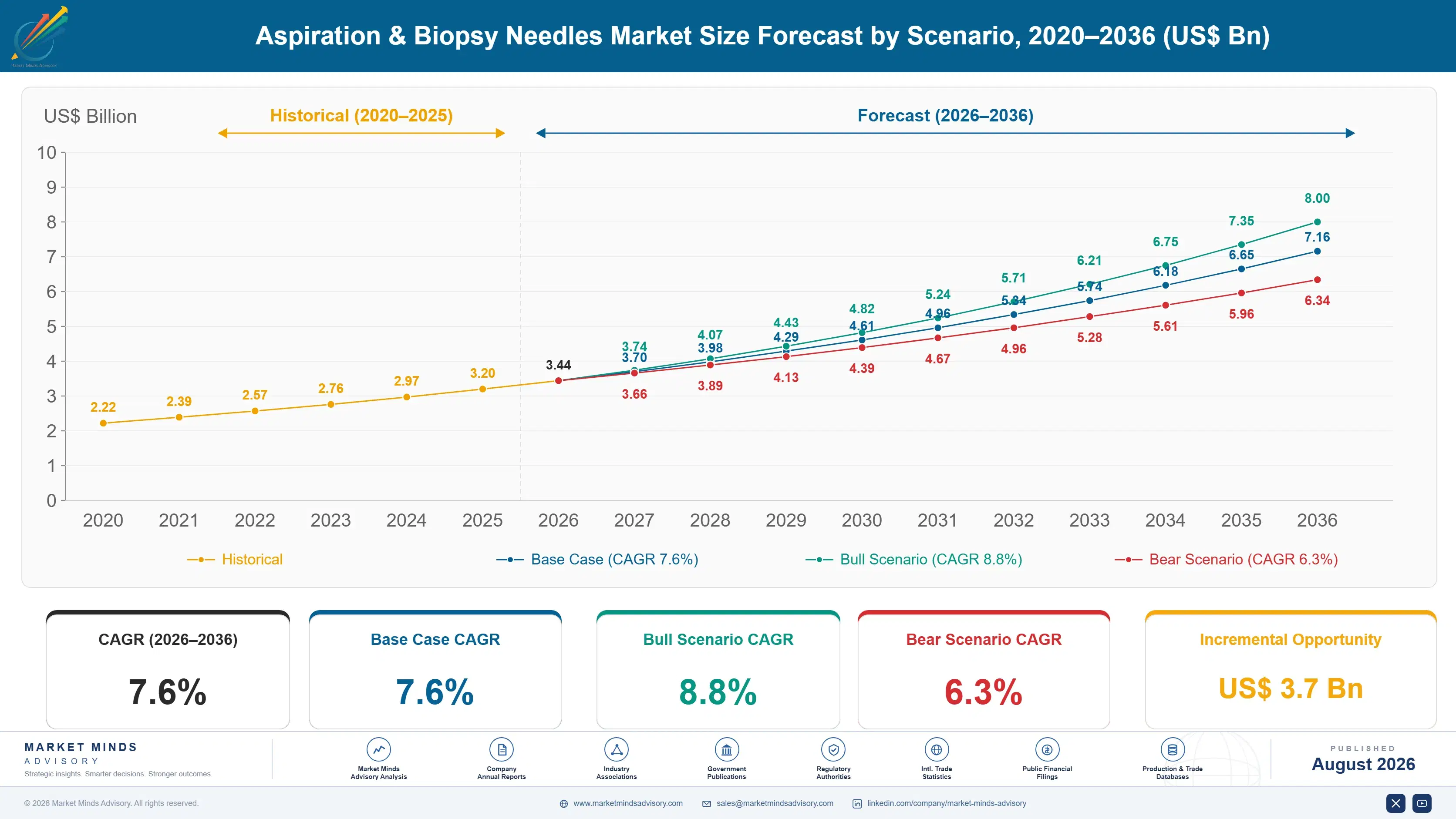
Biopsy needle demand grew steadily through 2020 to 2025, interrupted in 2020 as elective cancer screening procedures were deferred during the pandemic, then rebounded as deferred screening volume caught up through 2022. Vacuum-assisted device adoption accelerated faster than the broader category as breast cancer screening guidelines expanded eligible age ranges, producing a historical CAGR of 6.6% that understates the acceleration in the device's most recent years.
The base case assumes 7.6% annual growth through 2036, driven by three mechanisms. First, expanded breast, lung, and prostate cancer screening eligibility under updated clinical guidelines is increasing the population undergoing routine biopsy procedures. Second, hospitals are standardizing on vacuum-assisted platforms that reduce repeat-procedure rates, directly increasing device volume per diagnosed lesion. Third, image-guided biopsy adoption in ambulatory surgical centers is shifting procedure volume out of hospitals into lower-cost settings that still require dedicated biopsy device purchases.
The bull case assumes faster screening guideline expansion and vacuum-assisted conversion pull growth toward 8.8%. The bear case centers on reimbursement pressure and hospital procurement consolidation that squeezes device pricing faster than volume growth can offset, pulling growth down toward 6.3% if payer reimbursement rates for image-guided biopsy procedures decline meaningfully across major developed healthcare markets simultaneously.

Screening Volume and Diagnostic Yield Economics

Biopsy device selection has become a diagnostic yield decision, not just a procurement one. Hospitals increasingly choose vacuum-assisted and image-guided systems because they reduce repeat-procedure rates and non-diagnostic sample failures, and that clinical outcome now shows up directly in radiology department budgets and quality metrics hospital administrators track closely across every reporting cycle and board review.
CR5 CONCENTRATION48%Reflects moderate consolidation among global biopsy device manufacturers
VACUUM-ASSISTED DEVICE PREMIUM35-45%Premium hospitals pay over standard core biopsy devices
US PROCEDURE VOLUME SHARE34%Share of global biopsy procedures performed in that country
REPEAT BIOPSY RATE REDUCTION18-24%Improvement vacuum-assisted systems deliver over conventional core needles
DISPOSABLE COMPONENT COST SHARE55-62%Portion of device cost tied to single-use consumables
AVERAGE PROCEDURE REIMBURSEMENT RATEUS$450-850Typical payer reimbursement range across major biopsy procedure types
The United States generates roughly a third of global procedure volume, reflecting both its cancer screening infrastructure and its comparatively high biopsy rate per positive imaging finding relative to other developed healthcare systems. Device makers price accordingly, charging meaningfully more for vacuum-assisted platforms in the US than in cost-constrained European and Asian public health systems, where budget owners negotiate harder on unit price.
The next decade will reward manufacturers that integrate biopsy hardware with imaging and AI-assisted lesion targeting software rather than those still competing purely on needle mechanics. Reimbursement policy, more than technology readiness, will set the pace of vacuum-assisted conversion in cost-constrained health systems. Expect procedure volume to keep growing faster than device average selling price, compressing per-unit margins even as total category revenue expands steadily across nearly every major healthcare market worldwide, from the most developed systems to the fastest-emerging ones.
"Hospitals aren't buying needles anymore, they're buying diagnostic confidence. A radiologist who gets a non-diagnostic sample and has to repeat a biopsy has already lost the economic argument for the cheaper device."
Director, Medical Devices Practice · MMA Medical Devices Practice ·

Market Trends

AI-Assisted Lesion Targeting Integrates With Biopsy Platforms

Hologic, BD, and several imaging-software specialists have integrated AI-assisted lesion targeting directly into vacuum-assisted biopsy workflows since 2023, using prior imaging studies to guide needle placement and reduce the passes needed to sample a lesion adequately. Early clinical studies presented at radiology society meetings show meaningful reductions in non-diagnostic sample rates when AI targeting is used alongside vacuum-assisted devices, particularly for smaller or harder-to-visualize lesions conventional core needle technique struggles with. Hospitals evaluating capital equipment purchases increasingly request AI-compatible biopsy platforms, even when the software itself is licensed and priced separately from the hardware purchase.
Market Impact: Adds biopsy referral volume 12-15% annually
Ambulatory Surgical Centers Shift Biopsy Procedure Volume

US ambulatory surgical centers are capturing a growing share of image-guided biopsy procedures that used to happen exclusively in hospital radiology departments, driven by lower facility fees and payer preference for lower-cost outpatient settings over hospital-based procedures. This shift is changing the buyer for biopsy devices, since ambulatory centers negotiate device pricing independently of hospital group purchasing organizations and often favor different vendors than their affiliated hospital systems use. Device manufacturers are building dedicated ambulatory sales channels and smaller-footprint equipment configurations to serve this faster-growing but more price-sensitive customer segment separately.
Market Impact: Cuts repeat procedures 18-24%

Market Opportunities and Growth Drivers

Expanded Cancer Screening Guidelines Increase Biopsy Volume

Updated breast cancer screening guidelines from the US Preventive Services Task Force, lowering the recommended starting age to 40, are expanding the population undergoing routine mammography and, by extension, the population referred for follow-up biopsy when imaging findings are indeterminate. Lung cancer screening expansion under similar guideline updates for high-risk smokers is generating a comparable increase in referred biopsy volume for pulmonary nodules identified on low-dose CT scans. Hospitals report meaningfully higher biopsy procedure volume in markets where these guideline updates have been in effect longest, giving device manufacturers a reliable multi-year demand signal.
Market Impact: Compresses device pricing by 5-8% annually

Vacuum-Assisted Conversion Reduces Repeat Procedure Rates

Vacuum-assisted biopsy devices reduce non-diagnostic sample rates by 18 to 24% compared to conventional core needle technique, according to clinical studies presented at major radiology conferences, directly reducing the repeat-procedure burden on both patients and hospital scheduling capacity. Hospitals evaluating total cost of care, not just device acquisition cost, increasingly favor vacuum-assisted platforms because avoiding a repeat procedure saves more than the price premium the device carries over conventional alternatives. Radiology departments under scheduling capacity pressure are converting to vacuum-assisted systems specifically to free up procedure slots currently consumed by repeat biopsies.
Market Impact: GPO contracts cover 60%+ of purchases

Market Restraints and Challenges

Reimbursement Pressure Compresses Device Pricing Steadily

Hospital group purchasing organizations and payer reimbursement caps are compressing biopsy device pricing even as procedure volume keeps growing, since Medicare and major private payers have not raised biopsy procedure reimbursement rates proportionally with device manufacturers' input costs. The root cause is that biopsy procedures are bundled into broader diagnostic imaging reimbursement codes that do not separately account for device technology tier, leaving hospitals to absorb any premium for advanced vacuum-assisted or AI-compatible platforms. Device manufacturers are responding by bundling service contracts and consumables into multi-year pricing agreements that smooth revenue even as per-unit device pricing stays flat.
Market Impact: Cuts non-diagnostic sample rates by 15-20%

Group Purchasing Consolidation Limits Vendor Differentiation

Hospital group purchasing organizations increasingly negotiate biopsy device contracts across entire health systems rather than department by department, and these consolidated contracts often favor whichever vendor offers the broadest bundled discount across multiple device categories rather than the best biopsy-specific technology. The root cause is that GPO contracting incentives reward total account value over top clinical performance in any single device category, disadvantaging specialist biopsy device makers without a broad product portfolio to bundle. Smaller specialist manufacturers are responding by forming distribution partnerships with larger medical device companies that already hold GPO contracts, trading margin for guaranteed hospital access.
Market Impact: Shifts 20%+ volume to outpatient
3 additional market trends, 4 additional growth drivers, and 2 additional restraints and challenges are covered in the full report. Contact sales@marketmindsadvisory.com to access the complete intelligence.

Segment CAGR and Growth Architecture

This report segments the aspiration and biopsy needles market by device type across fine-needle aspiration needles, core biopsy devices, vacuum-assisted biopsy systems, bone marrow aspiration and biopsy needles, co-axial introducer needles, and image-guided biopsy gun systems. Device type was chosen over clinical application because purchasing and reimbursement decisions follow device category rather than the specific tissue site sampled.
aspiration-biopsy-needles-market-size-market-share-analysis-1787301155055

Vacuum-Assisted Biopsy Devices

Vacuum-assisted biopsy devices are the fastest-growing category at 9.8% annually, roughly 29% faster than the market average. Breast cancer screening volume is the primary demand driver, since vacuum-assisted systems collect multiple tissue samples through a single needle insertion, reducing both non-diagnostic sample rates and patient discomfort compared to conventional core needle technique. Hospitals are converting radiology suites to vacuum-assisted platforms specifically to reduce repeat-procedure scheduling burden, and that conversion is now extending beyond breast biopsy into select lung and soft-tissue applications where multi-sample collection improves diagnostic yield. Hologic, BD, and Devicor lead this category, with newer AI-integrated targeting features increasingly differentiating premium platforms from basic vacuum-assisted systems on price and clinical outcome data.
CAGR 9.8%

Image-Guided Biopsy Gun Systems

Image-guided biopsy gun systems, the second-fastest category at 9.1% annually, benefit from the broader shift toward ultrasound, CT, and MRI-guided procedures that improve targeting accuracy for lesions difficult to sample through blind or palpation-guided technique. Interventional radiologists increasingly prefer image-guided approaches even for straightforward biopsies, since the additional targeting confidence reduces the risk of a non-diagnostic or inadequately targeted sample. Reusable biopsy gun handles paired with disposable needle cartridges create a recurring consumables revenue stream that manufacturers value beyond the initial capital equipment sale. Adoption is growing fastest in ambulatory surgical centers and community hospitals newly investing in image-guided capability to compete with larger academic medical centers on procedure quality and outcomes.
CAGR 9.1%
Full segment breakdown across 6 segments available in the complete report.

Regional Architecture and Country Demand Map

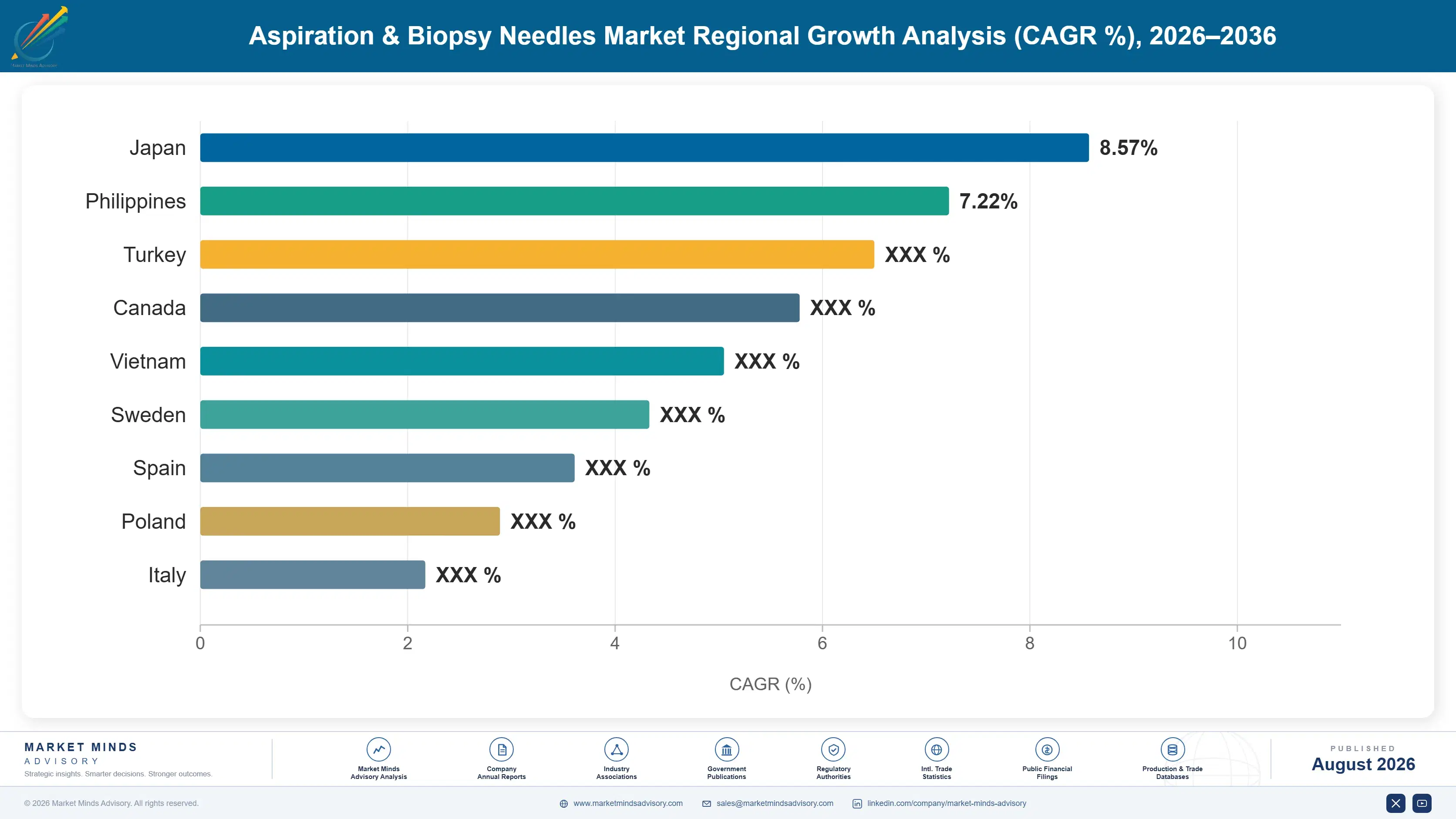
North America retains the largest regional share on screening volume and reimbursement infrastructure, with East Asia expanding fastest as cancer screening programs scale. South Asia and Pacific is growing quickest off a smaller base, while Latin America, the Middle East and Africa, and Eastern Europe remain earlier-stage markets.

North America

US mammography screening guidelines and well-established reimbursement codes for image-guided biopsy procedures make this the largest and most mature biopsy device market globally, with hospital group purchasing organizations increasingly setting the terms device manufacturers must meet to win system-wide contracts. Canada's provincial health systems are slower to adopt vacuum-assisted and AI-compatible platforms than the US given more centralized capital equipment budgeting and longer procurement cycles. Mexico's private hospital sector, serving both domestic patients and medical tourism, is adopting advanced biopsy technology faster than its public health system, creating a two-tier adoption pattern within the same country that manufacturers increasingly account for when designing commercial and pricing strategy across their North American accounts.
Share: 30% | CAGR: 7.0% (2026 to 2036)

Western Europe

Germany, France, and the UK run centralized national screening programs that generate predictable biopsy procedure volume, but public health system budget constraints keep vacuum-assisted and AI-compatible device adoption slower than in the United States. Germany's statutory health insurance system reimburses biopsy procedures at rates that support device upgrades more readily than the UK's National Health Service, which faces tighter capital equipment budgets. France's national breast cancer screening program is expanding eligible age ranges similarly to the US, generating comparable procedure volume growth even though device technology adoption trails. Southern European markets including Spain and Italy show the slowest adoption of premium vacuum-assisted platforms within the region, reflecting tighter regional healthcare budget constraints overall.
Share: 22% | CAGR: 6.1% (2026 to 2036)
Regional intelligence for 5 additional markets available in the complete report: East Asia, South Asia and Pacific, Latin America, Middle East and Africa, Eastern Europe. Contact sales@marketmindsadvisory.com.
aspiration-biopsy-needles-market-size-country-cagr-analysis-1787301155679

Where Biopsy Device Margins Concentrate

Margin in this market increasingly sits in consumables, service contracts, and AI software licensing rather than the capital equipment sale itself. Four levers explain most of the gap between manufacturers still competing purely on device hardware price and those capturing recurring revenue across the full procedure lifecycle from capital sale through ongoing consumables and service.

Locking In Recurring Consumables and Cartridge Revenue

Vacuum-assisted and image-guided biopsy systems generate ongoing disposable needle and cartridge revenue that typically exceeds the original capital equipment sale price within eighteen to twenty-four months of installation, since each procedure consumes a single-use component. Manufacturers that place capital equipment at a low or subsidized price specifically to lock in the recurring consumables relationship see 20 to 25% better lifetime account economics than those pricing capital equipment at full margin upfront. This dynamic mirrors the razor-and-blade model common in other medical device categories, and it rewards manufacturers with the broadest installed base of compatible capital equipment.
Market Impact: Adds a 20-25% lift to lifetime account economics

Bundling Service Contracts With Capital Equipment Sales

Hospitals increasingly purchase multi-year service and maintenance contracts alongside capital biopsy equipment, and these contracts carry margins meaningfully above the equipment sale itself since they require primarily technician labor rather than capital-intensive manufacturing. Manufacturers offering bundled service contracts report renewal rates above 75%, turning what used to be a one-time capital sale into a recurring revenue relationship that persists for the equipment's full service life. Losing a service contract to a third-party maintenance provider is correspondingly damaging, since it also risks losing the hospital's next capital equipment purchase to a competitor with a stronger service relationship.
Market Impact: Service contract renewal rates exceed 75% across most accounts

Licensing AI-Assisted Lesion Targeting Software Separately

Manufacturers increasingly license AI-assisted lesion targeting software as a separate subscription from the biopsy hardware itself, charging hospitals an annual fee that scales with procedure volume rather than bundling the software cost into the equipment purchase price. This software licensing revenue carries margins closer to enterprise software than medical device hardware, and attachment rates are rising as radiology departments see measurable non-diagnostic sample rate reductions that justify the ongoing subscription cost. Hologic and BD both report AI software attachment rates above 40% on new platform sales, with attachment rates climbing steadily as clinical evidence accumulates supporting the software's diagnostic value.
Market Impact: AI software attachment rates exceed 40% on new sales

Expanding Ambulatory Surgical Center Distribution Channels

Ambulatory surgical centers are capturing a growing share of image-guided biopsy procedure volume, and manufacturers building dedicated sales and distribution channels for this segment capture volume that used to flow entirely through hospital group purchasing organizations. Ambulatory centers negotiate device contracts independently and often favor different vendors than their affiliated hospital systems, creating an opportunity for challenger manufacturers to win accounts that incumbent hospital-focused vendors overlook. Manufacturers with dedicated ambulatory sales teams report account growth exceeding 20% annually in this channel, well above the slower-moving hospital group purchasing organization channel, even though average account size runs smaller per location.
Market Impact: Captures share in a channel growing 20%+ annually

Who Controls the Margin Pool

CR5 concentration sits at 48%, reflecting meaningful consolidation among established medical device manufacturers. BD and Boston Scientific lead on installed base and hospital relationships, but the gap to challengers including Hologic and Merit Medical has narrowed as vacuum-assisted and AI-integrated platforms become available through licensing partnerships rather than proprietary development alone, letting smaller specialists compete credibly on technology.
Competitive activity plays out on three fronts. AI-assisted lesion targeting integration is the most visible, with nearly every major manufacturer now offering or partnering for compatible software. Consumables and service contract bundling is the second front, where BD and Boston Scientific use their broad installed base to defend recurring revenue. Ambulatory surgical center distribution is the third front, where smaller specialists are winning accounts that hospital-focused incumbents overlook.

Pressure is building from two directions rankings have not caught up with. Hologic has moved from a breast-imaging specialist into a genuine biopsy device leader specifically through its vacuum-assisted platform, taking share from BD in breast procedures. Chinese domestic manufacturers are simultaneously expanding into conventional core and fine-needle device categories in export markets, competing on price against established distribution networks that took decades to build.
aspiration-biopsy-needles-market-size-company-positioning-matrix-1787301156220

Competitive Moat and Risk Dimensions

BECTON, DICKINSON AND COMPANY

Moat: Global Hospital Distribution Network

BD's distribution network and existing hospital relationships across nearly every major health system give it access to group purchasing organization contracts that smaller specialists cannot match, letting it bundle biopsy devices with its broader medical device portfolio to win system-wide agreements spanning many product categories.
BECTON, DICKINSON AND COMPANY

Risk: Slower AI Software Integration Pace

BD has moved more slowly than Hologic on AI-assisted lesion targeting integration specifically for breast biopsy, since its biopsy portfolio spans multiple clinical applications that compete internally for software development resources rather than concentrating investment in a single high-growth segment as aggressively as some competitors do.
BOSTON SCIENTIFIC CORPORATION

Moat: Broad Interventional Device Portfolio

Boston Scientific's broad interventional device portfolio, spanning cardiology, endoscopy, and urology alongside biopsy devices, gives its sales teams cross-selling access to hospital procurement relationships that pure-play biopsy device competitors cannot easily replicate across an equally wide range of clinical departments, service lines, and budget owners.
BOSTON SCIENTIFIC CORPORATION

Risk: Limited Breast Biopsy Market Share

Boston Scientific holds comparatively limited share in breast biopsy specifically, the fastest-growing clinical application in the category, ceding that high-growth segment largely to Hologic, BD, and Devicor rather than competing there directly at scale with a dedicated platform of its own comparable in scope and clinical evidence.

Key Players

Becton, Dickinson and Company
Boston Scientific Corporation
Hologic Inc.
Merit Medical Systems Inc.
Argon Medical Devices Inc.

Others

Cook Medical Inc.
Cardinal Health Inc.
Medtronic plc
Devicor Medical Products Inc.
INRAD Inc.
US Biopsy LLC
Angiotech Pharmaceuticals Inc.
CIVCO Medical Solutions
Rex Medical L.P.
Mermaid Medical A/S
TSK Laboratory Co.
Somatex Medical Technologies GmbH
Gallini S.r.l.
Sterylab S.r.l.
Vimex Sp. z o.o.

Recent Developments

FEBRUARY 2025

BD Expands Biopsy Device Manufacturing Capacity

BD completed an organic capacity expansion at its biopsy device manufacturing facility to add dedicated vacuum-assisted system assembly lines, responding to rising breast cancer screening volume and hospital demand for shorter delivery lead times on capital equipment orders across North America and select export markets.
Signal: Signals BD is committing significant manufacturing capital to vacuum-assisted platforms rather than treating them as a secondary product line.
JUNE 2025

Hologic Acquires AI-Guided Biopsy Targeting Startup

Hologic acquired a specialist AI-guided lesion targeting startup to strengthen its vacuum-assisted biopsy platform's diagnostic accuracy and reduce non-diagnostic sample rates, adding machine learning engineering talent it previously lacked in-house for rapid software feature development, faster clinical validation, and quicker regulatory submission across major markets.
Signal: Indicates manufacturers are increasingly building AI capability through acquisition rather than slower internal development timelines alone.
OCTOBER 2025

Merit Medical Signs Supply Agreement With Hospital Network

Merit Medical signed a multi-year supply agreement with a large US hospital network to provide biopsy devices and consumables across its interventional radiology departments, replacing a prior multi-vendor sourcing arrangement with a single qualified supplier relationship covering all network facilities, clinics, and affiliated outpatient sites.
Signal: Confirms that hospital networks are increasingly consolidating biopsy device supply toward fewer qualified vendors system-wide across regions.

Precision Machining and Consumables Exposure

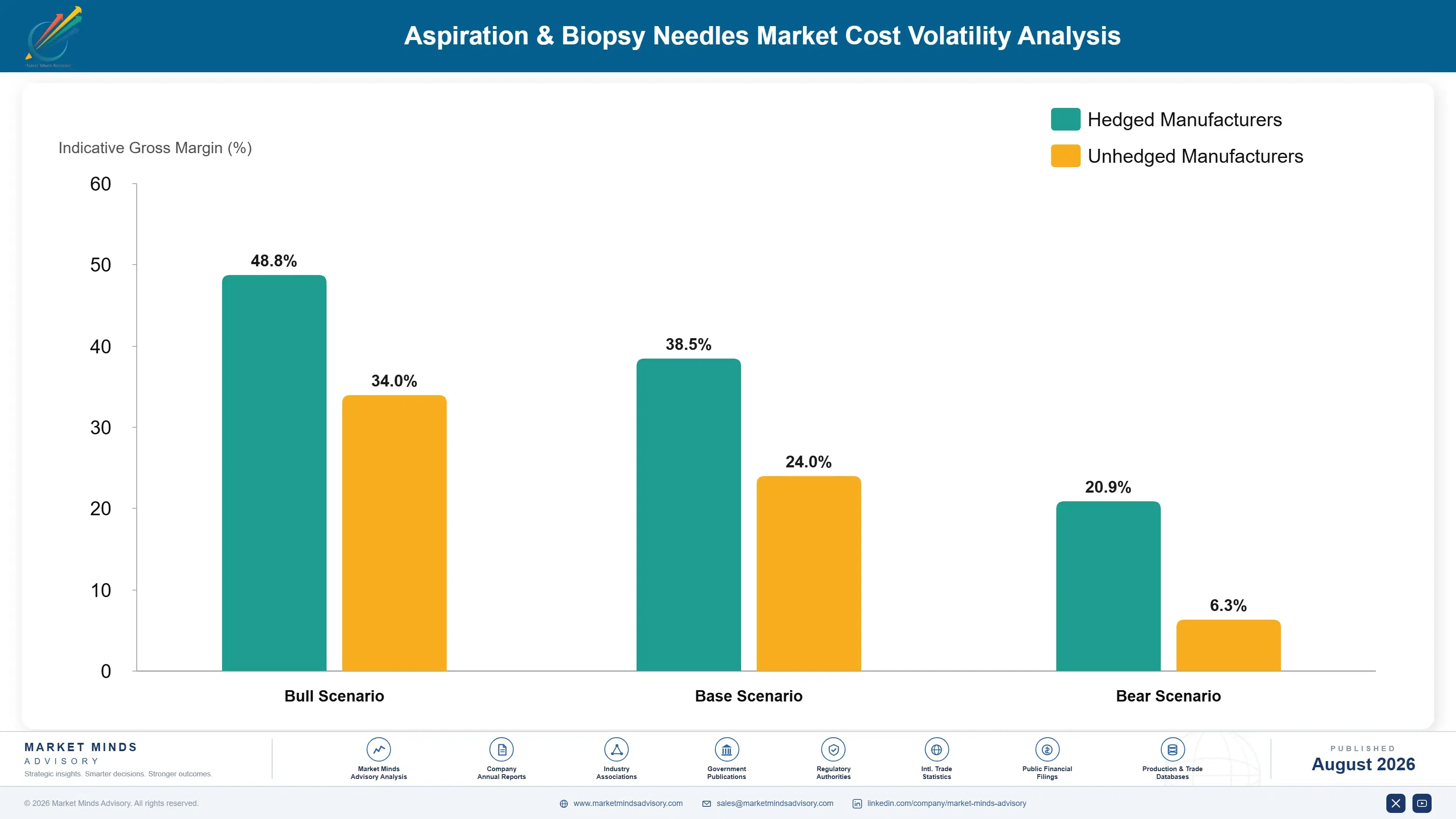
Precision-machined stainless steel and specialty polymer components account for 45 to 55% of biopsy device manufacturing cost, with electronic components for AI-compatible platforms making up a growing share of the remainder. Steel and polymer inputs are sourced from a mix of medical-grade specialty suppliers, while precision machining is concentrated among a smaller number of qualified contract manufacturers meeting medical device regulatory standards.
Medical-grade stainless steel prices rose more than 15% within two quarters during 2022 as broader steel market volatility spilled into specialty medical-grade supply chains, according to company annual report disclosures from major device manufacturers. That volatility forced several manufacturers to renegotiate consumables pricing with hospital group purchasing organizations mid-contract, an unusual step in an industry that typically holds pricing steady within long multi-year hospital agreements.

Scale manufacturers like BD and Boston Scientific negotiate steel and component supply contracts across their full global device portfolio, giving them better pricing than smaller specialists buying at lower volumes. Manufacturers with in-house precision machining capability carry a durable cost advantage over competitors relying entirely on contract manufacturers, reshaping where device makers choose to locate production facilities long term.
aspiration-biopsy-needles-market-size-cost-volatility-analysis-1787301156420

Qualifying Multiple Precision Machining Suppliers

Manufacturers are qualifying precision machining suppliers across multiple regions rather than relying on a single contract manufacturer, reducing exposure to any single supplier's capacity constraints or quality issues. This adds supplier qualification complexity but has measurably reduced delivery delays passed through to hospital customers during recent supply disruptions and demand spikes across multiple device categories.

Locking Multi-Year Steel and Component Contracts

Larger manufacturers are negotiating multi-year fixed-price steel and component supply agreements directly with suppliers, trading some upside if prices fall for protection against sudden spikes tied to broader steel market volatility. Smaller manufacturers without comparable purchasing volume typically cannot access these terms and remain more exposed to spot pricing swings throughout the contract cycle.

Insourcing Precision Machining Capability Where Feasible

Several manufacturers are insourcing precision machining capability for their highest-volume device components rather than relying entirely on contract manufacturers, reducing exposure to third-party capacity constraints and quality variability. This insourcing strategy requires capital investment upfront but reduces long-run exposure to contract manufacturer pricing power and unpredictable delivery delays across the full product line and portfolio.

Portfolio Architecture for Margin Defence

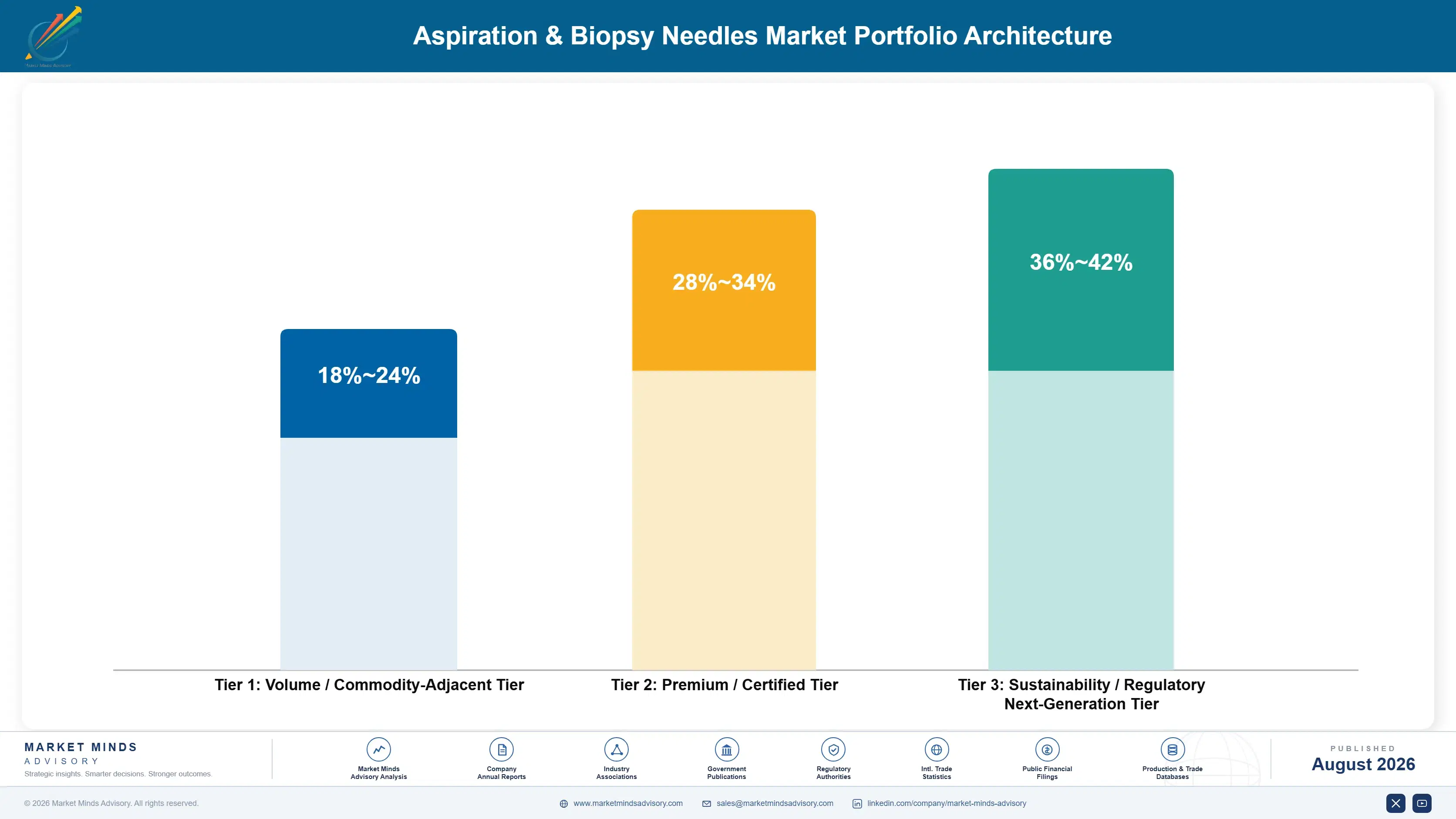
Portfolio economics split into three tiers. Volume commodity-adjacent devices, primarily conventional fine-needle and core biopsy needles, run on modest margins driven by intense price competition among established manufacturers and increasingly capable regional competitors expanding their footprint. Premium and certified devices, carrying vacuum-assisted mechanisms and validated clinical outcome data, command meaningfully better margins because hospitals pay for reduced repeat-procedure rates a
The tension between volume and premium runs deep, since hospital group purchasing organizations want the lowest acquisition cost per device while radiology departments increasingly demand the diagnostic yield improvements that only premium-tier vacuum-assisted and AI-compatible platforms deliver consistently. BD and Boston Scientific manage this by maintaining separate conventional and premium product lines, letting hospital systems mix procurement across both tiers.

High-value pools concentrate in AI-integrated vacuum-assisted platforms, where clinical evidence scarcity and hospital adoption timelines both support pricing power that ordinary commodity manufacturing cannot replicate. Capital is flowing fastest into AI software development and clinical validation studies, as manufacturers race to establish the evidence base that will define premium platform competitiveness through the next decade across breast, lung, and prostate applications.

Volume / Commodity-Adjacent Tier

Conventional fine-needle aspiration and core biopsy needles without vacuum assistance or AI integration, priced primarily on unit cost and competing mainly on distribution reach and basic reliability across high-volume hospital and clinic settings.
Gross Margin: 18-24%

Premium / Certified Tier

Vacuum-assisted biopsy systems bundled with validated clinical outcome data and multi-year service contracts that hospitals value for reduced repeat-procedure rates and predictable total cost of care across the device lifecycle.
Gross Margin: 28-34%

Sustainability / Regulatory / Next-Generation Tier

AI-integrated vacuum-assisted and image-guided platforms addressing expanded screening guideline volume and diagnostic accuracy requirements, where clinical evidence scarcity and early-mover advantage both support the strongest pricing power in the category.
Gross Margin: 36-42%
aspiration-biopsy-needles-market-size-portfolio-architecture-1787301156945

High-value Sub-segments and Strategic Watch-out

AI-Integrated Vacuum-Assisted Breast Biopsy Systems

Expanded breast cancer screening eligibility and rising demand for reduced repeat-procedure rates make this segment both guideline-driven and clinically necessary, commanding sustained pricing power even as AI software licensing costs gradually normalize across the broader premium device category over the next several years of adoption.
Gross Margin: 38-44%

Consumables and Service Contract Bundles

Recurring consumables and service contract revenue is growing steadily as hospitals standardize on vacuum-assisted platforms requiring ongoing disposable cartridges, commanding a durable subscription-like revenue premium even though capital equipment volume growth trails the fastest device segments by a considerable and steadily widening margin each year.
Gross Margin: 30-36%

Standard Core Biopsy Needles

Conventional core biopsy needles remain the largest unit-volume segment by far, competing mainly on price and distribution reach rather than technology differentiation, with margins compressed by intense competition among established and increasingly capable regional manufacturers expanding their export volume into several new markets each year.
Gross Margin: 16-22%

Legacy Non-Vacuum Manual Biopsy Devices

Older manual biopsy devices without vacuum assistance face rising clinical preference risk as hospitals adopt updated screening protocols, and manufacturers with heavy legacy exposure risk losing accounts to vacuum-assisted competitors faster than they can convert their remaining product lines and installed hospital account base to the newer format.
Gross Margin: 10-15%

How Biopsy Device Demand Recurs

Biopsy device demand carries a genuine annuity quality through recurring consumables and service contracts layered on top of the initial capital equipment sale. Hospitals replace disposable needle and cartridge components with every procedure regardless of macroeconomic conditions, and service contract renewal rates above 75% give manufacturers a recurring revenue stream that persists independent of new capital equipment sales cycles across nearly every hospital account and department.
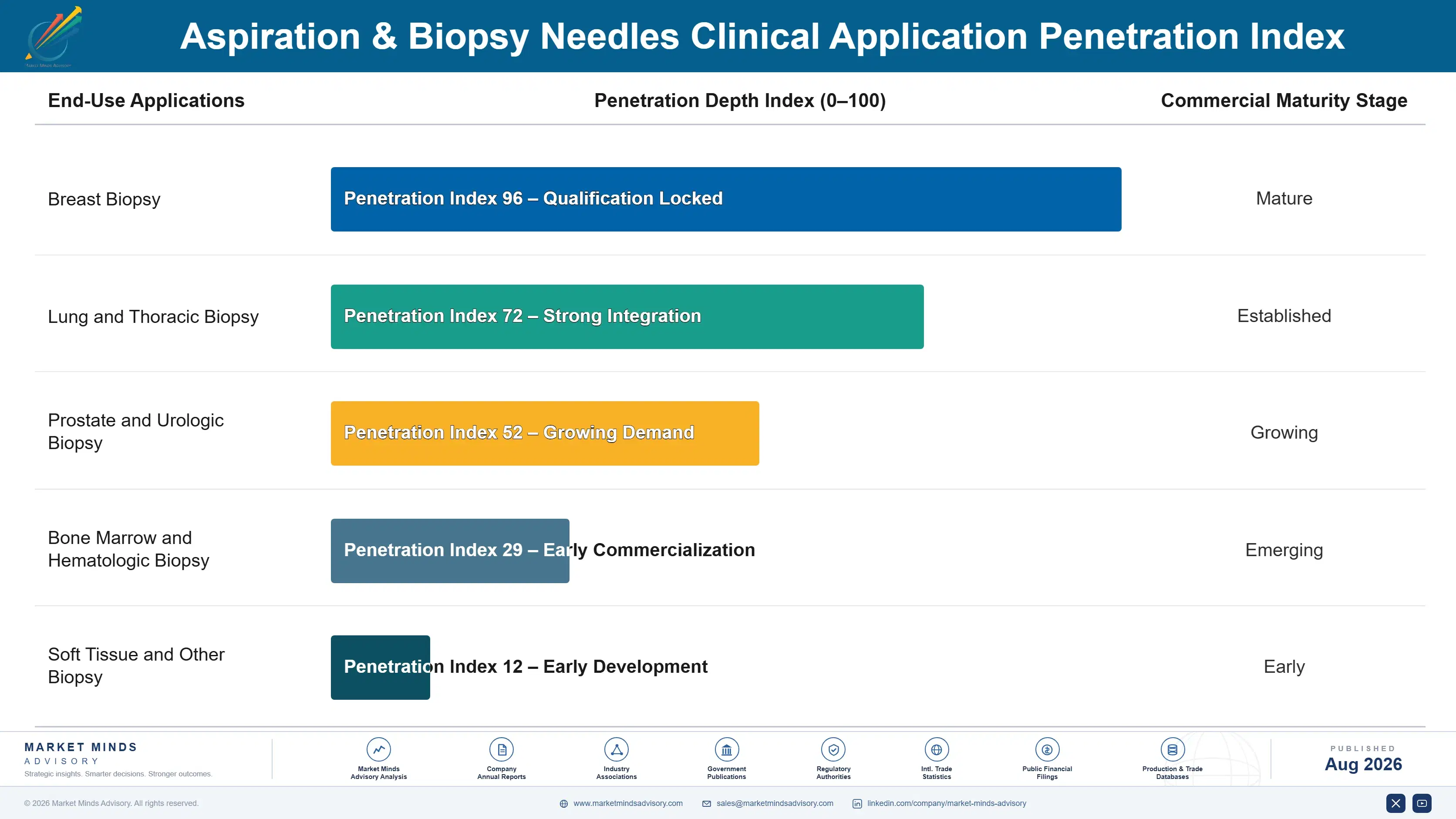
Adoption depth varies meaningfully by clinical application. Breast biopsy shows the deepest vacuum-assisted adoption, since screening volume and reimbursement infrastructure are both most mature there. Lung and prostate biopsy adoption is growing but less mature, tracking guideline expansion more recently. Bone marrow and soft-tissue biopsy adoption remains shallower, since conventional core needle technique still dominates those lower-volume clinical applications across most hospital systems today.

A younger generation of interventional radiologists and pathologists, trained on AI-assisted targeting workflows during residency rather than adopting them later in practice, is accelerating hospital demand for AI-compatible biopsy platforms. That generational shift is reshaping which manufacturers even get invited into hospital capital equipment evaluation processes in the first place, and which get quietly excluded from consideration entirely.
aspiration-biopsy-needles-market-size-end-use-penetration-index-1787301157490

What Wins in Biopsy Devices

These are among the four positions where our research anticipates prominent divergence between winners and laggards over the coming forecast period. Each is grounded in the demand model, the regulatory perimeter, and the announced capacity pipeline.
01 / CLINICAL EVIDENCE INVESTMENT

Invest in AI targeting clinical evidence before it becomes standard of care

Manufacturers that invest in clinical evidence generation for AI-assisted lesion targeting ahead of it becoming standard of care capture premium pricing and hospital adoption priority before that becomes a baseline expectation. Waiting until clinical guidelines mandate AI-assisted targeting means competing for hospital capital equipment budgets against manufacturers that built their evidence base years earlier, at a moment when adoption is accelerating across the entire industry simultaneously. Early movers are also better positioned to win group purchasing organization contracts that increasingly specify AI compatibility as an evaluation criterion.
02 / CONSUMABLES REVENUE STRATEGY

Price capital equipment low to lock in recurring consumables revenue

Manufacturers that price capital biopsy equipment competitively to win the initial hospital sale capture years of recurring consumables revenue that typically exceeds the original equipment price within eighteen to twenty-four months of installation. Competitors that price capital equipment at full margin upfront often lose the account entirely to a manufacturer willing to subsidize the initial sale for the long-term consumables relationship that follows. The window to establish these installed-base relationships is narrowing as hospitals consolidate purchasing decisions across entire health systems rather than department by department.
03 / AMBULATORY CHANNEL STRATEGY

Build dedicated ambulatory surgical center distribution before incumbents do

Manufacturers that build dedicated sales and distribution channels for ambulatory surgical centers capture volume shifting out of hospitals faster than competitors still relying entirely on hospital group purchasing organization relationships. Ambulatory centers negotiate device contracts independently and often favor different vendors than their affiliated hospital systems use, creating a genuine opportunity for challenger manufacturers overlooked by hospital-focused incumbents. Manufacturers that wait to build this channel risk losing price-sensitive, fast-growing volume to competitors who invested during the current market expansion already underway.
04 / REIMBURSEMENT ADVOCACY POSITION

Engage payers directly on device-tier reimbursement before margins compress further

Manufacturers that engage payers and policymakers directly on differentiated reimbursement for advanced device tiers avoid the margin compression that comes from biopsy procedures being bundled into generic diagnostic imaging codes. Manufacturers that stay passive on reimbursement policy risk having their premium device pricing absorbed entirely by hospitals unable to pass the cost through to payers under current bundled reimbursement structures. The window for meaningful reimbursement policy influence narrows as bundled payment models become more entrenched across major healthcare systems worldwide.

Engagement Snapshot From the Field

A live engagement with an industry participant carrying material or product regulatory and market exposure ahead of a defining policy shift, showing how our research translates into a defensible multi-year portfolio strategy.
MARKET MINDS ADVISORY · CLIENT ENGAGEMENT SUMMARY
Aspiration & Biopsy Needles Producer Strategic Portfolio Review and Transition Roadmap 2026·Investment Scenario on Aspiration & Biopsy Needles Exposure Evaluation 2025-26
CLIENT PROFILE
The client is a regional hospital system operating 14 facilities across three states, with an interventional radiology and breast imaging program generating more than 22,000 biopsy procedures annually and an annual biopsy device and consumables spend exceeding US$18 million (client-reported, unverified by MMA). The system was evaluating whether to standardize on a single vacuum-assisted device vendor across all facilities.
STRATEGIC CHALLENGE
The client needed to determine whether standardizing on a single biopsy device vendor system-wide would generate meaningful cost savings without compromising radiologist preference or diagnostic outcome quality, given that individual facilities had historically made independent purchasing decisions across several competing vendors with varying levels of physician loyalty and contract terms.
MMA APPROACH
MMA conducted a facility-by-facility analysis correlating device vendor mix, procedure volume, non-diagnostic sample rates, and current contract pricing across the client's full radiology network. The engagement combined primary interviews with radiologists at each facility and comparative benchmarking against peer hospital system standardization initiatives already underway in comparable regional markets and health system sizes.
KEY FINDINGS
  1. The client's 14 facilities used five different biopsy device vendors, creating meaningfully higher per-unit consumables pricing than peer systems that had already standardized on fewer vendors.
  2. Non-diagnostic sample rates varied more than twofold across facilities depending on device vendor and technique, suggesting device standardization could meaningfully improve diagnostic outcome consistency system-wide.
  3. Radiologist vendor preference was concentrated among a subset of facilities with strong existing relationships, rather than distributed evenly across the client's full physician base.
  4. Peer benchmarking showed standardized systems achieving consumables pricing 15 to 20% below the client's current blended rate across comparable procedure volume and facility count.
CLIENT PROFILE
The client is a regional hospital system operating 14 facilities across three states, with an interventional radiology and breast imaging program generating more than 22,000 biopsy procedures annually and an annual biopsy device and consumables spend exceeding US$18 million (client-reported, unverified by MMA). The system was evaluating whether to standardize on a single vacuum-assisted device vendor across all facilities.
STRATEGIC CHALLENGE
The client needed to determine whether standardizing on a single biopsy device vendor system-wide would generate meaningful cost savings without compromising radiologist preference or diagnostic outcome quality, given that individual facilities had historically made independent purchasing decisions across several competing vendors with varying levels of physician loyalty and contract terms.
MMA APPROACH
MMA conducted a facility-by-facility analysis correlating device vendor mix, procedure volume, non-diagnostic sample rates, and current contract pricing across the client's full radiology network. The engagement combined primary interviews with radiologists at each facility and comparative benchmarking against peer hospital system standardization initiatives already underway in comparable regional markets and health system sizes.
KEY FINDINGS
  1. The client's 14 facilities used five different biopsy device vendors, creating meaningfully higher per-unit consumables pricing than peer systems that had already standardized on fewer vendors.
  2. Non-diagnostic sample rates varied more than twofold across facilities depending on device vendor and technique, suggesting device standardization could meaningfully improve diagnostic outcome consistency system-wide.
  3. Radiologist vendor preference was concentrated among a subset of facilities with strong existing relationships, rather than distributed evenly across the client's full physician base.
  4. Peer benchmarking showed standardized systems achieving consumables pricing 15 to 20% below the client's current blended rate across comparable procedure volume and facility count.
RECOMMENDED STRATEGY
Phase 1: Phase 1 (Months 1-3): Benchmark current device performance and pricing across all facilities, identifying the vendor combination that best balances cost savings and radiologist preference. Phase 2: Phase 2 (Months 4-9): Negotiate a system-wide standardization agreement with the selected vendor, sequencing facility conversion to minimize disruption to procedure scheduling. Phase 3: Phase 3 (Months 10-15): Monitor diagnostic outcome metrics and consumables pricing post-standardization, adjusting the vendor agreement as procedure volume and clinical evidence evolve.
OUTCOME
The client's standardization initiative reduced blended consumables pricing by an estimated 17% across its full facility network within the first year (client-reported, unverified by MMA). Standardizing on a single vendor also reduced non-diagnostic sample rate variability across facilities, improving consistency in diagnostic outcome quality system-wide.

Frequently Asked Questions

Foundational context covering the market sizes, CAGR, scope, country, region and competition that inform every finding below. This section is provided to cover basics and most often pre-purchase conversations, answered from the MMA Primary Research Dataset.

What is the current size of the Aspiration & Biopsy Needles Market?

The market was valued at US$3.2 billion in 2025 and is projected to reach US$3.4 billion in 2026 as cancer screening volume and vacuum-assisted adoption continue rising.

How large will the Aspiration & Biopsy Needles Market be by 2036?

MMA projects the market will reach US$7.1 billion by 2036, roughly 2.09 times its 2026 value, driven by expanded screening guidelines and vacuum-assisted device conversion.

What is the CAGR for the Aspiration & Biopsy Needles Market 2026 to 2036?

The market is projected to grow at a 7.6% CAGR between 2026 and 2036, with a bull case of 8.8% and a bear case of 6.3%.

Which segment is growing fastest?

Vacuum-assisted biopsy devices are the fastest-growing segment at 9.8% annually, roughly 29% faster than the category average, driven by breast cancer screening volume and diagnostic yield improvements.

Who are the major companies in the Aspiration & Biopsy Needles Market?

Leading manufacturers include BD, Boston Scientific, Hologic, Merit Medical Systems, and Argon Medical Devices, which together hold roughly half of category revenue on a disclosed-revenue basis.

Which country is growing fastest?

China leads country-level growth at an estimated 10.2% annually, supported by expanding national cancer screening infrastructure and rising private hospital investment in advanced diagnostic equipment.

Report Segmentation Architecture

The full report scope spans multiple orthogonal segmentation dimensions, with cross-tabulated demand data provided for each dimension pair. Coverage extends further to regional breakdowns, trend trajectories, and the competitive detail needed to support segment-level decision-making.

By Device Type

  • Fine-Needle Aspiration Needles
  • Core Biopsy Devices
  • Vacuum-Assisted Biopsy Systems
  • Bone Marrow Aspiration and Biopsy Needles
  • Co-axial Introducer Needles
  • Image-Guided Biopsy Gun Systems

By Clinical Application

  • Breast Biopsy
  • Lung and Thoracic Biopsy
  • Prostate and Urologic Biopsy
  • Bone Marrow and Hematologic Biopsy
  • Soft Tissue and Other Biopsy

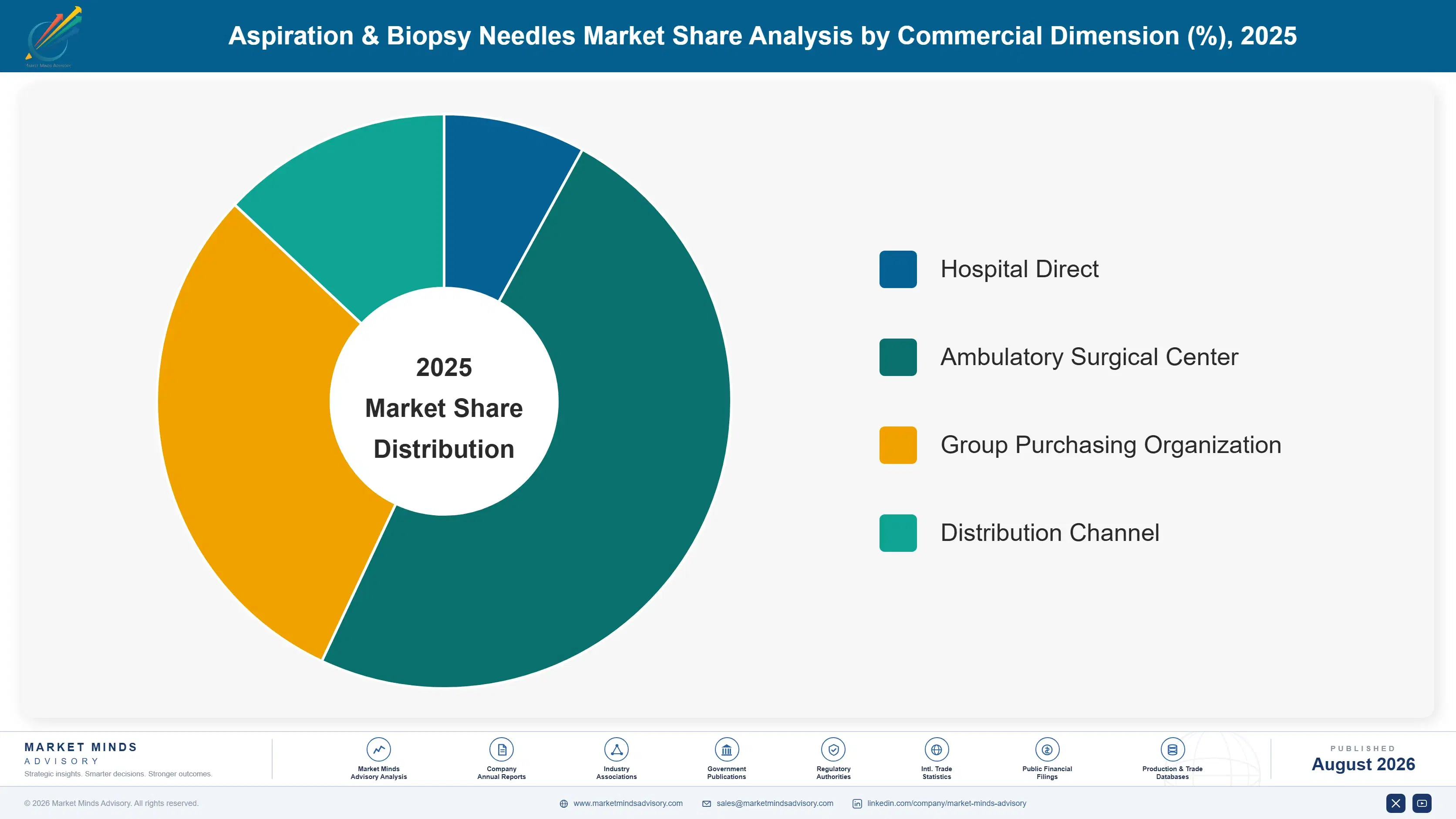
By Commercial Dimension

  • Hospital Direct
  • Ambulatory Surgical Center
  • Group Purchasing Organization
  • Distribution Channel

By Region

  • North America
  • Western Europe
  • East Asia
  • South Asia and Pacific
  • Latin America
  • Middle East and Africa
  • Eastern Europe

Scope, Methodology, and Coverage

Every figure in this report is reproducible from documented input assumptions. The scope below maps the historical period, the forecast horizon, the segmentation dimensions, and the countries covered, alongside the underlying primary and qualitative methodology.
Historical Period
2020 to 2025
Forecast Period
2026 to 2036
Base Year
2025 (USD billions; MMA Primary Research Dataset, August 2026)
Market Definition
The Aspiration and Biopsy Needles market covers fine-needle aspiration needles, core biopsy devices, vacuum-assisted biopsy systems, bone marrow aspiration and biopsy needles, and co-axial introducer needles used for tissue and fluid sampling across oncology, hematology, and interventional radiology procedures. It excludes surgical excisional biopsy instruments and general-purpose injection needles with no dedicated biopsy sampling mechanism.
Quantitative Units
USD billions (current prices); procedure volume in millions where disclosed by segment
Segmentation Dimensions
By Device Type; By Clinical Application; By Commercial Dimension; By Region
Regions Covered
North America, Western Europe, East Asia, South Asia and Pacific, Latin America, Middle East and Africa, Eastern Europe
Countries Covered
USA, China, Germany, France, UK, Japan, South Korea, India, Australia, Canada, Brazil, Mexico, Indonesia, Vietnam, Thailand, Malaysia, UAE, Saudi Arabia, South Africa, Nigeria, Turkey, Poland, Netherlands, Italy, Spain, Sweden, Switzerland, Argentina, Colombia, Singapore, and additional markets relevant to this sector
Key Companies Profiled
Becton, Dickinson and Company, Boston Scientific Corporation, Hologic Inc., Merit Medical Systems Inc., Argon Medical Devices Inc., Cook Medical Inc., Cardinal Health Inc., Medtronic plc, Devicor Medical Products Inc., INRAD Inc., US Biopsy LLC, Angiotech Pharmaceuticals Inc., CIVCO Medical Solutions, Rex Medical L.P., Mermaid Medical A/S, TSK Laboratory Co., Somatex Medical Technologies GmbH, Gallini S.r.l., Sterylab S.r.l., Vimex Sp. z o.o.
Quantitative Methodology
Primary survey, n=3,800 respondents, Q4 2025, six countries; demand-side model with trade association cross-validation
Qualitative Methodology
47 expert interviews, Q4 2025; applied to validate demand model assumptions, identify emerging dynamics, and assess competitive positioning
Report Format
PDF and XLSX data workbook (Word format preview document)
Publisher
Market Minds Advisory
Report Code
MMA-2026-MED-116
Published
August 2026
Contact
sales@marketmindsadvisory.com | www.marketmindsadvisory.com

Purchase the full Aspiration & Biopsy Needles Market Report (2026 to 2036).

The full report delivers a complete quantitative and qualitative assessment of the aspiration and biopsy needles market through 2036, including device-type and country-level forecasts across all seven MMA-tracked regions. It profiles the twenty leading manufacturers shaping competitive dynamics, with detailed moat and risk analysis for the top two players and a full development timeline of recent corporate activity. The report includes primary survey data from 3,800 respondents and 47 expert interviews conducted in Q4 2025, alongside a dedicated input cost and reimbursement policy analysis. Buyers receive segmentation, regional, and competitive datasets formatted for direct integration into internal strategic planning models.
Device-type and regional forecasts through 2036 inclusive
Competitive profiles of twenty leading global manufacturers
Primary survey data from 3,800 global respondents
Expert interview insights from 47 industry practitioners
Input cost and reimbursement policy risk analysis
Editable data tables for internal strategic modeling

Built For The People Who Decide

From boardroom strategy to bench-side execution, this report is read cover-to-cover by leaders shaping the next decade of their industry, turning demand scenarios, market dynamics and valuation benchmarks into decisions.
CXOs/ Presidents/ VPs/ Managers
M&A and Corporate Development
Strategy Teams and R&D Heads
Procurement and Product Directors
Regulatory and Compliance Leaders
Investor Relations and Equity Analysts