Market Minds Advisory
North America & Europe Asphalt Mixing Plant Market

North America & Europe Asphalt Mixing Plant Market: Recycled Content, Permit Neutrality, And A Retrofit Business Nobody Named

Almost nobody in these regions is buying a new asphalt plant. They are buying a parallel drum and a new burner, because a plant built for twenty per cent recycled mix cannot run fifty.

Lead Analyst

David Horsley

Published

September 2026

Make Smarter Decisions with Customized Research Insights

Request a free sample report and evaluate market opportunities, growth trends, and competitive dynamics relevant to your business needs.

2025 MARKET VALUE$1.7BMarket Size 2025
2036 FORECAST VALUE$2.8BBase Case , 2026 to 2036
CAGR 2026 TO 20364.7 %Bull 5.9% / Bear 3.5%
INCREMENTAL OPPORTUNITY$1.0BNet 10- year value creation
EXPANSION MULTIPLE1.58x2036 value over 2026 base
Strategic Levers
M&A Pipeline
Regional Outlook
Country Rankings
Competitive Intelligence
Segmental Deep-dive
Call-Us : 91 93563 13602

Executive Snapshot and Market Trajectory

The plant population in North America and Europe has barely changed in twenty years, and the median unit is over 21 years old. What changed is the specification it must meet. The market reaches USD 1.7 billion in 2025 and grows at 4.7% on retrofit rather than replacement.
RAP handling and recycling retrofit systems grow fastest at 10.2%, about 2.17 times the market rate, because agencies have pushed recycled content from twenty per cent toward fifty and a plant designed for the former cannot physically deliver the latter. North America holds 46% of value, well above the band this framework applies by default, since the market is defined across two regions only. Western Europe takes 32%.
Concentration runs at 58%, held up by the fact that very few builders can supply a complete plant, its controls, and the retrofit modules that keep an old one compliant. Competition has moved from plant capacity to recycling capability and burner emissions performance. Retrofit already carries 44% of category value, and manufacturers still organised around selling complete plants are chasing roughly a third of the money available. That mismatch is the most consistent error here.
Market Definition
The North America and Europe asphalt mixing plant market covers complete hot-mix and warm-mix asphalt production plants, both stationary and relocatable, together with the recycling, emissions control, and burner retrofit systems supplied into the existing plant population. Demand is North American and European, with export supply from those manufacturing bases included. Paving and compaction equipment, milling machines, bitumen and aggregate materials, aggregate crushing plants, and concrete batching plants are excluded.
Base Year Value
$1.7B in 2025 (MMA Primary Research Dataset, August 2026)
Forecast Period
2026 to 2036, eleven discrete annual values
CAGR
4.7% base case. Bull 5.9%. Bear 3.5%.
Fastest Growth Segment
RAP Handling and Recycling Retrofit Systems: 10.2% CAGR
Fastest Growth Country
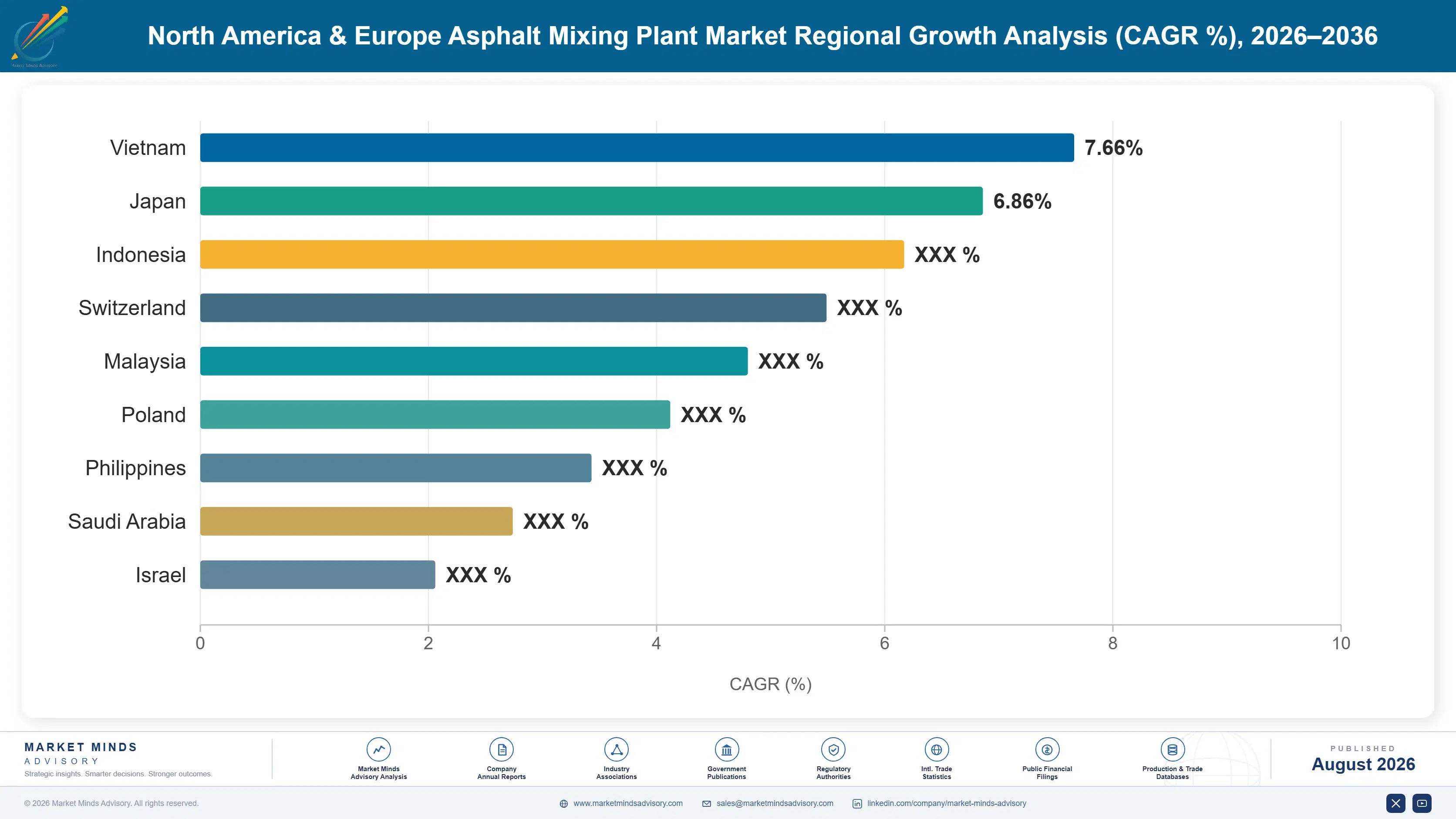
Poland: 5.6% CAGR
Fastest Growth Region
South Asia and Pacific: 6.6% CAGR
Largest Region
North America: 46% of 2025 global value
Market Leaders
Wirtgen Group, Fayat Group, Ammann, Astec Industries, Gencor Industries. Source: MMA Primary Research Dataset, July 2026.
Primary Survey
n=3,800 procurement and R&D decision-makers, Q4 2025, six countries
Methodology
Demand-side build-up, cross-validated against public data, 47 expert interviews

North America & Europe Asphalt Mixing Plant Market Forecast Scenarios

asphalt-mixing-plant-market-2-size-forecast-scenario-1787332605872
Between 2020 and 2025 complete plant sales were flat and everything else grew. American infrastructure funding released deferred road budgets, but contractors spent it on production capability rather than capacity, because the plant they owned still made mix. European demand behaved the same way, with emissions compliance rather than volume driving the spend. A 3.6% historical CAGR conceals a mix shift that changed the business.
Three mechanisms carry the 4.7% base case. Recycled content is the largest: several European agencies and a growing number of American states now allow RAP above 40%, and a plant built for 20% needs a parallel drum, new feed, and more filtration. Emissions rules are second, since the Industrial Emissions Directive and state NOx limits target the burner and baghouse directly. And plant age does the rest, the median unit being past 21 years.
The 5.9% bull case turns on European agencies converging on the Dutch and German recycled content levels, which would put a retrofit requirement on most of the installed population at once. The 3.5% bear case is road funding, since plant investment tracks agency budgets with a two-year lag and nothing a manufacturer does changes it. Both sit outside the industry's control.

A Retrofit Business Wearing A Capital Equipment Name

Count the plants in North America and Europe and the number is roughly what it was two decades ago. Road networks are built, tonnage is broadly flat, and nobody needs another mixing plant in a market where existing ones run below capacity most of the year. What has changed is what those plants are required to produce, and that is an entirely different purchase.
TOP FIVE CONCENTRATION58%Few builders can supply a complete plant and its controls
AVERAGE PLANT VALUEUSD 3.6 millionComplete stationary plant delivered and commissioned on a prepared site
RETROFIT REVENUE SHARE44%Portion of category value from upgrades rather than complete plants
AVERAGE RAP CONTENT31%Recycled pavement share in mix produced across these regions
PLANT POPULATION AGEOver 21 yearsMedian age of operating plants across both covered regions
PLANT SERVICE LIFE25 to 35 yearsOperating years before a complete plant replacement becomes necessary
Average recycled content across these regions now runs 31%, and Dutch and German practice reaches well past half. A plant designed around 20% cannot get there by turning a dial. It needs a parallel drum to heat the RAP without burning the bitumen already in it, a separate cold feed, and more baghouse capacity for the extra dust. That package costs a fraction of a new plant and is the largest single line here.
Retrofit carries 44% of category value against a complete plant at USD 3.6 million, which tells you where the business sits. A plant runs 25 to 35 years and the median across both regions is past 21, so the addressable population for upgrade work is large, identifiable, and mostly still operating. Manufacturers selling only complete plants meet these customers once a generation.
"Ask a plant manufacturer what they sell and they describe a complete plant. Ask a contractor what they last bought and they describe a parallel drum and a burner. Those two answers have been drifting apart for fifteen years and only one side has noticed."
Director, Construction Materials Equipment Practice · MMA Construction and Indus

Market Trends

Recycled Content Specifications Outrun What Existing Plants Deliver

Average RAP content across these regions sits at 31%, but that average hides an enormous spread. Dutch and German producers routinely exceed half, several American state departments have raised allowances past 40%, and the direction is one way. The engineering problem is heat: RAP already contains bitumen, so it cannot be dried in the main burner flame without oxidising the binder and ruining the mix. A parallel drum solves it, along with a separate feed and additional filtration. That package is what most contractors are actually buying, and it costs a fraction of a plant.
Market Impact: Median plant age past 21 years
Burner Fuel Conversion Arrives Ahead Of Any Mandate

A drying drum burner is the largest single energy consumer on an asphalt plant and the largest emitter, which puts it at the centre of every decarbonisation conversation a contractor has with a public client. Multi-fuel and hydrogen-ready burners, biofuel conversions, and electric heating for bitumen tanks are all being specified now, generally ahead of regulation rather than because of it, since agencies increasingly score tenders on carbon. The economics do not always work on fuel cost alone, which is unusual: contractors are buying these to win work rather than to save money.
Market Impact: Permit renewal sets 5 year clock

Market Opportunities and Growth Drivers

Ageing Plant Population Forces Component Replacement Regardless

The median asphalt plant across North America and Europe is past 21 years, against a design life of 25 to 35, which puts a large share of the population into the window where components fail rather than wear. Baghouses, drum shells, bitumen tank heating, and control systems all reach end of life on their own schedules and get replaced individually, because replacing the whole plant means a site permit conversation nobody wants to reopen. Permitting is the quiet driver here: an existing plant on an existing site carries approvals that a new one would spend years obtaining.
Market Impact: Plants run below 45% utilisation

Emissions Rules Target The Burner And The Baghouse

The Industrial Emissions Directive in Europe and NESHAP plus state limits in North America both regulate the same two components, which is convenient for a retrofit supplier and awkward for a contractor with a 1998 plant. Particulate limits push baghouse replacement and filter media upgrades. NOx limits push burner replacement, because combustion geometry is not something a control tuning fixes. Neither requirement can be met by operating the plant more carefully, which is what separates a compliance-driven purchase from a discretionary one. Nobody negotiates with a permit renewal. Neither requirement is negotiable.
Market Impact: Permitting takes 3 to 7 years

Market Restraints and Challenges

Complete Plant Demand Has Stalled Across Both Regions

Road networks in North America and Western Europe are built, asphalt tonnage is broadly flat, and the plant population runs below capacity for most of the year, which removes every conventional reason to buy a new plant. The root cause is that this is a replacement market in a mature economy rather than a growth market anywhere. Commercially it means complete plant lines run at low utilisation and carry fixed cost that retrofit revenue has to cover. Manufacturers are mitigating by building retrofit and parts businesses, by exporting into growth regions, and by consolidating assembly capacity.
Market Impact: RAP allowances raised past 40%

Site Permitting Blocks Relocation And New Plant Approval

Getting a new asphalt plant permitted on a new site in a developed country takes years and frequently fails, because air quality objections, noise, and heavy vehicle movements bring organised local opposition to almost every application. The root cause is that nobody wants a plant near them and planning systems in both regions give that objection real weight. Commercially it protects incumbent plant locations enormously and makes their owners reluctant to touch the permit at all. Suppliers are mitigating by designing retrofits that fit inside existing permitted footprints and emissions envelopes without triggering review.
Market Impact: Burner drives 60% of plant energy
4 additional market trends, 2 additional growth drivers, and 3 additional restraints and challenges are covered in the full report. Contact sales@marketmindsadvisory.com to access the complete intelligence.

Segment CAGR and Growth Architecture

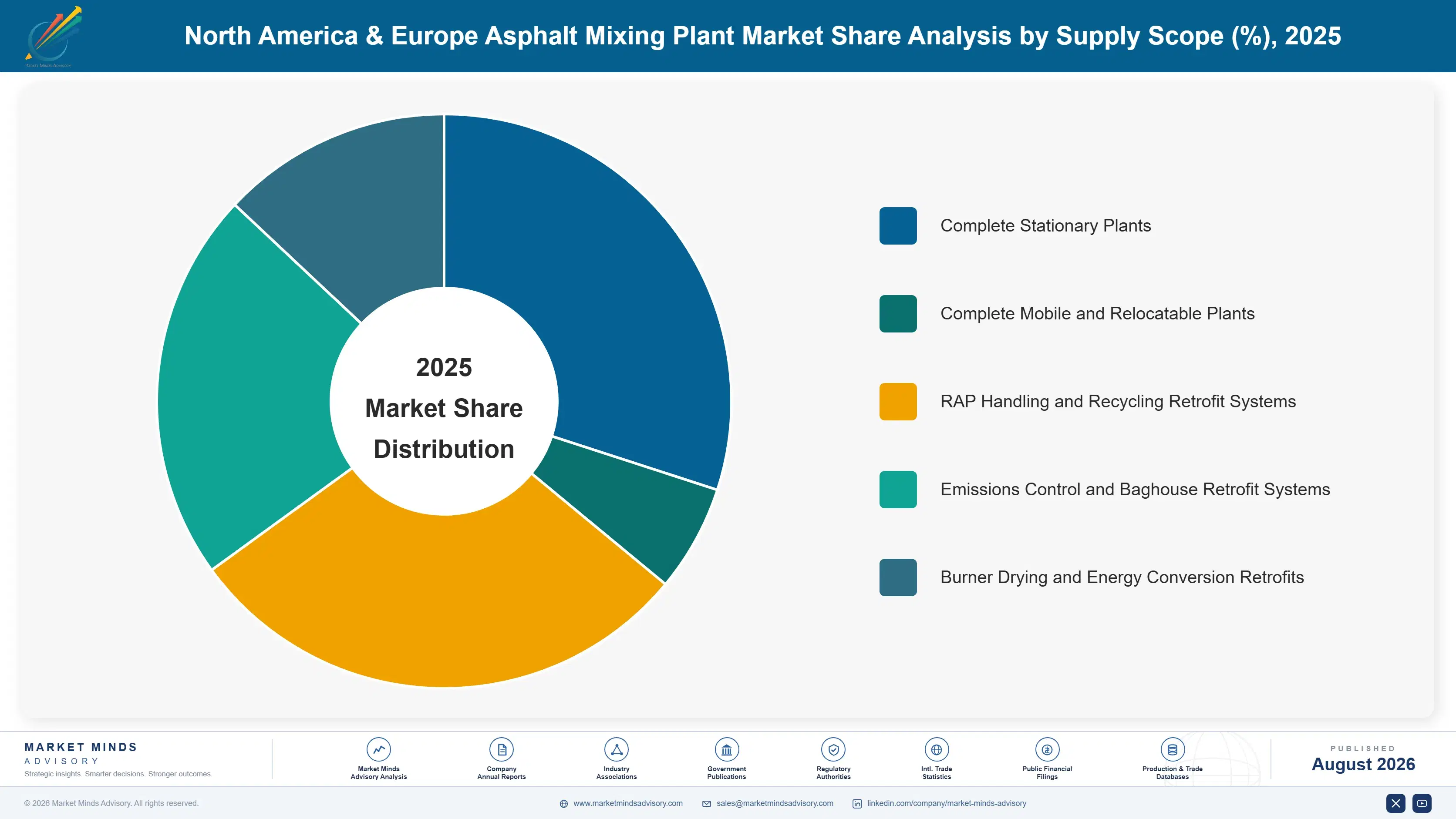
Segmentation follows supply scope, meaning what a customer actually buys, because in these regions that is the distinction that matters commercially. A complete plant and a recycling retrofit reach different buyers, different budgets, and different approval routes. Plant configuration, mixing process, and end-use application are handled in the framework rather than as segments. That split is the whole story here.
asphalt-mixing-plant-market-2-market-share-analysis-1787332606407

RAP Handling and Recycling Retrofit Systems

RAP retrofit systems grow fastest at 10.2%, about 2.17 times the market rate, and the reason is arithmetic rather than fashion. Average recycled content sits at 31% while leading agencies specify past half, and a plant built for 20% needs a parallel drum, a separate cold feed, and additional filtration to reach that. The parallel drum matters most, because RAP already contains bitumen that oxidises if it goes through the main burner flame. A package costs a fraction of a complete plant and installs inside an existing permit, which is why contractors buy it and boards approve it without much argument. Permitting neutrality is doing as much selling as the specification.
CAGR 10.2%

Burner, Drying, and Energy Conversion Retrofits

Burner and energy retrofits grow at 9.1% on two arguments that rarely appear together. NOx limits in both regions make an older burner non-compliant at permit renewal, which is a compliance purchase with a date attached. Public tender carbon scoring makes a multi-fuel or hydrogen-ready burner a commercial advantage on the bid, which is a growth purchase with no deadline at all. Contractors buying for the second reason often cannot make the fuel cost arithmetic work and buy anyway, because losing a framework contract costs considerably more. Electric bitumen tank heating and heat recovery sit inside the same budget conversation. Two very different buyers arrive at the same purchase order here.
CAGR 9.1%
Full segment breakdown across 7 segments available in the complete report.

Regional Architecture and Country Demand Map

This market is defined across North America and Europe, so the seven-region table concentrates far more sharply than the default bands allow. Those two regions carry 90% of value between them, with the remainder representing export supply from North American and European plants. Each out-of-band figure is explained below.

North America

North America holds 46% of value, far above the 32% ceiling this framework normally applies, which follows directly from a market defined across two regions only. Federal infrastructure funding released road budgets deferred for a decade, and state departments of transportation raised recycled content allowances across most of the country. Contractors here own their plants outright more often than European operators do, which makes retrofit an easier decision. Drum-mix configurations dominate the installed population, and they take RAP retrofits more readily than batch plants. Growth at 5.0% leads the covered regions on funding availability rather than on any regulatory push. Canadian demand follows the same pattern on a smaller scale entirely.
Share: 46% | CAGR: 5.0% (2026 to 2036)

Western Europe

Well above the 26% ceiling at 32% of value, Western Europe records that share for the same definitional reason, and its demand profile differs from North America's in almost every respect. Batch plants dominate here, which produce to tighter mix specifications and handle RAP less readily, so the retrofit engineering is harder and more valuable. Dutch and German producers run recycled content well past half and are effectively setting the direction for everybody else. The Industrial Emissions Directive drives baghouse and burner work on a permit renewal schedule. Growth at 3.7% is the slowest of the covered regions on flat road tonnage. Harder engineering at lower volume is a difficult combination.
Share: 32% | CAGR: 3.7% (2026 to 2036)
Regional intelligence for 5 additional markets available in the complete report: East Asia, South Asia and Pacific, Latin America, Middle East and Africa, Eastern Europe. Contact sales@marketmindsadvisory.com.
asphalt-mixing-plant-market-2-country-cagr-analysis-1787332606925

Where This Market Actually Pays

Four levers matter here, and selling complete plants is not the most important of them. Retrofit reach into the installed population, permit-neutral design, recycling engineering depth, and parts capture decide the outcome, because the plant population is fixed and the specification is not. A manufacturer organised entirely around complete plant sales is addressing a shrinking share of a flat market.

Map The Installed Population And Sell Into It

Every asphalt plant in North America and Europe is a known object at a known address with a known build year, and the median is past 21 years. That makes the retrofit opportunity fully enumerable, which is rare in capital equipment. A manufacturer who has catalogued the population by age, configuration, and recycled content capability knows exactly which owners face a specification they cannot meet and when their permit renews. Most builders do not maintain that database because their sales organisation was built to chase new plant enquiries. The retrofit market rewards outbound work rather than waiting for a tender.
Market Impact: Population median age is past 21 ye

Design Retrofits That Never Reopen The Site Permit

A contractor will decline an upgrade that triggers a permit review, because permitting an asphalt plant takes 3 to 7 years and frequently attracts organised local objection that was not there before. A retrofit fitting inside the existing footprint, stack height, and emissions envelope avoids the whole conversation, and that constraint is worth more to the buyer than any performance figure. Suppliers who engineer to it win work competitors cannot bid. Suppliers who present a technically superior package requiring a permit variation lose to an inferior one that does not. Permit neutrality beats performance in this market consistently.
Market Impact: Avoids a permit review taking 3 to

Engineer For Batch Plants, Not Just Drum-Mix

Drum-mix plants take RAP retrofits comparatively easily, and most suppliers have solved that case. Batch plants, which dominate the European installed base and produce to tighter specifications, are considerably harder: the mixing cycle, the screening deck, and the weigh hopper all constrain how much recycled material can be introduced without wrecking gradation control. A supplier who has solved high-RAP retrofit on batch configurations addresses roughly 32% of category value that the drum-mix specialists cannot reach. The engineering is genuinely difficult, which is exactly why the position is defensible once built. Difficulty is the moat here rather than the obstacle.
Market Impact: Reaches roughly 32% of value compet

Hold The Parts Business Against Refurbishment Traders

An asphalt plant consumes drum flights, baghouse filter bags, mixer paddles and liners, and burner components on schedules the manufacturer knows better than the owner. Across a 25 to 35 year life that parts stream is worth a large multiple of the original plant margin. Refurbishment traders and pattern part makers take it wherever the manufacturer's availability is slow or its pricing invites a comparison. Holding it needs regional stock and same-week delivery rather than a catalogue, and most builders have neither. The parts business is unglamorous and it is where the margin actually lives.
Market Impact: Parts stream spans a 25 to 35 year

Who Controls the Margin Pool

Concentration sits at 58% for the top five, which reflects how few builders supply a complete plant, its controls, and the retrofit modules that keep an older one compliant. The gap between leaders and challengers is installed base access and retrofit engineering rather than plant performance, since every serious builder makes acceptable mix. All participants here are assessed on one basis, revenue from asphalt mixing plants, plant systems, and retrofit equipment.
Competition runs on four lines. Installed base access decides retrofit work, because the manufacturer who built the plant knows its configuration and usually holds the drawings. Recycling engineering depth decides which retrofits a supplier can actually deliver, particularly on batch configurations. Permit-neutral design decides whether a proposal is buyable at all. Price decides complete plant tenders in Eastern Europe, where procurement forces it forward.

Two pressures will shift positions. Refurbishment traders and independent retrofit engineers are taking work the original builders assumed was theirs, and they compete on responsiveness rather than on capability. Meanwhile Turkish and Chinese builders are reaching complete plant tenders in Eastern Europe at prices the incumbents cannot approach. Rankings favour whoever holds installed base knowledge and batch plant recycling engineering together, and few hold both.
asphalt-mixing-plant-market-2-company-positioning-matrix-1787332607444

Competitive Moat and Risk Dimensions

WIRTGEN GROUP

Moat: Benninghoven and paving fleet reach

Wirtgen's Benninghoven plants sit alongside milling machines, pavers, and rollers that the same contractor already operates, which means the plant conversation happens inside an existing commercial relationship rather than cold. Recycling engineering depth on batch configurations is genuine and hard to replicate. John Deere ownership behind it also funds a service network across both covered regions that specialists cannot match.
WIRTGEN GROUP

Risk: Flat complete plant demand

The complete plant line carries fixed cost against demand that has not grown in either covered region for years, and retrofit revenue has to cover it. Contractors increasingly buy upgrade packages rather than plants, which is a smaller ticket through a different buyer. Exposure to public road funding cycles runs deep, and those cycles follow budgets no manufacturer influences.
FAYAT GROUP

Moat: Marini range and European depth

Fayat's Marini and Ermont lines hold deep positions across French, Italian, and Southern European contractors, where batch practice and tight mix specifications are the norm and recycling retrofit is hardest. Family ownership allows a longer view on retrofit development than listed competitors comfortably take. The road equipment portfolio around it reaches the same contractor through several product lines at once.
FAYAT GROUP

Risk: European concentration and slow growth

Revenue concentrates in Western and Southern Europe, where road tonnage is flat and growth runs below the covered regions' average. North American position is thinner than the scale of that market warrants, and it is where funding has actually released. Eastern European complete plant tenders are increasingly contested by Turkish builders on price that a French cost base cannot approach.

Players Tracked

Prominent Players

Wirtgen Group
Fayat Group
Ammann
Astec Industries
Gencor Industries

Other Key Players

Lintec & Linnhoff
Parker Plant
CMI Roadbuilding
Asphalt Drum Mixers
Stansteel
ALmix
Meeker Equipment
Reliable Asphalt Products
Bernardi Impianti
Amomatic
E-MAK
Polygonmach
Nikko
Speco
Sinosun

Recent Developments

APRIL 2025

State agencies raise recycled asphalt content allowances again

Several American state transportation departments raised permitted recycled asphalt pavement content in surface and binder courses, following performance data from agencies that moved earlier. These were specification revisions rather than commercial events, and they place a physical requirement on plants that were designed around much lower recycled fractions.
Signal: A specification change converts an install
OCTOBER 2024

Hydrogen-ready burner installations begin on European plants

European asphalt producers commissioned the first hydrogen-ready and multi-fuel burner installations on operating plants, generally driven by carbon scoring in public road tenders rather than by any fuel cost advantage. These were equipment installations rather than transactions, and the fuel supply to run them at scale does not yet exist.
Signal: Buying equipment to win a tender rather th
JUNE 2024

Turkish plant builders widen presence in Eastern European tenders

Turkish asphalt plant manufacturers won a larger share of Eastern European public tenders, competing on delivered price and short lead times against established Western European builders. These were competitive share movements rather than corporate transactions, and they concentrate in complete plant awards rather than in retrofit work.
Signal: Price competition arrives first in exactly

Steel, Burners, Filter Media, Freight

Steel dominates everything else here. Structural and plate steel carries 32% to 44% of a complete plant's cost, sourced regionally because shipping fabricated sections far is uneconomic. Burners, drives, and electrical systems add 18% to 26%, from European and American specialist suppliers. Baghouse filter media and casing run 8% to 14%. Freight and site erection labour make up the remainder.
European steel prices moved violently through 2021 and 2022 as energy costs hit mill production and safeguards restricted imports, and the IEA documented the underlying industrial energy constraint. Plant builders had quoted fixed prices on projects delivering eighteen months out, standard practice here and an uncovered commodity position. Wirtgen's parent and Astec Industries both disclosed material cost pressure. Several builders moved to indexed contracts afterwards and several did not.

Each range above exceeds three points because a complete plant and a retrofit module share very little beyond the steel. Exposure separates by product mix. A complete plant builder carries steel risk on long-lead fixed-price contracts it cannot hedge. A retrofit supplier carries far less, since lead times are months rather than years. Turkish builders hold steel proximity and lower fabrication labour, which is why they compete on price.
asphalt-mixing-plant-market-2-cost-volatility-analysis-1787332607639

Index long-lead plant contracts to steel

Structural and plate steel carries 32% to 44% of a complete plant's cost and moved by large multiples between 2021 and 2023, while this industry routinely quotes fixed prices on eighteen-month delivery. That combination is a commodity position dressed as a supply contract. Indexation costs a negotiating concession at award and removes an exposure that already destroyed sector margin once.

Fabricate near the market, not near the head office

Fabricated steel sections are bulky and low in value by volume, so freight is a real cost line rather than a rounding error and a plant assembled far from its market carries a handicap. Regional fabrication near a major road programme costs capital and looks inefficient in a quiet year. It also wins tenders where delivered price decides the award.

Stock filter media and burner parts regionally

Baghouse media and burner components fail on schedules the manufacturer can predict, and an asphalt plant down in paving season costs the contractor more per day than the part costs outright. Regional stock and same-week delivery hold that revenue against pattern part makers and refurbishment traders. A catalogue and a six-week lead time hand it to them instead.

Portfolio Architecture for Margin Defence

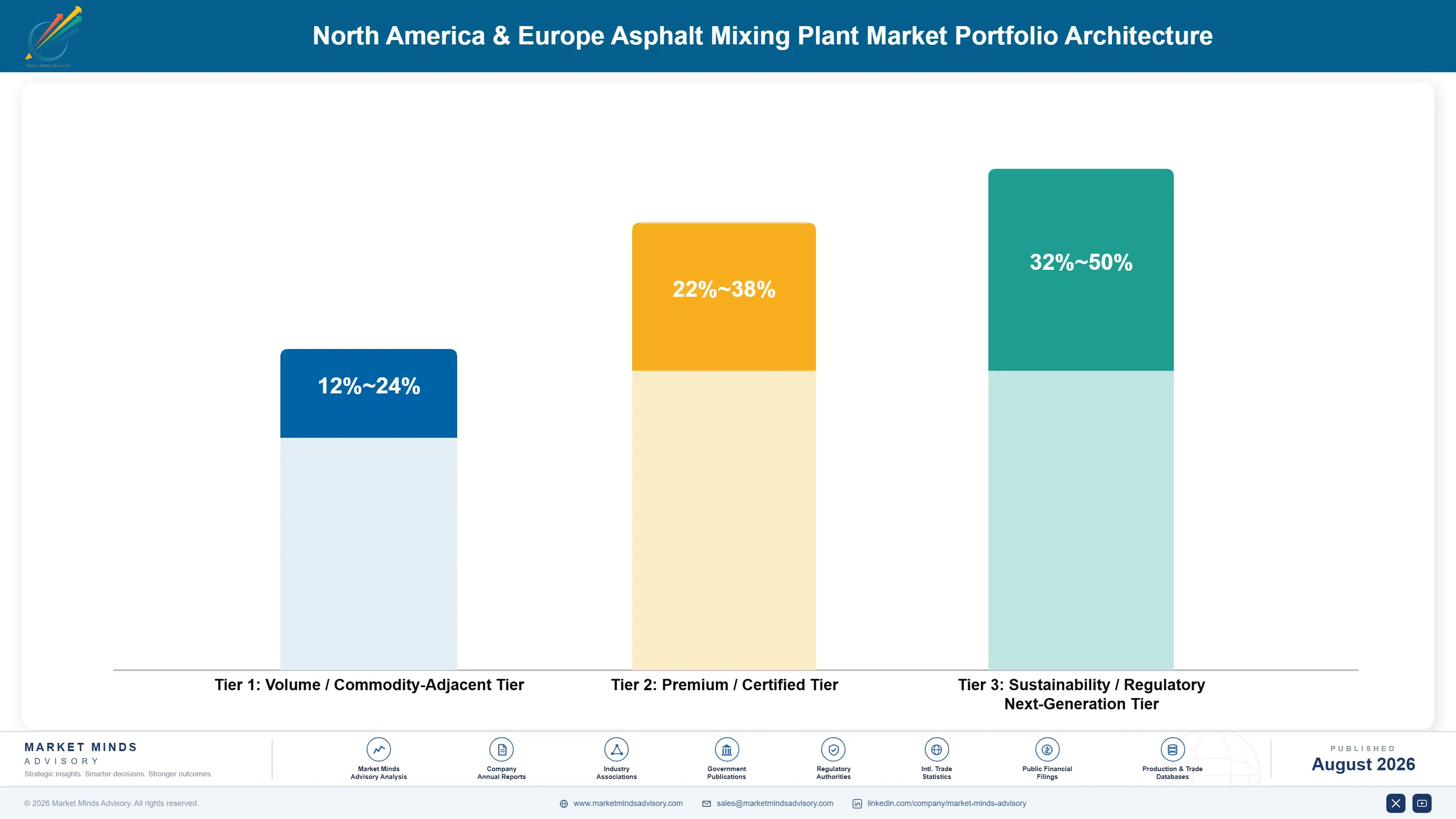
Three tiers sit inside this category and the margin logic differs between them. Complete plants form the volume tier, where Eastern European public tenders force price forward and Turkish builders compete effectively. Emissions and baghouse retrofits earn more, because a permit renewal date rather than a buyer decides the timing. Recycling and burner retrofits price highest, since the engineering is difficult and the alternative is failing a specification.
The tension is between complete plant revenue that keeps the fabrication shop busy and retrofit revenue that makes money. A plant order fills the shop for months at thin margin under tender pressure. A retrofit package is smaller, engineered rather than fabricated, and earns considerably better. Builders organised around fabrication capacity struggle to run a retrofit business, because it needs engineers travelling rather than steel moving.

High-value pools concentrate where engineering or permitting limits competition: high-RAP retrofits on batch configurations, burner conversions meeting NOx limits at renewal, and any package fitting inside an existing permitted envelope. The commodity end is complete plants into Eastern European public tender, where the specification is fixed and Turkish delivered price sets the level. Parts sit quietly across all of it and earn better than either.

Volume / Commodity-Adjacent Tier

Complete stationary and relocatable plants supplied against public and private tender across both covered regions. The range is wide because indexed and fixed-price contracts produced entirely different outcomes through the 2021 to 2023 steel price movement.
Gross Margin: 12-24%

Premium / Certified Tier

Emissions control and baghouse retrofit systems fitted at permit renewal, plus plant control and automation upgrades. The range is wide because compliance-driven work holds pricing while discretionary upgrades on the same equipment compete against refurbishment traders.
Gross Margin: 22-38%

Sustainability / Regulatory / Next-Generation Tier

High-RAP recycling retrofits, parallel drum systems, and multi-fuel or hydrogen-ready burner conversions. The range is wide because batch plant engineering carries far more design content and far less competition than the equivalent drum-mix work does.
Gross Margin: 32-50%
asphalt-mixing-plant-market-2-portfolio-architecture-1787332608144

High-value Sub-segments and Strategic Watch-out

RAP Handling and Recycling Retrofit Systems

High value and high growth at 10.2%, the fastest segment, because recycled content specifications have moved past what plants designed for 20% can physically deliver. Batch plant retrofits are considerably harder than drum-mix and correspondingly better paid, which is where the defensible position sits. Difficulty is the moat.
Gross Margin: 32-50%

Burner, Drying, and Energy Conversion Retrofits

High value with strong growth at 9.1%, driven by NOx limits at permit renewal and by carbon scoring in public road tenders. Contractors buy these to win framework contracts as often as to cut fuel cost, which is unusual and worth understanding properly. Two buyers, one purchase order.
Gross Margin: 32-50%

Complete Stationary Plants

The volume core by ticket size at 2.8%, growing slowest of anything here because road networks in both regions are built and the plant population already runs below capacity. Tender pricing is contested by Turkish builders and public procurement rules keep price forward. Necessary volume at unrewarding margin.
Gross Margin: 12-24%

Emissions Control and Baghouse Retrofit Systems

The strategic watch-out at 6.3%, dependable while permit renewals fall due but increasingly contested by independent filtration specialists and refurbishment traders who respond faster than the original builders do. Defending it needs regional stock rather than better engineering. Responsiveness rather than capability is the whole competition.
Gross Margin: 22-38%

How Plant Owners Actually Buy

Demand commits at plant installation and then repeats as parts, upgrades, and eventual component replacement across 25 to 35 years. The plant does not move and its site permit is close to irreplaceable, so the owner is a known customer at a fixed address for a working lifetime. The manufacturer who built it holds the drawings and usually the relationship. That is annuity economics disguised as capital equipment.
Stickiness varies by owner type more than by geography. Large vertically integrated contractors stick hardest, because they standardise across a plant fleet and value one supplier relationship over marginal savings. Public sector and municipal owners stick through procurement rules that favour the original supplier on compatibility grounds. Independent single-plant operators stick least, since they buy on price from whoever answers quickly and have no fleet standard.

The buyer has moved from a plant manager to a sustainability lead and a bid team. Twenty years ago a production manager specified on tonnes per hour and reliability. Now a contractor's tender team asks what recycled content and what carbon figure the plant can evidence, because those score points on public work. Suppliers still presenting production capacity are addressing a person who no longer decides.
asphalt-mixing-plant-market-2-end-use-penetration-index-1787332608632

Our Call On Asphalt Plants

These are among the four positions where our research anticipates prominent divergence between winners and laggards over the coming forecast period. Each is grounded in the demand model, the regulatory perimeter, and the announced capacity pipeline.
01 / RETROFIT BUSINESS PRIORITY

The plant population is fixed, the specification is not

Road networks in both covered regions are built, tonnage is flat, and the plant count has barely moved in twenty years, which means almost nobody is buying a new plant for a conventional reason. What has changed is what those plants must produce, and retrofit already carries 44% of category value on that basis alone. A manufacturer whose sales organisation is still built to chase complete plant enquiries is addressing roughly a third of the money in front of it.
02 / PERMIT NEUTRALITY DESIGN

Never make the owner reopen a permit

Permitting an asphalt plant takes 3 to 7 years in either region and attracts organised local objection that was not there before the application, which makes an existing permitted site one of the most valuable assets a contractor holds. Any retrofit requiring a permit variation therefore loses to an inferior package that fits inside the existing footprint, stack height, and emissions envelope. Suppliers who treat that constraint as a design requirement rather than an inconvenience win work their competitors cannot even bid for.
03 / BATCH PLANT ENGINEERING

Solve the hard configuration, not the easy one

Drum-mix plants take recycling retrofits comparatively easily and every supplier has solved that case, which is why the work is competitive and thinly paid. Batch plants dominate the European installed base, produce to tighter gradation specifications, and constrain recycled content through the mixing cycle, the screening deck, and the weigh hopper together. Solving high-RAP retrofit on batch configurations reaches roughly 32% of category value that drum-mix specialists cannot serve, and the difficulty is precisely what makes the position hold over time.
04 / PARTS STREAM DEFENCE

Regional stock beats a parts catalogue

An asphalt plant consumes drum flights, filter bags, mixer liners, and burner components across a 25 to 35 year life, and that stream is worth several times the margin on the original plant. Refurbishment traders and pattern part makers take it wherever the original builder quotes a six-week lead time on something the contractor needs during paving season. Holding it requires regional stock and same-week despatch rather than better parts, which is a distribution investment most builders keep deferring indefinitely.

Engagement Snapshot From the Field

A live engagement with an industry participant carrying material or product regulatory and market exposure ahead of a defining policy shift, showing how our research translates into a defensible multi-year portfolio strategy.
MARKET MINDS ADVISORY · CLIENT ENGAGEMENT SUMMARY
North America & Europe Asphalt Mixing Plant Producer Strategic Portfolio Review and Transition Roadmap 2026·Investment Scenario on North America & Europe Asphalt Mixing Plant Exposure Evaluation 2025-26
CLIENT PROFILE
A European asphalt plant manufacturer with roughly USD 96 million in annual revenue engaged MMA after complete plant orders fell for a third consecutive year while its retrofit enquiries stayed flat (client-reported, unverified by MMA). The company had built more than 400 plants across both covered regions over four decades and could not explain why so little upgrade work came back to it.
STRATEGIC CHALLENGE
Sales attributed the decline to market conditions and asked for a lower price point on the entry plant range. Engineering wanted to develop a new drum-mix platform. Nobody had asked the 400 existing plant owners what they had bought recently or from whom. The board needed a position before committing a development budget it could only spend once.
MMA APPROACH
MMA built a register of the client's installed plants by age, configuration, current recycled content capability, and permit renewal date, which the company had never assembled. We contacted 180 of those owners on what upgrade work they had commissioned and who supplied it. We then modelled three options: a cheaper entry plant, a new drum-mix platform, and a batch plant recycling retrofit programme.
KEY FINDINGS
  1. Owners of the client's plants had commissioned substantial retrofit work and awarded roughly 70% of it to independent engineers and refurbishment traders rather than to the original builder (client-reported, unverified by MMA).
  2. The most common reason given was response time rather than price, since independents quoted within days where the client took several weeks to respond at all.
  3. Around 60% of the installed register faced a recycled content specification its current configuration could not meet, and most owners had not yet identified a supplier.
  4. A cheaper entry plant modelled poorly against both alternatives, because the buyers it targeted were not purchasing complete plants at any price point.
CLIENT PROFILE
A European asphalt plant manufacturer with roughly USD 96 million in annual revenue engaged MMA after complete plant orders fell for a third consecutive year while its retrofit enquiries stayed flat (client-reported, unverified by MMA). The company had built more than 400 plants across both covered regions over four decades and could not explain why so little upgrade work came back to it.
STRATEGIC CHALLENGE
Sales attributed the decline to market conditions and asked for a lower price point on the entry plant range. Engineering wanted to develop a new drum-mix platform. Nobody had asked the 400 existing plant owners what they had bought recently or from whom. The board needed a position before committing a development budget it could only spend once.
MMA APPROACH
MMA built a register of the client's installed plants by age, configuration, current recycled content capability, and permit renewal date, which the company had never assembled. We contacted 180 of those owners on what upgrade work they had commissioned and who supplied it. We then modelled three options: a cheaper entry plant, a new drum-mix platform, and a batch plant recycling retrofit programme.
KEY FINDINGS
  1. Owners of the client's plants had commissioned substantial retrofit work and awarded roughly 70% of it to independent engineers and refurbishment traders rather than to the original builder (client-reported, unverified by MMA).
  2. The most common reason given was response time rather than price, since independents quoted within days where the client took several weeks to respond at all.
  3. Around 60% of the installed register faced a recycled content specification its current configuration could not meet, and most owners had not yet identified a supplier.
  4. A cheaper entry plant modelled poorly against both alternatives, because the buyers it targeted were not purchasing complete plants at any price point.
RECOMMENDED STRATEGY
Phase 1: Phase 1 (0 to 7 months): Publish the installed plant register internally and staff a retrofit desk that quotes within five working days. Phase 2: Phase 2 (7 to 22 months): Develop a batch plant recycling retrofit package engineered to fit inside existing permitted envelopes. Phase 3: Phase 3 (22 to 40 months): Approach every register owner facing a specification gap ahead of their permit renewal date.
OUTCOME
The board cancelled the entry plant project and funded the retrofit desk within two months, which the commercial director later called the least expensive decision available. Retrofit enquiries rose materially once quoting time fell below a week, and the client reports its first batch recycling package delivered on an existing permit (client-reported, unverified by MMA). Complete plant orders remain flat.

Frequently Asked Questions

Foundational context covering the market sizes, CAGR, scope, country, region and competition that inform every finding below. This section is provided to cover basics and most often pre-purchase conversations, answered from the MMA Primary Research Dataset.

What is the current size of the North America & Europe Asphalt Mixing Plant Market?

The market across North America and Europe is valued at USD 1.7 billion in 2025, covering complete hot-mix and warm-mix plants plus recycling, emissions, and burner retrofit systems. Paving equipment and bitumen materials are excluded.

How large will the North America & Europe Asphalt Mixing Plant Market be by 2036?

The market is forecast to reach USD 2.82 billion by 2036 in the base case, about 1.58 times the 2026 level. That represents incremental value of roughly USD 1.04 billion.

What is the CAGR for the North America & Europe Asphalt Mixing Plant Market 2026 to 2036?

The market grows at a 4.7% CAGR in the base case, with bull and bear scenarios at 5.9% and 3.5%. The spread turns on recycled content specifications and on public road funding.

Which segment is growing fastest?

RAP handling and recycling retrofit systems grow fastest at 10.2%, about 2.17 times the overall rate, because plants built for 20% recycled content cannot reach 50%. Burner retrofits follow at 9.1%.

Who are the major companies in the North America & Europe Asphalt Mixing Plant Market?

Leading participants include Wirtgen Group, Fayat Group, Ammann, Astec Industries, and Gencor Industries. Concentration sits at roughly 58%, reflecting how few builders supply complete plants and retrofit modules together.

Which country is growing fastest?

Poland grows fastest at a 5.6% CAGR, as cohesion-funded road programmes continue and plant purchases follow those budgets. The United States follows on federal infrastructure funding.

Report Segmentation Architecture

The full report scope spans multiple orthogonal segmentation dimensions, with cross-tabulated demand data provided for each dimension pair. Coverage extends further to regional breakdowns, trend trajectories, and the competitive detail needed to support segment-level decision-making.

By Supply Scope

  • Complete Stationary Plants
  • Complete Mobile and Relocatable Plants
  • RAP Handling and Recycling Retrofit Systems
  • Emissions Control and Baghouse Retrofit Systems
  • Burner Drying and Energy Conversion Retrofits

By End-Use Industry

  • Public Highway and Road Agencies
  • Private Road Construction Contractors
  • Airport and Port Infrastructure
  • Mining and Industrial Haul Roads
  • Municipal Maintenance Operations

By Procurement Route

  • Public Tender Award
  • Direct Contractor Purchase
  • Framework Supply Agreement
  • Dealer and Distributor Channel

By Region

  • North America
  • Western Europe
  • East Asia
  • South Asia and Pacific
  • Latin America
  • Middle East and Africa
  • Eastern Europe

Scope, Methodology, and Coverage

Every figure in this report is reproducible from documented input assumptions. The scope below maps the historical period, the forecast horizon, the segmentation dimensions, and the countries covered, alongside the underlying primary and qualitative methodology.
Historical Period
2020 to 2025
Forecast Period
2026 to 2036
Base Year
2025 (USD billions; MMA Primary Research Dataset, August 2026)
Market Definition
The North America and Europe asphalt mixing plant market comprises the manufacture and sale of hot-mix and warm-mix asphalt production plants and the retrofit systems supplied into the existing plant population, valued at manufacturer selling prices to road contractors, public highway agencies, aggregate producers, and dealers. It spans complete stationary and relocatable batch and drum-mix plants, together with recycled asphalt pavement handling and parallel drum systems, emissions control and baghouse retrofits, burner and drying conversions, bitumen storage and heating, cold feed and screening assemblies, and plant control and automation upgrades. Demand is North American and European, and export supply from manufacturing bases in those regions is included. Paving machines, compaction rollers, cold milling machines, aggregate crushing and screening plants, concrete batching plants, bitumen and aggregate materials themselves, and road construction and maintenance services are excluded. Plant operating and haulage services are outside scope.
Quantitative Units
USD billions (current prices); volume in units of complete plants and retrofit systems shipped
Segmentation Dimensions
By Supply Scope; By End-Use Industry; By Procurement Route; By Region
Regions Covered
North America, Western Europe, East Asia, South Asia and Pacific, Latin America, Middle East and Africa, Eastern Europe
Countries Covered
USA, Canada, Mexico, Germany, France, Italy, Spain, Netherlands, Belgium, Austria, Switzerland, UK, Ireland, Sweden, Norway, Finland, Denmark, Poland, Czechia, Slovakia, Hungary, Romania, Bulgaria, Croatia, Lithuania, Latvia, Estonia, Turkey, Saudi Arabia, United Arab Emirates, Egypt, Morocco, South Africa, Australia, Brazil, Chile, and additional markets relevant to this sector
Key Companies Profiled
Wirtgen Group, Fayat Group, Ammann, Astec Industries, Gencor Industries, Lintec & Linnhoff, Parker Plant, CMI Roadbuilding, Asphalt Drum Mixers, Stansteel, ALmix, Meeker Equipment, Reliable Asphalt Products, Bernardi Impianti, Amomatic, E-MAK, Polygonmach, Nikko, Speco, Sinosun
Quantitative Methodology
Primary survey, n=3,800 respondents, Q4 2025, six countries; demand-side model with trade association cross-validation
Qualitative Methodology
47 expert interviews, Q4 2025; applied to validate demand model assumptions, identify emerging dynamics, and assess competitive positioning
Report Format
PDF and XLSX data workbook (Word format preview document)
Publisher
Market Minds Advisory
Report Code
MMA-2026-CON-463
Published
August 2026
Contact
sales@marketmindsadvisory.com | www.marketmindsadvisory.com

Purchase the full North America & Europe Asphalt Mixing Plant Market Report (2026 to 2036).

The full MMA North America and Europe Asphalt Mixing Plant report sizes the market across five supply scopes, five end-use segments, four procurement routes, and seven regions through 2036. It profiles 20 participants on a consistent basis of plant, system, and retrofit revenue, scoring each on installed base access, recycling engineering depth, permit-neutral design capability, and parts distribution reach. Scenario models quantify how recycled content specifications, emissions enforcement, and road funding cycles move both volume and achievable margin. The report also includes an installed plant register by age and configuration, recycled content specification tracking by agency, permit renewal timing analysis, and retrofit capture benchmarking across the major builders.
Five-scope and four-route market sizing to 2036
Twenty-participant benchmark on plant and retrofit revenue
Installed plant register by age and configuration
Recycled content specification tracking by highway agency
Permit renewal timing analysis across both covered regions
Retrofit capture benchmarking across the major plant builders

Built For The People Who Decide

From boardroom strategy to bench-side execution, this report is read cover-to-cover by leaders shaping the next decade of their industry, turning demand scenarios, market dynamics and valuation benchmarks into decisions.
CXOs/ Presidents/ VPs/ Managers
M&A and Corporate Development
Strategy Teams and R&D Heads
Procurement and Product Directors
Regulatory and Compliance Leaders
Investor Relations and Equity Analysts