Market Minds Advisory
Asparagus Market

Asparagus Market: Hand-Harvest Economics, Peruvian Water Limits, and the Perennial Capital Cycle Nobody Can Shorten

Asparagus is cut by hand every day of its season, takes three years from planting to first commercial harvest, and is losing Peruvian acreage to crops that need less water and fewer people.

Lead Analyst

Lisa Gevelber

Published

September 2026

Make Smarter Decisions with Customized Research Insights

Request a free sample report and evaluate market opportunities, growth trends, and competitive dynamics relevant to your business needs.

2025 MARKET VALUE$24.6BMarket Size 2025
2036 FORECAST VALUE$40.3BBase Case , 2026 to 2036
CAGR 2026 TO 20364.6 %Bull 5.8% / Bear 3.4%
INCREMENTAL OPPORTUNITY$14.6BNet 10- year value creation
EXPANSION MULTIPLE1.57x2036 value over 2026 base
Strategic Levers
M&A Pipeline
Regional Outlook
Country Rankings
Competitive Intelligence
Segmental Deep-dive
Call-Us : 91 93563 13602

Executive Snapshot and Market Trajectory

Asparagus is the most labour-intensive vegetable in commercial production, and that single fact governs everything else about it. Spears are cut by hand daily through a season measured in weeks, which means the crop competes for workers rather than for land, and loses that competition wherever wages rise.
Commercial power sits with growers who control seasonal labour and water together, because either constraint alone ends a season. Peruvian acreage in Ica has fallen as aquifer depletion and labour cost pushed producers toward blueberries and avocado, needing neither daily cutting nor the same water. Asparagus extracts grow fastest at 8.6%, roughly 1.87 times the market, from a very small base. East Asia holds 30% of value.
The category is barely concentrated, with the top five holding around 8% of production and processing, because asparagus is grown by thousands of independent farms and traded through fragmented channels. Chinese output dominates world volume while remaining almost entirely domestic, which means global trade is set by Peru, Mexico, and a handful of European producers rather than by the largest grower. Canned volume keeps declining in Western retail. Fresh formats keep gaining instead.
Market Definition
This report covers asparagus grown for human consumption and sold as fresh whole spears, fresh-cut and prepared product, frozen, canned and jarred, dried and powdered, and as extracts and derivatives, valued at wholesale and processed trade level. Both green and white asparagus are included across all forms. Ornamental asparagus varieties, asparagus seed and crown propagation material, and finished consumer supplements containing asparagus extract alongside other actives fall outside scope.
Base Year Value
$24.6B in 2025 (MMA Primary Research Dataset, August 2026)
Forecast Period
2026 to 2036, eleven discrete annual values
CAGR
4.6% base case. Bull 5.8%. Bear 3.4%.
Fastest Growth Segment
Asparagus Extracts and Derivatives: 8.6% CAGR
Fastest Growth Country
India: 7.2% CAGR
Fastest Growth Region
South Asia and Pacific: 6.6% CAGR
Largest Region
East Asia: 30% of 2025 global value
Market Leaders
Danper Trujillo, Camposol Holding, Greenyard NV, Bonduelle Group, Del Monte Foods. Source: MMA Analysis based on company annual reports.
Primary Survey
n=3,800 procurement and R&D decision-makers, Q4 2025, six countries
Methodology
Demand-side build-up, cross-validated against public data, 47 expert interviews

Asparagus Market Forecast Scenarios

asparagus-market-trends-growth-size-forecast-scenario-1787462447306
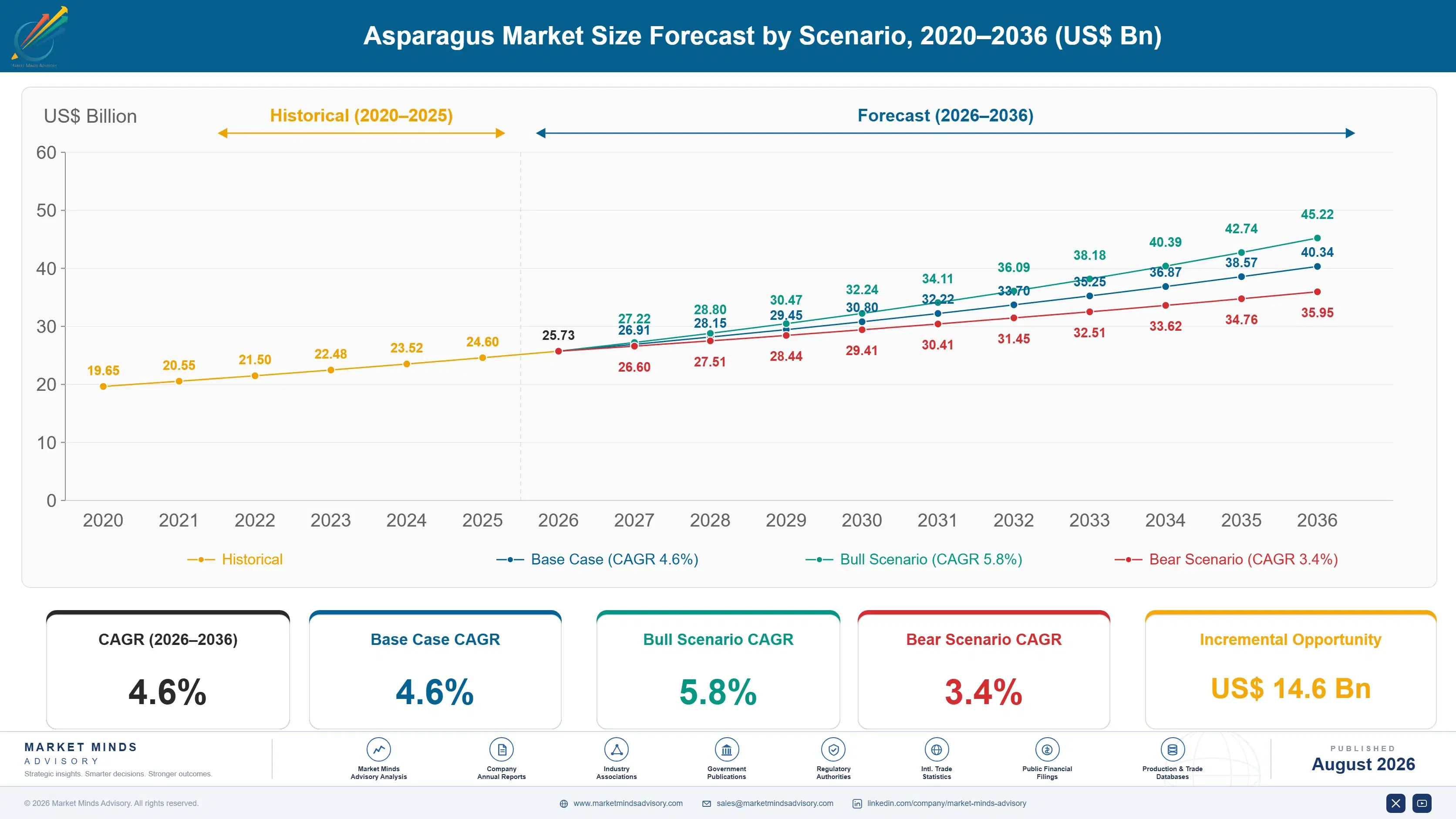
The 2020 to 2025 period was defined by supply relocation, not demand change. Peruvian area contracted as Ica groundwater tightened and labour costs rose, while Mexican production expanded into the North American window and Chinese output kept growing for a market that barely exports. European white asparagus held its premium but struggled for harvest labour. The 3.9% historical growth was mostly price, since world volume moved little.
The 4.6% base case rests on three mechanisms. Fresh-cut and prepared formats keep converting asparagus from a special-occasion vegetable into a weekday one, particularly in North American and European retail where trimmed packs sell at real premiums. Chinese domestic consumption keeps rising with income and modern retail reach, which matters enormously given the volume base. And extract and nutraceutical demand in Korea and Japan keeps expanding, adding high-value outlets for material that would otherwise be graded out.
The 5.8% bull case assumes mechanised or assisted harvesting reaches commercial reliability, which would reopen acreage abandoned on labour grounds. The 3.4% bear case reflects continued Peruvian contraction alongside European labour shortages that shorten harvest windows, tightening supply into a demand base that simply substitutes other vegetables. Harvest labour availability decides which of those cases arrives.

Why Labour, Not Land, Limits Supply

Three constraints govern asparagus and none of them is consumer demand. Harvest labour comes first, since spears must be cut individually every day and no reliable machine does it. Water comes second, most visibly in the Ica valley where aquifer depletion has already removed acreage. And the perennial cycle comes third, because a grower commits capital three years before first harvest and lives with it for nine.
TOP-FIVE CONCENTRATION8%Share of global production and processing held collectively
AVERAGE SELLING PRICE$3.24/kgBlended farmgate equivalent across fresh and processed forms
HARVEST LABOUR SHARE47%Hand cutting cost as proportion of total production cost
ESTABLISHMENT PAYBACK PERIOD3 yearsTime from planting until first commercially viable cutting
EXPORT TRADE INTENSITY17%Portion of world output crossing a border before consumption
CROWN PRODUCTIVE LIFE9 yearsAverage commercial yield span before replanting becomes necessary
That produces commercial behaviour unlike annual vegetable crops. A grower cannot respond to a good price by planting more, and cannot exit a bad market without abandoning a productive asset. Supply therefore adjusts slowly and painfully, which is why Peruvian contraction has taken a decade to show up in trade data. Buyers who understand that cycle contract forward; those buying spot discover there is none available.
The next decade turns on whether harvesting can be assisted. Vision-guided cutting systems have been trialled repeatedly without reaching commercial reliability, because spears grow at different rates within the same bed. If that problem is solved, acreage abandoned on labour grounds becomes viable again and the supply picture changes completely. If it is not, asparagus keeps retreating toward places where labour remains cheap.
"Peru did not lose asparagus acreage to a competitor country. It lost it to blueberries, which need less water, do not require somebody walking every row at dawn, and pay considerably better per hectare."
Director, Fresh Produce and Horticulture Practice · MMA Fresh Produce / Horticulture Practice · August 2026

Market Trends

Peruvian Acreage Retreats Toward Less Demanding Crops

Asparagus built the modern Peruvian export horticulture industry, and it is now being displaced by the very success it created. Ica valley groundwater has fallen under sustained extraction, harvest labour costs have risen, and blueberries and avocado deliver better returns per hectare with lower water use and no requirement for daily hand cutting. Growers replanting expiring asparagus crowns increasingly choose something else, and because crowns run roughly nine productive years the contraction shows up slowly. Peru remains a major exporter, but the direction of the capital cycle is now clearly against the crop.
Market Impact: Commands 45% retail price premium
Extract and Nutraceutical Demand Creates Value From Grade-Outs

Asparagus extract preparations have built a genuine consumer category across Korea and Japan, positioned around liver support and alcohol metabolism, and they use material that fresh packing lines would otherwise discard as undersized, bent, or woody. Growth of 8.6% comes off a very small base but the economics are unusually attractive, since input cost is close to zero for the grower and the finished preparation sells at supplement pricing. Processors able to route grade-outs into extraction rather than into low-value canning improve whole-crop returns without changing a single agronomic practice.
Market Impact: Absorbs 88% of Chinese output

Market Opportunities and Growth Drivers

Prepared Formats Convert Asparagus Into Weekday Vegetable Purchasing

Trimmed, portioned, and microwave-ready asparagus packs have moved the vegetable out of occasion cooking and into ordinary weekday meals across North American and European retail. Consumers who would not buy loose spears because of trimming waste and cooking uncertainty buy prepared packs readily, and those packs carry retail premiums well above loose product. The format also extends effective shelf presence, since portioning lets retailers merchandise smaller units at accessible price points. Growth of 7.8% in prepared formats therefore reflects genuine occasion expansion rather than any switch from loose product alone.
Market Impact: Consumes 47% of production cost

Chinese Domestic Consumption Rises With Retail Modernisation

China grows the overwhelming majority of world asparagus and exports very little of it, so Chinese domestic demand shifts global volume in a way no other market can. Consumption has risen steadily with income growth, cold chain expansion, and modern grocery reach into secondary cities, and asparagus has moved from a restaurant vegetable toward household purchase. Domestic processing into frozen and canned formats also absorbs increasing volume. Because the production base is so large, even modest per capita gains translate into tonnage that would overwhelm any Western market entirely. No other single market moves world volume like this.
Market Impact: Delays revenue by 3 years

Market Restraints and Challenges

Daily Hand Harvesting Makes Labour Nearly Half of Cost

Asparagus spears emerge at different rates within the same bed and must be cut individually at precise height every day through the season, which makes hand cutting roughly 47% of production cost and the highest labour intensity of any commercial vegetable. The root cause is botanical rather than organisational, since selective harvesting cannot be scheduled around worker availability. German and British growers have faced repeated seasonal shortages, and Peruvian wage growth has eroded the cost advantage that built the export industry. Responses include mechanised assistance trials, harvest platform systems, and relocating production toward lower-wage geographies.
Market Impact: Removes 4% of export acreage

Perennial Establishment Locks Capital Before Any Revenue Arrives

A new asparagus field yields nothing commercially for roughly three years while requiring full cultivation, irrigation, and weed control throughout, then produces for around nine before replanting becomes necessary. The root cause is crown development biology, which no agronomic intervention meaningfully shortens. Commercially this means growers cannot respond to strong prices within a season and cannot exit weak markets without stranding an asset. Participants respond by staggering replanting across blocks to smooth cash flow, by contracting forward with processors to underwrite establishment, and by pairing asparagus with annual crops on the same holding.
Market Impact: Adds 8.6% segment growth annually
3 additional market trends, 2 additional growth drivers, and 4 additional restraints and challenges are covered in the full report. Contact sales@marketmindsadvisory.com to access the complete intelligence.

Segment CAGR and Growth Architecture

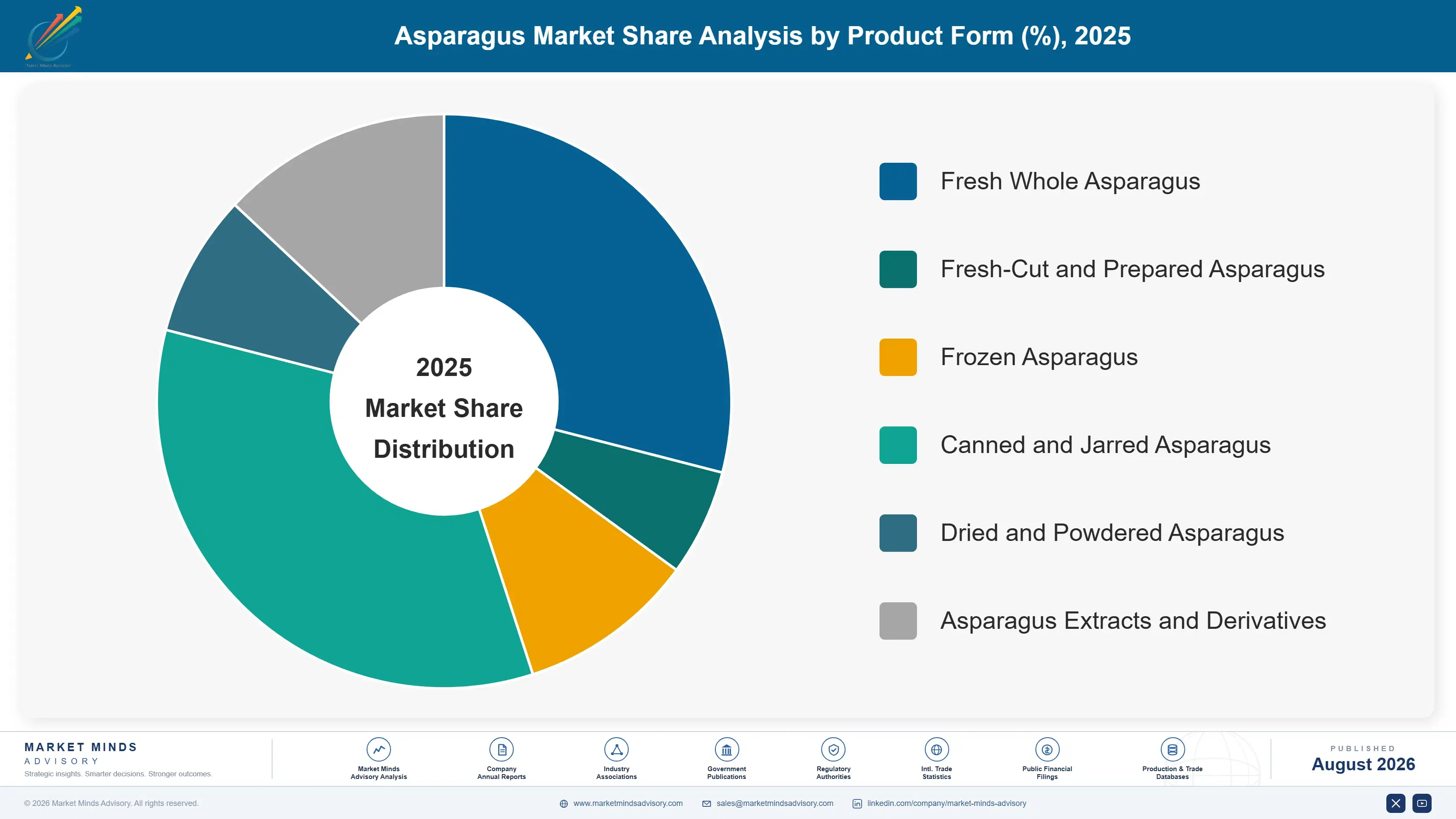
Segmentation follows product form as traded, the single commercial logic that determines shelf life, freight economics, processing capital, and price realisation per kilogram. Form decides whether a spear must reach a consumer within days or wait two years in a jar. Growing region, variety colour, and channel appear separately in the framework as commercial dimensions rather than parallel segments.
asparagus-market-trends-growth-market-share-analysis-1787462447855

Asparagus Extracts and Derivatives

This is the smallest segment and the most profitable route for material nobody else wants. Extract preparations built a real consumer category across Korea and Japan around liver support and alcohol metabolism positioning, and they consume undersized, bent, and woody spears that fresh packing lines grade out entirely. Growth of 8.6%, roughly 1.87 times the market, comes off a very small base, so the tonnage remains modest while the margin contribution is disproportionate. The commercial constraint is demand concentration: two national markets carry almost all consumption, and the category depends on health positioning that regulators in other jurisdictions have not accepted. Processors treat it as valuable optionality rather than as a growth platform.
CAGR 8.6%

Fresh-Cut and Prepared Asparagus

Trimmed, portioned, and microwave-ready packs have done more for asparagus consumption than any marketing campaign, converting a vegetable people found intimidating into something bought on a Tuesday. Growth of 7.8% reflects genuine occasion expansion rather than cannibalisation of loose spears. Retail premiums run well above loose product because the retailer is selling convenience and waste avoidance rather than the vegetable itself. The operational demands are serious: cutting exposes tissue that deteriorates quickly, so processing must sit close to the field or close to the customer, with cold chain integrity maintained throughout. That requirement favours integrated growers and processors over traders buying on open markets. Traders buying on open markets cannot serve this format reliably at all.
CAGR 7.8%
Full segment breakdown across 6 segments available in the complete report.

Regional Architecture and Country Demand Map

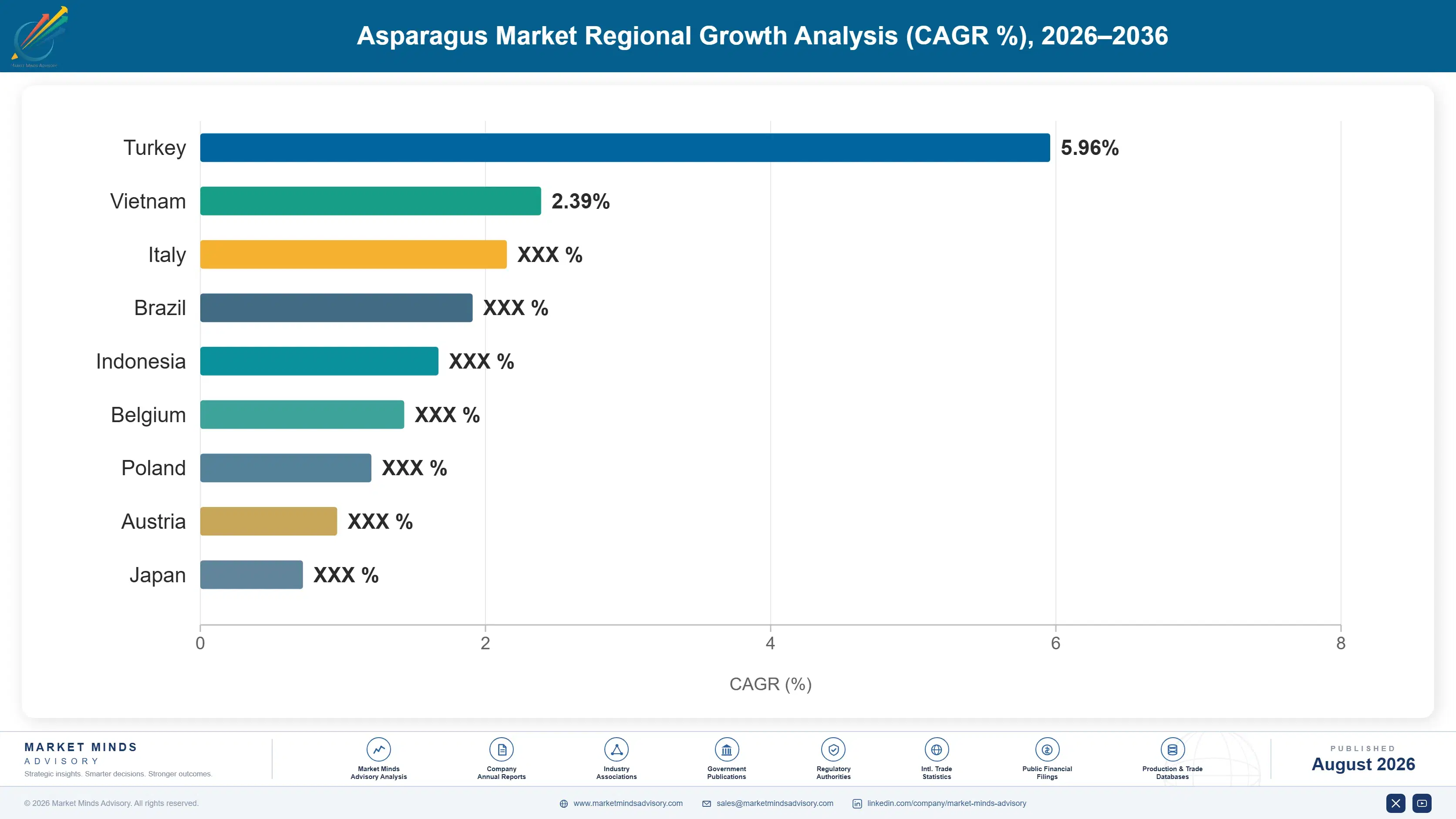
East Asia holds the largest share at 30%, reflecting Chinese production that dominates world volume while remaining almost entirely domestic. North America and Western Europe follow on high-value fresh and prepared demand, while South Asia and Pacific grows fastest from a modest base. Latin America supplies the export trade.

North America

Domestic production has retreated substantially while consumption has grown, and imports closed the gap. Michigan and Washington acreage fell as labour costs rose and growers found better returns elsewhere, leaving Mexican and Peruvian supply to serve most of the American fresh market across the year. Mexican production expanded into exactly that window, with Sonora and Baja California shipping into the winter and early spring period. Prepared and trimmed formats have grown strongly through grocery, carrying premiums well above loose spears and converting occasional purchase into routine. Canadian demand follows the same pattern at smaller scale. Regional growth of 3.9% is driven by value rather than by volume. Domestic acreage is unlikely to return.
Share: 24% | CAGR: 3.9% (2026 to 2036)

Western Europe

White asparagus is a cultural institution here rather than merely a vegetable, and that shapes the entire commercial season. German Spargel demand concentrates into roughly ten weeks from April, generating price premiums no other vegetable achieves, and the same window creates an annual scramble for seasonal harvest labour drawn largely from Central and Eastern Europe. Minimum wage increases and travel restrictions have made that labour supply less reliable, and some growers have reduced planted area rather than risk uncut fields. French, Dutch, Spanish, and Italian production serves both domestic demand and export. Growth of 3.1% is the slowest of any region and reflects labour constraint more than demand. Culture sustains the premium; labour decides the volume.
Share: 22% | CAGR: 3.1% (2026 to 2036)
Regional intelligence for 5 additional markets available in the complete report: East Asia, South Asia and Pacific, Latin America, Middle East and Africa, Eastern Europe. Contact sales@marketmindsadvisory.com.
asparagus-market-trends-growth-country-cagr-analysis-1787462448383

Where Asparagus Growers Can Actually Earn

Selling loose spears into wholesale during a short season is how most asparagus value gets given away. The four moves below shift revenue toward positions that survive a bad harvest week: prepared format conversion, whole-crop utilisation, forward-contracted programmes that underwrite establishment, and counter-seasonal windows where nobody else can supply. None of the four requires new plantings.

Convert Loose Spears Into Trimmed and Portioned Packs

Prepared formats carry retail premiums around 45% above loose product, and the processing cost of trimming, portioning, and packing is a fraction of that gap. The requirement is proximity, since cut tissue deteriorates quickly and the operation must sit near the field or near the customer with unbroken cold chain. A packing line costs roughly $3.5 million for meaningful throughput. Growers who integrate forward capture the premium themselves rather than surrendering it to a packer, and they also gain the retail relationship that loose wholesale supply never provides. Wholesale clears quickly, which is precisely the temptation to resist.
Market Impact: Captures roughly a 45% premium at retail shelf

Route Grade-Outs Into Extract Rather Than Cheap Canning

Undersized, bent, and woody spears currently go into low-value canning or get discarded, yet the same material serves the Korean and Japanese extract category at supplement-grade pricing. Establishing extraction capability or contracting with a processor who has it converts perhaps 12% of harvested volume from a cost recovery exercise into a genuine margin contributor. Nothing about the agronomy changes. The constraint is demand concentration in two national markets, so treat it as valuable optionality on whole-crop returns rather than as a growth platform to build capacity against. Processors without extraction access simply cannot bid for it.
Market Impact: Upgrades roughly 12% of total harvested volume annually

Underwrite Replanting With Multi-Year Processor Contracts

A grower facing three years of cost before revenue, followed by nine of production, is making a decade-long capital commitment, and increasingly chooses blueberries instead. Processors and retailers who want continued asparagus supply can contract forward across the establishment period with agreed volumes and price floors, which changes the replanting calculation entirely. The buyer secures supply in a contracting market at known cost. Peruvian and European acreage lost over the past decade would have been largely defensible with this structure, and almost nobody offered it. Establishment cost runs roughly $28,000 per hectare before any revenue arrives.
Market Impact: Secures contracted supply across all 9 productive seasons

Target Counter-Seasonal Windows Where Competition Disappears

Asparagus prices move violently with seasonal availability, and a supplier landing product when Northern Hemisphere fields are dormant faces almost no competition. Australian, Peruvian, and Southern African growers shipping into Japanese, Korean, and European off-season windows realise prices 60% to 90% above in-season levels, which comfortably absorbs air freight cost. The requirement is programme reliability rather than opportunism, because retailers plan promotions months ahead and will not build a window around a supplier who delivers inconsistently. Southern Hemisphere growers hold the natural advantage, and the window rewards programme discipline over opportunistic shipments.
Market Impact: Realises a 60 to 90% off-season price uplift

Who Controls the Margin Pool

Concentration is extremely low: the top five hold roughly 8% of global production and processing, measured consistently as asparagus volume handled at grower or processor level. Danper and Camposol built scale on Peruvian export horticulture, while Greenyard, Bonduelle, and Del Monte participate through fresh distribution and preserved processing rather than through farming. Thousands of independent growers supply the rest, and Chinese production sits largely outside international commercial structures.
Competition runs along three lines. Access to harvest labour is the first and most decisive, since a grower who cannot cut on time loses the crop rather than margin. Programme reliability into retail is the second, particularly for counter-seasonal windows that buyers plan months ahead. The third is processing integration, where growers who trim, portion, and pack capture premiums that those selling loose into wholesale never see.

Two pressures will reshape positions. Crop substitution is removing acreage from established exporters faster than new supply appears, since growers replanting expiring crowns increasingly choose blueberries. Meanwhile Mexican and North African producers are capturing windows Peru and European growers previously held. The exposed position is a mid-sized grower selling loose spears into wholesale, without prepared capability, forward contracts, or a secured seasonal workforce.
asparagus-market-trends-growth-company-positioning-matrix-1787462448919

Competitive Moat and Risk Dimensions

DANPER TRUJILLO

Moat: Integrated Peruvian Production Scale

Danper combines farming, processing, and export logistics across Peruvian valleys, which lets it move product between fresh, frozen, and preserved channels according to grade and market conditions rather than selling everything into one outlet. That flexibility protects whole-crop returns when fresh markets soften. Retail programme relationships in Europe and North America took years to build and are difficult to displace.
DANPER TRUJILLO

Risk: Water and Substitution Exposure

Peruvian asparagus depends on Ica and La Libertad groundwater that has been under sustained extraction pressure, and rising harvest wages have made the crop less attractive than blueberries or avocado at replanting. Every expiring crown block is a decision point. Defending asparagus acreage against those alternatives requires accepting lower returns per hectare than the company could otherwise earn.
BONDUELLE GROUP

Moat: Preserved Vegetable Processing Network

Bonduelle operates canning and freezing capacity across Europe and the Americas with established retail and foodservice distribution, letting it absorb asparagus volume that fresh channels cannot take and convert seasonal gluts into year-round shelf presence. That processing footprint would cost enormous capital to replicate. It also gives growers a reliable outlet, which supports the supply relationships the business depends on.
BONDUELLE GROUP

Risk: Canned Category Decline

Canned asparagus volume is falling steadily across Western retail as consumers move toward fresh and frozen formats, and that decline shows no sign of reversing anywhere. The processing asset base is sized for a category that is shrinking. Redirecting capacity toward frozen and prepared formats requires capital investment and competes against operators already established in those growing formats.

Players Tracked

Prominent Players

Danper Trujillo
Camposol Holding
Greenyard NV
Bonduelle Group
Del Monte Foods

Other Key Players

Beta S.A.
Agrolatina
Altar Produce
Gourmet Trading Company
Crystal Valley Foods
Limgroup BV
Walker Brothers
Jersey Asparagus Farms
Seneca Foods
Ardo NV
Simplot Australia
Shandong Longda Meishi
Yantai Tianyuan Foods
Fresh Del Monte Produce
Zhangzhou Rainbow Foods

Recent Developments

APRIL 2025

German growers reduce planted area on seasonal labour uncertainty

German asparagus producers reported reduced planted area ahead of the spring season, citing minimum wage increases and continued uncertainty over Central and Eastern European seasonal harvest labour availability. Several growers chose to leave older blocks uncut rather than risk committing to fields they might be unable to harvest on schedule.
Signal: Labour availability is now removing European acreage directly, without any change in consumer demand at all.
SEPTEMBER 2024

Peruvian growers continue replanting expiring blocks with blueberries

Peruvian horticultural producers continued converting expiring asparagus crown blocks to blueberry and avocado plantings across the Ica and La Libertad valleys, citing water availability, harvest labour cost, and materially better returns per hectare. Asparagus export volumes reflected the cumulative effect of several seasons of such decisions.
Signal: Crop substitution at replanting is quietly reshaping global asparagus supply faster than any trade policy could.
JULY 2025

Selective harvesting trials advance without reaching commercial reliability

Further trials of vision-guided selective asparagus harvesting equipment progressed across European and North American growing regions, improving spear recognition and cutting accuracy. Commercial reliability across variable field conditions has not yet been achieved, and growers continue to treat the technology as promising rather than deployable at present.
Signal: Mechanised harvesting remains the single change that would most alter asparagus supply economics across the world.

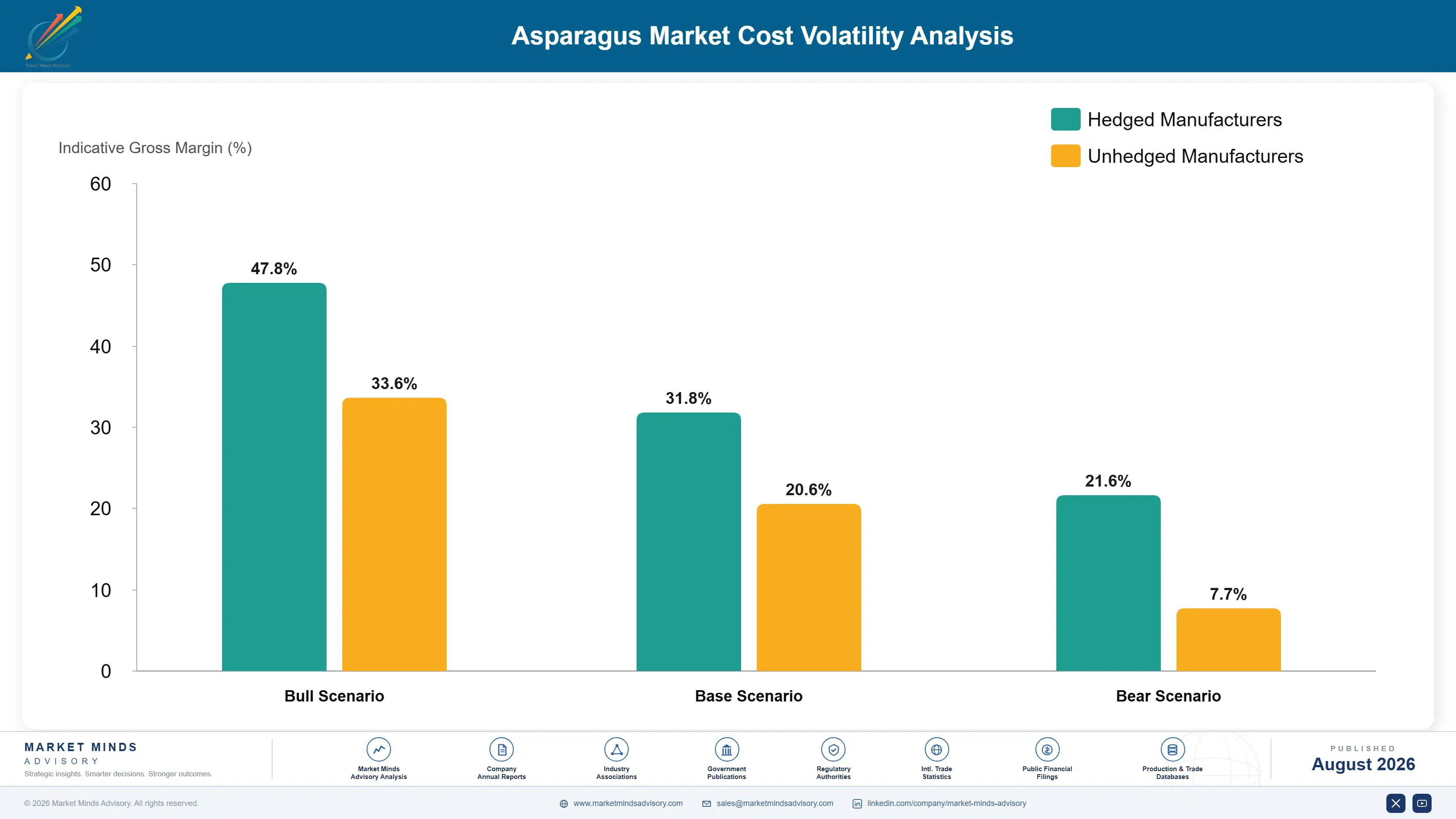
Hand Labour, Water, and Air Freight

Hand harvest labour accounts for roughly 47% of production cost, the highest of any commercial vegetable, drawn from seasonal workforces in Peru, Mexico, and Central and Eastern Europe. Irrigation water and energy for pumping contribute around 14%, rising sharply where aquifer levels have fallen. Crown establishment amortisation takes 11%, and crop protection, packaging, and cold chain absorb the remainder.
German minimum wage increases through 2022 and into 2024 raised harvest cost across the European white asparagus crop, and several growers reduced planted area rather than commit to fields they might not be able to cut. Peruvian wage growth eroded the cost advantage that had built the export industry. Air freight rates for premium counter-seasonal shipments remained volatile, and IEA reporting on jet fuel and energy costs documented that pressure through the period.

Exposure varies far more with labour geography than with farm size. Growers in regions with reliable low-cost seasonal workforces held cost position, while German, Dutch, and British producers absorbed wage increases into a crop with no alternative harvest method. Peruvian producers faced water and wage pressure together, which is why replanting turned against the crop. Mexican growers, closer to the American market with lower harvest wages, gained share.
asparagus-market-trends-growth-cost-volatility-analysis-1787462449120

Secure seasonal labour through multi-year worker relationships

Growers who maintain relationships with the same seasonal crews across years harvest on schedule while competitors recruit in a panic every spring. Housing quality, transport, and return incentives cost less than a single uncut week does. Several German and British operations have shifted to guaranteed return arrangements, and those growers have not reduced planted area while neighbours have.

Stagger replanting across blocks to smooth establishment cost

Replanting an entire holding at once creates three years with no revenue from that ground, which few balance sheets tolerate comfortably. Staggering across blocks on a rolling schedule keeps a proportion always in full production while establishment costs are absorbed gradually. It also spreads exposure to any single establishment season going badly, which matters when weather decides crown survival.

Match irrigation investment to realistic aquifer availability scenarios

Ica valley experience shows that pumping deeper is a temporary answer to a long-run water problem, and the energy cost rises as the water table falls. Investment should be sized against realistic long-term availability rather than current extraction rates. Where the arithmetic does not work, converting the block to a lower-water crop at replanting is the honest decision.

Portfolio Architecture for Margin Defence

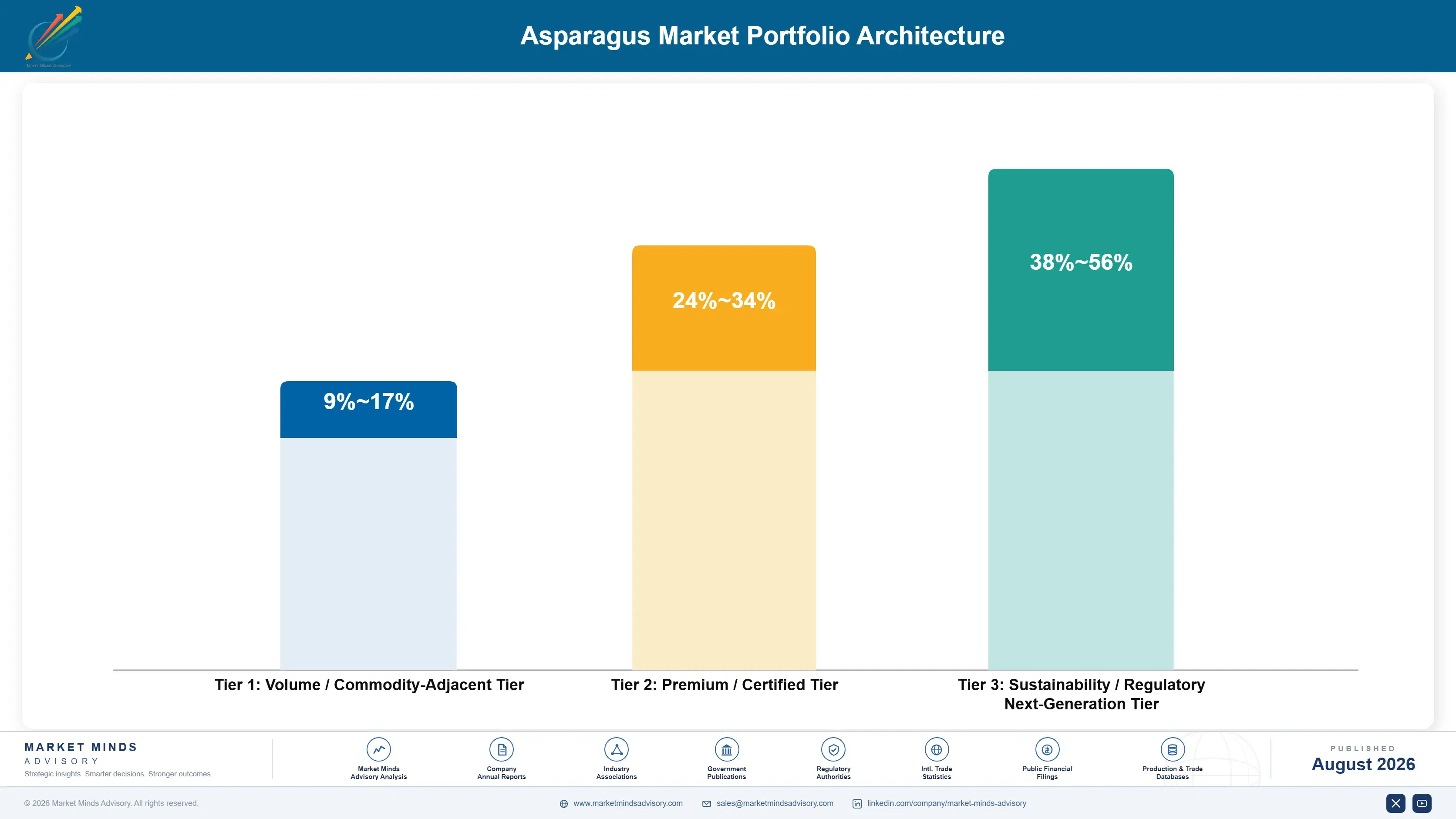
Three tiers separate on how far a spear travels from the field before someone adds value. Bulk loose fresh and standard canned product sold into wholesale earns 9% to 17%, because the grower is selling a commodity into a market that prices on the day. Prepared, trimmed, and premium frozen formats earn 24% to 34%, since the buyer is purchasing convenience and consistency rather than the vegetable itself. Extracts and counter-seasonal programme supply earn most of all.
The tension is that the short season forces volume decisions before prices are known. A grower cutting for eight weeks must move product as it comes, and the temptation is to sell loose into wholesale because it clears quickly. That decision surrenders the entire prepared premium to a packer downstream. Growers who have integrated forward report better whole-crop returns even after absorbing processing capital, though the cash flow through establishment years becomes harder to manage.

High-value pools sit where supply is genuinely scarce or where the buyer is purchasing something other than the raw vegetable. Counter-seasonal windows, prepared convenience formats, and extract material all price on availability or on service rather than on the daily wholesale reference that governs loose spears.

Volume / Commodity-Adjacent Tier

Loose fresh spears sold into wholesale and standard canned product for retail and foodservice. Prices on the day against whatever else is landing. The wide range reflects large differences in harvest labour cost and freight position between producing regions.
Gross Margin: 9%-17%

Premium / Certified Tier

Trimmed, portioned, and prepared formats plus premium individually quick frozen product supplied to retail programmes. Buyers pay for convenience and consistency. Range width separates basic trimmed packs from fully prepared microwave-ready formats within this tier.
Gross Margin: 24%-34%

Sustainability / Regulatory / Next-Generation Tier

Extract and nutraceutical material, counter-seasonal programme supply, and contracted volume underwriting replanting. Scarcity of supply and programme reliability, rather than production economics, sustain the margin structure across this tier throughout the forecast period.
Gross Margin: 38%-56%
asparagus-market-trends-growth-portfolio-architecture-1787462449638

High-value Sub-segments and Strategic Watch-out

Counter-Seasonal Programme Supply

Highest value in the market, realising 60% to 90% above in-season pricing when Northern Hemisphere fields are dormant. Air freight is comfortably absorbed at those levels. Programme reliability rather than opportunism is the entry requirement, since retailers plan windows months ahead. Consistency beats opportunism every time.
Gross Margin: 44%-56%

Extract and Nutraceutical Material

High value with the fastest growth at 8.6%, converting graded-out spears into supplement-grade input at almost no incremental farm cost. Demand concentrates in Korea and Japan, so treat it as valuable optionality on whole-crop returns rather than a platform to build against. Nothing about the agronomy changes.
Gross Margin: 40%-54%

Loose Fresh Spears Into Wholesale

The volume core, clearing quickly during a compressed season but pricing on the day against everything else landing. It moves the crop, which matters when cutting cannot pause, yet it surrenders the entire prepared premium to somebody further downstream. Integrate forward or accept the daily reference.
Gross Margin: 8%-16%

Standard Canned and Jarred Asparagus

The strategic watch-out. Western retail volume is declining steadily as consumers shift toward fresh and frozen, and processing assets are sized for a category that keeps shrinking. Redirect capacity toward frozen and prepared formats rather than defending shelf space. Assets sized for it will keep getting emptier.
Gross Margin: 10%-20%

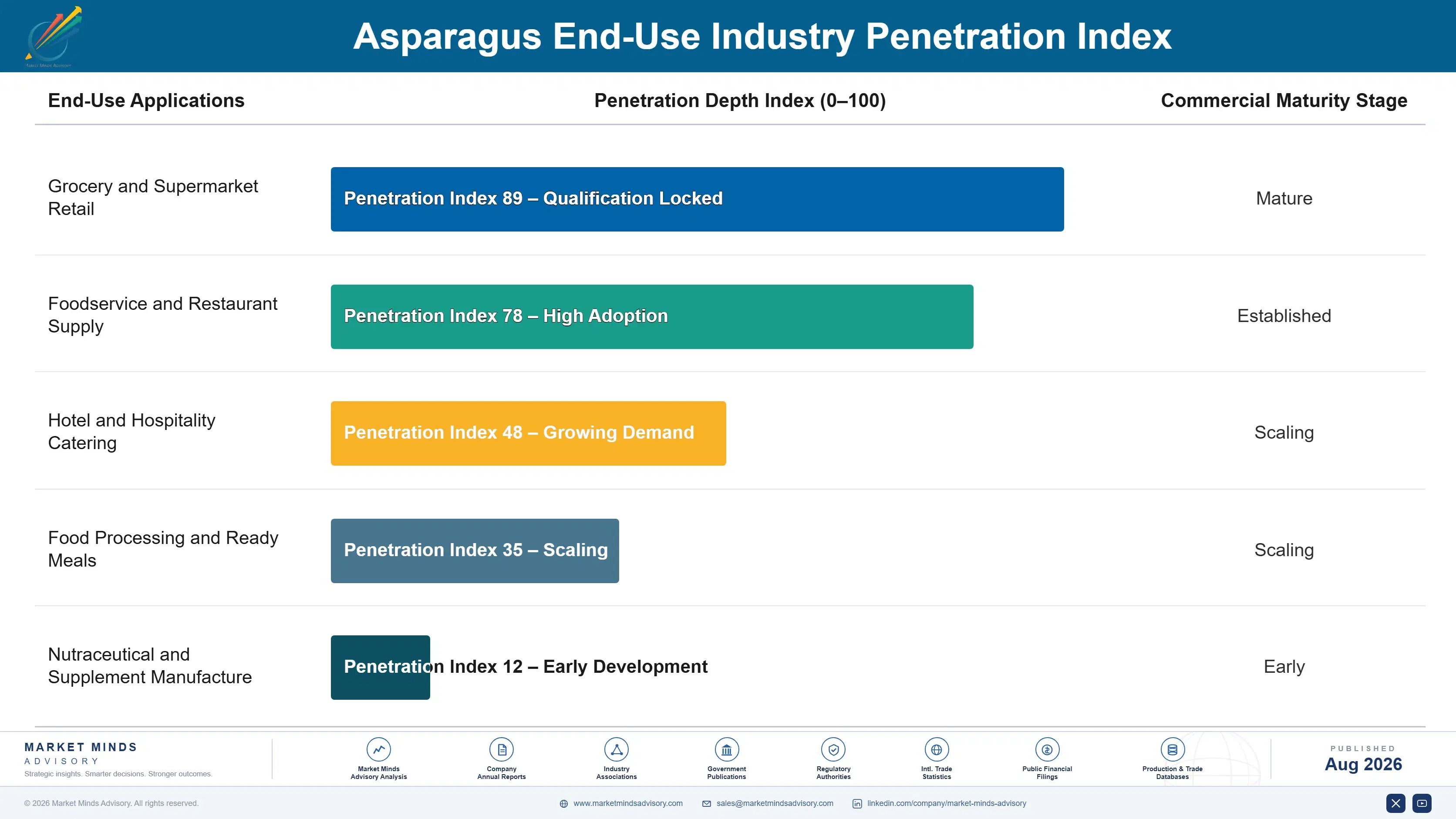
Why Seasonal Programmes Repeat Annually

Asparagus revenue behaves as an annuity at the programme level even though the crop itself arrives in a violent eight-week burst. A retailer who has built a seasonal promotion around a supplier, agreed pack formats, and integrated delivery windows repeats that arrangement year after year, because rebuilding it means renegotiating logistics, specifications, and promotional planning all at once. Typical retail programme tenure runs five to eight years, and the reliability demonstrated in the first two seasons is what buys the rest.
Stickiness varies sharply by channel and by season position. Counter-seasonal programme supply is the most durable, since a retailer filling a window when nothing else is available has few alternatives and values continuity above price. Prepared format supply comes next, protected by processing proximity requirements and cold chain integration. Loose wholesale is the least sticky of all, priced daily against whatever else has landed at market, with no relationship value whatsoever attached to yesterday's delivery.

Buyer profiles have changed considerably. Retail sourcing teams now ask about water use and seasonal labour conditions before discussing price, and air-freighted product faces carbon questions it did not face five years ago.
asparagus-market-trends-growth-end-use-penetration-index-1787462450157

Where Asparagus Capital Should Go

These are among the four positions where our research anticipates prominent divergence between winners and laggards over the coming forecast period. Each is grounded in the demand model, the regulatory perimeter, and the announced capacity pipeline.
01 / PREPARED FORMAT INTEGRATION

Trim and portion in-house rather than surrendering the premium downstream

Prepared packs carry retail premiums around 45% above loose spears, and the trimming, portioning, and packing cost is a small fraction of that gap for any grower with volume to justify a line. The requirement is proximity and cold chain integrity, since cut tissue deteriorates quickly and the operation must sit near the field or near the customer. A line costs roughly $3.5 million for meaningful throughput, and integration also delivers the retail relationship that loose wholesale supply never provides.
02 / REPLANTING CONTRACT STRUCTURES

Underwrite establishment or watch acreage convert to blueberries

A grower replanting asparagus commits to three years of cost before revenue and nine years of production afterwards, and increasingly declines that in favour of blueberries needing less water and no daily hand cutting. Processors and retailers wanting continued supply can contract forward across the establishment period with agreed volumes and price floors, which changes the calculation entirely. Most of the Peruvian and European acreage lost over the past decade would have been defensible under that structure, and almost nobody offered it.
03 / WHOLE-CROP UTILISATION DISCIPLINE

Send graded-out spears to extraction, not to cheap canning

Undersized, bent, and woody spears currently go into low-value canning or get discarded entirely, yet identical material serves the Korean and Japanese extract category at supplement-grade pricing without any change to farm practice. Establishing extraction capability or contracting a processor who holds it converts roughly 12% of harvested volume from cost recovery into genuine margin contribution. Demand concentrates in two national markets, so treat it as valuable optionality on whole-crop returns rather than a platform worth building substantial capacity against.
04 / SEASONAL WORKFORCE SECURITY

Secure returning crews before the season, not during it

Hand harvest is roughly 47% of production cost and cannot be deferred, scheduled around availability, or currently mechanised, which means a grower who cannot cut on time loses the entire crop rather than merely losing margin on it. Housing quality, transport provision, and guaranteed return arrangements cost considerably less than a single uncut week does at peak season. German and British operations that shifted to returning-crew arrangements have held their planted area while neighbours recruiting fresh each spring have reduced theirs.

Engagement Snapshot From the Field

A live engagement with an industry participant carrying material or product regulatory and market exposure ahead of a defining policy shift, showing how our research translates into a defensible multi-year portfolio strategy.
MARKET MINDS ADVISORY · CLIENT ENGAGEMENT SUMMARY
Asparagus Producer Strategic Portfolio Review and Transition Roadmap 2026·Investment Scenario on Asparagus Exposure Evaluation 2025-26
CLIENT PROFILE
A Peruvian export horticulture producer farming asparagus alongside grapes and citrus across coastal valleys, with annual revenue near USD 195 million (client-reported, unverified by MMA). Asparagus supplied roughly 44% of planted area but a declining share of contribution, with most output sold as loose fresh spears and standard canned product through export traders rather than direct retail programmes.
STRATEGIC CHALLENGE
Groundwater availability had tightened, harvest wages had risen for four consecutive seasons, and roughly a third of asparagus crown blocks were reaching the end of productive life within three years. Management faced a replanting decision across those blocks with blueberry returns per hectare visibly higher, and no clear view of whether any asparagus configuration remained competitive.
MMA APPROACH
MMA modelled block-level returns for asparagus against blueberry and avocado alternatives under three water availability and wage scenarios across a full nine-year crown cycle. Channel economics were rebuilt separating loose wholesale from prepared, counter-seasonal, and extract outlets. Retail programme opportunities in Asian off-season windows were sized, with findings tested through 47 expert interviews during Q4 2025.
KEY FINDINGS
  1. Asparagus sold as loose fresh spears returned less per hectare than blueberries under every water and wage scenario modelled across the full crown cycle.
  2. Counter-seasonal shipments into Japanese and Korean windows realised prices 74% above in-season averages, but represented only 6% of the company's asparagus volume.
  3. Roughly 14% of harvested spears were graded out and canned at barely above cost, while extract processors in Korea were paying substantially more for identical material.
  4. Two crown blocks with the best water access and lowest labour requirement remained competitive against blueberries if directed entirely toward prepared and counter-seasonal channels.
CLIENT PROFILE
A Peruvian export horticulture producer farming asparagus alongside grapes and citrus across coastal valleys, with annual revenue near USD 195 million (client-reported, unverified by MMA). Asparagus supplied roughly 44% of planted area but a declining share of contribution, with most output sold as loose fresh spears and standard canned product through export traders rather than direct retail programmes.
STRATEGIC CHALLENGE
Groundwater availability had tightened, harvest wages had risen for four consecutive seasons, and roughly a third of asparagus crown blocks were reaching the end of productive life within three years. Management faced a replanting decision across those blocks with blueberry returns per hectare visibly higher, and no clear view of whether any asparagus configuration remained competitive.
MMA APPROACH
MMA modelled block-level returns for asparagus against blueberry and avocado alternatives under three water availability and wage scenarios across a full nine-year crown cycle. Channel economics were rebuilt separating loose wholesale from prepared, counter-seasonal, and extract outlets. Retail programme opportunities in Asian off-season windows were sized, with findings tested through 47 expert interviews during Q4 2025.
KEY FINDINGS
  1. Asparagus sold as loose fresh spears returned less per hectare than blueberries under every water and wage scenario modelled across the full crown cycle.
  2. Counter-seasonal shipments into Japanese and Korean windows realised prices 74% above in-season averages, but represented only 6% of the company's asparagus volume.
  3. Roughly 14% of harvested spears were graded out and canned at barely above cost, while extract processors in Korea were paying substantially more for identical material.
  4. Two crown blocks with the best water access and lowest labour requirement remained competitive against blueberries if directed entirely toward prepared and counter-seasonal channels.
RECOMMENDED STRATEGY
Phase 1: Phase 1 (months one to six): convert the four weakest asparagus blocks to blueberry at replanting and redirect graded-out volume toward Korean extract processors. Phase 2: Phase 2 (months seven to eighteen): build trimming and portioning capability and negotiate direct counter-seasonal programmes with two Asian retail groups. Phase 3: Phase 3 (months nineteen to thirty-six): replant the two retained asparagus blocks under contracted volume with agreed price floors covering establishment.
OUTCOME
The producer converted four blocks and reported asparagus contribution per remaining hectare rising 38% within two seasons on a smaller footprint (client-reported, unverified by MMA). Extract sales replaced most canned volume at better realisation. One Asian retail programme is running and a second is in negotiation.

Frequently Asked Questions

Foundational context covering the market sizes, CAGR, scope, country, region and competition that inform every finding below. This section is provided to cover basics and most often pre-purchase conversations, answered from the MMA Primary Research Dataset.

What is the current size of the Asparagus Market?

The market was valued at USD 24.6 billion in 2025, rising to an estimated USD 25.7 billion in 2026. East Asia holds the largest regional share at 30% of global value.

How large will the Asparagus Market be by 2036?

MMA forecasts USD 40.3 billion by 2036 under the base case, an expansion multiple of 1.57 times the 2026 level. Incremental value creation across the period reaches USD 14.6 billion.

What is the CAGR for the Asparagus Market 2026 to 2036?

The base case CAGR is 4.6%, with a bull case of 5.8% and a bear case of 3.4%. Historical growth between 2020 and 2025 ran at 3.9%, driven mostly by price rather than volume.

Which segment is growing fastest?

Asparagus extracts and derivatives, at 8.6%, roughly 1.87 times the overall market rate. Growth comes from Korean and Japanese nutraceutical demand using material fresh lines grade out.

Who are the major companies in the Asparagus Market?

Danper Trujillo, Camposol Holding, Greenyard, Bonduelle, and Del Monte Foods lead, though the top five hold only about 8% of production and processing between them worldwide.

Which country is growing fastest?

India, at 7.2%, driven by urban modern retail and hospitality demand from a small base. Domestic production remains limited, so most of that growth is served through imports.

Report Segmentation Architecture

The full report scope spans multiple orthogonal segmentation dimensions, with cross-tabulated demand data provided for each dimension pair. Coverage extends further to regional breakdowns, trend trajectories, and the competitive detail needed to support segment-level decision-making.

By Product Form

  • Fresh Whole Asparagus
  • Fresh-Cut and Prepared Asparagus
  • Frozen Asparagus
  • Canned and Jarred Asparagus
  • Dried and Powdered Asparagus
  • Asparagus Extracts and Derivatives

By End-Use Industry

  • Grocery and Supermarket Retail
  • Foodservice and Restaurant Supply
  • Hotel and Hospitality Catering
  • Food Processing and Ready Meals
  • Nutraceutical and Supplement Manufacture

By Commercial Dimension

  • Direct Retail Programme Supply
  • Wholesale and Terminal Market Trade
  • Export Trader and Importer Channel
  • Contract Processing Arrangements

By Region

  • North America
  • Western Europe
  • East Asia
  • South Asia and Pacific
  • Latin America
  • Middle East and Africa
  • Eastern Europe

Scope, Methodology, and Coverage

Every figure in this report is reproducible from documented input assumptions. The scope below maps the historical period, the forecast horizon, the segmentation dimensions, and the countries covered, alongside the underlying primary and qualitative methodology.
Historical Period
2020 to 2025
Forecast Period
2026 to 2036
Base Year
2025 (USD billions; MMA Primary Research Dataset, August 2026)
Market Definition
The market comprises asparagus grown for human consumption and traded as fresh whole spears, fresh-cut and prepared product, frozen, canned and jarred, dried and powdered, and as extracts and derivatives, valued at wholesale and processed trade level. Both green and white asparagus are captured across every form and growing region. Ornamental asparagus species, crown and seed propagation material sold to growers, and finished consumer supplements combining asparagus extract with other actives fall outside scope.
Quantitative Units
USD billions (current prices); tonnes of product; USD per kilogram farmgate equivalent price
Segmentation Dimensions
By Product Form; By End-Use Industry; By Commercial Dimension; By Region
Regions Covered
North America, Western Europe, East Asia, South Asia and Pacific, Latin America, Middle East and Africa, Eastern Europe
Countries Covered
USA, China, Germany, France, UK, Japan, South Korea, India, Australia, Canada, Brazil, Mexico, Indonesia, Vietnam, Thailand, Malaysia, UAE, Saudi Arabia, South Africa, Nigeria, Turkey, Poland, Netherlands, Italy, Spain, Sweden, Switzerland, Argentina, Colombia, Singapore, and additional markets relevant to this sector
Key Companies Profiled
Danper Trujillo, Camposol Holding, Greenyard NV, Bonduelle Group, Del Monte Foods, Beta S.A., Agrolatina, Altar Produce, Gourmet Trading Company, Crystal Valley Foods, Limgroup BV, Walker Brothers, Jersey Asparagus Farms, Seneca Foods, Ardo NV, Simplot Australia, Shandong Longda Meishi, Yantai Tianyuan Foods, Fresh Del Monte Produce, Zhangzhou Rainbow Foods
Quantitative Methodology
Primary survey, n=3,800 respondents, Q4 2025, six countries; demand-side model with trade association cross-validation
Qualitative Methodology
47 expert interviews, Q4 2025; applied to validate demand model assumptions, identify emerging dynamics, and assess competitive positioning
Report Format
PDF and XLSX data workbook (Word format preview document)
Publisher
Market Minds Advisory
Report Code
MMA-2026-AGR-211
Published
August 2026
Contact
sales@marketmindsadvisory.com | www.marketmindsadvisory.com

Purchase the full Asparagus Market Report (2026 to 2036).

The full report sizes asparagus demand across six product forms and seven regions with 2026 to 2036 forecasts under base, bull, and bear cases. It models block-level replanting economics against blueberry and avocado alternatives, showing precisely where asparagus acreage is defensible and where it is not. Competitive profiles cover twenty growers and processors assessed consistently on asparagus-attributable volume handled. Labour and water analysis traces harvest wage and aquifer trajectories by producing region. Commercial guidance addresses prepared format integration, replanting contract structures, whole-crop utilisation, and seasonal workforce security.
Six product forms sized and forecast separately
Replanting economics modelled against alternative crop returns
Twenty grower and processor profiles on consistent volume basis
Harvest labour cost trajectories tracked by producing region
Counter-seasonal window pricing benchmarked across major import markets
Water availability scenarios modelled for principal export valleys

Built For The People Who Decide

From boardroom strategy to bench-side execution, this report is read cover-to-cover by leaders shaping the next decade of their industry, turning demand scenarios, market dynamics and valuation benchmarks into decisions.
CXOs/ Presidents/ VPs/ Managers
M&A and Corporate Development
Strategy Teams and R&D Heads
Procurement and Product Directors
Regulatory and Compliance Leaders
Investor Relations and Equity Analysts