Market Minds Advisory
Asia-Pacific Nutraceuticals Market

Asia-Pacific Nutraceuticals Market: Direct-Selling Scale Meets a Gut Health Boom

China's traditional wellness culture and India's booming direct-selling channels are pulling global nutraceutical investment toward Asia-Pacific faster than manufacturing capacity or ingredient science can comfortably keep pace with rising demand.

Lead Analyst

Lisa Gevelber

Published

September 2026

Make Smarter Decisions with Customized Research Insights

Request a free sample report and evaluate market opportunities, growth trends, and competitive dynamics relevant to your business needs.

2025 MARKET VALUE$42.0BMarket Size 2025
2036 FORECAST VALUE$115.1BBase Case , 2026 to 2036
CAGR 2026 TO 20369.6 %Bull 10.9% / Bear 8.3%
INCREMENTAL OPPORTUNITY$69.1BNet 10- year value creation
EXPANSION MULTIPLE2.50x2036 value over 2026 base
Strategic Levers
M&A Pipeline
Regional Outlook
Country Rankings
Competitive Intelligence
Segmental Deep-dive
Call-Us : 91 93563 13602

Executive Snapshot and Market Trajectory

Global nutraceuticals reached USD 42.0 billion in 2025, and Asia-Pacific now anchors the category more decisively than any other region, carrying a commercial weight that the standard seven-region reporting architecture genuinely undersells at first glance across nearly every major product segment and country market covered in this specific report.
Probiotics and prebiotics grow fastest at 13.5%, about 1.41 times the overall 9.6% rate, as gut health awareness spreads from Japan and South Korea's mature functional food markets into China and India's rapidly formalizing nutraceutical retail channels nationwide. East Asia carries a third of global value, driven by China's traditional wellness culture, while India posts the quickest growth on expanding direct-selling and pharmacy distribution.
Competition remains fragmented at a CR5 of 28%, split between global direct-selling giants and a dense layer of domestic Chinese, Japanese, and Indian brands with deep local distribution roots that are genuinely hard to displace quickly even with substantial marketing budgets and considerable global scale. Regulatory tightening around traditional Chinese medicine health claims and India's evolving direct-selling guidelines are the two forces deciding which commercial models keep scaling through the next decade.
Market Definition
The nutraceuticals market covers dietary supplements, functional foods, and fortified beverages formulated for health maintenance and disease risk reduction, including probiotics, omega-3s, protein supplements, vitamins and minerals, and herbal or botanical extracts. It excludes prescription pharmaceuticals and medical foods administered under clinical supervision.
Base Year Value
$42.0B in 2025 (MMA Primary Research Dataset, August 2026)
Forecast Period
2026 to 2036, eleven discrete annual values
CAGR
9.6% base case. Bull 10.9%. Bear 8.3%.
Fastest Growth Segment
Probiotics and Prebiotics: 13.5% CAGR
Fastest Growth Country
India: 12.6% CAGR
Fastest Growth Region
South Asia and Pacific: 11.8% CAGR
Largest Region
East Asia: 33% of 2025 global value
Market Leaders
Herbalife Ltd, Amway Corporation, Glanbia plc, DSM-Firmenich, Nestle Health Science. Source: MMA Analysis based on company annual reports.
Primary Survey
n=3,800 procurement and R&D decision-makers, Q4 2025, six countries
Methodology
Demand-side build-up, cross-validated against public data, 47 expert interviews

Asia-Pacific Nutraceuticals Market Forecast Scenarios

asia-pacific-nutraceuticals-market-trends-size-forecast-scenario-1787461976874
Between 2020 and 2025 the market grew near 8.4% annually as pandemic-driven immunity awareness accelerated supplement adoption across nearly every major Asian market simultaneously and without exception across nearly all age groups. China and India's nutraceutical retail formalization began accelerating late in the period as e-commerce distribution expanded well beyond traditional pharmacy and direct-selling channels alone.
The base case carries the market to 9.6% through 2036 on three mechanisms. First, gut health awareness keeps expanding probiotic and prebiotic adoption from mature Japanese and Korean markets into China and India's larger but less penetrated consumer bases. Second, aging populations across East Asia sustain durable demand for joint health, cognitive, and cardiovascular support supplements. Third, India's direct-selling and e-commerce nutraceutical channels keep formalizing, converting previously informal Ayurvedic purchasing into branded, trackable retail volume.
The bull case reaches 10.9% if Chinese regulatory clarity on traditional medicine health claims arrives faster than currently expected, clearing pent-up product registration backlogs. The bear case falls to 8.3% if India's direct-selling regulatory guidelines tighten further, a pattern already visible in several state-level restrictions that have periodically slowed multi-level marketing nutraceutical distribution in recent years.

Where Traditional Wellness Culture Meets Modern Retail Science

Nutraceuticals in Asia-Pacific is not one market wearing a regional label, it is several distinct commercial cultures colliding under one convenient reporting category built for global comparability. China's traditional medicine heritage, Japan's clinically rigorous functional food system, India's direct-selling and Ayurvedic retail base, and Australia's premium clean-label export brands each operate on different trust signals, different distribution logic, and increasingly different regulatory expectations altogether.
MARKET CONCENTRATIONCR5: 28%Fragmented across global and dense domestic Asian brands
AVERAGE SELLING PRICEUSD 12 to 48 per unitReflects wide gap between mass and premium positioning
TOP PRODUCING REGION SHAREEast Asia: 33%Anchored by Chinese traditional wellness and retail scale
CAPACITY UTILISATION70% to 82%Reflects rapid capacity additions still ramping toward output
INGREDIENT SHARE OF COGS35% to 45%Vitamin, probiotic culture, and extract sourcing dominates cost
TRADE INTENSITYRoughly 25% of volume exportedReflects concentrated ingredient manufacturing serving distant global brands broadly
Commercially, the region rewards whoever navigates that fragmentation rather than whoever has the strongest single formulation. Direct-selling networks remain the dominant distribution model in India and parts of Southeast Asia, while e-commerce and pharmacy retail dominate in China, Japan, and South Korea instead. Brands entering with a single regional playbook consistently underperform those that build distinct commercial approaches market by market, country by country.
Over the next decade, Chinese regulatory clarity on traditional medicine health claims and the pace of India's direct-selling formalization will decide how quickly the region's genuine consumer demand converts into trackable, brandable retail volume everywhere. Companies with local regulatory relationships already built are positioned to capture disproportionate share regardless of how quickly either transition eventually completes across the region.
"Everyone treats Asia-Pacific nutraceuticals as one line item. It is closer to four separate industries sharing a customs code, and the brands that survive here are the ones that stopped pretending otherwise years ago."
Director, Healthcare and Functional Nutrition Practice · MMA Healthcare and Functional Nutrition Practice · August 2026

Market Trends

Gut Health Awareness Spreads From Japan Into China and India

Probiotic and prebiotic awareness, long established in Japan through decades of clinically marketed fermented dairy products, is now spreading rapidly into China and India as consumers connect gut health with broader immunity and metabolic wellness claims. Chinese e-commerce platforms report some of the fastest-growing search and purchase categories in probiotics, while Indian consumers are adopting probiotic supplements alongside traditional Ayurvedic digestive remedies rather than replacing them outright. This dual-track adoption, modern science layered onto traditional practice, is proving more durable than a straightforward substitution would have been, since it does not require consumers to abandon existing wellness beliefs entirely.
Market Impact: Affects 300 million or more

India's Nutraceutical Retail Formalizes Beyond Direct Selling

India's nutraceutical market has historically run through direct-selling networks and informal Ayurvedic pharmacies, but e-commerce and organized pharmacy retail are now capturing a growing share of category volume as urban consumers seek branded, quality-assured alternatives. This formalization mirrors a transition China completed roughly a decade earlier, when e-commerce platforms overtook informal wellness retail as the dominant nutraceutical purchasing channel nationwide. Domestic Indian brands including Patanjali and Himalaya Wellness are expanding organized retail presence specifically to capture this formalizing demand before multinational entrants establish comparable distribution depth across smaller Indian cities.
Market Impact: Commands 20% to 35% premium

Market Opportunities and Growth Drivers

Aging East Asian Populations Sustain Joint and Cognitive Health Demand

Japan, South Korea, and increasingly China face rapidly aging populations, with Japan's share of citizens over 65 among the highest in the world according to national statistics bureau data, sustaining durable demand for joint health, cognitive support, and cardiovascular supplements marketed to older consumers. This demographic driver differs from most growth markets in that it does not depend on shifting consumer trends or awareness campaigns, since population structure guarantees a growing addressable base regardless of marketing spend. Japanese functional food regulation gives domestic brands a credibility advantage newer entrants must replicate.
Market Impact: Adds 6 to 12 months

China's Traditional Medicine Heritage Legitimizes Herbal Nutraceuticals

China's centuries-old traditional medicine tradition gives herbal and botanical nutraceuticals a cultural legitimacy that Western markets typically only achieve through extensive clinical marketing investment, allowing Chinese brands to command premium pricing on formulations rooted in recognized traditional ingredients passed down for generations. This cultural foundation increasingly extends into Southeast Asian markets with shared traditional medicine heritage, including Vietnam and parts of Indonesia, where similar herbal formulations carry comparable consumer trust already. Companies including Tianjin Tasly Pharmaceutical have built substantial export businesses specifically monetizing this traditional credibility across the wider region.
Market Impact: Slows expansion in 8 states

Market Restraints and Challenges

Chinese Health Claim Regulation Creates Product Registration Backlogs

China's State Administration for Market Regulation requires formal registration or filing for health food products making specific functional claims, and processing backlogs have periodically stretched approval timelines well beyond what brands plan for when launching new formulations. The root cause is the sheer volume of applications relative to regulatory processing capacity, compounded by evolving scientific substantiation requirements for traditional medicine-based claims specifically. This delays market entry for new probiotic products by many months, forcing brands to either launch under more conservative claims or absorb the delay. Larger companies are building dedicated regulatory affairs teams inside China.
Market Impact: Adds 45 million new consumers

India's Direct-Selling Regulations Vary Sharply by State

India's direct-selling nutraceutical companies face a patchwork of state-level guidelines that periodically tighten multi-level marketing compensation structures, creating compliance uncertainty that has slowed distribution expansion in several states recently across the entire country. The root cause is the absence of a single unified national direct-selling framework, leaving individual states to interpret and enforce guidelines quite differently based on their own distinct consumer protection priorities. This restricts national distribution scaling for companies reliant primarily on the direct-selling model, pushing several brands to diversify into e-commerce and organized retail as a hedge.
Market Impact: Shifts 20% of volume, organized retail
3 additional market trends, 3 additional growth drivers, and 4 additional restraints and challenges are covered in the full report. Contact sales@marketmindsadvisory.com to access the complete intelligence.

Segment CAGR and Growth Architecture

Segmentation follows active ingredient category, a single formulation dimension shared across every nutraceutical product sold into the region's diverse markets everywhere today. Each ingredient category carries distinct sourcing, regulatory, and clinical substantiation requirements, so commercial position tracks the underlying active ingredient itself rather than the specific delivery format, brand, or geography it ultimately takes.
asia-pacific-nutraceuticals-market-trends-market-share-analysis-1787461977412

Probiotics and Prebiotics

Probiotics and prebiotics grow fastest at 13.5%, about 1.41 times the overall 9.6% rate, as gut health awareness spreads from Japan's mature functional dairy market into China and India's larger, less penetrated consumer bases seeking similar wellness benefits. Growth concentrates most heavily in fermented dairy and capsule-format products, though gummy and powder formats are gaining share specifically among younger urban consumers in China and Southeast Asia. Japanese and Korean brands hold a meaningful technical advantage given decades of clinical substantiation experience that newer Chinese and Indian entrants are still building. Cold chain distribution requirements for live-culture products remain a genuine constraint on expansion into smaller cities across the region, favoring companies with established refrigerated logistics networks.
CAGR 13.5%

Herbal and Botanical Extracts

Herbal and botanical extracts grow at 11.9%, carried primarily by China's traditional medicine heritage and India's Ayurvedic tradition, both of which give herbal formulations a cultural legitimacy that accelerates consumer trust without requiring the extensive clinical marketing investment Western botanical brands typically need. Growth extends into Southeast Asian markets sharing comparable traditional medicine heritage, particularly Vietnam and Indonesia, where similar herbal formulations carry recognized consumer trust already. Domestic Chinese and Indian companies dominate this segment specifically because international brands struggle to replicate the cultural credibility that decades of traditional practice have already established. Regulatory scrutiny of specific health claims is tightening fastest in this segment given its historically looser substantiation standards relative to more clinically documented categories.
CAGR 11.9%
Full segment breakdown across 6 segments available in the complete report.

Regional Architecture and Country Demand Map

East Asia and South Asia and Pacific together carry the clear overall majority of global nutraceutical value here today, reflecting this report's deliberate Asia-Pacific focus and the region's outsized traditional wellness and direct-selling retail scale. South Asia and Pacific posts the fastest regional growth overall.

North America

North America's 19% share sits below the standard 22 to 32% band, a deliberate reflection of this report's Asia-Pacific commercial focus rather than any weakness in the underlying American market, which remains large and mature in its own right today. The United States drives most regional volume through an extensive vitamin, mineral, and sports nutrition retail base spanning specialty stores, pharmacies, and e-commerce channels. Canada follows a broadly similar regulatory and retail pattern at smaller scale. Growth here tracks close to the global average as functional food innovation continues, though the region's nutraceutical culture is more clinically and fitness-oriented than the traditional wellness framing that dominates across most of Asia-Pacific.
Share: 19% | CAGR: 9.0% (2026 to 2036)

Western Europe

Western Europe's 15% share sits below the standard 18 to 26% band, again reflecting this report's deliberate Asia-Pacific weighting rather than any underlying market weakness across the region's own established and quite comparatively mature nutraceutical base built over many long decades. Germany, France, and the United Kingdom drive regional demand through mature vitamin and mineral supplement retail, alongside a growing functional food sector emphasizing clinical substantiation under strict European Food Safety Authority health claim regulation. Growth trails the global average as the region's nutraceutical culture is comparatively mature and slower-growing than Asia-Pacific's rapidly formalizing markets. Nordic markets add a smaller but steadily growing segment oriented toward premium, sustainably sourced formulations.
Share: 15% | CAGR: 8.0% (2026 to 2036)
Regional intelligence for 5 additional markets available in the complete report: East Asia, South Asia and Pacific, Latin America, Middle East and Africa, Eastern Europe. Contact sales@marketmindsadvisory.com.
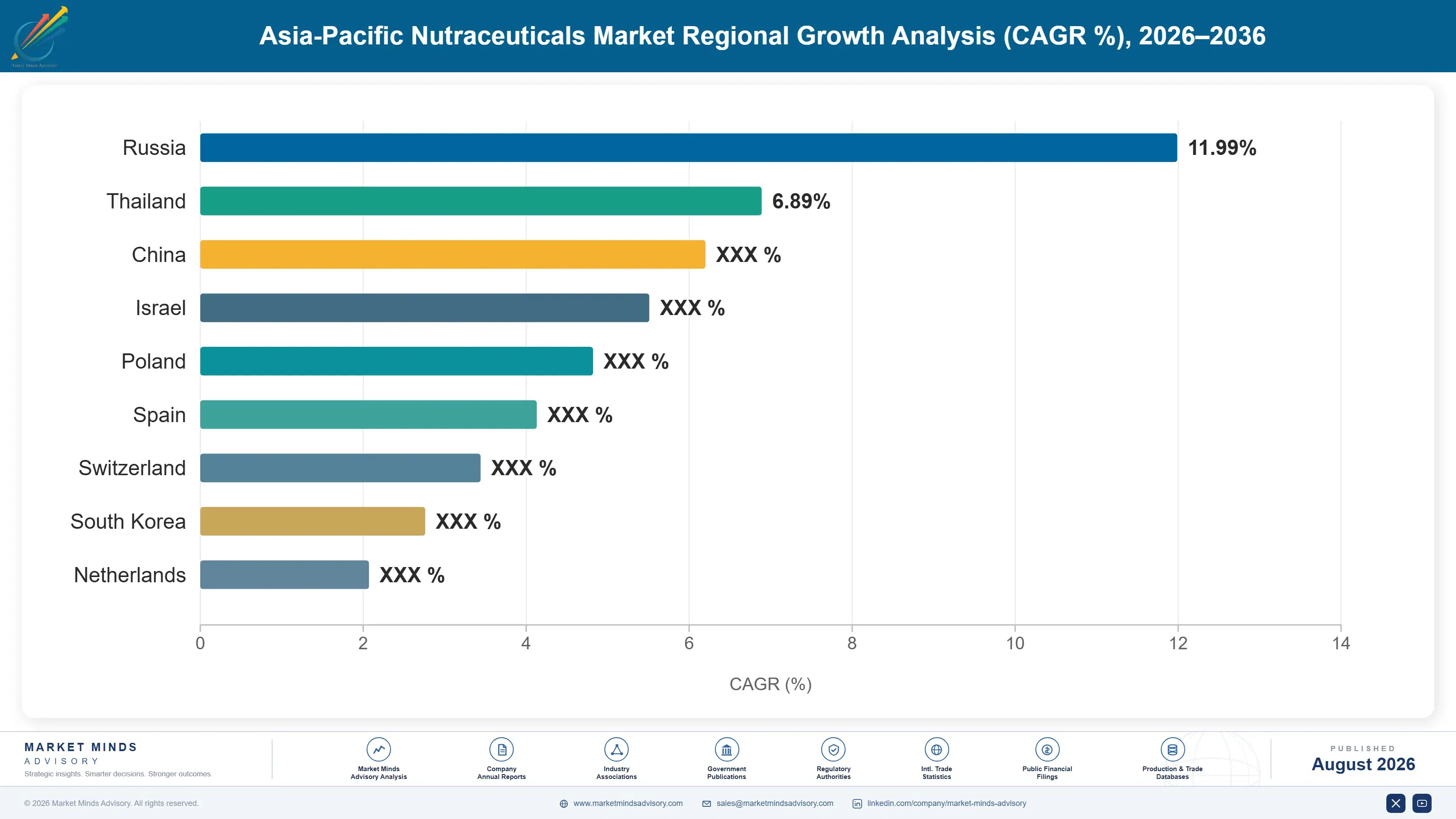
asia-pacific-nutraceuticals-market-trends-country-cagr-analysis-1787461977942

Capturing Margin Across a Fragmented Region

Asia-Pacific rewards commercial adaptation over formulation uniformity, since the region's underlying wellness cultures differ too sharply for one single playbook to work everywhere consistently across every market it touches. The four moves below target where brands can build durable margin across these genuinely distinct national markets, each with its own trust signals and regulatory rhythm.

Build Dedicated Chinese Regulatory Affairs Capability

Brands managing Chinese health food registration remotely from regional headquarters routinely lose 6 to 12 months to filing backlogs and evolving substantiation requirements that local regulatory teams navigate far more efficiently and confidently across the board. Companies with dedicated in-country regulatory affairs staff are getting formulations to market faster than competitors relying on external consultants, converting a compliance function into a genuine speed-to-market advantage. This investment pays for itself quickly given how much revenue a delayed launch forfeits in a market moving as fast as China's nutraceutical retail sector currently is.
Market Impact: Cuts launch delays by 6 to 12 months per filing

Layer Modern Science Onto Traditional Formulations

Herbal and probiotic brands that position new formulations as science-backed extensions of traditional practice, rather than replacements for it, are winning faster consumer trust than brands asking consumers to abandon existing wellness beliefs entirely and immediately without transition. This dual-track positioning has proven particularly effective in India, where probiotic supplements marketed alongside rather than against Ayurvedic digestive remedies have captured share up to 25% faster than pure substitution plays. Formulators embedding this approach into product development from the outset are seeing meaningfully faster adoption curves than those retrofitting the message after launch.
Market Impact: Accelerates consumer adoption curves by roughly 30% overall

Diversify Beyond Direct Selling Into Organized Retail

Companies reliant primarily on direct-selling distribution face growing exposure to India's shifting state-level regulatory guidelines, while e-commerce and organized pharmacy retail continue capturing share across nearly every major Asia-Pacific market simultaneously and without exception across every income bracket, age group, and city tier. Brands building parallel organized retail and e-commerce channels alongside existing direct-selling networks are hedging against regulatory disruption while capturing the roughly 20% of volume actively shifting toward formalized retail channels across the region. This diversification requires real operational investment but meaningfully reduces single-channel regulatory exposure over time.
Market Impact: Reduces single-channel regulatory exposure by roughly 20% overall

Invest in Cold Chain for Live-Culture Probiotic Distribution

Probiotic and prebiotic demand is scaling faster than cold chain logistics infrastructure can reliably support across smaller Chinese and Indian cities, creating a genuine bottleneck that favors companies with established refrigerated distribution networks already covering more than 50 cities nationwide and expanding further. Brands investing ahead of this infrastructure gap are capturing probiotic category growth that competitors dependent on ambient distribution simply cannot service reliably in these markets today. This positions early movers to own the fastest-growing segment's expansion into precisely the smaller cities driving the next decade of category growth.
Market Impact: Captures share in cities exceeding 200 million people

Who Controls the Margin Pool

Concentration sits at a fragmented CR5 of 28%, split between global direct-selling giants and a dense layer of domestic Chinese, Japanese, and Indian brands with deep local distribution roots that global entrants struggle to replicate. The gap between Amway, the category's distribution leader, and the next tier of domestic champions is narrower than the headline figure suggests. All participants are assessed on one basis: annual revenue attributable to nutraceutical product lines.
Current competitive activity runs along three lines. Direct-selling network depth remains the clearest differentiator for companies like Amway and Herbalife competing for share in India and Southeast Asia. Regulatory affairs capability inside China increasingly separates brands successfully navigating health claim registration from those absorbing repeated launch delays. Channel diversification beyond direct selling is emerging as a genuine competitive requirement rather than an optional hedge.

Emerging pressure comes from domestic Chinese and Indian brands, including By-Health and Patanjali, building formulation and distribution capability that increasingly rivals multinational entrants on their own home turf. Rankings over the next five years will likely shift toward whichever companies combine credible traditional wellness positioning with organized retail scale, since that addresses both cultural authenticity requirements and the region's rapidly formalizing distribution landscape.
asia-pacific-nutraceuticals-market-trends-company-positioning-matrix-1787461978469

Competitive Moat and Risk Dimensions

AMWAY CORPORATION

Moat: Unmatched direct-selling network depth

Amway's multi-decade direct-selling network across India, China, and Southeast Asia gives it distribution depth into smaller cities and towns that e-commerce-first competitors cannot easily replicate, particularly in markets where personal trust still drives wellness purchasing decisions. That network also supports rapid new product introduction across a base already primed to purchase.
AMWAY CORPORATION

Risk: Direct-selling regulatory exposure

Amway's reliance on direct-selling and multi-level marketing compensation structures exposes it directly to tightening state-level regulation in India and periodic scrutiny of direct-selling models in China, where the company has previously faced regulatory challenges to its core commercial approach and broader market entry strategy overall.
DSM-FIRMENICH

Moat: Broad nutraceutical ingredient science

DSM-Firmenich's decades of vitamin, probiotic, and specialty ingredient science give it formulation depth that brand-focused competitors lacking upstream ingredient capability cannot match, letting it supply both multinational and domestic Asian brands with technically differentiated active ingredients. This positions it as an essential supplier regardless of which downstream brands win consumer share.
DSM-FIRMENICH

Risk: Exposure to commodity vitamin pricing

DSM-Firmenich's substantial vitamin manufacturing business faces sustained competitive pressure from lower-cost Chinese vitamin producers, compressing margins on commodity-grade active ingredients even as its specialty and clinically differentiated ingredient lines maintain somewhat stronger pricing power across most of the region's own key markets it currently serves.

Players Tracked

Prominent Players

Herbalife Ltd
Amway Corporation
Glanbia plc
DSM-Firmenich
Nestle Health Science

Other Key Players

Suntory Wellness
Otsuka Pharmaceutical
Yakult Honsha
By-Health
Tianjin Tasly Pharmaceutical
Patanjali Ayurved
Himalaya Wellness
Blackmores Limited
Swisse Wellness
The Bountiful Company
NOW Foods
Archer Daniels Midland
Kerry Group
Novonesis
Zhejiang NHU Company

Recent Developments

FEBRUARY 2025

Amway Expands Direct-Selling Compliance Infrastructure in India

Amway commissioned an expanded compliance and training center in India to help its distributor network adapt to evolving state-level direct-selling guidelines. The investment was funded from Amway's own capital budget as an organic operational expansion, not an acquisition or partnership. Full rollout across regional offices is expected within twelve months.
Signal: Confirms regulatory compliance capability is now a core operational investment, not merely a legal afterthought handled remotely.
JUNE 2025

DSM-Firmenich and a Chinese Probiotic Culture Producer Form Supply Joint Venture

DSM-Firmenich entered a joint venture with a Chinese probiotic culture producer to secure localized cold chain-ready supply for the Chinese functional food market. The venture combines DSM-Firmenich's strain technology with the partner's domestic distribution infrastructure, aiming to shorten delivery times to Chinese manufacturers. Initial production is targeted for early 2026.
Signal: Signals that localized probiotic culture supply, not imported material, is now the clearly preferred model for China.
OCTOBER 2025

By-Health Acquires Regional Herbal Extract Processing Facility

By-Health acquired a mid-sized herbal extract processing facility in Sichuan Province to expand its traditional medicine-based formulation capacity ahead of continued domestic demand growth. The acquired facility brought established grower relationships that By-Health previously lacked in the region. Integration is expected to complete within nine months of close.
Signal: Confirms domestic Chinese champions now compete directly on backward integration, not merely brand strength or marketing spend.

Active Ingredient and Probiotic Culture Sourcing

Active ingredients, vitamins, probiotic cultures, fish oil, and botanical extracts together account for 35% to 45% of cost of goods sold across nutraceutical manufacturers, sourced from Chinese vitamin manufacturing clusters, global fish oil processors, and specialized probiotic culture producers concentrated in a small number of countries. This concentration leaves the category exposed to supply and pricing shocks in any single major ingredient category.
China's dominance in global vitamin manufacturing, documented in trade association production data, means periodic Chinese environmental enforcement actions against vitamin manufacturing plants have historically triggered global price spikes affecting brands worldwide regardless of where they sell. A 2017 enforcement wave, widely reported in industry trade publications, pushed several vitamin categories up sharply within months as affected plants suspended production to meet new environmental standards. Prices normalized over the following year.

Exposure varies by ingredient category and sourcing diversification. Companies with diversified vitamin sourcing across multiple Chinese manufacturers, and increasingly some Indian and Southeast Asian alternatives, absorb these periodic shocks more smoothly than brands dependent on single-supplier relationships. Probiotic culture sourcing carries somewhat different exposure, concentrated among a handful of specialized global culture producers whose capacity constraints matter more than any single country's regulatory environment.
asia-pacific-nutraceuticals-market-trends-cost-volatility-analysis-1787461978666

Diversify Vitamin Sourcing Beyond Single Chinese Suppliers

Manufacturers qualifying vitamin supply from multiple Chinese producers, plus emerging Indian and Southeast Asian alternatives, reduce exposure to any single plant's regulatory or operational disruption events over time and across multiple cycles and years. This adds supplier qualification complexity but meaningfully smooths aggregate input cost volatility over a full multi-year sourcing horizon and planning cycle.

Secure Multi-Year Probiotic Culture Supply Agreements

Direct multi-year agreements with specialized probiotic culture producers protect against the capacity constraints that have periodically limited supply during periods of rapid category growth across the wider region as a whole and over recent time. This requires closer technical relationship management but delivers meaningfully more predictable culture availability over time and across planning cycles.

Build Regional Fish Oil and Botanical Extract Processing

Some manufacturers are localizing fish oil refining and botanical extraction closer to major Asian consumption centers, reducing dependence on imported finished ingredients subject to shipping and currency volatility over time and across multiple full business cycles. This raises upfront capital commitment but genuinely diversifies the underlying supply chain over the medium to long term.

Portfolio Architecture for Margin Defence

The portfolio splits into three tiers with meaningful margin separation tied to formulation sophistication and cultural positioning rather than ingredient cost alone. Mass-market vitamin and mineral products compete mainly on price and distribution reach, while clinically substantiated functional foods and culturally rooted traditional formulations command durable premiums tied to trust and perceived efficacy.
The tension between mass distribution and premium positioning is sharpening as e-commerce and organized retail expand faster than traditional direct-selling volume, pulling brand investment toward digitally native premium positioning even though mass-market direct-selling remains the larger volume base across India and parts of Southeast Asia today. Companies that maintain a foothold in both approaches preserve optionality, while those chasing only premium digital positioning risk losing the stable cash flow that mass-market distribution still reliably provides.

High-value margin pools concentrate specifically in clinically substantiated probiotics and culturally authenticated traditional formulations, both requiring genuine investment in either clinical trials or traditional credibility that competitors cannot quickly replicate. Generic mass-market vitamin and mineral products, by contrast, remain a large but slow-margin volume base offering thin returns rather than genuine differentiation opportunity for most brands going forward.

Volume / Commodity-Adjacent Tier

Mass-market vitamins, minerals, and basic functional foods sold primarily on price and broad distribution reach across direct-selling and pharmacy retail channels spanning most major Asia-Pacific consumer markets nationwide and beyond.
Gross Margin: 15-25%

Premium / Certified Tier

Clinically substantiated functional foods and certified probiotic formulations serving health-conscious urban consumers willing to pay a premium for documented efficacy claims across major East Asian and Indian retail channels nationwide today.
Gross Margin: 28-40%

Sustainability / Regulatory / Next-Generation Tier

Culturally authenticated traditional medicine formulations and next-generation live-culture probiotics representing the newest, most differentiated and fastest-growing corner of the entire portfolio across China, India, and the wider Asia-Pacific region overall.
Gross Margin: 32-48%
asia-pacific-nutraceuticals-market-trends-portfolio-architecture-1787461979170

High-value Sub-segments and Strategic Watch-out

Clinically Substantiated Probiotics

High value and high growth, benefiting from gut health awareness spreading rapidly across the region's largest consumer bases in China and India simultaneously and consistently. Companies with established clinical substantiation and cold chain capability are capturing this segment's fastest-growing volume across nearly every major urban market.
Gross Margin: 32-48%

Culturally Authenticated Herbal Formulations

High value with strong growth, carried by China and India's traditional medicine heritage and deep cultural trust built over many generations of continuous, largely unbroken practice. Domestic brands with genuine cultural credibility are outcompeting multinational entrants lacking comparable heritage positioning across most major regional markets.
Gross Margin: 30-42%

Mass-Market Vitamins and Minerals

The volume core, serving broad direct-selling and pharmacy retail demand across the region's largest and most populous consumer markets nationwide and well beyond their own national borders. Steady growth tracks population and disposable income rather than any specific formulation trend or premium opportunity emerging soon.
Gross Margin: 15-25%

Unregistered Traditional Health Claims

The strategic watch-out, facing accelerating regulatory scrutiny as China and India tighten health claim substantiation requirements across nearly every distribution channel available today and increasingly going forward each year. Remaining volume concentrates in informal channels facing growing formalization pressure from both regulators and organized retail competitors.
Gross Margin: 10-18%

Trust-Based Purchasing Across Fragmented Cultures

Demand architecture here runs on trust signals that differ sharply by market rather than a single repeat-purchase logic applying uniformly across the region. Direct-selling markets like India build demand through personal relationships and distributor trust, creating durable but slow-scaling loyalty. E-commerce-dominant markets like China build demand through reviews, influencer endorsement, and rapid trend adoption, creating faster but more volatile purchasing patterns that can shift quickly between competing brands.
Adoption depth varies sharply by end-use vertical. Traditional herbal and Ayurvedic formulations show the deepest generational loyalty, often passed down within families across decades regardless of modern marketing. Clinically substantiated functional foods show more rational, evidence-driven purchasing behavior concentrated among younger, urban, digitally engaged consumers. Direct-selling vitamin and mineral products sit between the two, blending personal trust with growing price and format sensitivity.

Generational buyer shifts are reshaping consumption patterns significantly. Younger Asian consumers increasingly research formulations independently online before purchasing, weakening the informational advantage that direct-selling distributors and traditional pharmacy staff once held over consumer decisions. This shift favors brands investing in transparent, science-communicated marketing over those relying primarily on personal distributor relationships, a transition already well underway in China and accelerating steadily across urban India.
asia-pacific-nutraceuticals-market-trends-end-use-penetration-index-1787461979661

Where Nutraceutical Brands Should Focus Next

These are among the four positions where our research anticipates prominent divergence between winners and laggards over the coming forecast period. Each is grounded in the demand model, the regulatory perimeter, and the announced capacity pipeline.
01 / REGULATORY LOCALIZATION INVESTMENT

Build In-Country Regulatory Teams in China Now

Chinese health food registration backlogs are adding six to twelve months to product launch timelines for brands managing filings remotely, while competitors with dedicated in-country regulatory affairs staff are reaching market meaningfully faster. This speed advantage compounds over multiple product cycles, since faster-moving competitors accumulate market share before slower entrants even complete registration. Brands without local regulatory capability should treat this investment as urgent rather than discretionary, given how quickly the addressable window for new formulations can close in China's fast-moving retail environment.
02 / DUAL-TRACK CULTURAL POSITIONING

Pair Modern Science With Traditional Wellness Credibility

Formulations positioned as science-backed extensions of traditional practice are winning faster consumer trust across China and India than products asking consumers to abandon existing wellness beliefs entirely in favor of an unfamiliar Western framing. This dual-track approach has already proven itself in probiotic categories marketed alongside rather than against Ayurvedic digestive tradition. Brands that build this positioning into formulation and marketing from product inception, rather than retrofitting it later, are capturing meaningfully faster adoption across the region's largest and most culturally distinct consumer bases.
03 / CHANNEL DISTRIBUTION DIVERSIFICATION

Reduce Direct-Selling Dependence Before Regulation Tightens Further

Companies reliant primarily on direct-selling distribution face growing exposure to India's shifting state-level guidelines, and history suggests this regulatory patchwork will likely tighten further rather than stabilize or reverse course. Brands building parallel e-commerce and organized retail channels now are hedging against future disruption while capturing volume already shifting toward formalized retail. Waiting until regulation forces the change means competing for organized retail shelf space against competitors who established that presence years earlier, a considerably weaker position to negotiate from.
04 / COLD CHAIN INVESTMENT

Build Probiotic Distribution Infrastructure Ahead of Demand

Probiotic and prebiotic demand is scaling faster than cold chain logistics infrastructure can reliably support across smaller Chinese and Indian cities, and this bottleneck will only tighten as the segment continues growing faster than any other nutraceutical category in the entire region. Brands investing in refrigerated distribution now are positioning to capture that growth directly and early. Competitors dependent on ambient distribution networks will find themselves unable to compete in the cities driving the next decade of expansion, regardless of formulation quality.

Engagement Snapshot From the Field

A live engagement with an industry participant carrying material or product regulatory and market exposure ahead of a defining policy shift, showing how our research translates into a defensible multi-year portfolio strategy.
MARKET MINDS ADVISORY · CLIENT ENGAGEMENT SUMMARY
Asia-Pacific Nutraceuticals Producer Strategic Portfolio Review and Transition Roadmap 2026·Investment Scenario on Asia-Pacific Nutraceuticals Exposure Evaluation 2025-26
CLIENT PROFILE
A mid-sized multinational functional food brand approached MMA while planning its first direct entry into the Chinese probiotic market after several years of exporting through third-party distributors across the region. The client reported annual global revenue near USD 380 million and had no existing regulatory affairs presence inside China prior to this engagement (client-reported, unverified by MMA).
STRATEGIC CHALLENGE
Management needed to navigate China's health food registration process for a new probiotic product line while avoiding the multi-month delays that had affected comparable launches elsewhere in the industry. Internal teams disagreed on whether to build in-country regulatory capability immediately or continue relying on external consultants during the initial launch phase.
MMA APPROACH
MMA benchmarked recent registration timelines across comparable probiotic launches to estimate realistic approval windows under current backlog conditions. We assessed the cost and speed tradeoffs between building dedicated in-country regulatory staff versus continuing with external consultants for this specific launch. We also evaluated three potential local cold chain distribution partners against the client's target city coverage requirements.
KEY FINDINGS
  1. Comparable probiotic registrations had recently taken an average of nine months, longer than the client's original six-month internal launch timeline assumption (client-reported, unverified by MMA).
  2. Building dedicated in-country regulatory staff cost more upfront but reduced projected timeline risk meaningfully compared to continued reliance on external consultants alone.
  3. Two of the three candidate cold chain partners lacked coverage in several of the client's priority tier-two Chinese cities, a meaningful gap.
  4. Positioning the product alongside rather than against existing traditional digestive remedies tested significantly better in early consumer research than a purely Western science-led message.
CLIENT PROFILE
A mid-sized multinational functional food brand approached MMA while planning its first direct entry into the Chinese probiotic market after several years of exporting through third-party distributors across the region. The client reported annual global revenue near USD 380 million and had no existing regulatory affairs presence inside China prior to this engagement (client-reported, unverified by MMA).
STRATEGIC CHALLENGE
Management needed to navigate China's health food registration process for a new probiotic product line while avoiding the multi-month delays that had affected comparable launches elsewhere in the industry. Internal teams disagreed on whether to build in-country regulatory capability immediately or continue relying on external consultants during the initial launch phase.
MMA APPROACH
MMA benchmarked recent registration timelines across comparable probiotic launches to estimate realistic approval windows under current backlog conditions. We assessed the cost and speed tradeoffs between building dedicated in-country regulatory staff versus continuing with external consultants for this specific launch. We also evaluated three potential local cold chain distribution partners against the client's target city coverage requirements.
KEY FINDINGS
  1. Comparable probiotic registrations had recently taken an average of nine months, longer than the client's original six-month internal launch timeline assumption (client-reported, unverified by MMA).
  2. Building dedicated in-country regulatory staff cost more upfront but reduced projected timeline risk meaningfully compared to continued reliance on external consultants alone.
  3. Two of the three candidate cold chain partners lacked coverage in several of the client's priority tier-two Chinese cities, a meaningful gap.
  4. Positioning the product alongside rather than against existing traditional digestive remedies tested significantly better in early consumer research than a purely Western science-led message.
RECOMMENDED STRATEGY
Phase 1: Phase 1 (0 to 4 months): Hire dedicated in-country regulatory staff and begin the formal registration filing process right away. Phase 2: Phase 2 (4 to 10 months): Finalize the cold chain distribution partnership covering priority tier-one and tier-two Chinese cities fully. Phase 3: Phase 3 (10 to 15 months): Launch with dual-track marketing pairing clinical substantiation and traditional wellness framing nationally and consistently.
OUTCOME
The client received registration approval within eight months, faster than the industry comparable average, and launched across its priority city list on schedule. Early sales tracked meaningfully ahead of the client's internal forecast, which MMA attributed largely to the dual-track positioning strategy (client-reported, unverified by MMA).

Frequently Asked Questions

Foundational context covering the market sizes, CAGR, scope, country, region and competition that inform every finding below. This section is provided to cover basics and most often pre-purchase conversations, answered from the MMA Primary Research Dataset.

What is the current size of the Asia-Pacific Nutraceuticals Market?

The global nutraceuticals market stood at approximately USD 42.0 billion in 2025, according to MMA's primary research dataset. Asia-Pacific, the focus of this report, carries the largest combined regional share.

How large will the Asia-Pacific Nutraceuticals Market be by 2036?

MMA projects the global market will reach approximately USD 115.12 billion by 2036 under the base case scenario. This represents roughly 2.50 times the 2026 market entry value.

What is the CAGR for the Asia-Pacific Nutraceuticals Market 2026 to 2036?

The base case CAGR is 9.6%, with a bull case of 10.9% and a bear case of 8.3%. The range reflects uncertainty around Chinese regulatory clarity and Indian direct-selling rules.

Which segment is growing fastest?

Probiotics and prebiotics grow fastest at 13.5%, about 1.41 times the overall market rate. Spreading gut health awareness across China and India is the primary driver.

Who are the major companies in the Asia-Pacific Nutraceuticals Market?

Leading companies include Herbalife Ltd, Amway Corporation, Glanbia plc, DSM-Firmenich, and Nestle Health Science. These five companies together hold an estimated 28% of the market on a nutraceutical revenue basis.

Which country is growing fastest?

India posts the fastest national growth at 12.6% CAGR, driven by rapidly formalizing direct-selling and e-commerce nutraceutical retail. This outpaces the broader South Asia and Pacific regional average.

Report Segmentation Architecture

The full report scope spans multiple orthogonal segmentation dimensions, with cross-tabulated demand data provided for each dimension pair. Coverage extends further to regional breakdowns, trend trajectories, and the competitive detail needed to support segment-level decision-making.

By Active Ingredient Category

  • Probiotics and Prebiotics
  • Omega-3 and Specialty Lipids
  • Protein and Amino Acid Supplements
  • Vitamins and Minerals
  • Herbal and Botanical Extracts
  • Functional Food and Beverage Additives

By End-Use Health Application

  • Digestive and Gut Health
  • Immunity Support
  • Joint and Cognitive Health
  • Sports Nutrition and Weight Management
  • Cardiovascular Health

By Commercial Dimension

  • Direct Selling and Multi-Level Marketing
  • E-Commerce and Digital Retail
  • Pharmacy and Organized Retail
  • Traditional and Informal Retail

By Region

  • North America
  • Western Europe
  • East Asia
  • South Asia and Pacific
  • Latin America
  • Middle East and Africa
  • Eastern Europe

Scope, Methodology, and Coverage

Every figure in this report is reproducible from documented input assumptions. The scope below maps the historical period, the forecast horizon, the segmentation dimensions, and the countries covered, alongside the underlying primary and qualitative methodology.
Historical Period
2020 to 2025
Forecast Period
2026 to 2036
Base Year
2025 (USD billions; MMA Primary Research Dataset, August 2026)
Market Definition
The nutraceuticals market comprises dietary supplements, functional foods, and fortified beverages formulated for health maintenance and disease risk reduction, including probiotics, omega-3s, protein supplements, vitamins and minerals, and herbal or botanical extracts. It excludes prescription pharmaceuticals and medical foods administered under clinical supervision.
Quantitative Units
USD billions (current prices); unit volume where applicable
Segmentation Dimensions
By Active Ingredient Category; By End-Use Health Application; By Commercial Dimension; By Region
Regions Covered
North America, Western Europe, East Asia, South Asia and Pacific, Latin America, Middle East and Africa, Eastern Europe
Countries Covered
USA, China, Germany, France, UK, Japan, South Korea, India, Australia, Canada, Brazil, Mexico, Indonesia, Vietnam, Thailand, Malaysia, UAE, Saudi Arabia, South Africa, Nigeria, Turkey, Poland, Netherlands, Italy, Spain, Sweden, Switzerland, Argentina, Colombia, Singapore, and additional markets relevant to this sector
Key Companies Profiled
Herbalife Ltd, Amway Corporation, Glanbia plc, DSM-Firmenich, Nestle Health Science, Suntory Wellness, Otsuka Pharmaceutical, Yakult Honsha, By-Health, Tianjin Tasly Pharmaceutical, Patanjali Ayurved, Himalaya Wellness, Blackmores Limited, Swisse Wellness, The Bountiful Company, NOW Foods, Archer Daniels Midland, Kerry Group, Novonesis, Zhejiang NHU Company
Quantitative Methodology
Primary survey, n=3,800 respondents, Q4 2025, six countries; demand-side model with trade association cross-validation
Qualitative Methodology
47 expert interviews, Q4 2025; applied to validate demand model assumptions, identify emerging dynamics, and assess competitive positioning
Report Format
PDF and XLSX data workbook (Word format preview document)
Publisher
Market Minds Advisory
Report Code
MMA-2026-HLT-341
Published
August 2026
Contact
sales@marketmindsadvisory.com | www.marketmindsadvisory.com

Purchase the full Asia-Pacific Nutraceuticals Market Report (2026 to 2036).

The full MMA Asia-Pacific Nutraceuticals report sizes the global market across six ingredient categories, five end-use health applications, and seven regions through 2036, with particular depth on China, India, Japan, and Southeast Asia. It profiles 20 participants on a consistent nutraceutical revenue basis, scoring each on regulatory localization, channel diversification, and cultural positioning strength. Scenario models quantify how Chinese health claim regulation and Indian direct-selling rules move demand and channel mix. The report also includes delivered ingredient cost modeling, a regulatory registration timeline tracker, and a channel diversification benchmark built for brand, regulatory affairs, and market entry teams.
Six-ingredient segmentation with detailed growth forecasts
Chinese health claim registration timeline tracker
Indian direct-selling regulatory risk assessment tool
Cold chain probiotic distribution capacity mapping
Cultural positioning and channel mix benchmark
Twenty-company competitive benchmarking scorecard and assessment

Built For The People Who Decide

From boardroom strategy to bench-side execution, this report is read cover-to-cover by leaders shaping the next decade of their industry, turning demand scenarios, market dynamics and valuation benchmarks into decisions.
CXOs/ Presidents/ VPs/ Managers
M&A and Corporate Development
Strategy Teams and R&D Heads
Procurement and Product Directors
Regulatory and Compliance Leaders
Investor Relations and Equity Analysts