Market Minds Advisory
Asia-Pacific Islamic Finance Market

Asia-Pacific Islamic Finance Market: Digital Banking Platforms and Sukuk Issuance Growth

Rising sukuk issuance, expanding digital Islamic banking adoption, and accelerating takaful penetration are jointly reshaping how Asia-Pacific institutions structure Shariah-compliant financial products across every customer segment nationwide. across every institution type.

Lead Analyst

Published

September 2026

Make Smarter Decisions with Customized Research Insights

Request a free sample report and evaluate market opportunities, growth trends, and competitive dynamics relevant to your business needs.

2025 MARKET VALUE$42.0BMarket Size 2025
2036 FORECAST VALUE$104.1BBase Case , 2026 to 2036
CAGR 2026 TO 20368.6 %Bull 9.9% / Bear 7.3%
INCREMENTAL OPPORTUNITY$58.5BNet 10- year value creation
EXPANSION MULTIPLE2.28x2036 value over 2026 base
Strategic Levers
M&A Pipeline
Regional Outlook
Country Rankings
Competitive Intelligence
Segmental Deep-dive
Call-Us : 91 93563 13602

Executive Snapshot and Market Trajectory

Asia-Pacific Islamic finance institutions are expanding well beyond traditional retail banking as sukuk issuance and digital platforms capture younger, tech-savvy Shariah-compliant customers across the region. Regulators are actively encouraging this diversification as part of broader financial inclusion policy nationwide. Growth here is proving durable across most demographic segments. nationwide today.
Retail and commercial Islamic banking remains the dominant revenue driver, but digital Islamic banking platforms are expanding fastest as neobanks and incumbent institutions launch mobile-first Shariah-compliant products. Demand concentrates heavily among Malaysia and Indonesia's large Muslim-majority populations seeking modern digital banking alternatives. Sukuk-linked wealth products are also gaining traction among affluent Shariah-compliant investors seeking portfolio diversification. Cross-border distribution partnerships between regional banking groups are also expanding steadily across most major relationships nationwide.
Malaysian and Indonesian banking groups retain substantial combined share of regional assets, but digital-first entrants are winning share among younger customers underserved by traditional branch networks. Tightening Shariah governance standards continue reshaping which institutions can profitably scale cross-border Islamic finance products. Compliance cost keeps climbing steadily, pushing smaller regional institutions toward consolidation across most competitive tiers. Broker scrutiny is reshaping distribution structures nationwide.
Market Definition
This report covers revenue generated by banks, takaful providers, asset managers, and digital platforms offering Shariah-compliant financial products across Asia-Pacific, including Islamic banking, sukuk, takaful, and Islamic asset management. It excludes conventional banking revenue earned by the same institutions and non-financial halal industry sectors.
Base Year Value
$42.0B in 2025 (MMA Primary Research Dataset, August 2026)
Forecast Period
2026 to 2036, eleven discrete annual values
CAGR
8.6% base case. Bull 9.9%. Bear 7.3%.
Fastest Growth Segment
Digital Islamic Banking Platforms: 16.2% CAGR
Fastest Growth Country
Bangladesh: 14.8% CAGR
Fastest Growth Region
South Asia and Pacific: 10.8% CAGR
Largest Region
South Asia and Pacific: 24% of 2025 global value
Market Leaders
Maybank Islamic, CIMB Islamic, Bank Syariah Indonesia, Bank Islam Malaysia, Al Rajhi Bank. Source: MMA Analysis based on company annual reports.
Primary Survey
n=3,800 procurement and R&D decision-makers, Q4 2025, six countries
Methodology
Demand-side build-up, cross-validated against public data, 47 expert interviews

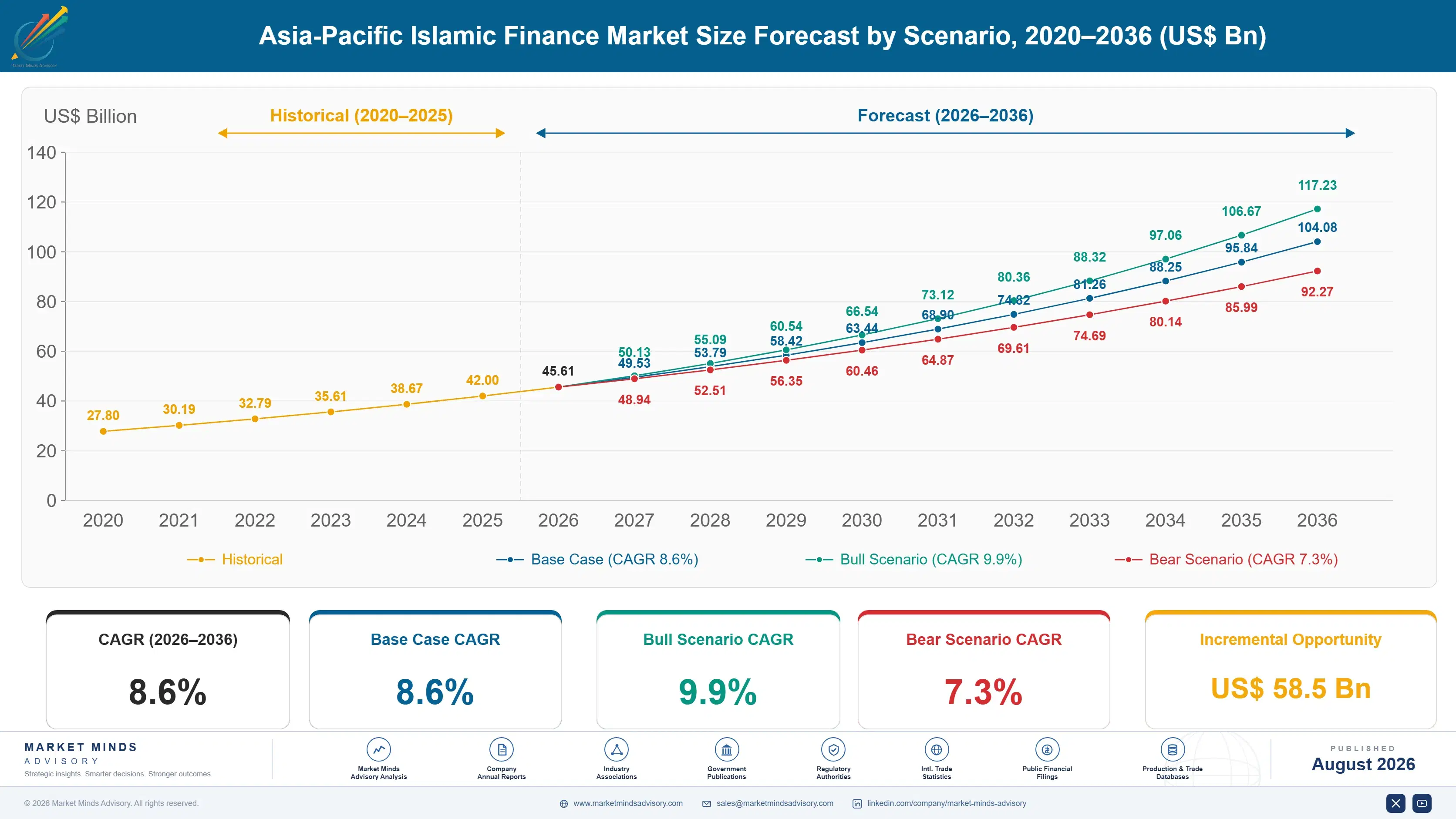
Asia-Pacific Islamic Finance Market Forecast Scenarios

asia-pacific-islamic-finance-market-size-forecast-scenario-1787938980212
Islamic finance revenue grew steadily between 2020 and 2025 as pandemic-driven digital adoption in 2020 and 2021 accelerated a shift toward mobile-first Shariah-compliant banking across most major regional markets. Sukuk issuance also climbed steadily as governments diversified funding sources beyond conventional bond markets. International sukuk demand also contributed meaningfully to overall issuance volume growth across most major regional markets.
The base case assumes continued growth driven by three commercial mechanisms: rising sukuk issuance as governments and corporations diversify funding sources, growing digital Islamic banking adoption among younger Muslim-majority populations, and broader takaful penetration as insurance awareness expands across underserved markets. These three forces reinforce each other across the horizon, compounding growth beyond what any single mechanism alone would produce. Sponsorship-adjacent digital partnership revenue growth is reinforcing this momentum considerably across most major regional banking groups.
The bull case hinges on cross-border sukuk market integration reaching new depth across Southeast Asia simultaneously. The bear case centers on a sustained regional economic slowdown that suppresses financing demand and sukuk issuance volume, slowing overall revenue growth across most institution types nationwide. Either scenario would meaningfully reshape which institutions hold pricing power over the coming decade across the region.

Digital Platforms Reshape Shariah-Compliant Banking

Asia-Pacific Islamic finance sits at the intersection of rising sukuk issuance, expanding digital adoption, and a maturing regulatory infrastructure that has strengthened Shariah governance considerably across most major regional markets over the past several years. Institutions that invested early in digital account opening and mobile-first product design are now capturing disproportionate share of new customers across most Muslim-majority urban markets nationwide, particularly among younger demographics.
TOP 5 CONCENTRATION41%Combined revenue share held by the largest institutions
AVERAGE FINANCING MARGIN4.2%Typical profit rate spread on Islamic financing products
SUKUK ISSUANCE GROWTH RATE12.4%Annual growth rate in regional sukuk issuance volume nationwide
DIGITAL ADOPTION SHARE38%New accounts opened entirely through fully digital channels
TAKAFUL PENETRATION RATE6%Share of insurable population covered by takaful products
NON-PERFORMING FINANCING RATIO2.1%Share of financing balances classified as non-performing overall
The market's commercial character reflects a bifurcated institution base: large banking groups offering standardized Islamic products at scale, and digital-first entrants competing on mobile experience for younger customers underserved by traditional branch networks. This bifurcation is intensifying as large banking groups push further into digital-first territory once ceded entirely to neobank competitors, narrowing the differentiation gap smaller entrants depended on for growth.
Regulatory harmonization of Shariah standards, combined with growing product innovation around digital sukuk platforms, will define the competitive landscape over the coming decade as institutions balance growth ambitions against prudential compliance standards. Consolidation pressure on smaller regional institutions is building steadily, and continued digital sukuk platform innovation could reshape which institutions command the fastest-growing segments of customer demand.
"Islamic banking used to mean a specialized branch with different paperwork. Now the institutions winning are the ones who figured out that Shariah compliance and a great mobile app are not mutually exclusive."
Practice Lead, Islamic Banking and Financial Services Intelligence · MMA Islamic Banking and Financial Services Practice · August 2026

Market Trends

Digital Sukuk Platforms Expand Retail Investor Access

Digital platforms increasingly enable retail investors to purchase fractional sukuk holdings directly through mobile applications, converting what was once an institutional-only investment vehicle into a mainstream retail savings product. Bank Syariah Indonesia and Maybank Islamic have both expanded proprietary digital sukuk platforms covering an increasing share of retail investment demand nationwide. This shift is opening meaningful incremental revenue without requiring traditional institutional distribution channels, particularly among younger investors seeking Shariah-compliant portfolio diversification beyond standard savings accounts. Regulatory clarity around digital sukuk distribution is also improving investor confidence across most participating markets.
Market Impact: Lifts sukuk underwriting revenue by 19%
Neobank Entrants Accelerate Digital-First Islamic Banking

Digital-first Islamic neobanks continue launching across the region, converting what was once a branch-dependent banking relationship into a fully mobile experience covering account opening, financing applications, and Shariah-compliant investment products. CIMB Islamic and Bank Islam Malaysia have both expanded proprietary digital banking platforms covering a growing share of new account openings. This shift is compressing customer acquisition cost meaningfully across the industry, favoring institutions with strong technical integration capability over those still dependent on branch-based onboarding. Smaller institutions without comparable engineering budgets increasingly license third-party digital banking platforms to remain competitive.
Market Impact: Raises takaful penetration by 2 points

Market Opportunities and Growth Drivers

Government Sukuk Issuance Diversifies National Funding Sources

Malaysian and Indonesian government sukuk issuance continues expanding as national treasuries diversify funding sources beyond conventional bond markets, supporting deeper regional sukuk market liquidity and pricing benchmarks. Maybank Islamic and CIMB Islamic have both reported higher sukuk underwriting revenue as a direct consequence of this expanding issuance calendar. Every new sovereign sukuk issuance translates directly into additional underwriting, distribution, and secondary market trading revenue across the broader Islamic finance sector nationwide. Cross-border sukuk listing partnerships between regional exchanges are also reinforcing this demand by improving secondary market liquidity considerably. Adoption keeps rising.
Market Impact: Adds 6 months to launch cycles

Rising Muslim Middle-Class Wealth Expands Takaful Demand

Rising disposable income among Asia-Pacific's growing Muslim middle class continues expanding demand for takaful protection products, pushing insurers to broaden product breadth beyond basic family and general takaful coverage. Bank Syariah Indonesia and Bank Islam Malaysia have both expanded dedicated takaful distribution partnerships tied directly to this rising wealth over the past several years. This trend is expected to persist as wage growth continues outpacing inflation across most participating Muslim-majority economies nationwide. Digital takaful distribution partnerships are capturing a meaningfully higher share of total premium revenue than standard agent-based distribution channels.
Market Impact: Raises specialist hiring cost by 24%

Market Restraints and Challenges

Shariah Governance Fragmentation Complicates Cross-Border Products

Differing Shariah interpretation standards across national regulatory bodies continue complicating cross-border product structuring, forcing institutions to redesign financing structures separately for each participating jurisdiction rather than deploying a single standardized product. The root cause is the absence of a single globally harmonized Shariah governance framework, with national scholars applying differing interpretations to comparable financial structures. Institutions are mitigating the pressure by expanding dedicated multi-jurisdiction Shariah compliance teams, but product development cycles remain meaningfully longer than for comparable conventional finance products. Smaller institutions without dedicated multi-jurisdiction teams face disproportionate delay relative to larger diversified competitors.
Market Impact: Expands retail sukuk access 8%

Limited Islamic Finance Talent Pool Constrains Growth

A persistent shortage of qualified Shariah scholars and Islamic finance specialists continues constraining institutions' ability to scale product development and compliance functions at the pace demand requires. The root cause is limited specialized education infrastructure relative to the industry's rapid growth trajectory over the past decade. Institutions are mitigating this by expanding partnerships with Islamic finance training institutes, but talent scarcity remains a meaningful bottleneck for institutions seeking to expand into new product categories and jurisdictions. Universities offering specialized Islamic finance programs are also struggling to keep pace with rapidly evolving industry skill requirements.
Market Impact: Cuts account opening under 10 minutes
3 additional market trends, 3 additional growth drivers, and 4 additional restraints and challenges are covered in the full report. Contact sales@marketmindsadvisory.com to access the complete intelligence.

Segment CAGR and Growth Architecture

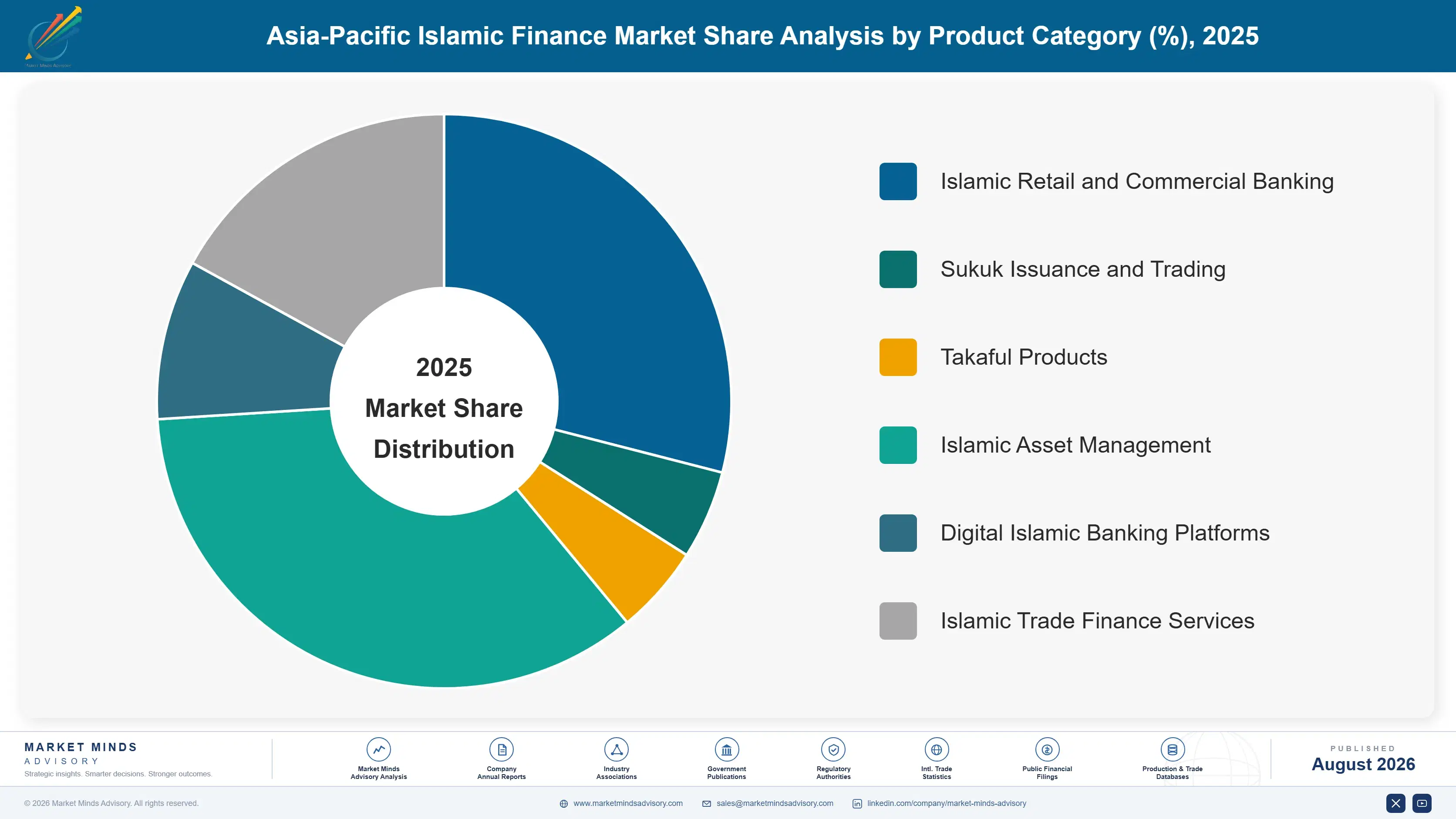
Asia-Pacific Islamic finance segments across six mutually exclusive product categories, ranging from traditional retail banking through fast-growing digital banking platforms and sukuk products that increasingly determine which institutions capture new customer revenue across the industry. These distinctions matter increasingly for institutions setting long-term technology and product development investment priorities across the region. nationwide. today.
asia-pacific-islamic-finance-market-market-share-analysis-1787938980768

Digital Islamic Banking Platforms

Digital Islamic banking platforms bundle mobile-first account opening, Shariah-compliant financing applications, and integrated investment products into a single application experience tailored specifically to tech-savvy Muslim-majority customer segments across the region. CIMB Islamic and Bank Islam Malaysia have both scaled proprietary digital platforms covering an increasing share of new account openings nationwide. Growth here consistently outpaces every other segment because younger customers increasingly prefer app-based banking over traditional branch relationships, and digital onboarding costs continue falling as platform infrastructure matures across most participating institutions. Regulatory support for financial inclusion should further accelerate this trend over the coming several years across most participating markets. Adoption keeps accelerating steadily across every major market segment.
CAGR 16.2%

Sukuk Issuance and Trading

Sukuk issuance and trading bundles underwriting, distribution, and secondary market trading services into a single revenue category that has expanded well beyond its original sovereign issuance base into corporate and retail-accessible structures. Maybank Islamic and Al Rajhi Bank have both built proprietary sukuk platforms that process issuance and trading activity across institutional and increasingly retail investor segments. Demand is accelerating as governments and corporations increasingly view sukuk as a mainstream funding alternative rather than a niche Shariah-compliant instrument reserved for specialized investors. Issuance timelines in this segment run meaningfully faster than legacy underwriting processes, reflecting the scale of automation these platforms have built into their distribution infrastructure across every stage of the investor journey.
CAGR 12.4%
Full segment breakdown across 6 segments available in the complete report.

Regional Architecture and Country Demand Map

Asia-Pacific Islamic finance assets concentrate within South Asia and Pacific given the market's regional scope, while other regions expand from different bases across rising Shariah-compliant demand worldwide. Regulatory frameworks and Muslim population concentration both shape how quickly each region absorbs new Shariah-compliant financial product formats.

North America

United States and Canadian Islamic finance, while outside this report's Asia-Pacific focus, provides useful comparative context for niche Shariah-compliant product innovation given the region's smaller but growing Muslim population base. Guidance Residential and comparable American providers focus primarily on home financing products. Digital-first providers continue winning incremental share from traditional providers, a trend Asia-Pacific institutions are actively studying and adapting for their own markets. Sponsorship and referral models pioneered here are increasingly adapted by Asia-Pacific institutions seeking to diversify beyond retail banking alone. American Islamic finance providers have processed meaningfully more niche product volume over the past decade than any comparable Asia-Pacific entrant, offering a useful benchmark for product design and pricing calibration across the industry.
Share: 22% | CAGR: 7.8% (2026 to 2036)

Western Europe

The United Kingdom anchors this region's Islamic finance assets, with London's established position as a Western sukuk listing hub setting a template other European markets are now studying closely. Germany and France maintain comparably smaller Islamic finance markets shaped by smaller Muslim population bases relative to the United Kingdom. Regulatory frameworks for Islamic finance vary considerably by country, creating a fragmented but rapidly evolving regional product landscape. Cross-border sukuk listing partnerships remain more standardized here than in Asia-Pacific given decades of London's established Islamic capital market infrastructure. The Netherlands and Ireland show growing interest in sukuk-linked fund structures as institutional investors seek diversified Shariah-compliant portfolio exposure beyond traditional United Kingdom listings.
Share: 18% | CAGR: 7.0% (2026 to 2036)
Regional intelligence for 5 additional markets available in the complete report: East Asia, South Asia and Pacific, Latin America, Middle East and Africa, Eastern Europe. Contact sales@marketmindsadvisory.com.
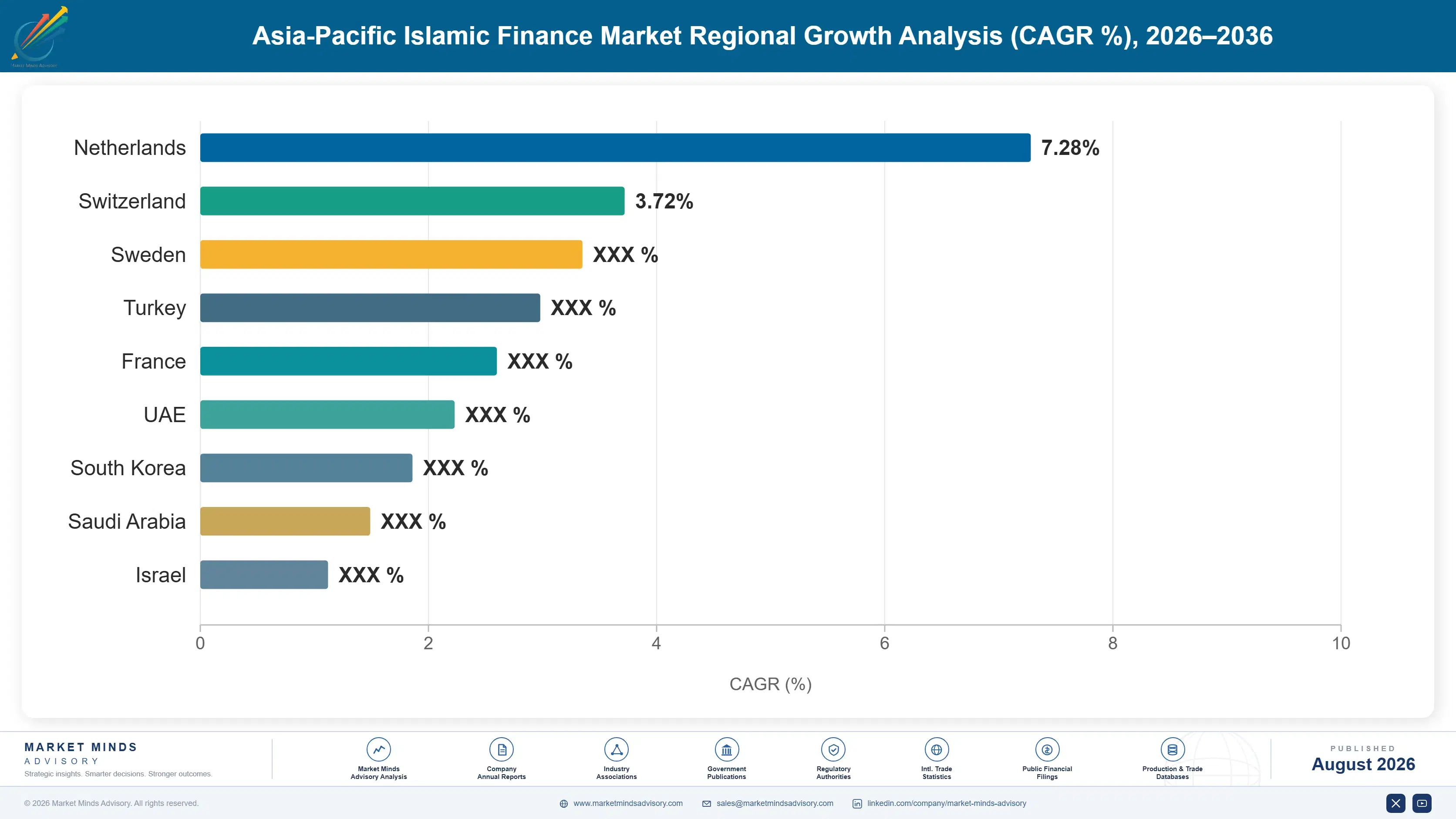
asia-pacific-islamic-finance-market-country-cagr-analysis-1787938981287

Where Institutions Can Capture Additional Margin

Beyond standard financing margins, Islamic finance institutions are building adjacent revenue streams that monetize digital distribution, sukuk underwriting scale, and takaful cross-selling without depending further on profit rate competition alone across the core banking business. a shift reshaping technology investment priorities across the industry as core financing margins face continued compression pressure. nationwide. today.

Expand Digital Sukuk Distribution to Retail Investors

Institutions offering fractional digital sukuk access can capture retail investors who would otherwise avoid the asset class entirely due to high traditional minimum investment thresholds, expanding the addressable investor base meaningfully across most Muslim-majority markets. Bank Syariah Indonesia and Maybank Islamic have both scaled digital distribution partnerships reaching retail investors previously excluded from institutional-only sukuk offerings. Early data shows this channel generating 22 to 30 percent higher lifetime revenue per relationship than standard deposit products alone. This gap is expected to widen further as digital distribution infrastructure costs continue falling across most major markets.
Market Impact: Adds 22 to 30% revenue per relationship annually

Build Cross-Border Islamic Wealth Management Services

Expanding cross-border wealth management services for affluent Shariah-compliant clients captures assets that would otherwise flow to conventional or international private banks, generating meaningfully higher fee revenue per relationship than standard retail banking. Maybank Islamic and CIMB Islamic have both expanded dedicated cross-border wealth desks tied directly to this affluent client segment over the past several years. Early data shows this channel generating fee revenue 3 to 4 times higher than standard retail banking relationships. These desks also improve client retention, since wealth management relationships create ongoing engagement beyond standard transactional banking.
Market Impact: Captures 3 to 4 times standard fee revenue

Monetize Shariah Compliance Infrastructure Through Licensing

Large institutions that built proprietary Shariah governance and compliance technology are increasingly licensing this infrastructure to smaller regional institutions lacking comparable compliance budgets, converting a cost center into a standalone revenue line. Bank Islam Malaysia has begun exploring platform licensing arrangements with several smaller institutional partners seeking faster compliance capability without full internal build costs. Early pilots suggest this channel could generate 5 to 8 percent incremental platform revenue within 3 years. This approach generates high-margin recurring software revenue that partially offsets rising compliance and technology investment elsewhere in the business.
Market Impact: Generates 5 to 8% incremental revenue by 2029

Cross-Sell Takaful Products Through Banking Relationships

Institutions increasingly bundle takaful protection products into the banking relationship, capturing commission revenue from an engaged customer at the exact moment they are making major financial decisions about savings and protection. Bank Syariah Indonesia and Bank Islam Malaysia have both expanded referral programs tied directly to banking relationships, generating meaningful incremental fee income per customer. Customers holding 2 or more bundled products show measurably stronger retention and lower attrition rates overall. This cross-selling motion also strengthens customer retention across the broader banking relationship over multiple years. Adoption keeps rising steadily.
Market Impact: Adds 9 to 13% fee revenue per customer

Who Controls the Margin Pool

Top 5 concentration sits at 41 percent of Asia-Pacific Islamic finance revenue, moderate given the market's fragmentation across Malaysian, Indonesian, and Gulf-linked institutions. Maybank Islamic and CIMB Islamic lead the pack, with a notable gap separating them from the third-ranked competitor across most revenue metrics. This gap reflects differences in regional scale that smaller institutions struggle to close quickly.
Current competitive activity centers on digital banking platform launches, sukuk distribution innovation, and cross-border wealth management expansion rather than aggressive rate-based price competition alone. Institutions are racing to expand digital access and shorten onboarding timelines, since these capabilities increasingly determine which institutions win customers who would otherwise choose conventional banking alternatives. Marketing spend has shifted toward digital convenience and Shariah transparency messaging over headline profit rate positioning in most recent campaigns.

Emerging pressure is coming from digital-first entrants and Gulf-linked institutions like Dubai Islamic Bank that target customers underserved by traditional regional players. Rankings could shift meaningfully if a mid-tier institution successfully combines digital distribution with existing branch network scale, a combination none of the current top five players has fully executed yet. Continued fintech funding activity suggests this competitive pressure will intensify rather than fade over the next several years.
asia-pacific-islamic-finance-market-company-positioning-matrix-1787938981856

Competitive Moat and Risk Dimensions

MAYBANK ISLAMIC

Moat: Regional Branch and Digital Scale

Maybank Islamic operates the largest combined branch and digital origination network across Malaysia and Southeast Asia, giving it acquisition cost advantages that smaller institutions cannot match without comparable infrastructure investment. This scale compounds because existing banking relationships create natural cross-sell opportunities into sukuk and takaful products, generating a steady revenue pipeline across most customer segments nationwide.
MAYBANK ISLAMIC

Risk: Legacy System Modernization Lag

Maybank Islamic's scale advantage is partially offset by legacy core banking infrastructure that slows digital platform rollout relative to nimbler fintech competitors building on modern technology stacks from inception. Continued investment is required to close this gap, and any visible delay risks ceding fast-growing digitally native customer segments to more agile competitors.
CIMB ISLAMIC

Moat: Multi-Country Distribution Network

CIMB Islamic's operations span multiple Southeast Asian markets simultaneously, giving it distribution breadth that single-country competitors cannot replicate without years of regulatory approval and infrastructure investment across each jurisdiction. This diversification reduces exposure to any single market's regulatory or economic shifts and lets CIMB Islamic maintain consistent revenue growth even when individual markets experience temporary softness.
CIMB ISLAMIC

Risk: Multi-Jurisdiction Compliance Complexity

Managing Shariah compliance and product structuring across multiple jurisdictions creates coordination complexity that single-market competitors avoid entirely, occasionally slowing product rollout timing relative to more focused competitors. This complexity could become a meaningful disadvantage as digital sukuk innovation accelerates across the industry. This exposure could meaningfully raise compliance cost as regulators across the region tighten Shariah governance oversight.

Players Tracked

Prominent Players

Maybank Islamic
CIMB Islamic
Bank Syariah Indonesia
Bank Islam Malaysia
Al Rajhi Bank

Other Key Players

RHB Islamic Bank
Bank Muamalat Indonesia
Dubai Islamic Bank
Kuwait Finance House
Standard Chartered Saadiq
HSBC Amanah
OCBC Al-Amin
Public Islamic Bank
Islami Bank Bangladesh
BIMB Holdings
Alliance Islamic Bank
Affin Islamic Bank
Bank Muamalat Malaysia
Bank Rakyat
Islamic Development Bank

Recent Developments

MARCH 2025

Bank Syariah Indonesia Launches Digital Sukuk Retail Platform

Bank Syariah Indonesia launched a digital platform enabling retail investors to purchase fractional sukuk holdings directly through its mobile banking application nationwide. The launch covers the majority of retail investors previously excluded from institutional-only sukuk offerings, reducing minimum investment thresholds meaningfully across most product categories.
Signal: Signals digital sukuk distribution becoming a core competitive battleground across the entire region well over time.
AUGUST 2025

CIMB Islamic Expands Cross-Border Wealth Management Desk

CIMB Islamic announced an expansion of its cross-border wealth management desk to serve affluent Shariah-compliant clients across Malaysia, Indonesia, and Singapore. The expansion follows growing demand for cross-border wealth services among affluent Shariah-compliant clients across most major regional markets. Early client interest has exceeded initial projections.
Signal: Signals cross-border wealth management becoming a key differentiator across most major regional markets broadly today too.

Shariah Compliance and Talent Cost Pressure

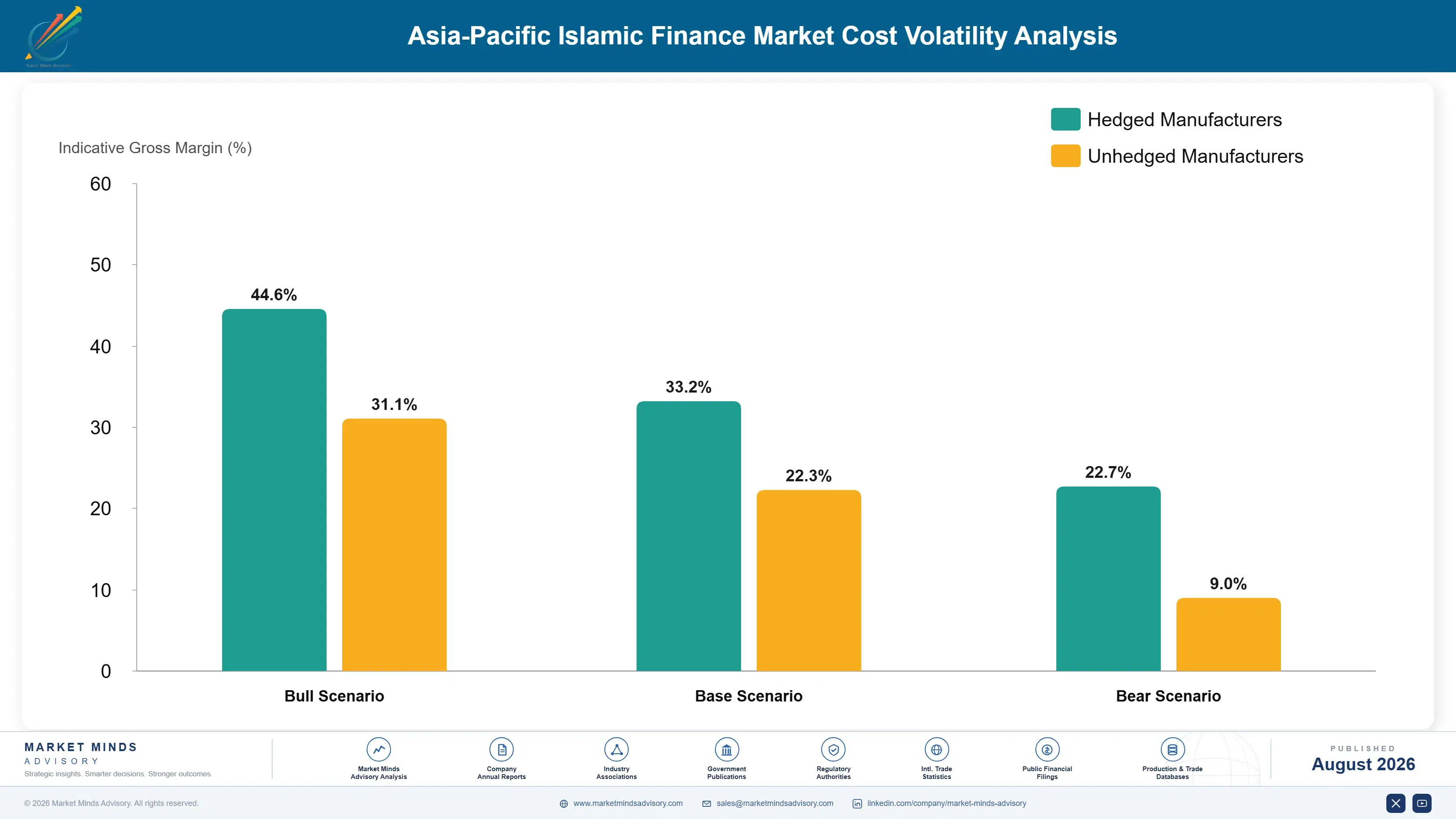
Deposit and profit-sharing distribution cost represents roughly 45 percent of total operating cost for Islamic finance institutions, with Shariah compliance and scholar advisory staffing accounting for a further 18 percent tied to multi-jurisdiction governance requirements. Technology infrastructure and digital platform investment make up most of the remainder, increasingly sourced through third-party licensing rather than internal builds.
The 2023 to 2024 regional interest rate benchmark divergence, documented in Islamic Financial Services Board industry reports, pushed profit rate competitiveness pressure on Islamic institutions relative to conventional bank deposit rates. Maybank Islamic's 2024 annual report noted elevated compliance staffing cost as a direct pressure on institutional profitability, a pressure that persisted well into the following fiscal year across most mid-sized institutions. Several smaller institutions faced disproportionately larger margin compression relative to asset size given fixed governance structures.

Smaller regional institutions face proportionally higher Shariah compliance cost than the largest five institutions, since they lack the scale needed to spread scholar advisory and governance infrastructure investment across a larger revenue base. This creates a durable cost disadvantage for sub-scale providers, pushing many toward partnership with larger institutions or exit from price-sensitive segments entirely as compliance cost keeps climbing faster than fee revenue growth.
asia-pacific-islamic-finance-market-cost-volatility-analysis-1787938982088

Shared Shariah Advisory Infrastructure

Smaller institutions increasingly pool Shariah scholar advisory and governance infrastructure investment through industry consortiums, spreading fixed cost across a larger participant base and narrowing the compliance cost gap against the largest five institutions. Several mid-sized institutions have also begun pooling scholar review processes to achieve faster product approval timelines than any single institution could negotiate independently.

Digital Platform Licensing for Compliance

Institutions increasingly license proprietary Shariah compliance and digital banking technology from larger platform providers rather than building systems internally, converting a large fixed technology investment into a variable operating cost. Early data suggests this model can cut technology cost meaningfully for smaller institutions unable to justify large internal engineering budgets independently. Adoption keeps growing.

Cross-Border Talent Pooling Arrangements

Institutions increasingly share Islamic finance specialist talent across multi-country operations through secondment and training partnerships, reducing the recruitment cost burden that talent scarcity otherwise imposes on individual institutions. Industry consortiums have begun standardizing shared training curricula, lowering onboarding cost for institutions entering new jurisdictions. These arrangements also improve talent retention meaningfully across participating institutions over multiple years.

Portfolio Architecture for Margin Defence

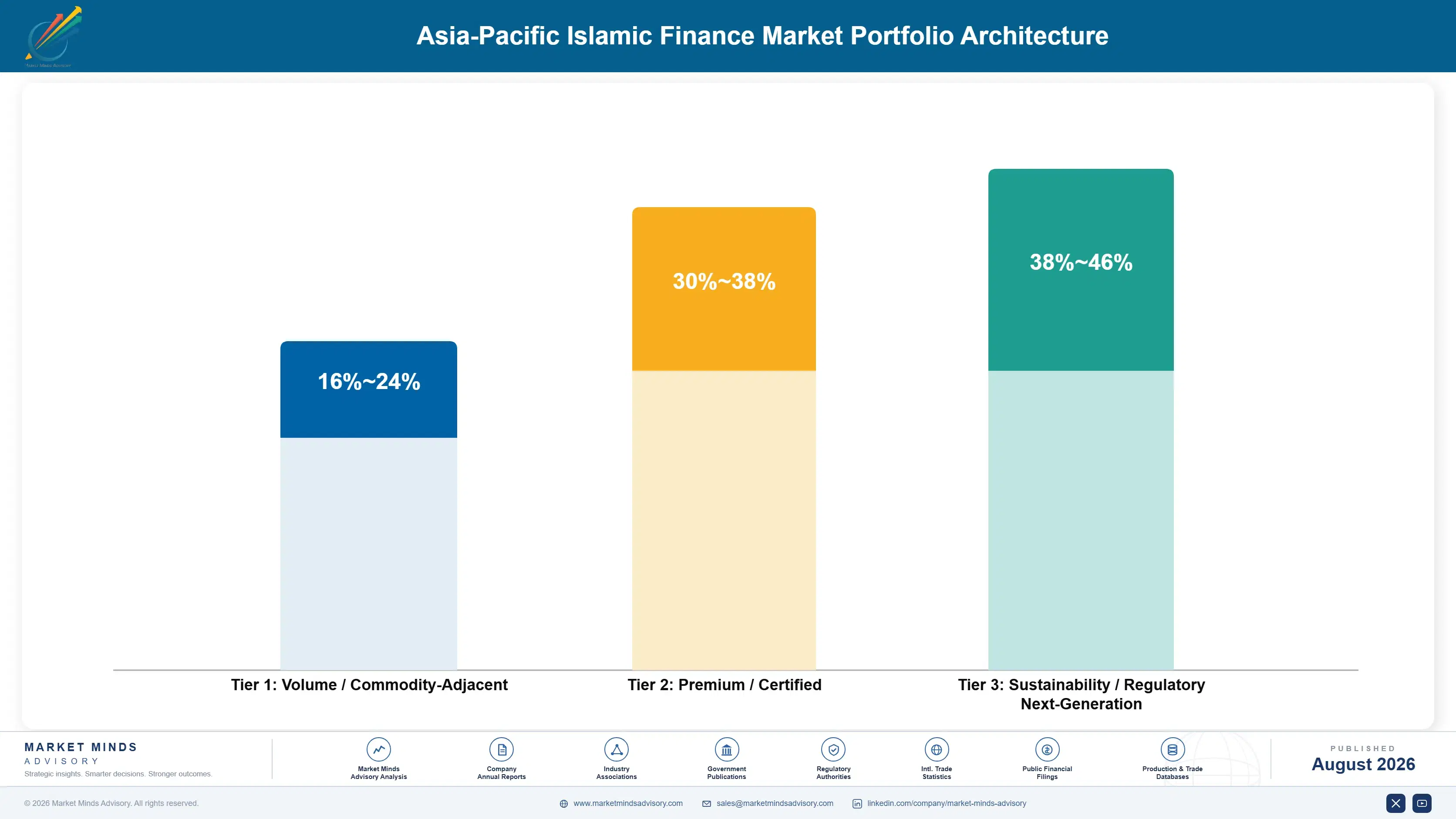
Asia-Pacific Islamic finance economics split across three tiers with meaningfully different margin profiles. Volume-oriented standard retail Islamic banking competes almost entirely on profit rate and branch convenience, generating thin net margins relative to more differentiated product structures across the industry. Only the largest five institutions sustain acceptable returns at this pricing level given fixed technology and compliance overhead spread across enormous customer volume nationwide.
Certified sukuk underwriting and wealth management products command premium pricing tied to service depth and cross-border distribution reach. Digital-first Islamic banking platforms carry the highest margins but remain a comparatively small share of total revenue today, reflecting their early stage of mainstream adoption across most institution segments nationwide. Early movers in this tier are capturing disproportionate share of affluent clients seeking cross-border Shariah-compliant investment access.

The volume versus premium tension defines competitive strategy across every major institution: large banking groups defend core retail margins through scale, while digital specialists concentrate on higher-value sukuk and wealth segments where differentiation still commands real pricing power. Smaller institutions without scaled digital infrastructure increasingly partner with technology providers rather than build comparable capability independently, a trend likely to continue through the forecast period.

Volume / Commodity-Adjacent

Standard retail Islamic banking products competing primarily on profit rate and branch access for broad, price-sensitive customer segments nationwide across most institutions. Margin here has compressed steadily over the past several years as digital comparison tools increase rate transparency for customers.
Gross Margin: 16-24%

Premium / Certified

Sukuk underwriting and cross-border wealth management bundling service depth and distribution reach for clients with specific investment and timeline requirements. Retention rates run notably higher among wealth management clients relative to standard retail banking accounts on comparable platforms.
Gross Margin: 30-38%

Sustainability / Regulatory / Next-Generation

Digital-first Islamic banking platforms serving customers seeking mobile-first Shariah-compliant access without traditional branch visits or paperwork requirements. Adoption remains concentrated among the largest and most sophisticated fintech entrants currently building out this capability.
Gross Margin: 38-46%
asia-pacific-islamic-finance-market-portfolio-architecture-1787938982623

High-value Sub-segments and Strategic Watch-out

Digital Islamic Banking Platforms

Mobile-first structures bringing Shariah-compliant access to younger customers represent the fastest-growing, highest-margin opportunity in Islamic finance today, with adoption accelerating steadily. Early movers are capturing disproportionate share of new customer relationships across every major Muslim-majority market. Provider selection increasingly shapes customer decisions across the market.
Gross Margin: 38-46%

Cross-Border Wealth Management Services

Affluent client wealth services command premium fees and strong client retention, though growth trails the fastest digital banking segment as adoption remains concentrated among larger institutions currently. Providers investing early in wealth infrastructure are seeing measurable revenue gains across their institutional portfolios. This trend should strengthen as infrastructure expands further.
Gross Margin: 30-38%

Standard Retail Islamic Banking

The volume backbone of the industry, generating predictable but thin origination margins across the vast majority of total Islamic banking assets nationwide under continuous rate pressure. Consolidation pressure continues building steadily among smaller sub-scale institutions lacking comparable technology infrastructure investment. Scale remains the primary driver of profitability here.
Gross Margin: 16-24%

Legacy Branch-Only Product Distribution

A shrinking segment as digital-first channels increasingly displace traditional branch-only distribution, pushing legacy providers to modernize or exit this category entirely over time. Decline timelines vary considerably depending on how quickly digital onboarding adoption spreads across remaining customer segments. Specialized providers focused on transition are watching closely.
Gross Margin: 12-18%

How Banking Relationships Compound Over Time

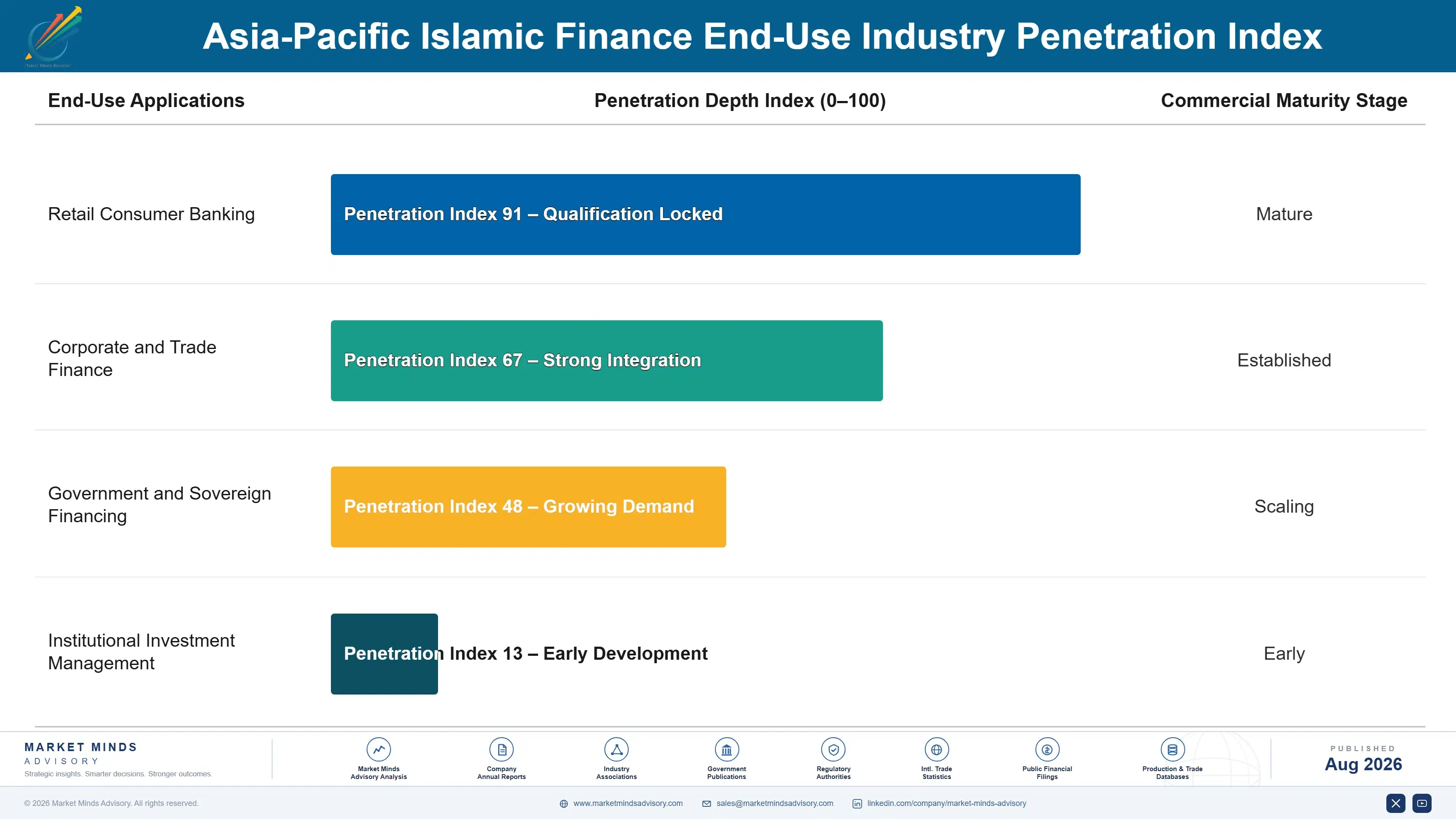
Islamic banking relationships behave like annuities once established. Customers rarely switch primary banking relationships once opened, and profit-sharing accounts generate recurring fee and margin revenue for the institution across multiple decades without requiring renewed sales effort in most cases. Attrition happens almost exclusively through customer relocation or a rare voluntary switching decision rather than active provider churn mid-relationship.
Adoption stickiness varies meaningfully by customer vertical. Affluent wealth management clients exhibit the deepest stickiness, often maintaining the same institutional relationship across multiple generations, while younger digital-first customers show comparatively higher churn as neobank entrants undercut legacy institutions on convenience and speed. Financial services and technology-sector customers, quicker to adopt digital-first banking platforms, show the shallowest stickiness of any major customer vertical measured.

Buyer profiles are shifting generationally as younger customers, more comfortable evaluating digital-first Islamic banking platforms, replace older customers who historically favored the familiarity of a physical branch relationship with their primary bank. This generational transition is gradually eroding the switching-cost advantage that incumbent institutions relied on for decades. Institutions slow to modernize their digital onboarding capability risk losing renewal conversations to challengers even after years of otherwise uninterrupted service.
asia-pacific-islamic-finance-market-end-use-penetration-index-1787938983125

MMA Analyst Assessment and Recommendations

These are among the four positions where our research anticipates prominent divergence between winners and laggards over the coming forecast period. Each is grounded in the demand model, the regulatory perimeter, and the announced capacity pipeline.
01 / PRODUCT INNOVATION STRATEGY

Build digital sukuk capability before competitors dominate the segment

Digital sukuk distribution remains a meaningfully underdeveloped capability outside a small handful of specialized institutions, and early movers are already capturing disproportionate share of retail investor demand across most major markets. Institutions that wait risk ceding a fast-growing, high-margin segment to Bank Syariah Indonesia and Maybank Islamic permanently. The window for establishing real distribution scale here is closing steadily, and every additional quarter of delay makes catching up meaningfully harder for institutions entering this fast-moving distribution category, compounding risk exposure across the sukuk portfolio rather than just newly launched offerings.
02 / DISTRIBUTION AND PARTNERSHIPS

Expand cross-border wealth management for affluent clients

Cross-border wealth management revenue is growing faster than standard retail banking, and the institutions capturing this growth are the ones investing early in affluent client infrastructure that captures assets before they flow to conventional private banks. Providers still dependent primarily on standard retail products are ceding this segment to more wealth-focused competitors. This is not a marginal opportunity, it is one of the largest sources of net-new fee revenue available over the next several years, and institutions treating it as secondary will regret that choice.
03 / TALENT AND COMPLIANCE STRATEGY

Build shared Shariah advisory infrastructure before scarcity worsens

Islamic finance talent scarcity shows no sign of easing, and institutions that build shared advisory infrastructure now will absorb future compliance demands more efficiently than competitors scrambling to recruit specialists later under deadline pressure. Treating talent investment purely as overhead misses its defensive value against future scaling constraints. Institutions that get this positioning wrong risk losing product development speed to better-prepared competitors entirely, a cost that compounds meaningfully with every additional quarter of unaddressed talent scarcity across the broader industry landscape.
04 / REGULATORY ADVOCACY STRATEGY

Advocate for Shariah governance harmonization across jurisdictions

Fragmented Shariah governance standards show no sign of consolidating naturally, and institutions that actively advocate for cross-border harmonization now will benefit disproportionately when standards eventually converge across the region. Waiting passively for harmonization to happen organically leaves little influence over which standards ultimately prevail. Institutions treating this advocacy as optional rather than strategic risk losing influence over standards that will define competitive positioning for decades, a risk that compounds steadily with every additional quarter of passivity across the region nationwide.

Engagement Snapshot From the Field

A live engagement with an industry participant carrying material or product regulatory and market exposure ahead of a defining policy shift, showing how our research translates into a defensible multi-year portfolio strategy.
MARKET MINDS ADVISORY · CLIENT ENGAGEMENT SUMMARY
Asia-Pacific Islamic Finance Producer Strategic Portfolio Review and Transition Roadmap 2026·Investment Scenario on Asia-Pacific Islamic Finance Exposure Evaluation 2025-26
CLIENT PROFILE
The client, a mid-sized Islamic bank operating primarily across Malaysia and Brunei, held roughly USD 3.5 billion in Shariah-compliant assets under management distributed through a traditional branch network. Leadership sought to evaluate whether launching a digital sukuk retail platform would meaningfully expand their addressable investor base. The client operated primarily through in-person branch relationships rather than digital-first distribution channels historically.
STRATEGIC CHALLENGE
The client lacked internal data on digital sukuk distribution economics and was uncertain whether existing branch relationships could effectively transition customers toward a fundamentally different digital investment channel. Leadership also worried that launching a new digital product too early could dilute focus during a period of already elevated regulatory compliance demands.
MMA APPROACH
MMA conducted a structured market sizing exercise for digital sukuk demand within the client's existing customer footprint, benchmarking competitor platform economics and minimum investment thresholds against the client's current product suite. The engagement included structured interviews with the client's relationship managers to gauge realistic near-term customer transition capacity. Findings were benchmarked against comparable regional banks already operating digital sukuk platforms successfully.
KEY FINDINGS
  1. Relationship manager interviews revealed strong latent demand among younger customers who had previously been unable to access sukuk investment due to high traditional minimum thresholds.
  2. Competitor digital sukuk platforms carried meaningfully wider margins than the client's existing branch-based investment book, even after accounting for platform development cost.
  3. Customer education requirements were more substantial than leadership initially assumed, requiring a dedicated digital literacy program before meaningful volume could be expected.
  4. Regulatory treatment of fractional sukuk ownership remained genuinely unsettled in one jurisdiction, creating near-term launch timing risk worth monitoring closely. MMA recommended a structured evaluation process before finalizing the launch timeline.
CLIENT PROFILE
The client, a mid-sized Islamic bank operating primarily across Malaysia and Brunei, held roughly USD 3.5 billion in Shariah-compliant assets under management distributed through a traditional branch network. Leadership sought to evaluate whether launching a digital sukuk retail platform would meaningfully expand their addressable investor base. The client operated primarily through in-person branch relationships rather than digital-first distribution channels historically.
STRATEGIC CHALLENGE
The client lacked internal data on digital sukuk distribution economics and was uncertain whether existing branch relationships could effectively transition customers toward a fundamentally different digital investment channel. Leadership also worried that launching a new digital product too early could dilute focus during a period of already elevated regulatory compliance demands.
MMA APPROACH
MMA conducted a structured market sizing exercise for digital sukuk demand within the client's existing customer footprint, benchmarking competitor platform economics and minimum investment thresholds against the client's current product suite. The engagement included structured interviews with the client's relationship managers to gauge realistic near-term customer transition capacity. Findings were benchmarked against comparable regional banks already operating digital sukuk platforms successfully.
KEY FINDINGS
  1. Relationship manager interviews revealed strong latent demand among younger customers who had previously been unable to access sukuk investment due to high traditional minimum thresholds.
  2. Competitor digital sukuk platforms carried meaningfully wider margins than the client's existing branch-based investment book, even after accounting for platform development cost.
  3. Customer education requirements were more substantial than leadership initially assumed, requiring a dedicated digital literacy program before meaningful volume could be expected.
  4. Regulatory treatment of fractional sukuk ownership remained genuinely unsettled in one jurisdiction, creating near-term launch timing risk worth monitoring closely. MMA recommended a structured evaluation process before finalizing the launch timeline.
RECOMMENDED STRATEGY
Phase 1: Phase 1 (Pilot): Launch a limited digital sukuk platform in Malaysia only, restricted to a small group of trained relationship managers. Phase 2: Phase 2 (Scale): Expand platform capability and relationship manager training based on pilot performance data, extending into Brunei gradually. during this second phase. Phase 3: Phase 3 (Optimize): Refine pricing and eligibility criteria using accumulated performance data, then evaluate expansion into additional markets. where regulatory clarity supports it.
OUTCOME
The client launched its digital sukuk pilot within Malaysia, generating meaningful new investment volume from customers who would not have previously qualified for traditional sukuk products (client-reported, unverified by MMA). Customer adoption exceeded initial expectations, and the client began planning regional expansion within the first year.

Frequently Asked Questions

Foundational context covering the market sizes, CAGR, scope, country, region and competition that inform every finding below. This section is provided to cover basics and most often pre-purchase conversations, answered from the MMA Primary Research Dataset.

What is the current size of the Asia-Pacific Islamic Finance Market?

The Asia-Pacific Islamic Finance Market reached $42.0 billion in revenue in 2025. This figure reflects Islamic banking, sukuk, takaful, and Islamic asset management revenue generated across the region.

How large will the Asia-Pacific Islamic Finance Market be by 2036?

MMA projects the market will reach $104.08 billion by 2036, roughly 2.28 times its 2026 value. Growth is driven primarily by digital banking adoption and expanding sukuk issuance volume.

What is the CAGR for the Asia-Pacific Islamic Finance Market 2026 to 2036?

The market is projected to grow at an 8.6 percent compound annual growth rate between 2026 and 2036. This compares to a historical CAGR of roughly 7.4 percent recorded across the preceding 2020 to 2025 period.

Which segment is growing fastest?

Digital Islamic banking platforms are growing fastest at a 16.2 percent CAGR, nearly double the overall market rate. This reflects rapid adoption of mobile-first Shariah-compliant banking among younger customer segments.

Who are the major companies in the Asia-Pacific Islamic Finance Market?

Maybank Islamic, CIMB Islamic, Bank Syariah Indonesia, Bank Islam Malaysia, and Al Rajhi Bank lead the market by revenue. Together these five institutions hold roughly 41 percent combined concentration.

Which country is growing fastest?

Bangladesh is the fastest-growing Islamic finance market at a 14.8 percent CAGR, driven by expanding formal Shariah-compliant banking adoption. Its large Muslim population continues shifting toward regulated financial products.

Report Segmentation Architecture

The full report scope spans multiple orthogonal segmentation dimensions, with cross-tabulated demand data provided for each dimension pair. Coverage extends further to regional breakdowns, trend trajectories, and the competitive detail needed to support segment-level decision-making.

By Product Category

  • Islamic Retail and Commercial Banking
  • Sukuk Issuance and Trading
  • Takaful Products
  • Islamic Asset Management
  • Digital Islamic Banking Platforms
  • Islamic Trade Finance Services

By End-Use Industry

  • Retail Consumer Banking
  • Corporate and Trade Finance
  • Government and Sovereign Financing
  • Institutional Investment Management

By Commercial Dimension

  • Direct Branch Distribution
  • Digital Direct-to-Consumer Platform
  • Institutional Wealth Advisory Channel
  • Cross-Border Correspondent Banking

By Region

  • North America
  • Western Europe
  • East Asia
  • South Asia and Pacific
  • Latin America
  • Middle East and Africa
  • Eastern Europe

Scope, Methodology, and Coverage

Every figure in this report is reproducible from documented input assumptions. The scope below maps the historical period, the forecast horizon, the segmentation dimensions, and the countries covered, alongside the underlying primary and qualitative methodology.
Historical Period
2020 to 2025
Forecast Period
2026 to 2036
Base Year
2025 (USD billions; MMA Primary Research Dataset, August 2026)
Market Definition
This report covers revenue generated by banks, takaful providers, asset managers, and digital platforms offering Shariah-compliant financial products across Asia-Pacific, including Islamic banking, sukuk, takaful, and Islamic asset management. It excludes conventional banking revenue earned by the same institutions and non-financial halal industry sectors.
Quantitative Units
USD billions (current prices); local currency equivalents where noted
Segmentation Dimensions
By Product Category; By End-Use Industry; By Commercial Dimension; By Region
Regions Covered
North America, Western Europe, East Asia, South Asia and Pacific, Latin America, Middle East and Africa, Eastern Europe
Countries Covered
USA, China, Germany, France, UK, Japan, South Korea, India, Australia, Canada, Brazil, Mexico, Indonesia, Vietnam, Thailand, Malaysia, UAE, Saudi Arabia, South Africa, Nigeria, Turkey, Poland, Netherlands, Italy, Spain, Sweden, Switzerland, Argentina, Colombia, Singapore, and additional markets relevant to this sector
Key Companies Profiled
Maybank Islamic, CIMB Islamic, Bank Syariah Indonesia, Bank Islam Malaysia, Al Rajhi Bank, RHB Islamic Bank, Bank Muamalat Indonesia, Dubai Islamic Bank, Kuwait Finance House, Standard Chartered Saadiq, HSBC Amanah, OCBC Al-Amin, Public Islamic Bank, Islami Bank Bangladesh, BIMB Holdings, Alliance Islamic Bank, Affin Islamic Bank, Bank Muamalat Malaysia, Bank Rakyat, Islamic Development Bank
Quantitative Methodology
Primary survey, n=3,800 respondents, Q4 2025, six countries; demand-side model with trade association cross-validation
Qualitative Methodology
47 expert interviews, Q4 2025; applied to validate demand model assumptions, identify emerging dynamics, and assess competitive positioning
Report Format
PDF and XLSX data workbook (Word format preview document)
Publisher
Market Minds Advisory
Report Code
MMA-2026-TEC-291
Published
August 2026
Contact
sales@marketmindsadvisory.com | www.marketmindsadvisory.com

Purchase the full Asia-Pacific Islamic Finance Market Report (2026 to 2036).

This report provides comprehensive coverage of the Asia-Pacific Islamic Finance Market, including detailed sizing, segmentation, and regional analysis through 2036. It examines competitive dynamics among the leading banking groups and digital entrants, covering their strategic positioning, moats, and vulnerabilities. The analysis also addresses Shariah governance drivers, talent cost pressure, and emerging digital sukuk trends reshaping institutional economics. Readers gain access to primary survey data, expert interview insights, and MMA's proprietary forecasting methodology. The report is designed for Islamic banking strategy executives, fintech product teams, and institutional sukuk investors evaluating positioning decisions, product launch priorities, or capital allocation across the Islamic finance value chain.
Ten-year market sizing and forecast model
Six-segment MECE product category segmentation model
Seven-region demand, share, and growth analysis
Competitive landscape with moat and risk profiles
Primary survey data from 3,800 respondents
Forty-seven expert interviews across institution types

Built For The People Who Decide

From boardroom strategy to bench-side execution, this report is read cover-to-cover by leaders shaping the next decade of their industry, turning demand scenarios, market dynamics and valuation benchmarks into decisions.
CXOs/ Presidents/ VPs/ Managers
M&A and Corporate Development
Strategy Teams and R&D Heads
Procurement and Product Directors
Regulatory and Compliance Leaders
Investor Relations and Equity Analysts