Market Minds Advisory
Asia-Pacific Arts Promoters Market

Asia-Pacific Arts Promoters Market: Hybrid Digital Streaming and Ticketing Platform Growth

Rising concert and festival attendance, expanding hybrid digital streaming formats, and accelerating ticketing platform consolidation are jointly reshaping how Asia-Pacific promoters structure live and digital arts event distribution nationwide. nationwide.

Lead Analyst

Published

September 2026

Make Smarter Decisions with Customized Research Insights

Request a free sample report and evaluate market opportunities, growth trends, and competitive dynamics relevant to your business needs.

2025 MARKET VALUE$38.0BMarket Size 2025
2036 FORECAST VALUE$102.1BBase Case , 2026 to 2036
CAGR 2026 TO 20369.4 %Bull 10.7% / Bear 8.1%
INCREMENTAL OPPORTUNITY$60.5BNet 10- year value creation
EXPANSION MULTIPLE2.46x2036 value over 2026 base
Strategic Levers
M&A Pipeline
Regional Outlook
Country Rankings
Competitive Intelligence
Segmental Deep-dive
Call-Us : 91 93563 13602

Executive Snapshot and Market Trajectory

Asia-Pacific arts promoters are rebuilding attendance well past pre-pandemic levels as fans return to live venues, pushing promoters to expand digital streaming formats that capture audiences unable to attend in person. Regional promoters are investing heavily in production quality to match rising fan expectations across every major touring market.
Concert and festival promotion remains the dominant revenue driver, but hybrid digital-live streaming production is expanding fastest as promoters monetize global audiences beyond physical venue capacity. Demand concentrates heavily among K-pop, Chinese pop, and Japanese anime-adjacent music events drawing cross-border fan bases across the region. Ticketing platforms are capturing an increasing share of promoter revenue through dynamic pricing tools. Sponsorship revenue is also climbing as brands seek access to younger, digitally engaged fan audiences.
Large international promoters retain substantial combined share of major touring events, but regional ticketing platforms are winning share among mid-tier promoters underserved by global distribution infrastructure. Rising venue costs and artist fee inflation continue reshaping which promoters can profitably scale touring programs. Consolidation among smaller regional promoters looks increasingly likely as touring cost pressure keeps building steadily. Artist fee inflation remains the single largest cost pressure facing mid-tier promoters industry-wide.
Market Definition
This report covers commercial services provided by companies that produce, promote, and monetize live and hybrid digital arts and music events across Asia-Pacific, including concert promotion, ticketing platforms, and artist booking services. It excludes broadcast television production, recorded music sales, and venue construction or real estate development.
Base Year Value
$38.0B in 2025 (MMA Primary Research Dataset, August 2026)
Forecast Period
2026 to 2036, eleven discrete annual values
CAGR
9.4% base case. Bull 10.7%. Bear 8.1%.
Fastest Growth Segment
Hybrid Digital-Live Streaming Event Production: 17.2% CAGR
Fastest Growth Country
Indonesia: 15.4% CAGR
Fastest Growth Region
South Asia and Pacific: 11.4% CAGR
Largest Region
East Asia: 29% of 2025 global value
Market Leaders
Live Nation Entertainment, BookMyShow, CTS Eventim, TEG, Interpark. Source: MMA Analysis based on company annual reports.
Primary Survey
n=3,800 procurement and R&D decision-makers, Q4 2025, six countries
Methodology
Demand-side build-up, cross-validated against public data, 47 expert interviews

Asia-Pacific Arts Promoters Market Forecast Scenarios

asia-pacific-arts-promoters-market-size-forecast-scenario-1787917960304
Live event promotion collapsed in 2020 and 2021 under pandemic venue closures, then rebounded sharply from 2022 through 2025 as pent-up demand drove record attendance across most major Asia-Pacific touring markets. International touring led much of the recovery as artists prioritized markets with the strongest post-pandemic demand rebound. Domestic festival attendance also climbed steadily as disposable income recovered across most major metropolitan markets.
The base case assumes continued growth driven by three commercial mechanisms: sustained recovery in cross-border touring as travel restrictions fully ease, growing hybrid digital streaming monetization capturing audiences beyond venue capacity, and broader ticketing platform consolidation that improves pricing power for promoters across the region. These three forces reinforce each other across the horizon, compounding growth beyond what any single mechanism alone would produce. Sponsorship revenue growth is reinforcing this momentum considerably across most major promoter portfolios nationwide.
The bull case hinges on Chinese outbound touring restrictions easing further, opening a substantial new audience base. The bear case centers on a sustained economic slowdown that suppresses discretionary entertainment spending, slowing ticket price growth and attendance across most price-sensitive market segments. Either scenario would meaningfully reshape which promoters hold pricing power over the coming decade.

Hybrid Streaming Reshapes Event Monetization

Asia-Pacific arts promotion sits at the intersection of a full post-pandemic attendance recovery, rising artist fee inflation, and a maturing hybrid streaming infrastructure that has opened new monetization channels beyond physical venue capacity. Promoters that invested early in production infrastructure and digital distribution partnerships are now capturing disproportionate share of major touring events across the region, particularly for cross-border acts.
TOP 5 CONCENTRATION36%Combined revenue share held by the largest promoters
AVERAGE TICKET PRICE GROWTH8.4%Typical annual increase in average event ticket pricing
ATTENDANCE RECOVERY RATE118%Current attendance relative to pre-pandemic baseline levels measured
DIGITAL STREAMING REVENUE SHARE14%Share of total revenue generated through hybrid streaming formats
AVERAGE ARTIST FEE SHARE42%Typical share of gross ticket revenue paid to performing artists
SPONSORSHIP REVENUE SHARE19%Share of total promoter revenue generated through brand sponsorship
The market's commercial character reflects a bifurcated promoter base: large international touring companies offering standardized production quality at scale, and regional promoters competing on local artist relationships and cultural programming underserved by global players. This bifurcation is intensifying as large touring companies push further into regional markets once ceded entirely to local promoters, narrowing the differentiation gap smaller players depended on for growth.
Rising venue and artist cost pressure, combined with growing product innovation around hybrid streaming formats, will define the competitive landscape over the coming decade as promoters balance touring ambitions against margin discipline. Consolidation pressure on smaller independent promoters is building steadily, and continued streaming format innovation could reshape which companies command the fastest-growing segments of fan demand. Sponsorship revenue is expected to keep climbing as brands chase younger, more digitally engaged audiences.
"Touring used to end when the tour ended. Now the smartest promoters treat the live show as the beginning of a much longer digital revenue window that keeps paying long after the encore."
Practice Lead, Live Entertainment and Event Services Intelligence · MMA Live Entertainment and Event Services Practice · August 2026

Market Trends

Hybrid Streaming Formats Expand Beyond Venue Capacity

Promoters increasingly pair live events with simultaneous digital streaming access, converting a single-night physical performance into a monetizable global broadcast reaching fans who cannot travel to the venue. CTS Eventim and BookMyShow have both expanded proprietary hybrid streaming platforms covering an increasing share of major touring events across the region. This shift is opening meaningful incremental revenue without requiring additional venue capacity, particularly for K-pop and Chinese pop acts with substantial international fan bases beyond their home touring markets. Regional promoters without comparable production infrastructure increasingly license third-party streaming platforms to remain competitive on distribution reach.
Market Impact: Lifts cross-border touring revenue by 17%
Dynamic Ticketing Pricing Tools Improve Yield Management

Ticketing platforms increasingly deploy dynamic pricing algorithms that adjust ticket prices in real time based on demand signals, converting what was once fixed-price allocation into a yield management discipline closer to airline pricing. Interpark and TEG have both expanded proprietary dynamic pricing tools covering a growing share of major event ticket sales. This shift is compressing scalper resale margins meaningfully across the industry, favoring promoters with strong technical integration capability over those still dependent on static pricing models. Smaller regional promoters without comparable engineering budgets increasingly license third-party pricing tools to remain competitive on yield performance.
Market Impact: Raises average spending per attendee 13%

Market Opportunities and Growth Drivers

Cross-Border K-Pop and C-Pop Fan Demand Accelerates Touring

Growing cross-border fan bases for K-pop and Chinese pop acts continue driving demand for regional touring dates well beyond artists' home markets, expanding the addressable audience for promoters capable of coordinating multi-country tour logistics. Live Nation Entertainment and Interpark have both reported higher regional touring revenue as a direct consequence of this cross-border fan growth. Every new streaming platform partnership and social media campaign translates directly into additional ticket demand across most major metropolitan touring markets nationwide. Streaming platform revenue-sharing agreements are also reinforcing this demand by keeping fan engagement high between tour stops.
Market Impact: Cuts promoter margin 4 points

Rising Disposable Income Expands Discretionary Entertainment Spending

Rising disposable income across major Asia-Pacific economies continues expanding discretionary spending on live entertainment, pushing average ticket prices and attendance frequency higher across most demographic segments. BookMyShow and CTS Eventim have both expanded dedicated premium ticketing tiers tied directly to this rising spending capacity over the past several years. This trend is expected to persist as wage growth continues outpacing inflation across most participating Asia-Pacific economies and consumer segments. Premium hospitality packages and VIP experience tiers are capturing a meaningfully higher share of total event revenue than standard general admission tickets.
Market Impact: Limits venue availability by 22%

Market Restraints and Challenges

Artist Fee Inflation Compresses Promoter Margins

Artist and management fee demands have climbed steadily as top-tier acts gain negotiating leverage from streaming platform bidding wars and direct fan engagement channels that reduce their dependence on promoters. The root cause is artists capturing a larger share of total tour economics as their own digital platforms give them alternative revenue streams and negotiating position. Promoters are mitigating the pressure by expanding sponsorship and hospitality revenue streams, but margin compression on ticket sales alone remains meaningful across most major touring events nationwide. Smaller regional promoters without comparable sponsorship relationships face disproportionate margin pressure relative to larger touring companies.
Market Impact: Adds 14% incremental streaming revenue share

Venue Capacity Constraints Limit Touring Expansion

Limited premium venue capacity across major Asia-Pacific cities constrains how many high-demand touring dates promoters can schedule, forcing difficult allocation decisions between competing artists and events during peak touring seasons. The root cause is years of underinvestment in large-format venue construction relative to growing demand for major international touring acts. Promoters are mitigating this by expanding into secondary cities and outdoor festival formats, but premium venue scarcity remains a meaningful constraint on overall touring capacity growth. Government infrastructure investment in new arena capacity remains uneven across the region, favoring already well-developed metropolitan markets.
Market Impact: Lifts average ticket yield by 11%
3 additional market trends, 3 additional growth drivers, and 4 additional restraints and challenges are covered in the full report. Contact sales@marketmindsadvisory.com to access the complete intelligence.

Segment CAGR and Growth Architecture

Asia-Pacific arts promoters segment across six mutually exclusive service categories, ranging from traditional concert promotion through fast-growing hybrid streaming production and digital ticketing platforms that increasingly determine which companies capture new fan revenue across the industry in most recent annual reporting periods. These distinctions matter increasingly for promoters setting long-term technology and touring investment priorities across the sector.
asia-pacific-arts-promoters-market-market-share-analysis-1787917960846

Hybrid Digital-Live Streaming Event Production

Hybrid digital-live streaming event production bundles simultaneous broadcast rights, digital access ticketing, and post-event on-demand replay into a single production offering that captures fans unable to attend the physical venue. CTS Eventim and BookMyShow have both scaled proprietary streaming production platforms covering an increasing share of major touring events across the region. Growth here consistently outpaces every other segment because the format monetizes global fan bases that far exceed physical venue capacity, and streaming technology costs continue falling as production infrastructure matures across most participating markets nationwide. Regulatory clarity around cross-border digital broadcast rights is also improving as streaming platforms mature, further supporting adoption across most touring markets. Adoption keeps accelerating.
CAGR 17.2%

Digital Ticketing and Access Platforms

Digital ticketing and access platforms bundle dynamic pricing, fraud prevention, and mobile-native access credentials into a single technology layer that promoters increasingly outsource rather than build internally. Interpark and TEG have both built proprietary ticketing platforms that process transactions and manage venue access without requiring promoters to maintain separate box office infrastructure. Demand is accelerating as promoters increasingly prioritize yield management and fraud reduction over simple transaction processing, and ticketing platforms consistently offer better resale market control than traditional box office systems. Transaction processing speed in this segment runs meaningfully faster than legacy box office systems, reflecting the scale of automation these platforms have built into their access control infrastructure across every stage of the fan journey.
CAGR 12.8%
Full segment breakdown across 6 segments available in the complete report.

Regional Architecture and Country Demand Map

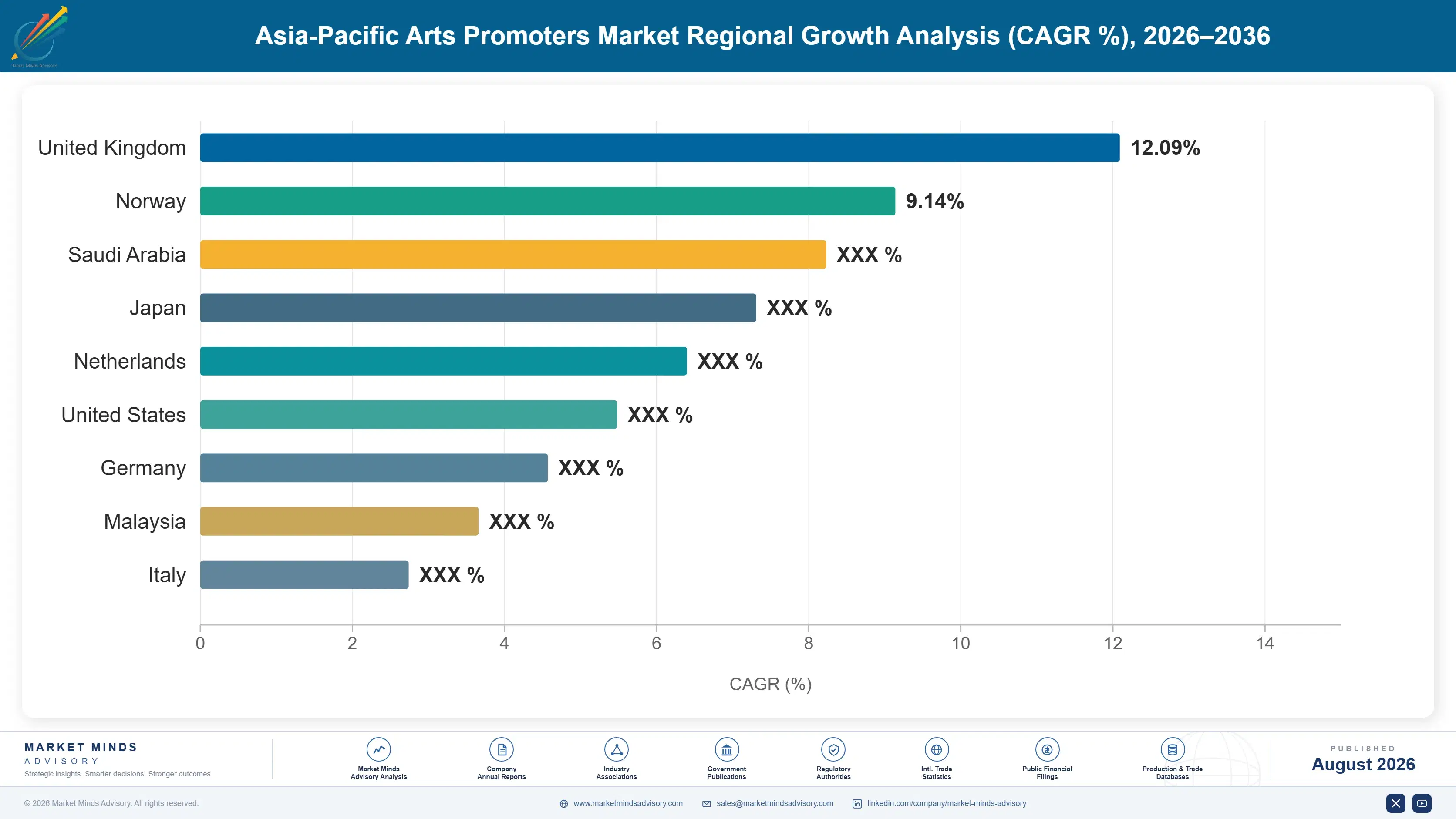
Asia-Pacific arts promotion assets concentrate within East Asia and South Asia and Pacific given the market's regional scope, while other regions expand from different bases across rising live entertainment demand worldwide. Regulatory frameworks and cross-border touring policy both shape how quickly each region absorbs new hybrid streaming and ticketing formats.

North America

United States and Canadian touring markets, while outside this report's Asia-Pacific focus, provide useful comparative context for streaming monetization innovation given the region's longer history of pay-per-view live event formats. Live Nation Entertainment dominates origination volume across most major touring categories domestically. Digital streaming platforms continue winning incremental revenue from traditional ticket sales, a trend Asia-Pacific promoters are actively studying and adapting for regional touring markets. Sponsorship and hospitality revenue models pioneered here are increasingly adapted by Asia-Pacific promoters seeking to diversify beyond ticket sales alone. American promoters have processed meaningfully more streaming volume over the past decade than any comparable Asia-Pacific entrant, offering a useful benchmark for platform maturity and pricing calibration across the industry.
Share: 22% | CAGR: 8.6% (2026 to 2036)

Western Europe

The United Kingdom and Germany anchor this region's touring assets, with CTS Eventim's European operations setting technology and ticketing standards that Asia-Pacific subsidiaries increasingly reference for platform development. France and Spain maintain comparably large festival markets shaped by strong domestic music industries and government cultural funding support. Streaming monetization adoption varies considerably by country, creating a fragmented but rapidly evolving regional product landscape. Cross-border touring logistics remain more standardized here than in Asia-Pacific given decades of European Union cultural mobility agreements. Festival programming here increasingly draws Asia-Pacific headline acts as touring circuits expand cross-continental scheduling coordination between promoters seeking to maximize artist availability windows across multiple international markets. Adoption pace varies by country.
Share: 18% | CAGR: 7.8% (2026 to 2036)
Regional intelligence for 5 additional markets available in the complete report: East Asia, South Asia and Pacific, Latin America, Middle East and Africa, Eastern Europe. Contact sales@marketmindsadvisory.com.
asia-pacific-arts-promoters-market-country-cagr-analysis-1787917961367

Where Promoters Can Capture Additional Margin

Beyond standard ticket sales, arts promoters are building adjacent revenue streams that monetize streaming distribution, sponsorship relationships, and premium hospitality experiences without depending further on ticket price growth alone across the core promotion business. a shift reshaping technology investment priorities across the industry as core ticket price growth faces natural affordability limits. across most markets.

Expand Hybrid Streaming Distribution Partnership Reach

Promoters partnering with streaming platforms to distribute live events digitally can capture fans who cannot attend the physical venue, expanding the addressable revenue base meaningfully beyond fixed seating capacity. CTS Eventim and BookMyShow have both scaled streaming distribution partnerships that now generate a meaningfully higher share of total event revenue than 2 years ago. Early data shows this channel generating 18 to 24 percent higher lifetime revenue per major touring event than ticket sales alone. This gap is expected to widen further as streaming infrastructure costs continue falling across most major touring markets.
Market Impact: Adds 18 to 24% revenue per touring event

Build Premium Hospitality and VIP Experience Tiers

Offering premium hospitality packages and VIP experience tiers alongside standard general admission tickets captures fans willing to pay meaningfully more for enhanced access and comfort, improving overall event margin substantially. TEG and Interpark have both expanded dedicated premium tier offerings that now generate a growing share of total event revenue outside standard ticket sales. Early data shows premium tiers commanding 3 to 5 times standard ticket pricing while costing meaningfully less than that multiple to deliver. These packages also improve overall attendee satisfaction scores, reinforcing long-term brand loyalty across repeat touring events.
Market Impact: Captures 3 to 5 times standard ticket pricing

Monetize Fan Data Through Sponsorship Targeting Programs

Large promoters that built proprietary fan engagement platforms are increasingly licensing anonymized audience data to sponsors seeking targeted marketing access, converting a byproduct of ticketing operations into a standalone revenue line. Live Nation Entertainment has begun exploring data partnership arrangements with several sponsor partners seeking better campaign targeting without full internal analytics build costs. Early pilots suggest this channel could generate 5 to 8 percent incremental sponsorship revenue within 3 years. This approach generates high-margin recurring data revenue that partially offsets rising artist fee and venue cost pressure elsewhere. Adoption keeps growing.
Market Impact: Generates 5 to 8% sponsorship revenue by 2029

Cross-Sell Merchandise and Digital Collectible Products

Promoters increasingly bundle physical merchandise and digital collectible sales into the event ticketing process, capturing commission revenue from an engaged fan at the exact moment they are making event attendance and spending decisions. Modern Sky and Zouk Group have both expanded merchandise referral programs tied directly to ticketing relationships, generating meaningful incremental fee income per attendee. Fans purchasing 2 or more bundled products show measurably stronger repeat attendance behavior overall. This cross-selling motion also strengthens fan loyalty across the broader event relationship over multiple touring cycles. Providers investing early here are seeing measurable engagement gains.
Market Impact: Adds 6 to 10% fee revenue per attendee

Who Controls the Margin Pool

Top 5 concentration sits at 36 percent of Asia-Pacific arts promotion revenue, moderate given the market's fragmentation across international and regional promoters. Live Nation Entertainment and BookMyShow lead the pack, with a notable gap separating them from the third-ranked competitor across most revenue metrics. This gap reflects differences in global scale that smaller regional players struggle to close quickly.
Current competitive activity centers on hybrid streaming distribution, premium hospitality tier expansion, and dynamic ticketing investment rather than aggressive price-based competition alone. Promoters are racing to expand digital monetization and improve yield management, since these capabilities increasingly determine which companies win major touring events that would otherwise go to competing promoters. Marketing spend has shifted toward digital engagement and streaming quality messaging over headline ticket pricing in most recent campaigns.

Emerging pressure is coming from regional digital-first entrants like Damai.cn and Modern Sky that target fans underserved by traditional international promoters. Rankings could shift meaningfully if a mid-tier promoter successfully combines streaming distribution with existing venue relationships, a combination none of the current top five players has fully executed yet. Continued streaming platform investment activity suggests this competitive pressure will intensify rather than fade over the next several years.
asia-pacific-arts-promoters-market-company-positioning-matrix-1787917961917

Competitive Moat and Risk Dimensions

LIVE NATION ENTERTAINMENT

Moat: Global Touring Scale

Live Nation operates the largest combined touring and venue network globally, giving it artist relationship and production cost advantages that smaller regional promoters cannot match without comparable infrastructure investment. This scale compounds because existing artist relationships create natural cross-booking opportunities into Asia-Pacific markets, generating a steady touring pipeline across most major metropolitan venues nationwide.
LIVE NATION ENTERTAINMENT

Risk: Regional Cultural Relevance Gap

Live Nation's global scale advantage is partially offset by limited relationships with regional artists and cultural programming that local promoters understand more intimately. Continued investment in regional talent partnerships is required to close this gap, and any visible delay risks ceding fast-growing domestic fan segments to more culturally attuned competitors.
BOOKMYSHOW

Moat: Regional Ticketing Distribution

BookMyShow's dominant ticketing distribution network across India and expanding Southeast Asian markets gives it fan reach that international promoters have struggled to replicate at comparable scale. This distribution network required years to build and creates switching costs for event organizers who rely on BookMyShow's established payment and access infrastructure.
BOOKMYSHOW

Risk: International Touring Dependency Risk

BookMyShow's ticketing revenue depends heavily on international touring acts choosing to route through its markets, exposing it to touring schedule decisions made by artists and promoters headquartered elsewhere. Diversifying into original content production remains a strategic priority to reduce this dependency over the coming several years.

Players Tracked

Prominent Players

Live Nation Entertainment
BookMyShow
CTS Eventim
TEG
Interpark

Other Key Players

AEG Presents Asia
Damai.cn
Modern Sky
Frontier Touring
Chugg Entertainment
Ticketek
IMG
Marshall Live Entertainment
CJ ENM
SM Entertainment
YG Entertainment
Zouk Group
Klook
Mediacorp
Avex Live Creative

Recent Developments

MAY 2025

CTS Eventim Expands Hybrid Streaming Platform to Southeast Asia

CTS Eventim expanded its hybrid streaming production platform into Southeast Asian markets, previously limited to its core European and Northeast Asian operations. The expansion covers the majority of new touring events scheduled in the region, reducing production quality gaps meaningfully across most participating venues and touring circuits.
Signal: Signals hybrid streaming distribution becoming a core competitive battleground across the wider region well over time.
OCTOBER 2025

BookMyShow Partners With Regional Venue Operators for Premium Tiers

BookMyShow announced a partnership with regional venue operators to launch premium hospitality ticketing tiers across major Indian and Southeast Asian touring markets. The partnership follows growing demand for enhanced fan experiences beyond standard general admission ticketing across most major touring markets in the region. Early bookings suggest strong demand.
Signal: Signals premium hospitality tiers becoming a key differentiator across most major touring markets nationwide today too.

Artist Fee and Venue Cost Pressure

Artist and management fees represent roughly 44 percent of total event operating cost for Asia-Pacific promoters, with venue rental and production staffing accounting for a further 28 percent tied to premium metropolitan venue availability. Marketing and ticketing platform fees make up most of the remainder, increasingly sourced through digital distribution partnerships rather than traditional print advertising.
The 2023 to 2024 post-pandemic touring surge, documented in IFPI global industry reports, pushed artist fee demands up meaningfully as top-tier acts capitalized on pent-up fan demand across most major touring markets. Live Nation Entertainment's 2024 annual report noted elevated artist cost as a direct pressure on touring margins, a pressure that persisted well into the following fiscal year across most promoters. Several smaller promoters faced disproportionately larger fee increases relative to their booking volume given limited negotiating leverage.

Smaller regional promoters face proportionally higher artist and venue cost than the largest five promoters, since they lack the booking volume needed to negotiate favorable multi-event artist packages. This creates a durable cost disadvantage for sub-scale providers, pushing many toward partnership with larger promoters or exit from price-sensitive touring segments as artist fees keep climbing faster than ticket revenue growth.
asia-pacific-arts-promoters-market-cost-volatility-analysis-1787917962115

Multi-Event Artist Package Negotiation

Larger promoters increasingly negotiate multi-city touring packages with artists upfront, securing better per-event pricing than single-date bookings and narrowing the cost gap against international competitors with comparable booking volume. Several mid-sized promoters have also begun pooling booking volume across regional touring circuits to achieve better collective pricing terms. This coordination benefits smaller promoters most.

Secondary Venue and Outdoor Festival Formats

Promoters increasingly expand into secondary cities and outdoor festival formats where venue rental cost runs meaningfully lower than premium metropolitan arenas, improving overall event margin substantially across most touring programs. Early data suggests these formats can deliver comparable attendance at meaningfully lower fixed cost per event across most secondary market touring dates. Adoption keeps rising steadily.

Shared Production Infrastructure Across Promoters

Smaller regional promoters increasingly pool production equipment and staffing investment through industry partnerships, spreading fixed cost across a larger event base and narrowing the per-event cost gap against the largest five promoters. Industry consortiums have begun standardizing shared logistics frameworks, lowering onboarding cost for new promoters entering the market. Adoption keeps rising steadily too.

Portfolio Architecture for Margin Defence

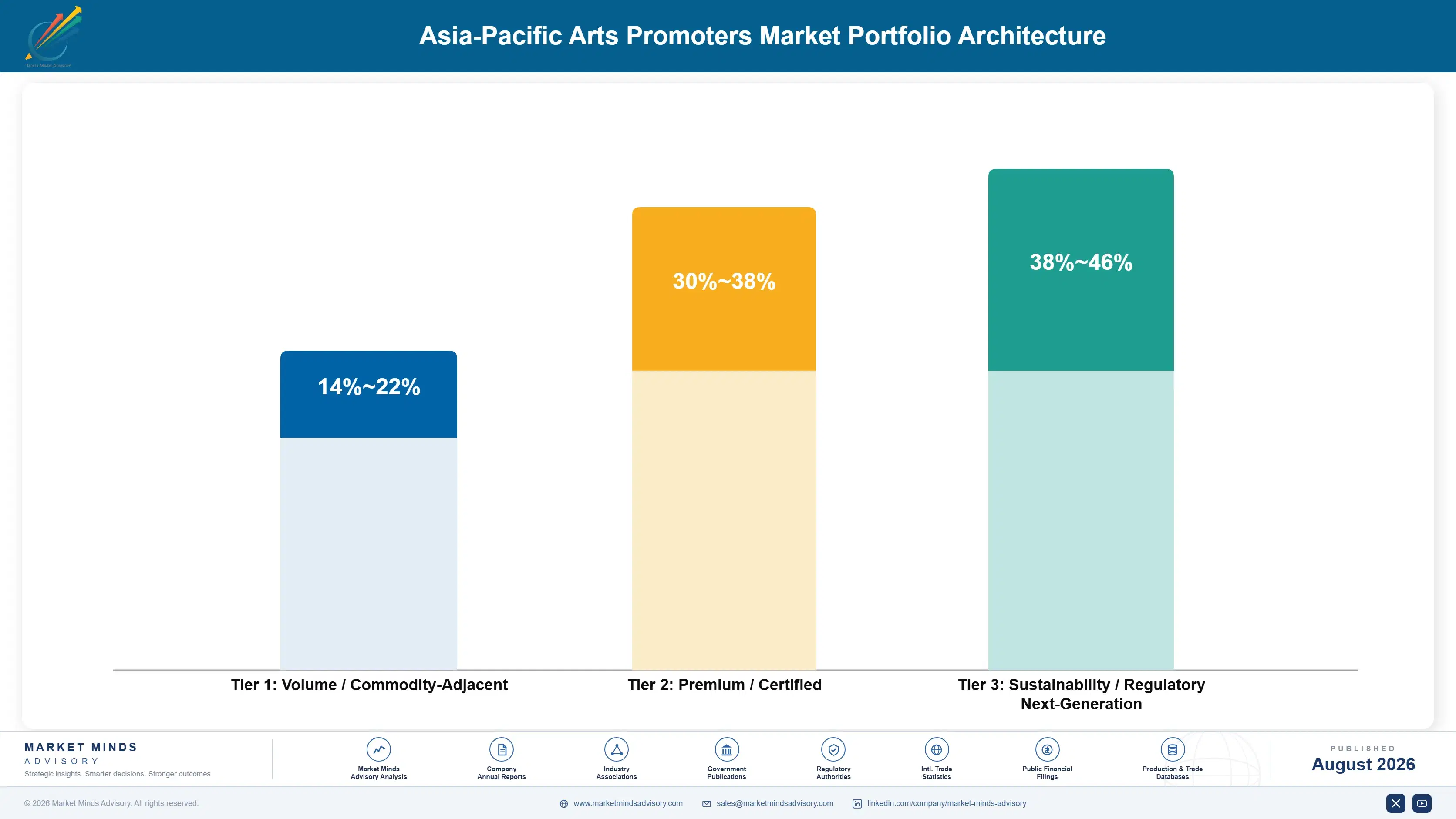
Asia-Pacific arts promotion economics split across three tiers with meaningfully different margin profiles. Volume-oriented standard concert and touring promotion compete almost entirely on booking scale and venue access, generating thin net margins relative to more differentiated event formats across the industry. Only the largest five promoters sustain acceptable returns at this pricing level given fixed venue and artist relationship overhead spread across enormous booking volume nationwide.
Certified premium hospitality and VIP experience products command premium pricing tied to service depth and enhanced fan access. Hybrid streaming and next-generation digital distribution formats carry the highest margins but remain a comparatively small share of total revenue today, reflecting their early stage of mainstream adoption across most promoter portfolios nationwide. Early movers in this tier are capturing disproportionate share of fans seeking enhanced venue access and comfort experiences.

The volume versus premium tension defines competitive strategy across every major promoter: large touring companies defend core concert margins through booking scale, while regional specialists concentrate on higher-value streaming and hospitality segments where differentiation still commands real pricing power. Smaller promoters without scaled streaming infrastructure increasingly partner with distribution platforms rather than build comparable capability independently, a trend likely to continue through the forecast period.

Volume / Commodity-Adjacent

Standard concert and festival promotion competing primarily on booking scale and venue access for broad, price-sensitive fan segments nationwide across most touring markets. Margin here has compressed steadily over the past several years as artist fee inflation outpaces average ticket price growth.
Gross Margin: 14-22%

Premium / Certified

Premium hospitality and VIP experience tiers bundling enhanced fan access and service depth for attendees with specific comfort and exclusivity preferences. Retention rates run notably higher among premium tier attendees relative to standard general admission ticket holders on comparable events.
Gross Margin: 30-38%

Sustainability / Regulatory / Next-Generation

Hybrid streaming and digital distribution formats serving fans seeking event access without physical venue attendance requirements or geographic constraints. Adoption remains concentrated among the largest and most sophisticated streaming technology entrants currently building out this capability.
Gross Margin: 38-46%
asia-pacific-arts-promoters-market-portfolio-architecture-1787917962626

High-value Sub-segments and Strategic Watch-out

Hybrid Streaming Distribution Formats

Digital broadcast structures bringing global fan access to touring events represent the fastest-growing, highest-margin opportunity in arts promotion today, with adoption accelerating steadily across the industry. Early movers are capturing disproportionate share of new fan relationships across every major touring market. Provider selection increasingly shapes fan decisions.
Gross Margin: 38-46%

Premium Hospitality and VIP Tiers

Enhanced fan experience packages command premium fees and strong repeat attendance, though growth trails the fastest streaming segment as adoption remains concentrated among larger touring events currently. Providers investing early in hospitality infrastructure are seeing measurable revenue gains across their event portfolios. This trend should strengthen as infrastructure expands further.
Gross Margin: 30-38%

Standard Concert Promotion

The volume backbone of the industry, generating predictable but thin origination margins across the vast majority of total event revenue nationwide under continuous booking cost pressure. Consolidation pressure continues building steadily among smaller sub-scale promoters lacking comparable booking volume leverage. Scale remains the primary driver of profitability here.
Gross Margin: 14-22%

Legacy Print and Radio Marketing

A shrinking segment as promoters increasingly shift marketing spend toward digital and social media channels, pushing traditional advertising formats toward continued decline across most touring markets. Decline timelines vary considerably depending on how quickly digital marketing budgets absorb remaining traditional spend. Specialized providers are watching closely.
Gross Margin: 10-16%

How Fan Relationships Compound Over Years

Arts promotion relationships behave like recurring subscriptions once a fan base is established. Loyal fans attend multiple events across a promoter's touring calendar each year, and promoters that retain fan loyalty at renewal capture another multi-event revenue stream without needing to acquire an entirely new audience. Attrition happens almost exclusively through changing fan interest or a rare touring schedule gap rather than active promoter switching mid-tour.
Adoption stickiness varies meaningfully by fan vertical. K-pop and dedicated fandom audiences exhibit the deepest stickiness, often attending every touring date within reach across multiple years, while casual festival attendees show comparatively higher churn as competing entertainment options draw discretionary spending elsewhere. Financial services and technology-sector consumers, quicker to adopt digital streaming access, show the shallowest venue loyalty of any major fan vertical measured.

Buyer profiles are shifting generationally as younger fans, more comfortable engaging through streaming and digital access formats, replace older attendees who historically valued the physical venue experience above all else. This generational transition is gradually eroding the venue-loyalty advantage that incumbent promoters relied on for decades. Promoters slow to modernize their digital access offerings risk losing renewal engagement to challengers even after years of otherwise loyal attendance.
asia-pacific-arts-promoters-market-end-use-penetration-index-1787917963128

MMA Analyst Assessment and Recommendations

These are among the four positions where our research anticipates prominent divergence between winners and laggards over the coming forecast period. Each is grounded in the demand model, the regulatory perimeter, and the announced capacity pipeline.
01 / PRODUCT INNOVATION STRATEGY

Build hybrid streaming capability before competitors dominate the segment

Hybrid streaming distribution remains a meaningfully underdeveloped capability outside a small handful of specialized promoters, and early movers are already capturing disproportionate share of global fan demand beyond physical venue capacity. Promoters that wait risk ceding a fast-growing, high-margin segment to CTS Eventim and BookMyShow permanently. The window for establishing real streaming distribution scale here is closing steadily, and every additional quarter of delay makes catching up meaningfully harder for entrants arriving late to this fast-moving digital distribution category overall.
02 / DISTRIBUTION AND PARTNERSHIPS

Expand premium hospitality tiers for revenue diversification

Premium hospitality revenue is growing faster than standard ticket sales, and the promoters capturing this growth are the ones investing early in enhanced fan experience infrastructure that captures attendees willing to pay meaningfully more. Providers still dependent primarily on standard ticketing are ceding this segment to more experience-focused competitors. This is not a marginal opportunity, it is one of the largest sources of net-new revenue available over the next several years, and promoters treating it as secondary will regret that choice.
03 / ARTIST RELATIONSHIP MANAGEMENT

Negotiate multi-event packages before fee inflation accelerates further

Artist fee inflation shows no sign of easing, and promoters that lock in multi-city touring packages now will absorb future fee increases more efficiently than competitors negotiating single-date bookings under deadline pressure later. Treating booking strategy as purely tactical misses its defensive value against future cost escalation. Promoters that get this positioning wrong will keep absorbing avoidable margin compression for years to come, an exposure that compounds meaningfully across the entire touring calendar rather than a single isolated booking event.
04 / VENUE AND CAPACITY STRATEGY

Diversify into secondary cities before premium venues saturate

Premium venue capacity constraints in major metropolitan markets show no sign of easing, and promoters that build secondary city touring infrastructure now will capture growth that competitors confined to saturated primary markets cannot access. Waiting until premium venues fully saturate leaves little time to build the local relationships and logistics networks that take years to establish credibly. Promoters treating secondary market expansion as optional risk losing growth to more forward-looking competitors entirely across every touring cycle ahead for years to come.

Engagement Snapshot From the Field

A live engagement with an industry participant carrying material or product regulatory and market exposure ahead of a defining policy shift, showing how our research translates into a defensible multi-year portfolio strategy.
MARKET MINDS ADVISORY · CLIENT ENGAGEMENT SUMMARY
Asia-Pacific Arts Promoters Producer Strategic Portfolio Review and Transition Roadmap 2026·Investment Scenario on Asia-Pacific Arts Promoters Exposure Evaluation 2025-26
CLIENT PROFILE
The client, a mid-sized regional promoter operating primarily across Southeast Asia, generated roughly USD 45 million in annual touring revenue through traditional concert promotion distributed via local venue partnerships. Leadership sought to evaluate whether launching a hybrid streaming distribution product would meaningfully expand their addressable fan base. The client operated primarily through venue partnerships and local promoter networks rather than international touring circuits directly.
STRATEGIC CHALLENGE
The client lacked internal data on streaming production economics and was uncertain whether existing venue partnerships could effectively support a fundamentally different production and broadcast model. Leadership also worried that entering hybrid streaming without established distribution platform relationships would expose the business to unacceptable production quality risk. Regional connectivity constraints also raised questions about production reliability across the client's covered markets.
MMA APPROACH
MMA conducted a structured market sizing exercise for hybrid streaming demand within the client's existing touring footprint, benchmarking competitor production quality and distribution platform economics against the client's current cost structure. The engagement included structured interviews with the client's top-producing venue partners to gauge realistic near-term production capacity. Findings were benchmarked against comparable regional promoters already operating hybrid streaming programs successfully.
KEY FINDINGS
  1. Venue partner interviews revealed strong latent demand among fans in secondary cities who had previously been unable to access major touring events due to travel cost.
  2. Competitor streaming production carried meaningfully wider margins than the client's existing standard promotion book, even after accounting for production and distribution partnership cost.
  3. Production quality requirements were more substantial than leadership initially assumed, requiring a dedicated technical training program before meaningful volume could be expected.
  4. Distribution platform partnership terms varied considerably between providers, creating meaningful near-term selection risk worth evaluating carefully before committing. MMA recommended a structured evaluation process before finalizing a partner selection decision.
CLIENT PROFILE
The client, a mid-sized regional promoter operating primarily across Southeast Asia, generated roughly USD 45 million in annual touring revenue through traditional concert promotion distributed via local venue partnerships. Leadership sought to evaluate whether launching a hybrid streaming distribution product would meaningfully expand their addressable fan base. The client operated primarily through venue partnerships and local promoter networks rather than international touring circuits directly.
STRATEGIC CHALLENGE
The client lacked internal data on streaming production economics and was uncertain whether existing venue partnerships could effectively support a fundamentally different production and broadcast model. Leadership also worried that entering hybrid streaming without established distribution platform relationships would expose the business to unacceptable production quality risk. Regional connectivity constraints also raised questions about production reliability across the client's covered markets.
MMA APPROACH
MMA conducted a structured market sizing exercise for hybrid streaming demand within the client's existing touring footprint, benchmarking competitor production quality and distribution platform economics against the client's current cost structure. The engagement included structured interviews with the client's top-producing venue partners to gauge realistic near-term production capacity. Findings were benchmarked against comparable regional promoters already operating hybrid streaming programs successfully.
KEY FINDINGS
  1. Venue partner interviews revealed strong latent demand among fans in secondary cities who had previously been unable to access major touring events due to travel cost.
  2. Competitor streaming production carried meaningfully wider margins than the client's existing standard promotion book, even after accounting for production and distribution partnership cost.
  3. Production quality requirements were more substantial than leadership initially assumed, requiring a dedicated technical training program before meaningful volume could be expected.
  4. Distribution platform partnership terms varied considerably between providers, creating meaningful near-term selection risk worth evaluating carefully before committing. MMA recommended a structured evaluation process before finalizing a partner selection decision.
RECOMMENDED STRATEGY
Phase 1: Phase 1 (Pilot): Launch a limited hybrid streaming product with a single distribution partner across a small group of flagship touring events. Phase 2: Phase 2 (Scale): Expand production capability and distribution partnership coverage based on pilot performance data, extending across more events. during this second phase. Phase 3: Phase 3 (Optimize): Refine pricing and production quality using accumulated performance data, then evaluate expansion into additional markets. where demand supports it.
OUTCOME
The client launched its hybrid streaming pilot across its flagship touring events, generating meaningful new revenue from fans who would not have previously attended in person (client-reported, unverified by MMA). Venue partner adoption exceeded initial expectations, and the client began planning regional expansion within the first year.

Frequently Asked Questions

Foundational context covering the market sizes, CAGR, scope, country, region and competition that inform every finding below. This section is provided to cover basics and most often pre-purchase conversations, answered from the MMA Primary Research Dataset.

What is the current size of the Asia-Pacific Arts Promoters Market?

The Asia-Pacific Arts Promoters Market reached $38.0 billion in revenue in 2025. This figure reflects concert promotion, ticketing platforms, and artist booking services generating revenue across the region.

How large will the Asia-Pacific Arts Promoters Market be by 2036?

MMA projects the market will reach $102.09 billion by 2036, roughly 2.46 times its 2026 value. Growth is driven primarily by hybrid streaming adoption and expanding cross-border touring demand.

What is the CAGR for the Asia-Pacific Arts Promoters Market 2026 to 2036?

The market is projected to grow at a 9.4 percent compound annual growth rate between 2026 and 2036. This compares to a historical CAGR of roughly 8.1 percent recorded across the preceding 2020 to 2025 period.

Which segment is growing fastest?

Hybrid digital-live streaming event production is growing fastest at a 17.2 percent CAGR, nearly double the overall market rate. This reflects rapid adoption of formats that monetize fans beyond physical venue capacity.

Who are the major companies in the Asia-Pacific Arts Promoters Market?

Live Nation Entertainment, BookMyShow, CTS Eventim, TEG, and Interpark lead the market by revenue. Together these five promoters hold roughly 36 percent combined concentration across the region.

Which country is growing fastest?

Indonesia is the fastest-growing arts promotion market at a 15.4 percent CAGR, driven by rising disposable income and expanding venue infrastructure investment. Live entertainment demand is accelerating across the country's major cities.

Report Segmentation Architecture

The full report scope spans multiple orthogonal segmentation dimensions, with cross-tabulated demand data provided for each dimension pair. Coverage extends further to regional breakdowns, trend trajectories, and the competitive detail needed to support segment-level decision-making.

By Service Category

  • Live Concert and Music Event Promotion
  • Theater and Performing Arts Promotion
  • Visual Arts Exhibition Promotion
  • Digital Ticketing and Access Platforms
  • Artist Booking and Talent Management
  • Hybrid Digital-Live Streaming Production

By End-Use Industry

  • Music and Concert Touring
  • Theater and Performing Arts
  • Festival and Multi-Genre Events
  • Corporate and Sponsored Events

By Commercial Dimension

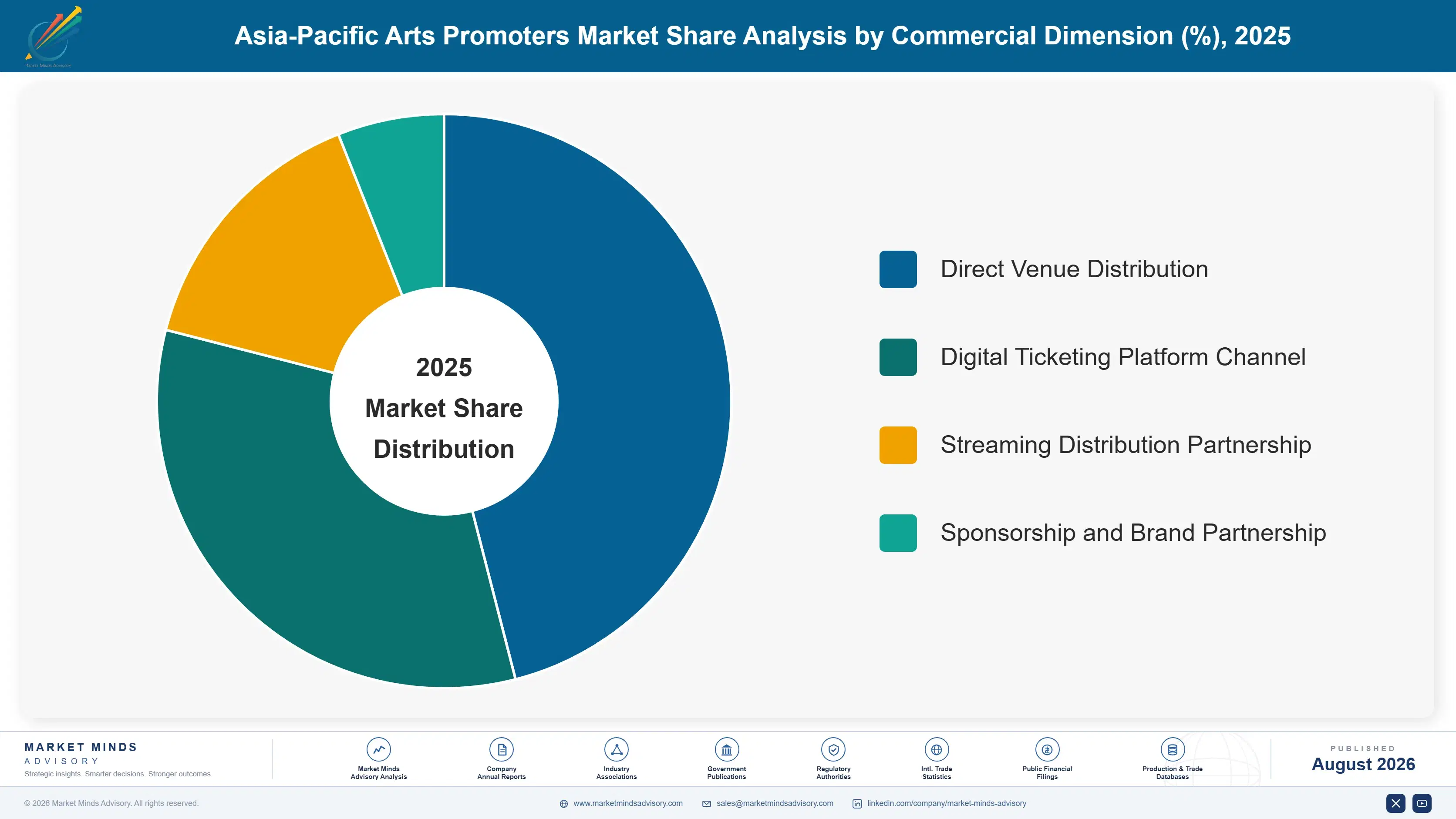
  • Direct Venue Distribution
  • Digital Ticketing Platform Channel
  • Streaming Distribution Partnership
  • Sponsorship and Brand Partnership

By Region

  • North America
  • Western Europe
  • East Asia
  • South Asia and Pacific
  • Latin America
  • Middle East and Africa
  • Eastern Europe

Scope, Methodology, and Coverage

Every figure in this report is reproducible from documented input assumptions. The scope below maps the historical period, the forecast horizon, the segmentation dimensions, and the countries covered, alongside the underlying primary and qualitative methodology.
Historical Period
2020 to 2025
Forecast Period
2026 to 2036
Base Year
2025 (USD billions; MMA Primary Research Dataset, August 2026)
Market Definition
This report covers commercial services provided by companies that produce, promote, and monetize live and hybrid digital arts and music events across Asia-Pacific, including concert promotion, ticketing platforms, and artist booking services. It excludes broadcast television production, recorded music sales, and venue construction or real estate development.
Quantitative Units
USD billions (current prices); local currency equivalents where noted
Segmentation Dimensions
By Service Category; By End-Use Industry; By Commercial Dimension; By Region
Regions Covered
North America, Western Europe, East Asia, South Asia and Pacific, Latin America, Middle East and Africa, Eastern Europe
Countries Covered
USA, China, Germany, France, UK, Japan, South Korea, India, Australia, Canada, Brazil, Mexico, Indonesia, Vietnam, Thailand, Malaysia, UAE, Saudi Arabia, South Africa, Nigeria, Turkey, Poland, Netherlands, Italy, Spain, Sweden, Switzerland, Argentina, Colombia, Singapore, and additional markets relevant to this sector
Key Companies Profiled
Live Nation Entertainment, BookMyShow, CTS Eventim, TEG, Interpark, AEG Presents Asia, Damai.cn, Modern Sky, Frontier Touring, Chugg Entertainment, Ticketek, IMG, Marshall Live Entertainment, CJ ENM, SM Entertainment, YG Entertainment, Zouk Group, Klook, Mediacorp, Avex Live Creative
Quantitative Methodology
Primary survey, n=3,800 respondents, Q4 2025, six countries; demand-side model with trade association cross-validation
Qualitative Methodology
47 expert interviews, Q4 2025; applied to validate demand model assumptions, identify emerging dynamics, and assess competitive positioning
Report Format
PDF and XLSX data workbook (Word format preview document)
Publisher
Market Minds Advisory
Report Code
MMA-2026-TEC-268
Published
August 2026
Contact
sales@marketmindsadvisory.com | www.marketmindsadvisory.com

Purchase the full Asia-Pacific Arts Promoters Market Report (2026 to 2036).

This report provides comprehensive coverage of the Asia-Pacific Arts Promoters Market, including detailed sizing, segmentation, and regional analysis through 2036. It examines competitive dynamics among the leading international and regional promoters, covering their strategic positioning, moats, and vulnerabilities. The analysis also addresses artist fee pressure, venue capacity constraints, and emerging hybrid streaming trends reshaping event economics. Readers gain access to primary survey data, expert interview insights, and MMA's proprietary forecasting methodology. The report is designed for promoter strategy executives, ticketing platform teams, and institutional media investors evaluating positioning decisions, product launch priorities, or capital allocation across the live entertainment value chain.
Ten-year market sizing and forecast model
Six-segment MECE service category segmentation model
Seven-region demand, share, and growth analysis
Competitive landscape with moat and risk profiles
Primary survey data from 3,800 respondents
Forty-seven expert interviews across promoter types

Built For The People Who Decide

From boardroom strategy to bench-side execution, this report is read cover-to-cover by leaders shaping the next decade of their industry, turning demand scenarios, market dynamics and valuation benchmarks into decisions.
CXOs/ Presidents/ VPs/ Managers
M&A and Corporate Development
Strategy Teams and R&D Heads
Procurement and Product Directors
Regulatory and Compliance Leaders
Investor Relations and Equity Analysts