Market Minds Advisory
Asia-Pacific Airbag Market

Asia-Pacific Airbag Market: Regulatory Mandates and Rising Airbag Counts Per Vehicle Through 2036

Bharat NCAP and China's C-NCAP are pushing automakers to fit more airbags per vehicle, forcing suppliers to scale side, curtain, and knee airbag production faster than overall vehicle output is growing across the region.

Lead Analyst

David Horsley

Published

September 2026

Make Smarter Decisions with Customized Research Insights

Request a free sample report and evaluate market opportunities, growth trends, and competitive dynamics relevant to your business needs.

2025 MARKET VALUE$13.5BMarket Size 2025
2036 FORECAST VALUE$27.0BBase Case , 2026 to 2036
CAGR 2026 TO 20366.5 %Bull 7.6% / Bear 5.3%
INCREMENTAL OPPORTUNITY$12.6BNet 10- year value creation
EXPANSION MULTIPLE1.88x2036 value over 2026 base
Strategic Levers
M&A Pipeline
Regional Outlook
Country Rankings
Competitive Intelligence
Segmental Deep-dive
Call-Us : 91 93563 13602

Executive Snapshot and Market Trajectory

Airbag counts per vehicle are climbing fastest in Asia as regulators there catch up to European and North American safety mandates, forcing automakers and suppliers to add side, curtain, and knee airbags to vehicle platforms that historically shipped with only driver and passenger protection standard.
India's Bharat NCAP rating program and China's tightening C-NCAP requirements are compressing into a few years the airbag adoption curve that took Europe and North America roughly two decades to complete, giving suppliers like Autoliv and Joyson Safety Systems a genuine growth runway even as vehicle production growth itself moderates. Side and curtain airbags are capturing disproportionate investment as regulators mandate broader occupant coverage beyond frontal impact protection alone, even as vehicle production growth moderates.
Suppliers including Daicel Corporation and Toyoda Gosei are expanding regional manufacturing capacity to serve automakers localizing production across India, Thailand, and Indonesia rather than importing airbag modules from established manufacturing hubs. Inflator technology and control unit sophistication increasingly differentiate suppliers, since basic airbag fabric and cushion manufacturing has become widely commoditized across the broader supply base, particularly for automakers competing on safety ratings in price-sensitive segments.
Market Definition
The Asia-Pacific airbag market covers driver airbags, passenger airbags, side and curtain airbags, knee and far-side airbags, airbag inflators and initiators, and airbag control units and sensors sold to automakers and tier-one automotive suppliers. It excludes seatbelt systems and other passive safety components sold as standalone products.
Base Year Value
$13.5B in 2025 (MMA Primary Research Dataset, August 2026)
Forecast Period
2026 to 2036, eleven discrete annual values
CAGR
6.5% base case. Bull 7.6%. Bear 5.3%.
Fastest Growth Segment
Side and Curtain Airbags: 9.5% CAGR
Fastest Growth Country
India: 11.0% CAGR
Fastest Growth Region
South Asia and Pacific: 9.0% CAGR
Largest Region
East Asia: 30% of 2025 global value
Market Leaders
Autoliv, ZF Friedrichshafen, Joyson Safety Systems, Daicel Corporation, Toyoda Gosei. Source: MMA Analysis based on company annual reports.
Primary Survey
n=3,800 procurement and R&D decision-makers, Q4 2025, six countries
Methodology
Demand-side build-up, cross-validated against public data, 47 expert interviews

Asia-Pacific Airbag Market Forecast Scenarios

asia-pacific-airbag-market-trends-size-forecast-scenario-1787463620107
Between 2020 and 2025 the market grew at roughly 5.5 percent a year, with pandemic-era vehicle production disruptions briefly slowing airbag shipments before regulatory mandates in India and China accelerated demand through the back half of the period as automakers resumed capacity investment across the region, and inflator supply chains normalized after earlier disruption episodes eased considerably.
The base case assumes 6.5 percent annual growth to 2036, built on three mechanisms: regulatory mandates raising minimum airbag counts per vehicle across India, China, and Southeast Asian markets, automaker localization of vehicle platforms requiring regional airbag supply rather than imports, and rising consumer expectations for higher safety ratings even in budget vehicle segments. Together these three mechanisms sustain growth above simple vehicle production volume trends, beyond the industry's traditional pace.
A bull case near 7.6 percent depends on additional Southeast Asian regulators adopting mandatory multi-airbag requirements faster than currently planned across their vehicle safety programs. The bear case near 5.3 percent assumes regional vehicle production growth slows enough that airbag demand growth tracks closer to simple unit volume trends, and automakers defer adding optional airbag content in their most price-sensitive vehicle trims.

Regulatory Convergence and Rising Airbag Counts

Airbag manufacturing sits downstream of two distinct technical disciplines, textile engineering for the cushion fabric and precision chemistry for the inflator, and few suppliers master both well enough to compete across every airbag category a modern vehicle platform requires, and that dual expertise requirement has shaped the industry's competitive structure for decades, across every major regional market today, and that dual expertise requirement has shaped industry structure for decades.
PRODUCER CONCENTRATIONCR5 65%top five suppliers hold roughly two-thirds of global shipments
AVERAGE SELLING PRICE$42/unitblended price across all airbag module categories sold today
CHINA PRODUCTION SHARE34%share of global airbag module production located within this country
AIRBAGS PER VEHICLE6.2 unitsaverage airbag count fitted across new vehicles sold globally
TRADE INTENSITY38%share of shipments crossing a border before reaching assembly plants
FABRIC COST SHARE46% of COGScombined fabric and inflator cost burden within module production
Commercially, the market splits between mature driver and passenger airbag modules priced close to commodity levels and a faster-growing side, curtain, and knee airbag tier commanding better margins as regulatory mandates expand required coverage. Margins concentrate in inflator and control unit technology, where certification history and safety performance data matter more than simple manufacturing scale, as automakers increasingly weigh documented safety performance data before committing.
Over the next decade, inflator chemistry and sensor integration capability will matter more to competitive position than basic cushion fabric manufacturing, since fabric production technology itself is now widely accessible across multiple regional suppliers competing primarily on price, particularly as automakers weigh certification history alongside raw unit cost carefully, over the coming decade, particularly as automakers weigh certification depth alongside simple unit cost.
"A decade ago two airbags was standard almost everywhere in Asia. Regulators there have compressed a twenty-year adoption curve into about five, and suppliers are still catching up."
Director, Automotive Practice · MMA Automotive Practice · August 2026

Market Trends

Bharat NCAP Mandates Accelerate Indian Airbag Adoption

India's Bharat NCAP rating program, launched to give consumers comparable crash safety information, has pushed automakers to fit additional airbags well beyond the minimum regulatory requirement to achieve competitive safety ratings that increasingly influence consumer purchase decisions. Autoliv and Joyson Safety Systems have both expanded Indian manufacturing capacity specifically to serve this demand rather than relying on imported modules from established manufacturing hubs elsewhere. This shift is compressing into a few years an airbag adoption curve that took developed markets roughly two decades to complete previously, reflecting how quickly regulatory pressure is reshaping supplier investment priorities across the country.
Market Impact: Regional vehicle output grows 5-6% annually
China's C-NCAP Tightens Multi-Airbag Requirements Sharply

China's C-NCAP rating program has tightened its multi-airbag scoring criteria, pushing domestic automakers to fit side, curtain, and knee airbags across a broader range of vehicle price segments than previously standard in the market. Daicel Corporation and Toyoda Gosei have both expanded Chinese manufacturing capacity specifically to serve this domestic demand wave rather than depending on export volume from established Japanese production facilities. This regulatory tightening is spreading from premium vehicle segments into budget models as competition intensifies across the domestic market, reinforcing how quickly domestic certification requirements are reshaping supplier manufacturing footprints.
Market Impact: Safety ratings sway 60% of buyers

Market Opportunities and Growth Drivers

Regional Vehicle Production Growth Sustains Airbag Volume

Asian vehicle production has grown steadily as domestic demand expands and automakers localize manufacturing to serve regional markets rather than relying on imports from established production hubs elsewhere, and every additional vehicle produced requires a proportional airbag module allocation regardless of trim level or price segment. This volume relationship gives airbag suppliers a predictable demand floor tied directly to broader vehicle production growth rather than depending on any single automaker's individual platform decisions within the competitive regional manufacturing landscape shaping the industry, across both established manufacturing hubs and newer regional assembly plants alike.
Market Impact: Inflators add 15-20% to module cost

Consumer Safety Rating Awareness Expands Premium Segment

Consumer awareness of crash safety ratings has grown substantially as rating programs like Bharat NCAP and C-NCAP publicize results widely, and that awareness increasingly influences purchase decisions even in price-sensitive vehicle segments where safety content was historically minimized to control cost. Autoliv and Joyson Safety Systems have both expanded product lines targeting budget vehicle platforms specifically to serve this shifting consumer expectation, capturing demand that automakers previously served with minimal airbag content, a trend expected to continue as rating program awareness keeps expanding further, even where regulatory minimums remain unchanged for several more years.
Market Impact: Separate certification adds 8-10% to costs

Market Restraints and Challenges

Inflator Cost Sensitivity Limits Budget Vehicle Adoption

Inflator and control unit costs remain a meaningful share of total vehicle cost for budget-segment automakers, and the underlying cause is that inflator chemistry and certification requirements have not commoditized as quickly as basic cushion fabric manufacturing has across the broader supply base. The commercial impact limits how quickly automakers in the most price-sensitive segments can add optional airbag content beyond regulatory minimums. Suppliers are mitigating this through simplified inflator designs engineered specifically for cost-sensitive budget vehicle platforms, particularly across automakers competing in the most cost-constrained emerging market segments, and this gap persists despite years of engineering cost-reduction effort.
Market Impact: India adoption grew 40% in 3yrs

Regional Certification Fragmentation Slows Supplier Scaling

Airbag certification requirements vary meaningfully across Asian markets, and the underlying cause is that individual national regulators have developed testing protocols somewhat independently rather than converging on a single shared regional standard. The commercial impact forces suppliers to certify products separately for each market rather than achieving economies of scale from one unified regional certification process. Industry associations are mitigating this through ongoing efforts to harmonize testing protocols across major regional markets, particularly for smaller suppliers lacking the scale to absorb multiple certification programs easily, and full harmonization likely remains years away given current negotiation progress.
Market Impact: C-NCAP now requires 6 airbags
4 additional market trends, 3 additional growth drivers, and 3 additional restraints and challenges are covered in the full report. Contact sales@marketmindsadvisory.com to access the complete intelligence.

Segment CAGR and Growth Architecture

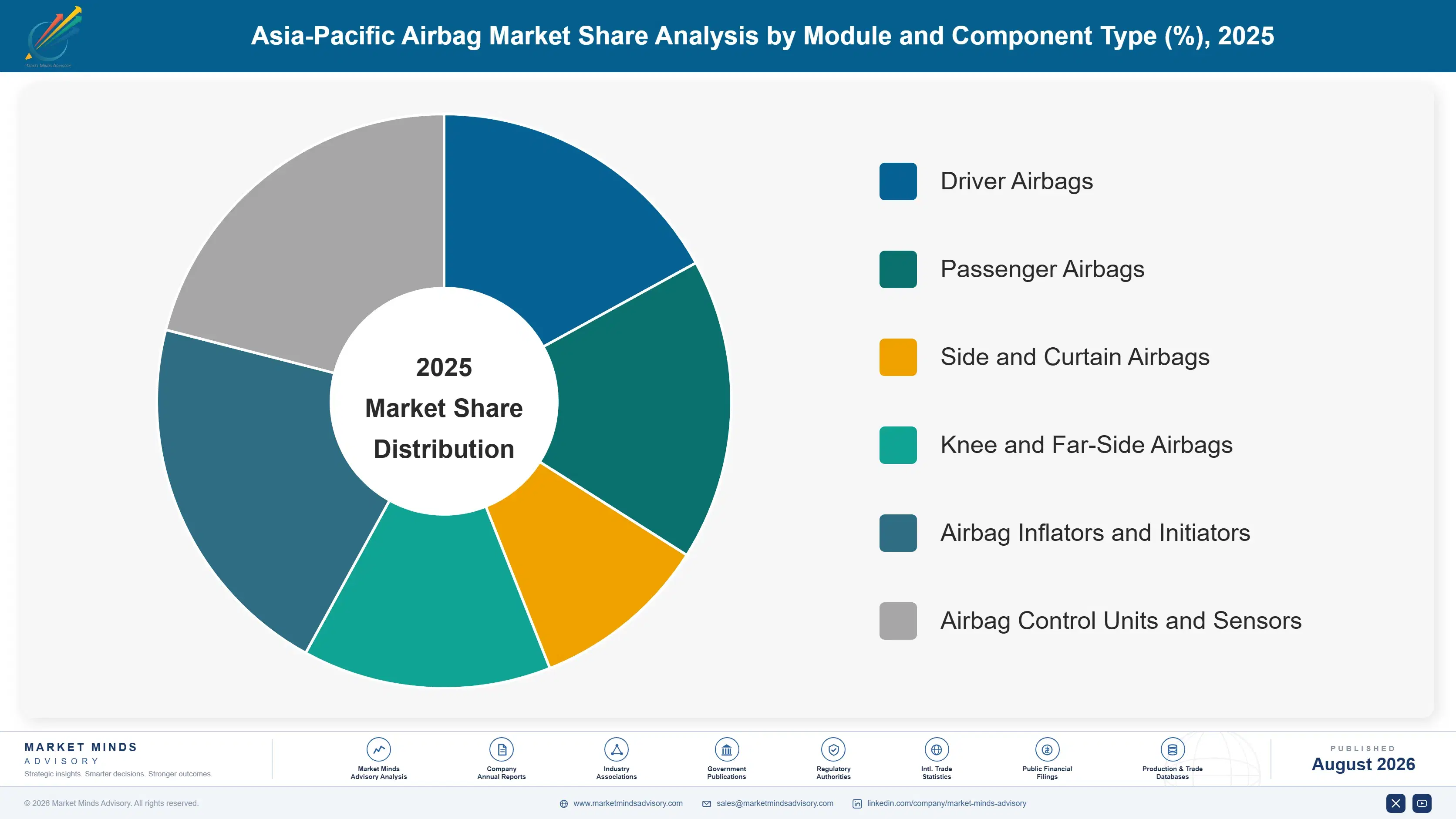
The market splits into six categories by module and component type, from driver and passenger airbags through inflators and control units. Side and curtain airbags are growing fastest as regulators mandate broader occupant coverage, while knee and far-side airbags follow closely as premium vehicle safety content spreads into mainstream segments, as regulators steadily widen required occupant protection zones.
asia-pacific-airbag-market-trends-market-share-analysis-1787463620641

Side and Curtain Airbags

Side and curtain airbags are growing faster than any other category because regulatory rating programs across Asia now weight side-impact and rollover protection heavily in their scoring criteria, pushing automakers to fit these systems well beyond the frontal protection that driver and passenger airbags alone provide. Bharat NCAP and China's C-NCAP have both tightened side-impact scoring specifically, forcing automakers competing for top safety ratings to add curtain airbags even in vehicle segments that historically shipped without them. Autoliv and Joyson Safety Systems have both expanded curtain airbag production capacity specifically to serve this demand, and the category's technical complexity, spanning the full roofline rather than a single mounting point, gives established suppliers a meaningful engineering advantage over new entrants.
CAGR 9.5%

Knee and Far-Side Airbags

Knee and far-side airbags are following side and curtain systems into mainstream vehicle segments as automakers pursue top safety ratings across an increasingly broad range of price points, extending protection technology that was until recently reserved for premium vehicle platforms. Toyoda Gosei and Daicel Corporation compete most directly in this category, where packaging constraints within smaller vehicle interiors demand more compact inflator and cushion designs than larger premium platforms typically require. This combination of regulatory pressure and premium-to-mainstream technology transfer gives knee and far-side airbags a growth rate meaningfully above the broader market average across the region, Continental AG has similarly expanded compact inflator development to serve smaller vehicle platforms.
CAGR 8.5%
Full segment breakdown across 7 segments available in the complete report.

Regional Architecture and Country Demand Map

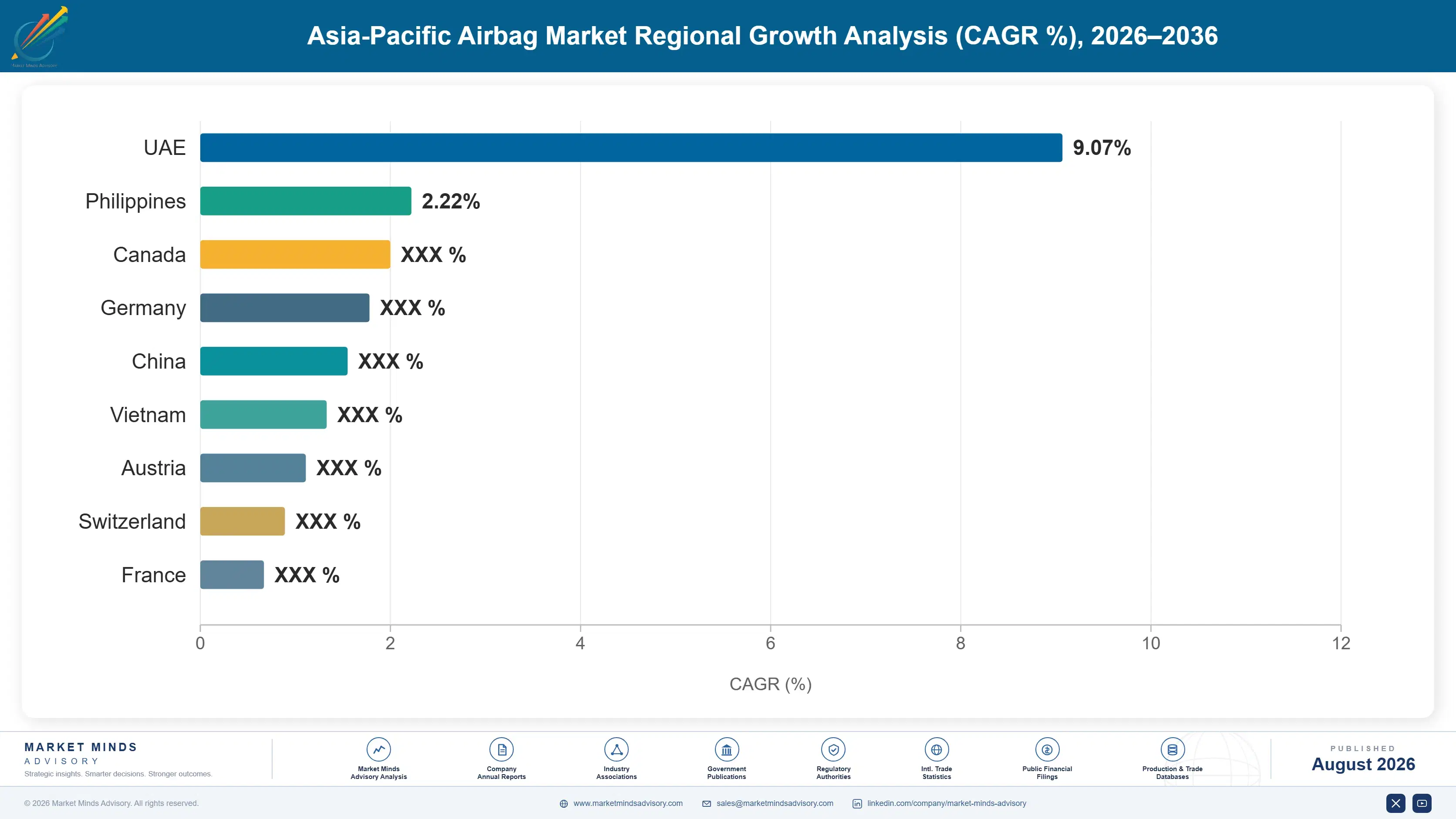
East Asia leads global airbag demand, anchored by China's vehicle production scale and Japanese supplier headquarters concentration. South Asia and Pacific posts the fastest growth as India's Bharat NCAP mandates compress decades of adoption into a few years across the country's rapidly expanding vehicle market.

North America

US automakers maintain mature multi-airbag standards across nearly all vehicle segments, with growth here driven mainly by vehicle replacement cycles rather than any regulatory expansion of minimum airbag requirements. Autoliv and ZF Friedrichshafen both maintain significant domestic manufacturing capacity serving established original equipment relationships with major automakers. Canada's smaller vehicle market follows similar regulatory standards, contributing proportionally modest additional demand. Electric vehicle platform redesigns are creating incremental airbag redesign work as automakers reconfigure interior packaging around battery pack placement and new crash structure requirements across several manufacturing plants. Aftermarket replacement demand also contributes steady baseline volume tied to collision repair activity nationwide, across every major metropolitan market, supporting stable long-term supplier revenue.
Share: 22% | CAGR: 6.0% (2026 to 2036)

Western Europe

Europe pioneered multi-airbag safety standards decades ago through Euro NCAP rating pressure, and the region's automakers now specify comprehensive protection across nearly every vehicle segment as standard equipment rather than an optional upgrade. ZF Friedrichshafen, headquartered in Germany, anchors substantial regional supplier capacity serving both domestic and export vehicle production. Growth here trails faster-growing Asian markets because the region's adoption curve largely completed years ago, leaving replacement and incremental technology upgrades as the primary demand driver. Regulatory focus has shifted toward sensor integration and pedestrian protection systems beyond simple airbag count requirements. Suppliers headquartered here continue exporting engineering expertise to newer manufacturing operations across other regions, reinforcing the region's engineering leadership.
Share: 20% | CAGR: 5.0% (2026 to 2036)
Regional intelligence for 5 additional markets available in the complete report: East Asia, South Asia and Pacific, Latin America, Middle East and Africa, Eastern Europe. Contact sales@marketmindsadvisory.com.
asia-pacific-airbag-market-trends-country-cagr-analysis-1787463621160

Capturing Value as Coverage Requirements Widen

Suppliers capture the largest margin gains not from selling more units but from shifting what they sell: side and curtain systems, integrated sensor packages, and regional manufacturing footprints that avoid import costs entirely. Each lever depends on capability incumbents already have and challengers must still build from scratch, and it favors suppliers who move early.

Expand Side and Curtain Airbag Production Capacity

Suppliers with mature side and curtain airbag engineering can capture a price premium of roughly 20 to 25 percent over standard driver and passenger modules, capturing value from automakers racing to meet tightening rating program requirements across India and China. Autoliv and Joyson Safety Systems have both prioritized this expansion with existing customers rather than competing purely for new original equipment contracts, since incumbent suppliers already hold the platform relationship and crash testing history needed to win the upgrade without a fully competitive tender process in most cases, and this advantage is widening as more regulators finalize comparable rating criteria.
Market Impact: Side and curtain systems add a 20-25% premium

Localize Manufacturing to Avoid Import Tariffs

Suppliers that build local manufacturing capacity in India and Southeast Asia avoid import tariffs and shipping costs that add an estimated 12 to 18 percent to landed module cost, letting them compete on price against domestic component makers while maintaining healthier margins than importing finished modules would allow. Daicel Corporation and Toyoda Gosei have both expanded regional manufacturing specifically to capture this cost advantage, since automakers increasingly favor suppliers who match their own local assembly footprint, and this gap is widening as more automakers formalize local content requirements across their supply chains.
Market Impact: Local manufacturing helps avoid a 12-18% import cost

Integrate Sensors and Control Units Into Modules

Suppliers that bundle inflator, cushion, and control unit sensors into a single integrated module capture a higher share of total system value than selling components separately, generating margin roughly 15 to 20 percent above unbundled component sales. ZF Friedrichshafen has pursued this integration strategy aggressively, using its broader electronics capability to bundle sensor packages that pure mechanical component suppliers cannot easily replicate without significant additional engineering investment. Smaller mechanical-only suppliers increasingly struggle to match this bundled value proposition across competitive tenders in every major regional market, and this gap is expected to widen further as electronics content keeps expanding.
Market Impact: Integrated modules help add a 15-20% margin uplift

Who Controls the Margin Pool

Concentration sits high at a CR5 near 65 percent, reflecting an industry where crash certification history and inflator chemistry expertise create genuine barriers against new entrants. Autoliv holds the clearest leadership position given its broad product range and deep original equipment relationships across multiple automakers. The gap between Autoliv and challengers like Daicel Corporation is meaningful but narrowing in specific categories like side and curtain airbags, where several suppliers now offer comparable technical capability.
Current competitive activity centers on regional manufacturing expansion and side and curtain airbag capacity, as suppliers race to serve automakers localizing production across India and Southeast Asia while meeting tightening rating program requirements. Joyson Safety Systems and Toyoda Gosei have both expanded Asian manufacturing footprints, while ZF Friedrichshafen continues integrating sensor and control unit capability into bundled module offerings.

Emerging pressure comes from domestic Indian and Chinese component makers scaling technical capability rapidly within their large home markets, a trajectory that could eventually support competition beyond basic components into full module supply. Rankings could shift meaningfully over the next decade if domestic suppliers close the remaining certification and inflator chemistry gap that currently protects established multinational suppliers.
asia-pacific-airbag-market-trends-company-positioning-matrix-1787463621686

Competitive Moat and Risk Dimensions

AUTOLIV

Moat: Broad Certification Portfolio

Autoliv's certification history spans nearly every major regional rating program, letting it win platform contracts across automakers who require proven compliance track records rather than accepting the certification risk that newer suppliers still carry into competitive tenders, and reinforcing its position as the preferred choice for multi-platform global vehicle programs.
AUTOLIV

Risk: Domestic Competitor Pressure

Autoliv's premium pricing position faces mounting pressure from domestic Indian and Chinese suppliers offering comparable basic module performance at meaningfully lower cost, a dynamic that could erode its market share in price-sensitive segments over the coming years, particularly as those domestic suppliers accumulate their own certification track records over time.
DAICEL CORPORATION

Moat: Inflator Chemistry Expertise

Daicel Corporation's decades of inflator chemistry research give it a technical depth in propellant formulation and safety performance that newer entrants struggle to replicate quickly, supporting premium positioning across automakers prioritizing proven inflator reliability, as more automakers formalize inflator reliability requirements into their supplier scorecards.
DAICEL CORPORATION

Risk: Narrow Product Concentration

Daicel Corporation's business concentrates more heavily on inflators than full module supply compared with diversified competitors like Autoliv, potentially limiting its ability to capture the growing value in bundled sensor and control unit integration strategies, as automakers increasingly favor suppliers who can deliver both mechanical and electronic content together.

Players Tracked

Prominent Players

Autoliv
ZF Friedrichshafen
Joyson Safety Systems
Daicel Corporation
Toyoda Gosei

Other Key Players

Continental AG
Hyundai Mobis
Ashimori Industry
Nihon Plast
Hyosung
Delphi Technologies
Denso Corporation
Tokai Rika
Sungwoo Hitech
Evonik Industries
Nippon Kayaku
Dalphi Metal Espana
Global Safety Textiles
Kolon Industries
Anhui Zhongding

Recent Developments

MAY 2025

Autoliv announced an expansion of its Indian manufacturing capacity to serve growing demand from automakers pursuing top Bharat NCAP ratings, adding side and curtain airbag production lines specifically to meet tightening regional safety requirements across several vehicle platforms,, reinforcing its regional leadership position across the country.
Signal: Signals supplier confidence that Indian regulatory momentum will sustain long-term capacity utilization broadly across the industry
AUGUST 2025

Joyson Safety Systems entered a supply agreement with a major Chinese automaker to provide knee and far-side airbag modules across several vehicle platforms over a multi-year period, expanding its presence in a category previously dominated by Japanese suppliers,, signaling deeper supplier diversification across multiple regions.
Signal: Confirms Chinese automakers increasingly diversify supplier relationships beyond traditional Japanese partnerships across their platform going forward.
FEBRUARY 2026

ZF Friedrichshafen launched an integrated airbag control unit combining sensor fusion and inflator triggering logic into a single module, aimed at simplifying automaker integration work and reducing total system wiring complexity across vehicle platforms, and reinforcing its position as a leader in electronics and sensor integration technology.
Signal: Signals a broader competitive shift toward integrated electronics capability rather than mechanical components across supplier going forward.

Fabric and Inflator Propellant Exposure

Cushion fabric, typically woven nylon or polyester, and inflator propellant chemicals together represent roughly 46 percent of cost of goods sold for airbag module manufacturers, sourced from a concentrated group of specialty textile mills and chemical producers whose own pricing cycles directly influence module contract pricing across the broader supply chain, particularly during periods of tight global capacity utilization.
Specialty nylon fabric prices rose meaningfully during a 2021 to 2022 petrochemical supply disruption tied to pandemic-era manufacturing and shipping bottlenecks, according to industry commodity pricing reports, and that shortage passed through to airbag module contract pricing within roughly two to three quarters as manufacturers renegotiated terms with automaker customers already committed to vehicle production schedules. Manufacturers without long-term fabric supply agreements absorbed the sharpest cost increases during that period across the industry.

Smaller regional component manufacturers without diversified fabric and propellant sourcing absorb price volatility directly in margin, while larger diversified suppliers with broader procurement relationships smooth pricing for their downstream automaker customers instead. That resilience gap increasingly determines which suppliers can offer multi-year fixed-price contracts that large automakers now expect from their strategic component partners, given the scale of their platform footprint.
asia-pacific-airbag-market-trends-cost-volatility-analysis-1787463621883

Long-Term Fabric Supply Agreements

Manufacturers are securing specialty nylon fabric supply through multi-year contracts with textile mills rather than relying on spot-market purchases, smoothing cost volatility during years when petrochemical feedstock disruptions push fabric prices higher than budgeted across a given production cycle, helping preserve stable margins even when broader textile demand elsewhere tightens overall capacity each cycle.

Diversified Propellant Chemical Sourcing

Manufacturers are securing inflator propellant chemicals through multiple specialty chemical suppliers rather than relying on a single source, smoothing cost volatility during regional supply disruptions that periodically affect specific chemical manufacturing facilities and their surrounding markets globally, and helping manufacturers maintain delivery schedules even when a single supplier faces unexpected capacity constraints worldwide too.

Vertical Integration Into Fabric Weaving

Some larger manufacturers are integrating vertically into fabric weaving operations, reducing exposure to third-party textile mill pricing while gaining tighter control over quality specifications that inflator and cushion performance ultimately depend on meaningfully, an approach increasingly valued by manufacturers seeking to avoid dependence on any single external mill over time, across every major regional facility.

Portfolio Architecture for Margin Defence

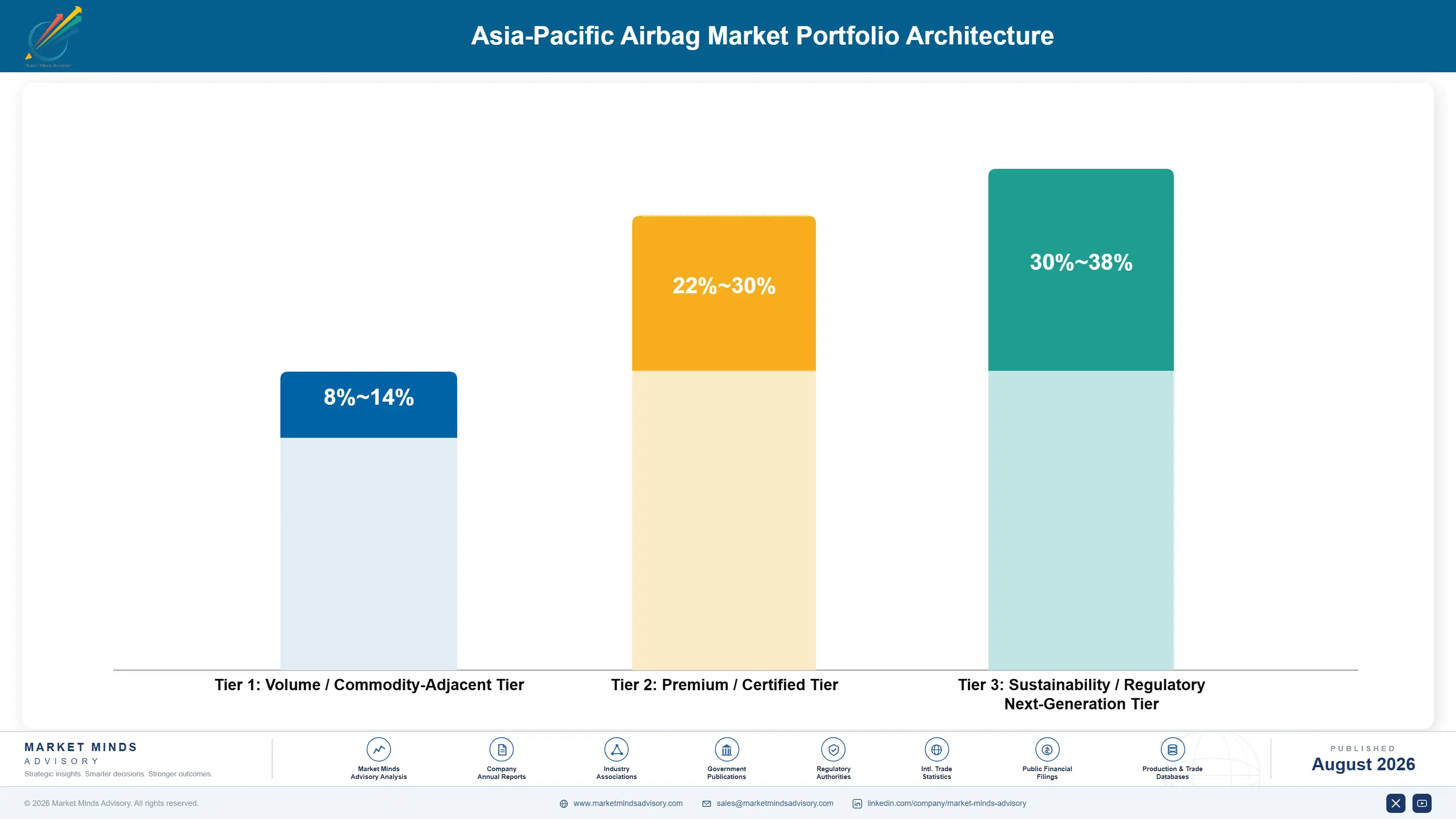
The market splits across three tiers: commodity driver and passenger airbag modules sold on thin margins against original equipment volume contracts, side and curtain systems sold with regulatory compliance and engineering support at a premium, and an emerging tier of integrated sensor and control unit modules commanding the highest margins as automakers seek bundled electronics capability, reflecting how quickly the underlying technology mix within the industry keeps shifting toward electronics.
Volume sits overwhelmingly in the driver and passenger module tier, where bulk contracts with automakers generate revenue scale but comparatively thin margins given intense price competition among established and domestic component suppliers. Premium tension is sharpest in side and curtain systems, where certification and engineering capability earn meaningfully better margins than commoditized basic modules, pulling supplier investment toward capacity that can serve both tiers.

High-value margin pools concentrate in integrated sensor modules and side and curtain systems sold to automakers pursuing top safety ratings, a category still smaller in absolute volume than commodity driver and passenger modules but growing faster and attracting disproportionate research investment from the leading suppliers each year, a pattern likely to continue strengthening as more automakers finalize their own multi-airbag platform roadmaps.

Volume / Commodity-Adjacent Tier

Standardized driver and passenger airbag modules sold on multi-year volume contracts to automakers, competing primarily on manufacturing cost and delivery reliability across regions, reflecting the intense price sensitivity these budget-constrained buyers bring to every procurement decision.
Gross Margin: 8%-14%

Premium / Certified Tier

Side and curtain airbag systems sold with regulatory certification and engineering support, commanding a premium over standardized module equivalents across most original equipment contracts, as regulatory pressure continues building steadily across an expanding set of regional markets.
Gross Margin: 22%-30%

Sustainability / Regulatory / Next-Generation Tier

Integrated sensor fusion and control unit modules tied to advanced occupant protection systems, sold into the industry's highest-margin bundled electronics arrangements available today, as more automakers seek unified electronics architecture over separately sourced mechanical components.
Gross Margin: 30%-38%
asia-pacific-airbag-market-trends-portfolio-architecture-1787463622393

High-value Sub-segments and Strategic Watch-out

Integrated Sensor and Control Modules

Integrated sensor and control unit modules command the category's highest margins and are growing fastest as automakers increasingly demand bundled electronics capability over standalone mechanical components each platform cycle, and suppliers with established electronics capability are capturing the bulk of this expanding demand today and beyond.

Side and Curtain Airbag Systems

Side and curtain airbag systems sold into original equipment contracts command steady premium pricing on certification value, growing reliably as regulatory mandates continue expanding across additional regional vehicle markets worldwide, a combination increasingly viewed as a competitive necessity rather than an optional differentiator now and beyond.

Standardized Driver and Passenger Modules

The largest volume pool by far, standardized modules generate scale revenue for top suppliers but offer little margin expansion room given intense multi-region price competition among established component manufacturers, leaving manufacturers to compete mainly on delivery reliability and established regional service networks consistently and beyond.

Domestic Indian and Chinese Component Suppliers

Domestic Indian and Chinese suppliers scaling technical capability could challenge multinational suppliers on cost within their home markets over the next decade, a shift worth monitoring closely, particularly if domestic certification capability matures faster than currently anticipated by most industry observers region-wide and beyond too.

Platform Cycles and Certification Loyalty

Original equipment demand behaves like an annuity once an automaker qualifies a specific supplier's airbag module against its own vehicle platform crash testing, since switching suppliers again requires repeating extensive vehicle-level certification that most automakers avoid unless supply is disrupted, giving incumbent suppliers durable multi-year volume once they win the initial platform contract and pass the first renewal cycle, across every major regional manufacturing footprint.
Adoption depth varies by segment: large global automakers show the deepest supplier stickiness given the scale of platform certification testing required across multiple export markets, while smaller regional automakers switch suppliers more readily since their production volumes are smaller and requalification costs correspondingly lower relative to total component spend involved in each vehicle program, particularly where vehicle platforms rotate more frequently across shorter regional product cycles.

A generational shift among younger vehicle safety engineers toward treating airbag sensor data as an integration point with broader driver assistance systems rather than a standalone mechanical safety device is pulling supplier selection earlier into platform design decisions, giving electronics-capable suppliers a seat at the table that mechanical-only vendors historically never had, reshaping how platform teams weigh electronics capability against simple component price.
asia-pacific-airbag-market-trends-end-use-penetration-index-1787463622901

Positioning as Coverage Requirements Widen

These are among the four positions where our research anticipates prominent divergence between winners and laggards over the coming forecast period. Each is grounded in the demand model, the regulatory perimeter, and the announced capacity pipeline.
01 / SIDE AND CURTAIN INVESTMENT

Expand side and curtain airbag capacity ahead of tightening mandates

Side and curtain systems already command a 20 to 25 percent premium, and suppliers without proven crash certification cannot access the platform contracts Autoliv and Joyson Safety Systems increasingly dominate as rating programs tighten side-impact scoring criteria. Building this capability now, even at substantial engineering investment, positions a supplier to capture the highest-margin category before additional markets phase in comparable mandates. Suppliers who wait risk permanent exclusion from contracts that require years of certification history to win and open bidding to a wider field of competitors.
02 / REGIONAL MANUFACTURING LOCALIZATION

Localize manufacturing in India and Southeast Asia to avoid tariffs

Import tariffs and shipping costs add an estimated 12 to 18 percent to landed module cost, and Daicel Corporation and Toyoda Gosei already demonstrate the advantage of matching local manufacturing footprints to automaker assembly locations across the region. Suppliers without comparable regional capacity struggle to compete against domestic component makers on price. Building local manufacturing now secures long-term platform relationships before automakers finalize their regional sourcing strategies further spanning both new platform contracts and existing customer relationships across every major regional segment.
03 / ELECTRONICS INTEGRATION BUILDOUT

Bundle sensor and control units to capture integration margin

Integrated sensor and control unit modules add an estimated 15 to 20 percent margin uplift over unbundled components, and ZF Friedrichshafen already demonstrates this advantage through its broader electronics capability that mechanical-only suppliers cannot easily replicate. Automakers increasingly favor suppliers who deliver both mechanical and electronic content together in a single contract. Suppliers building comparable integration capability now will capture this widening margin advantage before competitors close the technology gap across every region where regulatory pressure keeps intensifying and cost conditions ahead.
04 / INDIAN MARKET CERTIFICATION

Build Bharat NCAP certification depth before domestic suppliers mature

India's airbag market is growing at roughly 11.0 percent annually, and Bharat NCAP is compressing decades of adoption into a handful of years, giving early movers a genuine opportunity to build certification depth before domestic component makers close the remaining technical gap. Suppliers who invest in local crash testing capability now can secure platform relationships ahead of fully mature domestic competition emerging over time. Early certification depth secures long-term original equipment relationships before this fast-growing market consolidates further around a small number of dominant domestic suppliers.

Engagement Snapshot From the Field

A live engagement with an industry participant carrying material or product regulatory and market exposure ahead of a defining policy shift, showing how our research translates into a defensible multi-year portfolio strategy.
MARKET MINDS ADVISORY · CLIENT ENGAGEMENT SUMMARY
Asia-Pacific Airbag Producer Strategic Portfolio Review and Transition Roadmap 2026·Investment Scenario on Asia-Pacific Airbag Exposure Evaluation 2025-26
CLIENT PROFILE
A regional automaker expanding vehicle production across India and Southeast Asia engaged MMA to guide an airbag supplier localization strategy after new Bharat NCAP scoring requirements made its existing imported module supply chain a competitive liability against rivals sourcing locally. The automaker's annual airbag procurement spend exceeded 60 million dollars (client-reported, unverified by MMA), making supplier selection a material decision for its senior platform engineering leadership.
STRATEGIC CHALLENGE
The automaker's imported module supply chain added meaningful landed cost and lead time compared with competitors sourcing locally, while its existing side and curtain airbag specification fell short of the coverage needed to achieve a top Bharat NCAP rating on its next vehicle platform refresh, threatening its ability to compete on published safety rankings against rival platforms.
MMA APPROACH
MMA benchmarked regional airbag suppliers against local manufacturing footprint and side and curtain certification depth, modeled the landed cost savings of switching to a regional supplier, and structured a phased transition plan sequenced around the automaker's platform refresh timeline, drawing on comparable localization programs completed at similarly sized regional automakers elsewhere.
KEY FINDINGS
  1. Switching to a regional supplier with local manufacturing cut landed module cost meaningfully within the first year, freeing budget for other priority engineering investments across the platform.
  2. Upgrading to a side and curtain specification secured the top Bharat NCAP rating on the refreshed platform, validating the upgrade decision earlier than the original engagement timeline anticipated.
  3. A phased supplier transition across two vehicle programs avoided the production disruption a full switch would have created, keeping production schedules on track throughout the transition period.
  4. Supplier certification support during the transition proved as valuable to the automaker's engineering team as the cost savings, giving engineering leadership confidence to expand the relationship further.
CLIENT PROFILE
A regional automaker expanding vehicle production across India and Southeast Asia engaged MMA to guide an airbag supplier localization strategy after new Bharat NCAP scoring requirements made its existing imported module supply chain a competitive liability against rivals sourcing locally. The automaker's annual airbag procurement spend exceeded 60 million dollars (client-reported, unverified by MMA), making supplier selection a material decision for its senior platform engineering leadership.
STRATEGIC CHALLENGE
The automaker's imported module supply chain added meaningful landed cost and lead time compared with competitors sourcing locally, while its existing side and curtain airbag specification fell short of the coverage needed to achieve a top Bharat NCAP rating on its next vehicle platform refresh, threatening its ability to compete on published safety rankings against rival platforms.
MMA APPROACH
MMA benchmarked regional airbag suppliers against local manufacturing footprint and side and curtain certification depth, modeled the landed cost savings of switching to a regional supplier, and structured a phased transition plan sequenced around the automaker's platform refresh timeline, drawing on comparable localization programs completed at similarly sized regional automakers elsewhere.
KEY FINDINGS
  1. Switching to a regional supplier with local manufacturing cut landed module cost meaningfully within the first year, freeing budget for other priority engineering investments across the platform.
  2. Upgrading to a side and curtain specification secured the top Bharat NCAP rating on the refreshed platform, validating the upgrade decision earlier than the original engagement timeline anticipated.
  3. A phased supplier transition across two vehicle programs avoided the production disruption a full switch would have created, keeping production schedules on track throughout the transition period.
  4. Supplier certification support during the transition proved as valuable to the automaker's engineering team as the cost savings, giving engineering leadership confidence to expand the relationship further.
RECOMMENDED STRATEGY
Phase 1: Phase 1 (Months 1-4): Qualify a regional supplier for the highest-priority vehicle platform first, the platform facing the nearest rating program deadline. Phase 2: Phase 2 (Months 5-10): Extend the regional supplier relationship across a second vehicle program, validating cost savings before expanding the relationship further. Phase 3: Phase 3 (Months 11-15): Complete the transition and finalize joint certification documentation together, closing out the transition on schedule and within budget.
OUTCOME
The automaker completed its phased supplier transition within the recommended fifteen-month window and achieved a top Bharat NCAP rating on its refreshed platform (client-reported, unverified by MMA), while landed module cost savings strengthened its competitive pricing position significantly, strengthening its position ahead of the next platform generation review.

Frequently Asked Questions

Foundational context covering the market sizes, CAGR, scope, country, region and competition that inform every finding below. This section is provided to cover basics and most often pre-purchase conversations, answered from the MMA Primary Research Dataset.

What is the current size of the Asia-Pacific Airbag Market?

The global airbag market was valued at approximately $13.5 billion in 2025. Asia-Pacific demand is expanding fastest as regulatory mandates widen required coverage across most regional vehicle segments today.

How large will the Asia-Pacific Airbag Market be by 2036?

MMA projects the market will reach approximately $26.99 billion by 2036, roughly 1.88 times its 2026 value. Regional regulatory momentum drives much of this growth.

What is the CAGR for the Asia-Pacific Airbag Market 2026 to 2036?

The market is projected to grow at a 6.5 percent compound annual rate between 2026 and 2036. Bull and bear scenarios range from 5.3 to 7.6 percent.

Which segment is growing fastest?

Side and curtain airbags are the fastest-growing segment at a 9.5 percent CAGR, well above the overall market rate. Tightening side-impact scoring criteria drive this expansion.

Who are the major companies in the Asia-Pacific Airbag Market?

Leading suppliers include Autoliv, ZF Friedrichshafen, Joyson Safety Systems, Daicel Corporation, and Toyoda Gosei. Together they hold a CR5 near 65 percent of global capacity.

Which country is growing fastest?

India posts the fastest national growth at roughly 11.0 percent, driven by Bharat NCAP mandates compressing decades of adoption into a few years. Domestic manufacturing capacity is expanding rapidly to meet this demand.

Report Segmentation Architecture

The full report scope spans multiple orthogonal segmentation dimensions, with cross-tabulated demand data provided for each dimension pair. Coverage extends further to regional breakdowns, trend trajectories, and the competitive detail needed to support segment-level decision-making.

By Module and Component Type

  • Driver Airbags
  • Passenger Airbags
  • Side and Curtain Airbags
  • Knee and Far-Side Airbags
  • Airbag Inflators and Initiators
  • Airbag Control Units and Sensors

By Vehicle Category

  • Passenger Cars
  • Light Commercial Vehicles
  • Sport Utility Vehicles
  • Electric Vehicles

By Commercial Dimension

  • Original Equipment Manufacturer Supply
  • Tier-One Integration Contracts
  • Aftermarket and Replacement Supply

By Region

  • North America
  • Western Europe
  • East Asia
  • South Asia and Pacific
  • Latin America
  • Middle East and Africa
  • Eastern Europe

Scope, Methodology, and Coverage

Every figure in this report is reproducible from documented input assumptions. The scope below maps the historical period, the forecast horizon, the segmentation dimensions, and the countries covered, alongside the underlying primary and qualitative methodology.
Historical Period
2020 to 2025
Forecast Period
2026 to 2036
Base Year
2025 (USD billions; MMA Primary Research Dataset, August 2026)
Market Definition
The Asia-Pacific airbag market covers driver airbags, passenger airbags, side and curtain airbags, knee and far-side airbags, airbag inflators and initiators, and airbag control units and sensors sold to automakers and tier-one automotive suppliers. It excludes seatbelt systems and other passive safety components sold as standalone products.
Quantitative Units
USD billions (current prices); unit volume for vehicle production detail
Segmentation Dimensions
By Module and Component Type; By Vehicle Category; By Commercial Dimension; By Region
Regions Covered
North America, Western Europe, East Asia, South Asia and Pacific, Latin America, Middle East and Africa, Eastern Europe
Countries Covered
China, Japan, South Korea, India, Australia, Indonesia, Thailand, Vietnam, Malaysia, USA, Canada, Germany, France, UK, Sweden, Brazil, Mexico, UAE, Saudi Arabia, South Africa, Poland, Czech Republic, Hungary, Slovakia, Turkey, Argentina, Chile, Colombia, Singapore, and additional markets relevant to this sector
Key Companies Profiled
Autoliv, ZF Friedrichshafen, Joyson Safety Systems, Daicel Corporation, Toyoda Gosei, Continental AG, Hyundai Mobis, Ashimori Industry, Nihon Plast, Hyosung, Delphi Technologies, Denso Corporation, Tokai Rika, Sungwoo Hitech, Evonik Industries, Nippon Kayaku, Dalphi Metal Espana, Global Safety Textiles, Kolon Industries, Anhui Zhongding
Quantitative Methodology
Primary survey, n=3,800 respondents, Q4 2025, six countries; demand-side model with trade association cross-validation
Qualitative Methodology
47 expert interviews, Q4 2025; applied to validate demand model assumptions, identify emerging dynamics, and assess competitive positioning
Report Format
PDF and XLSX data workbook (Word format preview document)
Publisher
Market Minds Advisory
Report Code
MMA-2026-AUT-102
Published
August 2026
Contact
sales@marketmindsadvisory.com | www.marketmindsadvisory.com

Purchase the full Asia-Pacific Airbag Market Report (2026 to 2036).

The full Asia-Pacific Airbag Market report delivers a comprehensive 2026 to 2036 forecast across six module and component categories, seven regions, and twenty profiled companies active in this sector. It includes detailed segmentation by vehicle category, fabric and inflator cost modeling, and competitive benchmarking measured against a single consistent shipment volume basis throughout. Analysts document the regulatory and electronics integration trends reshaping supplier positioning across the industry. Buyers receive full access to the underlying data tables, regional breakouts, and a customizable Excel model built for scenario planning.
2026-2036 volume and value forecasts by segment
Six-category module type breakdown and detailed analysis
Seven-region market sizing and share detail
Twenty-company competitive profiles and full benchmarking
Fabric and inflator cost sensitivity modeling
Editable Excel forecast workbook with scenario toggles

Built For The People Who Decide

From boardroom strategy to bench-side execution, this report is read cover-to-cover by leaders shaping the next decade of their industry, turning demand scenarios, market dynamics and valuation benchmarks into decisions.
CXOs/ Presidents/ VPs/ Managers
M&A and Corporate Development
Strategy Teams and R&D Heads
Procurement and Product Directors
Regulatory and Compliance Leaders
Investor Relations and Equity Analysts