Market Minds Advisory
Ashwagandha Extract Market

Ashwagandha Extract Market: Adaptogen Boom Meets Standardization Pressure

Ashwagandha demand is outrunning verified supply, pushing brands toward standardized, withanolide-assayed extract while unregulated root powder floods e-commerce channels, and the suppliers who can prove potency consistently are capturing the premium retail shelf space fastest.

Lead Analyst

Lisa Gevelber

Published

September 2026

Make Smarter Decisions with Customized Research Insights

Request a free sample report and evaluate market opportunities, growth trends, and competitive dynamics relevant to your business needs.

2025 MARKET VALUE$0.7BMarket Size 2025
2036 FORECAST VALUE$2.9BBase Case , 2026 to 2036
CAGR 2026 TO 203613.4 %Bull 14.8% / Bear 12.0%
INCREMENTAL OPPORTUNITY$2.1BNet 10- year value creation
EXPANSION MULTIPLE3.52x2036 value over 2026 base
Strategic Levers
M&A Pipeline
Regional Outlook
Country Rankings
Competitive Intelligence
Segmental Deep-dive
Call-Us : 91 93563 13602

Executive Snapshot and Market Trajectory

Ashwagandha has become one of the top-selling herbal supplements in the United States, and that popularity is outpacing the industry's ability to verify what's inside every bottle. Brands now compete on withanolide potency documentation as much as price, since inconsistent third-party test results have started drawing regulatory and retailer scrutiny.
North America is the largest consumption market by a wide margin, driven by mainstream retail penetration through pharmacy chains, grocery stores, and direct-to-consumer supplement brands rather than specialty health stores alone. India remains the dominant cultivation and processing base, supplying both branded standardized extract makers and lower-cost root powder exporters simultaneously. Withanolide-enriched concentrate is scaling fastest as brands chase documented potency claims that differentiate premium products from commodity root powder sold on weight alone.
Competition is intensifying, with the top five suppliers holding just over a third of global capacity while dozens of Indian processors compete on price for unstandardized material. Ixoreal Biomed and Natreon dominate the branded extract segment through patented KSM-66 and Sensoril formulations, commanding premium pricing that standardized extract cannot match. Regulatory attention is increasing: several US states and European regulators are scrutinizing withanolide content against independent lab testing results.
Market Definition
The ashwagandha extract market covers standardized root extract, root powder, leaf extract, and withanolide-enriched concentrate derived from Withania somnifera, sold into dietary supplements, functional foods and beverages, and cosmetic applications for stress, sleep, and cognitive support claims. It excludes fresh or dried whole ashwagandha root sold without extraction or standardization processing, and excludes ashwagandha used in traditional Ayurvedic formulations that are not independently sold as an extract ingredient.
Base Year Value
$0.7B in 2025 (MMA Primary Research Dataset, August 2026)
Forecast Period
2026 to 2036, eleven discrete annual values
CAGR
13.4% base case. Bull 14.8%. Bear 12.0%.
Fastest Growth Segment
Withanolide-Enriched Concentrate: 17.2% CAGR
Fastest Growth Country
India: 16.8% CAGR
Fastest Growth Region
South Asia and Pacific: 15.4% CAGR
Largest Region
North America: 30% of 2025 global value
Market Leaders
Ixoreal Biomed, Natreon Inc, Arjuna Natural, Sabinsa Corporation, and Verdure Sciences lead global supply. Source: MMA Analysis based on company annual reports.
Primary Survey
n=3,800 procurement and R&D decision-makers, Q4 2025, six countries
Methodology
Demand-side build-up, cross-validated against public data, 47 expert interviews

Ashwagandha Extract Market Forecast Scenarios

ashwagandha-extract-market-trends-size-forecast-scenario-1787462622103
Between 2020 and 2025, ashwagandha extract demand grew at an estimated 12.2% annually as pandemic-era stress and sleep concerns pulled the ingredient into mainstream retail supplement categories faster than most other adaptogens. Ixoreal Biomed and Natreon both expanded standardized extraction capacity through the period, though the market saw an influx of unstandardized, lower-cost root powder competing on price rather than documented potency.
MMA's base case projects 13.4% annual growth to 2036 on three mechanisms: continued mainstream retail expansion of standardized ashwagandha into pharmacy chains and grocery stores beyond specialty stores, growing clinical research supporting stress, sleep, and cognitive health claims that let brands substantiate premium marketing, and rising demand for withanolide-enriched concentrate among brands seeking documented, consistent potency to differentiate from generic root powder. Functional beverage formulators add a smaller fourth growth channel.
A bull catalyst comes from potential FDA guidance formally recognizing standardized withanolide content claims, which could accelerate mainstream retail adoption meaningfully within a few years. The bear risk is regulatory or reputational: a high-profile contamination or mislabeling scandal, similar to episodes that have hit other rapidly growing botanical categories, could trigger a consumer confidence pullback that slows growth across the entire category, not just the affected brand.

Mainstream Adoption Meets Potency Verification Pressure

Ashwagandha's rise from niche Ayurvedic ingredient to mainstream retail supplement happened faster than the industry's testing infrastructure could keep pace with. Root powder sold purely on weight, without any withanolide content verification, still circulates widely through e-commerce channels, while standardized, assay-verified extract increasingly defines the premium end of the category. That gap between verified and unverified material is now the defining commercial fault line.
MARKET CONCENTRATION36%Top five suppliers hold just over one third
AVERAGE SELLING PRICE$42.60/kgWithanolide-enriched concentrate commands the steepest pricing in the category
TOP PRODUCING COUNTRYIndiaDominant cultivation and standardized extraction processing base globally
CAPACITY UTILIZATION68%Extraction lines expanding quickly to meet surging demand levels
FEEDSTOCK COST SHARE29% of COGSRaw root material dominates total extraction production costs annually
TRADE INTENSITY61% exportedMost Indian production is exported to Western supplement markets
Commercially, the market behaves like a specialty botanical business scaling at technology-sector speed. India's cultivation and processing base sets a cost floor for commodity root powder, while branded, clinically studied extracts like KSM-66 and Sensoril command multiples of that price through patented extraction processes and published clinical research. Brands increasingly specify these branded extracts by name rather than accepting generic standardized material.
Over the next decade, expect regulatory scrutiny and third-party testing to matter more than raw growth rate alone, particularly as US states and European regulators examine labeled withanolide content against independent lab results. Suppliers investing in verified, batch-consistent extraction are positioned to capture premium retail shelf space that generic root powder suppliers increasingly cannot access even when their underlying pricing looks competitive.
"Ashwagandha grew up faster than its own quality infrastructure. The brands and suppliers who invest in real potency verification now will be the ones still standing after the inevitable industry cleanup."
Director, Nutraceutical Ingredients and Botanical Extracts Practice · MMA Nutraceutical Ingredients and Botanical Extracts Practice · August 2026

Market Trends

Mainstream Retail Penetration Accelerates Beyond Specialty Channels

Ashwagandha has moved decisively beyond specialty health food stores into mainstream pharmacy chains, big-box retailers, and grocery store supplement aisles, a distribution shift that has expanded its addressable consumer base within the past three years. Major US retailers have expanded ashwagandha supplement shelf space since 2023, driven by sell-through data and rising consumer awareness following social media and wellness media coverage of stress and sleep benefits. Ixoreal Biomed reports its branded KSM-66 ingredient now appears in more than a thousand finished products globally, reflecting how quickly formulators have adopted the branded extract across categories.
Market Impact: Lifts landing page conversion by 15%+
Functional Beverage Brands Add Ashwagandha for Stress Relief

Functional beverage brands, including ready-to-drink teas, sparkling adaptogen drinks, and coffee alternatives, are increasingly incorporating standardized ashwagandha extract to support stress-relief and calm-focused product positioning, a category virtually nonexistent five years ago. Water-soluble micronized extract formats have become essential for this category specifically, since beverage applications require extract that dissolves cleanly without the gritty texture or bitter aftertaste that standard extract powder can introduce. At least a dozen new functional beverage brands launched ashwagandha-containing products in 2025 alone, and category executives report this ingredient now ranks among the most frequently requested adaptogens for new beverage formulation projects industry-wide.
Market Impact: Scales new brands within 2 years

Market Opportunities and Growth Drivers

Growing Clinical Research Supports Stress and Sleep Claims

A growing body of peer-reviewed clinical research supporting ashwagandha's effects on cortisol reduction, sleep quality, and anxiety symptoms is giving brands a stronger substantiation basis for premium marketing claims than most competing adaptogen ingredients currently have available. Several randomized controlled trials published in peer-reviewed journals over the past three years specifically studied standardized KSM-66 and Sensoril extract formulations, giving brands using these branded ingredients a documented clinical basis competitors selling generic extract cannot cite. Brand marketing teams report that citing specific clinical trial results, rather than generic adaptogen claims, improves consumer conversion rates on product landing pages and retail packaging.
Market Impact: Found products under 50% labeled potency

Social Media Wellness Trends Drive Younger Adoption

Social media wellness content, short-form video across platforms popular with younger consumers, has driven substantial new-to-category adoption of ashwagandha among demographics that traditional supplement marketing historically struggled to reach. Brands report that products explicitly marketed around stress relief and sleep support, framed in language consistent with social media wellness trends, are outselling more clinically framed positioning among consumers under thirty-five specifically. Several direct-to-consumer brands built around social media marketing have scaled ashwagandha product lines to significant revenue within two to three years of launch, a growth trajectory unusual for a botanical supplement ingredient category dominated by legacy players.
Market Impact: Risks price spikes exceeding 20%

Market Restraints and Challenges

Inconsistent Withanolide Labeling Undermines Category Trust

Independent lab testing has repeatedly found ashwagandha products contain withanolide content significantly below label claims, and the root cause is that no mandatory, standardized testing protocol currently governs how brands verify potency before sale. A widely cited study found several tested products contained less than half their labeled withanolide content, drawing media attention and regulatory interest from state attorneys general in the United States. The resulting reputational risk affects the entire category, since consumers cannot easily distinguish verified from unverified products on shelf. Larger suppliers are mitigating this by publishing third-party certificates of analysis retailers can verify independently.
Market Impact: Adds 1,000+ finished KSM-66 product launches

Root Harvest Concentration in India Creates Supply Risk

Ashwagandha cultivation remains heavily concentrated in a handful of Indian states, and the root cause of supply volatility is that most farming remains smallholder-based rather than large-scale contracted cultivation. A poor monsoon season or pest outbreak affecting these concentrated growing regions can tighten root supply within a single season, pushing spot prices for root material up as mainstream demand keeps rising. This concentration also exposes the entire global supply chain to India-specific agricultural policy or export regulation changes. Larger processors are mitigating this by contract-farming across multiple Indian states and beginning pilot cultivation trials elsewhere.
Market Impact: Adds 12+ new functional beverage launches
3 additional market trends, 3 additional growth drivers, and 3 additional restraints and challenges are covered in the full report. Contact sales@marketmindsadvisory.com to access the complete intelligence.

Segment CAGR and Growth Architecture

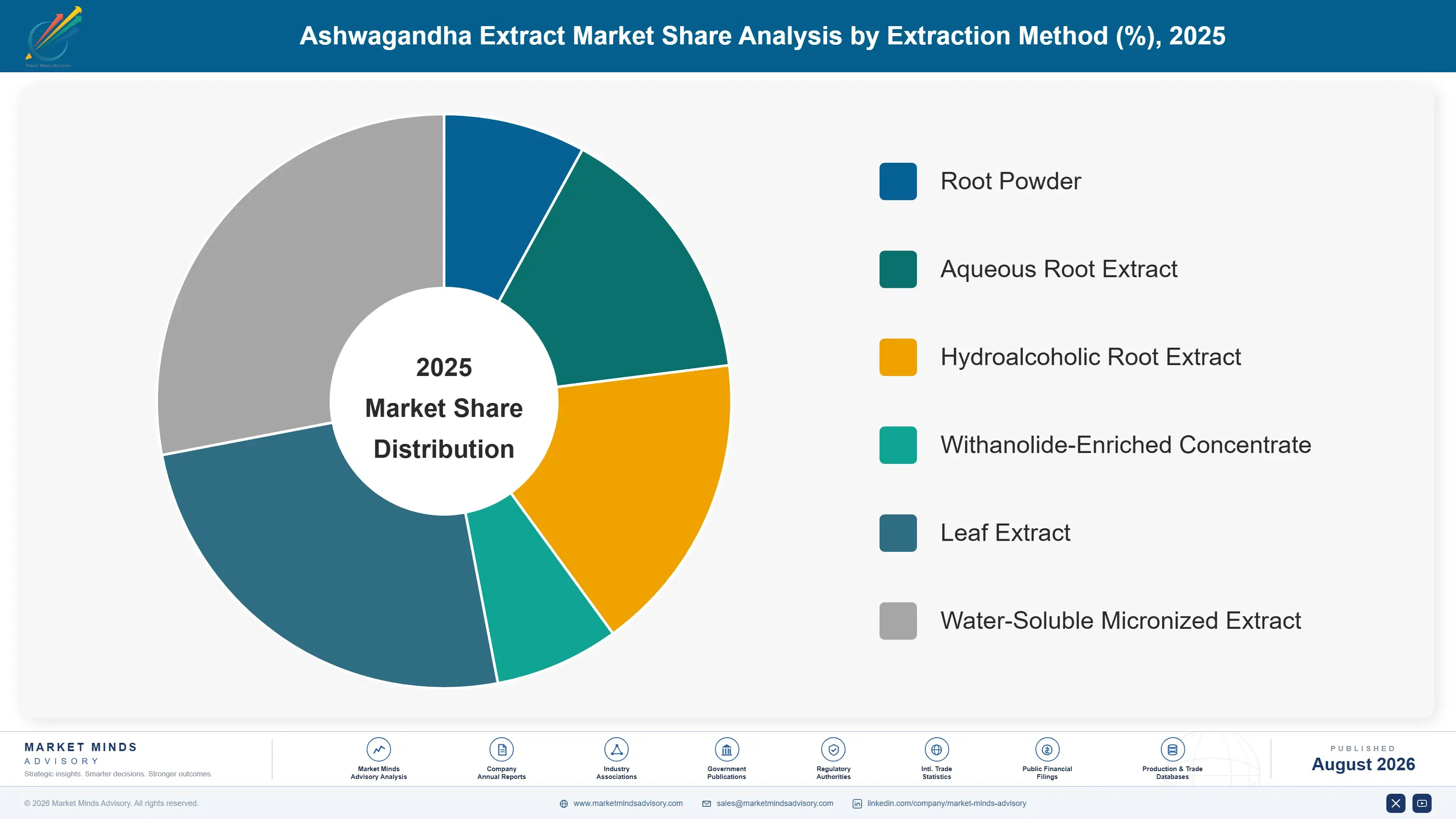
Ashwagandha extract is segmented by extraction and standardization method, the classification that determines potency documentation, cost structure, and target application: root powder, aqueous root extract, hydroalcoholic root extract, withanolide-enriched concentrate, leaf extract, and water-soluble micronized extract each serve distinct supplement, beverage, and cosmetic buyers, avoiding the overlap a brand-based split would create, a distinction buyers rarely revisit once qualified.
ashwagandha-extract-market-trends-market-share-analysis-1787462622637

Withanolide-Enriched Concentrate

Withanolide-enriched concentrate, standardized to a guaranteed minimum withanolide percentage well above conventional extract, is the fastest-growing segment as brands chase documented, batch-consistent potency to differentiate from generic root powder amid rising consumer and regulatory scrutiny over labeled content accuracy. Ixoreal Biomed and Natreon both dominate this segment through patented extraction processes protected by trademark and patent protection that generic manufacturers cannot legally replicate. Brands increasingly specify these branded concentrates by name on packaging rather than listing generic ashwagandha extract, since consumer awareness of specific branded ingredients like KSM-66 has grown substantially through years of ingredient marketing investment. Production costs for concentrate remain meaningfully above standard extract, but premium retail pricing more than compensates suppliers with genuine potency verification capability.
CAGR 17.2%

Water-Soluble Micronized Extract

Water-soluble micronized extract, engineered to dissolve cleanly in beverages without the grittiness or bitterness that standard extract powder introduces, is scaling quickly as functional beverage brands add ashwagandha to ready-to-drink teas, sparkling adaptogen drinks, and coffee alternatives. This format requires specialized micronization processing that most conventional root powder or standard extract manufacturers have not invested in, concentrating this segment among a smaller number of technically capable suppliers. Beverage formulators report this format also masks ashwagandha's naturally bitter, earthy flavor profile more effectively than standard extract, an important consideration given how flavor-sensitive beverage consumers are relative to capsule or gummy supplement consumers. Adoption is accelerating fastest among beverage categories launched within the past two years specifically.
CAGR 15.6%
Full segment breakdown across 6 segments available in the complete report.

Regional Architecture and Country Demand Map

North America leads global ashwagandha extract demand by a wide margin, reflecting mainstream retail penetration through pharmacy chains and grocery stores, while South Asia and Pacific, anchored by India's cultivation and processing base, supplies much of the raw material feeding global supplement manufacturing across both hemispheres.

North America

The United States is by a wide margin the largest single consumer of ashwagandha extract, having moved the ingredient from specialty health store shelves into mainstream pharmacy chains, grocery stores, and direct-to-consumer supplement brands within just a few years. Ixoreal Biomed and Natreon both maintain significant US commercial operations supporting brand customers directly, reflecting how central this market is to their overall business. Canadian supplement retailers have followed similar mainstream adoption patterns slightly behind the US timeline. Regulatory attention is also concentrated here first, since several US state attorneys general have opened inquiries into labeled withanolide content accuracy following independent testing studies that found meaningful potency shortfalls in tested products.
Share: 30% | CAGR: 14.2% (2026 to 2036)

Western Europe

Germany and the United Kingdom anchor Western European demand, though adoption trails North America meaningfully given stricter novel food and health claim regulations governing botanical supplement marketing across the European Union. France's pharmacy-centric supplement retail channel has been slower to embrace ashwagandha relative to grocery and mass retail channels seen in North America. The European Food Safety Authority's more conservative stance on unauthorized health claims has limited how aggressively brands can market stress and sleep benefits compared with US marketing latitude. Growth here trails the global average because regulatory caution is slowing the mainstream retail expansion seen elsewhere. Scandinavian markets are seeing early but fast-growing adoption through pharmacy and wellness e-commerce channels reaching health-conscious younger consumers.
Share: 20% | CAGR: 11.9% (2026 to 2036)
Regional intelligence for 5 additional markets available in the complete report: East Asia, South Asia and Pacific, Latin America, Middle East and Africa, Eastern Europe. Contact sales@marketmindsadvisory.com.
ashwagandha-extract-market-trends-country-cagr-analysis-1787462623162

Where Ashwagandha Suppliers Can Capture Margin

Margin capture in ashwagandha extract increasingly depends on documented potency verification and branded ingredient positioning rather than raw export volume. Suppliers that can guarantee withanolide content, secure clinical research backing, and build recognizable branded ingredient names are commanding meaningfully better pricing than those competing purely on cost per kilogram of generic root powder. That shift favors branded suppliers.

Branded, Clinically Studied Extract Ingredient Positioning

Suppliers that build a recognizable branded ingredient name backed by published clinical research, following the model Ixoreal Biomed established with KSM-66, are capturing premium pricing that generic standardized extract cannot command. Branded extracts like KSM-66 and Sensoril reportedly command a 3 to 5 times price premium per kilogram over generic standardized extract of comparable withanolide content. Building this positioning requires sustained investment in clinical trials and ingredient marketing over multiple years, a barrier that has kept this higher-margin segment concentrated among a small number of established branded ingredient suppliers rather than newer entrants.
Market Impact: Commands a 3 to 5 times price premium

Third-Party Potency Certification for Retail Trust

Suppliers that certify withanolide content through independent third-party testing, publishing certificates of analysis customers and retailers can verify directly, are capturing premium pricing from brands facing growing retailer and regulatory scrutiny over labeled potency accuracy. Following widely reported independent testing that found some products contained under 50 percent of labeled withanolide content, several major retailers began requiring certificates of analysis before accepting new ashwagandha SKUs starting in 2024. Suppliers without in-house or accredited third-party testing capability are increasingly losing shelf placements to certified competitors, even when raw material pricing is otherwise comparable.
Market Impact: Avoids delisting risk tied to under-50% potency tests

Water-Soluble Formats for Functional Beverage Brands

Investing in water-soluble micronized extraction technology, which dissolves cleanly in beverages without gritty texture or bitter aftertaste, lets suppliers serve the fast-growing functional beverage category that standard extract powder cannot easily access. This specialized processing typically adds 15 to 20 percent to production cost compared with standard extract, but functional beverage brands pay a meaningful premium for a format that performs reliably in their specific application. At least a dozen new functional beverage brands launched ashwagandha products in 2025 alone, and suppliers with established water-soluble capability are winning the majority of new beverage formulation contracts.
Market Impact: Adds 15 to 20 percent processing cost recovered

Bundled Clinical Substantiation and Regulatory Support

Bundling access to existing clinical trial data and regulatory documentation support alongside the physical extract sale helps smaller supplement brands that lack in-house scientific and regulatory teams substantiate marketing claims confidently. Suppliers offering this bundled service report shortened customer time-to-market by several weeks on new product launches, since brands avoid commissioning duplicate clinical research their extract supplier has already funded. This service layer also raises effective per-kilogram pricing by an estimated 10 to 15 percent, since brands otherwise face substantiation costs that can run into six figures if commissioned independently.
Market Impact: Raises effective pricing by 10 to 15 percent

Who Controls the Margin Pool

Five suppliers hold just over a third of global ashwagandha extract capacity on a production-volume basis, leaving considerable room for both branded extract leaders and countless smaller Indian processors selling unstandardized material. The gap between branded, clinically studied extract suppliers and generic root powder exporters is wide on price and margin, even though both sell under the same botanical category name.
Current competitive activity centers on three fronts: branded ingredient marketing backed by clinical research to command premium pricing, third-party potency certification to win retailer trust amid growing scrutiny, and water-soluble format innovation to capture functional beverage demand. Ixoreal Biomed and Natreon have both continued investing in clinical research and certification infrastructure specifically to defend their branded positioning against generic competition.

Emerging pressure is coming from regulatory scrutiny itself, which could reshape rankings faster than any competitive move: state attorneys general and European regulators investigating labeled potency accuracy could force smaller, uncertified processors out of major retail channels within a few years. Rankings could also shift if a well-funded new entrant successfully challenges Ixoreal Biomed's KSM-66 patents or builds comparable clinical research backing for a competing branded extract.
ashwagandha-extract-market-trends-company-positioning-matrix-1787462623692

Competitive Moat and Risk Dimensions

IXOREAL BIOMED

Moat: Patented KSM-66 Clinical Research Base

Ixoreal Biomed built KSM-66 into the most recognized branded ashwagandha ingredient globally through sustained investment in patented extraction technology and published clinical research spanning stress, sleep, and cognitive claims. That combination lets the company command premium pricing and secure formulation slots that generic standardized extract suppliers simply cannot access, regardless of their raw material cost advantage.
IXOREAL BIOMED

Risk: Patent Expiration and Generic Entry

As KSM-66's underlying patents approach expiration in various jurisdictions over the coming years, generic manufacturers could begin replicating the extraction process without the licensing costs Ixoreal Biomed currently commands. The company's premium pricing model depends heavily on maintaining perceived differentiation once formal patent protection lapses, a transition several established branded ingredient categories have navigated with mixed commercial results.
NATREON INC

Moat: Established Sensoril Clinical Trial Portfolio

Natreon's Sensoril extract benefits from one of the longer clinical research histories in the category, giving the company a differentiated claims portfolio, particularly around cortisol reduction, that newer branded entrants have not yet matched. This research depth supports premium pricing and gives formulation customers confidence in substantiated marketing claims.
NATREON INC

Risk: Smaller Scale Than Category Leader

Natreon operates at meaningfully smaller scale than Ixoreal Biomed's KSM-66 business, limiting its marketing budget and brand-building investment relative to the category leader. As mainstream retail buyers increasingly default to the most recognized branded ingredient name, Natreon risks losing formulation slots to KSM-66 even in categories where Sensoril's clinical data is comparably strong.

Players Tracked

Prominent Players

Ixoreal Biomed
Natreon Inc
Arjuna Natural
Sabinsa Corporation
Verdure Sciences

Other Key Players

Nutra Green Biotechnology
Xi'an Sost Biotech
Now Health Group
Indena
Naturex
Amsar Pvt Ltd
Aum Ingredients
Vidya Herbs
Herbo Nutra
Bioprex Labs
PLT Health Solutions
Synthite Industries
Nektium
Martin Bauer Group
Kanchan Aroma Ingredients

Recent Developments

AUGUST 2024

Independent Testing Study Finds Widespread Potency Shortfalls

An independent laboratory testing study published in August 2024 found that a meaningful share of commercially available ashwagandha supplements contained withanolide content significantly below labeled amounts, drawing rapid media attention and prompting several US state attorneys general to open inquiries into labeling accuracy across multiple brands.
Signal: Signals third-party potency verification is shifting from a marketing advantage to a baseline market access requirement quickly.
FEBRUARY 2025

Major Retailers Require Certificates of Analysis

Several major US retailers began requiring certificates of analysis confirming labeled withanolide content before accepting new ashwagandha supplement SKUs starting in February 2025, directly responding to the prior year's independent testing findings and mounting consumer and regulatory pressure over labeling accuracy industry-wide. Analysts expect other retailers to follow quickly.
Signal: Signals retailers are taking on an enforcement role regulators have not yet formally established themselves industry-wide.
MAY 2024

Ixoreal Biomed Expands KSM-66 Clinical Research Portfolio

Ixoreal Biomed announced expanded clinical research investment for its branded KSM-66 ingredient in May 2024, funding additional randomized controlled trials examining cognitive performance and athletic recovery applications beyond the stress and sleep claims that built the ingredient's initial market position. Company executives called the expansion a long-term strategic priority.
Signal: Signals branded ingredient leaders are diversifying clinical claims to defend market position against emerging generic competition.

Root Cultivation and Extraction Cost Exposure

Raw ashwagandha root, sourced predominantly from smallholder and contracted farms in Madhya Pradesh and Rajasthan, accounts for roughly twenty-nine percent of total extraction production cost across the industry. Extraction and standardization processing, particularly for branded, patent-protected concentrate requiring specialized equipment and analytical testing infrastructure, adds a second significant cost layer that varies considerably depending on extract type and required potency documentation.
Indian root prices rose sharply during 2023 and 2024 as mainstream retail demand accelerated faster than smallholder cultivation could scale, according to industry trade reporting and processor disclosures, tightening available supply for both branded and generic extract manufacturers simultaneously. Processors without long-term farmer contracts faced the steepest cost increases, since spot-market root purchases became considerably more expensive as demand outpaced available harvest volume across the concentrated growing regions supplying most global material.

Smaller processors relying on open-market smallholder aggregation carry meaningfully more cost and supply-consistency exposure than larger, vertically integrated suppliers like Ixoreal Biomed that maintain direct, long-term farmer contracts. Branded extract manufacturers with established clinical research investments also face outsized reputational exposure if root shortages force cost-cutting that compromises the potency consistency their published clinical trials depend on.
ashwagandha-extract-market-trends-cost-volatility-analysis-1787462623890

Contract-Farm Root Directly With Indian Growers

Larger processors are shifting away from open-market smallholder aggregation toward direct, multi-year contract farming arrangements with Indian growers, securing more predictable root supply and pricing ahead of continued mainstream demand growth. This approach requires upfront investment in farmer relationships but has measurably reduced input cost volatility for suppliers that implemented it before the 2023 to 2024 price increases.

Pilot Cultivation Trials Outside India

Several processors are beginning pilot ashwagandha cultivation trials in countries beyond India with suitable growing conditions, aiming to diversify geographic concentration risk that currently leaves the entire global supply chain dependent on a small number of Indian growing regions. These trials remain small-scale but could meaningfully reduce single-country dependence over the coming decade if successful.

Invest in Yield-Improving Cultivation Practices

Processors and agricultural partners are investing in improved seed varieties and cultivation practices aimed at increasing per-acre withanolide yield, potentially reducing the acreage needed to meet growing demand without proportionally increasing land and water resource pressure. Early results suggest meaningful yield improvements are achievable, though widespread adoption across smallholder farms will take years to materialize fully.

Portfolio Architecture for Margin Defence

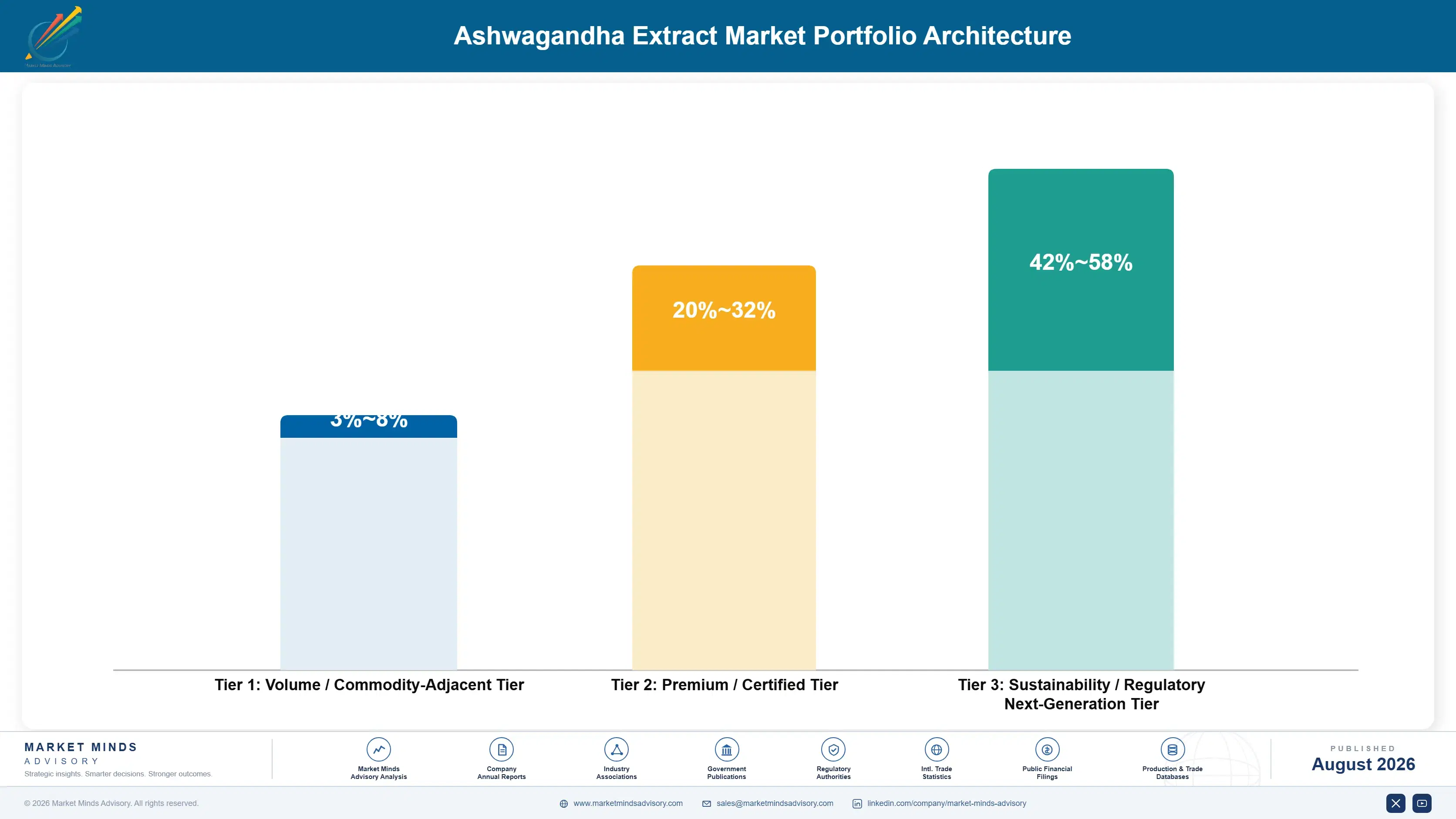
Ashwagandha suppliers operate a three-tier portfolio spanning commodity root powder sold largely on cost per kilogram, standardized extract commanding premium pricing on documented withanolide content, and branded, clinically studied concentrate positioned for the highest-margin premium supplement and functional beverage accounts. Gross margins vary enormously across these tiers, from thin single digits on commodity root powder to well above forty-five percent on branded, patent-protected concentrate sold directly to premium supplement brands.
The volume versus premium tension is sharpening as more suppliers chase branded concentrate margins, but commodity root powder still represents meaningful shipped volume and remains important for covering fixed cultivation and processing costs during the industry's continued mainstream demand expansion. Suppliers that abandon commodity volume too quickly in pursuit of premium accounts risk losing scale advantages built over years of cultivation investment.

High-value margin pools concentrate specifically in branded, clinically studied concentrate sold directly to premium supplement and functional beverage brands, and in certified standardized extract supplying retailers now requiring documented potency verification before shelf placement. Commodity root powder remains the volume anchor but carries the thinnest margins and the greatest reputational risk exposure in the entire category.

Volume / Commodity-Adjacent Tier

Commodity root powder sold primarily on cost per kilogram without independent withanolide verification, competing mainly on price into private-label and lower-tier retail channels where potency documentation is not consistently required.
Gross Margin: 3-8%

Premium / Certified Tier

Standardized extract certified to a guaranteed minimum withanolide percentage through third-party testing, sold into mainstream retail supplement brands facing growing regulatory and retailer documentation requirements Pricing sits meaningfully above commodity root powder but below branded, patent-protected concentrate.
Gross Margin: 20-32%

Sustainability / Regulatory / Next-Generation Tier

Branded, clinically studied concentrate such as KSM-66 and Sensoril, backed by published research and patent-protected extraction processes, positioned for premium supplement and functional beverage brands paying the category's highest per-kilogram prices.
Gross Margin: 42-58%
ashwagandha-extract-market-trends-portfolio-architecture-1787462624383

High-value Sub-segments and Strategic Watch-out

Branded Clinical-Grade Concentrate

Patent-protected, clinically studied branded concentrate is capturing the highest margins in the category as brands increasingly specify these ingredients by name on packaging, and established leaders like Ixoreal Biomed and Natreon continue expanding clinical research to defend this premium positioning against emerging generic competition at scale globally.
Gross Margin: 42-58%

Water-Soluble Beverage-Grade Extract

Water-soluble micronized extract engineered for functional beverage applications is scaling quickly as adaptogen drinks and ready-to-drink teas proliferate, though specialized processing requirements currently limit this segment to a smaller number of technically capable suppliers. Adoption should broaden as micronization equipment costs decline over the next several years.
Gross Margin: 25-38%

Standardized Commodity Extract

Standardized extract without branded positioning or extensive clinical backing remains the category's volume core, serving mainstream retail brands that want documented potency without paying premium branded ingredient pricing. Most suppliers in this tier compete primarily on price and reliable, consistent supply rather than marketing differentiation.
Gross Margin: 20-32%

Unverified Root Powder

Root powder sold without independent withanolide verification faces rising regulatory and retailer scrutiny following widely publicized potency shortfall findings, making this a segment suppliers and brands should actively move away from quickly. Several brands still sourcing this way have already faced retailer delisting within the past year.
Gross Margin: 1-6%

Ashwagandha's Retail Shelf Lock-In Economics

Ashwagandha extract behaves differently from most annuity ingredients because mainstream retail adoption happened so recently that most brand-supplier relationships remain young rather than deeply entrenched, leaving meaningful room for supplier switching if potency or certification concerns arise. That said, branded ingredients like KSM-66 and Sensoril do generate genuine lock-in once a brand builds marketing claims and packaging around a specific patented ingredient name, since switching requires new substantiation and repackaging investment.
Adoption depth varies by end-use vertical. Mainstream retail and pharmacy channel brands adopted standardized and branded extract relatively quickly once distribution expanded, chasing documented claims that justify premium shelf pricing, while functional beverage formulators are still in an earlier adoption phase, working through water-soluble format technical requirements before committing to large-scale reformulation across their existing beverage product lines.

Generational buyer shifts are visible mainly in the direct-to-consumer and social-media-driven brand segment, where younger brand founders favor branded, clinically documented extract specifically for its marketing substantiation value, while legacy vitamin and mineral supplement manufacturers have been slower to add ashwagandha, still evaluating category durability before committing significant shelf space and marketing investment to an unproven ingredient category.
ashwagandha-extract-market-trends-end-use-penetration-index-1787462624879

Where Ashwagandha Value Concentrates

These are among the four positions where our research anticipates prominent divergence between winners and laggards over the coming forecast period. Each is grounded in the demand model, the regulatory perimeter, and the announced capacity pipeline.
01 / POTENCY VERIFICATION INVESTMENT

Third-party certification will separate durable brands from delisting risk

Independent testing has repeatedly found meaningful potency shortfalls across commercially available ashwagandha products, and major retailers have begun requiring certificates of analysis before accepting new SKUs as a direct response. Brands and suppliers without verified, documented withanolide content face real delisting and reputational risk regardless of how competitive their pricing looks today, since the category's credibility problem affects every unverified product on shelf. MMA recommends investing in third-party certification now, before verification becomes a baseline retail requirement rather than a competitive advantage worth paying for.
02 / BRANDED INGREDIENT POSITIONING

Build branded, clinically backed positioning ahead of commoditization

Branded extracts like KSM-66 and Sensoril command a multiple of generic standardized extract pricing, and that premium is sustained by years of clinical research investment competitors cannot easily replicate quickly. As mainstream retail continues expanding, brands and ingredient suppliers without a differentiated, clinically substantiated positioning risk being pushed toward commodity pricing as more standardized extract enters the market. MMA recommends suppliers with sufficient resources invest in dedicated clinical research now, before the category matures further and branded differentiation becomes harder to establish.
03 / WATER-SOLUBLE FORMAT DEVELOPMENT

Develop water-soluble formats ahead of beverage category growth

Functional beverage brands are adopting ashwagandha faster than almost any other application category, and water-soluble micronized extract formats are essential for beverage applications that standard extract powder cannot serve adequately. Specialized micronization processing currently limits this capability to a smaller number of technically capable suppliers, creating a meaningful first-mover advantage for those already invested in the technology. MMA recommends suppliers without water-soluble capability evaluate investment now, while functional beverage formulation contracts remain available to a limited supplier pool willing to commit resources early.
04 / INDIAN SUPPLY DIVERSIFICATION

Diversify cultivation geography ahead of concentration risk

Ashwagandha cultivation remains heavily concentrated in a small number of Indian growing regions, exposing the entire global supply chain to weather, pest, and agricultural policy risk specific to that geography. Rising mainstream demand is already tightening available root supply and pushing prices higher, a pressure that will intensify further as retail adoption continues expanding across new markets. MMA recommends processors and brand customers begin evaluating cultivation diversification now, before geographic concentration risk translates into a supply disruption that affects the entire category simultaneously.

Engagement Snapshot From the Field

A live engagement with an industry participant carrying material or product regulatory and market exposure ahead of a defining policy shift, showing how our research translates into a defensible multi-year portfolio strategy.
MARKET MINDS ADVISORY · CLIENT ENGAGEMENT SUMMARY
Ashwagandha Extract Producer Strategic Portfolio Review and Transition Roadmap 2026·Investment Scenario on Ashwagandha Extract Exposure Evaluation 2025-26
CLIENT PROFILE
The client is a mid-sized North American dietary supplement brand generating an estimated seventy-five million dollars in annual revenue (client-reported, unverified by MMA), with its flagship product built around a stress-relief ashwagandha formulation. The client had sourced generic standardized extract from a single Indian supplier for over three years when an independent industry testing study raised concerns about potency shortfalls in ashwagandha products more broadly.
STRATEGIC CHALLENGE
Two major retail partners informed the client that continued shelf placement required third-party certificates of analysis confirming labeled withanolide content, a documentation standard the client's existing supplier could not reliably provide on a consistent basis. The client faced a choice between reformulating around a certified branded extract under a tight timeline or risking delisting from its two largest retail accounts.
MMA APPROACH
MMA conducted a structured evaluation of three certified extract suppliers, including two branded ingredient providers, benchmarking clinical research depth, certification documentation, and pricing against the client's existing formulation and retailer-mandated compliance timeline. The engagement included direct supplier reference calls and a formulation feasibility review confirming the recommended replacement would not require reformulating the client's other product ingredients.
KEY FINDINGS
  1. The incumbent supplier's potency documentation relied on self-reported testing rather than accredited third-party verification, a gap that had gone unaddressed for over three years of continuous supply.
  2. Switching to a branded, certified extract added roughly twenty-two percent to per-kilogram ingredient cost but eliminated the delisting risk entirely within the retailer's required documentation window.
  3. One of the three evaluated suppliers could not provide batch-level certificates of analysis within the timeline the client's retail partners required, disqualifying it despite competitive pricing.
  4. The client's new branded extract relationship also enabled stronger marketing claims tied to published clinical research, measurably improving conversion rates (client-reported, unverified by MMA).
CLIENT PROFILE
The client is a mid-sized North American dietary supplement brand generating an estimated seventy-five million dollars in annual revenue (client-reported, unverified by MMA), with its flagship product built around a stress-relief ashwagandha formulation. The client had sourced generic standardized extract from a single Indian supplier for over three years when an independent industry testing study raised concerns about potency shortfalls in ashwagandha products more broadly.
STRATEGIC CHALLENGE
Two major retail partners informed the client that continued shelf placement required third-party certificates of analysis confirming labeled withanolide content, a documentation standard the client's existing supplier could not reliably provide on a consistent basis. The client faced a choice between reformulating around a certified branded extract under a tight timeline or risking delisting from its two largest retail accounts.
MMA APPROACH
MMA conducted a structured evaluation of three certified extract suppliers, including two branded ingredient providers, benchmarking clinical research depth, certification documentation, and pricing against the client's existing formulation and retailer-mandated compliance timeline. The engagement included direct supplier reference calls and a formulation feasibility review confirming the recommended replacement would not require reformulating the client's other product ingredients.
KEY FINDINGS
  1. The incumbent supplier's potency documentation relied on self-reported testing rather than accredited third-party verification, a gap that had gone unaddressed for over three years of continuous supply.
  2. Switching to a branded, certified extract added roughly twenty-two percent to per-kilogram ingredient cost but eliminated the delisting risk entirely within the retailer's required documentation window.
  3. One of the three evaluated suppliers could not provide batch-level certificates of analysis within the timeline the client's retail partners required, disqualifying it despite competitive pricing.
  4. The client's new branded extract relationship also enabled stronger marketing claims tied to published clinical research, measurably improving conversion rates (client-reported, unverified by MMA).
RECOMMENDED STRATEGY
Phase 1: Phase 1 (Weeks 1 to 3): Benchmark three certified extract suppliers against clinical research depth, documentation, and pricing requirements ahead of the compliance deadline. Phase 2: Phase 2 (Weeks 4 to 6): Confirm formulation feasibility with the top two suppliers and negotiate transition pricing and timelines. Phase 3: Phase 3 (Weeks 7 to 10): Execute supplier transition, submit updated certificates of analysis, and retain shelf placement at both retail accounts.
OUTCOME
The client retained shelf placement at both retail accounts and avoided an estimated nine million dollars in annual revenue exposure from potential delisting (client-reported, unverified by MMA). The new branded extract relationship also strengthened the client's marketing claims, contributing to measurable sales growth within two quarters of the transition.

Frequently Asked Questions

Foundational context covering the market sizes, CAGR, scope, country, region and competition that inform every finding below. This section is provided to cover basics and most often pre-purchase conversations, answered from the MMA Primary Research Dataset.

What is the current size of the Ashwagandha Extract Market?

The global ashwagandha extract market is valued at approximately $0.72 billion in 2025. Growth is driven by mainstream retail expansion alongside rising clinical research supporting stress and sleep claims.

How large will the Ashwagandha Extract Market be by 2036?

MMA projects the market will reach approximately $2.87 billion by 2036, more than 3.5 times its 2026 base value. Withanolide-enriched concentrate will account for a growing share of that expansion.

What is the CAGR for the Ashwagandha Extract Market 2026 to 2036?

The market is expected to grow at a compound annual growth rate of 13.4% between 2026 and 2036. Bull and bear scenarios range from 12.0% to 14.8% depending on regulatory and supply conditions.

Which segment is growing fastest?

Withanolide-enriched concentrate is the fastest-growing segment, expanding at roughly 17.2% annually, about 1.3 times the overall market rate. Brands increasingly specify branded concentrate for documented potency.

Who are the major companies in the Ashwagandha Extract Market?

Ixoreal Biomed, Natreon Inc, Arjuna Natural, Sabinsa Corporation, and Verdure Sciences lead global supply. The top five suppliers together hold just over a third of global capacity.

Which country is growing fastest?

India is growing fastest, as domestic processors scale standardized extraction capacity to meet both export demand and rapidly expanding domestic wellness consumption. Cultivation investment is reinforcing this growth.

Report Segmentation Architecture

The full report scope spans multiple orthogonal segmentation dimensions, with cross-tabulated demand data provided for each dimension pair. Coverage extends further to regional breakdowns, trend trajectories, and the competitive detail needed to support segment-level decision-making.

By Extraction Method

  • Root Powder
  • Aqueous Root Extract
  • Hydroalcoholic Root Extract
  • Withanolide-Enriched Concentrate
  • Leaf Extract
  • Water-Soluble Micronized Extract

By End-Use Industry

  • Dietary Supplements
  • Functional Food and Beverage
  • Cosmetics and Personal Care
  • Pharmaceuticals
  • Animal Nutrition

By Commercial Dimension

  • Branded Certified Extract
  • Standardized Generic Extract
  • Private Label Supply
  • Direct Brand Partnership

By Region

  • North America
  • Western Europe
  • East Asia
  • South Asia and Pacific
  • Latin America
  • Middle East and Africa
  • Eastern Europe

Scope, Methodology, and Coverage

Every figure in this report is reproducible from documented input assumptions. The scope below maps the historical period, the forecast horizon, the segmentation dimensions, and the countries covered, alongside the underlying primary and qualitative methodology.
Historical Period
2020 to 2025
Forecast Period
2026 to 2036
Base Year
2025 (USD billions; MMA Primary Research Dataset, August 2026)
Market Definition
The ashwagandha extract market covers standardized root extract, root powder, leaf extract, and withanolide-enriched concentrate derived from Withania somnifera, sold into dietary supplements, functional foods and beverages, and cosmetic applications for stress, sleep, and cognitive support claims. It excludes fresh or dried whole ashwagandha root sold without extraction or standardization processing, and excludes ashwagandha used in traditional Ayurvedic formulations that are not independently sold as an extract ingredient.
Quantitative Units
USD billions (current prices); metric tons of ashwagandha extract where applicable
Segmentation Dimensions
By Extraction Method; By End-Use Industry; By Commercial Dimension; By Region
Regions Covered
North America, Western Europe, East Asia, South Asia and Pacific, Latin America, Middle East and Africa, Eastern Europe
Countries Covered
USA, China, Germany, France, UK, Japan, South Korea, India, Australia, Canada, Brazil, Mexico, Indonesia, Vietnam, Thailand, Malaysia, UAE, Saudi Arabia, South Africa, Nigeria, Turkey, Poland, Netherlands, Italy, Spain, Sweden, Switzerland, Argentina, Colombia, Singapore, and additional markets relevant to this sector
Key Companies Profiled
Ixoreal Biomed, Natreon Inc, Arjuna Natural, Sabinsa Corporation, Verdure Sciences, Nutra Green Biotechnology, Xi'an Sost Biotech, Now Health Group, Indena, Naturex, Amsar Pvt Ltd, Aum Ingredients, Vidya Herbs, Herbo Nutra, Bioprex Labs, PLT Health Solutions, Synthite Industries, Nektium, Martin Bauer Group, Kanchan Aroma Ingredients
Quantitative Methodology
Primary survey, n=3,800 respondents, Q4 2025, six countries; demand-side model with trade association cross-validation
Qualitative Methodology
47 expert interviews, Q4 2025; applied to validate demand model assumptions, identify emerging dynamics, and assess competitive positioning
Report Format
PDF and XLSX data workbook (Word format preview document)
Publisher
Market Minds Advisory
Report Code
MMA-2026-AGR-104
Published
August 2026
Contact
sales@marketmindsadvisory.com | www.marketmindsadvisory.com

Purchase the full Ashwagandha Extract Market Report (2026 to 2036).

This report delivers a complete assessment of the global ashwagandha extract market across all major extraction methods, end-use industries, and geographic regions through 2036. It includes detailed competitive profiling of twenty companies, segmentation analysis distinguishing root powder, standardized extract, withanolide-enriched concentrate, leaf extract, and water-soluble formats, and regional demand modeling across all seven MMA-covered geographies. Buyers will find quantified forecasts for market size, segment growth rates, and regional CAGR alongside qualitative analysis of potency verification trends, branded ingredient positioning, and cultivation supply risk. A dedicated revenue lever framework identifies four specific commercial actions suppliers can take to capture margin as mainstream retail demand accelerates.
Twenty-company competitive profiling with moat and risk analysis
Seven-region demand model with justified share and CAGR bands
Extraction-method segmentation across six MECE categories
Quantified revenue lever framework for margin capture strategies
Potency verification and cultivation risk exposure analysis
Anonymized case study on retailer certification transition

Built For The People Who Decide

From boardroom strategy to bench-side execution, this report is read cover-to-cover by leaders shaping the next decade of their industry, turning demand scenarios, market dynamics and valuation benchmarks into decisions.
CXOs/ Presidents/ VPs/ Managers
M&A and Corporate Development
Strategy Teams and R&D Heads
Procurement and Product Directors
Regulatory and Compliance Leaders
Investor Relations and Equity Analysts