Market Minds Advisory
Aseptic IBC Market

Aseptic IBC Market: The Cold Chain Nobody Has To Run

Aseptic bulk shipping replaced frozen logistics for fruit and dairy intermediates, and the value now sits in liner barrier film and fitment sterility rather than in the drums or bins carrying them.

Lead Analyst

Published

September 2026

Make Smarter Decisions with Customized Research Insights

Request a free sample report and evaluate market opportunities, growth trends, and competitive dynamics relevant to your business needs.

2025 MARKET VALUE$1.4BMarket Size 2025
2036 FORECAST VALUE$3.1BBase Case , 2026 to 2036
CAGR 2026 TO 20367.4 %Bull 8.6% / Bear 6.2%
INCREMENTAL OPPORTUNITY$1.6BNet 10- year value creation
EXPANSION MULTIPLE2.07x2036 value over 2026 base
Strategic Levers
M&A Pipeline
Regional Outlook
Country Rankings
Competitive Intelligence
Segmental Deep-dive
Call-Us : 91 93563 13602

Executive Snapshot and Market Trajectory

Every aseptic IBC sold is a refrigeration bill someone decided not to pay. Shipping mango pulp or tomato paste at ambient temperature instead of frozen is the entire proposition, and it holds whenever energy costs more than sterility does. That calculation has moved decisively.
Demand concentrates in East Asia at 30% of value, because China ships more tomato paste and apple juice concentrate in aseptic bulk than any other origin. Collapsible composite IBCs grow at 11.1%, half again the market rate of 7.4%, as processors trade reusable steel for containers that fold flat on the return leg. Freight economics decide more of this market than packaging preference ever has. Empty return cost is the number buyers actually model.
Five suppliers hold 41% of packaging revenue, but the concentration that matters is in aseptic filling equipment, where three machine builders effectively decide which containers qualify. FDA and European Commission validation requirements make a switch expensive once a line is running. Sustainability pressure pushes toward reusable stainless, and sterility assurance pushes the opposite way. Both arguments are correct. The processors caught between them are buying both and hedging.
Market Definition
The market covers aseptic intermediate bulk containers and their sterile liner systems used to store and ship shelf-stable liquid and semi-liquid products between 200 and 1,500 litres, including bag-in-drum, bag-in-bin, rigid reusable and collapsible composite formats. Aseptic filling machinery, road tankers, flexitanks above 5,000 litres and retail-format aseptic cartons are excluded. Sterilisation chemicals and cleaning services fall outside scope.
Base Year Value
$1.4B in 2025 (MMA Primary Research Dataset, August 2026)
Forecast Period
2026 to 2036, eleven discrete annual values
CAGR
7.4% base case. Bull 8.6%. Bear 6.2%.
Fastest Growth Segment
Collapsible Composite IBCs: 11.1% CAGR
Fastest Growth Country
India: 11.8% CAGR
Fastest Growth Region
South Asia and Pacific: 9.6% CAGR
Largest Region
East Asia: 30% of 2025 global value
Market Leaders
Greif, Sealed Air, Schutz, Mauser Packaging Solutions, Goglio. Source: MMA Analysis based on disclosed packaging segment revenue, company annual reports 2025.
Primary Survey
n=3,800 procurement and R&D decision-makers, Q4 2025, six countries
Methodology
Demand-side build-up, cross-validated against public data, 47 expert interviews

Aseptic IBC Market Forecast Scenarios

aseptic-ibc-market-size-forecast-scenario-1787676779116
Growth between 2020 and 2025 ran at 6.2%, and the drivers were unglamorous. Ocean freight rates spiked, which made every kilogram of shipped water expensive and pushed processors toward concentrates in aseptic bulk. Energy prices did the same thing to frozen storage. Then rates normalised and volumes held anyway, because nobody rebuilds a cold chain they have already dismantled.
The 7.4% base case rests on three mechanisms. Fruit and vegetable processing capacity keeps moving toward growing regions, and origin processing requires aseptic bulk to reach distant customers without freezing. Single-use bioprocess containers are pulling pharmaceutical bulk handling away from stainless vessels, which adds a higher-value stream to the same supplier base. And retailer commitments on frozen-chain emissions are pushing branded food manufacturers to specify ambient intermediates where product quality permits it. None of the three needs a demand recovery to work.
The bull case at 8.6% turns on aseptic dairy intermediates scaling in South Asia, where milk powder currently absorbs volumes that ambient liquid concentrate could take. The bear case at 6.2% is a sterility failure at a major processor: one recall traced to liner integrity would slow specification changes across the industry for years. Both are live.

What The Bag Actually Has To Survive

An aseptic IBC has one job: keep a sterile product sterile for 18 months at ambient temperature, through handling that assumes nobody will be careful. The container itself is largely irrelevant to that. What matters is the barrier film, the fitment seal and whether the filling head can connect without breaking sterility, which is why suppliers who own liner technology capture value that drum makers never see.
FIVE-FIRM CONCENTRATION41%Share of packaging revenue held by leading suppliers
AVERAGE LINER PRICE$38Typical cost of an aseptic bag with fitment
TOP PRODUCING COUNTRYChina 27%Chinese share of global aseptic bulk container output
FILM COST SHARE46%Barrier film and fitment portion of liner COGS
TRADE INTENSITY68%Share of filled containers crossing at least one border
REUSABLE CONTAINER CYCLES42 tripsMedian service life of a rigid stainless aseptic container
Two container philosophies compete and neither is winning cleanly. Rigid stainless containers amortise across 42 trips and look unbeatable on cost per use, until you price the return leg and the cleaning validation. Collapsible composites fold to a fifth of their filled height and ship home cheaply, but they carry a new liner every cycle. The answer depends almost entirely on trade lane length.
Qualification is the real barrier and it has nothing to do with price. Changing liner supplier on a running aseptic line means revalidating sterility assurance, which takes months and risks a production window nobody wants to gamble. Suppliers know this. It is why aseptic liner pricing holds up in a packaging industry that otherwise renegotiates annually, and why new entrants struggle regardless of product quality.
"Everyone benchmarks the drum. The drum is the cheapest part of the system and the only part that has never caused a recall."
Director, Bulk Packaging and Cold Chain Practice · MMA Packaging Practice · August 2026

Market Trends

Collapsible Composites Displace Steel On Long Lanes

A stainless IBC returning empty from Rotterdam to Shanghai occupies the same slot as a full one and costs roughly the same to move. Collapsible composites fold to a fifth of that volume, and on lanes over 8,000 kilometres the return saving swamps the liner cost difference within two cycles. Processors shipping into Europe and North America switched first because their lanes are longest. Regional distribution still favours steel, where the container comes back on a truck that was going anyway and cleaning capacity already exists on site. Lane length decides it.
Market Impact: Removes 340,000 reefer container moves

Single-Use Bioprocess Containers Pull Aseptic Volume Upmarket

Biopharmaceutical manufacturers abandoned stainless bulk vessels for single-use bags across most upstream and fill-finish operations, and the containers holding them are close cousins of food-grade aseptic IBCs. The engineering is stricter: extractables testing, gamma irradiation validation, full material traceability. Prices run 15 to 20 times food equivalents for containers of similar volume. Several packaging suppliers have built dedicated pharmaceutical lines rather than trying to upgrade food capacity, because the cleanroom and documentation requirements do not retrofit onto an existing plant sensibly. The capital gate is high and it keeps the field small.
Market Impact: Saves 2,800 kWh per container

Market Opportunities and Growth Drivers

Origin Processing Shifts Fruit Volume Into Aseptic Bulk

Mango, guava and tomato increasingly get processed where they grow rather than where they are consumed, because pulp ships better than fruit and the labour is cheaper at origin. India's Ministry of Commerce reports processed fruit pulp exports growing well ahead of fresh fruit, and almost all of that volume moves in aseptic bulk. The same pattern runs in Brazil for orange and passionfruit, and in Xinjiang for tomato paste. Every tonne that switches from frozen drums to aseptic bulk removes a refrigerated container from the lane permanently. That switch does not reverse.
Market Impact: Delays supplier switching by 12 months

Frozen Chain Energy Cost Rewrites Intermediate Sourcing Decisions

A refrigerated container burns energy every hour it is powered, and IEA data on industrial refrigeration costs has made that line item visible to procurement teams who previously buried it in logistics. Ambient aseptic shipping eliminates it entirely. The comparison got sharper through the European energy crisis and has not softened since, because cold storage rates reset upward and stayed there. Food manufacturers now run the frozen-versus-aseptic calculation at every contract renewal rather than at plant design. Frequency of the question matters more than its answer. That shift in review cadence is permanent.
Market Impact: Affects 82% of liner volume

Market Restraints and Challenges

Sterility Validation Locks Processors Into Existing Suppliers

Switching aseptic liner supplier means revalidating the whole sterility assurance chain, and on a running line that costs production time nobody has budgeted. The root cause is regulatory: sterility is validated as a system, not as a component, so changing any part reopens the whole file. Commercially this suppresses price competition and keeps volumes with incumbents regardless of quality gains elsewhere. The mitigation participants are exploring is parallel qualification, running a second supplier on one line for 12 months before switching others. Most processors do it anyway. The alternative is paying incumbent prices forever.
Market Impact: Cuts return freight by 78%

Multilayer Barrier Films Resist Recycling At Scale

An aseptic liner is typically five or more layers of different polymers plus an aluminium foil barrier, and that construction is what keeps product sterile for 18 months. It is also close to unrecyclable through conventional streams. The root cause is functional: no mono-material film yet matches foil for oxygen barrier at the required shelf life. European packaging waste regulation is tightening around exactly this construction, and processors face reporting obligations they cannot currently satisfy. Metallised mono-material films are the mitigation under active trial, and shelf-life results remain short of foil. The gap is roughly 4 months.
Market Impact: Prices run 20 times higher
3 additional market trends, 4 additional growth drivers, and 2 additional restraints and challenges are covered in the full report. Contact sales@marketmindsadvisory.com to access the complete intelligence.

Segment CAGR and Growth Architecture

Segmentation follows container system architecture: how the product is contained, supported and handled, rather than what is inside it or who buys it. Six systems cover the market without overlap, from bag-in-drum through to single-use bioprocess containers. End-use industry and distribution route are treated as separate dimensions because both cut across every container type. The logic holds throughout.
aseptic-ibc-market-market-share-analysis-1787676779668

Collapsible Composite IBCs

A collapsible composite IBC is a corrugated or plastic sleeve on a pallet base, holding an aseptic liner, that folds flat when empty. It exists because the return leg is expensive and steel does not fold. Growth at 11.1%, half again the market rate of 7.4%, tracks long-haul aseptic trade almost exactly: Indian pulp into Europe, Chinese paste into North America, Brazilian juice concentrate everywhere. The weakness is stacking strength when filled, which limits vessel loading configurations and irritates freight forwarders. Suppliers have responded with reinforced corner posts rather than heavier walls, because weight is the other thing customers are paying to avoid. Every kilogram added undoes part of the saving.
CAGR 11.1%

Single-Use Pharmaceutical Bulk Containers

These are aseptic containers built to a different standard entirely: gamma-irradiated, extractables-tested, documented to a level that would astonish a fruit processor. Volumes are small and values are not, running 15 to 20 times food-grade equivalents per unit. Growth at 9.6% follows biologics manufacturing capacity, which keeps expanding in Ireland, Singapore and increasingly in China regardless of what happens to food packaging demand. The commercial attraction for suppliers is obvious. The barrier is equally obvious: cleanroom manufacturing, validated supply chains and a qualification process measured in years rather than months, which is why only a handful of packaging firms have made the crossing successfully. Most looked at it and stayed in food.
CAGR 9.6%
Full segment breakdown across 6 segments available in the complete report.

Regional Architecture and Country Demand Map

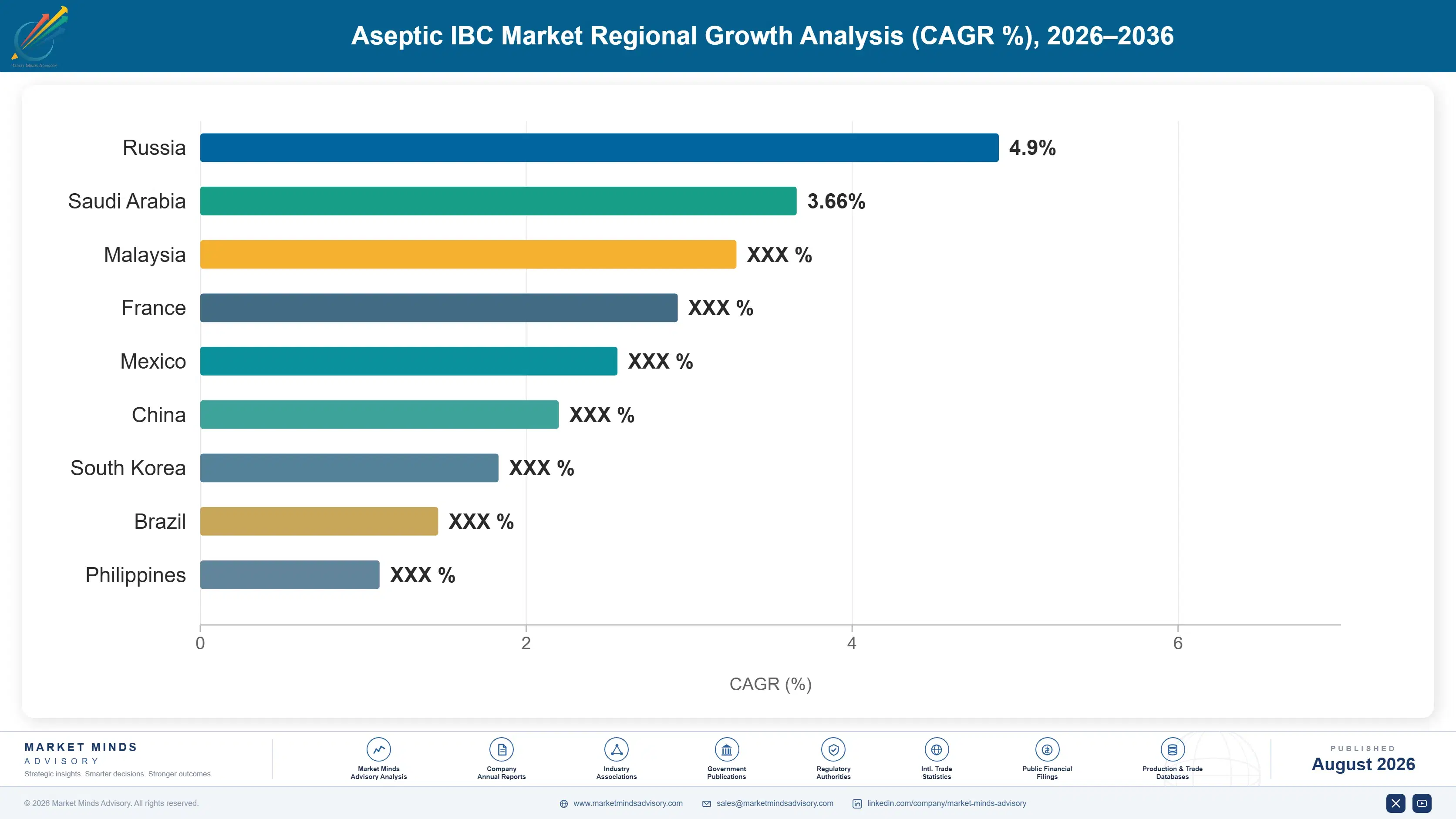
Geography tracks where liquid food gets processed rather than where it gets eaten, and those places are increasingly different. East Asia leads on Chinese tomato paste and apple concentrate output. South Asia grows fastest on fruit pulp exports, while Western Europe holds value share through pharmaceutical bulk containers.

North America

California processes tomatoes at a scale that rivals Xinjiang, and most of that paste moves in aseptic bulk to food manufacturers across the continent. Domestic lanes are short, which keeps rigid reusable containers competitive here longer than anywhere else. Pharmaceutical bulk containers add a second demand stream concentrated in North Carolina, Massachusetts and Indiana, where biologics capacity clusters. Mexican processing has grown quickly in mango, avocado and citrus intermediates for the United States market, running the same aseptic formats with shorter return legs. Canadian demand is thin, mostly maple and berry concentrates. FDA low-acid aseptic filing requirements shape specification more than customer preference does. Regulatory filing is the gate every new format must pass.
Share: 22% | CAGR: 6.6% (2026 to 2036)

Western Europe

European demand splits between importing and manufacturing. Italian and Spanish processors handle tomato, citrus and stone fruit at origin scale, filling aseptic bulk for export and for northern European food manufacturers. German and Dutch buyers sit at the other end, receiving pulp and concentrate from three continents and holding it ambient rather than frozen. The pharmaceutical layer is substantial: Irish and Swiss biologics plants consume single-use bulk containers at values that distort the region's revenue share upward relative to its volume. Packaging waste regulation is tighter here than anywhere, and multilayer liner construction is squarely in its path. Nobody has a compliant alternative yet. The deadline arrives before the technology does.
Share: 20% | CAGR: 5.9% (2026 to 2036)
Regional intelligence for 5 additional markets available in the complete report: East Asia, South Asia and Pacific, Latin America, Middle East and Africa, Eastern Europe. Contact sales@marketmindsadvisory.com.
aseptic-ibc-market-country-cagr-analysis-1787676780217

Getting Paid For The Liner

Container revenue is contested every tender. Liner revenue is validated, specified and difficult to move, which makes it worth several times more per dollar of sales. Four levers shift the mix in that direction, and each requires giving the customer something they will value more than the discount they were expecting instead. Discount is the easy answer.

Sell Validated Sterility Assurance Rather Than Containers

A processor buying containers negotiates on price per unit. A processor buying validated sterility assurance is buying insurance against a recall that would cost 200 times the annual packaging spend. The second conversation supports a premium of 12 to 18% and is far harder for a competitor to undercut, because undercutting requires matching the validation file. Suppliers who invested in documented process capability, batch traceability and audit support have moved customers onto this footing. Those who competed on film specification alone are still negotiating price every year, and losing a little each time.
Market Impact: Supports a price premium of 12 to 18%

Lease Container Fleets To Seasonal Fruit Processors

An Indian mango processor fills for six weeks and stores containers for 46. Owning that fleet is capital sitting idle, and processors know it. Leasing converts their capex into a per-fill charge and gives the supplier an asset earning across multiple seasons in different hemispheres. Utilisation is the whole business: a container running Indian mango then South African citrus then Brazilian passionfruit earns roughly 3 times what a single-season fleet does. The operational demand is real, requiring cleaning depots, tracking and repositioning logistics that most packaging suppliers have never run before.
Market Impact: Raises container asset utilisation by roughly 3 times annually

Qualify Pharmaceutical Grade Lines Beside Existing Food Capacity

Pharmaceutical bulk containers sell for 15 to 20 times food-grade equivalents, and the underlying technology is closer than the price gap suggests. What separates them is cleanroom manufacturing, gamma irradiation validation and documentation depth. A dedicated line costs a mid-sized supplier several million dollars and takes 2 years to qualify with a first customer. The suppliers who committed early now hold positions that are effectively unassailable, because a biologics manufacturer will not requalify a container supplier without a compelling reason. Late entrants face the same capital cost against a smaller remaining opportunity.
Market Impact: Prices at 15 to 20 times food grade

Bundle Filling Head Compatibility Into Liner Supply Agreements

The fitment where the filling head connects is the sterility-critical interface, and it is proprietary to each machine builder. Liner suppliers who license or co-develop fitments with the three main aseptic filler manufacturers become the default specification on those lines. Customers running a competitor's liner face connection risk they would rather not carry. This is worth roughly 8 points of share on every newly installed line, captured without a price concession. The cost is a development relationship with a machine builder who has their own commercial interests and no obligation to be exclusive.
Market Impact: Wins roughly 8 share points on each new line

Who Controls the Margin Pool

Measured on disclosed packaging segment revenue, the five largest suppliers hold a CR5 of 41%. That figure flatters the container side and understates the liner side, where two firms supply a disproportionate share of aseptic bag technology worldwide. Greif and Sealed Air sit ahead of the challenger group on both breadth and validated position, and the gap has widened through acquisition rather than through product development.
Competitive activity runs along three lines currently. Barrier film performance is the first, where suppliers compete on oxygen transmission rates and shelf-life claims that customers verify slowly and trust heavily. The second is fitment compatibility with aseptic filling machinery, a quieter contest fought through machine builder relationships rather than through customers. The third is geographic coverage, because a processor filling in three countries wants one qualified supplier rather than three separate validation files. Regional players struggle on exactly this point.

Pressure is arriving from film converters moving downstream. A company that already extrudes barrier film has most of what it needs to make liners, and several Asian converters have done exactly that. Rankings will shift wherever validation requirements are lightest, which means food before pharmaceutical, and regional trade before intercontinental.
aseptic-ibc-market-company-positioning-matrix-1787676780736

Competitive Moat and Risk Dimensions

GREIF

Moat: Integrated Liner And Container

Greif supplies both the rigid outer container and the aseptic liner inside it, which lets it guarantee the interface between the two rather than pointing at a partner when something fails. Processors buying a validated system rather than two components pay for that single point of accountability, and it is difficult to replicate without owning both manufacturing bases.
GREIF

Risk: Industrial Packaging Cycle Exposure

Aseptic sits inside a much larger industrial packaging business whose fortunes follow steel drum and containerboard demand. When that cycle turns down, capital allocation arguments inside the company get harder for a specialist product line to win, however attractive its margins. Competitors focused solely on aseptic face no such internal contest and can invest through the cycle.
SEALED AIR

Moat: Barrier Film Technology Depth

Sealed Air's position rests on decades of barrier film development that transfers into aseptic liner performance, backed by extrusion capacity most competitors have to buy from third parties. Owning the film means controlling oxygen transmission and shelf-life claims rather than inheriting them, and in a market where shelf life is the specification, that control is where the pricing power sits.
SEALED AIR

Risk: Limited Rigid Container Presence

Supplying the liner without the container leaves Sealed Air dependent on partners for the outer system, and processors increasingly want one supplier accountable for the whole assembly. That preference favours integrated competitors on new line qualifications. The exposure is manageable while liner technology stays differentiated, and becomes serious the moment barrier film performance converges across suppliers.

Players Tracked

Prominent Players

Greif
Sealed Air
Schutz
Mauser Packaging Solutions
Goglio

Other Key Players

Smurfit Westrock
Amcor
Sonoco Products
Berry Global
Sartorius
Thermo Fisher Scientific
Entegris
Snyder Industries
Hoover Ferguson
Time Technoplast
Nampak
CDF Corporation
TriMas Packaging
Bulk Lift International
Fujimori Kogyo

Recent Developments

FEBRUARY 2025

Greif expands aseptic liner production capacity at Netherlands facility

Greif commissioned additional aseptic liner capacity in the Netherlands, an organic expansion rather than an acquisition or joint venture. The stated driver was European food manufacturer demand for regionally supplied liners with shorter qualification lead times, alongside customer preference for supply that avoids intercontinental shipment of empty packaging.
Signal: Regional liner supply is becoming a specification requirement, not a logistics preference, which changes where capacity gets built.
JUNE 2025

Sealed Air signs multi-year liner supply agreement with Indian pulp processor group

Sealed Air entered a multi-year supply agreement covering aseptic liners for an Indian fruit pulp processing group. This was a supply agreement, not a joint venture or equity investment, and it includes joint qualification work on fitment compatibility with the group's installed European filling equipment.
Signal: Multi-year liner contracts at origin processors lock volume years ahead, which is how validation advantage converts into revenue.
SEPTEMBER 2025

Schutz opens reconditioning depot network for reusable aseptic containers in Southeast Asia

Schutz opened a reconditioning and cleaning depot network in Southeast Asia for reusable aseptic containers, funded organically. The facilities allow containers filled in Thailand and Vietnam to be cleaned, revalidated and returned to service regionally rather than shipped back to Europe between fills. Capacity came online in stages.
Signal: Depot networks decide whether reusable containers stay competitive on long lanes, and they are expensive to build.

What The Liner Costs To Make

Liner cost is dominated by film. Multilayer barrier structures, aluminium foil and the fitment together account for 44 to 47% of liner COGS, sourced from a narrow set of converters in Japan, Germany and increasingly Taiwan. Polyethylene and polyamide resin add roughly 19%, tracking oil-linked feedstock pricing. Container costs behave differently: steel, corrugated board and moulded plastic follow commodity indices with no specialty premium at all.
Aluminium is the input that has actually hurt. EIA and IEA energy data document the European smelter curtailments through 2022, when power costs made primary aluminium production uneconomic across several countries, and foil prices moved accordingly. Liner suppliers holding fixed-price contracts absorbed the difference for a full year. Amcor and Sonoco annual reports for the period describe recovering it through surcharge mechanisms rather than base price increases, which customers accepted precisely because the cause was documented and external.

Exposure splits by integration. Suppliers extruding their own film absorb resin volatility and control foil sourcing; those buying finished laminate take the move with a lag and no negotiating position. Small regional liner makers are worst placed, buying laminate at spot from converters who serve larger customers first. Scale is a supply guarantee, not a discount.
aseptic-ibc-market-cost-volatility-analysis-1787676780935

Index liner pricing to published aluminium and resin benchmarks

Surcharge mechanisms tied to published benchmarks remove the argument from the negotiation entirely. Customers dislike them until the first downward move, after which they become the preferred structure. The discipline is publishing the formula and applying it symmetrically, because a surcharge that only rises destroys the trust that made it acceptable in the first place.

Qualify a second foil source before it becomes urgent

Foil qualification for aseptic use takes months of barrier testing and shelf-life validation, which cannot be compressed when supply fails. Suppliers who qualified a second source during calm conditions had options in 2022. Those who started when prices moved discovered that qualification timelines and price spikes run on completely different clocks. The lesson cost real money.

Move toward metallised film where shelf life permits

Metallised polyester replaces aluminium foil in some applications and removes the smelter exposure entirely. Barrier performance is genuinely lower, so it works for products with 9 month requirements rather than 18. Mapping the customer base by actual shelf-life need, rather than by specified need, usually reveals more convertible volume than anyone expected. Specification drift runs one direction.

Portfolio Architecture for Margin Defence

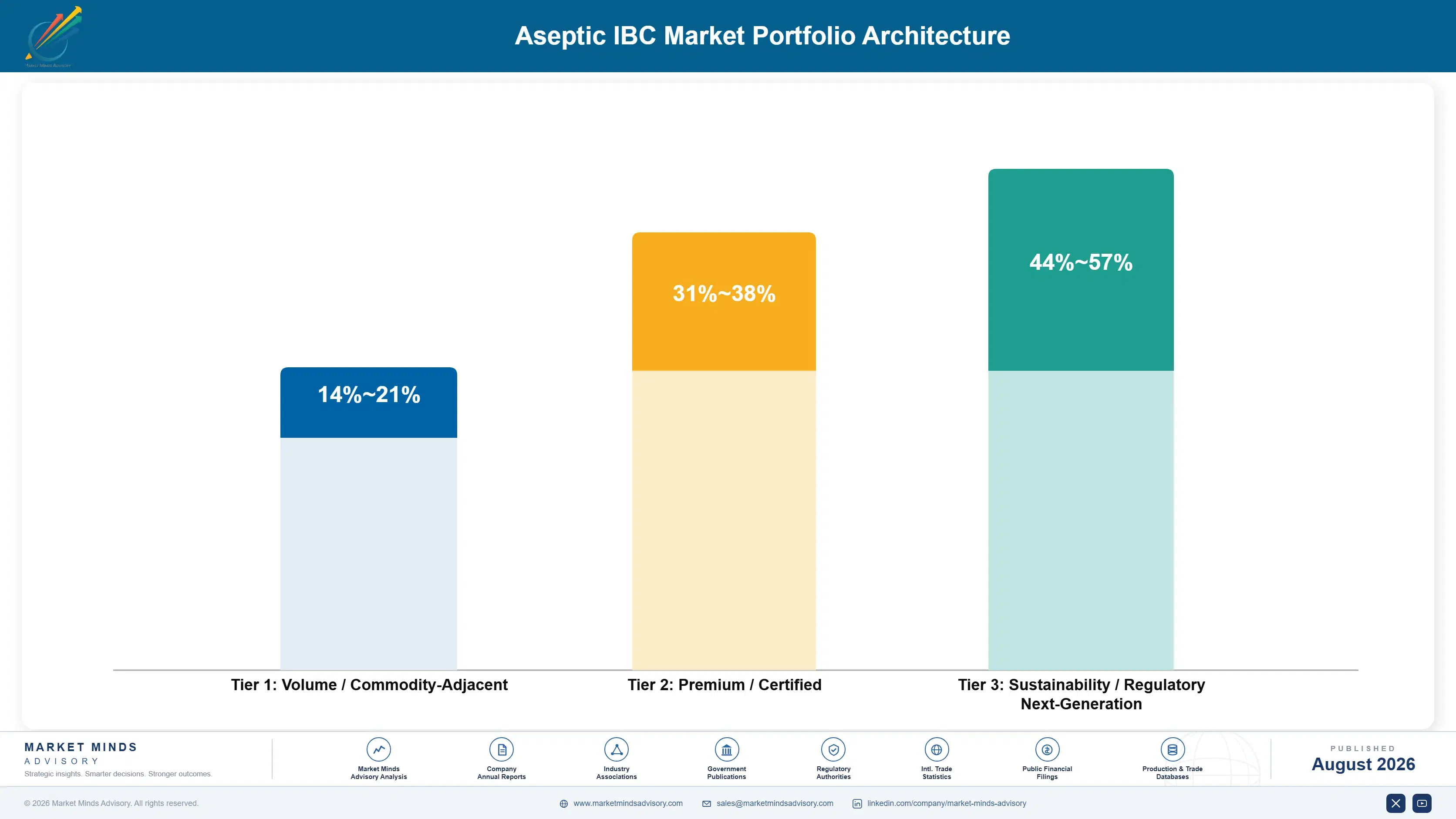
Margin structure here is defined by validation, not by material. A steel drum earns commodity margins because anyone can make one to specification. An aseptic liner qualified into a running pharmaceutical line earns four to five times that, because requalification costs the customer more than the price difference ever will. Everything else sits on that spectrum.
The tension is that volume containers and premium liners go into the same tender, on the same purchase order. Suppliers who discount the container to win the account then find the liner priced by reference to that concession. Separating the two commercially is the obvious answer and it is harder than it sounds, because procurement teams insist on a single quotation for the complete system. The suppliers holding liner margin are the ones who declined that request early and lost some accounts doing it.

High-value pools sit in three places. Pharmaceutical bulk containers, where qualification depth creates genuine pricing power. Fitment and dispensing systems, where compatibility with filling machinery is worth more than the component costs. And container leasing to seasonal processors, which converts a product sale into a utilisation business with entirely different economics. None of the three is where volume sits.

Volume / Commodity-Adjacent

Steel drums, corrugated sleeves, pallet bases and standard food-grade liners sold on annual tender. The 7-point range separates integrated producers making their own film from converters buying finished laminate. Pricing resets every year and rarely moves upward.
Gross Margin: 14-21%

Premium / Certified

Validated aseptic liner systems with documented sterility assurance, fitment compatibility and audit support. The 7-point spread reflects the difference between qualified food applications and those carrying extended shelf-life guarantees. Switching costs rather than product features hold this pricing in place.
Gross Margin: 31-38%

Sustainability / Regulatory / Next-Generation

Single-use pharmaceutical bulk containers, gamma-irradiated bioprocess bags and recyclable mono-material liner developments. The 13-point range is unusually wide because pharmaceutical qualification supports pricing that recyclable food formats cannot yet command, and both sit in this tier.
Gross Margin: 44-57%
aseptic-ibc-market-portfolio-architecture-1787676781469

High-value Sub-segments and Strategic Watch-out

Pharmaceutical Bulk Bioprocess Containers

Highest value and strong growth, tied to biologics manufacturing capacity rather than to food demand at all. Qualification barriers keep the field to a handful of suppliers and keep pricing firm. The risk is customer concentration: a small number of biologics manufacturers account for most volume.
Gross Margin: 52-55%

Validated Fitment And Dispensing Systems

High value with steady rather than spectacular growth, tracking aseptic filling line installations. Compatibility with machine builders is the moat and it is relationship-based rather than technical. Demand is tied to capital equipment cycles, which makes it lumpier than the liner business it accompanies. Forecasting it is genuinely hard.
Gross Margin: 40-43%

Standard Bag-In-Drum Systems

The volume core and the oldest format in the market, still carrying the largest share of tonnage moved. Competition is entirely on price and regional converters are taking share in Asia. Most established suppliers are managing this line for cash rather than for growth. Nobody is investing here.
Gross Margin: 15-18%

Multilayer Foil Barrier Liners

The strategic watch-out. Revenue is substantial and performance is unmatched, but European packaging waste regulation targets exactly this construction and no compliant alternative yet matches its shelf life. The risk is investing in foil capacity that regulation strands before the depreciation schedule finishes. Timing that call is the whole problem.
Gross Margin: 29-32%

Why Aseptic Volume Stays Put

Aseptic packaging generates repeat revenue with unusual reliability because the liner is consumed on every fill. A processor running 40,000 fills a year buys 40,000 liners a year, forever, and the container barely matters to that arithmetic. Over a ten-year line life, liner spend typically exceeds the original filling equipment investment several times over.
Stickiness varies by how much validation the end product carries. Pharmaceutical bulk containers essentially never change supplier, because a change means a regulatory filing amendment. Low-acid food applications sit close behind, since FDA process filings name the packaging system. High-acid fruit products are more flexible, and processors there do switch on price when the difference gets large enough. Beverage bases sit in the middle, where the brand owner's quality team has an opinion and the procurement team has a target.

The buyer profile is shifting from plant engineers to sustainability officers, and they ask different questions. The engineer wanted shelf life and fill reliability. The sustainability officer wants recycled content, recyclability and a carbon figure per container, and has authority to reject a specification the engineer already approved. Suppliers who can answer both are winning tenders that used to be decided on technical merit alone.
aseptic-ibc-market-end-use-penetration-index-1787676782053

Where The Margin Actually Lives

These are among the four positions where our research anticipates prominent divergence between winners and laggards over the coming forecast period. Each is grounded in the demand model, the regulatory perimeter, and the announced capacity pipeline.
01 / LINER VALUE CAPTURE

Own the liner, rent out the container

The container is a commodity that anyone with a press and a specification can make, while the liner carries the sterility assurance that a processor cannot afford to get wrong. Margin follows that distinction precisely, with validated liner systems earning four to five times what rigid containers return on the same revenue base. Capital committed to container manufacturing capacity earns less than the same capital committed to film extrusion, fitment development and validation infrastructure, and that gap has widened every year since 2020.
02 / PHARMACEUTICAL CROSSING DECISION

Commit to pharmaceutical bulk now or never

Single-use bioprocess containers price at 15 to 20 times food-grade equivalents and grow with biologics capacity that has no correlation to food demand cycles. The qualification barrier is measured in years and the capital requirement in millions, which means the window for entering is closing as incumbent positions harden with each customer qualification. A supplier that has not committed by 2028 will face the same investment against a materially smaller pool of unqualified customers, and against competitors who have already amortised theirs.
03 / BARRIER FILM TRANSITION

Plan for foil replacement before regulation forces it

European packaging waste regulation targets multilayer foil construction directly, and 82% of current liner volume uses exactly that structure with no compliant alternative matching its shelf life today. Metallised mono-material films close part of the gap but fall roughly 4 months short on the shelf-life guarantees that make aseptic bulk work commercially. The suppliers who map their customer base by actual rather than specified shelf-life need will find convertible volume earlier, and will convert it on their own timetable rather than the regulator's.
04 / SEASONAL FLEET ECONOMICS

Lease containers to processors who fill six weeks yearly

Seasonal fruit processors own container fleets that sit idle for 46 weeks a year, which is capital nobody defends when the alternative is explained clearly. A leased container rotating between Indian mango, South African citrus and Brazilian passionfruit earns roughly 3 times what a single-season fleet returns on the same asset. The operational demand is genuine, requiring depots, cleaning validation and repositioning capability, but it converts a contested product sale into a utilisation business competitors cannot easily copy or quickly build.

Engagement Snapshot From the Field

A live engagement with an industry participant carrying material or product regulatory and market exposure ahead of a defining policy shift, showing how our research translates into a defensible multi-year portfolio strategy.
MARKET MINDS ADVISORY · CLIENT ENGAGEMENT SUMMARY
Aseptic IBC Producer Strategic Portfolio Review and Transition Roadmap 2026·Investment Scenario on Aseptic IBC Exposure Evaluation 2025-26
CLIENT PROFILE
An Indian fruit pulp processing group operating four aseptic filling plants across Andhra Pradesh and Maharashtra, exporting mango, guava and tomato concentrate to buyers in Europe, the Gulf and East Asia. Annual revenue was reported at 210 million dollars (client-reported, unverified by MMA). The group filled approximately 96,000 aseptic containers a year, almost entirely in bag-in-drum format across a season lasting 11 weeks.
STRATEGIC CHALLENGE
European buyers had begun asking for packaging carbon data the group could not produce, and two had signalled preference for collapsible formats on freight emissions grounds. Switching format meant requalifying liners with three separate filling lines mid-season, which was impossible, or waiting a full year and risking contracts. Nobody internally owned the decision because it sat between operations and export sales.
MMA APPROACH
MMA modelled total delivered cost per tonne by format and destination lane rather than comparing packaging prices, which is how the group had been evaluating it. Nine expert interviews with European buyers established what packaging data those customers would actually require and by when. The analysis treated the filling line qualification calendar, not packaging cost, as the binding constraint on any transition.
KEY FINDINGS
  1. Collapsible composite formats cut delivered cost per tonne on European lanes by 9%, driven almost entirely by empty return freight rather than by any packaging price difference.
  2. Gulf and East Asian lanes showed no delivered-cost advantage for collapsible formats, because shorter distances and cheaper return legs removed the entire basis of the saving.
  3. Only one of the group's four plants had a filling line capable of running collapsible formats without mechanical modification, which nobody in the organisation had previously established.
  4. European buyers wanted packaging carbon data within 18 months but had no format requirement attached, meaning the reporting problem and the packaging problem were separate.
CLIENT PROFILE
An Indian fruit pulp processing group operating four aseptic filling plants across Andhra Pradesh and Maharashtra, exporting mango, guava and tomato concentrate to buyers in Europe, the Gulf and East Asia. Annual revenue was reported at 210 million dollars (client-reported, unverified by MMA). The group filled approximately 96,000 aseptic containers a year, almost entirely in bag-in-drum format across a season lasting 11 weeks.
STRATEGIC CHALLENGE
European buyers had begun asking for packaging carbon data the group could not produce, and two had signalled preference for collapsible formats on freight emissions grounds. Switching format meant requalifying liners with three separate filling lines mid-season, which was impossible, or waiting a full year and risking contracts. Nobody internally owned the decision because it sat between operations and export sales.
MMA APPROACH
MMA modelled total delivered cost per tonne by format and destination lane rather than comparing packaging prices, which is how the group had been evaluating it. Nine expert interviews with European buyers established what packaging data those customers would actually require and by when. The analysis treated the filling line qualification calendar, not packaging cost, as the binding constraint on any transition.
KEY FINDINGS
  1. Collapsible composite formats cut delivered cost per tonne on European lanes by 9%, driven almost entirely by empty return freight rather than by any packaging price difference.
  2. Gulf and East Asian lanes showed no delivered-cost advantage for collapsible formats, because shorter distances and cheaper return legs removed the entire basis of the saving.
  3. Only one of the group's four plants had a filling line capable of running collapsible formats without mechanical modification, which nobody in the organisation had previously established.
  4. European buyers wanted packaging carbon data within 18 months but had no format requirement attached, meaning the reporting problem and the packaging problem were separate.
RECOMMENDED STRATEGY
Phase 1: Phase one: build packaging carbon reporting from existing supplier data before changing any format, addressing the stated customer requirement immediately. Phase 2: Phase two: qualify collapsible formats on the single capable line during the off-season, serving European lanes only and leaving other destinations unchanged. Phase 3: Phase three: modify a second filling line only after two full seasons of European volume confirm the delivered-cost advantage holds at scale.
OUTCOME
The group produced packaging carbon reporting within seven months and retained both European accounts without changing format. Collapsible qualification on the single capable line completed before the following season, and delivered cost per tonne on European lanes fell 8% against the prior year (client-reported, unverified by MMA). The second line modification remains deferred pending volume confirmation.

Frequently Asked Questions

Foundational context covering the market sizes, CAGR, scope, country, region and competition that inform every finding below. This section is provided to cover basics and most often pre-purchase conversations, answered from the MMA Primary Research Dataset.

What is the current size of the Aseptic IBC Market?

The market was worth 1.4 billion dollars in 2025, covering aseptic intermediate bulk containers and their sterile liner systems. It reaches 1.5 billion dollars in 2026 on current forecasts.

How large will the Aseptic IBC Market be by 2036?

MMA forecasts 3.1 billion dollars by 2036, an increase of 1.6 billion dollars over the 2026 base. That represents an expansion multiple of 2.07 times across the forecast period.

What is the CAGR for the Aseptic IBC Market 2026 to 2036?

The base case compounds at 7.4% annually. MMA's bull case reaches 8.6% if aseptic dairy intermediates scale in South Asia, while the bear case sits at 6.2% following any major sterility failure.

Which segment is growing fastest?

Collapsible composite IBCs, at 11.1%, half again the market rate of 7.4%. Empty return freight cost on long trade lanes is what drives the switch away from rigid steel containers.

Who are the major companies in the Aseptic IBC Market?

Greif, Sealed Air, Schutz, Mauser Packaging Solutions and Goglio lead on disclosed packaging segment revenue. Amcor, Sonoco Products, Sartorius, Thermo Fisher Scientific and Time Technoplast compete strongly in specific formats.

Which country is growing fastest?

India at 11.8%, driven by mango and guava pulp exports that only work commercially at ambient temperature. Vietnam and Thailand follow on pineapple and coconut concentrate volumes.

Report Segmentation Architecture

The full report scope spans multiple orthogonal segmentation dimensions, with cross-tabulated demand data provided for each dimension pair. Coverage extends further to regional breakdowns, trend trajectories, and the competitive detail needed to support segment-level decision-making.

By Container System

  • Bag-in-Drum Aseptic Systems
  • Bag-in-Bin Aseptic Systems
  • Rigid Stainless Reusable IBCs
  • Collapsible Composite IBCs
  • Single-Use Pharmaceutical Bulk Containers
  • Semi-Rigid Plastic Aseptic IBCs

By End-Use Industry

  • Fruit and Vegetable Processing
  • Dairy and Beverage Intermediates
  • Biopharmaceutical Manufacturing
  • Sauces, Pastes and Culinary Bases
  • Nutraceutical and Functional Ingredients
  • Liquid Egg and Protein Intermediates

By Commercial Dimension

  • Direct Sale to Processor
  • Distributor and Converter Channel
  • Container Leasing and Pooling
  • Contract Filler Supplied
  • Machine Builder Bundled
  • Reconditioned Container Supply

By Region

  • North America
  • Western Europe
  • East Asia
  • South Asia and Pacific
  • Latin America
  • Middle East and Africa
  • Eastern Europe

Scope, Methodology, and Coverage

Every figure in this report is reproducible from documented input assumptions. The scope below maps the historical period, the forecast horizon, the segmentation dimensions, and the countries covered, alongside the underlying primary and qualitative methodology.
Historical Period
2020 to 2025
Forecast Period
2026 to 2036
Base Year
2025 (USD billions; MMA Primary Research Dataset, August 2026)
Market Definition
Scope covers aseptic intermediate bulk containers between 200 and 1,500 litres together with the sterile liner systems, fitments and closures that make them functional, across bag-in-drum, bag-in-bin, rigid stainless, collapsible composite, semi-rigid plastic and single-use pharmaceutical formats. Aseptic filling machinery, road and rail tankers, flexitanks above 5,000 litres and consumer-format aseptic cartons are excluded. Sterilant chemicals, container cleaning services and freight are outside the boundary.
Quantitative Units
USD billions (current prices); containers shipped; liners consumed; installed reusable fleet size; fill events per season
Segmentation Dimensions
By Container System; By End-Use Industry; By Commercial Dimension; By Region
Regions Covered
North America, Western Europe, East Asia, South Asia and Pacific, Latin America, Middle East and Africa, Eastern Europe
Countries Covered
USA, China, Germany, France, UK, Japan, South Korea, India, Brazil, Mexico, Italy, Spain, Poland, Saudi Arabia, South Africa
Key Companies Profiled
Greif, Sealed Air, Schutz, Mauser Packaging Solutions, Goglio, Smurfit Westrock, Amcor, Sonoco Products, Berry Global, Sartorius, Thermo Fisher Scientific, Entegris, Snyder Industries, Hoover Ferguson, Time Technoplast, Nampak, CDF Corporation, TriMas Packaging, Bulk Lift International, Fujimori Kogyo
Quantitative Methodology
Primary survey, n=3,800 respondents, Q4 2025, six countries; demand-side model with trade association cross-validation
Qualitative Methodology
47 expert interviews, Q4 2025; applied to validate demand model assumptions, identify emerging dynamics, and assess competitive positioning
Report Format
PDF and XLSX data workbook (Word format preview document)
Publisher
Market Minds Advisory
Report Code
MMA-2026-PAC-111
Published
August 2026
Contact
sales@marketmindsadvisory.com | www.marketmindsadvisory.com

Purchase the full Aseptic IBC Market Report (2026 to 2036).

The full report runs to 190 pages and covers all six container system segments, seven regions and 20 profiled companies in detail. It includes the complete segment CAGR set, regional fill volume and value data, and format share analysis by trade lane and destination. Company profiles carry evaluation on disclosed packaging segment revenue, with moat and risk assessment for the top five suppliers. The competitive section extends to 16 tracked corporate developments across 2024 and 2025, each with commercial interpretation. Primary research inputs include a quantitative survey of 3,800 respondents and 47 expert interviews conducted in Q4 2025.
Six container system segments with individual CAGR forecasts
Seven regional markets with fill volume and value
Twenty company profiles on consistent revenue evaluation basis
Sixteen tracked corporate developments with commercial interpretation notes
Format share analysis across eleven major trade lanes
Liner COGS breakdown by film and fitment component

Built For The People Who Decide

From boardroom strategy to bench-side execution, this report is read cover-to-cover by leaders shaping the next decade of their industry, turning demand scenarios, market dynamics and valuation benchmarks into decisions.
CXOs/ Presidents/ VPs/ Managers
M&A and Corporate Development
Strategy Teams and R&D Heads
Procurement and Product Directors
Regulatory and Compliance Leaders
Investor Relations and Equity Analysts