Market Minds Advisory
Artificial Tears Market

Artificial Tears Market: Preservative-Free Safety and Prescription Dry Eye Dynamics

A high-profile contamination recall pushed consumers toward preservative-free single-dose formats faster than manufacturers could retool production lines, while prescription dry eye drugs quietly built a genuine second growth engine alongside the traditional over-the-counter aisle.

Lead Analyst

Alice Ballenger

Published

September 2026

Make Smarter Decisions with Customized Research Insights

Request a free sample report and evaluate market opportunities, growth trends, and competitive dynamics relevant to your business needs.

2025 MARKET VALUE$6.8BMarket Size 2025
2036 FORECAST VALUE$14.0BBase Case , 2026 to 2036
CAGR 2026 TO 20366.8 %Bull 8.0% / Bear 5.5%
INCREMENTAL OPPORTUNITY$6.8BNet 10- year value creation
EXPANSION MULTIPLE1.93x2036 value over 2026 base
Strategic Levers
M&A Pipeline
Regional Outlook
Country Rankings
Competitive Intelligence
Segmental Deep-dive
Call-Us : 91 93563 13602

Executive Snapshot and Market Trajectory

Artificial tears demand is splitting between consumers shifting toward preservative-free single-dose formats after a widely publicized contamination recall and a growing prescription tier addressing dry eye disease at its underlying inflammatory cause rather than symptoms alone. That tension is reshaping which manufacturers consumers trust most. today. today.
Prescription dry eye pharmaceuticals form the fastest-growing segment as ophthalmologists increasingly treat chronic dry eye disease with targeted anti-inflammatory drugs rather than relying on over-the-counter lubrication alone. East Asia anchors the deepest commercial concentration, reflecting extremely high digital screen-time exposure across Japan, South Korea, and China driving well-documented dry eye prevalence that developing regions still cannot fully replicate at comparable diagnosed scale today. That combination positions the region as the category's genuine commercial center worldwide.
Alcon and Bausch + Lomb set the commercial benchmark through broad multi-formulation eye care portfolios and deep ophthalmology prescriber relationship networks respectively, while a fragmented tail of regional manufacturers competes on price across commodity lubricant formulations. Expanding preservative-free safety demand and prescription dry eye drug adoption are both reshaping which companies capture volume as formulation safety and clinical differentiation increasingly outweigh shelf price alone. Smaller manufacturers form partnerships to compete.
Market Definition
The artificial tears market covers over-the-counter lubricating eye drop formulations and prescription pharmaceuticals used to manage dry eye disease and ocular surface discomfort, including preservative-free single-dose products, multi-dose preserved formulations, gels, ointments, and prescription anti-inflammatory dry eye drugs. It spans products sold through retail pharmacy, optometry and ophthalmology practice, and hospital channels. Contact lens solutions, unrelated ophthalmic surgical products, and general eye vitamins without direct dry eye indication are excluded from this scope.
Base Year Value
$6.8B in 2025 (MMA Primary Research Dataset, August 2026)
Forecast Period
2026 to 2036, eleven discrete annual values
CAGR
6.8% base case. Bull 8.0%. Bear 5.5%.
Fastest Growth Segment
Prescription Dry Eye Pharmaceuticals: 12.8% CAGR
Fastest Growth Country
Brazil: 9.6% CAGR
Fastest Growth Region
South Asia and Pacific: 8.8% CAGR
Largest Region
East Asia: 27% of 2025 global value
Market Leaders
Alcon, Bausch + Lomb, AbbVie, Johnson & Johnson, Novartis. Source: MMA Analysis based on company annual reports.
Primary Survey
n=3,800 procurement and R&D decision-makers, Q4 2025, six countries
Methodology
Demand-side build-up, cross-validated against public data, 47 expert interviews

Artificial Tears Market Forecast Scenarios

artificial-tears-market-size-forecast-scenario-1787305902882
Artificial tears demand grew steadily across 2020 to 2025 as rising digital screen time expanded diagnosed dry eye prevalence, then accelerated further following a widely publicized contamination recall that pushed consumers and pharmacists toward preservative-free formats. The market grew at an estimated 5.8% historical CAGR across the period, reflecting steady category growth that stepped up meaningfully once the recall reshaped purchasing behavior.
The base case assumes preservative-free format adoption continues broadening across major developed markets through 2030, prescription dry eye pharmaceutical adoption keeps expanding as ophthalmologists shift toward treating underlying inflammation, and screen-time-driven diagnosis rates keep rising across both developed and emerging markets. Together these three mechanisms support a 6.8% forecast CAGR, with multi-dose preserved formulations remaining the volume anchor even as preservative-free and prescription formats capture growing value share each year worldwide.
The bull case centers on faster-than-expected prescription dry eye drug adoption that pushes category value well ahead of current over-the-counter growth timelines. The bear case centers on renewed contamination or quality concerns at a major manufacturer, which would slow consumer confidence and compress category growth across cost-constrained retail channels for several years as consolidation accelerates.

Formulation Safety and Prescription Differentiation Dynamics

Artificial tears sit at the intersection of consumer retail economics and ophthalmic pharmaceutical science, since a formulation must satisfy both everyday price sensitivity and the sterility standards that a widely publicized contamination recall made a genuine purchasing consideration for the first time. That split has kept the vendor base divided between large diversified consumer health companies and specialty developers competing on prescription clinical differentiation.
TOP 5 CONCENTRATION48%share held by leading five artificial tears manufacturers
AVERAGE UNIT PRICE$0.85 per single-dose vialtypical retail price across preservative-free single-dose formulation options
LEADING COUNTRY SHAREChina, 15%share of global artificial tears commercial revenue overall
PRESERVATIVE-FREE PENETRATION34% of unit volumeshare of total unit volume sold in preservative-free formats
PRESCRIPTION DRY EYE ADOPTION18% of diagnosed patientsshare of diagnosed patients currently using a prescription therapy
DIGITAL SCREEN EXPOSURE CORRELATION62% of diagnosed casesshare of new diagnoses linked to reported high screen time
Commercially, the market splits between a mature multi-dose preserved base sold through established retail pharmacy relationships built over decades of category development, and a smaller but faster-growing prescription and preservative-free tier sold on safety and clinical efficacy rather than shelf price alone. Punctal plugs and device-based therapies round out demand with procedure-linked purchasing tied to chronic case management.
Over the next decade, formulation safety credentials and prescription clinical evidence will matter more than raw shelf presence alone, since pharmacists and ophthalmologists increasingly recommend products based on documented sterility assurance and outcomes data rather than which brand has occupied shelf space longest. Companies that expand safety and clinical evidence into mid-tier retail and prescriber relationships fastest stand to capture a widening share of a market that formulation trust is reshaping as much as category volume growth is.
"For decades this category sold on convenience and price. Then one contamination recall reminded everyone that these are sterile pharmaceutical products going directly into the eye, and that changed the purchasing conversation almost overnight."
Director, Ophthalmic Consumer Health Practice · MMA Healthcare / Ophthalmic Cons

Market Trends

Contamination Recall Accelerates Preservative-Free Format Shift

A widely publicized contamination recall involving a multi-dose preserved artificial tears product has meaningfully accelerated consumer and pharmacist preference for preservative-free single-dose formats, which carry lower contamination risk given their single-use design and sterile manufacturing process. Alcon and Bausch + Lomb have both expanded preservative-free production capacity since 2023, targeting consumers who now actively check formulation type before purchasing. Smaller regional manufacturers are following more slowly, constrained by the tooling investment required for single-dose packaging conversion, but the shift is broadening steadily each year across major retail pharmacy markets worldwide.
Market Impact: Adds 5% annual diagnosed patient gr
Prescription Dry Eye Drugs Expand Beyond Symptom Relief

Ophthalmologists are increasingly prescribing anti-inflammatory dry eye pharmaceuticals that address the underlying inflammatory cause of chronic dry eye disease rather than relying solely on over-the-counter lubrication that only relieves symptoms temporarily. AbbVie and Novartis have both expanded prescription dry eye pharmaceutical investment since 2023, targeting patients with moderate to severe disease that over-the-counter products cannot adequately manage. This prescription shift is broadening steadily each year across major ophthalmology and optometry practice networks worldwide, extending category value meaningfully. Health systems increasingly view prescription adoption as a critical treatment pathway worth pursuing.
Market Impact: Adds 4% annual category volume grow

Market Opportunities and Growth Drivers

Rising Digital Screen Time Expands Diagnosed Patient Population

Global digital device usage continues rising each year, with reduced blink rates during extended screen exposure sustaining long-term growth in the diagnosed dry eye patient population regardless of near-term retail pricing cycles in any single market. This screen-time-driven diagnosis growth provides a durable baseline demand floor beneath the faster-growing prescription adoption trend layered on top of it, since underlying dry eye prevalence continues expanding independent of specific treatment choices. Optometrists increasingly screen for dry eye symptoms during routine annual eye examinations. That opportunity compounds further each year across major developed markets today.
Market Impact: Delays conversion by 14 months

Aging Population Sustains Long-Term Category Volume Growth

Global population aging continues each year, with declining natural tear production among older adults sustaining long-term demand for lubricating eye drop products regardless of near-term consumer purchasing cycles in any single market. This demographic trend provides a durable baseline volume floor beneath the faster-growing preservative-free and prescription trends layered on top of it, since underlying age-related dry eye prevalence continues expanding independent of specific formulation preferences. Retailers increasingly stock broader formulation ranges to serve this expanding demographic. Manufacturers with strong age-focused outreach increasingly capture this expanding demand first. Adoption continues broadening steadily.
Market Impact: Excludes 41% of diagnosed patients

Market Restraints and Challenges

Preservative-Free Conversion Requires Substantial Tooling Investment

Converting production lines from multi-dose preserved bottles to preservative-free single-dose packaging requires substantial capital investment in specialized filling and sealing equipment that many smaller regional manufacturers cannot readily justify given their existing multi-dose production scale. This constraint is particularly burdensome for manufacturers serving price-sensitive emerging markets where preservative-free premium pricing remains difficult to sustain relative to developed-market consumer willingness to pay. Manufacturers are responding by pursuing contract manufacturing partnerships and phased conversion timelines that spread capital investment across multiple production cycles. Investors are watching this dynamic closely across major producing markets today.
Market Impact: Adds $0.15 per converted unit

Prescription Pricing Limits Broader Patient Access

Prescription dry eye pharmaceutical pricing remains substantially higher than over-the-counter alternatives, creating access barriers for patients whose insurance coverage does not adequately reimburse newer anti-inflammatory therapies even when clinical evaluation confirms genuine treatment need beyond symptom relief. This constraint is most pronounced in markets without comprehensive prescription drug coverage mandates, leaving many diagnosed patients dependent on over-the-counter management despite moderate to severe disease. Companies are responding by expanding patient assistance programs and pursuing broader payer coverage negotiations across major developed markets. Investors are watching this access dynamic closely across major healthcare markets today.
Market Impact: Adds $840 per treated patient annua
3 additional market trends, 3 additional growth drivers, and 2 additional restraints and challenges are covered in the full report. Contact sales@marketmindsadvisory.com to access the complete intelligence.

Segment CAGR and Growth Architecture

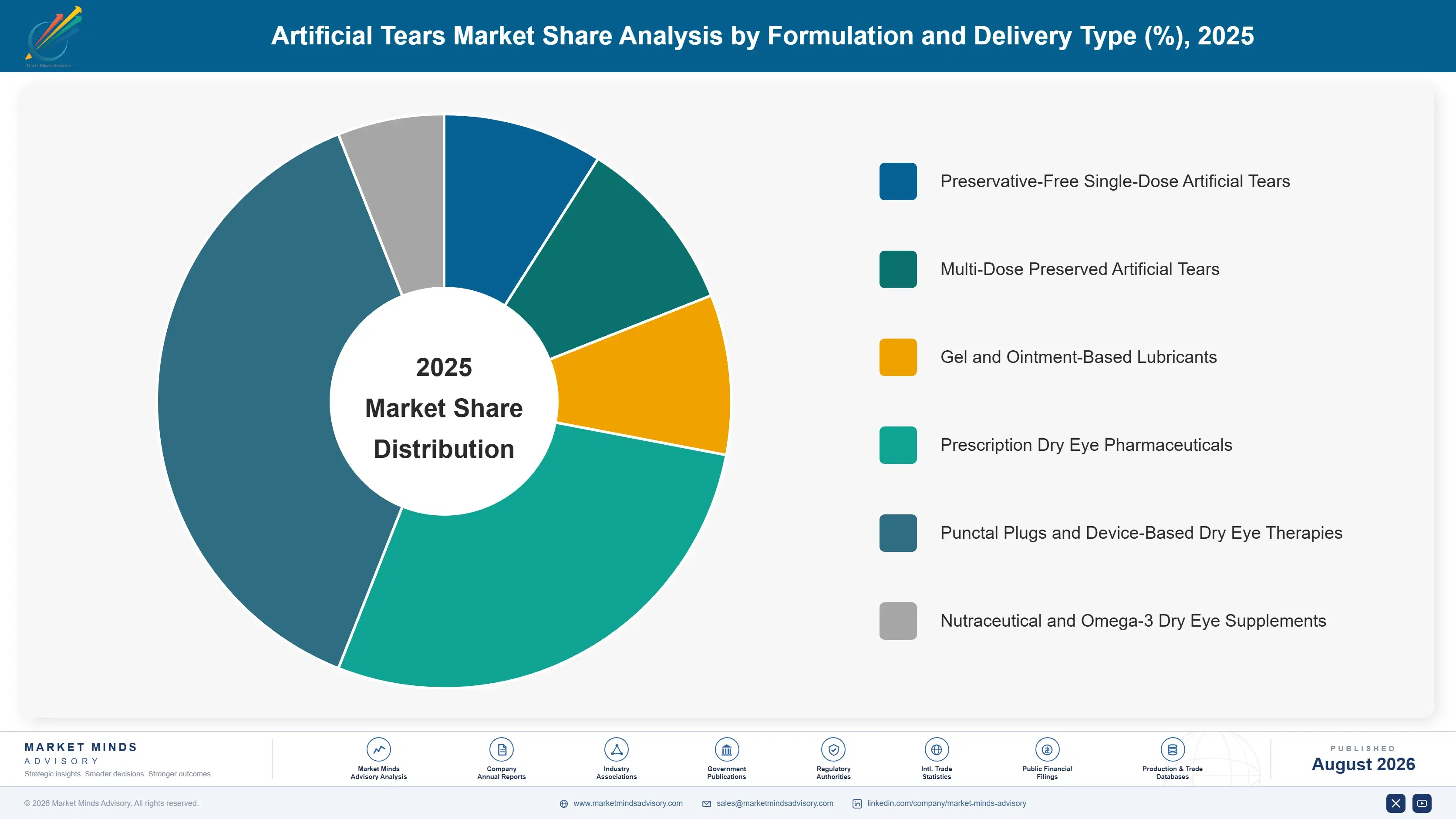
Artificial tears segment by formulation and delivery type, the classification retailers and prescribers use to set pricing tier, safety positioning, and clinical indication, since preservative-free, prescription, and device-based buyers each negotiate under distinct commercial terms. Vendors price each category differently depending on formulation safety and clinical evidence depth involved. across the broader industry today.
artificial-tears-market-market-share-analysis-1787305903416

Prescription Dry Eye Pharmaceuticals

Prescription dry eye pharmaceuticals form the fastest-growing segment as ophthalmologists increasingly treat chronic dry eye disease with targeted anti-inflammatory drugs rather than relying on over-the-counter lubrication alone for moderate to severe cases. AbbVie and Novartis have both expanded prescription pharmaceutical investment since 2023, targeting patients whose disease severity exceeds what over-the-counter products can adequately manage. Companies that secure strong prescriber relationships are capturing patient volume from competitors that lack comparable clinical evidence depth, an advantage that compounds as more ophthalmologists standardize around a smaller set of trusted prescription options. If prescription adoption continues at the current pace, this segment could approach a meaningful share of total category value within the next several years.
CAGR 12.8%

Preservative-Free Single-Dose Artificial Tears

Preservative-free single-dose artificial tears form the second-fastest segment as consumers and pharmacists increasingly favor formulations carrying lower contamination risk following a widely publicized manufacturing recall that reshaped category purchasing behavior. Alcon and Bausch + Lomb have both expanded single-dose production capacity since 2023, targeting consumers who now actively evaluate formulation safety before purchasing decisions. Manufacturers that build strong preservative-free production scale early are capturing volume from competitors lacking comparable single-dose packaging capability, an advantage that compounds as more consumers standardize around preservative-free purchasing habits across their broader retail category preferences. Payers increasingly view this segment as a durable long-term differentiator worth monitoring closely across retail channels. That trajectory should continue strengthening as more retailers adopt validated safety protocols.
CAGR 9.4%
Full segment breakdown across 6 segments available in the complete report.

Regional Architecture and Country Demand Map

Artificial tears commercial activity concentrates where digital screen-time exposure and diagnosed dry eye prevalence are most developed, even though underlying category demand runs broadly distributed globally rather than concentrated in any particular region each year. particularly across major screen-time and prescription infrastructure markets tracked globally.

North America

The United States accounts for the overwhelming majority of North America's artificial tears commercial value, reflecting comprehensive prescription drug reimbursement infrastructure and dense retail pharmacy distribution supporting broad formulation access across every major consumer segment. Canada contributes a smaller but meaningful share through its established retail pharmacy network. Preservative-free adoption runs meaningfully ahead of the global average across most large retail pharmacy chains in the region. Prescription dry eye pharmaceutical adoption continues expanding steadily each year across major ophthalmology practice networks nationwide. Retailers increasingly consolidate purchasing with fewer, larger-scale manufacturers to secure reliable safety supply. Brand loyalty programs continue expanding across the region's largest pharmacy chains. That consolidation trend continues strengthening steadily each year across the sector.
Share: 26% | CAGR: 6.2% (2026 to 2036)

Western Europe

Germany, France, and the United Kingdom together anchor Western Europe's artificial tears demand, reflecting well-established national health system pharmacy infrastructure and comparatively strong regulatory attention to formulation safety standards following the industry's broader contamination concerns. Regulatory evaluation of preservative-free packaging claims across the European Union has driven particularly careful evaluation of manufacturer safety credentials. Smaller Western European markets rely more heavily on regional pharmacy distributors rather than domestic large-scale production, concentrating manufacturing volume at fewer high-throughput facilities. Regional recycling and quality assurance investment continues expanding gradually to support broader formulation safety confidence across national systems. Pharmacy-channel recommendations continue carrying outsized influence over purchasing. That influence continues strengthening steadily across national systems.
Share: 20% | CAGR: 5.4% (2026 to 2036)
Regional intelligence for 5 additional markets available in the complete report: East Asia, South Asia and Pacific, Latin America, Middle East and Africa, Eastern Europe. Contact sales@marketmindsadvisory.com.
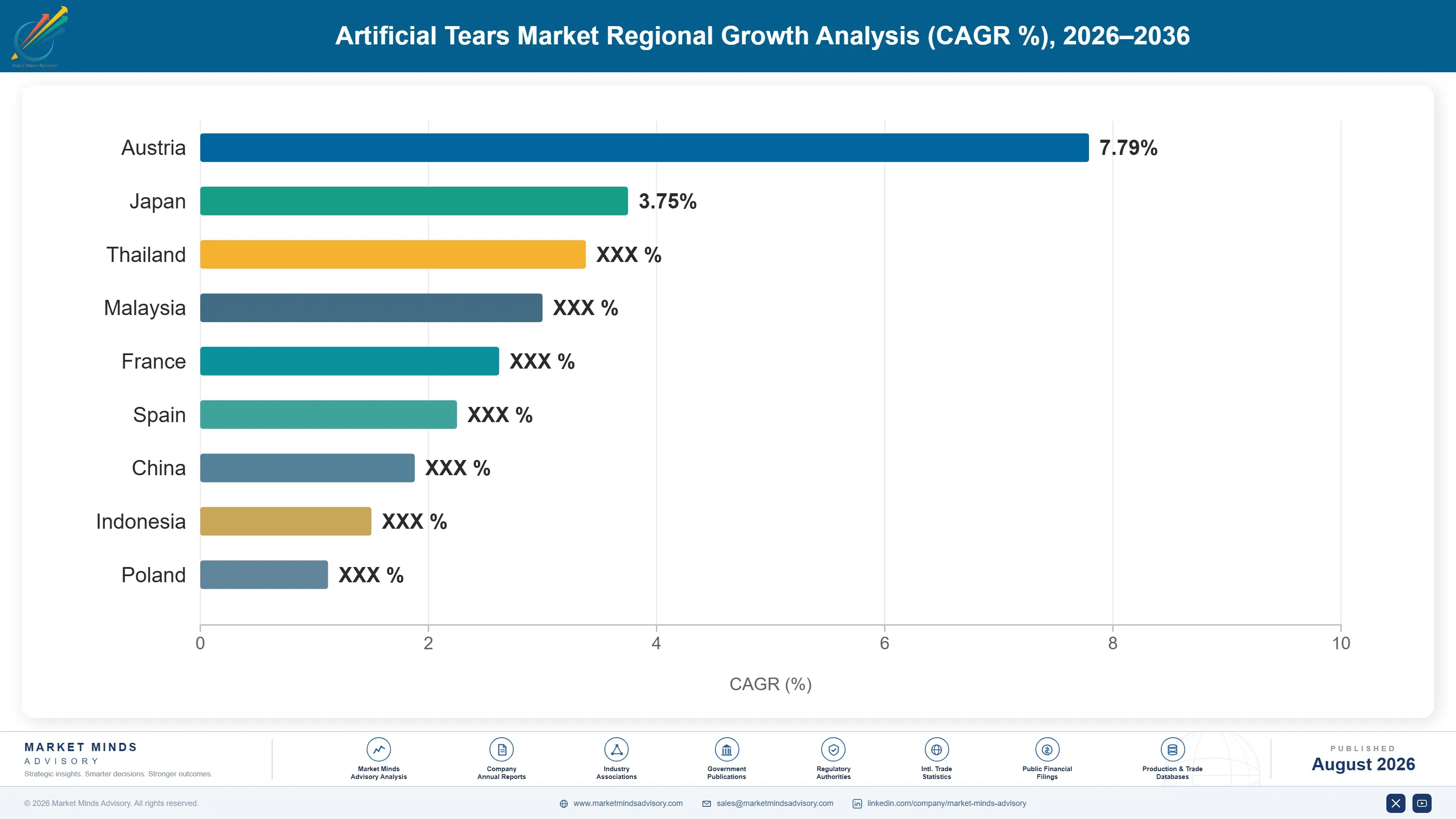
artificial-tears-market-country-cagr-analysis-1787305903937

Where Formulation Value Concentrates Next

Revenue growth in artificial tears increasingly depends on capturing preservative-free safety adoption, prescription dry eye pharmaceutical expansion, and formulation trust rebuilding rather than raw legacy multi-dose volume alone, since consumer confidence, not raw category growth, is reshaping where value concentrates across the industry today. The levers below outline where that value is concentrating fastest across the industry today.

Expanding Preservative-Free Production Capacity Right Now

Manufacturers expanding preservative-free production capacity are capturing consumer relationships that multi-dose-only competitors cannot fulfill, particularly as more consumers face growing awareness of formulation safety following the industry's contamination recall. Building competitive preservative-free capacity typically costs $12 million to $28 million in tooling, sterile production, and validation testing investment. Manufacturers without adequate capacity increasingly lose retail shelf placement to better-capitalized competitors offering proven safe supply sooner. That gap widens each successive year as more retailers standardize around certified safety credentials. Adoption continues broadening steadily as more consumers seek certified safe supply.
Market Impact: Costs $12 to $28 million to fully b

Building Prescription Dry Eye Clinical Evidence Depth

Companies building deep prescription dry eye clinical evidence are capturing ophthalmologist prescribing relationships that over-the-counter-only competitors cannot access for patients with moderate to severe disease. Developing competitive clinical evidence typically costs $60 million to $140 million in clinical trial execution, regulatory submission, and post-marketing outcomes investment. Companies with superior clinical evidence increasingly win prescriber preference from competitors offering only symptom-relief alternatives without underlying inflammation treatment. Adoption continues broadening steadily. Adoption continues broadening steadily as more prescribers seek differentiated treatment evidence. That advantage compounds each successive year. Prescribers increasingly favor companies demonstrating consistent investment.
Market Impact: Costs $60 to $140 million to fully

Securing Large Retail Pharmacy Distribution Partnerships

Manufacturers securing dedicated distribution partnerships with large retail pharmacy chains are capturing volume growth that transactional independent pharmacy relationships cannot match on scale and long-term shelf placement commitment. These partnerships typically carry a 10 to 18% margin premium given the guaranteed shelf space and promotional support pharmacy chains provide. Manufacturers able to demonstrate reliable safety credentials increasingly win these partnerships over less-prepared competitors seeking similar retail access. Adoption continues broadening steadily. Adoption continues broadening steadily as more chains seek coordinated safety relationships. That advantage compounds each successive year. Chains increasingly favor manufacturers demonstrating consistency.
Market Impact: Commands a 10 to 18% margin premium

Investing In Sterile Manufacturing Quality Certification

Manufacturers investing in sterile manufacturing quality certification beyond baseline regulatory requirements are positioned to capture premium safety-conscious consumer volume that standard manufacturers cannot fully address for retailers seeking maximum contamination risk mitigation. Developing competitive certification capability typically costs $8 million to $18 million in quality systems, third-party auditing, and facility investment. Manufacturers with strong certification increasingly win premium retail relationships from competitors offering only baseline compliance alternatives. Adoption continues broadening steadily as more retailers seek maximum risk mitigation. That advantage compounds each successive year across the category. Retailers increasingly favor manufacturers demonstrating consistency.
Market Impact: Costs $8 to $18 million to fully bu

Who Controls the Margin Pool

The top five vendors hold an estimated 48% of global artificial tears revenue, a moderate concentration reflecting the category's mix of large diversified consumer health companies and specialty prescription pharmaceutical developers. Alcon and Bausch + Lomb lead on multi-formulation portfolio breadth and ophthalmology prescriber relationship depth respectively, while a fragmented tail of regional manufacturers competes on price across commodity lubricant formulations.
Current competitive activity centers on three fronts. Preservative-free production capacity expansion is opening a new front for manufacturers willing to invest ahead of confirmed broader consumer conversion. Prescription clinical evidence development is becoming increasingly important as companies compete for ophthalmologist prescribing preference beyond symptom-relief positioning. And several mid-sized manufacturers are pursuing large retail pharmacy partnerships to differentiate beyond commoditized independent pharmacy sales. That competition continues intensifying steadily across the broader category each year.

Emerging pressure comes from regional manufacturers moving into preservative-free production as they partner with contract manufacturers and packaging technology firms, though matching Alcon or Bausch + Lomb's portfolio breadth and prescriber relationships remains years away for most. If these challengers close that gap, expect share to shift within specific regional retail relationships first, before pressure reaches the largest diversified incumbents.
artificial-tears-market-company-positioning-matrix-1787305904455

Competitive Moat and Risk Dimensions

ALCON INC.

Moat: Broad Multi-Formulation Eye Care Portfolio

Alcon maintains one of the industry's broadest multi-formulation eye care portfolios spanning preservative-free, gel, and prescription-adjacent products, giving it shelf presence across virtually every consumer segment that narrower competitors cannot match. That portfolio breadth lets Alcon capture consumer relationships regardless of which specific formulation preference a given shopper holds.
ALCON INC.

Risk: Recurring Contamination Recall Risk

Alcon's broad manufacturing footprint across multiple facilities and formulation types creates meaningful exposure to the kind of contamination or quality event that has already reshaped consumer trust once across the broader category. If a comparable quality event affected Alcon specifically, the company risks disproportionate reputational damage given its scale and market visibility relative to smaller competitors.
BAUSCH + LOMB CORPORATION

Moat: Deep Ophthalmology Prescriber Relationship Network

Bausch + Lomb maintains one of the industry's deepest ophthalmology and optometry prescriber relationship networks, built through decades of continuous engagement establishing trust with eye care professionals who recommend products to patients daily. That relationship depth gives Bausch + Lomb a durable prescribing influence advantage that newer entrants without comparable professional trust cannot quickly replicate.
BAUSCH + LOMB CORPORATION

Risk: High Leverage From Spin-Off Structure

Bausch + Lomb's substantial financial leverage inherited from its corporate spin-off structure constrains capital flexibility relative to less leveraged competitors during periods of tightening credit conditions. If category growth requires faster capital deployment than Bausch + Lomb's leverage position allows, it risks losing pace to better-capitalized rivals pursuing similar preservative-free and prescription investment.

Players Tracked

Prominent Players

Alcon Inc.
Bausch + Lomb Corporation
AbbVie Inc.
Johnson & Johnson
Novartis AG

Other Key Players

Santen Pharmaceutical Co. Ltd.
Thea Pharma SAS
Sun Pharmaceutical Industries Ltd.
Cipla Limited
Similasan AG
Akorn Operating Company LLC
Rohto Pharmaceutical Co. Ltd.
Prestige Consumer Healthcare Inc.
Perrigo Company plc
Harrow Inc.
Sentiss Pharma Private Limited
Entod Pharmaceuticals Pvt. Ltd.
Eyevance Pharmaceuticals LLC
Kala Pharmaceuticals Inc.
Viatris Inc.

Recent Developments

MAY 2025

Alcon Expands Preservative-Free Manufacturing Capacity

Alcon commissioned additional preservative-free single-dose manufacturing capacity to meet rising consumer demand following industry-wide contamination concerns, following distributor commitments signed as more retailers sought certified safe supply. The expansion followed sustained retailer pressure for dedicated preservative-free infrastructure across major markets. Retailers welcomed the move as a positive supply signal.
Signal: Confirms preservative-free capacity remain
OCTOBER 2024

AbbVie Signs Multi-Year Ophthalmology Network Agreement

AbbVie secured a multi-year prescription dry eye partnership agreement with a major ophthalmology practice network, guaranteeing coordinated patient education and prescribing support through 2029 across several affiliated clinical programs. The agreement reflects prescribers' push to lock in reliable clinical partnership relationships. Prescribers welcomed the agreement as a meaningful clinical improvement.
Signal: Shows prescribers prioritizing long-term c
JANUARY 2025

Bausch + Lomb Announces Sterile Manufacturing Certification Expansion

Bausch + Lomb announced expanded sterile manufacturing quality certification across its core artificial tears portfolio to serve growing demand from safety-conscious retailers and consumers seeking dermatologist-backed reassurance beyond baseline regulatory compliance. Similar certification programs are expected across other qualified competitors soon. Retailers welcomed the expansion as a meaningful trust signal.
Signal: Signals quality certification is becoming

Sterile Packaging and Active Ingredient Cost Pressure

Sterile single-dose packaging materials and active lubricant ingredients together account for roughly 36% of effective cost of goods for artificial tears manufacturers, given the specialized sterile filling and sealing requirements involved in preservative-free formulation manufacturing. Prescription active pharmaceutical ingredient synthesis costs add a further meaningful share, particularly for manufacturers producing both over-the-counter and prescription formulations.
Sterile packaging and active ingredient costs rose meaningfully following 2022 global supply chain disruption affecting specialty chemical and packaging suppliers, with several manufacturers reporting input cost increases exceeding 17% in their annual reports before pricing stabilized through 2023 and into 2024. Industry supply chain reviews have flagged sterile packaging capacity as this market's single most concentrated cost driver, more than active ingredient or prescription API costs combined. Several manufacturers have flagged packaging cost pressure as an ongoing operational risk.

Smaller regional manufacturers without long-term packaging supply agreements absorbed the 2022 cost increases hardest, losing retail contract bids to larger competitors including Alcon and Bausch + Lomb that had negotiated priority supplier allocation years in advance. Manufacturers with secured packaging supply weathered the cost increases far better than those dependent on spot market purchasing, a cost advantage that persists most sharply across smaller regional manufacturers today.
artificial-tears-market-cost-volatility-analysis-1787305904649

Long-Term Packaging Supplier Agreements Secure Pricing

Manufacturers increasingly negotiate multi-year sterile packaging supply agreements with priority allocation clauses, reducing exposure to spot market price volatility during periods of broader specialty chemical supply disruption. This approach has helped several manufacturers maintain more stable retail pricing even during periods of broader input cost inflation. Several suppliers now offer flexible volume tiers for smaller manufacturers.

Shared Manufacturing Infrastructure Lowers Fixed Cost

Smaller regional manufacturers increasingly share sterile filling infrastructure through contract manufacturing arrangements, spreading fixed equipment cost across broader production volume than any single smaller operation could support alone economically. This shared infrastructure model has helped smaller manufacturers remain price-competitive against larger integrated companies. This model has become increasingly common as smaller manufacturers scale operations.

Vertical Integration Into Packaging Production Reduces Exposure

Several larger manufacturers are investing in direct sterile packaging production capability to reduce dependence on third-party suppliers, gaining pricing control and supply security that non-integrated competitors cannot match during periods of tightening supply. This integration also reduces exposure to spot market volatility across the supply chain. This structure increasingly appeals to manufacturers seeking supply security today.

Portfolio Architecture for Margin Defence

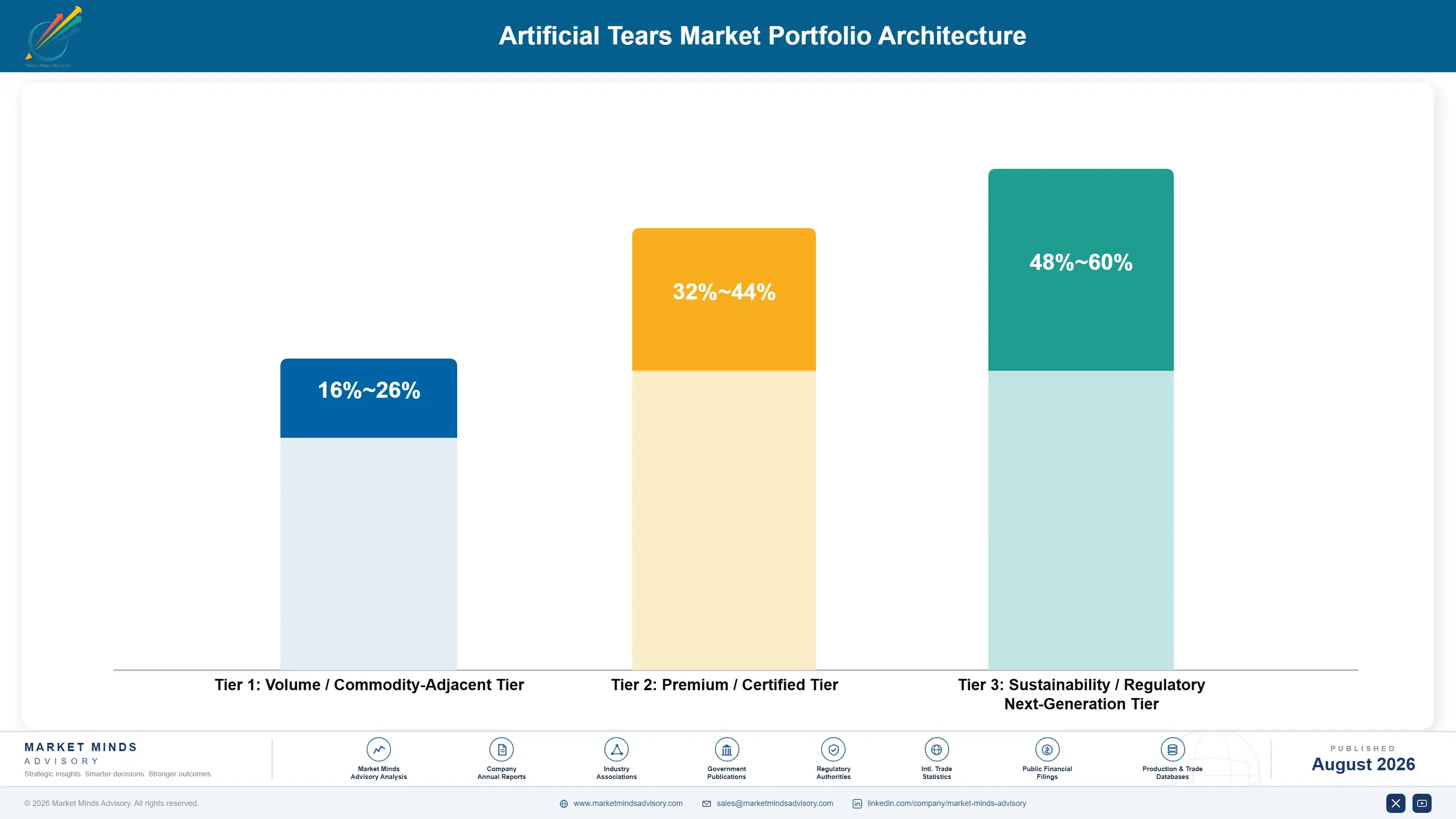
Artificial tears portfolios span three margin tiers, from commodity-adjacent standard multi-dose preserved formulations sold largely on price, through certified preservative-free formats carrying safety-driven premiums, toward an emerging next-generation tier built around prescription dry eye pharmaceuticals still gaining share. Gross margin widens meaningfully at each tier as formulation safety and clinical evidence depth increase across the industry today, reflecting growing willingness to pay
The volume versus premium tension centers on production and clinical investment allocation. Manufacturers must choose between dedicating capital to high-margin preservative-free and prescription programs with growing but still-smaller volume, or serving reliable standard multi-dose demand that fills out most retail volume across a typical year. Manufacturers without spare capital increasingly favor higher-margin next-generation programs where competition remains comparatively thin still.

High-value margin pools concentrate in preservative-free formats and prescription pharmaceuticals with completed clinical validation, where safety investment and evidence depth keep competition thin and consumers pay a premium for demonstrated trust and treatment efficacy. Standard multi-dose formulations remain the volume anchor but carry thinner margins across the portfolio, leaving smaller manufacturers with fewer diversification options than larger integrated competitors today.

Volume / Commodity-Adjacent Tier

Standard multi-dose preserved formulations sold largely on price and shelf availability without safety-driven premiums, across most standard retail buyer segments worldwide. Pricing pressure from private-label competition keeps margins comparatively thin across this tier.
Gross Margin: 16-26%

Premium / Certified Tier

Preservative-free single-dose formats sold under retail pharmacy relationships carrying safety-driven pricing power built through years of proven sterile manufacturing performance. Consumers increasingly compare formulation safety data before committing to a brand.
Gross Margin: 32-44%

Sustainability / Regulatory / Next-Generation Tier

Prescription dry eye pharmaceuticals in active premium prescriber adoption, commanding premium pricing against limited proven alternatives as clinical evidence and treatment differentiation expand across major markets. Manufacturers with the deepest clinical evidence capture most of this premium value today.
Gross Margin: 48-60%
artificial-tears-market-portfolio-architecture-1787305905148

High-value Sub-segments and Strategic Watch-out

Prescription Dry Eye Pharmaceuticals

Fastest-growing and highest long-term value pool as ophthalmologists expand treatment under accumulating clinical evidence and narrowing coverage gaps, though growth remains concentrated in well-resourced prescriber relationships rather than the broader market. AbbVie and Novartis are among those actively expanding capacity today. That advantage compounds each year.
Gross Margin: 50-62%

Preservative-Free Single-Dose Artificial Tears

High-value pool growing steadily as consumers adopt safer formats, particularly across safety-conscious retail channels where formulation trust demand has increased meaningfully since 2023 across multiple product lines. Alcon and Bausch + Lomb continue expanding capacity, reinforcing this segment's growth trajectory. Investors increasingly track adoption metrics closely across this segment.
Gross Margin: 32-44%

Multi-Dose Preserved Artificial Tears

Steady volume core segment tied to standard retail workflows, carrying moderate margins below preservative-free and prescription tiers but anchoring most manufacturer revenue across the industry consistently each year. Smaller brands continue relying on multi-dose formats, supporting steady demand today. This segment anchors baseline manufacturer revenue across the industry.
Gross Margin: 16-26%

Prescription-Access-Constrained Patient Segment

Strategic watch-out segment facing a persistent affordability ceiling as premium prescription pricing leaves manufacturers dependent on patient assistance program reach rather than guaranteed broad prescribing access nationwide. Manufacturers serving this segment increasingly fund assistance programs to offset declining affordability confidence. That ceiling persists until affordability investment accelerates industry-wide.
Gross Margin: 14-24%

Recurring Chronic Purchasing Relationship

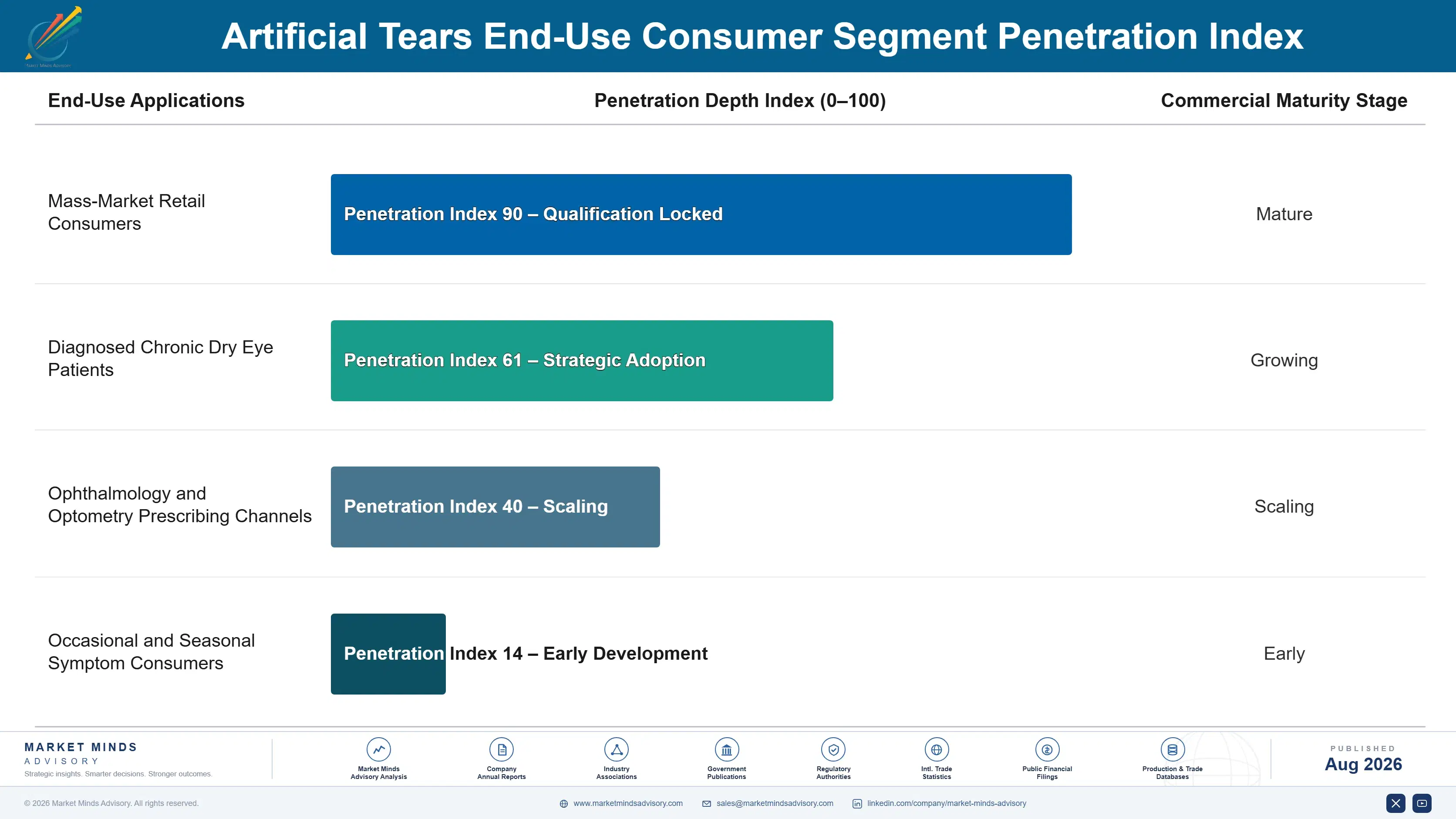
Artificial tears purchasing functions closer to a recurring annuity than a single transaction for chronic dry eye sufferers, since establishing a trusted daily formulation typically locks in repeat purchasing for years once a consumer finds a product that manages their symptoms reliably. Occasional or seasonal purchasing behaves somewhat differently, tracking allergy season and environmental irritant exposure rather than any dedicated chronic relationship specifically.
Adoption depth varies sharply by end-use vertical. Ophthalmology and optometry practices show the deepest engagement with prescription and preservative-free formulations, given dedicated dry eye disease management protocols and comfort recommending clinically differentiated products, while general retail pharmacy consumers adopt more slowly since premium formulation investment rarely gets justified by comparatively mild, infrequent symptoms. That divide shapes where manufacturers concentrate commercial and clinical investment.

A generational shift is underway as younger consumers, raised during the era of routine formulation safety awareness following the industry's contamination recall, evaluate brands on sterile manufacturing credentials and ingredient transparency rather than decades-long familiarity with conventional multi-dose bottle formats. That openness gives safety-forward manufacturers a rare opening to win consumer share in a category where legacy brand loyalty has otherwise been difficult to dislodge.
artificial-tears-market-end-use-penetration-index-1787305905635

Where MMA Sees The Opportunity

These are among the four positions where our research anticipates prominent divergence between winners and laggards over the coming forecast period. Each is grounded in the demand model, the regulatory perimeter, and the announced capacity pipeline.
01 / PRESERVATIVE-FREE FORMAT INVESTMENT

Expand Safe Format Capacity Before Trust Fully Rebuilds

Consumers are increasingly requiring demonstrated formulation safety before adopting a brand as their primary artificial tears relationship, and manufacturers without adequate preservative-free investment are losing consumer relationships to better-equipped competitors as this shift accelerates. Capacity investment requires meaningful upfront capital but opens durable consumer relationships that multi-dose-only competitors cannot match once safety expectations fully harden. Manufacturers waiting until trust fully rebuilds will find themselves racing to catch up against incumbents who invested years earlier, a gap that widens each quarter capacity investment lags behind competitor programs already underway.
02 / PRESCRIPTION CLINICAL INVESTMENT

Build Clinical Evidence Before Prescribing Habits Fully Settle

Ophthalmologists have not universally committed to a single prescription dry eye therapy standard, leaving a genuine opportunity for companies willing to fund clinical evidence generation ahead of confirmed industry standardization trends. Waiting for prescribing habits to formally settle risks missing the differentiation window entirely once a preferred therapy approach forms across prescriber networks. The investment required is meaningful but positions early movers to capture a category growing faster than basic symptom-relief offerings today, a window that will not stay open indefinitely.
03 / RETAIL PARTNERSHIP DEVELOPMENT

Pursue Pharmacy Partnerships Before Category Consolidation Peaks

Large retail pharmacy chain formulation standardization has repeatedly rewarded early-mover manufacturers first, and manufacturers without dedicated partnership strategies risk ceding this growing category volume to competitors who invest in safety-driven relationships earlier. Retail partnerships represent a meaningful growth opportunity even though standard commodity sales currently drive most category revenue. Manufacturers pursuing partnership development now, while competitive density remains manageable, protect volume against the next wave of competitors entering this reshaping category, gaining durable advantage as the category continues rapidly reshaping worldwide.
04 / REGIONAL ACCESS INVESTMENT

Prioritize South Asia and East Asia Access Investment Now

South Asia and Pacific and East Asia carry rapidly growing screen-time-driven demand relative to their current commercial artificial tears value, as organized retail and pharmaceutical manufacturing investment accelerate across India, China, and neighboring markets. Manufacturers concentrating capacity expansion solely around legacy Western relationships risk ceding share in the regions where demand growth will be steepest through 2036. Early investment in regional production and distribution partnerships offers a meaningful head start over competitors still anchored entirely to legacy Western customer bases.

Engagement Snapshot From the Field

A live engagement with an industry participant carrying material or product regulatory and market exposure ahead of a defining policy shift, showing how our research translates into a defensible multi-year portfolio strategy.
MARKET MINDS ADVISORY · CLIENT ENGAGEMENT SUMMARY
Artificial Tears Producer Strategic Portfolio Review and Transition Roadmap 2026·Investment Scenario on Artificial Tears Exposure Evaluation 2025-26
CLIENT PROFILE
The client is a mid-sized regional retail pharmacy chain operating multiple store locations across several major United States metropolitan markets, selling artificial tears products across both branded and private-label lines. The chain reported annual revenue of approximately $620 million (client-reported, unverified by MMA) and was evaluating whether to accelerate its transition toward preservative-free-only shelf stocking ahead of anticipated regulatory attention or maintain its existing mixed formulation assortment instead.
STRATEGIC CHALLENGE
Leadership needed to decide whether accelerating a preservative-free-only stocking policy, which carried meaningful vendor renegotiation and inventory transition cost, would generate sufficient consumer trust and liability protection benefits to justify the cost relative to continuing with its existing mixed formulation assortment. Competing regional pharmacy chains were beginning to shift stocking policies voluntarily.
MMA APPROACH
MMA benchmarked the client's stocking policy options against comparable pharmacy chains that had already completed voluntary formulation transitions, modeling consumer trust impact and vendor relationship cost against transition timing and category management requirements. The analysis incorporated primary survey data from pharmacy category managers at ten comparable regional retail chains. Findings were cross-checked against loyalty benchmarks published in recent industry surveys.
KEY FINDINGS
  1. Consumer trust improvement from early formulation transition exceeded management's initial projections once safety-driven purchasing behavior shifts were incorporated into the category positioning model used.
  2. Peer pharmacy chains that transitioned early reported measurably stronger consumer loyalty metrics than chains that waited for broader category conversion to force the transition.
  3. Vendor renegotiation costs were recovered faster than initially budgeted once category sales volume increases were properly incorporated into the financial model used for this specific transition.
  4. Delaying the transition carried a quantifiable competitive risk as consumers increasingly favored pharmacy chains with certified safe formulation assortments in loyalty and repeat purchasing decisions.
CLIENT PROFILE
The client is a mid-sized regional retail pharmacy chain operating multiple store locations across several major United States metropolitan markets, selling artificial tears products across both branded and private-label lines. The chain reported annual revenue of approximately $620 million (client-reported, unverified by MMA) and was evaluating whether to accelerate its transition toward preservative-free-only shelf stocking ahead of anticipated regulatory attention or maintain its existing mixed formulation assortment instead.
STRATEGIC CHALLENGE
Leadership needed to decide whether accelerating a preservative-free-only stocking policy, which carried meaningful vendor renegotiation and inventory transition cost, would generate sufficient consumer trust and liability protection benefits to justify the cost relative to continuing with its existing mixed formulation assortment. Competing regional pharmacy chains were beginning to shift stocking policies voluntarily.
MMA APPROACH
MMA benchmarked the client's stocking policy options against comparable pharmacy chains that had already completed voluntary formulation transitions, modeling consumer trust impact and vendor relationship cost against transition timing and category management requirements. The analysis incorporated primary survey data from pharmacy category managers at ten comparable regional retail chains. Findings were cross-checked against loyalty benchmarks published in recent industry surveys.
KEY FINDINGS
  1. Consumer trust improvement from early formulation transition exceeded management's initial projections once safety-driven purchasing behavior shifts were incorporated into the category positioning model used.
  2. Peer pharmacy chains that transitioned early reported measurably stronger consumer loyalty metrics than chains that waited for broader category conversion to force the transition.
  3. Vendor renegotiation costs were recovered faster than initially budgeted once category sales volume increases were properly incorporated into the financial model used for this specific transition.
  4. Delaying the transition carried a quantifiable competitive risk as consumers increasingly favored pharmacy chains with certified safe formulation assortments in loyalty and repeat purchasing decisions.
RECOMMENDED STRATEGY
Phase 1: Phase 1 (Months 1 to 5): Renegotiate vendor agreements and begin phased inventory transition across select store locations ahead of full rollout. Phase 2: Phase 2 (Months 6 to 12): Complete full formulation transition across the store network while tracking consumer trust and sales performance against the modeled benchmark closely. Phase 3: Phase 3 (Months 13 to 18): Expand safety marketing to capture broader consumer loyalty benefits once the transition demonstrates measurable results.
OUTCOME
Within twelve months of transition, the client reported consumer loyalty improvement of approximately 19% (client-reported, unverified by MMA), exceeding initial projections meaningfully. Category sales volume increased measurably (client-reported, unverified by MMA), and the chain now serves as a regional reference model for peer pharmacy organizations.

Frequently Asked Questions

Foundational context covering the market sizes, CAGR, scope, country, region and competition that inform every finding below. This section is provided to cover basics and most often pre-purchase conversations, answered from the MMA Primary Research Dataset.

What is the current size of the Artificial Tears Market?

The artificial tears market was valued at approximately $6.80 billion in 2025. Growth is driven primarily by preservative-free safety adoption and expanding prescription dry eye pharmaceutical use.

How large will the Artificial Tears Market be by 2036?

The market is forecast to reach approximately $14.02 billion by 2036, roughly 1.93 times its 2026 value as preservative-free and prescription formats broaden globally. Growth reflects broadening preservative-free and prescription adoption.

What is the CAGR for the Artificial Tears Market 2026 to 2036?

The market is forecast to grow at a 6.8% CAGR between 2026 and 2036. Bull and bear scenarios range from roughly 5.5% to 8.0% depending on prescription adoption pace and consumer trust trends.

Which segment is growing fastest?

Prescription dry eye pharmaceuticals are the fastest-growing segment at approximately 12.8% CAGR, roughly 1.88 times the overall market growth rate. Preservative-free single-dose formats follow as the second-fastest segment.

Who are the major companies in the Artificial Tears Market?

Leading companies include Alcon, Bausch + Lomb, AbbVie, Johnson & Johnson, and Novartis, together holding an estimated 48% of global commercial revenue. Smaller regional manufacturers make up the remaining fragmented share.

Which country is growing fastest?

Brazil is the fastest-growing country at approximately 9.6% CAGR, driven by expanding retail pharmacy infrastructure and rising digital screen-time exposure. China still commands the largest overall share of commercial value.

Report Segmentation Architecture

The full report scope spans multiple orthogonal segmentation dimensions, with cross-tabulated demand data provided for each dimension pair. Coverage extends further to regional breakdowns, trend trajectories, and the competitive detail needed to support segment-level decision-making.

By Formulation and Delivery Type

  • Preservative-Free Single-Dose Artificial Tears
  • Multi-Dose Preserved Artificial Tears
  • Gel and Ointment-Based Lubricants
  • Prescription Dry Eye Pharmaceuticals
  • Punctal Plugs and Device-Based Dry Eye Therapies
  • Nutraceutical and Omega-3 Dry Eye Supplements

By End-Use Consumer Segment

  • Mass-Market Retail Consumers
  • Diagnosed Chronic Dry Eye Patients
  • Ophthalmology and Optometry Prescribing Channels
  • Occasional and Seasonal Symptom Consumers

By Commercial Dimension

  • Retail Pharmacy and Grocery Distribution
  • Prescription and Physician-Directed Sales
  • Direct-To-Consumer E-Commerce Channels
  • Hospital and Institutional Procurement

By Region

  • North America
  • Western Europe
  • East Asia
  • South Asia and Pacific
  • Latin America
  • Middle East and Africa
  • Eastern Europe

Scope, Methodology, and Coverage

Every figure in this report is reproducible from documented input assumptions. The scope below maps the historical period, the forecast horizon, the segmentation dimensions, and the countries covered, alongside the underlying primary and qualitative methodology.
Historical Period
2020 to 2025
Forecast Period
2026 to 2036
Base Year
2025 (USD billions; MMA Primary Research Dataset, August 2026)
Market Definition
The artificial tears market covers over-the-counter lubricating eye drop formulations and prescription pharmaceuticals used to manage dry eye disease and ocular surface discomfort, including preservative-free single-dose products, multi-dose preserved formulations, gels, ointments, and prescription anti-inflammatory dry eye drugs. It spans products sold through retail pharmacy, optometry and ophthalmology practice, and hospital channels. Contact lens solutions, unrelated ophthalmic surgical products, and general eye vitamins without direct dry eye indication are excluded from this scope.
Quantitative Units
USD billions (current prices); unit volume in millions where applicable
Segmentation Dimensions
By Formulation and Delivery Type; By End-Use Consumer Segment; By Commercial Dimension; By Region
Regions Covered
North America, Western Europe, East Asia, South Asia and Pacific, Latin America, Middle East and Africa, Eastern Europe
Countries Covered
USA, China, Germany, France, UK, Japan, South Korea, India, Australia, Canada, Brazil, Mexico, Indonesia, Vietnam, Thailand, Malaysia, UAE, Saudi Arabia, South Africa, Nigeria, Turkey, Poland, Netherlands, Italy, Spain, Sweden, Switzerland, Argentina, Colombia, Singapore, and additional markets relevant to this sector
Key Companies Profiled
Alcon Inc., Bausch + Lomb Corporation, AbbVie Inc., Johnson & Johnson, Novartis AG, Santen Pharmaceutical Co. Ltd., Thea Pharma SAS, Sun Pharmaceutical Industries Ltd., Cipla Limited, Similasan AG, Akorn Operating Company LLC, Rohto Pharmaceutical Co. Ltd., Prestige Consumer Healthcare Inc., Perrigo Company plc, Harrow Inc., Sentiss Pharma Private Limited, Entod Pharmaceuticals Pvt. Ltd., Eyevance Pharmaceuticals LLC, Kala Pharmaceuticals Inc., Viatris Inc.
Quantitative Methodology
Primary survey, n=3,800 respondents, Q4 2025, six countries; demand-side model with trade association cross-validation
Qualitative Methodology
47 expert interviews, Q4 2025; applied to validate demand model assumptions, identify emerging dynamics, and assess competitive positioning
Report Format
PDF and XLSX data workbook (Word format preview document)
Publisher
Market Minds Advisory
Report Code
MMA-2026-HLT-156
Published
August 2026
Contact
sales@marketmindsadvisory.com | www.marketmindsadvisory.com

Purchase the full Artificial Tears Market Report (2026 to 2036).

This report analyzes the global artificial tears market, covering preservative-free, multi-dose, and prescription segments across all seven MMA-tracked global regions. It includes detailed market sizing and forecasts through 2036, competitive benchmarking of the top twenty vendors across large diversified consumer health companies and specialty pharmaceutical developers, and segment-level analysis of formulation safety adoption. The report draws on MMA's primary survey of 3,800 respondents and 47 expert interviews conducted in the fourth quarter of 2025, supplemented by company disclosures and government health agency data. Buyers receive full access to regional data tables, competitive profiles, and strategic recommendations tailored to manufacturers, retailers, and healthcare investors worldwide.
Full seven-region market sizing and forecast data
Competitive benchmarking of twenty profiled industry vendors
Segment-level analysis of formulation safety adoption trends
Primary survey data from 3,800 global respondents
Expert interview insights from 47 ophthalmic health specialists
Strategic recommendations for manufacturers and retailers

Built For The People Who Decide

From boardroom strategy to bench-side execution, this report is read cover-to-cover by leaders shaping the next decade of their industry, turning demand scenarios, market dynamics and valuation benchmarks into decisions.
CXOs/ Presidents/ VPs/ Managers
M&A and Corporate Development
Strategy Teams and R&D Heads
Procurement and Product Directors
Regulatory and Compliance Leaders
Investor Relations and Equity Analysts