Market Minds Advisory
Artificial Intelligence in Retail Market

Artificial Intelligence in Retail Market: Artificial Intelligence in Retail Market. Trends and Forecast 2026 to 2036

Generative AI is moving retail personalization from static recommendation widgets toward conversational shopping assistants and dynamic pricing engines, forcing merchants to rebuild commerce platforms around real-time inference rather than periodic batch processing.

Lead Analyst

Published

September 2026

Make Smarter Decisions with Customized Research Insights

Request a free sample report and evaluate market opportunities, growth trends, and competitive dynamics relevant to your business needs.

2025 MARKET VALUE$8.5BMarket Size 2025
2036 FORECAST VALUE$28.2BBase Case , 2026 to 2036
CAGR 2026 TO 203611.5 %Bull 12.8% / Bear 10.2%
INCREMENTAL OPPORTUNITY$18.7BNet 10- year value creation
EXPANSION MULTIPLE2.97x2036 value over 2026 base
Strategic Levers
M&A Pipeline
Regional Outlook
Country Rankings
Competitive Intelligence
Segmental Deep-dive
Call-Us : 91 93563 13602

Executive Snapshot and Market Trajectory.

Generative AI is compressing the gap between browsing and purchase, letting retailers deploy conversational shopping assistants that answer product questions instantly rather than routing customers through static search results and category filters that frustrate impatient shoppers browsing on mobile devices.
Retailers are shifting budget from legacy rule-based recommendation engines toward generative and predictive AI platforms capable of dynamic pricing, demand forecasting, and inventory optimization at scale across the entire enterprise operation today and going forward. North America and East Asia concentrate the largest share of AI retail technology spending, driven respectively by large enterprise retailer budgets and massive e-commerce platform investment in China's rapidly expanding digital retail sector overall each year.
Competitive intensity centers on data integration depth, since AI models perform only as well as the unified customer and inventory data feeding them, a challenge many retailers with fragmented legacy systems still haven't fully solved. Cloud platform vendors and specialized retail AI startups are both racing to own this integration layer, with large technology companies increasingly bundling AI capability directly into existing commerce platform subscriptions rather than selling it as a standalone module priced separately.
Market Definition
The Artificial Intelligence in Retail Market covers software platforms applying machine learning and generative AI to personalization, demand forecasting, dynamic pricing, and inventory optimization across retail operations. It excludes general enterprise resource planning software without embedded AI capability and point-of-sale hardware sold independently of analytics functionality.
Base Year Value
$8.5B in 2025 (MMA Primary Research Dataset, September 2026)
Forecast Period
2026 to 2036, eleven discrete annual values
CAGR
11.5% base case. Bull 12.8%. Bear 10.2%.
Fastest Growth Segment
Generative AI-Powered Personalization and Recommendation Engines: 17.0% CAGR
Fastest Growth Country
China: 14.5% CAGR
Fastest Growth Region
South Asia and Pacific: 13.5% CAGR
Largest Region
North America: 31% of 2025 global value
Market Leaders
Leading participants include Microsoft, Salesforce, Adobe, Amazon Web Services, and SAP.
Primary Survey
n=3,800 procurement and R&D decision-makers, Q4 2025, six countries
Methodology
Demand-side build-up, cross-validated against public data, 47 expert interviews

Artificial Intelligence in Retail Market Forecast Scenarios

artificial-intelligence-in-retail-market-size-forecast-scenario-1789993526713
Between 2020 and 2025, the market grew steadily as retailers adopted early recommendation engines and basic demand forecasting tools, then accelerated meaningfully once generative AI made conversational commerce and dynamic content generation commercially viable near the end of the period overall. Retailers previously hesitant about AI investment moved faster once competitors demonstrated measurable conversion gains.
The base case assumes continued generative AI maturation, expanding enterprise retailer budgets, and gradual replacement of static personalization rules with adaptive models across the forecast period through 2036. Retailers will prioritize unifying fragmented customer and inventory data to feed increasingly sophisticated AI models, cloud platform vendors will continue bundling AI capability into existing commerce subscriptions to accelerate adoption, and mid-market retailers will increasingly access enterprise-grade AI capability through managed platforms rather than building in-house data science teams.
A bull scenario emerges if agentic AI shopping assistants achieve mainstream consumer trust faster than expected, driving accelerated retailer investment across the entire customer journey simultaneously. The bear risk is data privacy regulation tightening significantly around AI-driven personalization, which could constrain the customer data collection practices that current AI retail models depend on for effective operation.

Where Data Integration Depth Determines AI Performance

Artificial intelligence in retail has moved past pilot programs into core operational infrastructure, since retailers now treat personalization and demand forecasting accuracy as direct competitive differentiators rather than experimental technology investments. Vendors that can demonstrate measurable conversion and inventory efficiency gains are capturing disproportionate share of enterprise retailer technology budgets currently growing faster than overall retail technology spending broadly.
MARKET CONCENTRATIONCR5 30%Top five vendors hold under a third of revenue
AVERAGE DEPLOYMENT COST$280KTypical annual enterprise licensing and integration fee paid
TOP ADOPTING REGION SHARE31%North America leads global AI retail technology spending
CONVERSION RATE LIFT15-25%Typical improvement retailers report after AI personalization deployment
CLOUD DEPLOYMENT SHARE62%Portion of new deployments choosing cloud over on-premise
DATA INTEGRATION TIMELINE6-9 monthsAverage months required to unify fragmented retail data
Data integration remains the single largest barrier to AI performance, since even the most sophisticated model produces poor recommendations when fed fragmented, inconsistent customer and inventory data spread across disconnected legacy systems. Retailers that have invested in unified data platforms ahead of AI deployment consistently report stronger results than those attempting simultaneous data consolidation and model implementation, a lesson increasingly shaping vendor implementation methodology across the industry.
Generative AI is expanding the addressable use case list well beyond traditional recommendation engines, into conversational shopping assistants, automated content generation, and dynamic pricing that adjusts in near real time to demand signals. Mid-market retailers increasingly access this capability through managed cloud platforms rather than building specialized data science teams, narrowing the technology gap that once separated large enterprise retailers from smaller competitors.
"Every retailer wants the personalization engine. Almost none of them have fixed their underlying data first, which means most AI deployments are optimizing on top of a broken foundation rather than a clean one."
Director, Retail Technology and AI Strategy Practice · MMA Technology Practice · September 2026

Market Trends

Generative AI Shopping Assistants Enter Mainstream Use

Major retailers have begun deploying conversational shopping assistants powered by large language models that answer product questions, compare items, and complete purchases through natural dialogue rather than traditional search and filter navigation across the entire online storefront experience. Several large retail chains have publicly reported measurable conversion rate improvements exceeding 15% among shoppers who engage with these assistants compared to those using conventional search interfaces alone. Vendors offering pre-integrated conversational commerce capability are winning a disproportionate share of new enterprise contracts as retailers race to match early adopter results quickly.
Market Impact: Lifts order value by 20%
Dynamic Pricing Engines Respond to Real-Time Demand Signals

Retailers are deploying AI-driven dynamic pricing engines that adjust prices continuously based on real-time demand signals, competitor pricing, and inventory levels rather than relying on periodic manual repricing cycles that lag actual market conditions considerably each business day. This shift has pushed several vendors toward streaming data architecture investments that process pricing signals within minutes rather than the daily batch cycles that defined the previous generation of pricing software available years ago. Retailers implementing dynamic pricing report meaningful margin improvement during high-demand periods and reduced markdown losses during inventory clearance.
Market Impact: Cuts inventory holding costs by 18%

Market Opportunities and Growth Drivers

Rising Customer Acquisition Costs Push Personalization Investment

Digital advertising costs have climbed steadily across major platforms in recent years, forcing retailers to extract more revenue from their existing customer relationships rather than relying primarily on new customer acquisition to drive overall business growth going forward. AI-driven personalization directly addresses this pressure by increasing average order value and repeat purchase frequency among existing customers, delivering measurable return on investment that justifies technology spending even during broader marketing budget constraints. Retailers report personalization-driven revenue increases reaching 10 to 20% among customers exposed to AI-tailored product recommendations and offers consistently.
Market Impact: Cuts model accuracy by 30%

Supply Chain Volatility Drives Demand Forecasting Investment

Persistent supply chain disruptions in recent years have exposed the limitations of traditional statistical demand forecasting models, pushing retailers toward machine learning approaches that incorporate a wider range of real-time signals including social media trends, weather patterns, and competitor pricing movements. Retailers using AI-driven forecasting report meaningfully reduced inventory holding costs and fewer stockout incidents compared to those relying on legacy forecasting methods built for a more predictable retail environment. This capability has become particularly valuable as consumer demand patterns grow increasingly volatile and difficult to predict using historical data alone.
Market Impact: Restricts data across over 50 jurisdictions

Market Restraints and Challenges

Fragmented Legacy Data Undermines AI Model Accuracy

Many retailers, particularly those built through years of store and channel acquisitions, still operate customer and inventory data across disconnected legacy systems that were never originally designed to communicate with each other effectively or reliably. The commercial impact is severe: AI models trained on incomplete or inconsistent data produce recommendations and forecasts that underperform expectations, undermining internal confidence in AI investment and slowing further budget approval. Vendors are increasingly offering managed data integration services as a prerequisite phase before AI model deployment begins, extending implementation timelines but improving eventual outcomes.
Market Impact: Lifts conversion rates by over 15%

Consumer Privacy Regulation Limits Personalization Data Collection

Data privacy regulations across multiple jurisdictions increasingly restrict how retailers can collect and use customer behavioral data for personalization purposes, rooted in growing consumer and regulatory concern over surveillance-style tracking practices employed by earlier generations of adtech and retail technology vendors worldwide over recent time. The commercial impact falls hardest on retailers dependent on third-party data sources, since first-party data collection requires rebuilding customer relationship infrastructure that many retailers have not yet invested in. Some vendors now offer privacy-preserving personalization techniques that generate recommendations without storing individually identifiable customer data.
Market Impact: Cuts repricing latency under 5 minutes
3 additional market trends, 4 additional growth drivers, and 2 additional restraints and challenges are covered in the full report. Contact sales@marketmindsadvisory.com to access the complete intelligence.

Segment CAGR and Growth Architecture

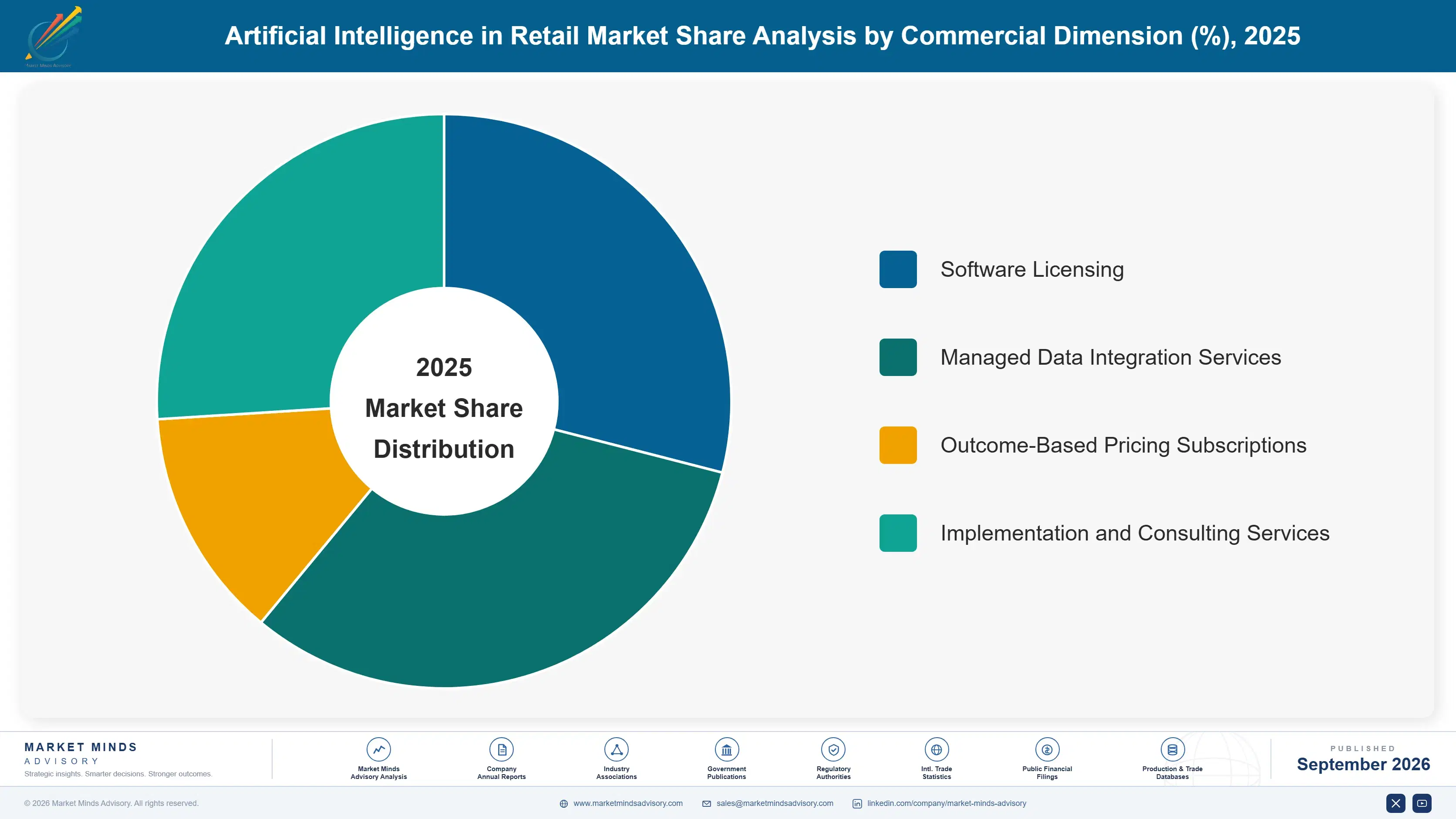
Artificial intelligence in retail segments by application function across six categories, spanning generative personalization through dynamic pricing, demand forecasting, and inventory optimization used across store and e-commerce channels worldwide today and going forward. Each represents a distinct AI capability addressing a specific retail operational function, rather than overlapping product tiers within a single category or hierarchy.
artificial-intelligence-in-retail-market-market-share-analysis-1789993527248

Generative AI-Powered Personalization and Recommendation Engines

Generative AI-powered personalization and recommendation engines are growing fastest as retailers move beyond static rule-based recommendation widgets toward conversational assistants that understand natural language product queries and generate dynamic content tailored to individual shoppers browsing across multiple channels and devices simultaneously throughout the entire day and evening hours worldwide today. These systems increasingly power entire shopping experiences rather than isolated recommendation modules bolted onto existing e-commerce platforms, fundamentally changing how customers discover and evaluate products online today and going forward. Large retailers with substantial proprietary customer data are adopting this capability fastest, while smaller retailers increasingly access comparable functionality through managed platforms offered by major cloud and commerce technology vendors.
CAGR 17.0%

Dynamic Pricing and Revenue Management Systems

Dynamic pricing and revenue management systems are expanding rapidly as retailers seek to optimize margin capture across highly volatile demand conditions that traditional periodic repricing cycles cannot adequately address at meaningful scale across the entire enterprise operation and broader global supply chain network overall. These systems process real-time signals spanning competitor pricing, inventory levels, and demand elasticity to adjust prices continuously rather than through scheduled manual reviews conducted weekly or monthly across the entire organization structure and reporting hierarchy. Adoption concentrates among large format retailers and e-commerce platforms with sufficient transaction volume to justify the technology investment, though smaller retailers are increasingly accessing simplified versions through retail technology platform subscriptions.
CAGR 14.0%
Full segment breakdown across 6 segments available in the complete report.

Regional Architecture and Country Demand Map

North America leads global AI retail technology spending given its concentration of large enterprise retailers and headquartered technology vendors. East Asia follows closely behind, driven by massive e-commerce platform investment, while South Asia and Pacific posts the market's fastest regional growth as digital retail infrastructure expands rapidly.

North America

North America's dominance rests on the scale of enterprise retail technology budgets at large national chains and the concentration of leading AI platform vendors, including Microsoft, Salesforce, and Amazon Web Services, headquartered directly within the region and its metropolitan technology hubs. Retailers here were among the earliest adopters of generative AI shopping assistants, driven partly by intense competitive pressure from Amazon's continuous investment in AI-driven personalization across its own sprawling network of third-party sellers and fulfillment warehouses. The region's dense concentration of enterprise data science talent also gives North American retailers a lasting advantage in building custom AI capability beyond what off-the-shelf vendor platforms currently offer to smaller competitors nationwide.
Share: 31% | CAGR: 12.5% (2026 to 2036)

Western Europe

Western Europe's growth trails North America's pace, weighed down by stricter data privacy enforcement under the General Data Protection Regulation, which constrains the customer behavioral data collection that many AI personalization models depend on for accurate targeting and effective conversion across every retail channel and consumer touchpoint available today across the continent. German and French retailers have prioritized privacy-preserving personalization techniques, adopting AI vendors who can demonstrate compliant data handling architecture over those simply offering the strongest recommendation accuracy alone. The United Kingdom leads regional adoption among large grocery and fashion retailers, drawing on a mature e-commerce infrastructure built over multiple decades of digital retail investment across the entire sector.
Share: 21% | CAGR: 10.0% (2026 to 2036)
Regional intelligence for 5 additional markets available in the complete report: East Asia, South Asia and Pacific, Latin America, Middle East and Africa, Eastern Europe. Contact sales@marketmindsadvisory.com.
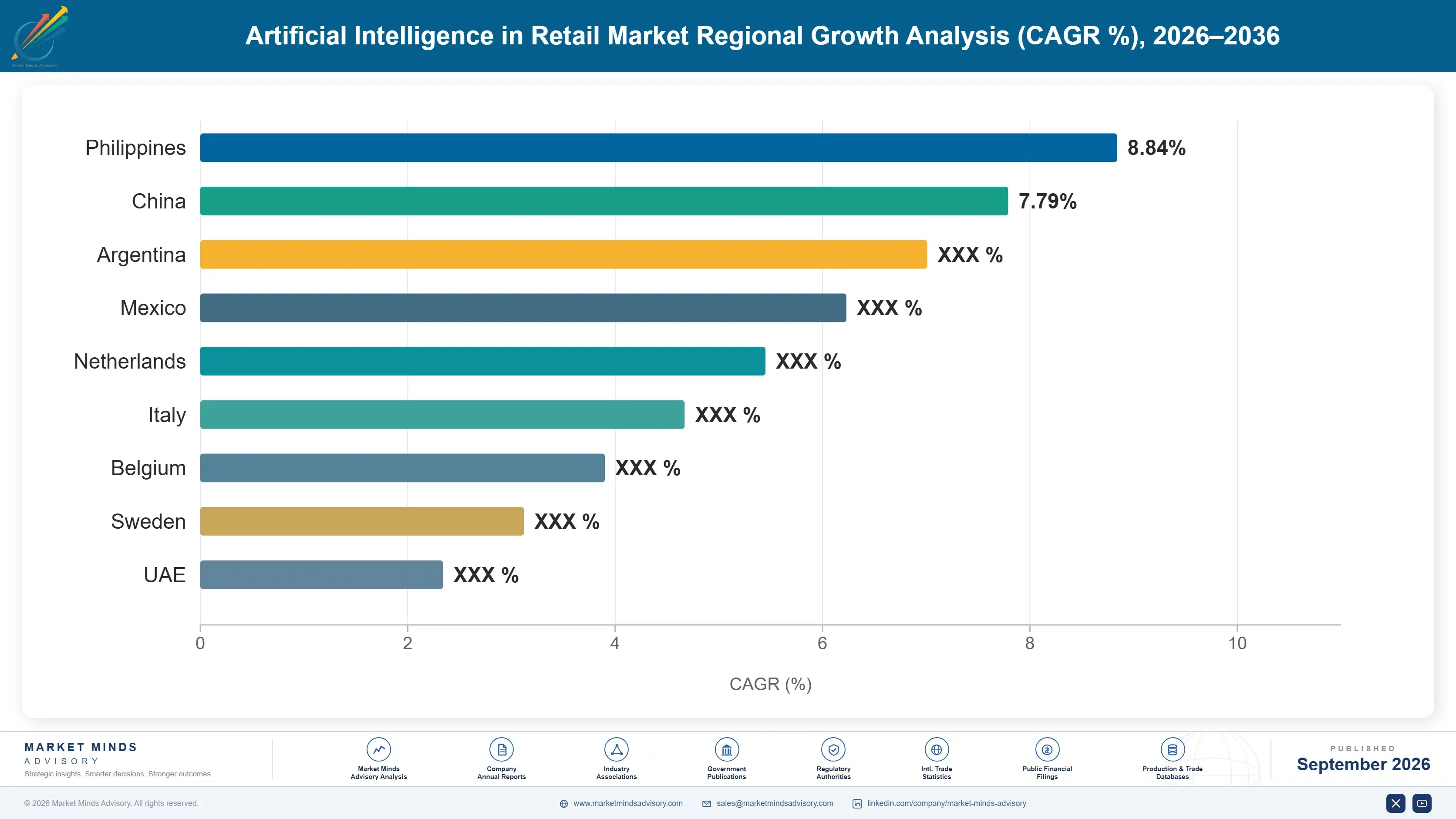
artificial-intelligence-in-retail-market-country-cagr-analysis-1789993527762

Where Vendors Can Defend Subscription Pricing

Revenue expansion in AI retail technology depends increasingly on proving measurable business outcomes rather than raw feature breadth, since retailers now demand quantified conversion and margin improvement before committing to expanded contract value across additional stores or product lines at each renewal cycle throughout the ongoing vendor relationship over time and even well beyond.

Outcome-Based Pricing Tied to Conversion Lift

Vendors offering outcome-based pricing models, where fees scale with measured conversion or revenue lift rather than flat licensing, can command premium contract terms since retailers face lower adoption risk when payment ties directly to demonstrated results across their entire operations and stores nationwide today. Several vendors report average contract values rising by roughly 25% when outcome-based pricing structures replace traditional flat-fee licensing models entirely. This positioning matters most for mid-market retailers hesitant to commit large upfront budgets without proof of measurable return on their specific customer base and product catalog.
Market Impact: Lifts total contract value by roughly 25% annually

Managed Data Integration Services Expansion Strategy

Offering managed data integration services as a prerequisite phase before AI model deployment lets vendors capture recurring revenue well beyond the core software license, addressing the persistent data fragmentation problem that undermines model accuracy across most retail accounts still running disconnected legacy systems accumulated over many years of piecemeal acquisitions. This service layer can add 20 to 30% incremental revenue per account, since retailers increasingly prefer outsourcing complex data unification work rather than building internal data engineering teams amid ongoing technology talent shortages across the retail sector broadly and consistently.
Market Impact: Adds 20 to 30% of total account revenue

Conversational Commerce Module Upsell Growth Strategy

Retailers increasingly pay premium pricing for conversational shopping assistant modules that layer directly on top of existing personalization platforms, since these assistants have demonstrated measurable conversion lift without requiring a complete platform replacement or costly migration project across the wider enterprise organization and its many operating teams and departments. Vendors offering this consolidation typically see contract expansion of 15 to 22% when customers add conversational commerce capability to their existing AI platform subscription. This lever works best for retailers already running the vendor's core personalization engine, where integration friction remains minimal.
Market Impact: Expands contract value by 15 to 22% overall

Cross-Channel Analytics Bundle Expansion Growth Strategy

Vendors offering unified analytics spanning online, in-store, and mobile channels within a single AI platform can convert single-channel license sales into broader enterprise-wide subscriptions, capturing incremental revenue that channel-specific point solutions never generate for the vendor across the wider customer account relationship over time. Bundling cross-channel analytics typically increases total contract value by 18 to 28% over single-channel deployments, since retailers pay for unified customer visibility that eliminates the reconciliation work required across separate systems. Large format retailers with both physical stores and e-commerce operations represent the strongest adoption segment.
Market Impact: Increases total contract value by 18 to 28%

Who Controls the Margin Pool

The AI in retail market shows relatively low concentration, with the top five vendors controlling roughly 30% of global revenue given the fragmented nature of retail technology stacks and the many specialized point solution vendors still competing for share. Microsoft and Salesforce hold a moderate scale advantage over Adobe and the remaining challengers, backed by broad cloud platform integration that smaller specialized vendors cannot easily replicate.
Current competitive activity centers on conversational commerce module launches and cross-channel analytics bundle expansion, with major vendors announcing integrated platforms that combine personalization, pricing, and inventory optimization into unified suites. Several vendors are pursuing outcome-based pricing structures, seeking to reduce adoption friction for retailers hesitant about committing large upfront budgets without proven results.

Emerging pressure comes from specialized retail AI startups like Dynamic Yield and Bloomreach rapidly closing the capability gap with established enterprise platform vendors, supported by venture capital targeting generative personalization and conversational commerce specifically. Rankings could shift meaningfully over the coming decade as data integration depth and measurable conversion outcomes, rather than platform breadth alone, become the primary basis for competitive differentiation within the highest-value enterprise retail segment.
artificial-intelligence-in-retail-market-company-positioning-matrix-1789993528293

Competitive Moat and Risk Dimensions

MICROSOFT

Moat: Deep Azure Cloud Integration

Microsoft's moat rests on deep Azure cloud integration across large enterprise retailer accounts already running its infrastructure, letting it bundle AI retail capability directly into existing subscription relationships rather than selling standalone software. Switching costs run high: retailers already invested in Azure's data and identity infrastructure face substantial migration friction considering a competing AI vendor requiring separate infrastructure.
MICROSOFT

Risk: Slower Retail-Specific Feature Depth

Microsoft's broad enterprise focus means it moves slower than specialized retail AI startups on retail-specific feature depth, particularly around conversational commerce capability where nimbler competitors iterate faster. Retailers seeking advanced personalization increasingly evaluate specialized vendors alongside Microsoft, and if the gap in retail-specific capability widens, Microsoft risks losing new logo growth to focused competitors even while retaining its installed base.
SALESFORCE

Moat: Bundled CRM Platform Integration

Salesforce pairs its AI retail capability with its broader customer relationship management platform already embedded across many retailers' marketing and sales operations, letting it sell integrated commerce solutions rather than standalone point products. This bundled positioning makes Salesforce difficult to displace within accounts already running its customer data platform for other functions.
SALESFORCE

Risk: Per-Seat Pricing Model Pressure

Salesforce's per-seat and per-contact pricing model faces pressure from vendors offering usage-based pricing that scales more predictably for high-growth e-commerce customers. Younger, more specialized competitors are winning fast-growing retail accounts specifically because Salesforce's pricing model penalizes rapid customer base growth, a segment increasingly important as e-commerce expands globally.

Players Tracked

Prominent Players

Microsoft
Salesforce
Adobe
Amazon Web Services
SAP

Other Key Players

Oracle
Google
IBM
NVIDIA
Shopify
Blue Yonder
Manhattan Associates
NielsenIQ
Dynamic Yield
Bloomreach
Algolia
Coveo
Lucidworks
Syte
Increff

Recent Developments

MARCH 2026

Microsoft acquired a conversational commerce startup in March 2026, adding natural language shopping assistant capability to its existing retail AI platform. The deal extends Microsoft's ability to compete with specialized vendors in conversational commerce, addressing growing customer demand as retailers seek unified platforms rather than assembling separate point solutions.
Signal: Signals conversational commerce becoming a required baseline platform feature for retail AI vendors rather than a differentiator.
MAY 2026

Salesforce and a major cloud infrastructure provider announced a joint venture in May 2026 to deliver managed AI personalization hosting for mid-market retailers lacking dedicated data science teams. The venture combines Salesforce's commerce platform with elastic compute capacity, targeting retailers priced out of enterprise-grade AI due to high upfront investment.
Signal: Signals major cloud infrastructure providers partnering directly with commerce vendors to reach underserved mid-market retail customers.
APRIL 2026

Adobe secured a multi-year supply agreement in April 2026 with a consortium of specialty retail chains to deploy its AI-driven personalization suite across their combined e-commerce infrastructure. The agreement represents one of the largest multi-retailer consortium deployments announced this year, reinforcing Adobe's positioning in cost-sharing arrangements among smaller specialty retailers.
Signal: Signals consortium-based deployments emerging as a viable and durable cost-sharing model for smaller specialty retail chains.

Where AI Compute Costs Squeeze Vendor Margins

Cloud compute for training and running large language models represents approximately 30% of total cost of goods sold for AI retail vendors, with data storage and integration engineering adding a further 18%. Most vendors source compute capacity from a concentrated group of three hyperscale cloud providers, leaving them exposed to pricing changes and graphics processing unit availability constraints during high-demand periods.
Graphics processing unit shortages during 2023 and 2024 significantly raised inference and training costs for AI retail vendors, with several major chip manufacturers reporting sustained supply constraints in their annual investor filings during that period. The disruption forced smaller vendors to delay planned model improvements and feature launches, temporarily limiting the personalization accuracy gains that customers had been promised in contract renewal negotiations already underway at the time.

Smaller vendors without long-term committed-use cloud contracts face a persistent competitive disadvantage, often paying on-demand compute pricing premiums of 20 to 35% above the negotiated rates larger competitors secure through multi-year enterprise agreements. This exposure varies by business model too: vendors running inference for every customer transaction absorb more compute cost volatility than those offering less computationally intensive batch-based recommendation models.
artificial-intelligence-in-retail-market-cost-volatility-analysis-1789993528491

Securing Multi-Year Committed-Use Cloud Agreements

Larger vendors are locking in multi-year committed-use agreements directly with hyperscale cloud providers, guaranteeing capacity priority and discounted pricing ahead of on-demand buyers during periods of tight compute supply. These agreements typically require upfront usage commitments but protect margins by fixing infrastructure pricing well ahead of customer contract renewal cycles and model retraining schedules planned in advance.

Optimizing Model Size to Reduce Inference Cost

Several vendors are deploying smaller, more efficient AI models specifically optimized for retail personalization tasks rather than relying on large general-purpose language models that carry substantially higher inference cost per customer interaction and query. This approach reduces ongoing compute expense meaningfully while maintaining comparable recommendation accuracy for most standard retail use cases and applications.

Diversifying Compute Workloads Across Cloud Regions

Several vendors are distributing model training and inference workloads across multiple cloud regions and providers, reducing dependency on any single provider's capacity constraints during periods of elevated demand across the entire industry landscape overall. This multi-cloud approach adds modest architectural complexity upfront but has proven effective at maintaining service reliability even during regional shortages.

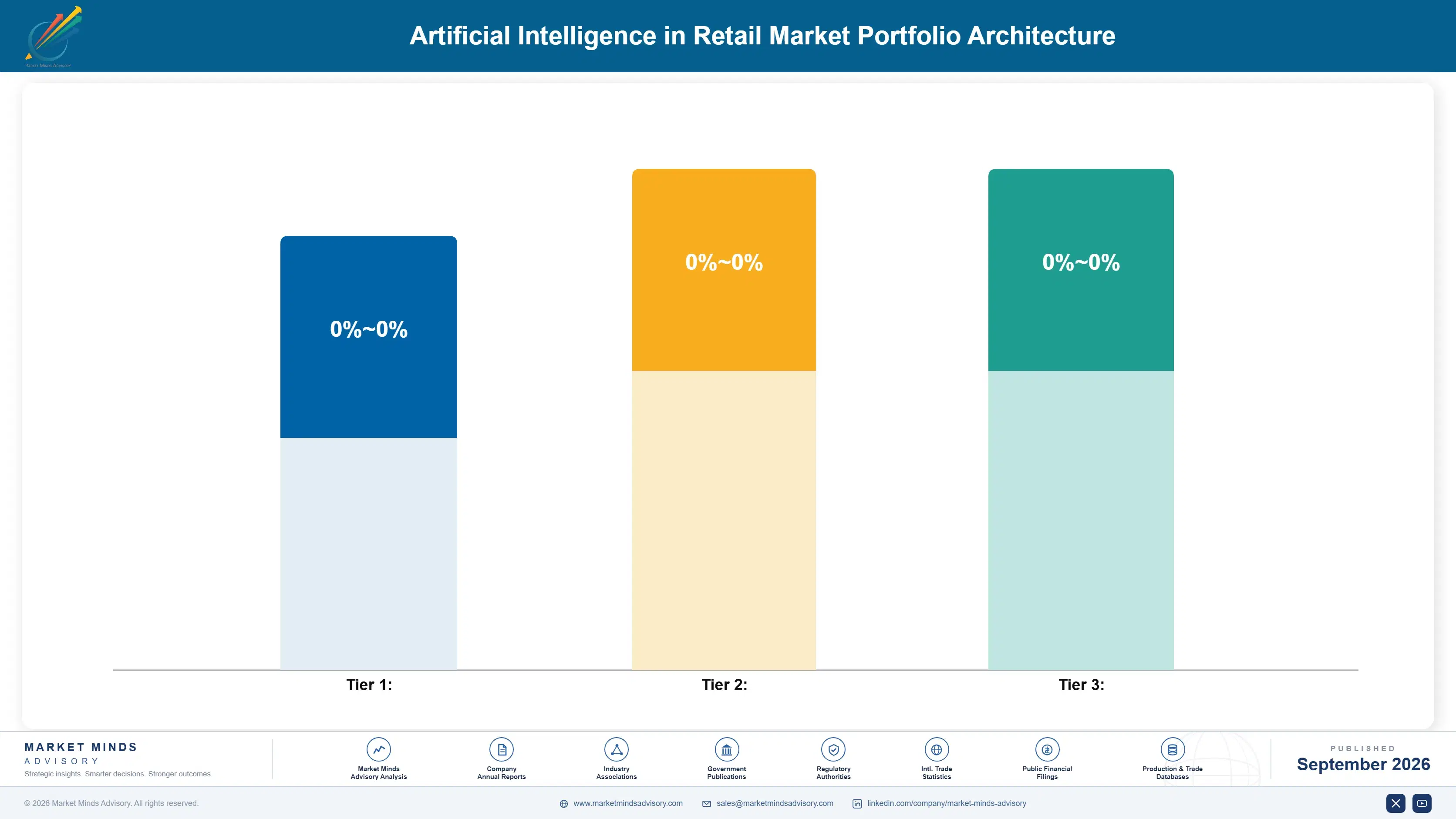
Portfolio Architecture for Margin Defence

Portfolio architecture in AI retail technology splits into three distinct tiers, ranging from commodity rule-based recommendation engines competing on price to certified generative AI platforms carrying substantial margin premiums. Gross margins vary from the low twenties on basic personalization licenses to over 60% on integrated generative platforms with proven conversion outcomes, reflecting the model sophistication and outcome-based pricing structures required to sell credibly into large enterprise retail accounts.
Volume economics still matter for smaller retailers, since basic recommendation licenses account for a meaningful share of total contracts signed annually across the mid-market segment. But value concentrates elsewhere: large enterprise retailers running generative AI platforms with managed data integration services generate a disproportionate share of vendor profit, paying recurring subscription fees for capability that basic recommendation engines cannot match on conversion outcomes.

The highest-value pools sit at the intersection of generative personalization and conversational commerce, where vendors combining both can command premium pricing that pure recommendation engine vendors cannot match. Sustainability-adjacent categories, including AI-driven markdown optimization that reduces retail waste, remain smaller today but are attracting disproportionate development investment, since environmental reporting mandates create durable competitive barriers that commodity vendors struggle to clear.

Basic rule-based recommendation engines sold largely on per-license price, with gross margins in the low twenties given intense competition from low-cost regional and legacy vendors offering limited product differentiation nationwide.
Gross Margin

Generative AI platforms carrying proven conversion outcome track records, commanding gross margins in the low forties as retailers pay for measurable revenue lift and faster time to positive return on investment.
Gross Margin

Fully explainable, outcome-validated platforms paired with managed data integration and conversational commerce capability, achieving gross margins above 60% through certification barriers that competitors cannot quickly or easily replicate at scale.
Gross Margin
artificial-intelligence-in-retail-market-portfolio-architecture-1789993528994

High-value Sub-segments and Strategic Watch-out

Generative AI-Powered Personalization and Recommendation Engines

Generative AI-powered personalization and recommendation engines combine the fastest projected growth with the highest per-contract margins in the portfolio, driven by conversational commerce adoption across enterprise retail accounts. Vendors capturing this segment early are positioned to defend pricing power as customers standardize on generative platforms.

Dynamic Pricing and Revenue Management Systems

Dynamic pricing and revenue management systems pair strong growth with meaningful margin premiums, supported by demand for real-time price optimization across volatile market conditions. This segment carries higher technical barriers than legacy periodic repricing, which limits new entrant competition and helps established vendors retain pricing discipline.

Inventory Optimization Systems

Inventory optimization systems represent the volume core of the market, generating the largest contract count even as growth moderates relative to generative and pricing categories. Margins here run thinner, but the recurring forecasting and replenishment obligation provides vendors with a durable services revenue stream across every retailer relationship.

Store Operations and Visual AI Systems

Store operations and visual AI systems carry the slowest growth in the portfolio and warrant strategic monitoring rather than heavy near-term investment, given slower retailer adoption of in-store computer vision technology. A shift toward mandatory loss prevention automation could extend this segment's relevance meaningfully within certain retail categories.

Where AI Spending Becomes Recurring Infrastructure

AI retail deployments generate annuity-like economics once integrated with core commerce and inventory systems, since retailers rarely rip out functioning personalization infrastructure once it demonstrates measurable conversion improvement across the customer base. Vendors capture recurring revenue through model retraining subscriptions, data integration services, and increasingly through outcome-based pricing tiers layered on top of the original platform license, creating revenue that compounds over the retailer relationship's lifetime.
Adoption depth and stickiness vary considerably by end-use vertical. Large enterprise grocery and fashion retailers, once integrated with a vendor's data infrastructure, rarely switch providers given the requalification burden involved, while smaller specialty retailers show comparatively higher churn given lower switching costs and less customized integration. E-commerce-only retailers sit between these extremes, anchored by conversion-critical personalization but still exposed to competitive displacement during major platform migrations.

A generational shift in buyer profile is underway as chief digital officers and data science leads, rather than pure marketing executives, increasingly influence the purchasing decision for AI retail platforms. These technical buyers prioritize model transparency and data integration flexibility over vendor brand reputation, favoring providers who can demonstrate measurable conversion outcomes across comparable retailer deployments rather than theoretical accuracy claims.
artificial-intelligence-in-retail-market-end-use-penetration-index-1789993529537

Where Vendors Should Focus Investment

These are among the four positions where our research anticipates prominent divergence between winners and laggards over the coming forecast period. Each is grounded in the demand model, the regulatory perimeter, and the announced capacity pipeline.
01 / CONVERSATIONAL COMMERCE INVESTMENT

Prioritize conversational commerce over static recommendation widgets

Retailers are shifting spend toward conversational shopping assistants that demonstrate measurable conversion lift, moving away from static recommendation widgets that feel increasingly dated to modern digital shoppers everywhere. Microsoft and Salesforce have already demonstrated this shift, investing heavily in natural language commerce capability to defend pricing power against specialized startups with narrower but deeper conversational focus. Vendors delaying this investment risk losing enterprise renewals to competitors offering conversational commerce as a standard platform feature within the next several contract cycles.
02 / DATA INTEGRATION SERVICE EXPANSION

Build managed data integration services to capture recurring revenue

Retailers with fragmented legacy data consistently underperform on AI model accuracy, creating a persistent barrier that vendors can address through managed data integration services offered as a prerequisite deployment phase rather than an afterthought. Vendors without this service layer capture only the initial software license value, leaving substantial recurring revenue on the table that service-oriented competitors are actively capturing instead. Building managed integration capability should be treated as a core strategic priority rather than an optional add-on offered opportunistically to a handful of large accounts.
03 / DYNAMIC PRICING ARCHITECTURE INVESTMENT

Invest in real-time pricing infrastructure ahead of demand volatility

Increasingly volatile consumer demand patterns are forcing a fundamental architecture shift away from periodic manual repricing toward continuous, real-time pricing decisions that respond to competitor moves and inventory signals instantly. Vendors that invest early in this architecture can differentiate on responsiveness, a metric retailers increasingly treat as a direct proxy for platform sophistication when comparing competing systems. This positioning matters most for large format retailers facing intense price competition, where slow-to-adapt vendors risk exclusion from procurement entirely as expectations rise.
04 / OUTCOME-BASED PRICING MODEL ADOPTION

Adopt outcome-based pricing to reduce mid-market adoption friction

Mid-market retailers remain hesitant to commit large upfront budgets for AI platforms without proof of measurable return specific to their own customer base and product catalog composition overall. Vendors offering outcome-based pricing structures tied directly to conversion or revenue lift can capture this hesitant segment while established competitors continue relying on traditional flat licensing models that feel riskier to adopt. This dynamic will likely accelerate as more vendors publish case studies demonstrating measurable results, further increasing pressure on flat-fee incumbents.

Engagement Snapshot From the Field

A live engagement with an industry participant carrying material or product regulatory and market exposure ahead of a defining policy shift, showing how our research translates into a defensible multi-year portfolio strategy.
MARKET MINDS ADVISORY · CLIENT ENGAGEMENT SUMMARY
Artificial Intelligence in Retail Producer Strategic Portfolio Review and Transition Roadmap 2026·Investment Scenario on Artificial Intelligence in Retail Exposure Evaluation 2025-26
CLIENT PROFILE
The client is a multi-channel specialty apparel retailer operating several hundred stores alongside a growing e-commerce business, generating substantial annual revenue across both channels combined (client-reported, unverified by MMA). The organization had relied on a basic rule-based recommendation engine for nearly a decade, generating stagnant conversion rates and limited personalization across its increasingly digital-first customer base.
STRATEGIC CHALLENGE
The client faced declining e-commerce conversion rates relative to competitors, with digital marketing costs rising faster than digital revenue growth for several consecutive quarters (client-reported, unverified by MMA). Leadership needed a unified AI personalization strategy that could work across both physical stores and digital channels without a lengthy, disruptive implementation timeline.
MMA APPROACH
MMA conducted a comprehensive audit of existing data infrastructure gaps, vendor evaluation criteria, and total cost of ownership across three competing generative AI platforms under evaluation by the client. The engagement combined primary interviews with digital and merchandising leadership, competitive vendor benchmarking against the framework outlined in this report, and a phased rollout sequencing model prioritizing highest-traffic categories first.
KEY FINDINGS
  1. Customer purchase data across physical stores and e-commerce channels had never been unified, preventing the AI model from recognizing repeat customers shopping through different channels entirely.
  2. Mobile shoppers, representing the fastest-growing traffic segment, showed the lowest conversion rates of any channel, largely because the legacy recommendation engine was never optimized for smaller mobile screens.
  3. Competitors already running generative AI personalization showed conversion rates roughly 22% higher than the client across comparable product categories and customer segments during the same measurement period.
  4. Store associates lacked access to the same customer purchase history and preference data available to the e-commerce team, creating an inconsistent personalization experience across channels.
CLIENT PROFILE
The client is a multi-channel specialty apparel retailer operating several hundred stores alongside a growing e-commerce business, generating substantial annual revenue across both channels combined (client-reported, unverified by MMA). The organization had relied on a basic rule-based recommendation engine for nearly a decade, generating stagnant conversion rates and limited personalization across its increasingly digital-first customer base.
STRATEGIC CHALLENGE
The client faced declining e-commerce conversion rates relative to competitors, with digital marketing costs rising faster than digital revenue growth for several consecutive quarters (client-reported, unverified by MMA). Leadership needed a unified AI personalization strategy that could work across both physical stores and digital channels without a lengthy, disruptive implementation timeline.
MMA APPROACH
MMA conducted a comprehensive audit of existing data infrastructure gaps, vendor evaluation criteria, and total cost of ownership across three competing generative AI platforms under evaluation by the client. The engagement combined primary interviews with digital and merchandising leadership, competitive vendor benchmarking against the framework outlined in this report, and a phased rollout sequencing model prioritizing highest-traffic categories first.
KEY FINDINGS
  1. Customer purchase data across physical stores and e-commerce channels had never been unified, preventing the AI model from recognizing repeat customers shopping through different channels entirely.
  2. Mobile shoppers, representing the fastest-growing traffic segment, showed the lowest conversion rates of any channel, largely because the legacy recommendation engine was never optimized for smaller mobile screens.
  3. Competitors already running generative AI personalization showed conversion rates roughly 22% higher than the client across comparable product categories and customer segments during the same measurement period.
  4. Store associates lacked access to the same customer purchase history and preference data available to the e-commerce team, creating an inconsistent personalization experience across channels.
RECOMMENDED STRATEGY
Phase 1: Consolidate customer and transaction data across all channels onto a single unified platform within twelve months, prioritizing mobile experience optimization first given its traffic growth. Phase 2: Deploy generative AI personalization trained on the newly unified customer dataset, retraining models specifically on mobile shopping behavior patterns previously ignored by the legacy engine. Phase 3: Equip store associates with access to the same customer preference and purchase history data available online, enabling consistent personalized recommendations across every channel.
OUTCOME
Within twelve months of platform deployment, the client reported e-commerce conversion rates rising by approximately 19%, closing most of the meaningful gap with competitors already running generative AI personalization successfully (client-reported, unverified by MMA). Mobile conversion specifically saw the largest improvement across all channels measured.

Frequently Asked Questions

Foundational context covering the market sizes, CAGR, scope, country, region and competition that inform every finding below. This section is provided to cover basics and most often pre-purchase conversations, answered from the MMA Primary Research Dataset.

What is the current size of the Artificial Intelligence in Retail Market?

The Artificial Intelligence in Retail Market reached an estimated $8.5 billion in 2025. This base reflects rising enterprise retailer investment in generative personalization and AI-driven demand forecasting capability.

How large will the Artificial Intelligence in Retail Market be by 2036?

The market is projected to reach approximately $28.2 billion by 2036. This growth reflects sustained generative AI adoption, expanding enterprise retailer budgets, and conversational commerce maturation globally.

What is the CAGR for the Artificial Intelligence in Retail Market 2026 to 2036?

The Artificial Intelligence in Retail Market is projected to grow at an 11.5% compound annual growth rate between 2026 and 2036. This rate reflects accelerating generative AI adoption across retail channels.

Which segment is growing fastest?

Generative AI-Powered Personalization and Recommendation Engines is the fastest-growing segment, expanding at 17.0% annually, roughly 1.48 times the overall market rate. This reflects accelerating conversational commerce adoption across enterprise retailers.

Who are the major companies in the Artificial Intelligence in Retail Market?

Major companies include Microsoft, Salesforce, Adobe, Amazon Web Services, and SAP. These vendors combine deep cloud platform integration with expanding generative AI personalization capability across enterprise retail.

Which country is growing fastest?

China is the fastest-growing country, driven by massive e-commerce platform investment from Alibaba and JD.com in AI-driven personalization and logistics. Its 14.5% projected CAGR outpaces the broader East Asia regional average.

Report Segmentation Architecture

The full report scope spans multiple orthogonal segmentation dimensions, with cross-tabulated demand data provided for each dimension pair. Coverage extends further to regional breakdowns, trend trajectories, and the competitive detail needed to support segment-level decision-making.

By AI Application Function

  • Generative AI-Powered Personalization and Recommendation Engines
  • Dynamic Pricing and Revenue Management Systems
  • Demand Forecasting Systems
  • Inventory Optimization Systems
  • Fraud and Loss Prevention Systems
  • Store Operations and Visual AI Systems

By End-Use Industry

  • Grocery and Food Retail
  • Fashion and Apparel Retail
  • Electronics and Consumer Technology Retail
  • Home Improvement and Furniture Retail
  • Health and Beauty Retail
  • General Merchandise Retail

By Commercial Dimension

  • Software Licensing
  • Managed Data Integration Services
  • Outcome-Based Pricing Subscriptions
  • Implementation and Consulting Services

By Region

  • North America
  • Western Europe
  • East Asia
  • South Asia and Pacific
  • Latin America
  • Middle East and Africa
  • Eastern Europe

Scope, Methodology, and Coverage

Every figure in this report is reproducible from documented input assumptions. The scope below maps the historical period, the forecast horizon, the segmentation dimensions, and the countries covered, alongside the underlying primary and qualitative methodology.
Historical Period
2020 to 2025
Forecast Period
2026 to 2036
Base Year
2025 (USD billions; MMA Primary Research Dataset, September 2026)
Market Definition
The Artificial Intelligence in Retail Market covers software platforms applying machine learning and generative AI to personalization, demand forecasting, dynamic pricing, and inventory optimization across retail operations. It excludes general enterprise resource planning software without embedded AI capability and point-of-sale hardware sold independently of analytics functionality.
Quantitative Units
USD Billion, CAGR (%)
Segmentation Dimensions
By AI Application Function, By End-Use Industry, By Commercial Dimension, By Region
Regions Covered
North America, Western Europe, East Asia, South Asia and Pacific, Latin America, Middle East and Africa, Eastern Europe
Countries Covered
United States, Canada, Germany, United Kingdom, France, China, Japan, South Korea, India, Australia, Brazil, Mexico, Saudi Arabia, United Arab Emirates, Poland
Key Companies Profiled
Microsoft, Salesforce, Adobe, Amazon Web Services, SAP, Oracle, Google, IBM, NVIDIA, Shopify, Blue Yonder, Manhattan Associates, NielsenIQ, Dynamic Yield, Bloomreach, Algolia, Coveo, Lucidworks, Syte, Increff
Quantitative Methodology
Primary survey, n=3,800 respondents, Q4 2025, six countries; demand-side model with trade association cross-validation
Qualitative Methodology
47 expert interviews, Q4 2025; applied to validate demand model assumptions, identify emerging dynamics, and assess competitive positioning
Report Format
PDF and XLSX data workbook (Word format preview document)
Publisher
Market Minds Advisory
Report Code
MMA-2026-TEC-946
Published
September 2026
Contact
sales@marketmindsadvisory.com | www.marketmindsadvisory.com

Purchase the full Artificial Intelligence in Retail Market Report (2026 to 2036).

This report provides comprehensive analysis of the Artificial Intelligence in Retail Market across all major application functions, regions, and competitive dynamics through 2036. It combines primary survey data from 3,800 respondents with 47 expert interviews conducted across six countries during the fourth quarter of 2025. The analysis covers segment-level growth forecasts, regional demand architecture, and competitive positioning assessments across the full ten-year forecast horizon, spanning personalization, pricing, and forecasting applications. Readers gain the strategic context needed to inform investment prioritization, vendor selection, and market entry timing decisions.
Ten-year market sizing and forecast model
Segment-level growth and margin analysis breakdown
Regional demand architecture across seven regions
Competitive benchmarking and moat risk assessment
Input cost exposure and mitigation strategies
Anonymized client engagement case study review

Built For The People Who Decide

From boardroom strategy to bench-side execution, this report is read cover-to-cover by leaders shaping the next decade of their industry, turning demand scenarios, market dynamics and valuation benchmarks into decisions.
CXOs/ Presidents/ VPs/ Managers
M&A and Corporate Development
Strategy Teams and R&D Heads
Procurement and Product Directors
Regulatory and Compliance Leaders
Investor Relations and Equity Analysts