Market Minds Advisory
Articulating Paper Forceps Market

Articulating Paper Forceps Market: Precision Occlusal Instrumentation and the Disposable Format Transition

Dental practices are converting occlusal marking instruments from reusable steel to single-use disposable format as infection control audits tighten and dental service organizations standardize procurement across expanding multi-location clinic networks nationwide.

Lead Analyst

Alice Ballenger

Published

September 2026

Make Smarter Decisions with Customized Research Insights

Request a free sample report and evaluate market opportunities, growth trends, and competitive dynamics relevant to your business needs.

2025 MARKET VALUE$0.1BMarket Size 2025
2036 FORECAST VALUE$0.2BBase Case , 2026 to 2036
CAGR 2026 TO 20364.2 %Bull 5.5% / Bear 2.9%
INCREMENTAL OPPORTUNITY$0.1BNet 10- year value creation
EXPANSION MULTIPLE1.46x2036 value over 2026 base
Strategic Levers
M&A Pipeline
Regional Outlook
Country Rankings
Competitive Intelligence
Segmental Deep-dive
Call-Us : 91 93563 13602

Executive Snapshot and Market Trajectory

Dental practices worldwide are shifting occlusal adjustment protocols toward single-use articulating paper forceps as infection control audits tighten across group practices, dental service organizations, and public clinics, pushing procurement teams to reconsider decades-old reusable instrument standards across their entire operatory equipment inventories nationwide.
Group dental practices and dental service organizations now drive replacement purchasing, favoring single-use disposable forceps over autoclavable steel instruments as sterilization labor costs climb and cross-contamination liability grows steadily. North America and East Asia together account for the largest share of unit volume, with dense private practice networks in the United States and expanding chair counts across China and South Korea anchoring demand for reusable and disposable instrument formats across general and specialty dental settings.
Five manufacturers hold roughly two-fifths of global unit volume, leaving a long tail of regional producers competing on price in a market where product differentiation is limited mostly to handle ergonomics, tip precision, and sterile packaging format choices. Regulatory attention to single-use device disposal and reprocessing validation protocols is reshaping purchasing specifications gradually across many public health systems and accredited dental training institutions worldwide, particularly across group practice networks.
Market Definition
The Articulating Paper Forceps Market covers hand-held instruments used to hold and position articulating paper or ribbon for occlusal marking during dental examination, adjustment, and restorative procedures. It excludes the articulating paper and ribbon consumables themselves when sold independent of any bundled forceps kit, and excludes general dental hand instruments not designed specifically for occlusal marking media placement.
Base Year Value
$0.1B in 2025 (MMA Primary Research Dataset, August 2026)
Forecast Period
2026 to 2036, eleven discrete annual values
CAGR
4.2% base case. Bull 5.5%. Bear 2.9%.
Fastest Growth Segment
Single-Use Disposable Forceps: 7.5% CAGR
Fastest Growth Country
India: 7.8% CAGR
Fastest Growth Region
South Asia and Pacific: 6.2% CAGR
Largest Region
North America: 30% of 2025 global value
Market Leaders
Hu-Friedy, Miltex, Nordent Manufacturing, ASA Dental, Waldent Innovations. Source: MMA Analysis, July 2026.
Primary Survey
n=3,800 procurement and R&D decision-makers, Q4 2025, six countries
Methodology
Demand-side build-up, cross-validated against public data, 47 expert interviews

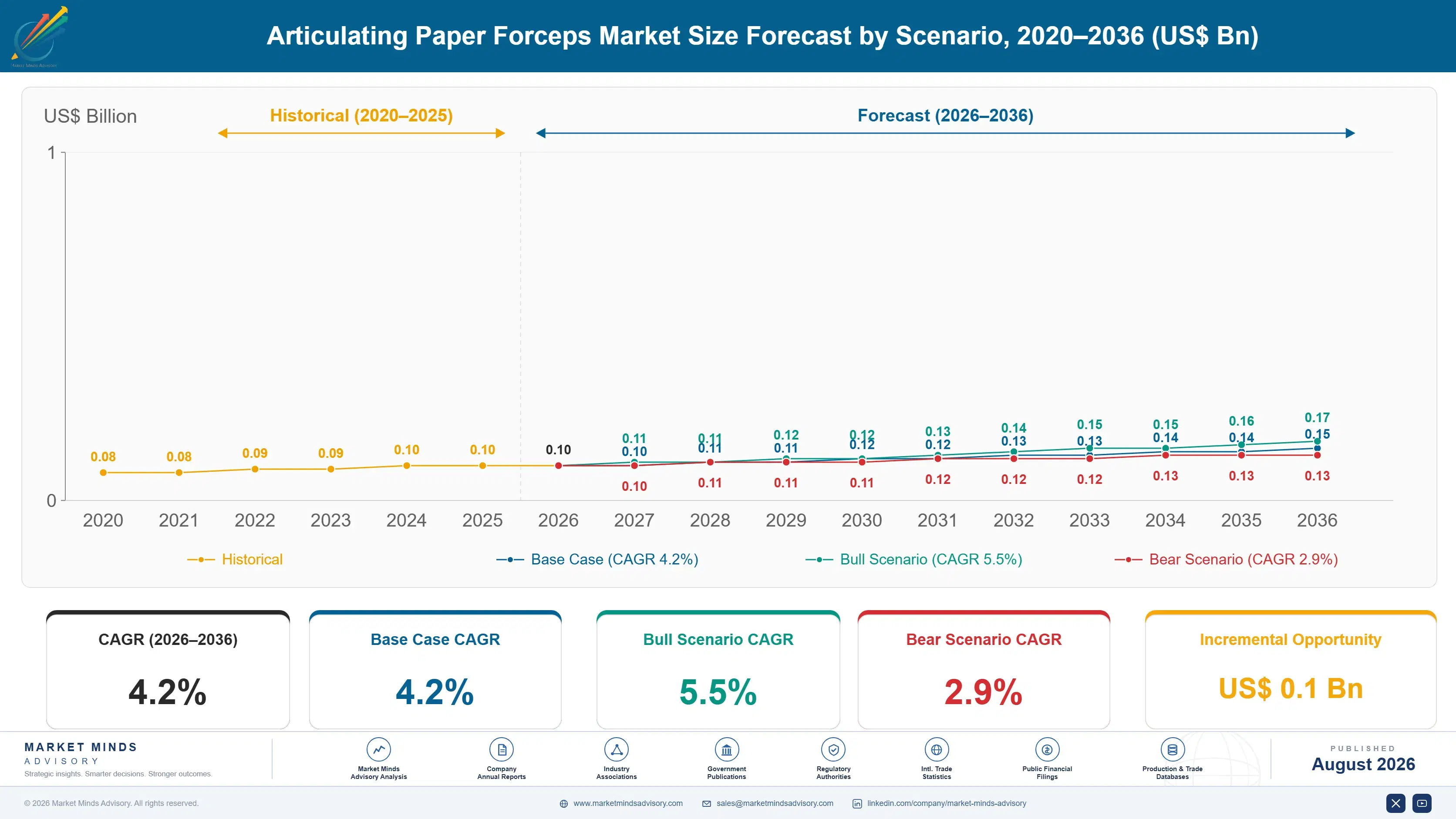
Articulating Paper Forceps Market Forecast Scenarios

articulating-paper-forceps-market-size-forecast-scenario-1787305791173
Global unit demand grew steadily between 2020 and 2025 as elective dental visit volumes recovered from pandemic disruption and group practice consolidation accelerated standardized instrument procurement across newly acquired locations, lifting the historical growth rate to roughly four percent annually across most established markets, with disposable format adoption climbing fastest inside larger multi-location practice networks.
The base case assumes continued conversion from reusable to single-use disposable formats inside high-volume group practices, expanding chair counts across East Asian markets, and steady replacement purchasing tied to sterilization compliance audits rather than discretionary capital spending. These three mechanisms together support base-case growth near the middle of the forecast band through 2036, with disposable format share climbing fastest inside dental service organization networks operating standardized infection control protocols across many locations.
A bull scenario assumes accelerated single-use adoption driven by tightening reprocessing validation requirements across major regulatory markets, pushing unit growth toward the top of the forecast band through the decade. A bear scenario assumes continued economic pressure on discretionary dental visit frequency and delayed capital replacement cycles, slowing conversion away from reusable steel instruments and holding growth closer to the forecast floor instead.

From Reusable Steel to Single-Use Convenience

Articulating paper forceps sit at a small but essential point in the dental instrument supply chain, converting from reusable stainless steel toward single-use disposable plastic as infection control expectations rise steadily across group practices, dental service organizations, and public clinics worldwide. The shift is gradual, uneven across geographies, and shaped more by procurement policy than by any single technology breakthrough in the category.
MARKET CONCENTRATION38%Combined unit shipment share held by top five manufacturers
AVERAGE SELLING PRICE$0.85 per unitBlended price spanning reusable steel and disposable plastic formats
TOP PRODUCING COUNTRYUSA, 31% shareShare of global unit output concentrated in domestic manufacturing
DISPOSABLE FORMAT PENETRATION42% of volumeShare of annual unit volume sold in single-use format
INSTRUMENT REPLACEMENT CYCLE18 monthsTypical interval before reusable instruments retire from active service
DISTRIBUTOR CHANNEL SHARE61% of volumeShare of unit volume reaching practices through dental distributors
Commercial character in this market is defined by low unit price and high transaction frequency rather than capital-equipment economics, so distributor relationships and bundled consumable attach rates matter more to manufacturer margin than any single large account win. Dental service organizations increasingly negotiate standardized instrument specifications across every clinic in their network, concentrating purchasing power with a comparatively small number of corporate buyers across most developed markets.
Reprocessing validation requirements and single-use device disposal guidance are gradually reshaping specification writing at the group-practice level, sustaining a decade-long increase in device and consumable demand even as reusable steel instruments retain a loyal base among independent solo practitioners who value long service life, lower packaging waste, and simpler autoclave-based sterilization workflows over disposable convenience.
"The category looks boring until you notice that disposable format pricing power rivals anything in specialty dental consumables."
Director, Dental and Medical Instruments Practice · MMA Dental Instruments and C

Market Trends

Single-Use Disposable Format Displacing Reusable Steel Instruments

Group dental practices and dental service organizations are converting instrument specifications toward single-use disposable articulating paper forceps, citing sterilization labor cost and cross-contamination liability rather than unit price alone. Surveyed practice administrators report disposable format now accounts for roughly 42 percent of unit volume across large multi-location networks, up from under 25 percent five years earlier. Manufacturers are responding with dedicated disposable production lines, redesigned ergonomic handles suited to single use, and packaging formats built for chairside sterile presentation rather than autoclave cycling, reshaping product development priorities across the category.
Market Impact: 55 percent of audited practices aff

Dental Service Organization Consolidation Standardizes Procurement Specifications

Dental service organizations now operate a growing share of practice locations across major markets, and centralized procurement teams increasingly write single-vendor instrument specifications covering every clinic in the network rather than leaving purchasing to individual practice managers. This consolidation compresses supplier lists, favoring manufacturers able to guarantee consistent multi-location supply and bundled consumable kits over smaller regional producers. Roughly 30 percent of contracted volume in mature markets now flows through structured multi-year agreements negotiated at the organization level rather than individual practice purchase orders, reshaping how manufacturers allocate sales resources.
Market Impact: Chair count grows 6 percent annuall

Market Opportunities and Growth Drivers

Infection Control Audits Tightening Across Group Dental Practices

Accreditation bodies and group practice quality programs are tightening infection control audit checklists, increasingly flagging reusable instruments with visible wear or unclear sterilization records as compliance risks rather than acceptable practice variation. Practice administrators cite audit findings as a leading reason for converting occlusal marking instruments to single-use disposable format, since disposable forceps eliminate documentation burden tied to autoclave cycle validation entirely. Roughly 55 percent of surveyed multi-location practices report at least one audit finding tied to reusable instrument sterilization records within the past two years, accelerating disposable format conversion timelines across affected networks.
Market Impact: Group practice adoption lags by 15

Chair Count Expansion Across East Asian Dental Markets

New dental clinic openings and chair count expansion across China, South Korea, and neighboring markets are lifting baseline instrument demand independent of any format shift between reusable and disposable forceps. Government insurance coverage expansion for basic dental procedures in several East Asian markets is widening patient visit frequency, directly increasing occlusal adjustment procedure volume and corresponding forceps consumption across both public and private clinic networks. Industry estimates put East Asian chair count growth near 6 percent annually through the forecast period, meaningfully outpacing chair count growth across most Western European markets over the same window.
Market Impact: Average selling price fell 8 percen

Market Restraints and Challenges

Price Sensitivity Among Independent Solo Dental Practitioners

Independent solo practitioners, who still account for a meaningful share of practice locations in several mature markets, resist converting to disposable format because reusable steel forceps carry a lower per-procedure cost once purchase price is amortized across years of autoclave-based reuse. The root cause is a fee schedule structure in many markets that reimburses occlusal adjustment procedures at a flat rate regardless of instrument cost, leaving little incentive to absorb higher disposable consumable spending. Manufacturers are exploring tiered pricing and small-practice bundled kits to soften the transition, but adoption among this segment remains roughly 15 percent below group practice levels.
Market Impact: Disposable share reaches 42 percent

Limited Product Differentiation Compresses Manufacturer Pricing Power

Articulating paper forceps carry few meaningful technical differences between competing manufacturers beyond handle ergonomics, tip geometry, and packaging format, making the category vulnerable to price-based competition once a buyer qualifies more than one supplier. The root cause is the instrument's simple mechanical design, which limits patentable innovation and keeps switching costs low for group practice procurement teams comparing multiple vendors. Some manufacturers are pursuing bundled consumable kits and multi-year distributor agreements to lock in volume and reduce reliance on per-unit price competition, though blended average selling prices have still declined roughly 8 percent over five years.
Market Impact: 30 percent of contracted volume
4 additional market trends, 4 additional growth drivers, and 4 additional restraints and challenges are covered in the full report. Contact sales@marketmindsadvisory.com to access the complete intelligence.

Segment CAGR and Growth Architecture

Segmentation follows product and material format, the dimension that most directly determines manufacturer margin, sterilization workflow, and distributor packaging strategy across this narrow instrument category. Disposable, bundled, and reusable formats carry distinct cost structures and buyer decision criteria, making format the clearest lens for tracking where unit volume and profit pools are actually shifting fastest.
articulating-paper-forceps-market-market-share-analysis-1787305791698

Single-Use Disposable Forceps

Single-use disposable forceps are the fastest-growing format, expanding at roughly 7.5 percent annually as group dental practices and dental service organizations replace autoclave-dependent instruments with individually packaged, sterile units discarded after a single patient encounter. Adoption is concentrated among multi-location practice networks that value predictable per-procedure cost and simplified infection control documentation over the lower amortized cost of reusable steel instruments. Manufacturers have responded with dedicated injection-molding capacity, redesigned ergonomic grips suited specifically to single use, and blister packaging formats built for chairside presentation rather than autoclave cycling routines. Independent solo practitioners remain the slowest converters, continuing to favor reusable instruments where procedure volume does not justify disposable per-unit spending.
CAGR 7.5%

Articulating Paper and Ribbon Consumables Bundled Kits

Bundled consumable kits, pairing a disposable or reusable forceps with pre-measured articulating paper or ribbon in a single sterile package, are the second-fastest-growing format at roughly 6.0 percent annually. These kits appeal to procurement teams seeking simplified ordering and inventory management across multi-location networks, consolidating two previously separate purchase lines into one standardized product code and reorder cadence across every clinic location. Dental service organizations increasingly specify bundled kits by default for new clinic openings, since kit packaging reduces chairside setup time and cross-contamination risk versus separately sourced components. Growth trails the pure disposable-forceps segment because kit pricing carries a premium that price-sensitive independent practices resist absorbing routinely across every visit.
CAGR 6.0%
Full segment breakdown across 6 segments available in the complete report.

Regional Architecture and Country Demand Map

Unit demand concentrates in markets with dense private dental practice networks and mature group-practice consolidation, with North America and East Asia together accounting for more than half of global volume, while adoption elsewhere tracks insurance coverage expansion and dental chair density growth closely across the decade.

North America

North America takes the largest regional share, supported by an unusually dense private dental practice network spanning tens of thousands of independent and group-affiliated clinics, plus premium instrument pricing that private-pay and insurance-reimbursed procedures alike can absorb without heavy discounting pressure. Dental service organizations across the United States and Canada have consolidated a meaningful share of practice locations, standardizing instrument specifications and pushing disposable-format conversion meaningfully faster than in most other regions. Regulatory attention to single-use device disposal and infection control compliance, particularly among state dental boards, reinforces demand for documented, traceable sterile instrumentation. Canada's smaller but steadily growing group-practice segment adds incremental volume alongside the dominant United States market.
Share: 30% | CAGR: 4.7% (2026 to 2036)

Western Europe

Western Europe combines a large installed base of reusable stainless steel forceps with slower disposable-format conversion than North America, reflecting reimbursement systems in Germany, France, and the United Kingdom that reward procedure efficiency over instrument format choice specifically. National dental associations across the region maintain sterilization and reprocessing validation standards that keep well-maintained reusable instruments commercially viable for a longer service life than in markets with tighter single-use disposal guidance. Group-practice consolidation is advancing in the United Kingdom and the Netherlands, gradually lifting bundled-kit adoption among larger clinic networks there. Growth trails the global average as replacement cycles remain longer and per-unit price competition among established regional distributors keeps volume growth modest across most Western European markets consistently.
Share: 23% | CAGR: 2.7% (2026 to 2036)
Regional intelligence for 5 additional markets available in the complete report: East Asia, South Asia and Pacific, Latin America, Middle East and Africa, Eastern Europe. Contact sales@marketmindsadvisory.com.
articulating-paper-forceps-market-country-cagr-analysis-1787305792205

Disposable Attach and Bundled Consumables Growth

Manufacturer margin in this narrow category depends less on unit price than on attach rate, contract structure, and distribution reach, since the underlying instrument is simple and hard to differentiate technically from competitors. These four levers describe where profit pools are shifting fastest as the market converts steadily toward disposable and bundled consumable formats.

Single-Use Disposable Format Price Premium Strategy

Disposable forceps command a substantially higher per-unit price than reusable steel instruments despite lower material cost per piece, since buyers value the eliminated sterilization labor and compliance documentation burden more than raw material economics. Manufacturers capturing this premium position disposable lines around infection control positioning rather than price parity with reusable alternatives, protecting margin as more group practices convert specifications. Disposable formats command a roughly 250 percent price premium over comparable reusable units on a per-procedure cost basis once sterilization labor is included, a gap manufacturers can defend as long as compliance pressure continues building steadily.
Market Impact: Disposable formats command a roughl

Bundled Consumables and Instrument Kit Growth Strategy

Packaging forceps together with pre-measured articulating paper or ribbon into a single sterile kit consolidates two purchase lines into one standardized product code, simplifying procurement for multi-location dental service organizations that value fewer vendor relationships. Kit pricing carries a premium over separately purchased components, and attach rates for bundled formats have climbed toward roughly 35 percent of disposable-format unit volume in mature markets with strong group-practice penetration. Manufacturers offering broader kit configurations, spanning different paper grip and thickness combinations, capture incremental shelf space and repeat ordering that single-product suppliers cannot match as easily.
Market Impact: Bundled kit attach rates now approa

Dental Service Organization Contract Structuring Strategy

Multi-year supply agreements negotiated directly with dental service organization corporate procurement teams lock in volume across every clinic in the network, reducing the sales cost of serving many small individual practice locations separately. Structured contracts now cover roughly 30 percent of total contracted volume in mature markets, up meaningfully from a smaller share five years earlier, and typically include tiered pricing that rewards network-wide standardization on a single manufacturer's product line. Manufacturers able to guarantee consistent multi-location supply and responsive account management capture a disproportionate share of this consolidating, increasingly influential buyer segment.
Market Impact: Structured contracts now cover 30 p

Distributor Partnership Network Expansion Growth Strategy

Independent distributor networks provide reach into smaller dental practices that manufacturers cannot cost-effectively serve through direct sales representatives given deal sizes averaging under a few hundred dollars per order. Expanding partnership agreements across underserved regional territories lets Articulating Paper Forceps producers grow presence in fragmented markets without carrying the fixed cost burden of direct field coverage. Export volume through distributor channels grows roughly 20 percent each year, outpacing direct sales growth, as distributors combine complementary product lines into single orders that reduce shipping cost per unit for smaller independent practices nationwide.
Market Impact: Export volume grows roughly 20 perc

Who Controls the Margin Pool

The top five manufacturers by unit shipment volume hold roughly 38 percent combined share, a moderate concentration level that leaves meaningful room for regional producers competing on price and distributor relationships rather than brand recognition alone. Hu-Friedy and Miltex lead the category by a clear margin, with a noticeable gap separating them from mid-tier challengers still building out multi-location distribution reach across secondary markets.
Current competitive activity centers on three dimensions: expanding dedicated single-use disposable production capacity, signing multi-year supply agreements directly with dental service organization procurement teams, and broadening bundled consumable kit configurations to capture more shelf space per order. Distributor partnership breadth increasingly separates category leaders from smaller regional producers unable to guarantee consistent multi-location supply commitments across growing practice networks.

Emerging pressure comes from regional Asian manufacturers offering steel and disposable forceps at meaningfully lower price points, gradually winning price-sensitive independent practice accounts outside the established leaders' core distributor networks. Rankings could shift meaningfully if a mid-tier challenger secures a large dental service organization contract, since concentrated corporate buying power now moves volume faster than organic account-by-account share gains among fragmented independent practices worldwide.
articulating-paper-forceps-market-company-positioning-matrix-1787305792728

Competitive Moat and Risk Dimensions

HU-FRIEDY

Moat: Dental Distribution Network Depth

Hu-Friedy has spent decades building direct relationships with dental distributors across nearly every major market, giving it shelf presence and reorder priority that newer entrants cannot easily replicate. This distribution depth lets the company win group practice contracts on service reliability rather than price alone, defending margin against lower-cost regional challengers consistently.
HU-FRIEDY

Risk: Legacy Reusable Portfolio Exposure

A large share of Hu-Friedy's installed base still runs on reusable steel instruments, exposing the company to slower replacement cycle revenue if disposable conversion accelerates faster than its own disposable production capacity can scale to match rising group-practice demand across major markets and distributor channels simultaneously.
MILTEX

Moat: Integra LifeSciences Parent Backing

Miltex benefits from Integra LifeSciences' broader medical device distribution infrastructure and balance sheet, letting it bundle dental instruments alongside adjacent surgical product lines when negotiating with large dental service organization and hospital-affiliated dental accounts nationwide, an advantage smaller dental-only specialist competitors cannot easily match given their narrower distribution reach.
MILTEX

Risk: Reduced Focus Versus Specialists

Operating inside a diversified parent company means dental instruments compete internally for capital and management attention against larger surgical and orthopedic product lines, potentially slowing Miltex's disposable-format product development pace relative to dental-only specialist competitors focused entirely on this category and its evolving customer requirements.

Players Tracked

Prominent Players

Hu-Friedy
Miltex
Nordent Manufacturing
ASA Dental
Waldent Innovations

Other Key Players

Osung MND
American Eagle Instruments
Premier Dental Products Company
GC Corporation
Acteon Group
Aesculap
Salvin Dental Specialties
Directa AB
Kerr Dental
Almore International
Paradise Dental Technologies
Medesy
LM-Dental
J. Morita Corporation
HLW Dental Instruments

Recent Developments

MAY 2025

Hu-Friedy Launches Expanded Single-Use Disposable Instrument Line

Hu-Friedy launched an expanded single-use disposable articulating paper forceps line with improved ergonomic handle design, adding new manufacturing capacity dedicated entirely to disposable instrument production. The launch targets dental service organizations prioritizing infection control compliance across their multi-location practice networks, supporting standardized procurement across facilities.
Signal: Signals accelerating manufacturer investme
OCTOBER 2024

Miltex Signs Multi-Year Supply Agreement With Dental Service Organization

Miltex signed a multi-year supply agreement with a large dental service organization covering standardized instrument procurement across every clinic in its expanding network. The agreement guarantees consistent pricing and delivery timelines in exchange for exclusive single-vendor status, reflecting the growing importance of corporate procurement relationships across this fragmented, price-sensitive category.
Signal: Signals growing dental service organizatio
JANUARY 2025

Nordent Manufacturing Acquires Regional Dental Instrument Distributor

Nordent Manufacturing completed the acquisition of a regional dental instrument distributor specializing in direct-to-practice sales relationships, strengthening its distribution reach into smaller independent dental practices previously served entirely through third-party wholesalers nationwide. The acquisition accelerates Nordent direct sales roadmap, reducing dependence on external distribution partnerships.
Signal: Signals continued industry consolidation a

Steel and Polymer Input Cost Exposure

Medical-grade stainless steel accounts for roughly 30 percent of cost of goods sold for reusable forceps, sourced primarily from mills in China, Germany, and the United States, while injection-molded polymer resin accounts for a comparable share of disposable-format production cost, sourced mainly from petrochemical suppliers across North America and East Asia serving multiple downstream instrument categories.
Stainless steel prices climbed sharply during 2024 as tariff actions and reduced Chinese export volume tightened availability across Western buyers, according to the World Trade Organization's 2025 trade monitoring report. Several forceps manufacturers absorbed the increase temporarily rather than pass costs through immediately, given intense price competition among mid-tier suppliers, before adjusting list prices roughly 4 percent in early 2025 to partially restore margin across affected product lines.

Smaller regional manufacturers without long-term supply contracts face the steepest exposure, since they typically purchase steel and resin on spot markets rather than through hedged forward agreements that larger competitors like Hu-Friedy and Miltex negotiate directly with mills. This gap widens further for manufacturers concentrated in tariff-affected import corridors, where landed material cost has risen disproportionately relative to domestically sourced competitors.
articulating-paper-forceps-market-cost-volatility-analysis-1787305792924

Forward Contracting With Steel and Resin Suppliers

Larger manufacturers negotiate annual or multi-year fixed-price agreements directly with steel mills and resin suppliers, insulating a meaningful share of production cost from spot market volatility swings that smaller competitors cannot avoid. This approach requires scale and forecasting confidence that smaller regional producers typically lack, reinforcing a durable cost advantage for established category leaders over time.

Dual Sourcing Across Regional Material Suppliers

Qualifying steel and resin suppliers across more than one geographic region reduces exposure to any single tariff action, mill outage, or shipping disruption affecting one supply corridor at a time. Manufacturers pursuing dual sourcing report smoother cost pass-through negotiations with distributors during volatile periods, avoiding sudden margin compression tied to concentrated supplier dependence on any one source.

Material Substitution Toward Lower-Cost Polymer Grades

Some manufacturers are qualifying lower-cost polymer grades for disposable-format handles where mechanical requirements permit substitution without compromising sterility or grip performance during clinical procedures nationwide and internationally. This shift reduces resin cost exposure gradually over time, though qualification testing and regulatory documentation slow the pace at which substitution can meaningfully offset rising overall input costs.

Portfolio Architecture for Margin Defence

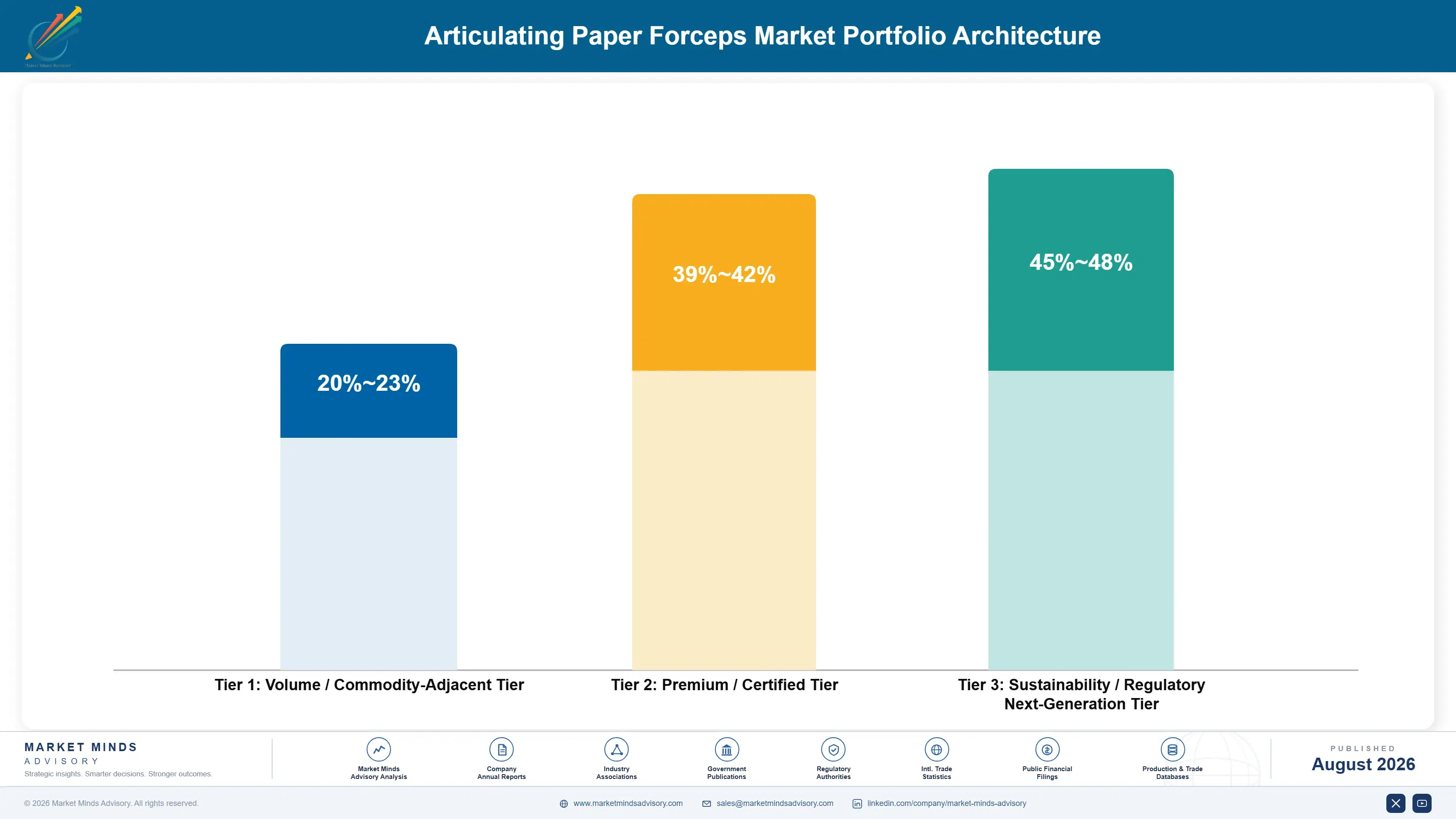
Portfolio economics in this narrow category split cleanly across three tiers defined by material, sterilization format, and buyer segment rather than by any single technology differentiator. Volume-tier reusable steel instruments carry thin margins driven by long service life and price competition among established distributors, while premium and next-generation disposable and bundled formats command meaningfully higher gross margin as buyers pay for convenience and compliance documentation rath
The volume-premium tension plays out most visibly between independent solo practitioners, who remain price-anchored to reusable steel pricing built around decades-old replacement cycles, and dental service organizations, whose corporate procurement teams increasingly specify premium disposable and bundled formats regardless of unit price differential versus reusable alternatives. Manufacturers straddling both tiers manage distinct sales motions, inventory strategies, and account service models for each buyer type simultaneously.

High-value margin pools concentrate in bundled consumable kits and premium ergonomic disposable lines sold directly into large dental service organization accounts, where multi-year volume commitments justify dedicated production capacity and tighter account management. Next-generation sustainability-oriented formats, including recyclable polymer disposables, remain a small but closely watched pool as environmental procurement criteria slowly enter group-practice purchasing specifications across several developed markets.

Volume / Commodity-Adjacent Tier

Reusable stainless steel forceps sold primarily to independent solo practitioners and smaller practices prioritizing long service life and low per-unit acquisition cost over disposable convenience, distributed mainly through regional dental supply wholesalers.
Gross Margin: 20-23%

Premium / Certified Tier

Single-use disposable forceps and standard bundled consumable kits sold to group practices and dental service organizations prioritizing infection control compliance, simplified procurement documentation, and predictable per-procedure instrument cost across every location.
Gross Margin: 39-42%

Sustainability / Regulatory / Next-Generation Tier

Recyclable polymer disposables, premium ergonomic designs, and emerging bundled kits engineered for lower environmental footprint, targeting sustainability-conscious dental service organization procurement specifications now spreading gradually across several developed markets and clinic networks.
Gross Margin: 45-48%
articulating-paper-forceps-market-portfolio-architecture-1787305793427

High-value Sub-segments and Strategic Watch-out

Bundled Consumable Kits

Bundled consumable kits sold under multi-year dental service organization contracts combine high growth with strong margin, as standardized procurement and reduced vendor count let manufacturers price above single-product disposable formats consistently, while lowering distribution and account servicing cost per order across every participating clinic location.
Gross Margin: 40-43%

Premium Ergonomic Disposable Forceps

Premium ergonomic disposable forceps targeting larger group practices offer strong margin with moderate volume growth, benefiting from brand loyalty among practice administrators reluctant to switch established, trusted suppliers even when lower-priced alternatives are readily available from regional competitors offering broadly comparable technical specifications and packaging quality.
Gross Margin: 42-45%

Standard Reusable Stainless Steel Forceps

Standard reusable stainless steel forceps remain the volume core of the category, generating steady but thin-margin revenue from independent practitioners and smaller clinics resistant to disposable format conversion given their lower procedure volume, tighter operating budgets, and long-established autoclave-based sterilization routines that still work reliably overall.
Gross Margin: 19-22%

Recyclable Polymer Disposable Formats

Recyclable polymer disposable formats warrant close monitoring as environmental procurement criteria could reshape specification writing quickly if a major dental service organization mandates sustainability requirements across its network, forcing competitors to accelerate their own recyclable product roadmaps and packaging redesigns in direct response nationwide and internationally.
Gross Margin: 34-37%

Recurring Replacement Economics in a Consumable

Demand in this category behaves less like a durable equipment market and more like a recurring consumable annuity, since every forceps unit, whether reusable or disposable, eventually wears out, breaks, or gets discarded and must be reordered by the practice or clinic administrator. Reusable steel instruments generate replacement revenue on multi-year cycles, while disposable formats generate reorder revenue continuously, tied directly to patient visit volume rather than instrument durability or
Adoption depth varies meaningfully by vertical: general dentistry practices convert to disposable format fastest, orthodontic and specialty practices lag slightly given lower occlusal marking frequency per patient visit, and dental teaching institutions often retain reusable instruments longer for cost reasons tied to high student-driven instrument turnover and breakage rates across large training programs and clinical rotations each semester.

A generational shift is underway as newer practice owners, trained under stricter infection control curricula, default to disposable format specifications without the cost hesitation that shaped purchasing among practitioners who built their careers around reusable steel instrumentation and its lower amortized per-procedure cost over several decades of steady clinical practice, patient care, and community trust.
articulating-paper-forceps-market-end-use-penetration-index-1787305793920

Where Value Concentrates Through 2036

These are among the four positions where our research anticipates prominent divergence between winners and laggards over the coming forecast period. Each is grounded in the demand model, the regulatory perimeter, and the announced capacity pipeline.
01 / FORMAT CONVERSION PRIORITY

Prioritize disposable format capacity over incremental reusable line investment

Disposable format conversion is the single clearest growth vector in this category, and manufacturers still allocating capital toward incremental reusable-line improvements risk losing share to competitors expanding dedicated single-use production capacity. Group dental practices and dental service organizations are the buyers actually driving specification change, and they have shown limited price sensitivity when infection control compliance is the stated rationale. Capital directed toward disposable capacity, ergonomic redesign, and blister packaging will compound faster than spending preserving legacy reusable product lines indefinitely.
02 / CONTRACT STRUCTURE DISCIPLINE

Build dedicated account teams for dental service organization procurement

Dental service organizations now negotiate instrument specifications across every clinic in their expanding network, and this concentrated buying power rewards manufacturers who can staff dedicated account relationships rather than treating each location as an individual transaction. Structured multi-year contracts already cover roughly 30 percent of contracted volume in mature markets, and that share is likely to keep climbing steadily as consolidation continues across most developed dental markets worldwide. Manufacturers without dedicated account infrastructure will struggle increasingly to win these consolidating accounts.
03 / DISTRIBUTION REACH INVESTMENT

Expand distributor partnerships to defend share in fragmented markets

Independent practices and smaller clinics remain price-sensitive and geographically fragmented, making direct sales coverage uneconomical relative to average deal size in most territories worldwide. Distributor partnerships let manufacturers maintain presence across these fragmented accounts without carrying fixed field-sales cost, and export volume through distributor channels is already growing faster than direct channel volume in several regions. Manufacturers underinvesting in distributor relationships risk ceding this large, slower-growing but still meaningful volume base to regional competitors willing to compete on price and service.
04 / INPUT COST HEDGING

Lock in steel and resin supply agreements ahead of volatility

Steel and resin input costs have already proven volatile once during the historical period, and smaller manufacturers without forward contracts absorbed the resulting margin pressure more severely than larger competitors holding hedged agreements. Establishing multi-year supply relationships with mills and resin suppliers now, well before the next volatility event, protects margin during the disposable format transition when production volume and material demand are both increasing simultaneously across the industry. This discipline separates resilient category leaders from vulnerable regional followers over time.

Engagement Snapshot From the Field

A live engagement with an industry participant carrying material or product regulatory and market exposure ahead of a defining policy shift, showing how our research translates into a defensible multi-year portfolio strategy.
MARKET MINDS ADVISORY · CLIENT ENGAGEMENT SUMMARY
Articulating Paper Forceps Producer Strategic Portfolio Review and Transition Roadmap 2026·Investment Scenario on Articulating Paper Forceps Exposure Evaluation 2025-26
CLIENT PROFILE
The client operates a mid-sized dental service organization managing several dozen affiliated general and specialty dental practice locations across three neighboring states, having grown primarily through acquisition of independent practices over the preceding four years. Instrument procurement had remained decentralized, with individual practice managers ordering from whichever local distributor offered the most convenient relationship, producing wide variation in unit pricing and instrument format across the network's clinics.
STRATEGIC CHALLENGE
Leadership sought to standardize occlusal instrument procurement across the network ahead of a planned expansion, but lacked visibility into which format, reusable or disposable, would deliver better total cost of ownership once sterilization labor and compliance documentation were factored in accurately. Practice-level resistance to changing established supplier relationships complicated the standardization effort further, threatening to delay the broader procurement consolidation initiative.
MMA APPROACH
MMA conducted a total cost of ownership analysis comparing reusable and disposable formats across the network's actual procedure volume and labor cost assumptions, drawing on primary interviews with practice administrators and sterilization staff across a representative sample of locations. The analysis incorporated distributor pricing benchmarks and compliance audit history to quantify the hidden cost of reusable format sterilization labor and documentation burden across the network.
KEY FINDINGS
  1. Disposable format total cost of ownership was 12 percent lower than reusable once sterilization labor was fully counted (client-reported, unverified by MMA).
  2. Practices with the highest sterilization audit finding frequency across the network showed the strongest financial case for immediate disposable format conversion at their locations.
  3. Consolidating distributor relationships from eleven regional suppliers down to three preferred vendors reduced average per-unit instrument pricing by roughly 9 percent (client-reported, unverified by MMA).
  4. Bundled consumable kits reduced chairside setup time meaningfully according to sterilization staff feedback gathered across the sampled practice locations during the pilot phase.
CLIENT PROFILE
The client operates a mid-sized dental service organization managing several dozen affiliated general and specialty dental practice locations across three neighboring states, having grown primarily through acquisition of independent practices over the preceding four years. Instrument procurement had remained decentralized, with individual practice managers ordering from whichever local distributor offered the most convenient relationship, producing wide variation in unit pricing and instrument format across the network's clinics.
STRATEGIC CHALLENGE
Leadership sought to standardize occlusal instrument procurement across the network ahead of a planned expansion, but lacked visibility into which format, reusable or disposable, would deliver better total cost of ownership once sterilization labor and compliance documentation were factored in accurately. Practice-level resistance to changing established supplier relationships complicated the standardization effort further, threatening to delay the broader procurement consolidation initiative.
MMA APPROACH
MMA conducted a total cost of ownership analysis comparing reusable and disposable formats across the network's actual procedure volume and labor cost assumptions, drawing on primary interviews with practice administrators and sterilization staff across a representative sample of locations. The analysis incorporated distributor pricing benchmarks and compliance audit history to quantify the hidden cost of reusable format sterilization labor and documentation burden across the network.
KEY FINDINGS
  1. Disposable format total cost of ownership was 12 percent lower than reusable once sterilization labor was fully counted (client-reported, unverified by MMA).
  2. Practices with the highest sterilization audit finding frequency across the network showed the strongest financial case for immediate disposable format conversion at their locations.
  3. Consolidating distributor relationships from eleven regional suppliers down to three preferred vendors reduced average per-unit instrument pricing by roughly 9 percent (client-reported, unverified by MMA).
  4. Bundled consumable kits reduced chairside setup time meaningfully according to sterilization staff feedback gathered across the sampled practice locations during the pilot phase.
RECOMMENDED STRATEGY
Phase 1: Phase 1 (Months 1 to 2): Conduct total cost of ownership analysis and distributor relationship audit across all network locations. Phase 2: Phase 2 (Months 3 to 5): Pilot standardized disposable format procurement across a representative subset of network practice locations first. Phase 3: Phase 3 (Months 6 to 9): Roll out the network-wide standardized procurement contract and consolidate all remaining distributor relationships fully.
OUTCOME
The client consolidated procurement to a single primary distributor relationship and standardized on disposable format across roughly 80 percent of network locations within nine months, reporting a 14 percent reduction in blended procurement and sterilization labor cost (client-reported, unverified by MMA). Practice-level satisfaction with ordering improved measurably per internal survey feedback.

Frequently Asked Questions

Foundational context covering the market sizes, CAGR, scope, country, region and competition that inform every finding below. This section is provided to cover basics and most often pre-purchase conversations, answered from the MMA Primary Research Dataset.

What is the current size of the Articulating Paper Forceps Market?

The global Articulating Paper Forceps Market is valued at approximately 0.12 billion dollars in 2025. This figure reflects unit shipment volume across reusable, disposable, and bundled kit product formats worldwide.

How large will the Articulating Paper Forceps Market be by 2036?

The market is projected to reach approximately 0.19 billion dollars by 2036. This represents cumulative growth driven primarily by disposable format conversion across group dental practices worldwide.

What is the CAGR for the Articulating Paper Forceps Market 2026 to 2036?

The market is forecast to grow at a compound annual growth rate of 4.2 percent between 2026 and 2036. Base-case growth reflects steady disposable format conversion tempered by a mature reusable installed base.

Which segment is growing fastest?

Single-use disposable forceps are the fastest-growing segment, expanding at roughly 7.5 percent annually, nearly 1.8 times the overall market rate. Growth is concentrated among group dental practices converting away from reusable steel instruments.

Who are the major companies in the Articulating Paper Forceps Market?

Leading companies include Hu-Friedy, Miltex, Nordent Manufacturing, ASA Dental, and Waldent Innovations. These five manufacturers hold roughly 38 percent of global unit shipment volume combined.

Which country is growing fastest?

India is among the fastest-growing national markets, supported by expanding private dental clinic networks and rising dental college enrollment nationwide. Growth here outpaces most established Western markets by a wide margin.

Report Segmentation Architecture

The full report scope spans multiple orthogonal segmentation dimensions, with cross-tabulated demand data provided for each dimension pair. Coverage extends further to regional breakdowns, trend trajectories, and the competitive detail needed to support segment-level decision-making.

By Primary Market Dimension

  • Single-Use Disposable Forceps
  • Articulating Paper and Ribbon Consumables Bundled Kits
  • Reusable Stainless Steel Locking Forceps
  • Reusable Stainless Steel Non-Locking Forceps
  • Reusable Premium Alloy and Ergonomic Handle Forceps
  • Pediatric and Specialty Design Forceps

By End-Use Industry

  • General Dentistry Practices
  • Orthodontic and Specialty Practices
  • Dental Service Organizations
  • Dental Teaching and Training Institutions
  • Public Health and Government Dental Clinics

By Commercial Dimension

  • Direct Manufacturer Sales
  • Dental Distributor Channel Sales
  • Group Practice Contract Sales
  • E-Commerce and Online Dental Supply Sales

By Region

  • North America
  • Western Europe
  • East Asia
  • South Asia and Pacific
  • Latin America
  • Middle East and Africa
  • Eastern Europe

Scope, Methodology, and Coverage

Every figure in this report is reproducible from documented input assumptions. The scope below maps the historical period, the forecast horizon, the segmentation dimensions, and the countries covered, alongside the underlying primary and qualitative methodology.
Historical Period
2020 to 2025
Forecast Period
2026 to 2036
Base Year
2025 (USD billions; MMA Primary Research Dataset, August 2026)
Market Definition
The Articulating Paper Forceps Market covers hand-held instruments used to hold and position articulating paper or ribbon for occlusal marking during dental examination, adjustment, and restorative procedures, spanning reusable, disposable, and bundled kit formats. It excludes standalone articulating paper and ribbon consumables sold independent of any bundled forceps kit, and excludes general dental hand instruments not designed specifically for occlusal marking media placement.
Quantitative Units
USD billions (current prices); unit shipment volume in millions of pieces
Segmentation Dimensions
By Product and Material Format; By End-Use Industry; By Commercial Dimension; By Region
Regions Covered
North America, Western Europe, East Asia, South Asia and Pacific, Latin America, Middle East and Africa, Eastern Europe
Countries Covered
USA, China, Germany, France, UK, Japan, South Korea, India, Australia, Canada, Brazil, Mexico, Indonesia, Vietnam, Thailand, Malaysia, UAE, Saudi Arabia, South Africa, Nigeria, Turkey, Poland, Netherlands, Italy, Spain, Sweden, Switzerland, Argentina, Colombia, Singapore, and additional markets relevant to this sector
Key Companies Profiled
Hu-Friedy, Miltex, Nordent Manufacturing, ASA Dental, Waldent Innovations, Osung MND, American Eagle Instruments, Premier Dental Products Company, GC Corporation, Acteon Group, Aesculap, Salvin Dental Specialties, Directa AB, Kerr Dental, Almore International, Paradise Dental Technologies, Medesy, LM-Dental, J. Morita Corporation, HLW Dental Instruments
Quantitative Methodology
Primary survey, n=3,800 respondents, Q4 2025, six countries; demand-side model with trade association cross-validation
Qualitative Methodology
47 expert interviews, Q4 2025; applied to validate demand model assumptions, identify emerging dynamics, and assess competitive positioning
Report Format
PDF and XLSX data workbook (Word format preview document)
Publisher
Market Minds Advisory
Report Code
MMA-2026-MED-531
Published
August 2026
Contact
sales@marketmindsadvisory.com | www.marketmindsadvisory.com

Purchase the full Articulating Paper Forceps Market Report (2026 to 2036).

This report delivers a full quantitative and qualitative assessment of the global Articulating Paper Forceps Market, covering historical performance from 2020 through 2025 and forecasts through 2036 across base, bull, and bear scenarios. It profiles twenty companies spanning reusable, disposable, and bundled kit product formats, benchmarked on a consistent unit shipment volume basis. Regional analysis spans all seven major world regions, with detailed demand mechanisms specific to each. The report also includes segmentation analysis, input cost exposure assessment, competitive positioning, and an anonymized client case study illustrating practical procurement decision-making.
Ten-year historical and forecast market sizing
Product format segmentation with growth rates
Seven-region demand mapping and competitive benchmarking
Twenty-company competitive profiling and moat analysis
Input cost exposure and mitigation strategy assessment
Anonymized client case study and strategic verdict

Built For The People Who Decide

From boardroom strategy to bench-side execution, this report is read cover-to-cover by leaders shaping the next decade of their industry, turning demand scenarios, market dynamics and valuation benchmarks into decisions.
CXOs/ Presidents/ VPs/ Managers
M&A and Corporate Development
Strategy Teams and R&D Heads
Procurement and Product Directors
Regulatory and Compliance Leaders
Investor Relations and Equity Analysts