Market Minds Advisory
Arteriovenous Fistula Treatment Market

Arteriovenous Fistula Treatment Market: Maturation Failure, Maintenance Economics, and Endovascular Creation

A large share of the fistulas this field creates never mature enough to use, and the interventions needed to rescue the rest are now worth more than the creation itself.

Lead Analyst

Alice Ballenger

Published

September 2026

Make Smarter Decisions with Customized Research Insights

Request a free sample report and evaluate market opportunities, growth trends, and competitive dynamics relevant to your business needs.

2025 MARKET VALUE$1.7BMarket Size 2025
2036 FORECAST VALUE$3.6BBase Case , 2026 to 2036
CAGR 2026 TO 20367.2 %Bull 8.4% / Bear 6.0%
INCREMENTAL OPPORTUNITY$1.8BNet 10- year value creation
EXPANSION MULTIPLE2.01x2036 value over 2026 base
Strategic Levers
M&A Pipeline
Regional Outlook
Country Rankings
Competitive Intelligence
Segmental Deep-dive
Call-Us : 91 93563 13602

Executive Snapshot and Market Trajectory

Roughly 38% of surgically created fistulas never mature well enough to use for dialysis. The campaign that pushed fistula creation over catheters therefore created an enormous population of accesses requiring intervention, and that maintenance work now carries the market. Creation happens once, while maintenance then recurs for years afterwards.
Endovascular fistula creation compounds at 10.8%, a full 1.50x the market rate, because a percutaneous anastomosis avoids surgical dissection and shows better maturation in several series, though adoption is slowed as much by which specialty performs it as by anatomy. East Asia holds the largest share at 30%, since Japan sustains the highest dialysis prevalence anywhere and China holds the largest dialysis population in absolute terms.
Concentration is moderate at 66%, and patients undergo roughly 1.6 interventions per access year simply to keep a fistula usable. Around 22% of dialysis patients remain dependent on a central venous catheter despite the infection and mortality risk that carries. Every conversion from catheter to permanent access generates creation revenue once and maintenance revenue for years afterwards, which makes that dependence rate the largest addressable volume anywhere in the category.
Market Definition
This market covers devices used to create, mature, maintain and salvage vascular access for haemodialysis, spanning surgical fistula creation instruments and sutures, endovascular fistula creation systems, synthetic and biologic grafts, drug-coated and plain angioplasty balloons, stent grafts and bare stents, and thrombectomy and declotting devices, measured at manufacturer revenue. Central venous catheters for dialysis, dialysis machines, dialysers and bloodlines, peritoneal dialysis products, and hospital procedure or service revenue are excluded.
Base Year Value
$1.7B in 2025 (MMA Primary Research Dataset, August 2026)
Forecast Period
2026 to 2036, eleven discrete annual values
CAGR
7.2% base case. Bull 8.4%. Bear 6.0%.
Fastest Growth Segment
Endovascular Fistula Creation Systems: 10.8% CAGR
Fastest Growth Country
India: 12.6% CAGR
Fastest Growth Region
South Asia and Pacific: 9.2% CAGR
Largest Region
East Asia: 30% of 2025 global value
Market Leaders
Becton Dickinson, Medtronic, W L Gore and Associates, Boston Scientific, and Merit Medical Systems. Source: MMA Primary Research Dataset, July 2026.
Primary Survey
n=3,800 procurement and R&D decision-makers, Q4 2025, six countries
Methodology
Demand-side build-up, cross-validated against public data, 47 expert interviews

Arteriovenous Fistula Treatment Market Forecast Scenarios

arteriovenous-fistula-treatment-market-size-forecast-scenario-1787305637105
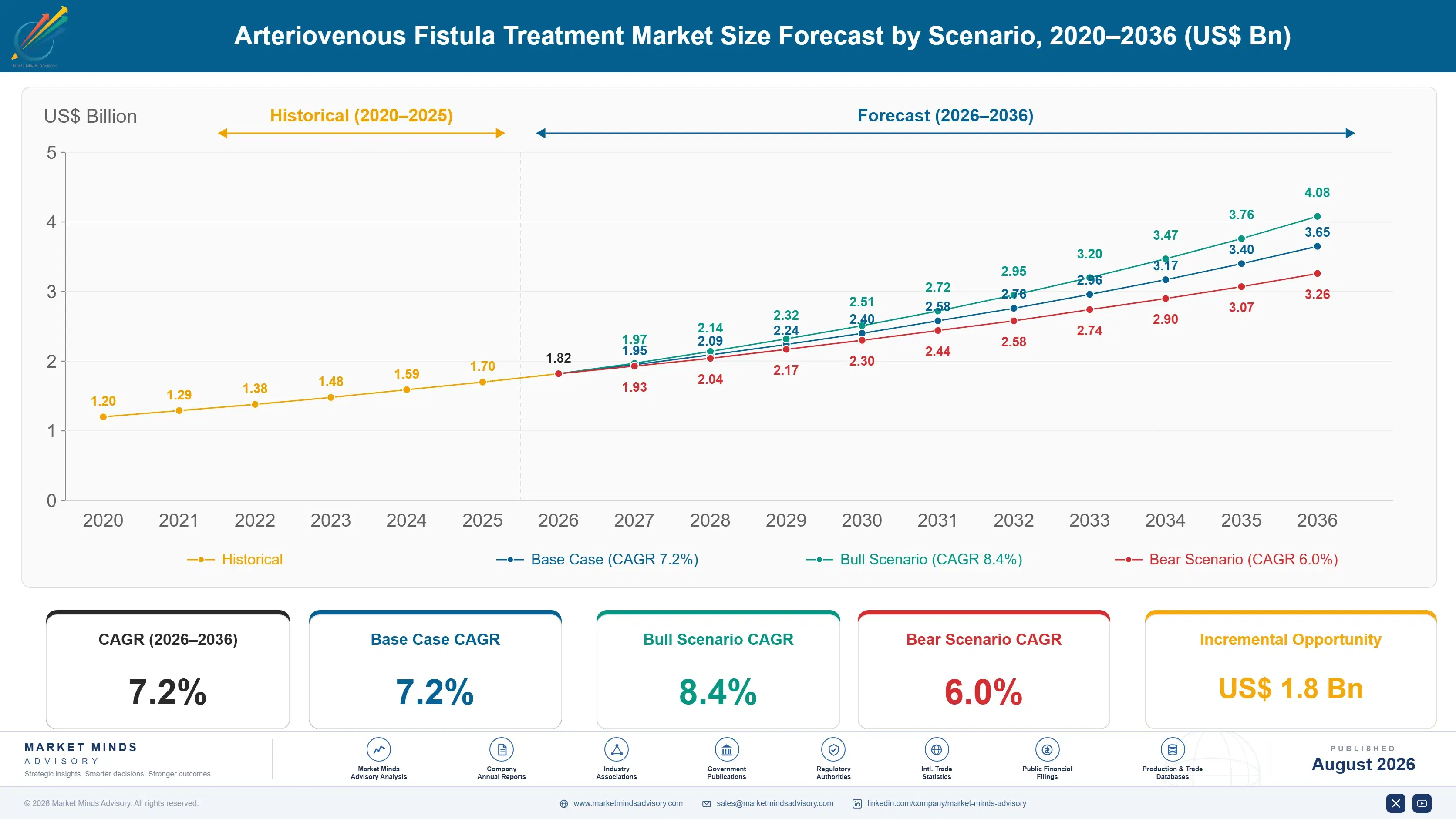
Growth ran near 6.2% from 2020 to 2025 as the field absorbed a consequence of its own guidance. Programmes promoting fistula creation over catheter dependence raised creation volumes, then discovered that many of those fistulas required repeated intervention to become usable. Drug-coated balloons meanwhile demonstrated superior patency in randomised study, which established a higher-priced maintenance product on genuine evidence.
Base case growth of 7.2% rests on three mechanisms. Dialysis populations keep expanding across Asia as diabetes and hypertension prevalence rise and access to treatment improves, with India compounding at 12.6%. Maintenance intervention volume grows with the installed access population rather than with new creations. And endovascular creation systems take share from surgical anastomosis where anatomy permits and an interventionalist is available to perform it. None of the three depends on the others arriving first.
The bull case at 8.4% assumes endovascular creation resolves the specialty access question and expands beyond the anatomically suitable minority, which would convert a large surgical volume into a device-intensive procedure. The bear case at 6.0% is a treatment shift: home and peritoneal dialysis expand faster than expected, reducing the vascular access population, while transplantation rates improve in the countries with the largest programmes.

Vascular Access: Maturation, Maintenance and Method

This market grew out of a public health success that produced an unexpected commercial consequence. Programmes urging clinicians to create arteriovenous fistulas rather than leave patients on central venous catheters were right about the mortality difference, and creation volumes rose sharply. Then the field confronted a fact it rarely quantified: roughly 38% of created fistulas never mature enough to use.
TOP FIVE CONCENTRATION66%Concentrated among manufacturers holding creation and maintenance portfolios
PRIMARY MATURATION FAILURE38%Surgically created fistulas never becoming usable for reliable dialysis access
INTERVENTIONS PER ACCESS YEAR1.6Procedures required annually to keep an established access functioning
CATHETER DEPENDENCE RATE22%Patients relying on central venous catheters rather than permanent access
ACCESS CREATION COSTUSD 4,800Typical device and procedure cost of establishing permanent access
GLOBAL DIALYSIS POPULATION4.1 millionPeople receiving maintenance haemodialysis worldwide requiring functioning vascular access
The result is that maintenance rather than creation now carries the economics. An established access requires around 1.6 interventions a year to stay patent, which means angioplasty balloons, stent grafts and thrombectomy devices are consumed repeatedly across a patient's dialysis lifetime while the creation procedure happens once. Drug-coated balloons demonstrated superior patency in randomised study, giving maintenance a higher-priced product on evidence peripheral arterial applications never established.
Endovascular creation is the interesting development and a slow one. Forming the anastomosis percutaneously avoids surgical dissection, shows better maturation in several published series and leaves no scar. Adoption is constrained partly by anatomy, since not every patient has suitable vessels, and considerably by specialty: the procedure moves access creation from a vascular surgeon to an interventionalist, and that transfer is being negotiated institution by institution.
"Everybody in nephrology celebrated moving patients off catheters and onto fistulas, and almost nobody costed what keeping those fistulas open would require. The maintenance business is bigger than the creation business, and it was never anyone's plan."
Principal Analyst, Vascular Access and Renal Devices Practice · MMA Medical Devi

Market Trends

Percutaneous anastomosis moves creation from surgeon to interventionalist

Endovascular systems form the arteriovenous connection through catheter access rather than surgical dissection, showing better maturation in several published series and leaving no incision. The segment compounds at 10.8%, and the constraint is only partly anatomical since suitable vessel configuration is required. The larger obstacle is that the procedure transfers access creation from vascular surgery to interventional nephrology or radiology, and institutions are negotiating that transfer one at a time rather than as a specialty. Manufacturers must therefore sell to vascular surgery and interventional specialties simultaneously, and evidence framed around technique preference rather than patient outcome makes that considerably harder.
Market Impact: India compounding at 12.6% annually
Drug-coated balloons establish evidence-backed maintenance pricing

Randomised study demonstrated superior target lesion patency for drug-coated balloons in arteriovenous access, which is notable because the same technology faced a sustained mortality signal controversy in peripheral arterial disease that this evidence base did not encounter. With around 1.6 interventions required per access year, a product that extends the interval between procedures carries genuine value to both payer and patient. Pricing above plain balloons has held on that evidence rather than eroding as competitors entered. Public procurement across Europe and Asia nonetheless assesses cost-effectiveness rather than accepting patency claims directly.
Market Impact: Catheter dependence near 22%

Market Opportunities and Growth Drivers

Asian dialysis populations expand faster than anywhere else

Diabetes and hypertension prevalence across Asia is rising sharply while access to maintenance dialysis improves, and the resulting patient population growth outpaces every other region. India compounds at 12.6% as national programme funding extends dialysis into district facilities that previously offered nothing. Roughly 4.1 million people worldwide receive maintenance haemodialysis, and every one of them requires functioning vascular access maintained across what is frequently a decade or more of treatment. Domestic Chinese and Indian device manufacturers supply much of that growing demand at prices international suppliers cannot approach in public hospital procurement.
Market Impact: Failure affecting 38% of fistulas

Catheter dependence remains high despite documented mortality risk

Around 22% of dialysis patients continue relying on central venous catheters, which carry substantially higher infection and mortality risk than a functioning fistula. Late referral to nephrology, urgent dialysis starts and failed access attempts all contribute. Every conversion from catheter to permanent access creates device demand at creation and then recurring maintenance demand afterwards, which makes reducing that dependence rate the single largest addressable volume opportunity in the whole category. Referral pathway programmes and vessel preservation education influence that population in ways no product feature reaches on its own, which is why manufacturers increasingly fund them.
Market Impact: Adoption below 8% of creations

Market Restraints and Challenges

Most created fistulas fail to mature into usable access

Roughly 38% of surgically created fistulas never develop sufficient flow and vessel calibre to support reliable dialysis needling, and many that eventually do require intervention to get there. The root cause is patient vessel quality in a population with widespread vascular disease, which no technique fully overcomes. Commercial impact is a creation procedure whose output frequently requires a second one. Participants pursue endovascular creation, pre-operative vessel mapping and external support devices intended to improve maturation rates. Improving the creation procedure improves the wrong step entirely. Vessel quality is what actually governs the outcome.
Market Impact: Compounding at 10.8% each year

Specialty boundaries slow adoption of endovascular creation

Percutaneous fistula formation moves a procedure historically performed by vascular surgeons to interventional nephrologists and radiologists, and institutional agreement on that transfer takes considerably longer than any clinical evaluation does. The root cause is professional rather than technical. Commercial impact is adoption proceeding institution by institution rather than by specialty consensus. Manufacturers respond with training programmes addressing both specialties, joint procedure models and evidence framed around patient outcome rather than technique preference. Institutions decide this one at a time rather than as a specialty. Manufacturers must address both specialties at once.
Market Impact: Interventions running 1.6 yearly
3 additional market trends, 4 additional growth drivers, and 2 additional restraints and challenges are covered in the full report. Contact sales@marketmindsadvisory.com to access the complete intelligence.

Segment CAGR and Growth Architecture

Segmentation follows device class, because class determines whether a product serves access creation or maintenance, which specialty uses it, how often it is consumed and what evidence supports its pricing. Six device classes cover vascular access supply without overlap between them. Access type and patient anatomy cut across every class at once and are treated as use attributes.
arteriovenous-fistula-treatment-market-market-share-analysis-1787305637642

Endovascular Fistula Creation Systems

Growing at 10.8%, a full 1.50x the market rate, endovascular systems form the arteriovenous anastomosis through catheter access using either radiofrequency or mechanical apposition, avoiding surgical dissection entirely and leaving no incision to heal. Published series report better maturation than open creation in comparable patients, which addresses the field's central failure directly. Suitable vessel anatomy is required and not every patient has it. The larger constraint is professional: the procedure moves creation from vascular surgery to interventional nephrology or radiology, and that transfer proceeds institution by institution. Manufacturers must reach both specialties at once, which few commercial organisations in this field were originally built to do. Few commercial organisations here were built that way.
CAGR 10.8%

Drug-Coated and Plain Angioplasty Balloons

Angioplasty balloons grow at 9.6% and carry the largest maintenance volume in the category, since an established access needs roughly 1.6 interventions annually to stay patent across a dialysis lifetime frequently exceeding a decade. Drug-coated versions demonstrated superior target lesion patency in randomised study, and that evidence held despite the mortality signal controversy that troubled the same technology in peripheral arterial disease. Pricing above plain balloons has been sustained on that basis rather than eroding as competitors entered, which is unusual in an interventional consumable. Plain balloons nonetheless carry most maintenance volume across price-sensitive procurement, where Chinese manufacturers offering adequate performance compete effectively on delivered cost alone. Adequate performance answers the requirement fully.
CAGR 9.6%
Full segment breakdown across 6 segments available in the complete report.

Regional Architecture and Country Demand Map

Regional value follows dialysis population and treatment modality mix rather than health spending, and those diverge because the countries with the largest dialysis populations are not the ones spending most per patient. Treatment modality mix matters as much as population size in determining where access devices are actually consumed.

East Asia

East Asia holds the largest share at 30% on dialysis population rather than spending. Japan sustains the highest per capita dialysis prevalence anywhere alongside near-universal fistula use and very low catheter dependence, which produces exceptional maintenance intervention volume across a long-surviving patient population. China holds the largest dialysis population in absolute terms and it continues expanding as provincial access improves. Domestic Chinese device manufacturers have taken meaningful share in balloons and grafts, competing on price against international suppliers across public hospital procurement. Japanese maintenance intervention volume per patient exceeds every other market considerably. Domestic manufacturers compete effectively on price across public hospital procurement throughout the region, and their share in balloons and grafts continues rising.
Share: 30% | CAGR: 8.4% (2026 to 2036)

North America

Twenty-six per cent of value, growing at 6.4%. Device pricing is the highest anywhere and drug-coated balloon adoption is furthest advanced, supported by the randomised evidence that emerged substantially from United States trials. Catheter dependence remains stubbornly high relative to Japan despite sustained programme effort, which represents a large unconverted population. Endovascular creation adoption is ahead of other regions and the specialty question is being negotiated most openly here, with interventional nephrology establishing procedural positions that vascular surgery historically held exclusively. Drug-coated balloon pricing has held here on the randomised evidence rather than eroding as competing products entered the segment. Catheter dependence remains the largest unconverted volume. Interventional nephrology is establishing procedural positions here.
Share: 26% | CAGR: 6.4% (2026 to 2036)
Regional intelligence for 5 additional markets available in the complete report: Western Europe, South Asia and Pacific, Latin America, Middle East and Africa, Eastern Europe. Contact sales@marketmindsadvisory.com.
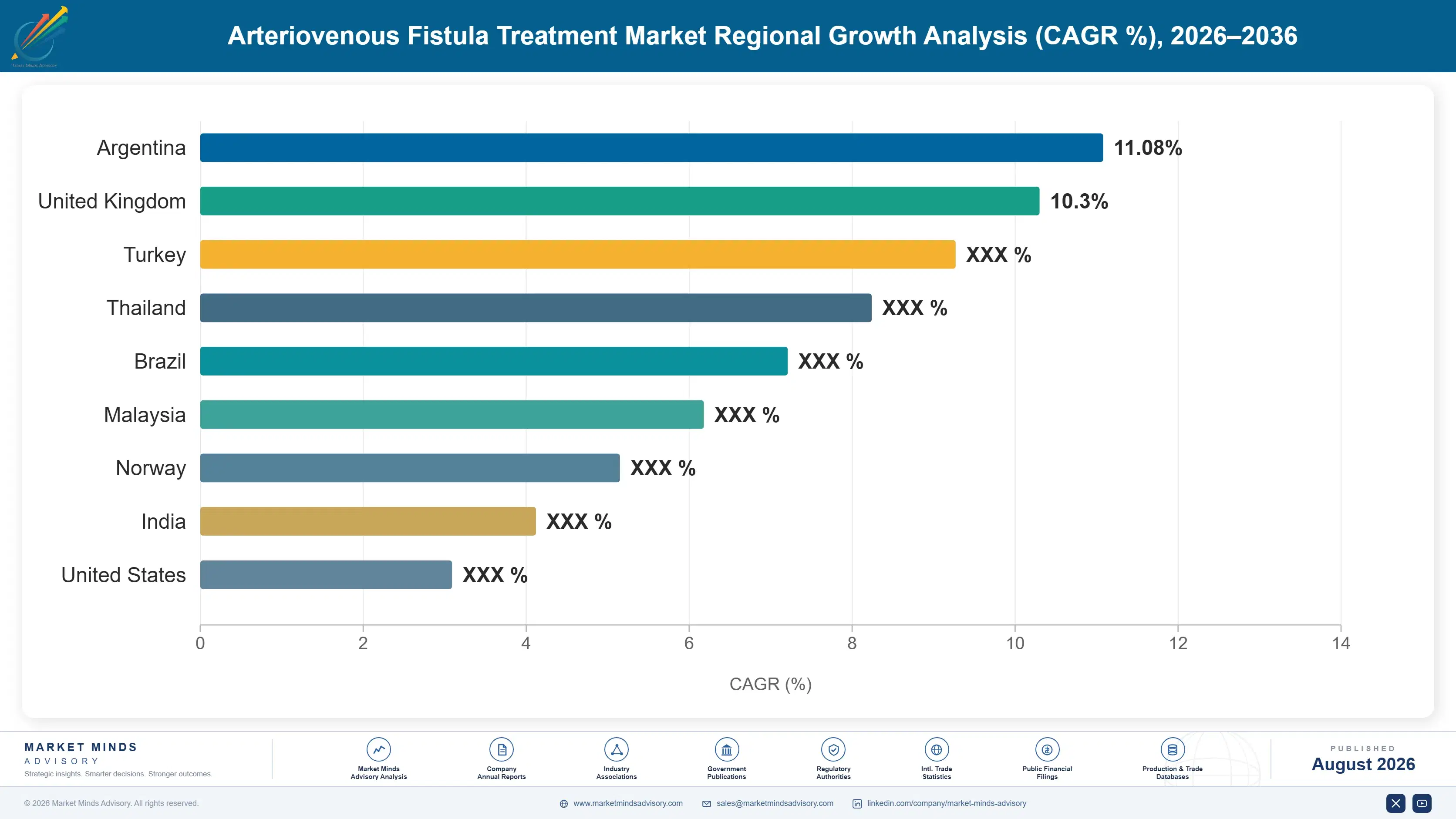
arteriovenous-fistula-treatment-market-country-cagr-analysis-1787305638164

Where Vascular Access Value Concentrates

Creating an access happens once and fails often, while keeping one open happens repeatedly for as long as a patient dialyses. Value therefore accrues to maintenance consumables, to products that improve maturation, and to whichever specialty ends up performing the creation. Creation volumes are modest and failure-prone. Maintenance is where the recurrence sits. Volumes there are modest.

Build the portfolio around maintenance rather than creation

An established access requires roughly 1.6 interventions annually across a dialysis lifetime that frequently exceeds a decade, while creation happens once and fails in 38% of attempts. Balloons, stent grafts and thrombectomy devices are therefore consumed repeatedly against a creation device sold occasionally. Manufacturers weighted toward surgical creation instruments hold the smaller and slower part of the category, and the maintenance population grows with every access that survives rather than with new referrals. The maintenance population grows with every access that survives. New referrals matter far less than surviving accesses do.
Market Impact: Roughly 1.6 interventions per acces

Price maintenance products against avoided repeat procedures

Drug-coated balloons demonstrated superior target lesion patency in randomised study, and a product extending the interval between interventions has genuine value to a payer funding roughly 1.6 procedures per access year. That evidence sustained pricing above plain balloons rather than eroding as competitors entered, which is unusual for an interventional consumable. Manufacturers competing on catheter specification rather than on demonstrated patency are contesting a variable that the outcome data has already settled. Cost-effectiveness assessment rather than clinical doubt limits adoption in tender markets. Plain balloons still carry most volume in those markets.
Market Impact: Extends the intervals between 1.6 a

Address maturation failure rather than creation technique

Roughly 38% of surgically created fistulas never become usable, which means the field's central problem is not how an anastomosis is made but whether the resulting access develops. Endovascular creation, pre-operative vessel mapping and external support devices all attack that directly, and the segment compounds at 10.8% on precisely that argument. Products improving a creation procedure that fails four times in ten are improving the wrong step in the pathway entirely. Vessel mapping and external support devices attack the same failure. Patient vessel quality is what actually governs the result.
Market Impact: Addresses the 38% maturation failur

Convert catheter-dependent patients into access populations

Around 22% of dialysis patients remain on central venous catheters despite considerably higher infection and mortality risk, largely through late referral, urgent starts and previous failed attempts. Every conversion generates creation device revenue once and maintenance revenue for years afterwards, which makes it the largest addressable volume in the category. Manufacturers supporting referral pathway programmes and vessel preservation education influence a population that no product feature reaches on its own. Late referral and urgent starts account for most of it. Previous failed attempts contribute substantially as well. No product feature reaches that population unaided.
Market Impact: Converts the 22% currently dependen

Who Controls the Margin Pool

Concentration is moderate at 66% across the top five, measured on annual revenue from vascular access creation and maintenance devices, the single basis applied throughout this analysis. Becton Dickinson and Medtronic lead through the broadest portfolios spanning both creation and maintenance, with Gore, Boston Scientific and Merit Medical holding strong positions in grafts, stent grafts and interventional consumables respectively.
Competition runs across two quite separate procedures. Creation competes on maturation outcomes, anatomical suitability and which specialty performs the procedure, and volumes are modest. Maintenance competes on patency evidence and consumable pricing across a far larger and repeating volume, with drug-coated balloons commanding premium on randomised data. Very few manufacturers hold credible positions in both, and those that do can supply a whole access programme.

Pressure builds from two directions. Chinese manufacturers have taken meaningful share in balloons and grafts across public procurement in Asia and increasingly beyond it, competing where evidence requirements are lighter. Separately, endovascular creation redistributes procedure volume between specialties, which changes who a manufacturer must sell to. Rankings shift most where a supplier establishes endovascular creation alongside an existing maintenance portfolio in the same institutions.
arteriovenous-fistula-treatment-market-company-positioning-matrix-1787305638689

Competitive Moat and Risk Dimensions

BECTON DICKINSON

Moat: Broadest access portfolio coverage

Holding endovascular creation, grafts, balloons and stent grafts lets Becton Dickinson supply an entire vascular access programme from creation through years of maintenance, which is a position very few competitors can offer. Established relationships across both vascular surgery and interventional specialties support adoption of newer creation methods within institutions where the professional transfer is being negotiated.
BECTON DICKINSON

Risk: Endovascular anatomical suitability limits

Percutaneous creation requires suitable vessel configuration that a substantial proportion of patients do not have, which caps the addressable population regardless of clinical performance or commercial effort. Adoption remains below 8% of creations. Chinese manufacturers compete effectively in balloons and grafts across price-sensitive public procurement in the fastest-growing regions.
MEDTRONIC

Moat: Randomised patency evidence leadership

Drug-coated balloon patency data from randomised study in arteriovenous access supports premium pricing in the largest maintenance segment, and that evidence held where the same technology faced sustained controversy in peripheral arterial applications. Endovascular creation capability alongside it covers both ends of the access pathway within the same interventional relationships.
MEDTRONIC

Risk: Maintenance price competition intensity

Competing drug-coated products have entered and public procurement across Europe and Asia assesses cost-effectiveness rather than accepting patency claims directly, which pressures the premium the evidence established. Plain balloon angioplasty still carries most maintenance volume in price-sensitive regions. Surgical creation remains the dominant route in most markets outside North America.

Players Tracked

Prominent Players

Becton Dickinson
Medtronic
W L Gore and Associates
Boston Scientific
Merit Medical Systems

Other Key Players

Teleflex
Cook Medical
Terumo
Cordis
AngioDynamics
LeMaitre Vascular
Humacyte
Laminate Medical Technologies
Getinge
B. Braun
Nipro
Baxter
Fresenius Medical Care
Asahi Kasei Medical
Vascular Graft Solutions

Recent Developments

MARCH 2025

Interventional nephrology programmes expand endovascular creation capability

Interventional nephrology services across several North American health systems established percutaneous fistula creation capability, an organic professional development that moved a procedure historically performed by vascular surgeons into a different specialty entirely. Vascular surgery retained the procedure in most other institutions. Adoption proceeded institution by institution.
Signal: Which specialty actually performs the proc
AUGUST 2025

Drug-coated balloon pricing holds against competitive entry

Drug-coated balloon pricing in arteriovenous access held above plain balloon alternatives despite competing products entering, an organic market outcome reflecting that randomised patency evidence supported the premium rather than brand position alone. Cost-effectiveness assessment in tender markets nonetheless pressured the same premium. Plain balloons continued carrying most volume regardless.
Signal: Outcome evidence rather than any device sp
JANUARY 2026

Chinese device manufacturers extend share in Asian access procurement

Chinese balloon and graft manufacturers widened their share across public hospital procurement in Asian dialysis programmes through organic commercial competition, offering adequate performance at prices international suppliers could not profitably match. Evidence requirements in those tenders weighed delivered price far above demonstrated patency. International suppliers lost share across those tenders.
Signal: Price competition reaches maintenance devi

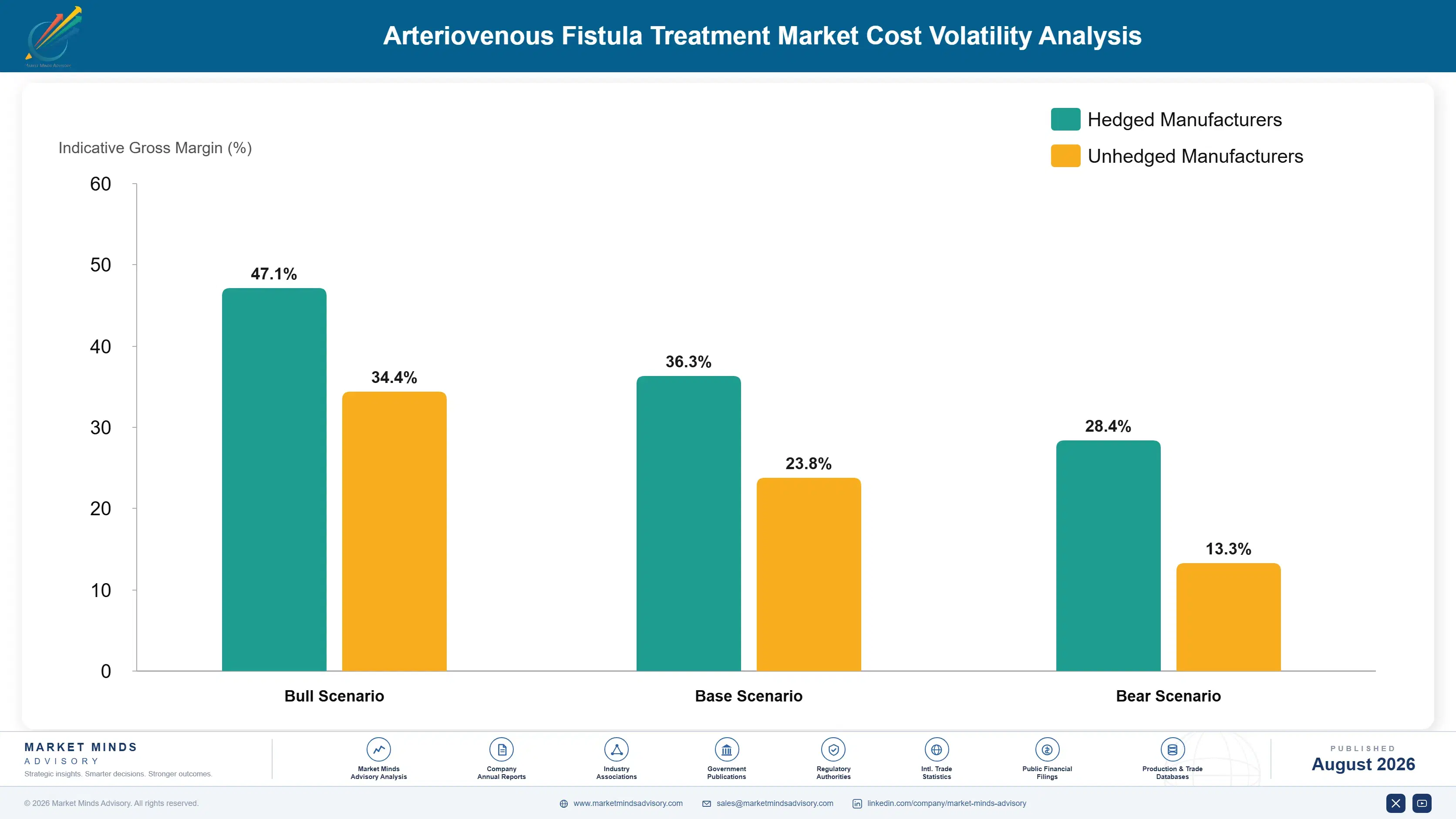
Polymer, Drug Coating and Nitinol Exposure

Cost structures differ sharply between device classes. Balloon catheters depend on medical polymers, braided shaft construction and, for drug-coated versions, paclitaxel with its excipient carrier, together roughly 37% of cost of goods. Expanded polytetrafluoroethylene graft material carries specialist processing that very few manufacturers perform. Stent grafts add nitinol, whose pricing moves with nickel and with the specialist tube drawing capacity that converts it.
Medical polymer availability tightened materially through 2021 and 2022 as several resin producers withdrew from medical applications citing liability exposure, and catheter manufacturers requalified materials under considerable time pressure. Manufacturer annual reports across the period documented supply disruption and the inventory positions subsequently built. Paclitaxel supply also faced scrutiny following the peripheral arterial mortality controversy, with several suppliers reassessing their participation in the coated device supply chain.

Exposure varies most by product mix and geography. Manufacturers weighted toward drug-coated products carry pharmaceutical excipient and regulatory burden that plain balloon producers avoid entirely. Graft manufacturers depend on processing capability that cannot be sourced externally. Chinese producers with domestic polymer, nitinol and assembly supply operate at cost structures international manufacturers cannot approach in the tender-driven procurement that decides most Asian and Latin American volume.
arteriovenous-fistula-treatment-market-cost-volatility-analysis-1787305638884

Qualify alternate medical polymer grades before producers exit

Several resin producers withdrew from medical applications entirely because liability exposure outweighed the volumes involved, and catheter manufacturers discovered the dependency only when supply stopped arriving. Qualifying alternate grades during ordinary conditions costs validation and regulatory filing work rather than capital investment. The exposure stays invisible precisely because these materials have been reliably available and inexpensive for decades.

Secure paclitaxel and excipient supply on committed terms

Drug-coated balloon production depends on pharmaceutical grade paclitaxel and specific excipient carriers, and several suppliers reassessed participation following the peripheral arterial mortality controversy that this application did not share. Committed multi-year supply protects a premium product line whose pricing rests on evidence that took years to generate. Qualifying an alternative coating supplier requires clinical bridging that is expensive and slow.

Integrate graft processing rather than depending on external capability

Expanded polytetrafluoroethylene processing for vascular grafts requires capability held by very few manufacturers, and external dependence on it exposes a product line to a supplier with considerable negotiating position. Internal capability converts that into process cost the manufacturer controls and permits wall structure variation. The capital requirement is substantial and the dependency removed is permanent.

Portfolio Architecture for Margin Defence

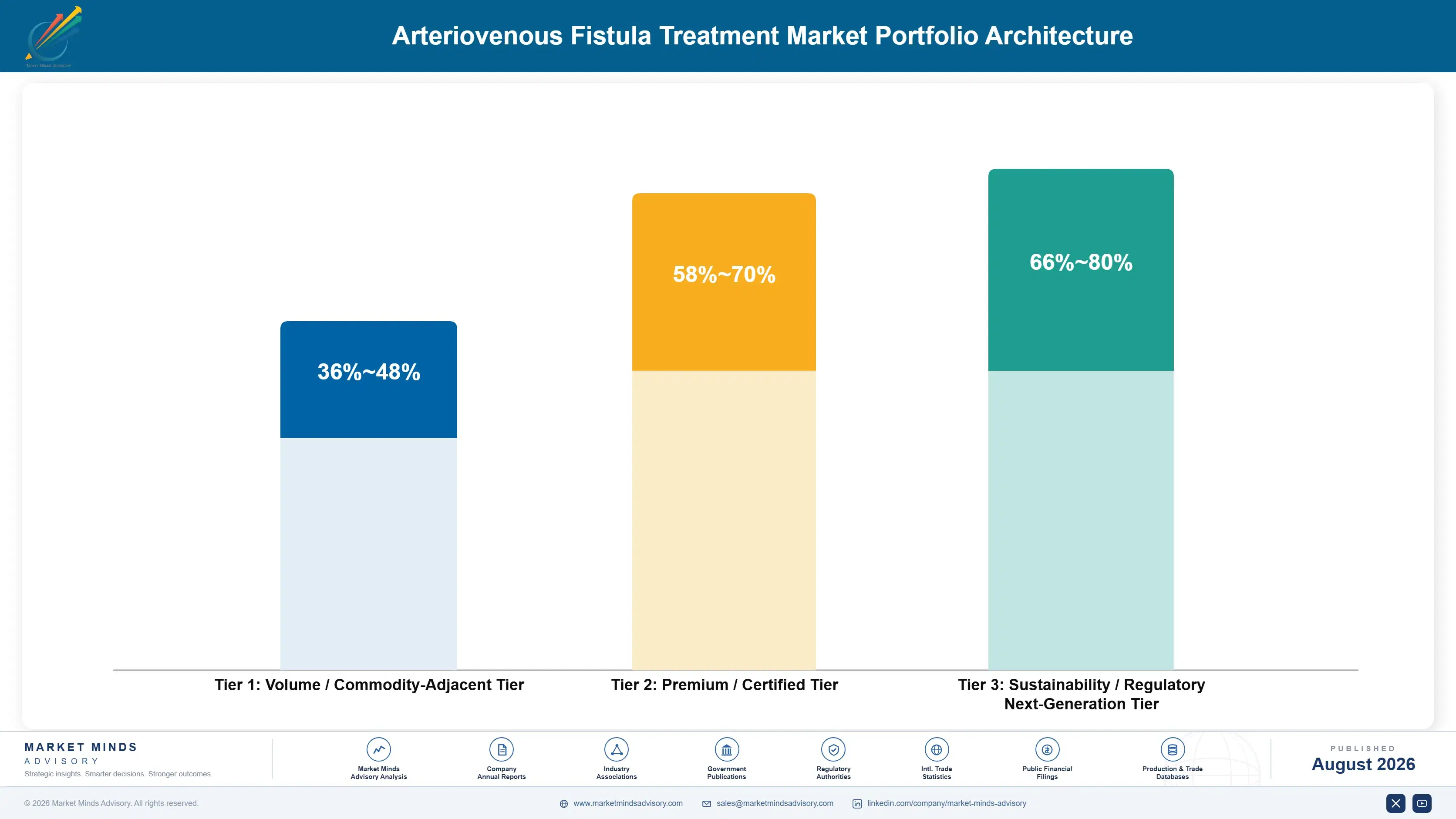
Margin architecture separates on whether outcome evidence supports the price. Plain balloon angioplasty and standard surgical instruments compete on delivered cost in tender procurement, and Chinese manufacturers with adequate performance take share wherever evidence requirements are light. Drug-coated balloons and stent grafts earn considerably better on randomised patency data that competitors must replicate rather than merely claim. Endovascular creation systems earn best on procedural novelt
The volume against premium tension runs along regional procurement. North American and Japanese practice adopts evidence-backed premium devices and pays for them, across dialysis populations that are large but not the fastest growing. Asian and Latin American procurement decides on delivered price for populations expanding far more quickly. A manufacturer serving only the first is in a slow market, and one serving only the second has no margin.

High-value pools concentrate around evidence and around repetition. Drug-coated balloons with patency data, stent grafts for outflow lesions, and endovascular creation systems all command pricing that plain consumables cannot. Surgical creation instruments and standard balloons, whatever their quality, compete in tenders where adequate performance at a lower price is a complete answer, and that competition is intensifying across every growth region.

Volume / Commodity-Adjacent Tier

Plain angioplasty balloons, surgical creation instruments and standard grafts sold through tender procurement, where Chinese manufacturers with adequate performance compete effectively on delivered price alone. Adequate performance is a complete answer here.
Gross Margin: 36-48%

Premium / Certified Tier

Stent grafts and specialist graft constructions supported by patency evidence and long clinical familiarity, protected by outcome data that competing products must generate rather than simply assert. Clinical familiarity reinforces the position considerably.
Gross Margin: 58-70%

Sustainability / Regulatory / Next-Generation Tier

Drug-coated balloons with randomised patency evidence and endovascular creation systems, commanding premium because outcome data and procedural novelty both restrict the field of credible competitors. Generating equivalent evidence takes competitors years.
Gross Margin: 66-80%
arteriovenous-fistula-treatment-market-portfolio-architecture-1787305639383

Access Lifetime Consumption and Referral Timing

Demand behaves as a lifetime consumption stream rather than a procedure market. A patient starting maintenance dialysis needs an access created once, and then needs it maintained for as long as treatment continues, which frequently exceeds a decade. At roughly 1.6 interventions per access year, the maintenance consumption from a single patient exceeds the creation device value many times over, and it recurs regardless of any purchasing decision made afterwards.
Depth of consumption varies sharply by access type and by patient vessel quality. Fistulas that mature well need comparatively little intervention, while marginal ones consume balloons, stent grafts and thrombectomy devices repeatedly. Grafts require more maintenance than fistulas but mature reliably, which is precisely the trade clinicians make when vessels are poor. Catheter-dependent patients consume no access devices at all, which is why the 22% dependence rate matters commercially.

Decision profiles differ between the two procedures. Vascular surgeons select creation devices and grafts on their own preference and institutional supply agreements. Interventional nephrologists and radiologists select maintenance consumables, and increasingly creation systems, which makes them the more consequential audience as endovascular methods advance. Dialysis provider organisations influence referral timing and vessel preservation, which determines how many patients reach permanent access.
arteriovenous-fistula-treatment-market-end-use-penetration-index-1787305639876

Where Vascular Access Strategy Lands

These are among the four positions where our research anticipates prominent divergence between winners and laggards over the coming forecast period. Each is grounded in the demand model, the regulatory perimeter, and the announced capacity pipeline.
01 / MAINTENANCE WEIGHTING PRIORITY

Keeping access open outsells creating it many times

An established vascular access requires roughly 1.6 separate interventions every single year across a dialysis lifetime that frequently exceeds a decade, while the creation procedure happens once and fails to produce usable access in around 38% of attempts. Balloons, stent grafts and thrombectomy devices are therefore consumed repeatedly against a single creation device sold only once to that same patient. Manufacturers still weighted toward surgical creation instruments hold the smaller, slower and considerably less defensible part of this entire category.
02 / OUTCOME EVIDENCE PRICING

Patency data held a premium that specification never would

Drug-coated balloons demonstrated clearly superior target lesion patency in randomised study within arteriovenous access, and that evidence held firm even as the same underlying technology faced a sustained mortality signal controversy in peripheral arterial applications elsewhere. Pricing above plain balloon alternatives has been sustained entirely on that basis rather than eroding as competing products entered the segment. Manufacturers competing on catheter specification rather than on demonstrated patency are contesting a variable that the outcome data has already settled quite decisively.
03 / MATURATION PROBLEM FOCUS

The failure is development, not the anastomosis technique

Roughly 38% of surgically created fistulas never develop the flow and vessel calibre required to support reliable dialysis needling, which means this field's central problem concerns whether an access matures rather than how the connection was originally made. Endovascular creation, pre-operative vessel mapping and external support devices all attack that specific failure directly, and endovascular systems compound at 10.8% on precisely that argument. Improving a creation procedure that fails roughly four times in every ten attempts is improving quite the wrong step.
04 / SPECIALTY TRANSFER NAVIGATION

Adoption depends on who is allowed to perform it

Percutaneous fistula formation moves a procedure historically performed by vascular surgeons directly into the hands of interventional nephrologists and radiologists, and institutional agreement on that professional transfer takes considerably longer than any clinical evaluation of the technology itself would ever require. Adoption consequently remains below 8% of all creations, despite maturation results that directly address this field's central failure. Manufacturers must therefore sell to both specialties simultaneously, and evidence framed around technique preference rather than patient outcome makes that considerably harder.

Engagement Snapshot From the Field

A live engagement with an industry participant carrying material or product regulatory and market exposure ahead of a defining policy shift, showing how our research translates into a defensible multi-year portfolio strategy.
MARKET MINDS ADVISORY · CLIENT ENGAGEMENT SUMMARY
Arteriovenous Fistula Treatment Producer Strategic Portfolio Review and Transition Roadmap 2026·Investment Scenario on Arteriovenous Fistula Treatment Exposure Evaluation 2025-26
CLIENT PROFILE
A vascular device manufacturer with a surgical graft range, plain angioplasty balloons and no drug-coated or endovascular creation products. Annual vascular access revenue was approximately USD 132 million (client-reported, unverified by MMA), concentrated in European and Latin American tender markets where delivered price rather than outcome evidence decided most procurement awards. Maintenance consumables carried most of the remaining volume.
STRATEGIC CHALLENGE
Plain balloon pricing had eroded severely against Chinese manufacturers offering adequate performance, while drug-coated competitors held premium pricing on randomised patency evidence the client could not match. The board needed to decide whether to invest in a drug-coated programme, enter endovascular creation, or concentrate on graft manufacturing where processing capability limited competition.
MMA APPROACH
MMA conducted 47 expert interviews spanning vascular surgeons, interventional nephrologists, interventional radiologists, dialysis unit medical directors, hospital procurement leads and vascular access coordinators across six countries. A quantitative survey of 3,800 respondents established creation and maintenance practice, device selection authority and intervention frequency. We then modelled revenue and margin outcomes under drug-coated investment, endovascular entry and graft concentration strategies.
KEY FINDINGS
  1. Interventional nephrologists rather than vascular surgeons selected maintenance consumables in five of six markets, and most had no relationship with the client's surgical sales organisation at all.
  2. Procurement leads accepted drug-coated premium pricing wherever randomised patency evidence existed, and declined it entirely for competing products offering specification claims alone.
  3. Vascular surgeons in four of six markets reported institutional discussions about endovascular creation, and several expected the procedure to transfer specialty within the forecast period.
  4. Graft processing capability limited the field of credible competitors substantially, and purchasers reported far fewer alternative suppliers than for balloons or standard instruments.
CLIENT PROFILE
A vascular device manufacturer with a surgical graft range, plain angioplasty balloons and no drug-coated or endovascular creation products. Annual vascular access revenue was approximately USD 132 million (client-reported, unverified by MMA), concentrated in European and Latin American tender markets where delivered price rather than outcome evidence decided most procurement awards. Maintenance consumables carried most of the remaining volume.
STRATEGIC CHALLENGE
Plain balloon pricing had eroded severely against Chinese manufacturers offering adequate performance, while drug-coated competitors held premium pricing on randomised patency evidence the client could not match. The board needed to decide whether to invest in a drug-coated programme, enter endovascular creation, or concentrate on graft manufacturing where processing capability limited competition.
MMA APPROACH
MMA conducted 47 expert interviews spanning vascular surgeons, interventional nephrologists, interventional radiologists, dialysis unit medical directors, hospital procurement leads and vascular access coordinators across six countries. A quantitative survey of 3,800 respondents established creation and maintenance practice, device selection authority and intervention frequency. We then modelled revenue and margin outcomes under drug-coated investment, endovascular entry and graft concentration strategies.
KEY FINDINGS
  1. Interventional nephrologists rather than vascular surgeons selected maintenance consumables in five of six markets, and most had no relationship with the client's surgical sales organisation at all.
  2. Procurement leads accepted drug-coated premium pricing wherever randomised patency evidence existed, and declined it entirely for competing products offering specification claims alone.
  3. Vascular surgeons in four of six markets reported institutional discussions about endovascular creation, and several expected the procedure to transfer specialty within the forecast period.
  4. Graft processing capability limited the field of credible competitors substantially, and purchasers reported far fewer alternative suppliers than for balloons or standard instruments.
RECOMMENDED STRATEGY
Phase 1: Phase one: build commercial coverage of interventional nephrology and radiology, since those specialties select maintenance consumables and increasingly creation systems too. Phase 2: Phase two: concentrate manufacturing investment on graft processing capability, where limited competition protects pricing that balloon competition has already destroyed. Phase 3: Phase three: license rather than develop a drug-coated platform, since generating randomised patency evidence independently would take longer than the position allows.
OUTCOME
The client established interventional specialty coverage, expanded graft processing capacity and licensed a drug-coated balloon platform (client-reported, unverified by MMA). Maintenance consumable revenue grew materially within eighteen months as the new commercial coverage reached previously unaddressed prescribers, and graft margins held while balloon pricing continued eroding.

Frequently Asked Questions

Foundational context covering the market sizes, CAGR, scope, country, region and competition that inform every finding below. This section is provided to cover basics and most often pre-purchase conversations, answered from the MMA Primary Research Dataset.

What is the current size of the Arteriovenous Fistula Treatment Market?

The global arteriovenous fistula treatment market was valued at USD 1.7 billion in 2025, spanning creation instruments, endovascular systems, grafts, balloons, stent grafts and thrombectomy devices. Roughly 4.1 million people worldwide receive maintenance haemodialysis.

How large will the Arteriovenous Fistula Treatment Market be by 2036?

MMA forecasts the market at USD 3.65 billion by 2036, expanding 2.01 times from the 2026 base of USD 1.82 billion. That represents roughly USD 1.83 billion of incremental value across the forecast decade.

What is the CAGR for the Arteriovenous Fistula Treatment Market 2026 to 2036?

The base case compound annual growth rate is 7.2%, with a bull case of 8.4% and a bear case of 6.0%. The bull case assumes endovascular creation resolves the specialty question and expands beyond anatomically suitable patients.

Which segment is growing fastest?

Endovascular fistula creation systems grow at 10.8%, a full 1.50x the overall market rate. Percutaneous anastomosis shows better maturation in several series and directly addresses the field's central failure.

Who are the major companies in the Arteriovenous Fistula Treatment Market?

Becton Dickinson, Medtronic, Gore, Boston Scientific and Merit Medical together hold 66% of revenue. Becton Dickinson leads on portfolio breadth while Medtronic leads on randomised patency evidence.

Which country is growing fastest?

India grows fastest at 12.6%, as national programme funding extends maintenance dialysis into district facilities. East Asia is the largest region at 30% of value on dialysis population rather than spending.

Report Segmentation Architecture

The full report scope spans multiple orthogonal segmentation dimensions, with cross-tabulated demand data provided for each dimension pair. Coverage extends further to regional breakdowns, trend trajectories, and the competitive detail needed to support segment-level decision-making.

By Device Class

  • Surgical Fistula Creation Instruments and Sutures
  • Endovascular Fistula Creation Systems
  • Synthetic and Biologic Grafts
  • Drug-Coated and Plain Angioplasty Balloons
  • Stent Grafts and Bare Stents
  • Thrombectomy and Declotting Devices

By End-Use Industry

  • Hospital Vascular Surgery Services
  • Interventional Nephrology Units
  • Interventional Radiology Departments
  • Freestanding Dialysis Access Centres
  • Dialysis Provider Organisations
  • Ambulatory Surgical Centres

By Commercial Dimension

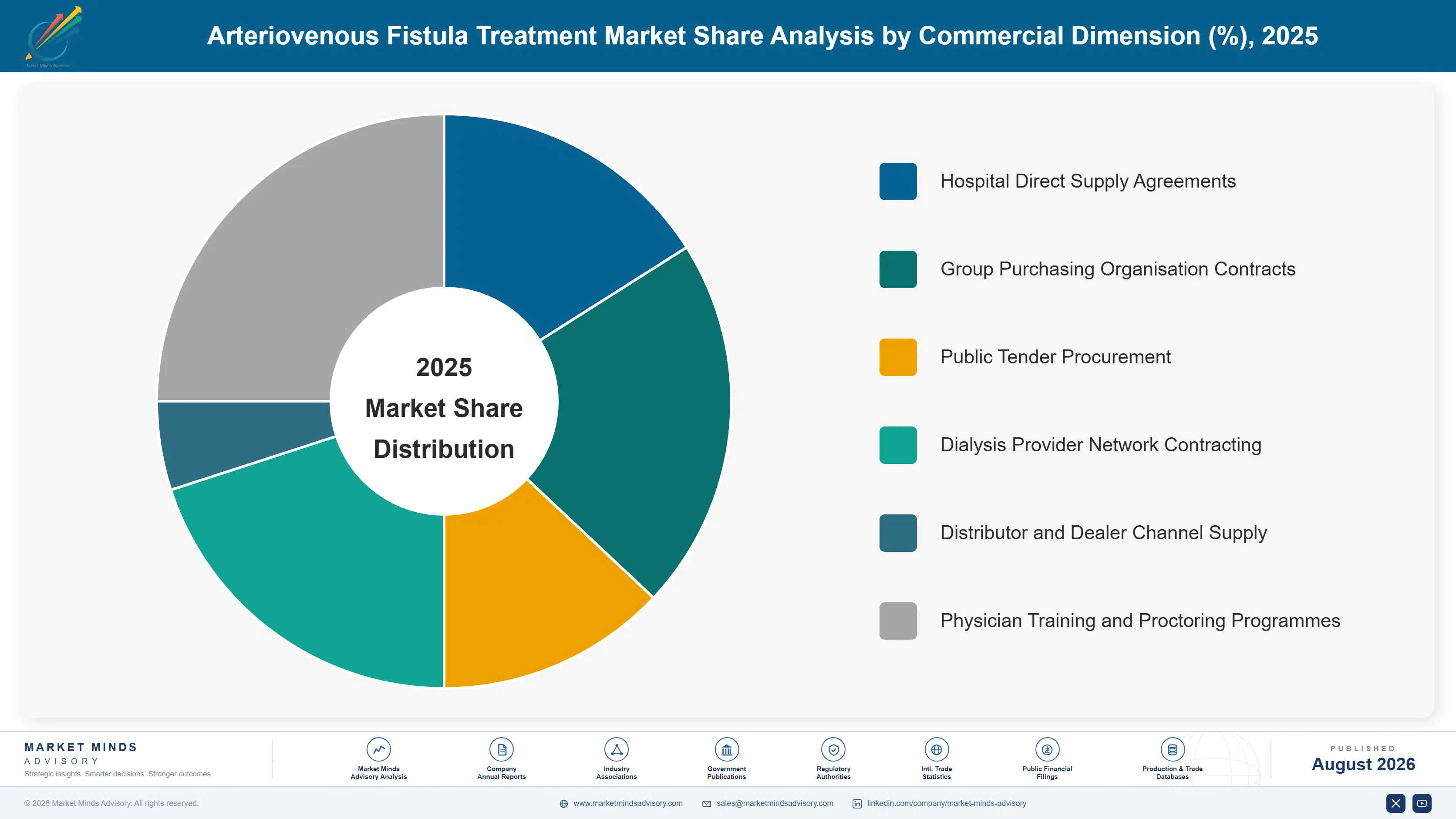
  • Hospital Direct Supply Agreements
  • Group Purchasing Organisation Contracts
  • Public Tender Procurement
  • Dialysis Provider Network Contracting
  • Distributor and Dealer Channel Supply
  • Physician Training and Proctoring Programmes

By Region

  • East Asia
  • North America
  • Western Europe
  • South Asia and Pacific
  • Latin America
  • Middle East and Africa
  • Eastern Europe

Scope, Methodology, and Coverage

Every figure in this report is reproducible from documented input assumptions. The scope below maps the historical period, the forecast horizon, the segmentation dimensions, and the countries covered, alongside the underlying primary and qualitative methodology.
Historical Period
2020 to 2025
Forecast Period
2026 to 2036
Base Year
2025 (USD billions; MMA Primary Research Dataset, August 2026)
Market Definition
This market comprises devices used to create, mature, maintain and salvage vascular access for maintenance haemodialysis, measured at manufacturer revenue across hospital direct supply agreements, group purchasing contracts, public tender procurement, dialysis provider network contracting, distributor channels and physician training programmes. Coverage spans surgical fistula creation instruments, sutures and anastomotic devices, endovascular fistula creation systems using radiofrequency or mechanical apposition, synthetic expanded polytetrafluoroethylene grafts, early cannulation grafts and biologic or tissue engineered vascular conduits, drug-coated and plain angioplasty balloons used in access maintenance, stent grafts and bare metal stents for outflow and central venous stenosis, and thrombectomy, declotting and embolectomy devices. Central venous and tunnelled dialysis catheters, dialysis machines, dialysers, bloodlines and water treatment systems, peritoneal dialysis catheters and solutions, kidney transplantation products, imaging and vessel mapping equipment used incidentally, and hospital procedure or facility fee revenue fall outside scope.
Quantitative Units
USD millions (current prices); accesses created by method; maintenance interventions performed; devices consumed per access year; maturation failure rate; catheter dependence rate; dialysis population
Segmentation Dimensions
By Device Class; By End-Use Industry; By Commercial Dimension; By Region
Regions Covered
East Asia, North America, Western Europe, South Asia and Pacific, Latin America, Middle East and Africa, Eastern Europe
Countries Covered
Japan, China, South Korea, Taiwan, United States, Canada, Mexico, Germany, France, United Kingdom, Italy, Spain, Netherlands, Belgium, Sweden, India, Australia, Thailand, Indonesia, Philippines, Brazil, Argentina, Colombia, Chile, Saudi Arabia, United Arab Emirates, Egypt, South Africa, Poland, Romania, Hungary, Turkey, and additional markets relevant to dialysis access analysis
Key Companies Profiled
Becton Dickinson, Medtronic, W L Gore and Associates, Boston Scientific, Merit Medical Systems, Teleflex, Cook Medical, Terumo, Cordis, AngioDynamics, LeMaitre Vascular, Humacyte, Laminate Medical Technologies, Getinge, B. Braun, Nipro, Baxter, Fresenius Medical Care, Asahi Kasei Medical, Vascular Graft Solutions
Quantitative Methodology
Primary survey, n=3,800 respondents, Q4 2025, six countries; demand-side model with trade association cross-validation
Qualitative Methodology
47 expert interviews, Q4 2025; applied to validate demand model assumptions, identify emerging dynamics, and assess competitive positioning
Report Format
PDF and XLSX data workbook (Word format preview document)
Publisher
Market Minds Advisory
Report Code
MMA-2026-MED-388
Published
August 2026
Contact
sales@marketmindsadvisory.com | www.marketmindsadvisory.com

Purchase the full Arteriovenous Fistula Treatment Market Report (2026 to 2036).

The full MMA report separates access creation from access maintenance, quantifying why the second carries several times the value of the first across a patient's dialysis lifetime. It sizes six device classes and seven regions to 2036, modelling accesses created by method, maintenance interventions performed, devices consumed per access year, maturation failure and catheter dependence separately. Competitive assessment covers twenty manufacturers on one consistent revenue basis. Cost exposure is traced through polymer, drug coating and nitinol inputs. Four commercial levers and a strategic verdict close the report, grounded in 47 expert interviews and a 3,800-respondent survey.
Six device classes sized separately through 2036
Maintenance consumption modelled across full access lifetimes
Maturation failure rates mapped by creation method and region
Twenty manufacturers assessed on one consistent revenue basis
Specialty transfer tracked against endovascular creation adoption
Anonymised client engagement with tested strategic recommendations

Built For The People Who Decide

From boardroom strategy to bench-side execution, this report is read cover-to-cover by leaders shaping the next decade of their industry, turning demand scenarios, market dynamics and valuation benchmarks into decisions.
CXOs/ Presidents/ VPs/ Managers
M&A and Corporate Development
Strategy Teams and R&D Heads
Procurement and Product Directors
Regulatory and Compliance Leaders
Investor Relations and Equity Analysts