Market Minds Advisory
Arterial Cannula Market

Arterial Cannula Market: Wire Reinforcement, Cannulation Site, and the Support Duration Nobody Designed For

A cannula designed for six hours on cardiopulmonary bypass is now routinely left in a femoral artery for two weeks of extracorporeal support, and limb ischaemia is the result nobody engineered around.

Lead Analyst

Alice Ballenger

Published

September 2026

Make Smarter Decisions with Customized Research Insights

Request a free sample report and evaluate market opportunities, growth trends, and competitive dynamics relevant to your business needs.

2025 MARKET VALUE$1.1BMarket Size 2025
2036 FORECAST VALUE$2.2BBase Case , 2026 to 2036
CAGR 2026 TO 20367.2 %Bull 8.4% / Bear 6.0%
INCREMENTAL OPPORTUNITY$1.1BNet 10- year value creation
EXPANSION MULTIPLE1.98x2036 value over 2026 base
Strategic Levers
M&A Pipeline
Regional Outlook
Country Rankings
Competitive Intelligence
Segmental Deep-dive
Call-Us : 91 93563 13602

Executive Snapshot and Market Trajectory

These devices were designed for a six-hour operation and are now used for two-week admissions. Extracorporeal support stretched a bypass consumable far beyond its original design case, and the complications that followed are engineering problems, not clinical ones. Duration is the design brief nobody rewrote.
Extracorporeal life support arterial cannulae compound at 10.8%, a full 1.50x the market rate, on centre count growth that accelerated sharply after 2020 and never returned to the earlier baseline. East Asia holds the largest share at 31%, on cardiac surgery volume that exceeds any other region and a domestic manufacturing base supplying most of it. Distal perfusion catheters now accompany roughly 63% of peripheral cannulations, which turns a one-device procedure into a two-device one.
Concentration is high at 71%, unusual for a consumable, because coating chemistry, wire reinforcement and regulatory history are genuinely hard to replicate. Medtronic, Getinge and LivaNova hold the established positions. Chinese manufacturers compete on delivered price in domestic tenders and are now pursuing export registration, which is where the ranking pressure originates. Established suppliers have limited answer beyond bundling the whole perfusion circuit into programme-level contracts.
Market Definition
This market covers arterial cannulae used to return oxygenated blood to the arterial circulation during extracorporeal circulation, spanning aortic cannulae for cardiopulmonary bypass, peripheral cannulae for femoral and axillary access, extracorporeal life support arterial cannulae, cerebral and selective perfusion cannulae, and distal perfusion catheters. Venous drainage cannulae, cardioplegia delivery devices, oxygenators, pumps and circuit tubing, vascular access sheaths for interventional procedures, and arterial pressure monitoring catheters are excluded.
Base Year Value
$1.1B in 2025 (MMA Primary Research Dataset, August 2026)
Forecast Period
2026 to 2036, eleven discrete annual values
CAGR
7.2% base case. Bull 8.4%. Bear 6.0%.
Fastest Growth Segment
Extracorporeal Life Support Arterial Cannulae: 10.8% CAGR
Fastest Growth Country
China: 12.4% CAGR
Fastest Growth Region
South Asia and Pacific: 9.4% CAGR
Largest Region
East Asia: 31% of 2025 global value
Market Leaders
Medtronic, Getinge, LivaNova, Terumo, and Edwards Lifesciences. Source: MMA Primary Research Dataset, July 2026.
Primary Survey
n=3,800 procurement and R&D decision-makers, Q4 2025, six countries
Methodology
Demand-side build-up, cross-validated against public data, 47 expert interviews

Arterial Cannula Market Forecast Scenarios

arterial-cannula-market-size-forecast-scenario-1787305631205
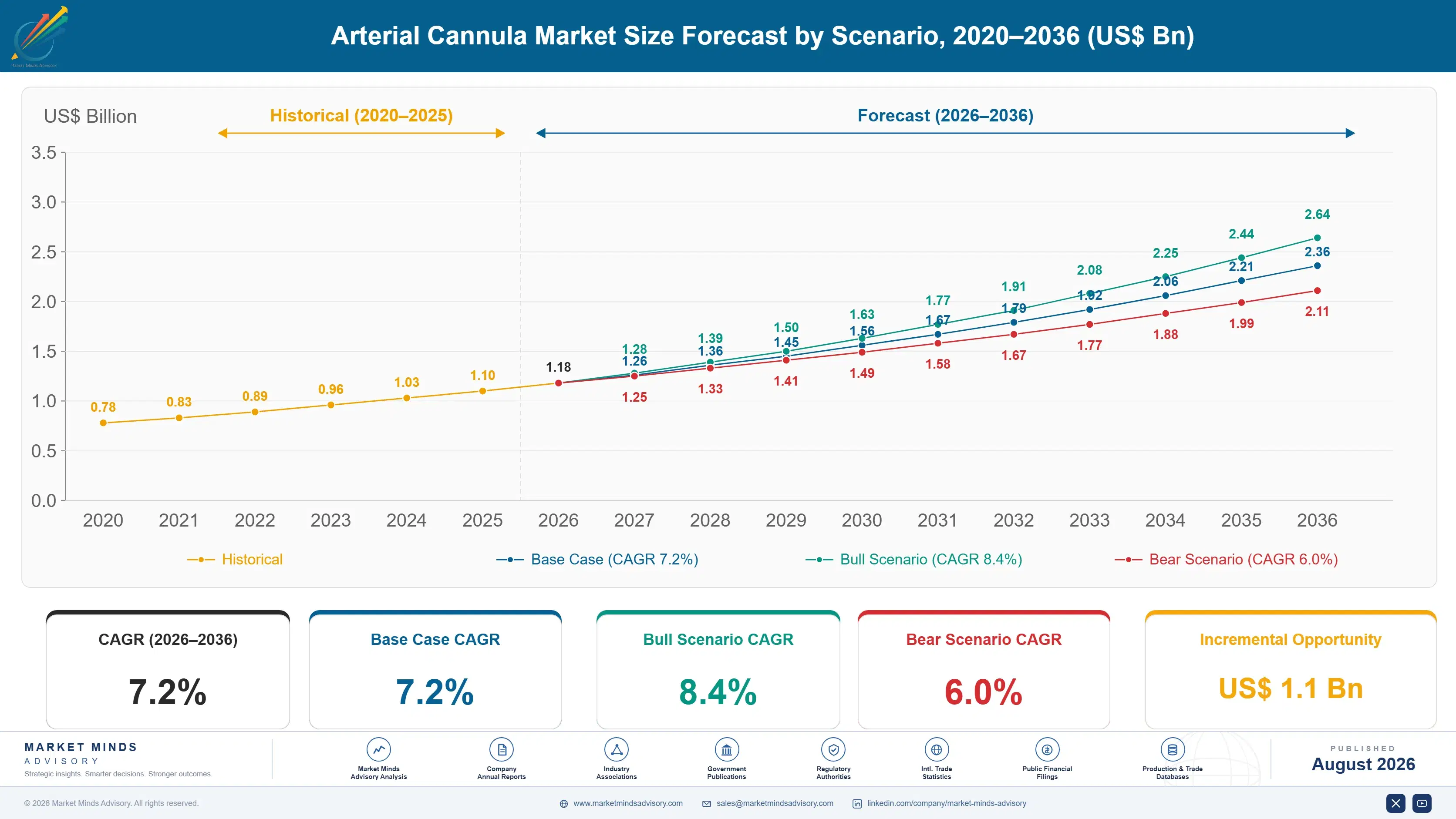
Growth ran near 6.0% from 2020 to 2025, and it split into two very different stories. Cardiopulmonary bypass volume grew slowly, held back by transcatheter alternatives taking work away from open surgery. Extracorporeal support volume moved in the opposite direction entirely, expanding sharply from 2020 onward as centres added capacity and then kept the programmes running after the immediate pressure passed.
Base case growth of 7.2% rests on three mechanisms. Extracorporeal support centre count keeps rising, particularly across Asia, and each new programme consumes cannulae from its first case. Distal perfusion catheter use is becoming routine rather than discretionary as limb ischaemia data accumulates, which adds a second device to procedures that previously used one. And complex aortic surgery volume continues growing, which uses the most specialised cannula configurations. Each of the three operates independently of the others.
The bull case at 8.4% assumes extracorporeal support extends further into cardiac arrest and bridge-to-transplant use, both of which run longer than conventional indications. The bear case at 6.0% reflects transcatheter procedures continuing to displace open cardiac surgery faster than expected, which shrinks the bypass cannula base that still accounts for most unit volume in this market.

Arterial Cannulation: Duration, Ischaemia and Access

An arterial cannula is a short tube, and that description hides almost everything that matters. It must carry full cardiac output at pressures that damage blood cells if the flow path is wrong, resist kinking under a drape, and present a surface that does not activate clotting over hours or days. Wire reinforcement, tip geometry and coating chemistry carry all of that.
TOP FIVE CONCENTRATION71%Concentrated among perfusion specialists with long regulatory histories
AVERAGE SELLING PRICE$210Typical price across configurations sold to hospital perfusion services
LIMB ISCHAEMIA INCIDENCE17%Peripheral support patients developing distal limb perfusion compromise
MEDIAN SUPPORT DURATION9 daysTime a peripheral support cannula remains in place typically
DISTAL PERFUSION ADOPTION63%Peripheral cannulations placed alongside a distal perfusion catheter
HOSPITAL TENDER SHARE78%Purchases made through competitive institutional tender rather than direct
The design case changed without anyone redesigning the device. A cannula developed for a six-hour cardiopulmonary bypass run is now routinely left in a femoral artery for nine days of extracorporeal support, and some cases run considerably longer. Nothing about the original engineering brief anticipated that. Roughly 17% of peripherally supported patients develop distal limb ischaemia, which is a direct consequence of a large cannula occupying an artery that also has to supply a leg.
The response has been a second device rather than a better first one. Distal perfusion catheters, placed downstream to keep the limb supplied, now accompany roughly 63% of peripheral cannulations. That is a meaningful commercial shift: a procedure that consumed one arterial device now consumes two, and the second barely existed as a category a decade ago.
"Nobody set out to build a device that stays in a femoral artery for nine days. The extracorporeal community took a bypass consumable and used it far outside its design envelope, and the limb ischaemia rate is what that looks like in the data. The manufacturer that engineers specifically for duration rather than adapting a bypass product will take this category."
Principal Analyst, Cardiac Surgery and Extracorporeal Support Practice · MMA Med

Market Trends

Distal perfusion catheters turn one device into two

Limb ischaemia during peripheral extracorporeal support runs near 17%, and the accumulated evidence has pushed distal perfusion from a discretionary manoeuvre to something close to standard practice. Roughly 63% of peripheral cannulations now include a distal perfusion catheter placed to supply the leg below the arterial cannula. The commercial consequence is direct: a procedure that consumed one arterial device now consumes two, and the second product line barely existed as a distinct category ten years ago. Manufacturers offering only the primary cannula are supplying half the procedure. The compatibility question between the two devices is one perfusionists currently resolve themselves.
Market Impact: Median support running 9 days
Extracorporeal support centre count grew and then stayed

Programme numbers expanded sharply from 2020 as hospitals built capacity under acute pressure, and the notable thing is what happened afterward. Centres retained the equipment, the trained perfusionists and the case mix, then extended into cardiac arrest, bridge-to-transplant and post-cardiotomy indications that had previously been referred elsewhere. Capability built for one purpose found several others. That is why extracorporeal cannulae compound at 10.8% against a market rate of 7.2%, and why the growth has proved considerably more durable than most observers expected. Programmes rarely close once staff are trained. Trained staff and an established case mix hold them open.
Market Impact: Complex configurations priced 4x ro

Market Opportunities and Growth Drivers

Support durations far exceed the original design envelope

Median peripheral support now runs around nine days, with a meaningful tail extending to several weeks in bridge-to-transplant cases. A cannula engineered for a six-hour bypass run faces entirely different demands over that period: coating durability, biofilm resistance, kink tolerance under repeated patient repositioning and haemolysis across sustained flow. Devices designed specifically for duration rather than adapted from bypass configurations command clear price premiums, and interviewed perfusionists described duration performance as the criterion that now separates products. The engineering brief has changed permanently. Nobody has built specifically against that brief yet.
Market Impact: Bypass volume growing under 3%

Complex aortic surgery uses the most specialised configurations

Arch replacement, frozen elephant trunk procedures and other complex aortic work require selective cerebral perfusion, which means additional cannulae placed into the head vessels alongside the primary arterial return. These configurations carry the highest prices in the category and the deepest surgeon preference, since the technique and the device are learned together. Volume is growing as centres consolidate complex aortic work into fewer, higher-throughput programmes. Those programmes then standardise, which locks a supplier in for years across a procedure mix worth several times a routine bypass case. Displacing an established programme standard is close to impossible.
Market Impact: Tender covering 78% of purchases

Market Restraints and Challenges

Transcatheter procedures reduce the open surgery base

Transcatheter aortic valve replacement and adjacent interventional techniques continue taking work that would previously have gone to open surgery on cardiopulmonary bypass, and that shrinks the base consuming aortic cannulae. The root cause is that patients recover faster from a catheter procedure, which is a genuine clinical advantage no device improvement offsets. Commercial impact falls on the highest-volume, lowest-price part of the category. Manufacturers respond by shifting emphasis toward extracorporeal support, complex aortic configurations and distal perfusion, where interventional alternatives do not exist. No interventional alternative exists for extracorporeal support, which is why emphasis keeps shifting there.
Market Impact: Distal perfusion reaching 63% of ca

Hospital tender purchasing compresses price on routine items

Roughly 78% of purchases run through competitive institutional tender, frequently bundled with the wider perfusion circuit, where delivered price rather than device performance decides awards. The root cause is that routine bypass cannulae are close enough in performance across suppliers that procurement can treat them as interchangeable. Commercial impact is sustained price erosion on the volume tier while specialised configurations hold pricing. Manufacturers respond by bundling circuits, contracting multi-year at programme level and moving clinical engagement to surgeons and perfusionists rather than procurement. Price erosion happens within retained accounts rather than through account loss.
Market Impact: Segment compounding at 10.8% annual
4 additional market trends, 2 additional growth drivers, and 3 additional restraints and challenges are covered in the full report. Contact sales@marketmindsadvisory.com to access the complete intelligence.

Segment CAGR and Growth Architecture

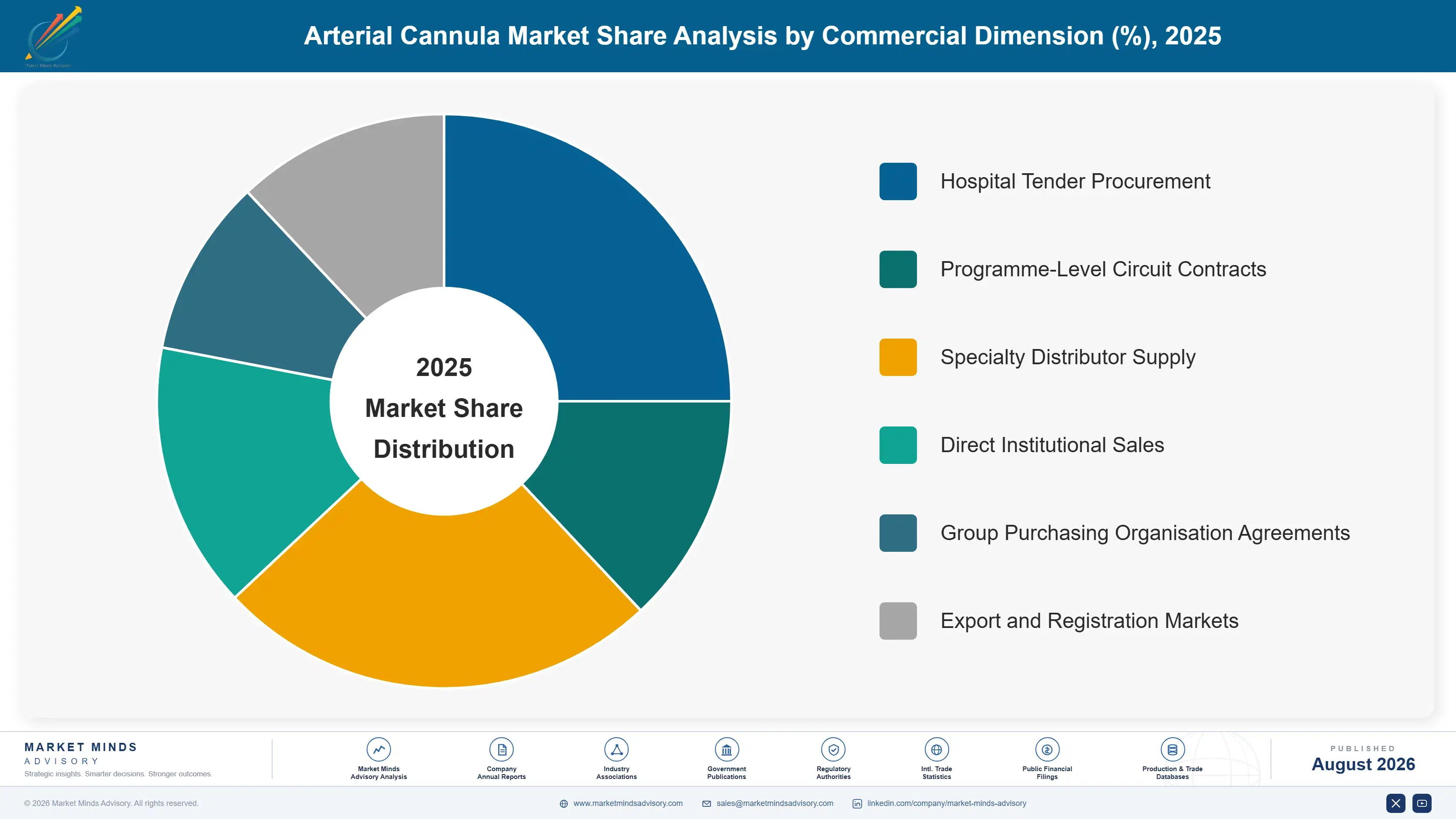
Five device classes divide this market by cannulation site and clinical application, which is how perfusionists and surgeons actually select. Each class faces a different competitive dynamic, and the price range across them spans more than an order of magnitude despite the underlying construction being broadly similar throughout. Selection sits with clinicians at one end and procurement at the other.
arterial-cannula-market-market-share-analysis-1787305631740

Extracorporeal Life Support Arterial Cannulae

Compounding at 10.8%, a full 1.50x the market rate, this class serves support runs measured in days rather than hours. Median duration sits near nine days and the tail extends to several weeks, which places demands on coating durability, kink resistance and haemolysis performance that bypass-derived designs were never engineered for. Centre count growth since 2020 has proved durable rather than temporary, and each new programme consumes from its first case. Wire reinforcement and surface chemistry carry the differentiation, and the regulatory history required to make duration claims is a genuine barrier to new entrants. Perfusionists trained on a particular support platform default toward its matched consumables, and that habit outlasts staff turnover.
CAGR 10.8%

Distal Perfusion Catheters

Growing at 9.6%, this class barely existed as a distinct category ten years ago and now accompanies roughly 63% of peripheral cannulations. The device supplies the limb below an arterial cannula that would otherwise occlude it, addressing a limb ischaemia rate near 17% that follows directly from using a large cannula in a femoral artery. Adoption has moved from discretionary to near-standard as outcome data accumulated. Commercially this converts a single-device procedure into a two-device one, and manufacturers supplying only the primary cannula now address half of what the procedure consumes. Absolute price sits below the primary cannula while margin runs higher, and tender exposure is lighter because procurement has not yet built comparison baselines for the category.
CAGR 9.6%
Full segment breakdown across 5 segments available in the complete report.

Regional Architecture and Country Demand Map

Regional distribution follows cardiac surgery volume and extracorporeal programme density, which diverge more than expected. Several markets performing large surgical volumes have comparatively few support programmes, while others run mature extracorporeal networks against modest open surgery numbers. Programme count predicts this market considerably better than surgical caseload alone does.

East Asia

Thirty-one per cent of global value, the largest regional position, and volume rather than pricing explains it. China performs more cardiac surgery than any other country and its extracorporeal programme count has expanded rapidly since 2020, with provincial hospitals building capacity that previously existed only in tertiary centres. Note: this share sits marginally above the 22 to 30% band because regional surgical volume genuinely exceeds every other region. Domestic manufacturers supply most Chinese demand through tender at prices well below imported equivalents, and several are now pursuing export registration. Japan and South Korea contribute higher-value positions with deep specialised configuration use. Regional pricing sits well below Western levels across every configuration class.
Share: 31% | CAGR: 8.4% (2026 to 2036)

North America

Twenty-six per cent of value on considerably lower unit volume than East Asia, which reflects pricing rather than activity. Extracorporeal programmes are mature and concentrated in academic centres with high case complexity, including bridge-to-transplant and extracorporeal cardiopulmonary resuscitation work that runs longer than conventional support. Distal perfusion adoption is the highest of any region, driven by outcome reporting requirements that make limb complications visible. Transcatheter substitution has advanced further here than anywhere else, which holds bypass cannula volume growth well below the regional average. Programme-level circuit contracting is further advanced here than in any other region, which favours suppliers able to bid oxygenators, tubing, service coverage and cannulae together rather than competing item by item. Single-product entrants find that difficult.
Share: 26% | CAGR: 6.6% (2026 to 2036)
Regional intelligence for 5 additional markets available in the complete report: Western Europe, South Asia and Pacific, Latin America, Middle East and Africa, Eastern Europe. Contact sales@marketmindsadvisory.com.
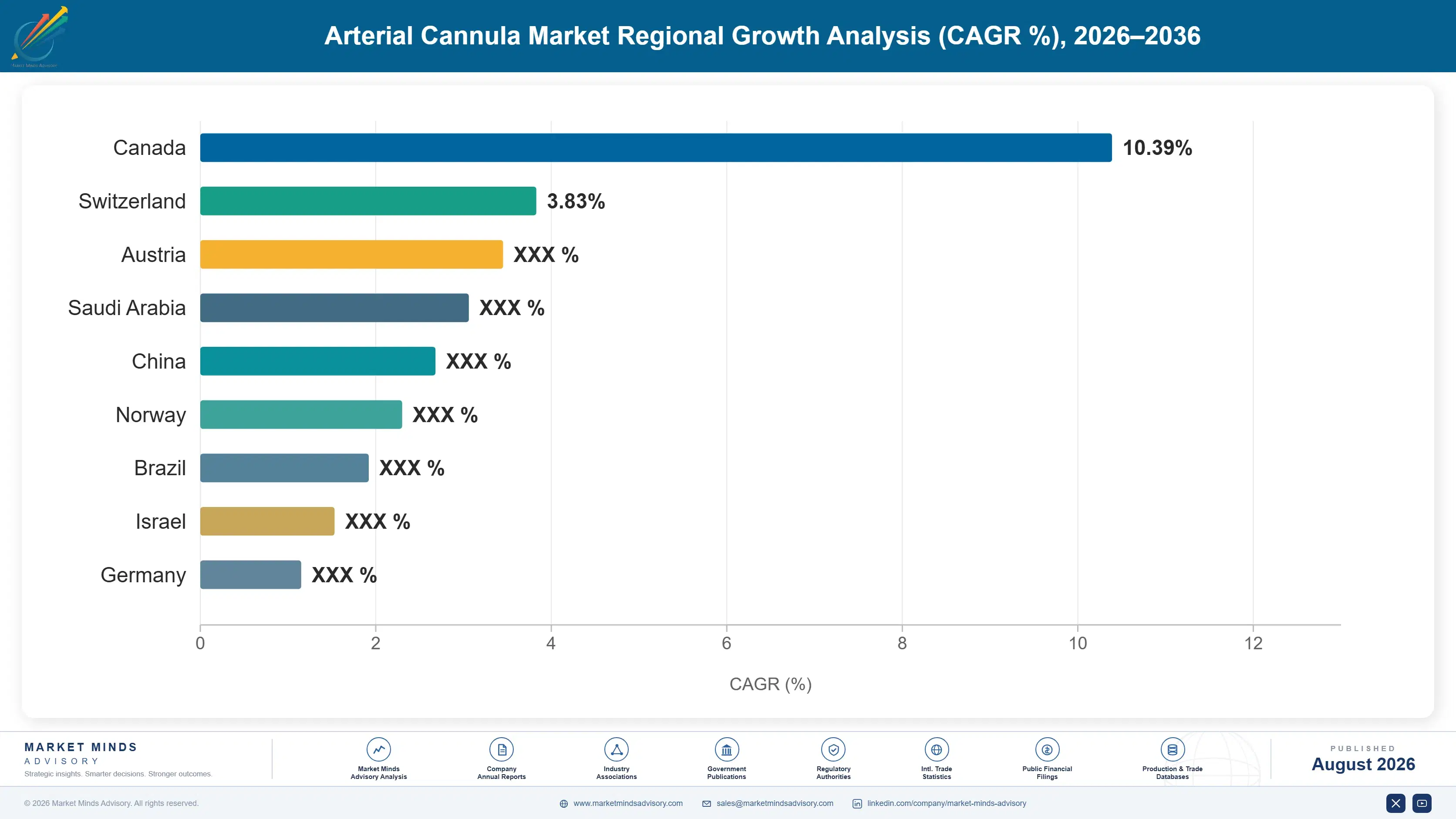
arterial-cannula-market-country-cagr-analysis-1787305632266

Where Cannula Value Actually Concentrates

Routine bypass cannulae are close to interchangeable and priced accordingly through tender. Everything commercially interesting in this category sits in configurations where the device is chosen by a clinician rather than by procurement, and where duration, access site or technique makes substitution genuinely difficult. Procurement decides one end of this market and clinicians decide the other.

Engineer explicitly for duration rather than adapting bypass designs

Median peripheral support runs near nine days against a bypass design case of six hours, and every product currently serving that use was adapted rather than purpose-built. Coating durability, kink tolerance and haemolysis performance over sustained flow are measurable and currently unclaimed. Interviewed perfusionists identified duration performance as the criterion now separating products, and devices making substantiated duration claims sustain price premiums of 25% to 35% over adapted equivalents. The regulatory work to support such claims takes time, which is precisely what makes the position defensible once established. No competitor currently holds that ground.
Market Impact: Price premiums running 25% to 35% h

Supply both devices in the peripheral procedure

Distal perfusion catheters now accompany roughly 63% of peripheral cannulations, and that figure continues rising as limb ischaemia data accumulates. A manufacturer offering only the primary arterial cannula addresses half the procedure and cedes the rest, frequently to a supplier who then has a clinical relationship it did not previously hold. Supplying both as a matched configuration also removes a compatibility question perfusionists currently resolve themselves. The second device carries lower absolute price but higher margin and considerably less tender exposure than the primary cannula does. Attachment into an existing account is also faster than winning a new one.
Market Impact: Second device in 63% of all periphe

Standardise complex aortic programmes rather than selling cases

Complex aortic work using selective cerebral perfusion carries prices around four times a routine configuration and the deepest surgeon preference in the category, because technique and device are learned together during training. Centres consolidating this work standardise on one supplier and then hold that standard for years. Engagement therefore belongs with the surgical training pathway and the programme director rather than with procurement or with individual case sales. Winning a programme at standardisation is worth many times what winning any sequence of individual cases could deliver. Programme standardisation typically holds for 5 years or more once set.
Market Impact: Configurations priced 4x routine eq

Contract circuits at programme level, not by component

Roughly 78% of purchases run through tender, and cannulae are frequently bundled into wider perfusion circuit awards where a component-level bid competes on delivered price alone. Bidding the full circuit at programme level across multi-year terms moves the conversation from unit price to total support cost including training, on-site coverage and inventory management. Suppliers competing this way reported award retention around 15% higher than component bidding delivered. It also makes a competitor's single-component price advantage considerably harder to act upon. It also makes a competitor's single-component price advantage far harder to act upon.
Market Impact: Award retention running roughly 15%

Who Controls the Margin Pool

The top five hold 71% of the market measured on revenue from arterial cannulation products, the basis used throughout this section. That concentration is high for a consumable and it reflects genuine barriers: coating chemistry, wire reinforcement construction and the regulatory history required to make performance claims all take years to establish. Medtronic and Getinge sit ahead of the field, with LivaNova holding a strong European position built through long perfusion relationships.
Competitive activity runs along three lines. Established suppliers are extending into distal perfusion to hold the whole peripheral procedure rather than part of it. Several are pursuing duration-specific product development for extracorporeal support rather than continuing to adapt bypass designs. And Chinese manufacturers compete aggressively on delivered price in domestic tender, having built volume at home before pursuing export registration.

Pressure is building from two directions. Export-focused Chinese suppliers are reaching Southeast Asian, Latin American and Eastern European tenders where price decides awards, and established participants have limited response beyond bundling. And the duration engineering gap remains genuinely open, so a manufacturer arriving with substantiated claims could reset positioning in the fastest-growing segment. Rankings shift on which of those two moves first.
arterial-cannula-market-company-positioning-matrix-1787305632793

Competitive Moat and Risk Dimensions

MEDTRONIC

Moat: Breadth across perfusion portfolio

The company supplies cannulae alongside oxygenators, circuits and monitoring within one perfusion offering, which lets it contract at programme level where competitors bid components. Breadth matters more here than in most categories, because tenders increasingly award the whole circuit rather than individual items, and a supplier bidding all of it competes on total support cost.
MEDTRONIC

Risk: Exposure to transcatheter substitution

A substantial part of the cannula position depends on open cardiac surgery volume, which transcatheter procedures continue to reduce, and the company's own structural heart business accelerates that shift. The internal hedge is real but incomplete, since a transcatheter case consumes no arterial cannula at all. Extracorporeal support growth offsets some of this, though not proportionally by revenue.
GETINGE

Moat: Extracorporeal support installed position

Deep presence in extracorporeal support systems gives the company a direct relationship with the programmes driving the fastest-growing part of this market, and cannula selection frequently follows the platform a centre already runs. Perfusionists trained on a system default toward its consumables, and that habit persists through staff turnover in a way that formal contracts do not require.
GETINGE

Risk: Narrow base outside cardiac

The company's position concentrates in cardiac and extracorporeal care without the diversified device portfolio some competitors use to absorb cyclical hospital capital cycles. That focus is an advantage in clinical credibility and a vulnerability in procurement, where suppliers bidding across several hospital departments can trade position between categories in ways a focused participant cannot.

Players Tracked

Prominent Players

Medtronic
Getinge
LivaNova
Terumo
Edwards Lifesciences

Other Key Players

Braile Biomedica
Nipro Corporation
Fresenius Medical Care
Xenios
Eurosets
Andocor
Bioengineering Laboratories
Chalice Medical
Sorin Group Deutschland
Microport Scientific
Xijian Medical
Dongguan Kewei Medical
Ningbo Fangkang Medical
Sinomed
Ace Medical

Recent Developments

MARCH 2023

Extracorporeal registry reports rising limb complication awareness

International extracorporeal registry reporting through the period documented distal limb ischaemia rates in peripheral arterial cannulation at levels that shifted clinical practice materially. Distal perfusion catheter placement moved from a discretionary manoeuvre toward standard technique across most reporting centres within two years of the data circulating widely.
Signal: Outcome registry data changed device consu
SEPTEMBER 2024

Chinese cannula manufacturers pursue export registration

Several Chinese perfusion device manufacturers advanced regulatory registration for arterial cannulae in Southeast Asian and Latin American markets, moving beyond a domestic tender base built over the preceding decade. The expansion was organic registration activity rather than acquisition or partnership, and it targets markets where delivered price decides tender awards.
Signal: Price-led competition is now reaching expo
JUNE 2025

Perfusion suppliers bundle cannulae into circuit contracts

Established perfusion suppliers moved further toward programme-level circuit contracting across European and North American hospital groups, bundling cannulae with oxygenators, tubing and service coverage under multi-year terms. The shift responds directly to component-level price competition and changes what a single-product competitor can realistically win. Single-product competitors lose the comparison entirely.
Signal: Bundling converts a component price contes

What Actually Costs Money Here

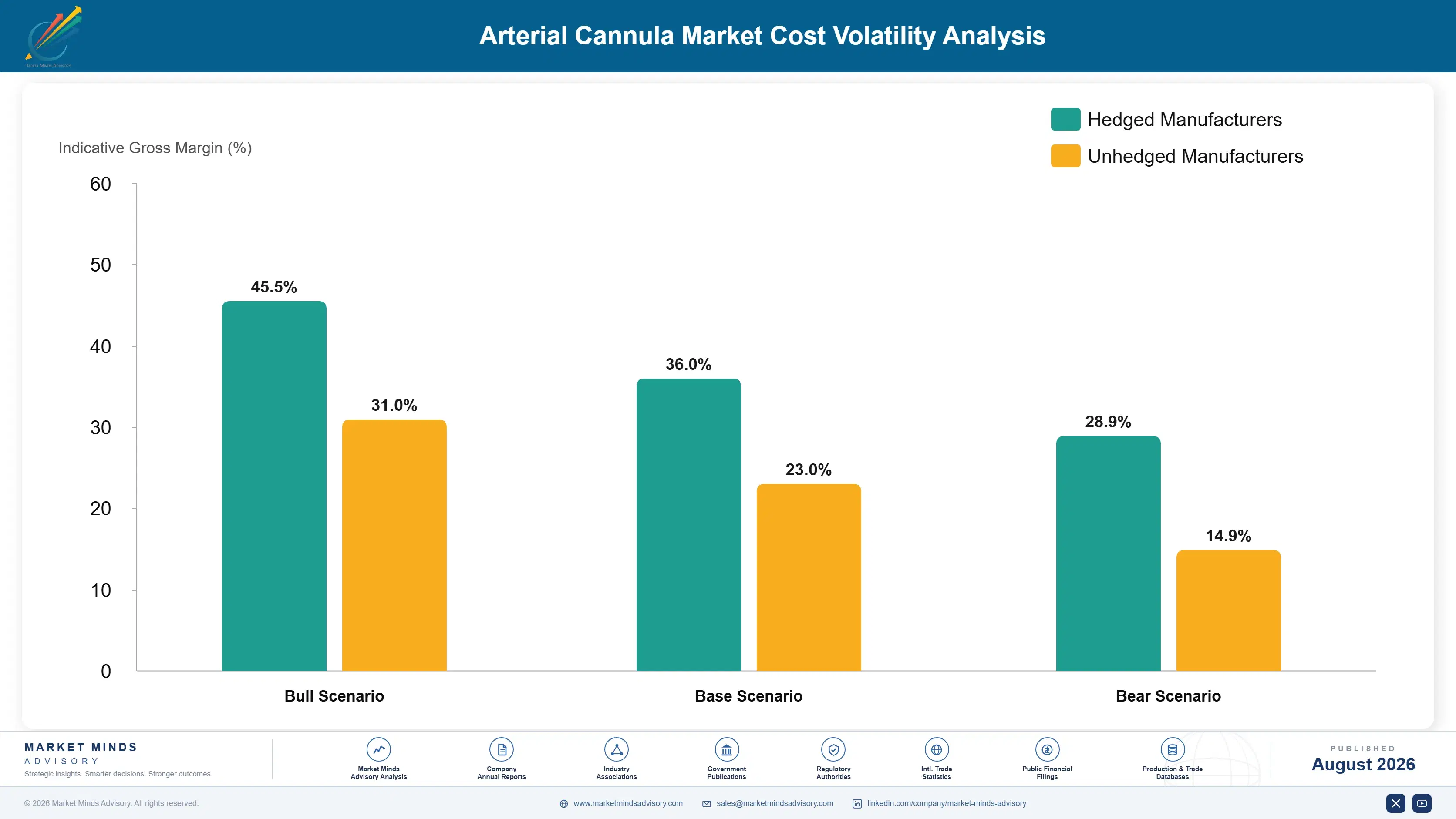
Raw material is a smaller part of this than the product's appearance suggests. Medical-grade polyurethane, silicone and reinforcement wire account for roughly 21% of cost of goods, sourced from a concentrated group of specialty suppliers in Europe, North America and Japan. Surface coating chemistry adds a further 14% and carries most of the technical differentiation. Sterilisation and validated cleanroom assembly absorb around 26%.
Medical-grade polymer pricing rose materially through 2022 and 2023 as feedstock and energy costs moved across European production, and suppliers with annual contracts absorbed the increase for a full cycle before repricing. Company disclosures across the perfusion sector documented margin compression through that interval. Ethylene oxide sterilisation capacity also tightened as emissions scrutiny constrained several facilities, adding cost and lead time. Both landed hardest on manufacturers without internal sterilisation capacity.

Exposure varies most by manufacturing footprint and by coating strategy. European manufacturing carries polymer, labour and compliance costs that Chinese producers do not face at comparable levels, and that gap decides tenders wherever delivered price outweighs clinical evidence. Participants licensing coating chemistry rather than owning it surrender both margin and the technical position supporting duration claims, where the category's pricing power now sits.
arterial-cannula-market-cost-volatility-analysis-1787305632990

Bring surface coating chemistry in house

Coating carries the largest share of technical differentiation and the ability to make duration performance claims, yet several participants license it from third parties. Acquiring or developing the chemistry internally captures margin and controls the claim pathway, though it requires validation work measured in years and regulatory submissions that cannot be shortened. Few participants have made the commitment.

Qualify alternative sterilisation modalities

Ethylene oxide capacity has tightened under emissions scrutiny, and manufacturers dependent on a single external provider carry real lead-time exposure. Validating radiation or vaporised hydrogen peroxide alternatives where material compatibility allows removes that dependency, and material selection at design stage decides whether the option exists at all. Retrofitting the choice onto an existing product is rarely practical.

Regional assembly against tender price pressure

Establishing assembly capacity in lower-cost regions closes part of the delivered price gap against domestic competitors in Asian and Latin American tenders. Regulatory registration of a second manufacturing site is substantial work, and quality system consistency across sites is what determines whether the saving survives contact with an audit. Most participants underestimate that consistency requirement.

Portfolio Architecture for Margin Defence

Margin architecture separates by whether a clinician or a procurement officer selects the device. Routine aortic cannulae for cardiopulmonary bypass are close enough across suppliers that tender treats them as interchangeable, and margins reflect that directly. Specialised configurations for complex aortic work and duration-rated extracorporeal cannulae are chosen by surgeons and perfusionists on performance grounds, and they clear margins two to three times higher.
The tension is between volume and defensibility. Routine bypass cannulae still account for most units shipped and provide the scale that supports manufacturing and sterilisation overhead, yet they carry sustained price erosion and no defensible position. Specialised configurations carry the margin but ship in a fraction of the volume, and no participant has found a way to grow one without the other supporting it.

High-value pools concentrate where technique and device are learned together. Selective cerebral perfusion for arch surgery, duration-rated extracorporeal cannulae and distal perfusion catheters all sit there, because the clinician selecting them has a specific performance requirement and a training history with a particular product. Everything selected on delivered price alone competes with manufacturers whose cost base is fundamentally different.

Volume / Commodity-Adjacent Tier

Routine aortic and peripheral cannulae for cardiopulmonary bypass purchased through institutional tender, frequently bundled into wider circuit awards where delivered price rather than device performance decides the outcome. Price erosion here is continuous and unanswerable.
Gross Margin: 34-46%

Premium / Certified Tier

Selective cerebral and complex aortic perfusion configurations chosen by surgeons whose technique was learned with a specific device, carrying prices around four times routine equivalents and deep programme-level loyalty. Programme standards hold for years once set.
Gross Margin: 58-70%

Sustainability / Regulatory / Next-Generation Tier

Duration-rated extracorporeal support cannulae and distal perfusion catheters, defended by coating chemistry, substantiated performance claims and the regulatory history required to make them credibly. This is the one tier where the engineering gap remains genuinely open.
Gross Margin: 64-78%
arterial-cannula-market-portfolio-architecture-1787305633490

Who Selects and What Persists

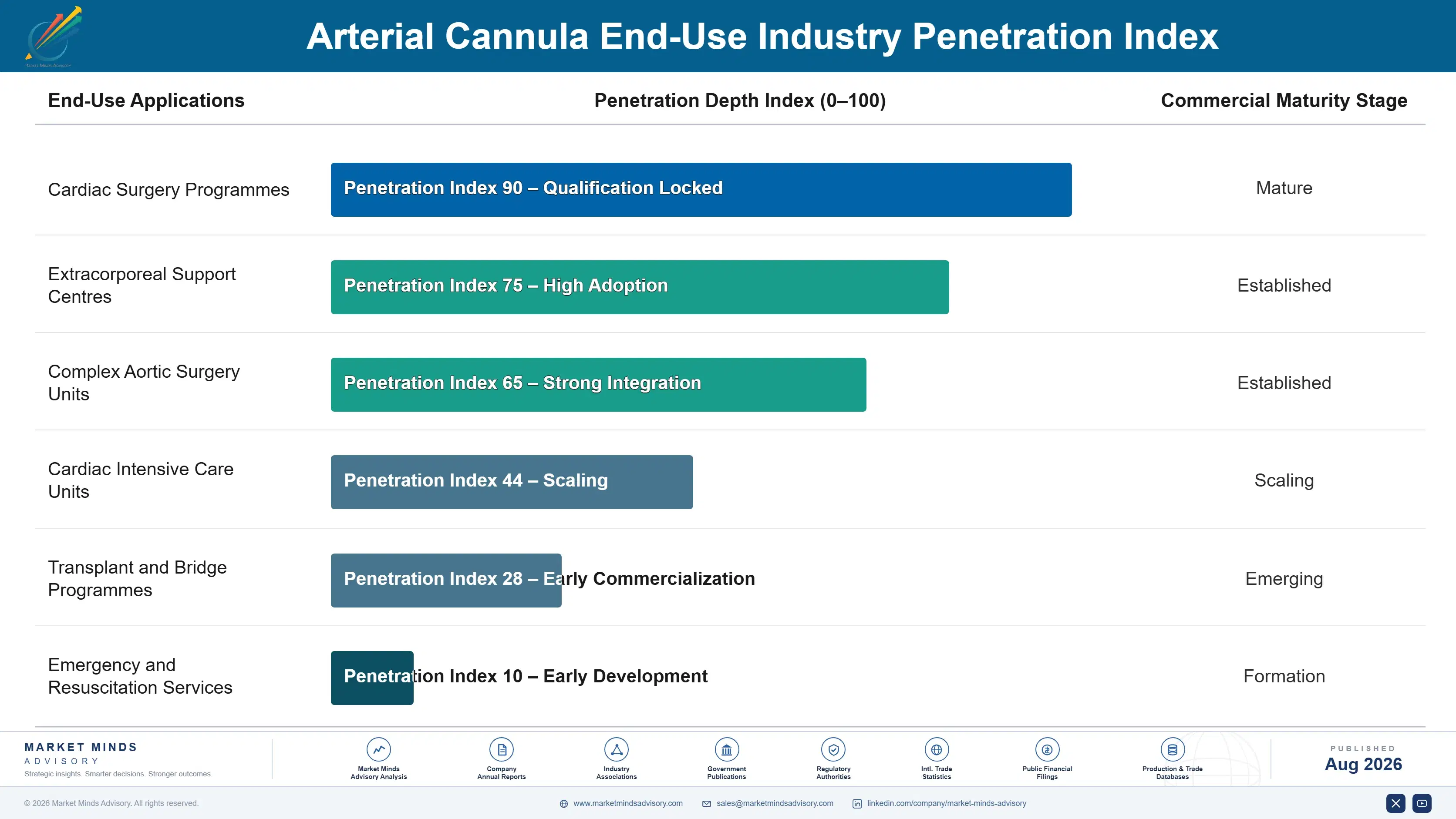
Revenue arrives per procedure, which makes this a consumption market rather than an annuity one, yet the purchasing behaviour behind it is unusually sticky. A perfusion programme standardises on a configuration, trains staff around it and rarely revisits the decision absent a supply failure or a price event large enough to reach hospital leadership. Roughly 78% of purchases run through tender, but tender frequently confirms an incumbent rather than displacing one.
Depth of adoption varies sharply by procedure type. Complex aortic programmes are the stickiest, because surgeons learned the technique with a specific device during training and substitution carries perceived clinical risk. Extracorporeal support sits close behind, with perfusionists defaulting to consumables matched to the platform they were trained on. Routine bypass is the loosest, and procurement moves it on price without meaningful clinical resistance in most institutions.

The clinical buyer profile is also changing. Perfusionists have gained considerable influence over consumable selection as extracorporeal support has professionalised, and in many centres they now specify what surgeons once chose alone. That shifts commercial engagement toward a group with different priorities: handling, setup time, kink behaviour under real working conditions and duration performance matter more to them than surgeon-facing marketing addressed.
arterial-cannula-market-end-use-penetration-index-1787305633983

Where Value Actually Sits

These are among the four positions where our research anticipates prominent divergence between winners and laggards over the coming forecast period. Each is grounded in the demand model, the regulatory perimeter, and the announced capacity pipeline.
01 / DURATION ENGINEERING GAP

Nobody has built for nine days yet

Median peripheral extracorporeal support runs near nine days against an original bypass design case of roughly six hours, and every product currently serving that use was adapted rather than purpose-built for it. Coating durability, kink tolerance and haemolysis performance across sustained flow are all measurable and all currently unclaimed by anyone. Devices carrying substantiated duration claims sustain price premiums of 25% to 35%, and the regulatory work required to substantiate them is exactly what would make the resulting position defensible.
02 / TWO-DEVICE PROCEDURE CAPTURE

Supplying one cannula now means supplying half

Distal perfusion catheters accompany roughly 63% of peripheral cannulations, driven by a limb ischaemia rate near 17% that follows directly from occupying a femoral artery with a cannula large enough to carry full cardiac output. A manufacturer offering only the primary device addresses half the procedure and hands a clinical relationship to whoever supplies the remainder, frequently a competitor with no prior account presence. Matched configurations also remove a compatibility question that perfusionists currently have to resolve themselves, case by case, without manufacturer guidance.
03 / PROGRAMME STANDARDISATION SELLING

Win the programme, not the individual case

Complex aortic configurations price around four times routine equivalents and carry the deepest surgeon preference in this category, because the technique and the device are learned together during surgical training rather than being chosen independently afterward. Centres consolidating complex aortic work standardise on a single supplier and then hold that standard for five years or more without seriously revisiting it. Commercial engagement therefore belongs with programme directors and training pathways rather than with procurement or with any individual case sale.
04 / CIRCUIT BUNDLING DEFENCE

Move the contest away from component pricing

Roughly 78% of all purchases in this market run through competitive tender, and the Chinese manufacturers now reaching export markets compete on a delivered price that established suppliers simply cannot match from their existing cost base. Bidding full perfusion circuits at programme level across multi-year contract terms shifts the whole conversation toward total support cost, including training, on-site coverage and consignment inventory management. Suppliers that compete this way reported award retention running around 15% higher than component-level bidding had ever delivered them previously.

Engagement Snapshot From the Field

A live engagement with an industry participant carrying material or product regulatory and market exposure ahead of a defining policy shift, showing how our research translates into a defensible multi-year portfolio strategy.
MARKET MINDS ADVISORY · CLIENT ENGAGEMENT SUMMARY
Arterial Cannula Producer Strategic Portfolio Review and Transition Roadmap 2026·Investment Scenario on Arterial Cannula Exposure Evaluation 2025-26
CLIENT PROFILE
A perfusion device manufacturer with annual revenue near $420 million (client-reported, unverified by MMA), holding an established arterial cannula range sold across Europe and selected export markets. The business had watched routine bypass pricing erode for several years under tender pressure and was weighing whether to invest in duration-specific extracorporeal development or defend its existing volume position through cost reduction and bundling instead.
STRATEGIC CHALLENGE
Duration-rated development required coating chemistry the company licensed rather than owned, plus a regulatory programme measured in years, against a routine cannula business generating most current revenue at falling margins. Leadership needed to understand whether perfusionists would actually pay for substantiated duration performance, and whether the licensing position made the strategy viable at all.
MMA APPROACH
We interviewed 46 perfusionists and 19 cardiac surgeons across six markets on device selection criteria, duration experience and willingness to pay for substantiated performance. Tender award records were analysed across three years to separate price-led from incumbent-confirming outcomes. We then modelled the development pathway against a bundling-led defence of the existing position.
KEY FINDINGS
  1. Perfusionists identified duration performance as the single criterion now separating products, and 71% said they would specify a device carrying substantiated claims over an adapted bypass design.
  2. Tender analysis showed 64% of awards confirmed the incumbent rather than displacing one, meaning price erosion was occurring within retained accounts rather than through account loss.
  3. The licensed coating position capped achievable margin on any duration-rated product and left claim substantiation dependent on a third party's regulatory cooperation and timelines.
  4. Distal perfusion represented a faster route to procedure capture than duration development, requiring considerably less regulatory work against an adoption curve already running at 63%.
CLIENT PROFILE
A perfusion device manufacturer with annual revenue near $420 million (client-reported, unverified by MMA), holding an established arterial cannula range sold across Europe and selected export markets. The business had watched routine bypass pricing erode for several years under tender pressure and was weighing whether to invest in duration-specific extracorporeal development or defend its existing volume position through cost reduction and bundling instead.
STRATEGIC CHALLENGE
Duration-rated development required coating chemistry the company licensed rather than owned, plus a regulatory programme measured in years, against a routine cannula business generating most current revenue at falling margins. Leadership needed to understand whether perfusionists would actually pay for substantiated duration performance, and whether the licensing position made the strategy viable at all.
MMA APPROACH
We interviewed 46 perfusionists and 19 cardiac surgeons across six markets on device selection criteria, duration experience and willingness to pay for substantiated performance. Tender award records were analysed across three years to separate price-led from incumbent-confirming outcomes. We then modelled the development pathway against a bundling-led defence of the existing position.
KEY FINDINGS
  1. Perfusionists identified duration performance as the single criterion now separating products, and 71% said they would specify a device carrying substantiated claims over an adapted bypass design.
  2. Tender analysis showed 64% of awards confirmed the incumbent rather than displacing one, meaning price erosion was occurring within retained accounts rather than through account loss.
  3. The licensed coating position capped achievable margin on any duration-rated product and left claim substantiation dependent on a third party's regulatory cooperation and timelines.
  4. Distal perfusion represented a faster route to procedure capture than duration development, requiring considerably less regulatory work against an adoption curve already running at 63%.
RECOMMENDED STRATEGY
Phase 1: Phase one: enter distal perfusion catheters to hold the whole peripheral procedure, using the shorter regulatory pathway to reach revenue within eighteen months. Phase 2: Phase two: negotiate coating chemistry ownership or acquisition, since duration claims are not credibly defensible from a licensed position over time. Phase 3: Phase three: develop duration-rated extracorporeal support cannulae once coating chemistry is controlled outright. Position against adapted bypass designs rather than on price.
OUTCOME
The company launched a distal perfusion catheter within fourteen months and attached it to roughly 40% of existing peripheral cannula accounts in the first year (client-reported, unverified by MMA). Coating acquisition discussions opened with two suppliers. Routine bypass pricing continued eroding as expected, but blended margin held flat for the first time in four years.

Frequently Asked Questions

Foundational context covering the market sizes, CAGR, scope, country, region and competition that inform every finding below. This section is provided to cover basics and most often pre-purchase conversations, answered from the MMA Primary Research Dataset.

What is the current size of the Arterial Cannula Market?

The global market is valued at $1.05 billion in 2025, rising to $1.13 billion in 2026. East Asia holds the largest share at 31%, reflecting cardiac surgery volume that exceeds any other region.

How large will the Arterial Cannula Market be by 2036?

MMA forecasts $2.24 billion by 2036, an increase of $1.11 billion over the 2026 base and an expansion multiple of 1.98x. Extracorporeal support growth carries most of that increase.

What is the CAGR for the Arterial Cannula Market 2026 to 2036?

The base case compound annual growth rate is 7.2%, with a bull case at 8.4% and a bear case at 6.0%. Historical growth from 2020 to 2025 ran near 6.0%, split between declining bypass and rising support volume.

Which segment is growing fastest?

Extracorporeal life support arterial cannulae compound at 10.8%, a full 1.50x the market rate. Programme count expanded sharply after 2020 and centres retained capability rather than winding it down afterward.

Who are the major companies in the Arterial Cannula Market?

Medtronic, Getinge, LivaNova, Terumo and Edwards Lifesciences together hold 71% of revenue from arterial cannulation products. Concentration is high for a consumable because coating chemistry and regulatory history are difficult to replicate.

Which country is growing fastest?

China compounds at 12.4%, faster than any other country covered, as provincial hospitals add extracorporeal capability that previously existed only in tertiary centres. Domestic manufacturers supply most of that demand through tender.

Report Segmentation Architecture

The full report scope spans multiple orthogonal segmentation dimensions, with cross-tabulated demand data provided for each dimension pair. Coverage extends further to regional breakdowns, trend trajectories, and the competitive detail needed to support segment-level decision-making.

By Cannula Type

  • Aortic Cannulae for Cardiopulmonary Bypass
  • Peripheral Femoral and Axillary Cannulae
  • Extracorporeal Life Support Arterial Cannulae
  • Cerebral and Selective Perfusion Cannulae
  • Distal Perfusion Catheters

By End-Use Industry

  • Cardiac Surgery Programmes
  • Extracorporeal Support Centres
  • Complex Aortic Surgery Units
  • Cardiac Intensive Care Units
  • Transplant and Bridge Programmes
  • Emergency and Resuscitation Services

By Commercial Dimension

  • Hospital Tender Procurement
  • Programme-Level Circuit Contracts
  • Specialty Distributor Supply
  • Direct Institutional Sales
  • Group Purchasing Organisation Agreements
  • Export and Registration Markets

By Region

  • East Asia
  • North America
  • Western Europe
  • South Asia and Pacific
  • Latin America
  • Middle East and Africa
  • Eastern Europe

Scope, Methodology, and Coverage

Every figure in this report is reproducible from documented input assumptions. The scope below maps the historical period, the forecast horizon, the segmentation dimensions, and the countries covered, alongside the underlying primary and qualitative methodology.
Historical Period
2020 to 2025
Forecast Period
2026 to 2036
Base Year
2025 (USD billions; MMA Primary Research Dataset, August 2026)
Market Definition
This market comprises arterial cannulae used to return oxygenated blood to the arterial circulation during extracorporeal circulation, measured at manufacturer revenue across hospital tender procurement, programme-level circuit contracts, specialty distributor supply, direct institutional sales, group purchasing organisation agreements and export registration markets. Coverage spans aortic cannulae for cardiopulmonary bypass in straight, curved and dispersion tip configurations, peripheral cannulae for femoral and axillary arterial access, extracorporeal life support arterial cannulae rated for extended support duration, cerebral and selective perfusion cannulae used in arch and complex aortic surgery, and distal perfusion catheters placed to maintain limb circulation below a peripheral arterial cannula. Venous drainage cannulae, cardioplegia delivery cannulae and needles, oxygenators, centrifugal and roller pumps, circuit tubing and connectors, vascular access sheaths used in interventional cardiology and radiology, arterial pressure monitoring catheters, and intra-aortic balloon pump catheters fall outside scope.
Quantitative Units
USD millions (current prices); units shipped by cannula type; average selling price by configuration; procedures performed; extracorporeal support days; distal perfusion attachment rate; tender share of purchases
Segmentation Dimensions
By Cannula Type; By End-Use Industry; By Commercial Dimension; By Region
Regions Covered
East Asia, North America, Western Europe, South Asia and Pacific, Latin America, Middle East and Africa, Eastern Europe
Countries Covered
China, Japan, South Korea, Taiwan, United States, Canada, Germany, Italy, France, United Kingdom, Spain, Netherlands, Belgium, Sweden, Switzerland, India, Australia, Singapore, Thailand, Malaysia, Indonesia, Brazil, Mexico, Argentina, Colombia, Chile, Saudi Arabia, United Arab Emirates, Egypt, South Africa, Poland, Czechia, Hungary, Turkey, and additional markets relevant to cardiac surgery analysis
Key Companies Profiled
Medtronic, Getinge, LivaNova, Terumo, Edwards Lifesciences, Braile Biomedica, Nipro Corporation, Fresenius Medical Care, Xenios, Eurosets, Andocor, Bioengineering Laboratories, Chalice Medical, Sorin Group Deutschland, Microport Scientific, Xijian Medical, Dongguan Kewei Medical, Ningbo Fangkang Medical, Sinomed, Ace Medical
Quantitative Methodology
Primary survey, n=3,800 respondents, Q4 2025, six countries; demand-side model with trade association cross-validation
Qualitative Methodology
47 expert interviews, Q4 2025; applied to validate demand model assumptions, identify emerging dynamics, and assess competitive positioning
Report Format
PDF and XLSX data workbook (Word format preview document)
Publisher
Market Minds Advisory
Report Code
MMA-2026-MED-444
Published
August 2026
Contact
sales@marketmindsadvisory.com | www.marketmindsadvisory.com

Purchase the full Arterial Cannula Market Report (2026 to 2036).

The full MMA report treats the gap between a six-hour design case and a nine-day clinical reality as the defining commercial fact in this category, quantifying what duration-rated engineering would be worth. It sizes five cannula classes and seven regions to 2036, modelling units shipped, pricing by configuration, procedure volume, support days, distal perfusion attachment and tender exposure separately. Competitive assessment covers twenty manufacturers on one consistent revenue basis. Cost exposure is traced through polymer, coating and sterilisation inputs. Four commercial levers and a strategic verdict close the report, grounded in 47 expert interviews and a 3,800-respondent survey.
Five cannula classes sized separately through 2036
Extracorporeal programme count mapped across every covered market
Distal perfusion attachment rates quantified against peripheral cannulation volume
Twenty manufacturers assessed on one consistent revenue basis
Tender award patterns analysed for incumbent retention behaviour
Anonymised manufacturer engagement with tested portfolio recommendations

Built For The People Who Decide

From boardroom strategy to bench-side execution, this report is read cover-to-cover by leaders shaping the next decade of their industry, turning demand scenarios, market dynamics and valuation benchmarks into decisions.
CXOs/ Presidents/ VPs/ Managers
M&A and Corporate Development
Strategy Teams and R&D Heads
Procurement and Product Directors
Regulatory and Compliance Leaders
Investor Relations and Equity Analysts