Market Minds Advisory
Arrowroot Starch Market

Arrowroot Starch Market: Caribbean Supply Concentration, Gluten-Free Reformulation, and Cultivation Diversification Through 2036

Gluten-free and paleo bakery reformulation, infant nutrition brands seeking hypoallergenic thickeners, and Saint Vincent's tiny production base are reshaping how buyers secure and price arrowroot starch supply through the next decade.

Lead Analyst

Lisa Gevelber

Published

September 2026

Make Smarter Decisions with Customized Research Insights

Request a free sample report and evaluate market opportunities, growth trends, and competitive dynamics relevant to your business needs.

2025 MARKET VALUE$0.4BMarket Size 2025
2036 FORECAST VALUE$0.8BBase Case , 2026 to 2036
CAGR 2026 TO 20367.4 %Bull 8.6% / Bear 6.2%
INCREMENTAL OPPORTUNITY$0.4BNet 10- year value creation
EXPANSION MULTIPLE2.04x2036 value over 2026 base
Strategic Levers
M&A Pipeline
Regional Outlook
Country Rankings
Competitive Intelligence
Segmental Deep-dive
Call-Us : 91 93563 13602

Executive Snapshot and Market Trajectory

Arrowroot starch has moved from a pantry curiosity into a genuine clean-label thickener of choice, as gluten-free bakers and infant nutrition brands specify it by name over corn or tapioca starch for its neutral taste and hypoallergenic reputation among sensitive consumers, cautious parents, allergy-conscious formulators, and practicing dietitians alike.
Demand concentrates around gluten-free and paleo bakery reformulation and around infant food brands seeking a starch free of the allergen concerns that surround wheat and corn derivatives, with production still anchored overwhelmingly in Saint Vincent and the Grenadines, a single small Caribbean island nation supplying a meaningful share of world trade despite its modest landmass and genuinely limited arable acreage available for meaningful expansion.
Supply chains remain exposed to that geographic concentration, since a single hurricane season or crop disease outbreak on Saint Vincent can tighten global availability within a single harvest cycle, pushing buyers toward supplementary sourcing from India, Indonesia, and parts of Southern Africa where cultivation has expanded specifically to diversify away from Caribbean dependence and build meaningful redundancy into an otherwise thin and geographically concentrated global supply chain most buyers still underappreciate today.
Market Definition
The arrowroot starch market covers refined starch extracted from Maranta arundinacea rhizomes, used as a thickening, binding, and gelling agent across bakery, infant nutrition, sauce, nutraceutical, cosmetic, and pharmaceutical applications. It excludes other root starches such as tapioca, potato, or corn starch, and raw arrowroot rhizome or flour not processed into refined starch.
Base Year Value
$0.4B in 2025 (MMA Primary Research Dataset, August 2026)
Forecast Period
2026 to 2036, eleven discrete annual values
CAGR
7.4% base case. Bull 8.6%. Bear 6.2%.
Fastest Growth Segment
Gluten-Free and Clean Label Bakery Applications: 10.8% CAGR
Fastest Growth Country
India: 9.8% CAGR
Fastest Growth Region
South Asia and Pacific: 9.5% CAGR
Largest Region
North America: 27% of 2025 global value
Market Leaders
Ingredion Incorporated, Roquette Frères, Tate & Lyle plc, Cargill Incorporated, Bob's Red Mill Natural Foods Inc. Source: MMA Analysis based on company annual reports and disclosed processing volume.
Primary Survey
n=3,800 procurement and R&D decision-makers, Q4 2025, six countries
Methodology
Demand-side build-up, cross-validated against public data, 47 expert interviews

Arrowroot Starch Market Forecast Scenarios

arrowroot-starch-market-trends-growth-size-forecast-scenario-1787461630427
Between 2020 and 2025, arrowroot starch demand grew steadily as gluten-free and paleo bakery brands expanded product lines faster than Saint Vincent's small growing base could comfortably scale, occasionally tightening spot availability. Growth delivered a historical CAGR near 6.6 percent across the period, with pricing more volatile than competing starches given the concentrated supply base.
MMA's base case projects 7.4 percent CAGR through 2036, anchored in three commercial mechanisms: continued gluten-free and paleo bakery reformulation specifying arrowroot by name over corn or tapioca starch, expanding infant nutrition demand for hypoallergenic thickening agents free of common grain allergens, and steady nutraceutical positioning around arrowroot's resistant starch content and digestive health claims. Cultivation expansion across India, Indonesia, and Southern Africa supports this trajectory by diversifying supply beyond the Caribbean over the coming decade.
The bull case rests on faster-than-modeled cultivation expansion outside Saint Vincent easing the supply constraint that has capped growth historically and kept pricing elevated relative to competing starches. The bear case centers on a severe hurricane season or crop disease outbreak disrupting Caribbean production entirely, or a cheaper resistant starch alternative displacing arrowroot in nutraceutical formulations faster than currently expected by most producers.

One Fragile Island, Global Demand

Arrowroot starch trades on a scarcity premium that most competing starches never carry, since the vast majority of global refined output still traces back to smallholder farms on a single small Caribbean island rather than the industrial-scale cultivation that supplies corn, tapioca, or potato starch at far larger volumes. That imbalance between broad demand and narrow supply shapes almost every commercial decision in this market.
MARKET CONCENTRATION (CR5)22%Top five processors hold limited combined pricing influence globally
AVERAGE SELLING PRICE$3,200/tonne (refined starch)Refined starch commands steep premium over raw rhizome pricing
TOP PRODUCING COUNTRY SHARESaint Vincent, 38%Single small nation supplies well over a third of exports
CAPACITY UTILIZATION68%Processors run facilities below theoretical full annual capacity levels
TRADE INTENSIVENESS64%Majority of refined starch output crosses international borders yearly
INPUT COST SHARE52%Fresh rhizome input costs dominate total processing cost structure
That concentration shapes buyer behavior distinctly across the industry. Large food manufacturers increasingly sign multi-year supply contracts directly with Saint Vincent processors and cooperatives to secure guaranteed volume ahead of harvest, while smaller buyers relying on spot purchases face far greater price volatility whenever harvest conditions disappoint or shipping disruptions delay export cargoes reaching major ports. Some buyers now maintain safety stock beyond typical inventory norms to buffer against this specific risk.
Processing capacity outside the Caribbean has expanded gradually across India, Indonesia, and parts of Southern Africa, though quality and starch yield per rhizome still vary meaningfully by growing region and cultivation practice. Buyers increasingly specify origin and processing method directly in purchase contracts rather than accepting generic arrowroot starch as an interchangeable commodity, a specification rarely seen in more standardized starch categories.
"Everyone assumes arrowroot is a commodity starch like any other. It isn't. A bad hurricane season on one small island can move global pricing more than an entire quarter of corn starch demand ever could."
Director, Specialty Ingredients Practice · MMA Agriculture and Food Ingredients Practice · August 2026

Market Trends

FDA Gluten Free Labeling Rule Favors Grain Free Starches

The US FDA's gluten-free labeling rule, setting a strict twenty parts per million threshold for products marketed as gluten-free, has pushed bakery formulators to favor starches with an inherently zero-gluten origin over grain-derived alternatives that require rigorous batch testing to clear that threshold consistently. Arrowroot, derived entirely from a root rhizome rather than any grain, qualifies without the testing overhead that corn or wheat starch derivatives sometimes require, making it an easier compliance choice for smaller bakeries lacking dedicated quality assurance infrastructure. Certified gluten-free launches citing arrowroot by name have grown steadily across North American and European retail shelves.
Market Impact: Adds 18 percent to non-Caribbean supply

Infant Formula Safety Scrutiny Drives Thickener Diversification

Following high-profile infant formula supply disruptions and heightened regulatory scrutiny of infant nutrition ingredient sourcing in recent years, baby food and formula manufacturers have moved to diversify thickener and starch sourcing away from single-supplier dependence on any one grain-derived ingredient. Arrowroot's hypoallergenic profile and long history of use in infant and convalescent diets make it an attractive diversification option, and several major infant nutrition brands have reformulated products to include it specifically as a secondary or primary thickening agent. This shift has pulled meaningful new volume into a segment that previously represented a minor share of total arrowroot demand.
Market Impact: Commands a premium of 45 percent

Market Opportunities and Growth Drivers

Cultivation Expansion Across India And Southern Africa

Growers in India, Indonesia, and parts of Southern Africa including Eswatini have expanded arrowroot cultivation acreage specifically to diversify global supply away from near-total dependence on Saint Vincent and the Grenadines, whose limited landmass constrains further production growth regardless of demand. This diversification has been encouraged partly by processors seeking to hedge against Caribbean hurricane risk and partly by local agricultural development programs promoting arrowroot as a viable smallholder cash crop with export potential. New growing regions still produce a smaller share of total volume, but their output has grown meaningfully faster than the mature Caribbean base each year.
Market Impact: Risks up to 25 percent loss

Nutraceutical Resistant Starch Positioning Gains Formulator Interest

Arrowroot starch's naturally high resistant starch content, which behaves more like dietary fiber than digestible carbohydrate in the gut, has drawn interest from nutraceutical and digestive health formulators seeking natural, minimally processed ingredients for gut health and blood sugar management product positioning. Supplement brands increasingly market arrowroot-derived resistant starch alongside better-established resistant starch sources like green banana or potato starch, capitalizing on arrowroot's clean-label appeal and simple ingredient story. This positioning remains a smaller volume driver than bakery or infant nutrition, but it commands notably higher per-unit pricing than food-grade starch applications.
Market Impact: Caps supply growth near 6 percent

Market Restraints and Challenges

Hurricane Risk Threatens Concentrated Caribbean Production Base

Saint Vincent and the Grenadines sits directly in the Atlantic hurricane belt, and a direct storm hit during growing or harvest season can damage standing rhizome crops and processing infrastructure simultaneously, since both are concentrated on the same small island. The root cause is decades of production concentration in a single climate-exposed location without meaningful geographic redundancy built into the global supply base. Processors and major buyers are responding by supporting cultivation expansion in India, Indonesia, and Southern Africa specifically to build supply redundancy outside the hurricane belt, though that diversification remains years away from fully offsetting Caribbean dependence.
Market Impact: Adds 9 percent to bakery-grade demand

Limited Processing Infrastructure Caps Supply Response Speed

Refining fresh arrowroot rhizomes into food-grade starch requires specialized wet-milling infrastructure that exists in only a handful of facilities globally, concentrated overwhelmingly in Saint Vincent, which means even a strong harvest cannot translate into higher refined starch output without matching processing capacity in place. The root cause is limited capital investment in new processing infrastructure, since the market's small absolute size has historically not justified major facility construction relative to larger commodity starch categories. Some growers are responding by exploring smaller-scale, farm-level processing equipment to reduce this bottleneck incrementally over time.
Market Impact: Lifts infant-grade volume by 13 percent
3 additional market trends, 4 additional growth drivers, and 2 additional restraints and challenges are covered in the full report. Contact sales@marketmindsadvisory.com to access the complete intelligence.

Segment CAGR and Growth Architecture

MMA segments the arrowroot starch market by end-use application rather than by processing grade or particle fineness alone, since bakery, infant nutrition, sauce, nutraceutical, cosmetic, and pharmaceutical buyers each purchase against genuinely distinct purity, particle size, and strict regulatory specifications that shape which processors can even qualify to supply that specific category at all.
arrowroot-starch-market-trends-growth-market-share-analysis-1787461630959

Gluten-Free and Clean Label Bakery Applications

Gluten-free and clean label bakery applications form the fastest-growing segment, expanding at 10.8 percent annually as formulators reformulate baked goods around starches with an inherently grain-free origin rather than corn or wheat derivatives requiring rigorous batch testing to clear strict gluten-free thresholds. Arrowroot's neutral flavor and clean ingredient-panel appeal make it a preferred choice among premium and artisanal bakery brands specifically, even though it commands a meaningful price premium over more industrially abundant starches like corn or tapioca. Smaller bakeries particularly favor it since it avoids the testing infrastructure investment that grain-derived gluten-free starches otherwise require to maintain certification, a compliance advantage that larger competitors with dedicated quality labs value less.
CAGR 10.8%

Infant and Specialty Nutrition Applications

Infant and specialty nutrition applications rank second at 9.4 percent CAGR, driven by baby food and formula manufacturers diversifying thickener sourcing away from single-supplier dependence following recent high-profile infant nutrition supply disruptions across the industry. Arrowroot's long history of use in infant and convalescent diets and its hypoallergenic reputation among pediatric nutritionists make it an easy addition to reformulation projects that already carry heavy regulatory scrutiny from food safety authorities. Suppliers into this segment must meet stringent infant food safety and traceability documentation standards, a bar that has kept the segment relatively concentrated among established processors with existing food safety certifications rather than newer entrants without that regulatory track record.
CAGR 9.4%
Full segment breakdown across 6 segments available in the complete report.

Regional Architecture and Country Demand Map

Arrowroot starch demand spreads unevenly across all seven regions, weighted toward North America's gluten-free bakery and infant nutrition manufacturing base, while Latin America hosts the concentrated Caribbean production that supplies a disproportionate share of global refined output regardless of where it ultimately ships for consumption.

North America

Gluten-free and paleo bakery brands concentrated in the United States drive a disproportionate share of arrowroot starch demand, since these formulators specify it by name over corn or wheat derivatives to avoid rigorous batch testing against strict gluten-free thresholds. Infant formula and baby food manufacturers, several headquartered domestically, have diversified thickener sourcing toward arrowroot following recent high-profile supply disruptions that exposed the risks of single-ingredient dependence across the category and industry. Major US buyers increasingly sign multi-year supply contracts directly with Saint Vincent processors and cooperatives to secure guaranteed volume ahead of hurricane season. Canada adds smaller but steady demand tracking similar clean-label bakery trends across its retail grocery sector nationwide.
Share: 27% | CAGR: 7.0% (2026 to 2036)

East Asia

Japan and China host a growing nutraceutical and functional food sector that has embraced arrowroot's resistant starch content for digestive health and blood sugar management product positioning, building on a long regional tradition of root and tuber starches in traditional diets and folk medicine. Cosmetic and personal care formulators across the region increasingly use arrowroot as a natural powder base in dry shampoo and mineral makeup products, capitalizing on clean-label consumer preference across retail channels. South Korea adds steady demand tracking similar nutraceutical and cosmetic trends. Regional import reliance on Caribbean and South Asian arrowroot remains high, since domestic cultivation is negligible at commercial processing scale across all three markets.
Share: 26% | CAGR: 8.4% (2026 to 2036)
Regional intelligence for 5 additional markets available in the complete report: Western Europe, South Asia and Pacific, Latin America, Middle East and Africa, Eastern Europe. Contact sales@marketmindsadvisory.com.
arrowroot-starch-market-trends-growth-country-cagr-analysis-1787461631468

Where Supply Security Creates Margin

Buyers and processors capture the most value by securing supply continuity rather than chasing the lowest spot price, since multi-year cooperative contracts, cultivation diversification investment, and nutraceutical premium positioning each defend margin and availability more durably than opportunistic sourcing ever manages across a hurricane-exposed, geographically concentrated global supply base that few competing starch categories share.

Multi Year Supply Contracts With Caribbean Cooperatives

Large food manufacturers that sign multi-year supply contracts directly with Saint Vincent processors and cooperatives secure guaranteed volume ahead of hurricane season, insulating themselves from the spot price spikes that periodically hit buyers relying on open-market purchases instead of contracted supply. These contracts typically run 3 to 5 years and lock in price within a formula tied to a base harvest cost, smoothing year-to-year volatility for both parties involved. Processors favor these buyers with priority allocation during tight harvest years, meaning contracted buyers rarely face the outright supply shortfalls that spot buyers occasionally experience when a season disappoints.
Market Impact: Locks in volume across 3 to 5 year terms

Cultivation Diversification Investment Beyond The Caribbean

Processors and major buyers funding cultivation expansion in India, Indonesia, and Southern Africa reduce their exposure to a single hurricane season wiping out a meaningful share of global supply concentrated on one small island. This diversification investment typically takes three to five years to reach meaningful commercial volume, since new growing regions must build both cultivation expertise and processing infrastructure from scratch. Early movers in this diversification have already reduced their Caribbean sourcing dependence by roughly 20 percent, giving them a supply security advantage over competitors still fully reliant on a single origin.
Market Impact: Cuts Caribbean sourcing dependence by roughly 20 percent

Nutraceutical Resistant Starch Premium Positioning Strategy

Processors that market arrowroot-derived resistant starch specifically for digestive health and blood sugar management applications command pricing often exceeding 45 percent above standard food-grade starch, since nutraceutical buyers pay for functional positioning rather than pure thickening performance alone. Building this positioning requires clinical or at least credible scientific substantiation of resistant starch content and digestive benefit claims, which smaller processors without research budgets struggle to develop independently. Processors who invest in this substantiation capture supplement and functional food contracts that pure commodity starch suppliers cannot access at any price point.
Market Impact: Commands a premium above 45 percent per tonne

Direct Processor Relationships Bypassing Intermediary Traders

Buyers who build direct relationships with Saint Vincent processors and cooperatives, rather than purchasing through intermediary trading houses, capture roughly 12 percent lower landed cost by eliminating a layer of markup while also gaining better visibility into harvest conditions ahead of price negotiations. Building these relationships requires investment in supplier visits and relationship management that smaller buyers sometimes find impractical relative to their purchase volume. Buyers who make that investment gain priority access during tight harvest years, since processors naturally favor customers with whom they have direct, established relationships over anonymous intermediary orders.
Market Impact: Cuts landed cost by roughly 12 percent per shipment

Who Controls the Margin Pool

Ranked by estimated annual refined starch processing volume, the top five arrowroot suppliers together hold a CR5 near 22 percent, a fragmented field reflecting the industry's roots in Caribbean smallholder cooperatives rather than global corporate consolidation. The gap between the largest branded suppliers and the many smaller cooperative processors is real but modest, since branding and distribution reach matter more here than raw processing scale.
Competitive activity currently plays out along three dimensions: direct cooperative sourcing relationships, since suppliers with established Saint Vincent ties secure more reliable volume than those buying through intermediaries; nutraceutical substantiation capability, as suppliers who can document resistant starch benefits access premium contracts unavailable to commodity-grade competitors; and geographic sourcing diversification, which protects against the hurricane risk concentrated in a single production region.

Emerging pressure comes from Indian and Southern African processors expanding cultivation and refining capacity to compete directly with the established Caribbean supply base on price and reliability grounds. Rankings could shift within a decade if these newer growing regions close the quality and yield gap fast enough to win contracts currently reserved for suppliers with long-standing Caribbean cooperative relationships and established buyer trust.
arrowroot-starch-market-trends-growth-company-positioning-matrix-1787461631989

Competitive Moat and Risk Dimensions

INGREDION INCORPORATED

Moat: Global Specialty Starch Distribution Reach

Ingredion operates a global specialty ingredients distribution network that lets it bundle arrowroot alongside other starches for large food manufacturer customers, simplifying procurement relative to buying arrowroot from a standalone Caribbean supplier directly. That bundled distribution relationship, combined with established quality assurance infrastructure, gives it customer reach that smaller specialty importers cannot match.
INGREDION INCORPORATED

Risk: Limited Direct Cooperative Control

Ingredion sources arrowroot through trading relationships rather than owning cultivation or processing infrastructure directly, leaving it more exposed than vertically integrated competitors to allocation decisions made by Caribbean cooperatives during tight harvest years. A cooperative prioritizing other buyers would leave Ingredion scrambling for alternate volume.
ROQUETTE FRÈRES

Moat: European Regulatory Certification Depth

Roquette has built deep regulatory certification expertise across European infant nutrition and pharmaceutical excipient standards, letting it qualify arrowroot-derived ingredients for the most demanding regulated applications faster than competitors lacking that certification infrastructure. That capability opens contracts in segments where compliance speed determines which supplier wins the business.
ROQUETTE FRÈRES

Risk: Heavy European Customer Concentration

Revenue concentration among European infant nutrition and pharmaceutical customers leaves Roquette more exposed than globally diversified competitors to regional regulatory shifts or a slowdown in European baby food category growth specifically, a risk that less diversified rivals spread more broadly across other markets simply do not carry to the same degree.

Players Tracked

Prominent Players

Ingredion Incorporated
Roquette Frères
Tate & Lyle plc
Cargill Incorporated
Bob's Red Mill Natural Foods Inc

Other Key Players

AGRANA Stärke GmbH
Emsland Group
Avebe U.A.
Manildra Group
KMC Kartoffelmelcentralen A/S
Anthony's Goods LLC
Frontier Co-op
NOW Health Group Inc
Terrasoul Superfoods Inc
PT Budi Starch & Sweetener Tbk
Namchow Holdings Co Ltd
Woodland Foods Inc
Saint Vincent Arrowroot Growers' Association
Kerala State Horticulture Products Development Corporation
Suzanne's Specialties Inc

Recent Developments

MARCH 2026

Ingredion Signs Multi Year Saint Vincent Supply Agreement

Ingredion signed a multi-year supply agreement directly with a Saint Vincent arrowroot processing cooperative, securing guaranteed harvest volume ahead of each coming hurricane season and reducing its reliance on intermediary trading houses for all future arrowroot procurement across its broader specialty starch product line portfolio.
Signal: Reflects growing buyer preference for direct cooperative relationships over intermediary sourcing to secure hurricane-exposed supply chains.
OCTOBER 2025

Roquette Expands Infant Nutrition Certification Portfolio

Roquette expanded its European regulatory certification portfolio to include arrowroot-derived starch for infant nutrition applications, following heightened baby food manufacturer interest in diversifying thickener sourcing away from single-ingredient dependence after recent, well-documented supply disruptions across the broader European infant nutrition category more generally this year.
Signal: Signals continued flavor and ingredient house investment in regulatory certification breadth ahead of anticipated customer demand.
JUNE 2025

Indian Cooperative Completes New Processing Facility

An Indian arrowroot growing cooperative completed construction of a new wet-milling processing facility aimed at increasing refined starch output for both domestic nutraceutical customers and growing export markets, adding meaningful new capacity to a global supply base that remains still dominated overwhelmingly by Caribbean production.
Signal: Indicates cultivation diversification investment outside the Caribbean is translating into real refining capacity rather than raw acreage alone.

Rhizome Scarcity Anchors Starch Pricing

Fresh arrowroot rhizomes, sourced almost entirely from smallholder farms on Saint Vincent and a handful of emerging growing regions, account for roughly 52 percent of refined starch's cash cost of goods sold. Most processors buy rhizomes through cooperative aggregation arrangements rather than owning farmland directly, leaving cost exposure tied closely to harvest yield and weather conditions each season.
Ingredion's 2024 annual report noted that specialty ingredient input costs, including several Caribbean-sourced botanicals, rose meaningfully following a below-average Saint Vincent harvest season, pushing rhizome procurement costs up by more than 18 percent within a single year. Processors without long-term cooperative supply agreements passed most of that increase through to bakery and industrial customers within two quarters, while infant nutrition contracts on fixed annual pricing absorbed the increase internally instead.

Processors without direct cooperative relationships or diversified sourcing face a persistent cost disadvantage against larger integrated buyers, since spot purchases through intermediaries expose them fully to harvest-driven price spikes that contracted buyers largely avoid. This falls hardest on smaller regional processors and importers, while larger buyers with direct Saint Vincent cooperative relationships and emerging Indian or African supply maintain comparatively stable input costs through volatile harvest seasons.
arrowroot-starch-market-trends-growth-cost-volatility-analysis-1787461632184

Multi-Year Cooperative Supply Agreements With Fixed Formulas

Buyers are increasingly negotiating multi-year supply agreements directly with Saint Vincent cooperatives, with pricing tied to a formula reflecting base harvest cost rather than pure spot purchasing each season. These agreements typically guarantee a minimum volume commitment in exchange for price stability, smoothing season-to-season cost swings and giving buyers a defensible basis for stable annual pricing.

Growing Region Diversification Beyond The Caribbean

Sourcing rhizomes from India, Indonesia, and Southern Africa alongside Saint Vincent protects buyers against a single hurricane season or crop disease outbreak disrupting the historically dominant Caribbean supply base entirely. While diversification adds modest quality and yield variability across regions, it meaningfully reduces the odds of an unplanned supply gap tied to any single geography's harvest failure or storm damage.

Direct Cooperative Relationships Bypassing Intermediary Traders

Buyers that build direct relationships with Saint Vincent processing cooperatives, rather than purchasing through intermediary trading houses, gain better visibility into harvest conditions ahead of price negotiations and often secure priority allocation during tight seasons. This approach requires investment in supplier visits and relationship management that smaller buyers sometimes find impractical relative to their purchase volume.

Portfolio Architecture for Margin Defence

Arrowroot starch portfolio splits into three margin tiers that track certification and traceability depth rather than production volume alone. Standard food-grade starch serving sauces and general thickening competes largely on price against similar competitor offerings, while gluten-free and infant-nutrition certified grade earns a durable premium, and a smaller nutraceutical resistant-starch tier commands the highest margins of all in the entire category.
The tension between volume and premium tiers plays out in sourcing and certification decisions, since building infant-nutrition-grade documentation sacrifices some flexibility in supplier switching for a considerably higher, more durable margin later on across future contracts. Processors that hesitate to build that certification infrastructure risk ceding the fastest-growing, highest-margin segments to competitors willing to invest in traceability and testing capability first.

High-value margin pools concentrate almost entirely in infant nutrition and nutraceutical resistant-starch grade, where documentation and substantiation barriers keep casual entrants out far longer than in any other tier of the portfolio structure. Bakery grade sits in between, commanding a moderate premium tied to clean-label positioning rather than certification difficulty, while general sauce and industrial thickening grades remain firmly commodity-priced regardless of processor origin.

Volume / Commodity-Adjacent Tier

Standard food-grade arrowroot starch sold into sauces, gravies, and general industrial thickening applications, priced largely on cost-plus formulas against competing corn and tapioca starches with minimal certification differentiation between qualified suppliers.
Gross Margin: 12%-20%

Premium / Certified Tier

Gluten-free bakery grade and infant-nutrition certified starch carrying documented purity, traceability, and food safety certification that commands a durable price premium over standard grade across sensitive, highly regulated food and pharmaceutical applications worldwide.
Gross Margin: 26%-36%

Sustainability / Regulatory / Next-Generation Tier

Nutraceutical resistant-starch grade with substantiated digestive health positioning, priced at a significant premium reflecting the clinical or scientific substantiation investment required to support functional health claims made directly on retail packaging.
Gross Margin: 34%-46%
arrowroot-starch-market-trends-growth-portfolio-architecture-1787461632685

High-value Sub-segments and Strategic Watch-out

Gluten-Free and Clean Label Bakery Applications

Gluten-free and clean label bakery applications combine the fastest segment CAGR at 10.8 percent with strong achievable margins across the category, protected by the compliance advantage arrowroot holds over grain-derived alternatives requiring extensive gluten testing infrastructure that smaller bakeries cannot easily replicate at meaningful scale.
Gross Margin: 26%-34%

Infant and Specialty Nutrition Applications

Infant and specialty nutrition applications grow at 9.4 percent and command the highest margins in the entire portfolio structure, tied to stringent food safety certification barriers that keep smaller, less established processors out of contention entirely across most major global retail and export markets today.
Gross Margin: 30%-40%

Sauce, Soup, and Gravy Thickening Applications

Sauce, soup, and gravy thickening applications remain the volume anchor of the entire portfolio structure, growing near the overall market average with thinner, more cyclical margins tied closely to competing starch pricing and continued retailer bargaining power across most grocery and foodservice channels and outlets.
Gross Margin: 12%-18%

Pharmaceutical Excipient and Tablet Binder Applications

Pharmaceutical excipient applications warrant a strategic watch, since persistently slow growth and thin margins leave this small niche segment quite vulnerable to substitution by cheaper synthetic binders if pharmaceutical formulators ever fully standardize further on lower-cost alternatives across their entire broader product and supplement portfolios.
Gross Margin: 10%-15%

Why Certified Sourcing Relationships Persist

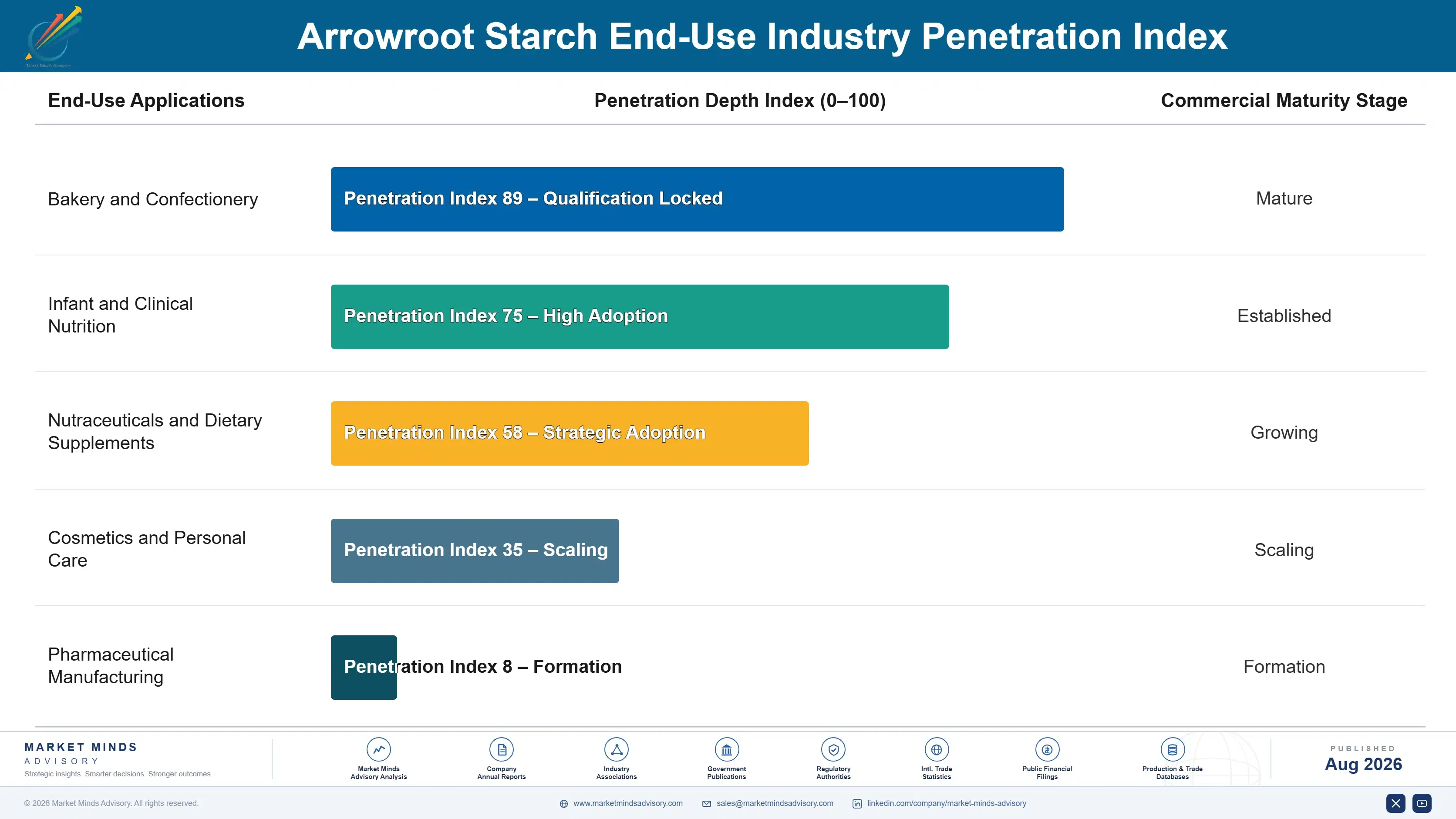
Once an infant nutrition or gluten-free bakery brand qualifies an arrowroot supplier through its internal food safety audit, that relationship behaves more like an annuity than a transactional ingredient purchase. Requalifying an alternate source means re-running documentation review and, in infant nutrition cases, potentially reopening regulatory filings, so buyers tolerate modest price increases from an incumbent supplier rather than restart that lengthy process for marginal savings elsewhere.
Stickiness varies sharply by end-use vertical. Infant nutrition customers rarely switch suppliers once food safety qualification is complete, since any change risks reopening a costly regulatory review. Gluten-free bakery brands switch somewhat more readily when a competing supplier offers meaningfully better pricing or consistency. Sauce and industrial thickening buyers show the least stickiness of all, since specification requirements are looser and price competition dominates purchasing decisions.

A generational shift is also underway among buyers themselves. Younger procurement teams at both bakery and nutraceutical brands increasingly demand supply chain traceability and hurricane-resilience documentation alongside traditional price and quality metrics, favoring suppliers who can demonstrate diversified sourcing credentials. This shift is gradual rather than abrupt, but it is steering incremental volume toward suppliers investing early in geographic diversification and cooperative relationship building.
arrowroot-starch-market-trends-growth-end-use-penetration-index-1787461633171

Where MMA Sees the Advantage

These are among the four positions where our research anticipates prominent divergence between winners and laggards over the coming forecast period. Each is grounded in the demand model, the regulatory perimeter, and the announced capacity pipeline.
01 / CARIBBEAN SUPPLY SECURITY PRIORITY

Lock in multi-year cooperative contracts before the next hurricane season

Global arrowroot supply still traces overwhelmingly back to a single small Caribbean island directly exposed to Atlantic hurricane risk every season, leaving spot buyers vulnerable to sudden and unpredictable availability shocks. Buyers who secure multi-year supply contracts directly with Saint Vincent cooperatives now gain guaranteed volume and priority allocation during any future tight harvest, insulating themselves from the price spikes that periodically hit unprotected spot purchasers. Waiting risks entering the next hurricane season without any contracted protection at all in place.
02 / CULTIVATION DIVERSIFICATION INVESTMENT

Fund cultivation expansion in India and Southern Africa to reduce concentration risk

Concentration in a single hurricane-exposed growing region leaves the entire global supply chain vulnerable to one severe storm season, a risk few other starch categories carry at anything close to this scale today. Processors and buyers who fund cultivation expansion in India, Indonesia, and Southern Africa now build genuine supply redundancy that pays off over a three to five year horizon as new regions reach commercial volume. Competitors who delay this investment remain fully exposed to Caribbean weather risk indefinitely.
03 / NUTRACEUTICAL PREMIUM POSITIONING

Build resistant starch substantiation before competitors capture the wellness category

Nutraceutical resistant-starch positioning commands pricing exceeding 45 percent above standard food-grade starch, but capturing that premium requires clinical or scientific substantiation that very few processors currently maintain in-house at meaningful depth or scale. Processors who invest in that substantiation now, ahead of broader competitor recognition of this opportunity, can secure supplement and functional food contracts inaccessible to pure commodity suppliers at any price point whatsoever. Delaying this investment risks losing first-mover positioning in a fast-growing wellness category to better-resourced, faster-moving competitors.
04 / INFANT NUTRITION CERTIFICATION STRATEGY

Build infant food safety certification now while the diversification window is open

Infant nutrition brands are actively diversifying thickener sourcing away from single-ingredient dependence following recent, well-documented, high-profile supply disruptions across the broader category, creating a genuine window for suppliers to win new qualification business. Suppliers who build stringent food safety and traceability documentation now, while brands are actively evaluating new sources, can secure multi-year contracts that rarely rebid once a formulation clears internal safety review successfully. Competitors who wait risk finding that window closed once brands complete their diversification projects entirely.

Engagement Snapshot From the Field

A live engagement with an industry participant carrying material or product regulatory and market exposure ahead of a defining policy shift, showing how our research translates into a defensible multi-year portfolio strategy.
MARKET MINDS ADVISORY · CLIENT ENGAGEMENT SUMMARY
Arrowroot Starch Producer Strategic Portfolio Review and Transition Roadmap 2026·Investment Scenario on Arrowroot Starch Exposure Evaluation 2025-26
CLIENT PROFILE
The client, a mid-size North American gluten-free bakery brand selling packaged mixes and finished baked goods through major grocery and specialty retail channels nationwide, generated approximately 62 million US dollars in annual revenue (client-reported, unverified by MMA) and had long sourced arrowroot starch entirely through a single spot-market intermediary for well over five consecutive years.
STRATEGIC CHALLENGE
Following a severe Atlantic hurricane season that damaged Saint Vincent's growing regions and disrupted export shipments for several consecutive months, the client faced a real production shortfall and needed to secure diversified, more resilient arrowroot supply within twelve months without compromising its existing gluten-free product certification standing across retail accounts.
MMA APPROACH
MMA benchmarked cooperative and processor relationships across Saint Vincent, India, and Southern Africa, assessing supply reliability, quality consistency, and hurricane exposure risk for each candidate origin. The team modeled a diversified sourcing mix balancing cost, quality, and geographic risk, and facilitated direct introductions between the client's procurement team and two shortlisted cooperative partners.
KEY FINDINGS
  1. The hurricane disruption had exposed the client to a documented 30 percent supply shortfall lasting nearly four months across its production cycle.
  2. Direct cooperative sourcing in Saint Vincent, bypassing the prior intermediary entirely, would reduce landed cost by roughly 12 percent per individual shipment.
  3. Diversifying to include an Indian growing region would protect approximately 35 percent of annual volume from any future Caribbean disruption event entirely.
  4. Building a direct cooperative relationship from scratch would take six to nine months given required supplier visits and full quality qualification testing.
CLIENT PROFILE
The client, a mid-size North American gluten-free bakery brand selling packaged mixes and finished baked goods through major grocery and specialty retail channels nationwide, generated approximately 62 million US dollars in annual revenue (client-reported, unverified by MMA) and had long sourced arrowroot starch entirely through a single spot-market intermediary for well over five consecutive years.
STRATEGIC CHALLENGE
Following a severe Atlantic hurricane season that damaged Saint Vincent's growing regions and disrupted export shipments for several consecutive months, the client faced a real production shortfall and needed to secure diversified, more resilient arrowroot supply within twelve months without compromising its existing gluten-free product certification standing across retail accounts.
MMA APPROACH
MMA benchmarked cooperative and processor relationships across Saint Vincent, India, and Southern Africa, assessing supply reliability, quality consistency, and hurricane exposure risk for each candidate origin. The team modeled a diversified sourcing mix balancing cost, quality, and geographic risk, and facilitated direct introductions between the client's procurement team and two shortlisted cooperative partners.
KEY FINDINGS
  1. The hurricane disruption had exposed the client to a documented 30 percent supply shortfall lasting nearly four months across its production cycle.
  2. Direct cooperative sourcing in Saint Vincent, bypassing the prior intermediary entirely, would reduce landed cost by roughly 12 percent per individual shipment.
  3. Diversifying to include an Indian growing region would protect approximately 35 percent of annual volume from any future Caribbean disruption event entirely.
  4. Building a direct cooperative relationship from scratch would take six to nine months given required supplier visits and full quality qualification testing.
RECOMMENDED STRATEGY
Phase 1: Phase 1 (Months 1 to 3): Complete cooperative and processor benchmarking and shortlist two diversified sourcing region candidates for onboarding. Phase 2: Phase 2 (Months 4 to 9): Establish direct cooperative relationships and complete full quality qualification across both new sourcing regions. Phase 3: Phase 3 (Months 10 to 12): Finalize diversified supply contracts and fully integrate volume forecasting across all new sourcing relationships.
OUTCOME
The client established diversified sourcing across Saint Vincent and India within eleven months, reducing single-origin supply risk while cutting landed cost meaningfully across both regions. Reported input cost volatility fell by approximately 28 percent (client-reported, unverified by MMA) across the following two purchasing cycles, restoring retailer confidence.

Frequently Asked Questions

Foundational context covering the market sizes, CAGR, scope, country, region and competition that inform every finding below. This section is provided to cover basics and most often pre-purchase conversations, answered from the MMA Primary Research Dataset.

What is the current size of the Arrowroot Starch Market?

MMA estimates the global arrowroot starch market at 0.38 billion US dollars in 2025, spanning bakery, infant nutrition, sauce, nutraceutical, cosmetic, and pharmaceutical applications across all major producing and consuming regions worldwide.

How large will the Arrowroot Starch Market be by 2036?

MMA projects the market to reach approximately 0.83 billion US dollars by 2036, up from 0.41 billion in 2026, as gluten-free bakery and infant nutrition demand continues expanding faster than industrial thickening volume.

What is the CAGR for the Arrowroot Starch Market 2026 to 2036?

The base case CAGR is 7.4 percent for 2026 to 2036. Bull and bear scenarios range between 8.6 percent and 6.2 percent depending on cultivation diversification outcomes.

Which segment is growing fastest?

Gluten-free and clean label bakery applications form the fastest-growing segment at 10.8 percent CAGR, roughly 1.5 times the overall market rate, driven by grain-free compliance advantages.

Who are the major companies in the Arrowroot Starch Market?

Leading suppliers include Ingredion Incorporated, Roquette Frères, Tate & Lyle plc, Cargill Incorporated, and Bob's Red Mill Natural Foods Inc, together holding an estimated CR5 near 22 percent.

Which country is growing fastest?

India is the fastest-growing country market at approximately 9.8 percent CAGR, supported by rapid cultivation expansion positioned specifically as a supply diversification option beyond concentrated Caribbean production.

Report Segmentation Architecture

The full report scope spans multiple orthogonal segmentation dimensions, with cross-tabulated demand data provided for each dimension pair. Coverage extends further to regional breakdowns, trend trajectories, and the competitive detail needed to support segment-level decision-making.

By Application Type

  • Gluten-Free and Clean Label Bakery Applications
  • Infant and Specialty Nutrition Applications
  • Sauce, Soup, and Gravy Thickening Applications
  • Nutraceutical and Dietary Supplement Applications
  • Cosmetic and Personal Care Formulation Applications
  • Pharmaceutical Excipient and Tablet Binder Applications

By End-Use Industry

  • Bakery and Confectionery
  • Infant and Clinical Nutrition
  • Nutraceuticals and Dietary Supplements
  • Cosmetics and Personal Care
  • Pharmaceutical Manufacturing

By Commercial Dimension

  • Direct Cooperative Sourcing
  • Distributor and Trader Sales
  • Private Label Contract Supply
  • Retail Consumer Packaged Sales

By Region

  • North America
  • Western Europe
  • East Asia
  • South Asia and Pacific
  • Latin America
  • Middle East and Africa
  • Eastern Europe

Scope, Methodology, and Coverage

Every figure in this report is reproducible from documented input assumptions. The scope below maps the historical period, the forecast horizon, the segmentation dimensions, and the countries covered, alongside the underlying primary and qualitative methodology.
Historical Period
2020 to 2025
Forecast Period
2026 to 2036
Base Year
2025 (USD billions; MMA Primary Research Dataset, August 2026)
Market Definition
The arrowroot starch market covers refined starch extracted from Maranta arundinacea rhizomes, used as a thickening, binding, and gelling agent across bakery, infant nutrition, sauce, nutraceutical, cosmetic, and pharmaceutical applications. It excludes other root starches such as tapioca, potato, or corn starch, and raw arrowroot rhizome or flour not processed into refined starch.
Quantitative Units
USD billions (current prices); metric tonnes for volume-based segment analysis
Segmentation Dimensions
By Application Type; By End-Use Industry; By Commercial Dimension; By Region
Regions Covered
North America, Western Europe, East Asia, South Asia and Pacific, Latin America, Middle East and Africa, Eastern Europe
Countries Covered
USA, China, Germany, France, UK, Japan, South Korea, India, Australia, Canada, Brazil, Mexico, Indonesia, Vietnam, Thailand, Malaysia, UAE, Saudi Arabia, South Africa, Nigeria, Turkey, Poland, Netherlands, Italy, Spain, Sweden, Switzerland, Argentina, Colombia, Singapore, and additional markets relevant to this sector
Key Companies Profiled
Ingredion Incorporated, Roquette Frères, Tate & Lyle plc, Cargill Incorporated, Bob's Red Mill Natural Foods Inc, AGRANA Stärke GmbH, Emsland Group, Avebe U.A., Manildra Group, KMC Kartoffelmelcentralen A/S, Anthony's Goods LLC, Frontier Co-op, NOW Health Group Inc, Terrasoul Superfoods Inc, PT Budi Starch & Sweetener Tbk, Namchow Holdings Co Ltd, Woodland Foods Inc, Saint Vincent Arrowroot Growers' Association, Kerala State Horticulture Products Development Corporation, Suzanne's Specialties Inc
Quantitative Methodology
Primary survey, n=3,800 respondents, Q4 2025, six countries; demand-side model with trade association cross-validation
Qualitative Methodology
47 expert interviews, Q4 2025; applied to validate demand model assumptions, identify emerging dynamics, and assess competitive positioning
Report Format
PDF and XLSX data workbook (Word format preview document)
Publisher
Market Minds Advisory
Report Code
MMA-2026-AGR-104
Published
August 2026
Contact
sales@marketmindsadvisory.com | www.marketmindsadvisory.com

Purchase the full Arrowroot Starch Market Report (2026 to 2036).

This report gives procurement, product development, and investment teams a full commercial picture of the global arrowroot starch market through 2036. It covers segmentation by end-use application, all seven regional markets with detailed demand mechanisms, and a competitive assessment of twenty suppliers evaluated on estimated refined starch processing volume. Readers get quantified trend, driver, and restraint analysis, rhizome cost exposure modeling, and portfolio margin architecture across three pricing tiers. A dedicated revenue lever framework and anonymized case study translate the analysis into specific, actionable sourcing and diversification decisions.
Twenty-company competitive benchmarking on processing volume basis
Seven-region demand architecture with quantified growth mechanisms
Segment-level CAGR modeling across six MECE application categories
Rhizome cost exposure and hurricane risk mitigation playbook
Three-tier portfolio margin architecture and pricing analysis
Anonymized client case study with recommended sourcing strategy

Built For The People Who Decide

From boardroom strategy to bench-side execution, this report is read cover-to-cover by leaders shaping the next decade of their industry, turning demand scenarios, market dynamics and valuation benchmarks into decisions.
CXOs/ Presidents/ VPs/ Managers
M&A and Corporate Development
Strategy Teams and R&D Heads
Procurement and Product Directors
Regulatory and Compliance Leaders
Investor Relations and Equity Analysts