Market Minds Advisory
Aroma Ingredients Market

Aroma Ingredients Market: Bio-Based Synthesis Reshapes a Petrochemical-Dependent Supply Chain

Precision fermentation is displacing petrochemical synthesis routes for vanillin and nootkatone, while natural-extracted ingredients command a widening premium, forcing flavor houses to rebuild supply chains around biotechnology partnerships rather than petrochemical feedstock contracts alone.

Lead Analyst

Lisa Gevelber

Published

September 2026

Make Smarter Decisions with Customized Research Insights

Request a free sample report and evaluate market opportunities, growth trends, and competitive dynamics relevant to your business needs.

2025 MARKET VALUE$18.5BMarket Size 2025
2036 FORECAST VALUE$45.0BBase Case , 2026 to 2036
CAGR 2026 TO 20368.4 %Bull 9.7% / Bear 7.1%
INCREMENTAL OPPORTUNITY$24.9BNet 10- year value creation
EXPANSION MULTIPLE2.24x2036 value over 2026 base
Strategic Levers
M&A Pipeline
Regional Outlook
Country Rankings
Competitive Intelligence
Segmental Deep-dive
Call-Us : 91 93563 13602

Executive Snapshot and Market Trajectory

Fermentation-derived aroma molecules are moving from pilot scale into commercial supply faster than petrochemical-route capacity can be retired, forcing flavor and fragrance houses to run two parallel supply chains through the transition, each carrying its own cost structure and separate quality control regime to manage.
China's consumer goods manufacturing base has made East Asia the largest buying region, absorbing aroma chemical volume for food, beverage, and personal care formulation at a pace multinational suppliers increasingly serve through local production rather than export shipment. Biotechnology and fermentation-derived ingredients are expanding far faster than any other category as precision fermentation proves out at commercial scale for molecules once available only through petrochemical synthesis or costly natural extraction from scarce plant sources.
Five diversified flavor and fragrance houses control most branded formulation revenue, so synthesis technology breadth, not raw material sourcing alone, decides who wins premium natural and biotech-derived ingredient contracts across every major consumer category worldwide. Clean-label reformulation pressure is colliding with petrochemical feedstock volatility to reshape which production routes actually win new business over the next several years, and the pace of that shift keeps accelerating.
Market Definition
The aroma ingredients market covers synthesized, extracted, and fermentation-derived chemical compounds used to create flavor and fragrance profiles across food, beverage, personal care, and household product formulation. It excludes finished flavor and fragrance compounds sold as blended formulations, and excludes essential oils sold for aromatherapy or direct topical retail use.
Base Year Value
$18.5B in 2025 (MMA Primary Research Dataset, August 2026)
Forecast Period
2026 to 2036, eleven discrete annual values
CAGR
8.4% base case. Bull 9.7%. Bear 7.1%.
Fastest Growth Segment
Biotechnology and Fermentation-Derived Aroma Chemicals: 14.5% CAGR
Fastest Growth Country
China: 9.8% CAGR
Fastest Growth Region
South Asia and Pacific: 10.5% CAGR
Largest Region
East Asia: 28% of 2025 global value
Market Leaders
Givaudan, International Flavors and Fragrances, dsm-firmenich, Symrise, Takasago International. Source: MMA Analysis based on company annual reports.
Primary Survey
n=3,800 procurement and R&D decision-makers, Q4 2025, six countries
Methodology
Demand-side build-up, cross-validated against public data, 47 expert interviews

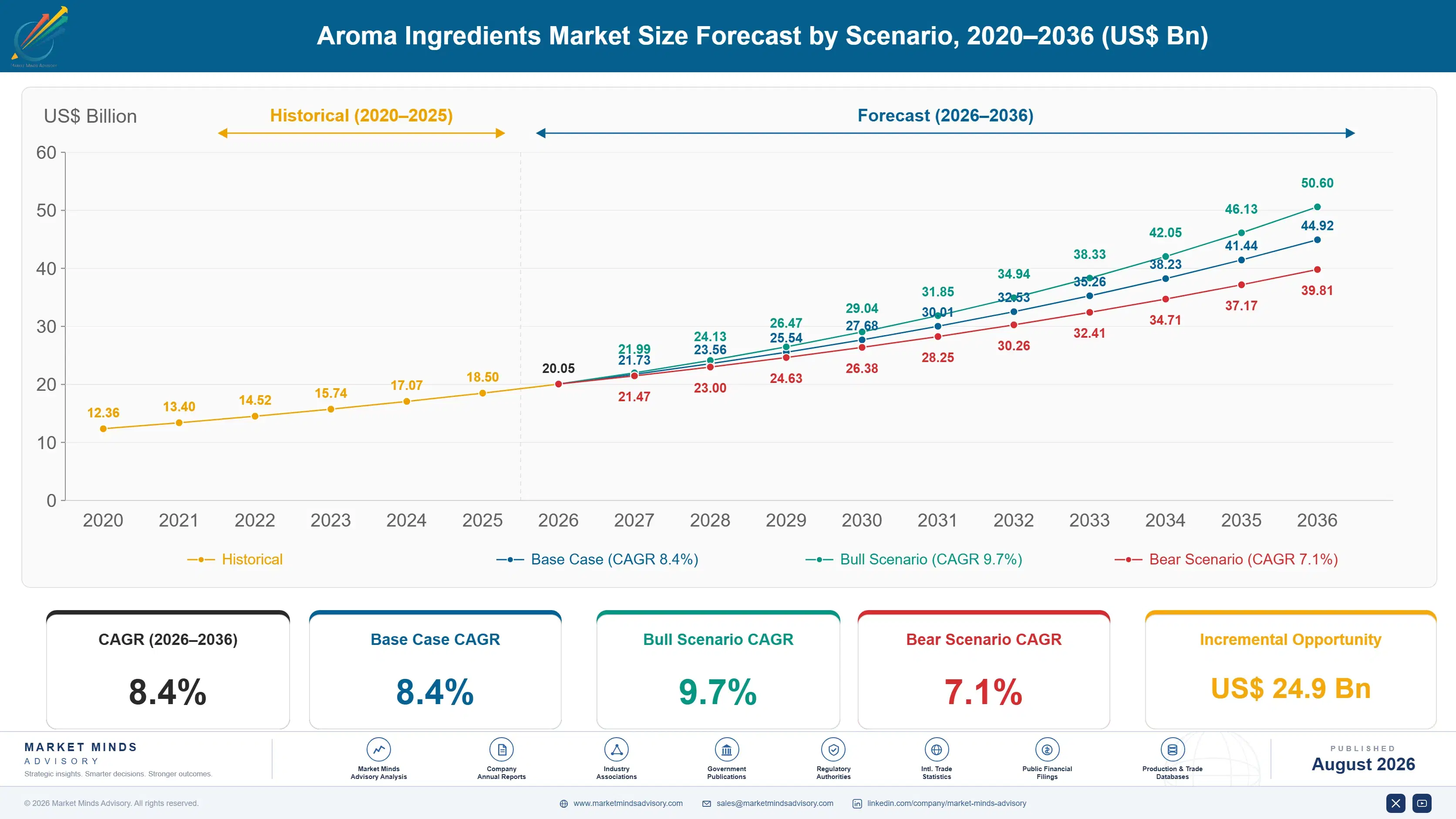
Aroma Ingredients Market Forecast Scenarios

aroma-ingredients-market-size-forecast-scenario-1787463270118
Aroma ingredient volumes grew steadily between 2020 and 2025 as consumer goods manufacturing expanded across East Asia, though petrochemical feedstock volatility disrupted margins for several quarters during that period across nearly every producer serving the category, regardless of scale or production route. Natural and fermentation-derived ingredient adoption accelerated meaningfully across the back half of that period as clean-label pressure intensified.
The base case assumes continued precision fermentation commercialization for high-value molecules, expanding clean-label demand for natural-extracted ingredients, and steady capacity investment by the five largest flavor and fragrance houses working in parallel across multiple production routes simultaneously. These three mechanisms together lift supply in step with demand without requiring petrochemical capacity to be fully retired before fermentation routes reach commercial maturity across every major molecule category this report tracks in detail.
A bull case builds on a major flavor house successfully commercializing fermentation-derived vanillin at cost parity with synthetic vanillin, pulling forward adoption industry-wide well ahead of schedule and across every major consumer category. The bear risk is a sustained petrochemical feedstock price spike that squeezes margins faster than fermentation routes can realistically scale to offset it within the same budget cycle.

Three Synthesis Routes Competing for the Same Demand

Aroma ingredients sit at the intersection of three production philosophies that used to compete independently: petrochemical synthesis for cost efficiency, natural extraction for clean-label appeal, and now fermentation biotechnology for molecules previously available only through one of the other two routes at meaningfully higher cost or lower consistency across most product categories buyers care about most, from beverages through fine fragrance and household care.
PRODUCER CONCENTRATION5 firms, 48%share of branded formulation revenue held by leaders
AVERAGE SELLING PRICE$42/kgblended basis price across all synthesis routes today
TOP PRODUCING COUNTRY SHAREChina, 21%share of global aroma chemical output manufactured domestically
CAPACITY UTILISATION79%average utilisation across dedicated synthesis and fermentation lines
TRADE INTENSITY47% cross-bordershare of finished ingredient volume traded across borders
FEEDSTOCK COST SHARE36% of COGSshare of production cost attributable to petrochemical feedstock
Commercially, the category behaves like a specialty chemical business layered onto a consumer goods demand curve. Five diversified flavor and fragrance houses control most branded formulation revenue, and long-term supply contracts, not spot purchasing, determine who gets priority access to newly commercialized fermentation-derived molecules first, well ahead of smaller regional competitors still relying on conventional synthesis routes alone for their core catalog.
Over the next decade, fermentation biotechnology will likely reshape which companies capture the fastest-growing slice of demand, since precision fermentation yield improvements are outpacing whatever gains petrochemical synthesis or natural extraction can still realistically achieve at scale across most molecule categories tracked in this report, from vanillin through rare fragrance compounds once sourced only from threatened or endangered plant species.
"Everyone wants to talk about fermentation as the future. The buyers who are actually winning are the ones who never stopped investing in the petrochemical route either."
Director, Flavor and Fragrance Ingredients Practice · MMA Specialty and Fine Chemicals Practice · August 2026

Market Trends

Precision fermentation reaches commercial cost parity for key molecules

Precision fermentation platforms have reached commercial cost parity with petrochemical synthesis for several high-volume molecules, including vanillin and nootkatone, since 2024, ending a decade of biotech aroma production remaining confined mostly to pilot-scale demonstration projects. Flavor houses that previously treated fermentation as a marketing-driven premium ingredient story are now qualifying it as a genuine cost-competitive production route across mainstream formulation, not just premium natural-positioned product lines. This shift matters because it removes the price penalty that previously limited fermentation-derived ingredients to a narrow premium niche, opening mainstream volume categories that were previously unreachable for biotech producers lacking scale.
Market Impact: Adds $340 million in demand
Clean-label reformulation accelerates natural ingredient demand

Packaged food and beverage manufacturers across North America and Western Europe have continued reformulating away from synthetic flavor and fragrance ingredients toward naturally sourced or naturally identical alternatives since 2023, driven by retailer-level clean-label commitments rather than any single regulatory mandate. This reformulation wave has pushed natural-extracted ingredient demand meaningfully ahead of overall category growth, particularly for citrus, vanilla, and mint-family aroma compounds where natural sourcing carries strong consumer recognition. Suppliers able to guarantee consistent natural sourcing at scale are capturing this demand fastest, since inconsistent natural supply has historically been the main barrier keeping formulators on synthetic alternatives instead.
Market Impact: Adds 9% regional volume growth yearly

Market Opportunities and Growth Drivers

Personal care reformulation drives biotech aroma ingredient adoption

Global personal care and household product manufacturers have accelerated reformulation toward biotechnology-derived and naturally identical aroma ingredients since 2023, responding to consumer demand for transparent, sustainably sourced fragrance components across shampoo, detergent, and cosmetic categories. This wave has expanded well beyond the food and beverage categories where clean-label pressure first emerged, creating a new demand channel for fermentation-derived and natural aroma ingredients previously concentrated in edible applications alone. Suppliers with established biotechnology production capability are capturing this channel fastest, since personal care formulators increasingly specify sustainable sourcing documentation as a purchase requirement rather than an optional marketing claim.
Market Impact: Adds 5-8% margin volatility yearly

East Asian consumer goods manufacturing scales aroma chemical consumption

Chinese and broader East Asian food, beverage, and personal care manufacturing has expanded consistently through 2024 and 2025, driving aroma ingredient consumption growth well ahead of mature Western markets already near consumption saturation. Rising middle-class disposable income across the region has expanded demand for premium formulated products carrying more sophisticated flavor and fragrance profiles than basic formulations required previously. Multinational flavor houses have responded by localizing production within China rather than exporting finished ingredients, shortening supply lead times and better matching regionally preferred flavor and fragrance profiles to local consumer preference.
Market Impact: Adds 15-25% price volatility yearly

Market Restraints and Challenges

Petrochemical feedstock volatility disrupts synthesis route margins

Aroma chemical synthesis routes reliant on petrochemical feedstocks such as benzene and toluene derivatives remain exposed to crude oil price volatility affecting the broader chemicals industry, since these feedstocks are not aroma-specific and compete with far larger-volume chemical uses. The root cause is that aroma chemical producers are price takers in petrochemical feedstock markets, lacking the purchasing scale to negotiate independent pricing terms. The commercial impact shows up as margin compression during any sustained crude oil price spike, regardless of underlying demand strength. Producers mitigate this by accelerating fermentation and natural-extraction route investment to reduce petrochemical exposure over time.
Market Impact: Adds 11% annual fermentation-route volume

Natural extraction supply depends on unpredictable agricultural harvests

Natural-extracted aroma ingredients sourced from citrus, vanilla, and other agricultural crops remain exposed to weather-driven harvest variability that synthetic and fermentation routes do not share, since a poor vanilla harvest in Madagascar or a citrus disease outbreak in Brazil can disrupt supply for an entire category overnight. The root cause is that natural supply chains still depend on weather and disease risks affecting any agricultural commodity. The commercial impact is periodic severe price spikes that push formulators back toward synthetic alternatives temporarily. Suppliers mitigate this by diversifying sourcing across regions and qualifying fermentation-derived alternatives as a buffer.
Market Impact: Lifts natural ingredient demand 8 points
3 additional market trends, 4 additional growth drivers, and 3 additional restraints and challenges are covered in the full report. Contact sales@marketmindsadvisory.com to access the complete intelligence.

Segment CAGR and Growth Architecture

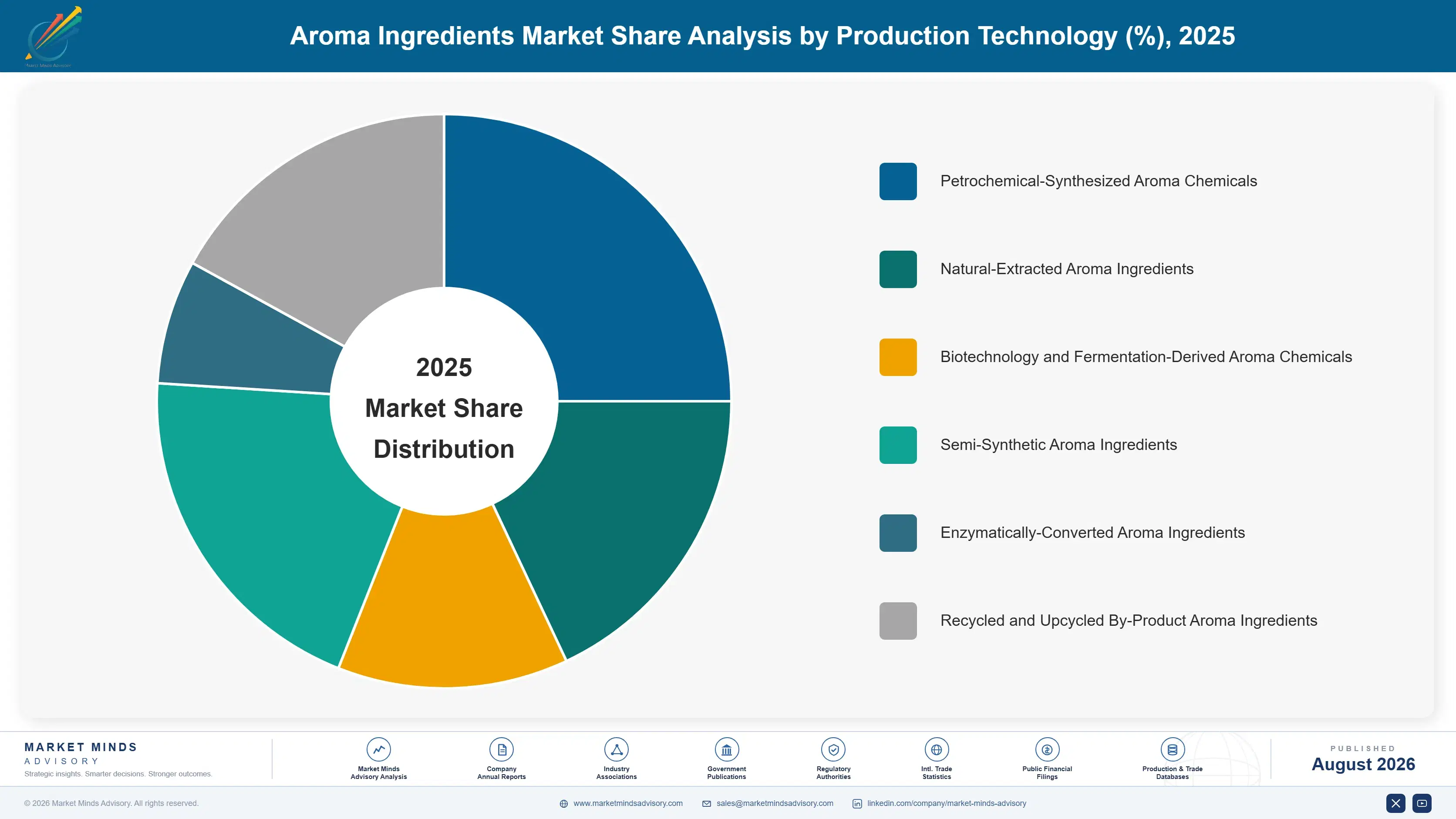
Segmentation follows production and synthesis technology, since the method used to produce a given aroma molecule determines cost structure, sourcing risk, and clean-label positioning, far more than any downstream application label attached to the finished formulated product later on, whether that product is a beverage, a packaged snack, or a fine fragrance sold at retail.
aroma-ingredients-market-market-share-analysis-1787463270668

Biotechnology and Fermentation-Derived Aroma Chemicals

Biotechnology and fermentation-derived aroma chemicals use engineered microorganisms to produce target molecules through precision fermentation, a route that has reached commercial cost parity with petrochemical synthesis for vanillin and nootkatone since 2024. This segment requires substantial upfront investment in fermentation infrastructure and strain engineering capability that only a handful of specialist biotechnology companies and the largest flavor houses currently operate at commercial scale. Demand is growing at roughly 1.73 times the category average, driven by clean-label positioning that carries genuine sustainability credentials rather than marketing claims alone. Buyers increasingly specify fermentation-derived sourcing directly in purchase contracts rather than accepting either petrochemical synthetic or natural-extracted alternatives interchangeably, pushing suppliers without fermentation capability out of this fastest-growing slice of demand entirely.
CAGR 14.5%

Natural-Extracted Aroma Ingredients

Natural-extracted aroma ingredients, sourced directly from citrus, vanilla, mint, and other agricultural crops through physical or solvent extraction, carry the strongest clean-label consumer recognition of any segment but remain exposed to agricultural harvest variability that synthetic and fermentation routes avoid entirely. This segment trails fermentation-derived ingredients on growth but comfortably outpaces petrochemical synthesis, supported by retailer clean-label commitments that increasingly specify natural sourcing directly rather than accepting naturally identical synthetic equivalents as a substitute for the genuine article. Suppliers able to guarantee consistent natural sourcing at scale, despite underlying agricultural volatility, are capturing premium pricing that inconsistent regional suppliers cannot reliably match across multiple consecutive harvest seasons in a row.
CAGR 10.8%
Full segment breakdown across 6 segments available in the complete report.

Regional Architecture and Country Demand Map

East Asia's consumer goods manufacturing base has made it the largest buying region for aroma ingredients, ahead of North America's diversified formulation demand, with South Asia and Pacific growing fastest off a considerably smaller manufacturing base as its consumer goods sector matures rapidly each year.

East Asia

China's expanding food, beverage, and personal care manufacturing base has made East Asia the single largest buying region for aroma ingredients, with multinational flavor houses increasingly localizing production within the country rather than exporting finished ingredients from Europe or North America. Japanese and South Korean demand adds a smaller but technically sophisticated market segment, particularly for premium fine fragrance and functional beverage applications requiring precise molecule specification and documented purity. Rising middle-class disposable income across the region continues expanding demand for more elaborately formulated consumer products carrying sophisticated flavor and fragrance profiles well beyond what basic formulations required just a decade ago, a shift still gathering pace across most product categories tracked here.
Share: 28% | CAGR: 9.3% (2026 to 2036)

North America

United States demand centers on a mature, highly diversified formulation base spanning food, beverage, personal care, and household product manufacturing, with clean-label reformulation pressure driving natural and fermentation-derived ingredient adoption faster here than in most other regions worldwide. Retailer-level synthetic ingredient phase-out commitments, rather than any single federal mandate, have pushed packaged food and beverage manufacturers toward naturally sourced alternatives at a pace multinational suppliers are still working to match with sufficient natural supply on hand. Canadian demand tracks closely behind the United States, and both markets rely on a mix of domestic production and imports from European and Asian aroma chemical manufacturers under long-term contract negotiated well ahead of peak formulation season each year.
Share: 25% | CAGR: 9.6% (2026 to 2036)
Regional intelligence for 5 additional markets available in the complete report: Western Europe, South Asia and Pacific, Latin America, Middle East and Africa, Eastern Europe. Contact sales@marketmindsadvisory.com.
aroma-ingredients-market-country-cagr-analysis-1787463271186

Where Aroma Ingredient Margins Concentrate

Margin in this category sits with synthesis technology breadth and supply diversification rather than raw material ownership, so producers capture the most value by operating across petrochemical, natural, and fermentation routes simultaneously rather than committing to just one at the expense of flexibility across every major buyer segment this report tracks in careful detail.

Fermentation Sourcing Guarantee as a Pricing Gate

Producers able to guarantee fermentation-derived sourcing on a technical data sheet, rather than sell generic synthetic aroma chemicals, capture roughly 45% higher per-kilogram pricing from clean-label formulation customers who need documented sustainability credentials for label claims. Building precision fermentation infrastructure and strain engineering capability requires capital most mid-sized producers have not yet committed to, which keeps this pricing gate open to only a handful of global suppliers today. Customers increasingly write fermentation-route requirements directly into supply contracts, effectively excluding non-biotech suppliers from the fastest-growing slice of demand regardless of their existing synthesis capacity.
Market Impact: Commands a 45% premium over synthetic grade today

Multi-Region Natural Ingredient Sourcing Diversification Plan

Diversifying natural aroma ingredient sourcing across multiple growing regions, rather than relying on a single country's harvest, has let a handful of producers maintain supply continuity while competitors ration allocation during weather-driven shortfalls. This approach adds upfront cost equivalent to roughly 8% of sourcing spend but removes the worst allocation risk during a poor harvest year, letting diversified suppliers onboard new customers that single-region competitors must turn away. Producers without diversified grower relationships increasingly find themselves buying spot-market natural extract at a real premium precisely when demand runs highest across the category.
Market Impact: Cuts harvest shortfall allocation risk by roughly 35%

Localized Chinese Production Capacity Buildout Plan

Localizing production capacity within China rather than exporting finished aroma chemicals from Europe or North America lets multinational producers respond faster to evolving Chinese formulation preferences and avoid import tariff exposure that affects foreign-manufactured ingredients disproportionately across most product categories. This channel now represents a meaningful and steadily growing part of total category demand, estimated at roughly 9 percentage points of incremental annual growth concentrated specifically in East Asia. The tradeoff is substantial upfront capital investment, offset by considerably shorter supply lead times and better-matched regional flavor and fragrance profiles going forward for years to come.
Market Impact: Adds 9 points of incremental annual growth overall

Personal Care Formulation Expertise Expansion Push

Investing in personal care and household product formulation expertise, beyond the category's traditional food and beverage base, opens a fast-growing channel worth an estimated $340 million in incremental annual demand tied to sustainable sourcing requirements. Producers investing in this capability ahead of competitors stand to capture meaningful early category-entry advantages once personal care formulators standardize on a preferred supplier relationship for years at a time. Development timelines run one to two years before results reach customer trials, and early movers are partnering directly with major personal care brands to accelerate qualification testing considerably.
Market Impact: Opens access to $340 million in new demand

Who Controls the Margin Pool

The top five flavor and fragrance houses hold roughly 48% of branded formulation revenue, leaving a long tail of smaller regional producers to compete mainly on price in less specification-sensitive synthetic and commodity natural ingredient channels across most emerging and smaller developed markets worldwide today.
Current competitive activity centers on three moves: building precision fermentation capability to capture premium biotech-derived ingredient pricing, diversifying natural ingredient sourcing across multiple growing regions to manage harvest risk, and localizing production capacity within China to serve the region's rapidly expanding consumer goods manufacturing base directly. Smaller players without fermentation capability increasingly position around natural certification instead of competing directly for biotech-derived business against the largest houses.

Emerging pressure comes from Chinese domestic aroma chemical producers building both natural extraction and fermentation capacity specifically to serve local reformulation demand rather than relying on multinational suppliers, which could erode the export processing model that has served the category for decades. Whichever producer first commercializes fermentation routes for the widest range of molecules at cost parity with synthesis stands to gain disproportionate share as clean-label pressure keeps intensifying across every major consumer category this report tracks.
aroma-ingredients-market-company-positioning-matrix-1787463271718

Competitive Moat and Risk Dimensions

GIVAUDAN SA

Moat: Broadest multi-route production platform

Givaudan operates petrochemical synthesis, natural extraction, and fermentation biotechnology capacity simultaneously, letting it serve any customer specification without ceding business to a specialist competitor, an advantage few rivals can match across all three production routes at comparable scale, consistency, and geographic reach worldwide, from bulk food flavor through fine fragrance.
GIVAUDAN SA

Risk: High fixed capital intensity

Operating three parallel production technologies simultaneously requires substantial ongoing capital investment across all three routes, which could pressure returns if customer demand concentrates unexpectedly in just one production route rather than spreading evenly across the full portfolio as originally planned for the year across every division.
INTERNATIONAL FLAVORS AND FRAGRANCES INC.

Moat: Deep flavor formulation expertise

IFF's scale in blended flavor and fragrance formulation, built through its Frutarom and DuPont Nutrition and Biosciences acquisitions, gives it distribution reach into food and beverage manufacturer accounts that standalone aroma ingredient suppliers would need years of dedicated sales effort and considerable capital to develop independently from scratch without that acquired scale.
INTERNATIONAL FLAVORS AND FRAGRANCES INC.

Risk: Integration complexity from acquisitions

IFF's growth through large acquisitions has left it managing a more complex combined operation than organically grown competitors, which could slow decision-making on fermentation route investment relative to more nimble rivals with simpler, leaner corporate structures and considerably shorter internal approval chains for management to navigate.

Players Tracked

Prominent Players

Givaudan SA
International Flavors and Fragrances Inc.
dsm-firmenich
Symrise AG
Takasago International Corporation

Other Key Players

Sensient Technologies Corporation
Robertet SA
T. Hasegawa Co., Ltd.
Mane SA
Kerry Group plc
Huabao International Holdings Limited
Ginkgo Bioworks Holdings, Inc.
Conagen Inc.
Evolva Holding SA
Zhejiang NHU Company Ltd.
Fuji Flavor Co., Ltd.
Vigon International, Inc.
Treatt plc
Ungerer and Company
Solvay S.A.

Recent Developments

JULY 2025

Givaudan Expands Fermentation-Based Vanillin Production Capacity

Givaudan commissioned an additional precision fermentation line dedicated to vanillin production, adding capacity aimed at clean-label customers seeking documented sustainable sourcing across food and beverage categories worldwide. The expansion followed two years of allocation constraints during periods of surging fermentation-route demand across several major customer accounts.
Signal: Signals leaders are investing ahead of demand rather than rationing existing fermentation capacity across their accounts
NOVEMBER 2025

dsm-firmenich Forms Biotech Partnership for Precision Fermentation

dsm-firmenich formed a partnership with a synthetic biology company to co-develop precision fermentation routes for additional fragrance molecules beyond its existing vanillin and nootkatone production capacity. The partnership includes shared strain engineering research and dedicated pilot facility access for both partner organizations involved in the agreement.
Signal: Confirms biotechnology partnerships are becoming standard industry practice rather than a rare competitive differentiator alone now
MARCH 2026

Symrise Acquires Natural Aroma Ingredient Extraction Facility

Symrise acquired a natural aroma ingredient extraction facility in Southeast Asia, adding citrus and spice extraction capacity aimed at diversifying natural ingredient sourcing beyond its existing European and Latin American supply base considerably. The deal includes long-term grower agreements across the surrounding region and neighboring countries.
Signal: Points to natural ingredient sourcing diversification as a growing industry priority alongside fermentation route investment now

Petrochemical and Agricultural Feedstock Exposure

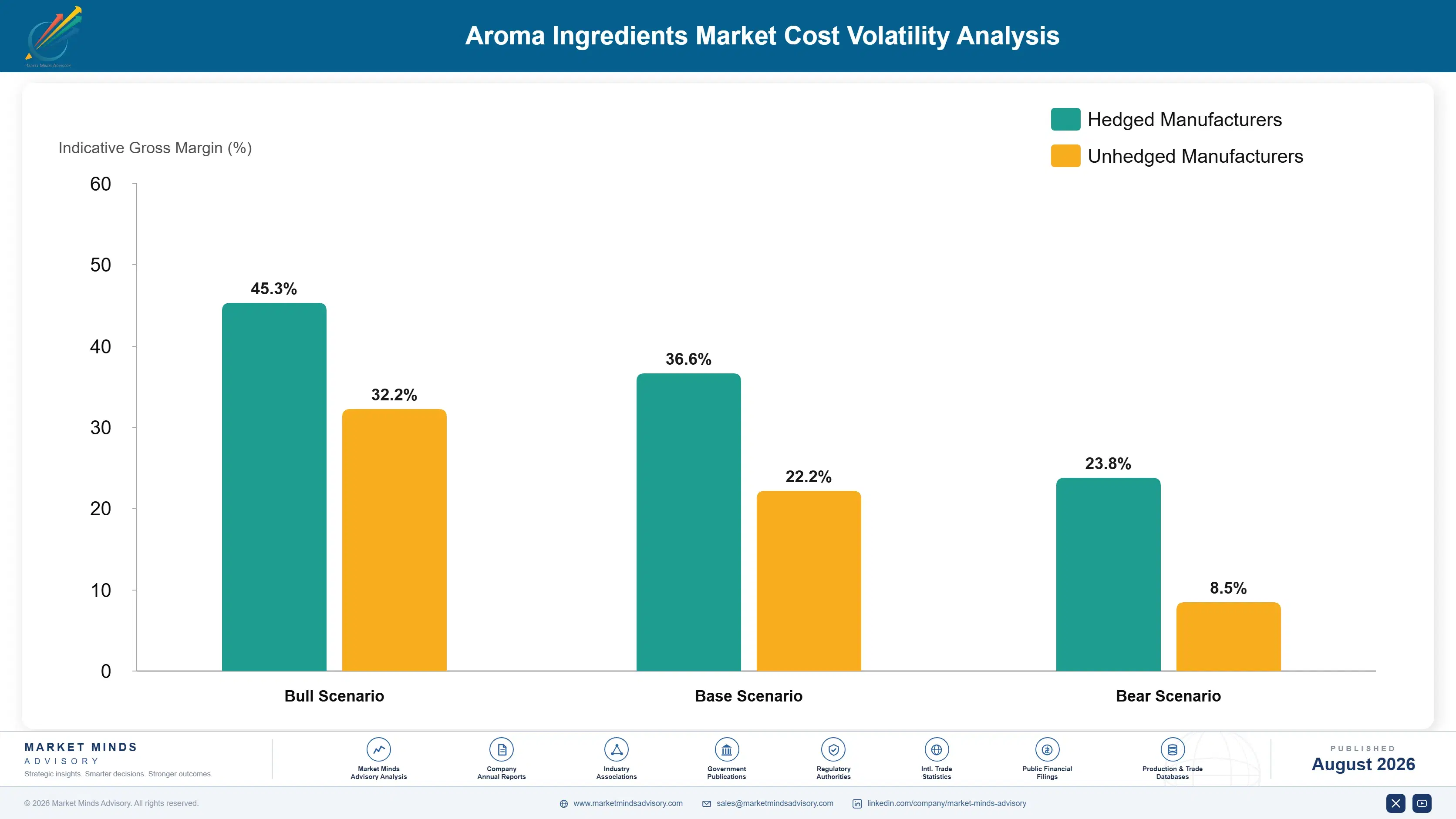
Petrochemical feedstocks such as benzene and toluene derivatives account for roughly 36% of production cost for synthetic-route aroma chemicals, with agricultural feedstock a comparable share for natural-extracted ingredients, making the category exposed to two distinct volatile commodity markets simultaneously. Feedstock supply concentrates in the United States, the European Union, and China, so global commodity cycles drive cost more than any single country's conditions alone.
A sharp rise in crude oil prices through 2024, documented in IEA energy market reports, pushed synthesis-route producers without long-term feedstock contracts to absorb meaningful margin compression within a single fiscal year across several major product lines. Producers holding multi-year petrochemical supply agreements passed through only modest cost increases to customers, while spot-market buyers faced considerably steeper input cost swings through the following several quarters of that same year.

The competitive disadvantage falls hardest on smaller producers relying on a single production route, since they face the same commodity swings as diversified rivals without the scale to hedge across multiple feedstock markets. Exposure also varies by route: fermentation-based producers face less petrochemical exposure but carry their own feedstock risk tied to agricultural sugar and starch inputs, a cost dynamic still new to most producers.
aroma-ingredients-market-cost-volatility-analysis-1787463271915

Long-Term Petrochemical Feedstock Agreements

Locking petrochemical feedstock supply under multi-year contracts with defined pricing formulas shields synthesis-route producers from spot market spikes during crude oil price surges, at the modest cost of somewhat higher average pricing in periods when spot feedstock would otherwise have been considerably cheaper to buy on the open market from independent suppliers not bound by contract.

Multi-Route Production Diversification

Operating petrochemical synthesis, natural extraction, and fermentation routes simultaneously diversifies feedstock risk considerably, since a price shock in one commodity market rarely hits all three routes with equal severity, letting diversified producers shift customer volume toward whichever route remains most cost competitive at any given time during the year without disrupting overall supply continuity.

Fermentation Feedstock Diversification Across Crops

Qualifying multiple sugar and starch feedstock sources, including corn, sugarcane, and cassava, for fermentation-route production reduces exposure to any single agricultural commodity's price cycle, an increasingly important consideration as fermentation-route volume continues to expand rapidly across the wider category and its many end markets worldwide each year, regardless of weather conditions or regional harvest quality.

Portfolio Architecture for Margin Defence

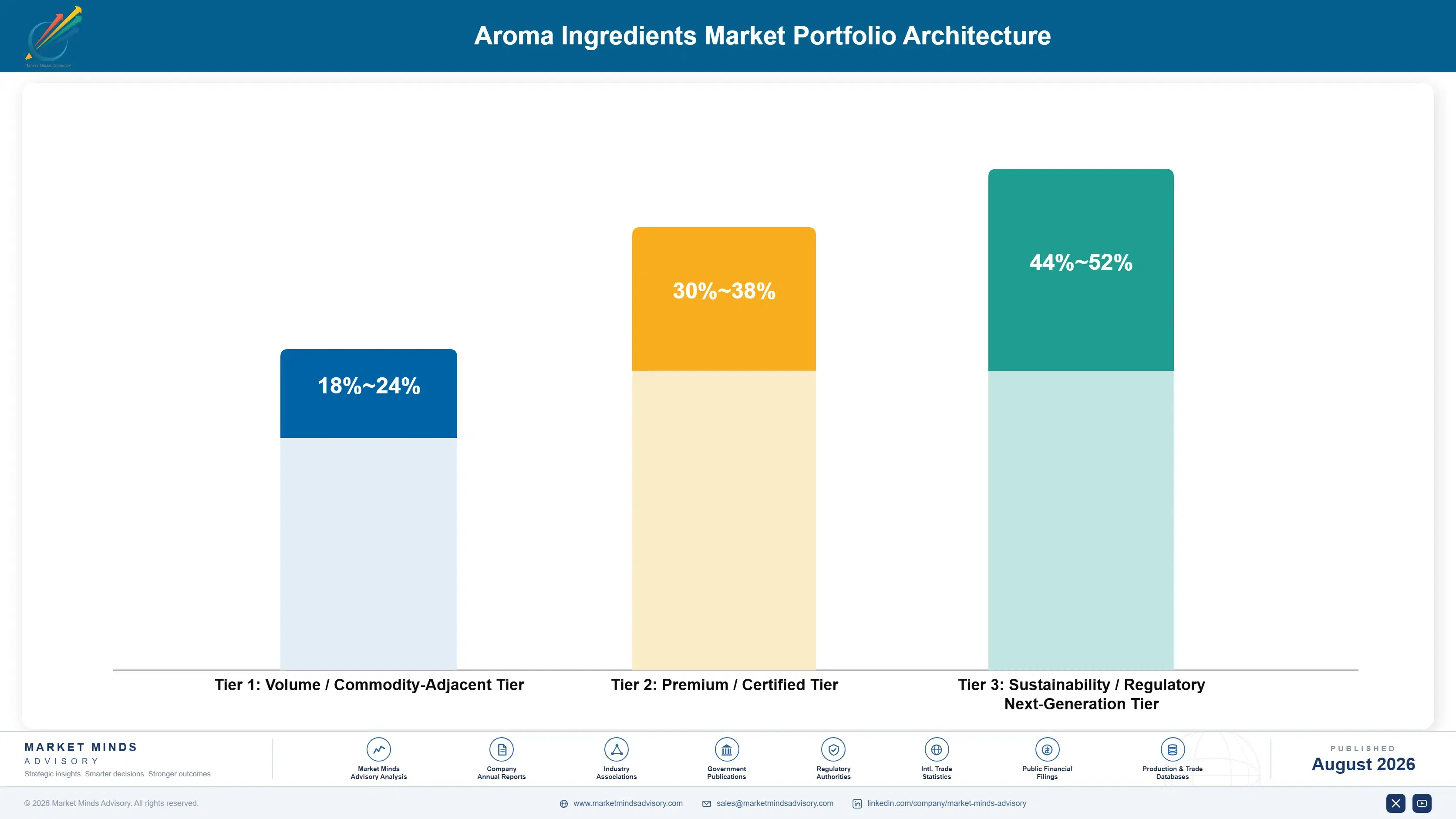
Three tiers separate this market clearly: commodity synthetic aroma chemicals sold mainly on price, certified natural-extracted ingredients carrying a moderate clean-label premium, and fermentation-derived biotech ingredients sold against documented sustainable sourcing for premium formulation across every major consumer category worldwide. Gross margin widens sharply moving from the first tier through the third, roughly tripling along the way across the category as a whole, rewarding early fermentation investment.
Volume still sits predominantly in the commodity synthetic tier, where thin margins reward scale and consistent delivery rather than technical differentiation of any real kind whatsoever across most customer accounts. Premium tiers carry a familiar tension: chasing volume growth in commodity synthesis risks diluting the sustainability reputation that earns fermentation-tier pricing from clean-label and personal care customers who pay specifically for documented, verifiable sourcing rather than price alone.

High-value margin pools concentrate in fermentation-derived biotech ingredients sold to clean-label and personal care formulation customers, while commodity synthetic aroma chemicals remain fundamentally a scale business best suited to producers with the lowest petrochemical feedstock cost position across multiple regions at once, rather than niche regional specialists lacking that scale.

Volume / Commodity-Adjacent Tier

Commodity synthetic aroma chemicals sold into bulk food, beverage, and household product formulation worldwide, priced mainly on feedstock cost and manufacturing scale rather than any sourcing story at all across accounts.
Gross Margin: 18-24%

Premium / Certified Tier

Certified natural-extracted aroma ingredients serving clean-label brands willing to pay a documented sourcing premium over commodity synthetic grade material sold at scale to bulk buyers across every retail channel available.
Gross Margin: 30-38%

Sustainability / Regulatory / Next-Generation Tier

Fermentation-derived biotech aroma chemicals sold against documented sustainable sourcing for clean-label and personal care formulation requiring strict batch-to-batch technical consistency across every single production run each calendar year without fail.
Gross Margin: 44-52%
aroma-ingredients-market-portfolio-architecture-1787463272425

High-value Sub-segments and Strategic Watch-out

Fermentation-Derived Biotech Aroma Chemicals

This segment combines the fastest unit growth in the category with the widest margin, as clean-label and personal care customers pay a real premium for documented fermentation-route sourcing. Producers with precision fermentation capability are best positioned, though expanding capacity requires multi-year strain engineering investment across several distinct molecule families.
Gross Margin: 46-52%

Certified Natural-Extracted Ingredients

Certified natural-extracted ingredients sold to clean-label food and beverage brands deliver strong volume growth and healthy stable margin, rewarding producers who invest in multi-region sourcing diversification over those relying on a single growing region exclusively for their entire supply each and every harvest season without exception.
Gross Margin: 30-38%

Commodity Synthetic Aroma Chemicals

The volume core of the category, sold mainly on price and delivery reliability into bulk food, beverage, and household product manufacturing, where feedstock cost efficiency determines which producer ultimately wins repeat business from large-volume buyers each contract renewal cycle across every major global market served.
Gross Margin: 18-22%

Petrochemical Volatility Limiting Synthetic Margins

Petrochemical feedstock volatility remains a genuine watch-out for commodity synthetic aroma chemical margins specifically, since a sustained crude oil price spike could compress margins faster than fermentation and natural routes can realistically scale to absorb the resulting shift in customer demand across this decade and beyond.
Gross Margin: unproven

How Aroma Ingredient Demand Repeats

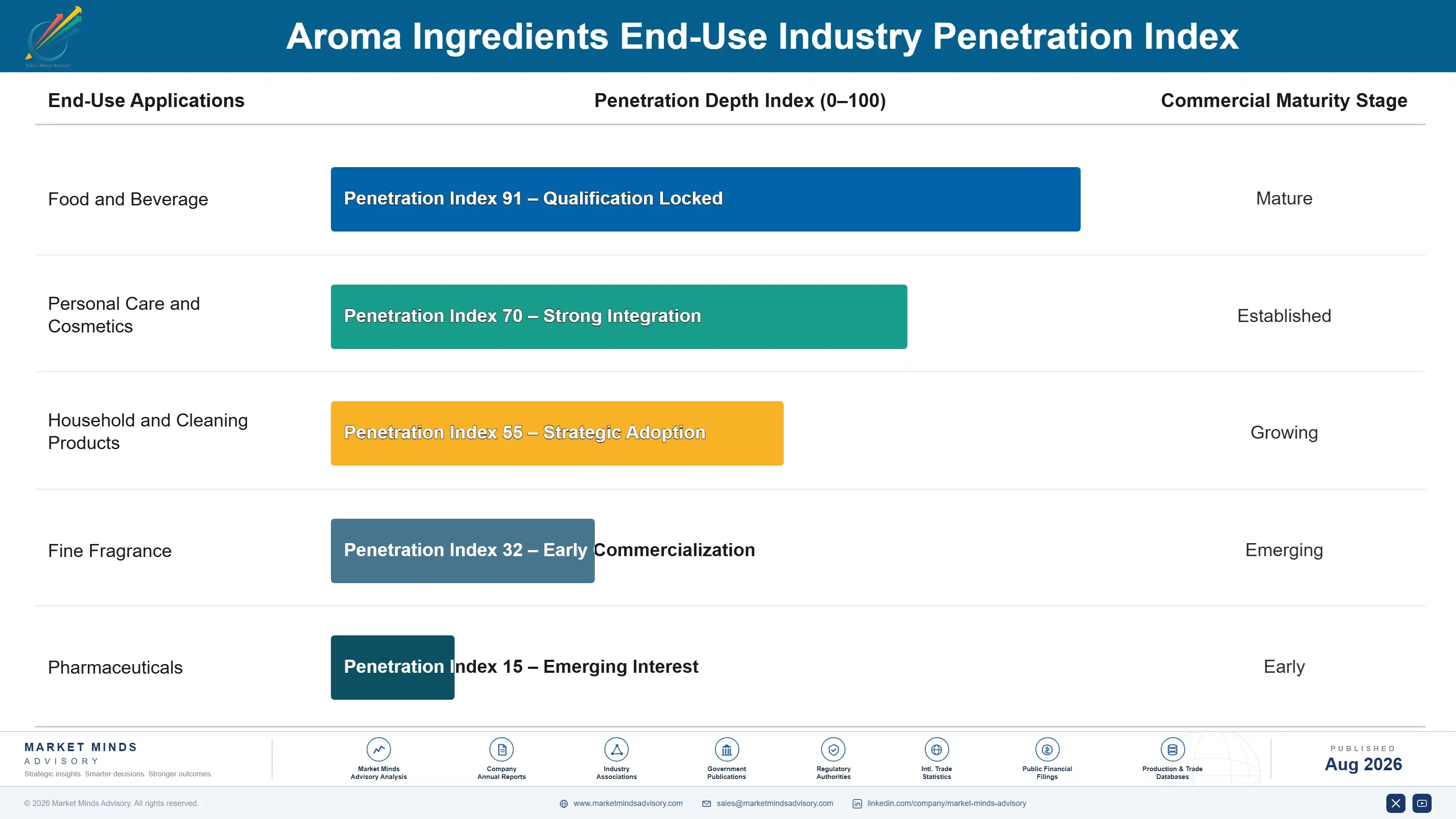
Supply contracts in this category function closer to annuities than one-off purchase orders, since flavor and fragrance formulators rarely re-qualify a new aroma ingredient supplier mid-formulation, given the considerable cost and time required to re-run sensory and stability testing from the start each time a switch is seriously considered by a brand's product development team. Once qualified, a supplier tends to hold that position for several product refresh cycles running.
Adoption runs deepest in fermentation-derived and natural-extracted ingredients, where reformulation is driven by binding clean-label commitments rather than discretionary brand preference, and shallowest in commodity synthetic categories, where price competition can shift share more easily between comparable products at any given time. Personal care sits somewhere in between, adopting selectively depending on the specific product line's sustainability positioning.

A generational shift is visible in formulation behavior itself: younger product development teams at consumer goods companies increasingly treat sustainable sourcing documentation as a default requirement rather than a marketing add-on, changing how new formulation budgets get allocated internally across a company's broader portfolio. This shift is accelerating decision timelines that once took years to fully complete.
aroma-ingredients-market-end-use-penetration-index-1787463272917

Where Aroma Ingredient Bets Should Go

These are among the four positions where our research anticipates prominent divergence between winners and laggards over the coming forecast period. Each is grounded in the demand model, the regulatory perimeter, and the announced capacity pipeline.
01 / FERMENTATION CAPACITY INVESTMENT

Build precision fermentation capability before rivals close the gap

Fermentation-derived aroma chemicals command roughly 45% higher pricing than commodity synthetic grade, yet only a handful of producers currently operate the precision fermentation infrastructure this requires at commercial scale. Buyers increasingly write fermentation-route requirements directly into supply contracts, closing out non-biotech suppliers from the fastest-growing demand segment entirely across every major market this report tracks in careful detail. Producers that build this capability now capture durable pricing power that competitors cannot easily replicate within a normal multi-year capital investment cycle.
02 / NATURAL SOURCING DIVERSIFICATION

Diversify natural ingredient sourcing across multiple growing regions

Natural aroma ingredient supply chains remain exposed to weather-driven harvest variability that synthetic and fermentation routes avoid entirely, and a single poor harvest can eliminate a primary supply source with little notice each season. Producers without multi-region grower relationships remain fully exposed to this risk regardless of how much overall category demand keeps growing across every buyer segment. Diversifying natural ingredient sourcing across multiple growing regions now, even at a modest premium over single-region sourcing, removes the single largest supply risk facing this segment.
03 / CHINA LOCALIZATION STRATEGY

Localize Chinese production capacity ahead of the next demand wave

China's expanding consumer goods manufacturing base has made East Asia the largest buying region for aroma ingredients, and multinational producers who delay localizing production risk ceding further share to domestic Chinese competitors already positioned there directly. Rising middle-class disposable income across the region continues expanding demand for more sophisticated flavor and fragrance profiles well beyond basic formulations required a decade ago. Producers that invest in local Chinese manufacturing capacity now secure durable distribution advantages competitors relying purely on export cannot easily replicate.
04 / PERSONAL CARE CHANNEL GROWTH

Expand personal care formulation expertise to capture new demand

Personal care and household product reformulation toward biotechnology-derived and naturally identical ingredients has expanded well beyond the food and beverage categories where clean-label pressure first emerged, creating a new and rapidly growing demand channel worth hundreds of millions annually. Producers with established biotechnology production capability are capturing this expanding channel fastest, since personal care formulators increasingly specify sustainable sourcing documentation as a purchase requirement rather than an optional claim. Investing in personal care formulation expertise now positions producers ahead of this channel's continued expansion.

Engagement Snapshot From the Field

A live engagement with an industry participant carrying material or product regulatory and market exposure ahead of a defining policy shift, showing how our research translates into a defensible multi-year portfolio strategy.
MARKET MINDS ADVISORY · CLIENT ENGAGEMENT SUMMARY
Aroma Ingredients Producer Strategic Portfolio Review and Transition Roadmap 2026·Investment Scenario on Aroma Ingredients Exposure Evaluation 2025-26
CLIENT PROFILE
The client is a mid-sized beverage flavor house based in the United States generating approximately $210 million in annual revenue (client-reported, unverified by MMA), producing flavor formulations for functional beverage and sparkling water brands sold through retail and foodservice channels across North America. The company had relied on commodity synthetic aroma chemicals for most of its formulation base and faced pressure to reformulate toward natural and fermentation-derived sourcing.
STRATEGIC CHALLENGE
The client needed to reformulate its top three flavor platforms toward fermentation-derived and natural-extracted ingredients within twelve months to meet a major retail customer's clean-label commitment deadline, but its existing supplier relationships offered only commodity synthetic grade ingredients lacking the sustainability documentation the reformulation required for final approval and sign-off.
MMA APPROACH
MMA mapped the fermentation-derived and natural-extracted ingredient supplier landscape, evaluated five producers against sourcing documentation quality, delivered cost, and sensory matching performance, and modeled a phased reformulation timeline balancing supply security against the client's twelve-month retail commitment deadline across all three flavor platforms currently under active internal review by the team.
KEY FINDINGS
  1. The client's existing synthetic ingredient supplier offered no fermentation-derived or natural-extracted alternatives at all for two of its three core flavor platforms.
  2. Two of the five evaluated producers offered fermentation-derived vanillin at cost parity with the client's existing synthetic ingredient pricing across the board.
  3. A dedicated three-year supply contract with a diversified natural and fermentation producer priced only 12% above the client's prior synthetic baseline cost.
  4. Switching suppliers required re-running sensory matching and stability testing, adding roughly six weeks to the original reformulation project timeline overall this year.
CLIENT PROFILE
The client is a mid-sized beverage flavor house based in the United States generating approximately $210 million in annual revenue (client-reported, unverified by MMA), producing flavor formulations for functional beverage and sparkling water brands sold through retail and foodservice channels across North America. The company had relied on commodity synthetic aroma chemicals for most of its formulation base and faced pressure to reformulate toward natural and fermentation-derived sourcing.
STRATEGIC CHALLENGE
The client needed to reformulate its top three flavor platforms toward fermentation-derived and natural-extracted ingredients within twelve months to meet a major retail customer's clean-label commitment deadline, but its existing supplier relationships offered only commodity synthetic grade ingredients lacking the sustainability documentation the reformulation required for final approval and sign-off.
MMA APPROACH
MMA mapped the fermentation-derived and natural-extracted ingredient supplier landscape, evaluated five producers against sourcing documentation quality, delivered cost, and sensory matching performance, and modeled a phased reformulation timeline balancing supply security against the client's twelve-month retail commitment deadline across all three flavor platforms currently under active internal review by the team.
KEY FINDINGS
  1. The client's existing synthetic ingredient supplier offered no fermentation-derived or natural-extracted alternatives at all for two of its three core flavor platforms.
  2. Two of the five evaluated producers offered fermentation-derived vanillin at cost parity with the client's existing synthetic ingredient pricing across the board.
  3. A dedicated three-year supply contract with a diversified natural and fermentation producer priced only 12% above the client's prior synthetic baseline cost.
  4. Switching suppliers required re-running sensory matching and stability testing, adding roughly six weeks to the original reformulation project timeline overall this year.
RECOMMENDED STRATEGY
Phase 1: Phase 1 (Months 1-3): Qualify two fermentation and natural-extracted suppliers in parallel against sensory matching criteria and unit cost closely. Phase 2: Phase 2 (Months 4-7): Negotiate a three-year dedicated supply contract with the selected producer well ahead of the coming peak season. Phase 3: Phase 3 (Months 8-12): Run sensory validation and retailer documentation review while transitioning all three flavor platforms fully onto new supply.
OUTCOME
The client completed its reformulation one month ahead of the retail customer's clean-label deadline across all three flavor platforms, and reported the new supply contract improved ingredient cost predictability by roughly 25% over the following two quarters (client-reported, unverified by MMA), crediting the diversified supply structure directly for the improvement.

Frequently Asked Questions

Foundational context covering the market sizes, CAGR, scope, country, region and competition that inform every finding below. This section is provided to cover basics and most often pre-purchase conversations, answered from the MMA Primary Research Dataset.

What is the current size of the Aroma Ingredients Market?

The global aroma ingredients market is valued at approximately $20.1 billion in 2026. This covers synthesized, extracted, and fermentation-derived compounds used across food, beverage, and personal care formulation.

How large will the Aroma Ingredients Market be by 2036?

MMA projects the market will reach approximately $45.0 billion by 2036. Growth is driven primarily by precision fermentation commercialization and expanding clean-label reformulation demand worldwide.

What is the CAGR for the Aroma Ingredients Market 2026 to 2036?

The market is forecast to grow at a compound annual rate of 8.4% between 2026 and 2036. Bull and bear scenarios range from 9.7% down to 7.1% depending on fermentation adoption and feedstock cost outcomes.

Which segment is growing fastest?

Biotechnology and fermentation-derived aroma chemicals are growing fastest, at roughly 1.73 times the category average rate. Precision fermentation reaching cost parity with petrochemical synthesis is the primary driver.

Who are the major companies in the Aroma Ingredients Market?

Leading companies include Givaudan, International Flavors and Fragrances, dsm-firmenich, Symrise, and Takasago International. Together the top five houses hold roughly 48% of branded formulation revenue.

Which country is growing fastest?

China is the fastest-growing country market, expanding at approximately 9.8% annually. Rapidly expanding food, beverage, and personal care manufacturing are the primary drivers of this growth.

Report Segmentation Architecture

The full report scope spans multiple orthogonal segmentation dimensions, with cross-tabulated demand data provided for each dimension pair. Coverage extends further to regional breakdowns, trend trajectories, and the competitive detail needed to support segment-level decision-making.

By Production Technology

  • Petrochemical-Synthesized Aroma Chemicals
  • Natural-Extracted Aroma Ingredients
  • Biotechnology and Fermentation-Derived Aroma Chemicals
  • Semi-Synthetic Aroma Ingredients
  • Enzymatically-Converted Aroma Ingredients
  • Recycled and Upcycled By-Product Aroma Ingredients

By End-Use Industry

  • Food and Beverage
  • Personal Care and Cosmetics
  • Household and Cleaning Products
  • Fine Fragrance
  • Pharmaceuticals

By Commercial Dimension

  • Direct Formulation Contracts
  • Ingredient Distributors
  • Private Label
  • Business-to-Business Bulk Supply

By Region

  • North America
  • Western Europe
  • East Asia
  • South Asia and Pacific
  • Latin America
  • Middle East and Africa
  • Eastern Europe

Scope, Methodology, and Coverage

Every figure in this report is reproducible from documented input assumptions. The scope below maps the historical period, the forecast horizon, the segmentation dimensions, and the countries covered, alongside the underlying primary and qualitative methodology.
Historical Period
2020 to 2025
Forecast Period
2026 to 2036
Base Year
2025 (USD billions; MMA Primary Research Dataset, August 2026)
Market Definition
The aroma ingredients market covers synthesized, extracted, and fermentation-derived chemical compounds used to create flavor and fragrance profiles across food, beverage, personal care, and household product formulation. It excludes finished flavor and fragrance compounds sold as blended formulations, and excludes essential oils sold for aromatherapy or direct topical retail use.
Quantitative Units
USD billions (current prices); metric tons of finished ingredient
Segmentation Dimensions
By Production Technology; By End-Use Industry; By Commercial Dimension; By Region
Regions Covered
North America, Western Europe, East Asia, South Asia and Pacific, Latin America, Middle East and Africa, Eastern Europe
Countries Covered
USA, China, Germany, France, UK, Japan, South Korea, India, Australia, Canada, Brazil, Mexico, Indonesia, Vietnam, Thailand, Malaysia, UAE, Saudi Arabia, South Africa, Nigeria, Turkey, Poland, Netherlands, Italy, Spain, Sweden, Switzerland, Argentina, Colombia, Singapore, and additional markets relevant to this sector
Key Companies Profiled
Givaudan SA, International Flavors and Fragrances Inc., dsm-firmenich, Symrise AG, Takasago International Corporation, Sensient Technologies Corporation, Robertet SA, T. Hasegawa Co., Ltd., Mane SA, Kerry Group plc, Huabao International Holdings Limited, Ginkgo Bioworks Holdings, Inc., Conagen Inc., Evolva Holding SA, Zhejiang NHU Company Ltd., Fuji Flavor Co., Ltd., Vigon International, Inc., Treatt plc, Ungerer and Company, Solvay S.A.
Quantitative Methodology
Primary survey, n=3,800 respondents, Q4 2025, six countries; demand-side model with trade association cross-validation
Qualitative Methodology
47 expert interviews, Q4 2025; applied to validate demand model assumptions, identify emerging dynamics, and assess competitive positioning
Report Format
PDF and XLSX data workbook (Word format preview document)
Publisher
Market Minds Advisory
Report Code
MMA-2026-CHM-404
Published
August 2026
Contact
sales@marketmindsadvisory.com | www.marketmindsadvisory.com

Purchase the full Aroma Ingredients Market Report (2026 to 2036).

The full report delivers a complete analysis of the aroma ingredients market across all seven regions and six production-technology segments. It includes detailed competitive profiles of twenty producers alongside proprietary MMA survey data drawn from 3,800 respondents and 47 expert interviews conducted during the fourth quarter of 2025. Ten-year forecast models are built under base, bull, and bear scenarios, with full regional share and growth breakdowns included throughout. A standalone section analyzes petrochemical and agricultural feedstock cost exposure and margin architecture across three distinct product tiers. Buyers also receive segment-level CAGR detail extending well beyond the two segments highlighted in this summary.
Full seven-region market sizing and forecast tables
Complete six-segment production technology breakdown detail
Twenty-company competitive profiles and moat analysis
Primary survey data collected across six countries
Petrochemical and agricultural feedstock exposure modeling
Portfolio tier margin benchmarking by segment type

Built For The People Who Decide

From boardroom strategy to bench-side execution, this report is read cover-to-cover by leaders shaping the next decade of their industry, turning demand scenarios, market dynamics and valuation benchmarks into decisions.
CXOs/ Presidents/ VPs/ Managers
M&A and Corporate Development
Strategy Teams and R&D Heads
Procurement and Product Directors
Regulatory and Compliance Leaders
Investor Relations and Equity Analysts