Market Minds Advisory
Armored Vehicle Upgrade and Retrofit Market

Armored Vehicle Upgrade and Retrofit Market: Active Protection Systems Reshape Legacy Fleet Sustainment

Anti-tank drone and guided missile lessons from recent conflicts are pushing militaries toward active protection system retrofits over costly new vehicle procurement, extending decades-old armored platforms well past their originally planned service life.

Lead Analyst

Published

September 2026

Make Smarter Decisions with Customized Research Insights

Request a free sample report and evaluate market opportunities, growth trends, and competitive dynamics relevant to your business needs.

2025 MARKET VALUE$5.8BMarket Size 2025
2036 FORECAST VALUE$11.0BBase Case , 2026 to 2036
CAGR 2026 TO 20366.0 %Bull 7.3% / Bear 4.7%
INCREMENTAL OPPORTUNITY$4.9BNet 10- year value creation
EXPANSION MULTIPLE1.79x2036 value over 2026 base
Strategic Levers
M&A Pipeline
Regional Outlook
Country Rankings
Competitive Intelligence
Segmental Deep-dive
Call-Us : 91 93563 13602

Executive Snapshot and Market Trajectory

Militaries worldwide are choosing to upgrade decades-old armored platforms rather than fund costly new vehicle procurement, with active protection systems becoming the priority retrofit following demonstrated anti-tank drone and guided missile effectiveness in recent conflicts. Militaries increasingly treat this shift as urgent rather than optional.
Active protection systems are growing fastest of six upgrade categories as militaries race to field countermeasures, while electronics and C4ISR upgrade packages follow closely on network-centric warfare digitization demand. The United States concentrates the bulk of upgrade spending given its outsized Abrams, Bradley, and Stryker fleet size. Contractors with combat-proven active protection technology are winning disproportionate share of this accelerating demand. Eastern European defense ministries are separately accelerating similar procurement decisions given regional security pressure.
Five contractors hold roughly fifty-five percent of upgrade revenue, led by General Dynamics Land Systems and Rheinmetall's deep platform sustainment expertise. Poland and other Eastern European militaries are accelerating modernization budgets sharply following heightened regional security concerns, though procurement qualification cycles remain a genuine bottleneck across the industry. Smaller regional contractors without comparable program history struggle to win the largest sustainment contracts, a gap that widens with every qualification cycle completed.
Market Definition
This report covers revenue from upgrade and retrofit systems installed on existing armored military vehicles, spanning add-on armor, active protection systems, electronics and C4ISR packages, powertrain upgrades, turret and weapon system upgrades, and survivability enhancements. It excludes new armored vehicle production, unarmored military transport vehicles, and civilian armored vehicle conversions.
Base Year Value
$5.8B in 2025 (MMA Primary Research Dataset, August 2026)
Forecast Period
2026 to 2036, eleven discrete annual values
CAGR
6.0% base case. Bull 7.3%. Bear 4.7%.
Fastest Growth Segment
Active Protection Systems: 11.0% CAGR
Fastest Growth Country
Poland: 9.0% CAGR
Fastest Growth Region
South Asia and Pacific: 8.0% CAGR
Largest Region
North America: 30% of 2025 global value
Market Leaders
General Dynamics Land Systems, Rheinmetall, BAE Systems, Rafael Advanced Defense Systems, Elbit Systems. Source: MMA Analysis based on company annual reports and defense procurement disclosures.
Primary Survey
n=3,800 procurement and R&D decision-makers, Q4 2025, six countries
Methodology
Demand-side build-up, cross-validated against public data, 47 expert interviews

Armored Vehicle Upgrade and Retrofit Market Forecast Scenarios

armoured-vehicles-upgrade-and-retrofit-market-size-forecast-scenario-1787982195793
Between 2020 and 2025 the armored vehicle upgrade market grew at roughly 5.0 percent annually, driven by steady sustainment budgets while active protection system adoption remained a comparatively smaller share of overall spending ahead of recent battlefield lessons accelerating demand. Contractors used this period building early integration capability ahead of accelerating demand. Sustainment spending stayed resilient throughout.
The base case assumes 6.0 percent annual growth through 2036, anchored in three mechanisms: accelerating active protection system retrofit demand following demonstrated anti-tank drone effectiveness in recent conflicts, budget-constrained militaries favoring upgrade programs over considerably more expensive new vehicle procurement, and Eastern European defense modernization spending surging sharply following heightened regional security concerns. Contractors with established combat-proven active protection technology are best placed to capture this combined growth. Poland's rapid budget expansion alone represents a meaningful share of this growth.
A bull scenario built on faster active protection system fielding and accelerating European defense budgets could push growth toward 7.3 percent. A bear scenario tied to procurement qualification delays and budget constraint in key markets could instead pull growth down toward 4.7 percent. Procurement qualification pace remains a secondary swing factor either way. European budget trajectories could also shift the outcome.

Sustainment Economics and Threat-Driven Retrofit Cycles

The armored vehicle upgrade market sits at a genuine inflection point where battlefield lessons from recent conflicts have compressed years of anticipated active protection system adoption into a considerably shorter procurement window than defense planners expected even three years ago. Few defense markets have compressed a decade of anticipated technology adoption into such a short procurement window before.
TOP-5 CONTRACTOR CONCENTRATION55%Upgrade revenue share held by five largest contractors
US FLEET REVENUE SHARE42%Global upgrade revenue tied to United States fleet programs
ACTIVE PROTECTION SYSTEM ADOPTION26%Fielded vehicles currently equipped with active protection systems
UPGRADE COST RATIO35% of new-buildTypical upgrade cost relative to comparable new vehicle procurement
AVERAGE PLATFORM SERVICE EXTENSION15 yearsTypical service life extension achieved through comprehensive upgrade
EASTERN EUROPE BUDGET GROWTH22%Regional defense modernization spending increase since recent escalation
Upgrading an existing platform typically costs roughly a third of comparable new vehicle procurement while extending service life by fifteen years or more, an economic proposition that grows more attractive as new vehicle programs face lengthening development timelines and rising unit costs across nearly every major defense market. This math becomes especially compelling for finance ministries already stretched across competing personnel and readiness spending priorities.
Two forces will reshape the next decade. Active protection system fielding will keep accelerating as more militaries observe the technology's demonstrated battlefield value directly, while Eastern European defense budgets keep expanding regardless of broader NATO spending trends elsewhere in the alliance. Contractors positioned to serve both established NATO customers and rapidly expanding Eastern European budgets simultaneously carry a genuine competitive advantage overall.
"Nobody wants to admit that a fifty-year-old tank hull with the right electronics and active protection kit can still be relevant, but that is exactly the bet every major army is making right now instead of waiting a decade for the next new platform."
Director, Defense Technology Practice · MMA Automotive and Defense Practice · August 2026

Market Trends

Active Protection Systems Become Standard Fleet Requirement

Demonstrated anti-tank guided missile and loitering munition effectiveness in recent conflicts has fundamentally reshaped how militaries think about armored vehicle survivability, shifting active protection systems from an optional enhancement to a standard fleet requirement across major military powers. The United States Army has accelerated Trophy active protection system integration onto its Abrams tank fleet considerably faster than originally planned procurement timelines suggested, while several European militaries are running parallel integration programs on Leopard and Challenger platforms. This is pulling engineering capacity toward active protection integration, sometimes at the expense of other upgrade categories competing for the same limited contractor bandwidth.
Market Impact: Grows APS orders 11 percent yearly
Network-Centric Warfare Drives C4ISR Digitization Retrofits

Militaries are increasingly retrofitting legacy armored vehicles with modern communications, sensor fusion, and battlefield management electronics to integrate older platforms into network-centric warfare doctrine that assumes real-time data sharing across the entire force structure. This digitization push treats electronics capability as increasingly more important to overall platform relevance than raw armor thickness or gun caliber alone, a genuine shift in how military planners evaluate legacy fleet value. Contractors offering modular electronics packages that integrate across multiple vehicle types without extensive platform-specific customization are winning disproportionate share of this digitization demand specifically.
Market Impact: Saves 65 percent versus new-build cost

Market Opportunities and Growth Drivers

Anti-Tank Threat Proliferation Drives Active Protection Demand

The proliferation of low-cost anti-tank guided missiles and loitering munitions among both state militaries and non-state actors has fundamentally increased the threat armored vehicles face on modern battlefields, making active protection systems that intercept incoming projectiles before impact a genuinely urgent capability gap rather than a future enhancement to consider eventually. Military planners across NATO and allied forces are accelerating procurement timelines considerably faster than typical defense acquisition cycles allow, treating this capability gap as an immediate operational risk rather than a longer-term modernization priority that could wait for the next budget cycle.
Market Impact: Excludes 20 percent of legacy fleet

Budget Constraints Favor Upgrade Over New Procurement

Defense budgets across most major military powers face genuine competing demands across personnel costs, readiness spending, and modernization priorities, making the considerably lower cost of upgrading existing platforms an increasingly attractive alternative to funding entirely new vehicle development and production programs that routinely run over budget and behind schedule. Upgrading an existing platform typically costs roughly a third of comparable new vehicle procurement while extending service life meaningfully, an economic proposition finance ministries increasingly favor over new program starts given persistent cost overrun patterns across recent major vehicle acquisition programs.
Market Impact: Adds 18 months to deployment

Market Restraints and Challenges

Legacy Platform Compatibility Limits Upgrade Scope

Many armored vehicles scheduled for upgrade were designed decades ago using chassis and electrical architecture never intended to support modern active protection systems, sensors, or digital communications equipment, creating genuine engineering constraints on how much capability a retrofit can realistically add without costly structural modification. The root cause is legacy platform design rather than any shortcoming in available upgrade technology itself, since modern systems exist but simply cannot always integrate cleanly onto decades-old hulls. Contractors are mitigating this through modular, open-architecture kits designed to accommodate a wider range of legacy chassis configurations than earlier retrofit systems could support.
Market Impact: Reaches 26 percent fleet adoption

Lengthy Qualification Cycles Slow Deployment Timelines

Defense procurement qualification processes typically require extensive testing and certification before a new upgrade system can be fielded at scale, a timeline that sits awkwardly against the urgency militaries increasingly feel given rapidly evolving battlefield threats observed in recent conflicts. The root cause is the genuine reliability and safety requirement of military hardware rather than excessive bureaucratic caution that could simply be relaxed without consequence. Contractors are mitigating this through phased, spiral development approaches that field partial capability improvements incrementally rather than waiting for a single comprehensive upgrade package to complete full qualification testing.
Market Impact: Affects 38 percent of fleet upgrades
3 additional market trends, 4 additional growth drivers, and 3 additional restraints and challenges are covered in the full report. Contact sales@marketmindsadvisory.com to access the complete intelligence.

Segment CAGR and Growth Architecture

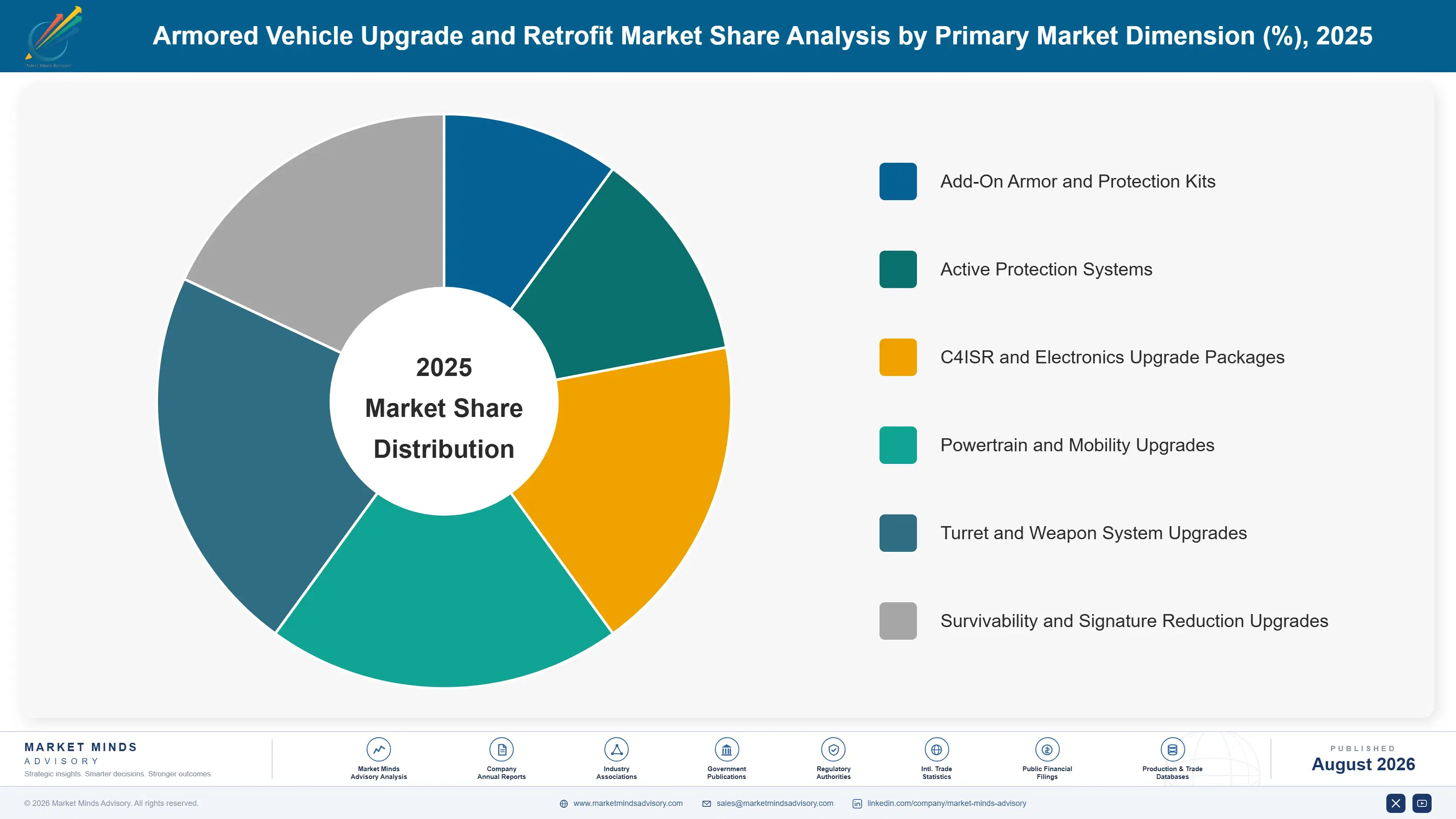
Segmentation follows upgrade category, the dimension militaries and contractors use to plan sustainment budgets and qualification programs. Six categories cover the market: armor kits, active protection, C4ISR electronics, powertrain, turret and weapons, and survivability enhancements. This mirrors how defense procurement offices themselves structure sustainment budget line items. Regulators and defense auditors reference this same breakdown when assessing readiness.
armoured-vehicles-upgrade-and-retrofit-market-market-share-analysis-1787982196325

Active Protection Systems

Active protection systems are growing fastest because demonstrated anti-tank guided missile and loitering munition effectiveness in recent conflicts has fundamentally reshaped how militaries evaluate armored vehicle survivability, shifting this capability from an optional enhancement to a standard fleet requirement across major military powers within just a few years. The United States Army has accelerated Trophy active protection system integration onto its Abrams fleet considerably faster than originally planned procurement timelines, while several European militaries run parallel integration programs on Leopard and Challenger platforms. Rafael Advanced Defense Systems and Elbit Systems, the two leading active protection system developers, are winning disproportionate share of this rapidly expanding segment given their established combat-proven track record and existing production capacity to scale delivery quickly.
CAGR 11.0%

C4ISR and Electronics Upgrade Packages

C4ISR and electronics upgrade packages are the second-fastest segment as militaries increasingly retrofit legacy platforms with modern communications, sensor fusion, and battlefield management systems to integrate older vehicles into network-centric warfare doctrine assuming real-time data sharing across the entire force structure. This digitization push treats electronics capability as increasingly important to overall platform relevance, a genuine shift from historical emphasis on raw armor thickness or gun caliber alone. Contractors offering modular electronics packages that integrate across multiple vehicle types without extensive platform-specific customization are winning disproportionate share of this digitization demand, since militaries increasingly prefer standardized systems across their diverse legacy fleet mix. Militaries increasingly treat electronics upgrades as a joint-operations prerequisite rather than an optional enhancement.
CAGR 8.5%
Full segment breakdown across 6 segments available in the complete report.

Regional Architecture and Country Demand Map

North America leads on the United States Army's outsized Abrams, Bradley, and Stryker fleet size and sustainment budget. Western Europe and East Asia follow on major platform upgrade programs, while South Asia and Pacific posts the fastest regional growth as legacy fleet modernization accelerates. Threat perception varies considerably by region.

North America

The United States Army operates the world's largest fleet of Abrams tanks, Bradley fighting vehicles, and Stryker combat vehicles, anchoring sustained upgrade demand that dwarfs comparable programs anywhere else in the world by sheer fleet scale alone. General Dynamics Land Systems and BAE Systems hold deep, decades-long sustainment relationships with the Army specifically, giving them privileged access to recurring upgrade contract cycles that competitors without comparable program history struggle to break into regardless of technical capability. Active protection system integration onto the Abrams fleet represents a particularly large near-term revenue driver, as the Army accelerates Trophy system fielding considerably faster than originally planned timelines suggested given battlefield lessons observed elsewhere. Canadian forces fund smaller upgrade programs separately.
Share: 30% | CAGR: 6.5% (2026 to 2036)

Western Europe

Germany, the United Kingdom, and France each maintain substantial domestic upgrade programs for their Leopard, Challenger, and Leclerc tank fleets respectively, supported by Rheinmetall, BAE Systems, and KNDS as the primary sustainment contractors across these national programs. NATO interoperability requirements increasingly push European militaries toward standardized electronics and communications upgrades that work consistently across allied platforms during joint operations, a genuine coordination challenge given the diversity of legacy vehicle types across the alliance. Regional growth trails North America and East Asia somewhat since European defense budgets, while expanding, still lag the scale of United States sustainment spending considerably despite recent increases across most NATO member states. France's Leclerc program remains smaller but follows similar logic prioritizing electronics.
Share: 24% | CAGR: 4.5% (2026 to 2036)
Regional intelligence for 5 additional markets available in the complete report: East Asia, South Asia and Pacific, Latin America, Middle East and Africa, Eastern Europe. Contact sales@marketmindsadvisory.com.
armoured-vehicles-upgrade-and-retrofit-market-country-cagr-analysis-1787982196873

Where Contractors Can Capture Sustainment Growth

Four levers stand out for contractors navigating a market shifting rapidly toward active protection systems and network-centric electronics. Each trades traditional platform-specific customization for either faster fielding, modular scalability, or export market access competitors cannot easily match. Each requires different capabilities, but all four are available to contractors already operating profitably today. Two are already available to most established suppliers.

Prioritize Active Protection System Integration Contracts

Active protection systems already reach 26 percent fleet adoption and are growing considerably faster than any other upgrade category as militaries treat this capability as an urgent operational requirement rather than a future enhancement to consider eventually. Contractors that prioritize active protection integration work over slower-moving upgrade categories can capture disproportionate share of near-term budget allocation, since military planners are accelerating procurement timelines considerably faster than typical defense acquisition cycles allow. This does require genuine combat-proven system credibility that newer entrants without established track records struggle to demonstrate convincingly to risk-averse military procurement officials.
Market Impact: Captures a full 26 percent of fleet share

Develop Modular Open-Architecture Upgrade Kits Now

Legacy platform compatibility constraints exclude roughly 20 percent of the fleet from standard upgrade packages, but contractors offering modular, open-architecture systems designed to accommodate a wider range of legacy chassis configurations can access this considerably larger addressable base than competitors requiring extensive platform-specific customization for each vehicle type. This approach also shortens qualification timelines meaningfully since core system components have already been tested and certified, letting contractors field capability faster across diverse fleet types than fully custom integration work would allow. Contractors that build this capability now are positioning themselves ahead of the next major fleet replacement cycle.
Market Impact: Reaches a full 20 percent of excluded fleet

Pursue Eastern European Modernization Contracts Now

Eastern European defense budgets have grown roughly 22 percent since recent regional security escalation, creating genuine near-term contract opportunity for contractors positioned to serve Poland and Baltic state modernization programs specifically. This market rewards contractors who can deliver quickly given the urgency driving these procurement decisions, favoring established suppliers with existing production capacity over those requiring significant capacity expansion before delivery can begin. Contractors that establish early relationships here position themselves for follow-on contracts as regional defense spending continues its current trajectory. Contractors that establish credibility early tend to retain preferred-supplier status through subsequent budget cycles.
Market Impact: Captures a full 22 percent of budget growth

Build Standardized C4ISR Packages Across Platform Types

C4ISR and electronics upgrades affect 38 percent of fleet upgrade programs, and contractors offering standardized packages that integrate across multiple vehicle types without extensive platform-specific customization can win disproportionate share as militaries increasingly prefer consistent systems across their diverse legacy fleet mix. This standardization also creates recurring software update and support revenue beyond the initial hardware installation, a considerably more durable revenue stream than one-time platform-specific integration contracts alone typically provide. This standardization strategy also reduces long-term support cost for the militaries adopting it. Militaries increasingly favor suppliers who can demonstrate this standardization credibly.
Market Impact: Affects a full 38 percent of all programs

Who Controls the Margin Pool

Five contractors hold roughly fifty-five percent of upgrade revenue, a moderate concentration level reflecting how much decades-long sustainment relationships with specific military customers matter alongside genuine technical capability. General Dynamics Land Systems and Rheinmetall lead on established platform sustainment expertise, with a meaningful gap separating them from smaller regional contractors lacking comparable program history. No single contractor dominates across every regional and platform category simultaneously.
Current competitive activity centers on three fronts: active protection system integration contract competition as militaries accelerate fielding timelines, modular electronics package development aimed at standardizing upgrades across diverse legacy fleet types, and Eastern European modernization contract pursuit as regional defense budgets expand rapidly. Several contractors are also investing in dedicated Eastern European sales and support presence separate from established Western programs.

Emerging pressure comes from Rafael Advanced Defense Systems and Elbit Systems, whose combat-proven active protection system expertise is winning integration contracts that traditional platform manufacturers without comparable specialized capability must now partner to access. Rankings could shift meaningfully as active protection system demand eventually rivals traditional armor and electronics upgrade spending, since manufacturers currently under-invested in this specialized capability may find themselves dependent on partnership arrangements rather than capturing full contract value independently.
armoured-vehicles-upgrade-and-retrofit-market-company-positioning-matrix-1787982197399

Competitive Moat and Risk Dimensions

GENERAL DYNAMICS LAND SYSTEMS

Moat: Deep US Army Sustainment History

General Dynamics Land Systems' decades-long sustainment relationship with the United States Army across the Abrams and Stryker fleets gives it privileged access to recurring upgrade contract cycles that competitors without comparable program history struggle to break into regardless of technical capability or competitive pricing they might otherwise offer.
GENERAL DYNAMICS LAND SYSTEMS

Risk: Limited Active Protection Expertise

General Dynamics Land Systems must partner with specialized active protection system developers like Rafael for the fastest-growing upgrade category, meaning it captures less contract value on this segment than fully vertically integrated competitors who developed comparable capability in-house. This gap could widen further as active protection systems capture a growing share of total upgrade spending.
RHEINMETALL

Moat: European Platform Sustainment Depth

Rheinmetall's deep sustainment relationships across Leopard and other European platforms, combined with growing Eastern European modernization contracts, position it to capture disproportionate share of the region's rapidly expanding defense budgets relative to competitors lacking comparable established European program presence. This positioning is becoming increasingly valuable as the region's defense budgets keep expanding rapidly.
RHEINMETALL

Risk: Manufacturing Capacity Constraints

Rheinmetall faces genuine capacity constraints meeting surging Eastern European demand simultaneously with existing sustainment commitments, potentially forcing difficult prioritization decisions between established customers and new, faster-growing contract opportunities. Failing to resolve this constraint overall could mean ceding meaningful share to competitors with more available capacity.

Players Tracked

Prominent Players

General Dynamics Land Systems
Rheinmetall
BAE Systems
Rafael Advanced Defense Systems
Elbit Systems

Other Key Players

Leonardo DRS
Oshkosh Defense
Iveco Defence Vehicles
KNDS
Patria
FNSS Defence Systems
Hanwha Defense
Israel Aerospace Industries
Textron Systems
Thales Group
Saab
Kongsberg Defence and Aerospace
Aselsan
Otokar
Denel Land Systems

Recent Developments

MARCH 2025

Rheinmetall Wins Major Leopard 2 Upgrade Contract

Rheinmetall secured a major contract to upgrade a European military's Leopard 2 tank fleet with modern electronics and active protection system integration, covering several hundred vehicles across a multi-year delivery schedule. The contract also includes long-term parts support and software update commitments extending over a decade.
Signal: Confirms that European militaries are increasingly accelerating comprehensive platform upgrades rather than pursuing piecemeal modernization approaches.
SEPTEMBER 2024

Rafael and General Dynamics Expand Trophy Integration

Rafael Advanced Defense Systems and General Dynamics Land Systems announced expanded integration of the Trophy active protection system across additional United States Army Abrams tank battalions, accelerating the fleet-wide fielding timeline. The expansion follows successful initial fielding results reported by Army test evaluation teams last year.
Signal: Shows that active protection system fielding continues accelerating well beyond the originally planned procurement timelines significantly.
JUNE 2025

General Dynamics Delivers Bradley A4 Upgrade Batch

General Dynamics Land Systems delivered a completed batch of upgraded Bradley A4 fighting vehicles to the United States Army, incorporating modernized electronics, powertrain, and survivability enhancements across the delivered fleet. The delivery represents a meaningful milestone within the Army's broader, ongoing multi-year Bradley modernization program overall.
Signal: Confirms that sustained United States Army investment in comprehensive Bradley fleet modernization continues on schedule reliably.

Armor, Electronics, and Integration Cost Pressures

Composite armor materials, active protection system hardware, and electronics components together represent the largest cost-to-serve components for upgrade contractors, running roughly fifty-two to fifty-seven percent of total upgrade cost, with integration labor and qualification testing adding a further eighteen percent on top. Nearly all specialized composite armor materials originate from a concentrated group of suppliers in the United States, Germany, and Israel.
Global supply chain tightness for specialized microelectronics during 2022 and 2023 pushed component costs and lead times higher across the defense industry, a constraint Rheinmetall's 2024 Annual Report specifically cited as a factor affecting delivery schedules for several European upgrade programs. Contractors with diversified supplier relationships navigated this period considerably more comfortably than those dependent on single-source components. Contractors with existing long-term supplier agreements recovered from this constraint more quickly than single-source competitors.

Smaller regional contractors face proportionally heavier exposure to this cost pressure because they lack the purchasing volume and long-term supplier contracts that General Dynamics, Rheinmetall, and BAE Systems can secure more easily through global procurement scale. Regional specialists without comparable purchasing power are consequently paying meaningfully higher per-unit component costs, compressing margin on price-sensitive export contracts specifically.
armoured-vehicles-upgrade-and-retrofit-market-cost-volatility-analysis-1787982197596

Diversify Composite Armor and Electronics Suppliers

Establishing relationships with multiple armor material and electronics component suppliers rather than concentrating with a single vendor reduces exposure to shortages and pricing spikes, letting contractors shift orders when any single supplier faces capacity constraints during demand surges. Contractors maintaining at least three active supplier relationships typically weather shortages more comfortably. This flexibility matters most during acute component shortages.

Pursue Joint Development Agreements With Component Makers

Partnering directly with specialized armor and electronics manufacturers on custom component development gives contractors earlier access to next-generation materials and more favorable pricing than purchasing standard components through conventional defense supply channels. Several smaller contractors have pursued exactly this kind of partnership successfully in recent years. Both parties typically benefit meaningfully from this kind of arrangement over time.

Standardize Modular Kits Across Platform Families

Designing upgrade kits that work across multiple platform families rather than customizing extensively for each vehicle type reduces per-unit engineering cost and lets contractors achieve meaningful purchasing scale faster across a broader program base. This approach also shortens overall qualification and testing timelines meaningfully across every program. Suppliers pursuing this approach report meaningfully faster delivery timelines overall.

Portfolio Architecture for Margin Defence

Upgrade contractors architect their offering across three tiers that trade integration complexity for margin in fairly predictable steps. Standard armor and powertrain upgrades anchor the volume tier at thin margin, electronics and C4ISR packages occupy a premium middle tier, and active protection systems sit at the top as the smallest but fastest-expanding category. No single tier alone determines a contractor's overall profitability across its full program portfolio.
The tension between volume and premium tiers reflects genuine technical difficulty rather than positioning alone: standard armor upgrades require comparatively conventional engineering and generate steady but thin-margin revenue, while active protection systems require considerably deeper sensor fusion and interceptor engineering that only the most capable contractors can deliver, which is why margin concentrates so heavily at the top of this hierarchy. This dynamic mirrors how technology companies price entry-level versus enterprise-grade offerings generally.

The highest-value pools concentrate in active protection system integration and standardized C4ISR packages, both benefiting from genuine technical and relationship barriers that smaller, less capitalized contractors cannot easily replicate without years of dedicated engineering and combat-proven qualification investment. Contractors lacking either specialty risk drifting toward the thin-margin volume tier by default.

Volume / Commodity-Adjacent Tier

Standard armor kit and powertrain upgrades requiring comparatively conventional engineering, sold widely across legacy fleet sustainment programs with limited specialization needs. Most legacy fleet sustainment programs operate primarily within this entry-level tier today.
Gross Margin: 13-16%

Premium / Certified Tier

Electronics and C4ISR upgrade packages requiring deeper systems integration and network compatibility expertise than standard mechanical upgrades demand, sold mainly to digitization-focused programs. This tier attracts steady demand from digitization-focused NATO interoperability programs.
Gross Margin: 23-26%

Sustainability / Regulatory / Next-Generation Tier

Active protection systems built on years of combat-proven sensor fusion and interceptor engineering that smaller, less capitalized contractors cannot quickly replicate. Only a handful of contractors worldwide currently operate confidently within this top tier.
Gross Margin: 29-32%
armoured-vehicles-upgrade-and-retrofit-market-portfolio-architecture-1787982198098

High-value Sub-segments and Strategic Watch-out

Active Protection Systems

Fastest-growing and highest-margin pool in the portfolio, driven by urgent battlefield survivability demand, with margin concentrated among the handful of contractors holding combat-proven interceptor technology. Suppliers here also benefit from urgent procurement timelines that traditional acquisition cycles will not accommodate. Growth here should stay strong for years.
Gross Margin: 29-32%

C4ISR and Electronics Upgrade Packages

High-value segment growing steadily on network-centric warfare digitization demand, with margin concentrated among contractors offering standardized packages across diverse legacy platform types. These contractors are winning disproportionate share of fast-growing joint-interoperability demand specifically. Regulatory approval also moves faster given established interoperability standards across the alliance.
Gross Margin: 23-26%

Armor and Powertrain Upgrades

Largest volume core segment by installed base, serving legacy fleet sustainment broadly, with margin staying thin due to competitive standardized pricing pressure across nearly every established contractor. Contractors here increasingly compete on delivery speed and total lifecycle support cost. Pricing pressure here shows no sign of easing anytime soon.
Gross Margin: 13-16%

Eastern European Modernization Contracts

Strategic watch-out tied closely to regional security conditions, where a stabilization of current tensions could compress the rapid budget growth driving contractors' recent capacity expansion decisions specifically. A stabilization of regional tensions could meaningfully compress this segment's near-term growth trajectory. Contractors dependent on this surge face the most exposure.
Gross Margin: 19-22%

Sustainment Cycles and Fleet-Wide Depth

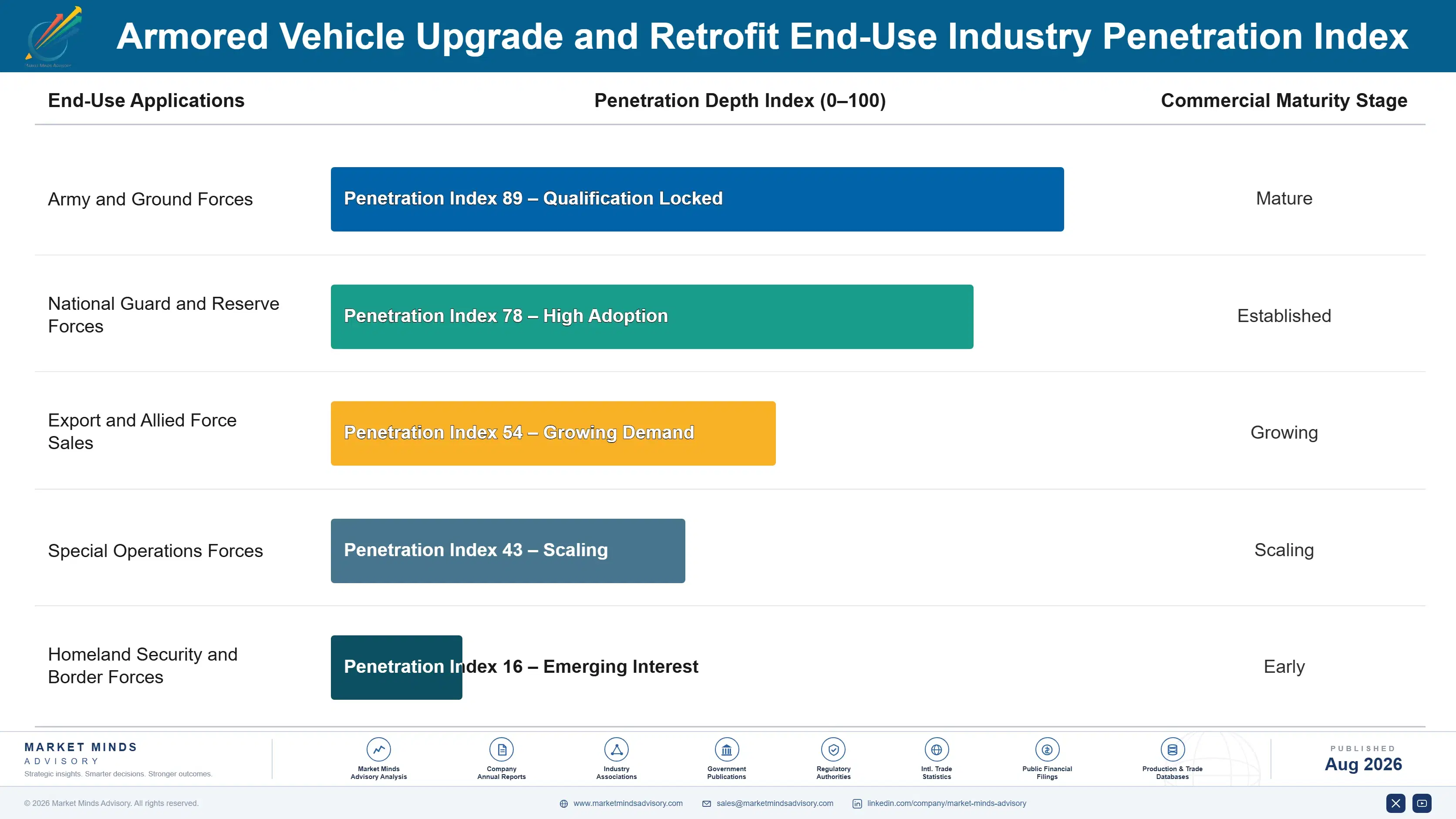
Armored vehicle upgrade demand runs on long, program-driven cycles rather than steady annuity revenue: fleet-wide modernization programs involve multi-year integration schedules followed by decades of parts support and software update revenue, while smaller electronics retrofits generate faster but more limited recurring maintenance relationships once installed. This lumpiness makes revenue forecasting genuinely harder than for comparable recurring-revenue defense businesses.
Adoption depth varies sharply by vertical. United States and allied NATO forces sit at the deepest end given decades of accumulated sustainment relationships and available budget, while smaller regional militaries remain earlier in their adoption curve, with many still evaluating whether active protection system investment justifies the cost given their comparatively smaller fleet size. Bridging both ends well is what separates the strongest contractors from everyone else in this market.

A generational shift is underway as newer military planners increasingly expect active protection and networked electronics as standard fleet requirements rather than optional enhancements, in contrast to veteran defense officials trained during an era when armor thickness alone defined platform survivability. Contractors slow to build credibility with this newer generation risk losing relevance over the coming decade.
armoured-vehicles-upgrade-and-retrofit-market-end-use-penetration-index-1787982198587

Where Upgrade Contractors Should Focus

These are among the four positions where our research anticipates prominent divergence between winners and laggards over the coming forecast period. Each is grounded in the demand model, the regulatory perimeter, and the announced capacity pipeline.
01 / ACTIVE PROTECTION PRIORITY

Prioritize active protection integration ahead of slower upgrade categories

Active protection systems already reach twenty-six percent fleet adoption and are growing considerably faster than any other upgrade category as militaries treat this capability as urgent rather than optional. Contractors that prioritize this work over slower-moving upgrade categories capture disproportionate share of near-term budget allocation, since procurement timelines are accelerating well beyond typical defense acquisition cycles. Contractors that delay building combat-proven credibility here, treating active protection as a secondary priority rather than a core capability investment, risk permanent exclusion from this fast-growing segment entirely.
02 / MODULAR ARCHITECTURE INVESTMENT

Build open-architecture kits to access legacy-constrained fleet segments

Legacy platform compatibility constraints exclude roughly twenty percent of the fleet from standard upgrade packages, but contractors offering modular, open-architecture systems designed for diverse chassis configurations can access this considerably larger addressable base. This approach also shortens qualification timelines meaningfully since core components are already tested and certified. Contractors that skip this investment, continuing to rely on fully custom integration for every platform variant, risk losing share to competitors capable of serving a considerably broader range of legacy platforms at meaningfully lower engineering cost per contract.
03 / EASTERN EUROPEAN EXPANSION

Establish early relationships in Eastern European modernization programs

Eastern European defense budgets have grown roughly twenty-two percent since recent regional security escalation, creating genuine near-term contract opportunity for contractors positioned to serve Poland and Baltic state programs specifically. This market rewards contractors who can deliver quickly given the urgency driving procurement decisions, favoring established suppliers over those requiring capacity expansion. Contractors that establish early relationships, rather than waiting for procurement processes to mature further, position themselves for meaningful follow-on contracts as the region's spending trajectory continues its current pace well into the coming decade.
04 / C4ISR STANDARDIZATION STRATEGY

Develop standardized electronics packages across diverse legacy platforms

C4ISR and electronics upgrades affect thirty-eight percent of fleet upgrade programs, and contractors offering standardized packages that integrate across multiple vehicle types without extensive customization can win disproportionate share as militaries increasingly prefer consistent systems. This standardization also creates recurring software support revenue beyond the initial installation. Contractors relying only on custom integration work, treating each platform as an isolated engineering problem rather than part of a broader standardized product line, forgo this considerably more durable, recurring revenue stream entirely.

Engagement Snapshot From the Field

A live engagement with an industry participant carrying material or product regulatory and market exposure ahead of a defining policy shift, showing how our research translates into a defensible multi-year portfolio strategy.
MARKET MINDS ADVISORY · CLIENT ENGAGEMENT SUMMARY
Armored Vehicle Upgrade and Retrofit Producer Strategic Portfolio Review and Transition Roadmap 2026·Investment Scenario on Armored Vehicle Upgrade and Retrofit Exposure Evaluation 2025-26
CLIENT PROFILE
The client is a mid-sized European defense ministry operating a fleet of several hundred aging main battle tanks facing an urgent modernization decision following heightened regional security concerns. Annual defense procurement budget was approximately 1.8 billion dollars (client-reported, unverified by MMA) at engagement start. The client sought an independent assessment of upgrade versus new procurement options.
STRATEGIC CHALLENGE
The ministry faced pressure to modernize its fleet quickly given regional security concerns, but leadership was uncertain whether upgrading the existing tank fleet with active protection systems and modern electronics could deliver adequate capability within budget, or whether new vehicle procurement was ultimately unavoidable despite the considerably higher cost and longer delivery timeline involved.
MMA APPROACH
MMA benchmarked the client's existing fleet condition against comparable upgrade programs completed by allied militaries, modeled capability and cost tradeoffs between comprehensive upgrade and new procurement across a ten-year horizon, and assessed contractor capacity to deliver within the client's required timeline. The engagement combined this technical assessment with structured interviews across the ministry's operational and procurement staff.
KEY FINDINGS
  1. A comprehensive upgrade package would deliver roughly 80 percent of new-platform capability at approximately 35 percent of the cost (client-reported, unverified by MMA).
  2. Contractor capacity constraints meant a full fleet upgrade would take longer than the ministry's originally desired delivery timeline. This finding shifted the ministry's internal planning assumptions meaningfully.
  3. A phased upgrade approach prioritizing active protection systems first could deliver meaningful capability improvement considerably faster than a comprehensive package. This phased approach also spread capital expenditure across multiple budget cycles.
  4. New vehicle procurement would not meaningfully outperform the upgraded fleet for at least another decade given current new-platform development timelines. This finding gave the ministry considerably more confidence in the upgrade path.
CLIENT PROFILE
The client is a mid-sized European defense ministry operating a fleet of several hundred aging main battle tanks facing an urgent modernization decision following heightened regional security concerns. Annual defense procurement budget was approximately 1.8 billion dollars (client-reported, unverified by MMA) at engagement start. The client sought an independent assessment of upgrade versus new procurement options.
STRATEGIC CHALLENGE
The ministry faced pressure to modernize its fleet quickly given regional security concerns, but leadership was uncertain whether upgrading the existing tank fleet with active protection systems and modern electronics could deliver adequate capability within budget, or whether new vehicle procurement was ultimately unavoidable despite the considerably higher cost and longer delivery timeline involved.
MMA APPROACH
MMA benchmarked the client's existing fleet condition against comparable upgrade programs completed by allied militaries, modeled capability and cost tradeoffs between comprehensive upgrade and new procurement across a ten-year horizon, and assessed contractor capacity to deliver within the client's required timeline. The engagement combined this technical assessment with structured interviews across the ministry's operational and procurement staff.
KEY FINDINGS
  1. A comprehensive upgrade package would deliver roughly 80 percent of new-platform capability at approximately 35 percent of the cost (client-reported, unverified by MMA).
  2. Contractor capacity constraints meant a full fleet upgrade would take longer than the ministry's originally desired delivery timeline. This finding shifted the ministry's internal planning assumptions meaningfully.
  3. A phased upgrade approach prioritizing active protection systems first could deliver meaningful capability improvement considerably faster than a comprehensive package. This phased approach also spread capital expenditure across multiple budget cycles.
  4. New vehicle procurement would not meaningfully outperform the upgraded fleet for at least another decade given current new-platform development timelines. This finding gave the ministry considerably more confidence in the upgrade path.
RECOMMENDED STRATEGY
Phase 1: Phase 1 (Months 1 to 6): Prioritize active protection system integration across the highest-readiness fleet segment while finalizing contractor selection. Phase 2: Phase 2 (Months 7 to 18): Complete electronics and C4ISR modernization across the remaining fleet, prioritizing the highest-readiness units first. Phase 3: Phase 3 (Months 19 to 30): Finalize powertrain and survivability upgrades while documenting lessons learned throughout the entire modernization program.
OUTCOME
Within thirty months, the client completed active protection system integration across its highest-readiness fleet segment and deferred new vehicle procurement by at least a decade (client-reported, unverified by MMA). The ministry's phased approach has since informed modernization planning at two allied defense ministries facing comparable fleet decisions.

Frequently Asked Questions

Foundational context covering the market sizes, CAGR, scope, country, region and competition that inform every finding below. This section is provided to cover basics and most often pre-purchase conversations, answered from the MMA Primary Research Dataset.

What is the current size of the Armored Vehicle Upgrade and Retrofit Market?

The market generated approximately 5.8 billion dollars in revenue in 2025, with sustainment spending staying resilient throughout recent budget cycles. Growth is steady, reflecting militaries favoring upgrade programs over costly new procurement.

How large will the Armored Vehicle Upgrade and Retrofit Market be by 2036?

MMA projects the market will reach approximately 11.0 billion dollars by 2036, nearly doubling upgrade revenue over the decade as growth compounds gradually with active protection adoption.

What is the CAGR for the Armored Vehicle Upgrade and Retrofit Market 2026 to 2036?

The base-case compound annual growth rate is 6.0 percent. Bull and bear scenarios range from 4.7 to 7.3 percent depending on procurement qualification pace and defense budget trends.

Which segment is growing fastest?

Active protection systems lead at an 11.0 percent CAGR, driven by demonstrated anti-tank drone and missile effectiveness in recent conflicts. C4ISR and electronics packages follow at 8.5 percent.

Who are the major companies in the Armored Vehicle Upgrade and Retrofit Market?

General Dynamics Land Systems, Rheinmetall, BAE Systems, Rafael Advanced Defense Systems, and Elbit Systems lead the market. Together these five hold roughly fifty-five percent of upgrade revenue.

Which country is growing fastest?

Poland leads at a 9.0 percent CAGR given its dramatically accelerated defense modernization spending following heightened regional security concerns. Baltic states follow a similar trajectory.

Report Segmentation Architecture

The full report scope spans multiple orthogonal segmentation dimensions, with cross-tabulated demand data provided for each dimension pair. Coverage extends further to regional breakdowns, trend trajectories, and the competitive detail needed to support segment-level decision-making.

By Primary Market Dimension

  • Add-On Armor and Protection Kits
  • Active Protection Systems
  • C4ISR and Electronics Upgrade Packages
  • Powertrain and Mobility Upgrades
  • Turret and Weapon System Upgrades
  • Survivability and Signature Reduction Upgrades

By End-Use Industry

  • Army and Ground Forces
  • National Guard and Reserve Forces
  • Export and Allied Force Sales
  • Special Operations Forces
  • Homeland Security and Border Forces

By Commercial Dimension

  • Domestic Sustainment Contracts
  • Foreign Military Sales
  • Direct Commercial Export Sales
  • Original Equipment Manufacturer Partnerships

By Region

  • North America
  • Western Europe
  • East Asia
  • South Asia and Pacific
  • Latin America
  • Middle East and Africa
  • Eastern Europe

Scope, Methodology, and Coverage

Every figure in this report is reproducible from documented input assumptions. The scope below maps the historical period, the forecast horizon, the segmentation dimensions, and the countries covered, alongside the underlying primary and qualitative methodology.
Historical Period
2020 to 2025
Forecast Period
2026 to 2036
Base Year
2025 (USD billions; MMA Primary Research Dataset, August 2026)
Market Definition
This report defines the Armored Vehicle Upgrade and Retrofit Market as revenue from upgrade and retrofit systems installed on existing armored military vehicles, spanning add-on armor, active protection systems, electronics and C4ISR packages, powertrain upgrades, turret and weapon system upgrades, and survivability enhancements. It excludes new armored vehicle production, unarmored military transport vehicles, and civilian armored vehicle conversions.
Quantitative Units
USD billions (current prices); revenue basis
Segmentation Dimensions
By Upgrade Category; By End-Use Force Type; By Commercial Dimension; By Region
Regions Covered
North America, Western Europe, East Asia, South Asia and Pacific, Latin America, Middle East and Africa, Eastern Europe
Countries Covered
United States, Germany, United Kingdom, France, Poland, Israel, South Korea, Japan, India, Australia, Brazil, UAE, Saudi Arabia, and additional markets relevant to global sustainment contracting
Key Companies Profiled
General Dynamics Land Systems, Rheinmetall, BAE Systems, Rafael Advanced Defense Systems, Elbit Systems, Leonardo DRS, Oshkosh Defense, Iveco Defence Vehicles, KNDS, Patria, FNSS Defence Systems, Hanwha Defense, Israel Aerospace Industries, Textron Systems, Thales Group, Saab, Kongsberg Defence and Aerospace, Aselsan, Otokar, Denel Land Systems
Quantitative Methodology
Primary survey, n=3,800 respondents, Q4 2025, six countries; demand-side model with trade association cross-validation
Qualitative Methodology
47 expert interviews, Q4 2025; applied to validate demand model assumptions, identify emerging dynamics, and assess competitive positioning
Report Format
PDF and XLSX data workbook (Word format preview document)
Publisher
Market Minds Advisory
Report Code
MMA-2026-AUT-112
Published
August 2026
Contact
sales@marketmindsadvisory.com | www.marketmindsadvisory.com

Purchase the full Armored Vehicle Upgrade and Retrofit Market Report (2026 to 2036).

The full report delivers a complete quantitative and qualitative assessment of the global armored vehicle upgrade market, spanning ten years of forecast detail across all six upgrade category segments. It includes company-level competitive profiling of all twenty tracked contractors and analysis of active protection system fielding timelines across major military powers. Buyers also receive detailed Eastern European modernization spending analysis and legacy fleet compatibility assessment not available in the summary version. A dedicated appendix walks through the primary survey and expert interview methodology underlying every forecast figure in detail. Regional benchmarking against comparable NATO and allied sustainment markets rounds out the deliverable.
Ten-year segment-level revenue forecast detail included
Full twenty-company competitive profiling and benchmarking
Active protection system fielding timeline review
Eastern European modernization spending analysis included
Legacy fleet compatibility assessment detail included
C4ISR standardization adoption tracking included fully

Built For The People Who Decide

From boardroom strategy to bench-side execution, this report is read cover-to-cover by leaders shaping the next decade of their industry, turning demand scenarios, market dynamics and valuation benchmarks into decisions.
CXOs/ Presidents/ VPs/ Managers
M&A and Corporate Development
Strategy Teams and R&D Heads
Procurement and Product Directors
Regulatory and Compliance Leaders
Investor Relations and Equity Analysts