Market Minds Advisory
Areca Nut Market

Areca Nut Market: Cultural Demand, Trade Policy Exposure, and the Leaf By-Product Opportunity

Areca nut remains a deeply cultural commodity concentrated in a handful of chewing and processing economies, where farm-gate pricing, cross-border trade restrictions, and rising health scrutiny are reshaping who captures margin across the value chain.

Lead Analyst

Lisa Gevelber

Published

September 2026

Make Smarter Decisions with Customized Research Insights

Request a free sample report and evaluate market opportunities, growth trends, and competitive dynamics relevant to your business needs.

2025 MARKET VALUE$6.8BMarket Size 2025
2036 FORECAST VALUE$10.5BBase Case , 2026 to 2036
CAGR 2026 TO 20364.0 %Bull 5.3% / Bear 2.7%
INCREMENTAL OPPORTUNITY$3.4BNet 10- year value creation
EXPANSION MULTIPLE1.48x2036 value over 2026 base
Strategic Levers
M&A Pipeline
Regional Outlook
Country Rankings
Competitive Intelligence
Segmental Deep-dive
Call-Us : 91 93563 13602

Executive Snapshot and Market Trajectory

Areca nut remains one of the world's most culturally concentrated agricultural commodities, with farm-gate pricing, cross-border trade restrictions, and rising health scrutiny around chewing-related oral disease now shaping margin capture more than raw production volume across the value chain from grower to export buyer.
Demand growth concentrates in flavored and scented supari formats sold as convenience mouth fresheners, and increasingly in areca palm leaf plates marketed as biodegradable tableware to markets that have never chewed the nut itself. South Asia and Pacific and East Asia together account for the overwhelming majority of consumption, while Bangladesh's expanding cultivation base is growing faster than any other country tracked as domestic demand outpaces existing supply.
Competitive character splits between farmer cooperatives like CAMPCO defending grower price stability and large diversified processors like Godrej Agrovet that trade areca nut alongside a broader agribusiness portfolio. Regulatory pressure from India's import restrictions and international health warnings around oral cancer risk is rising steadily, pushing traders toward diversification into leaf by-products and export-compliant processing that smaller regional players increasingly cannot match without losing volume elsewhere, even amid periods of sustained price volatility.
Market Definition
This report covers global trade, processing, and value-added supply of areca nut (betel nut) in raw, cured, powdered, flavored, and leaf by-product forms sold to chewing product manufacturers, food processors, and biodegradable packaging buyers. It excludes finished pan masala, gutkha, and tobacco-based chewing products that use areca nut only as one input among several.
Base Year Value
$6.8B in 2025 (MMA Primary Research Dataset, August 2026)
Forecast Period
2026 to 2036, eleven discrete annual values
CAGR
4.0% base case. Bull 5.3%. Bear 2.7%.
Fastest Growth Segment
Areca Leaf Plates and Sheath By-Products: 9.5% CAGR
Fastest Growth Country
Bangladesh: 7.2% CAGR
Fastest Growth Region
South Asia and Pacific: 6.0% CAGR
Largest Region
South Asia and Pacific: 54% of 2025 global value
Market Leaders
CAMPCO, Godrej Agrovet, Dharampal Satyapal Group, Kothari Products Limited, Vietdelta Industrial Co., Ltd. Source: MMA Analysis based on company annual reports.
Primary Survey
n=3,800 procurement and R&D decision-makers, Q4 2025, six countries
Methodology
Demand-side build-up, cross-validated against public data, 47 expert interviews

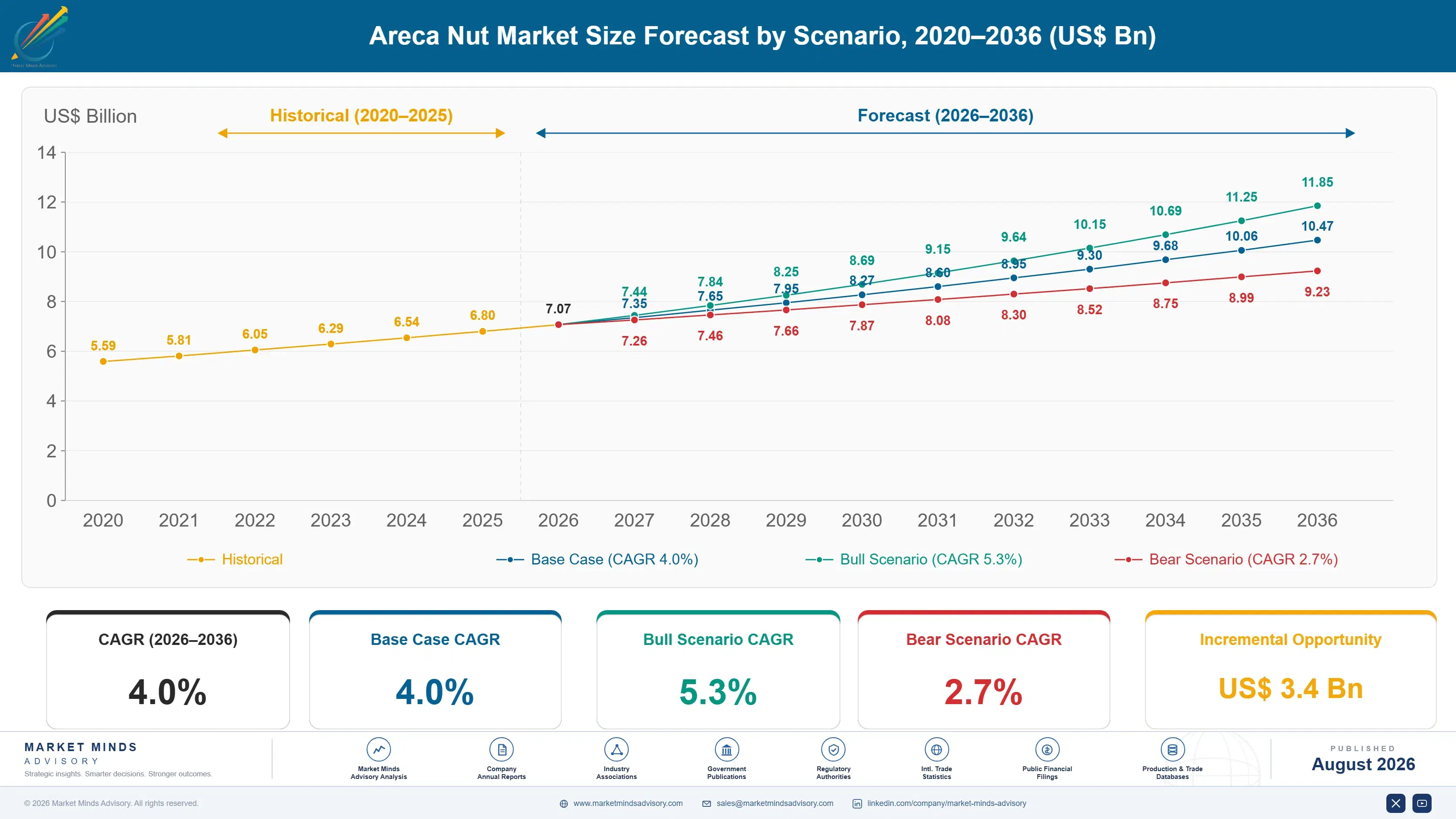
Areca Nut Market Forecast Scenarios

areca-nut-market-trends-growth-size-forecast-scenario-1787462129837
Areca nut demand grew unevenly between 2020 and 2025 as pandemic-era supply chain disruption, periodic Indian import restrictions, and volatile farm-gate pricing alternately squeezed and restored grower incomes. A historical CAGR of 3.2% reflects that uneven path, with flavored supari and leaf by-product formats gaining share fastest as processors sought margin beyond raw nut trading.
The base case assumes 4.0% annual growth through 2036, anchored by three mechanisms: continued cultivation expansion in Bangladesh and Myanmar to meet regional chewing demand, growing biodegradable tableware adoption for areca leaf plates in markets outside the traditional chewing culture, and steady processed and flavored supari demand across South Asia's urban retail channels. Together these push the category slowly beyond pure raw commodity trading toward genuine value-added processing across every major producing country tracked.
A bull scenario assumes leaf plate adoption accelerates faster than expected across Western foodservice and retail markets, pushing growth toward 5.3%. The bear case turns on tightening health-driven import restrictions and public health campaigns against chewing-related oral disease, compressing demand growth toward roughly 2.7% as several importing countries weigh tighter controls on chewing-related product categories overall.

Cultural Demand Meets Trade Policy Exposure

Areca nut sits at the center of a chewing culture spanning South Asia, Southeast Asia, and parts of East Asia and the Pacific, consumed directly, processed into supari, or manufactured into pan masala and gutkha products that use it as a primary input. This cultural concentration means demand tracks population and tradition more than income growth, unlike most agricultural commodities tied closely to broader consumer spending patterns and discretionary purchasing power.
MARKET CONCENTRATION (CR5)14%Category remains highly fragmented among smallholder traders worldwide
AVERAGE FARM-GATE PRICE$2.40 per kilogramRaw dried areca nut pricing across major producing regions
TOP PRODUCING COUNTRY SHAREIndia, 54%Largest single national base for cultivation and processing
EXPORT TRADE INTENSITY18% cross-borderShare of global areca nut output crossing national borders
SMALLHOLDER FARM SHARE72% of acreageSmall grower plots dominate total cultivated production area
KEY INPUT COST SHARE61% of COGSRaw nut procurement dominates total processing production cost
Commercially, the category splits between smallholder-supplied raw and cured nut sold through cooperatives and traders, and a smaller but growing value-added tier built on flavored supari and leaf by-products. Cooperatives like CAMPCO defend grower price stability through guaranteed procurement, while diversified processors like Godrej Agrovet capture disproportionate margin through trading scale and downstream integration across their wider agribusiness portfolio spanning multiple commodity categories.
Over the next decade, growth concentrates in Bangladesh and Myanmar as cultivation expands to meet domestic demand, and in leaf by-product exports as biodegradable tableware gains retail traction outside traditional chewing markets. Rising health scrutiny and periodic import restrictions will keep pushing traders toward compliant processing and diversification beyond raw nut trading, reshaping margin capture across the entire value chain.
"Areca nut trades on tradition, not marketing. The processors making real money now are the ones who stopped selling just the nut and started selling the leaf, the flavor, and the compliance paperwork too."
Director, Agricultural Commodities Practice · MMA Agriculture & Food Ingredients Practice · August 2026

Market Trends

Areca Leaf Plates Gaining Biodegradable Tableware Traction

Areca palm leaf plates and bowls, pressed from naturally fallen sheaths rather than harvested nuts, are gaining retail placement across North America, Western Europe, and East Asia as a genuine biodegradable alternative to single-use plastic tableware. Exporters in Karnataka and Kerala have expanded dedicated leaf-pressing units separate from nut processing facilities to meet rising order volume from foodservice distributors and eco-conscious retail chains. This trend is pulling an entirely new buyer base, including retailers who have never sourced areca nut itself, into the category's broader supply chain for the first time.
Market Impact: Adds 7.2% Bangladesh cultivation growth
Flavored Supari Formats for Convenience Retail

Processors are expanding flavored and scented supari formats sold in small convenience packs as mouth fresheners, moving the category beyond loose raw nut sold by weight in traditional wholesale markets. Kothari Products and similar manufacturers have introduced branded, shelf-stable flavored supari lines distributed through modern retail and quick-commerce channels across urban India, adding packaging formats and flavor profiles rarely seen a decade ago. This format shift is pulling younger urban consumers into the category through convenience positioning rather than traditional chewing occasions passed down within families, and export versions are now reaching South Asian diaspora retail shelves abroad as well.
Market Impact: Adds 5.0% East Asia demand growth

Market Opportunities and Growth Drivers

Cultivation Expansion in Bangladesh and Myanmar

Rising domestic chewing demand across Bangladesh and Myanmar is pulling new farmland into areca cultivation faster than in India's more mature growing regions, since both countries still import meaningful volume to cover current consumption. Government agricultural extension programs in both countries are supporting smallholder areca cultivation as a cash crop alternative to lower-value staples, particularly in coastal and delta growing regions well suited to the palm's climate requirements. This expansion is gradually shifting a portion of regional supply away from India-dependent import channels toward domestic self-sufficiency over the coming decade.
Market Impact: Cuts chewing-format demand growth 1-2%

China's Hunan and Hainan Processing Demand

China's domestic chewing product industry, centered in Hunan province and supplied partly by Hainan cultivation and partly by Southeast Asian imports, continues pulling meaningful processed areca nut volume despite periodic local regulatory scrutiny of the chewing product category itself. Vietnamese and Indonesian exporters have expanded supply relationships with Chinese processors as domestic Hainan output alone cannot meet Hunan's manufacturing demand during peak processing season. This cross-border processing relationship makes China a genuine demand anchor for Southeast Asian growers beyond its own limited domestic cultivation base, sustaining export volume even as Chinese cultivation output fluctuates year to year.
Market Impact: Raises trade cost volatility 15-20%

Market Restraints and Challenges

Oral Cancer Health Warnings and Regulatory Scrutiny

International health authorities, including the WHO's International Agency for Research on Cancer, classify areca nut as carcinogenic to humans, and this classification is increasingly cited in public health campaigns across India, China, and Taiwan aimed at reducing chewing prevalence. The root cause is genuine, well-documented epidemiological evidence linking chewing to oral submucous fibrosis and oral cancer. The commercial impact falls hardest on raw and flavored supari segments serving direct chewing occasions, while leaf by-products remain unaffected entirely. Processors are mitigating exposure by diversifying revenue into leaf by-products and export markets outside traditional chewing culture.
Market Impact: Adds 9.5% leaf by-product segment growth

Cross-Border Import Restriction Policy Volatility Risk

India periodically imposes minimum import price rules and quantitative restrictions on areca nut imports from Sri Lanka, Bhutan, Indonesia, and Bangladesh to protect domestic grower pricing, creating meaningful supply and pricing uncertainty for regional traders dependent on cross-border flows. The root cause is India's dual role as both the world's largest producer and a periodic net importer during domestic shortfall years. The commercial impact includes sudden price swings and stranded inventory for traders caught mid-shipment when restrictions change. Larger traders are mitigating exposure by diversifying sourcing across multiple exporting countries rather than depending on any single trade corridor.
Market Impact: Adds 6.8% flavored supari segment growth
4 additional market trends, 2 additional growth drivers, and 3 additional restraints and challenges are covered in the full report. Contact sales@marketmindsadvisory.com to access the complete intelligence.

Segment CAGR and Growth Architecture

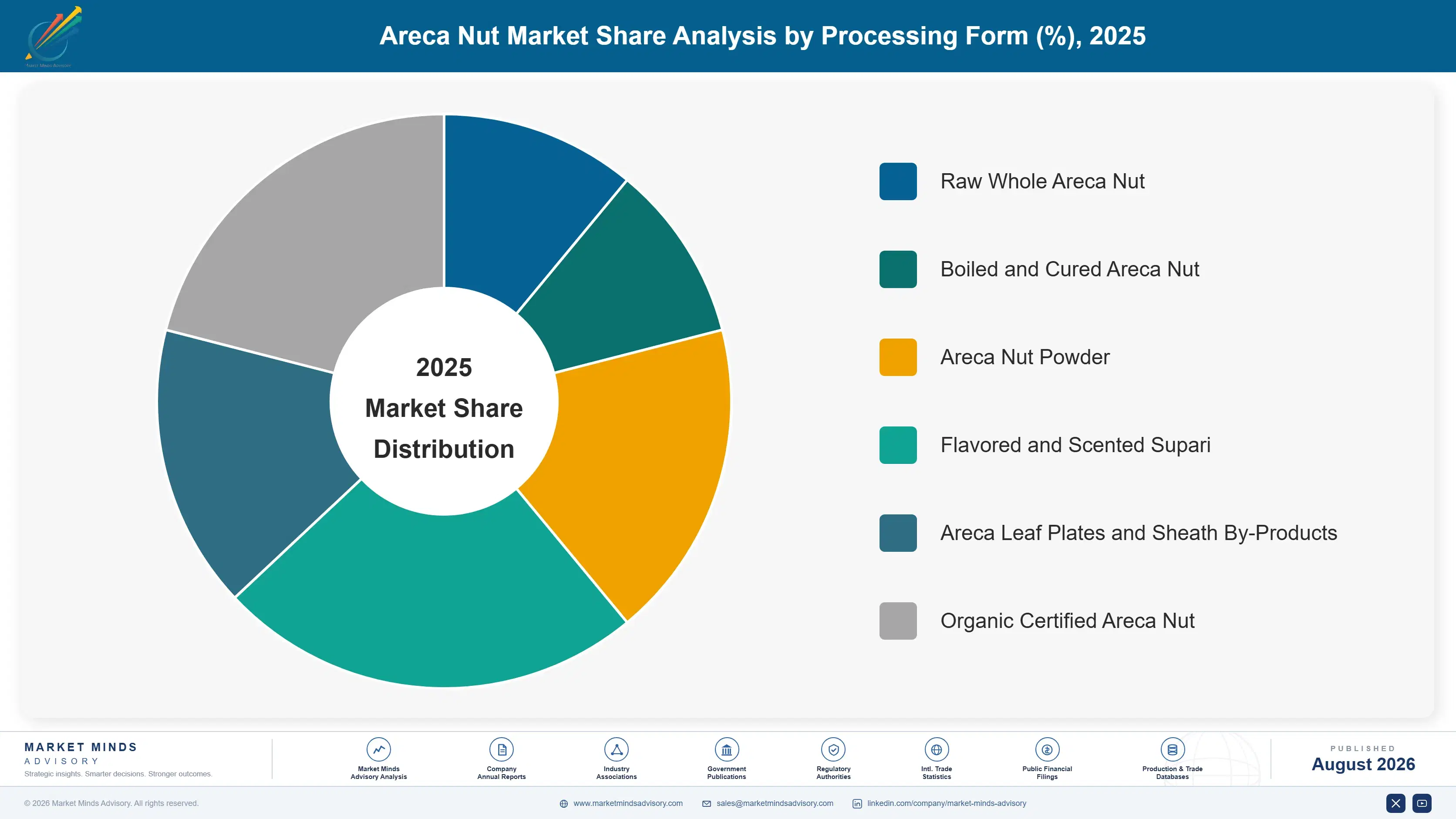
MMA segments the areca nut market by processing form rather than by end-use application, since curing, drying, and value-added processing steps, not the final buyer's industry, determine cost structure and margin more than any single downstream product distinction across chewing, food, or packaging uses today across every producing country this report tracks in detail.
areca-nut-market-trends-growth-market-share-analysis-1787462130373

Areca Leaf Plates and Sheath By-Products

Areca leaf plates and sheath by-products form the fastest-growing segment, pulled by rising demand for biodegradable tableware among retailers and foodservice operators who have never sourced areca nut itself. Exporters in Karnataka and Kerala have built dedicated leaf-pressing facilities entirely separate from nut curing operations, since the two product streams require different equipment, quality standards, and buyer relationships altogether. This segment carries a fundamentally different growth driver than the rest of the category, since it depends on packaging and sustainability trends in importing markets rather than chewing tradition. Demand concentrates in North America, Western Europe, and increasingly East Asia, where plastic packaging restrictions are pushing retailers toward certified biodegradable alternatives faster than domestic supply can scale.
CAGR 9.5%

Flavored and Scented Supari

Flavored and scented supari is the second-fastest segment, driven by branded convenience formats that move the category beyond loose raw nut sold by weight in traditional wholesale markets. Kothari Products and similar manufacturers have expanded shelf-stable, small-pack flavored supari lines distributed through modern retail and quick-commerce channels across urban India and the broader South Asian diaspora abroad. This segment commands meaningful margin over raw nut trading, since flavoring, packaging, and brand positioning let processors capture value beyond simple commodity weight-based pricing. Growth concentrates in urban South Asian retail and export markets serving diaspora communities, where convenience positioning is pulling younger consumers into the category through channels distinct from traditional family-based chewing occasions.
CAGR 6.8%
Full segment breakdown across 6 segments available in the complete report.

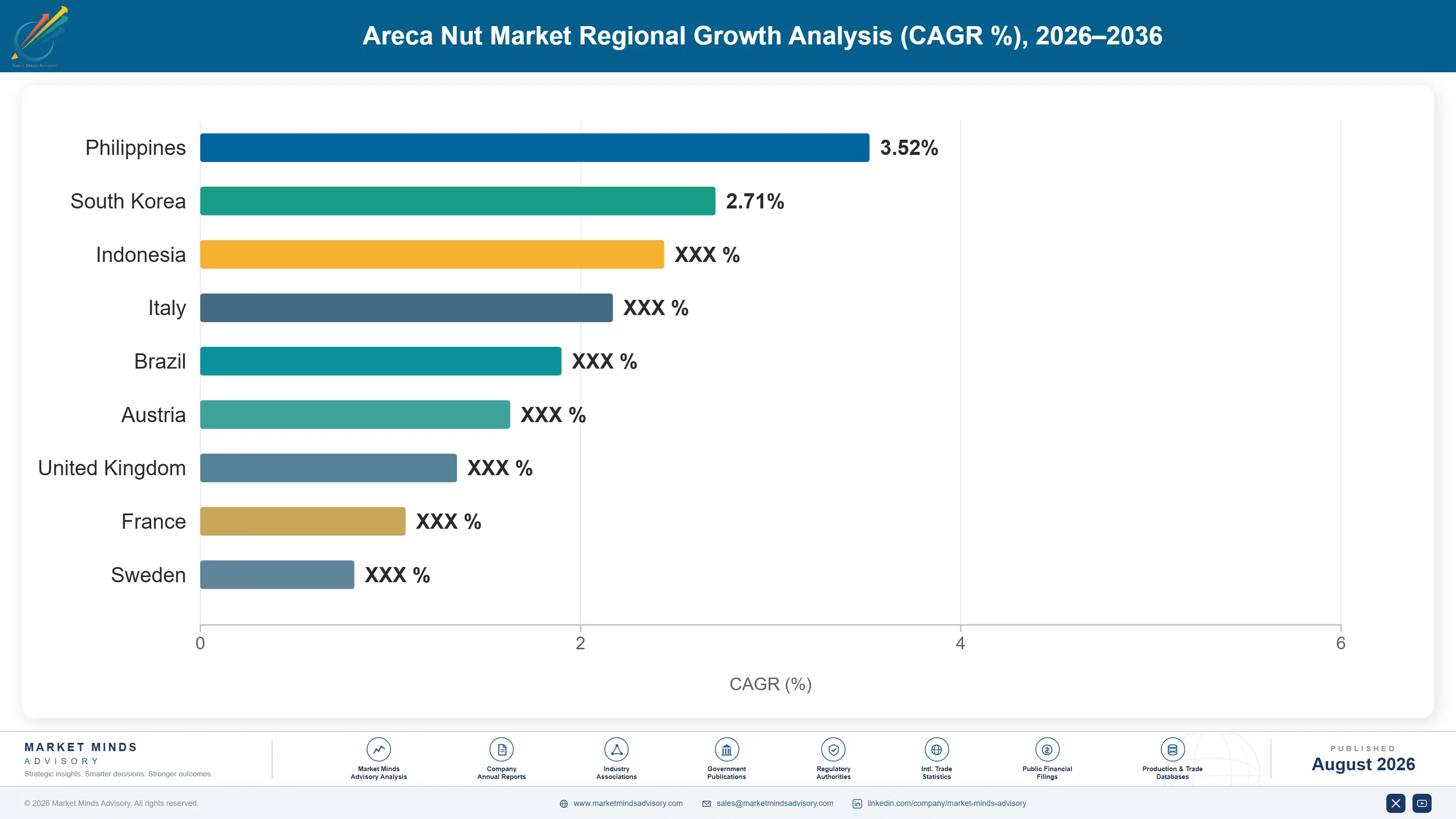
Regional Architecture and Country Demand Map

Areca nut consumption and production concentrate overwhelmingly across South Asia and Pacific and East Asia's chewing culture economies, while North America and Western Europe carry only marginal diaspora-driven import demand and negligible domestic cultivation of any kind across their retail and foodservice channels this year.

North America

The United States and Canada carry only marginal areca nut demand, limited almost entirely to South Asian and Southeast Asian diaspora communities importing raw and flavored supari for personal chewing use rather than any domestic cultivation or mainstream retail presence. This region's modeled share sits well below the standard band used elsewhere in this report, reflecting a genuine near-total absence of areca nut in mainstream North American consumption patterns rather than measurement error. Areca leaf plates represent the one meaningful growth pocket here, entering through sustainability-focused foodservice distributors rather than ethnic grocery channels. Growth tracks biodegradable packaging adoption far more than any chewing-related demand across the region's retail and foodservice buyers.
Share: 2% | CAGR: 3.0% (2026 to 2036)

Western Europe

The United Kingdom, the Netherlands, and Germany host the region's only meaningful areca nut demand, again concentrated among South Asian diaspora communities rather than mainstream retail or domestic cultivation of any kind. This region's modeled share sits well below the standard band used elsewhere in this report, since areca nut chewing has no cultural presence in mainstream Western European consumption outside these specific immigrant communities. Leaf plates are gaining modest retail traction here too, particularly in the Netherlands and Germany where plastic packaging restrictions are furthest along, drawing interest from retailers with no prior connection to the category at all. Growth remains slow overall given the small addressable base this region genuinely represents beyond that one growth pocket.
Share: 2% | CAGR: 2.2% (2026 to 2036)
Regional intelligence for 5 additional markets available in the complete report: East Asia, South Asia and Pacific, Latin America, Middle East and Africa, Eastern Europe. Contact sales@marketmindsadvisory.com.
areca-nut-market-trends-growth-country-cagr-analysis-1787462130894

Diversification Beyond Raw Nut Trading

Areca nut traders and processors extract more value from existing grower relationships by moving into leaf by-products, flavored formats, and export compliance rather than competing purely on raw commodity weight. The levers below concentrate on capturing biodegradable packaging demand, flavored format margin, and diversified sourcing that reduces exposure to trade policy volatility across every major exporting corridor.

Leaf Plate Export Capacity for Biodegradable Retail

Processors that built dedicated leaf-pressing capacity separate from nut curing operations are capturing biodegradable tableware contracts worth roughly 25 to 35% more per unit of raw material than traditional nut trading generates, since leaf plates serve an entirely different buyer base willing to pay a sustainability premium. Karnataka and Kerala exporters moved early on this capacity, securing distributor relationships before slower-moving competitors could respond to rising retail demand. Processors without dedicated leaf capacity increasingly miss this buyer base entirely, since leaf and nut processing require separate equipment investment and distinct quality control standards.
Market Impact: Adds a 25 to 35% leaf export premium

Flavored Format Branding for Modern Retail Channels

Processors that built branded, shelf-stable flavored supari lines are winning placement in modern retail and quick-commerce channels that traditional loose raw nut trading cannot access, capturing meaningfully higher per-unit pricing in the process. Kothari Products and similar manufacturers report that branded flavored formats generate roughly 2 to 3 times the per-kilogram value of raw nut sold by weight, since packaging, flavoring, and brand recognition let processors escape pure commodity pricing entirely. Processors still selling only raw nut increasingly lose younger urban consumers to branded convenience formats they encounter through modern retail and social media advertising alike.
Market Impact: Adds 2 to 3 times per-unit retail value

Multi-Country Sourcing to Reduce Trade Policy Exposure

Traders that diversify sourcing across India, Indonesia, Sri Lanka, and Bangladesh rather than depending on a single origin reduce their exposure to sudden import restriction changes that can strand inventory or spike pricing with limited warning. Building these multi-country supplier relationships typically takes 2 to 3 years of relationship building and quality qualification, but it lets a trader maintain supply continuity when any single corridor faces restriction. Traders without diversified sourcing risk losing customer contracts entirely during restriction periods, since buyers cannot wait indefinitely for a single blocked corridor to reopen.
Market Impact: Cuts supply disruption risk by roughly 40% overall

Export Compliance Documentation for Regulated Markets

Traders that invest in pesticide residue testing and export compliance documentation win preferential access to Western retail and foodservice buyers who increasingly require verified sourcing before signing distribution agreements, particularly for leaf by-products entering food-adjacent packaging categories. This compliance investment requires meaningful upfront cost, often 2 to 3 years of testing and certification work, but pays back through access to buyers unwilling to work with undocumented suppliers regardless of price. Traders without compliance documentation remain confined to traditional wholesale channels with thinner margin and less demand growth than compliant, documented competitors serving regulated Western markets today.
Market Impact: Wins 10 to 15% more regulated market contracts

Who Controls the Margin Pool

CR5 in areca nut sits near 14%, reflecting a category still dominated by smallholder growers and regional traders rather than global consolidation of any meaningful kind. CAMPCO leads through cooperative farmer network scale, with Godrej Agrovet close behind through diversified agribusiness trading capability, while the gap to smaller regional traders remains wide enough that consolidation looks unlikely given how fragmented smallholder cultivation genuinely is.
Current competitive activity centers on three fronts: leaf by-product export capacity build-out to capture biodegradable packaging demand, flavored format branding to escape raw commodity pricing, and multi-country sourcing diversification to reduce trade policy exposure. Larger traders and cooperatives with processing and compliance capability are moving fastest on all three, while smaller regional traders without capital access risk losing both export contracts and modern retail placement to better-resourced competitors.

Emerging pressure comes from Bangladesh and Myanmar cultivation expansion reducing regional import dependence on India over time, alongside Vietnamese and Indonesian traders scaling supply relationships with Chinese processors fast enough to challenge traditional South Asian trade corridors. Vietdelta Industrial and similar Southeast Asian traders are building genuine export scale that could eventually rival established Indian trading houses on regional cost and reliability.
areca-nut-market-trends-growth-company-positioning-matrix-1787462131411

Competitive Moat and Risk Dimensions

CAMPCO

Moat: Farmer Cooperative Network Scale

CAMPCO's cooperative structure gives it direct procurement relationships with tens of thousands of smallholder growers across Karnataka and Kerala, providing supply reliability that private traders competing for the same raw nut volume cannot easily replicate. This grower trust, built over decades of guaranteed procurement, creates meaningful loyalty during price volatility.
CAMPCO

Risk: Government Policy Dependence

CAMPCO's procurement pricing and operations remain closely tied to Indian government agricultural policy and periodic import restriction decisions, meaning shifts in trade policy direction can meaningfully affect its commercial flexibility. This dependence limits its ability to respond quickly to global market signals compared to private traders.
GODREJ AGROVET

Moat: Diversified Agribusiness Integration

Godrej Agrovet's areca nut trading sits within a much broader diversified agribusiness portfolio spanning animal feed, crop protection, and palm oil, giving it balance sheet resilience and logistics infrastructure that specialized areca traders lack entirely. This diversification lets it weather areca-specific price volatility more comfortably than focused competitors.
GODREJ AGROVET

Risk: Commodity Price Pass-Through Risk

Godrej Agrovet's areca nut trading margin remains exposed to volatile farm-gate pricing that it cannot always pass through to downstream buyers quickly, particularly during periods of import restriction uncertainty. Managing this exposure requires trading discipline that smaller, more specialized competitors sometimes apply more aggressively across their narrower, more focused book of business.

Players Tracked

Prominent Players

CAMPCO
Godrej Agrovet
Dharampal Satyapal Group
Kothari Products Limited
Vietdelta Industrial Co., Ltd.

Other Key Players

Ashapura Agrocomm
GM Group
KRBL
Mangalam Group
Saaha Agro Industries
Surya Exim
Vimal Agro Products
Dharsini Exports
Khodiyar Overseas Trade
Prestige Exim
Megh Overseas Private Limited
Baba Global Limited
Ghodawat Consumer Products
Swastika International
Sri Vinayaka Betelnut Traders

Recent Developments

FEBRUARY 2025

CAMPCO Raises Procurement Price for Member Growers

CAMPCO raised its guaranteed procurement price for member-supplied areca nut across Karnataka and Kerala, citing rising cultivation costs and sustained domestic demand. The revised pricing applies across the cooperative's next full procurement cycle and affects tens of thousands of smallholder grower accounts across both states.
Signal: Confirms cooperative structures remain central to grower price stability despite growing private trader competition each season.
JULY 2025

Godrej Agrovet Expands Areca Nut Trading Desk Capacity

Godrej Agrovet expanded its dedicated agricultural commodity trading desk to include broader areca nut sourcing across additional Indian growing regions, adding staff and logistics capacity to handle rising volume from new supplier relationships. The expansion supports the company's wider diversified agribusiness trading operations across multiple commodity categories.
Signal: Signals diversified conglomerates are treating areca nut as a genuine standalone trading category rather than a minor sideline.
NOVEMBER 2025

India Tightens Minimum Import Price on Areca Nut

India's government tightened minimum import price requirements on areca nut imports from several Southeast Asian countries, aiming to protect domestic grower pricing during a period of strong harvest volume nationwide. The policy affects import corridors from Indonesia, Sri Lanka, and Bangladesh most directly, according to trade ministry officials.
Signal: Confirms trade policy volatility remains a persistent recurring feature traders must actively plan around each cycle.

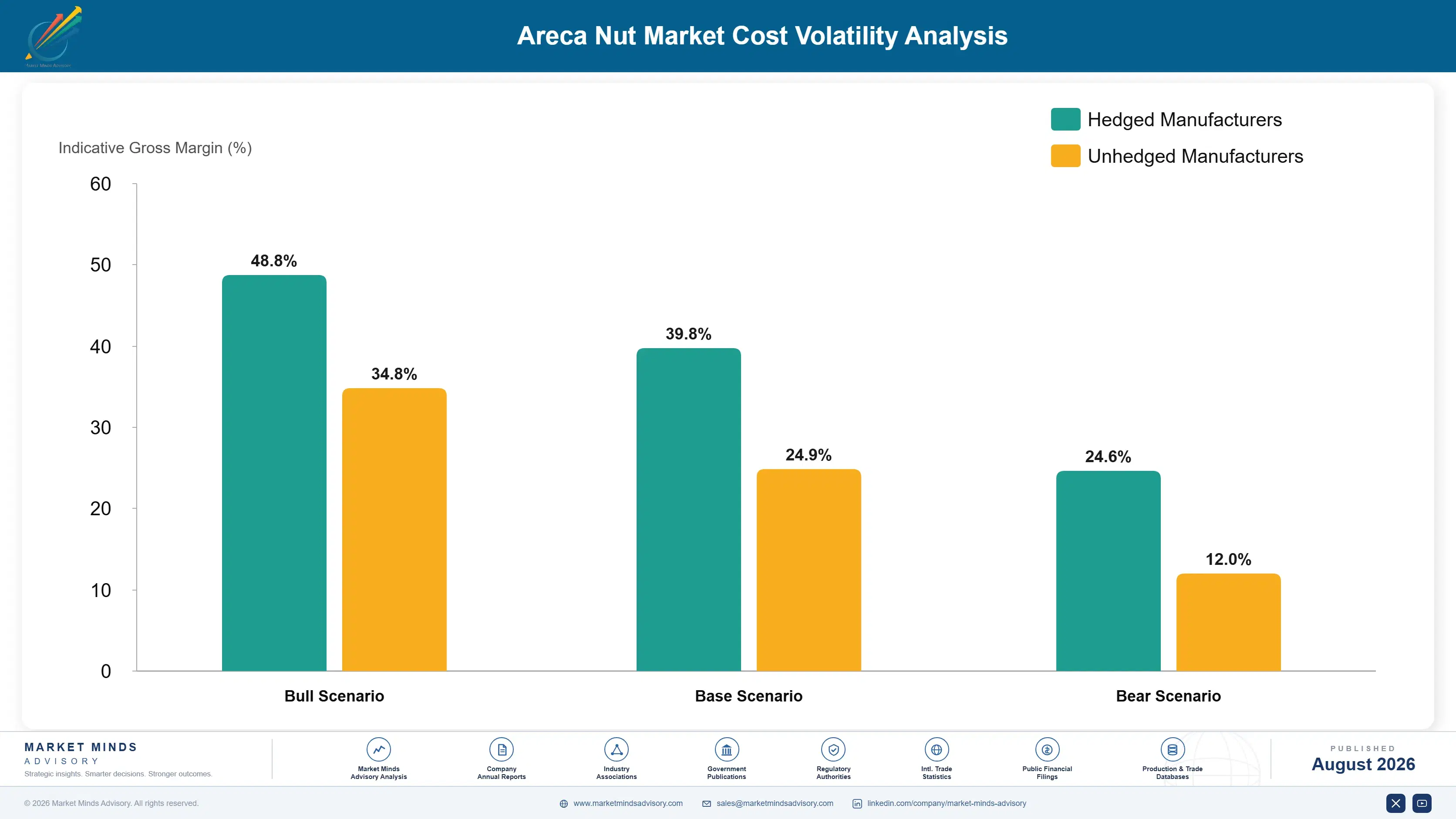
Raw Nut Procurement and Farm-Gate Exposure

Raw areca nut procurement accounts for roughly 61% of processor cost of goods sold, sourced almost entirely from smallholder growers whose pricing tracks domestic harvest volume and periodic government-influenced minimum support pricing rather than global commodity benchmarks. This exposure sits meaningfully higher than in more mechanized agricultural categories, given how labor-intensive harvesting and curing remain.
Indian farm-gate areca nut prices swung sharply following uneven monsoon seasons across 2022 and 2023, with several growing regions reporting yield shortfalls that tightened available supply for processors. CAMPCO's own procurement reports documented sustained price volatility across this period as cooperatives worked to stabilize grower payments despite fluctuating harvest volumes. Traders without diversified sourcing across multiple growing regions absorbed meaningfully higher per-unit procurement costs than competitors with broader supplier networks already established.

Exposure varies by trader type: large diversified processors with multi-region sourcing and cooperative relationships absorb volatility more evenly than smaller regional traders dependent on a single local growing area. Traders serving export markets requiring compliance documentation face additional cost layers that domestic-only traders serving traditional wholesale channels do not carry at all, widening the margin gap between the two groups each procurement cycle.
areca-nut-market-trends-growth-cost-volatility-analysis-1787462131610

Multi-Region Sourcing Across Growing Areas

Larger traders increasingly source raw areca nut from multiple growing regions across Karnataka, Kerala, and Assam rather than depending on a single local area, reducing exposure to localized harvest shortfalls or weather events. This diversification requires supplier relationship investment but meaningfully smooths procurement cost volatility across consecutive harvest cycles each year across every growing region involved.

Cooperative Procurement Price Stabilization Programs

Cooperatives like CAMPCO offer guaranteed minimum procurement pricing to member growers, trading some upside during strong harvest years for reduced downside exposure during weak ones. Traders without cooperative membership remain more exposed to spot farm-gate price spikes during periods of tight regional supply and harvest uncertainty each growing season across the country's major producing states.

Forward Contracting With Export Buyers

Some processors are increasingly locking in forward supply contracts with export buyers ahead of harvest season, trading some pricing flexibility for predictable volume commitments that help plan procurement budgets. This approach reduces exposure to spot market price swings that can occur between harvest and eventual sale to end buyers across each contracted growing season.

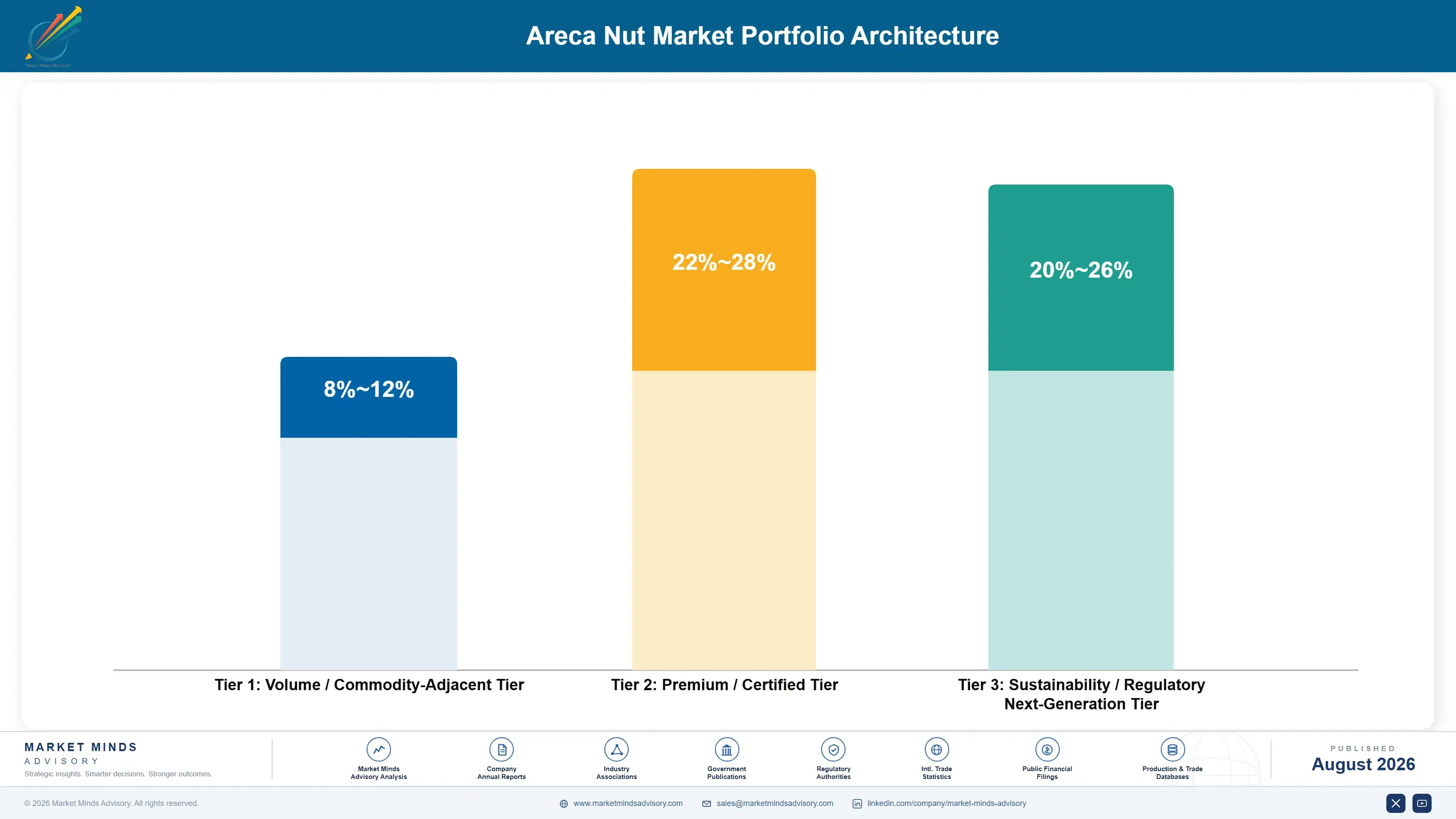
Portfolio Architecture for Margin Defence

Areca nut portfolios split across three tiers with different margin economics: a volume tier built on raw and cured nut sold through traditional wholesale channels, a premium tier built on flavored supari and export-compliant leaf by-products, and an emerging next-generation tier tied to certified organic cultivation and traceable sourcing that Western buyers are only beginning to pay a defined premium for.
The tension between volume and premium runs deep in how traders allocate limited processing and compliance investment: every unit of capacity dedicated to flavored or leaf by-product processing is capacity unavailable for raw nut trading that still generates the bulk of category revenue today. Get the mix wrong and a trader either misses premium export contracts or overinvests in compliance capacity that outpaces actual buyer demand for it right now.

High-value margin pools concentrate overwhelmingly in leaf by-products and flavored formats sold to export and modern retail buyers, not in raw nut trading alone. Traders that built processing and compliance capability early, CAMPCO and Kothari Products among them, now capture a share of total category profit well above their share of total raw nut volume traded each year.

Volume / Commodity-Adjacent Tier

Raw and cured areca nut sold through traditional wholesale channels to domestic chewing product manufacturers, priced close to farm-gate benchmarks with thin trading margin above procurement cost across most accounts.
Gross Margin: 8-12%

Premium / Certified Tier

Flavored supari and export-compliant leaf by-products sold to modern retail and biodegradable packaging buyers, commanding meaningful price premiums through branding, compliance documentation, and sustainability positioning that raw commodity trading cannot easily replicate at any price point.
Gross Margin: 22-28%

Sustainability / Regulatory / Next-Generation Tier

Certified organic and traceable areca nut aimed at Western buyers with public sustainability commitments, still a small volume tier but growing as retail sourcing transparency expectations continue rising across the category.
Gross Margin: 20-26%
areca-nut-market-trends-growth-portfolio-architecture-1787462132114

High-value Sub-segments and Strategic Watch-out

Areca Leaf Plates and Sheath By-Products (High-Value, High-Growth)

Leaf plates combine the fastest unit growth in the category with meaningfully above-average margins, making it the single most attractive segment for exporters with dedicated pressing capacity already in place. Demand continues to outpace available certified export capacity across Western retail and foodservice markets alike.
Gross Margin: 22-28%

Flavored and Scented Supari (High-Value, Moderate-Growth)

Flavored supari carries better margin than raw nut and continues gaining modern retail placement, though growth is more moderate than leaf plates since it depends on brand-building investment cycles that take real time to establish consumer recognition across new geographies and demographic groups each year.
Gross Margin: 18-24%

Raw and Cured Areca Nut (Volume Core)

Raw and cured areca nut remains the largest single category by volume and the backbone of trader cash flow, even though margin sits well below the specialty tiers. Nearly every trader depends on this volume base to fund compliance and processing investment elsewhere in the portfolio.
Gross Margin: 8-12%

Non-Compliant Export Trading (Strategic Watch-Out)

Raw nut trading without pesticide residue testing or export compliance documentation carries the thinnest margin in the portfolio and faces the most direct exposure to sudden import restrictions, making it the segment most at risk of exclusion from regulated markets in the years directly ahead.
Gross Margin: 5-9%

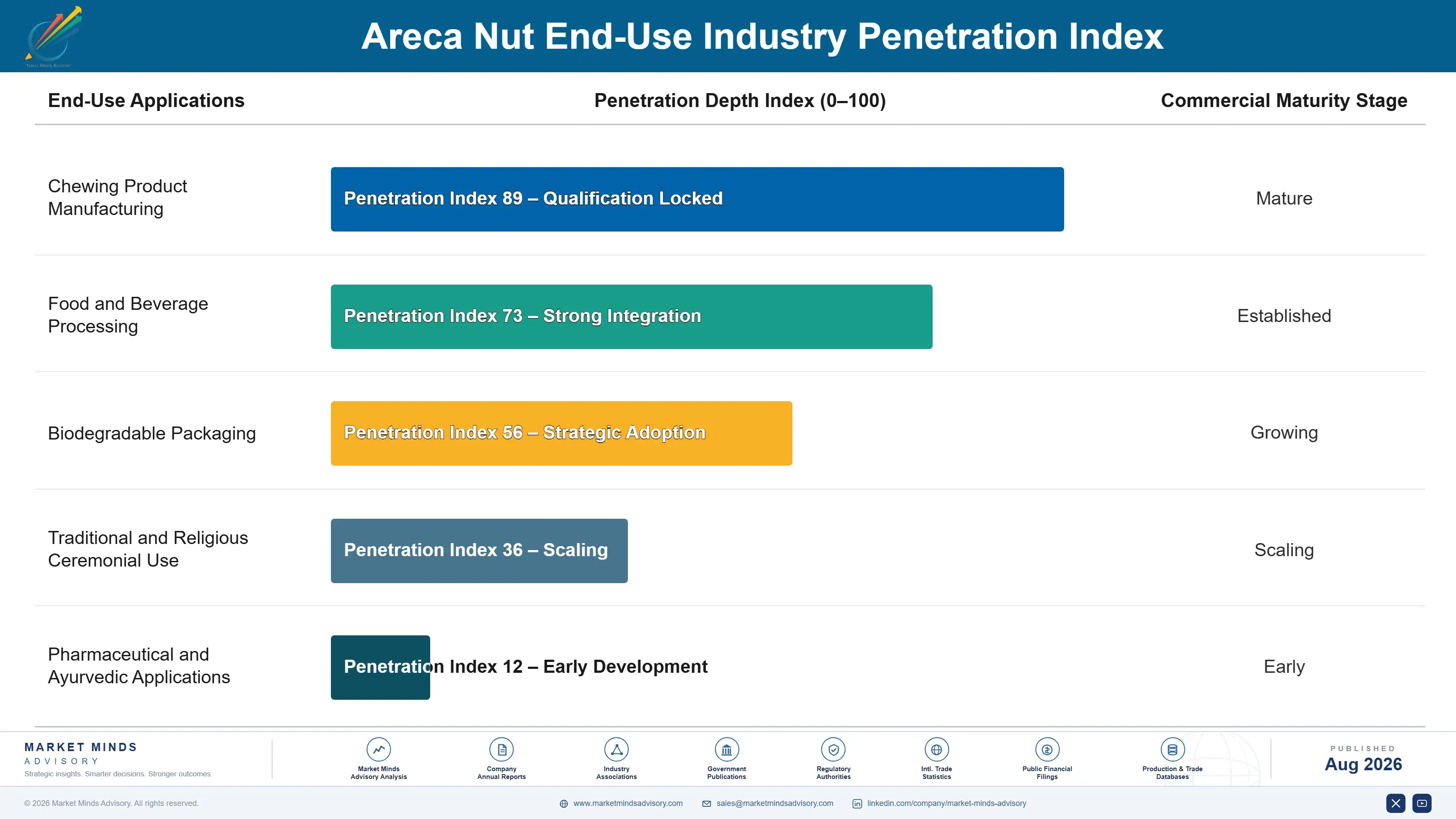
Cultural Habit and Trading Relationships

Areca nut demand runs on generational chewing habit and long-standing trader-grower relationships rather than formal contracts for most traditional volume, since chewing occasions pass down within families and communities more than they respond to marketing or price promotion. This gives established cooperatives and trading houses a meaningful retention advantage once a buyer relationship forms around consistent quality and reliable supply.
Adoption depth varies sharply by buyer type: traditional chewing product manufacturers show strong loyalty to established grower and trader relationships built over years, switching rarely even when marginal price differences emerge elsewhere. Export buyers sourcing leaf plates or flavored supari for Western retail show far less loyalty, switching more readily toward whichever supplier offers the strongest compliance documentation or pricing at contract renewal time. Diaspora import buyers sit between these extremes, valuing familiar regional sourcing but remaining price-sensitive given thin retail margins.

A generational shift is underway among younger consumers too: younger urban buyers increasingly encounter areca nut through branded flavored convenience formats rather than traditional family chewing occasions, while younger Western buyers encounter it entirely through leaf plates without any awareness of the nut's traditional chewing use at all.
areca-nut-market-trends-growth-end-use-penetration-index-1787462132600

Where Areca Nut Margin Concentrates

These are among the four positions where our research anticipates prominent divergence between winners and laggards over the coming forecast period. Each is grounded in the demand model, the regulatory perimeter, and the announced capacity pipeline.
01 / LEAF BY-PRODUCT TIMING

Early leaf pressing investment now defends a durable export lead

Exporters that built dedicated leaf-pressing capacity ahead of rising Western biodegradable tableware demand now hold distributor relationships that later movers cannot quickly replicate, since retail buyers rarely switch away from an established reliable supplier once a relationship forms. This timing advantage matters more than raw cultivation scale, because leaf plate demand depends entirely on packaging sustainability trends rather than traditional chewing culture. Exporters without early leaf capacity now face a multi-year capital and relationship-building process before they can compete for the same premium export contracts.
02 / TRADE POLICY EXPOSURE

Single-corridor traders face the sharpest import restriction risk

Traders dependent on a single sourcing or export corridor face the sharpest exposure to sudden Indian import restriction changes, since policy shifts can strand inventory or spike pricing with limited advance warning. This risk concentrates specifically among smaller regional traders lacking the capital to diversify sourcing across multiple growing countries simultaneously. Traders that diversified sourcing early face meaningfully less disruption during restriction periods than those still dependent on a single trade corridor for the bulk of their volume, a gap that widens further with each new policy change.
03 / HEALTH SCRUTINY TRAJECTORY

Chewing-format demand faces a slow but genuine long-term headwind

Rising health authority scrutiny and public health campaigns against chewing-related oral disease represent a genuine long-term demand headwind for raw and flavored chewing formats specifically, distinct from leaf by-products which face no such exposure at all. This headwind moves slowly given deep cultural entrenchment, but it is directionally consistent across every major chewing market tracked in this report. Traders diversifying toward leaf by-products and export compliance now reduce their exposure to this slow-moving but persistent category risk more effectively than competitors betting on chewing demand alone.
04 / REGIONAL CAPACITY SHIFT

Bangladesh cultivation growth is quietly reducing India's export leverage

Bangladesh's expanding domestic cultivation is gradually closing an import dependence gap that has historically pulled volume from India and other exporting countries, a shift that compounds slowly but consistently each growing season. This capacity shift is distinct from demand-side trends, since it reflects genuine new domestic supply rather than any change in regional chewing prevalence. Traders and cooperatives that build direct relationships with Bangladeshi growers now will be better positioned than those assuming import dependence continues indefinitely across the coming decade.

Engagement Snapshot From the Field

A live engagement with an industry participant carrying material or product regulatory and market exposure ahead of a defining policy shift, showing how our research translates into a defensible multi-year portfolio strategy.
MARKET MINDS ADVISORY · CLIENT ENGAGEMENT SUMMARY
Areca Nut Producer Strategic Portfolio Review and Transition Roadmap 2026·Investment Scenario on Areca Nut Exposure Evaluation 2025-26
CLIENT PROFILE
The client is a mid-sized South Indian areca nut trading house sourcing primarily from Karnataka smallholder growers and selling almost entirely into domestic wholesale chewing product channels. Revenue approached $32 million in the most recent fiscal year (client-reported, unverified by MMA), though margins had compressed steadily as domestic wholesale pricing came under pressure from larger, better-capitalized cooperative and conglomerate competitors.
STRATEGIC CHALLENGE
The trading house had no export compliance capability and no leaf by-product processing, leaving it entirely dependent on thinning domestic wholesale margin at a moment when larger competitors were capturing export and biodegradable packaging demand. Leadership needed to decide whether to build leaf pressing capacity, pursue export compliance certification, or both simultaneously given limited available capital.
MMA APPROACH
MMA benchmarked the trading house's cost structure against diversified competitors, modeled the capital and timeline required for both leaf pressing capacity and export compliance certification, and evaluated a phased sequencing that would let the smaller of the two investments fund the larger one over time rather than requiring simultaneous capital commitment across both initiatives.
KEY FINDINGS
  1. The trading house's domestic wholesale margin had compressed meaningfully faster than regional peers already diversified into leaf by-products or export-compliant flavored formats.
  2. Leaf pressing capacity required substantially less upfront capital than export compliance certification, making it the faster near-term path to margin diversification given available resources.
  3. Export compliance certification unlocked access to buyers willing to pay meaningfully more per unit than any domestic wholesale channel the trading house currently served.
  4. Regional competitors that diversified earliest already held multi-year distributor relationships that would be difficult for the trading house to displace quickly once established.
CLIENT PROFILE
The client is a mid-sized South Indian areca nut trading house sourcing primarily from Karnataka smallholder growers and selling almost entirely into domestic wholesale chewing product channels. Revenue approached $32 million in the most recent fiscal year (client-reported, unverified by MMA), though margins had compressed steadily as domestic wholesale pricing came under pressure from larger, better-capitalized cooperative and conglomerate competitors.
STRATEGIC CHALLENGE
The trading house had no export compliance capability and no leaf by-product processing, leaving it entirely dependent on thinning domestic wholesale margin at a moment when larger competitors were capturing export and biodegradable packaging demand. Leadership needed to decide whether to build leaf pressing capacity, pursue export compliance certification, or both simultaneously given limited available capital.
MMA APPROACH
MMA benchmarked the trading house's cost structure against diversified competitors, modeled the capital and timeline required for both leaf pressing capacity and export compliance certification, and evaluated a phased sequencing that would let the smaller of the two investments fund the larger one over time rather than requiring simultaneous capital commitment across both initiatives.
KEY FINDINGS
  1. The trading house's domestic wholesale margin had compressed meaningfully faster than regional peers already diversified into leaf by-products or export-compliant flavored formats.
  2. Leaf pressing capacity required substantially less upfront capital than export compliance certification, making it the faster near-term path to margin diversification given available resources.
  3. Export compliance certification unlocked access to buyers willing to pay meaningfully more per unit than any domestic wholesale channel the trading house currently served.
  4. Regional competitors that diversified earliest already held multi-year distributor relationships that would be difficult for the trading house to displace quickly once established.
RECOMMENDED STRATEGY
Phase 1: Phase 1 (Year 1): Build dedicated leaf-pressing capacity funded from existing cash flow, targeting initial distributor relationships in export-focused biodegradable packaging channels. Phase 2: Phase 2 (Years 2 to 3): Use improved leaf by-product margin to fund pesticide residue testing and export compliance certification for flavored supari formats. Phase 3: Phase 3 (Years 3 to 4): Pursue multi-year export contracts across both leaf by-products and compliant flavored supari, reducing dependence on domestic wholesale volume.
OUTCOME
Within two fiscal years, the trading house's leaf by-product revenue reached a meaningful share of total volume and funded export compliance certification ahead of the original planned timeline (client-reported, unverified by MMA). The phased approach let the business diversify without straining working capital, positioning it to compete for export contracts it could not have pursued under its prior domestic-only model.

Frequently Asked Questions

Foundational context covering the market sizes, CAGR, scope, country, region and competition that inform every finding below. This section is provided to cover basics and most often pre-purchase conversations, answered from the MMA Primary Research Dataset.

What is the current size of the Areca Nut Market?

The global areca nut market was valued at approximately $6.8 billion in 2025. This covers raw, cured, powdered, flavored, and leaf by-product forms sold to chewing product manufacturers and packaging buyers.

How large will the Areca Nut Market be by 2036?

MMA projects the market will reach approximately $10.5 billion by 2036, up from roughly $7.1 billion in 2026. That represents an expansion multiple of about 1.48 times over the ten-year forecast period.

What is the CAGR for the Areca Nut Market 2026 to 2036?

The base case CAGR is 4.0% annually, with a bull scenario near 5.3% and a bear scenario near 2.7%. This range reflects sensitivity to import restrictions and health-related chewing scrutiny.

Which segment is growing fastest?

Areca leaf plates and sheath by-products are the fastest-growing segment, expanding at roughly 9.5% annually, about 2.4 times the overall market's pace. Flavored and scented supari follows at approximately 6.8% annually.

Who are the major companies in the Areca Nut Market?

Leading players include CAMPCO, Godrej Agrovet, Dharampal Satyapal Group, Kothari Products Limited, and Vietdelta Industrial Co., Ltd. Together these five hold an estimated 14% combined market concentration today.

Which country is growing fastest?

Bangladesh is the fastest-growing national market, expanding near 7.2% annually as domestic cultivation closes a persistent import dependence gap. Myanmar follows as a significant secondary growth center in the region.

Report Segmentation Architecture

The full report scope spans multiple orthogonal segmentation dimensions, with cross-tabulated demand data provided for each dimension pair. Coverage extends further to regional breakdowns, trend trajectories, and the competitive detail needed to support segment-level decision-making.

By Processing Form

  • Raw Whole Areca Nut
  • Boiled and Cured Areca Nut
  • Areca Nut Powder
  • Flavored and Scented Supari
  • Areca Leaf Plates and Sheath By-Products
  • Organic Certified Areca Nut

By End-Use Industry

  • Chewing Product Manufacturing
  • Food and Beverage Processing
  • Biodegradable Packaging
  • Traditional and Religious Ceremonial Use
  • Pharmaceutical and Ayurvedic Applications

By Commercial Dimension

  • Domestic Wholesale Trade
  • Cross-Border Export Trade
  • Direct Cooperative Procurement
  • Modern Retail and Quick-Commerce

By Region

  • North America
  • Western Europe
  • East Asia
  • South Asia and Pacific
  • Latin America
  • Middle East and Africa
  • Eastern Europe

Scope, Methodology, and Coverage

Every figure in this report is reproducible from documented input assumptions. The scope below maps the historical period, the forecast horizon, the segmentation dimensions, and the countries covered, alongside the underlying primary and qualitative methodology.
Historical Period
2020 to 2025
Forecast Period
2026 to 2036
Base Year
2025 (USD billions; MMA Primary Research Dataset, August 2026)
Market Definition
This report defines the areca nut market as global trade, processing, and value-added supply of areca nut in raw, cured, powdered, flavored, and leaf by-product forms sold to chewing product manufacturers, food processors, and biodegradable packaging buyers. It excludes finished pan masala, gutkha, and tobacco-based chewing products that use areca nut only as one input among several.
Quantitative Units
USD billions (current prices); metric tonnes raw nut equivalent where cited
Segmentation Dimensions
By Processing Form; By End-Use Industry; By Commercial Dimension; By Region
Regions Covered
North America, Western Europe, East Asia, South Asia and Pacific, Latin America, Middle East and Africa, Eastern Europe
Countries Covered
USA, China, Germany, France, UK, Japan, South Korea, India, Australia, Canada, Brazil, Mexico, Indonesia, Vietnam, Thailand, Malaysia, UAE, Saudi Arabia, South Africa, Nigeria, Turkey, Poland, Netherlands, Italy, Spain, Sweden, Switzerland, Argentina, Colombia, Singapore, and additional markets relevant to this sector
Key Companies Profiled
CAMPCO, Godrej Agrovet, Dharampal Satyapal Group, Kothari Products Limited, Vietdelta Industrial Co., Ltd., Ashapura Agrocomm, GM Group, KRBL, Mangalam Group, Saaha Agro Industries, Surya Exim, Vimal Agro Products, Dharsini Exports, Khodiyar Overseas Trade, Prestige Exim, Megh Overseas Private Limited, Baba Global Limited, Ghodawat Consumer Products, Swastika International, Sri Vinayaka Betelnut Traders
Quantitative Methodology
Primary survey, n=3,800 respondents, Q4 2025, six countries; demand-side model with trade association cross-validation
Qualitative Methodology
47 expert interviews, Q4 2025; applied to validate demand model assumptions, identify emerging dynamics, and assess competitive positioning
Report Format
PDF and XLSX data workbook (Word format preview document)
Publisher
Market Minds Advisory
Report Code
MMA-2026-AGR-104
Published
August 2026
Contact
sales@marketmindsadvisory.com | www.marketmindsadvisory.com

Purchase the full Areca Nut Market Report (2026 to 2036).

The full Areca Nut Market report delivers detailed sizing and forecasts across all six processing-form segments, all seven world regions, and twenty profiled companies through 2036. It includes granular regional data tables, competitive benchmarking on a consistent trading volume basis, and input cost sensitivity modeling tied to Indian farm-gate pricing. Subscribers receive access to the underlying primary survey dataset (n=3,800 respondents, Q4 2025, six countries) and qualitative expert interview findings (n=47 interviews, Q4 2025). The report also includes segment-level margin analysis and a portfolio tiering framework analysts can apply directly to company assessments.
Full segmentation across six processing-form categories
Seven-region market sizing with growth forecasts
Twenty-company competitive benchmarking on consistent basis
Input cost sensitivity modeling tied to farm-gate pricing
Access to primary survey dataset of 3,800 respondents
Portfolio tiering framework for margin benchmarking

Built For The People Who Decide

From boardroom strategy to bench-side execution, this report is read cover-to-cover by leaders shaping the next decade of their industry, turning demand scenarios, market dynamics and valuation benchmarks into decisions.
CXOs/ Presidents/ VPs/ Managers
M&A and Corporate Development
Strategy Teams and R&D Heads
Procurement and Product Directors
Regulatory and Compliance Leaders
Investor Relations and Equity Analysts