Market Minds Advisory
Architectural Metal Coating Market

Architectural Metal Coating Market: The Barrier To Entry Is Calendar Time

A forty year facade warranty rests on ten years of real weathering data from South Florida, and no amount of laboratory capability or capital lets a new entrant skip a single one of those years.

Lead Analyst

Bilal Shaikh

Published

September 2026

Make Smarter Decisions with Customized Research Insights

Request a free sample report and evaluate market opportunities, growth trends, and competitive dynamics relevant to your business needs.

2025 MARKET VALUE$4.2BMarket Size 2025
2036 FORECAST VALUE$7.8BBase Case , 2026 to 2036
CAGR 2026 TO 20365.8 %Bull 7.0% / Bear 4.6%
INCREMENTAL OPPORTUNITY$3.4BNet 10- year value creation
EXPANSION MULTIPLE1.76x2036 value over 2026 base
Strategic Levers
M&A Pipeline
Regional Outlook
Country Rankings
Competitive Intelligence
Segmental Deep-dive
Call-Us : 91 93563 13602

Executive Snapshot and Market Trajectory

Architectural metal coating is roughly 4% of an installed curtain wall's cost and decides almost everything the building's owner will look at for the next forty years. That asymmetry is why specification runs on warranty rather than price. Failure is expensive to remedy: replacing the coating means replacing the facade.
Growth runs at 5.8% and powder leads it. Architectural powder coatings grow at 8.7%, exactly 1.50 times the market rate, pulled by solvent emission regulation and by extruders who prefer a process with no liquid waste stream to manage. East Asia holds 38%, above band, because Chinese aluminium extrusion and coil coating capacity together exceed the rest of the world's combined. Renovation is adding coated area without any new construction.
Concentration is moderate at 54% across the top five measured on coated metal area supplied, and warranty backing rather than formulation capability holds it. Around 310 approved applicator lines worldwide can apply the highest specification systems, and that approval is granted by the coating supplier rather than earned independently, which makes the applicator network part of the position. Warranties rest on ten years of South Florida exposure data. No laboratory method compresses that at all.
Market Definition
This market covers coating systems formulated and supplied for architectural metal building products, spanning fluoropolymer coil coatings, super durable polyester coil coatings, standard polyester coil coatings, architectural powder coatings, and liquid spray-applied architectural systems. Anodising and other electrochemical finishes, coatings for non-architectural metal, coil-coated substrates sold as finished panels, sealants and glazing systems, coating application equipment, and industrial or automotive coatings applied to the same substrates fall outside scope.
Base Year Value
$4.2B in 2025 (MMA Primary Research Dataset, August 2026)
Forecast Period
2026 to 2036, eleven discrete annual values
CAGR
5.8% base case. Bull 7.0%. Bear 4.6%.
Fastest Growth Segment
Architectural Powder Coatings: 8.7% CAGR
Fastest Growth Country
India: 8.4% CAGR
Fastest Growth Region
South Asia and Pacific: 7.9% CAGR
Largest Region
East Asia: 38% of 2025 global value
Market Leaders
PPG Industries, AkzoNobel, Sherwin-Williams, Beckers Group, Axalta Coating Systems. Source: MMA Analysis based on company annual reports.
Primary Survey
n=3,800 procurement and R&D decision-makers, Q4 2025, six countries
Methodology
Demand-side build-up, cross-validated against public data, 47 expert interviews

Architectural Metal Coating Market Forecast Scenarios

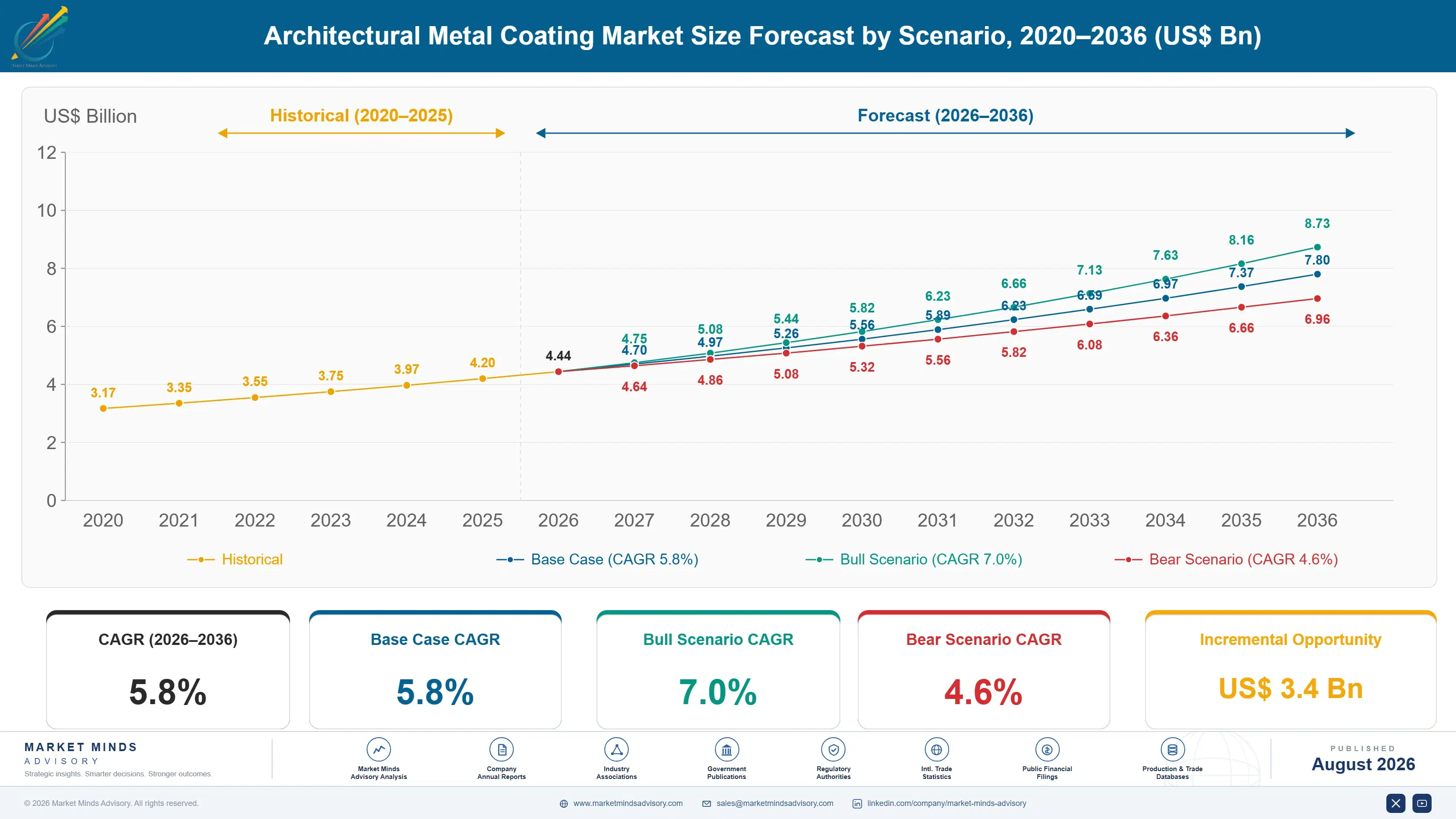
architectural-metal-coating-market-size-forecast-scenario-1787302610977
The 2020 to 2025 period ran at 4.8% and the composition shifted more than the rate suggests. Commercial construction weakened across several markets while residential metal roofing and siding grew, which moved volume between coating systems rather than removing it. Powder gained share throughout on emissions regulation, and super durable polyester took volume from standard polyester as specifiers discovered that the warranty gap was worth the price difference.
Three mechanisms carry the 5.8% base case. Facade renovation and overcladding is the largest, since ageing commercial stock in developed markets needs recladding for both appearance and thermal performance. Data centre and logistics construction is the second, adding large coated metal areas on fast schedules. And solvent emission regulation is the third, moving volume toward powder at 8.7% and away from liquid systems steadily. None of the three depends on commercial office construction recovering.
The 7.0% bull case rests on facade renovation programmes accelerating on energy performance regulation, which would add coated area without needing any new construction at all. The 4.6% bear case is commercial construction weakness across North America, Europe, and China together, since new build remains the volume base beneath a renovation market that is growing but still smaller.

Warranties Written On Weathering Data

The commercial logic here rests on an asymmetry. Coating is roughly 4% of an installed curtain wall's cost and determines colour, gloss, and film integrity for the building's whole visible life, so an architect specifying a facade is not optimising the coating line item at all. Failure is catastrophic and expensive to remedy, since replacing a facade coating means replacing the facade.
TOP FIVE CONCENTRATION54%Moderate, held through warranty backing and applicator approval networks
FLORIDA EXPOSURE REQUIREMENT10 yearsOf real time weathering before a warranty gets written
WARRANTY TERM OFFERED40 yearsOn film integrity for the highest specification systems available
RESIN SHARE OF COST48%Of coating production cost from binder resin alone
APPROVED APPLICATOR LINES310Licensed coil and spray lines worldwide able to apply
COATING SHARE OF FACADE4%Of installed curtain wall cost, deciding almost everything visible
Warranties are therefore the product. Systems carry film integrity and colour retention terms running to 40 years, and those terms rest on real time exposure data from South Florida test racks rather than on accelerated laboratory weathering. Ten years of exposure means ten years, and no capability, capital, or laboratory improvement compresses that. It is the most literal barrier to entry in the coatings industry.
Applicator approval extends the position downstream. Around 310 coil and spray lines worldwide are approved to apply the highest specification systems, and that approval comes from the coating supplier, who is warranting work done on somebody else's equipment. Concentration at 54% therefore reflects warranty backing and network control together rather than formulation capability, which is more widely held than the market structure suggests.
"A competitor can hire our chemists and buy better equipment than ours. What they cannot do is go back to 2016 and put panels on a Florida test rack. That is the whole moat and everybody in this industry knows it."
Director, Coatings and Building Envelope Materials Practice · MMA Chemicals and

Market Trends

Powder Coatings Take Share From Liquid Systems

Architectural powder coatings grow at 8.7% against 5.8% for the market, pulled by solvent emission regulation across most developed jurisdictions and by extruders who prefer a process with no liquid waste stream to manage. Powder has closed most of the durability gap that kept it out of high specification facade work for years. Colour matching and metallic effect finishes remain harder in powder, which is where liquid systems still hold defensible ground. Extruders operating their own powder lines are capturing application value that coil coaters previously held. That shift moves margin downstream. Few coating suppliers welcome it.
Market Impact: Coating is 4% of facade cost
Facade Renovation Overtakes New Build In Mature Markets

Ageing commercial building stock across North America and Western Europe is being reclad for appearance and thermal performance together, and energy performance regulation is accelerating that. Renovation coated area now rivals new construction in several mature markets. The work differs commercially: specification is driven by building owners and facade consultants rather than by developers, and colour matching to adjacent existing panels matters far more than it does on new build. Coated area on a reclad arrives without any frame or floorplate work being needed. Regulation rather than appearance increasingly triggers it. That demand is new.
Market Impact: Powder now grows at 8.7% yearly

Market Opportunities and Growth Drivers

Warranty Terms Decide Specification Rather Than Price

Coating is roughly 4% of installed curtain wall cost and determines everything visible about the building for decades, so architects and facade consultants specify on warranty term and proven weathering rather than on coating price. A supplier offering 40 year film integrity backed by real exposure data wins against a cheaper system with a shorter term. That logic has held for decades and shows no sign of changing anywhere. Balance sheet strength matters as much as chemistry, since a warranty is worth what the company behind it will be worth. Nobody says that part out loud.
Market Impact: Exposure testing takes 10 years

Data Centre Construction Adds Large Coated Areas

Data centre and logistics construction uses large uninterrupted metal wall and roof areas on schedules considerably faster than commercial office work, which suits coil coated products where the finish is applied before forming. Specification tends toward durable rather than decorative systems, and volumes per building are substantial. That demand grows with computing and distribution capacity rather than with commercial property cycles, which partly decouples it from the rest. Coil coated products suit the schedules because the finish is applied before the metal is formed. Site painting cannot compete on either speed or consistency.
Market Impact: Only 310 approved lines exist

Market Restraints and Challenges

Exposure Testing Blocks New Systems For A Decade

Warranties rest on ten years of real time South Florida exposure and the root cause is that accelerated laboratory weathering has never correlated well enough with real degradation for anyone to write a 40 year warranty against it. Commercial impact is that a genuinely new chemistry cannot be specified into premium facade work for a decade after invention. Mitigation runs through starting exposure programmes speculatively, extending existing qualified chemistries, and accepting lower specification work while data accumulates. Racking candidate systems speculatively is cheap against the option it buys. Most suppliers still treat it as a cost.
Market Impact: Powder coatings grow at 8.7%

Applicator Approval Limits Where Volume Can Go

Around 310 approved coil and spray lines worldwide can apply the highest specification systems, and the root cause is that the coating supplier warrants work performed on equipment it does not own, so it controls who may do it. Commercial impact is that regional demand growth outruns local approved capacity regularly. Mitigation runs through approving additional lines, training and auditing programmes, and in some cases capital support to bring a line to standard. Regional demand growth outruns approved capacity regularly, and the approvals then follow rather than lead. Audit and training programmes take months.
Market Impact: Warranties now run to 40 years
3 additional market trends, 4 additional growth drivers, and 2 additional restraints and challenges are covered in the full report. Contact sales@marketmindsadvisory.com to access the complete intelligence.

Segment CAGR and Growth Architecture

Segmentation follows coating chemistry and the application system it belongs to, because that determines weathering performance, warranty term, applicator requirement, and price per coated area. Substrate metal and building application both cut across every chemistry rather than separating them cleanly, which makes either a weaker primary dimension for this market. Chemistry is what the architect actually specifies by name.
architectural-metal-coating-market-market-share-analysis-1787302611513

Architectural Powder Coatings

The fastest system at 8.7%, exactly 1.50 times the market rate, applied electrostatically to extrusions and fabricated panels with no solvent and no liquid waste stream. Emission regulation drives it and extruder preference reinforces it, since a powder line is simpler to permit and operate than a liquid one. Durability has closed most of the gap that kept powder out of premium facade work for years, and super durable powder chemistries now carry warranty terms that would have been unthinkable a decade ago. Colour matching and metallic effects remain harder than in liquid systems. Extruders operating their own powder lines are both applicator and customer, which changes the commercial relationship considerably. Approval still comes from the coating supplier.
CAGR 8.7%

Fluoropolymer Coil Coatings

Second fastest at 6.9%, the premium coil chemistry carrying the longest warranty terms in the market and the deepest exposure data behind them. Fluoropolymer resin content determines the warranty, and the highest specification systems command pricing that liquid polyester cannot approach. Applicator approval is tightest here, since the coating supplier is warranting film performance for 40 years on coil lines it does not own. Renovation and premium commercial facade work carries most of the volume, and specification is written by architects rather than negotiated by contractors. Fluoropolymer resin comes from a handful of producers, and a supplier without secured supply cannot serve this segment at all. Access terms differ materially between coatings companies.
CAGR 6.9%
Full segment breakdown across 5 segments available in the complete report.

Regional Architecture and Country Demand Map

East Asia leads at 38%, above band, because Chinese aluminium extrusion and coil coating capacity exceed the rest of the world combined. North America follows on renovation and premium facade work. India grows fastest. Four regional shares sit outside their framework bands. Extrusion and construction geography explains all four.

East Asia

Thirty-eight percent, above the framework band, and justified because Chinese aluminium extrusion and coil coating capacity together exceed the rest of the world combined, serving construction volumes no other market approaches. Powder adoption is further advanced here than anywhere, driven by emission regulation and by extruders operating powder lines as standard practice. Japanese and Korean demand is smaller and weighted toward premium fluoropolymer systems on commercial towers. Growth at 6.5% runs above the market rate on renovation demand emerging alongside continued construction. Regional coatings producers have built credible powder positions serving domestic construction at prices global suppliers cannot approach, and specification levels are rising steadily behind them. That combination is uncomfortable for incumbents.
Share: 38% | CAGR: 6.5% (2026 to 2036)

North America

Twenty percent, below the framework band because coated metal demand follows construction and extrusion capacity rather than industrial output generally, and premium fluoropolymer systems account for a disproportionate share of the value here. Renovation and overcladding of ageing commercial stock now rivals new construction in coated area. Approved applicator networks are dense and long established, which makes specification straightforward for architects. Growth at 5.4% sits near the market rate, with renovation offsetting weak commercial new build. Premium fluoropolymer specification here rests on the deepest exposure data anywhere, since South Florida test racks sit inside the region and have run longest. Architects treat warranty term as the deciding comparison. Price rarely settles a facade specification.
Share: 20% | CAGR: 5.4% (2026 to 2036)
Regional intelligence for 5 additional markets available in the complete report: Western Europe, South Asia and Pacific, Middle East and Africa, Latin America, Eastern Europe. Contact sales@marketmindsadvisory.com.
architectural-metal-coating-market-country-cagr-analysis-1787302612033

Warranty, Network And Exposure Data

Coating is 4% of facade cost, warranties run to 40 years on ten years of exposure data, roughly 310 approved lines exist, and powder grows at 8.7%. Value comes from warranty depth, from applicator network control, and from exposure programmes started long before they are needed. Price decides remarkably little of it. Calendar time decides most.

Start Exposure Programmes Long Before Any Commercial Need

Warranties rest on ten years of real time South Florida exposure and no laboratory method compresses that, so a chemistry not on a rack today cannot carry a premium warranty until the middle of the next decade. Racking candidate systems speculatively costs very little against the option it buys. Suppliers who treated exposure as a cost rather than an option have found themselves unable to answer specification changes they could see coming years ahead. A chemistry racked in 2026 supports a 40 year warranty term from 2036 and not one day earlier. That is the entire calculation.
Market Impact: Exposure data alone takes a full 10

Control The Approved Applicator Network Deliberately

Around 310 coil and spray lines worldwide can apply the highest specification systems, and approval comes from the coating supplier because it warrants film performance on equipment it does not own. That network is a commercial asset rather than a technical formality. Suppliers who approve widely dilute the position and those who approve too narrowly lose regional volume to competitors with capacity where the building is actually going up. Approval follows audit and training programmes that take months, so the network has to be built ahead of the demand. Projects rarely wait for it.
Market Impact: Roughly 310 approved application li

Sell Warranty Term Rather Than Coating Specification

Coating is roughly 4% of installed curtain wall cost, so an architect comparing systems is comparing risk over decades rather than cost today. Technical datasheet comparison decides considerably less than suppliers assume. Warranty term, exposure evidence, and the supplier's ability to still exist in thirty years are what specification actually turns on, and the last of those favours large coatings groups over specialists in a way nobody says out loud. Specification is written a year or more before any order, by somebody who will never buy the material. Suppliers investing there collect orders competitors never see decided.
Market Impact: Coating is only 4% of installed fac

Build Powder Capability Before Liquid Volume Erodes

Architectural powder grows at 8.7% against 5.8% for the market, pulled by emission regulation and extruder preference, and it has closed most of the durability gap that kept it out of premium facade work. Liquid-weighted suppliers are defending share in a shrinking part of their own market. Powder formulation and the applicator relationships around it differ enough from liquid coil work that the capability has to be built rather than reallocated. Powder now reaches warranty terms that would have been unthinkable a decade ago, which removes the last specification objection. Colour matching remains genuinely harder.
Market Impact: Powder now grows at 8.7% every sing

Who Controls the Margin Pool

Concentration is moderate at 54% across the top five measured on coated metal area supplied, and warranty backing rather than formulation capability holds it there. Making a durable fluoropolymer coating is well within the capability of many mid-sized coatings companies; standing behind a 40 year warranty with a decade of exposure data and a balance sheet that will still exist to honour
Competitive activity runs on three fronts. Exposure data depth is the first and the least visible, since it accumulates silently over a decade and cannot be acquired afterwards. Applicator network control is the second, which decides where volume can physically go. And powder capability is the third, being built while liquid coil volumes still carry the revenue base for most suppliers.

Pressure arrives from two directions. Chinese and Indian coatings producers have built credible powder positions serving domestic construction at prices global suppliers cannot match. And powder itself is shifting value toward extruders who operate their own lines. Rankings shift on specification wins rather than on capacity. Neither pressure has changed the premium facade position yet, since warranty depth still decides that work and regional producers cannot evidence it.
architectural-metal-coating-market-company-positioning-matrix-1787302612556

Competitive Moat and Risk Dimensions

PPG INDUSTRIES

Moat: Exposure data and warranty backing

Decades of accumulated South Florida exposure data across many chemistries lets a supplier write warranty terms that competitors cannot match until their own racks mature, and no capital shortens that. Balance sheet strength matters as much, because a 40 year warranty is only worth what the company behind it will still be worth. Both compound with time rather than investment.
PPG INDUSTRIES

Risk: Powder shifting value toward extruders

Architectural powder grows at 8.7% and extruders operating their own powder lines capture application value that coil coating suppliers previously held within their own network. That shift moves margin downstream and weakens the applicator approval position specifically in the fastest growing part of the market. Liquid coil strength contributes least exactly where growth is highest.
AKZONOBEL

Moat: Powder position and applicator breadth

An established architectural powder position built ahead of the regulatory shift now sits in the fastest growing part of the market, supported by approval relationships across extruders in several regions. Powder formulation and the applicator relationships around it differ enough from coil work that the position cannot be reallocated into quickly by liquid-weighted competitors.
AKZONOBEL

Risk: Regional producers competing on price

Chinese and Indian coatings producers have built credible powder capability serving domestic construction at prices global suppliers cannot match, and powder demands less warranty backing than premium fluoropolymer coil work does. That weakens the barrier exactly where growth is strongest. Regional specification levels are rising, which will eventually help, and it has not yet.

Players Tracked

Prominent Players

PPG Industries
AkzoNobel
Sherwin-Williams
Beckers Group
Axalta Coating Systems

Other Key Players

BASF Coatings
Nippon Paint
Kansai Paint
Jotun
Tiger Coatings
IGP Pulvertechnik
Teknos
Hempel
Arkema
Daikin Industries
Asian Paints
Berger Paints
Meffert
Yung Chi Paint
Sika

Recent Developments

JANUARY 2025

Coatings supplier extends warranty term on powder system

A coatings supplier raised the film integrity warranty term on a super durable architectural powder system after its exposure racks passed the ten year mark, bringing powder within range of fluoropolymer coil terms. The extension was a warranty policy decision supported by accumulated exposure data rather than any reformulation.
Signal: Powder is reaching the warranty terms that
APRIL 2025

Extruder commissions in-house architectural powder line

An aluminium extruder brought powder coating application in-house rather than sending profiles to an approved third-party applicator, capturing application value while remaining within the coating supplier's approval framework. The move was internal vertical integration rather than any acquisition or joint venture arrangement. Third-party applicator volumes fell accordingly.
Signal: Powder is shifting the application value t
AUGUST 2025

Supplier approves additional applicator lines in Southeast Asia

A coatings supplier approved several additional coil and spray lines across Southeast Asia after regional demand growth outran the approved capacity available to serve premium specifications locally. The approvals followed audit and training programmes rather than any acquisition, partnership, or capital investment by the coating supplier.
Signal: Regional demand growth regularly outruns a

Resin, Pigment and Fluoropolymer

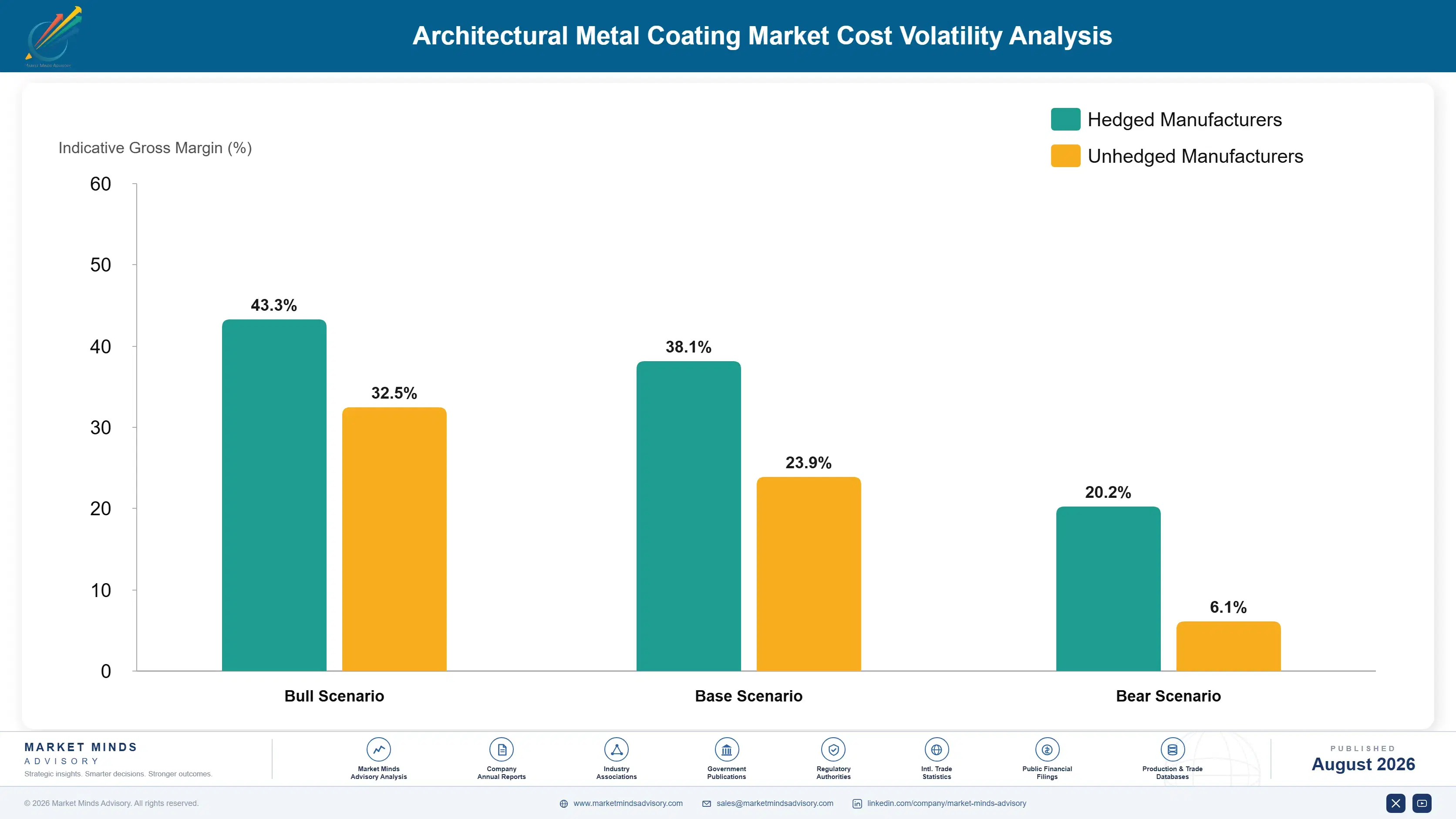
Coating production cost divides between binder resin at roughly 48%, pigments and effect materials near 22%, solvents and additives around 13% in liquid systems, packaging and distribution about 9%, and testing, labour, and overhead the balance. Fluoropolymer resin is the largest single exposure in premium systems and comes from a supply base considerably narrower than the coatings industry consuming it.
Titanium dioxide and fluoropolymer resin pricing both moved sharply through 2021 and 2022 as energy costs and feedstock availability tightened, and several coatings producers disclosed raw material cost pressure and pricing actions in filings covering those years. Specialty pigments for metallic and colour-matched architectural finishes moved further again. Pass-through into a market where prices are set at specification rather than at order took considerably longer than the cost movement did.

The competitive disadvantage mechanism runs through resin sourcing rather than through manufacturing scale. Standard polyester resins are widely available and priced similarly to every buyer, while fluoropolymer resin comes from a handful of producers and access terms differ materially between coatings companies. A supplier without secured fluoropolymer supply cannot serve premium specification at all, and that is exactly where warranty terms and margin both sit.
architectural-metal-coating-market-cost-volatility-analysis-1787302612751

Contract fluoropolymer resin supply on multi-year terms

Fluoropolymer resin comes from a handful of producers and is the largest single cost exposure in premium architectural systems, where warranty terms and margin both concentrate. Multi-year contracted supply secures both availability and pricing visibility against a narrow base. Spot purchasing works until it does not, and a supplier unable to deliver a specified premium system loses the

Write specification-stage pricing with raw material adjustment

Prices in architectural work are effectively set when the system is specified, which can be a year or more before the coating is ordered and applied. Raw material adjustment clauses referenced to the specification date shift that timing exposure to the party that controls the schedule. Contractors resist them and accept them more readily on projects where the

Qualify alternate pigment sources during formulation development

Pigments and effect materials carry around 22% of production cost and specialty architectural colours often depend on a single qualified source. Qualifying alternates during development costs testing time and avoids requalifying under supply pressure later, when the colour is already specified on a live project. Colour matching to an existing specified panel is considerably harder than developing a

Portfolio Architecture for Margin Defence

Three tiers describe this business and the spread follows warranty term rather than volume. Standard polyester coil coatings sit at the bottom, where the chemistry is settled, warranty terms are short, and price decides most orders. Super durable polyester and standard powder occupy the middle. Premium fluoropolymer coil and super durable powder sit at the top, where 40 year warranty terms and a decade of exposure data both apply.
The tension is that the bottom tier carries volume through industrial and lower specification building work and earns least, while the top tier carries the margin on volumes that depend on architectural specification the supplier does not control. A supplier weighted to premium is exposed to commercial construction cycles and to specification decisions made by consultants. One weighted to standard polyester competes on price against regional producers with lower cost bases.

High-value pools concentrate where the consequence of failure is severe. Premium facade fluoropolymer is the clearest case, since replacing a failed coating means replacing the facade, and that makes warranty term worth far more to the building owner than the coating's price difference ever was.

Volume / Commodity-Adjacent Tier

Standard polyester coil coatings for industrial cladding, roofing, and lower specification building work. Chemistry is settled, warranty terms are short, and regional producers compete on delivered price alone. Warranty backing confers little advantage here.
Gross Margin: 22-29%

Premium / Certified Tier

Super durable polyester coil and standard architectural powder where warranty terms and emission compliance both matter. Powder is growing fastest and shifting application value toward extruders operating their own lines.
Gross Margin: 30-38%

Sustainability / Regulatory / Next-Generation Tier

Premium fluoropolymer coil and super durable powder carrying warranty terms to forty years on a decade of exposure data. Best margin in the portfolio and the hardest position for any entrant to reach.
Gross Margin: 40-50%
architectural-metal-coating-market-portfolio-architecture-1787302613250

Specification, Approval, Reclad Cycles

Demand arrives through specification rather than through purchasing, which puts the commercial decision a year or more ahead of any order and in the hands of an architect or facade consultant who will never buy the material. Once specified, the coating ships against the project's coated area with no further selling activity. Suppliers who invest in specification relationships collect orders that competitors never see being decided.
Stickiness varies sharply by building type and by tier. Premium facade specifications are effectively locked once written, because substituting a coating means revisiting warranty terms with the building owner and no contractor wants that conversation. Industrial cladding sticks hardly at all and is retendered on price routinely. Renovation work sits between the two, with colour matching to existing panels adding friction that new build does not have.

Buyer profiles shifted as renovation grew and powder gained share. The earlier conversation was with an architect specifying a new commercial tower and a coil coater applying to order. The current one increasingly involves a building owner or facade consultant on a reclad, and an extruder operating its own powder line who is both applicator and customer at the same time.
architectural-metal-coating-market-end-use-penetration-index-1787302613743

What We Would Tell a Board

These are among the four positions where our research anticipates prominent divergence between winners and laggards over the coming forecast period. Each is grounded in the demand model, the regulatory perimeter, and the announced capacity pipeline.
01 / EXPOSURE PROGRAMME DISCIPLINE

Rack chemistries now or forfeit the next decade

Warranty terms rest on ten years of real time South Florida exposure, and no laboratory method, capital investment, or hiring decision compresses that requirement by a single month anywhere. A chemistry not on a rack today cannot carry a premium warranty until the middle of the next decade whatever happens in the meantime. Racking candidate systems speculatively costs very little indeed against the commercial option it quietly buys, and suppliers who treated exposure as a cost line have found themselves unable to answer.
02 / APPLICATOR NETWORK MANAGEMENT

The approval network is a commercial asset

Around 310 coil and spray lines worldwide can apply the highest specification systems, and that approval comes from the coating supplier because it warrants film performance on equipment somebody else owns entirely. Approve too widely and the position simply dilutes; approve too narrowly and regional volume goes straight to competitors holding approved capacity nearer the building itself. Treating approval as a technical formality rather than as a deliberate commercial decision wastes a position that competitors cannot replicate without building the same relationships themselves.
03 / POWDER CAPABILITY BUILDING

Powder is where the growth already went

Architectural powder grows at 8.7% against 5.8% for the wider market and has closed most of the durability gap that kept it out of premium facade specification for years. Formulation and the applicator relationships around it differ enough from liquid coil work that capability must be built rather than reallocated from existing lines. Liquid-weighted suppliers are defending share inside the shrinking half of their own market while extruders operating powder lines quietly capture application value that coil coaters used to hold.
04 / FLUOROPOLYMER SUPPLY SECURING

No fluoropolymer resin means no premium specification

Fluoropolymer resin comes from a handful of producers and represents the largest single cost exposure in premium architectural systems, where warranty terms and margin both concentrate heavily. A supplier without secured multi-year supply cannot serve premium specification reliably, and failing to deliver a specified system loses the specification rather than only the order. Access terms differ materially between coatings companies in ways that rarely become visible from outside, and they decide which suppliers can credibly bid premium facade work at all.

Engagement Snapshot From the Field

A live engagement with an industry participant carrying material or product regulatory and market exposure ahead of a defining policy shift, showing how our research translates into a defensible multi-year portfolio strategy.
MARKET MINDS ADVISORY · CLIENT ENGAGEMENT SUMMARY
Architectural Metal Coating Producer Strategic Portfolio Review and Transition Roadmap 2026·Investment Scenario on Architectural Metal Coating Exposure Evaluation 2025-26
CLIENT PROFILE
A regional architectural coatings producer with approximately 240 million dollars in annual revenue (client-reported, unverified by MMA), supplying polyester and super durable coil coatings to applicators across three countries. Powder capability was limited to a single low volume line, no fluoropolymer supply was contracted, and premium facade specification work had never been won against the global suppliers competing for it.
STRATEGIC CHALLENGE
The board wanted to know whether premium facade work was reachable at all, what it would take to get there, and whether powder was a better use of the same capital, given that both routes had been discussed internally for several years without resolution. Nobody had established why premium specifications were actually being lost.
MMA APPROACH
We assessed the client's exposure testing position against the warranty terms premium specification requires. Fluoropolymer resin access was reviewed with potential suppliers. Powder formulation capability was benchmarked against regional competitors, and specification win data was analysed to establish where the client was actually being excluded and why. Both routes were then costed against the same capital.
KEY FINDINGS
  1. The client held no exposure data beyond four years on any chemistry, which put premium fluoropolymer warranty terms at least six years away regardless of any other investment made.
  2. Specification losses traced almost entirely to warranty term rather than to price, formulation quality, or applicator relationships, which had been the internal assumption for years.
  3. Powder required no comparable exposure history at the specification levels the client actually served, making it reachable within eighteen months rather than within six years.
  4. Regional powder competitors were already established, but approved applicator capacity was short in two of the three countries the client served. That gap was reachable within the client's existing capability.
CLIENT PROFILE
A regional architectural coatings producer with approximately 240 million dollars in annual revenue (client-reported, unverified by MMA), supplying polyester and super durable coil coatings to applicators across three countries. Powder capability was limited to a single low volume line, no fluoropolymer supply was contracted, and premium facade specification work had never been won against the global suppliers competing for it.
STRATEGIC CHALLENGE
The board wanted to know whether premium facade work was reachable at all, what it would take to get there, and whether powder was a better use of the same capital, given that both routes had been discussed internally for several years without resolution. Nobody had established why premium specifications were actually being lost.
MMA APPROACH
We assessed the client's exposure testing position against the warranty terms premium specification requires. Fluoropolymer resin access was reviewed with potential suppliers. Powder formulation capability was benchmarked against regional competitors, and specification win data was analysed to establish where the client was actually being excluded and why. Both routes were then costed against the same capital.
KEY FINDINGS
  1. The client held no exposure data beyond four years on any chemistry, which put premium fluoropolymer warranty terms at least six years away regardless of any other investment made.
  2. Specification losses traced almost entirely to warranty term rather than to price, formulation quality, or applicator relationships, which had been the internal assumption for years.
  3. Powder required no comparable exposure history at the specification levels the client actually served, making it reachable within eighteen months rather than within six years.
  4. Regional powder competitors were already established, but approved applicator capacity was short in two of the three countries the client served. That gap was reachable within the client's existing capability.
RECOMMENDED STRATEGY
Phase 1: Phase 1 (months one to six): rack candidate fluoropolymer and super durable systems for exposure immediately, treating it as an option rather than a project. Phase 2: Phase 2 (months six to twenty-four): build powder capability and capacity, targeting the applicator shortage in the two undersupplied countries. Phase 3: Phase 3 (months twenty-four to seventy-two): revisit premium facade entry once exposure data matures and fluoropolymer supply is contracted. Treat it as an option rather than a plan.
OUTCOME
Exposure racking began within one quarter at minimal cost. Powder capacity investment was approved and commissioned inside eighteen months, and the premium facade ambition was formally deferred rather than continuing to absorb management attention it could not yet reward (client-reported, unverified by MMA). Specification loss analysis was adopted as a standing quarterly review.

Frequently Asked Questions

Foundational context covering the market sizes, CAGR, scope, country, region and competition that inform every finding below. This section is provided to cover basics and most often pre-purchase conversations, answered from the MMA Primary Research Dataset.

What is the current size of the Architectural Metal Coating Market?

The market is valued at USD 4.2 billion in 2025, rising to USD 4.44 billion in 2026. Scope covers coating systems supplied for architectural metal, not anodising, finished panels, or application equipment.

How large will the Architectural Metal Coating Market be by 2036?

MMA forecasts USD 7.80 billion by 2036, an increase of USD 3.36 billion over the 2026 base. That represents an expansion multiple of 1.76 times across the forecast period.

What is the CAGR for the Architectural Metal Coating Market 2026 to 2036?

The base case CAGR is 5.8%, with a bull case of 7.0% and a bear case of 4.6%. The historical rate from 2020 to 2025 was 4.8%, held down by commercial construction weakness.

Which segment is growing fastest?

Architectural powder coatings at 8.7%, exactly 1.50 times the market rate. Emission regulation and extruder preference for a process with no liquid waste stream both push the same direction.

Who are the major companies in the Architectural Metal Coating Market?

PPG Industries, AkzoNobel, Sherwin-Williams, Beckers Group, and Axalta Coating Systems lead on coated metal area supplied. The top five hold 54%, held there by warranty backing rather than formulation.

Which country is growing fastest?

India at 8.4%, where commercial construction and aluminium extrusion capacity are expanding together. Premium fluoropolymer specification is growing from a small base as international architects bring warranty expectations.

Report Segmentation Architecture

The full report scope spans multiple orthogonal segmentation dimensions, with cross-tabulated demand data provided for each dimension pair. Coverage extends further to regional breakdowns, trend trajectories, and the competitive detail needed to support segment-level decision-making.

By Coating Chemistry And System

  • Fluoropolymer Coil Coatings
  • Super Durable Polyester Coil Coatings
  • Standard Polyester Coil Coatings
  • Architectural Powder Coatings
  • Liquid Spray-Applied Architectural Systems

By End-Use Industry

  • Commercial Office And Curtain Wall
  • Data Centres, Logistics And Industrial Building
  • Residential Roofing And Siding
  • Facade Renovation And Overcladding
  • Institutional And Public Infrastructure

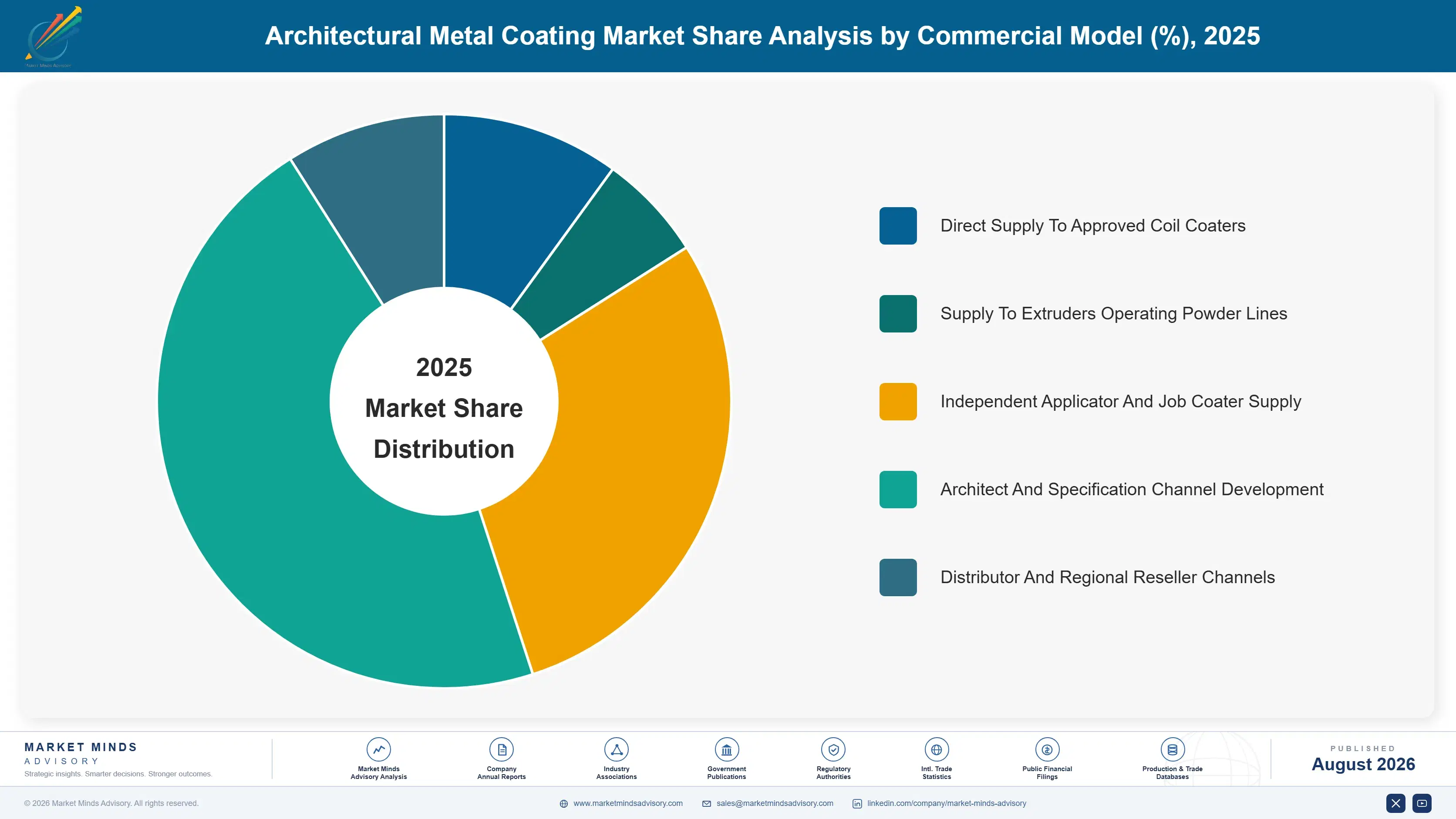
By Commercial Model

  • Direct Supply To Approved Coil Coaters
  • Supply To Extruders Operating Powder Lines
  • Independent Applicator And Job Coater Supply
  • Architect And Specification Channel Development
  • Distributor And Regional Reseller Channels

By Region

  • East Asia
  • North America
  • Western Europe
  • South Asia and Pacific
  • Middle East and Africa
  • Latin America
  • Eastern Europe

Scope, Methodology, and Coverage

Every figure in this report is reproducible from documented input assumptions. The scope below maps the historical period, the forecast horizon, the segmentation dimensions, and the countries covered, alongside the underlying primary and qualitative methodology.
Historical Period
2020 to 2025
Forecast Period
2026 to 2036
Base Year
2025 (USD billions; MMA Primary Research Dataset, August 2026)
Market Definition
This market comprises coating systems formulated and supplied for architectural metal building products, measured at coating supplier revenue across coil coater, extruder, independent applicator, specification, and distribution channels. Coverage spans fluoropolymer coil coatings, super durable polyester coil coatings, standard polyester coil coatings, architectural powder coatings including super durable powder chemistries, and liquid spray-applied architectural systems. Anodising, electrophoretic and other electrochemical finishes, coatings for non-architectural metal products, coil-coated substrates resold as finished panels or cassettes, sealants, gaskets and glazing systems, coating application and curing equipment, primer systems sold independently of topcoat specification, and industrial or automotive coatings applied to similar substrates fall outside scope.
Quantitative Units
USD billions (current prices); coated metal area in square metres; price per square metre by system; warranty term in years
Segmentation Dimensions
By Coating Chemistry And System; By End-Use Industry; By Commercial Model; By Region
Regions Covered
East Asia, North America, Western Europe, South Asia and Pacific, Middle East and Africa, Latin America, Eastern Europe
Countries Covered
China, Japan, South Korea, Taiwan, United States, Canada, Mexico, Germany, France, United Kingdom, Italy, Spain, Netherlands, India, Vietnam, Thailand, Australia, Brazil, Chile, Saudi Arabia, United Arab Emirates, South Africa, Poland, Czechia, Romania, and additional markets relevant to this sector
Key Companies Profiled
PPG Industries, AkzoNobel, Sherwin-Williams, Beckers Group, Axalta Coating Systems, BASF Coatings, Nippon Paint, Kansai Paint, Jotun, Tiger Coatings, IGP Pulvertechnik, Teknos, Hempel, Arkema, Daikin Industries, Asian Paints, Berger Paints, Meffert, Yung Chi Paint, Sika
Quantitative Methodology
Primary survey, n=3,800 respondents, Q4 2025, six countries; demand-side model with trade association cross-validation
Qualitative Methodology
47 expert interviews, Q4 2025; applied to validate demand model assumptions, identify emerging dynamics, and assess competitive positioning
Report Format
PDF and XLSX data workbook (Word format preview document)
Publisher
Market Minds Advisory
Report Code
MMA-2026-CHM-805
Published
August 2026
Contact
sales@marketmindsadvisory.com | www.marketmindsadvisory.com

Purchase the full Architectural Metal Coating Market Report (2026 to 2036).

The full report sizes architectural metal coating across five chemistry systems, five building end-uses, five commercial models, and seven regions, with warranty terms and the exposure data behind them assessed supplier by supplier. Approved applicator networks are mapped against regional demand, since that determines where premium specification volume can physically be served. Fluoropolymer resin access is reviewed as a distinct constraint on premium participation. Competitive profiling covers twenty suppliers on coated metal area, and powder capability is assessed separately from liquid coil positions. Regional demand is built from extrusion and construction geography rather than industrial output.
Warranty terms assessed against the exposure data actually supporting them
Approved applicator networks mapped against regional specification demand
Fluoropolymer resin access reviewed as a premium participation constraint
Powder capability assessed separately from established liquid coil positions
Facade renovation demand modelled independently of new construction activity
Specification win patterns analysed by warranty term

Built For The People Who Decide

From boardroom strategy to bench-side execution, this report is read cover-to-cover by leaders shaping the next decade of their industry, turning demand scenarios, market dynamics and valuation benchmarks into decisions.
CXOs/ Presidents/ VPs/ Managers
M&A and Corporate Development
Strategy Teams and R&D Heads
Procurement and Product Directors
Regulatory and Compliance Leaders
Investor Relations and Equity Analysts