Market Minds Advisory
Arborvitae Oil Market

Arborvitae Oil Market: From Sawmill Waste To Wellness Shelf: How Arborvitae Oil Became A Sandalwood Alternative

Arborvitae oil moves from a Pacific Northwest sawmill byproduct into a wellness and personal care ingredient, as CITES restrictions on sandalwood push aromatherapy brands toward a sustainable alternative distilled from lumber industry offcuts discarded.

Lead Analyst

Lisa Gevelber

Published

September 2026

Make Smarter Decisions with Customized Research Insights

Request a free sample report and evaluate market opportunities, growth trends, and competitive dynamics relevant to your business needs.

2025 MARKET VALUE$0.2BMarket Size 2025
2036 FORECAST VALUE$0.8BBase Case , 2026 to 2036
CAGR 2026 TO 203611.4 %Bull 12.8% / Bear 10.0%
INCREMENTAL OPPORTUNITY$0.5BNet 10- year value creation
EXPANSION MULTIPLE2.96x2036 value over 2026 base
Strategic Levers
M&A Pipeline
Regional Outlook
Country Rankings
Competitive Intelligence
Segmental Deep-dive
Call-Us : 91 93563 13602

Executive Snapshot and Market Trajectory

Arborvitae oil has moved from an obscure Pacific Northwest sawmill byproduct into a genuine wellness and fragrance ingredient, as CITES restrictions tightened global sandalwood supply and aromatherapy brands needed a sustainable, domestically sourced alternative distilled from lumber industry offcuts that sawmills once simply burned or discarded outright as pure waste.
The market stands at USD 0.24 billion in 2025 and reaches USD 0.80 billion by 2036 at an 11.4% CAGR. Cosmetic-grade refined oil grows fastest at 15.8%, about 1.39 times the overall rate, as mainstream personal care brands cross over from the aromatherapy channel. North America holds 48% of value on its near-total control of Western Red Cedar timber resources, while direct-sales distribution still dominates global sales volume across nearly every country tracked.
Concentration sits at a high 52%, dominated by direct-sales wellness companies that built entire product lines around one sustainably sourced oil few competitors could source at comparable cost. Buyers increasingly separate cosmetic-grade material from aromatherapy-grade oil, paying considerably more for documented purity and consistency than wellness packaging ever required. Pest control remains a genuinely underdeveloped opportunity most suppliers have not seriously pursued.
Market Definition
The arborvitae oil market covers essential oil steam-distilled or CO2-extracted from Thuja plicata wood, foliage, or sawmill byproduct, valued at the point of sale into aromatherapy, personal care, and pest-control applications. It excludes raw cedar lumber and wood products, finished cosmetic and cleaning products beyond the oil ingredient, and unrelated cedarwood oil species not derived from Thuja plicata.
Base Year Value
$0.2B in 2025 (MMA Primary Research Dataset, August 2026)
Forecast Period
2026 to 2036, eleven discrete annual values
CAGR
11.4% base case. Bull 12.8%. Bear 10.0%.
Fastest Growth Segment
Cosmetic-Grade Refined Arborvitae Oil: 15.8% CAGR
Fastest Growth Country
Canada: 16.5% CAGR
Fastest Growth Region
South Asia and Pacific: 13.4% CAGR
Largest Region
North America: 48% of 2025 global value
Market Leaders
doTERRA, Young Living, Rocky Mountain Oils, Plant Therapy, Eden Botanicals. Source: MMA Analysis based on company disclosures and industry reporting.
Primary Survey
n=3,800 procurement and R&D decision-makers, Q4 2025, six countries
Methodology
Demand-side build-up, cross-validated against public data, 47 expert interviews

Arborvitae Oil Market Forecast Scenarios

arborvitae-oil-market-size-forecast-scenario-1787463153164
Arborvitae oil compounded near 10.2% from 2020 to 2025, a period dominated almost entirely by direct-sales aromatherapy channel growth as doTERRA and Young Living both expanded distributor networks globally. CITES tightening on Indian and Australian sandalwood species after 2019 pushed several fragrance and cosmetic formulators to evaluate arborvitae oil as a domestic substitute earlier than the category's own marketing had achieved alone.
Three mechanisms carry the base case to 11.4%. First, personal care brands are substituting arborvitae oil for scarcer sandalwood and cedarwood species in formulations, a swap requiring genuine reformulation but no new sourcing infrastructure. Second, direct-sales wellness companies continue expanding distributor networks into new countries, extending a distribution model already proven at scale. Third, pest control and natural cleaning brands are beginning to specify arborvitae oil for its documented insect-repellent properties, a use case still largely untapped commercially.
The bull case at 12.8% assumes mainstream personal care crossover accelerates as cosmetic-grade supply scales and pricing becomes more competitive against synthetic sandalwood and cedarwood alternatives already established in fragrance formulations. The bear case at 10.0% assumes growth stays concentrated in the direct-sales aromatherapy channel, which has historically grown distributor count in recruitment cycles rather than a smooth continuous curve.

Why A Sawmill Byproduct Became A Wellness Ingredient

Three forces converge on arborvitae oil today. Sandalwood scarcity under CITES protection makes a documented, sustainably sourced substitute genuinely valuable to fragrance and cosmetic formulators who previously had few real alternatives with a comparable aromatic profile. Direct-sales wellness companies built an entire consumer education campaign around the oil's sourcing story, and pest control brands want a natural insect-repellent ingredient consumers already recognize by name from years of aromatherapy use.
MARKET CONCENTRATIONCR5: 52%Direct-sales wellness companies dominate global distribution volume entirely
COSMETIC GRADE PRICE PREMIUM2 to 4x aromatherapy gradeRefined purity commands meaningfully higher formulation pricing overall
TOP PRODUCING COUNTRY SHAREUSA: ~62% of global distillationWestern Red Cedar resource concentrates overwhelmingly in one country
DISTILLATION CAPACITY UTILISATION55% to 70%Steam distillation lines run considerably below full capacity
FEEDSTOCK SHARE OF COGS20% to 35% (byproduct input)Sawmill byproduct arrives cheap; labor and energy dominate
DIRECT-SALES CHANNEL SHARE60% to 70% of volumeMulti-level marketing still moves most global sales volume
The commercial character remains closer to a direct-sales consumer product than a traditional specialty chemical ingredient, since most volume still moves through wellness company distributor networks rather than open ingredient markets most formulators would otherwise expect. A genuine cosmetic and fragrance ingredient channel is emerging alongside it, where formulators buy refined material directly from distillers rather than through a wellness brand's retail packaging and marketing overhead.
The next decade turns on whether arborvitae oil breaks out of the direct-sales channel into mainstream cosmetic, fragrance, and pest-control formulation at meaningful volume, or remains substantially a wellness-company product indefinitely. Pacific Northwest distillation capacity is the physical constraint either growth path ultimately depends on, regardless of how demand evolves.
"This is sawmill waste that somebody turned into a nine-figure category through sheer distribution muscle. The sourcing story is genuinely good, but the real test is whether formulators outside the wellness aisle start buying it on its own merits."
Director, Natural Ingredients and Fragrance Chemistry Practice · MMA Chemicals and Materials / Natural Essential Oils and Fragrance Ingredients Practice · August 2026

Market Trends

Sandalwood Scarcity Pushes Formulators Toward Arborvitae Oil

CITES protection on Indian sandalwood and mounting harvest restrictions on Australian sandalwood species have tightened global sandalwood oil supply considerably since 2019, pushing fragrance houses and cosmetic formulators to evaluate domestic alternatives with a comparable woody-warm olfactory profile. Arborvitae oil, distilled from Western Red Cedar sawmill byproduct, offers a genuinely sustainable sourcing story that sandalwood, harvested from slow-growing wild and plantation trees, increasingly cannot match. Robertet and Symrise have both begun incorporating arborvitae oil into fragrance formulations specifically as a partial sandalwood replacement, a substitution that was barely discussed commercially before 2020 at any meaningful scale.
Market Impact: Costs 20% to 35% of sandalwood
Direct-Sales Wellness Companies Expand Distributor Networks Globally

doTERRA and Young Living both continue expanding their distributor networks into new countries, extending a direct-sales model that has proven remarkably effective at building consumer awareness for a previously obscure essential oil. The model carries real limitations, since distributor count grows in recruitment cycles rather than smoothly, and both companies have faced periodic regulatory scrutiny in several markets over multi-level marketing compensation structures generally. Even so, the direct-sales channel remains responsible for the large majority of global arborvitae oil volume, and any slowdown in distributor growth would meaningfully affect overall category demand across every downstream use case.
Market Impact: Built brand awareness across 60+ countries

Market Opportunities and Growth Drivers

Fragrance Formulators Substitute Arborvitae For Scarce Sandalwood

Sandalwood oil price has risen considerably as CITES protection and harvest restrictions tightened supply from India and Australia, the two dominant historical sources, pushing fragrance and cosmetic formulators to actively seek alternatives with a comparable woody-warm profile. Arborvitae oil offers a genuinely sustainable domestic sourcing story built on sawmill byproduct rather than harvested wild or plantation trees, a distinction increasingly valuable to brands facing sustainability scrutiny from both regulators and consumers. Robertet and Symrise have both incorporated arborvitae oil into fragrance formulations as a partial sandalwood substitute, a commercial application that barely existed before 2020 at meaningful volume.
Market Impact: Direct sales moves 65% of demand

Direct-Sales Companies Build Consumer Awareness At Scale

doTERRA built its entire arborvitae oil product line around a sourcing story tying the oil directly to Pacific Northwest sawmill byproduct, educating millions of distributors and consumers about an essential oil that had essentially no consumer recognition before the company's marketing campaign began. Young Living has pursued a comparable strategy through its owned-farm sourcing narrative, though with less specific focus on arborvitae itself. This distributor-driven education model achieved consumer awareness levels no traditional ingredient marketing budget could realistically have funded, and it remains the primary reason arborvitae oil has any retail consumer recognition at all today.
Market Impact: Byproduct feedstock costs vary 20% yearly

Market Restraints and Challenges

Direct-Sales Channel Dependence Creates Genuine Demand Fragility

The large majority of arborvitae oil volume still moves through direct-sales distributor networks, which grow in recruitment cycles rather than a smooth curve and have faced periodic regulatory scrutiny over multi-level marketing structures in several countries. The root cause is that the category never fully established an independent open-market ingredient channel; most consumers discover the oil through a distributor rather than a retail shelf or formulator relationship. The impact is that any slowdown in recruitment, or adverse regulatory action against the dominant companies, would disproportionately affect overall demand. Suppliers are responding by building relationships with formulators outside the wellness channel.
Market Impact: Sandalwood substitution demand grows 13% annually

Pacific Northwest Timber Supply Constrains Raw Material

Arborvitae oil supply depends on Western Red Cedar timber harvest and sawmill activity, driven primarily by lumber market demand rather than by essential oil demand, leaving oil producers as a genuine price-taker on their own feedstock. The root cause is that nobody harvests Western Red Cedar specifically for its oil yield, since lumber value vastly exceeds oil value per tree. The impact is that oil supply can tighten during lumber downturns when sawmill activity slows, regardless of how strong ingredient demand happens to be. Some distillers are responding by securing dedicated byproduct supply contracts directly with major sawmill operators.
Market Impact: Direct sales moves 65% of volume
3 additional market trends, 4 additional growth drivers, and 2 additional restraints and challenges are covered in the full report. Contact sales@marketmindsadvisory.com to access the complete intelligence.

Segment CAGR and Growth Architecture

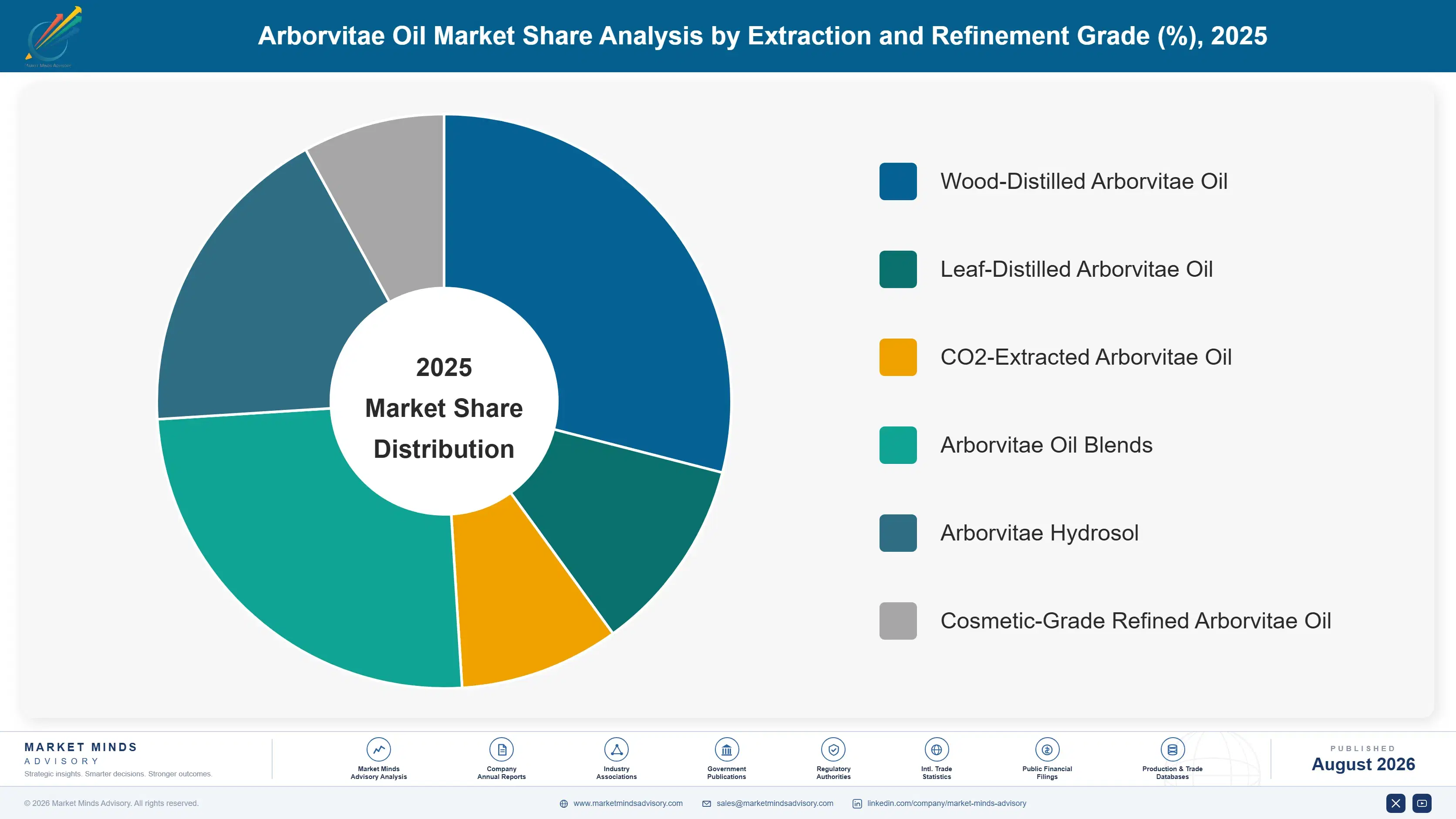
Segmentation follows extraction and refinement grade, the single classification logic separating how arborvitae oil is processed before sale. Wood-distilled, leaf-distilled, CO2-extracted, blended, hydrosol byproduct, and cosmetic-refined oil each carry distinct extraction cost, purity, and buyer type. End-use industry and distribution channel sit separately within the framework rather than being folded into this same hierarchy.
arborvitae-oil-market-market-share-analysis-1787463153748

Cosmetic-Grade Refined Arborvitae Oil

Cosmetic-grade refined arborvitae oil grows fastest at 15.8%, about 1.39 times the overall 11.4% rate, as mainstream personal care and skin-care brands cross over from the aromatherapy channel and specify tighter purity and consistency than direct-sales wellness packaging ever required. Refining removes trace compounds that can irritate sensitive skin, a step aromatherapy-grade oil sold through wellness channels typically skips entirely. Rocky Mountain Oils and Eden Botanicals both supply cosmetic-grade material to formulators outside the direct-sales channel, a customer base considerably more price-sensitive but also far larger in aggregate volume potential. The segment remains small today relative to aromatherapy-grade volume, but growth reflects genuine category expansion beyond its historical wellness-company customer base into mainstream personal care manufacturing.
CAGR 15.8%

CO2-Extracted Arborvitae Oil

CO2-extracted arborvitae oil grows second-fastest at 13.2%, roughly 1.16 times the overall rate, as fragrance houses and premium formulators specify CO2 extraction for its cleaner, more complete aromatic profile compared with steam distillation. The extraction method costs considerably more than steam distillation but avoids the heat degradation that alters certain aromatic compounds, a distinction that matters to fragrance chemists building precise formulations. Robertet and Symrise both source CO2-extracted material specifically for fine fragrance applications where formulation precision commands a genuine price premium over bulk aromatherapy-grade oil. Supply remains limited by the small number of distillers operating CO2 extraction equipment, which costs considerably more than standard steam distillation infrastructure most producers already have in place.
CAGR 13.2%
Full segment breakdown across 6 segments available in the complete report.

Regional Architecture and Country Demand Map

North America leads overwhelmingly on Western Red Cedar timber resource concentration, while direct-sales distributor networks in Western Europe and South Asia and Pacific extend consumption well beyond the raw material's home region. East Asia and Latin America sit below their usual bands given limited distributor and formulator-channel maturity.

North America

Western Red Cedar timber resources concentrate overwhelmingly in the Pacific Northwest, giving North America 48% of value, far above the 22 to 32% band, because the United States and Canada together supply nearly all commercially distilled arborvitae oil. doTERRA and Young Living both operate substantial sourcing and distillation relationships across Washington State and British Columbia sawmill operations. Liberty Natural Products and other regional distillers supply both wellness companies and the growing independent fragrance and cosmetic ingredient channel. The share sits far above its usual band because raw material geography, not just consumption, concentrates almost entirely in this one region, a genuine resource case rather than a modeling artifact. Growth of 11.8% reflects both continued direct-sales expansion and emerging cosmetic-grade demand.
Share: 48% | CAGR: 11.8% (2026 to 2036)

Western Europe

Direct-sales distributor networks and a substantial cosmetic and fragrance manufacturing base give Western Europe 20% of value, within the 18 to 26% band, despite the region growing no Western Red Cedar commercially and depending entirely on imported North American oil for essentially all its supply. Robertet and Symrise both incorporate arborvitae oil into fragrance formulations at their French and German facilities, serving fine fragrance and cosmetic customers outside the direct-sales channel entirely. doTERRA and Young Living distributor networks are well established across major European markets, extending penetration achieved earlier in North America. Growth of 9.9%, the slowest of the seven regions, reflects a market already relatively mature in direct-sales penetration, with cosmetic-grade crossover growing more gradually than in North America.
Share: 20% | CAGR: 9.9% (2026 to 2036)
Regional intelligence for 5 additional markets available in the complete report: East Asia, South Asia and Pacific, Latin America, Middle East and Africa, Eastern Europe. Contact sales@marketmindsadvisory.com.
arborvitae-oil-market-country-cagr-analysis-1787463154284

Where Arborvitae Oil Suppliers Capture More Value

Selling arborvitae oil purely through direct-sales wellness packaging caps how much of the category's real addressable market a distiller ever genuinely reaches beyond that one channel. The four moves below focus on cosmetic-grade refinement, CO2 extraction investment, direct fragrance-formulator relationships, and dedicated sawmill byproduct contracting that secures supply ahead of lumber market cycles entirely.

Refine Material To Cosmetic-Grade Purity Specification

Aromatherapy-grade oil sold through direct-sales wellness packaging carries looser purity specifications than cosmetic formulators require for a product applied directly to skin at scale. Distillers able to invest in additional refinement steps that remove trace irritant compounds can access cosmetic-grade pricing running 2 to 4 times aromatherapy-grade value, a considerably larger and more diversified customer base than the direct-sales channel alone provides. Rocky Mountain Oils and Eden Botanicals both built dedicated cosmetic-grade product lines separate from bulk aromatherapy supply. The refinement investment is modest relative to the price differential it captures across a distiller's output.
Market Impact: Commands a 2x to 4x cosmetic-grade price premium

Invest In CO2 Extraction For Fragrance-Grade Material

Fine fragrance formulators pay a genuine premium for CO2-extracted material over standard steam-distilled oil, since CO2 extraction avoids the heat degradation that alters certain aromatic compounds fragrance chemists specifically value. The equipment investment runs considerably higher than steam distillation infrastructure, which limits the number of distillers able to serve this premium channel directly. Robertet and Symrise both pay meaningfully above standard aromatherapy-grade pricing for CO2-extracted material meeting their formulation specifications precisely. Distillers already operating steam distillation capacity can add CO2 extraction incrementally, capturing fine fragrance demand that steam-distilled material alone cannot access at comparable pricing.
Market Impact: Commands a 25% to 40% fragrance-grade price premium

Build Direct Relationships With Fragrance Formulators

Selling exclusively through direct-sales wellness packaging or generic bulk essential oil brokers caps how much of the category's addressable market a distiller ever reaches beyond the aromatherapy channel itself. Contracting directly with fragrance houses and cosmetic formulators willing to commit to multi-year supply agreements captures margin that previously went to intermediary brokers, often 15% to 25% of delivered value. Robertet and Symrise both source directly from Pacific Northwest distillers rather than through bulk essential oil trading channels. Direct relationships also give distillers demand visibility supporting distillation capacity planning against sawmill byproduct availability.
Market Impact: Cuts broker margin by roughly 15% to 25%

Secure Dedicated Sawmill Byproduct Supply Contracts

Arborvitae oil supply depends entirely on Western Red Cedar sawmill activity driven by lumber demand, leaving distillers without dedicated supply contracts exposed to feedstock cost swings of 20% or more during lumber cycles they do not control. Distillers securing multi-year byproduct supply agreements directly with major sawmill operators lock in feedstock access and pricing ahead of these swings, converting an unpredictable input into a plannable one. Liberty Natural Products has pursued exactly this approach across several Pacific Northwest relationships. The contracting effort requires genuine relationship-building with an industry that has historically treated oil distillers as a minor byproduct customer.
Market Impact: Locks in feedstock cost within a 20% band

Who Controls the Margin Pool

Concentration sits at a high 52%, dominated by direct-sales wellness companies that built entire consumer product lines around a single sustainably sourced oil few competitors could match at comparable distribution scale. All participants are assessed on one basis: attributable arborvitae oil revenue across direct-sales, cosmetic, and fragrance channels.
Competition runs along three lines. First, distribution reach, since direct-sales companies with established distributor networks command consumer awareness no traditional ingredient marketing budget could replicate. Second, extraction and refinement capability, where cosmetic-grade purity and CO2 extraction separate specialty suppliers from bulk aromatherapy sellers. Third, sawmill relationships, as distillers with dedicated byproduct supply contracts avoid the feedstock volatility open-market buyers face directly.

Pressure is building from two directions. Fragrance houses including Robertet and Symrise are building direct Pacific Northwest sourcing relationships that bypass the direct-sales wellness channel entirely, competing for the same limited sawmill byproduct supply. Meanwhile smaller regional distillers are attempting to enter the cosmetic-grade channel directly rather than selling bulk material to the dominant wellness companies at commodity pricing. Rankings should favor participants holding both distribution reach and refinement capability over those dependent on a single channel or a single sawmill relationship.
arborvitae-oil-market-company-positioning-matrix-1787463154820

Competitive Moat and Risk Dimensions

DOTERRA

Moat: Built the category's consumer awareness

doTERRA built arborvitae oil's entire consumer identity through its distributor network marketing, turning an essentially unknown sawmill byproduct into a recognized wellness product few competitors can match on brand recognition or awareness. That awareness gives it pricing power smaller distillers selling unbranded bulk oil simply cannot access on their own.
DOTERRA

Risk: Regulatory scrutiny of MLM structure

doTERRA's direct-sales compensation structure has faced periodic regulatory scrutiny in several countries over multi-level marketing practices generally, and any adverse regulatory action against the company's core distribution model would disproportionately affect arborvitae oil demand given the category's outsized dependence on this single sales channel today.
YOUNG LIVING

Moat: Owned-farm sourcing narrative

Young Living's Seed to Seal sourcing programme, built around owned and partner farms, gives it a supply chain narrative competitors selling third-party bulk oil cannot easily replicate, supporting premium pricing within its own large distributor network specifically and consistently over many years of accumulated trust.
YOUNG LIVING

Risk: Less arborvitae-specific brand focus

Young Living has pursued a broader owned-farm sourcing story across many essential oils rather than building the same singular consumer association with arborvitae oil specifically that doTERRA achieved, leaving it somewhat less positioned to capture premium pricing in this particular category compared with its rival.

Players Tracked

Prominent Players

doTERRA
Young Living
Rocky Mountain Oils
Plant Therapy
Eden Botanicals

Other Key Players

Mountain Rose Herbs
Aura Cacia
Frontier Co-op
Edens Garden
Camden-Grey Essential Oils
Liberty Natural Products
SVA Organics
Berje Inc
Robertet
Symrise
NOW Foods
New Directions Aromatics
Jedwards International
Plant Guru
Bulk Apothecary

Recent Developments

APRIL 2024

doTERRA expands arborvitae oil sourcing partnership in Washington State

doTERRA announced an expanded sourcing and supply partnership with several Pacific Northwest sawmill operators in Washington State, securing additional Western Red Cedar byproduct volume to meet growing global distributor demand. This was a supply agreement expansion, not an acquisition or joint venture with another company.
Signal: Securing dedicated byproduct supply ahead of demand growth shows the category's leading company defending feedstock access proactively.
OCTOBER 2023

Young Living expands cedarwood and arborvitae distillation capacity

Young Living announced expanded steam distillation capacity at its Pacific Northwest facilities, adding output for arborvitae and related cedarwood essential oils under its established Seed to Seal sourcing programme. This was an organic capacity expansion funded from existing operations, not an acquisition or joint venture.
Signal: Capacity investment inside an owned-farm sourcing model signals distributors expect continued volume growth well beyond current levels.
JUNE 2024

Liberty Natural Products expands Pacific Northwest distillation capacity

Liberty Natural Products announced expanded steam distillation capacity at its Oregon facility, adding output to serve growing fragrance and cosmetic-grade demand outside the direct-sales wellness channel entirely and independently. This was an organic capacity expansion funded from existing operations, not an acquisition or joint venture.
Signal: An independent distiller expanding capacity for non-wellness customers confirms genuine demand is emerging outside the direct-sales channel.

Sawmill Byproduct And Distillation Energy

Sawmill byproduct feedstock runs 20% to 35% of cost of goods sold, considerably lower than most essential oil categories since the raw material arrives as a byproduct rather than a purpose-grown crop. Distillation energy and labor instead dominate cost structure, running 40% to 55% of total production cost, concentrated at Pacific Northwest facilities in Washington, Oregon, and British Columbia.
Pacific Northwest lumber markets softened considerably through 2023 as housing construction activity slowed, reducing sawmill throughput and tightening arborvitae byproduct availability even as ingredient demand kept growing steadily. Several distillers reported feedstock cost increases of 20% or more during the period as available byproduct volume fell relative to distillation capacity built during the category's earlier growth years. Lumber market recovery through 2024 partially eased this constraint, though byproduct availability remains tied to construction cycles distillers cannot influence directly.

Exposure separates distillers by sawmill relationship depth rather than scale alone. Distillers holding dedicated multi-year byproduct contracts with major sawmill operators avoided the sharpest of the 2023 tightening, while those buying byproduct on an ad hoc basis faced the steepest availability and cost pressure. Geographic proximity to multiple sawmill operations also matters, since byproduct spoils quickly and cannot economically travel far.
arborvitae-oil-market-cost-volatility-analysis-1787463155015

Contract sawmill byproduct on multi-year supply agreements

Distillers buying byproduct on an ad hoc basis faced the sharpest availability and cost pressure during the 2023 lumber market slowdown, while competitors holding dedicated supply contracts with sawmill operators weathered the tightening considerably better. Locking byproduct access and pricing ahead of lumber market cycles converts an unpredictable input into a plannable one across production planning horizons.

Locate distillation capacity near multiple sawmill operations

Byproduct spoils quickly and cannot economically travel far before distillation, so distillers located near a single sawmill operation carry concentrated supply risk if that facility reduces output or closes entirely. Locating capacity within reach of several sawmill operations simultaneously diversifies feedstock access without requiring any single dedicated supply contract to carry the full burden.

Diversify into leaf and foliage distillation alongside wood

Wood byproduct availability tracks lumber market cycles directly, but foliage and leaf material can be harvested somewhat independently of sawmill throughput, offering distillers a partial hedge against wood byproduct tightening during a downturn. The resulting oil carries a different aromatic profile suited to different applications, which also diversifies the product range distillers can offer formulators directly.

Portfolio Architecture for Margin Defence

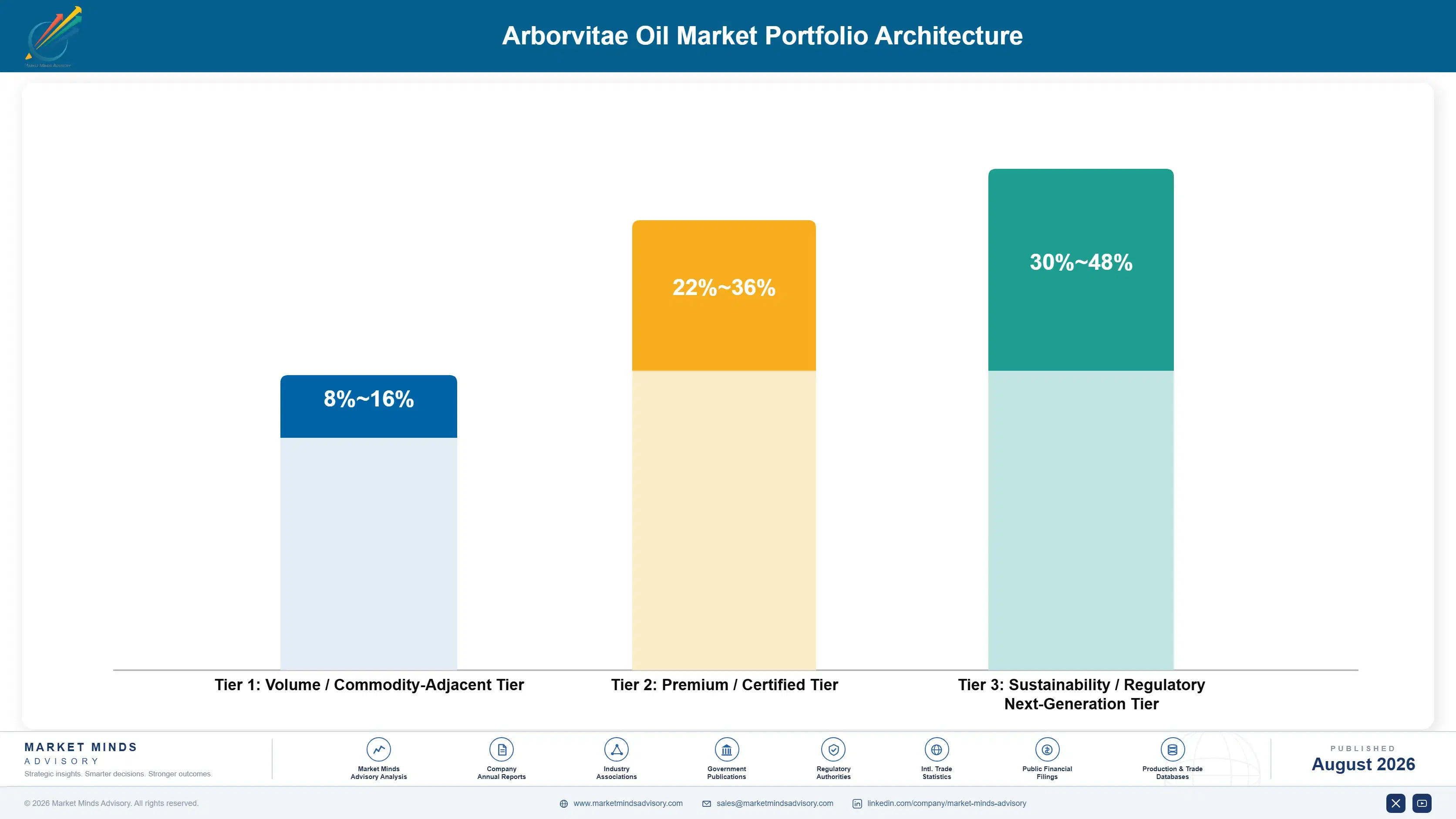
The portfolio splits into three tiers by refinement and channel positioning. Bulk aromatherapy-grade oil sold through direct-sales wellness packaging competes largely on brand and distribution rather than ingredient differentiation. Cosmetic-grade refined oil sold to formulators outside the wellness channel earns considerably more, since purity and consistency documentation carry real value. CO2-extracted fragrance-grade material sits at the top, priced against fine fragrance ingredient economics rather than wellness retail benchmarks.
The tension runs between direct-sales volume that built the category's consumer awareness and the margin available in cosmetic and fragrance channels most distillers have barely begun to serve. Wellness-channel sales fund distillation capacity but flow mostly to the dominant companies rather than independent distillers. Cosmetic and fragrance-grade volume carries better returns but depends on refinement infrastructure and formulator relationships smaller distillers often lack. Producers weighting entirely toward wellness-channel bulk sales carry real exposure to distributor recruitment cycles.

High-value pools concentrate wherever a buyer needs a documented attribute: cosmetic-grade purity for skin-applied formulations, CO2-extracted precision for fine fragrance, or dedicated byproduct sourcing for sustainability-focused brand positioning. Bulk aromatherapy-grade oil sold through commodity wellness channels competes largely on distribution reach and generally earns the thinnest margin per unit across the category.

Volume / Commodity-Adjacent Tier

Bulk aromatherapy-grade oil sold through direct-sales wellness packaging, priced against distribution and brand value rather than ingredient differentiation. Margins for independent distillers stay thin since dominant wellness companies capture most retail value.
Gross Margin: 8-16%

Premium / Certified Tier

Cosmetic-grade refined oil sold to formulators outside the wellness channel, commanding a real premium because buyers pay for documented purity and consistency rather than brand story alone, at meaningfully higher volume than aromatherapy packaging ever moves.
Gross Margin: 22-36%

Sustainability / Regulatory / Next-Generation Tier

CO2-extracted fragrance-grade material sold to fine fragrance houses, priced against specialty fragrance ingredient economics given the extraction investment and formulation precision required to earn this premium grade at genuine commercial scale.
Gross Margin: 30-48%
arborvitae-oil-market-portfolio-architecture-1787463155524

High-value Sub-segments and Strategic Watch-out

Cosmetic-Grade Refined Arborvitae Oil

High value and the fastest growth at 15.8%, driven by mainstream personal care brands crossing over from the aromatherapy channel into broader retail formulation at scale. Rocky Mountain Oils and Eden Botanicals both supply formulators outside the direct-sales wellness channel at meaningful and steadily growing volume.
Gross Margin: 22-36%

CO2-Extracted Arborvitae Oil

High value with strong growth at 13.2%, serving fine fragrance houses specifying CO2 extraction for its cleaner, more complete aromatic profile than steam distillation ever offers. Robertet and Symrise both pay meaningfully above standard pricing for material meeting their precise formulation specifications consistently and reliably.
Gross Margin: 30-48%

Wood-Distilled Arborvitae Oil

The volume core at 9.5% growth, the slowest of the six segments, built on established direct-sales wellness demand and decades of steam distillation infrastructure already in place across the Pacific Northwest region. Growth now tracks broader direct-sales expansion rather than outpacing it meaningfully at all.
Gross Margin: 8-16%

Arborvitae Hydrosol

The strategic watch-out at 8.2% growth, constrained by limited consumer awareness of hydrosol as a distinct product and by low per-unit value that makes it a byproduct-of-a-byproduct most distillers barely bother marketing separately, treating it instead as an incidental output of the primary distillation process.
Gross Margin: 10-18%

Why Distributor Relationships Compound Slowly

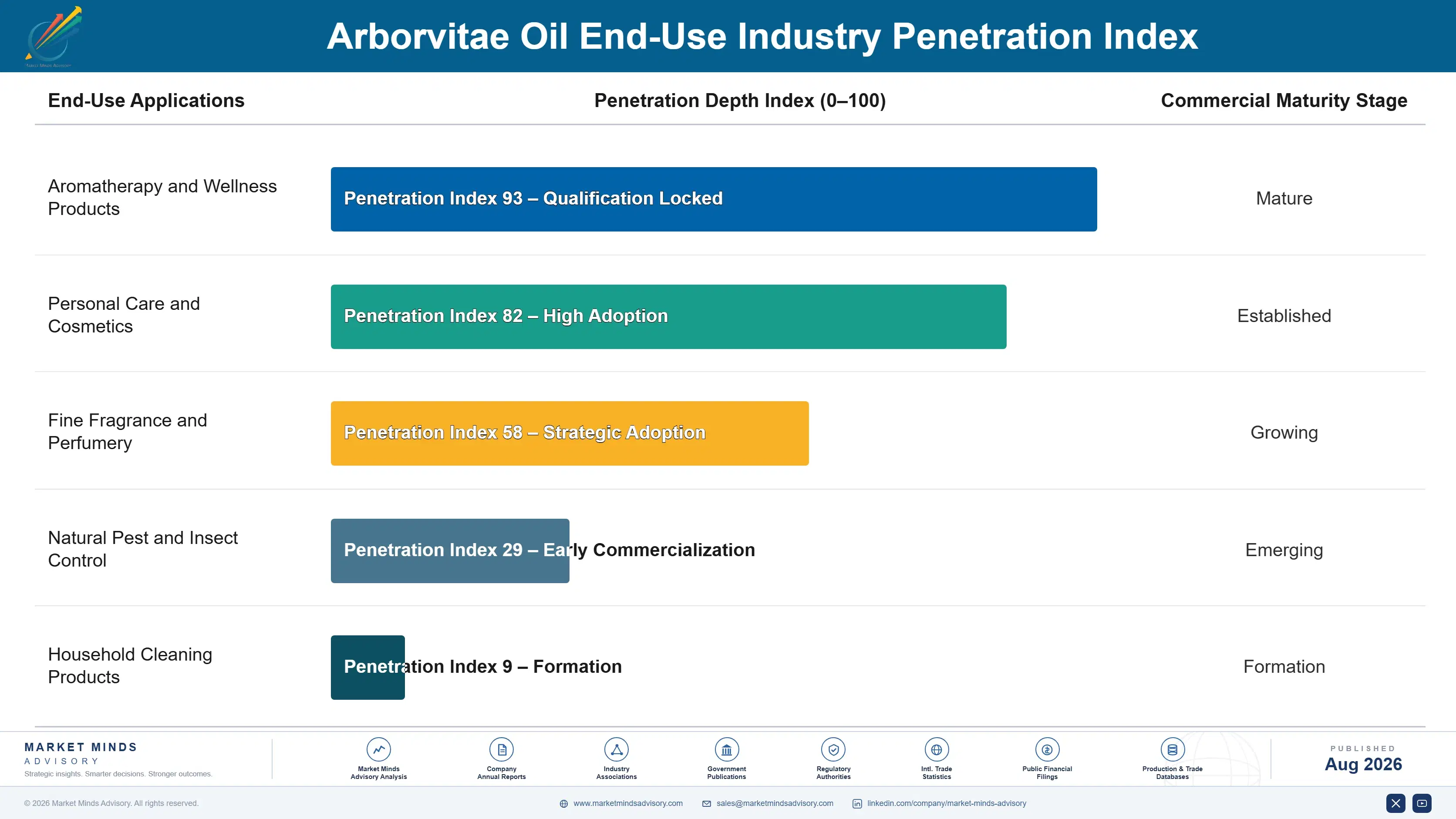
A distributor who builds a customer base around a specific wellness brand's arborvitae oil rarely switches brands afterward, since doing so means rebuilding trust and product familiarity with an established customer relationship built over years of personal selling. That switching cost behaves like an annuity for the dominant direct-sales companies, converting early distributor recruitment into years of recurring product sales rather than a one-time transaction that competitors could easily contest.
Adoption depth varies considerably by channel. Direct-sales wellness adoption runs deepest, since distributors build entire personal identities and income streams around specific product lines they will not casually abandon for a competitor. Fragrance and cosmetic formulator adoption follows a steadier, specification-driven pattern tied to sandalwood substitution economics rather than any brand loyalty whatsoever. Pest control and cleaning applications remain earliest-stage, with most brands still unaware arborvitae oil offers documented insect-repellent properties at all.

Buyer profiles have shifted from wellness distributors discovering a new product toward fragrance chemists and cosmetic formulators specifying arborvitae oil for its sustainability story and sandalwood-substitution economics as much as its aroma. Younger formulators increasingly research sourcing transparency directly rather than relying solely on a wellness brand's marketing narrative or distributor pitch.
arborvitae-oil-market-end-use-penetration-index-1787463156023

Our Call On Arborvitae Oil

These are among the four positions where our research anticipates prominent divergence between winners and laggards over the coming forecast period. Each is grounded in the demand model, the regulatory perimeter, and the announced capacity pipeline.
01 / DIRECT SALES BUILT CATEGORY

One distribution model still explains most of the demand

Direct-sales wellness companies built arborvitae oil's entire consumer identity through distributor network marketing, turning an obscure sawmill byproduct into a recognized wellness product in barely a decade of concentrated effort. That concentration is also the category's central vulnerability, since any slowdown in distributor recruitment or adverse regulatory action against multi-level marketing structures would disproportionately affect overall demand across every downstream channel. Suppliers should actively diversify into cosmetic and fragrance channels now, rather than treating direct-sales dependence as a permanent, unshakeable advantage.
02 / SANDALWOOD SCARCITY DRIVES DEMAND

CITES restrictions created a genuine formulation opportunity

CITES protection and harvest restrictions have tightened global sandalwood supply considerably since 2019, pushing fragrance houses and cosmetic formulators toward arborvitae oil as a domestically sourced alternative with a comparable woody-warm profile and a genuinely defensible sustainability story. Robertet and Symrise have both incorporated it into fragrance formulations, a substitution barely discussed commercially before 2020 at any meaningful scale. Formulators still relying entirely on scarce sandalwood should evaluate arborvitae oil now, before further CITES tightening raises switching costs considerably higher.
03 / TIMBER SUPPLY SETS CEILING

Sawmill byproduct availability, not demand, is the real constraint

Arborvitae oil supply depends entirely on Western Red Cedar sawmill activity driven by lumber market demand rather than by ingredient demand, leaving distillers as price-takers on their own feedstock during construction market downturns they cannot influence. The 2023 lumber slowdown demonstrated this exposure directly, tightening byproduct availability even as ingredient demand kept growing steadily throughout the same period across every channel. Distillers should secure dedicated multi-year byproduct supply contracts now, ahead of the next inevitable lumber market cycle and its inevitable tightening.
04 / COSMETIC CROSSOVER OPENS VOLUME

Refinement investment, not marketing, is what wins this channel

Cosmetic-grade refined oil grows at nearly one and a half times the overall category rate, as mainstream personal care brands cross over from the aromatherapy channel and specify tighter purity than direct-sales wellness packaging ever required. Rocky Mountain Oils and Eden Botanicals both built dedicated cosmetic-grade lines separate from bulk aromatherapy supply, capturing a customer base considerably larger than the direct-sales channel alone. Distillers without refinement capability should treat it as a near-term investment priority rather than an optional upgrade.

Engagement Snapshot From the Field

A live engagement with an industry participant carrying material or product regulatory and market exposure ahead of a defining policy shift, showing how our research translates into a defensible multi-year portfolio strategy.
MARKET MINDS ADVISORY · CLIENT ENGAGEMENT SUMMARY
Arborvitae Oil Producer Strategic Portfolio Review and Transition Roadmap 2026·Investment Scenario on Arborvitae Oil Exposure Evaluation 2025-26
CLIENT PROFILE
An independent Pacific Northwest essential oil distiller supplying primarily aromatherapy-grade arborvitae oil to direct-sales wellness companies engaged MMA amid growing concern about customer concentration. The client reported annual revenue near USD 18 million and sold roughly 85% of output to two wellness company customers under short-term purchase orders, with leadership seeking to diversify into cosmetic and fragrance channels (client-reported, unverified by MMA).
STRATEGIC CHALLENGE
Management could not agree whether to invest in cosmetic-grade refinement capability, CO2 extraction equipment, or both simultaneously, given limited capital and uncertainty about which channel would actually absorb meaningful volume. The board also worried that pursuing new channels too aggressively might damage the wellness-company relationships still generating the large majority of current revenue.
MMA APPROACH
MMA modeled the capital cost and realistic revenue ramp for cosmetic-grade refinement versus CO2 extraction investment separately, benchmarking pricing and demand signals from six fragrance and cosmetic formulators willing to discuss sourcing interest. We also assessed how much diversification the client's two wellness-company customers would tolerate without disrupting the existing purchase order relationship.
KEY FINDINGS
  1. Cosmetic-grade refinement required roughly USD 800,000 in capital investment against CO2 extraction's USD 2.4 million, with refinement offering a faster realistic payback (client-reported, unverified by MMA).
  2. Four of six formulators contacted expressed genuine near-term sourcing interest in cosmetic-grade material, versus two expressing interest in CO2-extracted fragrance-grade oil specifically.
  3. Neither wellness-company customer objected to diversification, since neither considered fragrance or cosmetic formulators direct competitors for wellness-channel volume (client-reported, unverified by MMA).
  4. Realistic cosmetic-grade volume ramp reached only 12% of total output within the first year, well below initial management expectations for the new channel.
CLIENT PROFILE
An independent Pacific Northwest essential oil distiller supplying primarily aromatherapy-grade arborvitae oil to direct-sales wellness companies engaged MMA amid growing concern about customer concentration. The client reported annual revenue near USD 18 million and sold roughly 85% of output to two wellness company customers under short-term purchase orders, with leadership seeking to diversify into cosmetic and fragrance channels (client-reported, unverified by MMA).
STRATEGIC CHALLENGE
Management could not agree whether to invest in cosmetic-grade refinement capability, CO2 extraction equipment, or both simultaneously, given limited capital and uncertainty about which channel would actually absorb meaningful volume. The board also worried that pursuing new channels too aggressively might damage the wellness-company relationships still generating the large majority of current revenue.
MMA APPROACH
MMA modeled the capital cost and realistic revenue ramp for cosmetic-grade refinement versus CO2 extraction investment separately, benchmarking pricing and demand signals from six fragrance and cosmetic formulators willing to discuss sourcing interest. We also assessed how much diversification the client's two wellness-company customers would tolerate without disrupting the existing purchase order relationship.
KEY FINDINGS
  1. Cosmetic-grade refinement required roughly USD 800,000 in capital investment against CO2 extraction's USD 2.4 million, with refinement offering a faster realistic payback (client-reported, unverified by MMA).
  2. Four of six formulators contacted expressed genuine near-term sourcing interest in cosmetic-grade material, versus two expressing interest in CO2-extracted fragrance-grade oil specifically.
  3. Neither wellness-company customer objected to diversification, since neither considered fragrance or cosmetic formulators direct competitors for wellness-channel volume (client-reported, unverified by MMA).
  4. Realistic cosmetic-grade volume ramp reached only 12% of total output within the first year, well below initial management expectations for the new channel.
RECOMMENDED STRATEGY
Phase 1: Phase 1 (0 to 6 months): Invest in cosmetic-grade refinement capability and begin qualification with the four interested formulators identified. Phase 2: Phase 2 (6 to 18 months): Scale cosmetic-grade volume toward 20% of output while maintaining existing wellness-company purchase order relationships unchanged. Phase 3: Phase 3 (18 to 30 months): Evaluate CO2 extraction investment once cosmetic-grade revenue validates sufficient demand to justify the larger capital commitment.
OUTCOME
The client completed cosmetic-grade refinement investment and began formulator shipments within the recommended window. Wellness-company relationships remained fully intact throughout, and the client reported cosmetic-grade revenue reached approximately USD 2.1 million in its first full year, ahead of the initial modeled estimate (client-reported, unverified by MMA).

Frequently Asked Questions

Foundational context covering the market sizes, CAGR, scope, country, region and competition that inform every finding below. This section is provided to cover basics and most often pre-purchase conversations, answered from the MMA Primary Research Dataset.

What is the current size of the Arborvitae Oil Market?

The arborvitae oil market reached USD 0.24 billion in 2025. Growth is driven by direct-sales wellness distribution, fragrance formulators substituting for scarce sandalwood, and emerging cosmetic-grade crossover demand.

How large will the Arborvitae Oil Market be by 2036?

The market is projected to reach USD 0.80 billion by 2036, an increase of USD 0.53 billion over the 2026 base as cosmetic-grade and fragrance-grade demand both continue expanding steadily.

What is the CAGR for the Arborvitae Oil Market 2026 to 2036?

The market is projected to grow at an 11.4% CAGR between 2026 and 2036, with a bull case of 12.8% and a bear case of 10.0% depending on channel diversification.

Which segment is growing fastest?

Cosmetic-grade refined arborvitae oil grows fastest at a 15.8% CAGR, about 1.39 times the overall market rate, as mainstream personal care brands cross over from the direct-sales aromatherapy channel.

Who are the major companies in the Arborvitae Oil Market?

Leading suppliers include doTERRA, Young Living, Rocky Mountain Oils, Plant Therapy, and Eden Botanicals, assessed on attributable arborvitae oil revenue across direct-sales, cosmetic, and fragrance channels.

Which country is growing fastest?

Canada grows fastest among tracked countries as British Columbia sawmill operators expand dedicated distillation capacity, capturing byproduct value that previously went largely unmonetized within the broader timber industry.

Report Segmentation Architecture

The full report scope spans multiple orthogonal segmentation dimensions, with cross-tabulated demand data provided for each dimension pair. Coverage extends further to regional breakdowns, trend trajectories, and the competitive detail needed to support segment-level decision-making.

By Extraction and Refinement Grade

  • Wood-Distilled Arborvitae Oil
  • Leaf-Distilled Arborvitae Oil
  • CO2-Extracted Arborvitae Oil
  • Arborvitae Oil Blends
  • Arborvitae Hydrosol
  • Cosmetic-Grade Refined Arborvitae Oil

By End-Use Industry

  • Aromatherapy and Wellness Products
  • Personal Care and Cosmetics
  • Fine Fragrance and Perfumery
  • Natural Pest and Insect Control
  • Household Cleaning Products

By Distribution Channel

  • Direct-Sales and Multi-Level Marketing
  • Direct Formulator Supply Agreements
  • Specialty Ingredient Distributors
  • Bulk Commodity Trading Channels

By Region

  • North America
  • Western Europe
  • East Asia
  • South Asia and Pacific
  • Latin America
  • Middle East and Africa
  • Eastern Europe

Scope, Methodology, and Coverage

Every figure in this report is reproducible from documented input assumptions. The scope below maps the historical period, the forecast horizon, the segmentation dimensions, and the countries covered, alongside the underlying primary and qualitative methodology.
Historical Period
2020 to 2025
Forecast Period
2026 to 2036
Base Year
2025 (USD billions; MMA Primary Research Dataset, August 2026)
Market Definition
The arborvitae oil market comprises essential oil steam-distilled or CO2-extracted from Thuja plicata wood, foliage, or sawmill byproduct, valued at the point of sale into aromatherapy, personal care, fragrance, and pest-control applications. It excludes raw cedar lumber and wood products, finished cosmetic and cleaning products beyond the oil ingredient, and cedarwood oil derived from species other than Thuja plicata.
Quantitative Units
USD billions (current prices); oil volume in metric tonnes where applicable
Segmentation Dimensions
By Extraction and Refinement Grade; By End-Use Industry; By Distribution Channel; By Region
Regions Covered
North America, Western Europe, East Asia, South Asia and Pacific, Latin America, Middle East and Africa, Eastern Europe
Countries Covered
USA, China, Germany, France, UK, Japan, South Korea, India, Australia, Canada, Brazil, Mexico, Indonesia, Vietnam, Thailand, Malaysia, UAE, Saudi Arabia, South Africa, Nigeria, Turkey, Poland, Netherlands, Italy, Spain, Sweden, Switzerland, Argentina, Colombia, Singapore, and additional markets relevant to this sector
Key Companies Profiled
doTERRA, Young Living, Rocky Mountain Oils, Plant Therapy, Eden Botanicals, Mountain Rose Herbs, Aura Cacia, Frontier Co-op, Edens Garden, Camden-Grey Essential Oils, Liberty Natural Products, SVA Organics, Berje Inc, Robertet, Symrise, NOW Foods, New Directions Aromatics, Jedwards International, Plant Guru, Bulk Apothecary
Quantitative Methodology
Primary survey, n=3,800 respondents, Q4 2025, six countries; demand-side model with trade association cross-validation
Qualitative Methodology
47 expert interviews, Q4 2025; applied to validate demand model assumptions, identify emerging dynamics, and assess competitive positioning
Report Format
PDF and XLSX data workbook (Word format preview document)
Publisher
Market Minds Advisory
Report Code
MMA-2026-CHM-105
Published
August 2026
Contact
sales@marketmindsadvisory.com | www.marketmindsadvisory.com

Purchase the full Arborvitae Oil Market Report (2026 to 2036).

The full MMA Arborvitae Oil report sizes the market across six extraction and refinement grades, five end-use industries, four distribution channels, and seven regions through 2036. It profiles 20 participants on a consistent basis of attributable arborvitae oil revenue, scoring each on distribution channel reach, refinement capability, and sawmill byproduct sourcing security. Scenario models quantify how sandalwood substitution demand, cosmetic-grade crossover, and Pacific Northwest lumber market cycles move both volume and achievable price. The report also includes a direct-sales channel concentration risk screen, a fragrance-formulator sourcing opportunity assessment, and a sawmill byproduct supply security model for sourcing and product development teams.
Six-grade and four-channel market sizing to 2036
Twenty-participant benchmark on attributable arborvitae oil revenue
Direct-sales channel concentration risk screen and scenario model
Fragrance-formulator sourcing opportunity assessment across major houses
Sawmill byproduct supply security model by distiller
Cosmetic-grade crossover volume and pricing opportunity model

Built For The People Who Decide

From boardroom strategy to bench-side execution, this report is read cover-to-cover by leaders shaping the next decade of their industry, turning demand scenarios, market dynamics and valuation benchmarks into decisions.
CXOs/ Presidents/ VPs/ Managers
M&A and Corporate Development
Strategy Teams and R&D Heads
Procurement and Product Directors
Regulatory and Compliance Leaders
Investor Relations and Equity Analysts