Market Minds Advisory
Aramid Honeycomb Core Material Market

Aramid Honeycomb Core Material Market: Aerospace-Grade Sandwich Structures and Emerging Wind Energy Demand

Boeing and Airbus production rate increases are pulling aramid honeycomb core demand into narrow-body aircraft programs faster than DuPont and Euro-Composites can add qualified capacity, while wind blade makers test it as a lighter option.

Lead Analyst

Bilal Shaikh

Published

September 2026

Make Smarter Decisions with Customized Research Insights

Request a free sample report and evaluate market opportunities, growth trends, and competitive dynamics relevant to your business needs.

2025 MARKET VALUE$0.7BMarket Size 2025
2036 FORECAST VALUE$1.4BBase Case , 2026 to 2036
CAGR 2026 TO 20366.8 %Bull 7.9% / Bear 5.6%
INCREMENTAL OPPORTUNITY$0.7BNet 10- year value creation
EXPANSION MULTIPLE1.92x2036 value over 2026 base
Strategic Levers
M&A Pipeline
Regional Outlook
Country Rankings
Competitive Intelligence
Segmental Deep-dive
Call-Us : 91 93563 13602

Executive Snapshot and Market Trajectory

Commercial aircraft production rates are climbing back toward pre-pandemic levels, and aramid honeycomb core suppliers cannot expand qualified capacity as fast as Boeing and Airbus are lifting narrow-body build rates, leaving buyers locked into multi-year allocation agreements just to secure sandwich panel core volume for years ahead.
Wind energy is emerging as the fastest-growing application as blade manufacturers test aramid honeycomb sandwich cores for nacelle covers and internal structural panels, though aerospace and defense structures account for the largest share of volume. North America commands the deepest demand pool given its commercial and military aircraft manufacturing base, while Europe supplies much of the qualified core production through Euro-Composites and allied fabricators serving Airbus programs.
DuPont's Nomex aramid paper underpins nearly every qualified honeycomb core on the market, giving it unusual influence over pricing and new-entrant qualification timelines regardless of which fabricator sells the finished core. Hexcel and Euro-Composites compete on fabrication precision and aerospace certification depth rather than raw material access, and tightening flammability and out-of-autoclave processing standards are pushing smaller regional fabricators toward consolidation or exit, a pattern already visible among smaller European producers today.
Market Definition
The aramid honeycomb core material market covers lightweight, para-aramid fiber paper honeycomb structures used as the structural core layer in sandwich composite panels across aerospace, marine, wind energy, and ground transportation applications. It excludes aluminum, foam, and carbon fiber honeycomb cores, as well as finished sandwich panel assemblies sold as complete structures rather than core material alone.
Base Year Value
$0.7B in 2025 (MMA Primary Research Dataset, August 2026)
Forecast Period
2026 to 2036, eleven discrete annual values
CAGR
6.8% base case. Bull 7.9%. Bear 5.6%.
Fastest Growth Segment
Wind Energy Blade Components: 9.5% CAGR
Fastest Growth Country
China: 10.2% CAGR
Fastest Growth Region
South Asia and Pacific: 8.8% CAGR
Largest Region
North America: 29% of 2025 global value
Market Leaders
Hexcel Corporation, DuPont de Nemours Inc., Euro-Composites S.A., Plascore Incorporated, Gill Corporation. Source: MMA Analysis based on company annual reports and primary research, July 2026.
Primary Survey
n=3,800 procurement and R&D decision-makers, Q4 2025, six countries
Methodology
Demand-side build-up, cross-validated against public data, 47 expert interviews

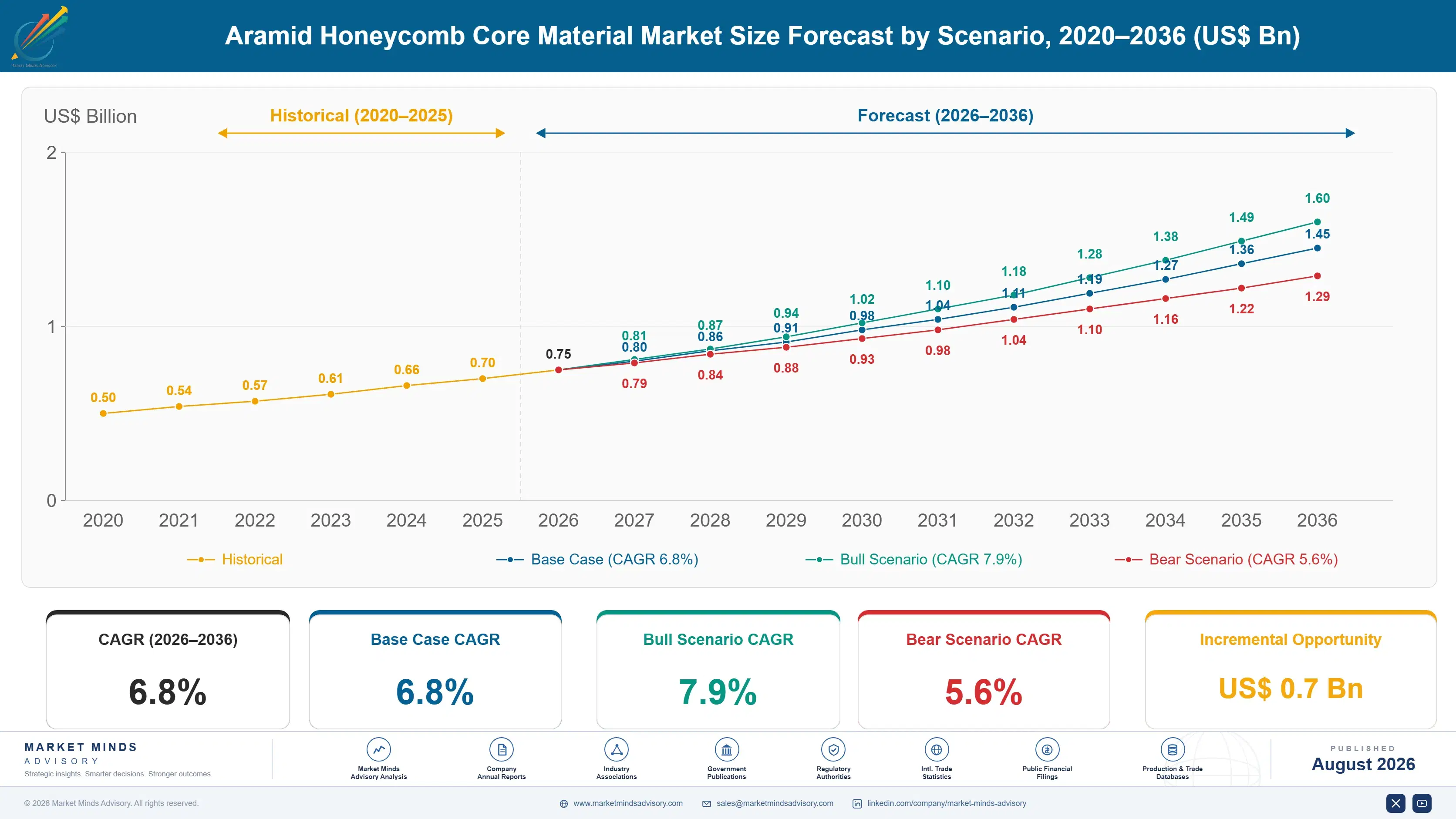
Aramid Honeycomb Core Material Market Forecast Scenarios

aramid-honeycomb-core-material-market-size-forecast-scenario-1787302874306
Aramid honeycomb core demand fell sharply in 2020 and 2021 as commercial aircraft output nearly halted, then recovered unevenly through 2023 as narrow-body build rates climbed back toward pre-pandemic levels. Wind energy prototyping added a small but growing demand pool from 2023 onward, contributing to an estimated 5.8% historical CAGR across the 2020 to 2025 period as that uneven recovery played out.
The base case assumes narrow-body aircraft build rate increases continue through 2030, wind blade manufacturers move beyond prototyping into qualified production volume by 2028, and DuPont and Euro-Composites add incremental Nomex paper and fabrication capacity to ease today's allocation constraints. Together these three commercial mechanisms support a 6.8% forecast CAGR, with aerospace remaining the anchor demand pool even as wind energy narrows the gap over the coming decade across every major producing region.
The bull case centers on wind blade manufacturers formally qualifying aramid honeycomb across multiple platforms by 2029, pulling volume well beyond current prototype programs and ahead of most forecasts. The bear case centers on a renewed commercial aircraft production slowdown, whether from supply chain disruption or a demand shock, which would strand allocation commitments and slow capacity investment industry-wide for several years.

Aerospace Production Rates Meet Emerging Wind Energy Demand

Aramid honeycomb core sits at the intersection of aerospace structural engineering and specialty fiber chemistry, since qualifying a new core supplier for a commercial aircraft program can take two to three years of flammability, peel-strength, and fatigue testing. That qualification barrier has kept the supplier base narrow even as demand climbs, and buyers cannot simply switch fabricators when allocation runs short, regardless of price offered.
MARKET CONCENTRATION (CR5)58%Top five suppliers hold majority share of volume
AVERAGE SELLING PRICE$42 per sq meterReflects core density, cell size, and certification grade
TOP PRODUCING COUNTRY SHAREUnited States, 34%Largest single national base for qualified aerospace production
CAPACITY UTILIZATION RATE81%Fabricators running near practical ceiling on total output
TRADE INTENSITY57% cross-borderMost shipped volume crosses a border before final integration
ARAMID FIBER COST SHARE46% of COGSLargest single cost line in core fabrication overall
Commercially, the market splits between a mature aerospace and defense base sold through long-term qualified-supplier agreements, and a smaller but faster-growing wind energy tier sold on weight reduction and blade balance performance rather than aerospace-grade certification alone. Marine and ground transportation applications round out demand with steadier, less cyclical purchasing patterns tied to shipbuilding and rail replacement schedules. Buyers in each tier evaluate suppliers differently.
Over the next decade, qualified capacity will matter more than raw material access alone, since DuPont's Nomex paper is available to every licensed fabricator on comparable terms. The suppliers that win new wind energy qualification programs while holding onto aerospace allocation commitments stand to capture a widening share of a market that is diversifying beyond its aerospace origins for the first time in decades.
"The honeycomb bottleneck right now isn't fiber supply, it's qualification calendars. A fabricator with open flammability test slots is worth more to an OEM than one with cheaper raw material."
Director, Advanced Materials Practice · MMA Chemicals & Materials / Advanced Com

Market Trends

Wind Blade Manufacturers Testing Honeycomb Core

Wind turbine blade manufacturers are running qualification trials on aramid honeycomb sandwich cores for nacelle covers and shear webs, targeting weight reductions of 12 to 18% versus balsa wood core on blades exceeding 80 meters. Vestas and Siemens Gamesa have both disclosed pilot programs evaluating honeycomb core in blade components since 2024, alongside foam and balsa alternatives already in commercial use. If even a handful of blade platforms move from pilot to qualified production by 2028, wind energy would become the second-largest application within five years, reshaping a demand base that has been almost entirely aerospace for decades.
Market Impact: Adds 75 aircraft monthly Airbus tar
Narrow-Body Aircraft Build Rate Recovery Accelerates

Boeing and Airbus have both raised 737 MAX and A320neo family production targets toward 50 and 75 aircraft per month respectively by 2027, and each additional aircraft requires dozens of honeycomb core sandwich panels across floor, wall, and fairing structures. That production ramp is running ahead of qualified honeycomb fabrication capacity, forcing airframers into multi-year allocation agreements with Hexcel, DuPont-licensed fabricators, and Euro-Composites just to secure guaranteed volume. Suppliers that can demonstrate reliable on-time delivery against these production schedules are winning long-term contracts well before capacity actually comes online, effectively locking in share ahead of any new entrant.
Market Impact: Cuts blade weight 12 to 18%

Market Opportunities and Growth Drivers

Commercial Aircraft Production Rate Increases Continue

Airbus targets 75 A320neo family deliveries per month by 2027, up from roughly 50 in 2024, and Boeing is separately working to restore 737 MAX rates toward 38 per month following extended regulatory oversight of its production quality systems. Each aircraft program requires a defined bill of qualified honeycomb core parts, meaning production rate increases translate almost directly into core demand growth without the substitution flexibility buyers have in less specialized material categories. Airframers are responding by pre-committing to multi-year supply agreements with qualified fabricators rather than risk allocation shortfalls as rates climb.
Market Impact: Adds 2 to 3 year delay

Wind Energy Weight Reduction Programs Expand

Offshore wind turbine platforms exceeding 15 megawatts are pushing blade lengths past 115 meters, and manufacturers need core materials that cut structural weight without sacrificing stiffness across nacelle covers and internal panels. Aramid honeycomb offers a 12 to 18% weight reduction versus balsa wood core at comparable stiffness, a meaningful advantage when blade weight directly affects tower and foundation design costs across an entire wind farm. GE Vernova and Vestas have both disclosed weight-reduction targets for next-generation platforms that reference alternative core materials including aramid honeycomb as one qualification pathway under active internal evaluation.
Market Impact: Relies on 1 aramid paper source

Market Restraints and Challenges

Long Aerospace Qualification Timelines Slow Growth

Qualifying a new aramid honeycomb core supplier for a commercial aircraft program typically takes two to three years of flammability, peel-strength, fatigue, and environmental testing under FAA and EASA oversight, rooted in the safety-critical role these panels play in cabin and structural applications. That timeline discourages new entrants and slows the pace at which suppliers can add qualified capacity even when demand justifies expansion, since airframers will not shortcut testing to relieve a supply squeeze. Several fabricators now run qualification programs in parallel with capacity expansion, betting that testing clears roughly when new production lines come online.
Market Impact: Adds 9.5% CAGR wind energy segment

Aramid Fiber Paper Single-Source Dependence Risk

Nearly every qualified aramid honeycomb core on the market traces back to DuPont's Nomex aramid paper, since alternative aramid paper sources have struggled to clear the same aerospace flammability and consistency qualification that Nomex has held for decades. That concentration leaves fabricators exposed to a single upstream supplier's pricing and allocation decisions, with no meaningful qualified alternative to switch toward during a shortage. Some fabricators are now co-investing with emerging aramid paper producers in Asia to build a second qualified source, though bringing any alternative through full aerospace certification is expected to take through at least 2029.
Market Impact: Supports 75 aircraft monthly target
3 additional market trends, 3 additional growth drivers, and 3 additional restraints and challenges are covered in the full report. Contact sales@marketmindsadvisory.com to access the complete intelligence.

Segment CAGR and Growth Architecture

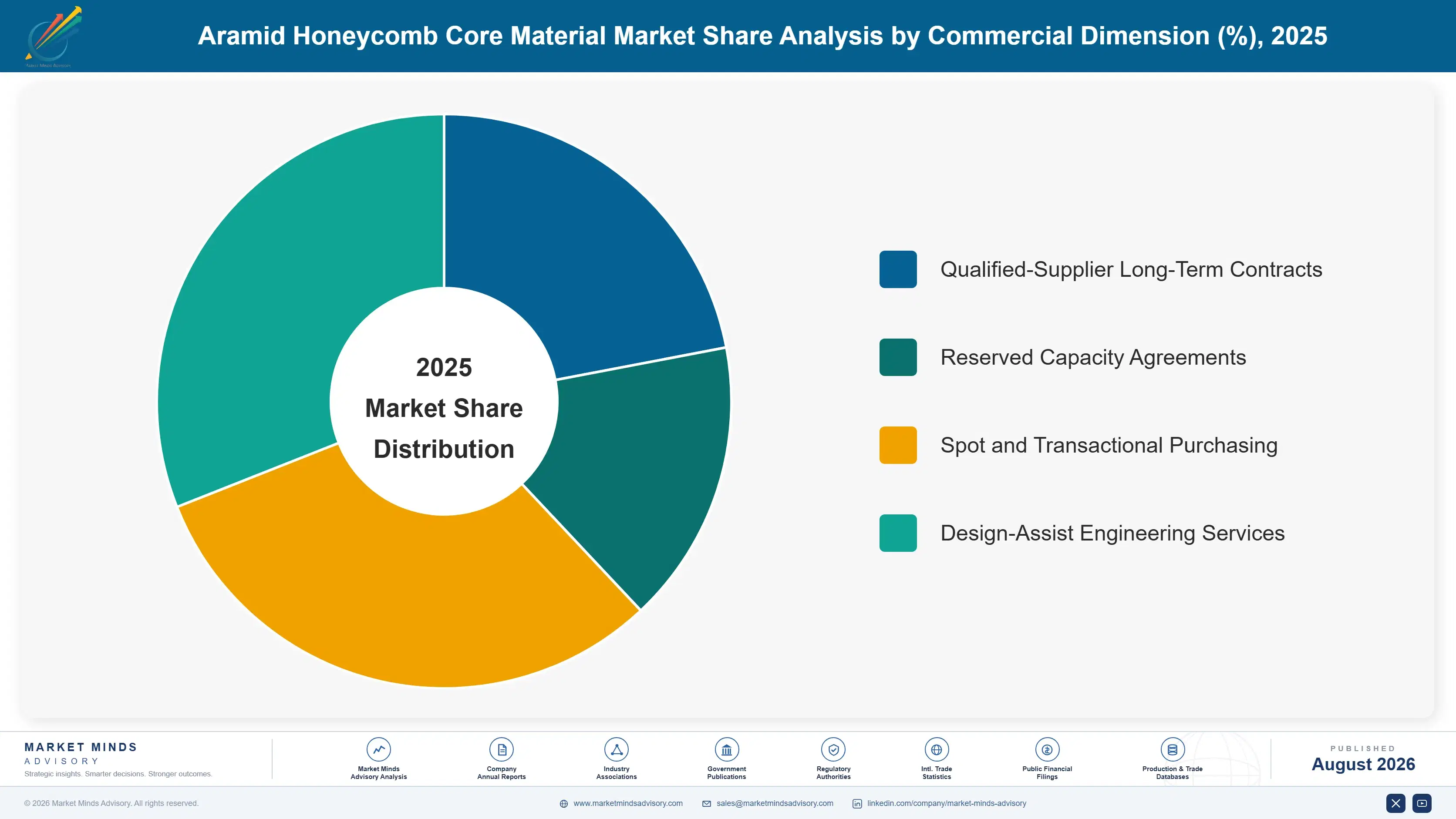
Aramid honeycomb core segments by end-use application, the classification buyers and fabricators use to set qualification requirements, density specifications, and certification pathways, since each application carries its own testing regime and certification timeline that shapes pricing and supplier selection across aerospace, wind energy, marine, ground transportation, and industrial panel end-uses across the industry each year.
aramid-honeycomb-core-material-market-market-share-analysis-1787302875192

Wind Energy Blade Components

Wind energy blade components are the fastest-growing application as turbine manufacturers move aramid honeycomb core from pilot testing into early qualified production for nacelle covers and internal blade panels. Offshore platforms exceeding 15 megawatts are the primary pull, since blade lengths exceed 115 meters and every kilogram of core weight saved reduces tower and foundation loading across the wind farm. Vestas, Siemens Gamesa, and GE Vernova have all disclosed evaluation programs referencing aramid honeycomb as an alternative to balsa wood and foam cores, though none has reached full commercial qualification. If two or three blade platforms clear qualification by 2028, this segment would double its share of market volume within five years, a pace no other application segment matches.
CAGR 9.5%

Aerospace and Defense Structures

Aerospace and defense structures remain the largest application by volume, covering cabin floor panels, wall assemblies, fairings, and control surfaces across commercial, business, and military aircraft programs. Rising Boeing and Airbus narrow-body build rates are the primary growth driver, since every additional aircraft requires a defined bill of qualified honeycomb core parts that cannot be substituted without new certification testing. Military and defense platforms add a steadier demand layer tied to multi-year procurement programs rather than commercial delivery schedules. Because qualification timelines run two to three years, suppliers here compete on proven delivery reliability against locked-in production schedules rather than on price alone, a dynamic that favors incumbents with long qualification track records over new entrants.
CAGR 8.2%
Full segment breakdown across 5 segments available in the complete report.

Regional Architecture and Country Demand Map

Aramid honeycomb core demand concentrates where commercial and military aircraft manufacturing scale is deepest. North America leads on aerospace production volume, East Asia follows on expanding wind blade and aircraft manufacturing capacity, and South Asia and Pacific grows fastest as new qualification programs come online.

North America

The United States accounts for the large majority of North America's aramid honeycomb core demand, anchored by Boeing's commercial and defense production base alongside Lockheed Martin, Northrop Grumman, and Sikorsky military and rotorcraft programs concentrated across its aerospace manufacturing corridor. Rising narrow-body build rates at Boeing's Renton and Everett facilities are the single largest near-term demand driver, since every 737 MAX delivered requires dozens of qualified honeycomb sandwich panels across floor, wall, and fairing structures. Canada contributes a smaller but steady share tied to Bombardier business jet production and its own defense aerospace supply base. Mexico's contribution is growing fastest of the three as aerospace component manufacturing continues expanding within its established maquiladora aerostructures sector serving US airframers directly.
Share: 29% | CAGR: 7.0% (2026 to 2036)

Western Europe

Germany, France, and the United Kingdom anchor Western Europe's aramid honeycomb core demand, reflecting Airbus's dual final assembly lines in Toulouse and Hamburg alongside Euro-Composites's own core fabrication base headquartered in Luxembourg. Airbus's A320neo family production rate increases toward 75 aircraft per month by 2027 are pulling qualified core volume forward faster than most fabricators can expand capacity within existing certified facilities. The UK contributes a distinct demand pool through its Airbus wing manufacturing and Rolls-Royce engine nacelle programs, both of which specify aramid honeycomb across structural and acoustic panel applications. Growth here trails the global average, reflecting an already-mature aerospace manufacturing base and a customer mix weighted toward established programs rather than new platform introductions.
Share: 21% | CAGR: 5.4% (2026 to 2036)
Regional intelligence for 5 additional markets available in the complete report: East Asia, South Asia and Pacific, Latin America, Middle East and Africa, Eastern Europe. Contact sales@marketmindsadvisory.com.
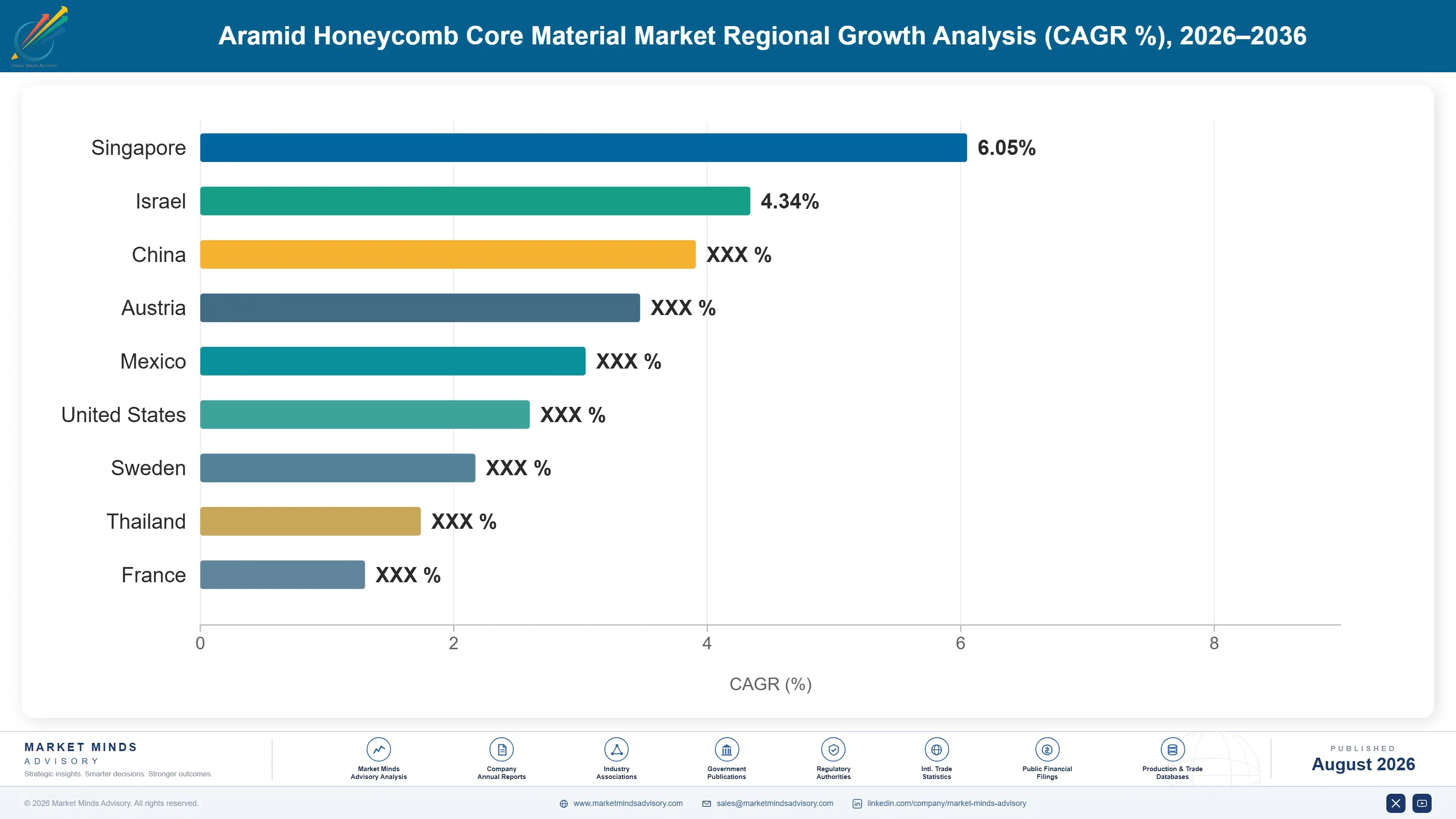
aramid-honeycomb-core-material-market-country-cagr-analysis-1787302876089

Where Honeycomb Fabricators Are Capturing Margin

Four commercial moves separate honeycomb core fabricators capturing outsized margin from those competing purely on delivered square meter price, each tied to qualification depth, capacity reliability, or application diversification beyond aerospace's traditional boundaries, and each requires a different mix of testing capital and multi-year commercial commitment before it pays off industry-wide over the coming decade.

Multi-Program Aerospace Qualification Portfolio Investment Strategy

Fabricators holding qualified-supplier status across multiple aircraft programs simultaneously, rather than a single platform, are capturing allocation priority when Boeing and Airbus raise production rates and need guaranteed volume fast. Building qualification across an additional aircraft program typically requires $1.5 million to $3 million in testing and certification investment spread across two to three years, but each qualified program then commands demand that unqualified competitors cannot serve regardless of price. Fabricators with narrow single-program qualification increasingly lose allocation priority to broader-portfolio competitors during rate increases, a pattern accelerating as airframers concentrate purchasing among fewer, deeper-qualified suppliers.
Market Impact: Costs $1.5 to $3 million per new qu

Wind Energy Application Development Program Investment

Fabricators investing early in wind energy qualification testing, ahead of confirmed commercial blade platform adoption, are positioning to capture first-mover share in a segment growing faster than aerospace, the market's traditional anchor application. Developing a qualified wind energy core specification typically costs $400,000 to $900,000 in weight, stiffness, and fatigue testing against turbine manufacturer requirements, a fraction of aerospace qualification cost given the less stringent flammability testing regime outside cabin applications. Fabricators without early wind energy testing investment risk missing the qualification window entirely once blade manufacturers commit to a preferred core supplier ahead of full commercial-scale platform launches.
Market Impact: Costs $400,000 to $900,000 per new

Reserved Production Capacity Agreement Program Strategy

Fabricators securing multi-year reserved capacity agreements with major airframers, guaranteeing defined monthly volume against production rate schedules, are capturing premium pricing that protects against spot-market competition from smaller regional producers without comparable delivery scale. These agreements typically carry a 6 to 12% price premium over transactional purchasing, reflecting the value airframers place on guaranteed supply continuity as they raise build rates through 2027 and beyond. Fabricators able to demonstrate reserved capacity and proven on-time delivery increasingly win renewal negotiations over lower-cost competitors lacking comparable production certainty, cementing incumbency advantage. Fabricators without such agreements compete purely on price during allocation shortfalls.
Market Impact: Commands 6 to 12% premium over spot

Second-Source Aramid Paper Development Investment Program

Fabricators co-investing with emerging Asian aramid paper producers to build a qualified alternative to DuPont's Nomex are working to reduce single-source exposure that currently constrains the entire industry's capacity expansion pace. Bringing an alternative aramid paper source through full aerospace flammability and consistency qualification typically costs $8 million to $15 million and takes through at least 2029, a heavy upfront investment that only the largest fabricators can currently absorb. Fabricators that succeed would gain negotiating leverage over pricing and allocation that no honeycomb producer currently holds, given the single-source dependence structuring the entire market today.
Market Impact: Costs $8 to $15 million to fully qu

Who Controls the Margin Pool

The top five fabricators hold an estimated 58% of global aramid honeycomb core volume, a concentration reflecting the qualification barriers that keep new entrants out and the smaller regional fabricators serving less certified applications. Hexcel and DuPont-licensed producers lead on qualified aerospace program breadth, while a second tier competes on price and delivery speed for marine and industrial categories that do not require full aerospace certification.
Current competitive activity centers on three fronts. Wind energy qualification investment is opening a new front for fabricators willing to commit testing capital ahead of platform adoption. Reserved capacity agreements are becoming the norm as airframers lock in supply ahead of production rate increases. And several fabricators are exploring second-source aramid paper investment in Asia to reduce dependence on a single upstream supplier that constrains the industry.

Emerging pressure comes from Chinese fabricators moving up the qualification curve as COMAC's own aircraft programs mature and domestic aramid paper production scales, though full aerospace-grade certification against Western standards remains years away for most. If Chinese producers close that qualification gap, expect share to shift within East Asia first, before any material pressure reaches North American or European incumbents given existing Boeing and Airbus qualified-supplier relationships.
aramid-honeycomb-core-material-market-company-positioning-matrix-1787302876905

Competitive Moat and Risk Dimensions

HEXCEL CORPORATION

Moat: Broad Multi-Program Qualification Depth

Hexcel holds qualified-supplier status across a wider range of commercial and defense aircraft programs than any other honeycomb fabricator, giving it allocation priority when airframers raise production rates and need guaranteed capacity fast. That breadth took decades to build and cannot be replicated quickly by any competitor, since each additional program requires its own multi-year testing cycle.
HEXCEL CORPORATION

Risk: Commercial Aircraft Cycle Exposure

Hexcel's revenue concentration in commercial aerospace leaves it more exposed than diversified competitors to any renewed production slowdown, whether from supply chain disruption, a demand shock, or airframer-specific quality issues. A sustained downturn in Boeing or Airbus build rates would directly compress Hexcel's core volume with limited ability to redirect qualified capacity toward other applications on short notice.
DUPONT DE NEMOURS INC.

Moat: Nomex Aramid Paper Position

DuPont's Nomex aramid paper underpins nearly every qualified honeycomb core sold across the industry, giving it considerable influence over pricing and new-entrant qualification timelines that no fabricator-level competitor can match. This upstream position generates revenue regardless of which fabricator ultimately sells the finished honeycomb core to an airframer.
DUPONT DE NEMOURS INC.

Risk: Diversified Portfolio Limits Focus

DuPont's aramid paper business represents a small fraction of its overall diversified chemicals portfolio, meaning honeycomb-specific capacity investment competes internally against other corporate priorities for capital allocation. That dynamic has left Nomex capacity expansion slower than aerospace and wind energy demand growth would otherwise justify, opening space for emerging Asian producers to pursue a qualified alternative.

Players Tracked

Prominent Players

Hexcel Corporation
DuPont de Nemours Inc.
Euro-Composites S.A.
Plascore Incorporated
Gill Corporation

Other Key Players

Argosy International, Inc.
ITB GmbH
Diab Group (Diab International AB)
Toray Advanced Composites
Avic Composite Corporation Ltd.
Axiom Materials, Inc.
Solvay Composite Materials
Teijin Limited
Kaman Aerospace Corporation
Rock West Composites, Inc.
SAERTEX GmbH & Co. KG
Zhongfu Shenying Carbon Fiber Co., Ltd.
Gurit Holding AG
Nordam Group, LLC
Shandong Yuanwang New Material Technology Co., Ltd.

Recent Developments

MARCH 2025

Hexcel Expands Honeycomb Core Fabrication Capacity

Hexcel commissioned additional aramid honeycomb core fabrication capacity at its Casa Grande, Arizona facility, expanding dedicated output to meet rising narrow-body aircraft program demand. The expansion followed multi-year allocation agreements signed with both Boeing and Airbus as both airframers raised production rate targets through 2027.
Signal: Confirms fabricators are pre-committing ca
SEPTEMBER 2024

Euro-Composites Signs Multi-Year Airbus Supply Agreement

Euro-Composites secured a multi-year reserved capacity agreement with Airbus covering honeycomb core sandwich panels for A320neo family production, guaranteeing defined monthly volume through 2028. The agreement reflects Airbus's broader push to lock in qualified supply ahead of further production rate increases. Similar agreements are expected across other qualified fabricators.
Signal: Shows airframers prioritizing supply certa
JANUARY 2025

DuPont Announces Nomex Paper Capacity Investment

DuPont announced incremental capacity investment at its Nomex aramid paper production facility to ease allocation constraints affecting licensed honeycomb fabricators industry-wide. The investment followed sustained pressure from fabricators citing paper allocation as their primary constraint on expanding qualified core output. Industry analysts expect similar announcements from competing producers.
Signal: Signals upstream bottleneck relief remains

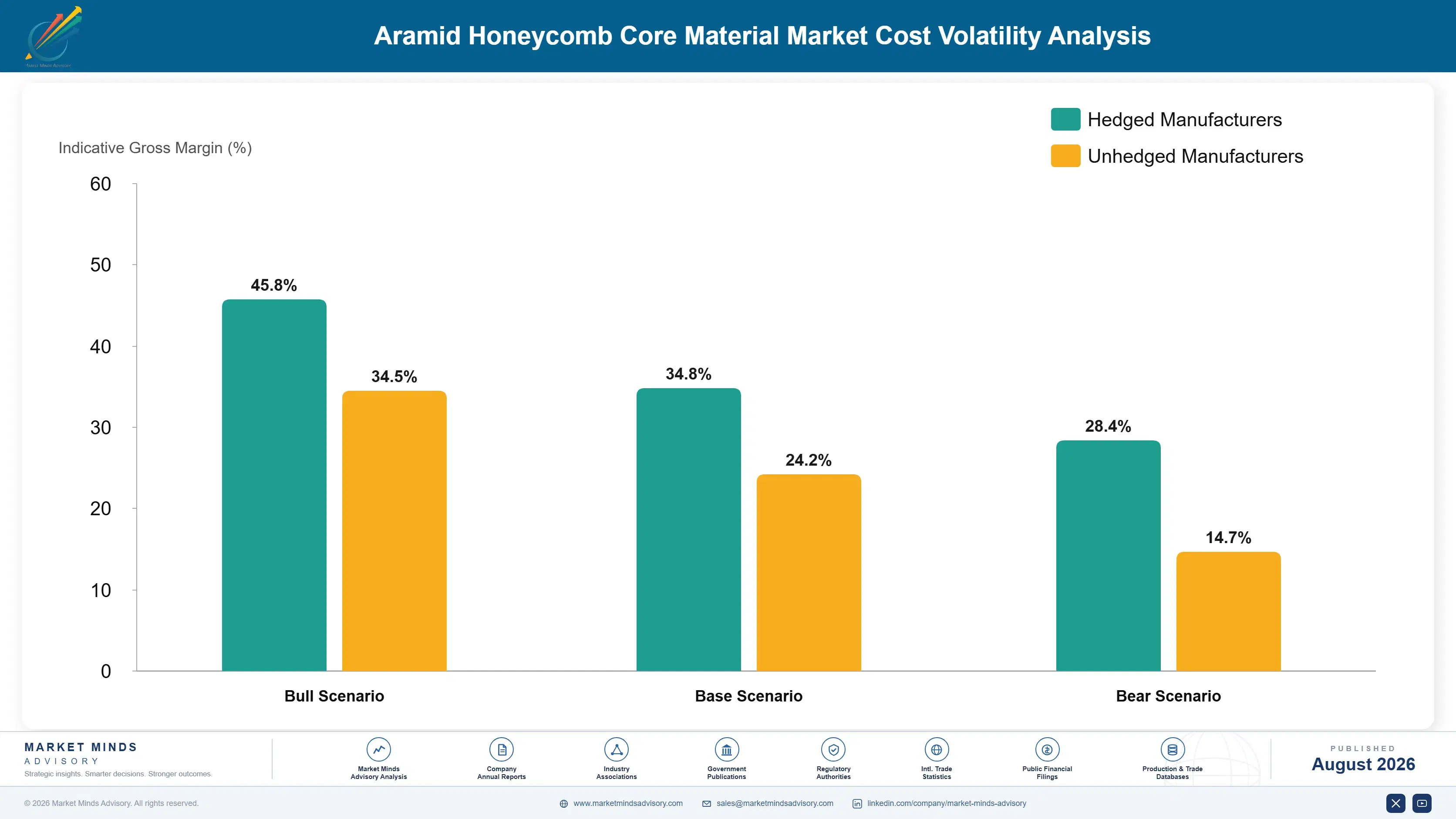
Aramid Paper Dependence and Aerospace Testing Cost

Aramid fiber paper accounts for roughly 46% of cost of goods sold in honeycomb core fabrication, sourced almost entirely from DuPont's Nomex production given the absence of a qualified aerospace-grade alternative. Resin, adhesive, and expansion process labor add a further significant share, with production concentrated among fabricators holding aerospace certification across their full manufacturing process.
Aramid paper allocation tightened sharply through 2023 and 2024 as aircraft production rate increases outpaced DuPont's capacity expansion, with several fabricators reporting order lead times extending beyond 12 months in their 2024 investor communications. Industry supply reviews have flagged aramid paper as the single most constrained input across the entire honeycomb core value chain, more so than resin or adhesive materials. Several fabricators have publicly flagged this constraint as their leading operational risk heading into 2026.

Smaller regional fabricators without long-term Nomex allocation agreements have struggled hardest against this constraint, losing qualification opportunities to larger competitors including Hexcel and DuPont-licensed producers that secured priority allocation years in advance. Fabricators with reserved paper supply weathered the tightening far better than those dependent on spot allocation, a cost and availability advantage that persists most sharply across smaller North American and European producers today.
aramid-honeycomb-core-material-market-cost-volatility-analysis-1787302877206

Long-Term Nomex Allocation Agreements

Larger fabricators are locking in multi-year Nomex paper allocation agreements directly with DuPont, guaranteeing volume ahead of aircraft production rate increases rather than relying on spot allocation that has grown increasingly unreliable since 2023. This approach adds cost certainty to capacity planning even when spot market pricing swings sharply during periods of tight allocation across the broader industry.

Second-Source Aramid Paper Qualification

Several fabricators are co-investing in emerging Asian aramid paper production to build a qualified alternative to Nomex, though full aerospace certification is not expected before 2029 given the multi-year testing regime involved. Early movers in this second-source qualification effort could gain meaningful negotiating leverage over pricing and allocation once the alternative clears full certification.

Application Diversification Beyond Aerospace

Fabricators are pursuing wind energy and marine qualification programs partly to diversify volume beyond aerospace-grade paper specifications, since some non-aerospace applications tolerate slightly relaxed aramid paper grades with shorter allocation lead times. This diversification strategy also spreads fabricators' revenue across a broader set of end-use applications, reducing dependence on any single aerospace qualification cycle for volume.

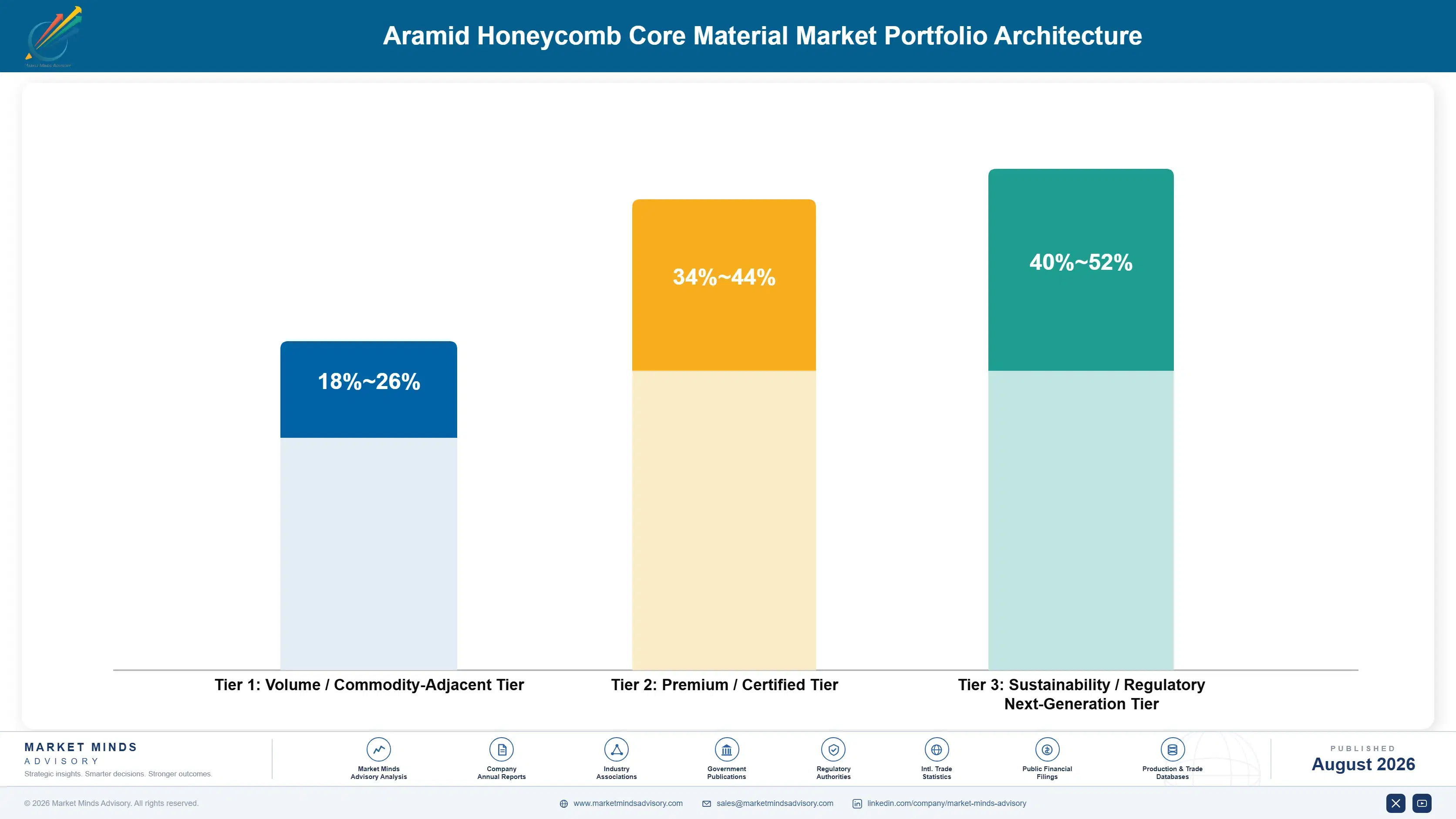
Portfolio Architecture for Margin Defence

Aramid honeycomb core portfolios span three margin tiers, from commodity-adjacent ground transportation and industrial panel core sold largely on price, through certified aerospace and marine core carrying qualification-driven premiums, toward an emerging next-generation tier built around wind energy and novel lightweighting applications still in early qualification. Gross margin widens meaningfully at each tier as certification depth and application specificity increase. Buyers pay for certific
The volume versus premium tension centers on capacity allocation. Fabricators must choose between dedicating qualified production lines to high-margin aerospace programs with guaranteed multi-year volume, or diverting capacity toward faster-growing but still-unproven wind energy qualification work that could pay off far more over a decade. Fabricators without spare qualified capacity increasingly favor higher-margin aerospace programs.

High-value margin pools concentrate in aerospace defense programs and early wind energy qualification work, where certification barriers keep competition thin and buyers pay a premium for proven reliability. Ground transportation and industrial panel core remain the volume anchor but carry the thinnest margins across the entire portfolio. Fabricators that can serve both ends of the portfolio without diluting aerospace focus capture the widest margin spread across the entire industry today.

Volume / Commodity-Adjacent Tier

Ground transportation and industrial panel core sold largely on price and delivery speed without aerospace-grade certification requirements, competing mainly on cost and lead time against foam and aluminum alternatives across most industrial and rail buyer segments.
Gross Margin: 18%-26%

Premium / Certified Tier

Aerospace, defense, and marine core sold under multi-year qualified-supplier agreements carrying certification-driven pricing power that new entrants cannot access without years of qualification testing and a proven delivery track record.
Gross Margin: 34%-44%

Sustainability / Regulatory / Next-Generation Tier

Wind energy and emerging lightweighting applications in early qualification, commanding premium pricing against limited proven alternatives as manufacturers wait for confirmed commercial-scale platform adoption before committing further capital for early adopters.
Gross Margin: 40%-52%
aramid-honeycomb-core-material-market-portfolio-architecture-1787302877736

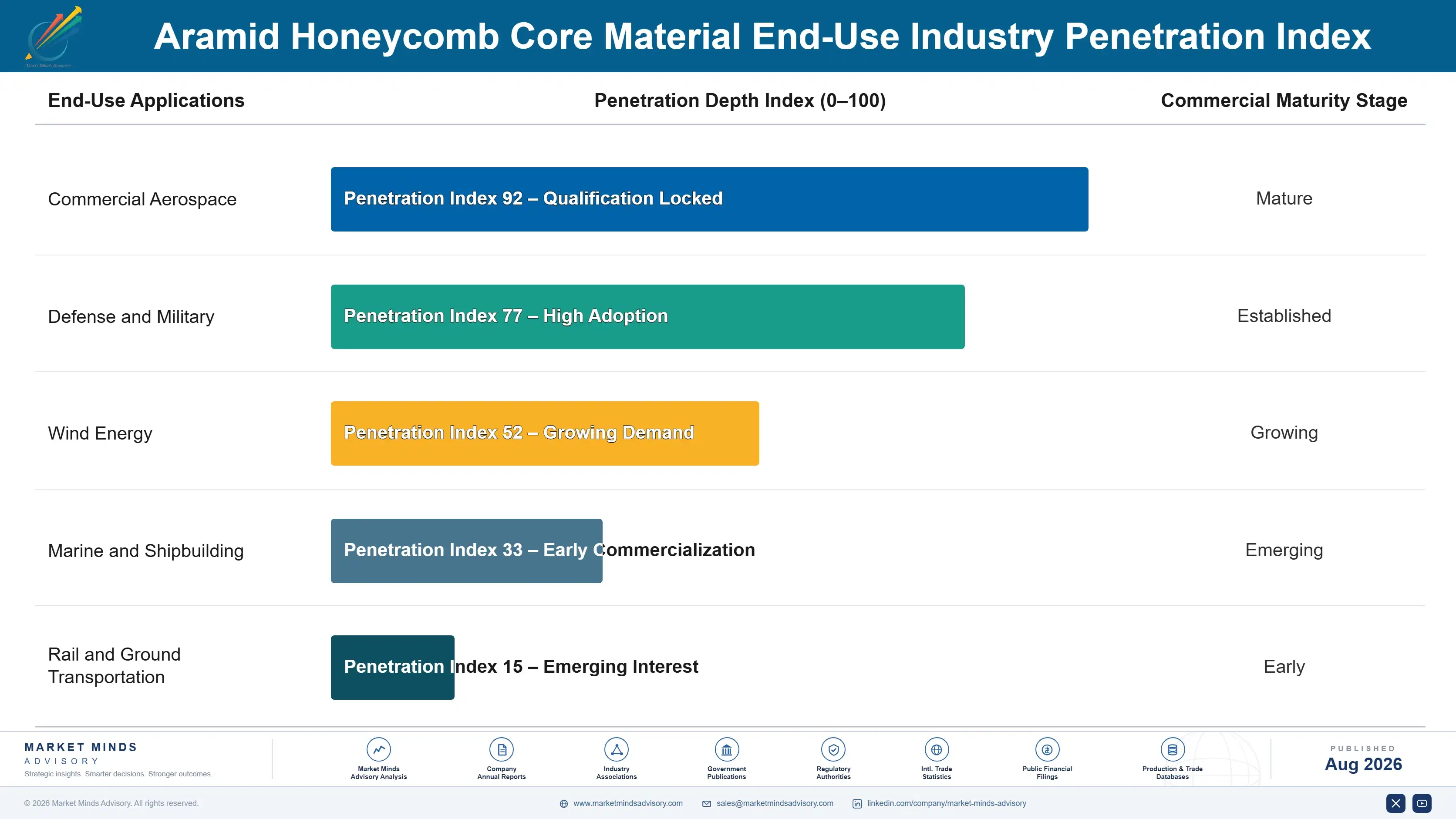
Qualification Lock-In Drives Repeat Purchasing

Aerospace honeycomb core purchasing functions closer to an annuity than a transactional sale, since once a fabricator clears qualification on a specific aircraft program, that supplier relationship typically persists for the program's entire production life, often two decades or longer. Airframers rarely requalify a core supplier mid-program given the cost and schedule risk involved, which locks in recurring revenue for incumbent suppliers well beyond any single purchase order.
Adoption depth varies sharply by end-use vertical. Commercial and defense aerospace programs show the deepest stickiness given multi-year qualification cycles and safety-critical certification requirements, while ground transportation and industrial panel buyers switch suppliers more readily since qualification barriers are far lower and price sensitivity plays a larger role in purchasing decisions. That difference shapes how fabricators prioritize qualification investment across their portfolios.

A generational shift is underway as wind energy buyers, who have no legacy relationship with existing aerospace-focused fabricators, evaluate suppliers on weight and stiffness performance data rather than decades-long qualification track records. That openness gives newer entrants and non-aerospace-focused fabricators a rare opening to win share in a market where incumbency has otherwise been nearly impossible to dislodge, particularly across newer regional markets.
aramid-honeycomb-core-material-market-end-use-penetration-index-1787302878228

Where Honeycomb Fabricators Should Focus Next

These are among the four positions where our research anticipates prominent divergence between winners and laggards over the coming forecast period. Each is grounded in the demand model, the regulatory perimeter, and the announced capacity pipeline.
01 / QUALIFICATION PORTFOLIO STRATEGY

Build multi-program aerospace qualification depth before rates peak

Fabricators that hold qualified-supplier status across multiple aircraft programs capture allocation priority when airframers raise production rates and need guaranteed volume immediately, a scarce advantage as build rates climb across the industry. Building that breadth requires multi-year investment that competitors cannot replicate quickly, since each program demands its own testing cycle. Fabricators waiting until rates peak to begin new qualification work will miss the current allocation window entirely, ceding priority to incumbents that started years earlier and now hold uncontested renewal position.
02 / WIND ENERGY ENTRY TIMING

Invest in wind qualification testing now, before platforms commit

Wind energy blade manufacturers have not yet committed to a preferred core supplier, leaving a genuine first-mover opportunity for fabricators willing to fund qualification testing ahead of confirmed commercial adoption, a window that will not stay open indefinitely. Waiting for platforms to formally commit risks missing the qualification window entirely once a preferred supplier relationship forms. The capital required is modest relative to aerospace qualification cost, making this a comparatively low-risk entry point into the market's fastest-growing application without committing large capital upfront.
03 / ARAMID PAPER SUPPLY SECURITY

Secure long-term Nomex allocation before further tightening

Aramid paper allocation has tightened sharply as aircraft production rates climb faster than DuPont can expand Nomex capacity, and fabricators without long-term agreements are losing qualification opportunities to better-secured competitors, a gap that is unlikely to close without direct DuPont allocation commitments. Locking in multi-year allocation now protects against further tightening as wind energy adds incremental demand atop already-strained aerospace volume, particularly for fabricators serving multiple qualified aircraft programs simultaneously. Fabricators pursuing second-source qualification should treat it as a multi-year hedge, not a near-term fix.
04 / REGIONAL CAPACITY EXPANSION

Prioritize East Asia and South Asia capacity given fastest regional growth

East Asia and South Asia and Pacific are growing faster than any other region as domestic aircraft programs mature and aramid paper production investment reduces import dependence over time, a shift already visible in recent capacity announcements. Fabricators concentrating capacity expansion solely in North America and Western Europe risk ceding share in the regions where volume growth will be steepest through 2036. Early investment in Asian qualification and fabrication capacity offers a meaningful head start over competitors still anchored to legacy Western manufacturing footprints.

Engagement Snapshot From the Field

A live engagement with an industry participant carrying material or product regulatory and market exposure ahead of a defining policy shift, showing how our research translates into a defensible multi-year portfolio strategy.
MARKET MINDS ADVISORY · CLIENT ENGAGEMENT SUMMARY
Aramid Honeycomb Core Material Producer Strategic Portfolio Review and Transition Roadmap 2026·Investment Scenario on Aramid Honeycomb Core Material Exposure Evaluation 2025-26
CLIENT PROFILE
The client is a Tier-1 aerostructures supplier providing honeycomb core sandwich panels to two major commercial airframers, with annual honeycomb-related revenue in the low hundreds of millions of dollars (client-reported, unverified by MMA). The client faced rising order volume as narrow-body production rates climbed but lacked confidence in how quickly to expand fabrication capacity without overcommitting capital.
STRATEGIC CHALLENGE
The client needed to decide how much new qualified fabrication capacity to build, and how quickly, given uncertainty over whether current aircraft production rate targets would hold through 2030 or face another disruption similar to 2020, while also evaluating whether to enter wind energy qualification work as a hedge against aerospace cyclicality.
MMA APPROACH
MMA benchmarked the client's qualification portfolio against five aerospace-focused competitors and modeled three aircraft production rate scenarios against the client's existing and planned capacity, incorporating primary interview data from aerospace and wind energy buyers on qualification timelines and switching behavior. The analysis also benchmarked reserved capacity agreement terms across five competing fabricators to identify pricing and allocation patterns relevant to the client's own negotiations.
KEY FINDINGS
  1. The client's qualification portfolio concentration in a single aircraft program left it more exposed to program-specific risk than diversified competitors with multi-program qualified status across airframers.
  2. Wind energy qualification investment required roughly one-fifth the capital of a new aerospace program qualification, offering a comparatively low-risk diversification pathway given current qualification cost structures.
  3. Competitors with reserved capacity agreements were winning renewal negotiations over the client despite comparable technical qualification, largely due to demonstrated delivery reliability during recent rate increases.
  4. Aramid paper allocation constraints posed a greater near-term risk to planned capacity expansion than any capital or labor availability constraint the client had originally prioritized in its planning.
CLIENT PROFILE
The client is a Tier-1 aerostructures supplier providing honeycomb core sandwich panels to two major commercial airframers, with annual honeycomb-related revenue in the low hundreds of millions of dollars (client-reported, unverified by MMA). The client faced rising order volume as narrow-body production rates climbed but lacked confidence in how quickly to expand fabrication capacity without overcommitting capital.
STRATEGIC CHALLENGE
The client needed to decide how much new qualified fabrication capacity to build, and how quickly, given uncertainty over whether current aircraft production rate targets would hold through 2030 or face another disruption similar to 2020, while also evaluating whether to enter wind energy qualification work as a hedge against aerospace cyclicality.
MMA APPROACH
MMA benchmarked the client's qualification portfolio against five aerospace-focused competitors and modeled three aircraft production rate scenarios against the client's existing and planned capacity, incorporating primary interview data from aerospace and wind energy buyers on qualification timelines and switching behavior. The analysis also benchmarked reserved capacity agreement terms across five competing fabricators to identify pricing and allocation patterns relevant to the client's own negotiations.
KEY FINDINGS
  1. The client's qualification portfolio concentration in a single aircraft program left it more exposed to program-specific risk than diversified competitors with multi-program qualified status across airframers.
  2. Wind energy qualification investment required roughly one-fifth the capital of a new aerospace program qualification, offering a comparatively low-risk diversification pathway given current qualification cost structures.
  3. Competitors with reserved capacity agreements were winning renewal negotiations over the client despite comparable technical qualification, largely due to demonstrated delivery reliability during recent rate increases.
  4. Aramid paper allocation constraints posed a greater near-term risk to planned capacity expansion than any capital or labor availability constraint the client had originally prioritized in its planning.
RECOMMENDED STRATEGY
Phase 1: Phase 1 (Months 1 to 4): Benchmark qualification portfolio breadth and secure expanded long-term Nomex paper allocation agreements with DuPont directly. Phase 2: Phase 2 (Months 5 to 10): Begin wind energy qualification testing on a limited scale while pursuing a second aerospace program qualification in parallel. Phase 3: Phase 3 (Months 11 to 18): Scale fabrication capacity investment tied to confirmed reserved agreements rather than speculative demand forecasts alone.
OUTCOME
Within twelve months of implementation, the client secured an expanded multi-year Nomex allocation agreement and began wind energy qualification testing alongside its existing aerospace program work. Client-reported honeycomb segment revenue grew by an estimated 14% over the following year, though this figure is client-reported and unverified by MMA.

Frequently Asked Questions

Foundational context covering the market sizes, CAGR, scope, country, region and competition that inform every finding below. This section is provided to cover basics and most often pre-purchase conversations, answered from the MMA Primary Research Dataset.

What is the current size of the Aramid Honeycomb Core Material Market?

The global aramid honeycomb core material market reached an estimated $0.68 billion in 2025. Aerospace and defense structures account for the largest share of that volume.

How large will the Aramid Honeycomb Core Material Market be by 2036?

MMA forecasts the market will reach approximately $1.40 billion by 2036. That represents a 1.92x expansion over the 2026 base value across the ten-year forecast period.

What is the CAGR for the Aramid Honeycomb Core Material Market 2026 to 2036?

The base case forecast CAGR is 6.8%, with a bull case of 7.9% and a bear case of 5.6% depending on aircraft production rates and wind energy qualification pace.

Which segment is growing fastest?

Wind Energy Blade Components is growing fastest at a 9.5% CAGR, roughly 1.40 times the overall market rate, as blade manufacturers move from pilot testing toward qualified production.

Who are the major companies in the Aramid Honeycomb Core Material Market?

Hexcel Corporation, DuPont de Nemours Inc., Euro-Composites S.A., Plascore Incorporated, and Gill Corporation lead the market. Together the top five hold an estimated 58% of global shipment volume.

Which country is growing fastest?

China leads growth as its wind turbine blade manufacturers and expanding COMAC aircraft programs both scale aramid honeycomb qualification, growing at an estimated 10.2% CAGR through 2036.

Report Segmentation Architecture

The full report scope spans multiple orthogonal segmentation dimensions, with cross-tabulated demand data provided for each dimension pair. Coverage extends further to regional breakdowns, trend trajectories, and the competitive detail needed to support segment-level decision-making.

By End-Use Application

  • Aerospace and Defense Structures
  • Wind Energy Blade Components
  • Marine and Shipbuilding Panels
  • Ground Transportation Panels
  • Industrial and Building Panels

By End-Use Industry

  • Commercial Aerospace
  • Defense and Military
  • Wind Energy
  • Marine and Shipbuilding
  • Rail and Ground Transportation

By Commercial Dimension

  • Qualified-Supplier Long-Term Contracts
  • Reserved Capacity Agreements
  • Spot and Transactional Purchasing
  • Design-Assist Engineering Services

By Region

  • North America
  • Western Europe
  • East Asia
  • South Asia and Pacific
  • Latin America
  • Middle East and Africa
  • Eastern Europe

Scope, Methodology, and Coverage

Every figure in this report is reproducible from documented input assumptions. The scope below maps the historical period, the forecast horizon, the segmentation dimensions, and the countries covered, alongside the underlying primary and qualitative methodology.
Historical Period
2020 to 2025
Forecast Period
2026 to 2036
Base Year
2025 (USD billions; MMA Primary Research Dataset, August 2026)
Market Definition
This report covers lightweight, para-aramid fiber paper honeycomb core structures used as the structural core layer in sandwich composite panels across aerospace, defense, wind energy, marine, and ground transportation applications. It excludes aluminum, foam, and carbon fiber honeycomb cores, as well as finished sandwich panel assemblies sold as complete structures rather than core material alone.
Quantitative Units
USD billions (current prices); square meters of qualified core shipped where disclosed
Segmentation Dimensions
By End-Use Application; By End-Use Industry; By Commercial Dimension; By Region
Regions Covered
North America, Western Europe, East Asia, South Asia and Pacific, Latin America, Middle East and Africa, Eastern Europe
Countries Covered
USA, China, Germany, France, UK, Japan, South Korea, India, Australia, Canada, Brazil, Mexico, Indonesia, Vietnam, Thailand, Malaysia, UAE, Saudi Arabia, South Africa, Nigeria, Turkey, Poland, Netherlands, Italy, Spain, Sweden, Switzerland, Argentina, Colombia, Singapore, and additional markets relevant to this sector
Key Companies Profiled
Hexcel Corporation, DuPont de Nemours Inc., Euro-Composites S.A., Plascore Incorporated, Gill Corporation, Argosy International Inc., ITB GmbH, Diab Group, Toray Advanced Composites, Avic Composite Corporation Ltd., Axiom Materials Inc., Solvay Composite Materials, Teijin Limited, Kaman Aerospace Corporation, Rock West Composites Inc., SAERTEX GmbH & Co. KG, Zhongfu Shenying Carbon Fiber Co. Ltd., Gurit Holding AG, Nordam Group LLC, Shandong Yuanwang New Material Technology Co. Ltd.
Quantitative Methodology
Primary survey, n=3,800 respondents, Q4 2025, six countries; demand-side model with trade association cross-validation
Qualitative Methodology
47 expert interviews, Q4 2025; applied to validate demand model assumptions, identify emerging dynamics, and assess competitive positioning
Report Format
PDF and XLSX data workbook (Word format preview document)
Publisher
Market Minds Advisory
Report Code
MMA-2026-CHM-118
Published
August 2026
Contact
sales@marketmindsadvisory.com | www.marketmindsadvisory.com

Purchase the full Aramid Honeycomb Core Material Market Report (2026 to 2036).

The full report delivers a complete assessment of the global aramid honeycomb core material market across all five end-use applications and seven world regions through 2036. It includes detailed competitive profiling of twenty active fabricators, primary survey data from qualification and procurement decision-makers, and a dedicated deep-dive on wind energy qualification timelines. Buyers receive access to underlying segment and regional data tables alongside the full narrative analysis, supporting both capacity planning and supplier evaluation decisions. The report also benchmarks revenue lever adoption and input cost exposure across the top twenty profiled companies, drawing on MMA's primary survey of 3,800 respondents and 47 expert interviews conducted in Q4 2025.
Twenty-company competitive profiling and margin benchmarking
Five-segment application-level forecast data and tables
Seven-region demand and CAGR breakdown data
Wind energy qualification timeline deep-dive analysis
Aramid paper supply chain risk assessment
Primary interview data from procurement decision-makers

Built For The People Who Decide

From boardroom strategy to bench-side execution, this report is read cover-to-cover by leaders shaping the next decade of their industry, turning demand scenarios, market dynamics and valuation benchmarks into decisions.
CXOs/ Presidents/ VPs/ Managers
M&A and Corporate Development
Strategy Teams and R&D Heads
Procurement and Product Directors
Regulatory and Compliance Leaders
Investor Relations and Equity Analysts