

Market Minds Advisory
AR and VR in Training Market

AR and VR in Training Market: AR and VR in Training Market. Immersive Simulation Reshapes Enterprise Skills Investment

Enterprise training budgets are shifting toward immersive simulation as headset costs decline sharply, forcing content vendors to prove measurable retention gains while cloud platforms displace standalone hardware deployments across manufacturing, healthcare, and defense programs.

Lead Analyst

Published

September 2026

Make Smarter Decisions with Customized Research Insights

Request a free sample report and evaluate market opportunities, growth trends, and competitive dynamics relevant to your business needs.

2025 MARKET VALUE$6.8BMarket Size 2025
2036 FORECAST VALUE$22.3BBase Case , 2026 to 2036
CAGR 2026 TO 203611.4 %Bull 12.7% / Bear 10.1%
INCREMENTAL OPPORTUNITY$14.7BNet 10- year value creation
EXPANSION MULTIPLE2.94x2036 value over 2026 base
Strategic Levers
M&A Pipeline
Regional Outlook
Country Rankings
Competitive Intelligence
Segmental Deep-dive
Call-Us : 91 93563 13602

Executive Snapshot and Market Trajectory.

Cloud-delivered simulation platforms are reshaping enterprise training investment faster than any prior corporate learning technology cycle, as headset hardware costs fall below thresholds that previously limited adoption to only the largest, best-funded organizations and training departments across most industries, geographies, and workforce categories.
Training buyers face simultaneous pressure from measurable skill retention demands, expanding use cases beyond manufacturing and healthcare into retail and soft-skills training, and rising competition from cloud subscription models that reduce hardware capital needs. India's expanding corporate training sector and government skilling initiatives are pulling adoption into domestic enterprises faster than incumbents anticipated, while North American defense and healthcare simulation programs continue funding the highest-value content contracts across most segments, industries, and workforce categories today.
Competitive intensity concentrates among five vendors controlling roughly forty percent of global revenue, though specialized content developers are winning enterprise contracts faster than platform incumbents expected just two years ago and continue gaining share steadily across most industries and customer segments today. Regulatory pressure around workplace safety training certification adds validation cost that smaller vendors increasingly struggle to absorb without dedicated instructional design teams and compliance expertise.
Market Definition
The AR and VR in Training Market covers headsets, simulation software, content authoring platforms, and analytics tools used to deliver immersive skills training across enterprise, healthcare, and defense settings. It excludes standalone consumer entertainment VR products and general e-learning platforms lacking dedicated immersive simulation capability.
Base Year Value
$6.8B in 2025 (MMA Primary Research Dataset, September 2026)
Forecast Period
2026 to 2036, eleven discrete annual values
CAGR
11.4% base case. Bull 12.7%. Bear 10.1%.
Fastest Growth Segment
Cloud-Based Training Platforms and Services: 15.5% CAGR
Fastest Growth Country
India: 14.0% CAGR
Fastest Growth Region
South Asia and Pacific: 13.4% CAGR
Largest Region
North America: 32% of 2025 global value
Market Leaders
Meta Platforms, Microsoft, PTC, STRIVR, and Immerse lead the field. Source: MMA Analysis, July 2026.
Primary Survey
n=3,800 procurement and R&D decision-makers, Q4 2025, six countries
Methodology
Demand-side build-up, cross-validated against public data, 47 expert interviews

AR and VR in Training Market Forecast Scenarios

ar-and-vr-in-training-market-size-forecast-scenario-1789980748110
The 2020 to 2025 period saw AR and VR training demand track corporate learning budget recovery closely, growing at a 10.2 percent compound annual rate as remote workforce needs accelerated adoption beyond early pilot programs and small-scale trials. Hardware cost declines during this period expanded the addressable customer base well beyond large enterprises that dominated early adoption.
Base case forecasts assume continued cloud subscription migration reducing upfront hardware costs, expanding use cases across retail and soft-skills training beyond manufacturing and healthcare, and rising corporate demand for measurable skill retention data justifying training budget allocation. These three mechanisms combine to sustain an 11.4 percent compound annual growth rate through 2036, with India and North America contributing the largest incremental volume gains as domestic corporate training investment expands and defense simulation budgets continue funding high-value content development.
A bull scenario reaching 12.7 percent growth depends on faster-than-expected retail and soft-skills training adoption beyond the technical and safety training use cases that currently dominate revenue generation. A bear scenario falling to 10.1 percent would likely follow a broader corporate training budget slowdown reducing enterprise willingness to fund new technology pilots across most industries and regions.

Skill Retention Data Justifies Training Budget Shift

Enterprise buyers increasingly demand quantified skill retention data before committing to broader rollouts, pushing vendors to build assessment analytics directly into simulation platforms rather than treating measurement as an afterthought or optional add-on feature across most deployment types and organizational sizes today.
MARKET CONCENTRATIONCR5 42%Top five vendors hold under half of global revenue share
AVERAGE DEPLOYMENT COST$85KTypical enterprise pilot deployment cost varies by use case scope
TOP PRODUCING COUNTRYUnited States 27%Leading vendor headquarters concentration drives content and platform development
HEADSET UTILIZATION RATE58%Share of deployed devices used regularly beyond initial pilot phase
RETENTION IMPROVEMENT RATE34%Average measured skill retention gain versus traditional training methods
CONTENT COST SHARE44%Custom simulation content development dominates ongoing vendor cost base
Manufacturing and healthcare training use cases continue dominating revenue, but retail customer service and soft-skills leadership training are expanding fastest as vendors demonstrate measurable behavioral change beyond technical procedure memorization alone across most enterprise buyers, industries, and geographic markets today. This shift pressures content developers to build increasingly sophisticated branching scenario software that adapts to trainee decisions in real time, favoring vendors with strong instructional design expertise over vendors competing purely on hardware compatibility and rendering fidelity alone.
Cloud subscription pricing increasingly displaces upfront hardware and software licensing purchases, letting smaller organizations access enterprise-grade simulation capability without large capital commitments that previously limited adoption to well-funded corporations and government agencies exclusively for years. Vendors increasingly bundle headset hardware into subscription contracts, reducing the capital expenditure barrier that historically slowed enterprise procurement approval cycles considerably across most industries, company sizes, and geographic markets worldwide.
"The headset was never the hard part, proving that training actually changes behavior on the job is. Vendors who can show that data will win every renewal, everyone else competes on price alone."
Senior Analyst, Immersive Learning and Corporate Training Technology Practice · MMA Technology Practice · September 2026

Market Trends

Cloud Subscriptions Displace Upfront Hardware Purchases

Vendors increasingly shift toward cloud subscription pricing that bundles headset hardware, content licensing, and analytics access into a single recurring fee, removing the large upfront capital commitment that historically slowed enterprise procurement approval across most organizations. This transition mirrors broader software-as-a-service adoption patterns already reshaping enterprise technology procurement more generally, letting smaller organizations access enterprise-grade simulation capability previously reserved for the largest, best-funded corporations. Vendors that delay building credible subscription offerings risk losing design wins to competitors offering more accessible, lower-commitment pricing models across most emerging customer segments entering the market.
Market Impact: India adds fastest 14 percent growth
Behavioral Analytics Prove Training Effectiveness Quantitatively

Vendors increasingly build sophisticated behavioral analytics directly into simulation platforms, capturing detailed trainee decision patterns and response times that let enterprises quantify skill retention gains rather than relying on post-training surveys and subjective supervisor assessments alone across most training programs today. This capability lets training departments justify budget allocation to finance leadership with concrete performance data rather than anecdotal engagement metrics that previously dominated training program evaluation across most industries. Vendors offering the most sophisticated analytics increasingly win renewal contracts over competitors providing only completion tracking and basic engagement dashboards.
Market Impact: Adds over 15 percent budget growth

Market Opportunities and Growth Drivers

India Expands Corporate Digital Skilling Investment

India's expanding corporate services sector, combined with government digital skilling initiatives targeting workforce modernization, drives domestic training technology investment faster than most global vendors originally anticipated in their regional growth models. Large Indian IT services and manufacturing companies increasingly deploy immersive training for onboarding and technical certification programs, favoring vendors with established local support and content localization teams over global vendors serving India remotely. This domestic demand pulls installed base growth directly into Indian enterprises rather than solely academic or pilot program contexts, reinforcing sustained regional adoption momentum across most major industry verticals.
Market Impact: Limits access below 100 thousand dollars

Defense and Healthcare Simulation Budgets Expand

Defense agencies and healthcare systems continue expanding dedicated simulation training budgets for high-risk procedures and combat readiness scenarios that carry substantial safety and cost consequences if performed incorrectly in real-world settings and situations. This funding pulls instrument and content purchase decisions directly into specialized government and institutional budgets rather than solely general corporate learning allocations, expanding the addressable commercial market meaningfully beyond generic soft-skills training demand. Vendors serving defense and healthcare customers increasingly prioritize certification-grade accuracy and regulatory documentation over pure production value that matters more in commercial training contexts.
Market Impact: Limits sessions to under 30 minutes

Market Restraints and Challenges

Content Development Cost Limits Smaller Adopters

Custom simulation content authoring requires substantial upfront investment in instructional design, 3D modeling, and scenario scripting that many smaller organizations cannot justify without a clear expected training volume to amortize the cost across. The root cause traces to the specialized skill combination required, blending subject matter expertise, instructional design, and technical development capability rarely found within a single team at smaller organizations lacking dedicated learning technology departments. Vendors are increasingly offering template-based authoring tools and pre-built content libraries covering common training scenarios to reduce the custom development burden for budget-constrained customers unable to justify bespoke content investment.
Market Impact: Cuts upfront cost 45 percent

Headset Comfort Limitations Constrain Session Length

Extended headset wear still causes discomfort and motion sickness for a meaningful share of trainees, limiting practical training session length and constraining the scenarios vendors can realistically deploy without risking trainee dropout mid-session entirely. The root cause lies in display refresh rate and field-of-view hardware limitations that software improvements alone cannot fully resolve, requiring continued hardware engineering investment from device manufacturers rather than content vendors alone. Vendors are increasingly designing shorter, modular training scenarios and offering seated alternatives to standing simulations to accommodate trainees experiencing discomfort during extended wear periods.
Market Impact: Improves retention measurement 34 percent
3 additional market trends, 4 additional growth drivers, and 2 additional restraints and challenges are covered in the full report. Contact sales@marketmindsadvisory.com to access the complete intelligence.

Segment CAGR and Growth Architecture

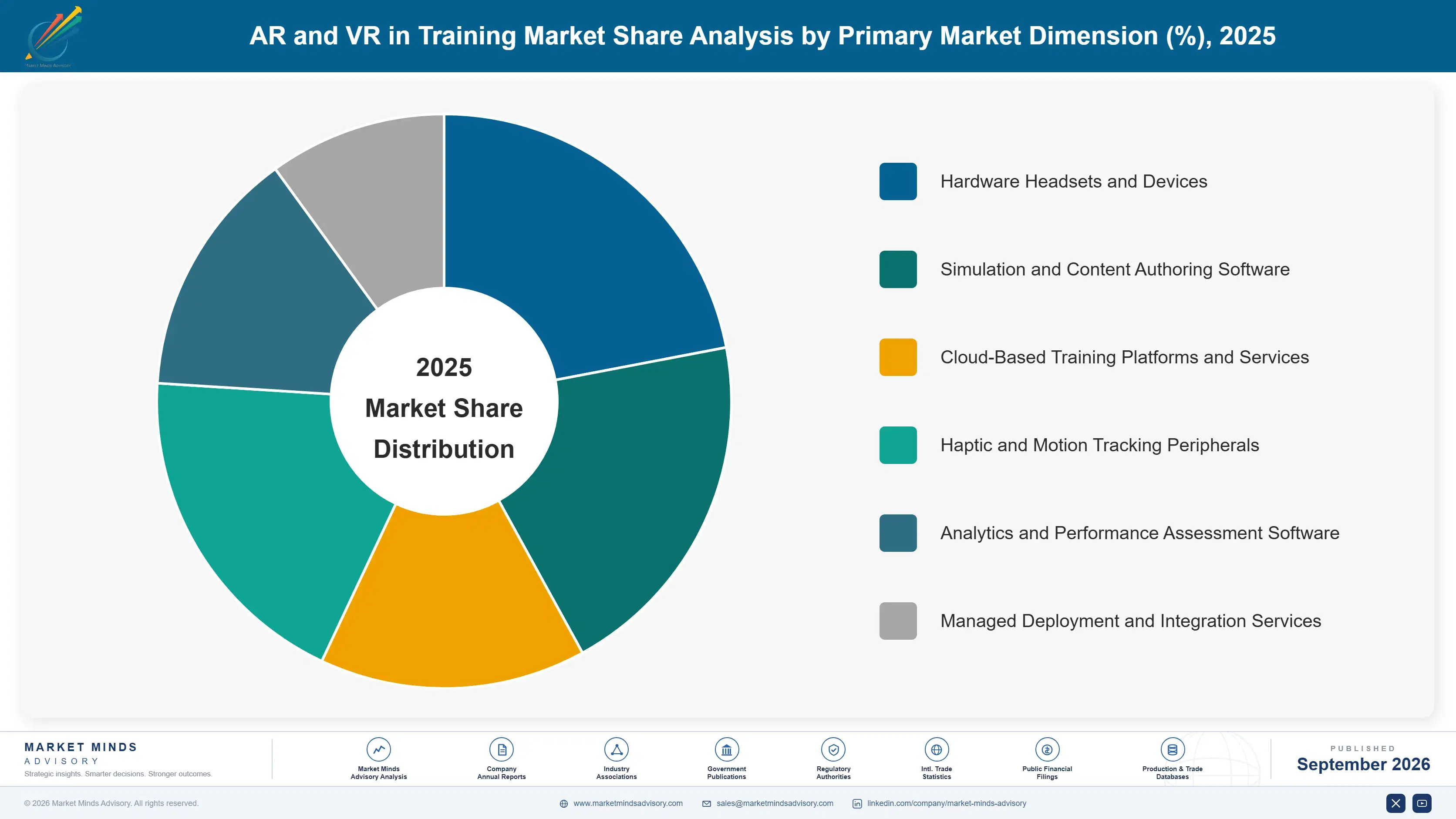
The AR and VR in Training Market segments by product type across six categories spanning hardware headsets, simulation and content authoring software, cloud-based training platforms and services, haptic and motion tracking peripherals, analytics and performance assessment software, and managed deployment services. Cloud platforms and analytics software lead growth, reflecting subscription migration and measurement demand across most enterprise programs.
ar-and-vr-in-training-market-market-share-analysis-1789980748672

Cloud-Based Training Platforms and Services

Cloud-based training platforms and services deliver simulation content and analytics through subscription arrangements that bundle headset provisioning, content licensing, and technical support into a single recurring fee rather than requiring separate upfront hardware and software purchases across most deployment models, organizational structures, industry categories, and geographic regions worldwide. Demand for this category grows fastest among all six segments, propelled by smaller organizations seeking enterprise-grade simulation capability without large capital commitments that previously limited adoption to well-funded corporations and government agencies. Vendors offering mature cloud platforms capture disproportionate new design wins versus competitors still requiring separate hardware procurement and on-premises software installation across most emerging customer segments and organizational sizes worldwide.
CAGR 15.5%

Analytics and Performance Assessment Software

Analytics and performance assessment software captures detailed trainee decision patterns, response times, and completion rates that let enterprises quantify skill retention gains rather than relying on post-training surveys and subjective supervisor assessments alone across most training programs and industry categories worldwide today. Growth in this category tracks rising demand from training departments needing concrete performance data to justify budget allocation to finance leadership rather than relying on anecdotal engagement metrics alone across most industries and organizational sizes. Vendors increasingly bundle sophisticated analytics dashboards into existing hardware and cloud-native product lines, letting customers upgrade measurement capability without replacing underlying deployment infrastructure across each contract renewal cycle and budget planning period entirely.
CAGR 13.2%
Full segment breakdown across 6 segments available in the complete report.

Regional Architecture and Country Demand Map

Regional AR and VR training demand concentrates where enterprise training budgets, defense simulation spending, and major vendor headquarters all intersect most heavily, with North America and East Asia leading on installed base scale, while South Asia and Pacific grows fastest on corporate skilling investment today.

North America

United States vendor headquarters concentration drives the region's leading share, since Meta Platforms, Microsoft, and STRIVR base core engineering, content development, and sales operations domestically, capturing revenue recognition even where deployment occurs internationally across other regions and markets worldwide. Department of Defense simulation training budgets add substantial demand beyond commercial enterprise purchases, sustaining specialized content development contracts across multiple branches and installations nationwide. Canadian enterprises contribute meaningful additional demand through parallel corporate training modernization programs and initiatives. Large healthcare systems and manufacturers headquartered in the region continue expanding immersive training deployment rather than relying solely on traditional classroom instruction, reinforcing installed base growth across most major industries and workforce categories.
Share: 32% | CAGR: 12.0% (2026 to 2036)

East Asia

China's expanding manufacturing sector drives substantial regional training technology adoption, as large domestic manufacturers deploy simulation training to address skilled labor shortages across expanding production facilities nationwide and across neighboring provinces and coastal regions today. Japan and South Korea contribute additional demand through advanced electronics manufacturing and automotive sector training programs requiring precise technical procedure certification and compliance documentation. Regional hardware manufacturers, including several Chinese headset producers, add manufacturing scale that keeps device costs competitive against Western alternatives and imports. Regional enterprises increasingly adopt domestically developed content platforms rather than importing Western training software, reinforcing this domestic technology trend across most major industrial sectors, workforce categories, and manufacturing regions nationwide.
Share: 26% | CAGR: 12.4% (2026 to 2036)
Regional intelligence for 5 additional markets available in the complete report: Western Europe, South Asia and Pacific, Latin America, Middle East and Africa, Eastern Europe. Contact sales@marketmindsadvisory.com.
ar-and-vr-in-training-market-country-cagr-analysis-1789980749199

Capturing Value From Behavioral Analytics

Training technology vendors can expand margin capture beyond raw hardware sales by pursuing four distinct commercial paths tied to analytics depth, subscription contract structure, defense and healthcare content specialization, and regional support infrastructure built across multiple enterprise and government customer relationships spanning several years, renewal cycles, expanding service categories, and evolving content libraries worldwide.

Premium Pricing for Analytics-Enabled Platform Access

Vendors offering mature behavioral analytics and performance measurement capability can charge premium pricing, typically 20 to 30 percent above basic completion-tracking platform pricing, since enterprises facing budget justification pressure will pay for proven skill retention data that traditional training methods cannot provide or verify. This premium persists until enough competitors achieve comparable analytics maturity, typically a two-to-three-year window across most enterprise customer segments and industries. Vendors that invest early in analytics development capture outsized margin during this window before broader industry adoption compresses pricing back toward standard levels across the market.
Market Impact: Adds a 20 to 30 percent price premium

Multi-Year Subscription Recurring Revenue Growth Model

Vendors offering multi-year subscription contracts bundling headset provisioning, content licensing, and analytics access capture more predictable, higher-lifetime-value revenue streams that typically generate 30 to 40 percent more total contract value over a five-year period compared to one-time hardware and software sales alone without ongoing support commitments included at purchase. This subscription model also deepens customer dependency on continuous vendor content updates and platform maintenance, reducing churn risk versus customers free to switch vendors at each contract renewal without meaningful switching cost or operational disruption to ongoing training programs and active initiatives.
Market Impact: Lifts contract value by 30 to 40 percent

Defense and Healthcare Content Specialization Strategy

Vendors offering certification-grade content specifically designed for defense and healthcare training programs can charge a meaningful premium over standard corporate-oriented platforms, since these customers value regulatory documentation and procedural accuracy that compresses liability risk by roughly 25 percent according to institutional risk assessments and formal safety audits conducted annually across most facilities. This specialization captures value from compliance urgency that general corporate customers typically do not share, while strengthening vendor relationships as institutions become dependent on vendor-specific certification workflows across multiple training programs, renewal cycles, and evolving regulatory requirements over time.
Market Impact: Cuts institutional liability risk by 25 percent overall

Shared Enterprise Content Library Access Model

Vendors increasingly support shared content library models that let multiple smaller organizations access a broad simulation scenario catalog through tiered subscription access, generating recurring library access fee revenue exceeding 30 percent above what any single smaller organization could justify commissioning independently on its own limited annual training budget alone entirely and permanently. This shared access model lets budget-constrained organizations access enterprise-grade content variety without full custom development cost, while vendors capture broader customer relationships and support revenue across multiple institutional partners sharing the same underlying content infrastructure and update cycle investment.
Market Impact: Adds over 30 percent library access fee revenue

Who Controls the Margin Pool

Market concentration sits at 42 percent among the top five vendors measured by platform and content subscription revenue, and Meta Platforms holds a meaningful lead over its closest challenger, Microsoft, in enterprise headset deployment volume specifically. The gap between the leader and the next challenger has narrowed as Microsoft expands its own mixed-reality enterprise offerings aggressively. Below the top five, dozens of specialized content developers compete on instructional design depth rather than raw hardware differentiation.
Current competitive activity centers on analytics platform depth, subscription bundling models, and defense and healthcare content specialization that increasingly determines customer selection more than raw rendering fidelity alone. PTC and STRIVR have both announced expanded analytics capability this year to differentiate against generic completion-tracking competitors, while Immerse continues deepening its cloud-native subscription offerings aimed at mid-market enterprise customers seeking accessible entry points.

Emerging pressure comes from specialized content developers winning enterprise contracts faster than platform incumbents expected, threatening to compress pricing across generic training content categories first. Rankings could shift meaningfully if a specialized vendor secures broad adoption across multiple hardware platforms simultaneously, validating a content-first model that reduces customer dependency on any single hardware manufacturer's platform entirely.
ar-and-vr-in-training-market-company-positioning-matrix-1789980749723

Competitive Moat and Risk Dimensions

META PLATFORMS INC

Moat: Dominant enterprise headset installed base

Meta maintains the largest installed base of enterprise-grade Quest headsets across corporate training deployments worldwide, creating a durable content marketplace and support revenue stream that competitors with smaller hardware installed bases cannot easily replicate. This scale also lets Meta amortize hardware research and development investment across a larger customer base than smaller platform competitors managing comparable engineering budgets.
META PLATFORMS INC

Risk: Consumer brand limits enterprise trust

Meta's dominant consumer social media brand identity sometimes complicates enterprise procurement conversations, particularly among government and defense customers wary of data privacy associations tied to the parent company's broader consumer business. This brand perception could limit growth in security-sensitive institutional markets where competitors without consumer brand baggage compete more easily.
MICROSOFT CORPORATION

Moat: Deep enterprise software integration advantage

Microsoft's mixed-reality training offerings integrate directly with existing enterprise Microsoft 365 and Azure cloud infrastructure that most large organizations already operate, letting it bundle training deployment into broader enterprise technology contracts that standalone competitors cannot match. This integrated positioning gives Microsoft disproportionate access to enterprise IT budget decisions beyond pure training software evaluation alone.
MICROSOFT CORPORATION

Risk: Slower content marketplace platform growth

Microsoft's mixed-reality content marketplace has grown more slowly than Meta's consumer-oriented content library, limiting the breadth of pre-built training scenarios available to enterprise customers compared to platform alternatives. Carriers increasingly prioritizing rapid deployment could shift meaningful contract share toward faster-moving challengers if Microsoft's content library expansion pace does not accelerate.

Players Tracked

Prominent Players

Meta Platforms Inc
Microsoft Corporation
PTC Inc
STRIVR Inc
Immerse Ltd

Other Key Players

HTC Corporation
Varjo Technologies Oy
Talespin Reality Labs Inc
Osso VR Inc
FundamentalVR Ltd
Bodyswaps Ltd
ForgeFX Simulations Inc
Roundtable Learning LLC
Mursion Inc
Interplay Learning Inc
Igloo Vision Ltd
Virtuleap Inc
Circuit Stream Inc
Simformotion LLC
Vection Technologies Ltd

Recent Developments

JANUARY 2026

Meta Platforms announced expanded enterprise analytics dashboard capabilities for its Quest for Business platform, targeting improved skill retention measurement across manufacturing and healthcare training deployments worldwide and across most industries. The update includes new integration options for third-party learning management system connectivity and detailed reporting.
Signal: Confirms analytics capability as the primary competitive differentiator among leading platform vendors today and going forward.
OCTOBER 2025

STRIVR completed a multi-year supply agreement with a major United States healthcare system to deploy clinical procedure training simulations across several hospital networks nationwide and regional affiliated facilities and clinics. The agreement includes ongoing content development and analytics reporting services covering multiple clinical departments and specialties.
Signal: Reflects continued specialized vendor expansion into large healthcare system training contracts and partnerships across multiple regions.
MAY 2025

PTC launched an expanded version of its Vuforia industrial training platform supporting subscription-based deployment for mid-market manufacturing customers previously unable to justify large upfront licensing costs and long-term commitments. The launch targets manufacturers seeking accessible entry points into immersive training technology across their production facilities and plants.
Signal: Signals accelerating vendor investment in subscription models targeting previously underserved mid-market manufacturing customers directly and broadly.

Content Development and Chipset Cost Exposure

Instructional design talent and mobile processing chipsets together represent roughly 48 percent of vendor cost of goods sold, sourced primarily from specialized learning designers based across North America and Europe, alongside semiconductor chipsets purchased from major mobile processor manufacturers worldwide. Cloud computing infrastructure for content hosting adds further meaningful cost exposure for subscription-based product lines.
Mobile processor chipset costs spiked during 2021 and 2022 as broader consumer electronics demand competed for constrained global semiconductor manufacturing capacity simultaneously, according to company annual reports discussing component sourcing challenges during that period. Several headset manufacturers reported delayed product launches and compressed hardware margins as they absorbed higher component costs rather than passing them fully through to enterprise customers under existing fixed-price purchase agreements.

Smaller content developers without dedicated instructional design teams face proportionally higher per-scenario development costs than vertically integrated majors like Meta and Microsoft, which amortize design talent across a much larger content catalog and customer base worldwide. Vendors headquartered in regions with weaker currencies also face amplified dollar-denominated chipset costs, widening the competitive cost gap against vendors with diversified global manufacturing and procurement footprints across multiple regions.
ar-and-vr-in-training-market-cost-volatility-analysis-1789980749919

Build Reusable Instructional Design Frameworks

Vendors increasingly build reusable instructional design frameworks and scenario templates that serve multiple training content categories simultaneously, reducing per-scenario development cost by amortizing design talent investment across a broader content portfolio and customer base. This design shift lowers marginal cost for each additional training module while accelerating time to market for new customer requests and updates.

Negotiate Multi-Year Chipset Supply Agreements

Locking multi-year chipset supply contracts with mobile processor manufacturers at fixed or partially hedged pricing protects vendors against shortage-driven cost spikes that have repeatedly compressed hardware margins during recent supply constraints and disruptions. This pricing certainty lets finance teams plan hardware pricing several years ahead with materially reduced exposure to sudden component cost swings and volatility.

Diversify Content Development Talent Sourcing

Sourcing instructional design talent from multiple regional talent pools rather than a single concentrated location reduces exposure to localized wage inflation or talent shortages tied to competing technology sector demand across major hiring markets. This diversification strategy adds modest coordination complexity but meaningfully reduces single-region dependency risk across the vendor's broader design talent base and pipeline.

Portfolio Architecture for Margin Defence

Vendor economics split into three tiers by content sophistication and analytics differentiation across most product categories offered today. Volume-tier standard content and hardware bundles carry gross margins around 25 to 32 percent, while premium analytics-bundled configurations reach 40 to 48 percent margins consistently. Certification-grade defense and healthcare content commands the widest margin range given the technical barriers protecting early movers from immediate competitive pressure.
Tension between volume and premium tiers centers on content specialization: vendors must decide how much instructional design investment to commit toward certification-grade defense and healthcare customers versus maintaining accessible standard content configurations serving budget-constrained smaller organizations. Most large vendors now prioritize specialization and analytics investment, accepting narrower standard content margins to secure future design-in position across upcoming enterprise contract renewal cycles.

High-value margin pools concentrate overwhelmingly in analytics-enabled platforms and certification-grade specialized content, where technical and regulatory barriers protect early movers from immediate price competition across most deployment scenarios and customer segments. Standard training content increasingly commoditizes as more vendors, including regional developers, achieve comparable baseline production quality, compressing margins toward the lower end of the volume tier band across most established global markets and industries.

Standard hardware and content bundles serving budget-constrained smaller organizations and mid-market enterprises, priced primarily on manufacturing scale and baseline content variety rather than analytics sophistication or deep specialization depth today.
Gross Margin: 25-32%

Analytics-bundled configurations meeting enterprise measurement requirements, commanding pricing power from software differentiation and behavioral data depth competitors cannot easily replicate quickly across comparable customer segments, industries, and geographic markets worldwide.
Gross Margin: 40-48%

Certification-grade defense and healthcare content addressing regulatory documentation requirements, where technical barriers and instructional design maturity drive the widest margin variance across vendors, deployment types, and customer segments today and beyond.
Gross Margin: 30-52%
ar-and-vr-in-training-market-portfolio-architecture-1789980750423

High-value Sub-segments and Strategic Watch-out

Cloud-Based Training Platforms and Services

Growing fastest among all six segments as smaller organizations seek enterprise-grade simulation capability without large capital commitments, commanding premium pricing and durable subscription economics that protect early movers from immediate competitive pressure across most customer segments, geographic regions, industry categories, and organizational sizes worldwide today.

Analytics and Performance Assessment Software

Enterprise budget justification demand drives strong secondary growth here, though moderate near-term margin pressure reflects intensifying competition among vendors racing to standardize measurement capability across next-generation training platform architectures, customer categories, geographic markets, industry verticals, pricing models, licensing structures, support tiers, and renewal terms worldwide.

Hardware Headsets and Devices

The largest volume segment by unit count, providing steady baseline revenue at comparatively thin hardware margins as commoditization intensifies with growing regional manufacturing capacity entering global supply chains and enterprise procurement decisions consistently and predictably over multiple budget years, renewal periods, and future planning cycles.

Standard Generic Content Libraries

A strategic watch-out segment facing sustained pricing pressure as generic content commoditizes faster than specialized certification-grade material, risking margin erosion for vendors slow to redirect focus toward higher-value analytics and specialization categories instead of legacy content libraries entirely and permanently across most markets and customer segments.

Renewal Economics of Simulation Content Investment

Vendor relationships operate on annuity-like economics once an enterprise commits to a simulation content library, since replacing embedded training modules requires re-authoring scenarios and retraining internal administrators managing course assignment and completion tracking. A typical enterprise contract generates recurring subscription and content update revenue across a three-to-five-year training program lifecycle, with new module development extending the relationship well beyond initial platform procurement.
Adoption stickiness varies meaningfully by end-use vertical: healthcare and manufacturing customers show the deepest stickiness given regulatory compliance documentation tied to specific certified training content and audit requirements. Retail and soft-skills customers show comparatively higher churn as generic content commoditizes faster across competing vendor platforms. Defense and government customers show extremely high stickiness tied to security clearance and procurement certification requirements that discourage frequent vendor switching.

Buyer profiles are shifting generationally as procurement authority moves from corporate learning and development departments toward operations and safety leaders who prioritize measurable performance outcomes over engagement metrics alone across most industries. Younger training leaders increasingly favor vendors offering transparent analytics dashboards and proven behavioral change data over vendors competing purely on production value and visual realism alone.
ar-and-vr-in-training-market-end-use-penetration-index-1789980750909

Immersive Training Investment Priorities

These are among the four positions where our research anticipates prominent divergence between winners and laggards over the coming forecast period. Each is grounded in the demand model, the regulatory perimeter, and the announced capacity pipeline.
01 / ANALYTICS PLATFORM INVESTMENT

Build behavioral analytics ahead of enterprise budget scrutiny intensifying

Enterprise training budgets face growing finance scrutiny that increasingly requires quantified performance data rather than anecdotal completion rates, and this pressure will only intensify as training technology spend competes against other corporate priorities. Vendors that build mature analytics capability now capture disproportionate renewal contracts among customers required to justify budget allocation with concrete evidence rather than engagement metrics alone. Vendors that delay this investment risk losing enterprise contracts entirely to competitors offering more credible measurement capability within the next several renewal cycles.
02 / SUBSCRIPTION MODEL TRANSITION

Accelerate subscription bundling before hardware margins compress further

Standard hardware pricing continues compressing as more manufacturers enter the market with comparable device specifications, making pure hardware sales an increasingly unreliable margin source for platform vendors across most customer segments and geographic markets. Vendors offering subscription bundles that combine hardware, content, and analytics access capture more predictable, higher-lifetime-value revenue than competitors relying primarily on one-time transactional sales alone. Building this capability now captures durable recurring revenue before hardware commoditization further erodes standalone device sales margins across most customer segments and industries.
03 / DEFENSE HEALTHCARE SPECIALIZATION

Build certification-grade content for defense and healthcare customers specifically

Defense and healthcare customers value regulatory documentation and procedural accuracy far more than general corporate customers do, since compliance failures carry substantial safety and liability consequences that generic corporate training does not face across most institutional settings. Vendors offering generic content to these specialized customers increasingly lose contracts to competitors building dedicated certification-grade packages specifically designed for institutional compliance requirements and audit standards. Building this specialized capability now captures a growing, well-funded customer segment before competitors establish dominant institutional relationships across major markets.
04 / HEADSET COMFORT ENGINEERING

Invest in headset comfort engineering to extend usable session length

Extended headset wear discomfort continues limiting practical training session length, constraining the scenarios vendors can realistically deploy without risking trainee dropout mid-session across most enterprise deployments and customer types worldwide today. Vendors investing in comfort engineering and modular shorter-session content design capture usage patterns that competitors relying on longer, less comfortable sessions cannot match reliably across comparable deployments. Solving this comfort barrier now expands the addressable use cases beyond current session-length constraints considerably across most industries and training categories today.

Engagement Snapshot From the Field

A live engagement with an industry participant carrying material or product regulatory and market exposure ahead of a defining policy shift, showing how our research translates into a defensible multi-year portfolio strategy.
MARKET MINDS ADVISORY · CLIENT ENGAGEMENT SUMMARY
AR and VR in Training Producer Strategic Portfolio Review and Transition Roadmap 2026·Investment Scenario on AR and VR in Training Exposure Evaluation 2025-26
CLIENT PROFILE
The client is a mid-sized manufacturing company operating several plants across the southeastern United States, employing roughly 4,200 production workers and generating annual revenue of approximately 620 million dollars (client-reported, unverified by MMA). The company relied entirely on traditional classroom and on-the-job training for technical certification, facing rising costs as skilled labor turnover increased across its facilities.
STRATEGIC CHALLENGE
Management needed to decide whether to invest in an enterprise-wide immersive training platform requiring significant capital investment and content development work, continue relying on traditional classroom training despite rising turnover-driven retraining costs, or pursue a phased pilot approach at a single facility before broader rollout commitment and final budget approval.
MMA APPROACH
MMA conducted primary interviews with the client's operations and training leadership alongside benchmarking analysis of training cost per worker and skill retention outcomes among comparable manufacturing companies pursuing immersive versus traditional training approaches across North America and Western Europe over a six-week engagement period covering multiple facility types and worker categories.
KEY FINDINGS
  1. Traditional classroom training required roughly 40 percent more retraining hours per worker compared to immersive simulation training documented across comparable manufacturing facilities studied.
  2. A single-facility pilot program cut new hire time-to-competency by roughly 35 percent compared to traditional classroom training methods used previously at the same facility.
  3. Skilled labor turnover imposed retraining costs exceeding what a phased immersive training rollout would cost across all facilities within the first eighteen months combined.
  4. Workers reported higher confidence performing complex procedures after immersive training compared to traditional methods, based on supervisor assessments conducted across multiple production lines.
CLIENT PROFILE
The client is a mid-sized manufacturing company operating several plants across the southeastern United States, employing roughly 4,200 production workers and generating annual revenue of approximately 620 million dollars (client-reported, unverified by MMA). The company relied entirely on traditional classroom and on-the-job training for technical certification, facing rising costs as skilled labor turnover increased across its facilities.
STRATEGIC CHALLENGE
Management needed to decide whether to invest in an enterprise-wide immersive training platform requiring significant capital investment and content development work, continue relying on traditional classroom training despite rising turnover-driven retraining costs, or pursue a phased pilot approach at a single facility before broader rollout commitment and final budget approval.
MMA APPROACH
MMA conducted primary interviews with the client's operations and training leadership alongside benchmarking analysis of training cost per worker and skill retention outcomes among comparable manufacturing companies pursuing immersive versus traditional training approaches across North America and Western Europe over a six-week engagement period covering multiple facility types and worker categories.
KEY FINDINGS
  1. Traditional classroom training required roughly 40 percent more retraining hours per worker compared to immersive simulation training documented across comparable manufacturing facilities studied.
  2. A single-facility pilot program cut new hire time-to-competency by roughly 35 percent compared to traditional classroom training methods used previously at the same facility.
  3. Skilled labor turnover imposed retraining costs exceeding what a phased immersive training rollout would cost across all facilities within the first eighteen months combined.
  4. Workers reported higher confidence performing complex procedures after immersive training compared to traditional methods, based on supervisor assessments conducted across multiple production lines.
RECOMMENDED STRATEGY
Phase 1: Phase one: deploy immersive training pilot at the highest-turnover facility within two quarters to validate cost savings directly and quickly. Phase 2: Phase two: expand deployment to remaining facilities gradually, prioritizing locations with the highest documented retraining cost burden first and consistently. Phase 3: Phase three: build internal content development capability to reduce ongoing dependency on external vendor customization services over time and budget cycles.
OUTCOME
Within twelve months, the client reported new hire time-to-competency improvements of roughly 35 percent and retraining cost reductions across the piloted facility of approximately 40 percent (client-reported, unverified by MMA). The company now plans facility-wide rollout across its remaining production sites and locations nationwide over time.

Frequently Asked Questions

Foundational context covering the market sizes, CAGR, scope, country, region and competition that inform every finding below. This section is provided to cover basics and most often pre-purchase conversations, answered from the MMA Primary Research Dataset.

What is the current size of the AR and VR in Training Market?

The AR and VR in Training Market reached 6.8 billion dollars in 2025, the base year for this report's forecast. Growth continues at an 11.4 percent compound annual rate through 2036, driven by cloud subscription migration and analytics-enabled platform adoption.

How large will the AR and VR in Training Market be by 2036?

The market is projected to reach 22.31 billion dollars by 2036, representing a 2.94 times expansion from its 2026 value. Cloud-based training platforms and analytics software drive most of this incremental growth across nearly every covered region.

What is the CAGR for the AR and VR in Training Market 2026 to 2036?

The base case compound annual growth rate is 11.4 percent across the ten-year forecast window. Bull case scenarios reach 12.7 percent on faster subscription adoption, while bear case scenarios fall to 10.1 percent on budget constraints.

Which segment is growing fastest?

Cloud-Based Training Platforms and Services grow fastest at a 15.5 percent compound annual rate, roughly 1.36 times the overall market average. Analytics and Performance Assessment Software follows as the second-fastest visible segment at 13.2 percent.

Who are the major companies in the AR and VR in Training Market?

Meta Platforms, Microsoft, PTC, STRIVR, and Immerse lead the field, together representing roughly 42 percent combined concentration. HTC and Varjo also maintain meaningful competitive positions across several major regional markets.

Which country is growing fastest?

India leads country-level growth at a 14.0 percent compound annual rate, outpacing the broader South Asia and Pacific region overall. Expanding corporate training investment and government digital skilling initiatives drive this acceleration across most major Indian enterprises.

Report Segmentation Architecture

The full report scope spans multiple orthogonal segmentation dimensions, with cross-tabulated demand data provided for each dimension pair. Coverage extends further to regional breakdowns, trend trajectories, and the competitive detail needed to support segment-level decision-making.

By Primary Market Dimension

  • Hardware Headsets and Devices
  • Simulation and Content Authoring Software
  • Cloud-Based Training Platforms and Services
  • Haptic and Motion Tracking Peripherals
  • Analytics and Performance Assessment Software
  • Managed Deployment and Integration Services

By End-Use Industry

  • Manufacturing and Industrial
  • Healthcare and Life Sciences
  • Defense and Government
  • Retail and Customer Service

By Commercial Dimension

  • Direct Platform Licensing
  • Subscription-Based Access Model
  • Managed Content Development Services
  • Shared Content Library Access

By Region

  • North America
  • East Asia
  • Western Europe
  • South Asia and Pacific
  • Latin America
  • Middle East and Africa
  • Eastern Europe

Scope, Methodology, and Coverage

Every figure in this report is reproducible from documented input assumptions. The scope below maps the historical period, the forecast horizon, the segmentation dimensions, and the countries covered, alongside the underlying primary and qualitative methodology.
Historical Period
2020 to 2025
Forecast Period
2026 to 2036
Base Year
2025 (USD billions; MMA Primary Research Dataset, September 2026)
Market Definition
The AR and VR in Training Market covers headsets, simulation software, content authoring platforms, and analytics tools used to deliver immersive skills training across enterprise, healthcare, and defense settings. It excludes standalone consumer entertainment VR products and general e-learning platforms lacking dedicated immersive simulation capability.
Quantitative Units
USD Billion
Segmentation Dimensions
Product Type, End-Use Industry, Commercial Dimension, Region
Regions Covered
North America, East Asia, Western Europe, South Asia and Pacific, Latin America, Middle East and Africa, Eastern Europe
Countries Covered
United States, China, India, Germany, United Kingdom, Japan, Brazil, and 31 additional countries
Key Companies Profiled
Meta Platforms Inc, Microsoft Corporation, PTC Inc, STRIVR Inc, Immerse Ltd, HTC Corporation, Varjo Technologies Oy, Talespin Reality Labs Inc, Osso VR Inc, FundamentalVR Ltd, Bodyswaps Ltd, ForgeFX Simulations Inc, Roundtable Learning LLC, Mursion Inc, Interplay Learning Inc, Igloo Vision Ltd, Virtuleap Inc, Circuit Stream Inc, Simformotion LLC, Vection Technologies Ltd
Quantitative Methodology
Primary survey, n=3,800 respondents, Q4 2025, six countries; demand-side model with trade association cross-validation
Qualitative Methodology
47 expert interviews, Q4 2025; applied to validate demand model assumptions, identify emerging dynamics, and assess competitive positioning
Report Format
PDF and XLSX data workbook (Word format preview document)
Publisher
Market Minds Advisory
Report Code
MMA-2026-TEC-101
Published
September 2026
Contact
sales@marketmindsadvisory.com | www.marketmindsadvisory.com

Purchase the full AR and VR in Training Market Report (2026 to 2036).

This report examines the global AR and VR in Training Market across product type, end-use industry, and commercial dimension through 2036. It quantifies cloud subscription migration, analytics-enabled platform adoption, and defense and healthcare content specialization as primary mechanisms shaping vendor strategy and margin capture. Coverage spans competitive positioning among five leading vendors and fifteen additional challengers across seven world regions, with detailed input cost and portfolio analysis included. The analysis draws on primary survey data spanning 3,800 respondents and 47 expert interviews conducted across six countries in the fourth quarter of 2025.
Full regional breakdown across all seven markets
Ten-year forecast scenarios with bull and bear cases
Detailed competitive profiles of twenty major vendors
Segment-level growth rates and margin economics analysis
Input cost exposure and mitigation strategy analysis
Anonymized client case study with strategic recommendations

Built For The People Who Decide

From boardroom strategy to bench-side execution, this report is read cover-to-cover by leaders shaping the next decade of their industry, turning demand scenarios, market dynamics and valuation benchmarks into decisions.
CXOs/ Presidents/ VPs/ Managers
M&A and Corporate Development
Strategy Teams and R&D Heads
Procurement and Product Directors
Regulatory and Compliance Leaders
Investor Relations and Equity Analysts