Market Minds Advisory
Aquarium Decor Market

Aquarium Decor Market: Aquarium Decor Market. Aquascaping as Design Discipline

Aquarium hobbyists increasingly treat decor as aquascaping design rather than functional filler, pushing manufacturers toward biologically safe materials and modular reef-mimicking designs as livestock safety scrutiny reshapes which products retailers will stock.

Lead Analyst

Published

September 2026

Make Smarter Decisions with Customized Research Insights

Request a free sample report and evaluate market opportunities, growth trends, and competitive dynamics relevant to your business needs.

2025 MARKET VALUE$2.4BMarket Size 2025
2036 FORECAST VALUE$4.7BBase Case , 2026 to 2036
CAGR 2026 TO 20366.4 %Bull 7.6% / Bear 5.2%
INCREMENTAL OPPORTUNITY$2.2BNet 10- year value creation
EXPANSION MULTIPLE1.86x2036 value over 2026 base
Strategic Levers
M&A Pipeline
Regional Outlook
Country Rankings
Competitive Intelligence
Segmental Deep-dive
Call-Us : 91 93563 13602

Executive Snapshot and Market Trajectory.

Aquarium decor has shifted from an afterthought purchase alongside fish and food to a deliberate design category, as hobbyists increasingly plan tank aesthetics around aquascaping trends before selecting livestock across nearly every tank size, hobbyist experience level, price tier, and retail channel available today across the world.
Naturalistic and modular reef-mimicking decor is pulling disproportionate revenue growth, concentrated among younger hobbyists in East Asian and North American markets who research material safety before purchase through dedicated aquascaping community platforms and livestreamed tank builds. Brands investing in biologically inert, non-leaching materials are capturing outsized loyalty among hobbyists who previously avoided decorative additions entirely due to livestock safety concerns and chemical leaching worries across most tank types and hobbyist experience levels.
Mass pet retailers and specialty aquascaping brands compete on distinctly different terms, as biological safety certification and non-toxic material testing increasingly determine which decor products retailers will stock following documented livestock injury incidents across the category, price tiers, and tank types nationwide. Independent aquascaping brands increasingly partner with contract testing labs to generate the safety documentation larger pet conglomerates historically monopolized through in-house testing infrastructure and expertise.
Market Definition
The aquarium decor market covers artificial and natural rockwork, driftwood, plants, backgrounds, and modular structures sold for freshwater and saltwater aquarium aesthetic and enrichment purposes through pet specialty, mass retail, and direct-to-consumer channels. It excludes live plants, live rock, and functional equipment such as filters, heaters, and lighting.
Base Year Value
$2.4B in 2025 (MMA Primary Research Dataset, September 2026)
Forecast Period
2026 to 2036, eleven discrete annual values
CAGR
6.4% base case. Bull 7.6%. Bear 5.2%.
Fastest Growth Segment
Modular Reef-Mimicking Structures: 9.8% CAGR
Fastest Growth Country
China: 8.6% CAGR
Fastest Growth Region
South Asia and Pacific: 8.3% CAGR
Largest Region
East Asia: 29% of 2025 global value
Market Leaders
Spectrum Brands (Tetra), Central Garden & Pet, Penn-Plax, Zoo Med Laboratories, Fluval (Rolf C. Hagen Group). Source: MMA Analysis based on company annual reports.
Primary Survey
n=3,800 procurement and R&D decision-makers, Q4 2025, six countries
Methodology
Demand-side build-up, cross-validated against public data, 47 expert interviews

Aquarium Decor Market Forecast Scenarios

aquarium-decor-market-size-forecast-scenario-1790016673671
Between 2020 and 2025, aquarium decor demand grew steadily as pandemic-era home hobby adoption surged, then continued expanding as aquascaping content gained mainstream visibility through social media platforms showcasing elaborate tank designs to broader audiences across most consuming markets and price tiers worldwide, with East Asian markets leading early adoption well ahead of most Western peers globally.
The base case rests on three commercial mechanisms operating together: aquascaping content driving aesthetic ambition among casual hobbyists, biologically safe material innovation resolving longstanding livestock safety concerns, and specialty brands expanding modular reef-mimicking product lines into mass retail channels across multiple price tiers, geographic markets, and hobbyist experience levels worldwide. Together these mechanisms support steady growth even as overall pet ownership growth moderates from pandemic-era peaks across most consuming markets.
The bull case rests on modular reef-mimicking structures scaling faster than expected among saltwater hobbyists seeking premium aquascaping solutions nationwide and abroad each year. The bear case centers on economic pressure pushing budget-conscious hobbyists toward cheaper, less tested decor, compressing average selling prices across the category faster than volume growth can offset over the next several forecast years.

Aquascaping Elevates Decor Purchase Decisions

Aquarium decor has moved from a functional afterthought to a deliberate design category where aquascaping aesthetics increasingly drive purchase decisions before livestock selection, as hobbyists treat tank design as a creative discipline rather than simple habitat furnishing across nearly every price tier and retail channel worldwide. This shift is converging with rising biological safety scrutiny across East Asian markets and clean-material preferences among younger hobbyists.
MARKET CONCENTRATIONCR5 28%top five brands hold moderate combined market share
AVERAGE UNIT PRICE$14.60blended mass and specialty channel decor item price nationwide
TOP PRODUCING COUNTRYChina 44%share of global aquarium decor manufacturing output currently
BIOLOGICALLY SAFE CERTIFIED SHARE31%share of new launches carrying third-party safety certification
MATERIAL COST SHARE35% COGSresin and ceramic input share of total production cost
REPLACEMENT CYCLE3 yearsaverage interval before hobbyists refresh tank decor arrangements
Commercially, specialty aquascaping brands are extending modular reef-mimicking product lines into mass retail to capture hobbyists who previously associated elaborate tank design exclusively with dedicated specialty stores and hobbyist forums. Mass conglomerates are responding by acquiring or partnering with material testing labs to close the safety credibility gap faster than building comparable in-house expertise from scratch, particularly in fast-growing saltwater and reef-mimicking segments.
Over the next decade, biological safety certification and material testing will separate manufacturers who can supply credible non-toxic claims from those relying on marketing language alone, while modular reef-mimicking systems test whether premium aquascaping design can command mainstream pricing beyond dedicated saltwater hobbyists and into freshwater mass retail assortments worldwide and across every major price tier tracked.
"Aquarium decor used to mean plastic castles from the discount aisle. Now hobbyists are treating their tanks like miniature landscape architecture projects, and most retailers still haven't caught up to what buyers actually want."
Director, Pet Products and Aquatics Practice · MMA Consumer Products Practice · September 2026

Market Trends

Aquascaping Content Drives Mainstream Aesthetic Ambition

Livestreamed and short-form video aquascaping content has driven mainstream hobbyist aesthetic ambition sharply upward, with roughly 34 percent of new tank setups now incorporating layered, naturalistic decor arrangements inspired by competitive aquascaping design across most consuming markets and price tiers tracked worldwide today. This content-driven mainstreaming is normalizing elaborate tank design among casual hobbyists who previously purchased minimal, purely functional decor without much aesthetic consideration. Retailers report aquascaping-inspired product bundles generating meaningfully higher basket value than individual decor item purchases, even as unit prices remain comparable across most product categories.
Market Impact: Sustains 8% premium demand growth
Biological Safety Certification Becomes Retail Requirement

Major pet specialty retailers have begun requiring third-party biological safety certification documentation before approving new decor SKU listings, a shift affecting roughly 29 percent of new product submissions following documented livestock injury incidents linked to leaching materials across the category, price tiers, retail formats, and product categories nationwide. This retailer-driven gatekeeping favors established manufacturers with dedicated testing infrastructure over smaller brands relying on informal safety claims and marketing language. Contract testing laboratories report growing backlogs as demand for certification documentation outpaces available testing capacity across the aquarium products industry broadly.
Market Impact: Expands regional demand across 3 countries

Market Opportunities and Growth Drivers

Pet Humanization Drives Premium Tank Design Selection

Pet humanization trends continue driving spending toward premium, aesthetically deliberate aquarium setups as hobbyists increasingly treat tank design as a home decor extension deserving the same purchase scrutiny applied to furniture and interior design choices across most household income brackets. Younger hobbyists in particular research material composition and biological safety before purchase, favoring brands publishing third-party testing results over those relying on marketing claims alone. This behavior shift is sustaining premium segment growth even as broader discretionary pet spending faces periodic pressure from inflation and economic uncertainty affecting comparable categories generally.
Market Impact: Raises input costs by roughly 13%

East Asian Aquascaping Competition Culture Expands

Rising East Asian aquascaping competition culture is driving demand for premium, naturalistic decor components as hobbyists pursue increasingly sophisticated tank designs modeled on competitive aquascaping standards across most major metropolitan markets, hobbyist communities, online forums, livestream platforms, and social media worldwide. Japanese and Chinese formulators and manufacturers are launching decor lines specifically calibrated to aquascaping competition aesthetic criteria, distinct from casual decorative products popular in Western mass retail. Domestic aquascaping equipment brands are expanding regional distribution networks, shortening product availability cycles considerably across the category, price tiers, and geographic markets.
Market Impact: Cuts repeat purchases by roughly 15%

Market Restraints and Challenges

Specialty Resin Cost Burden on Smaller Manufacturers

Resin and ceramic material costs have risen steadily as specialty manufacturing feedstock prices remain elevated, compressing manufacturer margins across nearly every price tier of decor production. The root cause is manufacturers' reliance on specialty resin compounds with limited alternative supplier options, since achieving biologically inert, non-leaching formulations requires precise chemistry that commodity materials cannot replicate. The commercial impact concentrates among smaller manufacturers lacking pricing power to pass costs through without losing shelf placement to larger competitors. Some manufacturers are exploring recycled ceramic content to partially offset rising virgin material costs.
Market Impact: Drives 34% of new tank setups

Livestock Injury Incidents Damage Brand Trust

Livestock injury incidents linked to leaching or sharp-edged decor continue generating negative reviews and occasional recalls, damaging brand reputation even for manufacturers with otherwise strong safety records across most product tiers. The root cause is inconsistent quality control across manufacturing facilities, particularly among lower-cost overseas producers supplying private label and budget decor lines. The commercial impact includes returned product complaints and damaged brand trust concentrated among hobbyists purchasing budget-tier decor products across most retail channels. Some retailers are mitigating exposure through mandatory third-party testing requirements before approving new supplier relationships.
Market Impact: Affects 29% of new product submissions
4 additional market trends, 2 additional growth drivers, and 3 additional restraints and challenges are covered in the full report. Contact sales@marketmindsadvisory.com to access the complete intelligence.

Segment CAGR and Growth Architecture

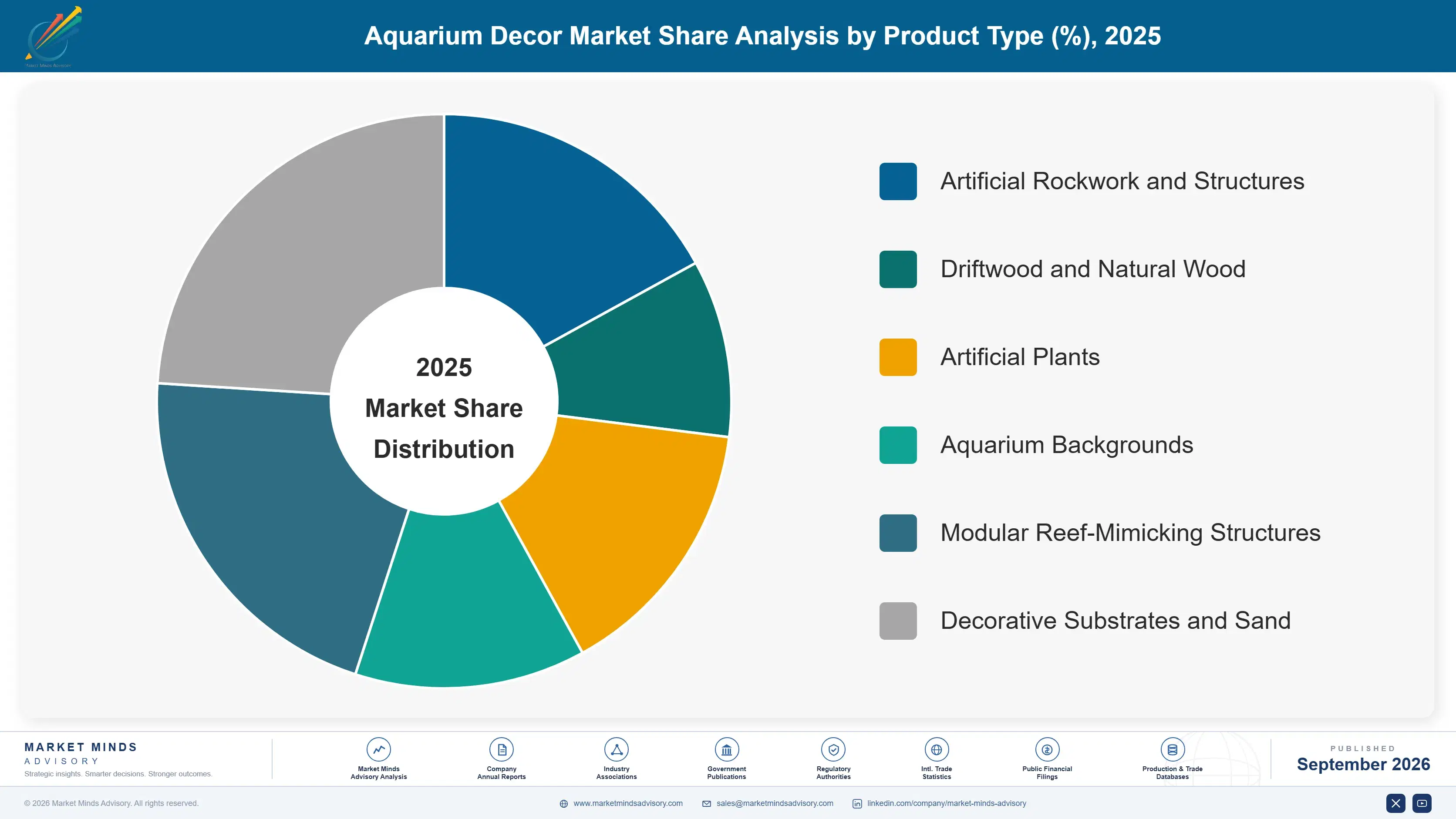
Segmentation follows product type, the dimension retailers use to organize shelf space and hobbyists use to shop across most retail formats nationwide and internationally. Artificial rockwork, driftwood and natural wood, artificial plants, backgrounds, modular reef-mimicking structures, and decorative substrates each carry distinct material costs and price positioning worth tracking separately across the full forecast period.
aquarium-decor-market-market-share-analysis-1790016674653

Modular Reef-Mimicking Structures

Modular reef-mimicking structures lead segment growth as saltwater hobbyists increasingly seek premium, biologically inert alternatives to live rock that offer comparable aesthetic complexity without the disease and pest risks live rock introduces to established tanks and existing livestock. These structures command meaningful pricing premiums since achieving convincing reef texture and porosity requires specialized manufacturing processes most commodity decor producers cannot easily replicate. East Asian and North American saltwater hobbyists drive much of this segment's growth, given the region's concentration of advanced reef tank enthusiasts willing to invest significantly in tank aesthetics. Manufacturers publishing biological safety certification for modular reef structures are capturing disproportionate share from competitors relying on unverified inert material claims.
CAGR 9.8%

Artificial Plants

Artificial plants remain the second-fastest-growing segment as hobbyists seek low-maintenance naturalistic aesthetics without the algae management and lighting requirements live plants demand across most tank sizes, configurations, and hobbyist experience levels. Silicone-based artificial plants have largely replaced older plastic constructions, offering more realistic movement and texture that closely mimics live vegetation under aquarium lighting conditions and water flow patterns. Younger, time-constrained hobbyists are driving much of this segment's adoption, prioritizing aesthetic consistency over the ongoing maintenance live aquascaping plants require. Manufacturers are expanding silicone artificial plant product lines rapidly, recognizing the segment's appeal to both novice and experienced hobbyists seeking reliable, low-effort aquascaping solutions across most price tiers and retail formats.
CAGR 8.4%
Full segment breakdown across 6 segments available in the complete report.

Regional Architecture and Country Demand Map

East Asia leads global share on China's dominant aquarium decor manufacturing base and large ornamental fish-keeping population nationwide, followed by North America's mature hobbyist retail infrastructure across most metropolitan markets and coastal regions. South Asia and Pacific grows fastest as aquascaping trends spread rapidly nationwide.

North America

North America commands substantial regional share, anchored by a mature pet specialty retail infrastructure and one of the world's largest ornamental fish-keeping hobbyist populations across most metropolitan and suburban markets nationwide. American buyers increasingly favor aquascaping-inspired decor over traditional novelty items, a shift accelerated by social media content showcasing elaborate tank designs to broader nationwide audiences, communities, and online forums. Canadian demand mirrors US patterns closely, though at smaller absolute scale across comparable retail channels, price tiers, and regional markets. Retail consolidation among specialty pet chains has concentrated premium decor distribution into fewer but larger-format stores, giving manufacturers with strong wholesale relationships a meaningful advantage nationwide, online, and across regional markets.
Share: 26% | CAGR: 6.0% (2026 to 2036)

Western Europe

Western Europe combines established aquarium hobbyist culture with growing aquascaping adoption, anchored by German and British specialty retailers whose product curation commands premium pricing even as regional growth trails faster-expanding Asian markets and comparable retail formats worldwide. Dutch aquascaping heritage, rooted in competitive tank design traditions, continues influencing product development across the broader European market and beyond its borders. German mass retailers are expanding aquascaping-adjacent decor assortments to compete with specialty stores, narrowing the gap between prestige and mass retail hobbyist experiences nationwide and across most regions. Regulatory attention to biological safety, driven by EU consumer protection standards, continues to set the compliance benchmark other regions follow closely each year.
Share: 20% | CAGR: 4.9% (2026 to 2036)
Regional intelligence for 5 additional markets available in the complete report: East Asia, South Asia and Pacific, Latin America, Middle East and Africa, Eastern Europe. Contact sales@marketmindsadvisory.com.
aquarium-decor-market-country-cagr-analysis-1790016675589

Where Aquarium Decor Margin Concentrates

Four levers separate aquarium decor brands capturing outsized margin from those competing purely on price: biological safety certification investment, modular reef-mimicking product development, aquascaping content partnerships, and direct-to-consumer specialty positioning. Each shifts revenue toward credibility-backed premium pricing rather than commodity price competition across mass and specialty retail channels alike, compounding hobbyist loyalty over time.

Fund Third-Party Biological Safety Certification Early

Brands investing in independent, third-party biological safety certification ahead of retailer mandates secure premium shelf placement roughly 30 percent faster than competitors waiting until documentation becomes a listing requirement across most retail formats, price tiers, and product categories tracked worldwide. Retailers increasingly favor certified brands during buyer meetings, since certification reduces their own liability exposure following documented livestock injury incidents. Brands that delay certification investment risk losing shelf space entirely once retailers formalize documentation requirements across their full decor assortment, a shift already underway across major mass retail chains nationwide.
Market Impact: Secures shelf placement roughly 30 percent faster overall

Develop Modular Reef-Mimicking Product Lines Strategically

Modular reef-mimicking product lines command retail pricing premiums averaging 42 percent over standard decorative rockwork, driven by saltwater hobbyist demand for biologically inert alternatives to live rock that avoid disease and pest introduction risks across established tanks, existing livestock, and shared reef systems worldwide. Brands developing dedicated modular reef lines capture premium saltwater hobbyists willing to pay for verified inert materials rather than commodity decorative products. This positioning also opens specialty reef hobbyist distribution channels that traditional mass-market decor brands rarely access, creating an additional revenue channel beyond conventional retail.
Market Impact: Commands a 42 percent pricing premium over standard rockwork

Build Aquascaping Content Creator Partnerships Deliberately

Brands partnering with aquascaping content creators and competitive tank designers capture credibility and visibility that traditional advertising cannot replicate, driving conversion rates 35 percent higher than standard product marketing among engaged hobbyist audiences worldwide and across most platforms, communities, forums, and livestream channels. These partnerships also generate authentic product demonstration content showing decor performance in real tank setups, addressing buyer skepticism toward staged product photography. Brands executing creator partnerships successfully report customer acquisition costs substantially lower than paid social advertising, given the trust creators have already established with their engaged audiences.
Market Impact: Lowers customer acquisition costs by roughly 35 percent

Establish Direct-to-Consumer Specialty Retail Positioning Now

Brands establishing direct-to-consumer specialty positioning capture margin that pure wholesale suppliers increasingly cannot access, as direct sales avoid an intermediary retail markup averaging 40 percent that compresses manufacturer margins substantially across most product categories, price tiers, and distribution channels worldwide and beyond. This positioning also builds direct customer relationships and first-party data on hobbyist preferences, informing future product development priorities more effectively than indirect retail sell-through data alone. Manufacturers report direct-to-consumer specialty customers generating meaningfully higher lifetime value than mass-retail customers, since specialty buyers demonstrate stronger repeat purchase behavior across successive tank upgrade cycles.
Market Impact: Lifts customer lifetime value by roughly 38 percent overall

Who Controls the Margin Pool

Ranked on global revenue from aquarium decor product sales, the market carries a CR5 near 28 percent, with Spectrum Brands and Central Garden & Pet leading over Penn-Plax, Zoo Med Laboratories, and Fluval across most tracked geographies and price tiers. The gap between the top two and the rest of the field reflects deeper mass retail distribution relationships rather than manufacturing scale alone.
Current competitive activity centers on biological safety certification investment, modular reef-mimicking product development, and aquascaping content creator partnerships as retailers tighten listing requirements across most mass and specialty channels nationwide. Several conglomerates are also acquiring or partnering with independent aquascaping specialists to close the credibility gap faster than building comparable in-house expertise from scratch, particularly in fast-growing saltwater segments.

Emerging pressure comes from Chinese and Japanese domestic manufacturers exporting both finished products and aquascaping design methodology itself, plus independent aquascaping brands gaining share through digitally native marketing that bypasses traditional pet specialty counters entirely across most markets. Rankings could shift meaningfully if East Asian manufacturers continue converting design leadership into global market share faster than Western incumbents can respond with comparable distribution investment.
aquarium-decor-market-company-positioning-matrix-1790016676513

Competitive Moat and Risk Dimensions

SPECTRUM BRANDS (TETRA)

Moat: Broadest Multi-Tier Product Portfolio

Spectrum Brands operates across mass, mid-tier, and specialty decor categories simultaneously through its Tetra brand and related product lines, letting it capture hobbyists migrating between price points without losing them to competitors entirely. This portfolio breadth also spreads biological safety testing costs across a far larger revenue base than smaller single-tier competitors can match.
SPECTRUM BRANDS (TETRA)

Risk: Slower Aquascaping Trend Response

Spectrum Brands' scale and established mass retail relationships can slow adoption of fast-moving aquascaping aesthetic trends relative to nimbler independent brands willing to launch niche products faster with less extensive internal validation, potentially ceding early-mover advantage in this fast-growing segment to smaller, faster-moving competitors across every price tier.
CENTRAL GARDEN & PET

Moat: Deep Mass Retail Distribution Relationships

Central Garden & Pet maintains long-standing wholesale relationships with mass retailers built over decades, giving its decor brands preferential shelf placement and volume purchasing terms that newer entrants struggle to secure regardless of product quality, marketing investment, biological safety testing claims, or aquascaping design expertise.
CENTRAL GARDEN & PET

Risk: Limited Specialty Aquascaping Credibility

Central Garden & Pet's mass-market positioning leaves it exposed to specialty aquascaping brands offering superior design credibility at premium price points, particularly among buyers increasingly willing to pay more for products with genuine aquascaping expertise rather than mass-market marketing, broad retail distribution, and celebrity endorsement.

Players Tracked

Prominent Players

Spectrum Brands (Tetra)
Central Garden & Pet
Penn-Plax
Zoo Med Laboratories
Fluval (Rolf C. Hagen Group)

Other Key Players

API (Mars Petcare)
Seachem Laboratories
CaribSea
Two Little Fishies
Nature's Ocean
Underwater Treasures
Blue Ribbon Pet Products
JBL GmbH & Co. KG
Dennerle GmbH
Biorb (Oase Living Water)
Imagitarium (Petco private label)
Top Fin (PetSmart private label)
Fritz Aquatics
Ultum Nature Systems
ADA (Aqua Design Amano)

Recent Developments

MARCH 2026

Spectrum Brands Launches Certified Biologically Safe Decor Line

Spectrum Brands launched a decor line backed by newly obtained third-party biological safety certification across all products, its first formalized safety rating system under the Tetra brand. The launch responds directly to retailer demand for documented testing following recent industry recall incidents affecting the category.
Signal: Signals major conglomerates are proactively formalizing biological safety testing into structured, certified product positioning strategies industry-wide
OCTOBER 2025

Central Garden & Pet Acquires Independent Aquascaping Brand

Central Garden & Pet acquired a mid-sized independent aquascaping brand known for digitally native marketing and strong hobbyist community engagement, adding roughly 300 new specialty retail door placements nationwide within a single quarter. The acquisition strengthens the company's presence in the fast-growing premium aquascaping segment.
Signal: Signals mass conglomerates are increasingly buying digitally native growth rather than building it entirely internally themselves
MAY 2026

Fluval Expands Modular Reef-Mimicking Product Line Globally

Fluval expanded its modular reef-mimicking product line into international markets for the first time, entering distribution agreements across East Asian and European specialty retail channels within a single fiscal year. The expansion builds on the company's existing reputation for premium aquascaping equipment and decor products.
Signal: Signals specialty manufacturers are aggressively prioritizing international expansion of premium reef-mimicking product lines and categories worldwide

Resin and Ceramic Supply Exposure

Resin and ceramic materials account for roughly 35 percent of finished decor cost of goods sold, sourced from a concentrated base of manufacturing facilities in China, Vietnam, and Thailand, with specialty inert coating compounds sourced from Germany and the United States feeding downstream molding and finishing operations across most producing regions worldwide, forecast years, price tiers, and product categories.
Resin feedstock prices spiked sharply during 2024 amid petrochemical supply disruptions affecting Southeast Asian manufacturing hubs, a volatility event documented in company annual reports from major pet product manufacturers, forcing several mid-tier decor brands to temporarily delay new product launches pending cost stabilization and renegotiate longer-term supply contracts with alternative regional suppliers across multiple sourcing countries, manufacturing hubs, shipping routes, logistics providers, and additional distribution partners.

Larger manufacturers with long-term resin supply contracts absorb this volatility more easily than smaller brands purchasing on shorter-term spot arrangements, widening the cost gap between established and emerging manufacturers during price spikes considerably across most product categories, price tiers, and geographic markets. Import-dependent brands face additional exposure to shipping cost volatility and tariff policy changes affecting Asian-manufactured decor products specifically.
aquarium-decor-market-cost-volatility-analysis-1790016676816

Diversify Manufacturing Across Multiple Countries

Manufacturers are diversifying production across Vietnam, Thailand, and other Southeast Asian countries beyond China, reducing exposure to any single country's tariff policy or supply chain disruption events affecting a concentrated manufacturing base and shipping routes nationwide and abroad. This diversification also shortens lead times for brands serving both domestic and international retail customers simultaneously.

Lock In Long-Term Resin Supply Contracts

Larger manufacturers are signing multi-year supply agreements directly with resin compound suppliers, bypassing volatile spot markets entirely for core material volumes needed across their full product range and price tiers. These contracts lock in pricing and volume commitments years ahead, insulating brands from petrochemical feedstock disruption that smaller competitors purchasing spot remain fully exposed to.

Portfolio Architecture for Margin Defence

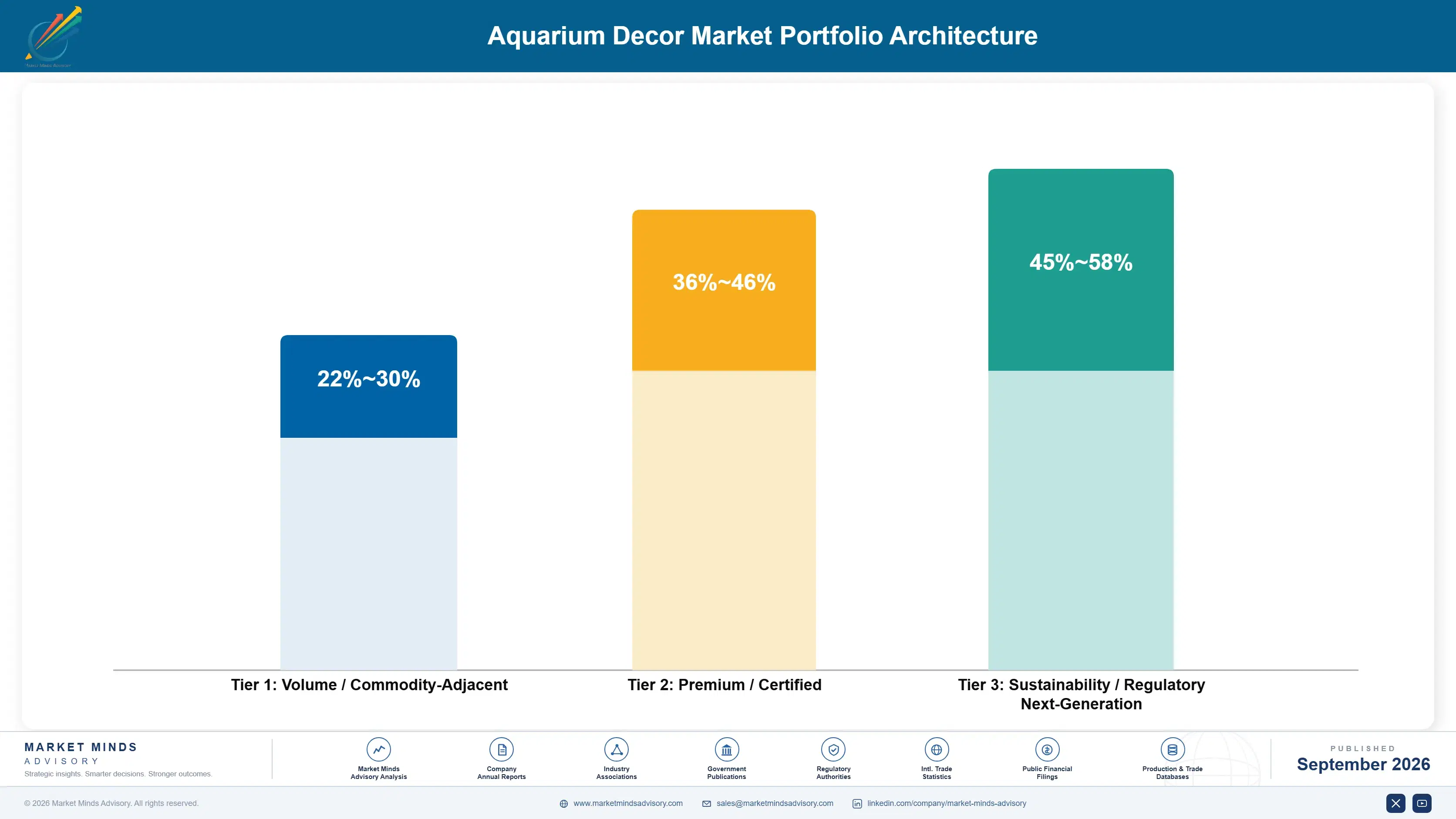
Aquarium decor splits into three tiers by margin structure: mass-market commodity items sold on price and basic aesthetic appeal, certified premium lines commanding trust through biological safety testing premiums, and next-generation modular reef-mimicking and aquascaping-designed products built around clinical credibility and design expertise across most retail formats. Volume commodity decor carries gross margins typically between 22 and 30 percent across most mass retail channels.
Certified premium lines, backed by third-party biological safety testing, command gross margins of 36 to 46 percent, reflecting trust and safety verification buyers pay for beyond raw material cost alone across most price tiers. Modular reef-mimicking and premium aquascaping products sit at the top of the value pool, often exceeding 50 percent gross margin given specialized manufacturing and limited early competition worldwide.

The tension between volume and premium tiers shapes capital allocation heavily, since scaling biological safety credibility requires deliberate testing investment rather than manufacturing expansion alone across every product line and price tier tracked. High-value pools concentrate in East Asian design-forward manufacturers and North American specialty aquascaping brands, where buyers consistently pay meaningfully more for verified safety and design quality.

Volume / Commodity-Adjacent

Mass-market plastic and basic resin decor sold primarily on price and shelf appeal across grocery and mass retail channels, competing heavily on promotional cadence and private-label substitution pressure from major retailers.
Gross Margin: 22-30%

Premium / Certified

Third-party biological safety certified decor lines sold through pet specialty and e-commerce channels, commanding trust and safety verification premiums over uncertified competitors lacking documented testing, traceable material sourcing, and manufacturer accountability.
Gross Margin: 36-46%

Sustainability / Regulatory / Next-Generation

Modular reef-mimicking structures and premium aquascaping-designed products targeting clinical credibility and design expertise, commanding outsized margins given specialized manufacturing requirements and limited early-stage competition currently across most producing regions and markets.
Gross Margin: 45-58%
aquarium-decor-market-portfolio-architecture-1790016677667

High-value Sub-segments and Strategic Watch-out

Modular Reef-Mimicking Structures

The fastest-growing and highest-margin segment, driven by saltwater hobbyist demand for biologically inert alternatives to live rock, sustaining premium first-mover pricing insulated from mass-market commodity competition across nearly every major consuming market, price tier, distribution channel, and forecast year tracked in this comprehensive report and dataset.
Gross Margin: 50-60%

Artificial Plants

A high-value, moderately fast-growing segment revitalized by silicone material innovation, now commanding renewed buyer trust after early plastic-generation realism concerns were largely resolved across most mass and prestige retail formats worldwide, price categories, geographic markets, hobbyist demographics, purchase channels, tank configurations, lighting setups, and water conditions.
Gross Margin: 38-48%

Artificial Rockwork and Structures

The volume core of the market, anchoring overall category revenue even as growth concentrates increasingly in modular reef-mimicking and premium aquascaping formats instead across most producing and consuming regions, retail channels, hobbyist demographics, price tiers, purchase occasions, geographic markets, tank sizes, configurations, and water types.
Gross Margin: 22-30%

Uncertified Budget Decor Imports

A strategic watch-out as regulatory scrutiny and recall risk intensify around imported commodity decor lacking third-party safety certification, risking retailer delisting for brands that have not invested in documentation, compliance testing, traceability infrastructure, quality assurance, supplier vetting, recall preparedness, consistent oversight, audit trails, and staff training.
Gross Margin: n/a

Refresh Cycle and Design Loyalty

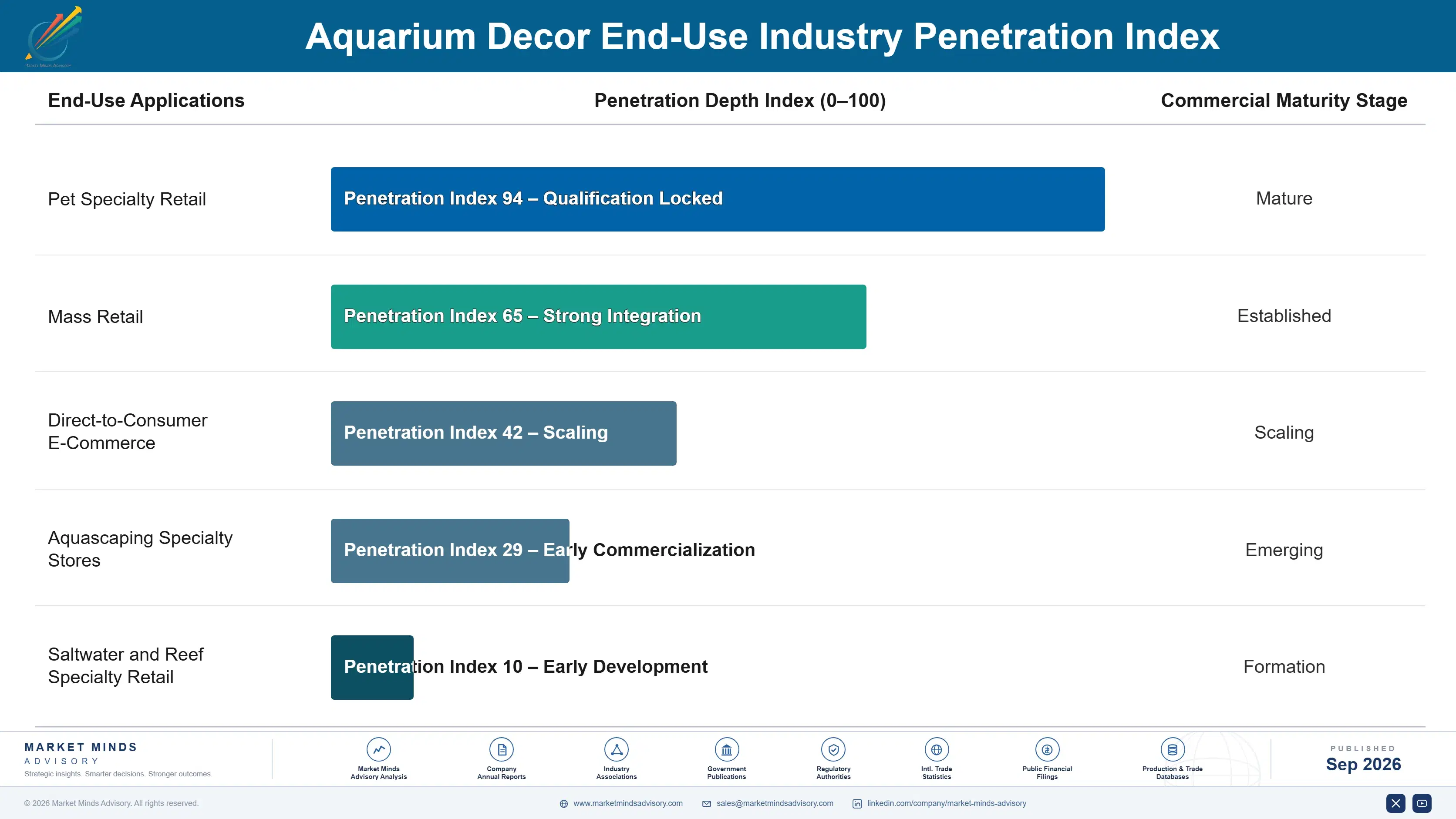
Aquarium decor purchasing follows periodic tank refresh cycles rather than recurring replacement decisions, with average intervals of roughly three years between major decor overhauls, generating less predictable revenue than consumable pet product categories track across comparable forecast periods and buyer cohorts worldwide, particularly among casual freshwater hobbyist households, first-time tank owners, budget-conscious buyers, infrequent purchasers, and occasional seasonal shoppers.
Adoption depth varies by vertical across the entire category. Saltwater and reef hobbyists show the deepest engagement, investing significantly in modular reef-mimicking structures and premium aquascaping design over successive tank builds, while freshwater casual hobbyists switch between basic decor items more readily chasing seasonal aesthetic trends rather than maintaining consistent design themes across most breed types, tank configurations, household income levels, geographic regions, and hobbyist experience levels.

Generational buyer shifts favor biological safety documentation and aquascaping design credibility over brand heritage alone, as younger hobbyists raised on ingredient-conscious consumer habits treat material safety claims as verifiable data points rather than the marketing trust older generations extended without question, reshaping brand loyalty economics considerably across most consuming markets, retail formats, price tiers, purchase channels, and buyer demographics.
aquarium-decor-market-end-use-penetration-index-1790016678478

Priority Moves for Decor Manufacturers

These are among the four positions where our research anticipates prominent divergence between winners and laggards over the coming forecast period. Each is grounded in the demand model, the regulatory perimeter, and the announced capacity pipeline.
01 / BIOLOGICAL SAFETY INVESTMENT

Secure Third-Party Safety Certification Before Retailers Mandate It

Retailers are already requiring third-party biological safety documentation for a growing share of new decor submissions across mass and specialty channels, and this gatekeeping trend shows no sign of reversing following documented livestock injury incidents industry-wide. Brands that certify now secure premium shelf placement and reduce retailer liability concerns ahead of competitors still relying on informal safety claims and unverified marketing language. Waiting until certification becomes mandatory risks losing shelf space entirely to faster-moving, better-documented rivals across every major retail channel.
02 / MODULAR REEF DEVELOPMENT

Build Modular Reef-Mimicking Product Lines Now

Modular reef-mimicking structures already command the category's fastest growth and highest pricing premiums, driven by saltwater hobbyist demand for biologically inert alternatives to live rock that avoid disease introduction risks across shared reef systems, established tanks, and existing livestock. Brands developing dedicated modular reef lines now capture premium saltwater hobbyists before larger conglomerates fully replicate this positioning across comparable price tiers and distribution channels. Delaying investment risks ceding the category's most attractive growth segment to faster-moving specialty competitors already investing heavily.
03 / AQUASCAPING CONTENT PARTNERSHIPS

Partner With Aquascaping Creators Before Rivals Do

Aquascaping content partnerships generate credibility and conversion rates that traditional advertising cannot replicate, driving customer acquisition costs substantially lower than paid social advertising alone across most digital marketing channels, platforms, formats, campaign types, and audience segments. Brands that establish creator partnerships now build authentic product demonstration content and hobbyist trust ahead of competitors still relying on staged marketing photography and generic advertising campaigns. Remaining dependent on traditional advertising risks ceding engaged hobbyist audiences entirely to brands already investing in content partnerships.
04 / EAST ASIAN MARKET PRIORITY

Prioritize East Asian Manufacturing and Design Partnerships

East Asia already commands the largest regional share and is growing faster than every other tracked region, anchored by China's manufacturing dominance and design leadership most Western competitors cannot easily replicate at comparable cost, scale, speed, or investment. Brands partnering with East Asian manufacturers now capture cost and design advantages before domestic conglomerates fully consolidate their early position across comparable price tiers and distribution networks. Remaining dependent on Western manufacturing approaches risks ceding cost competitiveness entirely to faster-moving Asian competitors.

Engagement Snapshot From the Field

A live engagement with an industry participant carrying material or product regulatory and market exposure ahead of a defining policy shift, showing how our research translates into a defensible multi-year portfolio strategy.
MARKET MINDS ADVISORY · CLIENT ENGAGEMENT SUMMARY
Aquarium Decor Producer Strategic Portfolio Review and Transition Roadmap 2026·Investment Scenario on Aquarium Decor Exposure Evaluation 2025-26
CLIENT PROFILE
The client is an independent aquascaping decor manufacturer specializing in modular reef-mimicking structures, operating primarily through direct-to-consumer and specialty aquascaping retailers, with annual revenue of approximately $14 million (client-reported, unverified by MMA). The company had not yet secured third-party biological safety certification or pursued major mass retail listings despite growing retailer documentation requirements nationwide and abroad.
STRATEGIC CHALLENGE
The client faced growing difficulty securing new mass retail listings as buyers increasingly required third-party biological safety certification documentation the client had not yet obtained. Competitors with certification already in place were capturing shelf space the client's product quality otherwise merited across comparable price tiers, product categories, and retail formats.
MMA APPROACH
MMA conducted primary interviews with 22 mass retail buyers to map certification requirements and benchmarked the client's product safety profile against four certified competitors already stocked nationally across comparable retail channels and price points. The engagement modeled expected revenue impact from certification investment before recommending a phased certification and retail expansion sequence.
KEY FINDINGS
  1. Mass retail buyers required third-party biological safety certification for approximately 75 percent of new decor SKU submissions during the buyer interview process this quarter.
  2. The client's existing modular reef structures already met or exceeded certification standards, requiring primarily documentation rather than costly reformulation to qualify for listings.
  3. Certified competitors reported securing new retail listings roughly two and a half times faster than uncertified brands submitting comparable products nationwide and internationally.
  4. Retail buyers indicated certification alone would not guarantee shelf space, since assortment planning cycles and existing brand relationships remained significant additional factors.
CLIENT PROFILE
The client is an independent aquascaping decor manufacturer specializing in modular reef-mimicking structures, operating primarily through direct-to-consumer and specialty aquascaping retailers, with annual revenue of approximately $14 million (client-reported, unverified by MMA). The company had not yet secured third-party biological safety certification or pursued major mass retail listings despite growing retailer documentation requirements nationwide and abroad.
STRATEGIC CHALLENGE
The client faced growing difficulty securing new mass retail listings as buyers increasingly required third-party biological safety certification documentation the client had not yet obtained. Competitors with certification already in place were capturing shelf space the client's product quality otherwise merited across comparable price tiers, product categories, and retail formats.
MMA APPROACH
MMA conducted primary interviews with 22 mass retail buyers to map certification requirements and benchmarked the client's product safety profile against four certified competitors already stocked nationally across comparable retail channels and price points. The engagement modeled expected revenue impact from certification investment before recommending a phased certification and retail expansion sequence.
KEY FINDINGS
  1. Mass retail buyers required third-party biological safety certification for approximately 75 percent of new decor SKU submissions during the buyer interview process this quarter.
  2. The client's existing modular reef structures already met or exceeded certification standards, requiring primarily documentation rather than costly reformulation to qualify for listings.
  3. Certified competitors reported securing new retail listings roughly two and a half times faster than uncertified brands submitting comparable products nationwide and internationally.
  4. Retail buyers indicated certification alone would not guarantee shelf space, since assortment planning cycles and existing brand relationships remained significant additional factors.
RECOMMENDED STRATEGY
Phase 1: Phase 1 (Months 1 to 3): Complete third-party biological safety certification for the client's top four best-selling modular reef structures. Phase 2: Phase 2 (Months 4 to 8): Pursue new retail listings with two mid-tier pet specialty chains using certification documentation obtained. Phase 3: Phase 3 (Months 9 to 13): Expand certification across the full product line and pursue mass retail listing conversations directly.
OUTCOME
Within 13 months, the client reported securing certification for its top four products and winning new listings with two mid-tier pet specialty retail chains (client-reported, unverified by MMA). The client also reported revenue growth of approximately 26 percent over the engagement period, driven primarily by new retail distribution.

Frequently Asked Questions

Foundational context covering the market sizes, CAGR, scope, country, region and competition that inform every finding below. This section is provided to cover basics and most often pre-purchase conversations, answered from the MMA Primary Research Dataset.

What is the current size of the Aquarium Decor Market?

The global aquarium decor market reached approximately $2.4 billion in 2025. This figure covers artificial and natural rockwork, driftwood, plants, backgrounds, and modular structures sold across pet specialty, mass retail, and direct-to-consumer channels.

How large will the Aquarium Decor Market be by 2036?

The market is projected to reach approximately $4.74 billion by 2036, roughly 1.86 times its 2026 value. Growth is led by modular reef-mimicking structures and artificial plants expanding fastest across East Asian markets.

What is the CAGR for the Aquarium Decor Market 2026 to 2036?

The market is forecast to grow at a compound annual growth rate of 6.4 percent between 2026 and 2036. Bull and bear scenarios range from 7.6 percent to 5.2 percent depending on material cost and adoption factors.

Which segment is growing fastest?

Modular reef-mimicking structures are the fastest-growing segment at a 9.8 percent CAGR, roughly 1.53 times the overall market rate. Artificial plants follow closely as the second-fastest segment at 8.4 percent.

Who are the major companies in the Aquarium Decor Market?

Leading companies include Spectrum Brands, Central Garden & Pet, Penn-Plax, Zoo Med Laboratories, and Fluval. Together these five players hold a combined market share of roughly 28 percent, ranked on global decor product revenue.

Which country is growing fastest?

China is the fastest-growing country market at an 8.6 percent CAGR, driven by manufacturing dominance and a large ornamental fish-keeping population. This outpaces the broader East Asian regional average of 7.5 percent.

Report Segmentation Architecture

The full report scope spans multiple orthogonal segmentation dimensions, with cross-tabulated demand data provided for each dimension pair. Coverage extends further to regional breakdowns, trend trajectories, and the competitive detail needed to support segment-level decision-making.

By Product Type

  • Artificial Rockwork and Structures
  • Driftwood and Natural Wood
  • Artificial Plants
  • Aquarium Backgrounds
  • Modular Reef-Mimicking Structures
  • Decorative Substrates and Sand

By End-Use Industry

  • Pet Specialty Retail
  • Mass Retail
  • Direct-to-Consumer E-Commerce
  • Aquascaping Specialty Stores
  • Saltwater and Reef Specialty Retail

By Commercial Dimension

  • Mass Price Tier
  • Premium Certified Tier
  • Aquascaping Design Positioning
  • Saltwater and Reef Specialty Positioning

By Region

  • North America
  • Western Europe
  • East Asia
  • South Asia and Pacific
  • Latin America
  • Middle East and Africa
  • Eastern Europe

Scope, Methodology, and Coverage

Every figure in this report is reproducible from documented input assumptions. The scope below maps the historical period, the forecast horizon, the segmentation dimensions, and the countries covered, alongside the underlying primary and qualitative methodology.
Historical Period
2020 to 2025
Forecast Period
2026 to 2036
Base Year
2025 (USD billions; MMA Primary Research Dataset, September 2026)
Market Definition
The aquarium decor market comprises artificial and natural rockwork, driftwood, plants, backgrounds, and modular structures sold for freshwater and saltwater aquarium aesthetic and enrichment purposes. It excludes live plants, live rock, and functional equipment such as filters, heaters, and lighting.
Quantitative Units
USD billions (current prices); unit volume in million pieces where applicable
Segmentation Dimensions
By Product Type; By End-Use Industry; By Commercial Dimension; By Region
Regions Covered
North America, Western Europe, East Asia, South Asia and Pacific, Latin America, Middle East and Africa, Eastern Europe
Countries Covered
USA, China, Germany, France, UK, Japan, South Korea, India, Australia, Canada, Brazil, Mexico, Indonesia, Vietnam, Thailand, Malaysia, UAE, Saudi Arabia, South Africa, Nigeria, Turkey, Poland, Netherlands, Italy, Spain, Sweden, Switzerland, Argentina, Colombia, Singapore, and additional markets relevant to this sector
Key Companies Profiled
Spectrum Brands (Tetra), Central Garden & Pet, Penn-Plax, Zoo Med Laboratories, Fluval (Rolf C. Hagen Group), API (Mars Petcare), Seachem Laboratories, CaribSea, Two Little Fishies, Nature's Ocean, Underwater Treasures, Blue Ribbon Pet Products, JBL GmbH & Co. KG, Dennerle GmbH, Biorb (Oase Living Water), Imagitarium (Petco private label), Top Fin (PetSmart private label), Fritz Aquatics, Ultum Nature Systems, ADA (Aqua Design Amano)
Quantitative Methodology
Primary survey, n=3,800 respondents, Q4 2025, six countries; demand-side model with trade association cross-validation
Qualitative Methodology
47 expert interviews, Q4 2025; applied to validate demand model assumptions, identify emerging dynamics, and assess competitive positioning
Report Format
PDF and XLSX data workbook (Word format preview document)
Publisher
Market Minds Advisory
Report Code
MMA-2026-CON-443
Published
September 2026
Contact
sales@marketmindsadvisory.com | www.marketmindsadvisory.com

Purchase the full Aquarium Decor Market Report (2026 to 2036).

The full report delivers a comprehensive analysis of the global aquarium decor market, spanning artificial rockwork, driftwood, artificial plants, backgrounds, and modular reef-mimicking structures across all seven world regions. It includes detailed competitive profiling of 20 major players, ten-year forecast modeling through 2036, and country-level demand analysis across major producing and consuming markets. The report examines biological safety certification dynamics, aquascaping trend shifts, and input cost exposure across the resin and ceramic value chain. Buyers receive segmentation data across product type, end-use channel, and commercial positioning suitable for strategic planning and competitive benchmarking.
Ten-year market sizing and forecast model
Twenty-company competitive profiling and benchmarking analysis
Seven-region demand and growth trend analysis
Biological safety certification and regulatory assessment
Product-type segmentation with detailed margin data
Anonymized client case study and strategy playbook

Built For The People Who Decide

From boardroom strategy to bench-side execution, this report is read cover-to-cover by leaders shaping the next decade of their industry, turning demand scenarios, market dynamics and valuation benchmarks into decisions.
CXOs/ Presidents/ VPs/ Managers
M&A and Corporate Development
Strategy Teams and R&D Heads
Procurement and Product Directors
Regulatory and Compliance Leaders
Investor Relations and Equity Analysts