Market Minds Advisory
Aquafeed Enzymes Market

Aquafeed Enzymes Market: Fishmeal Scarcity, Anti-Nutritional Factors, and the Thermostability Problem Nobody Advertises

Every percentage point of fishmeal replaced by plant protein introduces anti-nutritional factors that only enzymes remove, and Peruvian anchoveta quota volatility has made that substitution permanent rather than opportunistic across the industry.

Lead Analyst

Lisa Gevelber

Published

September 2026

Make Smarter Decisions with Customized Research Insights

Request a free sample report and evaluate market opportunities, growth trends, and competitive dynamics relevant to your business needs.

2025 MARKET VALUE$0.4BMarket Size 2025
2036 FORECAST VALUE$1.1BBase Case , 2026 to 2036
CAGR 2026 TO 20369.4 %Bull 10.7% / Bear 8.1%
INCREMENTAL OPPORTUNITY$0.6BNet 10- year value creation
EXPANSION MULTIPLE2.43x2036 value over 2026 base
Strategic Levers
M&A Pipeline
Regional Outlook
Country Rankings
Competitive Intelligence
Segmental Deep-dive
Call-Us : 91 93563 13602

Executive Snapshot and Market Trajectory

Aquafeed enzymes exist because fishmeal ran short. Every kilogram of marine protein replaced by soy, rapeseed, or sunflower brings phytate, non-starch polysaccharides, and trypsin inhibitors that fish digest poorly, and enzymes are the only economical way to recover that lost nutritional value. Nothing else does the job cheaply.
Commercial power sits with suppliers who can prove performance in commercial diets rather than in laboratory trials. Peruvian anchoveta quota cancellations have made plant protein substitution permanent, and salmonid diets now run above 60% plant protein where they once ran under 30%. Protease grows fastest at 12.4%, roughly 1.32 times the market, because protein digestibility is where the substitution hurts most. East Asia takes 30% of value.
Concentration is high, with the top five holding around 68% of supply, and the barrier is fermentation scale rather than enzyme discovery. Regulation shapes demand from an unexpected direction: phosphorus discharge limits in Norway, the European Union, and increasingly China make phytase a compliance tool as much as a nutritional one. The technical constraint everyone in this market lives with is extrusion, which cooks feed at temperatures that destroy most enzyme activity outright.
Market Definition
This report covers enzyme products formulated for inclusion in aquaculture feed, spanning phytase, protease, xylanase and beta-glucanase, cellulase and mannanase, amylase, and lipase and esterase preparations. Value is measured at enzyme product level as sold to feed mills and premix operators. Enzymes for terrestrial livestock feed, industrial and food processing enzymes, probiotics, organic acids, and complete feed premixes containing enzymes alongside other additives fall outside scope.
Base Year Value
$0.4B in 2025 (MMA Primary Research Dataset, August 2026)
Forecast Period
2026 to 2036, eleven discrete annual values
CAGR
9.4% base case. Bull 10.7%. Bear 8.1%.
Fastest Growth Segment
Protease: 12.4% CAGR
Fastest Growth Country
Vietnam: 12.1% CAGR
Fastest Growth Region
South Asia and Pacific: 11.6% CAGR
Largest Region
East Asia: 30% of 2025 global value
Market Leaders
Novonesis, dsm-firmenich, BASF, Adisseo, AB Enzymes. Source: MMA Analysis based on company annual reports.
Primary Survey
n=3,800 procurement and R&D decision-makers, Q4 2025, six countries
Methodology
Demand-side build-up, cross-validated against public data, 47 expert interviews

Aquafeed Enzymes Market Forecast Scenarios

aquafeed-enzymes-market-trends-growth-size-forecast-scenario-1787462407327
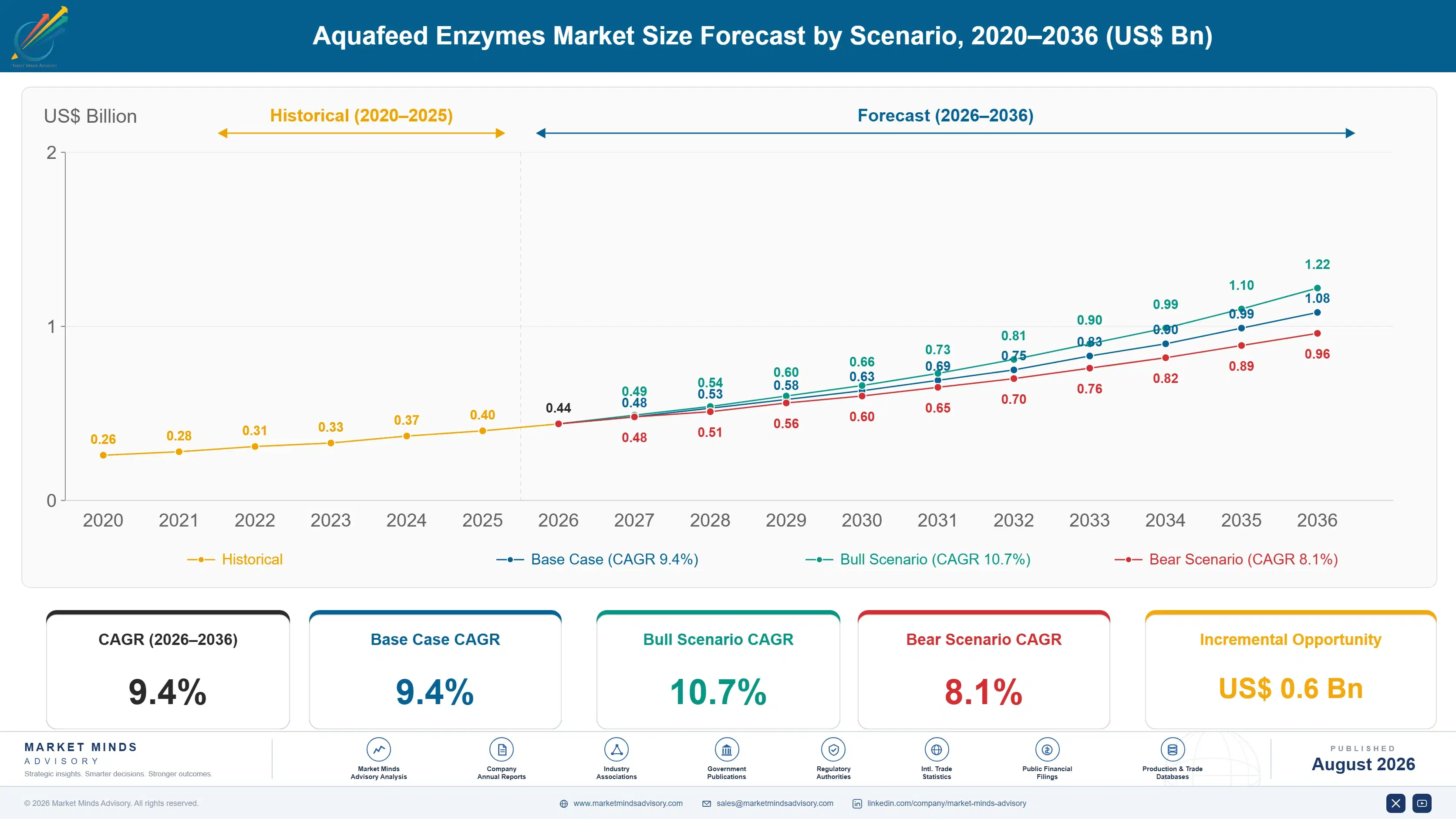
The 2020 to 2025 period was shaped by marine ingredient scarcity, not enzyme innovation. Peru cancelled its first anchoveta season in 2023, fishmeal prices reached records, and formulators accelerated substitution programmes that had moved cautiously before. Enzyme inclusion followed, because plant-heavy diets do not perform without it. The 8.2% historical growth understates the shift, since early adoption sat inside mill trials rather than commercial volume.
The 9.4% base case rests on three mechanisms. Plant and novel protein inclusion keeps rising as marine ingredient supply stays volatile, and each increment raises the enzyme requirement per tonne of feed. Phosphorus discharge regulation keeps converting phytase from an optional cost saver into a compliance requirement across Norway, the European Union, and Chinese coastal provinces. And shrimp and tilapia producers in Asia continue moving from farm-mixed feed toward commercial extruded diets, which is where enzymes are actually dosed.
The 10.7% bull case assumes marine ingredient supply stays tight while insect and single-cell proteins scale, each demanding new enzyme profiles. The 8.1% bear case reflects a run of strong anchoveta seasons that lowers fishmeal prices, slows substitution, and lets formulators quietly reduce enzyme inclusion to protect feed cost. Anchoveta biology decides more than suppliers do.

Why Fishmeal Scarcity Sells Enzymes

Three forces drive this market and none of them originate in enzyme science. Marine ingredient supply is finite and increasingly unreliable, which forces plant and novel protein substitution. Substituted diets carry anti-nutritional factors that fish cannot process, which creates the enzyme requirement. And discharge regulation penalises the phosphorus that phytate-bound feed releases into coastal water, which turns phytase into a permit condition.
TOP-FIVE CONCENTRATION68%Share of aquafeed enzyme supply held by leading producers
AVERAGE SELLING PRICE$18.60/kgBlended product price across enzyme classes and formats
FEED INCLUSION RATE0.04%Typical enzyme dosing as proportion of finished feed
PLANT PROTEIN SUBSTITUTION62%Average plant inclusion across commercial salmonid diet formulations
THERMOSTABILITY SURVIVAL84%Enzyme activity retained through commercial extrusion and drying
FEED CONVERSION GAIN6%Typical improvement attributable to correctly matched enzyme dosing
Commercial character follows from a technical awkwardness. Aquafeed is extruded at temperatures that destroy most enzyme activity, so suppliers either engineer thermostable variants or persuade mills to install vacuum coating equipment for post-extrusion application. Both routes cost money and neither is universal, which means enzyme selection depends as much on a mill's equipment as on the diet formulation. Suppliers with strong technical service teams win accounts that a better enzyme alone would not secure.
The next decade brings substrates nobody formulated enzymes for. Insect meal, single-cell protein, and fermented plant concentrates each present different chitin, cell wall, and nucleic acid profiles, and the enzyme blends optimised for soy do not transfer cleanly. Suppliers who characterise these substrates early will set the reference dosing that everyone else has to match.
"Half the enzyme activity sold into aquafeed never reaches the fish, because it was destroyed in the extruder. The suppliers who admit that and solve it commercially are winning accounts from those still quoting laboratory assay figures."
Director, Animal Nutrition and Feed Additives Practice · MMA Animal Nutrition / Feed Additives Practice · August 2026

Market Trends

Novel Protein Substrates Demand Entirely New Enzyme Profiles

Insect meal, single-cell protein from methanotrophic and yeast fermentation, and fermented plant concentrates are entering commercial aquafeed diets in Norway, Chile, and increasingly Asia. Each brings a different digestibility problem: black soldier fly meal carries chitin that fish process poorly, single-cell protein carries nucleic acid loads that stress the liver at high inclusion, and fermented concentrates carry residual cell wall material. Enzyme blends developed for soy and rapeseed do not transfer to these substrates without reformulation. Suppliers who characterise the new materials early effectively set the dosing reference that competitors must then match commercially.
Market Impact: Lifts plant inclusion above 60%
Post-Pellet Liquid Application Displaces Thermostable Formulations

Extrusion cooks aquafeed at temperatures between 100 and 140 degrees Celsius, and most enzyme activity does not survive that intact. Feed mills across Norway, Chile, and Vietnam have installed vacuum coating systems that apply liquid enzyme after extrusion and drying, recovering activity that thermostable granulates only partly preserve. The equipment costs several hundred thousand dollars per line but pays back through lower enzyme dosing and more consistent performance. That shift changes what suppliers must offer, moving demand from heat-tolerant granules toward stable liquid concentrates with documented post-application activity. Granulate suppliers are on the wrong side of that.
Market Impact: Cuts phosphorus discharge 28%

Market Opportunities and Growth Drivers

Marine Ingredient Scarcity Forces Permanent Plant Protein Substitution

Peru cancelled the first anchoveta season of 2023 outright and has repeatedly cut quotas since, sending fishmeal prices to record levels and removing any expectation of reliable marine protein supply. Salmonid diets that once ran below 30% plant protein now routinely exceed 60%, and shrimp and marine finfish diets have followed the same path. Every increment of substitution raises the phytate, non-starch polysaccharide, and protease inhibitor load that fish digest poorly. Enzyme inclusion is the only economical correction available, which ties enzyme demand directly to marine ingredient scarcity rather than to aquaculture volume alone.
Market Impact: Destroys 40% of applied activity

Phosphorus Discharge Rules Convert Phytase Into Compliance Equipment

Phytate-bound phosphorus passes through fish undigested and discharges into coastal water, and regulators have noticed. Norwegian aquaculture licensing conditions, European Union water quality obligations, and Chinese coastal discharge standards all constrain phosphorus release from farm sites. Phytase releases that bound phosphorus for absorption, cutting both the supplemental inorganic phosphate a formulator must add and the quantity discharged. That dual benefit converts phytase from a discretionary cost saver into something closer to a permit condition, and demand becomes far less sensitive to feed ingredient pricing as a result. Norwegian licence conditions are the strictest currently in force.
Market Impact: Excludes 35% of aquaculture volume

Market Restraints and Challenges

Extrusion Temperatures Destroy Most Applied Enzyme Activity

Aquafeed extrusion runs between 100 and 140 degrees Celsius under pressure and steam, conditions that denature most enzyme proteins within seconds. The root cause is that extrusion exists to gelatinise starch and create water-stable pellets, so the temperature cannot simply be lowered without losing the pellet. Suppliers quoting laboratory assay activity therefore overstate what reaches the fish, and formulators who dose against those figures see disappointing results. Responses include engineered thermostable variants, protective coating and granulation systems, and post-pellet vacuum application equipment that bypasses the heat step entirely at additional capital cost.
Market Impact: Adds 4 new substrate categories

Farm-Mixed Feed Bypasses the Commercial Enzyme Channel

Across much of Asia, small aquaculture producers still mix their own feed from local ingredients rather than buying extruded commercial diets, and enzymes reach almost none of that volume. The cause is economic: commercial feed costs more per kilogram, and farmers operating on thin margins with limited credit access default to what they can source locally. This keeps a large share of global aquaculture production outside the addressable market entirely. Suppliers respond by working through regional feed mills, by supporting mill upgrades that improve pellet quality, and by targeting the species where commercial feed adoption is already advancing.
Market Impact: Recovers 30% additional enzyme activity
3 additional market trends, 2 additional growth drivers, and 4 additional restraints and challenges are covered in the full report. Contact sales@marketmindsadvisory.com to access the complete intelligence.

Segment CAGR and Growth Architecture

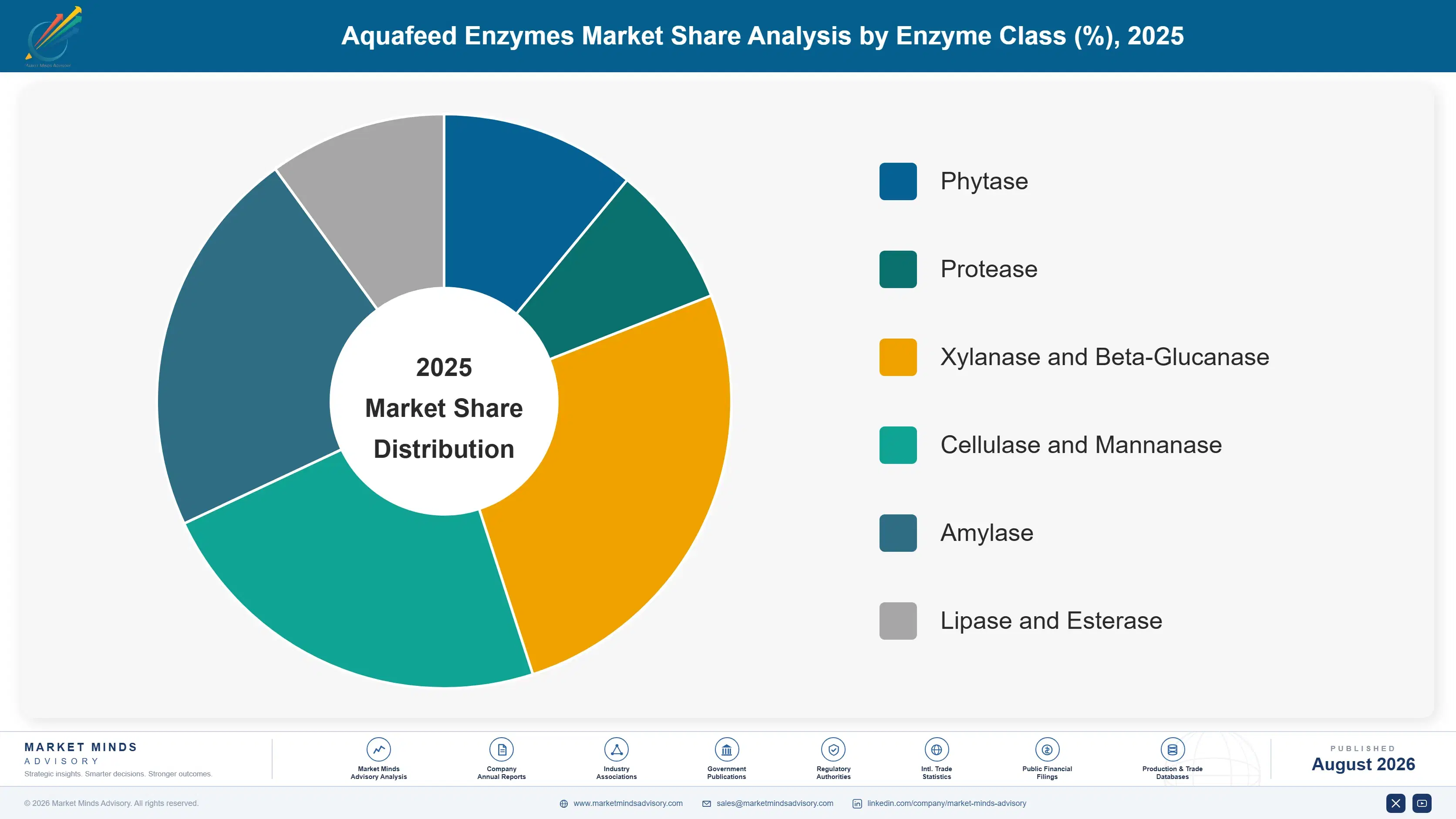
Segmentation follows enzyme class defined by substrate specificity, a single biochemical logic that determines the nutritional problem each product solves. Class decides which anti-nutritional factor is addressed, which diets need it, and how thermostability behaves under extrusion. Species, feed format, and channel structures appear separately in the framework as commercial dimensions rather than as parallel segments.
aquafeed-enzymes-market-trends-growth-market-share-analysis-1787462407895

Protease

Protease growth of 12.4%, roughly 1.32 times the market, tracks plant protein substitution more directly than any other class. Soy, rapeseed, and sunflower meals carry protease inhibitors and structural proteins that fish digest incompletely, and the resulting nitrogen loss shows up as both feed cost and discharge load. Exogenous protease recovers a meaningful part of it, particularly in carnivorous species whose digestive tracts evolved for marine protein rather than for seed meals. Commercial differentiation rests on activity across the pH range found in fish gut sections, which differs substantially from poultry and swine. Suppliers with species-specific data win formulation slots that a generic protease cannot displace easily. Generic protease competes on price and little else.
CAGR 12.4%

Cellulase and Mannanase

This class addresses cell wall material that traps nutrients inside plant ingredient matrices, releasing both the encapsulated protein and the energy the wall itself contains. Growth of 11.1% comes from rising inclusion of higher-fibre plant ingredients as formulators reach beyond soy toward rapeseed, sunflower, and increasingly fermented concentrates and by-product streams. Mannanase carries a secondary benefit that formulators value: mannan oligosaccharides released during hydrolysis appear to support gut condition, which matters in shrimp production where disease pressure is chronic. The commercial constraint is dosing precision, because over-application produces viscosity effects that harm pellet water stability rather than helping digestion. Suppliers with dosing curves validated in commercial diets hold this segment; those selling activity units do not.
CAGR 11.1%
Full segment breakdown across 6 segments available in the complete report.

Regional Architecture and Country Demand Map

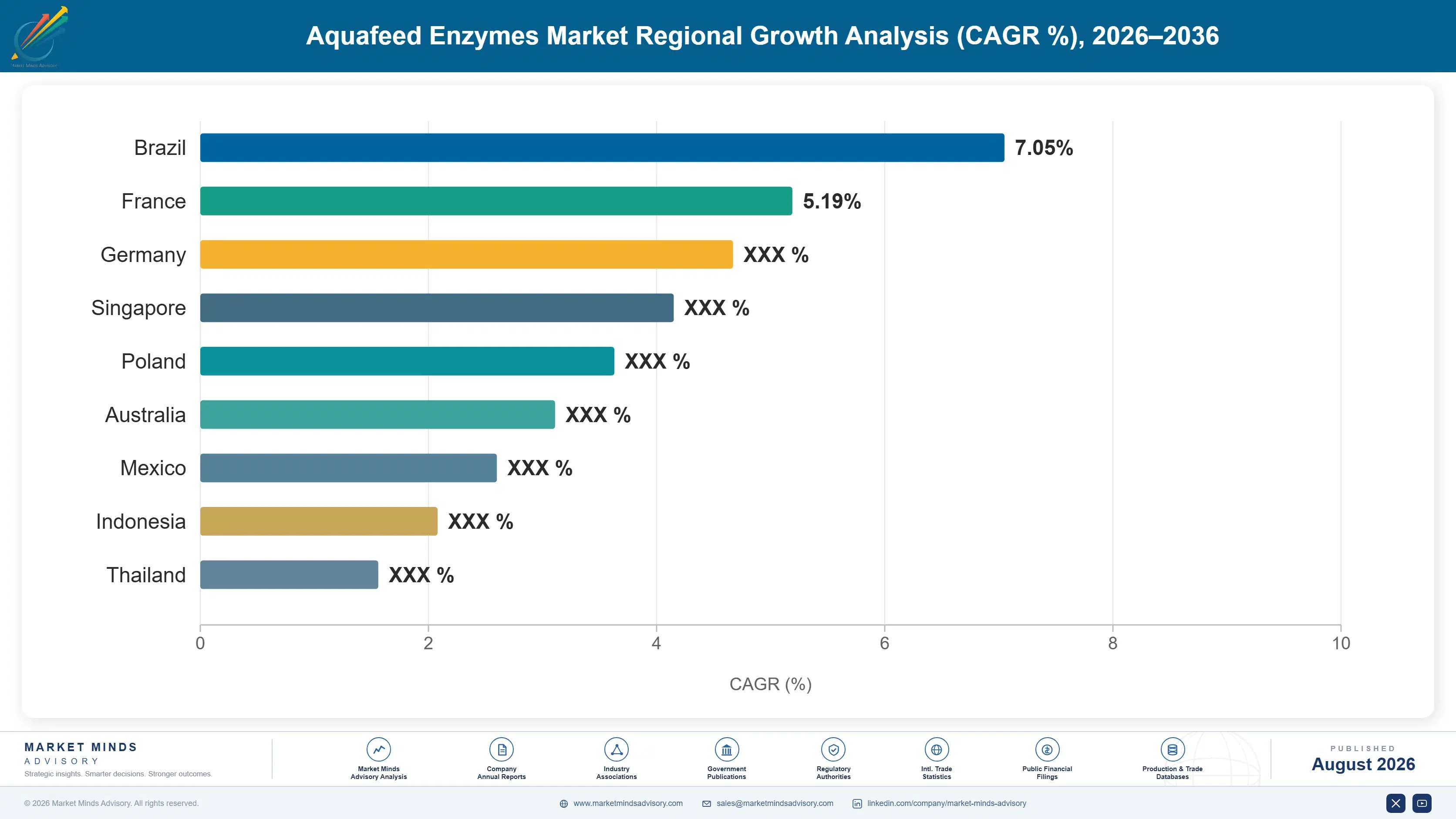
East Asia holds the largest share at 30%, reflecting Chinese aquaculture output that exceeds every other region combined. South Asia and Pacific grows fastest as Vietnamese and Indian commercial feed adoption accelerates, while North America and Western Europe hold high-value salmonid demand. Latin America follows Ecuadorian shrimp expansion.

North America

Land-based recirculating aquaculture systems are reshaping demand here in a way that no other region matches. Operators in Maine, Florida, Ohio, and Ontario run closed systems where every gram of undigested nutrient becomes a water treatment cost, which makes enzyme performance directly visible on the operating budget rather than buried in feed conversion statistics. Catfish production across Mississippi and Alabama provides steady volume on plant-heavy diets that need enzymes badly. Pacific salmon and trout operations in British Columbia and Washington buy through the same feed mills that serve Chile. Regional growth of 8.6% is carried by recirculating system expansion rather than by conventional net pen volume. Water treatment cost makes the argument for itself.
Share: 22% | CAGR: 8.6% (2026 to 2036)

Western Europe

Norwegian salmon farming anchors regional demand, and phosphorus discharge conditions attached to site licences make phytase a compliance instrument rather than a cost option. Feed mills operated by Skretting, BioMar, and Cargill formulate diets running above 60% plant protein, and enzyme selection is made centrally at formulation level rather than by individual farms. Scottish, Faroese, and Irish production follows the same specifications. Novel protein trials, particularly insect meal and single-cell protein, are more advanced here than anywhere else, which makes the region the proving ground for enzyme blends targeting those substrates. Growth of 7.9% reflects a mature and already highly optimised feed base. Formulation decisions here set specifications the rest of the world copies.
Share: 18% | CAGR: 7.9% (2026 to 2036)
Regional intelligence for 5 additional markets available in the complete report: East Asia, South Asia and Pacific, Latin America, Middle East and Africa, Eastern Europe. Contact sales@marketmindsadvisory.com.
aquafeed-enzymes-market-trends-growth-country-cagr-analysis-1787462408413

Where Aquafeed Enzyme Value Concentrates

Selling enzyme activity by the kilogram invites a comparison the supplier will eventually lose. The four moves below shift revenue toward positions that survive that comparison: documented in-feed performance, species-specific characterisation, application equipment partnerships, and early ownership of the novel substrates that nobody has formulated enzymes for yet. None of the four needs a new enzyme.

Publish Post-Extrusion Activity Rather Than Laboratory Assay

Most enzyme quotations cite activity measured in a laboratory, and formulators know that number bears limited relation to what survives an extruder. A supplier who publishes verified post-extrusion and post-drying activity under real mill conditions makes an honest comparison possible and usually wins it, because competitors quoting inflated figures cannot match performance in the pond. The testing programme costs perhaps $350,000 across major mill configurations. It converts the sales conversation from price per kilogram to delivered activity per tonne of feed, which is where a good product actually wins. Honest numbers turn out to be commercially useful.
Market Impact: Shifts the comparison toward 84% delivered activity basis

Characterise Novel Protein Substrates Before Competitors Do

Insect meal, single-cell protein, and fermented plant concentrates each present digestibility problems that soy-optimised enzyme blends do not address. The supplier who characterises these substrates first, publishes dosing recommendations, and runs commercial trials with early adopters sets the reference that every competitor must then argue against. The work costs around $800,000 per substrate category across trial and analytical programmes. Formulators tend to keep the enzyme they validated the novel ingredient with, so early positions convert into long-lived formulation slots rather than one-off trial revenue. Trial partners are easier to find than most suppliers currently assume.
Market Impact: Secures reference dosing positions across 4 substrate categories

Partner With Mills on Vacuum Coating Installations

Post-pellet liquid application recovers roughly 30% more enzyme activity than thermostable granulates preserve through extrusion, but it requires equipment many mills have not installed. Suppliers who co-invest, guarantee volume, or structure equipment cost into multi-year supply agreements convert a capital barrier into a switching barrier. Installations run several hundred thousand dollars per line. Once a mill applies liquid enzyme through dedicated equipment, changing supplier means revalidating dosing and stability, which converts what was a commodity purchase into an arrangement that lasts for years rather than seasons. Guaranteed volume is usually enough to close the deal.
Market Impact: Extends supply tenure by 3 to 5 years

Build Species-Specific Dosing Evidence for Shrimp Diets

Shrimp digestive physiology differs sharply from finfish, with a short gut, different pH profile, and chronic disease pressure that makes gut condition commercially critical. Most enzyme dosing guidance is extrapolated from finfish or, worse, from poultry. Generating shrimp-specific dosing and performance data across Ecuadorian, Indian, and Vietnamese production systems costs roughly $600,000 and addresses the fastest-growing volume pool in aquaculture. Producers running high stocking densities pay attention to anything that improves survival, and enzyme suppliers with credible shrimp data command better pricing than generic positioning ever supports. Nobody else is generating that evidence at present.
Market Impact: Addresses roughly 30% of global farmed aquaculture volume

Who Controls the Margin Pool

The top five hold roughly 68% of supply, measured consistently as aquafeed enzyme product revenue at supplier level. Concentration reflects fermentation scale rather than enzyme discovery, since producing enzyme protein economically requires large submerged fermentation assets and downstream processing that few companies operate. The gap between leaders and challengers is technical service depth as much as capacity, because formulators buy support alongside product.
Competitive activity runs along three lines. Thermostability engineering is the first, with suppliers competing on how much activity survives extrusion and on the granulation and coating systems that protect it. Species-specific evidence is the second, particularly for shrimp where most dosing guidance remains extrapolated from other animals. The third is regional manufacturing, as Chinese producers scale fermentation capacity and compete on delivered cost across Asian mills.

Two pressures will reshape rankings. Chinese enzyme producers including Vland Biotech and Sunson are moving beyond domestic supply into Southeast Asian and Latin American mills at prices multinationals struggle to match on standard classes. Meanwhile novel protein substrates are opening a technical contest that incumbency does not settle. The vulnerable position is a mid-sized supplier selling commodity phytase and xylanase without species data or application support.
aquafeed-enzymes-market-trends-growth-company-positioning-matrix-1787462408945

Competitive Moat and Risk Dimensions

NOVONESIS

Moat: Fermentation Scale and Strain Library

The company operates submerged fermentation capacity and a strain development library built over decades, which lets it produce enzyme protein at unit costs standalone competitors cannot approach. Strain improvement compounds over time, since each generation informs the next. That combination makes cost leadership durable rather than cyclical, and it funds the technical service teams that win formulation slots.
NOVONESIS

Risk: Aquaculture Portfolio Weighting

Aquafeed is a small part of a portfolio dominated by household care, baking, and terrestrial animal nutrition, so it competes internally for development attention and trial budget. Specialists focused solely on aquaculture move faster on species-specific work and novel substrate characterisation. Where a Chilean or Vietnamese mill needs shrimp trial data quickly, a focused competitor frequently arrives first.
DSM-FIRMENICH

Moat: Integrated Aquafeed Nutrition Position

The group supplies enzymes alongside vitamins, carotenoids, eubiotics, and formulation services to the same aquafeed mills, which places it inside diet design rather than beside it. Formulators value a single technical relationship covering multiple additive classes, and switching enzyme supplier alone gains little while disturbing a broader arrangement. That position has proved resilient through several pricing cycles.
DSM-FIRMENICH

Risk: Cost Exposure to Regional Producers

Standard phytase and xylanase are increasingly supplied by Chinese producers at delivered costs the group cannot match without eroding its wider pricing structure. As Asian mills professionalise procurement, those classes face steady erosion. Defending them consumes commercial attention that would be better spent on novel substrate positions where technical differentiation still commands genuine premium pricing.

Players Tracked

Prominent Players

Novonesis
dsm-firmenich
BASF
Adisseo
AB Enzymes

Other Key Players

Alltech
Kemin Industries
Huvepharma
Elanco Animal Health
BioResource International
Amano Enzyme
Advanced Enzyme Technologies
Vland Biotech
Sunson Industry Group
Jinan Bestzyme Bio-Engineering
Nutrex NV
Lesaffre
Guangdong VTR Bio-Tech
Dyadic International
Biocatalysts Ltd

Recent Developments

MARCH 2025

Novonesis extends aquaculture enzyme range for shrimp diets

Novonesis broadened its aquaculture enzyme offering with formulations targeted at shrimp production, supported by trial data generated in Ecuadorian and Southeast Asian commercial systems. The move addresses dosing guidance that had largely been extrapolated from finfish and terrestrial livestock rather than validated in shrimp gut conditions directly.
Signal: Species-specific evidence is now becoming the key differentiator in the fastest-growing part of aquaculture enzyme demand.
OCTOBER 2024

Adisseo expands enzyme production capacity for Asian feed mills

Adisseo increased enzyme manufacturing capability serving Asian aquafeed customers, positioning supply closer to the mills that account for the largest share of global aquaculture feed production. The investment reflects competitive pressure from domestic Chinese producers on delivered cost across standard enzyme classes and formats. Commissioning is scheduled through 2026.
Signal: Regional manufacturing proximity is now a cost requirement rather than a service improvement for Asian supply.
JUNE 2025

BioMar advances insect meal inclusion in commercial salmon diets

BioMar continued raising insect meal inclusion across commercial salmonid feed lines, working with enzyme suppliers on chitin handling and digestibility optimisation. Commercial trials in Norway and Scotland examined how existing enzyme blends perform against a substrate that soy-optimised formulations were never designed to address properly.
Signal: Novel protein adoption is creating enzyme development contests that established formulation positions do not automatically win.

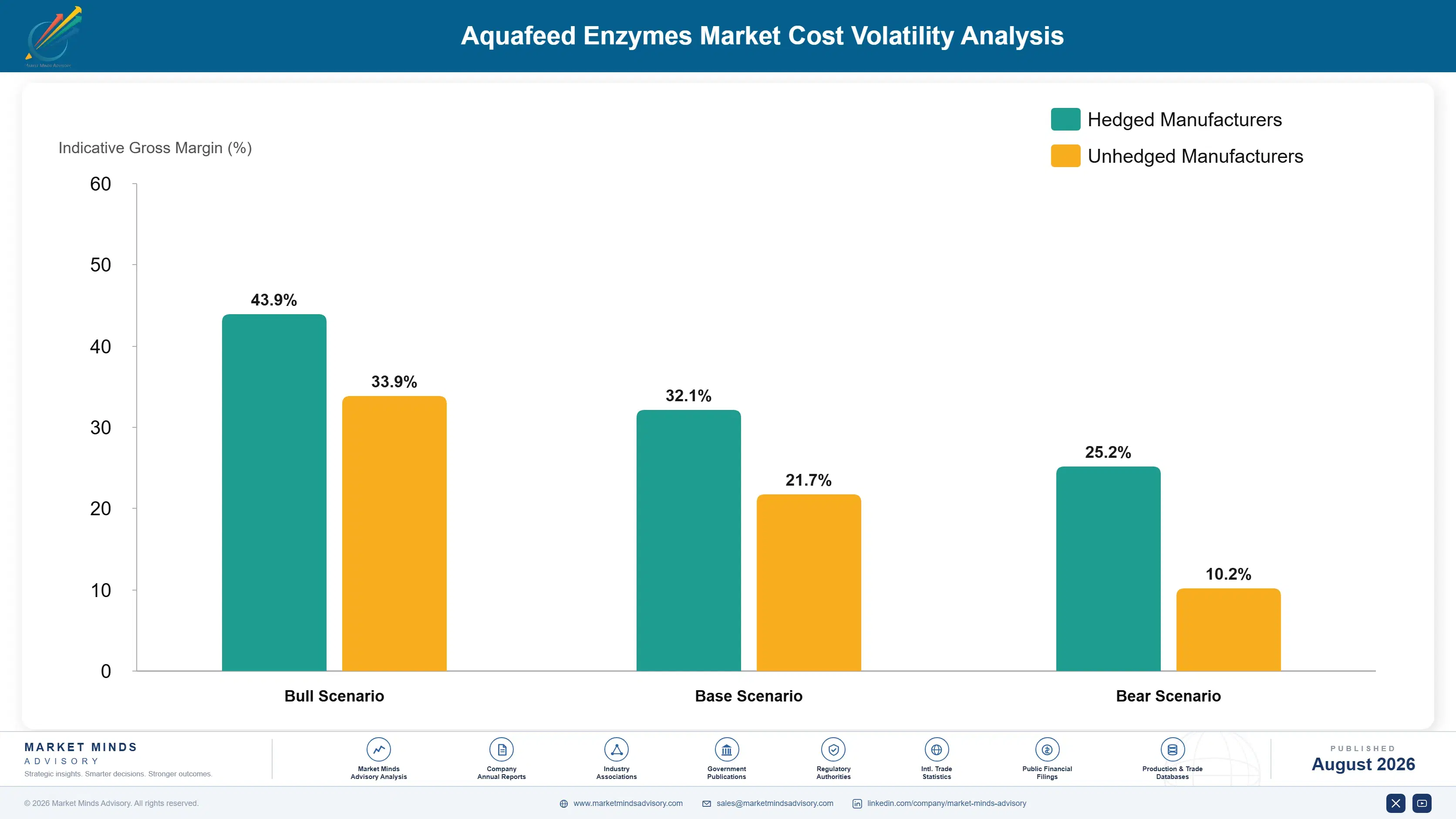
Fermentation Substrate, Energy, and Carrier Cost

Fermentation substrate, principally glucose syrup and corn steep liquor, accounts for roughly 31% of cost of goods, sourced from starch processors in the United States, China, and the European Union. Energy for fermentation, sterilisation, and spray drying takes a further 24%, drawn from natural gas and grid electricity depending on plant location. Carriers, coating, packaging, and testing absorb the remainder.
European industrial gas and electricity prices through 2022 and 2023 rose steeply according to IEA reporting, which hit fermentation hard because sterilisation and drying loads cannot be reduced. Novonesis and its predecessor entities referenced energy cost pressure across annual reporting in that period. Corn and glucose syrup prices moved sharply at the same time under Black Sea disruption, so substrate and energy inflated together. Producers with Asian or North American assets held cost position better than European operations.

Exposure varies by plant location and by product format far more than by company size. Liquid enzyme concentrates avoid spray drying entirely and carry lower energy intensity, which advantages suppliers whose customers have post-pellet application equipment. Chinese producers, operating on cheaper power and closer to substrate supply, held delivered cost advantage throughout the squeeze and used it to enter export markets.
aquafeed-enzymes-market-trends-growth-cost-volatility-analysis-1787462409147

Site fermentation capacity against long-term energy and substrate access

Fermentation economics are dominated by power and by starch-derived substrate, so plant location decides competitiveness for decades. Proximity to corn wet milling operations and to cheap baseload electricity matters far more than proximity to feed mills, because concentrated enzyme product ships cheaply. Several European producers learned this expensively after 2022 and have since shifted volume toward Asian and American assets.

Shift product mix toward liquid concentrates where mills permit

Liquid enzyme concentrates skip spray drying, granulation, and coating, removing the most energy-intensive steps in the process. Where customer mills operate post-pellet vacuum application, liquid formats cost less to produce and deliver more activity to the fish. Encouraging that equipment adoption therefore improves supplier margin and customer performance at the same time, which is an unusually aligned commercial position.

Contract substrate alongside wider fermentation requirements annually

Glucose syrup and corn steep liquor pricing follows grain markets, and enzyme producers running multiple fermentation lines can contract aggregate volume rather than product by product. Starch processors price committed annual tonnage materially better than spot purchasing. The approach also smooths exposure when one enzyme class runs soft, which happens whenever fishmeal prices fall and substitution programmes slow.

Portfolio Architecture for Margin Defence

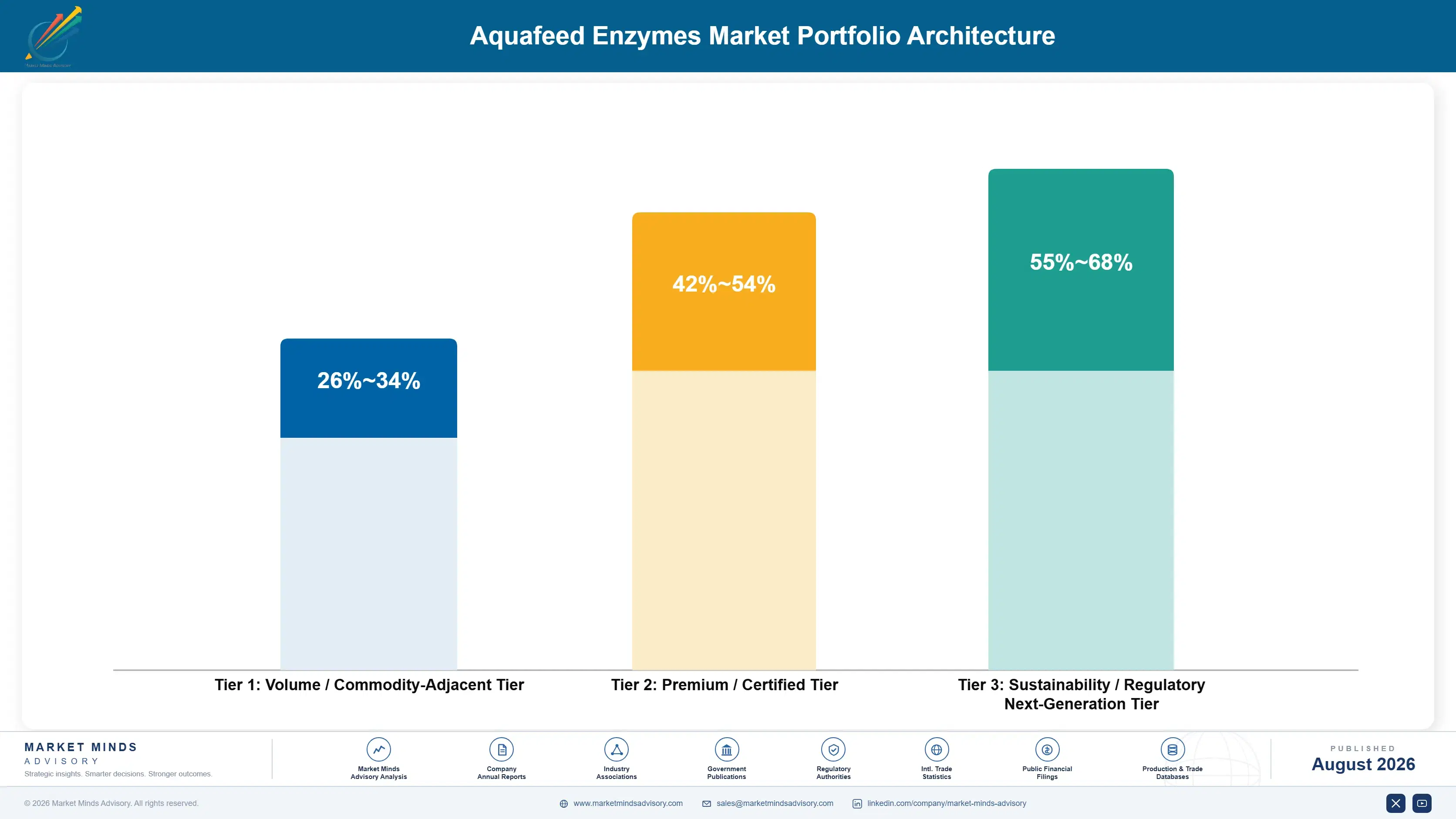
Three tiers separate on evidence depth rather than on enzyme chemistry. Standard phytase and xylanase sold on activity units compete against Chinese production on delivered cost and earn 26% to 34%. Species-validated products carrying documented in-feed performance data earn 42% to 54%, because the formulator is buying predictability rather than protein. Novel substrate and application-integrated products earn most of all, and that gap widens as substrates diversify.
The tension sits between volume defence and evidence investment. Standard classes keep fermentation assets loaded and generate the cash that funds trial programmes, yet defending them against Chinese delivered cost consumes commercial attention that would earn far more elsewhere. Several multinationals have quietly conceded standard phytase in Asian mills while holding species-validated and novel substrate positions. That looks like retreat and is closer to portfolio discipline.

High-value pools sit where the formulator cannot easily verify performance independently. Shrimp dosing, novel protein substrates, and post-pellet application all require evidence the buyer cannot generate alone, which is precisely why those positions resist commodity pricing pressure. Suppliers holding those positions renew rather than retender, and pricing conversations there are about performance rather than about activity units per dollar.

Volume / Commodity-Adjacent Tier

Standard phytase, xylanase, and amylase sold on declared activity units into price-led feed mill tenders. Competes directly against Chinese fermentation output. The wide range reflects large differences in plant energy cost and fermentation scale between producers.
Gross Margin: 26%-34%

Premium / Certified Tier

Species-validated enzyme products carrying documented in-feed performance and post-extrusion activity data. Formulators pay for predictability under real mill conditions. Range width separates finfish-validated products from fully shrimp-characterised supply within the same tier.
Gross Margin: 42%-54%

Sustainability / Regulatory / Next-Generation Tier

Novel substrate enzyme blends for insect and single-cell protein, plus liquid concentrates integrated with post-pellet application equipment. Reference positions and switching cost, rather than production economics, sustain margin across this tier.
Gross Margin: 55%-68%
aquafeed-enzymes-market-trends-growth-portfolio-architecture-1787462409647

High-value Sub-segments and Strategic Watch-out

Novel Protein Substrate Enzyme Blends

Highest value in the market and effectively uncontested today. Insect meal, single-cell protein, and fermented concentrates each need characterisation that soy-optimised blends cannot provide. Suppliers who publish first set the dosing reference competitors must argue against for years afterwards. Nobody is seriously contesting this space yet.
Gross Margin: 58%-70%

Shrimp-Validated Protease and Mannanase

High value with strong growth, addressing roughly 30% of global aquaculture volume where dosing guidance is largely extrapolated from finfish. Chronic disease pressure makes producers receptive to anything improving survival. Range width separates single-species data from multi-system validated supply. Survival data persuades producers faster than growth data.
Gross Margin: 48%-60%

Standard Phytase for Commercial Finfish Diets

The volume core, protected somewhat by phosphorus discharge regulation but fully exposed to Chinese delivered cost on the product itself. It keeps fermentation assets loaded and funds evidence programmes elsewhere, which is the honest reason to retain it. Regulation protects the demand here, not the price itself.
Gross Margin: 24%-32%

Thermostable Granulated Xylanase

The strategic watch-out. Post-pellet vacuum application recovers more activity at lower dosing, and every mill installing that equipment reduces demand for heat-protected granules. The format carries higher processing energy cost precisely as its performance advantage disappears. Depreciate these lines deliberately rather than expanding them any further.
Gross Margin: 28%-38%

Why Diet Formulations Resist Change

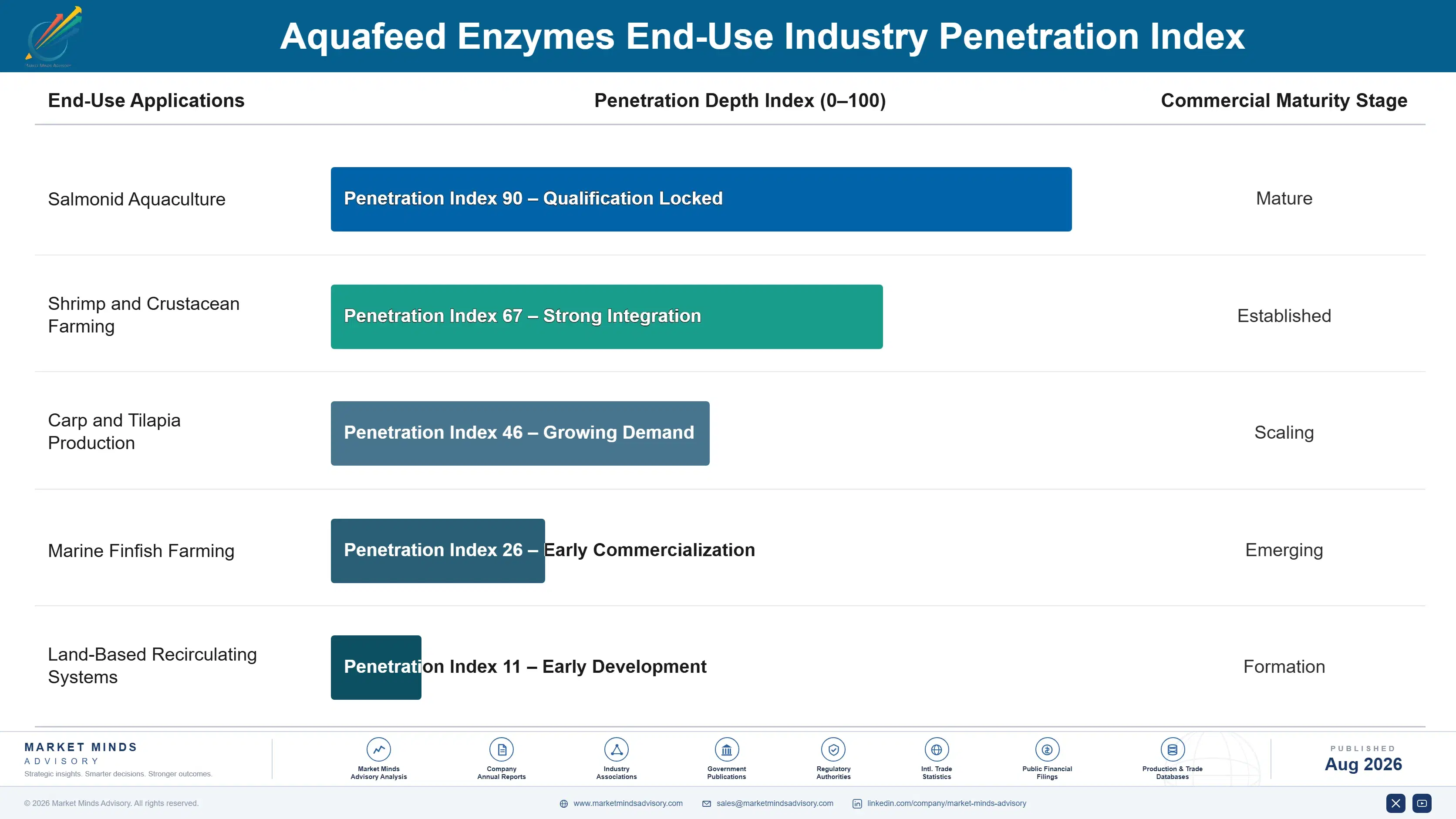
Enzyme revenue behaves as an annuity once a formulation slot is won. Feed formulators validate an enzyme across trial diets, commercial production runs, and eventually growth performance data from farm customers, and having done that they leave it alone unless something forces reconsideration. Typical formulation tenure runs five to eight years, and the initial validation work, which the supplier largely funds, is what buys that period of steady monthly volume.
Stickiness varies considerably by position. Enzymes validated against a novel protein substrate are the most durable, because the formulator qualified the ingredient and the enzyme together and separating them means repeating both trials. Post-pellet liquid supply comes next, protected by equipment dosing calibration. Standard granulated phytase and xylanase are the least sticky of all, retendered annually on activity units and delivered cost with almost no attachment to the incumbent supplier.

Buyer profiles have shifted noticeably. Feed mill technical teams now request post-extrusion activity data and species-specific trial evidence before commercial discussion begins, and sustainability leads increasingly ask about phosphorus and nitrogen discharge reduction alongside feed conversion. Procurement now arrives at technical meetings rather than the other way round. Discharge permits are increasingly written into feed specifications.
aquafeed-enzymes-market-trends-growth-end-use-penetration-index-1787462410144

Where Enzyme Producers Should Invest

These are among the four positions where our research anticipates prominent divergence between winners and laggards over the coming forecast period. Each is grounded in the demand model, the regulatory perimeter, and the announced capacity pipeline.
01 / DELIVERED ACTIVITY TRANSPARENCY

Publish post-extrusion activity and win the honest comparison

Laboratory assay figures bear limited relation to what survives an extruder running at 140 degrees, and every experienced formulator already knows this even when quotations pretend otherwise. A supplier publishing verified post-extrusion and post-drying activity across major mill configurations makes a fair comparison possible and usually wins it, since competitors quoting inflated numbers cannot match performance in the water. The testing programme costs roughly $350,000 and shifts the conversation from price per kilogram toward delivered activity per tonne of feed.
02 / NOVEL SUBSTRATE POSITIONING

Characterise insect and single-cell proteins before anyone else does

Insect meal, single-cell protein, and fermented plant concentrates each present chitin, nucleic acid, and cell wall problems that soy-optimised enzyme blends were never designed to address in the first place. The supplier who characterises a substrate first, publishes dosing guidance, and runs commercial trials with early adopters sets the reference every competitor afterwards has to argue against. At roughly $800,000 per substrate category, this is inexpensive relative to the formulation slots it locks in for the following decade of production.
03 / APPLICATION EQUIPMENT PARTNERSHIP

Convert vacuum coating capital into a durable switching barrier

Post-pellet liquid application recovers around 30% more enzyme activity than thermostable granulates preserve, but the equipment costs several hundred thousand dollars per line and many mills across Asia have not installed it. Suppliers who co-invest, guarantee volume, or fold equipment cost into multi-year supply agreements turn a capital barrier into a switching barrier that lasts. Once a mill calibrates dosing through dedicated equipment, changing supplier means revalidating stability and application rates, which nobody undertakes for a marginal price improvement on a small line item.
04 / STANDARD CLASS DISCIPLINE

Concede commodity phytase in Asia rather than defending it everywhere

Chinese producers now supply standard phytase and xylanase into Asian and increasingly into Latin American mills at delivered costs that multinationals cannot match without damaging their wider pricing structure across other classes. Defending that volume consumes commercial attention worth considerably more if directed at shrimp validation and novel substrate characterisation work. Retain just enough standard volume to keep the fermentation assets loaded and to fund evidence programmes, then compete deliberately in the places where technical differentiation still commands genuine premium pricing.

Engagement Snapshot From the Field

A live engagement with an industry participant carrying material or product regulatory and market exposure ahead of a defining policy shift, showing how our research translates into a defensible multi-year portfolio strategy.
MARKET MINDS ADVISORY · CLIENT ENGAGEMENT SUMMARY
Aquafeed Enzymes Producer Strategic Portfolio Review and Transition Roadmap 2026·Investment Scenario on Aquafeed Enzymes Exposure Evaluation 2025-26
CLIENT PROFILE
A Southeast Asian commercial aquafeed manufacturer operating four extrusion plants producing shrimp and pangasius diets, with annual revenue near USD 410 million (client-reported, unverified by MMA). The business had grown quickly on volume, buying enzymes from three suppliers on declared activity units and delivered price, with no internal capability to verify what activity actually survived its own extrusion process at any of the sites.
STRATEGIC CHALLENGE
Shrimp customers were reporting inconsistent growth performance across production batches, and feed conversion figures varied more between plants than formulation differences explained. Marine ingredient costs had risen sharply, plant protein inclusion had been pushed past 55%, and management suspected enzyme performance was the variable but had no evidence base on which to change suppliers or dosing.
MMA APPROACH
MMA designed an activity recovery study measuring enzyme performance at each stage of the production process across all four plants, then benchmarked delivered activity per tonne against supplier quotations rather than against declared assay figures. Post-pellet application economics were modelled per line. Shrimp-specific dosing evidence was assessed across available suppliers, with findings tested through 47 expert interviews during Q4 2025.
KEY FINDINGS
  1. Delivered enzyme activity varied from 51% to 88% of declared assay across the four plants, driven almost entirely by differences in extrusion temperature and conditioning time.
  2. The cheapest supplier on price per kilogram was the most expensive on delivered activity per tonne of finished feed, by a margin of roughly 34%.
  3. Only one of the three incumbent suppliers held shrimp-specific dosing data, and its products were used in the plant showing the most consistent customer growth results.
  4. Vacuum coating installation on two lines would pay back within fourteen months through reduced enzyme dosing alone, before counting any performance improvement.
CLIENT PROFILE
A Southeast Asian commercial aquafeed manufacturer operating four extrusion plants producing shrimp and pangasius diets, with annual revenue near USD 410 million (client-reported, unverified by MMA). The business had grown quickly on volume, buying enzymes from three suppliers on declared activity units and delivered price, with no internal capability to verify what activity actually survived its own extrusion process at any of the sites.
STRATEGIC CHALLENGE
Shrimp customers were reporting inconsistent growth performance across production batches, and feed conversion figures varied more between plants than formulation differences explained. Marine ingredient costs had risen sharply, plant protein inclusion had been pushed past 55%, and management suspected enzyme performance was the variable but had no evidence base on which to change suppliers or dosing.
MMA APPROACH
MMA designed an activity recovery study measuring enzyme performance at each stage of the production process across all four plants, then benchmarked delivered activity per tonne against supplier quotations rather than against declared assay figures. Post-pellet application economics were modelled per line. Shrimp-specific dosing evidence was assessed across available suppliers, with findings tested through 47 expert interviews during Q4 2025.
KEY FINDINGS
  1. Delivered enzyme activity varied from 51% to 88% of declared assay across the four plants, driven almost entirely by differences in extrusion temperature and conditioning time.
  2. The cheapest supplier on price per kilogram was the most expensive on delivered activity per tonne of finished feed, by a margin of roughly 34%.
  3. Only one of the three incumbent suppliers held shrimp-specific dosing data, and its products were used in the plant showing the most consistent customer growth results.
  4. Vacuum coating installation on two lines would pay back within fourteen months through reduced enzyme dosing alone, before counting any performance improvement.
RECOMMENDED STRATEGY
Phase 1: Phase 1 (months one to four): reprice all enzyme tenders on delivered activity per tonne rather than on declared assay units and price. Phase 2: Phase 2 (months five to thirteen): install vacuum coating on the two highest-volume shrimp lines and consolidate supply toward shrimp-validated products. Phase 3: Phase 3 (months fourteen to twenty-four): run controlled trials on insect meal inclusion with enzyme suppliers holding characterisation data for the substrate.
OUTCOME
The producer consolidated from three enzyme suppliers to two and reported feed conversion improving by 4.6% across shrimp lines within twelve months (client-reported, unverified by MMA). Enzyme spend fell 11% despite moving to higher-priced products. Both vacuum coating installations completed and payback tracked ahead of the modelled schedule.

Frequently Asked Questions

Foundational context covering the market sizes, CAGR, scope, country, region and competition that inform every finding below. This section is provided to cover basics and most often pre-purchase conversations, answered from the MMA Primary Research Dataset.

What is the current size of the Aquafeed Enzymes Market?

The market was valued at USD 0.4 billion in 2025, rising to an estimated USD 0.44 billion in 2026. East Asia holds the largest regional share at 30% of global value.

How large will the Aquafeed Enzymes Market be by 2036?

MMA forecasts USD 1.07 billion by 2036 under the base case, an expansion multiple of 2.43 times the 2026 level. Incremental value creation across the period reaches USD 0.63 billion.

What is the CAGR for the Aquafeed Enzymes Market 2026 to 2036?

The base case CAGR is 9.4%, with a bull case of 10.7% and a bear case of 8.1%. Historical growth between 2020 and 2025 ran at 8.2% as substitution programmes accelerated.

Which segment is growing fastest?

Protease, at 12.4%, roughly 1.32 times the overall market rate. Growth tracks plant protein substitution directly, since seed meals carry inhibitors and structural proteins that fish digest incompletely.

Who are the major companies in the Aquafeed Enzymes Market?

Novonesis, dsm-firmenich, BASF, Adisseo, and AB Enzymes lead, holding roughly 68% of supply between them. Vland Biotech, Sunson, and Huvepharma follow with growing Asian positions.

Which country is growing fastest?

Vietnam, at 12.1%, driven by pangasius and shrimp producers shifting from farm-mixed feed to commercial extruded diets. Export quality requirements are accelerating that transition considerably.

Report Segmentation Architecture

The full report scope spans multiple orthogonal segmentation dimensions, with cross-tabulated demand data provided for each dimension pair. Coverage extends further to regional breakdowns, trend trajectories, and the competitive detail needed to support segment-level decision-making.

By Enzyme Class

  • Phytase
  • Protease
  • Xylanase and Beta-Glucanase
  • Cellulase and Mannanase
  • Amylase
  • Lipase and Esterase

By End-Use Industry

  • Salmonid Aquaculture
  • Shrimp and Crustacean Farming
  • Carp and Tilapia Production
  • Marine Finfish Farming
  • Land-Based Recirculating Systems

By Commercial Dimension

  • Integrated Feed Mill Direct Supply
  • Premix and Blender Channel
  • Regional Distributor Networks
  • Contract and Toll Manufacturing

By Region

  • North America
  • Western Europe
  • East Asia
  • South Asia and Pacific
  • Latin America
  • Middle East and Africa
  • Eastern Europe

Scope, Methodology, and Coverage

Every figure in this report is reproducible from documented input assumptions. The scope below maps the historical period, the forecast horizon, the segmentation dimensions, and the countries covered, alongside the underlying primary and qualitative methodology.
Historical Period
2020 to 2025
Forecast Period
2026 to 2036
Base Year
2025 (USD billions; MMA Primary Research Dataset, August 2026)
Market Definition
The market comprises enzyme preparations formulated for inclusion in aquaculture feed, covering phytase, protease, xylanase and beta-glucanase, cellulase and mannanase, amylase, and lipase and esterase products, supplied in granulated, coated, and liquid formats. Value is measured at enzyme product level as sold to feed mills, premix operators, and blenders. Enzymes destined for terrestrial livestock feed, food and industrial processing enzymes, probiotics, organic acids, and complete additive premixes fall outside scope.
Quantitative Units
USD billions (current prices); tonnes of enzyme product; USD per kilogram average selling price
Segmentation Dimensions
By Enzyme Class; By End-Use Industry; By Commercial Dimension; By Region
Regions Covered
North America, Western Europe, East Asia, South Asia and Pacific, Latin America, Middle East and Africa, Eastern Europe
Countries Covered
USA, China, Germany, France, UK, Japan, South Korea, India, Australia, Canada, Brazil, Mexico, Indonesia, Vietnam, Thailand, Malaysia, UAE, Saudi Arabia, South Africa, Nigeria, Turkey, Poland, Netherlands, Italy, Spain, Sweden, Switzerland, Argentina, Colombia, Singapore, and additional markets relevant to this sector
Key Companies Profiled
Novonesis, dsm-firmenich, BASF, Adisseo, AB Enzymes, Alltech, Kemin Industries, Huvepharma, Elanco Animal Health, BioResource International, Amano Enzyme, Advanced Enzyme Technologies, Vland Biotech, Sunson Industry Group, Jinan Bestzyme Bio-Engineering, Nutrex NV, Lesaffre, Guangdong VTR Bio-Tech, Dyadic International, Biocatalysts Ltd
Quantitative Methodology
Primary survey, n=3,800 respondents, Q4 2025, six countries; demand-side model with trade association cross-validation
Qualitative Methodology
47 expert interviews, Q4 2025; applied to validate demand model assumptions, identify emerging dynamics, and assess competitive positioning
Report Format
PDF and XLSX data workbook (Word format preview document)
Publisher
Market Minds Advisory
Report Code
MMA-2026-AGR-166
Published
August 2026
Contact
sales@marketmindsadvisory.com | www.marketmindsadvisory.com

Purchase the full Aquafeed Enzymes Market Report (2026 to 2036).

The full report sizes aquafeed enzyme demand across six enzyme classes and seven regions with 2026 to 2036 forecasts under base, bull, and bear cases. It models delivered activity against declared assay across common extrusion configurations, quantifying how much applied enzyme actually reaches the animal. Competitive profiles cover twenty suppliers assessed consistently on aquafeed enzyme revenue, fermentation capacity, and species evidence depth. Substrate analysis maps enzyme requirements for insect meal, single-cell protein, and fermented concentrates. Commercial guidance addresses activity transparency, novel substrate positioning, application equipment partnership, and standard class discipline.
Six enzyme classes sized and forecast separately
Delivered activity modelled across common extrusion configurations
Twenty supplier profiles on consistent revenue basis
Novel protein substrate enzyme requirements characterised individually
Phosphorus discharge regulation mapped across major aquaculture jurisdictions
Vacuum coating investment cases and payback benchmarks included

Built For The People Who Decide

From boardroom strategy to bench-side execution, this report is read cover-to-cover by leaders shaping the next decade of their industry, turning demand scenarios, market dynamics and valuation benchmarks into decisions.
CXOs/ Presidents/ VPs/ Managers
M&A and Corporate Development
Strategy Teams and R&D Heads
Procurement and Product Directors
Regulatory and Compliance Leaders
Investor Relations and Equity Analysts