Market Minds Advisory
Aquaculture Immunostimulants Market

Aquaculture Immunostimulants Market: Functional Feed Additives, Certification Pressure, and Regional Production Economics

Shrimp and finfish operators are replacing prophylactic antibiotics with beta-glucan and nucleotide feed additives as EU and US import inspectors reject antibiotic-residue shipments, forcing a functional-feed reformulation across Asian and Latin American hatcheries.

Lead Analyst

Alice Ballenger

Published

September 2026

Make Smarter Decisions with Customized Research Insights

Request a free sample report and evaluate market opportunities, growth trends, and competitive dynamics relevant to your business needs.

2025 MARKET VALUE$1.8BMarket Size 2025
2036 FORECAST VALUE$4.0BBase Case , 2026 to 2036
CAGR 2026 TO 20367.6 %Bull 8.8% / Bear 6.4%
INCREMENTAL OPPORTUNITY$2.0BNet 10- year value creation
EXPANSION MULTIPLE2.08x2036 value over 2026 base
Strategic Levers
M&A Pipeline
Regional Outlook
Country Rankings
Competitive Intelligence
Segmental Deep-dive
Call-Us : 91 93563 13602

Executive Snapshot and Market Trajectory

Antibiotic residue rejections at European and American ports have turned immunostimulant feed additives from an optional upgrade into an export licence requirement, and shrimp hatcheries across Ecuador, India, and Vietnam are reformulating diets faster than regulators are writing the rules that force them to.
Beta-glucans still anchor volume because hatchery technicians trust two decades of shrimp trial data, but herbal and phytogenic blends are growing faster as feed millers chase natural-sourcing claims that win premium retail contracts in Europe. Asia-Pacific produces roughly nine in ten farmed shrimp tonnes worldwide, so any additive that improves survival rates through white spot syndrome and early mortality syndrome outbreaks earns immediate purchasing priority from integrated feed producers in Vietnam, India, and Indonesia.
The competitive field stays fragmented because feed millers formulate additives in-house almost as often as they buy them, which caps pricing power for specialist suppliers. Kemin, DSM-Firmenich, and Cargill hold formulation know-how and trial libraries that smaller entrants cannot easily replicate, while the EU's antimicrobial resistance rules and India's shrimp export protocols push functional feed additives from a discretionary line item toward a mandatory production input this cycle.
Market Definition
The aquaculture immunostimulants market covers beta-glucan, nucleotide, mannan oligosaccharide, peptidoglycan, herbal, and vitamin-based feed additives formulated to enhance non-specific immune response in farmed shrimp, salmon, and finfish species. It excludes therapeutic antibiotics, vaccines, and probiotics sold as standalone gut-health products rather than immune-modulating feed ingredients.
Base Year Value
$1.8B in 2025 (MMA Primary Research Dataset, August 2026)
Forecast Period
2026 to 2036, eleven discrete annual values
CAGR
7.6% base case. Bull 8.8%. Bear 6.4%.
Fastest Growth Segment
Herbal and Phytogenic Immunostimulants: 9.6% CAGR
Fastest Growth Country
India: 10.4% CAGR
Fastest Growth Region
South Asia and Pacific: 9.8% CAGR
Largest Region
East Asia: 29% of 2025 global value
Market Leaders
Kemin Industries, DSM-Firmenich, Adisseo, Cargill, Benchmark Holdings. Source: MMA Analysis based on company annual reports and investor filings.
Primary Survey
n=3,800 procurement and R&D decision-makers, Q4 2025, six countries
Methodology
Demand-side build-up, cross-validated against public data, 47 expert interviews

Aquaculture Immunostimulants Market Forecast Scenarios

aquaculture-immunostimulants-market-size-forecast-scenario-1787300005135
Global aquaculture immunostimulant demand grew steadily from 2020 through 2025 as shrimp farmers in Ecuador and India scaled production after early mortality syndrome losses forced a rethink of prophylactic antibiotic reliance. Import rejections at European ports for antibiotic residues accelerated adoption of beta-glucan and nucleotide additives industry-wide, and the segment expanded at roughly a 6.6 percent historical compound rate, slower than the growth now underway.
MMA's base case assumes 7.6 percent compound growth through 2036, built on three mechanisms. First, EU and US antimicrobial residue enforcement keeps pushing exporters in Vietnam, India, and Ecuador toward certified functional feed programmes. Second, integrated feed millers are embedding immunostimulants into standard grow-out formulations rather than treating them as a disease-response product. Third, shrimp genetics providers are pairing selective breeding with immune-support diets, widening the addressable base beyond outbreak years into routine hatchery protocol.
A bull scenario near 8.8 percent follows if the EU tightens antimicrobial residue thresholds again before 2030, forcing blanket reformulation across export hatcheries. The bear case near 6.4 percent materialises if feed-grade fishmeal and fish oil costs spike enough that millers cut discretionary additive inclusion rates to protect margins, deferring immunostimulant dosing to disease-outbreak periods only rather than year-round protocol.

Functional Feed Reformulation Under Regulatory Pressure

Aquaculture immunostimulants sit at the intersection of animal nutrition and disease management, and that dual identity is what is reshaping purchasing behaviour. Feed millers no longer treat these ingredients as a seasonal disease-response product; they are formulating them into base diets because insurance against a single early mortality syndrome outbreak now costs less than the outbreak itself. That calculus has pulled the category out of niche status and into standard procurement planning.
MARKET CONCENTRATION38%Top five suppliers hold meaningful but not dominant combined share
AVERAGE SELLING PRICE$8.40/kgReflects premium ingredient blends over commodity feed additives generally
ASIA-PACIFIC PRODUCTION SHARE89%Farmed shrimp and finfish tonnage concentrated overwhelmingly across Asian hatcheries
FEED COST SHARE62%Feed inputs dominate total shrimp and finfish production cost
ANTIBIOTIC SUBSTITUTION RATE41%Share of export hatcheries now using immunostimulant replacement protocols
TRADE INTENSITYHighIngredient supply crosses borders before reaching regional feed mills
Commercial activity concentrates around beta-glucans and nucleotides, the two ingredient classes with the deepest published trial data across shrimp and salmon species. Herbal and phytogenic blends are newer and carry less peer-reviewed efficacy data, but they carry a natural-sourcing claim that European retailers increasingly demand on pack, which is pulling volume toward them faster than their trial base alone would predict. That pull is reshaping formulation budgets well ahead of the peer-reviewed literature catching up.
The next decade will be shaped less by new ingredient discovery than by how fast certification schemes standardise dosing protocols across exporting countries. Whichever supplier gets its formulation embedded into national aquaculture extension programmes in India, Vietnam, and Ecuador captures a multi-year default position that competitors then have to actively dislodge.
"The additive that wins here is not the one with the best lab data. It is the one a government extension officer already recommends to ten thousand smallholder shrimp ponds."
Director, Animal and Aquaculture Health Practice · MMA Agriculture & Aquaculture

Market Trends

EU Antimicrobial Residue Enforcement Tightens Import Screening

The European Union's revised antimicrobial resistance action plan has pushed border inspection agencies to raise sampling frequency on imported shrimp and finfish, rejecting consignments that show residue traces from prophylactic antibiotic use. Exporters in Ecuador, India, and Vietnam are responding by embedding immunostimulant protocols into hatchery certification rather than treating additive use as optional. Feed millers report that certified antibiotic-free supply chains now command a price premium in French and German retail contracts, which is pulling immunostimulant inclusion rates up across export-oriented production even in ponds that have never recorded a residue violation themselves.
Market Impact: Adds 9pp to certified export volume

Shrimp Genetics Programs Pair Breeding With Immune Diets

Selective breeding programmes for specific pathogen-free shrimp broodstock are increasingly bundled with immune-support feed protocols rather than sold as standalone genetics products. Hatcheries in Ecuador and Indonesia report that combining resistant genetic lines with beta-glucan or nucleotide dosing during the post-larval stage measurably reduces early mortality syndrome losses compared with either intervention alone. Genetics suppliers including major broodstock providers now certify feed partners and recommend specific immunostimulant dosing windows in their post-larval handling protocols, effectively turning feed additive selection into a genetics-program compliance requirement rather than an independent purchasing decision for hatchery operators.
Market Impact: Mandates coverage for 55% of ponds

Market Opportunities and Growth Drivers

Antibiotic-Free Export Certification Becomes Baseline Requirement

India's Marine Products Export Development Authority and Ecuador's national aquaculture chamber have both formalised antibiotic-free certification pathways that name approved immunostimulant classes as qualifying inputs for premium export tiers. Certified hatcheries gain faster customs clearance into the European Union and access to processor contracts that pay above spot price for documented antibiotic-free production history. Smaller pond operators who cannot afford certification audits increasingly outsource compliance to integrated feed millers, who bundle the immunostimulant protocol, testing, and paperwork into a single premium feed package, extending the driver's reach well past the largest vertically integrated producers into the fragmented smallholder base.
Market Impact: Slows regional inclusion rates by 8pp

Recurrent Disease Outbreaks Keep Immune Support Non-Discretionary

White spot syndrome virus and early mortality syndrome remain endemic across major shrimp-producing regions, with outbreak years capable of wiping out thirty to forty percent of a season's stocked ponds in affected zones. Farm operators who survive a severe outbreak rarely revert to baseline feed formulations, treating immunostimulant inclusion as a permanent insurance cost rather than a response to active infection. Insurers and lenders financing pond operations in Vietnam and Indonesia now require documented immune-support feed protocols as a condition of coverage or working-capital credit, converting a farmer's discretionary purchase into a lender-mandated input across an expanding share of operations.
Market Impact: Excludes roughly 30% of smallholder ponds

Market Restraints and Challenges

Efficacy Variability Across Species and Water Conditions Slows Adoption

Immunostimulant response varies by species, water salinity, and stocking density, and trial results from one region often fail to replicate elsewhere, which is the root cause: most published efficacy data comes from controlled hatchery trials rather than the variable pond conditions smallholders farm under. That gap makes farm operators reluctant to pay a premium for outcomes they cannot verify on their own ponds, slowing inclusion-rate growth in price-sensitive markets like Bangladesh and Indonesia. Kemin and Adisseo are mitigating the friction by running regionalised field trials with local university partners and publishing dosing guidance rather than relying on global averages.
Market Impact: Lifts export-grade adoption by 12pp

Fragmented Distribution Limits Reach to Smallholder Ponds

Roughly half of global shrimp production comes from smallholder ponds under five hectares, and the root cause of limited immunostimulant penetration is a distribution gap: multinational suppliers sell through integrated feed millers and large processor networks that smallholders often sit outside of, relying on informal feed traders lacking premium additive lines. That leaves a meaningful share of global production under-protected even as certified exporters race ahead on adoption. Suppliers are mitigating this by partnering with government extension services and cooperative buying groups in India and Indonesia, bundling smaller additive packs with agronomic training to reach ponds standard channels cannot serve.
Market Impact: Bundles into 68% of broodstock sales
3 additional market trends, 4 additional growth drivers, and 2 additional restraints and challenges are covered in the full report. Contact sales@marketmindsadvisory.com to access the complete intelligence.

Segment CAGR and Growth Architecture

MMA segments the aquaculture immunostimulants market by active ingredient class, the classification hatchery nutritionists and regulators actually formulate and certify against, rather than by species or delivery format. Six ingredient classes cover the addressable market, each with distinct sourcing, cost, and regulatory documentation requirements across export markets, spanning inputs from yeast fermentation byproducts to marine-derived and botanical extracts.
aquaculture-immunostimulants-market-market-share-analysis-1787300005666

Herbal and Phytogenic Immunostimulants

Herbal and phytogenic immunostimulants, extracts drawn from garlic, astragalus, and various algae and seaweed sources, are growing fastest because they carry a natural-sourcing claim that European retailers increasingly print on pack alongside antibiotic-free certification. Feed millers in Vietnam and Ecuador are blending phytogenic extracts into premium export-tier formulations to support that retail claim, even where beta-glucan or nucleotide additives show comparable response in trials. Supply is fragmented across small botanical processors rather than integrated ingredient majors, which keeps unit costs volatile between suppliers. Kemin and Adisseo have both expanded phytogenic extraction capacity over the past two years to standardise supply for large exporters, signalling that consolidation is likely as the segment scales past its specialty footprint toward mainstream inclusion.
CAGR 9.6%

Beta-Glucans

Beta-glucans remain the largest single ingredient class by volume because two decades of published shrimp and salmon trial data give hatchery nutritionists more confidence formulating dosage than any newer class offers. Yeast-derived and algae-derived beta-glucan sources dominate supply, with yeast cell wall extracts holding a cost advantage that keeps them the default choice for large-volume export hatcheries in India and Ecuador. Growth here is steady rather than spectacular: beta-glucans are increasingly the base layer of a combination protocol that also includes nucleotides or phytogenic extracts rather than a standalone additive, which broadens their addressable volume even as their share of total immunostimulant revenue gradually declines relative to faster-growing specialty classes entering the same feed formulations across major producing regions.
CAGR 8.9%
Full segment breakdown across 6 segments available in the complete report.

Regional Architecture and Country Demand Map

Asia-Pacific dominates global aquaculture immunostimulant demand because the region produces the overwhelming majority of the world's farmed shrimp and finfish tonnage. North America and Western Europe contribute meaningful premium-segment revenue through salmon farming and feed R&D, while Latin America's export-oriented shrimp sector scales adoption quickly behind certification requirements.

North America

Salmon farming along the coasts of British Columbia, Maine, and Washington anchors North American demand, with functional feed programmes embedded directly into grow-out protocols rather than reserved for disease outbreaks. Cooke Aquaculture and Mowi's North American operations both publish sustainability-linked feed sourcing commitments that name immunostimulant inclusion as part of reduced-antibiotic strategies tied to retailer contracts with Whole Foods and Costco. Recirculating aquaculture system operators building indoor salmon and shrimp facilities across the United States represent a smaller but fast-scaling buyer segment, since RAS systems concentrate disease risk in ways that make immune-support feed a design requirement rather than an optional input from the first stocking cycle onward across newly commissioned facilities.
Share: 22% | CAGR: 7.6% (2026 to 2036)

Western Europe

Norway's salmon farming industry, the largest in the region by production volume, drives the bulk of Western European demand through functional feed contracts with BioMar and Skretting that specify immunostimulant inclusion during smolt transfer and seasonal disease-risk windows. Scottish salmon farms follow a similar functional-feed model, tightened further by the UK's post-Brexit biosecurity requirements on veterinary medicine imports. Regulatory pressure under the EU's Farm to Fork antimicrobial reduction targets is pushing feed millers across France, Spain, and Greece's sea bass and sea bream farms toward earlier and broader immunostimulant adoption, even though those species carry a thinner published efficacy base than salmon or shrimp, a gap regional feed associations are now working to close through joint trial programmes.
Share: 20% | CAGR: 6.1% (2026 to 2036)
Regional intelligence for 5 additional markets available in the complete report: East Asia, South Asia and Pacific, Latin America, Middle East and Africa, Eastern Europe. Contact sales@marketmindsadvisory.com.
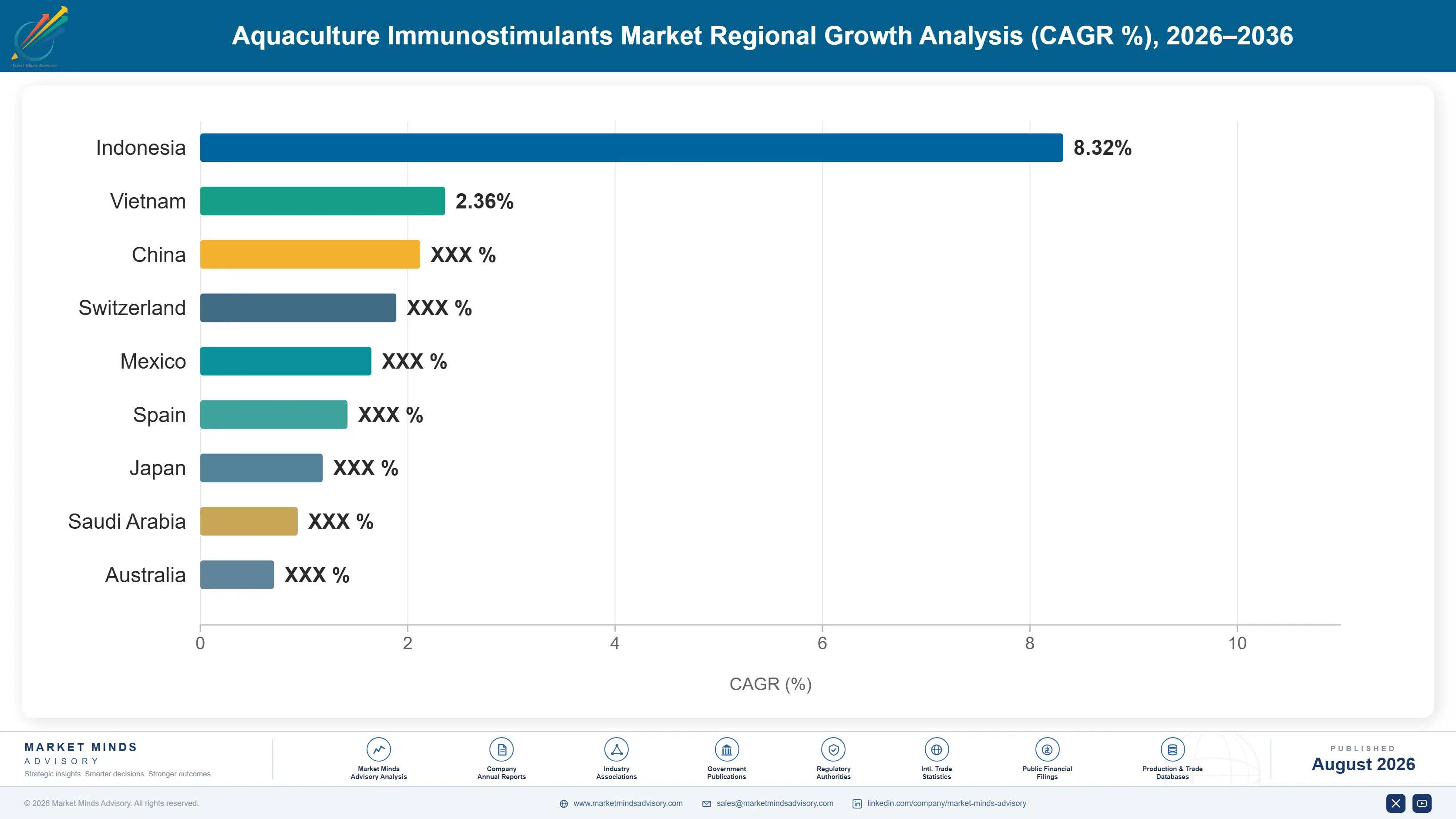
aquaculture-immunostimulants-market-country-cagr-analysis-1787300006183

Certification-Linked Premiums and Formulation Bundling

Suppliers extract value less through raw ingredient pricing than through bundling immunostimulants into certification programmes, combination protocols, and extension-service relationships that make switching costly once a hatchery adopts a supplier's formulation. The levers below describe how each layer of the value chain captures its share of the growing antibiotic-free access premium across export markets.

Bundling Certification Testing Into Premium Feed Packages

Integrated feed millers increasingly bundle immunostimulant inclusion, residue testing, and export certification paperwork into a single premium feed package rather than selling additives as a standalone line item, capturing margin across the full compliance chain instead of just the ingredient. Skretting and BioMar both report that certified antibiotic-free feed lines carry gross margins roughly 8 to 12 percentage points above standard formulations, since customers are paying for documented compliance access to European markets rather than the feed alone. Smallholder cooperatives that cannot afford standalone certification audits are increasingly buying into these bundled packages specifically to access the margin premium collectively.
Market Impact: Adds 8-12pp gross margin on certified feed lines

Combination Protocols Raise Per-Tonne Inclusion Value

Feed formulators are moving farmers from single-ingredient dosing toward combination protocols that pair beta-glucans with nucleotides or phytogenic extracts across growth stages, raising total immunostimulant spend per tonne even where any single ingredient's unit price stays flat. Hatcheries running combination protocols report roughly 20 percent lower early mortality syndrome losses than single-ingredient regimes in field trials across Ecuador and Vietnam, giving suppliers a defensible basis for premium combination-pack pricing. This shifts the commercial unit from a single additive sale to a season-long programme, extending supplier revenue capture beyond a single transaction into repeat renewal.
Market Impact: Raises immunostimulant spend by roughly 30% per tonne

Government Extension Partnerships Lock In Default Suppliers

Suppliers that get their formulation named in national aquaculture extension guidance, as Kemin and Adisseo have both done with India's Marine Products Export Development Authority, secure a default-purchase position across more than 10,000 smallholder ponds that individually lack the scale to evaluate competing products on their own. That default position is durable: extension officers rarely revise recommended protocols more than once every several years, and farmers who adopt the recommended input rarely switch absent a clear failure. The result is a customer base acquired once through a regulatory relationship rather than through repeated competitive tendering against rival suppliers.
Market Impact: Secures a multi-year default position across 10,000-plus ponds

Insurer and Lender Mandates Convert Discretionary Spend

Aquaculture insurers and working-capital lenders in Vietnam and Indonesia are increasingly requiring documented immune-support feed protocols as a condition of coverage or credit approval, converting what farmers once treated as a discretionary purchase into a financing prerequisite. Suppliers that get formally listed as approved protocol providers within insurer documentation gain a distribution channel that operates independent of direct farmer marketing spend, since the requirement flows down through the lender relationship instead. Early data from pilot programmes spanning more than 40 ponds shows financed operations carry meaningfully higher and more consistent immunostimulant inclusion rates than unfinanced ponds farming comparable species.
Market Impact: Converts 55% of financed ponds to mandatory buyers

Who Controls the Margin Pool

Five suppliers hold roughly 38 percent of the aquaculture immunostimulant market measured on a revenue basis, a concentration level that leaves real room for regional specialists. Kemin and DSM-Firmenich lead on trial-data depth and formulation breadth, but the gap to challengers like Alltech and Novus is narrower than the headline share suggests, since much of the unconcentrated remainder sits with feed millers formulating additives in-house.
Current competitive activity centres on three fronts: expanding phytogenic extraction capacity to meet natural-sourcing demand, securing named-supplier status within national certification programmes across India, Vietnam, and Ecuador, and building regionalised field-trial data to counter efficacy concerns among price-sensitive smallholder buyers. Suppliers are also formalising partnerships with genetics providers, bundling dosing recommendations directly into post-larval handling protocols rather than marketing additives as an independent purchase.

Emerging pressure comes from feed millers building internal formulation capability, and from regional botanical processors entering the phytogenic category with lower-cost extraction that lacks the trial documentation multinationals rely on for premium pricing. Rankings shift most where a supplier locks in extension-programme default status early, since that positioning compounds across certification cycles in ways later entrants cannot easily reverse once smallholder habits settle around an incumbent.
aquaculture-immunostimulants-market-company-positioning-matrix-1787300006701

Competitive Moat and Risk Dimensions

KEMIN INDUSTRIES

Moat: Multi-Species Trial Data Depth

Kemin has published shrimp and salmon efficacy trials across more species and geographies than most rivals, giving hatchery nutritionists a defensible basis for dosing decisions. That accumulated trial library, built over roughly two decades, is difficult for newer entrants to replicate quickly, and it underpins Kemin's positioning within multiple national extension and certification programmes across Asia and Latin America.
KEMIN INDUSTRIES

Risk: Phytogenic Segment Capacity Lag

Kemin's phytogenic and herbal extraction capacity has scaled more slowly than demand for natural-sourcing claims, leaving room for regional botanical processors to win volume in that specific segment. If phytogenic blends keep growing faster than beta-glucans, Kemin's overall category share could erode even while its core beta-glucan and nucleotide franchise remains intact and well defended.
DSM-FIRMENICH

Moat: Integrated Nutrition Distribution Network

DSM-Firmenich's ownership of Trouw Nutrition gives it direct distribution into integrated feed milling operations across Europe, Asia, and Latin America, letting it bundle immunostimulants into broader nutrition contracts rather than selling additives standalone. That integrated commercial relationship is difficult for standalone ingredient suppliers to match without a comparable feed milling footprint of their own.
DSM-FIRMENICH

Risk: Complex Post-Merger Integration Overhead

The 2023 merger between DSM and Firmenich has consumed significant management attention on integration and portfolio rationalisation, and some regional aquaculture teams report slower new-product decision cycles than before the merger. Competitors with simpler organisational structures have moved faster on regionalised phytogenic launches during the same window, narrowing DSM-Firmenich's historical speed advantage in that specific sub-segment.

Players Tracked

Prominent Players

Kemin Industries
DSM-Firmenich
Adisseo
Cargill
Benchmark Holdings

Other Key Players

Alltech
Novus International
Phibro Animal Health
Lallemand Animal Nutrition
BioMar Group
Nutreco
Aller Aqua
Grobest Global Service
Zoetis
Elanco Animal Health
Virbac
Hipra
Beneo
ForFarmers
Ridley Corporation

Recent Developments

MARCH 2026

Kemin Expands Phytogenic Extraction Capacity in Vietnam

Kemin Industries commissioned a new botanical extraction facility near Ho Chi Minh City in March 2026, adding dedicated capacity for garlic and algae-derived phytogenic immunostimulants. The facility supplies Vietnamese shrimp exporters, reducing lead times for hatcheries scaling antibiotic-free certification programmes ahead of anticipated European Union residue-threshold tightening.
Signal: Signals that ingredient majors now treat Southeast Asian phytogenic capacity as strategic rather than opportunistic sourcing.
NOVEMBER 2025

DSM-Firmenich and Marine Products Export Authority Sign Certification Agreement

DSM-Firmenich signed a formal supply and technical-support agreement with India's Marine Products Export Development Authority in November 2025, naming its nucleotide and beta-glucan lines as recommended inputs within the agency's antibiotic-free certification pathway. The agreement gives DSM-Firmenich named-supplier status across thousands of participating export-certified shrimp hatcheries nationwide.
Signal: Confirms that formal government certification endorsement is becoming the primary route to reaching smallholder-scale pond distribution nationwide.
JUNE 2025

Cargill Acquires Regional Phytogenic Ingredient Processor in Ecuador

Cargill acquired a regional botanical extraction processor based in Guayaquil, Ecuador in June 2025, adding localised phytogenic ingredient supply to its existing shrimp nutrition portfolio. The acquisition shortens Cargill's supply chain into Ecuador's export-certified hatchery network and reduces its reliance on imported herbal extract inputs from Asian processors.
Signal: Marks the first acquisition-led consolidation move inside the still fragmented Latin American phytogenic ingredient supply base.

Fishmeal and Fish Oil Cost Exposure

Marine-derived nucleotide and peptidoglycan feedstocks trace back to fishmeal and fish oil supply chains that source heavily from Peruvian anchoveta and other reduction fisheries, which together represent roughly 35 percent of finished immunostimulant production cost. Yeast-derived beta-glucan inputs carry less exposure to marine feedstock volatility, sourced instead from agricultural fermentation byproducts concentrated in European and North American processing facilities.
Peru's anchoveta harvest quota for the second 2023 fishing season was cut sharply following El Nino-linked warming, and Cargill's fiscal year 2024 annual report cited elevated marine protein input costs across its aquaculture nutrition segment as a direct consequence. Fishmeal spot prices rose during the affected quarters, pushing feed millers to substitute a larger share of algae-derived and yeast-derived immunostimulant inputs into formulations that had previously relied on marine-sourced ingredients.

Suppliers with diversified feedstock bases, spanning yeast fermentation, algae cultivation, and marine sourcing, absorb quota-driven price shocks more evenly than smaller regional processors dependent on a single marine input stream. That gives integrated majors like DSM-Firmenich and Cargill a cost-stability advantage over specialist phytogenic processors in Ecuador and Vietnam, who carry thinner balance sheets and less ability to hedge or substitute when a single feedstock source tightens.
aquaculture-immunostimulants-market-cost-volatility-analysis-1787300006895

Diversifying Feedstock Sourcing Across Marine and Fermentation Inputs

Leading suppliers are qualifying multiple feedstock sources for each ingredient class, pairing marine-derived nucleotides with fermentation-derived alternatives so that a single fishery quota cut no longer threatens total supply. This dual-sourcing approach adds qualification cost upfront but meaningfully reduces the price volatility passed through to feed millers during quota-constrained seasons. Kemin and DSM-Firmenich have both formalised similar dual-sourcing requirements recently.

Long-Term Offtake Agreements With Reduction Fisheries

Some suppliers are signing multi-year offtake agreements directly with Peruvian and Chilean reduction fisheries to lock in volume and pricing ahead of quota announcements, trading some flexibility for supply certainty. These agreements typically include price-adjustment bands tied to published quota levels rather than fixed pricing, balancing supplier and fishery risk. Suppliers lacking such agreements face greater spot-market exposure.

Expanding Algae-Based Alternative Ingredient Capacity

Algae cultivation facilities in Southeast Asia and the United States are scaling as an alternative to marine-sourced feedstocks, offering more predictable input costs since they are not subject to fishery quota cycles. Adoption remains gradual because algae-derived formulations still carry a smaller published efficacy dataset than established marine-sourced ingredients in shrimp trials, particularly for shrimp species with thinner trial histories.

Portfolio Architecture for Margin Defence

Immunostimulant suppliers operate across three margin tiers rather than one flat pricing structure. Commodity-adjacent beta-glucan and MOS inclusion sits at the volume base, premium certified formulations tied to export documentation occupy the middle, and next-generation phytogenic or combination-protocol products sit at the top, carrying gross margins meaningfully above the category average. Most suppliers participate in all three tiers simultaneously rather than specialising in just one.
The volume-premium tension plays out most visibly in shrimp exporting countries, where certified hatcheries pay a documented premium for traceable formulations while domestic-market producers in the same country often still buy commodity-tier beta-glucan blends with minimal documentation. Suppliers serving both tiers from a single portfolio capture more total value than specialists locked into either end alone. That dual exposure also cushions suppliers when certification cycles or export demand slow temporarily.

High-value margin pools concentrate in combination protocols sold alongside certification support and in phytogenic ingredients carrying natural-sourcing retail claims, both of which command pricing closer to specialty ingredient economics than to commodity feed additive pricing. Suppliers that can move a customer from single-ingredient commodity purchasing into a certified combination programme capture the largest share of that value shift over the coming forecast decade.

Volume / Commodity-Adjacent Tier

Standard beta-glucan and mannan oligosaccharide inclusion sold at scale into domestic-market shrimp and finfish production, largely undocumented and priced close to commodity feed additive benchmarks. This tier carries the highest volume but the thinnest margins across the entire supplier base.
Gross Margin: 18-24%

Premium / Certified Tier

Formulations tied to antibiotic-free export certification programmes, sold with documentation and traceability that command a defensible price premium into European and American import channels. Suppliers competing here differentiate mainly on documentation speed and audit reliability.
Gross Margin: 28-36%

Sustainability / Regulatory / Next-Generation Tier

Phytogenic, combination-protocol, and genetics-paired formulations carrying natural-sourcing claims and the deepest technical support, sold primarily into premium export tiers and retailer-linked sustainability programmes. This tier is smallest by volume today but expanding fastest across the forecast period.
Gross Margin: 38-48%
aquaculture-immunostimulants-market-portfolio-architecture-1787300007392

High-value Sub-segments and Strategic Watch-out

Phytogenic Combination Protocols

Combination protocols pairing phytogenic extracts with beta-glucans or nucleotides across growth stages carry the category's highest margins and fastest volume growth, driven by retailer natural-sourcing claims and measurably lower early mortality losses in field trials across Ecuador and Vietnam. Suppliers positioning early here capture disproportionate forward margin share.
Gross Margin: 40-50%

Salmon Functional Feed Contracts

Norwegian and Scottish salmon functional feed contracts carry strong margins and steady rather than explosive growth, anchored in long-standing supplier relationships with BioMar and Skretting that renew predictably each production cycle. New entrants rarely dislodge incumbents here since contract renewal depends more on trust than price.
Gross Margin: 30-38%

Standard Shrimp Beta-Glucan Inclusion

Baseline beta-glucan inclusion across Asian shrimp hatcheries remains the category's volume anchor, growing steadily with overall aquaculture output but carrying commodity-level margins that keep it a scale rather than profit driver. Suppliers defend this tier mainly to preserve distribution reach rather than to generate strong returns.
Gross Margin: 18-24%

Smallholder Informal Distribution Channel

Roughly half of global shrimp production still moves through informal feed traders that multinational suppliers cannot economically reach, leaving a large volume pool persistently under-penetrated unless distribution models change meaningfully. Suppliers that ignore this channel risk permanently ceding long-term volume to informal, unregulated feed substitutes region-wide.
Gross Margin: 12-20%

From Disease Response to Standard Protocol

Immunostimulant purchasing is shifting from an episodic disease-response buy toward a recurring seasonal protocol renewed every stocking cycle, which gives suppliers a more predictable, annuity-like revenue base than the category had a decade ago. Feed millers that embed additives into base formulations rather than optional add-ons lock in that renewal automatically with every feed order placed across an entire production season rather than a single shipment.
Adoption depth varies sharply by vertical. Export-certified shrimp hatcheries in Ecuador and India show the deepest and stickiest adoption, since certification audits effectively mandate continued use. Domestic-market tilapia and carp farming shows shallower adoption, with immunostimulants still treated as an optional upgrade rather than a certification requirement, leaving substantial headroom for future penetration as domestic retail standards eventually tighten. Salmon farming sits between these two extremes, closer to the certified end.

A generational shift among farm operators is reinforcing the trend. Younger pond managers who trained under university aquaculture programmes are more receptive to data-backed feed protocols than older operators who learned through informal apprenticeship, and they increasingly expect immunostimulant dosing guidance bundled with feed purchase rather than sourced separately, changing how suppliers structure technical support around each sale.
aquaculture-immunostimulants-market-end-use-penetration-index-1787300007881

Where MMA Sees the Real Opportunity

These are among the four positions where our research anticipates prominent divergence between winners and laggards over the coming forecast period. Each is grounded in the demand model, the regulatory perimeter, and the announced capacity pipeline.
01 / CERTIFICATION PARTNERSHIP PRIORITY

Lock in named-supplier status within export certification programmes now

Suppliers that secure named-supplier status within national certification programmes in India, Vietnam, and Ecuador gain a distribution advantage that compounds across multiple certification renewal cycles and is difficult for later entrants to reverse. This positioning matters more than short-term pricing competition, since certification bodies rarely revisit approved supplier lists more than once every several years. MMA recommends prioritising government and extension-body relationships over direct farmer marketing spend in the current three-year window, particularly across South Asia and Pacific and Latin America.
02 / PHYTOGENIC CAPACITY INVESTMENT

Scale phytogenic extraction capacity ahead of natural-sourcing demand

Phytogenic and herbal immunostimulants are growing at roughly 1.3 times the category average, driven by European retail natural-sourcing claims that show no sign of softening through the forecast period. Suppliers with fragmented, small-scale botanical extraction capacity risk losing meaningful share to competitors already investing in standardised, higher-volume processing across Vietnam and Ecuador right now. MMA views capacity investment in these two exporting countries as the highest-return capital allocation available anywhere within the category over the next three years, ahead of combination-protocol or certification-partnership spending.
03 / COMBINATION PROTOCOL BUNDLING

Bundle ingredients into season-long protocols rather than single sales

Combination protocols that pair beta-glucans with nucleotides or phytogenic extracts across growth stages capture meaningfully more total revenue per hatchery than single-ingredient sales, while also delivering measurably better disease outcomes across Ecuador and Vietnam that justify the added premium. Suppliers still selling single ingredients as standalone transactions are steadily ceding margin to competitors who have already moved to protocol-based commercial models. MMA recommends restructuring sales approaches around season-long protocol adoption rather than per-shipment ingredient transactions wherever feed miller relationships reasonably allow it.
04 / SMALLHOLDER DISTRIBUTION ACCESS

Build distribution reach into the underserved smallholder pond base

Roughly half of global shrimp production still moves through informal feed traders that multinational suppliers cannot economically reach through conventional commercial channels, leaving substantial volume persistently under-penetrated across India, Indonesia, and Bangladesh alike. Cooperative buying groups and government extension partnerships offer a lower-cost route into this base than building direct sales infrastructure would require on its own. MMA sees this distribution gap as the category's largest unaddressed volume opportunity for suppliers willing to invest in non-traditional channel partnerships over the next decade.

Engagement Snapshot From the Field

A live engagement with an industry participant carrying material or product regulatory and market exposure ahead of a defining policy shift, showing how our research translates into a defensible multi-year portfolio strategy.
MARKET MINDS ADVISORY · CLIENT ENGAGEMENT SUMMARY
Aquaculture Immunostimulants Producer Strategic Portfolio Review and Transition Roadmap 2026·Investment Scenario on Aquaculture Immunostimulants Exposure Evaluation 2025-26
CLIENT PROFILE
The client is a mid-sized integrated feed milling company operating across three Southeast Asian countries, supplying compound feed and additive-inclusive formulations to export-oriented shrimp hatcheries. The company reported annual revenue in the low hundreds of millions of dollars (client-reported, unverified by MMA) and had historically sold immunostimulants as an optional add-on line rather than embedding them into base feed formulations across its hatchery customer base.
STRATEGIC CHALLENGE
The client's certified export-tier customers were increasingly demanding documented antibiotic-free protocols, but the company's optional add-on sales model meant inconsistent adoption across its hatchery customer base and left it exposed to losing certified-tier contracts to competitors offering fully embedded formulations. Management needed a formulation and commercial strategy to convert its customer base toward standard inclusion without eroding near-term margin.
MMA APPROACH
MMA's engagement team benchmarked the client's inclusion rates and formulation costs against regional competitors, interviewed certification body representatives to map upcoming documentation requirements, and modelled margin impact across three formulation-bundling scenarios. The team then recommended a phased embedding strategy that shifted immunostimulants from optional add-on to standard base formulation across the client's certified-tier product lines over an eighteen-month rollout window.
KEY FINDINGS
  1. Certified-tier customers were willing to accept a documented feed price increase of eight to eleven percent (client-reported, unverified by MMA) in exchange for standardised antibiotic-free formulation.
  2. Competitors already embedding immunostimulants into base formulations were winning certified-tier contract renewals at a measurably higher rate than the client across the prior two seasons.
  3. Smallholder customers outside the certified tier showed far lower willingness to pay for embedded formulations, suggesting a tiered rather than uniform rollout would protect volume.
  4. Extension-body relationships in the client's operating countries had meaningful influence over smallholder purchasing decisions, more than direct sales calls did on their own.
CLIENT PROFILE
The client is a mid-sized integrated feed milling company operating across three Southeast Asian countries, supplying compound feed and additive-inclusive formulations to export-oriented shrimp hatcheries. The company reported annual revenue in the low hundreds of millions of dollars (client-reported, unverified by MMA) and had historically sold immunostimulants as an optional add-on line rather than embedding them into base feed formulations across its hatchery customer base.
STRATEGIC CHALLENGE
The client's certified export-tier customers were increasingly demanding documented antibiotic-free protocols, but the company's optional add-on sales model meant inconsistent adoption across its hatchery customer base and left it exposed to losing certified-tier contracts to competitors offering fully embedded formulations. Management needed a formulation and commercial strategy to convert its customer base toward standard inclusion without eroding near-term margin.
MMA APPROACH
MMA's engagement team benchmarked the client's inclusion rates and formulation costs against regional competitors, interviewed certification body representatives to map upcoming documentation requirements, and modelled margin impact across three formulation-bundling scenarios. The team then recommended a phased embedding strategy that shifted immunostimulants from optional add-on to standard base formulation across the client's certified-tier product lines over an eighteen-month rollout window.
KEY FINDINGS
  1. Certified-tier customers were willing to accept a documented feed price increase of eight to eleven percent (client-reported, unverified by MMA) in exchange for standardised antibiotic-free formulation.
  2. Competitors already embedding immunostimulants into base formulations were winning certified-tier contract renewals at a measurably higher rate than the client across the prior two seasons.
  3. Smallholder customers outside the certified tier showed far lower willingness to pay for embedded formulations, suggesting a tiered rather than uniform rollout would protect volume.
  4. Extension-body relationships in the client's operating countries had meaningful influence over smallholder purchasing decisions, more than direct sales calls did on their own.
RECOMMENDED STRATEGY
Phase 1: Phase 1 (Months 1 to 6): Embed immunostimulants into base formulations for certified-tier products only, preserving smallholder-tier pricing while building supply chain capacity. Phase 2: Phase 2 (Months 7 to 12): Pursue named-supplier status within the national certification programme to strengthen the client's positioning with certified-tier customers directly. Phase 3: Phase 3 (Months 13 to 18): Extend embedded formulations gradually into the smallholder tier, bundled with extension-partner training support to manage price sensitivity.
OUTCOME
Within the eighteen-month rollout window, the client reported certified-tier contract renewal rates improving meaningfully and gaining named-supplier status within one national certification programme (client-reported, unverified by MMA). Feed formulation margin on certified-tier products increased modestly as documented compliance value offset the added ingredient cost, while smallholder-tier volume held steady through the phased rollout approach.

Frequently Asked Questions

Foundational context covering the market sizes, CAGR, scope, country, region and competition that inform every finding below. This section is provided to cover basics and most often pre-purchase conversations, answered from the MMA Primary Research Dataset.

What is the current size of the Aquaculture Immunostimulants Market?

The global aquaculture immunostimulants market reached approximately $1.9 billion in 2026. Growth is concentrated in Asia-Pacific, which produces the large majority of the world's farmed shrimp and finfish tonnage.

How large will the Aquaculture Immunostimulants Market be by 2036?

MMA projects the market will reach approximately $3.95 billion by 2036. That represents more than a doubling of 2026 revenue over the ten-year forecast period.

What is the CAGR for the Aquaculture Immunostimulants Market 2026 to 2036?

The base case compound annual growth rate is 7.6 percent. Bull and bear scenarios range from roughly 6.4 percent to 8.8 percent depending on regulatory and feedstock cost developments.

Which segment is growing fastest?

Herbal and phytogenic immunostimulants are growing fastest, at roughly 1.3 times the overall market rate. Retail natural-sourcing claims in Europe are the primary driver behind that outperformance.

Who are the major companies in the Aquaculture Immunostimulants Market?

Kemin Industries, DSM-Firmenich, Adisseo, Cargill, and Benchmark Holdings lead the market. Together they hold roughly 38 percent of category revenue, leaving meaningful share fragmented among regional specialists.

Which country is growing fastest?

India is the fastest-growing major market, driven by certification requirements tied to European Union shrimp export access. Its aquaculture immunostimulant demand is expanding at roughly 10.4 percent annually.

Report Segmentation Architecture

The full report scope spans multiple orthogonal segmentation dimensions, with cross-tabulated demand data provided for each dimension pair. Coverage extends further to regional breakdowns, trend trajectories, and the competitive detail needed to support segment-level decision-making.

By Ingredient Type

  • Beta-Glucans
  • Nucleotides
  • Mannan Oligosaccharides
  • Peptidoglycans
  • Herbal and Phytogenic Blends
  • Vitamin and Mineral Immunomodulators

By End-Use Species

  • Shrimp
  • Salmon and Trout
  • Tilapia and Carp
  • Sea Bass and Sea Bream
  • Other Finfish and Crustaceans

By Commercial Channel

  • Integrated Feed Millers
  • Standalone Additive Sales
  • Certification-Bundled Programmes
  • Cooperative and Extension-Linked Distribution

By Region

  • North America
  • Western Europe
  • East Asia
  • South Asia and Pacific
  • Latin America
  • Middle East and Africa
  • Eastern Europe

Scope, Methodology, and Coverage

Every figure in this report is reproducible from documented input assumptions. The scope below maps the historical period, the forecast horizon, the segmentation dimensions, and the countries covered, alongside the underlying primary and qualitative methodology.
Historical Period
2020 to 2025
Forecast Period
2026 to 2036
Base Year
2025 (USD billions; MMA Primary Research Dataset, August 2026)
Market Definition
The aquaculture immunostimulants market covers beta-glucan, nucleotide, mannan oligosaccharide, peptidoglycan, herbal, and vitamin-based feed additives formulated to enhance non-specific immune response in farmed shrimp, salmon, and finfish species. It excludes therapeutic antibiotics, vaccines, and probiotics sold as standalone gut-health products rather than immune-modulating feed ingredients.
Quantitative Units
USD billions (current prices); metric tonnes of additive volume where applicable
Segmentation Dimensions
By Ingredient Type; By End-Use Species; By Commercial Channel; By Region
Regions Covered
North America, Western Europe, East Asia, South Asia and Pacific, Latin America, Middle East and Africa, Eastern Europe
Countries Covered
USA, China, Germany, France, UK, Japan, South Korea, India, Australia, Canada, Brazil, Mexico, Indonesia, Vietnam, Thailand, Malaysia, UAE, Saudi Arabia, South Africa, Nigeria, Turkey, Poland, Netherlands, Italy, Spain, Sweden, Switzerland, Argentina, Colombia, Singapore, and additional markets relevant to this sector
Key Companies Profiled
Kemin Industries, DSM-Firmenich, Adisseo, Cargill, Benchmark Holdings, Alltech, Novus International, Phibro Animal Health, Lallemand Animal Nutrition, BioMar Group, Nutreco, Aller Aqua, Grobest Global Service, Zoetis, Elanco Animal Health, Virbac, Hipra, Beneo, ForFarmers, Ridley Corporation
Quantitative Methodology
Primary survey, n=3,800 respondents, Q4 2025, six countries; demand-side model with trade association cross-validation
Qualitative Methodology
47 expert interviews, Q4 2025; applied to validate demand model assumptions, identify emerging dynamics, and assess competitive positioning
Report Format
PDF and XLSX data workbook (Word format preview document)
Publisher
Market Minds Advisory
Report Code
MMA-2026-AGR-101
Published
August 2026
Contact
sales@marketmindsadvisory.com | www.marketmindsadvisory.com

Purchase the full Aquaculture Immunostimulants Market Report (2026 to 2036).

The full report delivers a complete quantitative and qualitative assessment of the global aquaculture immunostimulants market across all seven regions and every ingredient segment covered in this summary. It includes detailed country-level sizing for the twelve largest shrimp and finfish producing markets, full profiles of all twenty companies named in the competitive landscape, and a complete database of corporate developments tracked over the trailing eighteen months. Analysts provide segment-by-segment margin benchmarking derived from primary interviews with forty-seven aquaculture nutrition experts, alongside a certification and regulatory tracker covering major export markets. Buyers also receive access to underlying data tables and a ninety-minute analyst briefing call included with purchase.
Country-level sizing for twelve major producing markets
Full profiles of all twenty companies profiled
Regulatory and certification tracker across export markets
Segment-level margin benchmarking from primary expert interviews
Eighteen-month corporate development and M&A tracking database
Ninety-minute analyst briefing call included with purchase

Built For The People Who Decide

From boardroom strategy to bench-side execution, this report is read cover-to-cover by leaders shaping the next decade of their industry, turning demand scenarios, market dynamics and valuation benchmarks into decisions.
CXOs/ Presidents/ VPs/ Managers
M&A and Corporate Development
Strategy Teams and R&D Heads
Procurement and Product Directors
Regulatory and Compliance Leaders
Investor Relations and Equity Analysts