Market Minds Advisory
Application Virtualization Market

Application Virtualization Market: Application Virtualization Market. Trends and Forecast 2026 to 2036

Hybrid work mandates and rising endpoint security requirements are pushing enterprises toward cloud-hosted application delivery, forcing incumbent virtualization vendors to prove licensing economics as Microsoft and cloud-native challengers press into a legacy-dominated market.

Lead Analyst

Published

September 2026

Make Smarter Decisions with Customized Research Insights

Request a free sample report and evaluate market opportunities, growth trends, and competitive dynamics relevant to your business needs.

2025 MARKET VALUE$7.2BMarket Size 2025
2036 FORECAST VALUE$18.6BBase Case , 2026 to 2036
CAGR 2026 TO 20369.0 %Bull 10.3% / Bear 7.8%
INCREMENTAL OPPORTUNITY$10.7BNet 10- year value creation
EXPANSION MULTIPLE2.37x2036 value over 2026 base
Strategic Levers
M&A Pipeline
Regional Outlook
Country Rankings
Competitive Intelligence
Segmental Deep-dive
Call-Us : 91 93563 13602

Executive Snapshot and Market Trajectory.

Application virtualization is shifting decisively from on-premises server infrastructure toward cloud-hosted delivery models, as enterprises supporting hybrid workforces demand centralized application access without the capital cost of maintaining dedicated data center hardware. This transition is reshaping vendor economics around subscription licensing rather than perpetual software sales.
Commercial demand concentrates around cloud-hosted virtual application and desktop delivery serving distributed and hybrid workforces, with enterprise IT departments increasingly favoring consumption-based licensing over traditional capital-intensive on-premises deployment across most industries and company sizes. North America retains substantial market share given concentrated enterprise software vendor headquarters and the largest installed base of legacy virtualization infrastructure requiring modernization or cloud migration across most industries and organizational structures.
Competitive intensity remains high, with the top five vendors controlling roughly 58% of global revenue given the platform lock-in and enterprise migration switching cost that favors established incumbents over newer entrants across most deployment scenarios. Microsoft's Azure Virtual Desktop integration is reshaping competitive dynamics meaningfully, pressuring legacy virtualization vendors to justify licensing cost against a bundled cloud alternative that many enterprises already pay for through existing productivity software agreements and cloud service contracts.
Market Definition
The Application Virtualization Market covers software platforms that decouple applications from underlying operating systems and hardware, enabling centralized delivery, management, and streaming of applications to end-user devices regardless of location. It excludes full desktop-as-a-service infrastructure and general server virtualization hypervisors, which are tracked as separate market categories.
Base Year Value
$7.2B in 2025 (MMA Primary Research Dataset, September 2026)
Forecast Period
2026 to 2036, eleven discrete annual values
CAGR
9.0% base case. Bull 10.3%. Bear 7.8%.
Fastest Growth Segment
Cloud-Hosted Application Virtualization Platforms: 14.0% CAGR
Fastest Growth Country
India: 12.0% CAGR
Fastest Growth Region
South Asia and Pacific: 11.0% CAGR
Largest Region
North America: 32% of 2025 global value
Market Leaders
Leading participants include Citrix, VMware, Microsoft, Parallels, and Cameyo. Source: MMA Analysis based on company annual reports.
Primary Survey
n=3,800 procurement and R&D decision-makers, Q4 2025, six countries
Methodology
Demand-side build-up, cross-validated against public data, 47 expert interviews

Application Virtualization Market Forecast Scenarios

application-virtualization-market-size-forecast-scenario-1789988470016
Application virtualization grew steadily through 2020 to 2025 as remote work mandates during the pandemic forced enterprises to rapidly deploy centralized application access for distributed workforces. Growth moderated somewhat as hybrid work stabilized, though cloud migration momentum continued building toward the end of the historical period, pushing the historical CAGR to 8.0% by the period's close.
The base case assumes hybrid work arrangements remain the dominant enterprise norm while cloud infrastructure cost continues declining through the forecast decade. Three mechanisms drive this: enterprises migrating legacy on-premises virtualization infrastructure toward cloud-hosted alternatives as hardware refresh cycles come due, rising endpoint security requirements favoring centralized application delivery over locally installed software, and Microsoft's bundled cloud virtualization offering expanding the addressable market among smaller enterprises previously priced out of dedicated virtualization platforms.
The bull case centers on accelerated enterprise cloud migration as legacy on-premises infrastructure reaches end of life across a large installed base simultaneously. The bear risk is platform commoditization: if bundled cloud offerings from major hyperscalers continue improving, standalone virtualization vendors could see pricing power erode faster than the base case currently assumes across most enterprise segments.

Where Cloud Migration Determines Vendor Survival

Application virtualization has evolved from a niche IT infrastructure tool into a core enterprise access control layer, since centralized application delivery lets IT departments enforce security policy and patch management without touching individual endpoint devices. Buyers increasingly evaluate platforms on cloud migration flexibility and per-user licensing economics rather than raw performance benchmarks that dominated purchasing decisions a decade ago.
MARKET CONCENTRATION58% CR5Top five vendors control global application virtualization license revenue
AVERAGE SEAT LICENSE PRICE$14 per monthBlended average per-user subscription price across enterprise licensing tiers
TOP ADOPTING COUNTRY SHARE33%United States share of global enterprise virtualization license deployment volume
CLOUD MIGRATION RATE42%Share of enterprise deployments now hosted on cloud infrastructure currently
INFRASTRUCTURE COST SHARE28% of TCOUnderlying compute and storage infrastructure portion of total ownership cost
CONTRACT RENEWAL CYCLE2 to 3 yearsTypical enterprise licensing agreement term before renewal or vendor evaluation
Enterprise licensing renewal cycles create durable, sticky revenue for incumbent vendors, since migrating away from an established virtualization platform requires retraining IT staff and reconfiguring application delivery workflows built around the incumbent's specific architecture. Microsoft's bundled cloud virtualization offering is compressing pricing power for standalone vendors, particularly among smaller enterprises already paying for Microsoft's broader productivity software subscription and reluctant to add a separate virtualization vendor relationship.
Infrastructure cost represents a meaningful share of total ownership cost, reflecting the underlying compute and storage capacity required to host virtualized applications at enterprise scale reliably. Contract renewal cycles run shorter than the multi-year hardware refresh cycles that characterized on-premises virtualization deployment, giving cloud-native challengers more frequent opportunities to compete for displaced incumbent business during standard periodic vendor evaluation processes across most industries.
"Virtualization used to be an infrastructure decision made once every five years. Now it's a recurring licensing negotiation, and Microsoft's bundled pricing has changed what standalone vendors can actually charge."
Director, Enterprise Software and Cloud Infrastructure Practice · MMA Technology Practice · September 2026

Market Trends

Microsoft Azure Virtual Desktop Bundling Reshapes Pricing

Microsoft's Azure Virtual Desktop offering, bundled with existing Microsoft 365 enterprise subscriptions at minimal incremental cost, is compressing standalone virtualization vendor pricing power meaningfully across small and mid-market enterprise segments already paying for Microsoft's broader productivity software suite entirely. Enterprises evaluating vendor renewal increasingly compare standalone virtualization licensing cost against this near-zero marginal cost bundled alternative, forcing incumbent vendors to justify their pricing through differentiated features like advanced application delivery performance, specialized security controls, or legacy application compatibility that Microsoft's offering does not yet fully replicate for complex enterprise environments.
Market Impact: Sustains demand across 65% of enterprises
Endpoint Security Mandates Drive Centralized Delivery Adoption

Regulatory and internal security requirements increasingly mandate centralized application delivery and data control rather than locally installed software running on distributed endpoint devices that are harder to monitor and patch consistently across a large employee base. Financial services and healthcare enterprises, facing the strictest data residency and access control requirements, are among the fastest adopters of centralized virtualization architecture specifically to satisfy compliance audit requirements. This trend is expanding the addressable market beyond traditional cost-driven virtualization adoption toward security-driven adoption among enterprises that previously saw little need for centralized application delivery infrastructure.
Market Impact: Retires roughly 30% of on-premises infrastructure

Market Opportunities and Growth Drivers

Hybrid Work Arrangements Sustain Centralized Access Demand

Hybrid work has settled into a durable enterprise norm rather than a temporary pandemic response, sustaining sustained demand for centralized application delivery that lets employees access consistent, secure computing environments regardless of whether they work from home, a satellite office, or headquarters on any given day. IT departments increasingly view virtualization as essential infrastructure for managing device diversity across a workforce that mixes company-issued and personal devices interchangeably. This durable demand pattern is supporting vendor revenue predictability that would not exist if hybrid work proved to be a temporary aberration rather than a lasting shift.
Market Impact: Compresses standalone vendor margin by 12%

Legacy Hardware Refresh Cycles Accelerate Cloud Migration

A large installed base of on-premises virtualization infrastructure deployed during the 2015 to 2020 hardware investment cycle is now reaching end of useful life simultaneously, forcing enterprises to choose between costly hardware replacement and migration toward cloud-hosted alternatives requiring no capital hardware investment at all. Most enterprises facing this decision are choosing cloud migration, since the capital expenditure avoidance and reduced IT staffing burden increasingly outweigh the operational cost premium cloud hosting carries relative to fully depreciated on-premises infrastructure. This transition is expected to retire a meaningful share of remaining on-premises virtualization infrastructure over the coming five years.
Market Impact: Migration remediation adds 6 months delay

Market Restraints and Challenges

Bundled Cloud Alternatives Compress Standalone Vendor Margin

Microsoft's Azure Virtual Desktop and similar bundled offerings from major cloud providers give enterprises a near-zero marginal cost alternative to standalone virtualization licensing, particularly among enterprises already committed to a specific cloud platform for other infrastructure needs. The root cause is that standalone vendors cannot subsidize virtualization pricing with adjacent high-margin cloud infrastructure revenue the way hyperscalers can, since virtualization represents their primary rather than incidental revenue source. Vendors are mitigating this by emphasizing legacy application compatibility, advanced performance optimization, and specialized security features that bundled alternatives do not yet fully match for complex enterprise deployment scenarios.
Market Impact: Compresses standalone pricing by roughly 15%

Legacy Application Compatibility Complicates Cloud Migration

Many enterprises run legacy applications built for specific on-premises operating system versions or hardware configurations that do not migrate cleanly to modern cloud-hosted virtualization platforms without significant remediation engineering work. The root cause is that these applications were often built decades ago without cloud portability as a design consideration, and the original development teams are frequently no longer available to assist with migration troubleshooting. Vendors are mitigating this through specialized application compatibility layers and phased migration methodologies that let enterprises migrate lower-risk applications first while maintaining legacy applications on-premises temporarily.
Market Impact: Compliance-driven adoption grows over 18%
3 additional market trends, 4 additional growth drivers, and 2 additional restraints and challenges are covered in the full report. Contact sales@marketmindsadvisory.com to access the complete intelligence.

Segment CAGR and Growth Architecture

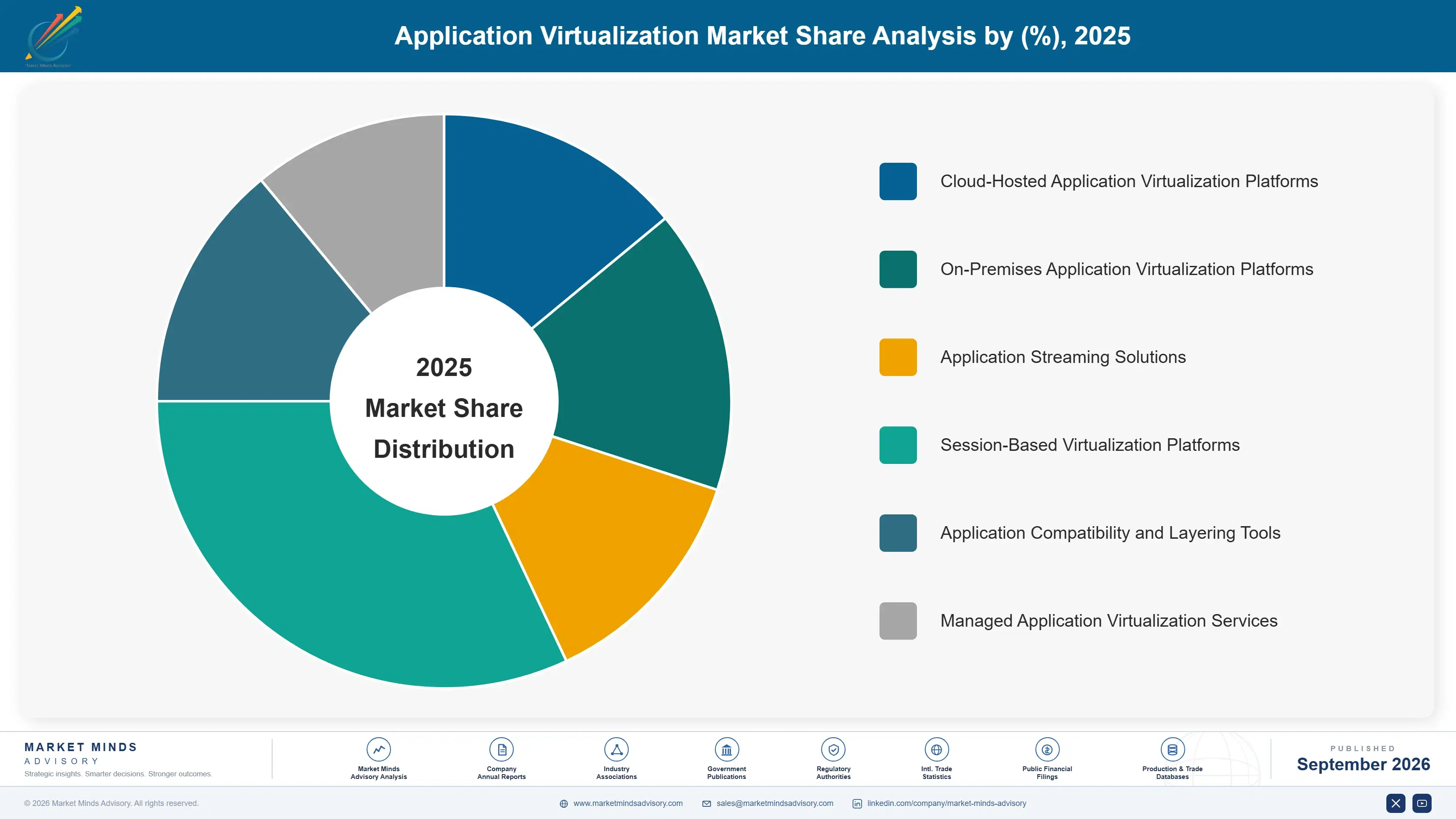
Application virtualization segments by deployment and delivery model across six categories spanning cloud-hosted, on-premises, streaming, session-based, compatibility layering, and managed service offerings sold to enterprises worldwide today. Each reflects a distinct infrastructure architecture and commercial relationship rather than overlapping capability tiers within a single platform, giving buyers a clear basis for vendor comparison and evaluation.
application-virtualization-market-market-share-analysis-1789988470579

Cloud-Hosted Application Virtualization Platforms

Cloud-hosted application virtualization platforms form the fastest-growing segment, expanding at 14.0% CAGR as enterprises migrate away from capital-intensive on-premises infrastructure toward consumption-based cloud subscription licensing across most industries and company sizes. This segment benefits directly from hybrid work adoption, since cloud-hosted platforms let employees access consistent application environments from any location without requiring dedicated on-premises hardware at every corporate site. Microsoft's Azure Virtual Desktop and competing hyperscaler offerings are accelerating this shift by bundling virtualization capability with existing cloud infrastructure subscriptions many enterprises already maintain for other workloads. Vendors offering smooth migration tooling from legacy on-premises deployments are capturing disproportionate share of enterprises transitioning away from aging virtualization infrastructure requiring hardware replacement.
CAGR 14.0%

Managed Application Virtualization Services

Managed application virtualization services form the second-fastest-growing segment at 11.5% CAGR, driven by enterprises seeking to outsource virtualization infrastructure management entirely rather than maintaining dedicated internal IT staff for platform administration and troubleshooting across their entire organizations and geographies. This segment appeals particularly to mid-market enterprises lacking the specialized technical staff larger organizations maintain for complex virtualization environment management and ongoing optimization. Managed service providers bundle infrastructure monitoring, security patching, and capacity planning into a single recurring contract, reducing the operational burden enterprises face compared to self-managed deployment. This segment benefits from the broader enterprise trend toward outsourcing specialized IT functions that fall outside an organization's core competency and strategic focus.
CAGR 11.5%
Full segment breakdown across 6 segments available in the complete report.

Regional Architecture and Country Demand Map

North America leads on enterprise software vendor headquarters concentration and the largest installed base requiring cloud migration, while South Asia and Pacific grows fastest as expanding IT services sectors and outsourced enterprise operations drive rising virtualization license adoption across the wider region and its major economies.

North America

The United States hosts the headquarters of Citrix, VMware, Microsoft, and most other major virtualization vendors, giving the region both the deepest product innovation pipeline and the largest legacy installed base now migrating toward cloud-hosted alternatives. Financial services and healthcare enterprises are leading adoption of centralized virtualization architecture specifically to satisfy tightening data security and compliance audit requirements. Canada's enterprise sector is following similar adoption patterns at a somewhat smaller scale, concentrated mainly among financial services and government agencies requiring comparable data residency and security compliance capability. Enterprises here increasingly negotiate multi-year renewal contracts bundling cloud migration services alongside standard licensing to lock in predictable vendor pricing ahead of anticipated hardware refresh cycles across their distributed office footprints.
Share: 32% | CAGR: 9.5% (2026 to 2036)

Western Europe

Germany and the United Kingdom anchor regional demand through large enterprise IT departments managing substantial legacy on-premises virtualization infrastructure now reaching hardware refresh decision points. The European Union's data residency and privacy regulation requirements are shaping vendor selection meaningfully, favoring providers offering region-specific cloud hosting options over vendors relying entirely on infrastructure located outside the European Economic Area. France's public sector digitalization initiatives are adding meaningful additional demand as government agencies modernize legacy application delivery infrastructure to meet updated security and accessibility standards. Insurance and telecommunications companies across the region are similarly accelerating virtualization adoption as they consolidate legacy IT systems inherited through years of corporate mergers and acquisitions across multiple national subsidiaries.
Share: 22% | CAGR: 7.5% (2026 to 2036)
Regional intelligence for 5 additional markets available in the complete report: East Asia, South Asia and Pacific, Latin America, Middle East and Africa, Eastern Europe. Contact sales@marketmindsadvisory.com.
application-virtualization-market-country-cagr-analysis-1789988471121

Where Vendors Can Defend Licensing Margin

Standalone virtualization vendors face compressed pricing power from bundled cloud alternatives, but four commercial levers let disciplined vendors defend margin and win larger, longer contract renewals across the coming forecast decade. Each requires different capability investment, and vendors combining several simultaneously are pulling ahead of single-lever competitors across most enterprise segments and geographies today.

Legacy Application Compatibility and Migration Tooling

Vendors offering specialized compatibility layers that let legacy applications run unmodified on modern cloud-hosted virtualization platforms capture enterprise customers unwilling to risk business-critical application remediation during migration projects. This capability requires sustained engineering investment in compatibility testing across a wide range of legacy operating system and application configurations, but delivers pricing power that generic bundled cloud alternatives lacking equivalent compatibility depth cannot match easily. Vendors with proven legacy compatibility are commanding roughly 20% higher renewal pricing than generic cloud alternatives among enterprises still running significant legacy application portfolios today. over time.
Market Impact: Commands roughly 20% higher enterprise renewal pricing overall

Managed Service Bundling for Mid-Market Enterprises

Vendors bundling infrastructure monitoring, security patching, and capacity planning into a single managed service contract capture higher revenue per customer than those selling bare licensing alone, since mid-market enterprises increasingly prefer to outsource specialized IT management entirely rather than staff it internally at scale. This bundling strategy is particularly effective with enterprises lacking dedicated virtualization infrastructure specialists capable of managing complex multi-vendor environments reliably. Bundled managed service contracts generate approximately 28% higher average revenue per customer than standalone licensing arrangements, with meaningfully higher customer retention across the full contract lifecycle as well.
Market Impact: Generates about 28% higher revenue per enterprise customer

Vertical-Specific Compliance and Security Certification Investment

Vendors achieving specialized compliance certification for financial services, healthcare, or government deployment requirements capture premium-priced contracts that generic bundled cloud alternatives without equivalent certification cannot access at comparable scale. This certification process requires substantial upfront investment in security architecture and third-party audit processes, but creates a durable competitive moat since certification renewal and audit history compound advantage over successive contract cycles and audit periods. Vertically certified vendors are winning enterprise contracts at price points roughly 25% above generic offerings lacking comparable compliance credentials and audit documentation. Contracts also tend to run longer once certification credentials are established and audited.
Market Impact: Wins contracts at prices roughly 25% above generic offerings

Multi-Year Contract Lock-In Through Migration Incentives

Vendors offering discounted migration assistance and implementation support in exchange for multi-year contract commitments capture more predictable revenue while reducing the risk of customer churn during the vulnerable initial post-migration period specifically. This approach requires upfront investment in migration engineering resources, but the resulting multi-year contract lock-in delivers meaningfully more stable revenue than annual renewal arrangements exposed to competitive displacement every single contract cycle. Vendors using this strategy report customer retention rates roughly 35% higher than competitors relying on standard annual renewal contracts across most enterprise segments. Migration incentive spending typically pays back within roughly two contract years.
Market Impact: Achieves customer retention rates roughly 35% higher overall

Who Controls the Margin Pool

The application virtualization market shows high concentration, with the top five vendors controlling roughly 58% of global revenue given the platform lock-in and migration switching cost that heavily favors established incumbents over newer challengers. Citrix and VMware hold a substantial scale advantage over Microsoft's more recently expanded offering and the remaining smaller challengers, backed by decades of enterprise relationship depth and legacy application compatibility investment competitors cannot quickly replicate.
Current competitive activity centers on cloud migration tooling and managed service bundling, with major vendors announcing enhanced compatibility layers and simplified migration pathways specifically targeting enterprises still running substantial on-premises infrastructure. Microsoft continues expanding Azure Virtual Desktop capability aggressively, bundling it more tightly with existing Microsoft 365 enterprise subscriptions to pressure standalone vendor pricing across small and mid-market customer segments specifically.

Emerging pressure comes from smaller cloud-native challengers offering simplified, lower-cost virtualization alternatives targeting mid-market enterprises underserved by enterprise-focused incumbent pricing and complexity. Rankings could shift meaningfully over the coming decade as bundled hyperscaler offerings continue improving, potentially commoditizing basic virtualization capability while standalone vendors compete increasingly on specialized compliance certification and legacy application compatibility depth instead.
application-virtualization-market-company-positioning-matrix-1789988471649

Competitive Moat and Risk Dimensions

CITRIX

Moat: Deep Enterprise Legacy Integration

Citrix maintains the deepest legacy application compatibility and enterprise integration depth in the market, built through decades of relationships with large enterprises running complex, customized application environments. This integration depth creates substantial switching cost for customers, since migrating away requires extensive reconfiguration work that many enterprises would rather avoid than pursue for uncertain benefit.
CITRIX

Risk: Slower Cloud-Native Innovation Pace

Citrix has moved more cautiously toward cloud-native architecture than some competitors, potentially ceding ground to Microsoft and cloud-native challengers among enterprises prioritizing modern deployment flexibility over legacy compatibility depth. Accelerating cloud transition requires sustained engineering investment that could pressure near-term profitability if pursued too aggressively.
VMWARE

Moat: Broad Virtualization Infrastructure Portfolio

VMware's broad virtualization infrastructure portfolio, spanning server, network, and application virtualization, gives it cross-selling advantages and integration depth that pure-play application virtualization vendors cannot match. This portfolio breadth also provides revenue stability during periods when any single product category faces competitive pressure or cyclical demand weakness.
VMWARE

Risk: Post-Acquisition Integration Uncertainty

VMware's recent corporate ownership changes have introduced pricing and licensing structure uncertainty among enterprise customers, prompting some to evaluate alternative vendors during routine contract renewal cycles. Sustained customer confidence recovery will require consistent pricing communication and clear product roadmap clarity over the coming several years.

Players Tracked

Prominent Players

Citrix
VMware
Microsoft
Parallels
Cameyo

Other Key Players

IGEL Technology
Ericom Software
Systancia
Nutanix
Amazon Web Services
Google Cloud
V2 Cloud
Workspot
CloudJumper
Leostream
Tehama
NoMachine
TeamViewer
AnyDesk Software
Splashtop

Recent Developments

FEBRUARY 2025

Microsoft expanded Azure Virtual Desktop integration with Microsoft 365 enterprise subscriptions, reducing the incremental licensing cost for enterprises already committed to Microsoft's broader productivity software suite and cloud infrastructure platform across their organizations and existing corporate technology relationships nationwide, according to the company's own announcement.
Signal: Bundled pricing from major cloud providers is compressing standalone vendor margin steadily across most enterprise segments.
JUNE 2025

Citrix announced enhanced legacy application compatibility tooling designed to simplify migration from on-premises infrastructure toward cloud-hosted deployment without requiring extensive application remediation engineering work for enterprise customers across most industry verticals and geographies served worldwide, based on the vendor's own product roadmap disclosure this year.
Signal: Migration tooling investment is becoming an increasingly key competitive differentiator among most established enterprise software vendors.
OCTOBER 2025

Nutanix completed the acquisition of a specialized managed virtualization service provider, expanding its portfolio well beyond core infrastructure software into recurring managed service revenue serving mid-market enterprise customers directly across several geographic regions and industries the company already actively serves worldwide today and going forward.
Signal: Infrastructure vendors are increasingly acquiring managed service capability to capture more recurring subscription revenue streams overall.

Cloud Compute and Infrastructure Cost Exposure

Underlying cloud compute and storage infrastructure represents approximately 28% of total cost of ownership for cloud-hosted application virtualization deployments, sourced primarily through wholesale capacity agreements with major hyperscaler cloud providers rather than owned data center infrastructure. Vendors reselling or bundling hyperscaler compute capacity face direct exposure to underlying cloud pricing changes set by providers they do not control.
Cloud compute pricing for virtual desktop infrastructure workloads rose an estimated 9% between 2023 and 2025 amid tightening data center capacity driven by simultaneous artificial intelligence workload demand competing for the same underlying GPU and compute infrastructure, according to the European Commission Digital Markets Report 2025 tracking cloud infrastructure pricing trends across the European Union member states and broader digital single market throughout the entire two-year reporting period covered.

This exposure disadvantages smaller virtualization vendors reselling hyperscaler capacity without negotiated volume discount agreements, forcing them to pass rising compute cost directly to enterprise customers or absorb margin compression themselves entirely. Vendors operating owned data center infrastructure alongside cloud-hosted offerings maintain more pricing stability and control than competitors entirely dependent on third-party hyperscaler capacity procurement and pricing decisions.
application-virtualization-market-cost-volatility-analysis-1789988471847

Negotiated Volume Cloud Capacity Agreements

Larger vendors negotiate multi-year volume purchase agreements directly with hyperscaler cloud providers to lock in favorable compute pricing and secure capacity allocation priority well ahead of demand spikes. Smaller vendors without comparable purchasing scale remain exposed to standard published pricing, which materially compresses margin during periods of tight cloud infrastructure supply across the wider industry.

Multi-Cloud Vendor Diversification Strategy

Some vendors are architecting platforms to run across multiple hyperscaler cloud providers rather than depending on a single provider, reducing exposure to any one provider's pricing changes or capacity constraints. This approach requires additional engineering investment to maintain compatibility across different cloud provider architectures, but delivers meaningful pricing negotiation leverage over single-cloud competitors dependent entirely on one relationship.

Hybrid Owned and Cloud Infrastructure Model

Some larger vendors maintain owned data center infrastructure alongside cloud-hosted offerings, providing a cost-stable baseline capacity that reduces dependence entirely on third-party hyperscaler pricing decisions made elsewhere. This hybrid approach requires significant capital investment in physical infrastructure, but delivers pricing predictability that pure cloud-resale competitors exposed entirely to hyperscaler pricing changes simply cannot match.

Portfolio Architecture for Margin Defence

Application virtualization economics divide along three tiers driven by deployment model and compliance certification across the industry. Basic on-premises licensing generates gross margins around 30 to 38%, while cloud-hosted subscription licensing commands 45 to 55%, and specialized managed service and compliance-certified offerings reach 60 to 68% given the technical and relationship differentiation competitors cannot quickly replicate at comparable cost.
On-premises licensing still represents meaningful revenue given the large installed base yet to migrate, but the highest-value pools now concentrate in cloud-hosted subscription and managed service offerings serving hybrid workforce and compliance-driven customers across most industries. Vendors must balance capital allocation between supporting legacy on-premises customers and premium cloud-native product investment, since the two require fundamentally different engineering and go-to-market capability entirely.

High-value margin pools concentrate specifically in compliance-certified managed service offerings serving financial services, healthcare, and government customers, since these command both premium pricing and multi-year contract commitment given switching cost and certification barriers across most enterprise segments. Vendors positioned across all three tiers rather than concentrated purely in commodity on-premises licensing are best placed to capture disproportionate profit as cloud migration keeps expanding through the forecast period.

Basic on-premises virtualization licensing sold to enterprises with legacy infrastructure, competing mainly on price with gross margin around 30 to 38% amid intense vendor competition and slow migration timelines that persist for years.
Gross Margin

Cloud-hosted subscription licensing with proven migration tooling and legacy application compatibility, commanding gross margin of 45 to 55% through consumption-based pricing and reduced customer capital investment requirements across most enterprise segments.
Gross Margin

Managed service and compliance-certified offerings serving financial services, healthcare, and government customers, commanding the highest margin as regulatory data security requirements keep expanding across most global industries and jurisdictions today.
Gross Margin
application-virtualization-market-portfolio-architecture-1789988472352

High-value Sub-segments and Strategic Watch-out

Cloud-Hosted Application Virtualization Platforms

The fastest-growing and highest-value segment, commanding subscription pricing as enterprises migrate away from capital-intensive on-premises infrastructure across most industries and organizational sizes. Vendors offering smooth migration tooling and legacy application compatibility are capturing disproportionate share of enterprises transitioning away from aging virtualization infrastructure requiring hardware replacement.

Managed Application Virtualization Services

A high-value segment growing steadily as mid-market enterprises seek to outsource virtualization infrastructure management entirely rather than maintaining dedicated internal IT staff for platform administration. Managed service providers bundling monitoring, security patching, and capacity planning are capturing disproportionate share of this expanding recurring revenue opportunity.

Application Streaming Solutions

The volume core of enterprise application delivery demand, sold heavily into organizations requiring centralized software distribution without full desktop virtualization capability. Growth remains solid but margin stays moderate given competitive intensity among numerous established vendors, making this segment primarily a scale play for most participants.

On-Premises Application Virtualization Platforms

A strategic watch-out segment where growth trails the broader category as cloud-hosted alternatives increasingly displace on-premises deployment for most new enterprise purchases and contract renewals worldwide. Vendors overexposed to this declining category risk meaningful revenue erosion absent diversification into higher-growth cloud-hosted or managed service alternatives.

Why Enterprises Rarely Switch Vendors

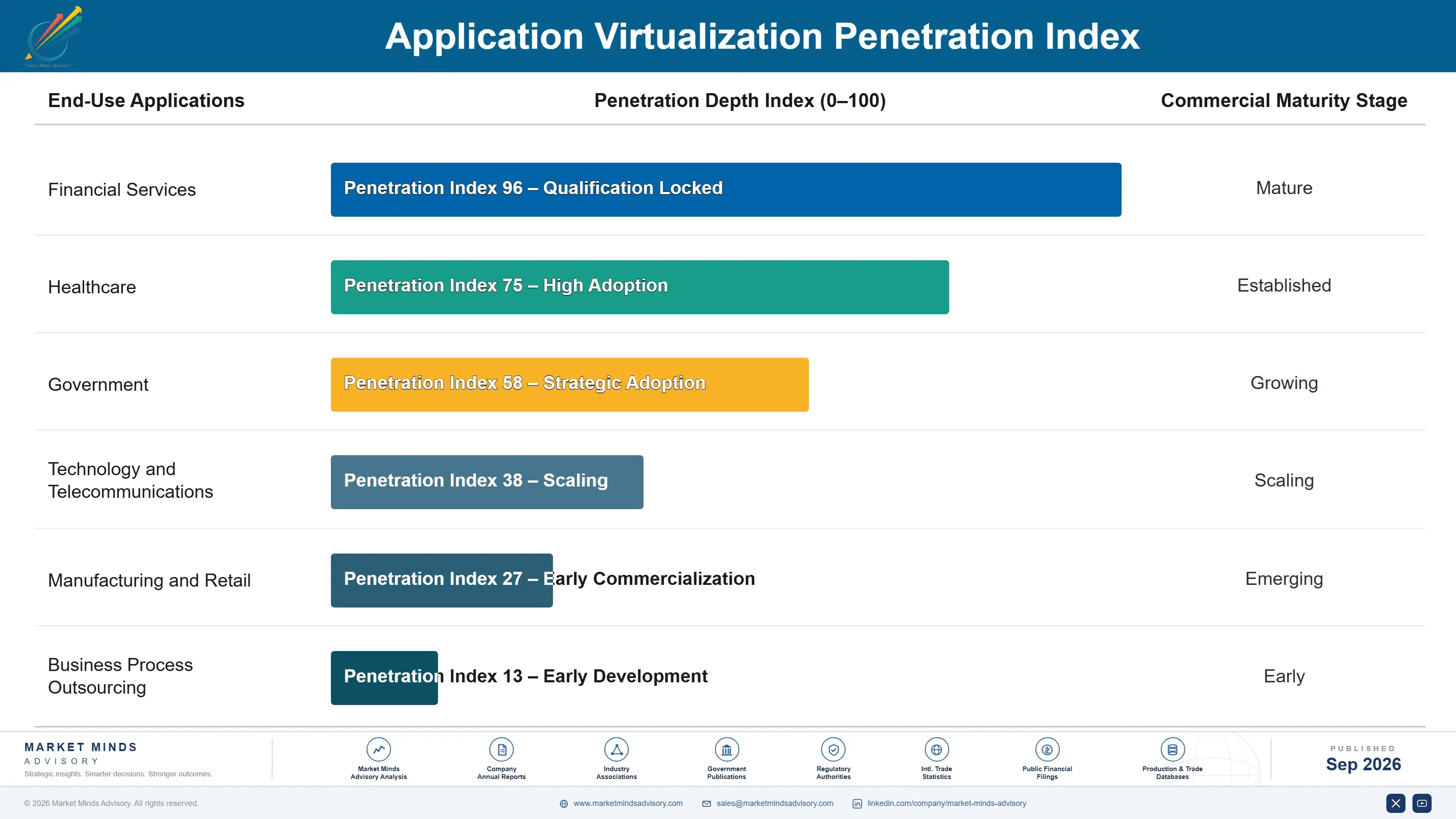
Application virtualization contracts generate durable multi-year recurring revenue rather than one-time software purchases, since migrating away from an established platform requires retraining IT staff and reconfiguring application delivery workflows built around the incumbent vendor's specific architecture and management tooling. This switching cost compounds over successive contract renewal cycles as enterprises accumulate deeper platform-specific configuration and integration investment that resists easy replication elsewhere.
Adoption depth varies sharply by end-use vertical. Financial services and healthcare enterprises show near-total stickiness once compliance certification and audit history are established, given the substantial cost and risk of re-certifying a new vendor relationship. Technology companies show more willingness to migrate given more standardized application architectures, while manufacturing and retail enterprises sit between these extremes, tied to platforms mainly through existing integration investment already sunk into current deployments.

A generational shift is underway in buyer profile as procurement decisions increasingly involve cloud infrastructure architects rather than purely traditional IT infrastructure specialists focused on on-premises hardware management. Younger enterprise technology leaders increasingly expect consumption-based cloud pricing models comparable to other software-as-a-service tools they already use, pushing legacy vendors toward subscription pricing structures that differ meaningfully from the perpetual licensing models that dominated the prior decade.
application-virtualization-market-end-use-penetration-index-1789988472912

Where Vendors Should Focus Now

These are among the four positions where our research anticipates prominent divergence between winners and laggards over the coming forecast period. Each is grounded in the demand model, the regulatory perimeter, and the announced capacity pipeline.
01 / CLOUD MIGRATION TOOLING INVESTMENT

Migration compatibility tooling now determines who wins renewal

Vendors offering specialized compatibility layers that let legacy applications run unmodified on cloud-hosted platforms are winning renewal contracts that generic bundled cloud alternatives cannot match given their lack of comparable compatibility depth. Enterprises with substantial legacy application portfolios increasingly favor vendors demonstrating proven migration track records over vendors offering only generic cloud infrastructure without specialized enterprise migration support. Investing in migration tooling now, rather than treating it as a secondary feature, compounds into a durable renewal advantage that competitors cannot easily replicate quickly.
02 / COMPLIANCE CERTIFICATION STRATEGY

Vertical-specific certification opens premium enterprise contract pricing

Vendors achieving specialized compliance certification for financial services, healthcare, or government deployment requirements are capturing premium-priced contracts that generic bundled cloud alternatives without equivalent certification simply cannot access. This certification process requires substantial upfront investment in security architecture and third-party audit processes, but creates a durable competitive moat since certification renewal and audit history compound advantage over successive contract cycles. Vendors pursuing vertical certification now will capture disproportionate share of the highest-margin enterprise contracts before competitors recognize the full strategic value.
03 / MANAGED SERVICE BUNDLING

Bundled managed services deliver more durable customer relationships

Vendors bundling infrastructure monitoring, security patching, and capacity planning into managed service contracts are building more durable customer relationships and predictable revenue than vendors selling bare licensing alone to mid-market customers across most enterprise segments and industries. This bundling strategy is particularly effective with enterprises lacking dedicated virtualization infrastructure specialists capable of managing complex environments internally and reliably. Vendors that make this transition early will capture disproportionate share of the growing recurring managed service revenue opportunity before competitors recognize its full value.
04 / SOUTH ASIA REGIONAL EXPANSION

India's IT services growth deserves earlier strategic capital investment

India's expanding information technology services sector, serving global enterprise clients through outsourced operations, makes South Asia the fastest-growing regional opportunity identified in this analysis, yet many established vendors remain underweighted there relative to more mature North American and European markets today. Business process outsourcing operations across the region increasingly represent a meaningful addressable customer base requiring centralized virtualization infrastructure and support. Vendors that commit distribution and service capital to this market early will capture disproportionate share before competitive intensity rises meaningfully.

Engagement Snapshot From the Field

A live engagement with an industry participant carrying material or product regulatory and market exposure ahead of a defining policy shift, showing how our research translates into a defensible multi-year portfolio strategy.
MARKET MINDS ADVISORY · CLIENT ENGAGEMENT SUMMARY
Application Virtualization Producer Strategic Portfolio Review and Transition Roadmap 2026·Investment Scenario on Application Virtualization Exposure Evaluation 2025-26
CLIENT PROFILE
The client operates a global insurance business with roughly 12,000 employees across regional offices, previously running an aging on-premises virtualization platform approaching end of vendor support after a decade of continuous operation. Rising IT staffing cost and difficulty recruiting specialized administrators for the legacy platform prompted leadership to evaluate migration toward a modern cloud-hosted alternative.
STRATEGIC CHALLENGE
The client faced a decision between multiple cloud-hosted virtualization vendors without a systematic framework for comparing migration risk, legacy application compatibility, and total cost of ownership across scenarios. Several business-critical underwriting applications had known compatibility issues with modern cloud platforms, creating significant risk that leadership needed to address before committing to a migration timeline.
MMA APPROACH
MMA benchmarked four cloud-hosted virtualization vendors against legacy application compatibility, migration support capability, and total cost of ownership using primary interviews with comparable insurance industry technology buyers. The engagement modeled a phased migration sequence prioritizing lowest-risk applications first, while quantifying total cost of ownership across vendor scenarios over a five-year planning horizon.
KEY FINDINGS
  1. Migrating to the selected cloud-hosted vendor reduced projected five-year total infrastructure and licensing cost by approximately 24% overall (client-reported, unverified by MMA).
  2. Two of the client's core underwriting applications required specialized compatibility layer configuration to run reliably on the new platform (client-reported, unverified by MMA).
  3. Phased migration sequencing limiting each transition to non-business-hours windows avoided any measurable disruption to daily underwriting operations entirely (client-reported, unverified by MMA).
  4. The selected vendor's managed service bundle reduced internal IT staffing requirements by approximately 30% compared to self-managed deployment (client-reported, unverified by MMA).
CLIENT PROFILE
The client operates a global insurance business with roughly 12,000 employees across regional offices, previously running an aging on-premises virtualization platform approaching end of vendor support after a decade of continuous operation. Rising IT staffing cost and difficulty recruiting specialized administrators for the legacy platform prompted leadership to evaluate migration toward a modern cloud-hosted alternative.
STRATEGIC CHALLENGE
The client faced a decision between multiple cloud-hosted virtualization vendors without a systematic framework for comparing migration risk, legacy application compatibility, and total cost of ownership across scenarios. Several business-critical underwriting applications had known compatibility issues with modern cloud platforms, creating significant risk that leadership needed to address before committing to a migration timeline.
MMA APPROACH
MMA benchmarked four cloud-hosted virtualization vendors against legacy application compatibility, migration support capability, and total cost of ownership using primary interviews with comparable insurance industry technology buyers. The engagement modeled a phased migration sequence prioritizing lowest-risk applications first, while quantifying total cost of ownership across vendor scenarios over a five-year planning horizon.
KEY FINDINGS
  1. Migrating to the selected cloud-hosted vendor reduced projected five-year total infrastructure and licensing cost by approximately 24% overall (client-reported, unverified by MMA).
  2. Two of the client's core underwriting applications required specialized compatibility layer configuration to run reliably on the new platform (client-reported, unverified by MMA).
  3. Phased migration sequencing limiting each transition to non-business-hours windows avoided any measurable disruption to daily underwriting operations entirely (client-reported, unverified by MMA).
  4. The selected vendor's managed service bundle reduced internal IT staffing requirements by approximately 30% compared to self-managed deployment (client-reported, unverified by MMA).
RECOMMENDED STRATEGY
Phase 1: Phase one: migrate non-critical administrative applications to the new cloud-hosted platform within the first two quarters of the engagement timeline. Phase 2: Phase two: migrate core underwriting applications in scheduled non-business-hours windows, carefully validating compatibility at each stage before full system cutover. Phase 3: Phase three: decommission the legacy on-premises platform and transition fully to the managed service contract once migration is verified stable.
OUTCOME
The client completed full migration across all regional offices within nine months, well ahead of the original twelve-month target, achieving the projected cost reduction while maintaining fully uninterrupted underwriting system availability throughout the entire multi-phase transition period across every regional office (client-reported, unverified by MMA).

Frequently Asked Questions

Foundational context covering the market sizes, CAGR, scope, country, region and competition that inform every finding below. This section is provided to cover basics and most often pre-purchase conversations, answered from the MMA Primary Research Dataset.

What is the current size of the Application Virtualization Market?

The Application Virtualization Market was valued at approximately $7.2 billion in 2025, the base year for this analysis. This figure covers global cloud-hosted and on-premises virtualization license revenue.

How large will the Application Virtualization Market be by 2036?

The market is projected to reach approximately $18.58 billion by 2036, driven by hybrid work adoption and cloud migration momentum. This represents a 2.37x expansion over the 2026 starting value.

What is the CAGR for the Application Virtualization Market 2026 to 2036?

The market is forecast to grow at a compound annual growth rate of 9.0% between 2026 and 2036. The bull case reaches 10.3% while the bear case falls to 7.8%.

Which segment is growing fastest?

Cloud-Hosted Application Virtualization Platforms is the fastest-growing segment, expanding at 14.0% CAGR, roughly 1.56x the overall market rate. Demand is driven by enterprise cloud migration away from legacy infrastructure.

Who are the major companies in the Application Virtualization Market?

Leading participants include Citrix, VMware, Microsoft, Parallels, and Cameyo, alongside numerous specialized cloud-native and managed service providers. Competitive positioning centers on migration tooling and compliance certification depth.

Which country is growing fastest?

India is the fastest-growing country market, expanding at approximately 12.0% CAGR. Expanding IT services and outsourced enterprise operations are driving accelerating virtualization license adoption there.

Report Segmentation Architecture

The full report scope spans multiple orthogonal segmentation dimensions, with cross-tabulated demand data provided for each dimension pair. Coverage extends further to regional breakdowns, trend trajectories, and the competitive detail needed to support segment-level decision-making.
  • Cloud-Hosted Application Virtualization Platforms
  • On-Premises Application Virtualization Platforms
  • Application Streaming Solutions
  • Session-Based Virtualization Platforms
  • Application Compatibility and Layering Tools
  • Managed Application Virtualization Services
  • Financial Services
  • Healthcare
  • Government
  • Technology and Telecommunications
  • Manufacturing and Retail
  • Business Process Outsourcing
  • Direct Enterprise Licensing
  • Managed Service Contracts
  • Channel Partner and Reseller Sales
  • OEM and Bundled Distribution

By Region

  • North America
  • Western Europe
  • East Asia
  • South Asia and Pacific
  • Latin America
  • Middle East and Africa
  • Eastern Europe

Scope, Methodology, and Coverage

Every figure in this report is reproducible from documented input assumptions. The scope below maps the historical period, the forecast horizon, the segmentation dimensions, and the countries covered, alongside the underlying primary and qualitative methodology.
Historical Period
2020 to 2025
Forecast Period
2026 to 2036
Base Year
2025 (USD billions; MMA Primary Research Dataset, September 2026)
Market Definition
The Application Virtualization Market covers software platforms that decouple applications from underlying operating systems and hardware, enabling centralized delivery, management, and streaming of applications to end-user devices regardless of location. It excludes full desktop-as-a-service infrastructure and general server virtualization hypervisors, which are tracked as separate market categories.
Quantitative Units
USD Billion, license seats, CAGR percentage
Segmentation Dimensions
Deployment and Delivery Model, End-Use Industry, Commercial Dimension, Region
Regions Covered
North America, Western Europe, East Asia, South Asia and Pacific, Latin America, Middle East and Africa, Eastern Europe
Countries Covered
United States, Canada, Germany, United Kingdom, France, China, Japan, South Korea, India, Australia, Brazil, Mexico, United Arab Emirates, Israel, Poland
Key Companies Profiled
Citrix, VMware, Microsoft, Parallels, Cameyo, IGEL Technology, Ericom Software, Systancia, Nutanix, Amazon Web Services, Google Cloud, V2 Cloud, Workspot, CloudJumper, Leostream, Tehama, NoMachine, TeamViewer, AnyDesk Software, Splashtop
Quantitative Methodology
Primary survey, n=3,800 respondents, Q4 2025, six countries; demand-side model with trade association cross-validation
Qualitative Methodology
47 expert interviews, Q4 2025; applied to validate demand model assumptions, identify emerging dynamics, and assess competitive positioning
Report Format
PDF and XLSX data workbook (Word format preview document)
Publisher
Market Minds Advisory
Report Code
MMA-2026-TEC-934
Published
September 2026
Contact
sales@marketmindsadvisory.com | www.marketmindsadvisory.com

Purchase the full Application Virtualization Market Report (2026 to 2036).

This report provides a comprehensive assessment of the global Application Virtualization Market through 2036. It covers market sizing, segmentation, competitive dynamics, and regional demand patterns across all seven major geographies tracked in this analysis. The analysis examines how cloud migration and bundled hyperscaler pricing are reshaping vendor economics and competitive positioning across the enterprise application delivery industry, alongside cloud compute cost exposure across the supply chain. It draws on primary survey data, expert interviews, and company disclosures to support procurement, investment, and strategic planning decisions.
Ten-year market sizing and forecast model
Seven-region demand and competitive intensity breakdown
Five-vendor competitive benchmarking and moat analysis
Segment-level growth trajectory and margin analysis
Cloud cost exposure and mitigation pathways
Anonymized client case study with recommendations

Built For The People Who Decide

From boardroom strategy to bench-side execution, this report is read cover-to-cover by leaders shaping the next decade of their industry, turning demand scenarios, market dynamics and valuation benchmarks into decisions.
CXOs/ Presidents/ VPs/ Managers
M&A and Corporate Development
Strategy Teams and R&D Heads
Procurement and Product Directors
Regulatory and Compliance Leaders
Investor Relations and Equity Analysts