Market Minds Advisory
Application Release Automation Market

Application Release Automation Market: Application Release Automation Market. AI Risk Scoring Reshapes Deployment Approvals

Enterprises are replacing manual deployment approval boards with AI-assisted release risk scoring as software delivery frequency accelerates, pushing budget toward orchestration platforms that can safely deploy dozens of times daily.

Lead Analyst

Published

September 2026

Make Smarter Decisions with Customized Research Insights

Request a free sample report and evaluate market opportunities, growth trends, and competitive dynamics relevant to your business needs.

2025 MARKET VALUE$2.9BMarket Size 2025
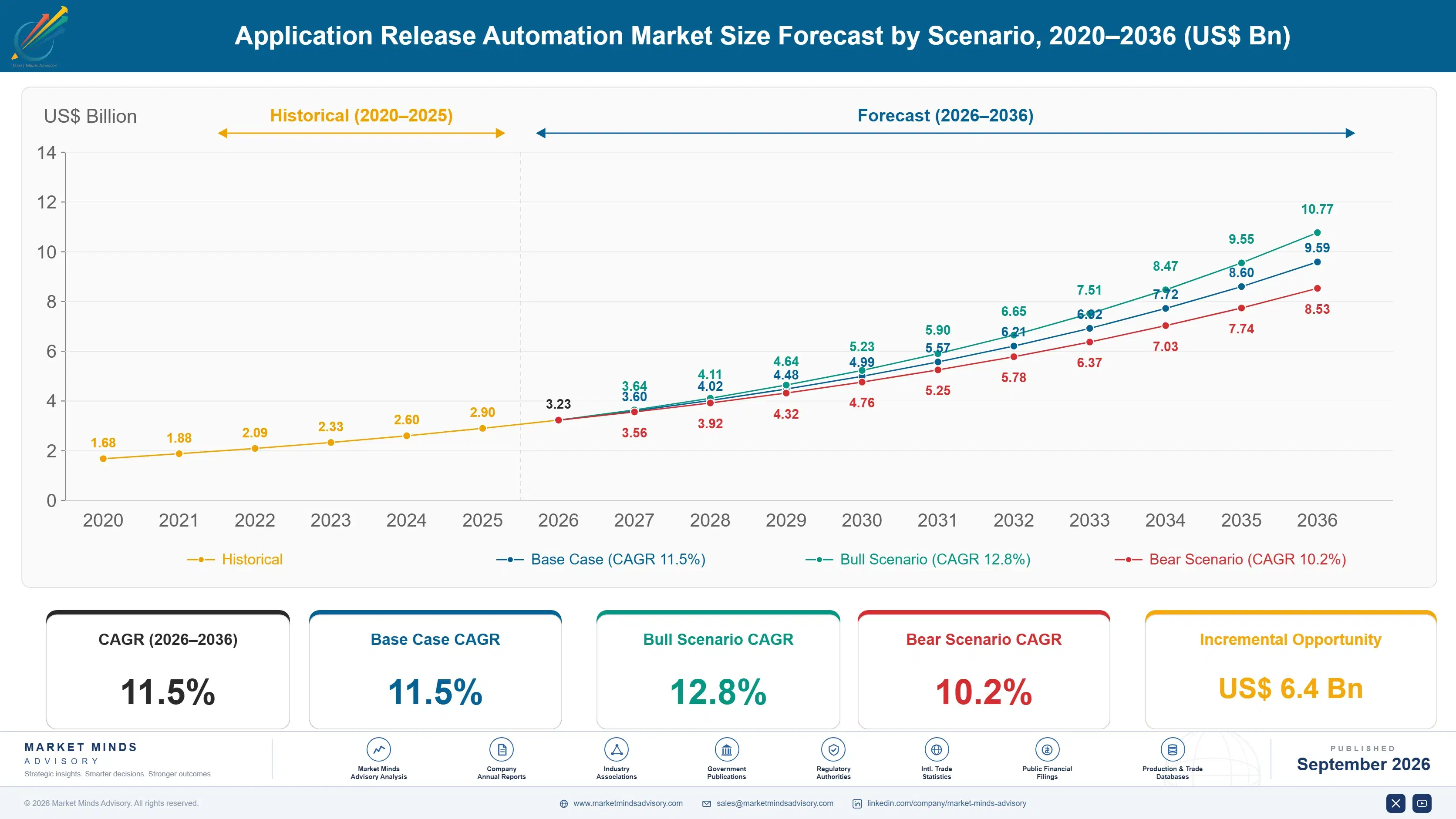
2036 FORECAST VALUE$9.6BBase Case , 2026 to 2036
CAGR 2026 TO 203611.5 %Bull 12.8% / Bear 10.2%
INCREMENTAL OPPORTUNITY$6.4BNet 10- year value creation
EXPANSION MULTIPLE2.97x2036 value over 2026 base
Strategic Levers
M&A Pipeline
Regional Outlook
Country Rankings
Competitive Intelligence
Segmental Deep-dive
Call-Us : 91 93563 13602

Executive Snapshot and Market Trajectory.

Enterprises are replacing manual deployment approval boards with AI-assisted release risk scoring as software delivery frequency accelerates past what human reviewers can realistically evaluate deployment by deployment across large application portfolios spanning hundreds of services and microservices deployed several times each day.
Cloud-native and AI-assisted risk analytics drive fastest adoption, since automating deployment risk assessment meaningfully reduces the change-approval bottleneck that historically slowed release velocity even after teams had already automated the underlying build and test pipeline stages. North America leads deployment given concentrated enterprise software vendor headquarters and the deepest DevOps tooling maturity, while compliance and audit trail automation increasingly extends beyond deployment mechanics into regulatory evidence generation that manual approval logs could not satisfy.
A moderately fragmented vendor base spans legacy enterprise release management platforms and cloud-native orchestration challengers, with hybrid mainframe-to-cloud deployment support increasingly separating winners from point solutions built for cloud-only environments and workloads exclusively without broader hybrid support. Multi-cloud and container orchestration requirements across enterprise environments continue to reshape which vendors can scale release automation across genuinely heterogeneous infrastructure without extensive custom integration and engineering work at every deployment stage.
Market Definition
The application release automation market covers software that orchestrates and automates deployment of applications across development, testing, staging, and production environments, managing approvals, rollback, and compliance for enterprise software delivery. It excludes standalone continuous integration build tools without release orchestration capability.
Base Year Value
$2.9B in 2025 (MMA Primary Research Dataset, September 2026)
Forecast Period
2026 to 2036, eleven discrete annual values
CAGR
11.5% base case. Bull 12.8%. Bear 10.2%.
Fastest Growth Segment
AI-Assisted Deployment Risk Analytics: 16.0% CAGR
Fastest Growth Country
India: 14.5% CAGR
Fastest Growth Region
South Asia and Pacific: 14.0% CAGR
Largest Region
North America: 32% of 2025 global value
Market Leaders
Broadcom, IBM, Digital.ai, Flexagon, Octopus Deploy
Primary Survey
n=3,800 procurement and R&D decision-makers, Q4 2025, six countries
Methodology
Demand-side build-up, cross-validated against public data, 47 expert interviews

Application Release Automation Market Forecast Scenarios

application-release-automation-market-size-forecast-scenario-1789986175436
Application release automation adoption grew steadily through 2020 to 2023 as remote software teams accelerated DevOps tooling investment during pandemic-driven digital transformation efforts across most industries. Momentum built further from 2024 as AI-assisted risk scoring matured enough to replace manual approval boards, lifting the historical growth rate to roughly 10.5 percent annually across the category.
Base case growth to 2036 rests on three commercial mechanisms: enterprises consolidating fragmented point deployment tools onto unified release orchestration platforms rather than maintaining separate systems per application team, AI-assisted risk scoring maturing enough to handle a growing share of approval decisions without human review, and regulatory frameworks increasingly requiring automated audit trails that manual deployment logs cannot reliably generate. These mechanisms reinforce each other across different buyer segments, sustaining above-average growth without depending on any single dominant catalyst.
A bull scenario centers on a major regulator formally endorsing automated release audit trails as sufficient compliance evidence, which would accelerate enterprise adoption across regulated industries within a single budget cycle. The bear risk is a high-profile automated deployment failure causing significant outage damage, which has historically slowed enterprise procurement decisions for automation tools by a year or more.

Where Risk Scoring Replaces Manual Approval Boards

Deployment risk scoring has become the primary purchasing criterion, since enterprises deploying dozens of times daily cannot sustain manual change advisory board review at that pace regardless of how experienced individual reviewers might be. Vendors that once competed narrowly on pipeline orchestration breadth now compete on risk model accuracy, which shifts engineering investment toward machine learning capability rather than workflow automation features alone.
MARKET CONCENTRATIONCR5 38%a fragmented base of legacy and cloud-native release vendors
AVERAGE DEPLOYMENT FREQUENCY12x per day for mature teamsdeployments per day among enterprises with full automation adopted
TOP ADOPTING COUNTRY SHAREUS 32%concentrated enterprise software vendor headquarters and DevOps tooling maturity
AI RISK SCORING ADOPTION42% of new deploymentsnew enterprise release pipelines now include automated risk assessment
MANUAL APPROVAL TIME SAVED65% faster approval cyclesautomated risk scoring versus traditional manual change advisory boards
COMPLIANCE COST SHARE22% of total platform costaudit trail and regulatory evidence generation versus core orchestration features
Hybrid mainframe-to-cloud deployment support remains a significant differentiator for large enterprises still running critical legacy systems alongside modern cloud-native applications, since these organizations cannot simply abandon decades of mainframe investment for a cloud-only orchestration platform. Compliance and audit trail generation has become a baseline expectation in regulated industries, concentrating advantage among vendors who can demonstrate automated evidence generation without requiring separate manual documentation processes.
Container and multi-cloud orchestration integration is becoming a baseline expectation rather than a differentiator, concentrating advantage among vendors who can demonstrate reliable deployment across heterogeneous infrastructure without extensive custom engineering work. Meanwhile several vendors are extending AI-assisted risk scoring into automated rollback decision-making, which could meaningfully reduce the human intervention required during failed deployment incidents within the next several product cycles.
"Every vendor pitches continuous delivery; most customers still have a Tuesday afternoon change advisory board meeting that decides whether Friday's release actually ships. The platforms winning now are the ones making that meeting genuinely unnecessary, not just faster."
Director, Enterprise DevOps and Release Engineering Practice · MMA Software for Orchestrating and Automating Enterprise Application Deployment Pipelines Practice · September 2026

Market Trends

AI Risk Scoring Replaces Manual Change Boards

Enterprises are replacing manual change advisory board review with AI-assisted deployment risk scoring that analyzes code change scope, historical failure patterns, and test coverage to automatically approve low-risk releases without human intervention. This shift has cut approval cycle times by roughly 65 percent at organizations running mature automated risk scoring, compared to traditional manual review processes that could take days for complex enterprise applications with multiple dependent systems. Roughly 42 percent of new enterprise release pipelines now include automated risk assessment capability, up sharply from a much smaller share just two years earlier when the technology remained largely experimental.
Market Impact: 12x daily deployments at mature teams

Compliance Automation Becomes Baseline Deployment Expectation Now

Regulated industries including financial services and healthcare are increasingly requiring automated audit trail generation for every production deployment, since regulators now expect verifiable evidence of change control that manual documentation processes cannot reliably produce at the pace modern software delivery demands. This compliance automation requirement has pushed release automation from a discretionary productivity tool into a mandatory regulatory infrastructure component for enterprises operating in regulated sectors specifically. Compliance and audit trail capability now represents roughly 22 percent of total platform cost at vendors serving regulated industry customers, a meaningful and growing share of overall platform investment.
Market Impact: 55% cite compliance as top driver

Market Opportunities and Growth Drivers

Deployment Frequency Growth Outpaces Manual Review Capacity

Enterprise software teams practicing continuous delivery now deploy applications considerably more frequently than manual change advisory boards can realistically review without becoming the primary bottleneck in the entire software delivery pipeline. Mature DevOps organizations report deploying roughly 12 times per day on average across their application portfolio, a pace that would require change advisory boards to convene continuously if every deployment required individual human sign-off before release. This volume pressure is forcing enterprises to adopt automated risk scoring not as an optional productivity enhancement but as an operational necessity to sustain modern release cadences.
Market Impact: Pilots often add 4-6 months delay

Regulatory Audit Requirements Mandate Automated Evidence

Financial services and healthcare regulators increasingly require verifiable, tamper-resistant audit trails documenting every production change, a standard that manual deployment logs and spreadsheet-based change tracking cannot reliably satisfy at the pace and scale modern software delivery demands across large enterprise portfolios. Automated release platforms generate this evidence as a natural byproduct of the deployment process itself, eliminating the separate documentation burden that manual processes previously required from already-stretched engineering teams. Roughly 55 percent of regulated enterprise customers now cite compliance automation as a primary purchase driver, ahead of pure deployment speed considerations.
Market Impact: Mainframe rollouts run 6-9 months late

Market Restraints and Challenges

AI Risk Model Trust Deficit Slows Adoption

Many engineering teams remain skeptical of allowing an automated model to approve production deployments without human review, particularly after early risk scoring implementations occasionally approved changes that later caused production incidents. The root cause is that early risk models trained on limited historical data sometimes missed failure patterns that experienced human reviewers would have caught through contextual judgment unavailable to the algorithm. The commercial impact shows up as longer evaluation cycles requiring extensive pilot testing before full production trust is granted. Leading vendors now mitigate this by offering graduated automation that starts with low-risk changes only.
Market Impact: 65% faster approval cycle times

Legacy Mainframe Integration Complexity Persists Broadly

Large enterprises running critical mainframe applications alongside modern cloud-native systems face significant integration complexity when extending release automation across genuinely hybrid infrastructure, since mainframe deployment processes were historically designed as entirely separate workflows from modern continuous delivery pipelines. The root cause is that mainframe and cloud-native systems evolved through completely different technology eras without coordinated deployment tooling standards ever being established. This has caused several enterprise-wide automation initiatives to stall on the mainframe portion of the estate specifically. Vendors are mitigating this by building dedicated mainframe connector modules rather than requiring full mainframe modernization first.
Market Impact: 22% of platform cost now compliance
3 additional market trends, 4 additional growth drivers, and 2 additional restraints and challenges are covered in the full report. Contact sales@marketmindsadvisory.com to access the complete intelligence.

Segment CAGR and Growth Architecture

Segmentation follows deployment target and function, spanning AI-assisted deployment risk analytics, cloud-native release orchestration, hybrid and mainframe release automation, multi-cloud and container orchestration, and compliance and audit trail software, each addressing a genuinely distinct technical function rather than overlapping customer type, industry vertical, or pricing model categories within this entire broader enterprise software market.
application-release-automation-market-market-share-analysis-1789986175997

AI-Assisted Deployment Risk Analytics

AI-assisted deployment risk analytics leads growth as enterprises finally have a credible alternative to manual change advisory board review that can keep pace with modern continuous delivery cadences reaching dozens of deployments per day across large application portfolios. These platforms analyze code change scope, historical failure patterns, and automated test coverage to generate a risk score that either automatically approves low-risk changes or routes higher-risk changes to human reviewers for targeted attention. Financial services and e-commerce companies are adopting this segment fastest, since their deployment volume and regulatory scrutiny simultaneously make both automation and accuracy commercially essential to sustaining release velocity. Vendors combining deep risk modeling with broad pipeline integration are capturing disproportionate share of this expanding investment.
CAGR 16.0%

Cloud-Native Application Release Orchestration

Cloud-native application release orchestration is the second-fastest growing segment, driven by enterprises consolidating fragmented deployment tools built for individual cloud providers onto unified platforms that can orchestrate releases consistently across multiple cloud environments simultaneously and reliably. These platforms increasingly incorporate infrastructure-as-code principles directly into release pipelines, treating environment configuration as a versioned artifact deployed alongside application code rather than a separately managed system entirely. Technology and SaaS companies are adopting this segment fastest, since their cloud-native architecture and rapid deployment cadence make unified multi-cloud orchestration considerably more valuable than for enterprises still running primarily on-premise infrastructure. Vendors offering genuine cross-cloud portability are winning disproportionate share fastest from single-provider incumbent platforms.
CAGR 15.0%
Full segment breakdown across 5 segments available in the complete report.

Regional Architecture and Country Demand Map

North America leads on concentrated enterprise software vendor headquarters and the deepest DevOps tooling maturity, while East Asia follows closely on rapid cloud-native adoption, and South Asia and Pacific posts the fastest regional growth on expanding IT services delivery investment across every major market today.

North America

US enterprises pioneered continuous delivery practices earlier than most other regions, giving domestic vendors including Broadcom and IBM decades of production deployment feedback that competitors elsewhere cannot easily replicate. Regulatory scrutiny from the SEC and financial services regulators has pushed US financial institutions to adopt automated audit trail generation earlier than comparable institutions in less stringently regulated markets. Canadian enterprises are following a similar adoption trajectory under comparable regulatory guidance and shared vendor relationships. Large technology and SaaS companies headquartered domestically continue driving a substantial share of near-term AI-assisted risk scoring adoption as they scale deployment frequency across expanding application portfolios. Mexican cross-border technology companies are following a comparable adoption curve closely behind.
Share: 32% | CAGR: 12.0% (2026 to 2036)

East Asia

China's rapidly expanding technology sector and massive e-commerce platforms are driving substantial release automation investment as domestic companies scale deployment frequency to match consumer app update expectations. Japan and South Korea are extending release automation into traditionally conservative enterprise sectors including banking and manufacturing, responding to competitive pressure from more digitally mature international competitors entering their markets. Both countries increasingly favor vendors offering hybrid mainframe integration given the region's substantial legacy technology investment across established financial institutions. Taiwan's technology manufacturing sector has separately driven meaningful release automation adoption given tight software-hardware integration requirements across the semiconductor supply chain. Taiwan and Southeast Asian technology hubs are following a similar trajectory as adoption expands.
Share: 24% | CAGR: 12.5% (2026 to 2036)
Regional intelligence for 5 additional markets available in the complete report: Western Europe, South Asia and Pacific, Latin America, Middle East and Africa, Eastern Europe. Contact sales@marketmindsadvisory.com.
application-release-automation-market-country-cagr-analysis-1789986176531

Where Release Platforms Should Expand Revenue

Beyond core platform licensing, vendors are building adjacent commercial layers around usage-based deployment volume pricing, compliance module subscriptions, managed migration services, and AI risk model training partnerships, each extending overall contract value well past the initial platform license into sustained multi-year account expansion across large and mid-sized enterprise customers operating everywhere across the globe.

Usage-Based Deployment Volume Pricing Tier Structures

Vendors are shifting pricing models toward usage-based fees tied to deployment volume rather than flat per-seat licensing, since enterprises deploying dozens of times daily generate far more platform value than smaller teams paying identical flat fees under legacy pricing structures. This usage-based component now generates roughly 28 percent of total contract value at several leading vendors, up meaningfully from a negligible share when flat licensing dominated the category just a few years ago. Enterprises accept this pricing since it aligns cost directly with the deployment volume actually driving measurable delivery velocity gains for their engineering teams.
Market Impact: 28% of contract value now priced on usage

Compliance and Audit Trail Module Subscriptions

Compliance and audit trail module subscriptions layered on top of core orchestration platforms are commanding premium recurring revenue, since regulated enterprises increasingly want automated evidence generation without building compliance reporting independently from scratch through custom engineering work. Attach rates for compliance modules now exceed 48 percent among large regulated-industry accounts, up sharply from a much smaller share when these modules first launched as standalone add-ons a few years back. Vendors bundling compliance into tiered packages are seeing measurably longer contract terms than those selling core orchestration as a standalone product alone.
Market Impact: 48% attach rate on compliance modules right now

Managed Legacy Platform Migration Support Services

Managed migration services helping enterprises move from legacy deployment tools onto modern release orchestration platforms are generating meaningful incremental revenue beyond the base subscription, since enterprises consistently underestimate the complexity of migrating years of accumulated deployment scripts and approval workflows onto a new platform. These services now represent roughly 20 percent of first-year contract value at several leading vendors, reflecting genuine willingness to pay for faster, lower-risk migration. Vendors offering this service report meaningfully higher renewal rates than those leaving customers to migrate entirely on their own without guided support.
Market Impact: 20% of first-year value from migration support work

AI Risk Model Customization Training Partnerships

AI risk model training partnerships that let enterprises fine-tune deployment risk scoring on their own historical incident data are commanding premium pricing over generic pre-trained models, since customized models trained on an organization's specific failure patterns produce meaningfully more accurate risk assessments than one-size-fits-all alternatives. These customization partnerships have expanded average contract value by roughly 32 percent for vendors pursuing this model, reflecting the substantially higher perceived value of personalized risk accuracy. Vendors lacking model customization capability increasingly struggle to compete for the largest enterprise accounts against competitors offering tailored risk models already proven in production.
Market Impact: 32% larger contracts via model customization efforts now

Who Controls the Margin Pool

Application release automation remains fragmented, with the top five vendors holding an estimated 38 percent of the market on a licensed-seat basis. Broadcom and IBM lead on breadth through legacy enterprise relationships, while a meaningful gap separates them from cloud-native challengers who compete mainly on modern architecture and AI risk scoring rather than broad platform maturity.
Current competitive activity centers on three fronts: vendors racing to embed AI-assisted risk scoring into existing orchestration platforms to close the credibility gap with skeptical enterprise buyers, larger platforms acquiring specialized compliance automation startups rather than building comparable capability internally, and several vendors expanding hybrid mainframe connector support to capture legacy infrastructure customers. Pricing pressure has intensified modestly among mid-tier vendors competing for mid-market accounts larger players consider too small to prioritize.

Emerging pressure comes from broader DevOps and CI/CD platforms extending into release orchestration through feature expansion rather than dedicated release automation product development, betting that adjacent workflow adoption can substitute for specialized deployment risk expertise built over years. Rankings could shift meaningfully if a major cloud provider bundles genuinely competitive release orchestration at no incremental cost, since that would compress the addressable market for standalone specialist vendors currently commanding premium pricing.
application-release-automation-market-company-positioning-matrix-1789986177057

Competitive Moat and Risk Dimensions

BROADCOM

Moat: Deep legacy enterprise installed base

Broadcom's acquisition of CA Technologies gave it a massive installed base of large enterprise customers running release automation across decades of accumulated legacy application portfolios, creating switching costs that keep customers in place even as newer cloud-native alternatives enter the market with modern architecture and pricing.
BROADCOM

Risk: Perceived slower innovation pace

Broadcom's reputation for prioritizing margin extraction over aggressive product innovation across its acquired software portfolio can slow feature development relative to venture-backed cloud-native competitors, risking share loss among enterprises prioritizing rapid AI risk scoring capability over established platform stability and long-standing support relationships built over years.
IBM

Moat: Strong mainframe integration heritage

IBM's decades of mainframe engineering expertise give its release automation platform a genuine advantage integrating hybrid mainframe-to-cloud deployment pipelines that cloud-native competitors struggle to replicate without deep legacy systems knowledge, letting it win large enterprise accounts still running critical mainframe workloads across finance and government.
IBM

Risk: Cloud-native perception disadvantage

Some cloud-first enterprise buyers still perceive IBM as a legacy technology vendor better suited to mainframe-heavy environments than modern cloud-native deployment pipelines, a perception that can cost the company contracts among digitally native companies even where its platform capability matches costlier established competitors on paper and in practice.

Players Tracked

Prominent Players

Broadcom
IBM
Digital.ai
Flexagon
Octopus Deploy

Other Key Players

GitLab
Atlassian
CloudBees
Harness Inc
Armory
JFrog
Puppet
Progress Software
HashiCorp
ServiceNow
OpenText
BMC Software
ConnectALL
Plutora
Copado

Recent Developments

FEBRUARY 2026

Broadcom Acquires AI Risk Scoring Startup

Broadcom acquired a small AI-assisted deployment risk scoring startup specializing in machine learning models for change failure prediction, folding the technology directly into its existing release automation platform rather than continuing to rely on manual change advisory board review for large enterprise customers across regulated industries.
Signal: Large legacy vendors are increasingly securing AI risk scoring capability through acquisition rather than internal development.
OCTOBER 2025

IBM Expands Mainframe Connector Module Suite

IBM expanded its mainframe connector module suite for release automation, aimed at reducing the engineering complexity large global enterprises face when extending automated deployment pipelines to critical legacy systems still running core financial and government workloads across the industry and its largest customer accounts today.
Signal: Vendors are increasingly investing directly in mainframe connectors to capture enterprises with substantial legacy infrastructure now.
MAY 2025

Digital.ai Signs Compliance Automation Partnership

Digital.ai signed a technology partnership with a compliance automation specialist to embed automated audit trail generation directly into its release orchestration platform, replacing a previously manual documentation process that several large regulated-industry customers had specifically flagged as a real compliance risk during recent internal audits.
Signal: Vendors are increasingly partnering with compliance specialists to meet growing regulated-industry audit trail requirements today too.

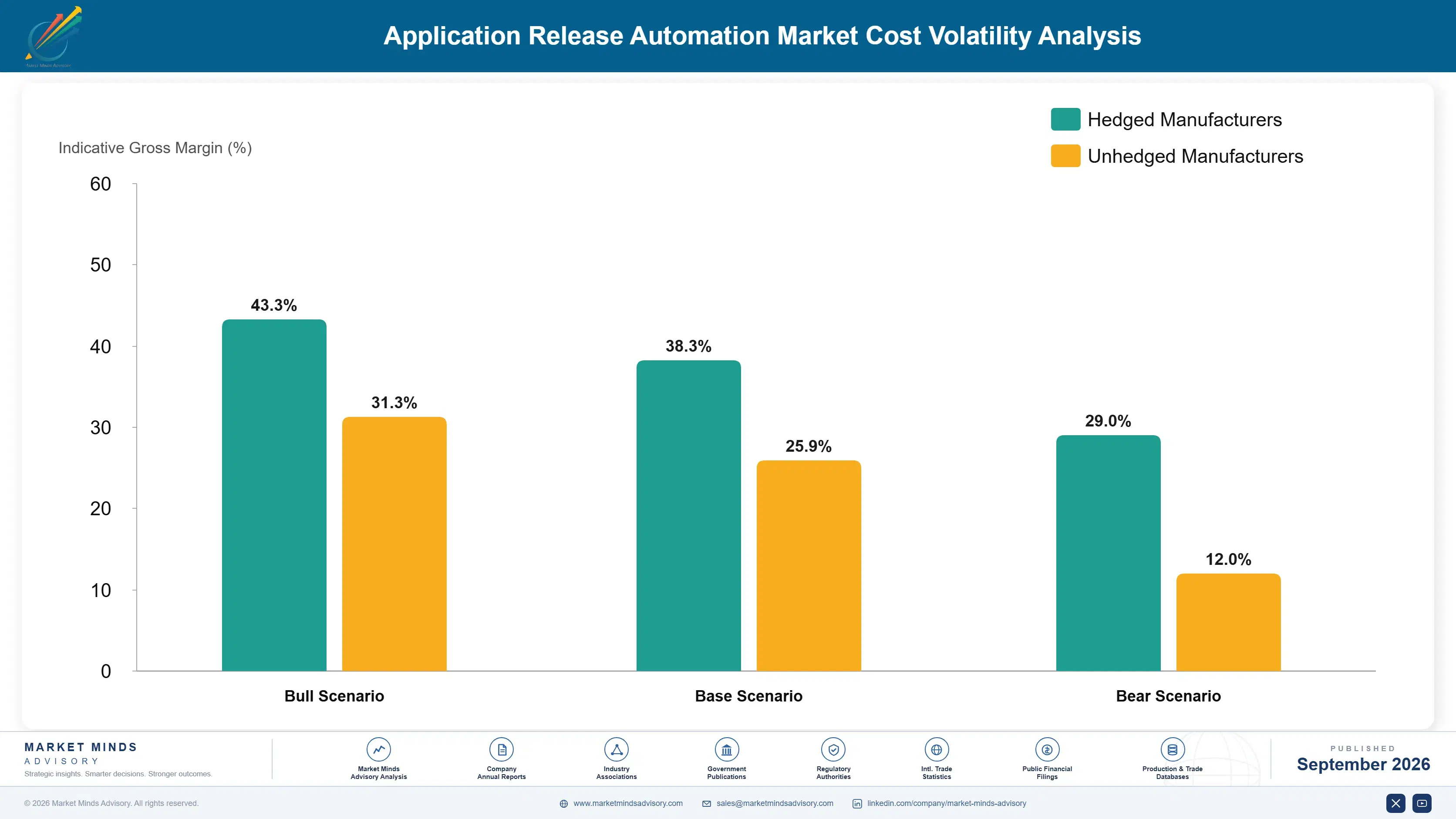
AI Model Training Costs Squeeze Margins

Machine learning model training infrastructure and cloud compute together represent roughly 44 percent of cost of goods sold for release automation vendors offering AI-assisted risk scoring, notably higher than traditional rule-based deployment tools face today. Model training and inference costs alone account for close to 26 percent, scaling with the volume of historical deployment data processed.
Cloud compute pricing for machine learning workloads rose sharply during 2023, following surging enterprise demand for generative AI capability across all software categories simultaneously, as documented in major cloud providers' published pricing update announcements that year. Vendors training risk models on large historical deployment datasets absorbed meaningfully higher compute costs for several quarters before optimizing model architecture and training efficiency to reduce per-customer compute expense.

Smaller vendors lacking scale to negotiate favorable enterprise cloud pricing face a real cost disadvantage against larger competitors like Broadcom and IBM, who can spread model training costs across a broader customer base and negotiate volume discounts unavailable to smaller specialists. This dynamic increasingly pushes smaller vendors toward niche vertical markets where larger competitors see insufficient contract value to compete aggressively on price alone.
application-release-automation-market-cost-volatility-analysis-1789986177252

Shared Model Training Across Customer Base

Vendors are training base risk models on aggregated, anonymized deployment data across their entire customer base rather than training separate models per customer from scratch, meaningfully reducing per-customer training cost while still allowing lightweight fine-tuning on individual customer data for accuracy improvements over time and across multiple renewal cycles, product updates, and quarterly releases.

Model Efficiency Optimization Investment

Vendors are investing in more efficient model architectures that require less compute per risk assessment, reducing cloud hosting costs per customer meaningfully while maintaining prediction accuracy, a technical investment that smaller vendors are adopting more slowly than larger competitors given the significant upfront engineering cost involved in making the transition work reliably at scale.

Multi-Cloud Compute Contract Negotiation

Larger vendors are negotiating compute contracts across multiple different cloud providers simultaneously to secure meaningful volume discounts and avoid single-vendor lock-in, using competitive bids between major providers to keep model training cost growth well below customer contract price escalators each and every renewal cycle and annual budget planning period across the entire global organization.

Portfolio Architecture for Margin Defence

Application release automation spans three commercial tiers: basic pipeline orchestration at the volume end, certified compliance-ready platforms meeting regulated-industry benchmarks in the middle, and AI-assisted risk scoring suites at the premium top, with gross margins expanding meaningfully from the commodity tier through to next-generation platforms that command significantly higher recurring revenue per enterprise account and deployment volume.
Volume-tier pipeline orchestration faces persistent price pressure from enterprises treating basic deployment automation as commoditized infrastructure, while premium AI risk scoring suites increasingly capture disproportionate margin as enterprises pay for approval automation rather than orchestration mechanics alone. Vendors straddling both tiers face internal tension allocating engineering resources between defending existing orchestration accounts and building the next-generation risk analytics capability premium accounts now demand.

High-value margin pools concentrate heavily around AI-assisted risk scoring and compliance automation, where large enterprises pay meaningfully more for measurable reductions in approval cycle time and audit preparation burden. Smaller vendors without risk modeling depth remain confined to lower-margin orchestration work, ceding the fastest-growing and most profitable segment entirely to larger, better-capitalized competitors with deeper machine learning and compliance engineering budgets. This margin gap widens further each year.

Volume / Commodity-Adjacent Tier

Basic pipeline orchestration tools serving smaller teams with minimal compliance capability beyond simple deployment scheduling and basic rollback functionality without any automated risk assessment or audit trail generation whatsoever available today.
Gross Margin: 24-32%

Premium / Certified Tier

Certified compliance-ready platforms meeting regulated-industry benchmarks, offering structured audit trail generation that meaningfully reduces the manual documentation burden regulated enterprises otherwise face during every single production deployment cycle each year.
Gross Margin: 40-48%

Sustainability / Regulatory / Next-Generation Tier

AI-assisted risk scoring suites that proactively evaluate deployment risk and automate approval decisions, commanding the highest per-seat pricing in the category among the largest enterprise customers running frequent deployments daily.
Gross Margin: 54-64%
application-release-automation-market-portfolio-architecture-1789986177757

High-value Sub-segments and Strategic Watch-out

AI-Assisted Deployment Risk Analytics

This segment combines the fastest unit growth in the market with the highest per-seat pricing, as enterprises pay premium rates for risk scoring that eliminates manual change advisory board bottlenecks, making it the clearest priority for vendor R&D investment over the next several years across accounts.
Gross Margin: 58-66%

Cloud-Native Application Release Orchestration

Growing quickly on enterprises consolidating fragmented cloud deployment tools, this segment carries strong margins though slightly below the AI risk scoring leader, as vendors increasingly bundle orchestration with compliance automation to justify premium pricing over standalone tools sold without any integration whatsoever available today reliably.
Gross Margin: 46-54%

Hybrid and Mainframe Release Automation

A large installed-base segment growing at a moderate pace, this hybrid category remains the anchor product most large enterprises purchase first before considering broader cloud-native investment, anchoring overall category volume even as growth increasingly shifts toward cloud-native platforms each and every single passing year consistently.
Gross Margin: 34-42%

Multi-Cloud and Container Release Orchestration

Growth here trails the segment leaders, and vendors risk this segment commoditizing further as basic container orchestration becomes a standard feature bundled into broader platforms rather than sold separately as a distinct standalone product line for most enterprise buyers today, everywhere and quite consistently now.
Gross Margin: 30-38%

Why Release Contracts Compound Over Time

Release automation subscriptions increasingly function as annuity products rather than one-time software purchases, since usage-based deployment fees, compliance module subscriptions, and AI model training partnerships attach to the base platform and recur across an enterprise's typical five to eight year vendor relationship. Vendors capturing this attached recurring revenue build customer lifetime value multiples well above the original subscription price.
Adoption depth varies meaningfully by application type: consumer-facing applications adopt shallowly, deploying orchestration primarily for deployment speed without deep risk analytics integration, while regulated financial and healthcare applications integrate release automation deeply into compliance documentation and approval workflows, creating switching costs that keep those customers within a single vendor's product family across multiple contract renewals, audits, and system-wide compliance reviews.

Buyer profiles are shifting generationally as engineering organizations increasingly include dedicated platform engineering and release management roles that evaluate vendor selection through risk model accuracy and compliance integration criteria rather than pure feature checklist comparisons alone. Younger technology leaders entering these roles expect measurable proof of approval cycle reduction before purchase, favoring vendors who can demonstrate quantified outcomes over long-standing incumbent relationships built on legacy tenure.
application-release-automation-market-end-use-penetration-index-1789986178273

Priorities for Release Automation Vendors

These are among the four positions where our research anticipates prominent divergence between winners and laggards over the coming forecast period. Each is grounded in the demand model, the regulatory perimeter, and the announced capacity pipeline.
01 / AI RISK MODEL CREDIBILITY

Prove Accuracy Before Selling Automation Scale

Enterprises remain genuinely skeptical of allowing automated models to approve production deployments without human review, and that skepticism continues to slow enterprise sales cycles even where risk scoring has demonstrably improved beyond early implementation failures that damaged category trust across the broader industry. Vendors who lead with measured accuracy data and graduated automation rollout during procurement pilots close larger contracts meaningfully faster than those emphasizing automation breadth alone. Demonstrated accuracy, not automation scope, wins enterprise accounts in this category today.
02 / RECURRING REVENUE EXPANSION

Build Usage-Based Pricing Before Competitors Do

Flat per-seat licensing undervalues high-frequency deployment accounts relative to the platform value they actually extract, making usage-based deployment pricing and compliance module subscriptions the more durable profit pools within this category over the coming several years of continued category maturation and vendor consolidation across the broader industry. Vendors that shift pricing models early capture meaningfully higher customer lifetime value and materially better account expansion than those still selling flat subscriptions alone. Waiting cedes the most profitable accounts to faster-moving competitors.
03 / HYBRID INFRASTRUCTURE SUPPORT

Invest in Mainframe Connectors, Not Just Cloud

Large enterprises running critical mainframe applications alongside modern cloud-native systems represent a substantial addressable market that cloud-only vendors cannot serve without significant additional engineering investment in legacy system integration capability built specifically for that particular hybrid infrastructure purpose, workload type, and regulatory compliance environment overall. Vendors offering dedicated mainframe connector modules are winning larger, more complex enterprise accounts than competitors requiring full modernization before adoption can even begin. Hybrid infrastructure support is becoming as commercially valuable as cloud-native capability itself.
04 / COMPLIANCE AUTOMATION INVESTMENT

Build Audit Trail Generation Ahead of Mandates

Regulated industries increasingly require verifiable, automated audit trails documenting every production change, and vendors lacking this capability will increasingly lose deals in financial services and healthcare regardless of their underlying orchestration technology quality or deployment speed advantages already achieved over many years of engineering investment. Vendors with established compliance automation credentials and audit trail generation capability will capture disproportionate share as regulatory scrutiny intensifies over the coming several years across these regulated markets. Compliance fluency is becoming a genuine competitive moat.

Engagement Snapshot From the Field

A live engagement with an industry participant carrying material or product regulatory and market exposure ahead of a defining policy shift, showing how our research translates into a defensible multi-year portfolio strategy.
MARKET MINDS ADVISORY · CLIENT ENGAGEMENT SUMMARY
Application Release Automation Producer Strategic Portfolio Review and Transition Roadmap 2026·Investment Scenario on Application Release Automation Exposure Evaluation 2025-26
CLIENT PROFILE
The client is a mid-size financial services firm managing roughly 180 production applications, with deployment approvals routed through a manual change advisory board that had become an acknowledged bottleneck limiting release frequency. Annual engineering time spent on manual deployment coordination and approval documentation exceeded $3.8 million (client-reported, unverified by MMA), a substantial share of total engineering capacity.
STRATEGIC CHALLENGE
The firm's manual change advisory board process could not scale with growing deployment frequency as engineering teams adopted continuous delivery practices, creating a widening gap between development velocity and release approval capacity. Leadership needed a migration strategy toward AI-assisted risk scoring that would satisfy strict financial services regulatory audit requirements without sacrificing the compliance rigor the manual process had previously provided.
MMA APPROACH
MMA benchmarked the firm's historical deployment and incident data against three AI-assisted release automation platforms, modeling expected approval time reduction and compliance documentation quality under each option. The engagement combined regulatory compliance review specific to financial services requirements with direct technical evaluation of risk model accuracy using the firm's own historical deployment outcomes as validation data.
KEY FINDINGS
  1. The manual change advisory board process consumed a disproportionate share of senior engineering time relative to the actual risk reduction it provided across most routine deployments.
  2. AI-assisted risk models trained on the firm's own historical deployment data demonstrated meaningfully higher accuracy than generic pre-trained models tested during evaluation.
  3. Regulated deployments requiring extensive manual documentation showed the largest projected time savings once automated audit trail generation fully replaced manual record-keeping entirely.
  4. The selected platform's graduated automation approach, starting with low-risk changes, addressed engineering team skepticism more effectively than platforms offering full automation immediately.
CLIENT PROFILE
The client is a mid-size financial services firm managing roughly 180 production applications, with deployment approvals routed through a manual change advisory board that had become an acknowledged bottleneck limiting release frequency. Annual engineering time spent on manual deployment coordination and approval documentation exceeded $3.8 million (client-reported, unverified by MMA), a substantial share of total engineering capacity.
STRATEGIC CHALLENGE
The firm's manual change advisory board process could not scale with growing deployment frequency as engineering teams adopted continuous delivery practices, creating a widening gap between development velocity and release approval capacity. Leadership needed a migration strategy toward AI-assisted risk scoring that would satisfy strict financial services regulatory audit requirements without sacrificing the compliance rigor the manual process had previously provided.
MMA APPROACH
MMA benchmarked the firm's historical deployment and incident data against three AI-assisted release automation platforms, modeling expected approval time reduction and compliance documentation quality under each option. The engagement combined regulatory compliance review specific to financial services requirements with direct technical evaluation of risk model accuracy using the firm's own historical deployment outcomes as validation data.
KEY FINDINGS
  1. The manual change advisory board process consumed a disproportionate share of senior engineering time relative to the actual risk reduction it provided across most routine deployments.
  2. AI-assisted risk models trained on the firm's own historical deployment data demonstrated meaningfully higher accuracy than generic pre-trained models tested during evaluation.
  3. Regulated deployments requiring extensive manual documentation showed the largest projected time savings once automated audit trail generation fully replaced manual record-keeping entirely.
  4. The selected platform's graduated automation approach, starting with low-risk changes, addressed engineering team skepticism more effectively than platforms offering full automation immediately.
RECOMMENDED STRATEGY
Phase 1: Phase 1 (Months 1-3): Deploy automated risk scoring for low-risk changes only, building engineering team trust gradually over the initial period. Phase 2: Phase 2 (Months 4-8): Expand automation coverage to moderate-risk changes as model accuracy is validated against real production deployment outcomes. Phase 3: Phase 3 (Months 9-12): Extend full automation to high-risk changes and fully retire the legacy manual change advisory board entirely.
OUTCOME
Within twelve months of completing the phased migration, the firm reported deployment approval time declining by roughly 58 percent (client-reported, unverified by MMA), alongside annual engineering time savings of approximately $2.1 million (client-reported, unverified by MMA) in recovered operating capacity, staff productivity, and overall team morale.

Frequently Asked Questions

Foundational context covering the market sizes, CAGR, scope, country, region and competition that inform every finding below. This section is provided to cover basics and most often pre-purchase conversations, answered from the MMA Primary Research Dataset.

What is the current size of the Application Release Automation Market?

The application release automation market was valued at $2.9 billion in 2025. It is projected to reach $3.23 billion in 2026 as AI-assisted risk scoring accelerates adoption.

How large will the Application Release Automation Market be by 2036?

The market is projected to reach $9.59 billion by 2036, up from $3.23 billion in 2026. That represents a 2.97 times expansion over the forecast decade.

What is the CAGR for the Application Release Automation Market 2026 to 2036?

The market is projected to grow at an 11.5 percent CAGR between 2026 and 2036. This is up from a historical CAGR of roughly 10.5 percent between 2020 and 2025.

Which segment is growing fastest?

AI-assisted deployment risk analytics leads growth at a 16.0 percent CAGR, roughly 1.39 times the overall market rate. Enterprises finally have a credible alternative to manual change advisory board review.

Who are the major companies in the Application Release Automation Market?

Broadcom, IBM, Digital.ai, Flexagon, and Octopus Deploy are the five largest participants by licensed-seat basis. Together they hold an estimated 38 percent of the global market.

Which country is growing fastest?

India is the fastest-growing country at a 14.5 percent CAGR, driven by the country's massive IT services and software delivery sector. Rapid enterprise digital transformation reinforces this trajectory further.

Report Segmentation Architecture

The full report scope spans multiple orthogonal segmentation dimensions, with cross-tabulated demand data provided for each dimension pair. Coverage extends further to regional breakdowns, trend trajectories, and the competitive detail needed to support segment-level decision-making.

By Deployment Target Function

  • AI-Assisted Deployment Risk Analytics
  • Cloud-Native Application Release Orchestration
  • Hybrid and Mainframe Release Automation
  • Multi-Cloud and Container Release Orchestration
  • Compliance and Audit Trail Software
  • Rollback and Incident Response Automation

By End-Use Industry

  • Financial Services and Insurance
  • Technology and Software
  • Healthcare and Life Sciences
  • Retail and E-Commerce
  • Government and Public Sector

By Commercial Dimension

  • Enterprise Direct Licensing
  • Usage-Based Deployment Pricing
  • Managed Migration Services
  • System Integrator Channel Distribution

By Region

  • North America
  • Western Europe
  • East Asia
  • South Asia and Pacific
  • Latin America
  • Middle East and Africa
  • Eastern Europe

Scope, Methodology, and Coverage

Every figure in this report is reproducible from documented input assumptions. The scope below maps the historical period, the forecast horizon, the segmentation dimensions, and the countries covered, alongside the underlying primary and qualitative methodology.
Historical Period
2020 to 2025
Forecast Period
2026 to 2036
Base Year
2025 (USD billions; MMA Primary Research Dataset, September 2026)
Market Definition
The application release automation market covers software that orchestrates and automates deployment of applications across development, testing, staging, and production environments, managing approvals, rollback, and compliance for enterprise software delivery. It excludes standalone continuous integration build tools without release orchestration capability.
Quantitative Units
USD billions (current prices); licensed seat count where applicable
Segmentation Dimensions
By Deployment Target Function; By End-Use Industry; By Commercial Dimension; By Region
Regions Covered
North America, Western Europe, East Asia, South Asia and Pacific, Latin America, Middle East and Africa, Eastern Europe
Countries Covered
USA, China, Germany, France, UK, Japan, South Korea, India, Australia, Canada, Brazil, Mexico, Indonesia, Vietnam, Thailand, Malaysia, UAE, Saudi Arabia, South Africa, Nigeria, Turkey, Poland, Netherlands, Italy, Spain, Sweden, Switzerland, Argentina, Colombia, Singapore, and additional markets relevant to this sector
Key Companies Profiled
Broadcom, IBM, Digital.ai, Flexagon, Octopus Deploy, GitLab, Atlassian, CloudBees, Harness Inc, Armory, JFrog, Puppet, Progress Software, HashiCorp, ServiceNow, OpenText, BMC Software, ConnectALL, Plutora, Copado
Quantitative Methodology
Primary survey, n=3,800 respondents, Q4 2025, six countries; demand-side model with trade association cross-validation
Qualitative Methodology
47 expert interviews, Q4 2025; applied to validate demand model assumptions, identify emerging dynamics, and assess competitive positioning
Report Format
PDF and XLSX data workbook (Word format preview document)
Publisher
Market Minds Advisory
Report Code
MMA-2026-TEC-189
Published
September 2026
Contact
sales@marketmindsadvisory.com | www.marketmindsadvisory.com

Purchase the full Application Release Automation Market Report (2026 to 2036).

This report delivers a comprehensive analysis of the global application release automation market, spanning deployment function segmentation, regional demand dynamics, and competitive positioning across twenty profiled companies worldwide. It includes ten-year forecasts through 2036, detailed input cost and margin analysis across three commercial tiers, and revenue diversification strategies for vendors navigating the shift toward AI-assisted risk scoring. The analysis draws on primary survey data, expert interviews, and company disclosures to support procurement, investment, and product strategy decisions. It closes with an anonymized client migration case study illustrating measured approval and productivity outcomes.
Deployment target function segmentation with growth forecasts
Seven-region demand analysis through the 2036 forecast
Competitive benchmarking of twenty profiled global vendors
Input cost and gross margin tier breakdown analysis
Revenue diversification and recurring pricing lever analysis
Anonymized client migration case study with outcomes

Built For The People Who Decide

From boardroom strategy to bench-side execution, this report is read cover-to-cover by leaders shaping the next decade of their industry, turning demand scenarios, market dynamics and valuation benchmarks into decisions.
CXOs/ Presidents/ VPs/ Managers
M&A and Corporate Development
Strategy Teams and R&D Heads
Procurement and Product Directors
Regulatory and Compliance Leaders
Investor Relations and Equity Analysts