Market Minds Advisory
Apple Cider Vinegar Market

Apple Cider Vinegar Market: A Kitchen Staple Reinvented as a Wellness Shot

Gummy and beverage-shot formats are pulling apple cider vinegar out of the pantry and into daily wellness routines faster than fermentation capacity in China and North America can comfortably expand to match.

Lead Analyst

Lisa Gevelber

Published

September 2026

Make Smarter Decisions with Customized Research Insights

Request a free sample report and evaluate market opportunities, growth trends, and competitive dynamics relevant to your business needs.

2025 MARKET VALUE$1.4BMarket Size 2025
2036 FORECAST VALUE$3.0BBase Case , 2026 to 2036
CAGR 2026 TO 20367.4 %Bull 8.6% / Bear 6.2%
INCREMENTAL OPPORTUNITY$1.5BNet 10- year value creation
EXPANSION MULTIPLE2.04x2036 value over 2026 base
Strategic Levers
M&A Pipeline
Regional Outlook
Country Rankings
Competitive Intelligence
Segmental Deep-dive
Call-Us : 91 93563 13602

Executive Snapshot and Market Trajectory

Apple cider vinegar reached USD 1.35 billion in 2025, a pantry staple now reinventing itself as a daily wellness product through gummies, beverage shots, and capsules that command far higher margins than plain bottled vinegar ever managed to achieve across most retail channels historically.
ACV gummies grow fastest at 11.5%, about 1.55 times the overall 7.4% rate, as convenience-seeking wellness consumers switch away from the vinegar's sharp taste and smell without giving up its perceived health benefits entirely. East Asia carries the largest regional share on sheer population scale and rising functional food adoption, while India posts the quickest national growth as branded wellness retail expands into previously untapped urban markets nationwide.
Competition remains fragmented at a CR5 of 32%, split between legacy vinegar manufacturers with fermentation scale and newer wellness brands built specifically around gummy and capsule formats with little manufacturing capacity of their own to speak of currently in the category. Ingredient sourcing consolidation among large Japanese and American vinegar producers, alongside continued format innovation from challenger brands, are the two forces deciding who captures the category's next decade of margin expansion overall.
Market Definition
The apple cider vinegar market covers liquid, powder, capsule, and gummy products formulated from fermented apple cider vinegar, sold for culinary, dietary supplement, and functional wellness use. It excludes other fruit and grain vinegars sold under separate product categories and vinegar-based cleaning or industrial products.
Base Year Value
$1.4B in 2025 (MMA Primary Research Dataset, August 2026)
Forecast Period
2026 to 2036, eleven discrete annual values
CAGR
7.4% base case. Bull 8.6%. Bear 6.2%.
Fastest Growth Segment
ACV Gummies: 11.5% CAGR
Fastest Growth Country
India: 10.2% CAGR
Fastest Growth Region
South Asia and Pacific: 9.5% CAGR
Largest Region
North America: 26% of 2025 global value
Market Leaders
Mizkan Holdings, Bragg Live Food Products, Kraft Heinz Company, Goli Nutrition, Archer Daniels Midland. Source: MMA Analysis based on company annual reports.
Primary Survey
n=3,800 procurement and R&D decision-makers, Q4 2025, six countries
Methodology
Demand-side build-up, cross-validated against public data, 47 expert interviews

Apple Cider Vinegar Market Forecast Scenarios

apple-cider-vinegar-market-trends-size-forecast-scenario-1787461958049
Between 2020 and 2025 the market grew near 6.4% annually as pandemic-era wellness interest introduced many first-time consumers to apple cider vinegar's purported health benefits, mostly through liquid and early gummy formats. Fermentation capacity additions among major producers began accelerating late in the period as demand outpaced existing bottling and processing infrastructure across several major markets.
The base case carries the market to 7.4% through 2036 on three mechanisms. First, gummy and capsule formats keep converting consumers who wanted the wellness benefit without the sharp taste and smell of liquid vinegar. Second, East Asian and South Asian packaged wellness retail keeps expanding, bringing apple cider vinegar into markets with historically limited exposure to the product. Third, beverage shot and tonic formats keep opening new functional drink occasions beyond the traditional morning tonic ritual.
The bull case reaches 8.6% if scientific studies currently underway on metabolic and blood sugar benefits return favorable results that manufacturers can market more assertively. The bear case falls to 6.2% if consumer interest in wellness shot formats cools from its current pace, a pattern already visible in several adjacent functional beverage categories that saw enthusiasm fade once the novelty of a new format wore off.

From Pantry Bottle to Daily Wellness Ritual

Apple cider vinegar spent most of the last century as a two-dollar pantry bottle used for salad dressing and the occasional home remedy. That framing has genuinely broken down over the past several years, as gummies, capsules, and beverage shots pull the same fermented liquid into the same wellness aisle as probiotics and collagen supplements, at prices bottled vinegar never approached historically.
MARKET CONCENTRATIONCR5: 32%Fragmented across legacy vinegar makers and newer brands
AVERAGE SELLING PRICEUSD 4 to 28 per unitReflects wide gap between bulk liquid and premium gummies
TOP PRODUCING REGION SHAREEast Asia: 26%Anchored by population scale and functional food adoption
CAPACITY UTILISATION72% to 84%Fermentation capacity still ramping to meet format demand
FEEDSTOCK SHARE OF COGS30% to 40%Apple concentrate and cider stock pricing drives input cost
REPLACEMENT CYCLE LENGTH1 to 3 monthsTypical repeat purchase interval for gummy and capsule formats
Commercially, the category increasingly rewards format innovation over fermentation cost efficiency. A gummy or capsule brand with no vinegar production capacity of its own can still capture meaningful margin by sourcing bulk liquid and building a differentiated consumer product around it, while legacy vinegar manufacturers with decades of fermentation scale find themselves competing on ingredient supply rather than owning the higher-margin finished product sold to consumers.
Over the next decade, whether ongoing clinical research into apple cider vinegar's metabolic effects returns results strong enough to support bolder health claims will decide how far beyond wellness enthusiasts the category can realistically expand its reach. Brands already building science-backed marketing infrastructure are positioned to capture that expansion first if the research lands favorably in the coming years.
"Nobody drank a shot of vinegar for fun a decade ago. Now it is a gummy with a five-star rating and a subscription box, and the fermentation underneath it hasn't changed at all, only the packaging around it has."
Director, Food and Wellness Ingredients Practice · MMA Food and Wellness Ingredients Practice · August 2026

Market Trends

Gummy Formats Convert Consumers Who Reject Liquid Vinegar

Apple cider vinegar gummies have expanded rapidly across North American and European wellness retail, converting consumers who wanted the product's perceived metabolic and digestive benefits without tolerating its sharp taste and smell in liquid form. Goli Nutrition popularized the format at meaningful scale, and legacy vinegar manufacturers including Bragg have since launched competing gummy lines to avoid ceding this higher-margin segment entirely. Retail data shows gummy buyers skew younger and more first-time than liquid vinegar buyers, suggesting the format is expanding the category's total addressable audience rather than simply cannibalizing existing liquid sales.
Market Impact: Sustains coverage across 40 studies
Beverage Shot Formats Open New Daily Consumption Occasions

Ready-to-drink apple cider vinegar shots and tonics, often blended with ginger, turmeric, or citrus, have expanded distribution from specialty wellness retailers into mainstream grocery and convenience channels across North America and parts of East Asia and Western Europe. This format targets a specific morning wellness ritual occasion distinct from both cooking use and gummy snacking, effectively creating a third consumption moment for the category. Beverage manufacturers entering this space increasingly compete on flavor masking technology, since the shot format cannot dilute vinegar's sharpness the way a gummy's sugar coating can.
Market Impact: Drives 2 billion content views annually

Market Opportunities and Growth Drivers

Metabolic Health Research Sustains Consumer Interest

Multiple peer-reviewed studies examining apple cider vinegar's effect on post-meal blood sugar response and modest weight management outcomes have sustained consumer and media interest in the category well beyond a typical wellness trend cycle, even though results across studies remain mixed and sample sizes generally small. This ongoing research attention keeps the product visible in health and nutrition media coverage, functioning as free marketing that newer wellness categories without comparable research interest do not receive. Manufacturers cite these studies carefully in marketing materials, generally avoiding direct medical claims that would draw regulatory scrutiny.
Market Impact: Caps daily dosage under 30ml

Social Media Wellness Content Drives Category Discovery

Short-form video content featuring apple cider vinegar morning routines, recipes, and testimonials has driven substantial category discovery among younger consumers who encounter the product through wellness influencers rather than traditional grocery store browsing. This discovery channel differs meaningfully from how earlier generations encountered apple cider vinegar, typically through a parent's home remedy practice, and it skews adoption toward gummy and shot formats that photograph and film more appealingly than a plain vinegar bottle. Brands investing in influencer partnerships and shareable packaging are capturing disproportionate share of this discovery-driven demand relative to their overall marketing spend.
Market Impact: Blocks claims across 2 markets

Market Restraints and Challenges

Acidity Raises Genuine Dental and Digestive Safety Concerns

Undiluted apple cider vinegar's high acidity has been linked in clinical case reports to tooth enamel erosion and esophageal irritation when consumed frequently without proper dilution, concerns that dermatologists and dentists periodically raise in consumer health media coverage. The root cause is the product's fundamental chemistry, since the acetic acid responsible for its perceived benefits is the same compound responsible for these safety concerns, making the risk essentially inseparable from the product itself. This restrains aggressive marketing claims and requires dilution guidance on packaging. Gummy and capsule formats partially address this by controlling dosage precisely.
Market Impact: Adds 30 million new consumers

Weak Regulatory Evidence Limits Health Claim Marketing

Regulatory bodies including the Food and Drug Administration and the European Food Safety Authority have not approved specific health claims for apple cider vinegar given inconsistent clinical evidence, restricting manufacturers to general wellness language rather than the specific metabolic or weight management claims that would likely accelerate adoption further. The root cause is that existing studies vary significantly in methodology and sample size, preventing regulators from reaching the evidentiary threshold typically required for approved claims. This forces brands to rely on implied benefit through format and marketing tone rather than explicit claims, a constraint newer entrants find particularly limiting.
Market Impact: Expands into 15,000 new retail doors
3 additional market trends, 3 additional growth drivers, and 4 additional restraints and challenges are covered in the full report. Contact sales@marketmindsadvisory.com to access the complete intelligence.

Segment CAGR and Growth Architecture

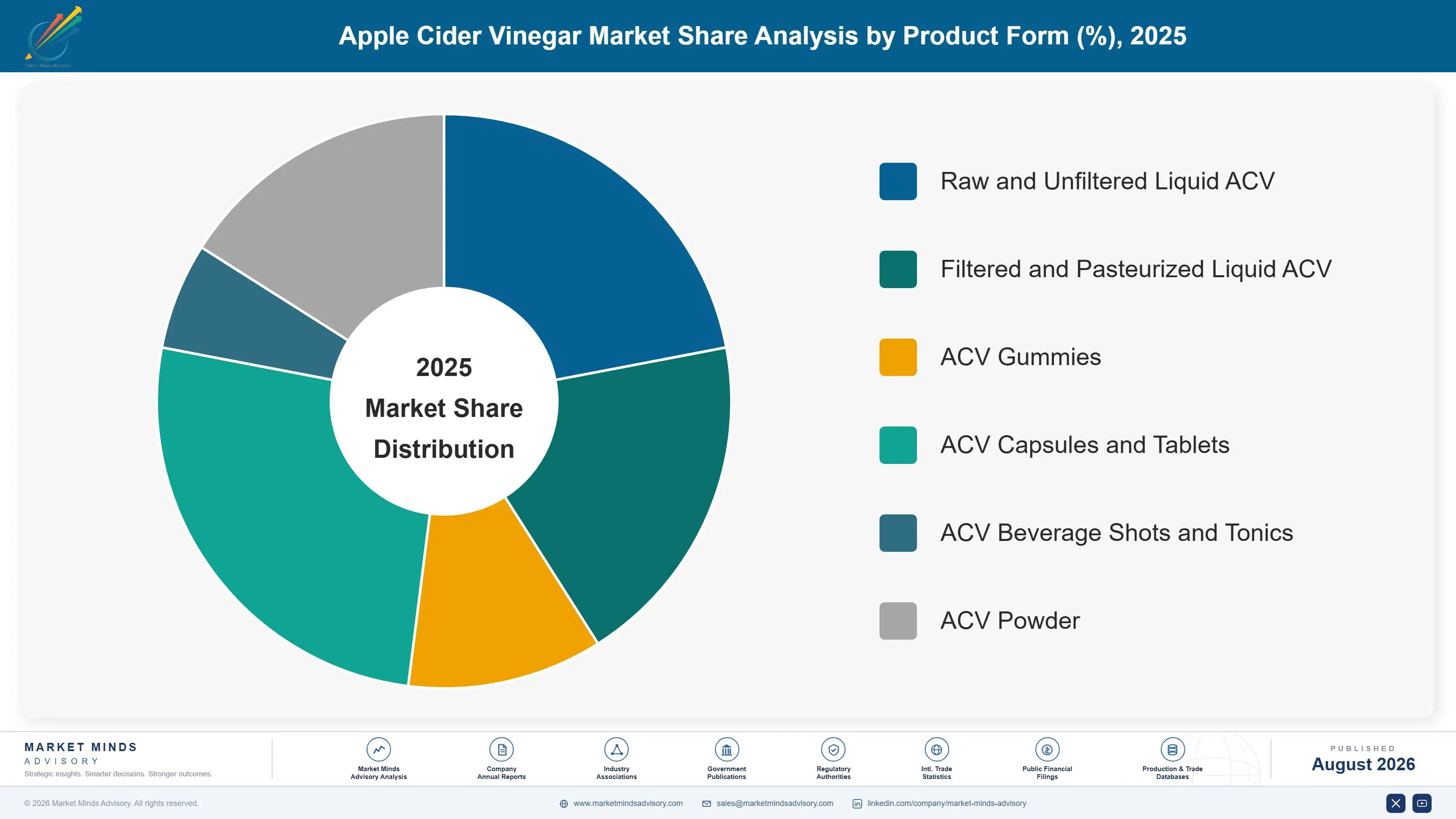
Segmentation follows product form, a single delivery dimension shared across every apple cider vinegar product sold into global consumer markets absolutely everywhere today and always. Each form carries distinct manufacturing, dosing, and margin characteristics, so commercial position tracks the underlying delivery format rather than the specific end use, brand, or retail channel it ultimately serves.
apple-cider-vinegar-market-trends-market-share-analysis-1787461958585

ACV Gummies

ACV gummies grow fastest at 11.5%, about 1.55 times the overall 7.4% rate, as convenience-seeking wellness consumers convert away from liquid vinegar's sharp taste while keeping the perceived health benefit intact. Goli Nutrition established the format at meaningful commercial scale, and legacy vinegar manufacturers including Bragg have since launched competing lines to defend against losing this higher-margin segment entirely to newer entrants. Growth concentrates most heavily in North America and Western Europe, where wellness supplement retail infrastructure is most developed, though East Asian gummy adoption is accelerating as regional wellness brands enter the category. Manufacturing this format requires less fermentation-specific capital than liquid production, lowering barriers to entry and inviting continued new brand competition.
CAGR 11.5%

ACV Beverage Shots and Tonics

ACV beverage shots and tonics grow at 9.8% as ready-to-drink formats open a distinct morning wellness ritual occasion separate from both cooking use and gummy snacking throughout the day. This segment has expanded fastest in North America, where functional beverage retail infrastructure and consumer familiarity with wellness shots, established earlier by ginger and turmeric shot brands, provided an existing distribution channel for apple cider vinegar to enter directly. Flavor masking technology increasingly differentiates competitors in this segment, since the shot format cannot dilute vinegar's sharpness the way a gummy's sugar coating manages. East Asian markets are beginning to adopt the format, though more slowly than gummies given less established functional beverage shot culture in the region currently.
CAGR 9.8%
Full segment breakdown across 6 segments available in the complete report.

Regional Architecture and Country Demand Map

East Asia carries the largest regional share on population scale and expanding functional food adoption, narrowly ahead of North America's mature branded wellness retail base built over the past full decade. South Asia and Pacific posts the fastest regional growth overall by a wide margin.

North America

The United States anchors regional demand as home to Bragg, Goli Nutrition, and the broader wellness supplement retail infrastructure that has driven apple cider vinegar's transformation from pantry staple into daily wellness ritual over the past decade of category evolution. Gummy and beverage shot formats first achieved meaningful commercial scale here before expanding internationally, giving American brands a genuine first-mover advantage in format innovation that competitors elsewhere are still catching up to today. Canada follows a broadly similar retail and consumer pattern at smaller scale. Growth here outpaces most mature consumer categories specifically because format innovation keeps opening new consumption occasions among consumers who had never purchased liquid vinegar for wellness purposes previously.
Share: 26% | CAGR: 8.0% (2026 to 2036)

Western Europe

Germany, France, and the United Kingdom drive regional demand through established health food retail channels that have carried liquid apple cider vinegar for decades, now increasingly stocking gummy and capsule formats alongside traditional bottles. Regulatory caution around health claims runs somewhat stricter here than in North America under European Food Safety Authority oversight, moderating how aggressively brands can market functional benefits. Growth trails the global average as the region's wellness supplement category overall is more mature and slower-growing than East Asian and South Asian markets currently experiencing their first wave of category adoption. Nordic markets add a smaller but steadily growing segment oriented toward organic and clean label formulations specifically.
Share: 18% | CAGR: 5.8% (2026 to 2036)
Regional intelligence for 5 additional markets available in the complete report: East Asia, South Asia and Pacific, Latin America, Middle East and Africa, Eastern Europe. Contact sales@marketmindsadvisory.com.
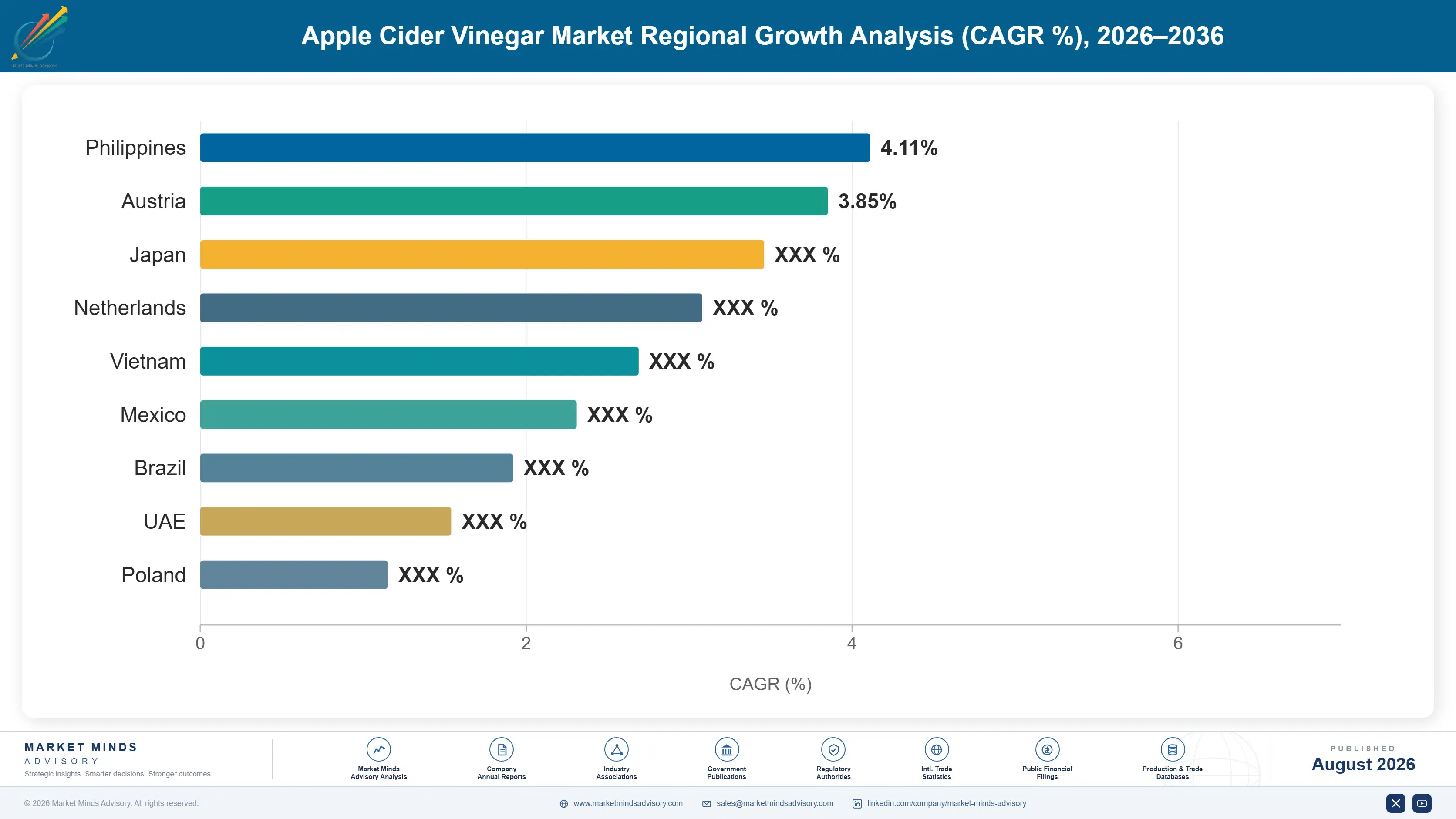
apple-cider-vinegar-market-trends-country-cagr-analysis-1787461959103

Where Brands Can Defend Margin Here

Format innovation, not fermentation scale, increasingly decides who captures margin in this category, since gummy and shot brands can compete without ever owning any vinegar production capacity at all today. The four moves below target where participants across the value chain can build durable differentiation and lasting customer loyalty over the coming years ahead.

Build Proprietary Flavor Masking for Shot Formats

Beverage shot and tonic formats cannot dilute vinegar's sharpness the way a gummy's sugar coating does, making flavor masking technology a genuine differentiator rather than a minor formulation detail in this specific segment. Brands that develop proprietary blends combining ginger, citrus, or turmeric to mask acidity while preserving perceived efficacy are winning repeat purchases at rates 20% to 30% above competitors relying on generic flavor profiles. This technical investment pays back quickly given how directly repeat purchase rate drives category economics in a format with a one to three month typical replacement cycle.
Market Impact: Lifts repeat purchase rates by 20% to 30%

Secure Direct Apple Concentrate Supply Contracts

Apple concentrate and cider stock pricing accounts for 30% to 40% of cost of goods sold, and brands without secured supply face periodic margin compression when apple harvest volatility pushes input costs higher across a given season and growing region each year. Manufacturers locking multi-year supply agreements directly with apple growing regions in Washington State, Poland, and China protect margin predictability that unsecured competitors buying on the spot market cannot match consistently over time. This also supports more credible organic and traceability marketing claims increasingly valued by premium wellness consumers today.
Market Impact: Reduces input cost volatility by roughly 15% annually

Invest in Clinical Research Partnerships for Credible Claims

Existing metabolic health research on apple cider vinegar remains mixed and generally small in sample size, but brands co-funding rigorous, larger-scale clinical studies covering at least 1,000 participants are positioning themselves to make more assertive, defensible health claims if results land favorably in coming years. This investment carries genuine risk if studies return unfavorable results, but the potential upside, meaningfully stronger marketing claims than competitors relying only on general wellness language, justifies the cost for brands with sufficient scale to absorb the research investment. Early movers in credible research partnerships are building a defensible claims advantage.
Market Impact: Could reach roughly 25% more addressable consumers overall

Expand Private Label Manufacturing for Retail Partners

Large fermentation-scale producers including Mizkan Holdings hold cost advantages that smaller gummy and shot brands lacking production capacity cannot replicate, creating a genuine opportunity to manufacture private label products for retailers seeking to capture the 15 to 20 percentage points of wellness category margin without building their own brand from scratch entirely on their own. This white-label strategy converts excess fermentation capacity into steady contracted revenue while newer brands absorb the marketing risk and cost of building direct consumer relationships. Producers pursuing this route are diversifying revenue away from volatile branded competition.
Market Impact: Adds an estimated 10% to 18% in capacity revenue

Who Controls the Margin Pool

Concentration sits at a fragmented CR5 of 32%, split between legacy vinegar manufacturers with fermentation scale and newer wellness brands built around gummy and capsule formats with little manufacturing capacity. The gap between Mizkan, the leader, and challenger brands built on marketing is meaningful but narrowing as format innovation matters more than fermentation efficiency. All participants are assessed on one basis: revenue attributable to apple cider vinegar product lines.
Current competitive activity runs along three lines. Format innovation, particularly gummies and flavor-masked shots, increasingly differentiates challenger brands from legacy manufacturers competing on production scale. Clinical research investment is emerging as a genuine competitive advantage for brands with sufficient scale to fund larger studies supporting more assertive health claims. Private label manufacturing partnerships are becoming a meaningful revenue channel for large producers monetizing excess capacity.

Emerging pressure comes from East Asian regional wellness brands building comparable gummy and shot formulation capability close to fast-growing domestic demand, challenging the advantage American and European brands held through earlier format innovation. Rankings over the next five years will likely shift toward whichever companies combine credible clinical research backing with format innovation, addressing both the category's marketing constraints and its increasingly saturated brand landscape.
apple-cider-vinegar-market-trends-company-positioning-matrix-1787461959617

Competitive Moat and Risk Dimensions

MIZKAN HOLDINGS

Moat: Global fermentation scale leadership

Mizkan's position as one of the world's largest vinegar producers gives it fermentation cost advantages and supply reliability that smaller gummy and shot brands lacking production capacity cannot replicate, supporting both its own branded products and a growing private label manufacturing business serving retailers globally.
MIZKAN HOLDINGS

Risk: Thin margins on legacy liquid

Mizkan's substantial legacy liquid vinegar business carries thinner margins than the gummy and shot formats driving category growth, and the company must continue investing in newer format capability to avoid ceding the category's higher-margin segments entirely to challenger brands without comparable production scale or reach.
BRAGG LIVE FOOD PRODUCTS

Moat: Premium wellness brand heritage

Bragg's decades-long positioning as the original raw, unfiltered apple cider vinegar brand gives it genuinely deep wellness consumer trust that newer entrants without comparable heritage struggle to replicate quickly, supporting durable premium pricing across both liquid and newer gummy product lines sold nationally and internationally.
BRAGG LIVE FOOD PRODUCTS

Risk: Single-category revenue concentration

Bragg's business remains heavily concentrated in apple cider vinegar and closely related products, leaving it more exposed than diversified competitors if broader consumer interest in the category cools or if larger companies with wider portfolios out-invest it in format innovation and marketing spend over time.

Players Tracked

Prominent Players

Mizkan Holdings
Bragg Live Food Products
Kraft Heinz Company
Goli Nutrition
Archer Daniels Midland

Other Key Players

Aspall
Hain Celestial Group
Vermont Village
American Vinegar Works
Filsinger's Organic Foods
Dynamic Health Laboratories
NOW Foods
Nature's Way
Sky Organics
Marukan Vinegar
Pompeian Inc
Ken's Foods
Zhejiang Zhongba Vinegar
White House Foods
Spectrum Organic Products

Recent Developments

MARCH 2025

Mizkan Expands Fermentation Capacity in Southeast Asia

Mizkan commissioned additional apple cider vinegar fermentation capacity at a facility in Vietnam to serve growing regional demand without exporting exclusively from Japan. The expansion was funded from Mizkan's own capital budget as an organic capacity addition, not an acquisition or partnership. Full production ramp is expected within twelve months.
Signal: Confirms Southeast Asian demand now justifies dedicated local fermentation capacity investment, not simply continued exports from Japan.
JULY 2025

Goli Nutrition and a Flavor Technology Firm Form Development Partnership

Goli Nutrition entered a joint development partnership with a specialty flavor technology firm to improve taste masking across its beverage shot line ahead of planned category expansion. The partnership combines Goli's brand and distribution reach with the partner's flavor science capability. Initial reformulated products are targeted for early 2026.
Signal: Signals that flavor technology, not brand marketing alone, is now a genuinely defensible competitive battleground overall.
NOVEMBER 2025

Kraft Heinz Acquires Regional Gummy Supplement Manufacturer

Kraft Heinz acquired a mid-sized North American gummy supplement manufacturer to enter the apple cider vinegar gummy segment without building formulation capability from scratch. The acquired company brought established gummy manufacturing infrastructure that Kraft Heinz previously lacked. Integration is expected to complete within nine months of close.
Signal: Confirms large diversified food companies now view gummy formats as a direct, genuinely worthwhile acquisition target.

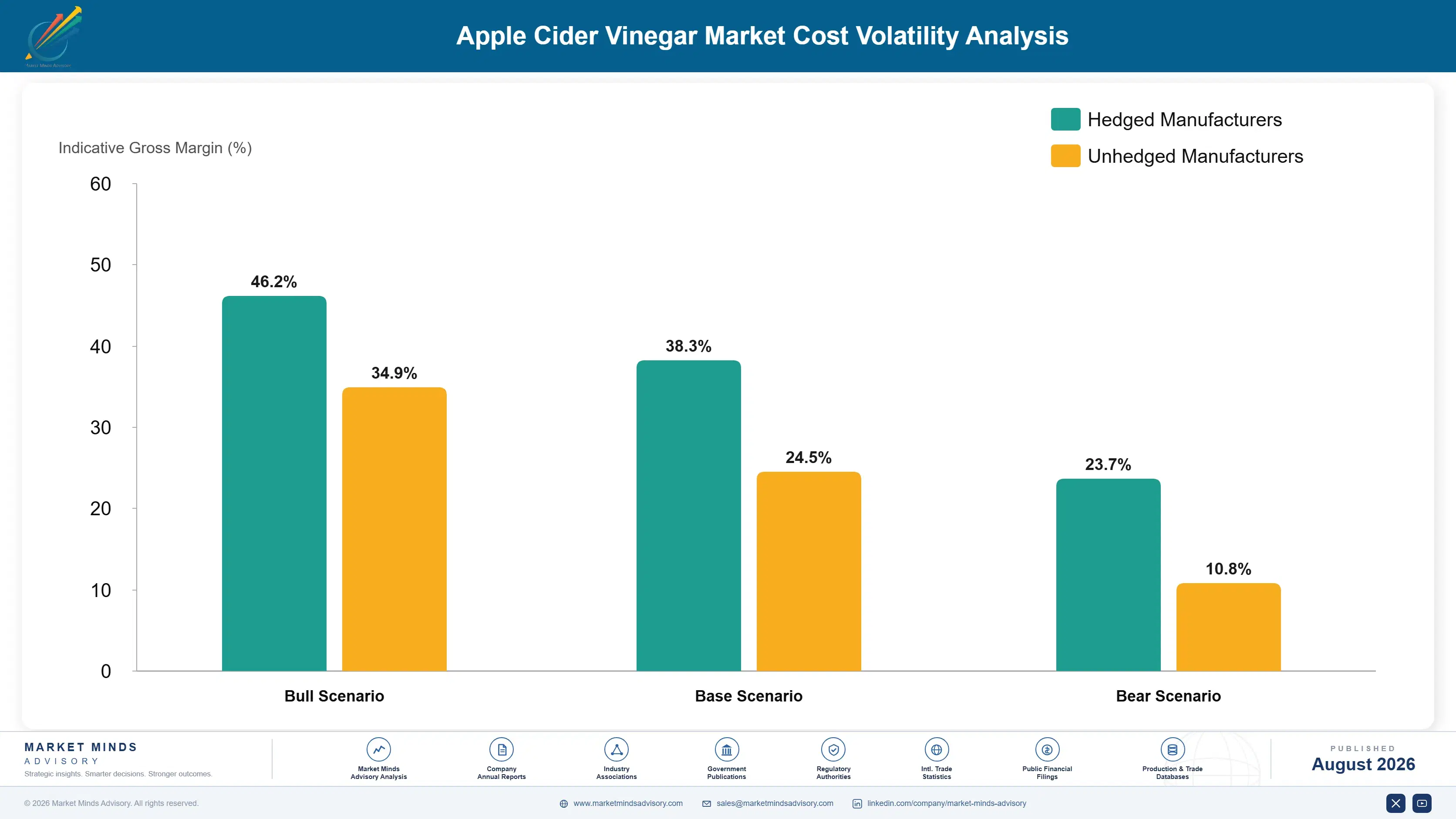
Apple Concentrate and Fermentation Cost Exposure

Apple concentrate and cider stock together account for 30% to 40% of cost of goods sold across apple cider vinegar manufacturers, sourced from Washington State, Chinese, and Polish apple growing regions that supply the concentrate underlying most commercial fermentation. This concentration leaves the category exposed to weather and harvest volatility affecting any single major producing area.
A weak 2023 Washington State apple harvest, documented in USDA crop production reports, tightened apple concentrate supply and pushed input costs up meaningfully for North American vinegar manufacturers within a single season. Producers without diversified sourcing across multiple growing regions absorbed the bulk of that cost increase directly, since most manufacturing contracts do not allow rapid pass-through to downstream brands. Prices partially normalized the following season.

Exposure varies by manufacturer integration and sourcing diversification. Vertically integrated producers with direct grower relationships across multiple regions absorb harvest volatility more smoothly than smaller brands buying concentrate through intermediaries, who face sudden margin compression during poor growing seasons. Geography matters too: manufacturers sourcing from both Chinese and American growing regions face different seasonal risk than those dependent on a single geography for supply.
apple-cider-vinegar-market-trends-cost-volatility-analysis-1787461959813

Diversify Apple Concentrate Sourcing Across Regions

Manufacturers qualifying apple concentrate supply from Washington State, China, and Poland simultaneously reduce dependence on any single region's weather or harvest outcome in a given growing season each and every single calendar year. This adds supplier qualification complexity but meaningfully smooths aggregate input cost volatility across a full multi-year sourcing cycle and planning horizon.

Secure Multi-Year Grower Supply Agreements

Direct multi-year contracts with apple growers, bypassing intermediate concentrate traders entirely, lock pricing terms and protect against the harvest-driven price spikes that have periodically hit unsecured buyers during poor growing seasons across many recent years. This requires closer grower relationship management but delivers meaningfully more predictable input costs across full budgeting and planning cycles.

Build Regional Fermentation Capacity Near Feedstock

Some manufacturers are localizing fermentation capacity closer to apple growing regions rather than shipping concentrate long distances, reducing both transportation cost and exposure to shipping disruption across multiple seasons and several quite distinct growing regions worldwide. This raises upfront capital commitment but genuinely diversifies the underlying supply chain footprint over time and across regions.

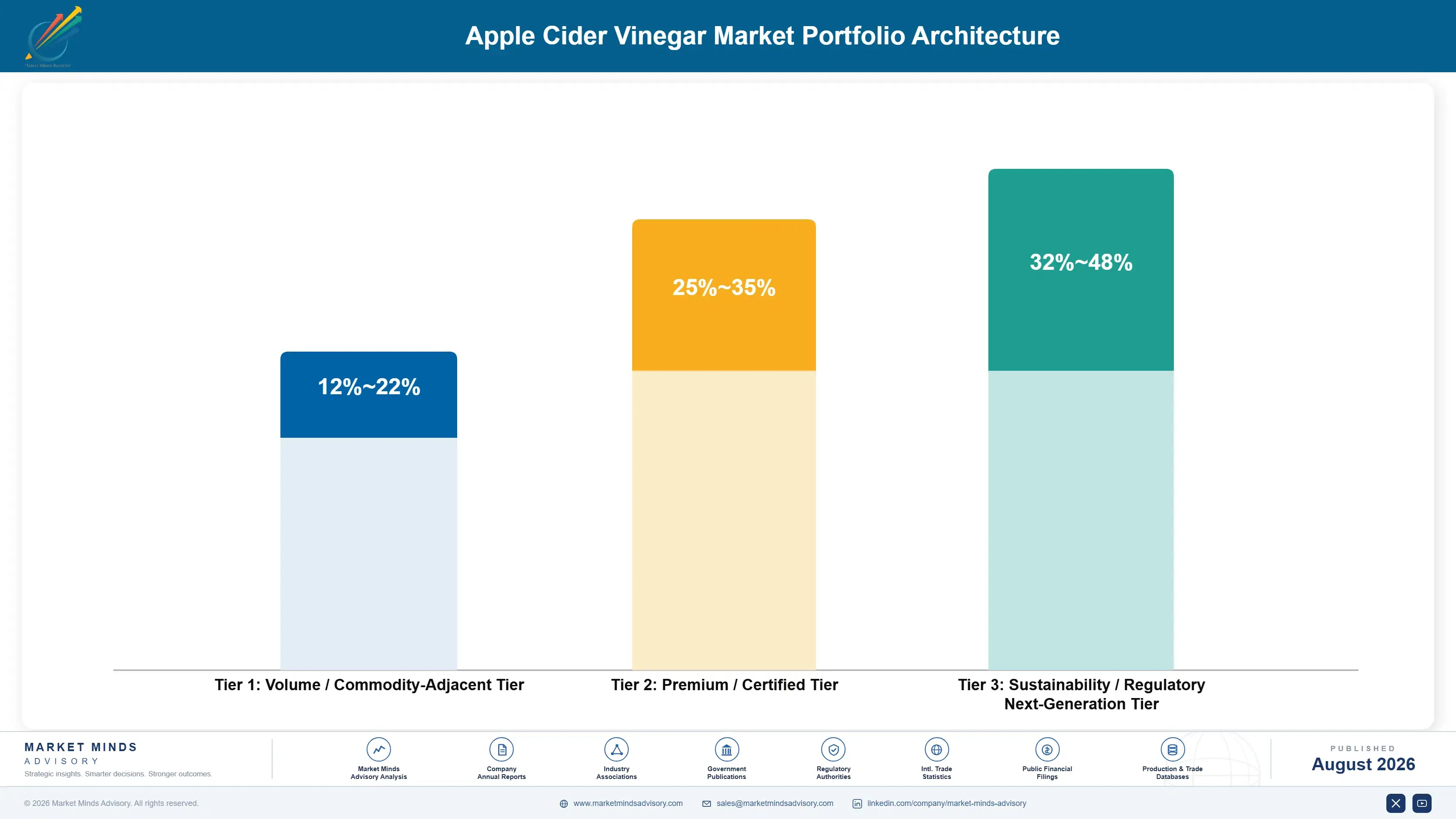
Portfolio Architecture for Margin Defence

The portfolio splits into three tiers with wide margin separation tied directly to format sophistication rather than fermentation cost alone. Bulk liquid apple cider vinegar competes mainly on price and shelf presence, while gummy, capsule, and flavor-masked shot formats command durable premiums tied to convenience and consumer experience rather than any inherent ingredient cost difference.
The tension between volume and premium is sharpening as gummy and shot formats grow faster than liquid vinegar demand, pulling brand investment and marketing spend toward the higher-margin segment even though liquid remains the larger volume base globally today, particularly outside North America and Western Europe. Companies that maintain a foothold in both formats preserve optionality, while those chasing only premium formats risk losing the stable, if slower-growing, cash flow that liquid vinegar sales still reliably provide.

High-value margin pools concentrate specifically in gummies and flavor-masked beverage shots, both requiring genuine format and flavor science investment that legacy liquid producers must build or acquire rather than simply extend from existing capability. Bulk liquid apple cider vinegar, by contrast, remains a large but slow-growing volume base offering thin, stable margins rather than genuine expansion opportunity for most participants going forward.

Volume / Commodity-Adjacent Tier

Bulk liquid apple cider vinegar sold primarily on price and shelf presence into grocery retail and food service channels across nearly every major global market, largely unchanged for many decades now.
Gross Margin: 12-22%

Premium / Certified Tier

Organic and raw unfiltered liquid formats plus standard capsule and tablet supplements commanding moderate premiums tied closely to certification and dosing convenience across most health-conscious retail channels nationwide and beyond.
Gross Margin: 25-35%

Sustainability / Regulatory / Next-Generation Tier

Gummies and flavor-masked beverage shots representing the newest, highest-margin, and fastest-growing corner of the portfolio built entirely on format innovation and genuine consumer experience rather than raw ingredient cost alone.
Gross Margin: 32-48%
apple-cider-vinegar-market-trends-portfolio-architecture-1787461960322

High-value Sub-segments and Strategic Watch-out

ACV Gummies

High value and high growth, converting consumers who reject liquid vinegar's taste while still preserving the product's perceived wellness benefits fully and completely for the buyer. Brands with strong flavor and format innovation are capturing the category's fastest-growing volume across nearly every major global market today.
Gross Margin: 34-48%

ACV Beverage Shots and Tonics

High value with strong growth, opening a distinct morning wellness occasion separate from both cooking use and gummy snacking entirely and quite completely apart from either. Flavor masking technology increasingly decides which brand wins repeat purchase in this specific segment across most major consumer markets worldwide.
Gross Margin: 30-42%

Bulk Liquid Apple Cider Vinegar

The volume core, serving grocery retail and food service demand across nearly every global market regardless of local wellness trends or overall category maturity level today and always. Steady growth tracks population and culinary use rather than any specific wellness formulation trend or premium positioning shift.
Gross Margin: 12-22%

Unbranded Commodity Liquid Supply

The strategic watch-out, facing margin compression as branded formats capture the wellness positioning this segment cannot easily claim for itself at all today or ever in the future. Remaining volume increasingly competes purely on price against private label alternatives entering nearly every major retail channel available.
Gross Margin: 8-16%

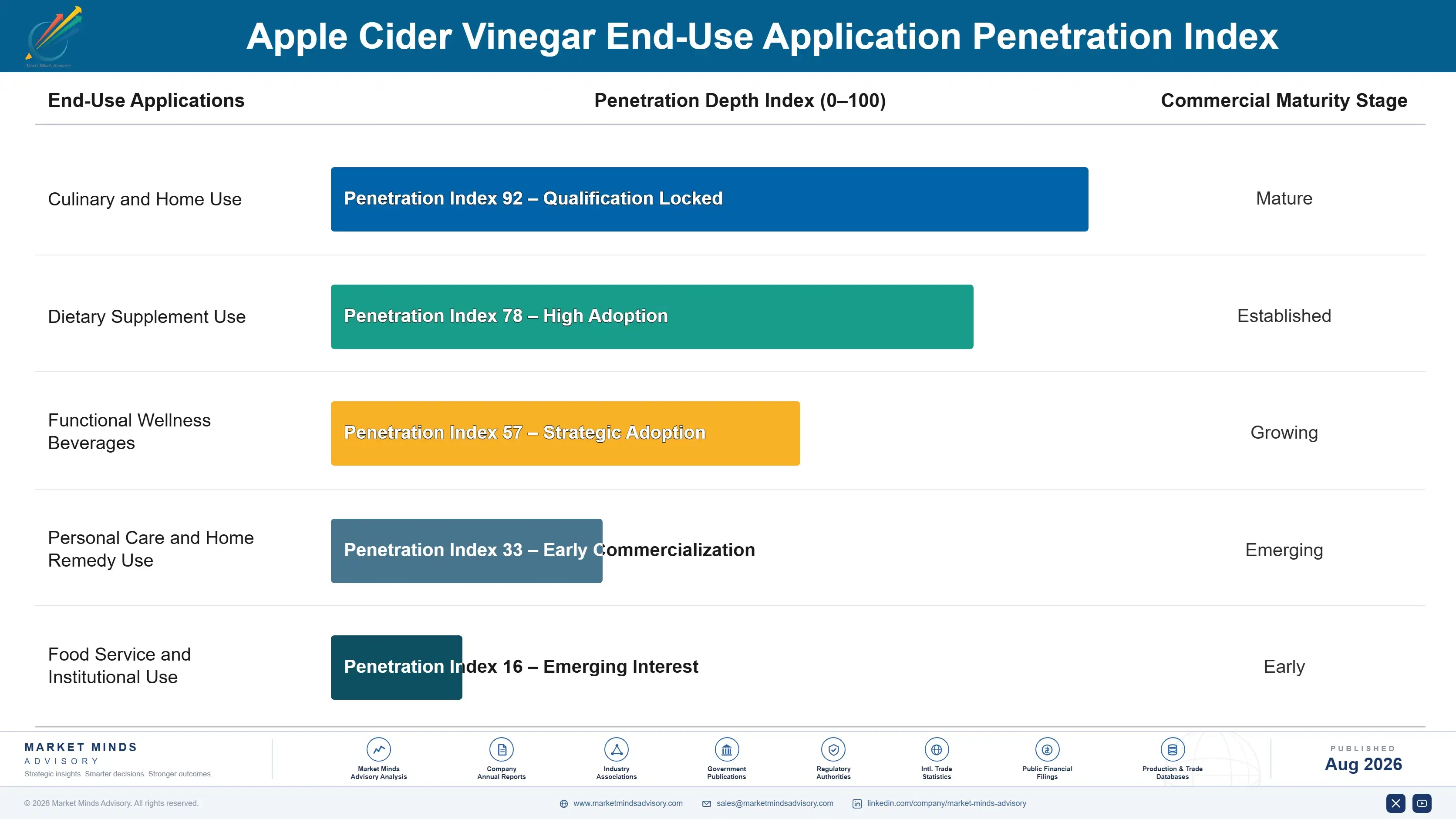
Ritual Purchasing Meets Discovery-Driven Demand

Demand architecture here splits between habitual ritual purchasing and discovery-driven trial that behaves very differently across formats. Liquid vinegar buyers, many following a longstanding home remedy or culinary habit, purchase in a steady, repeat pattern largely unaffected by marketing trends. Gummy and shot buyers behave differently, often discovering the product through social media content and converting into a repeat purchase pattern once the format proves palatable.
Adoption depth varies sharply by end-use format. Culinary and home remedy liquid users show the deepest habitual loyalty, often continuing a purchasing pattern established years earlier regardless of newer format availability. Gummy and capsule wellness buyers show more brand-switching behavior, willing to try competing products as new entrants launch with fresh marketing angles. Beverage shot buyers sit between the two, forming morning ritual habits once a preferred brand is established.

Generational buyer shifts are reshaping category discovery significantly. Younger consumers increasingly encounter apple cider vinegar through wellness influencer content rather than a parent's home remedy practice, a fundamentally different discovery path that favors format innovation and shareable packaging over the ingredient credibility that mattered most to earlier generations. This shift rewards brands investing in social-first marketing over those relying on traditional grocery placement.
apple-cider-vinegar-market-trends-end-use-penetration-index-1787461960810

Where ACV Brands Should Focus Next

These are among the four positions where our research anticipates prominent divergence between winners and laggards over the coming forecast period. Each is grounded in the demand model, the regulatory perimeter, and the announced capacity pipeline.
01 / FORMAT INNOVATION PRIORITY

Invest in Flavor Science Before Competitors Close the Gap

Flavor masking technology increasingly separates winning beverage shot brands from competitors relying on generic formulations, and this advantage compounds as satisfied customers convert into repeat subscription-style purchasing behavior over time. Brands without proprietary flavor science are losing repeat purchase rate to competitors who invested earlier in this specific capability and now hold a durable lead. The window to establish a credible flavor advantage is narrowing as more entrants recognize how directly it drives the category's underlying unit economics and long-term customer retention.
02 / CLINICAL RESEARCH INVESTMENT

Fund Larger Studies Before Regulatory Windows Shift

Existing metabolic health research remains mixed and generally small in scale, but brands funding larger, more rigorous studies now are positioning for meaningfully stronger marketing claims if results land favorably in coming years. This is a genuine bet given research uncertainty, but competitors without comparable investment will find themselves permanently behind on claims credibility regardless of how the science eventually resolves. Brands with sufficient scale to absorb this research risk should treat it as a strategic priority rather than a discretionary expense.
03 / FEEDSTOCK SUPPLY SECURITY

Lock Apple Concentrate Contracts Before Volatility Returns

Apple concentrate pricing has swung meaningfully following past harvest shortfalls, and brands without secured multi-year supply agreements absorb that volatility directly against margins already thinner than the category's premium formats would otherwise suggest to observers. Larger manufacturers are already diversifying sourcing across multiple growing regions, leaving smaller unhedged brands increasingly exposed during the next poor growing season. Securing supply now, ahead of the next disruption, protects margin predictability that downstream gummy and shot brands increasingly expect from their liquid concentrate suppliers.
04 / PRIVATE LABEL EXPANSION

Convert Fermentation Scale Into Contracted Manufacturing Revenue

Large fermentation-scale producers hold cost advantages that smaller gummy and shot brands cannot replicate, creating a genuine opportunity to manufacture private label products for retailers seeking wellness category margin without building their own brand entirely from scratch on their own. This diversifies revenue away from volatile branded competition while monetizing existing production capacity more fully than branded sales alone typically achieve on their own. Producers slow to pursue this channel risk ceding it entirely to more aggressive competitors already building retailer relationships.

Engagement Snapshot From the Field

A live engagement with an industry participant carrying material or product regulatory and market exposure ahead of a defining policy shift, showing how our research translates into a defensible multi-year portfolio strategy.
MARKET MINDS ADVISORY · CLIENT ENGAGEMENT SUMMARY
Apple Cider Vinegar Producer Strategic Portfolio Review and Transition Roadmap 2026·Investment Scenario on Apple Cider Vinegar Exposure Evaluation 2025-26
CLIENT PROFILE
A regional North American wellness beverage startup approached MMA while planning its entry into the apple cider vinegar shot category after building initial traction with a ginger shot product line. The client reported annual revenue near USD 18 million and had no existing apple cider vinegar formulation experience prior to this engagement (client-reported, unverified by MMA).
STRATEGIC CHALLENGE
Management needed to develop a palatable apple cider vinegar shot formulation that could compete against established players while avoiding the harsh acidity feedback that had limited some competing products in early consumer testing. The team also needed to decide whether to manufacture in-house or partner with an existing fermentation producer given their limited production experience.
MMA APPROACH
MMA benchmarked flavor masking approaches across five competing beverage shot products through blind consumer taste testing to identify the most successful formulation strategies currently in market. We modeled the cost and speed tradeoffs between building in-house fermentation capability versus partnering with an established producer for this specific product line. We also assessed potential private label partners against the client's timeline.
KEY FINDINGS
  1. The two highest-rated competing products in blind testing both used a citrus and ginger flavor combination rather than the more common turmeric blend the client had initially planned (client-reported, unverified by MMA).
  2. Partnering with an established fermentation producer would cut the client's time to market by approximately five months compared to building in-house capability from scratch.
  3. Three of the five candidate manufacturing partners already had private label capacity available within the client's required launch timeline, without any exception.
  4. Consumer willingness to pay tracked closely with perceived flavor quality rather than health claim messaging in the blind testing sessions conducted throughout the study.
CLIENT PROFILE
A regional North American wellness beverage startup approached MMA while planning its entry into the apple cider vinegar shot category after building initial traction with a ginger shot product line. The client reported annual revenue near USD 18 million and had no existing apple cider vinegar formulation experience prior to this engagement (client-reported, unverified by MMA).
STRATEGIC CHALLENGE
Management needed to develop a palatable apple cider vinegar shot formulation that could compete against established players while avoiding the harsh acidity feedback that had limited some competing products in early consumer testing. The team also needed to decide whether to manufacture in-house or partner with an existing fermentation producer given their limited production experience.
MMA APPROACH
MMA benchmarked flavor masking approaches across five competing beverage shot products through blind consumer taste testing to identify the most successful formulation strategies currently in market. We modeled the cost and speed tradeoffs between building in-house fermentation capability versus partnering with an established producer for this specific product line. We also assessed potential private label partners against the client's timeline.
KEY FINDINGS
  1. The two highest-rated competing products in blind testing both used a citrus and ginger flavor combination rather than the more common turmeric blend the client had initially planned (client-reported, unverified by MMA).
  2. Partnering with an established fermentation producer would cut the client's time to market by approximately five months compared to building in-house capability from scratch.
  3. Three of the five candidate manufacturing partners already had private label capacity available within the client's required launch timeline, without any exception.
  4. Consumer willingness to pay tracked closely with perceived flavor quality rather than health claim messaging in the blind testing sessions conducted throughout the study.
RECOMMENDED STRATEGY
Phase 1: Phase 1 (0 to 3 months): Select a private label manufacturing partner and finalize a citrus-ginger flavor formulation for testing. Phase 2: Phase 2 (3 to 6 months): Complete small-batch production runs and conduct expanded consumer taste testing sessions across several regions. Phase 3: Phase 3 (6 to 9 months): Launch across regional retail partners with flavor quality as the primary marketing message throughout.
OUTCOME
The client launched within the nine-month timeline using the recommended private label partnership and citrus-ginger formulation. Early sell-through data tracked meaningfully ahead of the client's initial ginger shot launch, which MMA attributed largely to the flavor-first positioning strategy adopted across the campaign (client-reported, unverified by MMA).

Frequently Asked Questions

Foundational context covering the market sizes, CAGR, scope, country, region and competition that inform every finding below. This section is provided to cover basics and most often pre-purchase conversations, answered from the MMA Primary Research Dataset.

What is the current size of the Apple Cider Vinegar Market?

The market stood at approximately USD 1.35 billion in 2025, according to MMA's primary research dataset. This reflects global demand across liquid, gummy, capsule, and beverage shot formats.

How large will the Apple Cider Vinegar Market be by 2036?

MMA projects the market will reach approximately USD 2.96 billion by 2036 under the base case scenario. This represents roughly 2.04 times the 2026 market entry value.

What is the CAGR for the Apple Cider Vinegar Market 2026 to 2036?

The base case CAGR is 7.4%, with a bull case of 8.6% and a bear case of 6.2%. The range reflects uncertainty around ongoing metabolic health research outcomes.

Which segment is growing fastest?

ACV gummies grow fastest at 11.5%, about 1.55 times the overall market rate. Consumers converting away from liquid vinegar's sharp taste are the primary driver.

Who are the major companies in the Apple Cider Vinegar Market?

Leading companies include Mizkan Holdings, Bragg Live Food Products, Kraft Heinz Company, Goli Nutrition, and Archer Daniels Midland. These five companies together hold an estimated 32% of the market on a revenue basis.

Which country is growing fastest?

India posts the fastest national growth at 10.2% CAGR, driven by branded wellness retail expanding into previously untapped urban markets. This outpaces the broader South Asia and Pacific regional average.

Report Segmentation Architecture

The full report scope spans multiple orthogonal segmentation dimensions, with cross-tabulated demand data provided for each dimension pair. Coverage extends further to regional breakdowns, trend trajectories, and the competitive detail needed to support segment-level decision-making.

By Product Form

  • Raw and Unfiltered Liquid ACV
  • Filtered and Pasteurized Liquid ACV
  • ACV Gummies
  • ACV Capsules and Tablets
  • ACV Beverage Shots and Tonics
  • ACV Powder

By End-Use Application

  • Culinary and Home Use
  • Dietary Supplement Use
  • Functional Wellness Beverages
  • Personal Care and Home Remedy Use
  • Food Service and Institutional Use

By Commercial Dimension

  • Direct Grocery Retail
  • Health and Wellness Specialty Retail
  • E-Commerce and Subscription Sales
  • Private Label Manufacturing

By Region

  • North America
  • Western Europe
  • East Asia
  • South Asia and Pacific
  • Latin America
  • Middle East and Africa
  • Eastern Europe

Scope, Methodology, and Coverage

Every figure in this report is reproducible from documented input assumptions. The scope below maps the historical period, the forecast horizon, the segmentation dimensions, and the countries covered, alongside the underlying primary and qualitative methodology.
Historical Period
2020 to 2025
Forecast Period
2026 to 2036
Base Year
2025 (USD billions; MMA Primary Research Dataset, August 2026)
Market Definition
The apple cider vinegar market comprises liquid, powder, capsule, and gummy products formulated from fermented apple cider vinegar, sold for culinary, dietary supplement, and functional wellness use. It excludes other fruit and grain vinegars sold under separate product categories and vinegar-based cleaning or industrial products.
Quantitative Units
USD billions (current prices); unit volume where applicable
Segmentation Dimensions
By Product Form; By End-Use Application; By Commercial Dimension; By Region
Regions Covered
North America, Western Europe, East Asia, South Asia and Pacific, Latin America, Middle East and Africa, Eastern Europe
Countries Covered
USA, China, Germany, France, UK, Japan, South Korea, India, Australia, Canada, Brazil, Mexico, Indonesia, Vietnam, Thailand, Malaysia, UAE, Saudi Arabia, South Africa, Nigeria, Turkey, Poland, Netherlands, Italy, Spain, Sweden, Switzerland, Argentina, Colombia, Singapore, and additional markets relevant to this sector
Key Companies Profiled
Mizkan Holdings, Bragg Live Food Products, Kraft Heinz Company, Goli Nutrition, Archer Daniels Midland, Aspall, Hain Celestial Group, Vermont Village, American Vinegar Works, Filsinger's Organic Foods, Dynamic Health Laboratories, NOW Foods, Nature's Way, Sky Organics, Marukan Vinegar, Pompeian Inc, Ken's Foods, Zhejiang Zhongba Vinegar, White House Foods, Spectrum Organic Products
Quantitative Methodology
Primary survey, n=3,800 respondents, Q4 2025, six countries; demand-side model with trade association cross-validation
Qualitative Methodology
47 expert interviews, Q4 2025; applied to validate demand model assumptions, identify emerging dynamics, and assess competitive positioning
Report Format
PDF and XLSX data workbook (Word format preview document)
Publisher
Market Minds Advisory
Report Code
MMA-2026-AGR-227
Published
August 2026
Contact
sales@marketmindsadvisory.com | www.marketmindsadvisory.com

Purchase the full Apple Cider Vinegar Market Report (2026 to 2036).

The full MMA Apple Cider Vinegar report sizes the market across six product forms, five end-use applications, and seven regions through 2036. It profiles 20 participants on a consistent revenue basis, scoring each on format innovation, feedstock supply security, and clinical research investment. Scenario models quantify how metabolic health research outcomes and format adoption move demand and pricing across the category. The report also includes delivered apple concentrate cost modeling, a flavor technology competitive screen, and a private label manufacturing opportunity assessment built for brand, formulation, and procurement teams.
Six-format segmentation with detailed growth forecasts
Apple concentrate feedstock supply risk assessment tool
Clinical research investment tracking and monitoring tool
Flavor masking technology competitive benchmark model
Regional wellness retail penetration and demand mapping
Twenty-company competitive benchmarking scorecard and assessment

Built For The People Who Decide

From boardroom strategy to bench-side execution, this report is read cover-to-cover by leaders shaping the next decade of their industry, turning demand scenarios, market dynamics and valuation benchmarks into decisions.
CXOs/ Presidents/ VPs/ Managers
M&A and Corporate Development
Strategy Teams and R&D Heads
Procurement and Product Directors
Regulatory and Compliance Leaders
Investor Relations and Equity Analysts