Market Minds Advisory
Application Programming Interface (API) Security Market

Application Programming Interface (API) Security Market: Application Programming Interface (API) Security Market. AI Agent Proliferation Reshapes Enterprise Attack Surface Investment

AI agent integrations are multiplying API endpoints faster than security teams can inventory them, forcing vendors to build automated discovery capability while enterprises push runtime protection deeper into environments traditional gateway controls never fully covered.

Lead Analyst

Published

September 2026

Make Smarter Decisions with Customized Research Insights

Request a free sample report and evaluate market opportunities, growth trends, and competitive dynamics relevant to your business needs.

2025 MARKET VALUE$2.4BMarket Size 2025
2036 FORECAST VALUE$11.8BBase Case , 2026 to 2036
CAGR 2026 TO 203615.6 %Bull 16.9% / Bear 14.3%
INCREMENTAL OPPORTUNITY$9.0BNet 10- year value creation
EXPANSION MULTIPLE4.26x2036 value over 2026 base
Strategic Levers
M&A Pipeline
Regional Outlook
Country Rankings
Competitive Intelligence
Segmental Deep-dive
Call-Us : 91 93563 13602

Executive Snapshot and Market Trajectory.

AI agent proliferation is reshaping API security investment faster than any prior application security technology cycle, as autonomous agents generate new API calls and endpoints that traditional inventory processes cannot track manually across most enterprise environments, cloud platforms, and development teams today and tomorrow.
Security teams face simultaneous pressure from exploding API endpoint counts driven by AI agent adoption, expanding shadow API discovery needs across cloud-native architectures, and rising competition from runtime protection vendors reducing reliance on perimeter controls. India's expanding IT services and digital payments sector is pulling API security investment into domestic enterprises faster than incumbents anticipated, while North American cybersecurity vendors continue funding the highest-value discovery and anomaly detection development contracts across most segments and industries.
Competitive intensity concentrates among five vendors controlling roughly thirty-eight percent of global revenue, though specialized runtime protection vendors are winning enterprise contracts faster than gateway incumbents expected just two years ago and continue gaining share steadily across most industries and customer segments. Regulatory pressure around data breach disclosure requirements adds validation cost that smaller vendors increasingly struggle to absorb without dedicated compliance engineering teams and legal counsel.
Market Definition
The API Security Market covers gateways, runtime protection, discovery, testing, and posture management solutions that secure application programming interfaces across enterprise cloud and on-premises environments. It excludes general-purpose web application firewalls and network security tools lacking dedicated API-specific inspection and inventory capability.
Base Year Value
$2.4B in 2025 (MMA Primary Research Dataset, September 2026)
Forecast Period
2026 to 2036, eleven discrete annual values
CAGR
15.6% base case. Bull 16.9%. Bear 14.3%.
Fastest Growth Segment
AI-Enhanced Anomaly Detection Software: 20.4% CAGR
Fastest Growth Country
India: 18.5% CAGR
Fastest Growth Region
South Asia and Pacific: 17.8% CAGR
Largest Region
North America: 34% of 2025 global value
Market Leaders
Akamai, Cloudflare, F5, Salt Security, and Traceable AI lead the field. Source: MMA Analysis, July 2026.
Primary Survey
n=3,800 procurement and R&D decision-makers, Q4 2025, six countries
Methodology
Demand-side build-up, cross-validated against public data, 47 expert interviews

Application Programming Interface (API) Security Market Forecast Scenarios

api-security-market-size-forecast-scenario-1789980724415
The 2020 to 2025 period saw API security demand track broader cloud-native application growth closely, growing at a 14.3 percent compound annual rate as microservices architecture adoption expanded API endpoint counts across most enterprise environments and cloud platforms. Early gateway-centric solutions dominated this period before runtime protection and discovery capabilities emerged as distinct product categories.
Base case forecasts assume continued AI agent proliferation expanding API endpoint counts, rising shadow API discovery demand across cloud-native architectures, and growing enterprise preference for runtime protection over perimeter-only gateway controls. These three mechanisms combine to sustain a 15.6 percent compound annual growth rate through 2036, with India and North America contributing the largest incremental volume gains as domestic digital infrastructure expands and cybersecurity vendors continue funding high-value discovery and anomaly detection development.
A bull scenario reaching 16.9 percent growth depends on faster-than-expected AI agent adoption that meaningfully accelerates API endpoint proliferation beyond current enterprise forecasts and budget planning cycles. A bear scenario falling to 14.3 percent would likely follow a broader cybersecurity budget slowdown reducing enterprise willingness to fund new discovery and runtime protection tool categories across most industries and regions.

Shadow API Discovery Drives Security Budget Reallocation

Enterprise security teams increasingly discover unknown API endpoints only after automated scanning tools reveal them, exposing gaps between engineering deployment velocity and security team visibility that traditional gateway controls never caught or flagged across most organizations and industries.
MARKET CONCENTRATIONCR5 38%Top five vendors hold under half of a still-fragmented market
AVERAGE CONTRACT VALUE$95KTypical enterprise annual contract value varies by deployment scope
TOP PRODUCING COUNTRYUnited States 29%Leading vendor headquarters concentration drives platform development investment
SHADOW API DISCOVERY RATE41%Share of enterprise API endpoints previously unknown before deployment scans
BREACH COST AVOIDANCE RATE62%Estimated share of breach costs avoided through runtime detection deployment
ENGINEERING COST SHARE51%Detection engineering and threat research dominate ongoing vendor cost base
Runtime protection increasingly displaces gateway-only architectures as the primary API defense layer, since gateways alone cannot detect anomalous behavior from already-authenticated API calls that exploit legitimate business logic rather than stolen credentials or tokens across most environments. This shift pressures gateway-centric vendors to build runtime detection capability rapidly or risk losing enterprise contracts to specialized challengers, favoring vendors with strong machine learning anomaly detection expertise over vendors competing purely on traffic throughput and latency benchmarks alone.
AI agent adoption compounds discovery challenges considerably, since autonomous agents generate API calls dynamically rather than through predictable, developer-authored integration patterns that traditional documentation processes could track reliably across most environments, platforms, and cloud providers. Vendors increasingly offer continuous discovery scanning that runs constantly rather than periodic audits, helping security teams keep pace with API endpoint counts that grow faster than manual inventory processes can reasonably track across most organizations and industries.
"Every enterprise has more APIs than its security team knows about, that gap is the entire market. Vendors who solve discovery first win the runtime protection contract automatically."
Senior Analyst, Application Security and API Protection Practice · MMA Technology Practice · September 2026

Market Trends

AI Agents Multiply Undocumented API Endpoints

Autonomous AI agents increasingly generate API calls dynamically as they complete multi-step tasks, creating undocumented endpoint patterns that traditional developer-authored API documentation and inventory processes cannot anticipate or track reliably across most enterprise environments. This shift forces security teams to deploy continuous automated discovery scanning rather than relying on periodic manual audits that worked adequately when API growth followed predictable, developer-driven integration patterns in prior technology cycles. Vendors that build mature AI-aware discovery capability increasingly win enterprise contracts over competitors still relying on documentation-based inventory approaches that miss agent-generated traffic entirely.
Market Impact: India processes over 15 billion transactions

Runtime Protection Displaces Gateway-Only Architecture Entirely

Enterprises increasingly deploy runtime protection capable of detecting anomalous behavior from already-authenticated API calls, addressing attack patterns that exploit legitimate business logic rather than stolen credentials that gateway-only architectures cannot catch reliably across most production environments, cloud platforms, and customer segments. This shift reflects growing recognition that perimeter-focused controls alone cannot stop attackers who gain legitimate access credentials through phishing or credential stuffing before exploiting business logic vulnerabilities directly. Vendors offering combined gateway and runtime protection increasingly win renewal contracts over competitors providing only one layer of the defense stack.
Market Impact: Adds 72 hour breach disclosure requirement

Market Opportunities and Growth Drivers

India Expands Digital Payments API Infrastructure

India's Unified Payments Interface network processes billions of transactions monthly, and the country's expanding digital payments and IT services sector continues building API-first products requiring dedicated security tooling at massive transaction scale and volume. This domestic infrastructure buildout pulls API security investment directly into Indian enterprises rather than solely serving as an offshore development location for Western clients, expanding the addressable commercial market meaningfully beyond historical outsourced development contracts and engagements. Vendors with established local support teams increasingly win domestic contracts over global vendors serving India remotely through regional distribution partners.
Market Impact: Generates over 200 alerts daily

Data Breach Disclosure Mandates Tighten Globally

Regulators across the European Union, the United States, and India continue tightening data breach disclosure timelines and API-specific security requirements, requiring enterprises to demonstrate documented API inventory and monitoring capability during compliance audits conducted annually or more frequently across most regulated sectors. Compliance certification now typically adds meaningful engineering overhead to security program development compared to prior years, favoring vendors with established compliance documentation templates over smaller competitors that must build custom reporting from scratch entirely. This regulatory tightening effectively raises the bar required to compete for enterprise contracts in regulated industries.
Market Impact: Extends deployment timelines by 6 months

Market Restraints and Challenges

Alert Fatigue Undermines Security Team Response

Automated API discovery and runtime detection tools increasingly generate large volumes of alerts, and overwhelmed security teams struggle to distinguish genuine threats from false positives, undermining the practical value of detection capability regardless of underlying accuracy. The root cause traces to detection algorithms tuned toward sensitivity rather than precision, since vendors fear missing genuine threats more than generating excessive noise that erodes analyst trust and attention over time. Vendors are increasingly building risk-scoring and automated triage capability that prioritizes alerts by business impact, reducing the manual review burden on security teams facing limited analyst headcount.
Market Impact: Adds 45 percent more API endpoints

Legacy Integration Complexity Slows Enterprise Deployment

Enterprises operating extensive legacy application infrastructure alongside newer cloud-native services face substantial integration complexity when deploying API security tooling that must monitor traffic across fundamentally different architectural generations simultaneously and continuously today. The root cause lies in inconsistent API documentation standards across legacy systems built years before modern API governance practices existed, requiring manual discovery work that automated tools cannot fully replace in older environments and platforms. Vendors are increasingly offering hybrid deployment models and professional services engagements to help enterprises bridge legacy and modern architecture during multi-year migration periods.
Market Impact: Cuts breach detection time 55 percent
3 additional market trends, 4 additional growth drivers, and 2 additional restraints and challenges are covered in the full report. Contact sales@marketmindsadvisory.com to access the complete intelligence.

Segment CAGR and Growth Architecture

The API Security Market segments by product type across six categories spanning gateway and access control solutions, runtime threat detection, discovery and inventory management software, testing and posture management, managed security services, and AI-enhanced anomaly detection software used across enterprise environments. AI-enhanced detection and discovery software lead growth, reflecting agent-driven endpoint proliferation across most enterprise environments today.
api-security-market-market-share-analysis-1789980724951

AI-Enhanced Anomaly Detection Software

AI-enhanced anomaly detection software applies machine learning models trained on API traffic patterns to identify malicious behavior from already-authenticated calls, addressing threats that exploit legitimate business logic rather than stolen credentials that gateway controls cannot catch reliably or consistently across most deployment types. Demand for this category grows fastest among all six segments, propelled by enterprises seeking automated detection capability that keeps pace with API endpoint counts expanding faster than manual security review processes can reasonably track across most environments and industries. Vendors offering mature anomaly detection capture disproportionate new design wins versus competitors still relying primarily on static rule-based detection approaches across most enterprise customer segments, industries, and deployment models worldwide.
CAGR 20.4%

API Discovery and Inventory Management Software

API discovery and inventory management software continuously scans enterprise environments to identify undocumented and shadow API endpoints that traditional developer documentation processes fail to capture reliably, particularly as AI agents generate dynamic API traffic patterns across most cloud platforms, services, and infrastructure types today. Growth in this category tracks rising enterprise recognition that security teams cannot protect API endpoints they do not know exist, making discovery the foundational capability underlying every other API security investment decision made today. Vendors increasingly bundle discovery capability directly into broader runtime protection and testing platforms, letting customers gain comprehensive endpoint visibility without deploying separate standalone discovery tools across their production environments and cloud infrastructure.
CAGR 17.5%
Full segment breakdown across 6 segments available in the complete report.

Regional Architecture and Country Demand Map

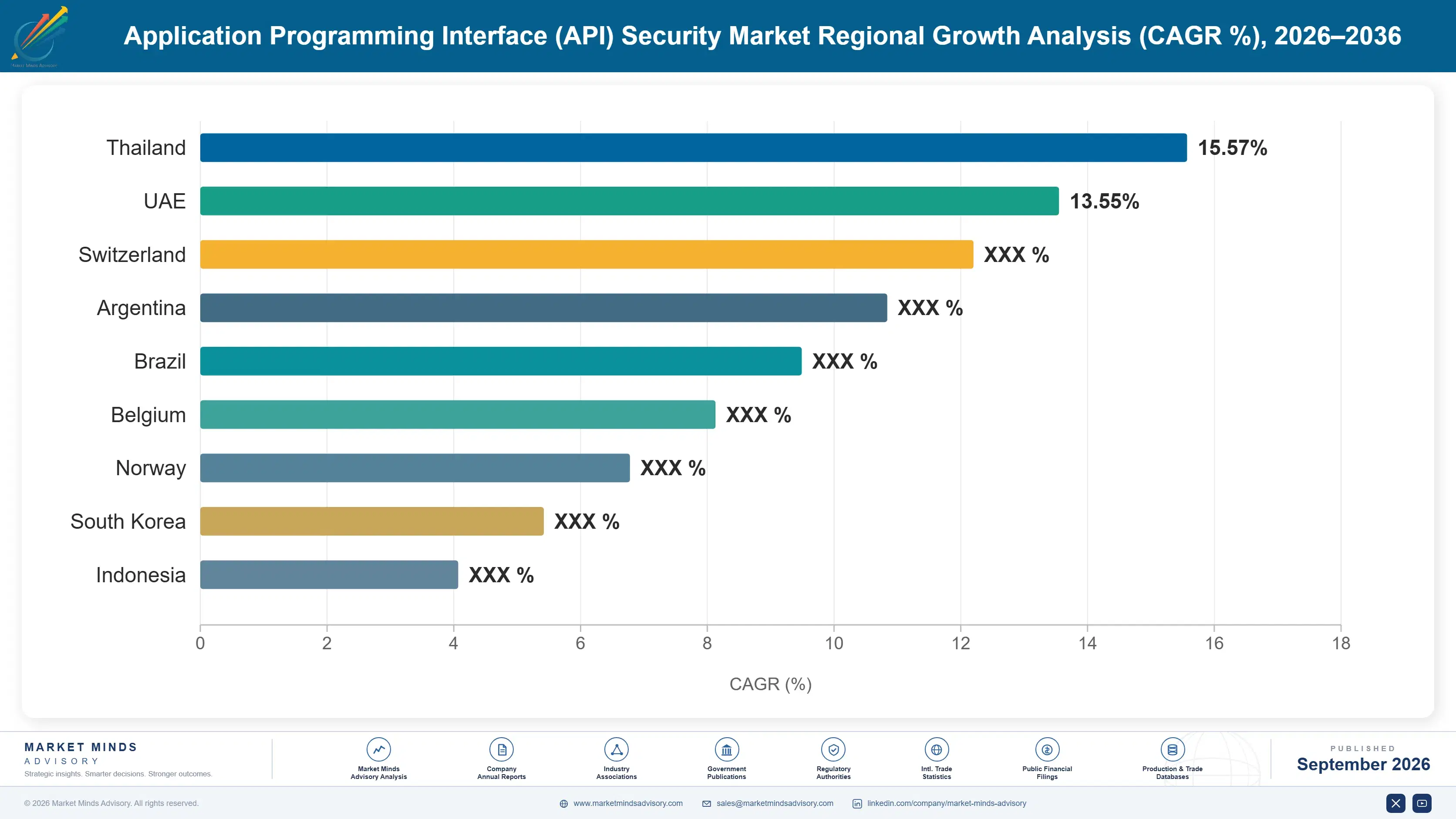
Regional API security demand concentrates where major cybersecurity vendor headquarters, enterprise cloud spend, and digital payments infrastructure intersect most heavily, with North America leading substantially above the standard regional band today, while South Asia and Pacific grows fastest on IT services and payments infrastructure expansion.

North America

United States cybersecurity vendor headquarters concentration drives regional share above the standard band (justification: dominant concentration of API security vendor headquarters, engineering talent, and largest enterprise cloud and cybersecurity budgets globally and consistently). Akamai, Cloudflare, F5, Salt Security, and Traceable AI all base core detection engineering and threat research domestically, capturing revenue recognition even where deployment occurs internationally across other regions and markets. Federal cybersecurity mandates under CISA add substantial government demand beyond commercial enterprise purchases and contracts. Canadian enterprises contribute meaningful additional demand through parallel cloud security modernization programs, reinforcing North America's position as the primary global engineering and revenue hub for this category and its adjacent product lines.
Share: 34% | CAGR: 16.2% (2026 to 2036)

East Asia

China's expanding technology sector and financial services digitalization drive substantial regional demand, as domestic enterprises increasingly deploy API security tooling to protect rapidly expanding cloud-native application infrastructure across multiple industries, provinces, coastal regions, and metropolitan hubs. Japan and South Korea contribute additional demand through advanced financial services and telecommunications sector adoption requiring stringent regulatory compliance documentation and audit support. Regional technology companies increasingly build domestic API security products rather than relying entirely on Western vendors, reflecting broader technology sovereignty priorities across major regional economies and governments. Regional enterprises increasingly adopt hybrid deployment models combining domestic and international vendor tooling across their expanding cloud infrastructure and application portfolios nationwide and beyond.
Share: 24% | CAGR: 16.6% (2026 to 2036)
Regional intelligence for 5 additional markets available in the complete report: Western Europe, South Asia and Pacific, Latin America, Middle East and Africa, Eastern Europe. Contact sales@marketmindsadvisory.com.
api-security-market-country-cagr-analysis-1789980725481

Capturing Value From Discovery-Led Adoption

API security vendors can expand margin capture beyond raw gateway licensing by pursuing four distinct commercial paths tied to discovery-led adoption, AI-enhanced detection depth, compliance certification services, and regional support infrastructure built across multiple enterprise customer relationships spanning several years, renewal cycles, expanding service categories, evolving compliance requirements, and diverse geographic markets worldwide today.

Premium Pricing for AI-Enhanced Detection Capability

Vendors offering mature AI-enhanced anomaly detection capability can charge premium pricing, typically 25 to 35 percent above rule-based detection platform pricing, since enterprises facing rising AI agent traffic will pay for proven detection accuracy that traditional signature-based methods cannot provide reliably or consistently across most environments. This premium persists until enough competitors achieve comparable AI detection maturity, typically a two-to-three-year window across most enterprise customer segments and industries. Vendors that invest early in detection model development capture outsized margin during this window before broader industry adoption compresses pricing back toward standard levels.
Market Impact: Adds a 25 to 35 percent price premium

Discovery-Led Land and Expand Sales Model

Vendors offering low-cost or free initial discovery scanning capture enterprise attention by revealing shadow API endpoints security teams did not know existed, creating an urgent business case for expanding into paid runtime protection and testing modules that typically lifts total contract value by 40 to 50 percent within the first renewal cycle after initial deployment, onboarding, and formal evaluation periods. This land-and-expand approach reduces initial sales friction since discovery alone requires minimal deployment risk, while the resulting endpoint inventory data creates a compelling internal justification for expanded security budget allocation.
Market Impact: Lifts contract value by 40 to 50 percent

Compliance Certification Fast-Track Service Program Offering

Vendors offering pre-built compliance documentation templates for data breach disclosure and industry-specific regulatory requirements can charge carriers a meaningful premium, since enterprises avoid 4 to 6 months of independent compliance mapping work by adopting vendor-provided documentation directly instead of building it internally from scratch entirely across most jurisdictions, industries, and regulatory frameworks. This service captures value from regulatory complexity that would otherwise burden internal legal and security teams considerably, while strengthening vendor lock-in as enterprises become dependent on vendor certification maintenance across multiple jurisdictions and evolving regulatory requirements over time and renewal cycles.
Market Impact: Cuts compliance mapping time by 60 percent overall

Managed Detection Services for Smaller Enterprises

Vendors increasingly offer managed API security services that handle discovery, tuning, and alert triage on behalf of smaller enterprises lacking dedicated in-house application security teams, generating recurring service revenue exceeding 35 percent above pure product licensing alone across most contract types and customer segments served today across multiple industries and geographic regions. This managed services model lets smaller enterprises access enterprise-grade detection capability without building internal expertise, while vendors capture higher-margin service revenue and deeper customer relationships that reduce competitive switching risk across multi-year managed service contracts and renewal periods and cycles.
Market Impact: Adds over 35 percent recurring service revenue growth

Who Controls the Margin Pool

Market concentration sits at 38 percent among the top five vendors measured by platform and subscription revenue, and Akamai holds a meaningful lead over its closest challenger, Cloudflare, in enterprise runtime protection deployment volume specifically. The gap between the leader and the next challenger remains narrow given how recently this category has consolidated through acquisition activity. Below the top five, dozens of specialized discovery and testing vendors compete on detection accuracy rather than gateway throughput alone.
Current competitive activity centers on AI-enhanced detection model quality, discovery-led sales motions, and compliance documentation depth that increasingly determines enterprise vendor selection more than raw gateway throughput specifications alone. F5 and Salt Security have both announced expanded discovery capability this year to compete against specialized standalone discovery vendors, while Traceable AI continues deepening its behavioral analytics offerings aimed at large enterprise customers seeking comprehensive endpoint visibility.

Emerging pressure comes from specialized AI-native detection vendors winning enterprise contracts faster than gateway incumbents expected, threatening to compress pricing across standard access control categories first. Rankings could shift meaningfully if a specialized vendor secures broad adoption across multiple cloud platforms simultaneously, validating a detection-first model that reduces enterprise dependency on any single gateway vendor's platform entirely.
api-security-market-company-positioning-matrix-1789980726014

Competitive Moat and Risk Dimensions

AKAMAI TECHNOLOGIES INC

Moat: Deep content delivery network integration

Akamai maintains a global content delivery network infrastructure already handling substantial internet traffic volume, letting it detect API threats at network edge locations before requests reach customer origin servers directly. This positioning gives Akamai visibility into attack patterns across its entire customer base that standalone API security vendors lacking comparable network scale cannot replicate easily.
AKAMAI TECHNOLOGIES INC

Risk: Integration complexity from acquisitions

Akamai's growth through acquiring specialized API security vendors creates integration complexity, since combining detection engines, data models, and customer support processes across multiple acquired platforms takes considerable engineering time to fully harmonize. Slower integration could delay unified product roadmap delivery relative to competitors built organically around a single coherent architecture.
CLOUDFLARE INC

Moat: Massive network scale threat intelligence

Cloudflare's extensive global network handles a substantial share of internet traffic, generating threat intelligence data at a scale smaller competitors cannot match, since observing attack patterns across millions of customer domains improves detection model training considerably. This scale advantage compounds over time as more customers contribute additional threat signal data.
CLOUDFLARE INC

Risk: Enterprise sales motion still developing

Cloudflare's historical strength in self-service and mid-market customer acquisition means its enterprise-focused sales and support capability for large, complex API security deployments remains less mature than competitors with longer enterprise sales histories. This could limit near-term large enterprise contract wins against more established enterprise-focused competitors.

Players Tracked

Prominent Players

Akamai Technologies Inc
Cloudflare Inc
F5 Inc
Salt Security Inc
Traceable AI Inc

Other Key Players

Wallarm Inc
Cequence Security Inc
42Crunch Ltd
APIsec Inc
Data Theorem Inc
Imperva Inc
Wib Security Ltd
Resurface Labs Inc
Escape Technologies SAS
Corsha Inc
Raidiam Ltd
Pynt Ltd
StackHawk Inc
Curity AB
Levo AI Inc

Recent Developments

FEBRUARY 2026

Akamai Technologies announced expanded AI-enhanced anomaly detection capabilities integrated directly into its existing content delivery network security platform, targeting improved detection of AI agent-generated API traffic patterns across most enterprise environments. The update includes new behavioral baseline modeling for enterprise customers managing complex microservices architectures and cloud infrastructure.
Signal: Confirms AI-aware detection as the primary competitive differentiator among leading platform vendors today and going forward.
OCTOBER 2025

Traceable AI completed a multi-year supply agreement with a major United States financial services institution to deploy comprehensive API discovery and runtime protection across its retail banking platform infrastructure and mobile applications. The agreement includes ongoing threat intelligence updates and compliance reporting services covering multiple business units.
Signal: Reflects continued specialized vendor expansion into large regulated financial services enterprise contracts and long-term partnerships nationwide.
MAY 2025

Salt Security launched an expanded version of its discovery platform supporting automated compliance documentation generation for data breach disclosure requirements across multiple regulatory jurisdictions simultaneously and continuously. The launch targets enterprises seeking reduced compliance mapping burden ahead of upcoming regulatory deadlines across several major markets.
Signal: Signals accelerating vendor investment in compliance automation targeting previously underserved regulated customer segments and industries broadly.

Detection Engineering Talent Cost Exposure

Detection engineering talent and threat research analysts together represent roughly 51 percent of vendor cost of goods sold, sourced primarily from specialized security engineers based across North America and Israel, alongside cloud computing infrastructure purchased from major hyperscale cloud providers globally. Machine learning model training compute adds further meaningful cost exposure for AI-enhanced product lines.
Cybersecurity talent compensation spiked sharply during 2022 and 2023 as broader technology sector demand for specialized security engineers competed for a constrained global talent pool simultaneously, according to industry compensation surveys published during that period. Several vendors reported compressed gross margins during that period as talent acquisition costs outpaced their ability to pass higher engineering costs through to enterprise customers under existing multi-year fixed-price subscription agreements.

Smaller vendors without established detection engineering teams face proportionally higher per-customer support costs than vertically integrated majors like Akamai and Cloudflare, which amortize threat research investment across a much larger customer base and network scale worldwide. Vendors headquartered in regions with weaker currencies also face amplified dollar-denominated talent costs, widening the competitive cost gap against vendors with diversified global engineering and procurement footprints across multiple regions.
api-security-market-cost-volatility-analysis-1789980726212

Build Shared Detection Models Across Products

Vendors increasingly build shared, reusable detection models and threat intelligence pipelines that serve multiple product lines simultaneously, reducing per-feature engineering cost by amortizing model training investment across a broader product portfolio and customer base overall. This design shift lowers marginal cost for each additional detection capability while accelerating time to market for new features.

Negotiate Multi-Year Cloud Compute Contracts

Locking multi-year cloud compute contracts at fixed or partially hedged pricing protects vendors against spot market volatility that has repeatedly compressed margins during recent AI training demand spikes. This pricing certainty lets finance teams plan model development budgets several years ahead with materially reduced exposure to sudden compute price swings tied to broader industry demand.

Diversify Security Talent Sourcing Regionally

Sourcing detection engineering talent from multiple regional talent pools rather than a single concentrated location reduces exposure to localized wage inflation or talent shortages tied to competing technology sector demand across major hiring markets. This diversification strategy adds modest coordination complexity but meaningfully reduces single-region dependency risk across the vendor's broader engineering talent base and pipeline.

Portfolio Architecture for Margin Defence

Vendor economics split into three tiers by detection sophistication and compliance differentiation across most product categories offered today. Volume-tier standard gateway and access control solutions carry gross margins around 28 to 35 percent, while premium runtime protection configurations reach 42 to 50 percent margins consistently. AI-enhanced anomaly detection and discovery software command the widest margin range given the technical barriers protecting early movers from immediate competitive pressure.
Tension between volume and premium tiers centers on engineering resource allocation: vendors must decide how much AI model development investment to commit toward next-generation detection versus maintaining broad gateway product lines serving customers still running traditional perimeter-only security architecture. Most large vendors now prioritize AI and discovery investment, accepting near-term margin pressure on standard gateway offerings to secure future design-in position across upcoming enterprise renewal cycles.

High-value margin pools concentrate overwhelmingly in AI-enhanced detection software and compliance-certified managed services, where technical and regulatory barriers protect early movers from immediate price competition across most deployment scenarios and customer segments. Standard gateway solutions increasingly commoditize as more vendors, including newer regional entrants, achieve comparable baseline functionality, compressing margins toward the lower end of the volume tier band across most established global markets and industries.

Standard gateway and access control solutions serving customers running traditional perimeter-only security architecture, priced primarily on transaction volume and baseline throughput capacity rather than detection sophistication or AI-driven capability entirely.
Gross Margin: 28-35%

Runtime protection and compliance-certified configurations meeting regulated industry documentation requirements, commanding pricing power from certification barriers competitors cannot easily replicate quickly across comparable customer segments, regulatory jurisdictions, and industry categories.
Gross Margin: 42-50%

AI-enhanced anomaly detection and discovery software addressing shadow API and agent-generated traffic challenges, where technical barriers and model training maturity drive the widest margin variance across vendors, deployments, and customer segments today.
Gross Margin: 32-55%
api-security-market-portfolio-architecture-1789980726711

High-value Sub-segments and Strategic Watch-out

AI-Enhanced Anomaly Detection Software

Growing fastest among all six segments as enterprises seek automated detection capability keeping pace with API endpoint proliferation, commanding premium pricing and durable technical barriers that protect early movers from immediate competitive pressure across most segments, industries, geographic markets, customer categories, and organizational sizes today.

API Discovery and Inventory Management Software

Foundational visibility demand drives strong secondary growth here, though moderate near-term margin pressure reflects intensifying competition among vendors racing to standardize discovery capability across next-generation cloud infrastructure deployment architectures, customer categories, geographic markets, pricing models, support tiers, licensing structures, integration types, and partnership models worldwide.

API Gateway and Access Control Solutions

The largest volume segment by deployment count, providing steady baseline revenue at comparatively thin margins as commoditization intensifies with growing vendor competition entering global supply chains and enterprise procurement decisions consistently and predictably over multiple budget years, renewal cycles, planning periods, and future contract terms.

Standard Rule-Based Detection Products

A strategic watch-out segment facing sustained pricing pressure as rule-based detection commoditizes faster than AI-enhanced alternatives, risking margin erosion for vendors slow to redirect focus toward higher-value anomaly detection categories instead of legacy rule sets, static signatures, manual review processes, and outdated legacy tooling entirely.

Renewal Economics of API Discovery Platforms

Vendor relationships operate on annuity-like economics once an enterprise deploys API discovery and runtime protection across production environments, since replacing embedded security tooling requires re-integrating detection agents across every application and cloud environment monitored. A typical enterprise contract generates recurring subscription and threat intelligence update revenue across a three-to-five-year security program lifecycle, with expanding endpoint coverage extending the relationship well beyond initial deployment.
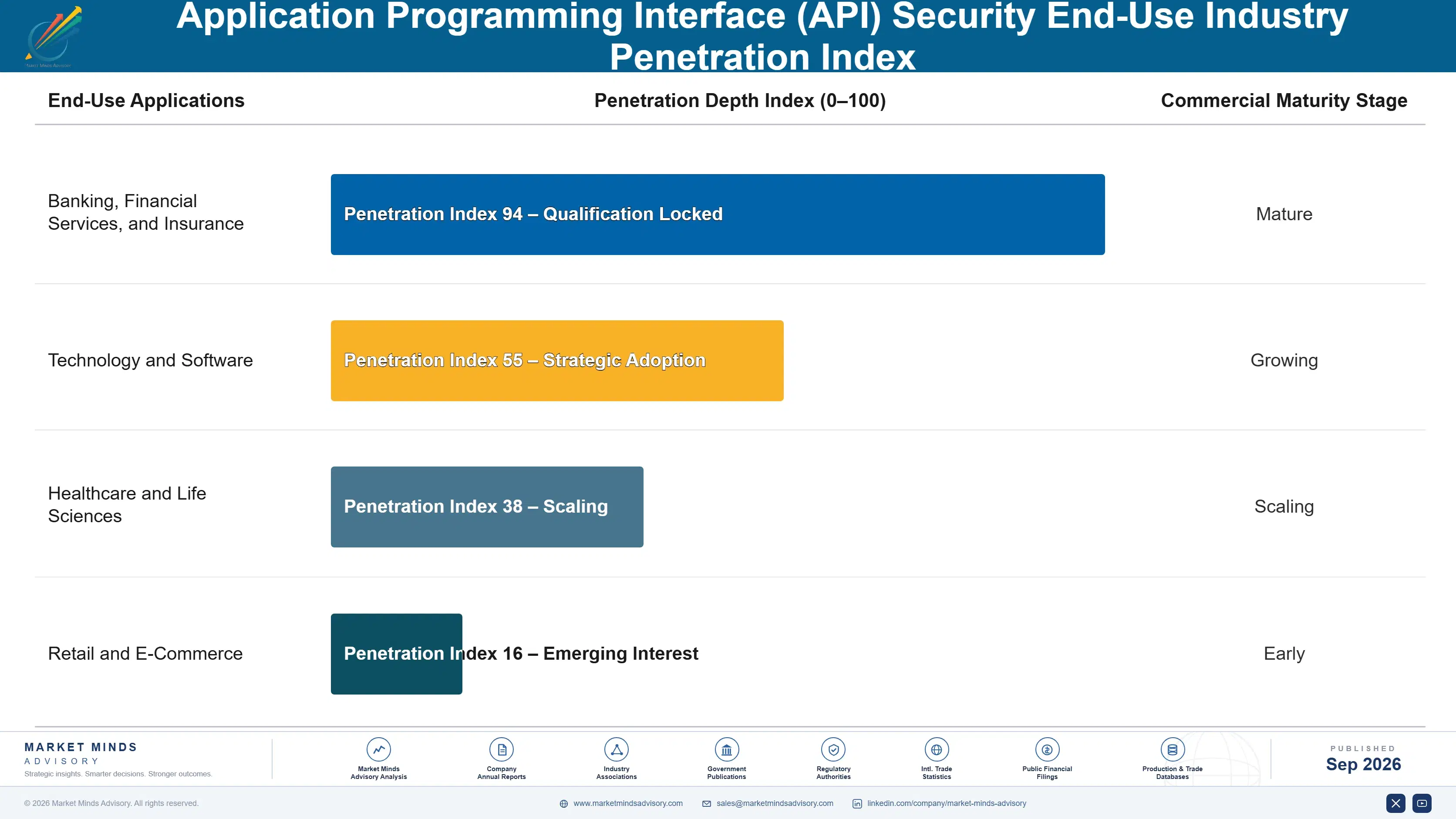
Adoption stickiness varies meaningfully by end-use vertical: financial services and healthcare customers show the deepest stickiness given regulatory compliance documentation tied to specific certified security tooling, while smaller technology companies show comparatively higher churn as generic protection commoditizes faster. Government and defense customers show extremely high stickiness tied to security clearance and procurement certification requirements that discourage frequent vendor switching.

Buyer profiles are shifting generationally as procurement authority moves from network security teams toward dedicated application security and platform engineering leaders who prioritize automated discovery accuracy over perimeter throughput specifications alone across most deployment types. Younger security leaders increasingly favor vendors offering transparent detection methodology and API-native integration over vendors competing purely on legacy gateway performance benchmarks and installed base relationships built over years.
api-security-market-end-use-penetration-index-1789980727203

API Security Vendor Investment Priorities

These are among the four positions where our research anticipates prominent divergence between winners and laggards over the coming forecast period. Each is grounded in the demand model, the regulatory perimeter, and the announced capacity pipeline.
01 / AI DETECTION MODEL INVESTMENT

Accelerate AI-enhanced detection before agent traffic overwhelms rule-based systems

AI agent-generated API traffic already exceeds a meaningful share of total enterprise call volume, and rule-based detection systems tuned for predictable, developer-authored patterns increasingly miss anomalous agent behavior entirely across most environments today. Vendors that build mature AI-enhanced detection capability now capture disproportionate design wins among enterprises facing rising agent traffic volume that traditional signatures cannot classify reliably or consistently. Vendors that delay this investment risk losing enterprise contracts entirely to competitors offering more accurate detection within the next several renewal cycles and budget periods.
02 / DISCOVERY-LED SALES STRATEGY

Lead with free discovery scanning to reveal shadow API risk

Enterprise security teams consistently underestimate their actual API endpoint count until automated discovery scanning reveals the true scope, creating a compelling and urgent internal business case for expanded security investment across most organizations. Vendors leading sales conversations with low-friction discovery capture enterprise attention faster than competitors leading with complex runtime protection sales cycles requiring lengthy technical evaluation and procurement approval. Building this land-and-expand motion now captures market share before competitors establish similar discovery-led sales processes across the same enterprise customer base and target markets.
03 / COMPLIANCE DOCUMENTATION AUTOMATION

Automate compliance documentation ahead of tightening disclosure mandates

Data breach disclosure timelines and API-specific security requirements continue tightening across major regulated markets simultaneously, and certification complexity is rising faster than most vendors' internal compliance teams can currently support adequately. Vendors without automated compliance documentation generation increasingly lose enterprise contracts to competitors offering pre-built regulatory mapping that reduces internal legal and security team burden considerably across most engagements. Building this automation capability now captures regulated enterprise customers before competitors establish comparable compliance-focused offerings across the same regulated markets and industry verticals.
04 / ALERT TRIAGE AUTOMATION INVESTMENT

Build automated alert triage before analyst fatigue erodes trust

Detection tools increasingly generate overwhelming alert volumes, and security analysts facing alert fatigue increasingly distrust or ignore detection output regardless of underlying accuracy, undermining the practical value of even highly accurate detection systems across most deployments. Vendors building risk-scoring and automated triage capability that prioritizes alerts by business impact increasingly retain customer trust better than competitors generating undifferentiated high-volume alert streams across comparable environments. Solving this triage problem now differentiates vendors meaningfully as enterprise security teams face persistent analyst headcount constraints industry-wide and across most regions.

Engagement Snapshot From the Field

A live engagement with an industry participant carrying material or product regulatory and market exposure ahead of a defining policy shift, showing how our research translates into a defensible multi-year portfolio strategy.
MARKET MINDS ADVISORY · CLIENT ENGAGEMENT SUMMARY
Application Programming Interface (API) Security Producer Strategic Portfolio Review and Transition Roadmap 2026·Investment Scenario on Application Programming Interface (API) Security Exposure Evaluation 2025-26
CLIENT PROFILE
The client is a mid-sized fintech company processing digital payments across several European markets, generating annual transaction volume exceeding 8 billion dollars and revenue of approximately 240 million dollars (client-reported, unverified by MMA). The company operated hundreds of API endpoints supporting mobile and merchant integrations, discovering during an internal audit that its security team could not account for a meaningful share of active endpoints.
STRATEGIC CHALLENGE
Management needed to decide whether to deploy a comprehensive discovery and runtime protection platform from a single vendor, assemble a best-of-breed stack combining separate discovery, testing, and protection tools from multiple vendors, or continue relying on existing gateway-only security architecture despite the audit findings and mounting regulatory pressure across its covered markets.
MMA APPROACH
MMA conducted primary interviews with the client's security and engineering leadership alongside benchmarking analysis of detection accuracy and total cost of ownership among comparable fintech companies pursuing single-vendor versus best-of-breed API security approaches across North America and Western Europe over a seven-week engagement period covering multiple vendor options and configurations.
KEY FINDINGS
  1. Existing gateway-only architecture missed roughly 40 percent of active API endpoints that automated discovery scanning subsequently identified across the client's production environment.
  2. A single-vendor discovery and runtime protection platform cut total deployment and integration time by roughly 50 percent compared to assembling separate best-of-breed tools independently.
  3. Best-of-breed tool assembly offered marginally stronger detection accuracy in isolated testing but required substantially more integration engineering time than the client's team could reasonably justify.
  4. Security team members reported higher confidence in a unified platform providing consistent alerting and reporting compared to managing multiple separate vendor dashboards simultaneously.
CLIENT PROFILE
The client is a mid-sized fintech company processing digital payments across several European markets, generating annual transaction volume exceeding 8 billion dollars and revenue of approximately 240 million dollars (client-reported, unverified by MMA). The company operated hundreds of API endpoints supporting mobile and merchant integrations, discovering during an internal audit that its security team could not account for a meaningful share of active endpoints.
STRATEGIC CHALLENGE
Management needed to decide whether to deploy a comprehensive discovery and runtime protection platform from a single vendor, assemble a best-of-breed stack combining separate discovery, testing, and protection tools from multiple vendors, or continue relying on existing gateway-only security architecture despite the audit findings and mounting regulatory pressure across its covered markets.
MMA APPROACH
MMA conducted primary interviews with the client's security and engineering leadership alongside benchmarking analysis of detection accuracy and total cost of ownership among comparable fintech companies pursuing single-vendor versus best-of-breed API security approaches across North America and Western Europe over a seven-week engagement period covering multiple vendor options and configurations.
KEY FINDINGS
  1. Existing gateway-only architecture missed roughly 40 percent of active API endpoints that automated discovery scanning subsequently identified across the client's production environment.
  2. A single-vendor discovery and runtime protection platform cut total deployment and integration time by roughly 50 percent compared to assembling separate best-of-breed tools independently.
  3. Best-of-breed tool assembly offered marginally stronger detection accuracy in isolated testing but required substantially more integration engineering time than the client's team could reasonably justify.
  4. Security team members reported higher confidence in a unified platform providing consistent alerting and reporting compared to managing multiple separate vendor dashboards simultaneously.
RECOMMENDED STRATEGY
Phase 1: Phase one: deploy discovery scanning immediately to establish a complete API endpoint inventory across the production environment, infrastructure, and mobile applications. Phase 2: Phase two: layer runtime protection onto newly discovered endpoints, prioritizing those handling sensitive payment and customer data first and most urgently. Phase 3: Phase three: integrate compliance reporting workflows to satisfy upcoming regulatory disclosure requirements across all covered European markets, jurisdictions, and regulatory bodies.
OUTCOME
Within nine months, the client reported complete API endpoint visibility and total deployment cost savings of roughly 50 percent compared to the best-of-breed alternative it initially considered (client-reported, unverified by MMA). The unified platform now anchors the client's ongoing compliance and security strategy and roadmap.

Frequently Asked Questions

Foundational context covering the market sizes, CAGR, scope, country, region and competition that inform every finding below. This section is provided to cover basics and most often pre-purchase conversations, answered from the MMA Primary Research Dataset.

What is the current size of the Application Programming Interface (API) Security Market?

The API Security Market reached 2.4 billion dollars in 2025, the base year for this report's forecast. Growth continues at a 15.6 percent compound annual rate through 2036, driven by AI agent traffic proliferation and shadow API discovery demand.

How large will the Application Programming Interface (API) Security Market be by 2036?

The market is projected to reach 11.80 billion dollars by 2036, representing a 4.26 times expansion from its 2026 value. AI-enhanced anomaly detection and discovery software drive most of this incremental growth across nearly every covered region.

What is the CAGR for the Application Programming Interface (API) Security Market 2026 to 2036?

The base case compound annual growth rate is 15.6 percent across the ten-year forecast window. Bull case scenarios reach 16.9 percent on faster AI agent adoption, while bear case scenarios fall to 14.3 percent on budget constraints.

Which segment is growing fastest?

AI-Enhanced Anomaly Detection Software grows fastest at a 20.4 percent compound annual rate, roughly 1.31 times the overall market average. API Discovery and Inventory Management Software follows as the second-fastest visible segment at 17.5 percent.

Who are the major companies in the Application Programming Interface (API) Security Market?

Akamai, Cloudflare, F5, Salt Security, and Traceable AI lead the field, together representing roughly 38 percent combined concentration. Wallarm and Cequence Security also maintain meaningful competitive positions across several major regional markets.

Which country is growing fastest?

India leads country-level growth at an 18.5 percent compound annual rate, outpacing the broader South Asia and Pacific region overall. Expanding digital payments infrastructure and IT services investment drive this acceleration across most major Indian enterprises.

Report Segmentation Architecture

The full report scope spans multiple orthogonal segmentation dimensions, with cross-tabulated demand data provided for each dimension pair. Coverage extends further to regional breakdowns, trend trajectories, and the competitive detail needed to support segment-level decision-making.

By Primary Market Dimension

  • API Gateway and Access Control Solutions
  • Runtime API Threat Detection and Protection
  • API Discovery and Inventory Management Software
  • API Security Testing and Posture Management
  • Managed API Security Services
  • AI-Enhanced Anomaly Detection Software

By End-Use Industry

  • Banking, Financial Services, and Insurance
  • Technology and Software
  • Healthcare and Life Sciences
  • Retail and E-Commerce

By Commercial Dimension

  • Direct Platform Licensing
  • Subscription-Based Access Model
  • Managed Security Services
  • Compliance Documentation Services

By Region

  • North America
  • East Asia
  • Western Europe
  • South Asia and Pacific
  • Latin America
  • Middle East and Africa
  • Eastern Europe

Scope, Methodology, and Coverage

Every figure in this report is reproducible from documented input assumptions. The scope below maps the historical period, the forecast horizon, the segmentation dimensions, and the countries covered, alongside the underlying primary and qualitative methodology.
Historical Period
2020 to 2025
Forecast Period
2026 to 2036
Base Year
2025 (USD billions; MMA Primary Research Dataset, September 2026)
Market Definition
The API Security Market covers gateways, runtime protection, discovery, testing, and posture management solutions that secure application programming interfaces across enterprise cloud and on-premises environments. It excludes general-purpose web application firewalls and network security tools lacking dedicated API-specific inspection and inventory capability.
Quantitative Units
USD Billion
Segmentation Dimensions
Product Type, End-Use Industry, Commercial Dimension, Region
Regions Covered
North America, East Asia, Western Europe, South Asia and Pacific, Latin America, Middle East and Africa, Eastern Europe
Countries Covered
United States, China, India, Germany, United Kingdom, Japan, Brazil, and 33 additional countries
Key Companies Profiled
Akamai Technologies Inc, Cloudflare Inc, F5 Inc, Salt Security Inc, Traceable AI Inc, Wallarm Inc, Cequence Security Inc, 42Crunch Ltd, APIsec Inc, Data Theorem Inc, Imperva Inc, Wib Security Ltd, Resurface Labs Inc, Escape Technologies SAS, Corsha Inc, Raidiam Ltd, Pynt Ltd, StackHawk Inc, Curity AB, Levo AI Inc
Quantitative Methodology
Primary survey, n=3,800 respondents, Q4 2025, six countries; demand-side model with trade association cross-validation
Qualitative Methodology
47 expert interviews, Q4 2025; applied to validate demand model assumptions, identify emerging dynamics, and assess competitive positioning
Report Format
PDF and XLSX data workbook (Word format preview document)
Publisher
Market Minds Advisory
Report Code
MMA-2026-TEC-118
Published
September 2026
Contact
sales@marketmindsadvisory.com | www.marketmindsadvisory.com

Purchase the full Application Programming Interface (API) Security Market Report (2026 to 2036).

This report examines the global API Security Market across product type, end-use industry, and commercial dimension through 2036. It quantifies AI agent traffic proliferation, discovery-led adoption, and compliance documentation automation as primary mechanisms shaping vendor strategy and margin capture. Coverage spans competitive positioning among five leading vendors and fifteen additional challengers across seven world regions, with detailed input cost and portfolio analysis included. The analysis draws on primary survey data spanning 3,800 respondents and 47 expert interviews conducted across six countries in the fourth quarter of 2025.
Full regional breakdown across all seven markets
Ten-year forecast scenarios with bull and bear cases
Detailed competitive profiles of twenty major vendors
Segment-level growth rates and margin economics analysis
Input cost exposure and mitigation strategy analysis
Anonymized client case study with strategic recommendations

Built For The People Who Decide

From boardroom strategy to bench-side execution, this report is read cover-to-cover by leaders shaping the next decade of their industry, turning demand scenarios, market dynamics and valuation benchmarks into decisions.
CXOs/ Presidents/ VPs/ Managers
M&A and Corporate Development
Strategy Teams and R&D Heads
Procurement and Product Directors
Regulatory and Compliance Leaders
Investor Relations and Equity Analysts