Market Minds Advisory
Antioxidant-Rich Skincare Market

Antioxidant-Rich Skincare Market: Antioxidant-Rich Skincare Market. Clinical Substantiation as Competitive Advantage

Skincare brands race to substantiate antioxidant claims with clinical data as regulators tighten greenwashing scrutiny, while vitamin C stability breakthroughs and novel plant-derived polyphenol actives reshape which formulators can credibly command premium anti-aging pricing.

Lead Analyst

Published

September 2026

Make Smarter Decisions with Customized Research Insights

Request a free sample report and evaluate market opportunities, growth trends, and competitive dynamics relevant to your business needs.

2025 MARKET VALUE$28.4BMarket Size 2025
2036 FORECAST VALUE$79.4BBase Case , 2026 to 2036
CAGR 2026 TO 20369.8 %Bull 11.1% / Bear 8.5%
INCREMENTAL OPPORTUNITY$48.2BNet 10- year value creation
EXPANSION MULTIPLE2.55x2036 value over 2026 base
Strategic Levers
M&A Pipeline
Regional Outlook
Country Rankings
Competitive Intelligence
Segmental Deep-dive
Call-Us : 91 93563 13602

Executive Snapshot and Market Trajectory.

Antioxidant skincare has shifted from a marketing buzzword to a clinically substantiated category, as buyers increasingly demand third-party efficacy data before paying premium prices for anti-aging serums, treatments, and daily maintenance formulations across nearly every price tier and retail channel available across the entire world today.
Vitamin C, niacinamide, and novel plant-derived polyphenol actives are pulling disproportionate revenue growth, concentrated among younger buyers in East Asian and North American markets who research ingredient lists before purchase through dedicated skincare community platforms and dermatologist-endorsed content. Brands investing in stability science, since many antioxidants degrade quickly on exposure to light and air, are capturing outsized loyalty among ingredient-literate repeat buyers willing to pay for verified potency and documented shelf-life performance.
Established beauty conglomerates and clinical-first independent brands compete on distinctly different terms, as ingredient stability science and regulatory substantiation requirements reshape which formulators can credibly claim measurable antioxidant efficacy at scale across every major retail channel worldwide and price tier available today. Independent clinical brands increasingly partner with contract dermatology research organizations to generate the peer-reviewed data larger conglomerates historically monopolized through in-house laboratories and testing facilities.
Market Definition
The antioxidant-rich skincare market covers serums, creams, and treatments formulated with vitamin C, niacinamide, resveratrol, and other polyphenol actives marketed on oxidative stress protection and anti-aging efficacy. It excludes ingestible antioxidant supplements and general moisturizers without a substantiated antioxidant claim.
Base Year Value
$28.4B in 2025 (MMA Primary Research Dataset, September 2026)
Forecast Period
2026 to 2036, eleven discrete annual values
CAGR
9.8% base case. Bull 11.1%. Bear 8.5%.
Fastest Growth Segment
Novel Plant-Derived Polyphenol Actives: 13.6% CAGR
Fastest Growth Country
South Korea: 12.4% CAGR
Fastest Growth Region
South Asia and Pacific: 11.8% CAGR
Largest Region
East Asia: 30% of 2025 global value
Market Leaders
L'Oreal, Estee Lauder Companies, Shiseido Company, Beiersdorf AG, Amorepacific Corporation. Source: MMA Analysis based on company annual reports.
Primary Survey
n=3,800 procurement and R&D decision-makers, Q4 2025, six countries
Methodology
Demand-side build-up, cross-validated against public data, 47 expert interviews

Antioxidant-Rich Skincare Market Forecast Scenarios

antioxidant-rich-skincare-market-size-forecast-scenario-1790015488292
Between 2020 and 2025, antioxidant skincare grew steadily from a niche dermatology-adjacent category into mainstream mass and prestige assortments, accelerating sharply once vitamin C stability formulation breakthroughs made potent, shelf-stable serums viable at scale across most retail price tiers and channels worldwide, with East Asian markets leading early adoption well ahead of most Western peers.
The base case rests on three commercial mechanisms operating together: clinical-first independent brands forcing incumbents to substantiate claims with peer-reviewed data, formulation science extending antioxidant shelf stability enough to support mass distribution, and East Asian ingredient-literate buyers sustaining premium repeat-purchase rates for verified-potency products across multiple price tiers and retail formats worldwide. Together these mechanisms support continued double-digit growth even as commodity antioxidant claims face rising regulatory scrutiny across major consuming markets.
The bull case rests on novel plant-derived polyphenol actives scaling faster than expected once cost-effective extraction methods mature enough for full-scale mass production. The bear case centers on regulatory bodies tightening antioxidant efficacy claim substantiation requirements faster than smaller independent brands can absorb, forcing costly reformulation or claim withdrawal across the category over the next several forecast years.

Clinical Substantiation Reshapes Category Trust

Antioxidant skincare has moved from a marketing shorthand for anti-aging benefit to a category buyers actively scrutinize for clinical evidence, as ingredient literacy spreads through skincare community platforms and dermatologist-endorsed social content across most major consuming markets worldwide and price tiers. This shift is converging with formulation science breakthroughs that finally made vitamin C and other unstable antioxidants viable at mass retail shelf life standards, reshaping category economics considerably.
MARKET CONCENTRATIONCR5 29%top five players hold moderate combined market share
AVERAGE UNIT PRICE$34.50blended mass and prestige serum price globally today
TOP PRODUCING COUNTRYSouth Korea 24%share of global antioxidant active ingredient formulation output
CLINICAL TRIAL INVESTMENT6% of R&Dshare of formulation budget spent on efficacy substantiation studies
ACTIVE INGREDIENT COST SHARE22% COGSantioxidant active input share of total production cost
REPLACEMENT CYCLE8 weeksaverage repurchase interval for a single serum bottle
Commercially, clinical-first independent brands are forcing established conglomerates to substantiate decades-old antioxidant claims with peer-reviewed data rather than marketing language alone. Larger players are responding by acquiring or partnering with dermatology research organizations to close the credibility gap faster than building in-house clinical capability entirely from scratch, particularly in fast-moving premium segments where trust drives repeat purchase decisions.
Over the next decade, regulatory bodies tightening claim substantiation requirements will separate formulators who can produce credible efficacy data from those relying on ingredient inclusion alone, while novel plant-derived polyphenol actives test whether next-generation antioxidants can command premium pricing beyond established vitamin C and niacinamide categories that already dominate most retail shelf space and marketing budgets industry-wide today.
"Antioxidant skincare used to sell on a promise. Now it has to sell on a data sheet, and most brands still haven't figured out how expensive that transition actually is."
Director, Skincare and Dermocosmetics Practice · MMA Chemicals and Materials Practice · September 2026

Market Trends

Clinical Substantiation Becomes Retail Shelf Requirement

Major beauty retailers in North America and East Asia have begun requiring third-party clinical efficacy documentation before approving new antioxidant serum listings, a shift affecting roughly 45 percent of new product submissions industry-wide across mass and prestige channels alike this year. This retailer-driven gatekeeping favors conglomerates and clinical-first independents with existing dermatology research relationships over smaller brands relying purely on ingredient inclusion claims without supporting data. Contract dermatology research organizations report study backlogs extending several months as demand for peer-reviewed substantiation data outpaces available clinical testing capacity across the industry.
Market Impact: Doubles testing budgets in 3 years
Novel Plant-Derived Polyphenol Actives Gain Traction

Formulators are commercializing novel polyphenol actives extracted from grape seed, green tea, and pomegranate byproducts, with documented antioxidant potency claims now appearing in roughly 18 percent of new premium serum launches tracked across major consuming markets this year alone across most retail channels worldwide. These next-generation actives command noticeably higher retail pricing premiums over established vitamin C formulations, since scarcer extraction methods and stronger clinical differentiation support higher margin positioning industry-wide. Ingredient suppliers are racing to secure exclusive sourcing agreements with agricultural byproduct processors before competitors lock in comparable supply relationships.
Market Impact: Grows demand across 12 major cities

Market Opportunities and Growth Drivers

South Korean Regulation Drives Clinical Testing Investment

South Korean beauty regulation now requires substantiated efficacy claims for cosmetics marketed on specific antioxidant benefits, prompting domestic formulators to invest heavily in in-house clinical testing infrastructure ahead of most global competitors still relying on supplier-provided ingredient data alone. This regulatory-driven investment has positioned South Korean brands as credibility leaders now exporting both finished products and clinical substantiation methodology to Western partners seeking faster compliance pathways. Domestic beauty conglomerates report clinical testing budgets roughly doubling over three years as competitive pressure to substantiate claims intensified considerably across every major product category.
Market Impact: Costs over $100,000 per claim

Urban Pollution Awareness Expands Antioxidant Demand

Rising air pollution awareness across major East Asian and South Asian cities is driving demand for antioxidant skincare positioned specifically against oxidative stress from environmental pollutants rather than solely age-related concerns. Dermatologists in heavily polluted metropolitan areas report a meaningful increase in patient requests for antioxidant-forward skincare regimens over the past several years, a pattern beauty brands are responding to with pollution-specific product lines and dedicated marketing campaigns nationwide and internationally. This environmental positioning is proving particularly effective among younger urban buyers who had not previously considered themselves anti-aging category customers.
Market Impact: Cuts delivered potency by 30%

Market Restraints and Challenges

Clinical Substantiation Cost Burden on Independents

Independent brands face steep clinical substantiation costs as retailers increasingly demand peer-reviewed efficacy data, since commissioning a single dermatology study can run well into six figures per claim tested. The root cause is fragmented access to accredited clinical testing infrastructure, concentrated among a small number of contract research organizations serving the entire beauty industry simultaneously. The commercial impact shows up as delayed product launches and occasional claim downgrades from strong to modest marketing language. Several independent brands are now pooling clinical testing resources through shared industry consortiums to spread substantiation costs across multiple smaller competitors collectively.
Market Impact: Affects 45% of new product submissions

Antioxidant Formulation Instability Undermines Marketing Claims

Antioxidant ingredient instability remains a persistent formulation challenge, since compounds like vitamin C degrade rapidly upon exposure to light, air, and heat, undermining efficacy claims by the time product reaches end consumers in humid or poorly stored retail environments. The root cause is inherent chemical reactivity that stabilization technology only partially solves at meaningfully higher formulation cost. The commercial impact includes returned product complaints and damaged brand trust when degraded serums underperform on delivered antioxidant potency. Formulators are mitigating exposure through opaque, airless packaging and encapsulation technology that meaningfully extends shelf-stable potency windows.
Market Impact: Reaches 18% of new premium launches
3 additional market trends, 2 additional growth drivers, and 4 additional restraints and challenges are covered in the full report. Contact sales@marketmindsadvisory.com to access the complete intelligence.

Segment CAGR and Growth Architecture

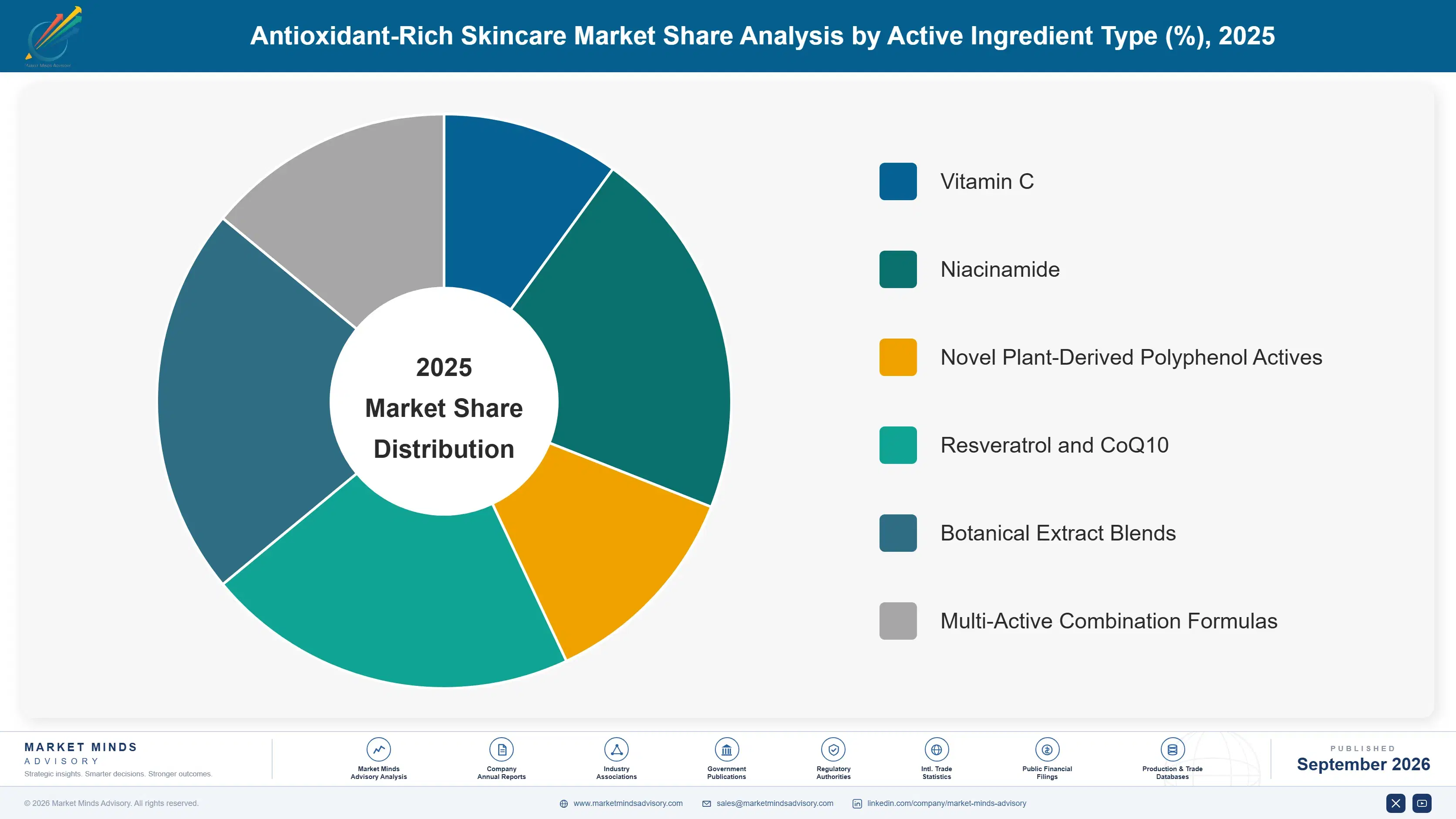
Segmentation follows active ingredient type, the dimension driving both formulation cost and buyer purchase decisions across mass and prestige retail channels alike. Vitamin C, niacinamide, novel polyphenol actives, resveratrol and CoQ10, botanical extract blends, and multi-active combination formulas each carry distinct cost, efficacy, and price positioning worth tracking separately across the entire forecast period.
antioxidant-rich-skincare-market-market-share-analysis-1790015488933

Novel Plant-Derived Polyphenol Actives

Novel plant-derived polyphenol actives, including grape seed, green tea, and pomegranate-derived compounds, lead segment growth as formulators commercialize next-generation antioxidants with stronger clinical differentiation than established vitamin C and niacinamide formulations already dominating retail shelf space worldwide. These actives command meaningful pricing premiums since extraction methods remain more specialized and supply chains less commoditized than conventional antioxidant inputs sourced at industrial scale globally. South Korean and Japanese formulators are leading commercialization, partnering directly with agricultural byproduct processors to secure exclusive sourcing before larger conglomerates enter the category at scale. Buyer interest is concentrated among ingredient-literate younger consumers actively researching novel actives through skincare community platforms and dermatologist-endorsed content before purchase.
CAGR 13.6%

Vitamin C

Vitamin C remains the second-fastest-growing segment despite being the category's most established active, as stability formulation breakthroughs finally made potent, shelf-stable serums viable at mass retail scale rather than requiring cold-chain prestige distribution alone across every consuming market worldwide today. Encapsulation and airless packaging technology have extended effective shelf life meaningfully, letting brands make stronger potency claims than previous generations of vitamin C serums could credibly support at comparable retail price points. This renewed credibility is driving repeat purchase among buyers who had previously abandoned vitamin C products after experiencing degraded, ineffective formulations. Mass retailers are expanding vitamin C assortments accordingly, narrowing the quality gap against prestige counter offerings considerably.
CAGR 11.2%
Full segment breakdown across 6 segments available in the complete report.

Regional Architecture and Country Demand Map

East Asia leads global share on South Korean and Japanese formulation science leadership and ingredient-literate buyer culture, followed by North America's clinical-first independent brand landscape. South Asia and Pacific grows fastest as pollution-driven demand accelerates rapidly across major metropolitan centers and expanding secondary cities nationwide.

North America

North America's antioxidant skincare demand centers on a thriving clinical-first independent brand landscape, where dermatologist-founded startups compete directly against established conglomerates by leading with peer-reviewed efficacy data rather than marketing claims alone. Roughly 24 percent of global revenue traces to the region, supported by strong e-commerce infrastructure that lets ingredient-literate buyers research formulations thoroughly before purchase decisions are finalized each season. Canadian demand mirrors US patterns closely, though at smaller absolute scale across comparable retail channels, pricing tiers, and distribution formats nationwide. Regulatory scrutiny from the FDA over unsubstantiated antioxidant claims is intensifying steadily, pushing brands toward more conservative marketing language backed by actual clinical study results rather than aspirational positioning.
Share: 24% | CAGR: 9.5% (2026 to 2036)

Western Europe

Western Europe combines strict EU cosmetics regulation with a mature dermocosmetics pharmacy channel that has sold clinically positioned skincare for decades longer than most other regions worldwide today. French and German pharmacy-brand antioxidant lines carry inherent credibility that newer direct-to-consumer entrants must work considerably harder to establish elsewhere in the market and across national borders each retail season. Regulatory compliance costs run higher here than in most regions, since EU claim substantiation standards exceed baseline requirements in several other major consuming markets tracked closely. British buyers increasingly favor clean-label antioxidant positioning, pushing formulators toward naturally derived actives even where synthetic alternatives offer comparable proven efficacy at meaningfully lower production cost.
Share: 19% | CAGR: 8.2% (2026 to 2036)
Regional intelligence for 5 additional markets available in the complete report: East Asia, South Asia and Pacific, Latin America, Middle East and Africa, Eastern Europe. Contact sales@marketmindsadvisory.com.
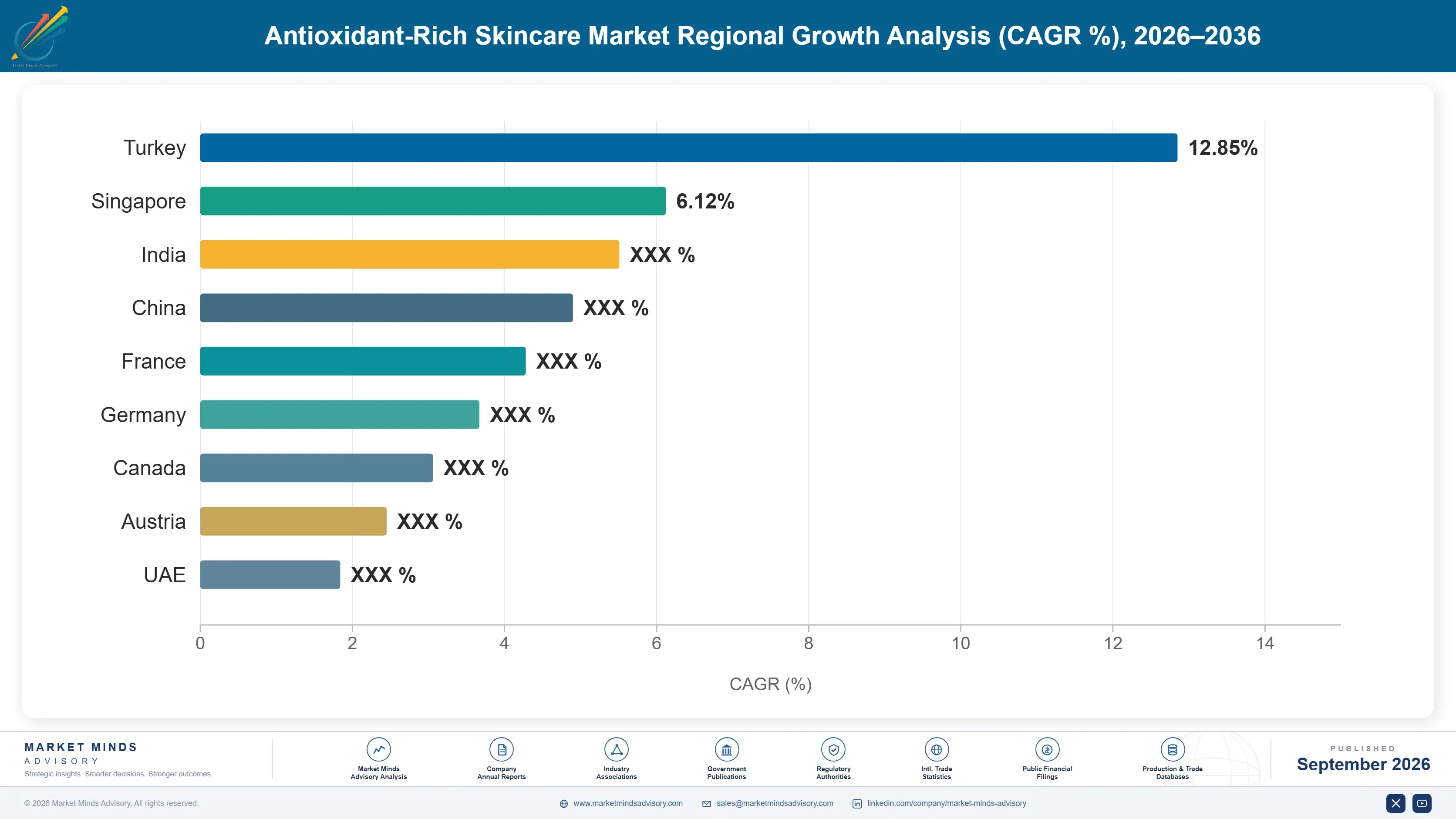
antioxidant-rich-skincare-market-country-cagr-analysis-1790015489466

Where Antioxidant Skincare Margin Concentrates

Four levers separate antioxidant skincare brands capturing outsized margin from those competing purely on ingredient inclusion: clinical substantiation investment, novel active commercialization, formulation stability technology, and pollution-specific positioning. Each shifts revenue toward credibility-backed premium pricing rather than commodity ingredient claims across mass and prestige retail channels alike worldwide, compounding customer trust over successive purchase cycles.

Fund Independent Clinical Substantiation Studies Early

Brands commissioning independent, peer-reviewed clinical studies for flagship antioxidant claims command retail price premiums averaging 28 percent over comparable products relying on supplier-provided ingredient data alone. Retailers increasingly favor substantiated products for premium shelf placement, and dermatologist recommendation rates run measurably higher for clinically documented formulations than for unsubstantiated competitors across every major retail channel and price tier. The upfront cost is significant, but brands report faster retailer approval cycles and stronger repeat purchase rates once credibility is established with ingredient-literate buyers researching formulations carefully before purchase decisions are finalized.
Market Impact: Commands a 28 percent price premium over rivals

Commercialize Novel Polyphenol Actives Ahead of Rivals

First-mover formulators commercializing novel plant-derived polyphenol actives capture meaningfully higher margins during the roughly 18-month window before competitors replicate comparable extraction and stabilization methods used in flagship product lines across the entire category and price tier worldwide today and beyond. Early entrants also secure exclusive sourcing agreements with agricultural byproduct processors, locking in supply advantages that later entrants cannot easily replicate at comparable cost or speed to market. This first-mover window is narrowing as extraction technology becomes more widely accessible, making speed to market increasingly valuable relative to formulation perfection.
Market Impact: Captures outsized margin across an 18-month early-mover window

Invest Early in Encapsulation and Stability Technology

Formulation stability technology, including encapsulation and airless packaging, extends effective antioxidant potency by an estimated 40 percent versus conventional jar packaging, letting brands make stronger, more defensible potency claims backed by measurable clinical data across every product category and price tier. This investment directly reduces returned product complaints tied to degraded efficacy, protecting brand trust that took years to build across loyal customer segments and retail partnerships. Mass retailers are increasingly requiring stability data before listing new antioxidant serums, making this investment less optional than it was several years ago.
Market Impact: Extends effective antioxidant potency by roughly 40 percent

Develop Pollution-Specific Positioning and New Formulations

Brands developing pollution-specific antioxidant positioning, targeting environmental oxidative stress rather than solely age-related concerns, are capturing new buyer segments worth an estimated 12 percent of category growth in heavily polluted metropolitan markets across Asia and beyond each forecast year and retail season. This positioning resonates particularly with younger urban buyers who had not previously considered themselves anti-aging category customers at all before this recent shift began reshaping the category. Formulators are pairing this positioning with dermatologist partnerships in high-pollution cities to build credibility quickly among a newly addressable customer base.
Market Impact: Captures 12 percent of category growth in polluted metros

Who Controls the Margin Pool

Ranked on global revenue from antioxidant-positioned skincare product sales, the market carries a CR5 near 29 percent, with L'Oreal and Estee Lauder Companies leading over Shiseido, Beiersdorf, and Amorepacific across most tracked geographies and price tiers. The gap between the top two and the rest of the field reflects deeper clinical research infrastructure and dermatology partnership networks rather than raw manufacturing scale alone.
Current competitive activity centers on clinical substantiation investment, novel polyphenol active commercialization, and formulation stability technology adoption across mass and prestige tiers alike worldwide and across price points. Several conglomerates are also acquiring or partnering with dermatology research organizations to close the credibility gap against clinical-first independent brands faster than building comparable in-house capability from scratch, particularly in fast-growing premium segments.

Emerging pressure comes from South Korean and Japanese domestic formulators exporting both finished products and clinical substantiation methodology itself, plus independent clinical-first brands gaining share through dermatologist-endorsed digital marketing that bypasses traditional department store counters entirely. Rankings could shift meaningfully if East Asian formulators continue converting formulation science leadership into global market share faster than Western incumbents can respond with comparable clinical infrastructure.
antioxidant-rich-skincare-market-company-positioning-matrix-1790015489991

Competitive Moat and Risk Dimensions

L'OREAL

Moat: Deepest Dermatology Research Network

L'Oreal operates one of the industry's largest in-house dermatological research divisions, generating peer-reviewed clinical data across its full antioxidant product range faster than smaller competitors can commission comparable third-party studies. This research scale also lets the company substantiate claims across multiple brand tiers simultaneously, spreading fixed clinical costs over a far larger revenue base.
L'OREAL

Risk: Slower Novel Active Commercialization

L'Oreal's scale and established clinical processes can slow adoption of newly emerging polyphenol actives relative to nimbler independent brands willing to commercialize novel ingredients faster with less extensive internal validation, potentially ceding early-mover advantage in next-generation antioxidant categories to smaller, faster-moving competitors across premium market segments.
ESTEE LAUDER COMPANIES

Moat: Strong Prestige Clinical Credibility

Estee Lauder's decades of dermatologist relationships and clinical trial publication history give its antioxidant serum lines credibility that newer entrants struggle to replicate quickly, particularly among prestige buyers who weight brand research heritage heavily in purchase decisions across multiple product categories and price tiers worldwide.
ESTEE LAUDER COMPANIES

Risk: Vulnerable to Independent Brand Disruption

Estee Lauder's prestige positioning and higher price points leave it exposed to clinical-first independent brands offering comparable or superior substantiated efficacy at lower price points, particularly among younger, ingredient-literate buyers less loyal to legacy brand heritage than previous generations of skincare customers across most markets.

Players Tracked

Prominent Players

L'Oreal
Estee Lauder Companies
Shiseido Company
Beiersdorf AG
Amorepacific Corporation

Other Key Players

Unilever
Procter & Gamble
Kao Corporation
LG Household & Health Care
Puig
Clarins Group
Revlon Inc.
Natura &Co
Chanel Limited
Johnson & Johnson Consumer Health
Kose Corporation
Cosmax Inc.
Colgate-Palmolive (Elta MD)
Galderma Group
Dr. Dennis Gross Skincare

Recent Developments

JANUARY 2026

L'Oreal Opens Dedicated Antioxidant Stability Research Center

L'Oreal opened a dedicated research center focused specifically on antioxidant formulation stability, aiming to accelerate development of longer-lasting vitamin C and polyphenol actives across its full brand portfolio. The facility centralizes clinical testing capacity previously distributed across several regional laboratories, cutting study timelines meaningfully for future product launches.
Signal: Signals major conglomerates are formalizing antioxidant stability science as a foundational, dedicated core research priority industry-wide
SEPTEMBER 2025

Estee Lauder Companies Partners With Dermatology Research Organization

Estee Lauder Companies signed a multi-year partnership with an independent dermatology research organization to generate peer-reviewed efficacy data for its antioxidant serum portfolio across multiple brand lines. The partnership responds directly to rising retailer demand for third-party substantiation before granting premium shelf placement to new product submissions.
Signal: Signals prestige conglomerates are increasingly outsourcing clinical credibility to specialists rather than building it entirely alone
APRIL 2026

Amorepacific Launches Novel Polyphenol Active Serum Line

Amorepacific launched a new serum line built around a proprietary polyphenol active extracted from Korean agricultural byproducts, positioned specifically against established vitamin C competitors across the premium segment. The launch builds on the company's existing formulation science leadership in the domestic Korean market and beyond.
Signal: Signals Korean formulators are converting domestic research leadership into differentiated, exportable global product lines successfully worldwide

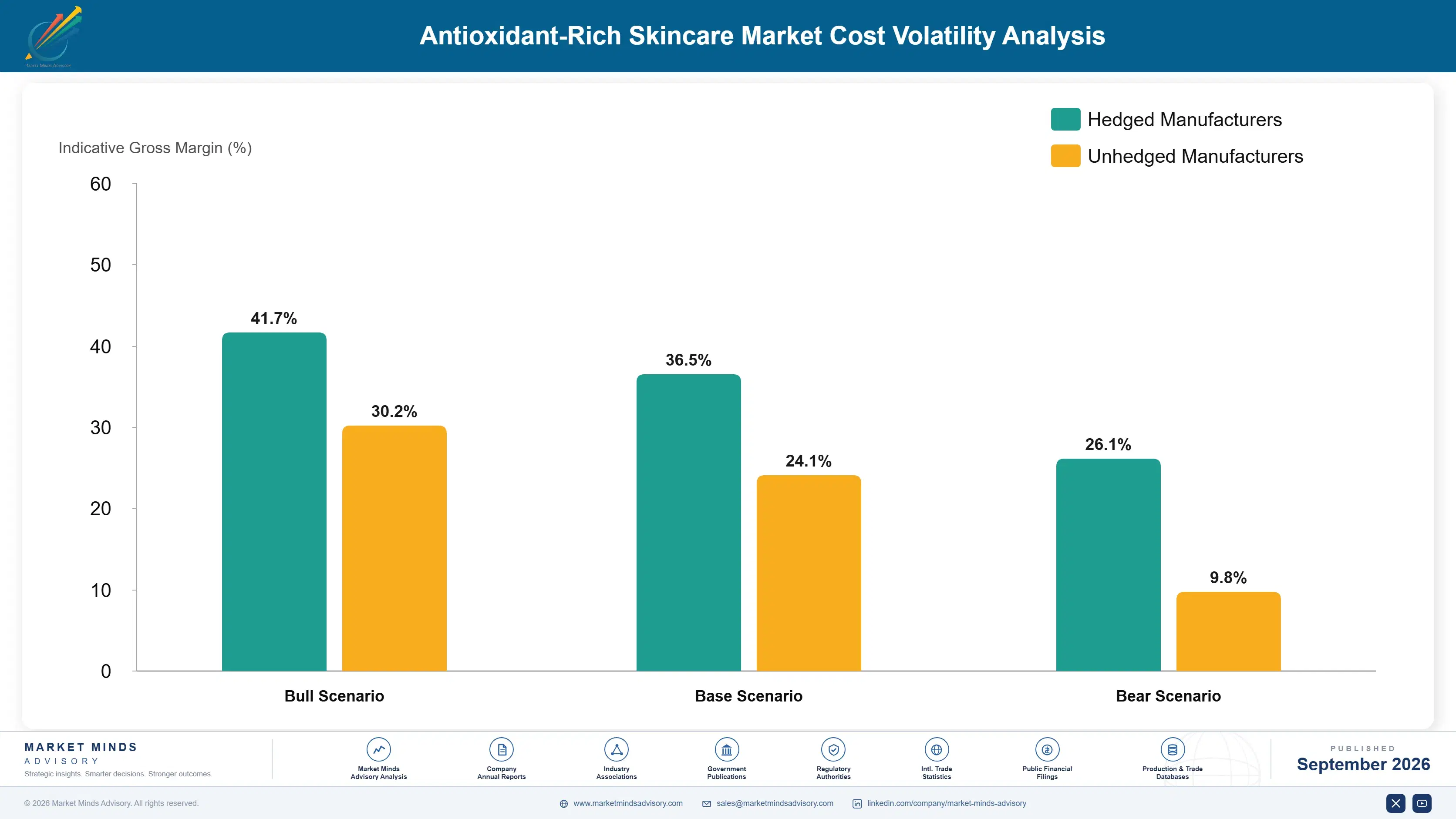
Antioxidant Ingredient Supply Exposure

Antioxidant active ingredients account for roughly 22 percent of finished serum cost of goods sold, sourced from a concentrated base of specialty ingredient suppliers headquartered in Switzerland, Japan, and the United States, with botanical extracts sourced from India, China, and Mediterranean growing regions feeding downstream formulation and manufacturing operations across most producing countries worldwide each season and year.
Vitamin C raw material prices spiked sharply during 2024 after a major Chinese ascorbic acid production facility temporarily halted operations for environmental compliance upgrades, a volatility event documented in company annual reports from major ingredient suppliers, forcing several mid-tier formulators to seek alternative antioxidant sourcing within a single production quarter and renegotiate longer-term supply contracts with alternative regional suppliers to reduce future exposure to comparable disruption events.

Vertically integrated conglomerates with long-term ingredient supply contracts absorb raw material volatility more easily than independent clinical brands purchasing on shorter-term spot arrangements, widening the cost gap between large and small players during price spikes considerably across most product categories tracked. Geographic exposure also varies, since Western formulators maintain deeper supplier relationships than newer regional entrants still building comparable sourcing networks.
antioxidant-rich-skincare-market-cost-volatility-analysis-1790015490188

Dual Sourcing Across Synthetic and Natural Vitamin C

Formulators are qualifying dual-pathway vitamin C sourcing, spanning both synthetic ascorbic acid and naturally derived alternatives, to reduce dependence on any single production facility or region for a critical active ingredient. This flexibility lets brands substitute during supply disruptions while maintaining consistent potency claims and avoiding costly formulation delays under time pressure from retail partners.

Long-Term Contracts With Regional Ingredient Suppliers

Larger conglomerates are signing multi-year supply agreements directly with regional antioxidant ingredient producers across multiple continents, bypassing volatile spot markets entirely for core active ingredient volumes each production cycle and season. These contracts lock in pricing and volume commitments years ahead, insulating houses from facility-specific disruption that smaller competitors purchasing spot remain fully exposed to.

Portfolio Architecture for Margin Defence

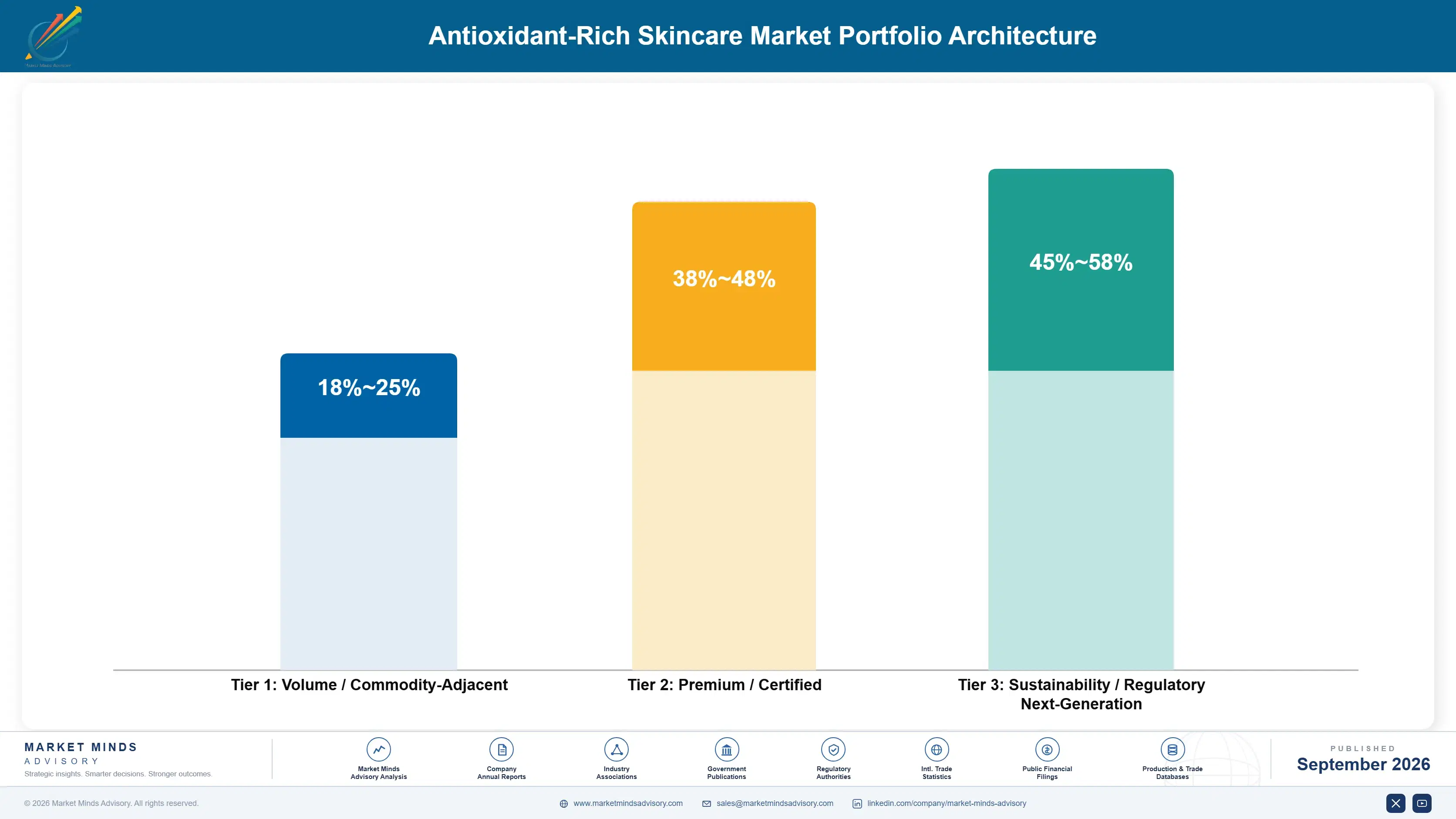
Antioxidant skincare splits into three tiers by margin structure: mass-market commodity serums sold on price and basic ingredient inclusion, clinically substantiated premium lines commanding trust and efficacy premiums, and next-generation sustainability-focused formulas built around novel plant-derived actives from agricultural byproducts and specialty botanical extracts each season. Volume commodity antioxidant products carry gross margins typically between 18 and 25 percent across most mass retail channels.
Clinically substantiated premium lines, backed by peer-reviewed efficacy studies, command gross margins of 38 to 48 percent, reflecting the research investment and credibility buyers pay for beyond raw formulation cost alone across most retail formats. Novel polyphenol active lines sit at the top of the value pool, often exceeding 52 percent gross margin given specialized extraction methods and limited early competition worldwide.

The tension between volume and premium tiers shapes capital allocation heavily, since scaling clinically-substantiated claims requires deliberate research investment rather than manufacturing expansion alone across every product line and price tier tracked. High-value pools concentrate in East Asian formulation science hubs and North American clinical-first independent brands, where buyers consistently pay meaningfully more for verified potency and documented efficacy.

Volume / Commodity-Adjacent

Mass-market antioxidant serums and moisturizers sold primarily on price and basic ingredient inclusion across grocery and drugstore channels, competing heavily on promotional cadence and private-label substitution pressure from major national retailers.
Gross Margin: 18-25%

Premium / Certified

Clinically substantiated antioxidant lines backed by peer-reviewed efficacy studies, sold through specialty and dermatology-adjacent channels, commanding research investment and credibility premiums over unsubstantiated competitors nationwide and internationally across most consuming markets.
Gross Margin: 38-48%

Sustainability / Regulatory / Next-Generation

Novel plant-derived polyphenol actives and next-generation formulations targeting ingredient-conscious buyers, produced through specialized extraction methods that command outsized early-mover margin advantages across most premium and prestige retail channels worldwide today.
Gross Margin: 45-58%
antioxidant-rich-skincare-market-portfolio-architecture-1790015490696

High-value Sub-segments and Strategic Watch-out

Novel Plant-Derived Polyphenol Actives

The fastest-growing and highest-margin segment, driven by South Korean and Japanese formulation science leadership and younger buyers seeking next-generation antioxidants beyond established vitamin C and niacinamide, sustaining premium first-mover pricing across nearly every major consuming market and prestige retail channel tracked in this ten-year forecast.
Gross Margin: 50-60%

Vitamin C

A high-value, moderately fast-growing segment revitalized by stability formulation breakthroughs, now commanding renewed buyer trust after previous generations of unstable, underperforming serums damaged category credibility for several years across most mass and prestige retail formats, price tiers, geographic regions, and consuming markets worldwide throughout the forecast period.
Gross Margin: 38-48%

Niacinamide

The volume core of the market, valued for gentle tolerability and broad compatibility with other actives, anchoring overall category revenue even as growth concentrates elsewhere in newer polyphenol-based formulations gaining traction among younger, ingredient-literate buyers across most retail channels, price tiers, geographic markets, and demographic cohorts.
Gross Margin: 28-38%

Unsubstantiated Commodity Antioxidant Claims

A strategic watch-out as regulatory scrutiny intensifies around unsubstantiated antioxidant marketing claims, risking costly reformulation or claim withdrawal for brands that have not invested in peer-reviewed efficacy documentation well ahead of tightening compliance deadlines across most major consuming markets, price tiers, and retail formats worldwide.
Gross Margin: n/a

Repurchase Loyalty and Ingredient Trust

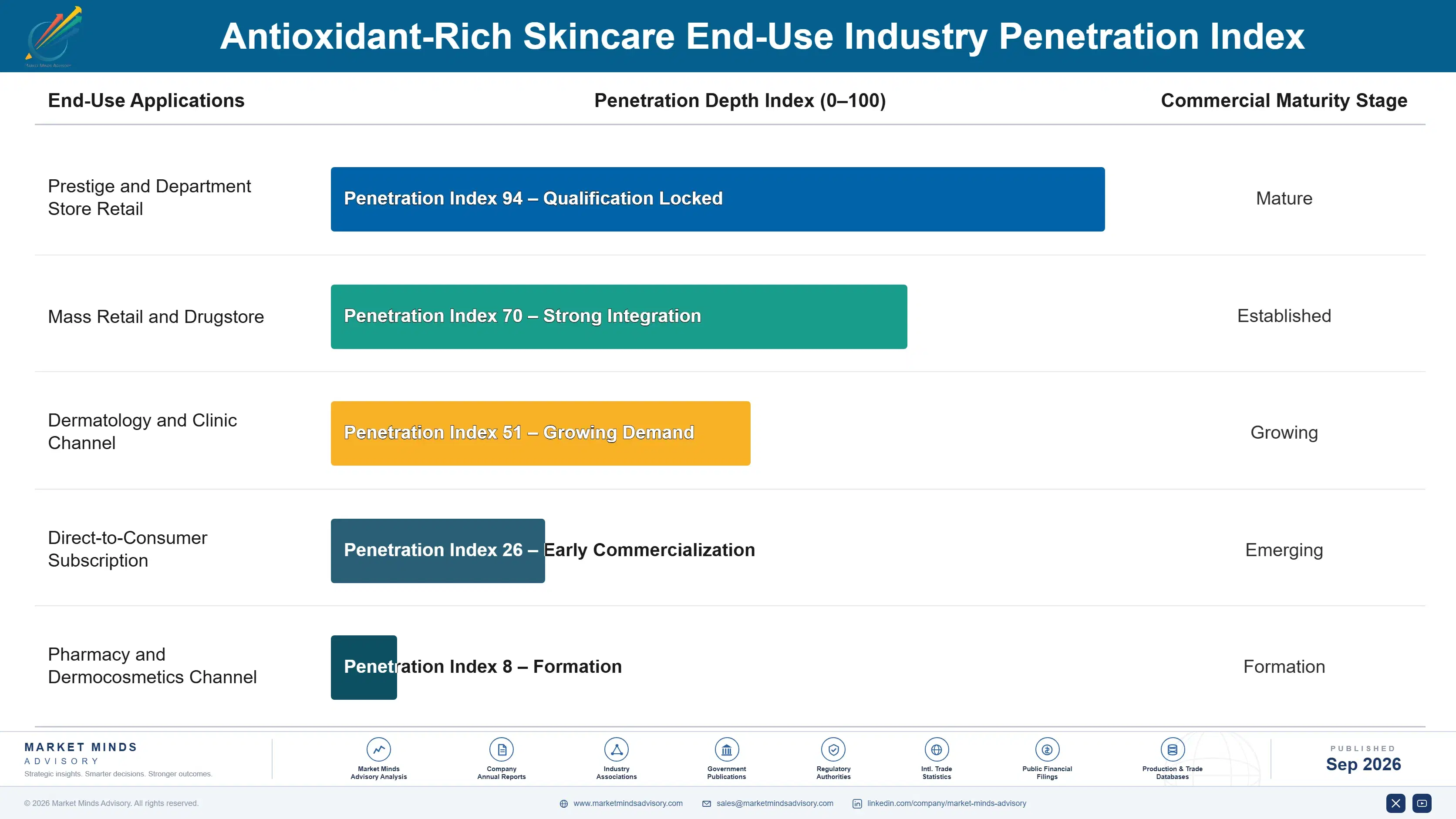
Antioxidant skincare purchasing follows recurring replenishment cycles rather than one-time capital decisions, with average serum repurchase intervals of roughly eight weeks among regular buyers, generating steadier revisit revenue than most other discretionary beauty categories track across comparable periods and buyer cohorts worldwide, particularly within clinically substantiated product lines carrying documented efficacy claims, dermatologist endorsement, and third-party certification over successive purchase cycles.
Adoption depth varies by vertical across the category. Buyers of clinically substantiated premium lines show the deepest loyalty once efficacy is proven through personal experience, often repurchasing for years without switching brands or formulations entirely, while mass commodity antioxidant buyers switch readily between products chasing promotional pricing rather than maintaining consistent formulation loyalty across purchase occasions, price tiers, retail channels, and product categories nationwide.

Generational buyer shifts favor ingredient literacy and clinical evidence over brand heritage alone, as younger buyers raised on skincare community platforms treat antioxidant claims as verifiable data points rather than the marketing trust older generations extended to established brands without independent substantiation, reshaping brand loyalty economics considerably across most consuming markets, retail formats, buyer demographics, purchase channels, and price tiers.
antioxidant-rich-skincare-market-end-use-penetration-index-1790015491189

Priority Moves for Skincare Formulators

These are among the four positions where our research anticipates prominent divergence between winners and laggards over the coming forecast period. Each is grounded in the demand model, the regulatory perimeter, and the announced capacity pipeline.
01 / CLINICAL INVESTMENT PRIORITY

Fund Independent Substantiation Before Retailers Mandate It

Major retailers are already requiring third-party clinical documentation for a growing share of new antioxidant product submissions across mass and prestige channels worldwide, and this gatekeeping trend shows no sign of reversing anytime soon. Brands that fund independent substantiation studies now secure premium shelf placement and dermatologist endorsement ahead of competitors still relying on supplier-provided ingredient data alone. Waiting until retailers mandate documentation risks losing shelf space entirely to faster-moving, better-documented rivals across every major retail channel and price tier.
02 / NOVEL ACTIVE COMMERCIALIZATION

Move Fast on Novel Polyphenol Actives Before Rivals Do

Novel plant-derived polyphenol actives are commanding meaningful pricing premiums during an early-mover window that is narrowing as extraction technology becomes more widely accessible industry-wide across most producing regions and supplier networks each year. Formulators that secure exclusive sourcing agreements with agricultural byproduct processors now lock in supply advantages that later entrants cannot easily replicate at comparable cost or speed to market. Delaying commercialization risks ceding the category's highest-margin segment entirely to faster-moving South Korean and Japanese competitors already investing heavily.
03 / FORMULATION STABILITY INVESTMENT

Prioritize Encapsulation Technology Over Marketing Spend

Formulation stability technology directly determines whether antioxidant potency claims hold up by the time product reaches end consumers in humid or poorly stored retail environments worldwide and abroad, and degraded serums generate returned product complaints that damage brand trust for years afterward. Investing in encapsulation and airless packaging now protects credibility that took considerable time to build across loyal customer segments and retail partnerships. Brands that skip this investment risk retailer delisting as stability data requirements become standard across the category.
04 / EAST ASIAN DISTRIBUTION EXPANSION

Expand East Asian Distribution Before Local Rivals Consolidate

East Asia already commands the largest regional share and is growing fastest among all tracked regions worldwide, anchored by South Korean and Japanese formulation science leadership that most Western competitors cannot easily replicate at comparable speed, cost, or investment scale. Brands over-indexed on legacy Western distribution risk ceding share to domestic conglomerates exporting both finished products and clinical substantiation methodology itself to Western partners. Expanding East Asian distribution now captures growth before domestic competitors fully consolidate their formulation science advantage.

Engagement Snapshot From the Field

A live engagement with an industry participant carrying material or product regulatory and market exposure ahead of a defining policy shift, showing how our research translates into a defensible multi-year portfolio strategy.
MARKET MINDS ADVISORY · CLIENT ENGAGEMENT SUMMARY
Antioxidant-Rich Skincare Producer Strategic Portfolio Review and Transition Roadmap 2026·Investment Scenario on Antioxidant-Rich Skincare Exposure Evaluation 2025-26
CLIENT PROFILE
The client is an independent clinical-first skincare brand focused on antioxidant serums, operating primarily through direct-to-consumer and select specialty retail channels in North America, with annual revenue of approximately $85 million (client-reported, unverified by MMA). The company built its reputation on peer-reviewed efficacy studies but lacked the wholesale retail relationships larger conglomerates hold across most major markets.
STRATEGIC CHALLENGE
The client struggled to secure premium shelf placement in prestige retail despite strong clinical data, as buyers favored conglomerate brands with established wholesale relationships over independent challengers regardless of substantiation quality or study rigor. Growth had plateaued as direct-to-consumer customer acquisition costs rose faster than revenue across nearly every channel.
MMA APPROACH
MMA conducted primary interviews with 35 prestige retail buyers and 20 dermatologists to map how clinical evidence actually influences shelf placement and recommendation decisions, benchmarked against four competitor market entry approaches already in market. The engagement modeled expected basket lift under three distribution partnership scenarios before recommending a phased retail expansion sequence.
KEY FINDINGS
  1. Retail buyers weighted third-party clinical study count more heavily than brand tenure when evaluating new antioxidant product submissions for premium shelf placement nationwide.
  2. Dermatologist recommendation rates for the client's flagship serum exceeded category average by roughly 15 percentage points among surveyed practitioners across the region.
  3. Competitors with formalized retail partnership programs reported customer acquisition costs roughly 25 percent lower than pure direct-to-consumer competitors relying solely on paid advertising.
  4. Buyers under 35 showed the strongest willingness to switch from established conglomerate brands to independent challengers offering verified, peer-reviewed clinical study data.
CLIENT PROFILE
The client is an independent clinical-first skincare brand focused on antioxidant serums, operating primarily through direct-to-consumer and select specialty retail channels in North America, with annual revenue of approximately $85 million (client-reported, unverified by MMA). The company built its reputation on peer-reviewed efficacy studies but lacked the wholesale retail relationships larger conglomerates hold across most major markets.
STRATEGIC CHALLENGE
The client struggled to secure premium shelf placement in prestige retail despite strong clinical data, as buyers favored conglomerate brands with established wholesale relationships over independent challengers regardless of substantiation quality or study rigor. Growth had plateaued as direct-to-consumer customer acquisition costs rose faster than revenue across nearly every channel.
MMA APPROACH
MMA conducted primary interviews with 35 prestige retail buyers and 20 dermatologists to map how clinical evidence actually influences shelf placement and recommendation decisions, benchmarked against four competitor market entry approaches already in market. The engagement modeled expected basket lift under three distribution partnership scenarios before recommending a phased retail expansion sequence.
KEY FINDINGS
  1. Retail buyers weighted third-party clinical study count more heavily than brand tenure when evaluating new antioxidant product submissions for premium shelf placement nationwide.
  2. Dermatologist recommendation rates for the client's flagship serum exceeded category average by roughly 15 percentage points among surveyed practitioners across the region.
  3. Competitors with formalized retail partnership programs reported customer acquisition costs roughly 25 percent lower than pure direct-to-consumer competitors relying solely on paid advertising.
  4. Buyers under 35 showed the strongest willingness to switch from established conglomerate brands to independent challengers offering verified, peer-reviewed clinical study data.
RECOMMENDED STRATEGY
Phase 1: Phase 1 (Months 1 to 3): Package existing clinical study data into a standardized retailer pitch deck targeting five priority specialty retail accounts. Phase 2: Phase 2 (Months 4 to 8): Launch a dermatologist partnership program in three metropolitan markets to drive recommendation-based customer acquisition. Phase 3: Phase 3 (Months 9 to 14): Expand into two additional prestige retail accounts based on Phase 1 and 2 conversion and basket data.
OUTCOME
Within 14 months, the client reported securing three new prestige retail wholesale accounts and a measurable reduction in blended customer acquisition cost as dermatologist referrals grew (client-reported, unverified by MMA). The client also reported revenue growth of approximately 34 percent over the engagement period, outpacing prior year growth meaningfully.

Frequently Asked Questions

Foundational context covering the market sizes, CAGR, scope, country, region and competition that inform every finding below. This section is provided to cover basics and most often pre-purchase conversations, answered from the MMA Primary Research Dataset.

What is the current size of the Antioxidant-Rich Skincare Market?

The global antioxidant-rich skincare market reached approximately $28.4 billion in 2025. This figure covers serums, creams, and treatments formulated with vitamin C, niacinamide, and other polyphenol actives marketed on antioxidant efficacy.

How large will the Antioxidant-Rich Skincare Market be by 2036?

The market is projected to reach approximately $79.41 billion by 2036, roughly 2.55 times its 2026 value. Growth is led by novel plant-derived polyphenol actives and vitamin C segments expanding fastest across East Asian markets.

What is the CAGR for the Antioxidant-Rich Skincare Market 2026 to 2036?

The market is forecast to grow at a compound annual growth rate of 9.8 percent between 2026 and 2036. Bull and bear scenarios range from 11.1 percent to 8.5 percent depending on regulatory and formulation factors.

Which segment is growing fastest?

Novel plant-derived polyphenol actives are the fastest-growing segment at a 13.6 percent CAGR, roughly 1.39 times the overall market rate. Vitamin C follows closely as the second-fastest segment at 11.2 percent.

Who are the major companies in the Antioxidant-Rich Skincare Market?

Leading companies include L'Oreal, Estee Lauder Companies, Shiseido Company, Beiersdorf AG, and Amorepacific Corporation. Together these five players hold a combined market share of roughly 29 percent, ranked on global antioxidant product revenue.

Which country is growing fastest?

South Korea is the fastest-growing country market at a 12.4 percent CAGR, driven by formulation science leadership and ingredient-literate buyer culture. This outpaces the broader East Asian regional average of 10.9 percent.

Report Segmentation Architecture

The full report scope spans multiple orthogonal segmentation dimensions, with cross-tabulated demand data provided for each dimension pair. Coverage extends further to regional breakdowns, trend trajectories, and the competitive detail needed to support segment-level decision-making.

By Active Ingredient Type

  • Vitamin C
  • Niacinamide
  • Novel Plant-Derived Polyphenol Actives
  • Resveratrol and CoQ10
  • Botanical Extract Blends
  • Multi-Active Combination Formulas

By End-Use Industry

  • Prestige and Department Store Retail
  • Mass Retail and Drugstore
  • Dermatology and Clinic Channel
  • Direct-to-Consumer Subscription
  • Pharmacy and Dermocosmetics Channel

By Commercial Dimension

  • Prestige Price Tier
  • Mass Price Tier
  • Clinically Substantiated Positioning
  • Clean-Label and Naturally Derived Positioning

By Region

  • North America
  • Western Europe
  • East Asia
  • South Asia and Pacific
  • Latin America
  • Middle East and Africa
  • Eastern Europe

Scope, Methodology, and Coverage

Every figure in this report is reproducible from documented input assumptions. The scope below maps the historical period, the forecast horizon, the segmentation dimensions, and the countries covered, alongside the underlying primary and qualitative methodology.
Historical Period
2020 to 2025
Forecast Period
2026 to 2036
Base Year
2025 (USD billions; MMA Primary Research Dataset, September 2026)
Market Definition
The antioxidant-rich skincare market comprises serums, creams, and treatments formulated with vitamin C, niacinamide, resveratrol, and other polyphenol actives marketed on oxidative stress protection and anti-aging efficacy. It excludes ingestible antioxidant supplements and general moisturizers without a substantiated antioxidant claim.
Quantitative Units
USD billions (current prices); unit volume in million bottles where applicable
Segmentation Dimensions
By Active Ingredient Type; By End-Use Industry; By Commercial Dimension; By Region
Regions Covered
North America, Western Europe, East Asia, South Asia and Pacific, Latin America, Middle East and Africa, Eastern Europe
Countries Covered
USA, China, Germany, France, UK, Japan, South Korea, India, Australia, Canada, Brazil, Mexico, Indonesia, Vietnam, Thailand, Malaysia, UAE, Saudi Arabia, South Africa, Nigeria, Turkey, Poland, Netherlands, Italy, Spain, Sweden, Switzerland, Argentina, Colombia, Singapore, and additional markets relevant to this sector
Key Companies Profiled
L'Oreal, Estee Lauder Companies, Shiseido Company, Beiersdorf AG, Amorepacific Corporation, Unilever, Procter & Gamble, Kao Corporation, LG Household & Health Care, Puig, Clarins Group, Revlon Inc., Natura &Co, Chanel Limited, Johnson & Johnson Consumer Health, Kose Corporation, Cosmax Inc., Colgate-Palmolive (Elta MD), Galderma Group, Dr. Dennis Gross Skincare
Quantitative Methodology
Primary survey, n=3,800 respondents, Q4 2025, six countries; demand-side model with trade association cross-validation
Qualitative Methodology
47 expert interviews, Q4 2025; applied to validate demand model assumptions, identify emerging dynamics, and assess competitive positioning
Report Format
PDF and XLSX data workbook (Word format preview document)
Publisher
Market Minds Advisory
Report Code
MMA-2026-CHM-119
Published
September 2026
Contact
sales@marketmindsadvisory.com | www.marketmindsadvisory.com

Purchase the full Antioxidant-Rich Skincare Market Report (2026 to 2036).

The full report delivers a comprehensive analysis of the global antioxidant-rich skincare market, spanning vitamin C, niacinamide, novel polyphenol actives, and multi-active combination formulas across all seven world regions. It includes detailed competitive profiling of 20 major players, ten-year forecast modeling through 2036, and country-level demand analysis across major producing and consuming markets. The report examines clinical substantiation dynamics, novel active commercialization trends, and input cost exposure across the antioxidant ingredient value chain. Buyers receive segmentation data across active ingredient type, end-use channel, and commercial positioning suitable for strategic planning and competitive benchmarking.
Ten-year market sizing and forecast model
Twenty-company competitive profiling and benchmarking analysis
Seven-region demand and growth trend analysis
Clinical substantiation trend and regulatory assessment
Active-ingredient segmentation with detailed margin data
Anonymized client case study and strategy playbook

Built For The People Who Decide

From boardroom strategy to bench-side execution, this report is read cover-to-cover by leaders shaping the next decade of their industry, turning demand scenarios, market dynamics and valuation benchmarks into decisions.
CXOs/ Presidents/ VPs/ Managers
M&A and Corporate Development
Strategy Teams and R&D Heads
Procurement and Product Directors
Regulatory and Compliance Leaders
Investor Relations and Equity Analysts