Market Minds Advisory
Antimony Market

Antimony Market: A Flame Retardant Business That Became a Strategic One

Most antimony arrives as a by-product of somebody else's lead or gold mining, which means supply responds to those metal prices rather than to any demand signal antimony itself sends.

Lead Analyst

Bilal Shaikh

Published

September 2026

Make Smarter Decisions with Customized Research Insights

Request a free sample report and evaluate market opportunities, growth trends, and competitive dynamics relevant to your business needs.

2025 MARKET VALUE$3.4BMarket Size 2025
2036 FORECAST VALUE$9.7BBase Case , 2026 to 2036
CAGR 2026 TO 203610.0 %Bull 11.2% / Bear 8.8%
INCREMENTAL OPPORTUNITY$6.0BNet 10- year value creation
EXPANSION MULTIPLE2.59x2036 value over 2026 base
Strategic Levers
M&A Pipeline
Regional Outlook
Country Rankings
Competitive Intelligence
Segmental Deep-dive
Call-Us : 91 93563 13602

Executive Snapshot and Market Trajectory

Roughly 64% of world antimony arrives as a by-product of lead, gold, and copper operations, so output tracks those metal prices rather than antimony demand. Price signals reach nobody who can respond to them, which is why supply has behaved so badly through the past three years.
Growth runs at 10.0% and the newer uses lead it. Antimony for energy storage and semiconductors grows at 15.0%, exactly 1.50 times the market rate, as liquid metal batteries and infrared detector materials both scale. East Asia holds the largest share at 46%, well outside any normal band, because China mines, processes, and consumes more antimony than everywhere else combined. Recycled secondary supply follows at 12.5%.
Concentration is high at 68% across the top five measured on contained antimony produced. Export controls introduced from 2024 turned a specialty chemical into a strategic material almost overnight, and Western consumers who had never thought about supply security are now paying for having ignored it. Flame retardant substitution research is finally being funded properly for the first time in decades. Only about 11% of roasting and refining capability sits outside Chinese control.
Market Definition
This market covers antimony metal, trioxide, and downstream antimony compounds supplied for industrial use, spanning antimony trioxide flame retardant synergists, antimony metal and alloys for lead-acid batteries, antimony for energy storage and semiconductor applications, catalyst-grade antimony compounds for polyester production, and recycled and secondary antimony recovery. Antimony ore and concentrate traded before processing, unprocessed mine output, and stibnite mineral specimens fall outside scope.
Base Year Value
$3.4B in 2025 (MMA Primary Research Dataset, August 2026)
Forecast Period
2026 to 2036, eleven discrete annual values
CAGR
10.0% base case. Bull 11.2%. Bear 8.8%.
Fastest Growth Segment
Antimony for Energy Storage and Semiconductors: 15.0% CAGR
Fastest Growth Country
India: 12.6% CAGR
Fastest Growth Region
South Asia and Pacific: 12.0% CAGR
Largest Region
East Asia: 46% of 2025 global value
Market Leaders
Hunan Gold, Perpetua Resources, Mandalay Resources, Nyrstar, Korea Zinc. Source: MMA Analysis based on company annual reports.
Primary Survey
n=3,800 procurement and R&D decision-makers, Q4 2025, six countries
Methodology
Demand-side build-up, cross-validated against public data, 47 expert interviews

Antimony Market Forecast Scenarios

antimony-market-size-forecast-scenario-1787302605118
The 2020 to 2025 period ran at 8.6% and supply disruption rather than demand growth explains most of the value increase. Chinese production declined through the period on ore depletion and environmental enforcement, while Russian output became commercially awkward after 2022. Export licensing introduced from 2024 tightened availability sharply, and prices moved several times faster than consumption did.
Three mechanisms carry the 10.0% base case. Flame retardant demand is the largest by volume, tied to construction, electronics, and transport safety standards that do not relax. Energy storage and semiconductor applications are the second, growing from a small base considerably faster than anything else. And Western supply development is the third, adding processing capacity at costs well above Chinese equivalents. None of the three depends on Chinese production recovering at all.
The 11.2% bull case rests on liquid metal battery deployment reaching commercial scale, which would create demand from an application that barely consumed antimony five years ago. The 8.8% bear case is flame retardant substitution accelerating as formulators find alternatives under price pressure, since high prices are exactly what funds substitution research in the first place.

Supply That Cannot Hear the Price

Antimony behaves unlike almost any other industrial mineral, and the reason is that roughly 64% of it arrives as a by-product. A lead smelter or a gold operation produces antimony because the ore contained it, not because anybody wanted more antimony that year. When the price triples, the people who could respond are mining something else entirely and adjusting their output to a different metal's economics.
BY-PRODUCT SUPPLY SHARE64%Of world output arriving alongside lead, gold, and copper
FLAME RETARDANT DEMAND SHARE53%Of consumption going into halogenated flame retardant synergist use
TOP FIVE CONCENTRATION68%High, and concentrated in a small number of producing countries
RECYCLED SUPPLY SHARE19%Of total supply recovered from lead-acid battery and scrap processing
WESTERN PROCESSING CAPACITY11%Of global roasting and refining capability outside Chinese control
SUBSTITUTION RESEARCH THRESHOLD3 timesPrice level at which formulators fund alternative synergist development
Demand meanwhile is unusually captive. Around 53% goes into flame retardant systems as a synergist with halogenated compounds, where it improves performance enough that formulators have tolerated considerable price increases rather than reformulate. That tolerance is not unlimited. Sustained pricing at around three times historical levels is roughly where substitution research gets funded properly, and several formulators crossed that line during 2024.
The strategic dimension arrived suddenly. Export licensing from 2024 turned a material most Western manufacturers had never considered into a supply security question, and only about 11% of global roasting and refining capability sits outside Chinese control. Building processing capacity takes years and permits, which is why the response so far has been stockpiling and substitution rather than new supply.
"A flame retardant formulator told me they had never once discussed antimony at board level in thirty years. They discussed it four times in 2024, and none of those conversations were about price."
Director, Critical Minerals and Specialty Chemicals Practice · MMA Chemicals and

Market Trends

Export Controls Convert A Chemical Into A Strategic Material

Licensing requirements introduced from 2024 changed how Western manufacturers think about a material they had previously bought without consideration. Only around 11% of global roasting and refining capability sits outside Chinese control, and building more takes years of permitting rather than months of capital. The immediate responses have been stockpiling, qualification of alternative suppliers, and substitution research, because none of those require a new mine or a new smelter to be built first. Consumers who had never discussed antimony at board level discussed it repeatedly during 2024. None of those conversations concerned price.
Market Impact: Some 53% goes to flame retardants

Energy Storage Creates Demand From Almost Nothing

Liquid metal battery chemistries and antimony-based semiconductor materials both consume antimony in applications that barely existed five years ago, growing at 15.0% against 10.0% for the market. Volumes remain small against flame retardant consumption and the growth rate is genuine. These applications also specify purity levels well above flame retardant grade, which requires refining capability that most by-product producers do not currently hold at all. That refining gap is a commercial opportunity rather than a technical obstacle for anybody willing to build it. Substitution pressure in these applications is also considerably weaker.
Market Impact: Recycling supplies 19% of total

Market Opportunities and Growth Drivers

Flame Retardant Standards Do Not Relax

Building codes, electronics safety requirements, and transport regulations all specify flame retardant performance that halogenated systems with antimony trioxide synergist meet reliably and cheaply. Around 53% of antimony consumption serves that role, and the standards themselves are not under pressure even where specific chemistries are. Demand therefore persists through price increases that would destroy a discretionary application, which is precisely why formulators tolerated three years of them. A qualified flame retardant system cannot change without retesting against the codes it was approved under. That approval barrier is what absorbed three years of price increases.
Market Impact: Around 64% is by-product supply

Recycling Supplies Nearly A Fifth Without New Mining

Lead-acid battery recycling recovers antimony alloyed into grids and posts, contributing around 19% of total supply from material already in circulation. That stream is genuinely counter-cyclical against mine by-product output, since it follows vehicle battery replacement rather than lead or gold prices. Expanding recovery rates within existing recycling infrastructure is considerably faster than opening a mine, and several Western processors are pursuing exactly that. Recovery circuits within existing recycling infrastructure cost far less than any equivalent primary supply position. Several Western processors have identified this as their fastest available response. Timelines run in months rather than years.
Market Impact: Substitution funds at 3 times

Market Restraints and Challenges

By-Product Supply Cannot Respond To Price

Around 64% of world antimony arrives alongside lead, gold, and copper, and the root cause is geological: antimony occurs with those metals and is recovered because it is there rather than because it is wanted. Commercial impact is a supply curve that barely moves when prices triple, since the operators who could respond are optimising a different metal entirely. Mitigation runs through primary antimony projects, expanded recycling, and long-term offtake that gives by-product producers a reason to recover more. Recovery investment by by-product operators is considerably faster than any new primary mine.
Market Impact: Only 11% of processing outside

High Prices Fund The Substitution That Removes Demand

Sustained pricing near three times historical levels is roughly where flame retardant formulators fund alternative synergist development properly, and the root cause is that antimony is a performance enhancer rather than an irreplaceable component. Commercial impact is that the price spike creating today's producer margins is simultaneously financing tomorrow's demand destruction. Mitigation runs through supply stability that keeps prices below the research funding threshold, and through building positions in applications where substitution is genuinely much harder. Once a substitution programme completes and requalifies, that demand does not return at any price.
Market Impact: New applications growing at 15.0%
3 additional market trends, 4 additional growth drivers, and 2 additional restraints and challenges are covered in the full report. Contact sales@marketmindsadvisory.com to access the complete intelligence.

Segment CAGR and Growth Architecture

Segmentation follows product form and application, because those determine required purity, processing route, price exposure, and how readily each use could substitute away under pressure. Ore grade and mining method both cut across every product form rather than separating them, which makes either a considerably weaker primary dimension here. Application decides how easily demand could disappear.
antimony-market-market-share-analysis-1787302605650

Antimony For Energy Storage And Semiconductors

The fastest application at 15.0%, exactly 1.50 times the market rate, from a base that barely existed five years ago. Liquid metal battery chemistries alongside antimony-based infrared detector and thermoelectric materials all consume it, and all of them specify purity levels well above flame retardant grade entirely. That purity requirement matters commercially, because most by-product producers cannot reach it at all without additional refining capability they do not currently hold. Volumes remain small against flame retardant consumption, while the growth rate itself is entirely genuine and accelerating. These applications also depend on antimony's specific electronic properties rather than a substitutable performance enhancement. Substitution pressure here is correspondingly weak compared with flame retardants.
CAGR 15.0%

Recycled And Secondary Antimony Recovery

Second fastest at 12.5%, recovering antimony alloyed into lead-acid battery grids and posts from material already circulating rather than from new mining. That stream contributes around 19% of total supply and is genuinely counter-cyclical against by-product output, since it follows vehicle battery replacement rather than lead or gold prices. Expanding recovery within existing recycling infrastructure is considerably faster than opening a mine, and Western processors pursuing supply security have identified it as the quickest available response. Recovery circuits can be commissioned within existing plants in months rather than the years a mine takes. Feed cost is also considerably more predictable than by-product concentrate purchasing. Several processors have contracted it already.
CAGR 12.5%
Full segment breakdown across 5 segments available in the complete report.

Regional Architecture and Country Demand Map

East Asia leads at 46%, far outside any normal band, because China mines, processes, and consumes more antimony than every other region combined. South Asia and Pacific follows on Indian and Australian activity, ahead of Western Europe. Nearly every share here sits outside its framework band.

East Asia

Forty-six percent, far outside the framework band, and justified because China mines, roasts, refines, and consumes more antimony than every other region combined by a considerable margin. That concentration is a measured fact about where the ore and the processing capacity physically sit rather than any analytical judgement. Chinese output has nonetheless declined on ore depletion and environmental enforcement, which is precisely what made export licensing from 2024 consequential. Growth at 10.6% runs above the market rate on domestic flame retardant and battery demand. Export licensing has since restricted which customers domestic producers may serve regardless of available output. Ore grade decline is a genuine physical constraint rather than a policy one.
Share: 46% | CAGR: 10.6% (2026 to 2036)

South Asia and Pacific

Fourteen percent, above the framework band, and Indian flame retardant and battery manufacture combined with Australian mine output explains it. Indian consumption is growing quickly as electronics and construction demand expands, while domestic processing capability remains limited and most trioxide is imported. Australian primary antimony projects have attracted considerable attention since export licensing, since they represent supply outside the dominant processing chain. Growth at 12.0% is the fastest of any region, driven by Indian consumption rather than by Australian production reaching scale. The 14% sits above the framework band, justified by Indian consumption growth and Australian primary resource interest together. Processing capability across the region remains genuinely limited. Most trioxide consumed in the region is imported rather than produced domestically.
Share: 14% | CAGR: 12.0% (2026 to 2036)
Regional intelligence for 5 additional markets available in the complete report: Western Europe, North America, Latin America, Eastern Europe, Middle East and Africa. Contact sales@marketmindsadvisory.com.
antimony-market-country-cagr-analysis-1787302606165

Building Supply the Price Cannot

Around 64% of supply is by-product, 53% of demand is flame retardant, recycling provides 19%, and only 11% of processing sits outside Chinese control. Value comes from offtake with by-product producers, from expanding recycling recovery, and from keeping prices below the substitution research threshold. Supply here responds to an entirely different metal's price signal instead.

Pay By-Product Producers To Recover More

Around 64% of world antimony arrives alongside lead, gold, and copper, and those operators frequently discard or under-recover the antimony, because it is a minor revenue line against their primary metal. Long-term offtake at guaranteed pricing gives those operators a genuine reason to invest in recovery circuits they would otherwise simply skip. That route adds supply considerably faster than any new mine could, and it requires commercial commitment rather than mining capital or permitting. Recovery circuit investment by an existing operator is measured in months rather than in permitting years.
Market Impact: Around 64% of all supply arrives as

Expand Recycling Before Attempting New Mining

Lead-acid battery recycling already supplies roughly 19% of total antimony from material in circulation, and raising recovery rates within existing infrastructure takes months rather than the years a mine requires. The stream is also counter-cyclical against by-product output, since it follows vehicle battery replacement rather than lead or gold prices. Western processors pursuing supply security have correctly identified this as the fastest available response to export licensing. Feed cost from that stream is also considerably more predictable than by-product concentrate purchasing. It requires no mining capability or permitting at all.
Market Impact: Recycling already supplies 19% of t

Keep Prices Below The Substitution Research Threshold

Sustained pricing around three times historical levels is where flame retardant formulators fund alternative synergist development properly, and several crossed that line during 2024. Antimony is a performance enhancer rather than an irreplaceable component, so the demand carrying 53% of consumption is defensible only while reformulating stays unattractive. Producers celebrating a price spike are watching their largest application fund its own replacement, which is a poor trade over any decade. Once substitution completes and requalifies against the codes, that demand does not return at any price. Supply stability is worth more than a spike over any decade.
Market Impact: Substitution research funds at 3 ti

Build Refining Capability For High Purity Applications

Energy storage and semiconductor uses grow at 15.0% against 10.0% for the market and specify purity well above flame retardant grade, which most by-product producers cannot reach without refining capability they do not hold. That gap is a commercial opportunity rather than a technical obstacle, since the refining is understood and the capital is modest against a mine. It also serves applications where substitution is considerably harder than in flame retardants. Refining capital is modest against a mine and the process itself is well understood. Those applications depend on electronic properties rather than substitutable performance enhancement.
Market Impact: New applications are now growing at

Who Controls the Margin Pool

Concentration is high at 68% across the top five measured on contained antimony produced, and geology rather than commercial strategy holds it there. Antimony occurs where it occurs, and roughly 64% of it is recovered by operators whose primary business is a different metal entirely. That structure means the largest producers are frequently not antimony companies at all, and their output decisions follow lead, gold, and copper economics.
Competitive activity runs on three fronts. Processing capability is the first and by far the most consequential since export licensing, because only around 11% of global roasting and refining sits outside Chinese control. Recycling recovery capacity is the second, which supplies material without any mining at all. And high purity refining is the third, serving applications growing far faster than the traditional demand base.

Pressure arrives from two directions. Flame retardant substitution research is being funded properly for the first time in decades. And primary antimony development outside China is attracting policy support that would not have existed three years ago. Both forces work against producers whose position rests entirely on flame retardant grade volume. High purity capability answers one of them directly.

Rankings shift on processing capacity rather than mine output.
antimony-market-company-positioning-matrix-1787302606687

Competitive Moat and Risk Dimensions

HUNAN GOLD

Moat: Integrated mining and processing scale

Holding mine output alongside roasting and refining capacity within the region that dominates global antimony processing gives control across the whole chain rather than a position within it. That integration determines who can supply refined product rather than concentrate, and processing capacity of that scale takes years and permits to build anywhere.
HUNAN GOLD

Risk: Ore depletion and export licensing

Chinese antimony ore grades have declined and environmental enforcement has closed capacity, while export licensing restricts the customers a producer can serve regardless of available output. Both constraints sit outside commercial control entirely. A dominant position in a declining resource base under administrative restriction is considerably less comfortable than the share figure suggests.
PERPETUA RESOURCES

Moat: Primary Western supply position

A primary antimony project outside the dominant processing chain holds strategic value that its production volume alone would not justify, particularly with policy support and offtake interest that did not exist before export licensing. Primary rather than by-product output also means production can respond to antimony economics directly rather than to another metal's price.
PERPETUA RESOURCES

Risk: Development timeline against demand

Permitting and construction take years, and the substitution research that high prices are currently funding could reduce flame retardant demand before first production arrives. A project justified by a price spike faces the risk that the spike itself removes the demand behind it. Timing risk of that kind is not manageable through operational execution.

Players Tracked

Prominent Players

Hunan Gold
Perpetua Resources
Mandalay Resources
Nyrstar
Korea Zinc

Other Key Players

United States Antimony
Larvotto Resources
Tri-Star Resources
Campine
Recylex
Amspec Chemical
Chemtura
Yiyang Huachang Antimony
Guizhou Dongfeng Chemical
Hsikwangshan Twinkling Star
Anhui Chunhui Group
Village Main Reef
Empresa Minera Unificada
Ozerny
Bhilwara Group

Recent Developments

JANUARY 2025

Formulator funds alternative flame retardant synergist programme

A flame retardant formulator commissioned development work on alternative synergist chemistries after sustained antimony pricing made reformulation economically rational for the first time in decades. The programme was internal research investment rather than any joint venture, acquisition, or licensing arrangement with a chemical supplier. Several chemistries entered evaluation.
Signal: The price spike producers are enjoying is
APRIL 2025

Battery recycler expands antimony recovery from lead-acid processing

A lead-acid battery recycler invested in antimony recovery circuits within existing processing infrastructure, raising extraction from material already circulating rather than requiring any new mining activity. The investment was organic capital expenditure rather than any acquisition, joint venture, or offtake arrangement with a mining company.
Signal: Recovery circuit expansion delivers new su
AUGUST 2025

Consumer signs long-term offtake with gold by-product producer

An industrial antimony consumer contracted long-term offtake with a gold producer recovering antimony as a by-product, giving that operator a commercial reason to invest in a recovery circuit it had previously skipped. The agreement was a supply contract rather than any joint venture or equity investment.
Signal: Paying by-product producers to recover mor

Concentrate, Roasting Energy and Reagents

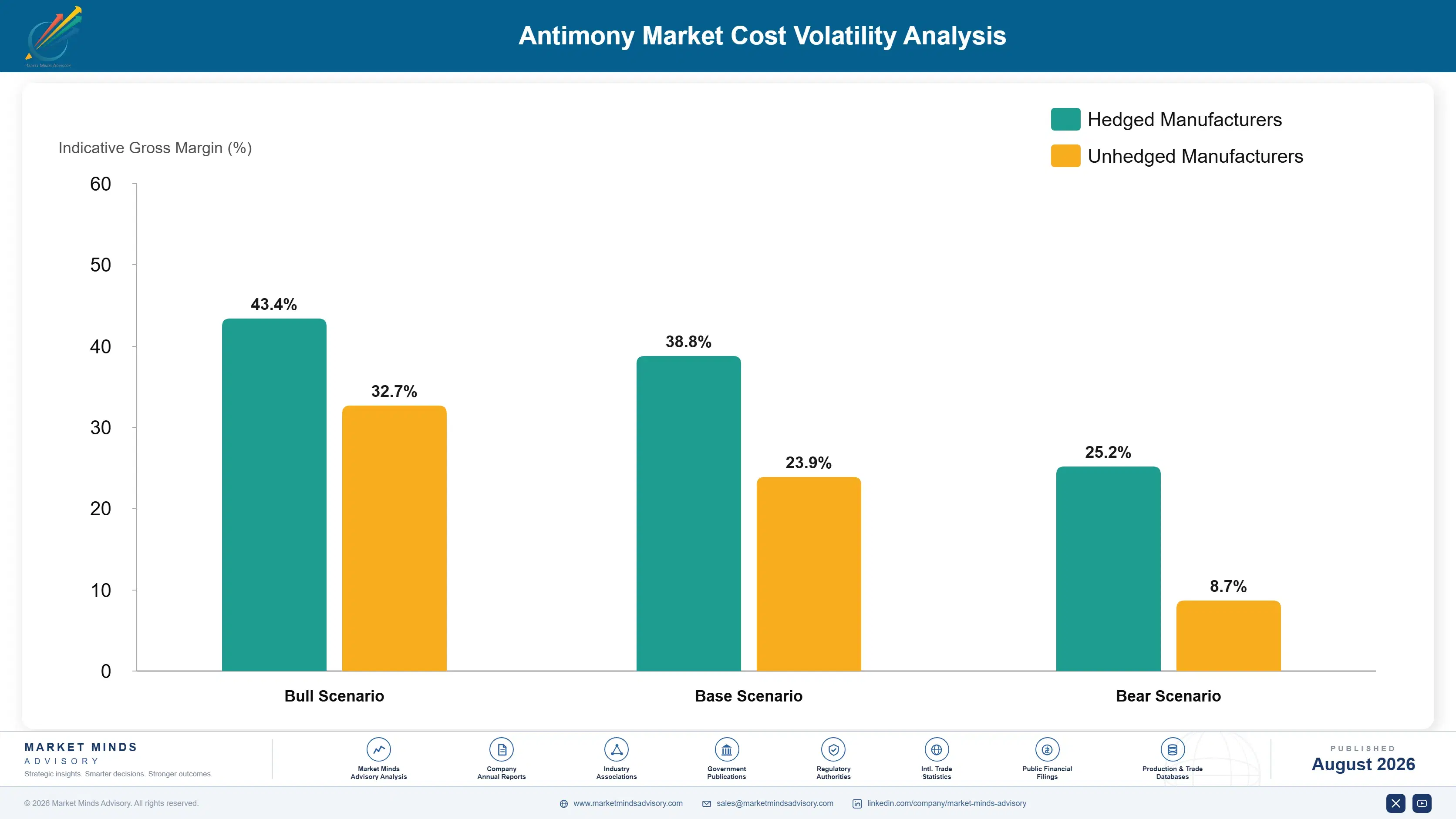
Antimony concentrate or by-product feed carries roughly 47% of processed product cost, roasting and smelting energy about 21%, reagents and fluxes near 11%, environmental control and emissions treatment around 9%, and labour, maintenance, and overhead the balance. Feed cost dominates and is set by a market where most sellers are optimising a different metal entirely, which makes it unusually unpredictable.
Antimony feed pricing moved violently through 2024 as export licensing tightened availability, and several processors disclosed input cost increases and supply interruption in annual filings covering that year. Energy costs for roasting rose separately through 2022 and have not returned to prior levels. Environmental compliance cost has risen steadily across every producing region and shows no sign of easing at all. Feed availability rather than price became binding.

The competitive disadvantage mechanism runs through feed access rather than through processing efficiency. A processor without offtake agreements or integrated mine supply buys concentrate in a market where availability rather than price is frequently the binding constraint, while an integrated producer or one holding long-term contracts runs continuously. Roasting and refining cost broadly the same everywhere; securing the feed to run does not.
antimony-market-cost-volatility-analysis-1787302606881

Contract feed on long-term offtake rather than spot purchase

Feed carries roughly 47% of processed product cost, and most sellers are by-product producers optimising a different metal whose antimony output follows that metal's economics rather than any antimony signal. Long-term offtake gives those operators a reason to invest in recovery and gives the processor supply continuity. Spot purchasing works until availability rather than price becomes the binding constraint.

Recover heat from roasting rather than venting it

Roasting and smelting energy carries about 21% of processed product cost, and antimony roasting operates at temperatures that make heat recovery genuinely worthwhile rather than marginal. Processors venting that heat are purchasing energy they have already produced once. Retrofitting recovery is possible and considerably more expensive than designing it into a new line from the start.

Build recycling feed alongside primary concentrate supply

Lead-acid battery recycling supplies roughly 19% of total antimony from circulating material, and that stream follows vehicle replacement cycles rather than lead or gold prices. A processor drawing on both primary and secondary feed carries considerably less exposure to by-product supply volatility. Recovery circuits within existing recycling infrastructure cost far less than any equivalent primary supply position.

Portfolio Architecture for Margin Defence

Three tiers describe this business and the spread follows purity and substitution exposure rather than volume. Flame retardant grade trioxide sits at the bottom, carrying most of the volume and all of the substitution risk. Battery alloy and catalyst grades occupy the middle, where specification is tighter and alternatives are less developed. High purity metal for semiconductor and energy storage applications sits at the top, where refining capability rather than ore access decides participation
The tension is that the tier carrying 53% of demand is the one funding its own replacement, while the tier growing at 15.0% requires refining capability most producers do not hold. A producer weighted entirely toward flame retardant grade is exposed to a substitution programme it cannot influence. One pursuing high purity needs capital and technical capability that ore access alone does not provide at all.

High-value pools concentrate where substitution is genuinely difficult. Semiconductor and thermoelectric materials depend on antimony's specific electronic properties rather than on a performance enhancement that another additive could deliver. That distinction defends the tier in a way volume never could.

Volume / Commodity-Adjacent Tier

Flame retardant grade antimony trioxide carrying around 53% of consumption and all of the substitution exposure. Volume is large, specification is undemanding, and formulators are now funding alternatives properly for the first time in decades.
Gross Margin: 18-26%

Premium / Certified Tier

Battery alloy antimony and catalyst-grade compounds for polyester production, where specification is tighter and substitution alternatives are considerably less developed. Lead-acid battery demand also connects directly to the recycling stream supplying feed.
Gross Margin: 27-35%

Sustainability / Regulatory / Next-Generation Tier

High purity antimony metal for semiconductor, thermoelectric, and energy storage applications where refining capability rather than ore access decides participation. Best margin by a clear distance, and substitution pressure here is genuinely weak.
Gross Margin: 38-50%
antimony-market-portfolio-architecture-1787302607381

Formulations, Contracts and Stockpiles

Demand arrives through flame retardant formulations, alloy specifications, and now strategic stockpiling, and those behave nothing alike. Formulation demand is steady, volume-driven, and specified into product recipes that change slowly. Alloy demand follows lead-acid battery production directly. Stockpiling is new, lumpy, and driven by supply security concerns that did not exist before export licensing in 2024 changed the calculation entirely. Stockpile buying does not repeat once positions are
Stickiness runs through formulation approval rather than any commercial relationship. A flame retardant system qualified against building codes and product safety standards cannot be changed without retesting, which is why formulators absorbed several years of price increases before funding alternatives. Once that substitution work completes, the demand does not return. High purity applications stick considerably harder on technical grounds.

Buyer profiles shifted decisively when export licensing arrived. The earlier buyer was a procurement function treating antimony trioxide as a routine chemical input on annual contracts. The current conversation increasingly involves supply chain risk functions and occasionally government policy teams asking questions that have nothing to do with price at all. Those functions evaluate concentration risk and processing location rather than annual contract pricing.
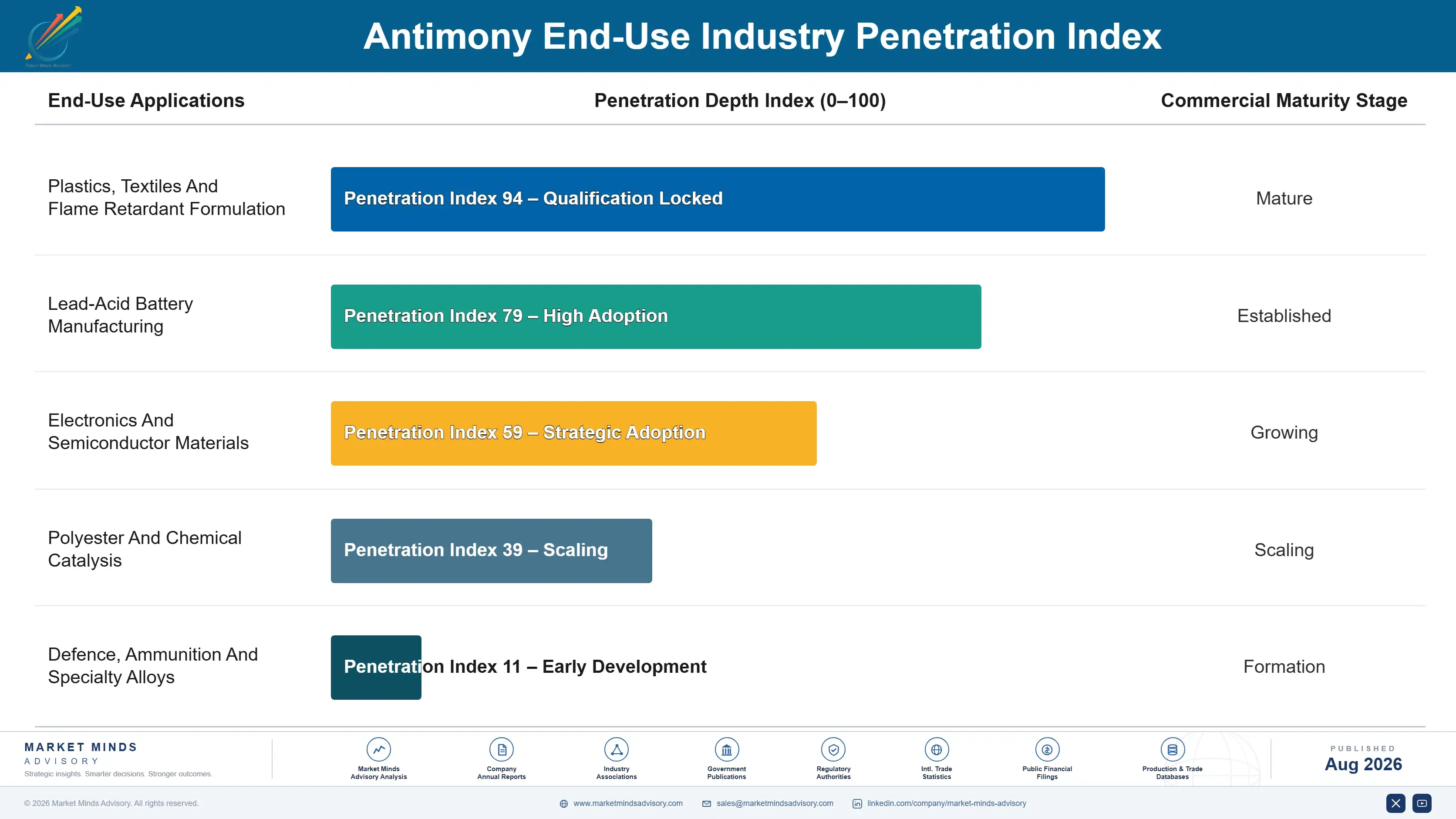
antimony-market-end-use-penetration-index-1787302607866

What We Would Tell a Board

These are among the four positions where our research anticipates prominent divergence between winners and laggards over the coming forecast period. Each is grounded in the demand model, the regulatory perimeter, and the announced capacity pipeline.
01 / BY-PRODUCT OFFTAKE STRATEGY

Pay the gold miners to bother recovering it

Roughly 64% of all world antimony arrives alongside lead, gold, and copper, and those operators frequently under-recover or simply discard it, because antimony is a minor revenue line set against their primary metal entirely. Long-term offtake at guaranteed pricing gives them a genuine commercial reason to invest in recovery circuits they would otherwise skip completely. That route adds supply considerably faster than any new mine possibly could, and it requires commercial commitment rather than mining capital or years of permitting.
02 / RECYCLING EXPANSION PRIORITY

The fastest new supply is already in circulation

Lead-acid battery recycling already supplies roughly 19% of the total antimony supply from material circulating within the economy, and raising recovery rates within existing processing infrastructure takes months rather than the many years that any new mine requires. That secondary stream is also genuinely counter-cyclical against by-product output, since it follows vehicle battery replacement cycles rather than lead or gold prices. Western processors pursuing supply security have correctly identified this as the quickest response available to them following export licensing.
03 / PRICE DISCIPLINE TRADE-OFF

Every price spike funds the substitution that follows

Sustained pricing at around three times historical levels is roughly the point where flame retardant formulators begin funding alternative synergist development properly, and several of the larger ones crossed that line during 2024 itself. Antimony is a performance enhancer rather than an irreplaceable component, so the demand carrying 53% of consumption stays defensible only while reformulating remains unattractive to those same formulators. Producers celebrating a price spike are watching their single largest application quietly fund its own eventual replacement instead.
04 / HIGH PURITY CAPABILITY

Refining reaches where substitution pressure cannot

Energy storage and semiconductor applications grow at 15.0% against 10.0% for the market, and they specify purity levels well above flame retardant grade, which most by-product producers cannot reach without refining capability they do not currently hold. That gap is a commercial opportunity rather than any technical obstacle, since the refining involved is well understood and the capital modest against any mine. Those applications also depend on antimony's specific electronic properties rather than on any substitutable performance enhancement at all.

Engagement Snapshot From the Field

A live engagement with an industry participant carrying material or product regulatory and market exposure ahead of a defining policy shift, showing how our research translates into a defensible multi-year portfolio strategy.
MARKET MINDS ADVISORY · CLIENT ENGAGEMENT SUMMARY
Antimony Producer Strategic Portfolio Review and Transition Roadmap 2026·Investment Scenario on Antimony Exposure Evaluation 2025-26
CLIENT PROFILE
A specialty chemical producer with approximately 175 million dollars in annual revenue (client-reported, unverified by MMA), manufacturing antimony trioxide flame retardant synergist and supplying formulators across two regions. Feed was purchased on spot and short-term contracts, no recycling feed position existed, and input availability had become the binding constraint on output during 2024. Substitution exposure had not been assessed.
STRATEGIC CHALLENGE
Management proposed acquiring an equity stake in a primary antimony mining project to secure feed supply. The board wanted an independent view on timeline and alternatives before committing capital to a mining asset the company had no capability to operate or develop. Feed sourcing alternatives had never been mapped. Timelines were entirely unexamined.
MMA APPROACH
We mapped feed supply globally by source type, separating primary from by-product and secondary material. Recovery rates at by-product operations were assessed against what offtake incentives might achieve. Recycling feed availability was quantified within reachable geography, and the mining project timeline was benchmarked against comparable developments from permitting to first output.
KEY FINDINGS
  1. The mining project would not deliver material within the timeframe over which the client's supply constraint operated, on any comparable development benchmark.
  2. Several by-product operations within reach were recovering antimony at rates well below technical potential, having no commercial reason to invest further. Offtake terms would change that.
  3. Recycling feed within reachable geography exceeded the client's entire annual requirement, and no competing processor had contracted it. Nobody had contracted it yet. The opportunity remained open.
  4. Two of the client's largest formulator customers had begun funding substitution research, which the client had not been aware of at all.
CLIENT PROFILE
A specialty chemical producer with approximately 175 million dollars in annual revenue (client-reported, unverified by MMA), manufacturing antimony trioxide flame retardant synergist and supplying formulators across two regions. Feed was purchased on spot and short-term contracts, no recycling feed position existed, and input availability had become the binding constraint on output during 2024. Substitution exposure had not been assessed.
STRATEGIC CHALLENGE
Management proposed acquiring an equity stake in a primary antimony mining project to secure feed supply. The board wanted an independent view on timeline and alternatives before committing capital to a mining asset the company had no capability to operate or develop. Feed sourcing alternatives had never been mapped. Timelines were entirely unexamined.
MMA APPROACH
We mapped feed supply globally by source type, separating primary from by-product and secondary material. Recovery rates at by-product operations were assessed against what offtake incentives might achieve. Recycling feed availability was quantified within reachable geography, and the mining project timeline was benchmarked against comparable developments from permitting to first output.
KEY FINDINGS
  1. The mining project would not deliver material within the timeframe over which the client's supply constraint operated, on any comparable development benchmark.
  2. Several by-product operations within reach were recovering antimony at rates well below technical potential, having no commercial reason to invest further. Offtake terms would change that.
  3. Recycling feed within reachable geography exceeded the client's entire annual requirement, and no competing processor had contracted it. Nobody had contracted it yet. The opportunity remained open.
  4. Two of the client's largest formulator customers had begun funding substitution research, which the client had not been aware of at all.
RECOMMENDED STRATEGY
Phase 1: Phase 1 (months one to nine): abandon the equity stake, contract long-term offtake with two by-product producers including recovery investment terms. Phase 2: Phase 2 (months nine to twenty-one): secure recycling feed agreements and commission recovery capability for secondary material processing. within existing plant infrastructure. Phase 3: Phase 3 (months twenty-one to thirty-six): develop high purity refining for applications where substitution pressure is materially weaker. and purity is demanded.
OUTCOME
The equity stake was abandoned. Offtake agreements with two by-product producers were signed within three quarters and both committed to recovery circuit investment, while recycling feed contracts covered a meaningful share of requirement by year end (client-reported, unverified by MMA). Capital was preserved for refining development instead.

Frequently Asked Questions

Foundational context covering the market sizes, CAGR, scope, country, region and competition that inform every finding below. This section is provided to cover basics and most often pre-purchase conversations, answered from the MMA Primary Research Dataset.

What is the current size of the Antimony Market?

The market is valued at USD 3.4 billion in 2025, rising to USD 3.74 billion in 2026. Scope covers antimony metal, trioxide, and downstream compounds supplied for industrial use, not ore or concentrate traded before processing.

How large will the Antimony Market be by 2036?

MMA forecasts USD 9.70 billion by 2036, an increase of USD 5.96 billion over the 2026 base. That represents an expansion multiple of 2.59 times across the forecast period.

What is the CAGR for the Antimony Market 2026 to 2036?

The base case CAGR is 10.0%, with a bull case of 11.2% and a bear case of 8.8%. The historical rate from 2020 to 2025 was 8.6%, driven by supply disruption rather than demand growth.

Which segment is growing fastest?

Antimony for energy storage and semiconductors at 15.0%, exactly 1.50 times the market rate. Liquid metal batteries and infrared detector materials both consume it at purity levels above flame retardant grade.

Who are the major companies in the Antimony Market?

Hunan Gold, Perpetua Resources, Mandalay Resources, Nyrstar, and Korea Zinc lead on contained antimony produced. The top five hold 68%, and geology rather than commercial strategy explains that concentration.

Which country is growing fastest?

India at 12.6%, where electronics and construction demand are expanding flame retardant and battery consumption quickly. Domestic processing capability remains limited, so most trioxide is currently imported.

Report Segmentation Architecture

The full report scope spans multiple orthogonal segmentation dimensions, with cross-tabulated demand data provided for each dimension pair. Coverage extends further to regional breakdowns, trend trajectories, and the competitive detail needed to support segment-level decision-making.

By Product Form And Application

  • Antimony Trioxide Flame Retardant Synergists
  • Antimony Metal And Alloys For Batteries
  • Antimony For Energy Storage And Semiconductors
  • Catalyst Grade Compounds For Polyester Production
  • Recycled And Secondary Antimony Recovery

By End-Use Industry

  • Plastics, Textiles And Flame Retardant Formulation
  • Lead-Acid Battery Manufacturing
  • Electronics And Semiconductor Materials
  • Polyester And Chemical Catalysis
  • Defence, Ammunition And Specialty Alloys

By Commercial Model

  • Long-Term Offtake And Supply Contracts
  • Spot And Short-Term Concentrate Purchase
  • Integrated Mine And Processing Supply
  • Secondary Recovery And Recycling Contracts
  • Strategic Stockpile And Government Procurement

By Region

  • East Asia
  • South Asia and Pacific
  • Western Europe
  • North America
  • Latin America
  • Eastern Europe
  • Middle East and Africa

Scope, Methodology, and Coverage

Every figure in this report is reproducible from documented input assumptions. The scope below maps the historical period, the forecast horizon, the segmentation dimensions, and the countries covered, alongside the underlying primary and qualitative methodology.
Historical Period
2020 to 2025
Forecast Period
2026 to 2036
Base Year
2025 (USD billions; MMA Primary Research Dataset, August 2026)
Market Definition
This market comprises antimony metal, antimony trioxide, and downstream antimony compounds supplied into industrial applications, measured at processed product revenue across contract, spot, and integrated supply channels. Coverage spans antimony trioxide flame retardant synergists, antimony metal and alloys for lead-acid battery and specialty alloy use, high purity antimony for energy storage and semiconductor applications, catalyst-grade antimony compounds for polyester production, and recycled and secondary antimony recovered from battery and scrap processing. Antimony ore and concentrate traded before processing, unprocessed mine output sold as run of mine material, stibnite mineral specimens, and antimony contained within finished products such as batteries or plastics fall outside scope.
Quantitative Units
USD billions (current prices); contained antimony produced in tonnes; primary against by-product and secondary supply split; processing capacity by region
Segmentation Dimensions
By Product Form And Application; By End-Use Industry; By Commercial Model; By Region
Regions Covered
East Asia, South Asia and Pacific, Western Europe, North America, Latin America, Eastern Europe, Middle East and Africa
Countries Covered
China, Japan, South Korea, Tajikistan, India, Australia, Vietnam, Myanmar, Germany, Belgium, France, United Kingdom, United States, Canada, Mexico, Bolivia, Peru, Brazil, Turkey, Russia, Kazakhstan, South Africa, Saudi Arabia, and additional markets relevant to this sector
Key Companies Profiled
Hunan Gold, Perpetua Resources, Mandalay Resources, Nyrstar, Korea Zinc, United States Antimony, Larvotto Resources, Tri-Star Resources, Campine, Recylex, Amspec Chemical, Chemtura, Yiyang Huachang Antimony, Guizhou Dongfeng Chemical, Hsikwangshan Twinkling Star, Anhui Chunhui Group, Village Main Reef, Empresa Minera Unificada, Ozerny, Bhilwara Group
Quantitative Methodology
Primary survey, n=3,800 respondents, Q4 2025, six countries; demand-side model with trade association cross-validation
Qualitative Methodology
47 expert interviews, Q4 2025; applied to validate demand model assumptions, identify emerging dynamics, and assess competitive positioning
Report Format
PDF and XLSX data workbook (Word format preview document)
Publisher
Market Minds Advisory
Report Code
MMA-2026-CHM-728
Published
August 2026
Contact
sales@marketmindsadvisory.com | www.marketmindsadvisory.com

Purchase the full Antimony Market Report (2026 to 2036).

The full report sizes antimony across five product forms and applications, five end-use industries, five commercial models, and seven regions, with primary, by-product, and secondary supply separated throughout. Processing capacity is mapped by region and ownership, since roasting and refining rather than ore access determines who can actually supply refined product. Substitution research activity is tracked against flame retardant pricing thresholds. Competitive profiling covers twenty companies on contained antimony produced, recycling recovery potential is assessed against existing processing infrastructure, and export licensing effects are modelled across consuming regions.
Primary, by-product, and secondary supply separated throughout sizing
Processing capacity mapped by region and ownership structure
Substitution research tracked against flame retardant pricing thresholds
Recycling recovery potential assessed against existing processing infrastructure
Export licensing effects modelled across consuming regions and applications
High purity refining capability compared against emerging application requirements

Built For The People Who Decide

From boardroom strategy to bench-side execution, this report is read cover-to-cover by leaders shaping the next decade of their industry, turning demand scenarios, market dynamics and valuation benchmarks into decisions.
CXOs/ Presidents/ VPs/ Managers
M&A and Corporate Development
Strategy Teams and R&D Heads
Procurement and Product Directors
Regulatory and Compliance Leaders
Investor Relations and Equity Analysts