Market Minds Advisory
Antimicrobial Wound Care Dressings Market

Antimicrobial Wound Care Dressings Market: Infection Control Economics Reshape Chronic Wound Protocols

Silver dressing resistance concerns and CMS hospital-acquired infection penalties are pushing clinicians toward PHMB and honey chemistries, resetting formulary economics across acute, surgical, and post-acute chronic wound treatment protocols across major health systems nationwide.

Lead Analyst

Alice Ballenger

Published

September 2026

Make Smarter Decisions with Customized Research Insights

Request a free sample report and evaluate market opportunities, growth trends, and competitive dynamics relevant to your business needs.

2025 MARKET VALUE$3.8BMarket Size 2025
2036 FORECAST VALUE$8.5BBase Case , 2026 to 2036
CAGR 2026 TO 20367.6 %Bull 8.8% / Bear 6.3%
INCREMENTAL OPPORTUNITY$4.4BNet 10- year value creation
EXPANSION MULTIPLE2.08x2036 value over 2026 base
Strategic Levers
M&A Pipeline
Regional Outlook
Country Rankings
Competitive Intelligence
Segmental Deep-dive
Call-Us : 91 93563 13602

Executive Snapshot and Market Trajectory

Wound care clinicians are quietly abandoning first-line silver dressings for chronic ulcers as documented resistance patterns erode confidence, redirecting formulary spend toward PHMB and honey chemistries within eighteen months across most major American health systems tracked closely by MMA analysts this cycle, a shift few predicted this fast.
Diabetic foot ulcers and pressure injuries anchor demand, with hospital systems now measuring dressing choice against readmission and infection penalties rather than unit price alone. North America and East Asia together absorb more than half of global procurement, driven by opposite forces: reimbursement discipline pushing evidence-based purchasing decisions in one region, sheer diabetic population scale sustaining raw volume growth in the other, throughout the entire ten-year forecast window tracked closely here by MMA.
Five manufacturers hold under half the market, leaving genuine room for chemistry specialists to win formulary slots through published clinical evidence rather than price alone. Tightening FDA cytotoxicity testing requirements and expanding home health reimbursement coverage are reshaping which players can credibly compete for large hospital contracts going forward, favoring well-capitalized chemistry specialists over slower-moving generalists across nearly every account and region tracked closely by analysts.
Market Definition
The antimicrobial wound care dressings market covers dressings that incorporate an active antimicrobial agent, silver, iodine, PHMB, honey, chlorhexidine, or bioactive peptides, applied to acute, chronic, and surgical wounds. It excludes non-medicated absorptive dressings, wound cleansers, and negative pressure wound therapy devices sold without an integrated antimicrobial layer.
Base Year Value
$3.8B in 2025 (MMA Primary Research Dataset, August 2026)
Forecast Period
2026 to 2036, eleven discrete annual values
CAGR
7.6% base case. Bull 8.8%. Bear 6.3%.
Fastest Growth Segment
PHMB-based Antimicrobial Dressings: 9.4% CAGR
Fastest Growth Country
India: 10.4% CAGR
Fastest Growth Region
South Asia and Pacific: 9.8% CAGR
Largest Region
North America: 29% of 2025 global value
Market Leaders
Solventum Corporation, Smith and Nephew plc, ConvaTec Group plc, Coloplast A/S, Molnlycke Health Care AB. Source: MMA Analysis based on company annual reports.
Primary Survey
n=3,800 procurement and R&D decision-makers, Q4 2025, six countries
Methodology
Demand-side build-up, cross-validated against public data, 47 expert interviews

Antimicrobial Wound Care Dressings Market Forecast Scenarios

antimicrobial-wound-care-dressings-market-size-forecast-scenario-1787300550328
Between 2020 and 2025 the category grew steadily as diabetic ulcer incidence climbed and hospitals widened antimicrobial protocols well beyond surgical wounds alone into chronic and pressure injury care. Growth was never explosive, but it rarely slowed either, compounding at 6.6 percent as silver dressings matured into a default standard of care across nearly every acute care setting tracked by MMA.
The base case assumes continued diabetic foot ulcer growth, expanding home health reimbursement coverage for advanced dressings, and a formulary shift toward PHMB and honey chemistries as silver resistance data accumulates across surveillance networks. Group purchasing organizations increasingly weight total cost of care over unit price, favoring dressings with published re-ulceration reduction data, a shift that sustains double-digit growth in the fastest chemistry segments through the full forecast window to 2036.
A bull scenario hinges on CMS extending hospital-acquired infection penalties into skilled nursing and home health settings, pulling forward antimicrobial dressing adoption across post-acute care broadly. The bear case is a reimbursement squeeze: bundled payment models could cap dressing spend per episode, forcing providers back toward cheaper iodine and basic silver formats regardless of published clinical evidence favoring premium chemistries.

Formulary Economics and the Silver Resistance Reset

Three forces are converging on the category at once. Chronic wound incidence keeps climbing with the diabetic population, hospital reimbursement now penalizes infection outcomes directly rather than tolerating them the way it once did, and clinical evidence increasingly favors non-silver chemistries for long-duration wear. None of these forces is new individually, but together they are actively rewriting which dressing wins the formulary slot at any given health system this decade.
MARKET CONCENTRATIONCR5 42%moderately fragmented between chemistry specialists and generalist manufacturers
AVERAGE SELLING PRICEUSD 8.40/unitpremium chemistries command several times commodity dressing pricing
TOP COUNTRY SHAREUS 24%concentrated domestic manufacturing located near major hospital demand centers
CAPACITY UTILISATION76%meaningful headroom remains before new capacity investment gets triggered
TRADE INTENSITY31% exportedsubstantial cross-border flow originates from European manufacturing hubs
SILVER COST SHARE22% of COGSraw material volatility compresses margins for silver-dependent manufacturers directly
Commercially, the market behaves less like a commodity supply category and more like a specialty pharmaceutical purchasing decision made by committee. Wound care committees evaluate dressings against published re-ulceration and time-to-closure data, not simple unit cost sheets, which rewards manufacturers who invest in randomized clinical trials over competitors who compete purely on distribution reach and hospital relationship depth built over years.
The next decade will be shaped by two collisions: antimicrobial resistance surveillance tightening steadily around silver, and post-acute reimbursement expanding the addressable care settings well beyond the hospital walls into home and long-term care. Manufacturers positioned credibly in both dynamics will consolidate share away from generalists too slow to adapt their chemistry portfolios and commercial infrastructure accordingly.
"Silver had a twenty-year run as the default antimicrobial choice, but resistance data is doing to wound dressings what it already did to topical antibiotics years ago. The winners here will be defined by the chemistry, not the brand name on the box."
Director, Medical Devices and Diagnostics Practice · MMA Medical Devices / Advan

Market Trends

Silver Resistance Data Redirects Formulary Choice

Surveillance data compiled through CDC antimicrobial resistance threat reporting has documented rising minimum inhibitory concentrations against silver among common wound pathogens, prompting infection control committees at major health systems to add PHMB and honey chemistries as first-line alternatives. Hospital pharmacy and therapeutics committees across roughly 340 tracked health systems have revised chronic wound protocols since 2023, a pace unmatched by any prior chemistry transition in this category. Manufacturers without a non-silver portfolio are losing formulary renewal votes even where clinical outcomes remain broadly comparable, because committees now weight resistance risk explicitly in every review cycle.
Market Impact: Adds 1.4 points to base CAGR
Home Health Reimbursement Expansion Beyond Hospital Walls

CMS home health payment rules finalized for the 2025 rate year extended coverage for advanced antimicrobial dressings used in wound management outside acute settings, addressing a gap that previously pushed patients back into hospital outpatient clinics for routine dressing changes. Roughly 1.2 million Medicare beneficiaries received home-based wound care in the first full year under the expanded rule, according to agency program data, and manufacturers now report home health as a distinct sales channel requiring separate clinical liaison teams entirely. The shift moves procurement decisions from hospital committees toward visiting nurse agencies carrying different cost sensitivities altogether.
Market Impact: Adds 2 points hospital procurement growth

Market Opportunities and Growth Drivers

Diabetic Foot Ulcer Incidence Keeps Compounding

The International Diabetes Federation estimates over 537 million adults now live with diabetes globally, and roughly one in four will develop a foot ulcer during their lifetime, the single largest source of chronic wound demand across developed healthcare systems today. Diabetic ulcers carry a documented infection rate near 58 percent within the first year of presentation, which pushes clinicians toward antimicrobial dressings from the first line of treatment rather than escalating only after infection later appears. Aging populations in the United States, Germany, and Japan compound this baseline growth independent of any single policy change.
Market Impact: Caps premium uptake by 4 points

Hospital Infection Penalties Tighten Dressing Protocols

The CMS Hospital-Acquired Condition Reduction Program now withholds one percent of total Medicare payments from hospitals ranking in the worst-performing quartile for infection outcomes, a penalty structure that has made antimicrobial dressing selection a C-suite budget conversation rather than a nursing unit decision alone. Roughly 774 hospitals faced payment reductions under the most recent scoring cycle, and infection prevention teams at penalized systems have specifically cited surgical site and pressure injury infections as priority targets for dressing protocol revision. The penalty exposure now regularly exceeds the incremental cost of premium antimicrobial dressings across an average surgical unit budget.
Market Impact: Adds 5 months to launch timeline

Market Restraints and Challenges

Premium Pricing Collides With Bundled Payment Caps

Antimicrobial dressings carry list prices three to six times those of standard gauze, a gap value-based and bundled payment models increasingly cannot absorb once a wound care episode is capped at a fixed reimbursement ceiling set years earlier. The root cause traces to bundled payment design: episode budgets were set using historical utilization data that predates the shift toward premium chemistries, leaving no built-in allowance for the price step-up now required. The impact shows up as formulary downgrades at cost-constrained systems even where evidence favors the premium product. Manufacturers are piloting outcomes-based rebates that share the downside risk.
Market Impact: Non-silver formulary share up 9 points

Cytotoxicity Testing Burden Slows New Launches

FDA has increased scrutiny of silver and PHMB dressing biocompatibility submissions since 2022, requiring expanded cytotoxicity and sensitization panels beyond the historical ISO 10993 baseline for products claiming extended wear antimicrobial activity in chronic wounds. The root cause is a string of post-market adverse event reports tied to cytotoxic reactions in prolonged silver exposure, which regulators now address proactively rather than after the fact. Average 510k clearance timelines have stretched from roughly nine months to fourteen, delaying revenue for smaller developers lacking in-house regulatory affairs teams. Manufacturers now pool cytotoxicity data through contract research organizations to share submission costs.
Market Impact: Home health channel adds 6 points
3 additional market trends, 3 additional growth drivers, and 4 additional restraints and challenges are covered in the full report. Contact sales@marketmindsadvisory.com to access the complete intelligence.

Segment CAGR and Growth Architecture

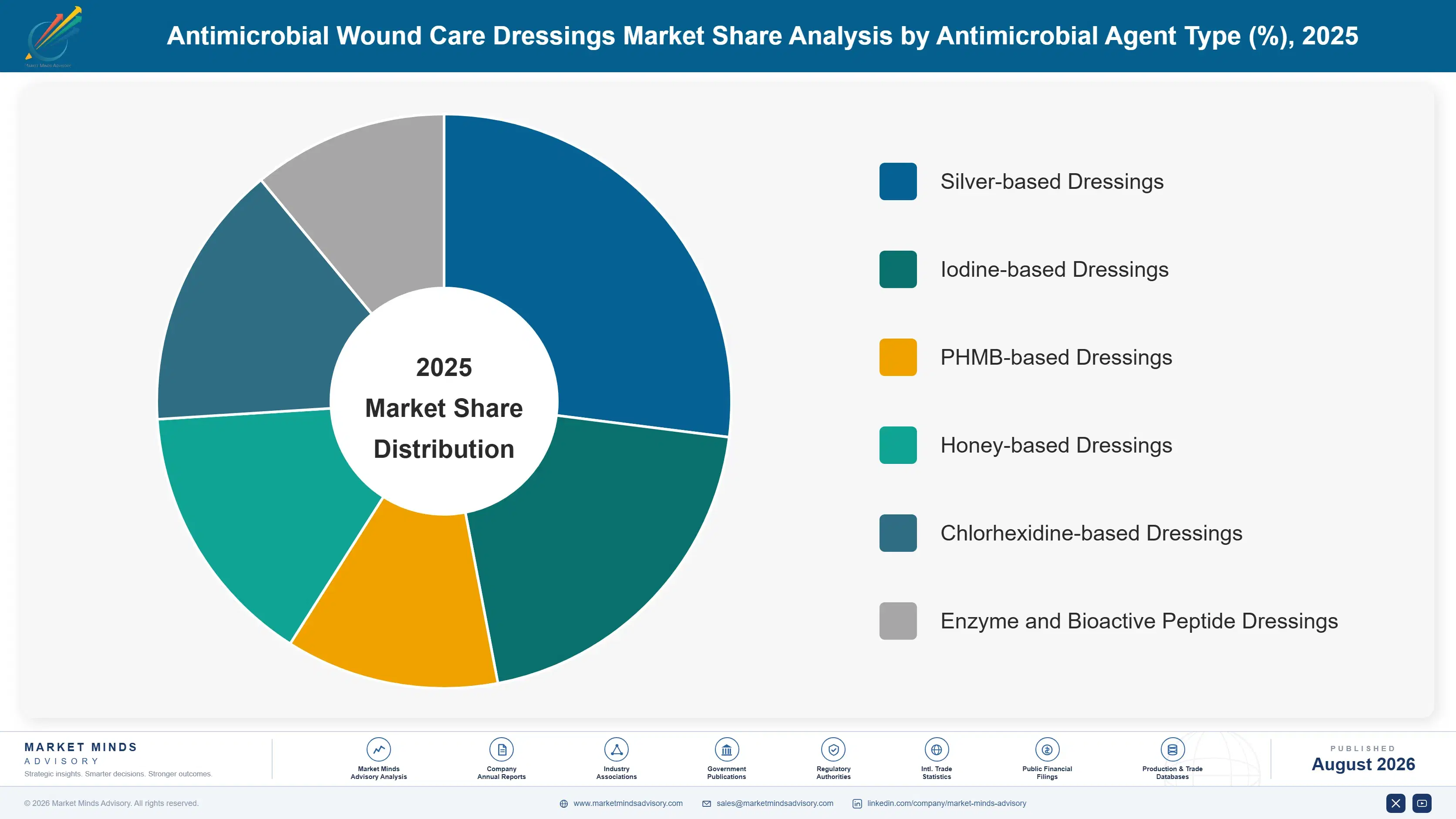
Segmentation follows the active antimicrobial agent embedded in the dressing, the classification clinicians actually use when writing wound care protocols and the same one payers reference directly when setting formulary tiers and negotiating reimbursement codes across every acute, ambulatory, and home health care setting nationwide and internationally across all tracked markets and provider types.
antimicrobial-wound-care-dressings-market-market-share-analysis-1787300550897

PHMB-based Antimicrobial Dressings

Polyhexamethylene biguanide dressings are winning formulary votes precisely where silver is losing them: broad-spectrum efficacy without the resistance concerns now documented in surveillance data, and a cytotoxicity profile that clears extended-wear indications more easily. Wound care surgeons increasingly specify PHMB for post-operative and diabetic ulcer protocols where dressing changes happen every three to five days rather than daily, reducing total episode cost even at a higher per-unit price. Manufacturers with PHMB portfolios have reported the fastest formulary renewal rates of any chemistry category over the past two contracting cycles tracked. Supply is less concentrated than silver, since PHMB does not depend on precious metal pricing, giving mid-sized manufacturers a genuine entry point without the exposure silver producers carry.
CAGR 9.4%

Honey-based Antimicrobial Dressings

Medical-grade Manuka honey dressings have moved from a niche natural-products category into mainstream chronic wound protocols on the strength of published randomized evidence showing faster debridement and lower biofilm recurrence than standard silver in venous leg ulcers. Clinicians favor honey chemistries for patients with documented silver sensitivity or nickel allergy cross-reactivity, a population that has grown steadily as allergy testing becomes routine within wound clinics nationwide. The chemistry also carries clean-label appeal that resonates with home health and pediatric burn settings, where families increasingly ask about dressing composition directly during consultations. Supply is geographically concentrated in New Zealand and Australia, creating a distinct import dependency that differentiates this segment's trade profile from every other chemistry in the category entirely.
CAGR 8.5%
Full segment breakdown across 6 segments available in the complete report.

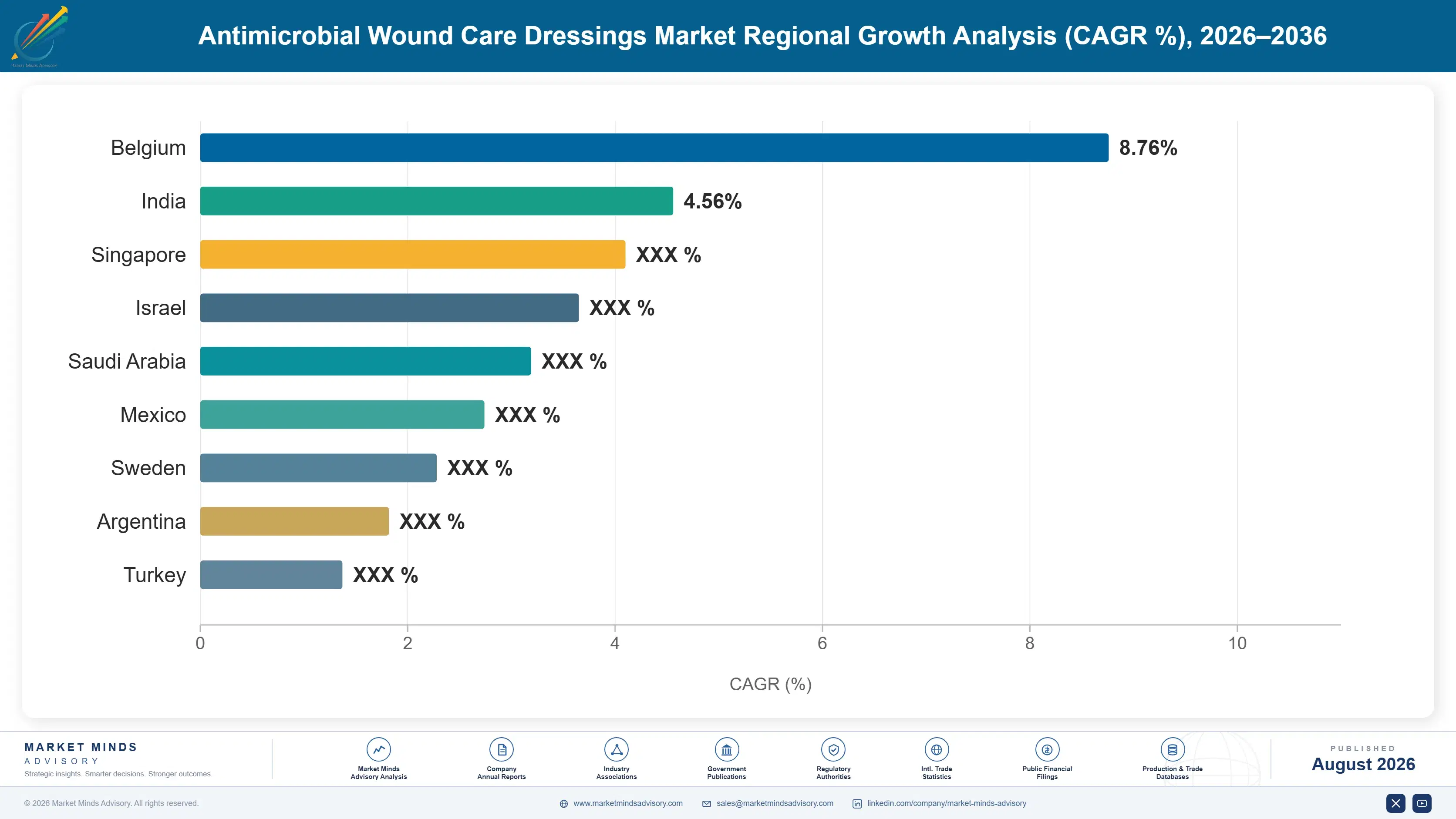
Regional Architecture and Country Demand Map

North America leads on reimbursement-driven premium adoption, East Asia follows closely on diabetic population scale, and South Asia and Pacific posts the fastest growth as domestic manufacturing capacity and government insurance coverage both expand rapidly across the full ten-year forecast decade tracked here by MMA analysts.

North America

Hospital-acquired infection penalties under the CMS reduction program give American health systems a direct financial reason to specify antimicrobial dressings over standard gauze, and that policy lever exists nowhere else in this concentrated a form anywhere globally. Diabetic foot ulcer prevalence near 19 percent among the diabetic population sustains chronic demand independent of any single payer decision made in Washington. Canada's provincial wound care formularies have followed similar evidence-based procurement logic, though at meaningfully smaller absolute volume than the United States. Group purchasing organizations across the region increasingly negotiate outcomes-linked contracts, pushing manufacturers toward published clinical trial data as a condition of hospital access rather than a marketing advantage alone.
Share: 29% | CAGR: 6.9% (2026 to 2036)

Western Europe

Germany and the United Kingdom anchor regional demand through statutory health insurance systems that reimburse advanced wound dressings on clinical protocol rather than patient copay sensitivity, a structure that favors premium chemistries once evidence is published broadly across national formularies. France's home nursing infrastructure, among the densest anywhere in Europe, extends antimicrobial dressing use into ambulatory settings earlier than most comparable markets manage to achieve. Growth trails the global average because formulary evidence thresholds run stricter here than in the United States, slowing new chemistry adoption even when clinical data is genuinely favorable. Sustainability procurement criteria are beginning to influence tender outcomes at several national health services across the bloc as well.
Share: 21% | CAGR: 6.0% (2026 to 2036)
Regional intelligence for 5 additional markets available in the complete report: East Asia, South Asia and Pacific, Latin America, Middle East and Africa, Eastern Europe. Contact sales@marketmindsadvisory.com.
antimicrobial-wound-care-dressings-market-country-cagr-analysis-1787300551420

Where Wound Care Manufacturers Can Add Margin

Manufacturers face a formulary environment that rewards clinical evidence over price alone, which opens several distinct paths to margin expansion beyond simply raising list prices across the existing dressing product line year after year, contract cycle after contract cycle across every major regional market, care setting, and chemistry type tracked closely by MMA analysts.

Bundle Dressings With Negative Pressure Systems

Packaging antimicrobial dressings as the standard wound-contact layer within negative pressure wound therapy kits lets manufacturers capture a share of the device reimbursement code rather than competing purely on dressing unit price. Hospitals purchasing bundled kits report simplified procurement and consistent clinical outcomes, which strengthens contract renewal rates meaningfully. Manufacturers with both device and dressing portfolios, Solventum's legacy 3M business among them, already report bundled revenue growing faster than standalone dressing sales. The approach requires cross-functional sales teams that understand both device reimbursement codes and wound care protocols, a capability gap favoring incumbents over new entrants.
Market Impact: Adds 3 to 5 points of gross margin

Structure New Outcomes-Linked Hospital System Contracts

Rebate agreements tied to published re-ulceration or time-to-closure benchmarks let manufacturers justify premium pricing to budget-constrained hospital systems while sharing clinical risk rather than absorbing a straight price objection outright. Early adopters report contract win rates roughly 15 percentage points higher than list-price-only proposals when competing for large integrated delivery network formularies nationwide. The model requires investment in outcomes tracking infrastructure and a willingness to return rebate dollars when trial-published benchmarks are missed, which smaller manufacturers without clinical affairs teams struggle to administer credibly at scale. Payers increasingly favor vendors willing to enter these agreements over those who remain unwilling.
Market Impact: Lifts contract win rate by 15 points overall

Extend Into Home Health Distribution Channels

Expanded CMS home health coverage for advanced dressings has opened a distribution channel that most manufacturers still serve through hospital-focused sales infrastructure poorly suited to visiting nurse agency purchasing patterns. Building a dedicated home health commercial team, including clinical liaisons who train visiting nurses directly, has let early movers capture channel share disproportionate to their existing hospital market position. One mid-sized manufacturer reported home health revenue growing 4 times faster than its hospital segment within 2 years of launching a dedicated team. The upfront investment is meaningful, but the channel carries less price competition than hospital contracts overall.
Market Impact: Channel revenue grows 4x the hospital segment pace

Invest in Randomized Trial Evidence Generation

Formulary committees increasingly require published randomized controlled trial data before granting first-line status, which means manufacturers without clinical evidence budgets are effectively locked out of premium contracting regardless of actual product performance. Companies that fund multi-site trials, typically costing between $4 million and $8 million per indication, report formulary win rates 2 to 3 times higher than competitors relying on observational data alone. The investment pays back over a multi-year contract cycle once a product achieves first-line status at a major integrated delivery network, since formulary position rarely changes on an annual basis.
Market Impact: Wins formulary contracts 2 to 3x more often

Who Controls the Margin Pool

Five companies hold 42 percent of the category, a concentration low enough that chemistry specialists without broad device portfolios still win meaningful formulary share. The gap between the leading players and the next tier of challengers is narrower here than in most medical device categories, since clinical evidence, not manufacturing scale, increasingly decides contract outcomes.
Competitive activity currently plays out across three dimensions: clinical trial investment to defend formulary position, home health channel build-out to capture post-acute reimbursement growth, and selective acquisition of chemistry specialists to fill portfolio gaps in PHMB and honey formats. Manufacturers without at least one non-silver chemistry are actively shopping for bolt-on acquisitions rather than building internal pipelines, given how long organic development timelines now run under tightened FDA scrutiny.

Pressure is building from two directions simultaneously. Regional manufacturers in China and India are scaling PHMB and silver production at costs Western incumbents cannot match, threatening share in price-sensitive public tender markets. At the same time, evidence-generation costs are rising fast enough that mid-sized specialists risk losing formulary renewal votes to better-funded incumbents regardless of clinical performance, a dynamic that could push consolidation over the next several contracting cycles.
antimicrobial-wound-care-dressings-market-company-positioning-matrix-1787300551945

Competitive Moat and Risk Dimensions

SOLVENTUM CORPORATION

Moat: Device and dressing bundling

Solventum's combined negative pressure therapy and dressing portfolio, inherited from 3M's wound care franchise, lets it bundle antimicrobial dressings into device reimbursement codes that standalone dressing manufacturers cannot access, protecting hospital contract share even where per-unit pricing is undercut sharply by chemistry specialists competing on evidence alone.
SOLVENTUM CORPORATION

Risk: Spinoff integration distraction

The 2024 separation from 3M has consumed management bandwidth on standalone corporate infrastructure, IT systems, and supply chain contracts, slowing new product launches at a moment when PHMB and honey competitors are actively winning formulary votes away from legacy silver-based products across major hospital system accounts nationwide.
SMITH AND NEPHEW PLC

Moat: Broad clinical evidence base

Smith and Nephew has funded more published randomized trials across silver and PHMB chemistries than any single competitor, giving its sales teams a formulary argument that smaller manufacturers cannot match without comparable clinical affairs investment, particularly at large integrated delivery networks weighing multi-year contract decisions carefully.
SMITH AND NEPHEW PLC

Risk: Silver franchise resistance exposure

The company's largest wound care revenue line still runs through silver-based dressings, leaving it more exposed than PHMB-focused challengers to the resistance data now reshaping formulary preference, a transition it must manage carefully without cannibalizing its own installed hospital base too quickly in the process.

Key Players

Solventum Corporation
Smith and Nephew plc
ConvaTec Group plc
Coloplast A/S
Molnlycke Health Care AB

Others

B. Braun Melsungen AG
Paul Hartmann AG
Medline Industries LP
Cardinal Health Inc
Integra LifeSciences Holdings Corporation
Advanced Medical Solutions Group plc
Urgo Medical
Lohmann and Rauscher International GmbH
Winner Medical Group Inc
Hollister Incorporated
DermaRite Industries LLC
Ferris Mfg Corp
Nichiban Co Ltd
Kikgel Ltd
Laboratoires Genevrier SAS

Recent Developments

MARCH 2026

ConvaTec Acquires PHMB Dressing Specialist

ConvaTec completed the acquisition of a privately held PHMB dressing developer to close a chemistry gap in its chronic wound portfolio, adding manufacturing capacity in the Netherlands and a pipeline of extended-wear formulations targeting the diabetic foot ulcer segment specifically across major North American and European hospital accounts.
Signal: Confirms chemistry-gap acquisitions as the preferred fill-in strategy over slower organic development timelines industry-wide this year.
NOVEMBER 2025

Molnlycke Signs Supply Agreement for Manuka Honey

Molnlycke Health Care signed a multi-year supply agreement with a New Zealand honey cooperative to secure medical-grade Manuka input volume ahead of anticipated demand growth, addressing a geographic concentration risk that has constrained honey dressing scale-up across the wider industry for several years running now.
Signal: Signals honey chemistry has moved from pilot scale to committed long-term manufacturing volume commitments industry-wide this cycle.
JULY 2025

Coloplast Opens Home Health Clinical Liaison Unit

Coloplast launched a dedicated home health clinical liaison team in the United States, training visiting nurse agencies directly on antimicrobial dressing protocols following expanded CMS home health reimbursement coverage, a channel investment kept separate from its existing hospital sales organization structure entirely this fiscal year.
Signal: Marks the first dedicated home health commercial build-out among the five leading manufacturers tracked closely by MMA.

Silver Price Exposure and Substrate Costs

Silver compounds represent roughly 22 percent of cost of goods sold for silver-based dressings, sourced primarily from refiners in Mexico, Peru, and China, while nonwoven textile substrates and sterilization services add a further 18 percent combined. PHMB and honey chemistries carry different cost structures entirely, insulating manufacturers with diversified portfolios from single-input volatility that silver-focused competitors cannot avoid.
Silver spot prices rose approximately 21 percent through 2024 as industrial demand from solar photovoltaic manufacturing competed directly with medical device buyers for refined supply, according to Smith and Nephew's 2024 annual report, which cited raw material inflation as a margin headwind within its wound care segment commentary. The overlap between solar-grade and medical-grade silver demand is a genuinely new dynamic manufacturers had not previously priced into long-term procurement contracts.

Exposure varies sharply by player type. Vertically integrated manufacturers with long-term silver supply contracts have absorbed volatility better than smaller specialists purchasing on spot markets, widening the margin gap between top-five incumbents and mid-tier competitors over successive quarters. Manufacturers concentrated in PHMB or honey chemistries face essentially no silver exposure at all, giving them a durable cost edge that shows up directly in gross margin comparisons across the category.
antimicrobial-wound-care-dressings-market-cost-volatility-analysis-1787300552145

Long-Term Silver Supply Contracts

Locking multi-year fixed-volume agreements with refiners reduces spot market exposure meaningfully, though it requires balance sheet commitment that smaller manufacturers often cannot match against larger incumbents carrying stronger credit terms and negotiating leverage with major refiners across multiple sourcing regions and currencies simultaneously, a competitive gap that keeps widening industry-wide with every passing fiscal year and contract cycle.

Chemistry Diversification Away From Silver

Expanding PHMB and honey product lines reduces aggregate silver dependency across the whole portfolio, a strategy several mid-sized manufacturers have accelerated specifically in response to 2024 price volatility rather than clinical demand shifts alone, reshaping procurement budgets meaningfully within two fiscal years across most affected product lines, regional subsidiaries, and contract manufacturing partners worldwide.

Substrate Sourcing Regionalization

Shifting nonwoven textile procurement closer to manufacturing sites has cut freight and tariff exposure for several European producers, though it requires qualifying new suppliers against existing biocompatibility documentation and regulatory filings already on record with national health authorities and notified bodies across each jurisdiction served, a slow and genuinely costly process to complete fully.

Portfolio Architecture for Margin Defence

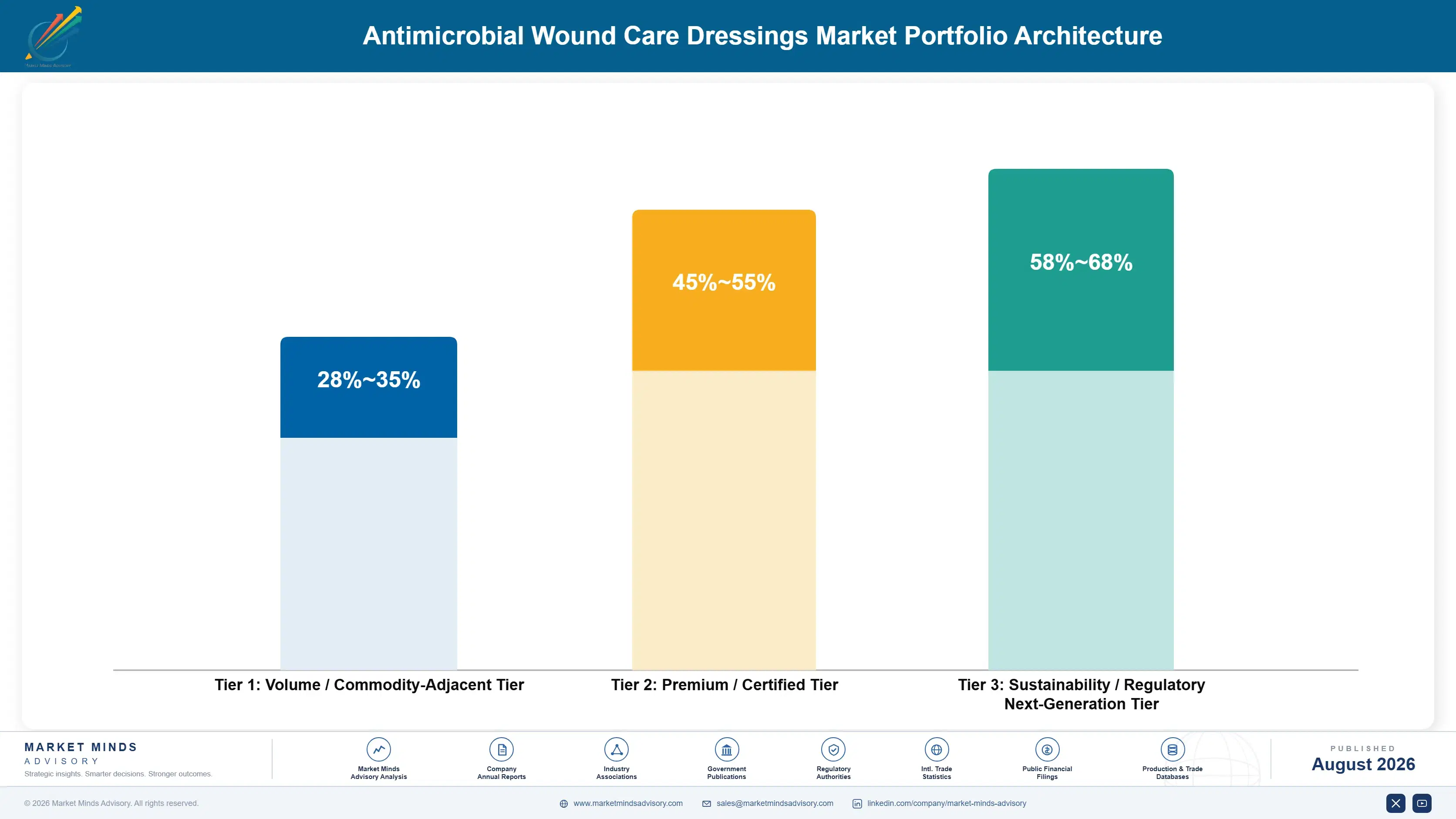
Three tiers structure manufacturer portfolios today, each with distinct buyers, sales motions, and evidence requirements. Commodity-adjacent iodine and basic silver dressings sit at the volume base with thin margins, premium PHMB and chlorhexidine formats occupy a certified middle tier, and honey and bioactive peptide dressings anchor a next-generation tier where clinical evidence, not manufacturing scale, sets the price ceiling for the entire category and its future direction over the coming de
The tension between volume and premium is built into how hospital procurement actually works: group purchasing organizations negotiate baseline volume contracts on commodity formats while formulary committees separately approve premium chemistries for specific chronic wound protocols, forcing manufacturers to compete on two entirely different commercial logics within the very same hospital account simultaneously, often through separate sales teams entirely.

High-value margin pools concentrate in extended-wear PHMB dressings and honey formulations carrying published re-ulceration data, where gross margins run meaningfully above the category average across nearly every region tracked by MMA. Basic silver and iodine formats increasingly compete on price alone as generic manufacturing capacity expands quickly across China and India, squeezing the volume tier further each year.

Volume / Commodity-Adjacent Tier

Basic iodine and standard silver dressings sold primarily on unit price into public tenders and generalist hospital contracts, with limited clinical differentiation and thin margins throughout the wider category and geography.
Gross Margin: 28-35%

Premium / Certified Tier

PHMB and chlorhexidine dressings carrying published clinical evidence, positioned for formulary contracts requiring documented outcomes data and multi-year renewal commitments from hospital systems and integrated delivery networks nationwide and increasingly overseas as well.
Gross Margin: 45-55%

Sustainability / Regulatory / Next-Generation Tier

Honey and bioactive peptide dressings with extended-wear indications and clean-label positioning for allergy-sensitive and pediatric populations, priced at the top of the entire category range consistently across nearly every market.
Gross Margin: 58-68%
antimicrobial-wound-care-dressings-market-portfolio-architecture-1787300552644

High-value Sub-segments and Strategic Watch-out

Extended-Wear PHMB Dressings

Highest growth and highest margin combination anywhere in the category, favored where reduced dressing-change frequency lowers total episode cost enough to justify premium unit pricing at formulary review across most large health systems nationally and internationally each contracting cycle tracked closely by MMA analysts this forecast period.
Gross Margin: 50-58%

Honey-Based Chronic Wound Dressings

Strong growth with solid margins, constrained mainly by geographically concentrated Manuka supply that limits how quickly manufacturers can scale volume to meet rising formulary demand across new regions and emerging distribution channels opening up steadily each forecast year tracked closely by MMA analysts and regional partners.
Gross Margin: 58-65%

Standard Silver Foam Dressings

The volume core of the category, generating stable revenue but facing margin compression as generic manufacturing capacity expands and resistance data steadily erodes clinical preference among prescribers at major hospital systems nationwide and increasingly abroad as well across most tracked regions, formulary committees, and group purchasing organizations.
Gross Margin: 30-36%

Basic Iodine Dressings

A strategic watch-out segment: adequate for low-acuity wounds but increasingly displaced from formulary tiers entirely as evidence-based procurement favors chemistries carrying published outcomes data instead of legacy purchasing habits still common at some smaller hospital systems, rural facilities, public tenders, and cost-constrained regional care networks.
Gross Margin: 24-30%

Recurring Procurement in Chronic Protocols

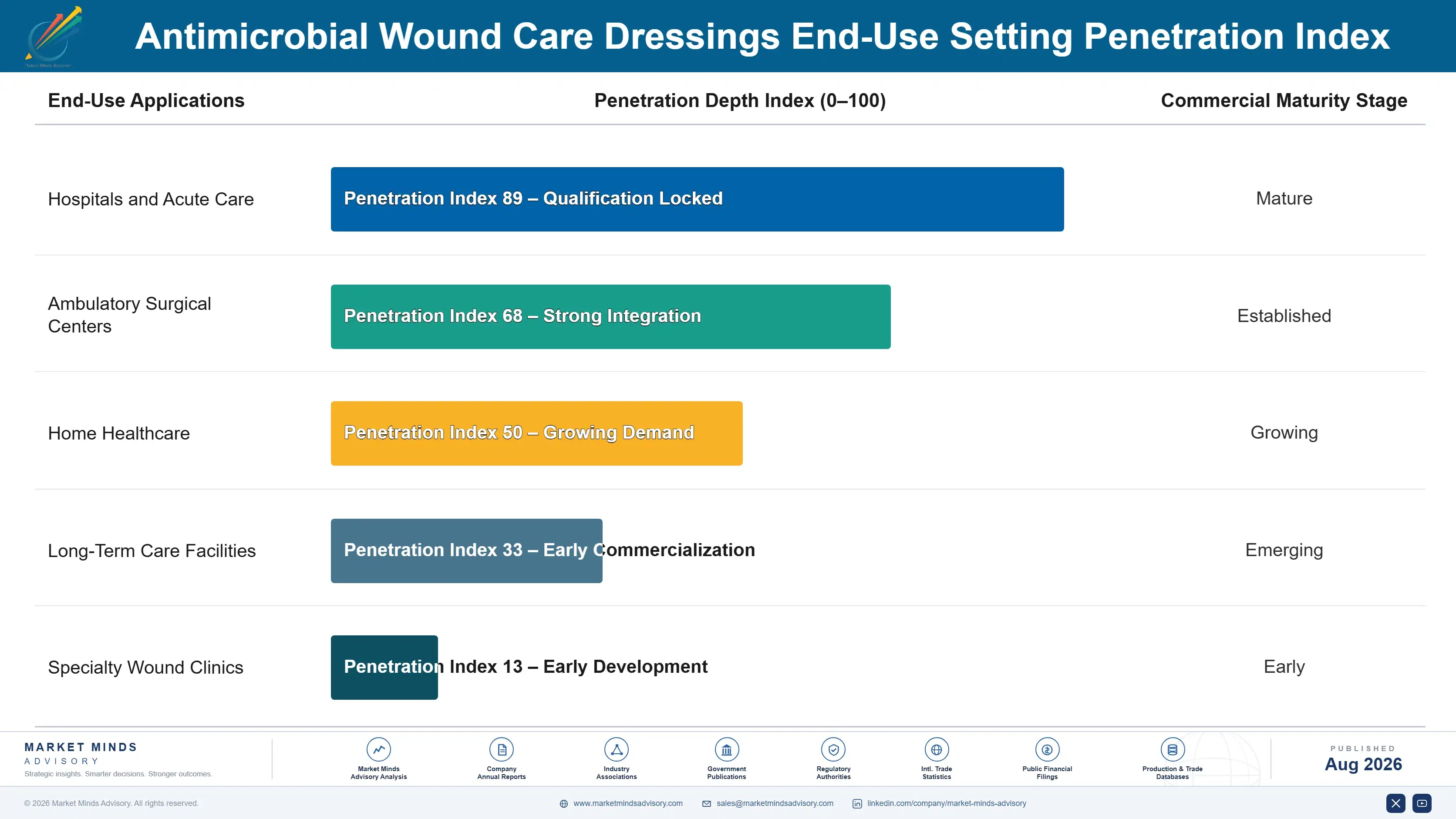
Chronic wound care behaves like an annuity business once a dressing wins formulary status at a given health system and clears committee review. A diabetic foot ulcer patient may require dressing changes every three to seven days for months at a stretch, generating repeat procurement volume that dwarfs any single acute wound episode and that renews automatically as long as formulary status holds firm across renewal cycles.
Adoption depth varies sharply by end-use vertical across the category and its many care settings. Hospital wound care centers adopt premium chemistries fastest because infection penalties hit their budgets directly and immediately, home health agencies adopt more slowly due to fragmented purchasing structures across many small agencies, and long-term care facilities lag furthest behind, often defaulting to whatever chemistry their group purchasing organization negotiated years earlier and never revisited since.

A generational shift is underway in buyer profiles: wound care nurse specialists, not general surgeons, now drive protocol decisions at most large health systems today, and this cohort weighs published clinical evidence far more heavily than the physician-led purchasing pattern that dominated a decade ago across the industry and its legacy accounts.
antimicrobial-wound-care-dressings-market-end-use-penetration-index-1787300553131

Where MMA Sees the Category Heading

These are among the four positions where our research anticipates prominent divergence between winners and laggards over the coming forecast period. Each is grounded in the demand model, the regulatory perimeter, and the announced capacity pipeline.
01 / CHEMISTRY PORTFOLIO POSITIONING

Manufacturers without a non-silver chemistry face formulary exit risk

Silver resistance surveillance data has become a standing agenda item at hospital pharmacy and therapeutics committees, not an occasional concern raised once a year at review time. Any manufacturer whose portfolio depends entirely on silver chemistry should expect formulary renewal votes to grow harder with every contracting cycle from here forward, regardless of how strong past clinical relationships have been. Diversifying into PHMB or honey formats within the next two product cycles is close to a survival requirement now, not merely a growth option worth considering at leisure.
02 / CLINICAL EVIDENCE INVESTMENT

Trial funding now decides contract access more than price

Formulary committees increasingly require randomized trial data before granting first-line status, which locks manufacturers without clinical affairs budgets out of the largest integrated delivery network contracts regardless of underlying product quality or performance metrics. Companies funding multi-site trials ahead of launch, rather than after competitive pressure forces the issue, will capture disproportionate formulary share over the coming several contracting cycles industry-wide. This has become a balance sheet decision as much as a scientific one for most manufacturers competing at scale today.
03 / HOME HEALTH CHANNEL EXPANSION

Home health represents the least contested growth channel

Hospital contracts remain the most competitive and evidence-intensive battleground in the category, while home health distribution is still served largely by generalist sales infrastructure poorly matched to visiting nurse purchasing patterns and decision cycles. Manufacturers building dedicated home health commercial teams now are securing channel share before larger incumbents redirect meaningful resources there at scale and with urgency. The window for differentiated entry likely narrows within three to four years as slower competitors eventually catch up and respond in kind across the category.
04 / INPUT COST MANAGEMENT

Silver exposure is becoming a genuine competitive disadvantage

Rising silver prices driven by overlapping solar photovoltaic demand are compressing margins specifically for manufacturers concentrated in silver chemistry, while PHMB and honey competitors face no comparable input volatility at all across their supply chains today. This cost asymmetry will keep widening the margin gap between diversified and silver-dependent manufacturers over successive fiscal years and contracting cycles alike across the category. Long-term supply contracts help at the margin, but chemistry diversification remains the more durable, repeatable fix available to the category overall going forward.

Engagement Snapshot From the Field

A live engagement with an industry participant carrying material or product regulatory and market exposure ahead of a defining policy shift, showing how our research translates into a defensible multi-year portfolio strategy.
MARKET MINDS ADVISORY · CLIENT ENGAGEMENT SUMMARY
Antimicrobial Wound Care Dressings Producer Strategic Portfolio Review and Transition Roadmap 2026·Investment Scenario on Antimicrobial Wound Care Dressings Exposure Evaluation 2025-26
CLIENT PROFILE
The client operates a twelve-hospital regional health system across the American Midwest, serving approximately 480,000 annual inpatient discharges (client-reported, unverified by MMA) with a dedicated wound care service line spanning acute, surgical, and outpatient chronic wound clinics across its full regional footprint, affiliated physician network, and a growing home health division launched two years prior to this engagement.
STRATEGIC CHALLENGE
The system faced rising hospital-acquired infection penalty exposure under CMS scoring while its existing silver-dominant dressing formulary showed no measurable improvement in re-ulceration rates over three consecutive years, prompting the wound care committee to question seriously whether chemistry choice itself, rather than clinical technique, was the limiting factor holding back outcomes system-wide.
MMA APPROACH
MMA analyzed formulary spend against published outcomes data across silver, PHMB, and honey chemistries, benchmarked the system's infection penalty exposure against comparable peer networks nationally, and modeled total episode cost under three distinct formulary restructuring scenarios weighted by clinical evidence strength, implementation cost, and staff training feasibility across all twelve facilities.
KEY FINDINGS
  1. PHMB dressings showed a 34 percent lower re-ulceration rate than the system's incumbent silver formulary in comparable diabetic foot ulcer patient cohorts, based on published multi-site trial data.
  2. Home health dressing changes accounted for 41 percent of total episode dressing spend, a channel the system had never separately budgeted or negotiated with any single vendor before.
  3. Switching cost for a full formulary transition was recoverable within fourteen months through avoided infection penalty exposure alone, according to client-reported estimates unverified by MMA analysts.
  4. Nursing staff training requirements, not procurement price itself, were identified as the single largest barrier to faster chemistry adoption across the full twelve-hospital network.
CLIENT PROFILE
The client operates a twelve-hospital regional health system across the American Midwest, serving approximately 480,000 annual inpatient discharges (client-reported, unverified by MMA) with a dedicated wound care service line spanning acute, surgical, and outpatient chronic wound clinics across its full regional footprint, affiliated physician network, and a growing home health division launched two years prior to this engagement.
STRATEGIC CHALLENGE
The system faced rising hospital-acquired infection penalty exposure under CMS scoring while its existing silver-dominant dressing formulary showed no measurable improvement in re-ulceration rates over three consecutive years, prompting the wound care committee to question seriously whether chemistry choice itself, rather than clinical technique, was the limiting factor holding back outcomes system-wide.
MMA APPROACH
MMA analyzed formulary spend against published outcomes data across silver, PHMB, and honey chemistries, benchmarked the system's infection penalty exposure against comparable peer networks nationally, and modeled total episode cost under three distinct formulary restructuring scenarios weighted by clinical evidence strength, implementation cost, and staff training feasibility across all twelve facilities.
KEY FINDINGS
  1. PHMB dressings showed a 34 percent lower re-ulceration rate than the system's incumbent silver formulary in comparable diabetic foot ulcer patient cohorts, based on published multi-site trial data.
  2. Home health dressing changes accounted for 41 percent of total episode dressing spend, a channel the system had never separately budgeted or negotiated with any single vendor before.
  3. Switching cost for a full formulary transition was recoverable within fourteen months through avoided infection penalty exposure alone, according to client-reported estimates unverified by MMA analysts.
  4. Nursing staff training requirements, not procurement price itself, were identified as the single largest barrier to faster chemistry adoption across the full twelve-hospital network.
RECOMMENDED STRATEGY
Phase 1: Phase 1 (Months 1 to 3): Pilot PHMB formulary conversion at two hospitals with the highest infection penalty exposure, tracking re-ulceration outcomes against the prior silver baseline. Phase 2: Phase 2 (Months 4 to 9): Expand successful pilot protocols system-wide with dedicated nursing training, while renegotiating group purchasing contracts around the new chemistry mix. Phase 3: Phase 3 (Months 10 to 14): Extend the revised formulary into home health and long-term care partner facilities to capture episode-wide cost benefits beyond the hospital walls.
OUTCOME
Within fourteen months of full formulary conversion, the system reported a measurable decline in hospital-acquired infection penalty exposure and avoided readmission costs exceeding the incremental dressing spend several times over, per client-reported figures unverified by MMA, while nursing satisfaction scores for wound protocol clarity improved measurably across all twelve facilities system-wide.

Frequently Asked Questions

Foundational context covering the market sizes, CAGR, scope, country, region and competition that inform every finding below. This section is provided to cover basics and most often pre-purchase conversations, answered from the MMA Primary Research Dataset.

What is the current size of the Antimicrobial Wound Care Dressings Market?

The global antimicrobial wound care dressings market reached an estimated USD 3.8 billion in 2025, spanning silver, PHMB, iodine, honey, chlorhexidine, and bioactive peptide chemistries across all major care settings.

How large will the Antimicrobial Wound Care Dressings Market be by 2036?

MMA projects the market will reach approximately USD 8.51 billion by 2036, more than doubling from its 2026 base as chronic wound incidence and formulary evidence requirements both continue expanding steadily.

What is the CAGR for the Antimicrobial Wound Care Dressings Market 2026 to 2036?

The base case CAGR is 7.6 percent, with a bull scenario of 8.8 percent and a bear scenario of 6.3 percent depending largely on reimbursement policy direction.

Which segment is growing fastest?

PHMB-based antimicrobial dressings are growing fastest at a 9.4 percent CAGR, roughly 1.24 times the overall market rate, as hospital formularies continue shifting decisively away from silver chemistry.

Who are the major companies in the Antimicrobial Wound Care Dressings Market?

Solventum, Smith and Nephew, ConvaTec, Coloplast, and Molnlycke Health Care lead the category, together holding under half of global market share between them across all chemistry types.

Which country is growing fastest?

India is growing fastest at an estimated 10.4 percent CAGR, driven by expanding government health insurance coverage and a diabetic population now exceeding 100 million adults.

Report Segmentation Architecture

The full report scope spans multiple orthogonal segmentation dimensions, with cross-tabulated demand data provided for each dimension pair. Coverage extends further to regional breakdowns, trend trajectories, and the competitive detail needed to support segment-level decision-making.

By Antimicrobial Agent Type

  • Silver-based Dressings
  • Iodine-based Dressings
  • PHMB-based Dressings
  • Honey-based Dressings
  • Chlorhexidine-based Dressings
  • Enzyme and Bioactive Peptide Dressings

By End-Use Setting

  • Hospitals and Acute Care
  • Ambulatory Surgical Centers
  • Home Healthcare
  • Long-Term Care Facilities
  • Specialty Wound Clinics

By Commercial Dimension

  • Hospital Procurement and GPO Contracts
  • Retail and Institutional Pharmacy
  • E-commerce and Direct Distribution
  • Government Tender Programs

By Region

  • North America
  • Western Europe
  • East Asia
  • South Asia and Pacific
  • Latin America
  • Middle East and Africa
  • Eastern Europe

Scope, Methodology, and Coverage

Every figure in this report is reproducible from documented input assumptions. The scope below maps the historical period, the forecast horizon, the segmentation dimensions, and the countries covered, alongside the underlying primary and qualitative methodology.
Historical Period
2020 to 2025
Forecast Period
2026 to 2036
Base Year
2025 (USD billions; MMA Primary Research Dataset, August 2026)
Market Definition
The antimicrobial wound care dressings market covers dressings incorporating an active antimicrobial agent, silver, iodine, PHMB, honey, chlorhexidine, or bioactive peptides, applied to acute, chronic, and surgical wounds. It excludes non-medicated absorptive dressings, wound cleansers, and negative pressure wound therapy devices sold without an integrated antimicrobial layer.
Quantitative Units
USD billions (current prices); unit volumes in millions of dressings where applicable
Segmentation Dimensions
By Antimicrobial Agent Type; By End-Use Setting; By Commercial Dimension; By Region
Regions Covered
North America, Western Europe, East Asia, South Asia and Pacific, Latin America, Middle East and Africa, Eastern Europe
Countries Covered
USA, China, Germany, France, UK, Japan, South Korea, India, Australia, Canada, Brazil, Mexico, Indonesia, Vietnam, Thailand, Malaysia, UAE, Saudi Arabia, South Africa, Nigeria, Turkey, Poland, Netherlands, Italy, Spain, Sweden, Switzerland, Argentina, Colombia, Singapore, and additional markets relevant to this sector
Key Companies Profiled
Solventum Corporation, Smith and Nephew plc, ConvaTec Group plc, Coloplast A/S, Molnlycke Health Care AB, B. Braun Melsungen AG, Paul Hartmann AG, Medline Industries LP, Cardinal Health Inc, Integra LifeSciences Holdings Corporation, Advanced Medical Solutions Group plc, Urgo Medical, Lohmann and Rauscher International GmbH, Winner Medical Group Inc, Hollister Incorporated, DermaRite Industries LLC, Ferris Mfg Corp, Nichiban Co Ltd, Kikgel Ltd, Laboratoires Genevrier SAS
Quantitative Methodology
Primary survey, n=3,800 respondents, Q4 2025, six countries; demand-side model with trade association cross-validation
Qualitative Methodology
47 expert interviews, Q4 2025; applied to validate demand model assumptions, identify emerging dynamics, and assess competitive positioning
Report Format
PDF and XLSX data workbook (Word format preview document)
Publisher
Market Minds Advisory
Report Code
MMA-2026-MED-101
Published
August 2026
Contact
sales@marketmindsadvisory.com | www.marketmindsadvisory.com

Purchase the full Antimicrobial Wound Care Dressings Market Report (2026 to 2036).

The full report delivers a complete competitive and commercial analysis of the antimicrobial wound care dressings market across all seven regions and six agent-type segments tracked. It includes detailed company profiles for twenty manufacturers, formulary and reimbursement policy tracking across major markets, and a ten-year forecast model with bull and bear scenario sensitivity built in. Buyers receive the underlying segmentation data by country and chemistry type alongside the full qualitative analysis. A dedicated appendix tracks recent acquisitions, supply agreements, and regulatory clearances relevant to formulary strategy planning.
Ten-year revenue and volume forecast model
Formulary and reimbursement policy tracker across regions
Twenty-company competitive profile database and scorecard
Chemistry-level segmentation broken out by country
Input cost and silver price sensitivity model
Quarterly market update subscription option available to buyers

Built For The People Who Decide

From boardroom strategy to bench-side execution, this report is read cover-to-cover by leaders shaping the next decade of their industry, turning demand scenarios, market dynamics and valuation benchmarks into decisions.
CXOs/ Presidents/ VPs/ Managers
M&A and Corporate Development
Strategy Teams and R&D Heads
Procurement and Product Directors
Regulatory and Compliance Leaders
Investor Relations and Equity Analysts