Market Minds Advisory
Antimicrobial Coatings Market

Antimicrobial Coatings Market: A Registration Number Decides the Claim, and the Claim Decides the Price

A commercial reading of antimicrobial coatings, where the biocidal chemistry inside the can is cheap and the regulatory registration proving what it actually does is what buyers are really paying for.

Lead Analyst

Bilal Shaikh

Published

September 2026

Make Smarter Decisions with Customized Research Insights

Request a free sample report and evaluate market opportunities, growth trends, and competitive dynamics relevant to your business needs.

2025 MARKET VALUE$4.6BMarket Size 2025
2036 FORECAST VALUE$9.9BBase Case , 2026 to 2036
CAGR 2026 TO 20367.2 %Bull 8.4% / Bear 6.0%
INCREMENTAL OPPORTUNITY$5.0BNet 10- year value creation
EXPANSION MULTIPLE2.00x2036 value over 2026 base
Strategic Levers
M&A Pipeline
Regional Outlook
Country Rankings
Competitive Intelligence
Segmental Deep-dive
Call-Us : 91 93563 13602

Executive Snapshot and Market Trajectory

Two coatings can carry identical silver loading and sell at completely different prices, because only one holds the EPA or biocidal products registration proving its antimicrobial claim. The chemistry is close to a commodity. The paperwork behind the claim is not, and that gap is where this market actually competes.
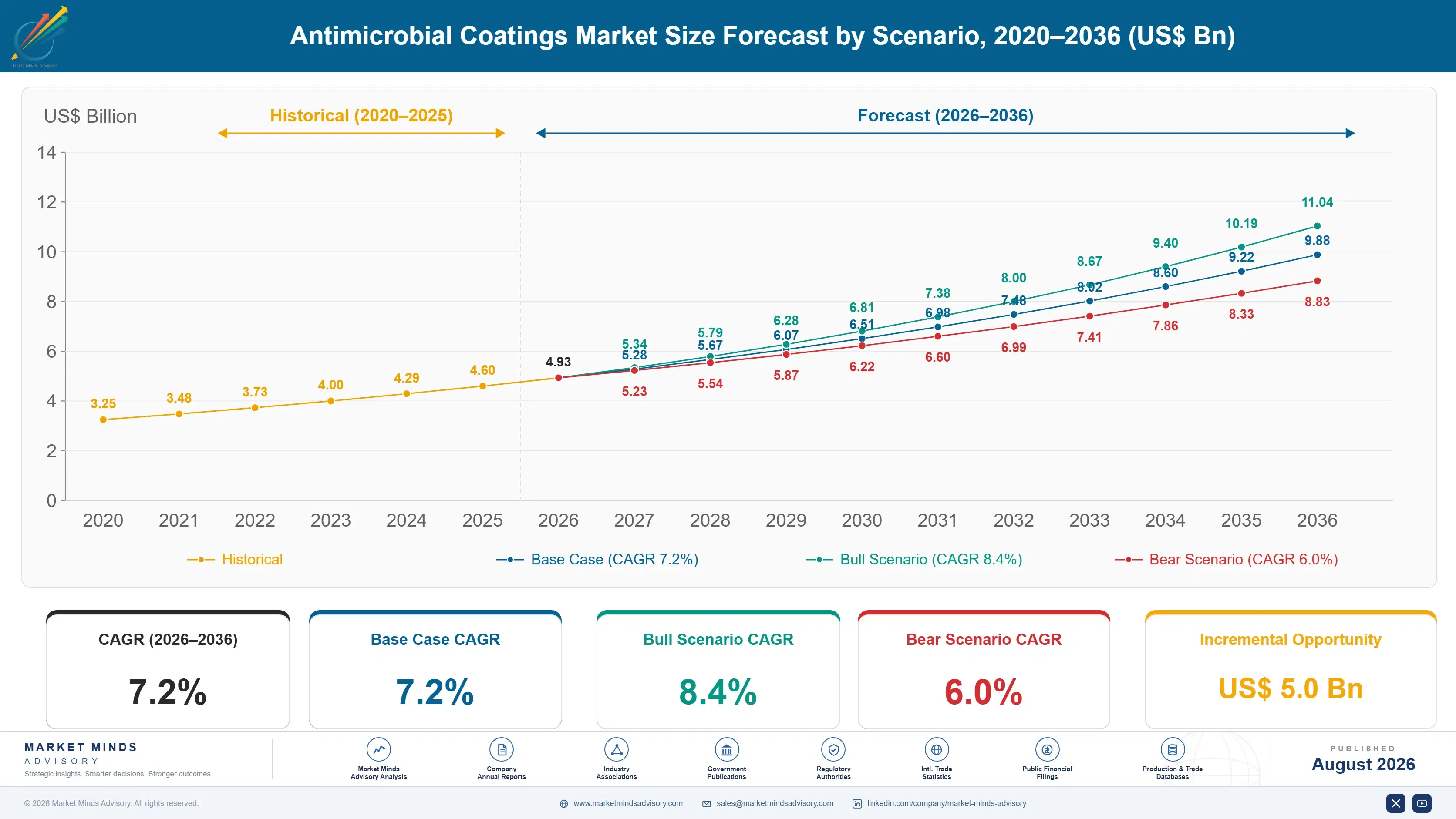
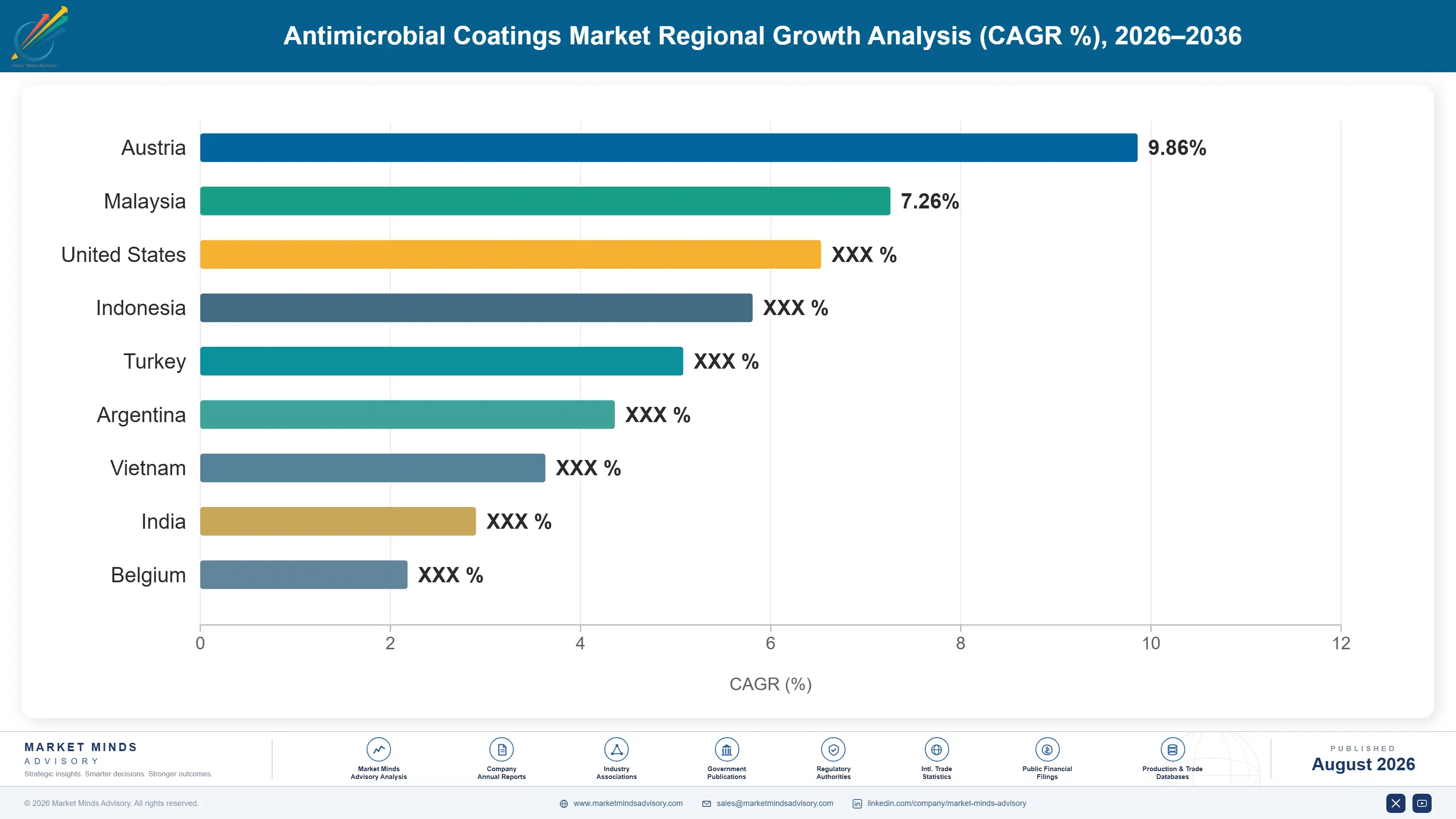
The market stands at USD 4.6 billion in 2025 and reaches USD 9.88 billion by 2036 at a 7.2% CAGR. Photocatalytic and self-disinfecting coatings grow fastest at 10.6%, about 1.47 times the overall rate, as titanium dioxide chemistry adds air-purifying claims to antimicrobial performance on building exteriors. East Asia holds 39% of value on coated appliance, electronics, and construction volume no other region approaches, while Vietnam posts the quickest national growth at 11.8%.
Concentration is moderate at roughly 32%, split between global coatings majors and specialist biocide formulators supplying them. Two forces now dominate the direction of travel completely. Regulatory registration cost is rising in every major jurisdiction, quietly excluding smaller formulators from healthcare and food-contact applications, and post-pandemic demand has settled into permanent specification on high-touch surfaces rather than reverting to its pre-2020 baseline.
Market Definition
The antimicrobial coatings market covers coatings, paints, and surface treatments formulated with biocidal active ingredients to inhibit the growth of bacteria, fungi, mould, and other microorganisms on treated surfaces, spanning silver-based, copper-based, zinc-based, organic and synthetic biocide, and photocatalytic and self-disinfecting chemistries. Antimicrobial textiles and fibres, antimicrobial plastics and polymer additives compounded into the substrate rather than applied as a coating, disinfectant and cleaning chemicals, and antibiotic pharmaceutical products are excluded.
Base Year Value
$4.6B in 2025 (MMA Primary Research Dataset, August 2026)
Forecast Period
2026 to 2036, eleven discrete annual values
CAGR
7.2% base case. Bull 8.4%. Bear 6.0%.
Fastest Growth Segment
Photocatalytic and Self-Disinfecting Coatings: 10.6% CAGR
Fastest Growth Country
Vietnam: 11.8% CAGR
Fastest Growth Region
South Asia and Pacific: 9.5% CAGR
Largest Region
East Asia: 39% of 2025 global value
Market Leaders
Sherwin-Williams, PPG Industries, AkzoNobel, BASF Coatings, Nippon Paint Holdings. Source: MMA Analysis based on company annual reports.
Primary Survey
n=3,800 procurement and R&D decision-makers, Q4 2025, six countries
Methodology
Demand-side build-up, cross-validated against public data, 47 expert interviews

Antimicrobial Coatings Market Forecast Scenarios

antimicrobial-coatings-market-size-forecast-scenario-1787324888568
Growth from 2020 to 2025 compounded near 6.1%, and the pandemic reshaped both the demand curve and the buyer base permanently. Healthcare and high-touch public surfaces drove a sharp initial surge, which then settled rather than collapsed, because facility managers and building codes locked in specifications that outlasted the acute crisis. HVAC adoption expanded steadily throughout, driven by ventilation standards.
Three mechanisms carry the base case to 7.2%. First, healthcare-associated infection control programmes, which increasingly specify registered antimicrobial surfaces in high-risk clinical areas rather than treating them as optional upgrades. Second, appliance and electronics manufacturers adding antimicrobial coating as a standard consumer-facing feature across touchscreens, handles, and control panels. Third, building exterior coatings incorporating photocatalytic chemistry, which combines self-cleaning and antimicrobial claims in dense urban construction where both properties are separately valuable to specifiers.
The bull case at 8.4% assumes healthcare specification broadens beyond current high-risk zones and photocatalytic exterior coatings gain wider building code recognition. The bear case at 6.0% assumes consumer appliance demand for the feature plateaus as differentiation value fades, registration cost consolidates the field faster than volume growth compensates, and public health attention continues receding from the peak pandemic period.

Why The Registration Number Is The Real Product

Three forces set demand. Regulatory specification drives the most value, since healthcare and food-contact buyers cannot legally claim antimicrobial performance without a registered product. Consumer feature adoption drives volume, as appliance and electronics manufacturers add coating as a standard specification across touchpoints regardless of registration depth. Building and infrastructure demand drives a third stream, tracking construction activity in humid and high-density urban markets spe
MARKET CONCENTRATIONCR5: 32%Moderately fragmented across coatings majors and biocide specialists
BIOCIDE COST SHARE15 to 30%Active antimicrobial ingredient as a portion of finished coating cost
REGISTRATION TIMELINE12 to 36 monthsTime to secure biocidal product approval in a major jurisdiction
PRICE PREMIUM OVER STANDARD20 to 60%Registered antimicrobial coating pricing against equivalent standard paint
EFFICACY DURATION CLAIM2 to 10 yearsContinuous antimicrobial performance period stated on approved labels
HEALTHCARE SURFACE SHAREAbout 22%Healthcare facilities as a portion of total application value
The commercial character is defined by registration cost rather than by formulation cost. Any competent chemist can compound a silver or copper biocide into a coating base. Proving efficacy to a regulator, and defending that claim against challenge, costs far more than the underlying chemistry and takes years rather than months. That barrier protects registered incumbents in healthcare and food-contact applications more effectively than any patent typically does.
The decade turns on whether registration requirements tighten or fragment further across jurisdictions. Stricter biocide product regulation in Europe has already pushed some formulators out of registered categories entirely, while unregulated consumer claims persist in markets with weaker enforcement. Suppliers who invested early in registration across multiple jurisdictions now hold a genuine moat, and that gap is widening rather than narrowing as compliance cost keeps climbing.
"Anyone can put silver in a can of paint. What they cannot do quickly is prove to a regulator that the silver stays effective for five years on a hospital door handle, and that proof is the entire commercial value of this category."
Director, Specialty Coatings and Surface Chemistry Practice · MMA Chemicals and

Market Trends

Pandemic-Era Demand Settles Into Permanent Specification

The surge in antimicrobial surface demand during 2020 and 2021 did not fully reverse once acute public health attention receded, because many facility managers and building codes locked specifications in during that window and never revisited them. Healthcare systems, transit authorities, and school districts that adopted registered antimicrobial coatings on high-touch surfaces largely retained the specification into routine renovation and new construction cycles. The commercial significance is that a demand spike driven by an emergency converted into a lasting baseline through procurement inertia rather than through any deliberate long-term decision, which is unusual and durable.
Market Impact: Cuts infection rates up to 30%
Photocatalytic Chemistry Combines Two Claims In One Coating

Titanium dioxide photocatalytic coatings use light-activated reactions to break down organic pollutants and inhibit microbial growth simultaneously, which lets a single exterior coating carry both a self-cleaning claim and an antimicrobial one. That dual functionality matters commercially in dense, humid, and polluted urban markets where both properties are independently valuable to building owners and neither alone would justify the premium. Adoption is strongest in construction markets across East and South Asia, where air quality concerns and rapid urban building stock turnover both favour the technology. Performance depends on sufficient ultraviolet exposure, which limits application on shaded or interior surfaces.
Market Impact: Adds to 500 million devices yearly

Market Opportunities and Growth Drivers

Healthcare-Associated Infection Programmes Specify Registered Surfaces

Hospitals and healthcare systems face direct financial and reputational consequences from healthcare-associated infections, and infection control programmes increasingly specify registered antimicrobial coatings on high-touch surfaces in intensive care, operating theatres, and emergency departments as a standard rather than an optional measure. That specification requires a validated regulatory registration behind the product, which channels healthcare demand toward a narrow field of qualified suppliers rather than the broader market. Facility renovation cycles running on decade-long timelines mean each specification decision commits considerable future volume to whichever supplier wins it, making the healthcare segment disproportionately valuable relative to its unit volume.
Market Impact: Costs above USD 100,000

Consumer Electronics And Appliances Adopt As Standard Feature

Smartphone manufacturers, appliance makers, and consumer electronics brands have added antimicrobial coating to touchscreens, handles, and control surfaces as a standard specification rather than a premium option, following consumer awareness that increased sharply during the pandemic and has only partially receded since. This segment carries considerably lighter registration burden than healthcare applications, since marketing claims in many jurisdictions require less regulatory substantiation than clinical infection control claims do. The commercial effect is high unit volume at thin per-unit value, which suits large coating formulators supplying electronics manufacturers directly rather than the smaller specialists serving healthcare accounts.
Market Impact: Actions rose over 40%

Market Restraints and Challenges

Registration Cost Excludes Smaller Formulators From Regulated Categories

Securing biocidal product registration in a major jurisdiction takes 12 to 36 months and costs well into six figures once efficacy testing, toxicology data, and regulatory submission are all accounted for properly. The root cause is that regulators treat antimicrobial surface claims as a public health matter requiring genuine substantiation rather than as an ordinary marketing statement. The commercial impact is that healthcare and food-contact applications concentrate among suppliers who can amortise registration cost across substantial volume. Mitigation runs through shared registration consortia, licensing of already-registered active ingredients, and geographic focus on markets where a supplier already holds approval.
Market Impact: Retention above 70% post-peak

Efficacy Claims Face Growing Regulatory And Legal Scrutiny

Antimicrobial marketing claims have attracted increased regulatory enforcement action and consumer litigation in several markets, particularly where products were sold with efficacy language exceeding what testing data actually supported at the time. The root cause is that the category grew quickly enough during the pandemic that enforcement lagged behind marketing practice for a period. The commercial impact is that reputable suppliers now invest more heavily in defensible testing and conservative labelling than the category previously required. Mitigation runs through third-party efficacy certification, standardised test protocols, and closer alignment between marketing language and registered claim scope.
Market Impact: Dual claim adds 15% premium
3 additional market trends, 4 additional growth drivers, and 2 additional restraints and challenges are covered in the full report. Contact sales@marketmindsadvisory.com to access the complete intelligence.

Segment CAGR and Growth Architecture

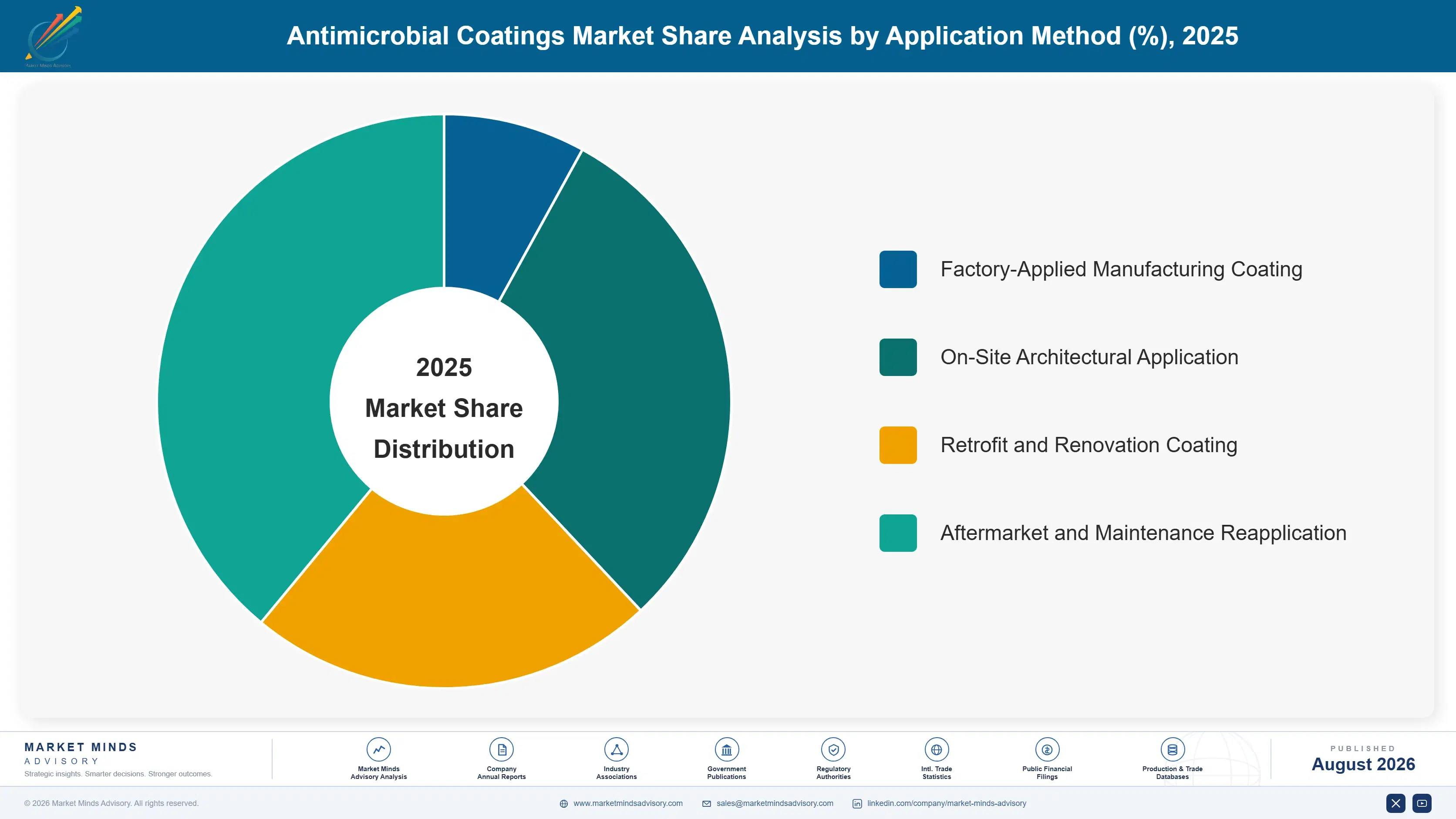
Segmentation follows biocide chemistry, a single active-ingredient logic describing what actually kills or inhibits the microorganism. Each chemistry carries its own registration pathway, cost structure, durability profile, and application fit, so commercial position tracks the active ingredient rather than the industry applying the coating. End-use industry and application method appear separately within the framework as distinct dimensions.
antimicrobial-coatings-market-market-share-analysis-1787324889131

Photocatalytic and Self-Disinfecting Coatings

Photocatalytic and self-disinfecting coatings grow fastest at 10.6%, about 1.47 times the overall 7.2% rate, using titanium dioxide and related light-activated chemistry to combine self-cleaning and antimicrobial performance in a single exterior product. Growth concentrates in dense, humid, and polluted urban construction markets across East and South Asia, where both properties independently justify the premium over standard exterior paint. The technology requires sufficient ultraviolet exposure to activate, which limits its use to exterior and well-lit interior surfaces and excludes shaded or enclosed applications entirely. Nippon Paint, TOTO, and several specialist photocatalytic formulators hold established positions. Standardised performance testing across jurisdictions remains underdeveloped relative to the category's growth. That gap complicates cross-border performance comparison for specifiers weighing competing suppliers.
CAGR 10.6%

Copper-Based Antimicrobial Coatings

Copper-based coatings grow at 9.2%, using copper and copper alloy formulations that carry among the strongest regulatory substantiation of any antimicrobial chemistry, including continuous effectiveness claims registered with health authorities in several major markets. That regulatory depth makes copper the preferred choice for the highest-scrutiny healthcare applications, including surfaces in intensive care and surgical environments where infection consequences are most severe. The chemistry costs more than silver-based alternatives and can discolour over time, which limits its use in applications where surface appearance matters as much as antimicrobial function. EOS Surfaces, Cupron, and several specialist healthcare coating suppliers anchor the category, alongside major coatings companies supplying licensed copper formulations. Several coatings companies license the copper technology rather than developing it independently.
CAGR 9.2%
Full segment breakdown across 5 segments available in the complete report.

Regional Architecture and Country Demand Map

Manufacturing and construction volume rather than regulatory intensity sets this overall distribution in the market today. East Asia leads decisively on coated appliance, electronics, and building output, North America follows closely behind on healthcare specification depth, and Vietnam posts the fastest national growth recorded anywhere.

North America

Healthcare specification depth gives North America 22% of value at 7.5% growth, sitting at the bottom of its share band despite carrying the most demanding registration regime anywhere. United States healthcare-associated infection programmes specify registered antimicrobial surfaces extensively in high-risk clinical areas, and EPA registration requirements have created genuine barriers protecting established suppliers from casual entry. Sherwin-Williams and PPG both hold strong domestic positions built on formulation and regulatory depth accumulated over several decades of investment. Consumer appliance adoption is strong but trails East Asian manufacturing volume considerably. Canadian demand follows similar patterns at smaller scale, and Mexican manufacturing is increasingly specifying the feature for export-bound appliances. Growth of 7.5% sits comfortably within its regulatory-driven trajectory.
Share: 22% | CAGR: 7.5% (2026 to 2036)

Western Europe

Western Europe holds 17% of value, below the 18 to 26% band, at the slowest growth of the seven regions at 6.0%, reflecting the region's strictest biocide product regulation anywhere in the world. European Union biocidal products regulation has raised registration cost and timeline beyond what several smaller formulators could sustain, consolidating the regulated segment among larger suppliers while pushing casual competitors toward unregistered consumer claims instead. AkzoNobel and BASF Coatings both hold deep positions built on regulatory compliance capability that smaller entrants struggle to replicate quickly. Healthcare specification is strong in Germany, the Netherlands, and Scandinavia specifically. Growth reflects a mature market where the easy volume has already converted.
Share: 17% | CAGR: 6.0% (2026 to 2036)
Regional intelligence for 5 additional markets available in the complete report: East Asia, South Asia and Pacific, Latin America, Middle East and Africa, Eastern Europe. Contact sales@marketmindsadvisory.com.
antimicrobial-coatings-market-country-cagr-analysis-1787324889637

Where Antimicrobial Coating Suppliers Hold Margin

Selling a biocide-loaded coating without registration behind it competes on commodity chemistry against anyone who can source the same active ingredient at similar cost. The four moves below shift earnings toward what unregistered competitors cannot reach: registration depth, dual-function chemistry, healthcare account relationships, and defensible testing evidence. Formulation alone rarely wins an account in any of these four categories today.

Build Registration Depth Ahead Of Demand

Securing biocidal product registration takes 12 to 36 months and well into six figures per jurisdiction, and suppliers who complete that process across several major markets simultaneously hold a position that casual competitors cannot assemble quickly at any price. Registration becomes a durable moat precisely because regulators require genuine efficacy substantiation rather than accepting a formulation claim on trust. Suppliers with registrations across the United States, European Union, and major Asian markets can pursue multinational healthcare and electronics accounts that single-jurisdiction competitors are simply excluded from bidding on entirely, regardless of formulation quality.
Market Impact: Registration spans 12 to 36 months

Combine Antimicrobial Function With A Second Claim

A coating carrying only an antimicrobial claim competes against every other registered biocide product on the market, while one also delivering self-cleaning, corrosion resistance, or thermal performance justifies its premium on multiple grounds simultaneously. Photocatalytic chemistry demonstrates this precisely, commanding roughly 15% additional premium over single-function antimicrobial coatings because the self-cleaning property independently justifies part of the cost. Suppliers should develop formulations stacking antimicrobial performance onto an existing coating category rather than launching antimicrobial products as a standalone line, since a bundled claim consistently outperforms a single one commercially. That premium has held steadily.
Market Impact: Dual-function pricing commands roug

Secure Healthcare System Accounts Through Renovation Cycles

Healthcare facility renovation and construction cycles run on decade-long timelines, and winning the specification for a hospital's high-touch surface programme commits that volume for the life of the facility rather than for a single order. Suppliers who invest in clinical relationships, infection control committee engagement, and case study evidence generation capture positions that transactional competitors bidding purely on price cannot displace once installed. Healthcare represents roughly 22% of application value but carries margin and retention considerably above the category average, because switching disrupts an entire infection control protocol nobody wants to revisit.
Market Impact: Healthcare accounts represent rough

Fund Third-Party Efficacy Testing As A Sales Asset

Regulatory enforcement and litigation risk around antimicrobial claims have increased noticeably, and buyers now weigh testing rigour more heavily than they did during the category's rapid pandemic-era growth. Suppliers who commission independent efficacy testing beyond the regulatory minimum, and who publish results transparently rather than relying on marketing language alone, differentiate on trust in a category where trust has become genuinely scarce. Testing budgets exceeding the regulatory minimum by roughly 40% have become the emerging baseline among leading suppliers. Procurement committees increasingly request that evidence directly rather than accepting label claims alone.
Market Impact: Testing spend now runs about 40% ab

Who Controls the Margin Pool

Concentration is moderate at roughly 32% for the top five, split between coatings majors selling registered lines and specialist biocide formulators supplying licensed technology into them. The gap between leaders and challengers is registration breadth and healthcare account depth rather than formulation sophistication, broadly comparable across established suppliers. All participants here are assessed on one basis, revenue from coatings carrying a registered or substantiated antimicrobial clai
Competition runs along three lines. First, registration depth across jurisdictions, since it determines who can even bid on regulated healthcare and food-contact accounts. Second, healthcare and institutional account relationships, which persist across renovation cycles measured in decades once established. Third, formulation breadth across biocide chemistries, since customers increasingly want a single supplier covering silver, copper, and photocatalytic options rather than sourcing each separately.

Pressure is building from two directions. Chinese domestic formulators are expanding registration coverage and moving into international healthcare and electronics accounts previously dominated by Western suppliers. Meanwhile specialist biocide technology companies are licensing directly to smaller regional coatings manufacturers, bypassing the global majors entirely on price-sensitive accounts. Rankings should favour suppliers combining registration breadth with genuine healthcare account depth over those holding formulation capability alone.
antimicrobial-coatings-market-company-positioning-matrix-1787324890158

Competitive Moat and Risk Dimensions

SHERWIN-WILLIAMS

Moat: Healthcare account depth

Sherwin-Williams holds deep healthcare and institutional account relationships built through decades of specification wins across North American hospital renovation programmes. Its registration portfolio spans the major biocide chemistries, letting it serve customers wanting silver, copper, and photocatalytic options from one supplier. Manufacturing scale supports competitive pricing on volume lines funding registration investment.
SHERWIN-WILLIAMS

Risk: Chinese price competition rising

Chinese domestic formulators compete on price in consumer and industrial categories where registration burden is lighter, pressuring margin on exactly the volume segments that historically funded broader portfolio investment. Its North American concentration limits participation in the fastest-growing Asian manufacturing volume. Registration maintenance across many jurisdictions carries ongoing cost that smaller, more focused competitors avoid by serving fewer markets.
AKZONOBEL

Moat: European regulatory compliance depth

AkzoNobel built genuine capability navigating the European Union's demanding biocidal products regulation, consolidating the regulated European segment among suppliers able to sustain that cost. Its photocatalytic and exterior coating technology serves construction directly, addressing dense urban markets where dual-function claims carry real value. Global manufacturing supports consistent specification across multinational accounts.
AKZONOBEL

Risk: Slow-growth European base

Heavy European weighting exposes it to the slowest-growing region in this market, where the easy specification volume has already converted to registered incumbents. Expansion into faster-growing Asian markets requires competing against domestic suppliers with lower cost structures under local regulatory regimes. Portfolio breadth across many coating categories means antimicrobial competes internally for capital against businesses with different growth profiles entirely.

Players Tracked

Prominent Players

Sherwin-Williams
PPG Industries
AkzoNobel
BASF Coatings
Nippon Paint Holdings

Other Key Players

RPM International
Axalta Coating Systems
Jotun
Kansai Paint
Asian Paints
Microban International
Sciessent
Cupron
EOS Surfaces
Sanitized AG
Milliken and Company
BioCote
Corning
TOTO
Nippon Steel Coatings

Recent Developments

MARCH 2023

European biocidal products regulation tightens active substance approvals

European regulators advanced review of active substances under the biocidal products regulation, narrowing the list of approved antimicrobial actives and raising evidentiary requirements for renewal. This was regulatory implementation rather than any corporate transaction, and it accelerated consolidation among European formulators able to sustain the compliance cost.
Signal: Regulatory tightening is doing the market
NOVEMBER 2023

Major appliance manufacturer standardises antimicrobial coating across product lines

A major global appliance manufacturer extended antimicrobial coating specification across its full consumer product range rather than limiting it to premium models. This was a procurement specification decision rather than an acquisition or merger, and it converted a differentiated feature into a baseline expectation across the category.
Signal: Once one major manufacturer standardises t
AUGUST 2024

Chinese formulator secures multi-jurisdiction biocide registration

A leading Chinese antimicrobial coating formulator completed registration across several major export markets simultaneously, extending beyond its previously domestic-focused regulatory coverage. This was an organic registration programme rather than any acquisition, and it opened international healthcare and electronics accounts to a supplier previously confined to the domestic market.
Signal: Registration barriers erode once a well-re

Silver, Copper, Resins, Registration

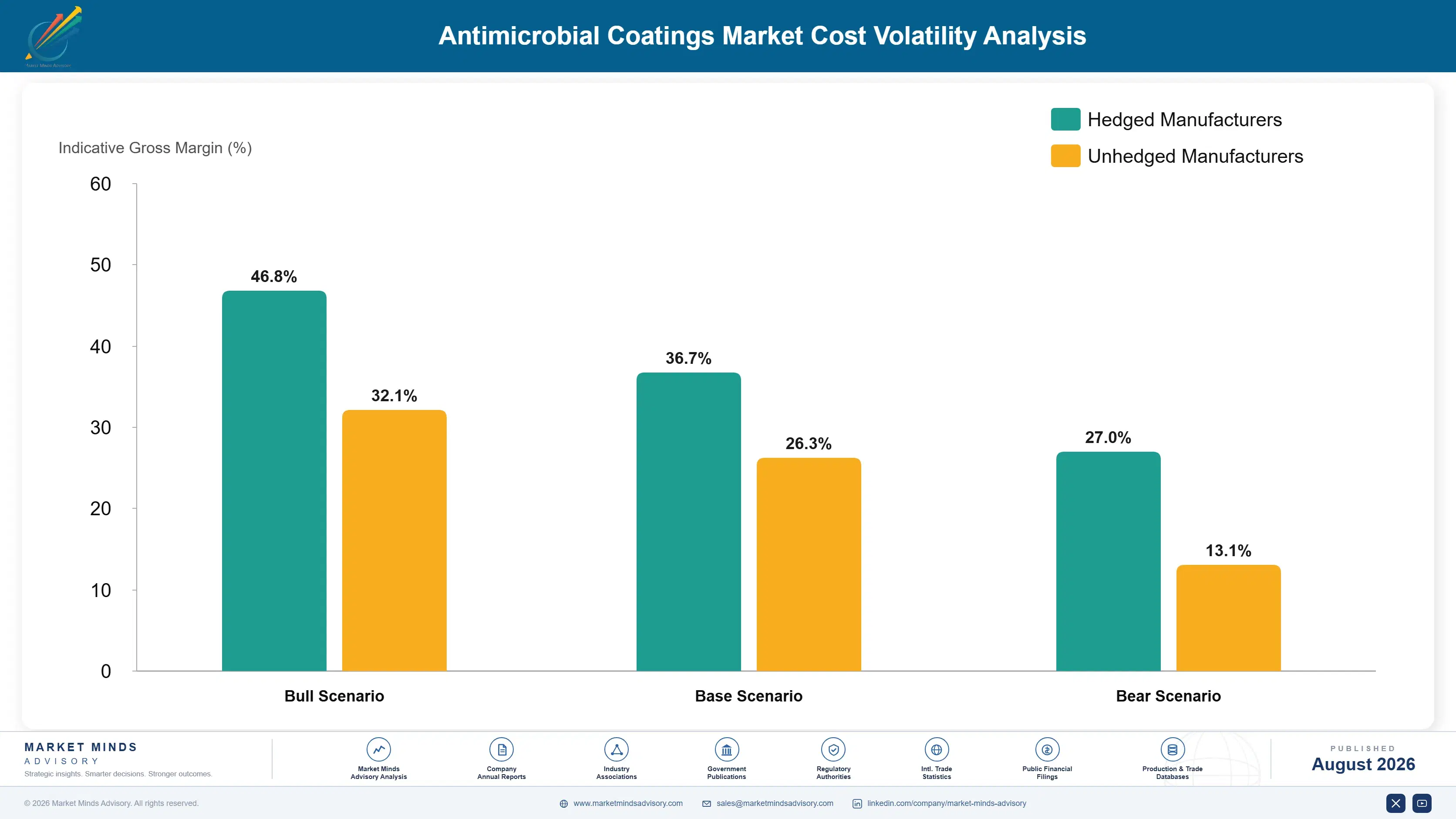
Active biocide ingredients dominate the differentiated cost structure. Silver, copper, and zinc compounds account for roughly 15% to 30% of finished coating cost depending on loading rate and chemistry, sourced from metal markets that move independently of the broader coatings industry. Resin and coating base contribute 35% to 45%, comparable to standard coatings. Registration amortisation represents a substantial fixed investment recovered across production volume.
Silver prices moved sharply through 2022 and into 2023 as broader precious metal markets tightened, lifting the cost of silver-based antimicrobial formulations meaningfully faster than the coatings base itself moved. Copper followed a similar pattern tied to broader industrial metal demand rather than to anything specific to the antimicrobial coatings category. Several suppliers disclosed the resulting input cost pressure across their 2022 and 2023 annual reporting.

Exposure divides sharply by chemistry and by contract structure rather than by geography. Silver-based formulators faced the steepest input volatility given precious metal price movement, while copper and zinc-based suppliers experienced somewhat more moderate swings tied to industrial metal cycles. Suppliers on multi-year fixed-price healthcare contracts absorbed cost increases directly, while those able to reprice consumer and industrial lines more frequently protected margin considerably better across the same period.
antimicrobial-coatings-market-cost-volatility-analysis-1787324890354

Diversify biocide chemistry across metal exposure

Concentrating entirely in silver-based formulations ties margin to precious metal price movement that has nothing to do with coating demand itself at all. Offering copper, zinc, and organic biocide alternatives spreads that exposure across several different commodity cycles considerably better. It also lets suppliers reposition customers toward whichever chemistry offers the best cost position available.

Index long-term healthcare contracts to metal benchmarks

Multi-year fixed-price agreements with healthcare and institutional buyers made sense when silver and copper moved slowly, and became a genuine liability when both metals rose sharply together. Indexing pricing to published metal benchmarks shares volatility with the buyer rather than concentrating it entirely on the supplier alone. Institutional buyers accept this once shown the alternative.

Amortise registration cost across shared active ingredient platforms

Registering each product formulation separately multiplies compliance cost unnecessarily when several products share the same underlying active ingredient and delivery mechanism. Designing a family of coatings around one registered active platform spreads that fixed cost across many finished products. It also shortens time to market for line extensions considerably, since the core registration work is already complete.

Portfolio Architecture for Margin Defence

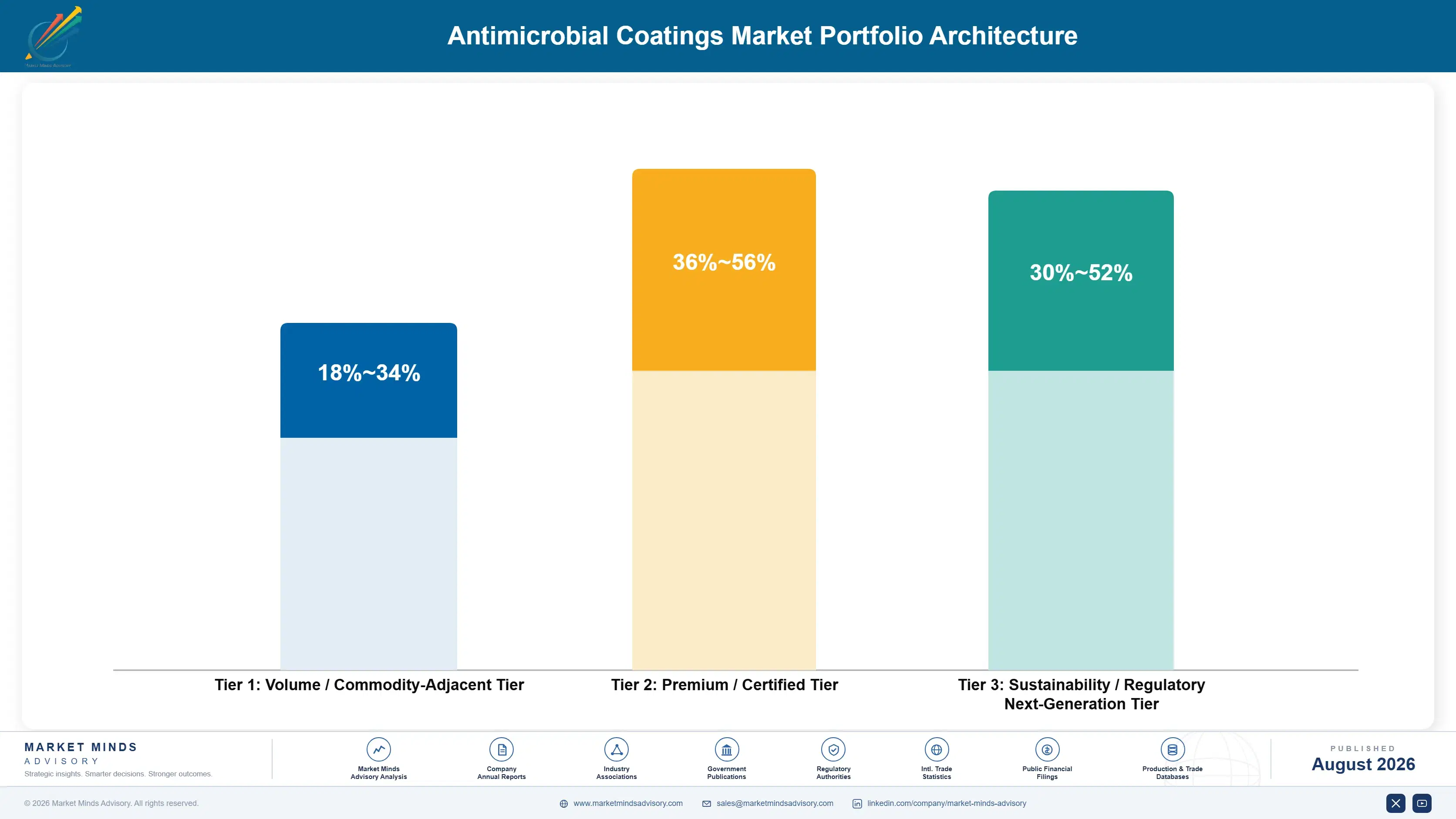
The portfolio splits into three tiers with quite different economics. Standard silver-based coatings for consumer and general industrial use are the volume tier, where formulation is broadly available and competition is genuine. Registered healthcare and food-contact products earn considerably more, because regulatory registration and clinical relationships narrow the field substantially. Photocatalytic and dual-function chemistries sit differently again, priced against the additional performanc
The tension runs between consumer volume that keeps production lines loaded and registered healthcare work that earns the return. Consumer electronics and appliance coating generates substantial tonnage and maintains relationships with major manufacturers where the broader coatings relationship matters commercially. Yet it competes on cost against formulators with lighter registration overhead. Suppliers managing this treat consumer volume as manufacturing scale and direct registration investment deliberately toward healthcare and food-contact categories.

High-value pools concentrate where registration or dual functionality limits competition: healthcare surfaces requiring clinical-grade substantiation, food-contact applications meeting hygiene certification, and photocatalytic exterior coatings carrying a second independently valuable claim. All three resist the price competition defining consumer antimicrobial coating, because the qualified supplier field is narrow and the buyer is purchasing regulatory assurance rather than paint alone. Standard consumer lines offer no comparable protection.

Volume / Commodity-Adjacent Tier

Standard silver and zinc-based antimicrobial coatings for consumer electronics, appliances, and general industrial use. The range is wide because formulators with lighter registration overhead compete directly on price against those carrying full compliance cost.
Gross Margin: 18-34%

Premium / Certified Tier

Registered healthcare, food-contact, and institutional antimicrobial coatings carrying clinical-grade substantiation and multi-jurisdiction approval. The range is wide because registration amortisation varies considerably with how many products share a certified platform.
Gross Margin: 36-56%

Sustainability / Regulatory / Next-Generation Tier

Photocatalytic and self-disinfecting exterior coatings, organic and bio-based biocide alternatives, and dual-function formulations combining antimicrobial with other performance claims. The range is wide because dual-function pricing depends heavily on which second claim the coating carries.
Gross Margin: 30-52%
antimicrobial-coatings-market-portfolio-architecture-1787324890853

High-value Sub-segments and Strategic Watch-out

Photocatalytic and Self-Disinfecting Coatings

High value and the fastest growth at 10.6%, combining antimicrobial and self-cleaning claims in dense urban construction markets across Asia. Ultraviolet exposure requirements limit application to exterior surfaces, and standardised performance testing across jurisdictions remains genuinely underdeveloped relative to current demand. Standardised testing would accelerate adoption further.
Gross Margin: 32-52%

Copper-Based Healthcare Coatings

High value with strong growth at 9.2%, carrying the deepest regulatory substantiation of any antimicrobial chemistry and commanding the highest-scrutiny healthcare accounts available anywhere in the market. Discolouration over time limits use where surface appearance matters, and cost runs considerably above silver-based alternatives across every application category.
Gross Margin: 36-56%

Silver-Based Consumer and Industrial Coatings

The volume core across consumer electronics, appliances, and general industrial applications worldwide. Growth is steady at 6.8% but formulation is broadly available, and competition on price is direct wherever registration burden is lighter than healthcare categories specifically require. Manufacturers treat it as a baseline specification line.
Gross Margin: 18-34%

Organic and Synthetic Biocide Coatings

The strategic watch-out, growing slowest at 5.4% as metal-based chemistries generally outperform on durability and regulatory substantiation depth over time. Cost advantages exist in some formulations, but efficacy duration claims typically run shorter than silver or copper alternatives allow. Suppliers here compete mainly on cost.
Gross Margin: 16-30%

How Antimicrobial Specifications Actually Stick

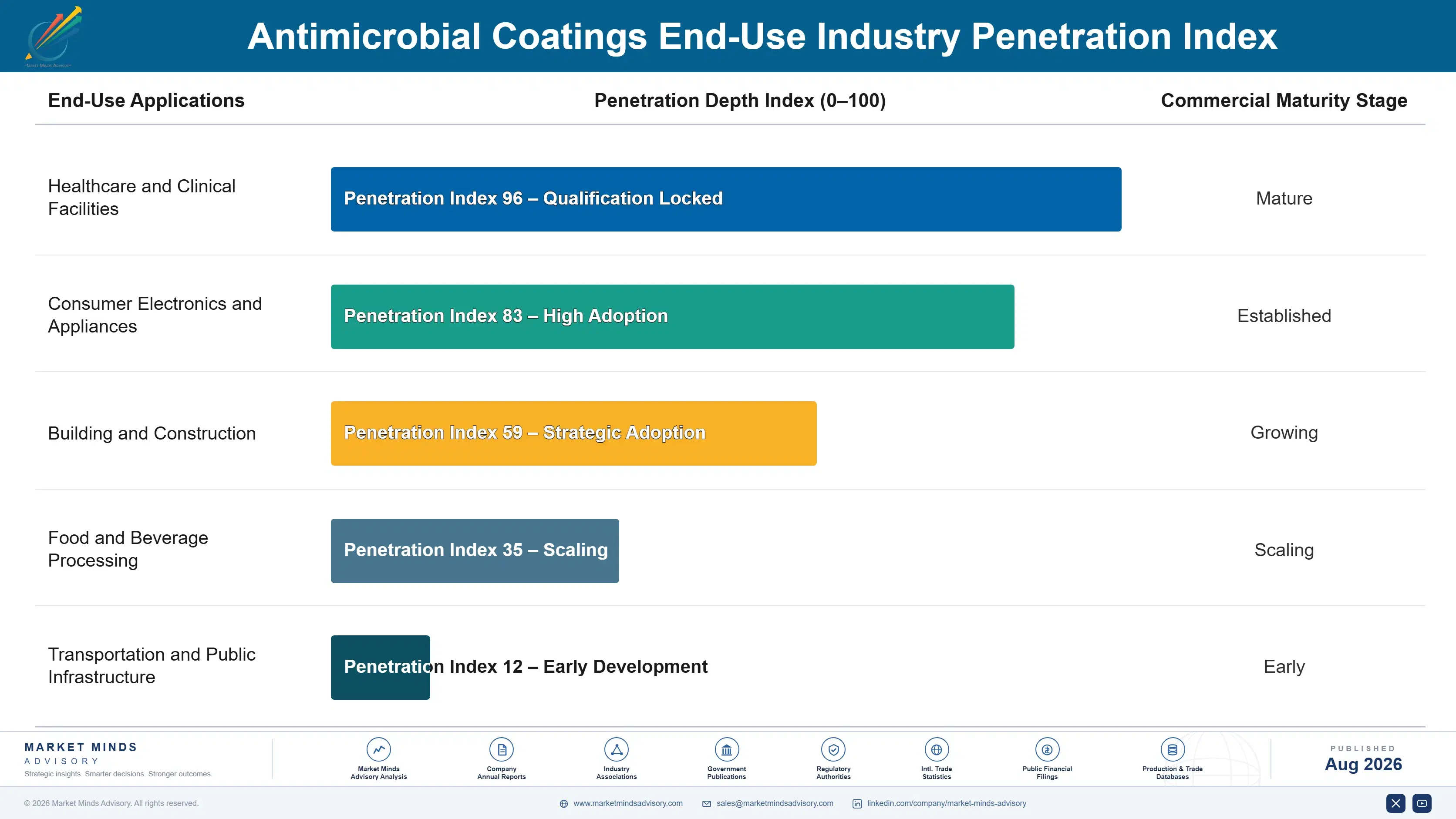
Revenue behaves differently across the two main buyer types. Healthcare specification is annuity-like, since a facility renovation locks a supplier in for the building's life and reorders follow maintenance cycles without fresh evaluation. Consumer electronics adoption is transactional and renegotiated each product cycle, with manufacturers free to switch suppliers or drop the feature if cost pressure shifts. Understanding which relationship an account represents shapes pricing decisions.
Adoption depth varies sharply by buyer type. Healthcare systems go deepest, running formal infection control specification and rarely switching suppliers once qualified. Consumer electronics manufacturers adopt readily but treat the feature as one specification line among many, switching on cost with limited loyalty. Construction owners specify photocatalytic coatings based on climate and code requirements. Food processing operators specify narrowly against hygiene certification tied to export markets.

Buyer profiles have shifted from facilities managers toward infection control committees, regulatory affairs functions, and sustainability officers with quite different priorities. A facilities manager compared coating price and coverage; an infection control committee wants clinical evidence and registration documentation, and a regulatory affairs function increasingly manages claim substantiation risk directly. Suppliers still selling on coverage and price alone find decisions made by committees that never saw their quotation.
antimicrobial-coatings-market-end-use-penetration-index-1787324891340

Our Call On Antimicrobial Coatings

These are among the four positions where our research anticipates prominent divergence between winners and laggards over the coming forecast period. Each is grounded in the demand model, the regulatory perimeter, and the announced capacity pipeline.
01 / REGISTRATION AS MOAT

The compliance file matters more than the formulation

Securing biocidal product registration takes 12 to 36 months and well into six figures per jurisdiction, and that barrier protects incumbents in healthcare and food-contact applications far more effectively than formulation secrecy ever could. Suppliers with registrations spanning the United States, European Union, and major Asian markets can pursue multinational accounts that single-jurisdiction competitors are simply excluded from bidding on. Formulators should treat registration investment as the primary competitive strategy rather than as a compliance cost to be minimised wherever possible.
02 / DUAL-FUNCTION PREMIUM CAPTURE

Stack a second claim onto antimicrobial performance

A coating carrying only an antimicrobial claim competes against every other registered biocide product on the market, while photocatalytic chemistry combining self-cleaning with antimicrobial function commands roughly 15% additional premium because the second property independently justifies part of the cost. That combination is what is driving the fastest-growing segment in this entire market, concentrated in dense urban construction. Suppliers should develop formulations stacking antimicrobial performance onto existing coating categories rather than launching standalone antimicrobial lines competing purely on biocide credentials alone.
03 / HEALTHCARE ACCOUNT DEPTH

Decade-long renovation cycles reward the first mover

Healthcare facility renovation and construction cycles run on decade-long timelines, and winning a hospital's high-touch surface specification commits that volume for the building's operating life rather than for a single order cycle. Suppliers investing in clinical relationships and infection control committee engagement capture positions that transactional price competitors cannot displace once installed and clinically validated across the facility. Healthcare represents roughly 22% of application value but carries retention and margin considerably above the broader category average, because switching disrupts an entire infection control protocol nobody wants to reopen.
04 / TESTING CREDIBILITY INVESTMENT

Enforcement risk is repricing trust across the category

Regulatory enforcement and litigation around antimicrobial marketing claims have increased noticeably following the category's rapid pandemic-era growth, and buyers now weigh testing rigour more heavily than efficacy claims alone. Suppliers commissioning independent testing beyond the regulatory minimum, and publishing results transparently, differentiate on trust that has become genuinely scarce across the category. That investment costs a fraction of a single enforcement action or liability claim, and it converts directly into procurement committee confidence during specification decisions that increasingly weigh evidence over marketing language.

Engagement Snapshot From the Field

A live engagement with an industry participant carrying material or product regulatory and market exposure ahead of a defining policy shift, showing how our research translates into a defensible multi-year portfolio strategy.
MARKET MINDS ADVISORY · CLIENT ENGAGEMENT SUMMARY
Antimicrobial Coatings Producer Strategic Portfolio Review and Transition Roadmap 2026·Investment Scenario on Antimicrobial Coatings Exposure Evaluation 2025-26
CLIENT PROFILE
A regional hospital network operating twelve facilities engaged MMA while planning a system-wide infection control renovation programme. The client reported annual facilities capital spend near USD 85 million and had accumulated coating specifications from six different suppliers across its facilities over the preceding decade, with no consistent standard ever applied across the network (client-reported, unverified by MMA).
STRATEGIC CHALLENGE
Infection rates varied meaningfully between facilities and nobody could establish whether coating choice, application quality, or unrelated clinical factors explained the difference. The renovation programme needed a single specification standard, but clinical staff distrusted marketing claims from several existing suppliers following recent industry enforcement actions covered in trade press. Budget constraints meant not every facility could receive the premium option immediately.
MMA APPROACH
MMA benchmarked infection outcome data against coating chemistry and registration status across all twelve facilities, isolating coating-attributable variance from clinical and demographic factors. We assessed each incumbent supplier on registration currency and independent testing evidence rather than on marketing claims. We then modelled a phased rollout prioritising the highest-risk clinical areas first against the available capital budget.
KEY FINDINGS
  1. Facilities using copper-based coatings in intensive care units showed measurably lower surface contamination rates than those using older silver-based products applied more than five years earlier.
  2. Two of the six incumbent suppliers held registrations that had lapsed or narrowed since original installation, meaning current marketing claims exceeded what their registration actually supported (client-reported, unverified by MMA).
  3. Standardising on two suppliers rather than six would cut procurement complexity substantially while preserving competitive tension through a genuine second source relationship.
  4. Phasing high-risk clinical areas first captured most of the infection control benefit within the first eighteen months at roughly 40% of total programme cost.
CLIENT PROFILE
A regional hospital network operating twelve facilities engaged MMA while planning a system-wide infection control renovation programme. The client reported annual facilities capital spend near USD 85 million and had accumulated coating specifications from six different suppliers across its facilities over the preceding decade, with no consistent standard ever applied across the network (client-reported, unverified by MMA).
STRATEGIC CHALLENGE
Infection rates varied meaningfully between facilities and nobody could establish whether coating choice, application quality, or unrelated clinical factors explained the difference. The renovation programme needed a single specification standard, but clinical staff distrusted marketing claims from several existing suppliers following recent industry enforcement actions covered in trade press. Budget constraints meant not every facility could receive the premium option immediately.
MMA APPROACH
MMA benchmarked infection outcome data against coating chemistry and registration status across all twelve facilities, isolating coating-attributable variance from clinical and demographic factors. We assessed each incumbent supplier on registration currency and independent testing evidence rather than on marketing claims. We then modelled a phased rollout prioritising the highest-risk clinical areas first against the available capital budget.
KEY FINDINGS
  1. Facilities using copper-based coatings in intensive care units showed measurably lower surface contamination rates than those using older silver-based products applied more than five years earlier.
  2. Two of the six incumbent suppliers held registrations that had lapsed or narrowed since original installation, meaning current marketing claims exceeded what their registration actually supported (client-reported, unverified by MMA).
  3. Standardising on two suppliers rather than six would cut procurement complexity substantially while preserving competitive tension through a genuine second source relationship.
  4. Phasing high-risk clinical areas first captured most of the infection control benefit within the first eighteen months at roughly 40% of total programme cost.
RECOMMENDED STRATEGY
Phase 1: Phase 1 (0 to 18 months): Standardise intensive care, surgical, and emergency areas across all twelve facilities on copper-based coatings from the two suppliers with current, verified registration. Phase 2: Phase 2 (18 to 36 months): Extend the standard to general inpatient areas, retiring the four suppliers whose registration or evidence base did not meet the new threshold. Phase 3: Phase 3 (36 to 54 months): Complete rollout across remaining facility areas and establish a recurring registration verification process for all coating suppliers system-wide.
OUTCOME
The client standardised on two verified suppliers and completed high-risk area conversion within the planned eighteen-month window, ahead of the full renovation budget cycle. Registration verification uncovered lapsed claims from two prior suppliers that the client has since referenced in its own procurement policy documentation (client-reported, unverified by MMA).

Frequently Asked Questions

Foundational context covering the market sizes, CAGR, scope, country, region and competition that inform every finding below. This section is provided to cover basics and most often pre-purchase conversations, answered from the MMA Primary Research Dataset.

What is the current size of the Antimicrobial Coatings Market?

The global antimicrobial coatings market is valued at USD 4.6 billion in 2025, covering silver, copper, zinc, organic, and photocatalytic coating chemistries applied to healthcare, consumer, and construction surfaces. Antimicrobial textiles and plastics additives are excluded.

How large will the Antimicrobial Coatings Market be by 2036?

The market is forecast to reach USD 9.88 billion by 2036 in the base case, about 2.00 times the 2026 level. That represents incremental value of roughly USD 4.95 billion across the forecast decade.

What is the CAGR for the Antimicrobial Coatings Market 2026 to 2036?

The market grows at a 7.2% CAGR in the base case, with bull and bear scenarios at 8.4% and 6.0%. The spread turns mainly on healthcare specification breadth and photocatalytic building code recognition.

Which segment is growing fastest?

Photocatalytic and self-disinfecting coatings grow fastest at 10.6%, about 1.47 times the overall rate, combining self-cleaning and antimicrobial claims. Copper-based healthcare coatings follow at 9.2% on regulatory substantiation depth.

Who are the major companies in the Antimicrobial Coatings Market?

Leading suppliers include Sherwin-Williams, PPG Industries, AkzoNobel, BASF Coatings, and Nippon Paint Holdings, holding roughly 32% between them. Specialist biocide formulators supply active ingredients and licensed technology into the field.

Which country is growing fastest?

Vietnam grows fastest at an 11.8% CAGR, as export-oriented electronics and appliance manufacturing adopts coating specification to match international brand requirements. India follows on healthcare infrastructure investment.

Report Segmentation Architecture

The full report scope spans multiple orthogonal segmentation dimensions, with cross-tabulated demand data provided for each dimension pair. Coverage extends further to regional breakdowns, trend trajectories, and the competitive detail needed to support segment-level decision-making.

By Biocide Chemistry

  • Silver-Based Coatings
  • Copper-Based Coatings
  • Zinc-Based Coatings
  • Organic and Synthetic Biocide Coatings
  • Photocatalytic and Self-Disinfecting Coatings

By End-Use Industry

  • Healthcare and Clinical Facilities
  • Consumer Electronics and Appliances
  • Building and Construction
  • Food and Beverage Processing
  • Transportation and Public Infrastructure

By Application Method

  • Factory-Applied Manufacturing Coating
  • On-Site Architectural Application
  • Retrofit and Renovation Coating
  • Aftermarket and Maintenance Reapplication

By Region

  • North America
  • Western Europe
  • East Asia
  • South Asia and Pacific
  • Latin America
  • Middle East and Africa
  • Eastern Europe

Scope, Methodology, and Coverage

Every figure in this report is reproducible from documented input assumptions. The scope below maps the historical period, the forecast horizon, the segmentation dimensions, and the countries covered, alongside the underlying primary and qualitative methodology.
Historical Period
2020 to 2025
Forecast Period
2026 to 2036
Base Year
2025 (USD billions; MMA Primary Research Dataset, August 2026)
Market Definition
The antimicrobial coatings market comprises coatings, paints, and surface treatments formulated with a biocidal active ingredient to inhibit the growth of bacteria, fungi, mould, algae, or other microorganisms on the treated surface, valued at manufacturer selling prices. It spans silver-based, copper-based, zinc-based, organic and synthetic biocide, and photocatalytic and self-disinfecting chemistries, applied through factory manufacturing processes, on-site architectural application, or aftermarket retrofit across healthcare, consumer electronics, construction, food processing, and transportation surfaces. Antimicrobial textiles and fibres, antimicrobial plastics and polymer additives compounded into a substrate rather than applied as a surface coating, disinfectant and cleaning chemical products, water treatment biocides, and antibiotic or antifungal pharmaceutical products are excluded.
Quantitative Units
USD billions (current prices); coated surface area and treated unit volume by application where applicable
Segmentation Dimensions
By Biocide Chemistry; By End-Use Industry; By Application Method; By Region
Regions Covered
North America, Western Europe, East Asia, South Asia and Pacific, Latin America, Middle East and Africa, Eastern Europe
Countries Covered
USA, China, Japan, South Korea, Germany, UK, France, Netherlands, Sweden, Italy, Spain, Canada, Mexico, Brazil, India, Vietnam, Thailand, Malaysia, Indonesia, Australia, UAE, Saudi Arabia, Qatar, South Africa, Egypt, Turkey, Poland, Czechia, Hungary, and additional markets relevant to this sector
Key Companies Profiled
Sherwin-Williams, PPG Industries, AkzoNobel, BASF Coatings, Nippon Paint Holdings, RPM International, Axalta Coating Systems, Jotun, Kansai Paint, Asian Paints, Microban International, Sciessent, Cupron, EOS Surfaces, Sanitized AG, Milliken and Company, BioCote, Corning, TOTO, Nippon Steel Coatings
Quantitative Methodology
Primary survey, n=3,800 respondents, Q4 2025, six countries; demand-side model with trade association cross-validation
Qualitative Methodology
47 expert interviews, Q4 2025; applied to validate demand model assumptions, identify emerging dynamics, and assess competitive positioning
Report Format
PDF and XLSX data workbook (Word format preview document)
Publisher
Market Minds Advisory
Report Code
MMA-2026-CHM-207
Published
August 2026
Contact
sales@marketmindsadvisory.com | www.marketmindsadvisory.com

Purchase the full Antimicrobial Coatings Market Report (2026 to 2036).

The full MMA Antimicrobial Coatings report sizes the market across five biocide chemistries, five end-use industries, four application methods, and seven regions through 2036. It profiles 20 suppliers on a consistent basis of antimicrobial coating revenue, scoring each on registration breadth across jurisdictions, healthcare and institutional account depth, formulation breadth across chemistries, and dual-function product development. Scenario models quantify how healthcare specification, registration cost, and photocatalytic adoption move both volume and achievable margin by chemistry. The report also includes registration cost and timeline benchmarking by jurisdiction, healthcare account retention analysis, and photocatalytic building code recognition tracking across major construction markets.
Five-chemistry and four-method market sizing through 2036
Twenty-supplier benchmark on antimicrobial coating revenue
Registration cost and timeline benchmarking by jurisdiction
Healthcare account specification and retention analysis
Photocatalytic building code recognition tracking by market
Consumer electronics adoption rate assessment by manufacturer

Built For The People Who Decide

From boardroom strategy to bench-side execution, this report is read cover-to-cover by leaders shaping the next decade of their industry, turning demand scenarios, market dynamics and valuation benchmarks into decisions.
CXOs/ Presidents/ VPs/ Managers
M&A and Corporate Development
Strategy Teams and R&D Heads
Procurement and Product Directors
Regulatory and Compliance Leaders
Investor Relations and Equity Analysts