Market Minds Advisory
Antimicrobial Coated Medical Devices Market

Antimicrobial Coated Medical Devices Market: Coating Chemistry as the New Compliance Line

Hospitals now write catheter-associated infection reduction into procurement contracts, silver and antibiotic coatings shift from premium option to purchasing requirement, and device makers without validated coating chemistry lose bids before price ever enters the conversation.

Lead Analyst

Alice Ballenger

Published

September 2026

Make Smarter Decisions with Customized Research Insights

Request a free sample report and evaluate market opportunities, growth trends, and competitive dynamics relevant to your business needs.

2025 MARKET VALUE$8.4BMarket Size 2025
2036 FORECAST VALUE$22.1BBase Case , 2026 to 2036
CAGR 2026 TO 20369.2 %Bull 10.4% / Bear 8.0%
INCREMENTAL OPPORTUNITY$12.9BNet 10- year value creation
EXPANSION MULTIPLE2.41x2036 value over 2026 base
Strategic Levers
M&A Pipeline
Regional Outlook
Country Rankings
Competitive Intelligence
Segmental Deep-dive
Call-Us : 91 93563 13602

Executive Snapshot and Market Trajectory

Hospitals increasingly treat antimicrobial coatings as a procurement prerequisite rather than a premium add-on, since Medicare's non-payment policy for hospital-acquired infections since 2008 pushed device buyers to demand documented proof of reduced catheter and implant colonization rates before any purchasing contract is finalized and signed.
Orthopedic and dental implants lead growth at 11.5%, roughly 1.25 times the overall rate, as surgeons adopt silver and antibiotic-eluting coatings to cut periprosthetic joint infection rates that currently force revision surgery in a meaningful share of cases. East Asia now holds the largest regional share at 29%, driven by China's expanding hospital infrastructure and centralized procurement standards that increasingly specify coated devices for high-risk surgical categories such as hip and knee revision procedures.
Competitive intensity concentrates around five suppliers controlling roughly 42% of coated-device revenue, yet none commands pricing power because hospitals qualify multiple vendors per category to protect supply continuity. FDA 510(k) pathways now require antimicrobial efficacy data beyond substantial equivalence, raising the bar for new entrants. Meanwhile silver-resistance research is prompting a shift toward combination chemistries that pair noble metals with antibiotic elution layers to extend efficacy windows beyond first-generation designs.
Market Definition
The antimicrobial coated medical devices market covers devices treated with silver, antibiotic, chlorhexidine, or other bioactive coatings applied specifically to inhibit microbial colonization on the device surface. It spans urinary and vascular catheters, orthopedic and dental implants, wound dressings, endotracheal tubes, and surgical sutures and mesh sold with a validated antimicrobial claim. Uncoated devices, standalone topical antiseptics, and antibiotic drugs administered independently of a device are excluded.
Base Year Value
$8.4B in 2025 (MMA Primary Research Dataset, August 2026)
Forecast Period
2026 to 2036, eleven discrete annual values
CAGR
9.2% base case. Bull 10.4%. Bear 8.0%.
Fastest Growth Segment
Orthopedic and Dental Implants: 11.5% CAGR
Fastest Growth Country
China: 12.8% CAGR
Fastest Growth Region
South Asia and Pacific: 11.2% CAGR
Largest Region
East Asia: 29% of 2025 global value
Market Leaders
Becton, Dickinson and Company, Teleflex Incorporated, Smith & Nephew plc, Bactiguard AB, Covalon Technologies Corp. Source: MMA Analysis based on company annual reports.
Primary Survey
n=3,800 procurement and R&D decision-makers, Q4 2025, six countries
Methodology
Demand-side build-up, cross-validated against public data, 47 expert interviews

Antimicrobial Coated Medical Devices Market Forecast Scenarios

antimicrobial-coated-medical-devices-market-size-forecast-scenario-1787300427213
Between 2020 and 2025 the market grew at an estimated 8.2% annually, accelerating through the pandemic as hospitals tightened infection-control budgets even while elective surgical volume dipped. Silver-coated urinary catheters saw the earliest adoption gains, given straightforward retrofit into existing procurement lines, while orthopedic coating adoption lagged behind surgeon familiarity and reimbursement clarity until 2023.
Three mechanisms carry the base case to 9.2%. First, CMS and equivalent payer policies keep penalizing hospital-acquired infections, pushing procurement teams to specify coated devices as a default rather than an exception. Second, orthopedic surgeons are converting pilot programs into standing formulary commitments as periprosthetic joint infection data accumulates. Third, coating suppliers are qualifying combination silver-antibiotic chemistries that extend efficacy duration, letting device makers charge a premium justified by lower revision rates rather than by marketing claims alone.
The bull case at 10.4% assumes the FDA finalizes updated antimicrobial device guidance that shortens approval timelines for combination coatings, letting suppliers move faster from pilot to full hospital system contracts. The bear case at 8.0% assumes silver-resistant bacterial strains spread widely enough that infection-control committees start questioning coating efficacy publicly, slowing new specification writing across major hospital purchasing groups.

Coating Chemistry as a Purchasing Criterion

Antimicrobial coating has moved from a niche wound-care feature into a cross-category purchasing standard spanning catheters, implants, and surgical hardware. Regulatory penalty structures for hospital-acquired infections converge with rising periprosthetic joint infection awareness and advancing polymer chemistry to make coated devices the default specification rather than the premium exception across most acute-care procurement categories in developed and increasingly emerging hospital systems
MARKET CONCENTRATION (CR5)42%Top five suppliers hold moderate combined device coating share
AVERAGE SELLING PRICE PREMIUM18-25%Coated devices command premium pricing over uncoated equivalents consistently
TOP PRODUCING COUNTRY SHARE34%China supplies largest share of coated device manufacturing capacity
HOSPITAL CONTRACT RENEWAL CYCLE3 to 5 yearsPurchasing agreements typically span several years before formulary renewal review
COATING INPUT COST SHARE22-28% of COGSSilver and polymer inputs weigh heavily on device production costs
TRADE INTENSITY41% cross-borderCoated components frequently cross borders before final device assembly occurs
Commercially, the category behaves like a specialty chemicals business layered onto a regulated device market. Coating suppliers license chemistry to device manufacturers under long exclusivity agreements rather than selling finished products directly, which concentrates negotiating leverage among a handful of chemistry originators. Device makers, in turn, compete on clinical outcome data and hospital relationships rather than on coating novelty alone, since most buyers now treat antimicrobial protection as table stakes.
Over the next decade, expect combination chemistries pairing silver with antibiotic or enzyme-based agents to replace single-agent coatings across most categories, as resistance concerns push formulary committees toward broader-spectrum solutions. Reimbursement expansion in South Asia and Pacific markets, alongside China's centralized hospital procurement standards, will likely determine where incremental volume actually lands across the region.
"Coating chemistry, not device engineering, now decides who wins a hospital contract. The devices themselves have converged; the surface science has not."
Director, Medical Devices and Infection Prevention Practice · MMA Medical Device

Market Trends

CMS Hospital-Acquired Condition Policy Reshapes Procurement

Since 2008, the Centers for Medicare and Medicaid Services has withheld additional payment for a defined list of hospital-acquired conditions including catheter-associated urinary tract infections and certain surgical site infections, forcing hospitals to absorb the full cost of treating them. That penalty structure pushed infection-control committees to specify antimicrobial-coated catheters and implants as a default line item rather than an optional upgrade, particularly in intensive care and orthopedic surgical units where infection rates carry the largest financial exposure. Similar non-payment frameworks are now emerging across several European national health systems, extending the same procurement logic beyond the United States entirely.
Market Impact: Coating cuts PJI risk 30%

Combination Silver-Antibiotic Chemistries Displace Single-Agent Coatings

Single-agent silver coatings dominated the category through the 2010s, but growing evidence of silver-tolerant bacterial biofilms is pushing device makers toward combination chemistries that pair noble metals with antibiotic elution layers or enzyme-based disruptors. Surmodics and Bactiguard have both published clinical data showing extended efficacy windows for dual-mechanism coatings compared with legacy single-agent designs, and several major orthopedic implant makers have begun qualifying combination formulations for hip and knee product lines entering trials in 2025. The shift raises input complexity and regulatory documentation burden, but it creates a genuine performance differentiator pricing alone cannot replicate.
Market Impact: Expands base by 3,200 beds yearly

Market Opportunities and Growth Drivers

Rising Periprosthetic Joint Infection Rates Drive Adoption

Periprosthetic joint infection complicates a meaningful share of hip and knee replacements, and each revision procedure costs hospitals substantially more than the original surgery while extending patient recovery by months. The American Academy of Orthopaedic Surgeons has flagged infection prevention as a leading quality metric in bundled payment programs, which now tie hospital reimbursement directly to complication rates rather than procedure volume alone. That reimbursement structure gives orthopedic surgeons a direct financial reason to specify antimicrobial-coated implants even where unit cost runs higher, since avoiding one revision surgery covers the coating premium many times over across a typical surgical caseload.
Market Impact: Limits adoption to 25% of implants

Emerging Market Hospital Construction Expands Device Base

China's Ministry of Health has directed provincial governments to expand tertiary hospital bed capacity substantially through 2030, and each new facility opening triggers a fresh procurement cycle for catheters, implants, and wound care supplies rather than a replacement purchase against an existing installed base. India's National Health Mission is funding a comparable expansion of district-level surgical infrastructure, and both programs increasingly specify infection-control performance criteria in tender documents rather than leaving coating decisions to individual hospital discretion. That shift moves antimicrobial specification upstream into national procurement policy, which locks in demand years before any single hospital places an order.
Market Impact: Delays reimbursement approval 18 months

Market Restraints and Challenges

Coating Durability Limits Long-Term Implant Adoption

Antimicrobial coatings on permanent orthopedic implants face a durability problem that catheter coatings do not: efficacy must persist for years inside the body, not weeks during a hospital stay. The root cause is elution kinetics, since most coatings release their active agent within weeks of implantation, leaving the device unprotected against late-onset infection years later. That gap has made implant makers cautious about broad rollout, limiting coated implants mostly to high-risk revision cases rather than primary procedures. Suppliers are responding with slower-release matrices and covalently bonded layers built to extend protection beyond the healing period.
Market Impact: Coating specified in 60% contracts

Reimbursement Fragmentation Outside the United States Slows Uptake

Outside the United States, reimbursement for antimicrobial-coated devices remains fragmented across national health systems that lack a unified non-payment penalty for hospital-acquired infections. The root cause is systemic: most European and Asia-Pacific payers reimburse devices through bundled procedure codes that do not distinguish coated from uncoated products, so hospitals absorb the coating premium directly rather than billing it separately. That fragmentation slows adoption in cost-constrained public health systems even where infection rates justify the switch. Device makers are pursuing health-economic dossiers and real-world evidence studies to persuade national health technology assessment bodies to grant coating-specific reimbursement codes.
Market Impact: Extends efficacy window by 40%
3 additional market trends, 4 additional growth drivers, and 2 additional restraints and challenges are covered in the full report. Contact sales@marketmindsadvisory.com to access the complete intelligence.

Segment CAGR and Growth Architecture

Segmentation follows the coated device category itself, a single product-type logic spanning urinary and vascular catheters, orthopedic and dental implants, wound dressings, endotracheal tubes, and surgical sutures and mesh. Each category carries distinct coating chemistry requirements, regulatory pathways, and buyer groups, so commercial position tracks the underlying device rather than the coating technology applied to reach it.
antimicrobial-coated-medical-devices-market-market-share-analysis-1787300427747

Orthopedic and Dental Implants

Orthopedic and dental implants grow fastest at 11.5%, about 1.25 times the overall market rate, as periprosthetic joint infection prevention becomes a defined quality metric inside bundled payment programs rather than a discretionary clinical preference. Hip and knee replacement volumes keep climbing with an aging population, and each procedure now carries financial exposure if infection forces revision surgery months later. Silver and antibiotic-eluting coatings applied to femoral stems, acetabular cups, and dental fixtures are moving from pilot programs at academic medical centers into standing formulary commitments at community hospitals. Zimmer Biomet, Stryker, and several dental implant specialists have disclosed active coating qualification programs, and surgeon societies increasingly cite infection data in specification guidance issued to hospital purchasing committees.
CAGR 11.5%

Surgical Sutures and Antimicrobial Mesh

Surgical sutures and antimicrobial mesh grow second-fastest at 10.2%, driven by surgical site infection reduction targets tied to hospital quality reporting and bundled payment penalties. Triclosan-coated sutures have become the default specification in colorectal and abdominal surgery at many major hospital systems, following clinical evidence linking coated sutures to lower surgical site infection rates in contaminated procedures. Hernia mesh manufacturers are following the same path, adding antimicrobial coatings to reduce mesh infection, one of the costliest complications to treat once established. Ethicon and several specialty mesh makers have expanded coated product lines over the past two years, and hospital purchasing organizations increasingly bundle coated sutures into standard surgical trays rather than leaving the choice to surgeons.
CAGR 10.2%
Full segment breakdown across 6 segments available in the complete report.

Regional Architecture and Country Demand Map

East Asia leads at 29% of global value on China's hospital infrastructure and centralized procurement standards, followed by North America at 27% on CMS non-payment penalties. Western Europe, South Asia and Pacific, Latin America, Middle East and Africa, and Eastern Europe account for the remainder, shaped by distinct reimbursement frameworks.

North America

The United States dominates regional volume through CMS's hospital-acquired condition non-payment policy, which since 2008 has withheld incremental payment for catheter-associated urinary tract infections and select surgical site infections, pushing hospital systems to specify antimicrobial-coated devices as a default line item across intensive care and orthopedic surgical units. Group purchasing organizations covering thousands of hospitals now negotiate coating specifications directly into national contracts, giving qualified suppliers guaranteed volume across large health systems rather than facility-by-facility sales cycles. Canada's provincial health systems follow similar infection-control quality metrics, though at smaller absolute scale. Growth of 9.5% reflects steady replacement demand across an already highly penetrated base rather than new-category adoption, since most acute-care hospitals already specify coated catheters as standard practice today.
Share: 27% | CAGR: 9.5% (2026 to 2036)

Western Europe

Germany, the United Kingdom, and France anchor Western European demand through national health service quality frameworks that increasingly track hospital-acquired infection rates as a funding-linked performance metric, even without a direct American-style non-payment mechanism. NICE guidance in the United Kingdom has explicitly recommended antimicrobial-impregnated central venous catheters in high-risk settings, giving suppliers a clear specification hook inside NHS procurement frameworks. German hospitals, operating under DRG-based reimbursement, absorb coating premiums directly, which keeps adoption concentrated in intensive care and oncology units where infection risk is highest. Growth of 7.7% trails the global average because public procurement cycles move slowly and budget-constrained regional health authorities weigh coating premiums against other capital priorities every fiscal year.
Share: 20% | CAGR: 7.7% (2026 to 2036)
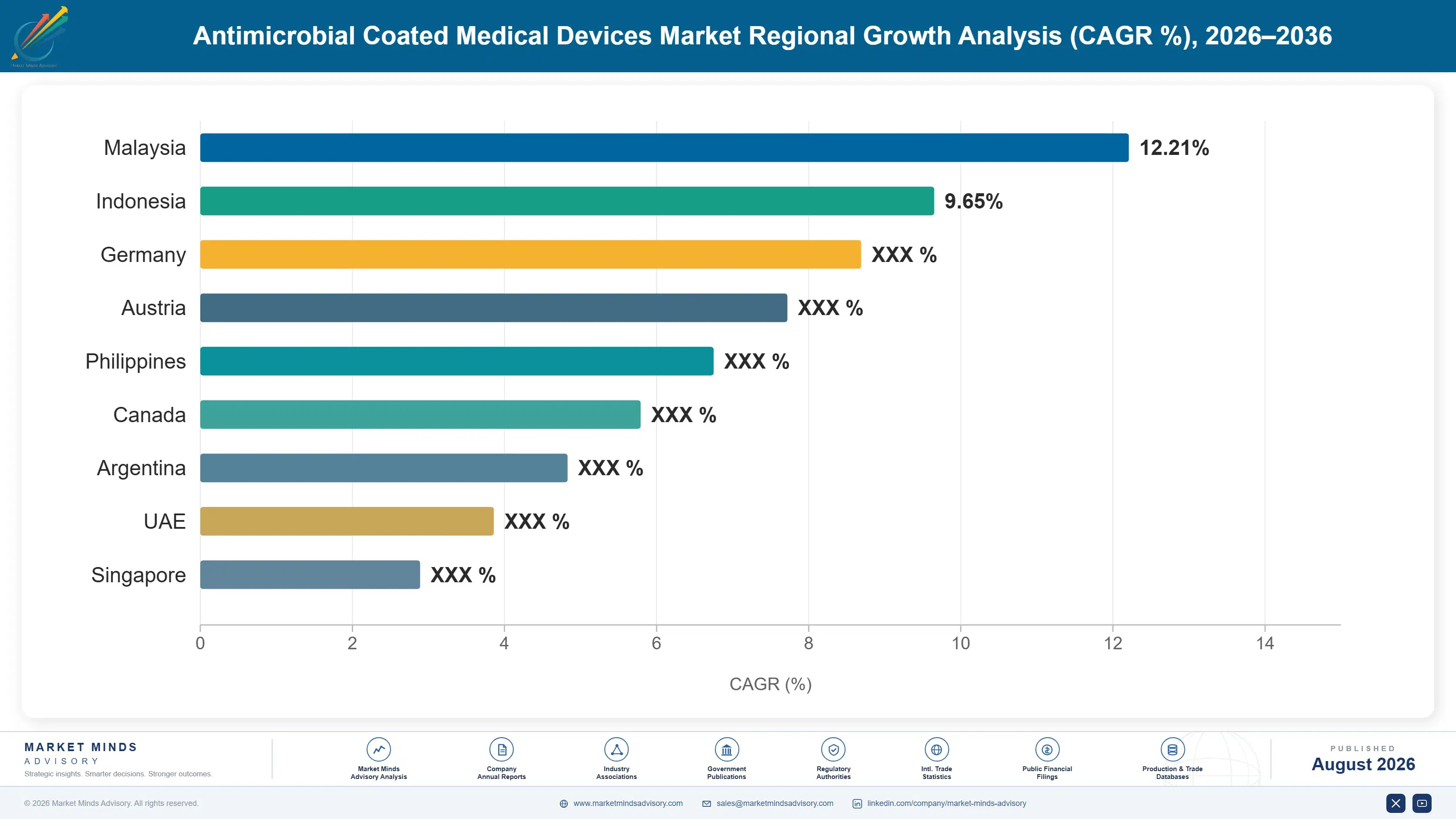
Regional intelligence for 5 additional markets available in the complete report: East Asia, South Asia and Pacific, Latin America, Middle East and Africa, Eastern Europe. Contact sales@marketmindsadvisory.com.
antimicrobial-coated-medical-devices-market-country-cagr-analysis-1787300428266

Where Coating Suppliers Can Defend Margin

Coating suppliers and device makers can defend margin against price-focused hospital procurement in several ways beyond raw specification volume. The four levers below identify where genuine commercial advantage exists: combination chemistry differentiation, health-economic evidence generation, group purchasing organization contracting, and manufacturing localization that lowers landed cost without ceding coating quality or clinical performance standards.

Build Health-Economic Evidence Dossiers for Payers

Hospitals and national payers increasingly demand documented cost-offset evidence before granting coating-specific reimbursement codes or formulary preference, not just clinical trial data on colonization reduction. Suppliers that fund independent health-economic studies quantifying avoided revision surgery cost, typically showing savings of 15,000 to 40,000 dollars per prevented periprosthetic joint infection, move faster through hospital value analysis committees than competitors relying on efficacy data alone. Bactiguard's published cost-offset studies in Scandinavian health systems have directly informed national reimbursement decisions, giving it a repeatable playbook other suppliers are now copying across additional markets.
Market Impact: Cuts hospital value analysis sales cycle by 30%

Localize Coating Manufacturing in China and India

Import tariffs, currency exposure, and shipping lead times all erode margin on coating chemistry sourced entirely from North American or European facilities and shipped into Asia-Pacific's fastest-growing hospital markets. Suppliers establishing local coating application facilities in China and India cut landed cost by an estimated 20% to 30% while qualifying more easily for centralized procurement tenders that increasingly favor domestic or regionally manufactured content over imported alternatives. Sciessent and DSM Biomedical have both announced Asia-Pacific manufacturing partnerships since 2024, positioning ahead of China's continuing push toward domestic medical device self-sufficiency policy.
Market Impact: Lowers landed manufacturing cost by roughly 25% overall

Bundle Coated Devices Into Group Purchasing Contracts

Individual hospital sales cycles for coated devices run slowly and unpredictably, since value analysis committees must evaluate each product category separately against existing formulary standards. Suppliers that negotiate directly with group purchasing organizations covering hundreds or thousands of member hospitals convert that slow, fragmented process into a single national contract, typically securing three to five year exclusivity commitments covering roughly 40% of the addressable hospital base in one negotiation. Becton Dickinson and Teleflex both hold multi-year GPO agreements across major American health systems, which insulates volume from quarter-to-quarter procurement volatility far better than facility-level selling.
Market Impact: Secures multi-year contracts covering 40% of total volume

Extend Coating Duration Through Polymer Innovation

Coating durability, not initial efficacy, increasingly determines premium pricing power, since hospitals and surgeons now compare products on how long protection lasts rather than whether a coating exists at all. Suppliers that develop slower-release polymer matrices extending active protection from roughly two weeks to eight weeks or longer can command list price premiums of 25% to 40% over legacy single-release formulations, particularly in orthopedic and vascular access categories where late-onset infection risk persists well beyond hospitalization. Surmodics has led this shift with its extended-release platform, and competitors are racing to close the technology gap.
Market Impact: Commands a durable 25% to 40% price premium

Who Controls the Margin Pool

Concentration sits at a moderate 42% held by the top five suppliers, evaluated on revenue from antimicrobial-coated device lines specifically, not total device revenue. Becton Dickinson and Teleflex lead on scale and hospital relationship depth, while Bactiguard and Covalon compete as chemistry specialists with narrower but defensible lines. The gap between leader and challenger is real but not decisive, since hospitals routinely qualify two or three vendors per category.
Competitive activity currently runs along three dimensions. Chemistry differentiation matters most, as combination silver-antibiotic and enzyme-based coatings displace legacy single-agent designs across nearly every category. Clinical evidence generation runs a close second, with suppliers funding larger outcome studies to support hospital value analysis committee approval. Group purchasing organization contracting is third, converting slow facility-level sales into multi-year national agreements.

Pressure is building from two directions. Asian coating manufacturers, particularly in China, are narrowing the technology gap while undercutting Western suppliers on price, threatening incumbents in the fastest-growing region. Academic and hospital-system spinouts are meanwhile commercializing enzyme-based and bacteriophage-derived coatings that could bypass resistance concerns entirely. Rankings will shift toward suppliers combining defensible chemistry with health-economic evidence.
antimicrobial-coated-medical-devices-market-company-positioning-matrix-1787300428787

Competitive Moat and Risk Dimensions

BECTON, DICKINSON AND COMPANY

Moat: Scale Across Hospital Categories

Becton Dickinson's antimicrobial-coated portfolio spans urinary catheters, central venous catheters, and surgical instruments, giving it breadth no chemistry specialist can match. That scale lets BD bundle coated and uncoated products into single hospital system contracts, embedding coating adoption inside relationships built over decades rather than requiring hospitals to qualify an additional vendor.
BECTON, DICKINSON AND COMPANY

Risk: Commodity Pressure on Core Lines

BD's non-coated catheter and syringe businesses face steady commodity price pressure from lower-cost manufacturers, and that pressure can bleed into coated product pricing negotiations when hospitals bundle categories together during contract renewal. Diversification protects revenue but does not fully insulate coating margin from the broader portfolio's competitive dynamics.
TELEFLEX INCORPORATED

Moat: Vascular Access Category Depth

Teleflex holds a concentrated leadership position specifically in coated vascular access and urology devices, an area where clinical evidence and surgeon familiarity accumulate slowly. That depth makes displacement difficult even for larger diversified competitors, since switching costs run through surgeon training and hospital protocol revision, not just price.
TELEFLEX INCORPORATED

Risk: Narrower Category Exposure Than BD

Teleflex's coating revenue concentrates in fewer device categories than Becton Dickinson's, leaving it more exposed if a single category faces reimbursement change or a competing chemistry gains traction. Its growth depends more heavily on vascular access and urology procedure volume holding up across major hospital systems nationwide.

Key Players

Becton, Dickinson and Company
Teleflex Incorporated
Smith & Nephew plc
Bactiguard AB
Covalon Technologies Corp.

Others

Surmodics, Inc.
Sciessent LLC
AdvanSource Biomaterials Corporation
DSM Biomedical
Cook Medical LLC
Integra LifeSciences Holdings Corporation
ConvaTec Group plc
Molnlycke Health Care AB
B. Braun Melsungen AG
Baxter International Inc.
Zimmer Biomet Holdings, Inc.
Stryker Corporation
Medtronic plc
Argentum Medical, LLC
Vertellus Holdings LLC

Recent Developments

MARCH 2025

Teleflex completes acquisition of antimicrobial coating specialist

Teleflex acquired a privately held antimicrobial coating technology developer for an undisclosed sum, adding enzyme-based coating chemistry to its vascular access portfolio. The acquisition was a full corporate purchase, not a joint venture or licensing arrangement, giving Teleflex direct ownership of the underlying intellectual property.
Signal: Signals device makers increasingly prefer owning coating chemistry outright rather than licensing it from third-party specialists.
SEPTEMBER 2024

Bactiguard signs supply agreement with major Asian device maker

Bactiguard entered a multi-year supply agreement to license its noble metal coating technology to a leading Japanese medical device manufacturer for use across urinary catheter product lines. The arrangement was a licensing and supply agreement, not an acquisition or joint venture, preserving Bactiguard's independent chemistry ownership.
Signal: Shows specialist chemistry suppliers extending reach through licensing rather than direct manufacturing expansion into new geographies.
JANUARY 2025

Zimmer Biomet expands antimicrobial coating trial to knee implants

Zimmer Biomet extended its antimicrobial coating qualification program from hip implants into knee replacement systems, entering clinical trials across several American academic medical centers and teaching hospitals. This was an internal product development expansion, not a corporate transaction of any kind, reflecting organic investment in coating capability.
Signal: Indicates orthopedic implant makers are committing internal R&D budget to coating rather than external chemistry licensing.

Silver and Polymer Feedstock Exposure

Silver compound and specialty polymer inputs together account for roughly 22% to 28% of coated device COGS, sourced primarily from refined silver nitrate suppliers in the United States and Europe and from medical-grade polymer producers concentrated in Germany, the United States, and China. Antibiotic active ingredients used in combination coatings add a further 5% to 8%, sourced mostly from Indian generic pharmaceutical manufacturers.
Silver prices climbed sharply through 2024, with the London Bullion Market Association benchmark rising from roughly 24 dollars to over 30 dollars per troy ounce across the year, driven partly by industrial demand from solar manufacturing competing for the same refined silver supply chain coating suppliers depend on. Bactiguard's 2024 annual report disclosed higher input costs tied to silver price movement, though it noted silver represents a small fraction of finished device cost.

Smaller specialist coating suppliers carry more exposure than diversified device makers, since chemistry-focused firms cannot offset silver price swings against a broader uncoated portfolio the way Becton Dickinson or Teleflex can. Suppliers sourcing polymer inputs from China face additional exposure to export policy shifts, while those anchored in domestic American or European supply chains pay a premium but avoid that risk.
antimicrobial-coated-medical-devices-market-cost-volatility-analysis-1787300428982

Diversify Silver Sourcing Across Refining Regions

Suppliers relying on a single refined silver source face concentrated price and availability risk. Qualifying secondary suppliers across North America, Europe, and Asia, even at modestly higher unit cost, protects continuity when any single region faces export restriction, refining disruption, or a sudden industrial demand spike from competing sectors such as solar panel manufacturing.

Lock Polymer Pricing Through Multi-Year Contracts

Medical-grade polymer prices track broader petrochemical feedstock volatility, which coating margins cannot easily absorb on a spot basis. Multi-year supply agreements with fixed or collared pricing, common practice among the larger diversified device makers, smooth input cost volatility and let commercial teams quote hospital contracts with confidence rather than repricing constantly against a moving feedstock market.

Shift Toward Lower Silver-Loading Chemistries

Combination coatings that pair a smaller silver dose with an antibiotic or enzyme-based agent reduce silver exposure per device without sacrificing efficacy, since the mechanisms work complementarily rather than redundantly. Suppliers pursuing this chemistry path insulate themselves from silver price swings while also addressing the resistance concerns pushing hospitals toward combination formulations in the first place.

Portfolio Architecture for Margin Defence

The portfolio splits into three tiers with wide margin separation tied to chemistry sophistication and clinical evidence depth. Volume tier products carry single-agent silver coatings on high-turnover disposables like standard urinary catheters, competing largely on price. Premium certified products carry combination chemistries backed by published clinical outcome data. Sustainability and next-generation products remain largely pre-commercial but attract the sector's most active research invest
The tension between volume and premium runs through nearly every supplier's roadmap. Volume products fund the sales infrastructure and hospital relationships premium products eventually depend on, yet volume margins keep compressing as coating becomes a baseline expectation rather than a differentiator. Suppliers that under-invest in premium chemistry risk commoditization, while those chasing premium exclusively without volume scale struggle to fund the evidence generation hospitals now demand.

High-value margin pools concentrate specifically in orthopedic and vascular access categories where infection consequences carry the largest financial and clinical stakes, and where bundled payment reimbursement structures reward documented outcome improvement directly. Wound care and general surgical categories generate steadier volume but thinner margin, since coating there competes against a wider set of lower-cost alternatives including simple antiseptic dressings.

Volume / Commodity-Adjacent Tier

Single-agent silver-coated urinary catheters and basic wound dressings sold largely on price against uncoated alternatives, with hospitals increasingly treating coating as a baseline procurement specification rather than a premium feature worth paying extra for.
Gross Margin: 8-15%

Premium / Certified Tier

Combination silver-antibiotic vascular access devices and orthopedic implant coatings backed by published clinical outcome data and formal hospital value analysis committee approval, commanding meaningful list price premiums over single-agent alternatives.
Gross Margin: 28-42%

Sustainability / Regulatory / Next-Generation Tier

Enzyme-based, bacteriophage-derived, and covalently bonded extended-release coatings still moving through clinical validation, targeting late-onset infection prevention that current single-release chemistries cannot adequately address across permanent implant categories and long-duration vascular access devices.
Gross Margin: 15-35%
antimicrobial-coated-medical-devices-market-portfolio-architecture-1787300429478

High-value Sub-segments and Strategic Watch-out

Orthopedic and Dental Implant Coatings

Fastest-growing at 11.5% CAGR, driven by periprosthetic joint infection prevention becoming a formal bundled payment quality metric rather than a discretionary clinical choice, with hospitals now specifying coating on femoral stems and acetabular cups by default across most orthopedic surgical programs, from academic medical centers to community hospitals.
Gross Margin: 28-42%

Vascular Access and Central Venous Catheters

Steady mid-single-digit to high-single-digit growth anchored by CMS non-payment penalties for catheter-associated bloodstream infections, with combination chemistry adoption expanding margin even as unit volume growth moderates across an already well-penetrated intensive care hospital base spanning most major American, European, and East Asian health systems today.
Gross Margin: 25-38%

Urinary Catheters and Basic Wound Dressings

The category's largest volume base by unit count, competing on price against uncoated alternatives, generating steady but thin margin as coating shifts from differentiator to baseline procurement expectation across most acute-care hospital settings and general surgical wards worldwide, including a growing share of emerging-market facilities.
Gross Margin: 8-15%

Silver-Resistant Biofilm Formulations

Emerging bacterial resistance to legacy single-agent silver coatings threatens the credibility of the category's largest installed base, pushing suppliers toward combination chemistries and creating genuine technology risk for any competitor slow to adapt its formulations before hospital committees start asking pointed efficacy and resistance questions directly.
Gross Margin: 10-25%

Annuity Economics of Hospital Contracts

Coated device demand behaves like an annuity once a hospital system commits, since group purchasing organization contracts typically run three to five years and formulary changes require a fresh value analysis committee review most hospitals are reluctant to initiate without clear justification. That structure rewards incumbency heavily: a supplier winning the initial formulary slot keeps it through multiple renewal cycles unless a competitor demonstrates a meaningful advantage.
Adoption depth varies sharply by end-use vertical. Intensive care units and orthopedic surgical departments have adopted coated devices almost universally, since infection consequences there are severe and well documented. General surgical wards and outpatient settings lag well behind, treating coating as optional rather than standard, partly because risk is genuinely lower and partly because budget scrutiny is tighter. Wound care sits in between, tracking severity and payer coverage.

Buyer profiles have shifted generationally. Procurement decisions that once sat primarily with individual surgeons now route through formal value analysis committees combining clinical, financial, and infection-control leadership, rewarding suppliers able to present integrated evidence rather than relationship selling alone. Younger infection-control practitioners entering hospital leadership treat stewardship data as a baseline input, not a marketing claim.
antimicrobial-coated-medical-devices-market-end-use-penetration-index-1787300429969

MMA's Read on Coating Chemistry

These are among the four positions where our research anticipates prominent divergence between winners and laggards over the coming forecast period. Each is grounded in the demand model, the regulatory perimeter, and the announced capacity pipeline.
01 / CHEMISTRY DIFFERENTIATION STRATEGY

Combination coatings will separate winners from commoditized single-agent suppliers

Single-agent silver coatings are becoming table stakes across nearly every device category, which means suppliers competing solely on having a coating rather than a specific chemistry advantage will see margin compress steadily over the next several years. Combination chemistries pairing silver with antibiotic or enzyme-based agents address genuine silver-resistance concerns that hospitals increasingly ask about directly during procurement review. Suppliers that fund clinical evidence generation now, before the differentiation window closes, will hold formulary positions competitors cannot easily dislodge once value analysis committees have already approved an incumbent supplier.
02 / REIMBURSEMENT POLICY EXPOSURE

Non-payment penalty structures will keep expanding beyond the United States

CMS's hospital-acquired condition non-payment policy created the commercial foundation this entire category depends on, and several European and Asia-Pacific health systems are now adopting comparable infection-related funding penalties. Suppliers positioned only around the American reimbursement structure risk missing the next wave of demand emerging in markets that lack an equivalent policy yet. Those building health-economic evidence dossiers proactively, ahead of formal reimbursement code creation in each new market, will capture share before competitors even recognize the opportunity has genuinely opened.
03 / GEOGRAPHIC MANUFACTURING STRATEGY

Asia-Pacific manufacturing localization determines who wins the fastest-growing region

East Asia and South Asia and Pacific together represent the fastest-growing regional combination in this market, driven by hospital construction and centralized procurement policy rather than simple GDP growth. Suppliers manufacturing coating chemistry entirely outside the region face tariff exposure, longer lead times, and tender requirements favoring domestic or regionally produced content outside suppliers cannot easily satisfy. Localizing application capacity in China and India now preserves market access that will be far harder to establish once local manufacturers close the technology gap.
04 / DURABILITY TECHNOLOGY INVESTMENT

Extended-release polymer chemistry will justify the next pricing premium cycle

Coating durability, not initial antimicrobial efficacy, increasingly separates premium products from commoditized ones, since hospitals now compare protection duration directly when evaluating competing formulations. Suppliers still selling single-release chemistry with efficacy windows measured in weeks will struggle to justify pricing premiums against extended-release competitors offering months of documented protection. The suppliers investing now in slower-release polymer matrices and covalently bonded antimicrobial layers are building the technology platform that will define competitive position for the next decade of formulary renewal cycles.

Engagement Snapshot From the Field

A live engagement with an industry participant carrying material or product regulatory and market exposure ahead of a defining policy shift, showing how our research translates into a defensible multi-year portfolio strategy.
MARKET MINDS ADVISORY · CLIENT ENGAGEMENT SUMMARY
Antimicrobial Coated Medical Devices Producer Strategic Portfolio Review and Transition Roadmap 2026·Investment Scenario on Antimicrobial Coated Medical Devices Exposure Evaluation 2025-26
CLIENT PROFILE
A twelve-hospital regional health system in the American Midwest, reporting approximately 1.8 billion dollars in annual net patient revenue, approached MMA while facing rising catheter-associated infection rates flagged in a routine CMS quality audit. The system's value analysis committee had received competing proposals from three coating suppliers and lacked a consistent framework for comparing clinical evidence, total cost of ownership, and contract terms (client-reported, unverified by MMA).
STRATEGIC CHALLENGE
Leadership faced pressure on two fronts: near-term CMS penalty exposure tied to catheter-associated infection rates, and a longer-term formulary strategy question about whether to standardize on one coating supplier system-wide or maintain multiple qualified vendors per category. Infection control favored the strongest available clinical evidence regardless of cost, while procurement needed a defensible total cost comparison before signing any multi-year contract.
MMA APPROACH
MMA benchmarked all three competing coating chemistries against published clinical outcome data, modeled total cost of ownership across a five-year contract horizon including avoided infection cost, and assessed each supplier's group purchasing organization contract terms for renewal flexibility. We also surveyed comparable regional health systems to validate real-world adoption experience beyond vendor-provided clinical trial data alone.
KEY FINDINGS
  1. The lowest-priced coating option carried the weakest clinical evidence base, and modeled total cost of ownership favored a mid-priced combination chemistry once avoided infection cost was included over five years.
  2. Maintaining two qualified vendors per category, rather than single-sourcing, preserved negotiating leverage at contract renewal without meaningfully increasing administrative burden on the value analysis committee.
  3. Catheter-associated infection rates at comparable regional health systems using combination chemistry ran meaningfully lower than the client's current single-agent baseline (client-reported, unverified by MMA).
  4. Group purchasing organization contract terms varied more in renewal and exit flexibility than in headline pricing, a distinction the original vendor proposals had not clearly disclosed.
CLIENT PROFILE
A twelve-hospital regional health system in the American Midwest, reporting approximately 1.8 billion dollars in annual net patient revenue, approached MMA while facing rising catheter-associated infection rates flagged in a routine CMS quality audit. The system's value analysis committee had received competing proposals from three coating suppliers and lacked a consistent framework for comparing clinical evidence, total cost of ownership, and contract terms (client-reported, unverified by MMA).
STRATEGIC CHALLENGE
Leadership faced pressure on two fronts: near-term CMS penalty exposure tied to catheter-associated infection rates, and a longer-term formulary strategy question about whether to standardize on one coating supplier system-wide or maintain multiple qualified vendors per category. Infection control favored the strongest available clinical evidence regardless of cost, while procurement needed a defensible total cost comparison before signing any multi-year contract.
MMA APPROACH
MMA benchmarked all three competing coating chemistries against published clinical outcome data, modeled total cost of ownership across a five-year contract horizon including avoided infection cost, and assessed each supplier's group purchasing organization contract terms for renewal flexibility. We also surveyed comparable regional health systems to validate real-world adoption experience beyond vendor-provided clinical trial data alone.
KEY FINDINGS
  1. The lowest-priced coating option carried the weakest clinical evidence base, and modeled total cost of ownership favored a mid-priced combination chemistry once avoided infection cost was included over five years.
  2. Maintaining two qualified vendors per category, rather than single-sourcing, preserved negotiating leverage at contract renewal without meaningfully increasing administrative burden on the value analysis committee.
  3. Catheter-associated infection rates at comparable regional health systems using combination chemistry ran meaningfully lower than the client's current single-agent baseline (client-reported, unverified by MMA).
  4. Group purchasing organization contract terms varied more in renewal and exit flexibility than in headline pricing, a distinction the original vendor proposals had not clearly disclosed.
RECOMMENDED STRATEGY
Phase 1: Phase 1 (0 to 6 months): Transition intensive care and orthopedic surgical units to combination chemistry coated catheters, prioritizing the highest infection-risk departments identified in the CMS audit. Phase 2: Phase 2 (6 to 18 months): Negotiate a dual-vendor group purchasing organization contract preserving renewal flexibility, while extending combination chemistry adoption to general surgical wards system-wide. Phase 3: Phase 3 (18 to 36 months): Build an internal infection-outcome tracking dashboard to generate system-specific evidence supporting future formulary decisions independent of vendor data.
OUTCOME
The health system reduced catheter-associated infection rates measurably within the first year of combination chemistry adoption, avoiding a reported CMS penalty exposure the system estimated at several million dollars annually. The dual-vendor contract structure preserved negotiating leverage at the eighteen-month renewal point, and the internal outcome dashboard has since been shared with two sister health systems (client-reported, unverified by MMA).

Frequently Asked Questions

Foundational context covering the market sizes, CAGR, scope, country, region and competition that inform every finding below. This section is provided to cover basics and most often pre-purchase conversations, answered from the MMA Primary Research Dataset.

What is the current size of the Antimicrobial Coated Medical Devices Market?

The market reached an estimated 8.4 billion dollars in 2025. That figure reflects global revenue across coated urinary and vascular catheters, orthopedic and dental implants, wound dressings, endotracheal tubes, and surgical sutures and mesh.

How large will the Antimicrobial Coated Medical Devices Market be by 2036?

MMA projects the market will reach approximately 22.1 billion dollars by 2036 under the base case scenario. That represents roughly 2.41 times the 2026 market value.

What is the CAGR for the Antimicrobial Coated Medical Devices Market 2026 to 2036?

The base case CAGR is 9.2% annually across the forecast period. Bull and bear scenarios run 10.4% and 8.0% respectively, reflecting regulatory and adoption uncertainty.

Which segment is growing fastest?

Orthopedic and dental implant coatings grow fastest at 11.5% CAGR, about 1.25 times the overall market rate. Bundled payment reimbursement tied to periprosthetic joint infection is the primary driver.

Who are the major companies in the Antimicrobial Coated Medical Devices Market?

Becton Dickinson, Teleflex, Smith and Nephew, Bactiguard, and Covalon Technologies lead the category. Together they hold roughly 42% of coated-device revenue on a consistent basis.

Which country is growing fastest?

China leads national growth at an estimated 12.8% CAGR, driven by centralized hospital procurement standards and rapid tertiary hospital capacity expansion. Provincial tender requirements increasingly specify infection-control performance criteria.

Report Segmentation Architecture

The full report scope spans multiple orthogonal segmentation dimensions, with cross-tabulated demand data provided for each dimension pair. Coverage extends further to regional breakdowns, trend trajectories, and the competitive detail needed to support segment-level decision-making.

By Device and Product Type

  • Urinary and Vascular Catheters
  • Orthopedic and Dental Implants
  • Wound Care Dressings
  • Endotracheal and Respiratory Devices
  • Surgical Sutures and Mesh
  • Other Coated Instruments

By End-Use Industry

  • Hospitals and Acute Care Centers
  • Ambulatory Surgical Centers
  • Long-Term Care Facilities
  • Specialty Orthopedic and Dental Clinics
  • Home Healthcare Settings

By Commercial Dimension

  • Direct Hospital System Contracts
  • Group Purchasing Organization Agreements
  • Distributor and Third-Party Sales
  • Original Equipment Manufacturer Licensing

By Region

  • North America
  • Western Europe
  • East Asia
  • South Asia and Pacific
  • Latin America
  • Middle East and Africa
  • Eastern Europe

Scope, Methodology, and Coverage

Every figure in this report is reproducible from documented input assumptions. The scope below maps the historical period, the forecast horizon, the segmentation dimensions, and the countries covered, alongside the underlying primary and qualitative methodology.
Historical Period
2020 to 2025
Forecast Period
2026 to 2036
Base Year
2025 (USD billions; MMA Primary Research Dataset, August 2026)
Market Definition
The antimicrobial coated medical devices market covers devices treated with silver, antibiotic, chlorhexidine, or other bioactive coatings applied specifically to inhibit microbial colonization on the device surface, spanning urinary and vascular catheters, orthopedic and dental implants, wound dressings, endotracheal tubes, and surgical sutures and mesh sold with a validated antimicrobial claim. Uncoated devices, standalone topical antiseptics, and antibiotic drugs administered independently of a device fall outside this scope.
Quantitative Units
USD billions (current prices); unit shipment volume where applicable
Segmentation Dimensions
By Device and Product Type; By End-Use Industry; By Commercial Dimension; By Region
Regions Covered
North America, Western Europe, East Asia, South Asia and Pacific, Latin America, Middle East and Africa, Eastern Europe
Countries Covered
USA, China, Germany, France, UK, Japan, South Korea, India, Australia, Canada, Brazil, Mexico, Indonesia, Vietnam, Thailand, Malaysia, UAE, Saudi Arabia, South Africa, Nigeria, Turkey, Poland, Netherlands, Italy, Spain, Sweden, Switzerland, Argentina, Colombia, Singapore, and additional markets relevant to this sector
Key Companies Profiled
Becton, Dickinson and Company; Teleflex Incorporated; Smith & Nephew plc; Bactiguard AB; Covalon Technologies Corp.; Surmodics, Inc.; Sciessent LLC; AdvanSource Biomaterials Corporation; DSM Biomedical; Cook Medical LLC; Integra LifeSciences Holdings Corporation; ConvaTec Group plc; Molnlycke Health Care AB; B. Braun Melsungen AG; Baxter International Inc.; Zimmer Biomet Holdings, Inc.; Stryker Corporation; Medtronic plc; Argentum Medical, LLC; Vertellus Holdings LLC
Quantitative Methodology
Primary survey, n=3,800 respondents, Q4 2025, six countries; demand-side model with trade association cross-validation
Qualitative Methodology
47 expert interviews, Q4 2025; applied to validate demand model assumptions, identify emerging dynamics, and assess competitive positioning
Report Format
PDF and XLSX data workbook (Word format preview document)
Publisher
Market Minds Advisory
Report Code
MMA-2026-MED-101
Published
August 2026
Contact
sales@marketmindsadvisory.com | www.marketmindsadvisory.com

Purchase the full Antimicrobial Coated Medical Devices Market Report (2026 to 2036).

The full MMA Antimicrobial Coated Medical Devices report sizes the market across six device categories, five end-use industries, four commercial contracting models, and seven regions through 2036. It profiles twenty participants on a consistent basis of coated-device revenue, scoring the top five on chemistry differentiation, clinical evidence depth, and reimbursement positioning. Scenario models quantify how CMS penalty expansion, combination chemistry adoption, and Asia-Pacific manufacturing localization move both demand and achievable pricing. The report also includes delivered cost modeling by device category, a reimbursement policy tracker across major health systems, and a formulary displacement risk assessment built for device makers, coating suppliers, and hospital procurement teams.
Six-segment device category demand model through 2036
Reimbursement policy tracker across major health systems
Coating chemistry supplier competitive positioning assessment
Group purchasing organization contract benchmarking data
Silver and polymer input cost sensitivity model
Formulary displacement risk scoring by category

Built For The People Who Decide

From boardroom strategy to bench-side execution, this report is read cover-to-cover by leaders shaping the next decade of their industry, turning demand scenarios, market dynamics and valuation benchmarks into decisions.
CXOs/ Presidents/ VPs/ Managers
M&A and Corporate Development
Strategy Teams and R&D Heads
Procurement and Product Directors
Regulatory and Compliance Leaders
Investor Relations and Equity Analysts