Market Minds Advisory
Antimicrobial Bottle Closures Market

Antimicrobial Bottle Closures Market: Antimicrobial Bottle Closures. Contamination Liability Reshapes Cap Specification Standards

Hospital-acquired infection concerns and pharma cold-chain contamination liability are pushing packaging buyers to specify antimicrobial closures as standard rather than optional, forcing conventional cap makers to license active technology once treated as a premium add-on.

Lead Analyst

Published

September 2026

Make Smarter Decisions with Customized Research Insights

Request a free sample report and evaluate market opportunities, growth trends, and competitive dynamics relevant to your business needs.

2025 MARKET VALUE$1.9BMarket Size 2025
2036 FORECAST VALUE$4.2BBase Case , 2026 to 2036
CAGR 2026 TO 20367.4 %Bull 8.7% / Bear 6.1%
INCREMENTAL OPPORTUNITY$2.1BNet 10- year value creation
EXPANSION MULTIPLE2.04x2036 value over 2026 base
Strategic Levers
M&A Pipeline
Regional Outlook
Country Rankings
Competitive Intelligence
Segmental Deep-dive
Call-Us : 91 93563 13602

Executive Snapshot and Market Trajectory.

Antimicrobial closures are moving from a niche pharmaceutical specification into mainstream personal care and food packaging as brand owners seek measurable contamination protection claims backed by documented laboratory efficacy testing rather than marketing language alone, particularly in categories handling repeated consumer hand contact.
Pharmaceutical and healthcare packaging remains the largest revenue base, but personal care and nutraceutical brands are adopting antimicrobial closures fastest as consumer hygiene awareness persists well beyond pandemic-era peaks across most developed markets and retail categories worldwide. North America leads consumption given stringent FDA and EPA registration requirements that reward suppliers able to document verified antimicrobial efficacy claims across every major product category and retail channel worldwide, from prescription drug vials to over-the-counter supplement bottles.
Competition centers on a handful of closure manufacturers licensing proprietary silver-ion and copper-based antimicrobial technology from specialized ingredient suppliers rather than developing it independently in-house. Regulatory registration costs are rising as EPA and equivalent bodies tighten efficacy documentation requirements, favoring larger suppliers who can amortize compliance costs across broader closure product lines and multiple end markets simultaneously, widening the gap with smaller regional closure makers lacking dedicated regulatory affairs teams.
Market Definition
The antimicrobial bottle closures market covers caps, lids, and dispensing closures treated with silver-ion, copper-based, organic polymer, or zinc pyrithione antimicrobial technology for pharmaceutical, personal care, nutraceutical, and food and beverage packaging. It excludes untreated conventional closures and antimicrobial coatings applied to bottle bodies rather than closures themselves.
Base Year Value
$1.9B in 2025 (MMA Primary Research Dataset, September 2026)
Forecast Period
2026 to 2036, eleven discrete annual values
CAGR
7.4% base case. Bull 8.7%. Bear 6.1%.
Fastest Growth Segment
Copper-Based Antimicrobial Closures: 10.5% CAGR
Fastest Growth Country
United States: 8.3% CAGR
Fastest Growth Region
South Asia and Pacific: 9.3% CAGR
Largest Region
North America: 30% of 2025 global value
Market Leaders
AptarGroup, Berry Global, Silgan Holdings, Guala Closures, and Sciessent lead the market. Source: MMA Primary Research Dataset, July 2026.
Primary Survey
n=3,800 procurement and R&D decision-makers, Q4 2025, six countries
Methodology
Demand-side build-up, cross-validated against public data, 47 expert interviews

Antimicrobial Bottle Closures Market Forecast Scenarios

antimicrobial-bottle-closures-market-size-forecast-scenario-1790013283098
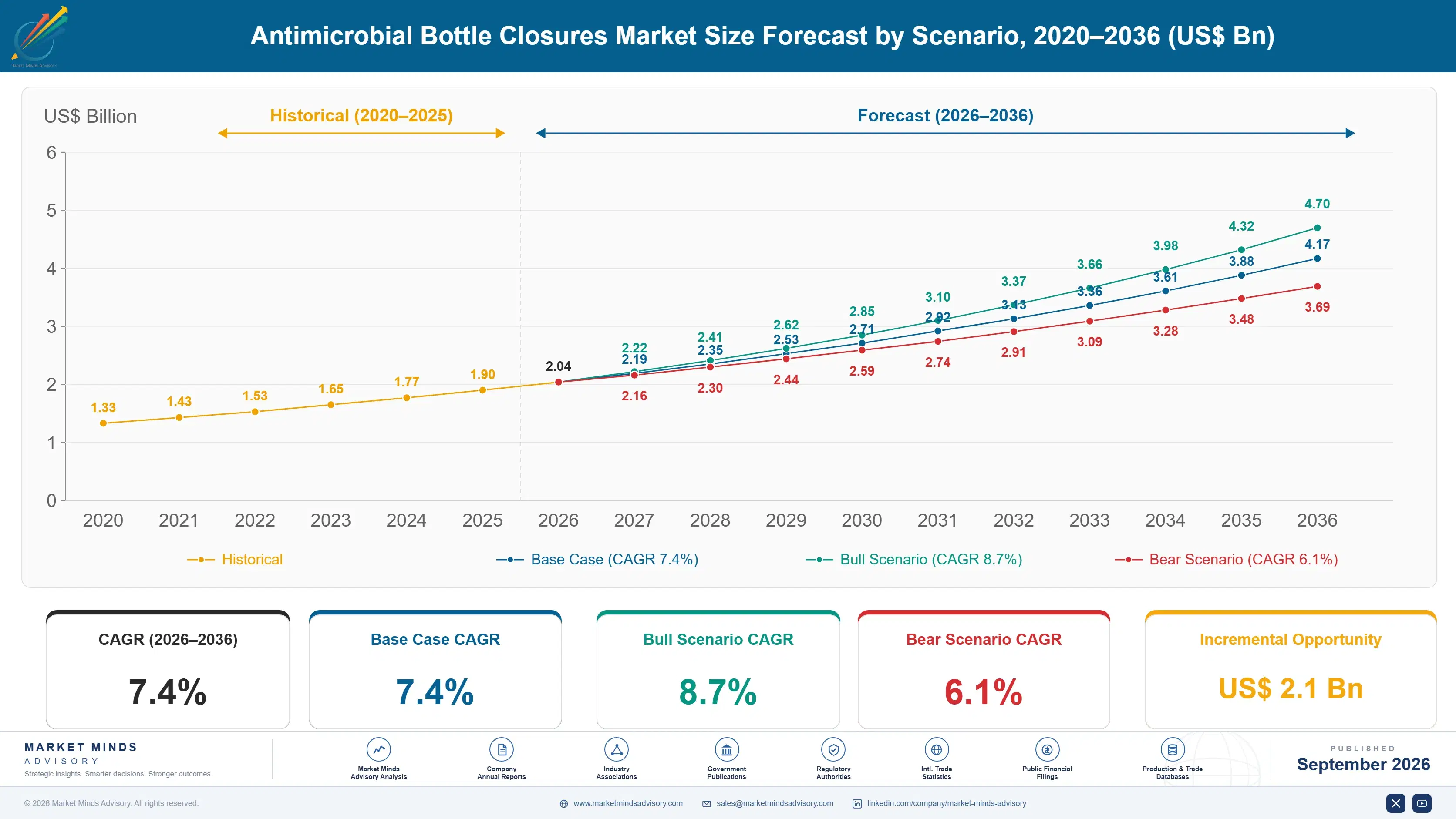
The category grew at an accelerating pace from 2020 to 2025 as pandemic-driven hygiene awareness expanded antimicrobial closure adoption beyond its traditional pharmaceutical base, with a historical CAGR near 6.4 percent reflecting sustained demand well after acute public health concerns receded across most consumer categories and retail formats worldwide, from personal care to nutraceutical packaging lines.
The base case assumes 7.4 percent annual growth through 2036, driven by three commercial mechanisms: continued expansion of antimicrobial specification into personal care and nutraceutical packaging, tightening pharmaceutical contamination liability standards across major markets, and falling per-unit licensing costs as antimicrobial technology suppliers scale production capacity further. Food and beverage adoption remains nascent but represents a large incremental addressable base as retailers begin specifying antimicrobial caps for high-touch products nationwide.
The bull case reaches 8.7 percent if food and beverage brands adopt antimicrobial closures faster than expected following a high-profile contamination event, pulling forward category-wide specification changes across multiple retail categories nationwide. The bear case falls to 6.1 percent if regulatory registration costs rise faster than anticipated, slowing new supplier entry and limiting price competition in premium segments overall.

From Pharma Niche to Mainstream Packaging Standard

Antimicrobial bottle closures have quietly become a differentiated packaging category as brand owners discover that consumers respond positively to visible contamination protection claims on high-touch product surfaces across nearly every retail category available today. What began as a pharmaceutical compliance requirement is now spreading into personal care and nutraceutical shelves nationwide, and increasingly into premium food and beverage lines as well.
MARKET CONCENTRATIONCR5 44%Top five suppliers hold under half of category revenue
AVERAGE UNIT PRICE PREMIUM35% over standard capsReflects added cost of licensed antimicrobial active technology
PHARMACEUTICAL CHANNEL SHARE48% of volumeHealthcare and pharma packaging remains the largest end-use category
REGISTRATION APPROVAL TIMELINE14 months averageTypical duration for new antimicrobial active regulatory clearance
LICENSING PENETRATION72% of closuresShare of antimicrobial closures using licensed third-party active technology
AVERAGE PRODUCT CERTIFICATION LIFE60 monthsTypical duration before efficacy certification requires renewed testing
Silver-ion technology remains the dominant antimicrobial mechanism given its long regulatory track record and broad-spectrum efficacy against bacteria, but copper-based and organic polymer alternatives are gaining share as suppliers seek lower-cost options with comparable efficacy claims across a wider range of applications and price tiers. Closure manufacturers increasingly license this active technology from specialized ingredient suppliers rather than developing proprietary formulations in-house, accelerating time to market considerably.
Regulatory registration remains the single largest barrier to new entrant competition, with EPA clearance for a new antimicrobial active typically requiring over a year of documented efficacy testing across multiple product categories. This favors established suppliers who can amortize registration costs across broad closure product lines serving multiple end markets simultaneously, widening the competitive gap over smaller regional entrants.
"Every closure manufacturer we talk to says they're evaluating antimicrobial licensing deals. The ones who move first will own the shelf conversation before their competitors even finish their pilot programs."
Director, Packaging Materials and Ingredient Technology Practice · MMA Packaging Practice · September 2026

Market Trends

Personal Care Brands Expand Antimicrobial Cap Adoption

Personal care brands are increasingly specifying antimicrobial closures on pump dispensers and lotion bottles subject to repeated hand contact, a category that historically used standard closures without any antimicrobial treatment at all. This shift reflects both genuine hygiene concerns and marketing opportunity, as brands discover that visible antimicrobial claims resonate with consumers even on products with no direct ingestion risk. Adoption is expanding fastest in hand sanitizer, lotion, and liquid soap dispensing closures, where antimicrobial specification rates have risen by roughly 40 percent over the past three years across major national brands.
Market Impact: Applies to 55 percent of packaging
Nutraceutical Packaging Standardizes on Antimicrobial Specifications

Nutraceutical and supplement brands are standardizing on antimicrobial closures across their full product lines rather than limiting the feature to flagship products only, driven by contamination liability concerns similar to those in pharmaceuticals but without the same regulatory mandate forcing adoption across the category. Brand owners increasingly view antimicrobial closures as a low-cost insurance policy against contamination-related product recalls, which carry substantial reputational and financial cost across the entire brand portfolio. Roughly 30 percent of major nutraceutical brands surveyed now specify antimicrobial closures as a standard requirement across their entire product portfolio.
Market Impact: Cuts licensing costs 20 percent

Market Opportunities and Growth Drivers

Hospital Contamination Liability Drives Pharma Mandates

Hospital-acquired infection concerns and pharmaceutical supply chain contamination incidents have pushed major healthcare systems to require antimicrobial closures on multi-dose vials and topical medication containers handled repeatedly by clinical staff across every department and shift nationwide and internationally. This requirement is cascading down through pharmaceutical manufacturer specifications, since suppliers serving hospital systems must standardize packaging across their broader product lines rather than maintaining separate hospital-only versions for a smaller customer segment. Roughly 55 percent of multi-dose pharmaceutical packaging now specifies antimicrobial closures as a baseline requirement rather than an optional upgrade.
Market Impact: Extends approval timelines to 14 months

Falling Licensing Costs Widen Addressable Applications

Antimicrobial technology suppliers are steadily lowering per-unit licensing fees as production scale increases, making antimicrobial closures economically viable for lower-margin categories such as household cleaning products and mass-market personal care that previously could not justify the cost premium at meaningful volume or scale of production nationwide. This price compression is expanding the addressable market beyond premium pharmaceutical and nutraceutical applications into categories where antimicrobial closures were previously considered cost-prohibitive at scale. Licensing costs have fallen an estimated 20 percent over the past three years as technology suppliers scale production further.
Market Impact: Limits price premiums to 35 percent

Market Restraints and Challenges

Regulatory Approval Timelines Limit New Entrant Speed

New antimicrobial actives face lengthy EPA registration processes requiring documented efficacy testing across multiple bacterial strains and exposure conditions, a root cause tracing back to the classification of antimicrobial technology as a pesticidal device under federal regulation rather than a simple packaging additive. This limits how quickly smaller technology suppliers can bring new formulations to market compared with established players who have already navigated the approval process multiple times over many years. Some suppliers are addressing the gap by pursuing regulatory approval for platform technologies applicable across multiple closure formats simultaneously.
Market Impact: Raises adoption 40 percent nationwide

Efficacy Claims Face Growing Consumer Skepticism

Consumer skepticism toward antimicrobial marketing claims is rising following several high-profile cases where products were found to overstate their actual protective benefit, a root cause tracing back to inconsistent testing standards across different antimicrobial technologies and manufacturers worldwide and across product categories. This skepticism limits the price premium brands can charge for antimicrobial features and increases scrutiny of marketing language used to describe closure performance across retail categories. Manufacturers are addressing the gap by pursuing third-party efficacy certification and more conservative marketing claims tied directly to documented laboratory test results.
Market Impact: Covers 30 percent of brands
3 additional market trends, 2 additional growth drivers, and 4 additional restraints and challenges are covered in the full report. Contact sales@marketmindsadvisory.com to access the complete intelligence.

Segment CAGR and Growth Architecture

The antimicrobial bottle closures market splits into six technology-based segments defined by active mechanism: silver-ion, copper-based, organic polymer, zinc pyrithione, quaternary ammonium coated, and other nanoparticle-based closures. Copper-based and organic polymer formulations are gaining share fastest as newer efficacy data and lower toxicity profiles attract brands seeking alternatives to legacy silver-ion technology across most end markets.
antimicrobial-bottle-closures-market-market-share-analysis-1790013283653

Copper-Based Antimicrobial Closures

Copper-based antimicrobial closures use copper oxide or copper alloy compounds embedded directly into the closure resin, offering continuous antimicrobial activity that does not diminish through surface wear the way some coating-based technologies can over repeated use and cleaning cycles across the product's full service life and beyond. Recent efficacy studies published by copper industry trade associations have strengthened the technology's regulatory standing, accelerating adoption among suppliers previously hesitant to commit to alternatives beyond established silver-ion chemistry. Copper's lower raw material cost relative to silver gives suppliers additional pricing flexibility, particularly attractive to brands entering the antimicrobial category for the first time on a constrained packaging budget and tight product launch timeline.
CAGR 10.5%

Organic Polymer Antimicrobial Closures

Organic polymer antimicrobial closures use non-metallic biocide compounds embedded in the closure material, appealing to brands seeking to avoid metal-based antimicrobial technology for marketing or regulatory reasons specific to certain product categories and consumer segments worldwide and across every price tier served. This segment benefits from growing consumer interest in non-metal, non-nanoparticle antimicrobial claims, particularly in personal care categories where metal content disclosure requirements are becoming more stringent in several jurisdictions worldwide. Suppliers are investing heavily in expanding organic polymer efficacy data to match the decades of documented performance that silver-ion technology already has behind it, closing the credibility gap with regulators and skeptical brand buyers alike across every major market.
CAGR 9.0%
Full segment breakdown across 6 segments available in the complete report.

Regional Architecture and Country Demand Map

North America leads on stringent FDA and EPA antimicrobial registration requirements that reward documented efficacy claims across every category, followed by East Asia's expanding pharmaceutical and personal care manufacturing base. South Asia and Pacific is expanding fastest as generic pharmaceutical exports drive rising packaging specification standards.

North America

North America holds the largest regional share because FDA and EPA antimicrobial registration standards are among the strictest globally, and suppliers who successfully navigate this process gain a durable competitive advantage over challengers still pursuing registration across multiple product categories and applications nationwide and abroad. Hospital systems and pharmaceutical manufacturers concentrated in the United States drive the bulk of regional demand, given the country's large healthcare packaging base and litigation-driven contamination liability concerns specific to the American legal environment and its class-action culture and jury trial system. Canada follows at meaningfully smaller scale, with demand concentrated in pharmaceutical and nutraceutical packaging serving both domestic and export markets across North America and beyond.
Share: 30% | CAGR: 7.8% (2026 to 2036)

Western Europe

Western Europe's growth trails North America and East Asia as EU biocidal product regulation imposes additional registration requirements beyond what antimicrobial technology suppliers already navigate under United States rules, slowing new formulation approval across every member state and national market and retail segment and price tier available today. Germany and the United Kingdom remain the largest national markets, reflecting their substantial pharmaceutical and personal care manufacturing bases serving both domestic and export customers across multiple continents and trading blocs. France's market follows a similar pattern, with growth concentrated in nutraceutical and premium personal care packaging rather than mass-market applications broadly across the retail sector and grocery channels nationwide and beyond.
Share: 20% | CAGR: 5.8% (2026 to 2036)
Regional intelligence for 5 additional markets available in the complete report: East Asia, South Asia and Pacific, Latin America, Middle East and Africa, Eastern Europe. Contact sales@marketmindsadvisory.com.
antimicrobial-bottle-closures-market-country-cagr-analysis-1790013284173

Beyond the Closure: Where Value Concentrates

Selling a treated closure at a modest unit premium over standard caps is a scale business dominated by licensing costs and manufacturing efficiency across every product category. The larger margin opportunities sit in technology licensing, regulatory documentation services, and application-specific formulation that established suppliers are increasingly building alongside core closure sales nationwide and internationally.

Licensing Proprietary Antimicrobial Technology to Closure Manufacturers

Specialized antimicrobial ingredient suppliers who hold proprietary silver-ion or copper-based active technology can license it to closure manufacturers rather than manufacturing finished closures themselves, generating high-margin royalty revenue without the capital investment required for injection molding capacity of their own or dedicated production lines and tooling costs. This model lets technology suppliers scale across multiple closure manufacturer partners simultaneously, capturing value from the entire addressable closure market rather than the single share they could produce directly, adding an estimated 25 percent to overall technology supplier revenue through licensing fees alone.
Market Impact: Adds an estimated 25 percent in licensing revenue

Offering Regulatory Registration Support as a Paid Service

Smaller closure manufacturers lack the in-house expertise to navigate EPA antimicrobial registration independently, creating an opportunity for larger suppliers or specialized consultancies to offer registration support services for a fee across the entire approval process and documentation cycle from start to finish and well beyond it entirely. This turns a regulatory burden into a revenue stream while helping smaller manufacturers enter the antimicrobial category faster than they could navigate the 14-month approval process alone, and it builds valuable long-term relationships with manufacturers who may become future licensing customers as well.
Market Impact: Monetizes registration support across the 14-month approval process

Developing Application-Specific Formulations for Premium Segments

Rather than offering a single standard antimicrobial formulation across all closure types, suppliers developing application-specific variants tailored to pharmaceutical, personal care, or food and beverage requirements can command premium pricing for the additional formulation and testing work involved in each individual case and application submitted for regulatory review and final approval. This approach recognizes that a pharmaceutical vial closure and a lotion pump closure face different contamination vectors and regulatory requirements, and suppliers who address this specificity capture roughly 15 percent higher pricing than generic formulation providers across the category.
Market Impact: Commands an estimated 15 percent higher premium pricing

Building Direct Efficacy Certification Partnerships With Testing Labs

As consumer skepticism toward antimicrobial marketing claims grows, suppliers who establish direct partnerships with independent testing laboratories for third-party efficacy certification can differentiate their products on verified performance rather than marketing language alone across every retail category and price tier available today and tomorrow across the industry as a whole. This certification carries meaningful weight with increasingly skeptical retail buyers and institutional purchasers, and suppliers offering it report retaining an estimated 18 percent more institutional accounts than competitors relying solely on internal testing claims each fiscal year going forward and beyond.
Market Impact: Retains an estimated 18 percent more institutional accounts

Who Controls the Margin Pool

Ranked on global revenue from antimicrobial closure sales and licensing, the market is moderately concentrated with a CR5 near 44 percent, reflecting a mix of large diversified closure manufacturers and specialized antimicrobial technology licensors. AptarGroup and Berry Global lead through scale and broad customer relationships across pharmaceutical and personal care packaging, while Sciessent holds a distinct position as the leading independent antimicrobial technology licensor. The gap between technology specialists and generalist closure manufacturers is widening as licensing economics increasingly favor those who own proprietary active technology.
Current competitive activity centers on expanding copper-based technology licensing agreements, new regulatory registrations for next-generation actives, and closure manufacturers acquiring smaller antimicrobial technology firms to bring licensing revenue in-house rather than paying ongoing royalties. Several manufacturers launched application-specific antimicrobial formulations in the past year targeting nutraceutical and premium personal care segments specifically.

Emerging pressure comes from closure manufacturers developing proprietary in-house antimicrobial technology to escape licensing fees paid to independent technology suppliers, a shift that could compress margins for pure-play technology licensors over time. Rankings are most likely to shift as regulatory approval costs rise, favoring larger players who can amortize compliance investment across broader closure portfolios.
antimicrobial-bottle-closures-market-company-positioning-matrix-1790013284694

Competitive Moat and Risk Dimensions

APTARGROUP

Moat: Broad Pharmaceutical Customer Relationships

AptarGroup's decades-long relationships with major pharmaceutical manufacturers give it privileged access to antimicrobial closure specification decisions that newer entrants cannot easily replicate. This customer depth lets AptarGroup cross-sell antimicrobial technology across its existing dispensing closure portfolio rather than needing to win new customer relationships from scratch for every antimicrobial product introduction.
APTARGROUP

Risk: Dependence on Licensed Technology

AptarGroup licenses much of its antimicrobial active technology from independent suppliers rather than owning proprietary chemistry outright, leaving it exposed to rising licensing costs or supply disruption if a key technology partner exits the relationship or raises fees substantially across its broader closure portfolio and customer base.
BERRY GLOBAL

Moat: Manufacturing Scale and Efficiency

Berry Global's manufacturing scale across dozens of facilities lets it produce antimicrobial closures at lower per-unit cost than smaller competitors, giving it pricing flexibility to compete on both premium and value-tier antimicrobial segments simultaneously across its broad customer base spanning multiple industries, geographies, and closure formats.
BERRY GLOBAL

Risk: Slower Technology Innovation Pace

Berry Global's scale-driven manufacturing model has historically prioritized cost efficiency over rapid technology innovation, leaving a meaningful opening for smaller, more specialized competitors to introduce next-generation antimicrobial formulations first and capture early-mover advantage in premium segments well before Berry can fully respond at commercial scale.

Players Tracked

Prominent Players

AptarGroup
Berry Global
Silgan Holdings
Guala Closures
Sciessent

Other Key Players

Bericap GmbH
United Caps
Weener Plastics
Closure Systems International
O.Berk Company
Sanner GmbH
Microban International
BioCote Limited
Amcor
Sacmi Group
CL Smith Company
Alpla Group
Comar LLC
Mold-Rite Plastics
Tekni-Plex

Recent Developments

JANUARY 2026

AptarGroup Expands Copper-Based Technology Licensing

AptarGroup expanded its licensing agreement with a leading copper-based antimicrobial technology supplier, adding copper-based closures to its existing silver-ion antimicrobial dispensing product line across multiple regions. The expansion targets brands seeking lower-cost antimicrobial alternatives without sacrificing documented efficacy performance across pharmaceutical and personal care applications.
Signal: Signals established closure manufacturers are diversifying beyond a single antimicrobial technology to hedge against supplier risk
OCTOBER 2025

Berry Global Invests in Organic Polymer Biocide Startup

Berry Global acquired a minority stake in a specialized antimicrobial technology startup developing organic polymer biocide formulations, gaining early access to next-generation non-metal antimicrobial chemistry. The investment reflects Berry's strategy of building proprietary technology capability rather than relying solely on external licensing arrangements going forward.
Signal: Signals scale manufacturers are investing directly in proprietary technology rather than remaining purely dependent on external licensors
APRIL 2026

Sciessent Signs Nutraceutical Packaging Licensing Deal

Sciessent signed a multi-year exclusive licensing agreement with a major nutraceutical packaging manufacturer to supply its proprietary antimicrobial technology across the manufacturer's full product line and international markets. The agreement reflects growing demand for documented antimicrobial efficacy in nutraceutical packaging beyond its traditional pharmaceutical stronghold.
Signal: Signals nutraceutical packaging is becoming a meaningful growth channel for antimicrobial technology suppliers well beyond traditional pharmaceuticals

Silver and Copper Feedstock Cost Exposure

Silver-ion antimicrobial technology represents roughly 40 percent of cost of goods sold for closures using that chemistry, with silver sourced primarily from mining operations in Mexico, Peru, and China through refined silver nitrate compound suppliers. Copper-based alternatives carry meaningfully lower feedstock costs given copper's greater natural abundance and established global supply chains across multiple mining regions.
Silver prices spiked sharply in 2024 amid rising industrial demand from solar panel manufacturing competing for the same refined silver supply, based on EIA commentary on industrial metals markets and global trade flows. Several antimicrobial technology suppliers reported input cost increases of 20 to 30 percent during that period, prompting several closure manufacturers to accelerate their evaluation of copper-based alternatives as a hedge against continued silver volatility going forward.

Suppliers reliant primarily on silver-ion technology face greater margin exposure to industrial silver demand cycles than diversified suppliers offering both silver and copper-based options across their product lines. Smaller technology suppliers without diversified feedstock exposure carry the steepest risk, since they lack the scale to hedge silver purchases or fully absorb sustained price volatility without passing costs directly to customers.
antimicrobial-bottle-closures-market-cost-volatility-analysis-1790013284891

Diversifying Toward Copper-Based Technology Options

Technology suppliers and closure manufacturers are increasingly offering copper-based antimicrobial options alongside traditional silver-ion products, reducing exposure to silver price volatility driven by competing industrial demand from solar panel and electronics component manufacturing worldwide and domestically. This diversification requires additional regulatory registration investment but gives customers pricing flexibility during periods of silver market disruption.

Securing Long-Term Silver Supply Contracts

Larger antimicrobial technology suppliers are locking in multi-year silver supply agreements with refiners rather than purchasing on the spot market, trading some pricing flexibility for meaningful supply certainty across multiple production cycles. This approach also gives suppliers earlier visibility into pricing trends, supporting more accurate customer contract pricing over multi-year terms and renewal cycles.

Portfolio Architecture for Margin Defence

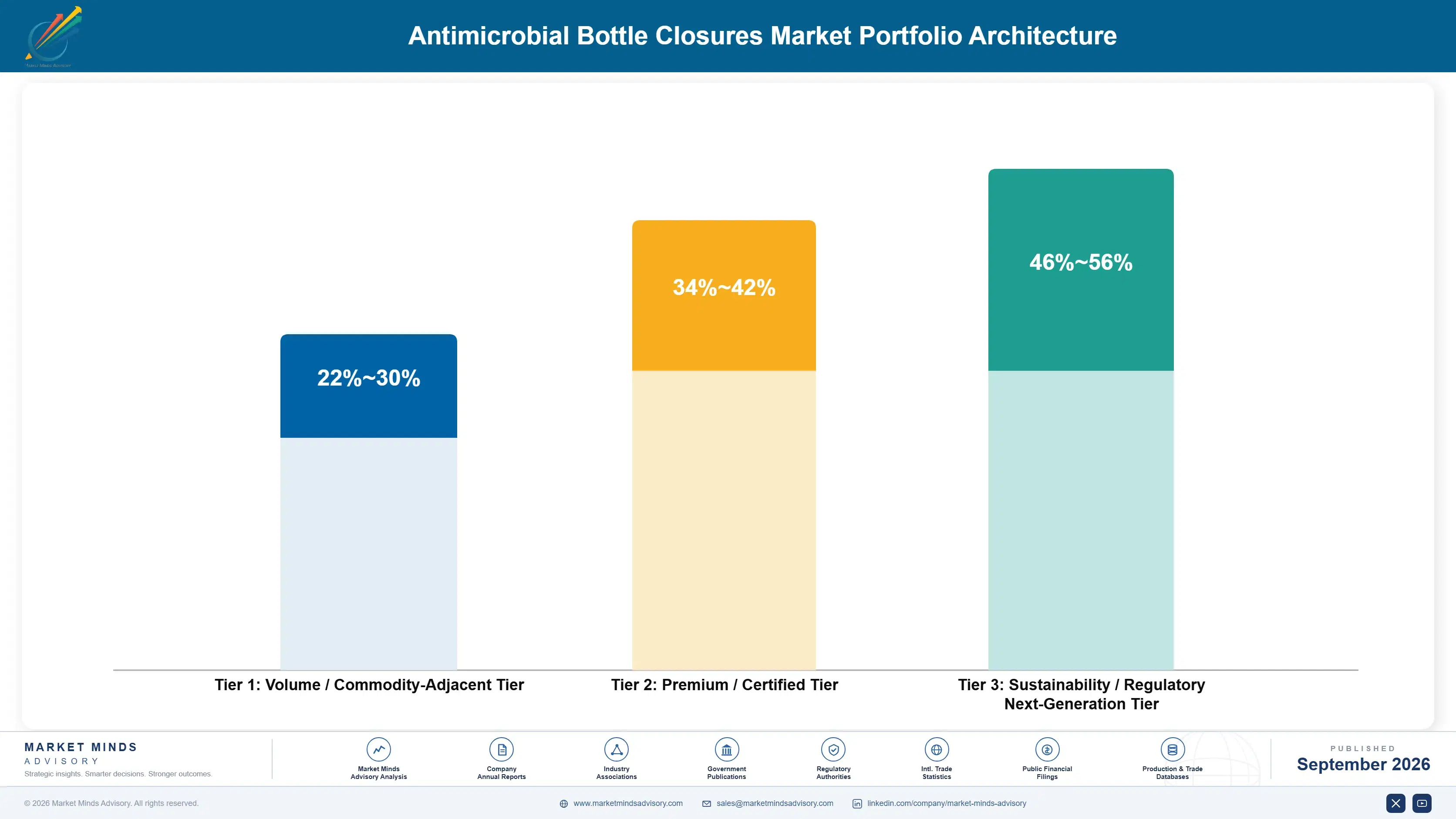
The category splits into three commercial tiers with distinct margin economics. Volume commodity-adjacent silver-ion closures used in standard pharmaceutical and personal care applications carry moderate margins given licensing costs baked into every unit. Premium certified copper-based and organic polymer formulations command higher margins through differentiated efficacy claims, and the sustainability-focused next-generation tier, while smallest in volume, is capturing a growing share of category gross profit through technology licensing.
Volume producers compete on licensing cost efficiency and manufacturing scale, leaving moderate room to absorb silver price volatility given the built-in cost structure of silver-ion technology across most product lines. Premium and next-generation suppliers instead compete on documented efficacy differentiation and application-specific formulation, letting them pass through higher costs while expanding margin as buyers prioritize verified performance over price alone.

High-value margin pools concentrate in technology licensing itself rather than closure manufacturing, where specialized suppliers capture royalty revenue across the entire addressable closure market regardless of who manufactures the finished product. Standard silver-ion closures remain the largest volume base but the moderate margin pool relative to the licensing layer above it, and that gap is expected to persist as licensing economics continue to strengthen.

Volume / Commodity-Adjacent Tier

Standard silver-ion antimicrobial closures sold across mainstream pharmaceutical and personal care packaging, competing primarily on licensing cost efficiency and manufacturing scale rather than differentiated efficacy claims or application-specific formulation depth.
Gross Margin: 22-30%

Premium / Certified Tier

Copper-based and organic polymer formulations with documented efficacy differentiation, sold to brands seeking lower-cost alternatives to silver-ion technology or non-metal antimicrobial claims for marketing purposes across personal care and nutraceutical categories.
Gross Margin: 34-42%

Sustainability / Regulatory / Next-Generation Tier

Advanced next-generation antimicrobial technologies with independently certified efficacy data, sold into premium pharmaceutical and nutraceutical applications commanding the category's highest licensing fees and unit pricing across every major market segment.
Gross Margin: 46-56%
antimicrobial-bottle-closures-market-portfolio-architecture-1790013285399

High-value Sub-segments and Strategic Watch-out

Copper-Based Antimicrobial Closures

Copper-Based Antimicrobial Closures: the fastest-growing, highest-margin segment as newer efficacy data and lower raw material costs attract suppliers seeking alternatives to legacy silver-ion technology across pharmaceutical, personal care, and nutraceutical packaging categories worldwide and across every major geography and price tier available today and tomorrow.
Gross Margin: 48-58%

Organic Polymer Antimicrobial Closures

Organic Polymer Antimicrobial Closures: strong growth and healthy margins as brands seek non-metal antimicrobial claims for marketing and regulatory reasons across personal care and premium packaging categories, particularly where metal disclosure requirements are tightening across multiple jurisdictions worldwide and domestically each year and across every retail channel.
Gross Margin: 38-46%

Silver-Ion Antimicrobial Closures

Silver-Ion Antimicrobial Closures: the largest volume base today, generating steady but exposed margins given silver price volatility and rising competition from copper-based and organic polymer alternatives gaining share across most major end-use categories and geographic markets worldwide and beyond every current forecast horizon and planning cycle.
Gross Margin: 22-30%

Regulatory Registration Cost Escalation

Regulatory Registration Cost Escalation: a segment to watch as EPA and equivalent bodies tighten efficacy documentation requirements further, potentially pricing smaller technology suppliers out of new active registration entirely within the next several years across multiple overlapping jurisdictions, markets, and closure categories worldwide and beyond.
Gross Margin: 20-30%

The Annuity Economics of Closure Specification

Antimicrobial closure specification behaves like an annuity once embedded in a brand owner's packaging standard, since switching suppliers requires re-validating regulatory compliance and re-running stability testing across the affected product line and every related SKU. This creates durable, multi-year revenue visibility for incumbent technology suppliers and closure manufacturers, particularly in pharmaceutical applications where switching costs are highest and regulatory scrutiny most intense.
Adoption stickiness varies meaningfully by end-use vertical. Pharmaceutical packaging shows the deepest lock-in, since regulatory approval is tied to the specific closure and antimicrobial technology combination used in the original drug application filing submitted to regulators. Personal care and nutraceutical categories show comparatively weaker stickiness, with brands more willing to switch technology suppliers between product reformulation cycles when pricing or performance shifts meaningfully.

Buyer profiles are shifting generationally as younger packaging engineers and procurement professionals, more attuned to sustainability and ingredient transparency than previous generations, increasingly favor organic polymer and copper-based alternatives over legacy silver-ion technology by default across new product development. This generational shift is accelerating adoption of newer antimicrobial technologies faster than pure efficacy performance data alone would explain, and shows little sign of reversing as these buyers advance into senior roles.
antimicrobial-bottle-closures-market-end-use-penetration-index-1790013285891

Where Value Is Actually Shifting

These are among the four positions where our research anticipates prominent divergence between winners and laggards over the coming forecast period. Each is grounded in the demand model, the regulatory perimeter, and the announced capacity pipeline.
01 / COPPER TECHNOLOGY INVESTMENT

Accelerate copper-based technology development ahead of silver volatility

Suppliers still treating copper-based technology as a secondary option are underestimating how quickly silver price volatility is pushing brand owners toward alternatives with comparable efficacy at lower and more stable cost across every applicable product category. Copper's growing efficacy data and lower raw material exposure make it a credible primary technology rather than a niche hedge against silver supply disruption alone. The suppliers gaining new licensing deals right now are the ones that invested in copper technology years before this shift became obvious to the rest of the market.
02 / TECHNOLOGY LICENSING EXPANSION

Build licensing relationships rather than compete purely on closure manufacturing

Closure manufacturers competing purely on manufacturing scale are ceding the most attractive margin pool to specialized technology licensors who capture royalty revenue across the entire addressable market regardless of who produces the finished closure product across every distribution channel. Manufacturers that develop or license proprietary technology directly capture more of this value than those remaining pure contract manufacturers dependent on external suppliers. The gap between technology owners and pure manufacturers will widen further as licensing economics continue to strengthen across the category.
03 / EFFICACY CERTIFICATION INVESTMENT

Pursue third-party certification before consumer skepticism erodes pricing power

Consumer skepticism toward antimicrobial marketing claims is rising, and suppliers relying solely on internal testing data will face increasing difficulty defending premium pricing as buyers demand independent verification across every major retail channel. Third-party efficacy certification requires upfront investment but builds a defensible claim that competitors relying on marketing language alone cannot easily match or replicate quickly. Suppliers that invest early in certification will retain pricing power longer than those that wait until skepticism has already eroded margins across the category.
04 / REGULATORY REGISTRATION TIMING

Pursue platform technology registration before approval costs rise further

EPA registration costs for new antimicrobial actives are rising as documentation requirements tighten, and suppliers who delay pursuing platform technology approvals applicable across multiple closure formats will face steeper costs and longer timelines than those who moved earlier and more decisively. Registering a platform technology once, rather than repeating the process for each individual product variant, meaningfully reduces long-term compliance costs and accelerates time to market. The suppliers best positioned for future growth are treating registration strategy as a core competitive investment rather than a compliance afterthought.

Engagement Snapshot From the Field

A live engagement with an industry participant carrying material or product regulatory and market exposure ahead of a defining policy shift, showing how our research translates into a defensible multi-year portfolio strategy.
MARKET MINDS ADVISORY · CLIENT ENGAGEMENT SUMMARY
Antimicrobial Bottle Closures Producer Strategic Portfolio Review and Transition Roadmap 2026·Investment Scenario on Antimicrobial Bottle Closures Exposure Evaluation 2025-26
CLIENT PROFILE
The client is a mid-sized nutraceutical brand headquartered in the United States, selling supplement products through both direct-to-consumer channels and major retail chains across North America. The brand had received several customer complaints regarding product contamination during shipping and storage, prompting leadership to evaluate antimicrobial closure adoption across its full product portfolio for the first time.
STRATEGIC CHALLENGE
The brand needed to select an antimicrobial technology and closure manufacturer without in-house regulatory or packaging engineering expertise, while managing cost sensitivity given its position as a mid-market rather than premium supplement brand. Leadership needed a defensible recommendation within a single budget cycle to address the contamination concerns before the next major product launch.
MMA APPROACH
MMA benchmarked five antimicrobial closure suppliers against the brand's volume and cost requirements, evaluating technology type, licensing cost structure, and documented efficacy credentials appropriate for nutraceutical packaging applications specifically. The engagement combined primary interviews with supplier technical teams and comparative cost modeling across silver-ion, copper-based, and organic polymer technology options.
KEY FINDINGS
  1. Copper-based technology offered the best balance of cost and documented efficacy for the brand's mid-market price positioning and product volume requirements specifically.
  2. Switching to antimicrobial closures would raise per-unit packaging cost by approximately 22 percent (client-reported, unverified by MMA), within the brand's target budget range.
  3. Two of five evaluated suppliers could provide the required efficacy documentation without meaningfully extending the brand's planned product launch timeline or budget.
  4. A phased rollout across the brand's top three product lines first allowed cost and consumer response validation before committing to full portfolio conversion.
CLIENT PROFILE
The client is a mid-sized nutraceutical brand headquartered in the United States, selling supplement products through both direct-to-consumer channels and major retail chains across North America. The brand had received several customer complaints regarding product contamination during shipping and storage, prompting leadership to evaluate antimicrobial closure adoption across its full product portfolio for the first time.
STRATEGIC CHALLENGE
The brand needed to select an antimicrobial technology and closure manufacturer without in-house regulatory or packaging engineering expertise, while managing cost sensitivity given its position as a mid-market rather than premium supplement brand. Leadership needed a defensible recommendation within a single budget cycle to address the contamination concerns before the next major product launch.
MMA APPROACH
MMA benchmarked five antimicrobial closure suppliers against the brand's volume and cost requirements, evaluating technology type, licensing cost structure, and documented efficacy credentials appropriate for nutraceutical packaging applications specifically. The engagement combined primary interviews with supplier technical teams and comparative cost modeling across silver-ion, copper-based, and organic polymer technology options.
KEY FINDINGS
  1. Copper-based technology offered the best balance of cost and documented efficacy for the brand's mid-market price positioning and product volume requirements specifically.
  2. Switching to antimicrobial closures would raise per-unit packaging cost by approximately 22 percent (client-reported, unverified by MMA), within the brand's target budget range.
  3. Two of five evaluated suppliers could provide the required efficacy documentation without meaningfully extending the brand's planned product launch timeline or budget.
  4. A phased rollout across the brand's top three product lines first allowed cost and consumer response validation before committing to full portfolio conversion.
RECOMMENDED STRATEGY
Phase 1: Phase one: convert the brand's top three best-selling product lines to copper-based antimicrobial closures within one full fiscal quarter of approval. Phase 2: Phase two: monitor consumer response and contamination complaint rates closely for two full quarters before expanding to additional product lines. Phase 3: Phase three: convert the remaining product portfolio to antimicrobial closures once cost and performance data were fully validated internally and externally.
OUTCOME
The brand completed its top three product line conversion within the planned quarter and reported a meaningful decline in contamination-related customer complaints during the following two quarters (client-reported, unverified by MMA). Based on these results, the brand approved full portfolio conversion ahead of its original planned timeline.

Frequently Asked Questions

Foundational context covering the market sizes, CAGR, scope, country, region and competition that inform every finding below. This section is provided to cover basics and most often pre-purchase conversations, answered from the MMA Primary Research Dataset.

What is the current size of the Antimicrobial Bottle Closures Market?

The market reached $1.9 billion globally in 2025. This covers silver-ion, copper-based, organic polymer, and zinc pyrithione closures for pharmaceutical, personal care, and nutraceutical packaging.

How large will the Antimicrobial Bottle Closures Market be by 2036?

MMA projects the market will reach $4.17 billion by 2036 under the base case scenario. That represents roughly double the 2026 starting value over the ten-year forecast window.

What is the CAGR for the Antimicrobial Bottle Closures Market 2026 to 2036?

The base case CAGR is 7.4 percent annually through 2036. Bull and bear scenarios range from 6.1 to 8.7 percent depending on food and beverage category adoption speed.

Which segment is growing fastest?

Copper-based antimicrobial closures lead at a 10.5 percent CAGR, roughly 1.42 times the overall market rate today. Organic polymer formulations follow closely as the second-fastest segment.

Who are the major companies in the Antimicrobial Bottle Closures Market?

AptarGroup, Berry Global, Silgan Holdings, Guala Closures, and Sciessent lead the market today. Together they hold an estimated CR5 near 44 percent of total category revenue.

Which country is growing fastest?

The United States leads at an estimated 8.3 percent CAGR, driven by stringent FDA and EPA registration requirements and hospital contamination liability concerns. India and China follow as pharmaceutical exports expand.

Report Segmentation Architecture

The full report scope spans multiple orthogonal segmentation dimensions, with cross-tabulated demand data provided for each dimension pair. Coverage extends further to regional breakdowns, trend trajectories, and the competitive detail needed to support segment-level decision-making.

By Primary Market Dimension

  • Silver-Ion Antimicrobial Closures
  • Copper-Based Antimicrobial Closures
  • Organic Polymer Antimicrobial Closures
  • Zinc Pyrithione-Based Closures
  • Quaternary Ammonium Coated Closures
  • Other Nanoparticle-Based Closures

By End-Use Industry

  • Pharmaceutical and Healthcare Packaging
  • Personal Care and Cosmetics
  • Nutraceutical and Dietary Supplements
  • Food and Beverage
  • Household and Industrial Chemicals

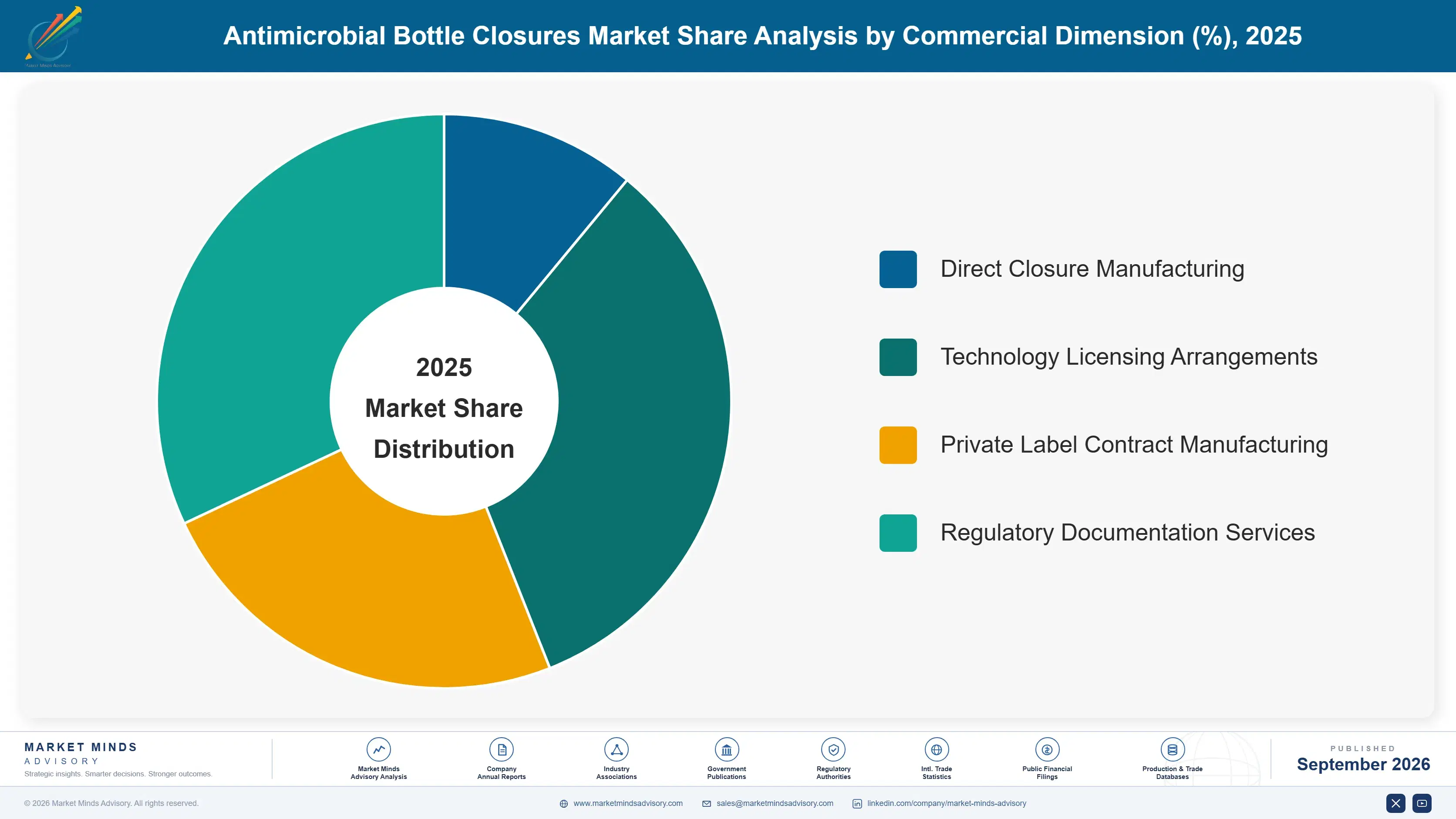
By Commercial Dimension

  • Direct Closure Manufacturing
  • Technology Licensing Arrangements
  • Private Label Contract Manufacturing
  • Regulatory Documentation Services

By Region

  • North America
  • Western Europe
  • East Asia
  • South Asia and Pacific
  • Latin America
  • Middle East and Africa
  • Eastern Europe

Scope, Methodology, and Coverage

Every figure in this report is reproducible from documented input assumptions. The scope below maps the historical period, the forecast horizon, the segmentation dimensions, and the countries covered, alongside the underlying primary and qualitative methodology.
Historical Period
2020 to 2025
Forecast Period
2026 to 2036
Base Year
2025 (USD billions; MMA Primary Research Dataset, September 2026)
Market Definition
The antimicrobial bottle closures market covers caps, lids, and dispensing closures treated with silver-ion, copper-based, organic polymer, or zinc pyrithione antimicrobial technology for pharmaceutical, personal care, nutraceutical, and food and beverage packaging. It excludes untreated conventional closures and antimicrobial coatings applied to bottle bodies rather than closures themselves.
Quantitative Units
USD billions (current prices); unit volume of treated closures where applicable
Segmentation Dimensions
By Primary Market Dimension; By End-Use Industry; By Commercial Dimension; By Region
Regions Covered
North America, Western Europe, East Asia, South Asia and Pacific, Latin America, Middle East and Africa, Eastern Europe
Countries Covered
USA, China, Germany, France, UK, Japan, South Korea, India, Australia, Canada, Brazil, Mexico, Indonesia, Vietnam, Thailand, Malaysia, UAE, Saudi Arabia, South Africa, Nigeria, Turkey, Poland, Netherlands, Italy, Spain, Sweden, Switzerland, Argentina, Colombia, Singapore, and additional markets relevant to this sector
Key Companies Profiled
AptarGroup, Berry Global, Silgan Holdings, Guala Closures, Sciessent, Bericap GmbH, United Caps, Weener Plastics, Closure Systems International, O.Berk Company, Sanner GmbH, Microban International, BioCote Limited, Amcor, Sacmi Group, CL Smith Company, Alpla Group, Comar LLC, Mold-Rite Plastics, Tekni-Plex
Quantitative Methodology
Primary survey, n=3,800 respondents, Q4 2025, six countries; demand-side model with trade association cross-validation
Qualitative Methodology
47 expert interviews, Q4 2025; applied to validate demand model assumptions, identify emerging dynamics, and assess competitive positioning
Report Format
PDF and XLSX data workbook (Word format preview document)
Publisher
Market Minds Advisory
Report Code
MMA-2026-PAC-233
Published
September 2026
Contact
sales@marketmindsadvisory.com | www.marketmindsadvisory.com

Purchase the full Antimicrobial Bottle Closures Market Report (2026 to 2036).

This report delivers a comprehensive assessment of the antimicrobial bottle closures market, covering market sizing, segmentation, and regional demand through 2036 across seven major world regions and end-use industries. It profiles the twenty leading suppliers, benchmarking competitive positioning, moat durability, and emerging risk across the top two market leaders in depth. The analysis includes detailed input cost exposure, portfolio margin architecture, and revenue diversification opportunities specific to antimicrobial technology suppliers. A dedicated case study illustrates how a nutraceutical brand navigated a live packaging specification engagement.
Ten-year market sizing and forecast to 2036
Six-segment MECE technology segmentation framework overview
Seven-region demand, share, and growth rate analysis
Twenty-company competitive benchmarking with moat and risk assessment
Input cost exposure and mitigation pathways
Anonymized nutraceutical brand specification case study

Built For The People Who Decide

From boardroom strategy to bench-side execution, this report is read cover-to-cover by leaders shaping the next decade of their industry, turning demand scenarios, market dynamics and valuation benchmarks into decisions.
CXOs/ Presidents/ VPs/ Managers
M&A and Corporate Development
Strategy Teams and R&D Heads
Procurement and Product Directors
Regulatory and Compliance Leaders
Investor Relations and Equity Analysts