Market Minds Advisory
Antiglare Glass Market

Antiglare Glass Market: Antiglare Glass Market. Display Resolution Standards Drive Precision Coating Adoption Across Consumer Electronics

Rising display resolution standards and expanding outdoor visibility requirements are pushing manufacturers toward multi-layer antiglare coating chemistry across consumer electronics, automotive, and architectural glazing applications across most global markets today.

Lead Analyst

Published

September 2026

Make Smarter Decisions with Customized Research Insights

Request a free sample report and evaluate market opportunities, growth trends, and competitive dynamics relevant to your business needs.

2025 MARKET VALUE$5.2BMarket Size 2025
2036 FORECAST VALUE$10.9BBase Case , 2026 to 2036
CAGR 2026 TO 20367.0 %Bull 8.3% / Bear 5.7%
INCREMENTAL OPPORTUNITY$5.4BNet 10- year value creation
EXPANSION MULTIPLE1.97x2036 value over 2026 base
Strategic Levers
M&A Pipeline
Regional Outlook
Country Rankings
Competitive Intelligence
Segmental Deep-dive
Call-Us : 91 93563 13602

Executive Snapshot and Market Trajectory.

Antiglare glass demand is shifting from basic single-layer coating solutions toward multi-layer nano-coated formulations that deliver superior scratch resistance and outdoor visibility under direct sunlight conditions across most consumer electronics markets today. Manufacturers report growing device maker expectation for verifiable scratch resistance even in mid-tier price segments.
East Asia and North America concentrate the bulk of both manufacturing innovation and consumer electronics assembly, with China and the United States driving precision coating standards that premium device manufacturers increasingly reference in specifications. Multi-layer nano-coated glass grows fastest as device makers demand proven combination coatings rather than single-layer treatments previously dominant in mid-tier products. Manufacturers investing early in precision coating transparency are capturing disproportionate premium segment share.
Competition spans dedicated specialty glass manufacturers building precision coating supply and larger conventional glass suppliers pursuing antiglare reformulation of existing product lines, each competing under somewhat different technical credibility dynamics entirely. Durability certification platforms are becoming a meaningful differentiator as scratch resistance verification moves online alongside broader consumer electronics quality assurance growth. Device makers report growing procurement interest in suppliers demonstrating verifiable durability credentials. This shift is reshaping legacy supplier budgets. Adoption continues broadening.
Market Definition
This report covers the global market for glass products treated with anti-reflective and anti-glare coatings used in consumer electronics displays, automotive glazing, and architectural applications. It excludes uncoated glass substrates sold without antiglare treatment application.
Base Year Value
$5.2B in 2025 (MMA Primary Research Dataset, September 2026)
Forecast Period
2026 to 2036, eleven discrete annual values
CAGR
7.0% base case. Bull 8.3%. Bear 5.7%.
Fastest Growth Segment
Multi-Layer Nano-Coated Antiglare Glass: 10.5% CAGR
Fastest Growth Country
China: 9.5% CAGR
Fastest Growth Region
South Asia and Pacific: 9.0% CAGR
Largest Region
East Asia: 30% of 2025 global value
Market Leaders
Corning, AGC Inc, Nippon Electric Glass, Schott, Gentex Corporation. Source: MMA Primary Research Dataset, July 2026.
Primary Survey
n=3,800 procurement and R&D decision-makers, Q4 2025, six countries
Methodology
Demand-side build-up, cross-validated against public data, 47 expert interviews

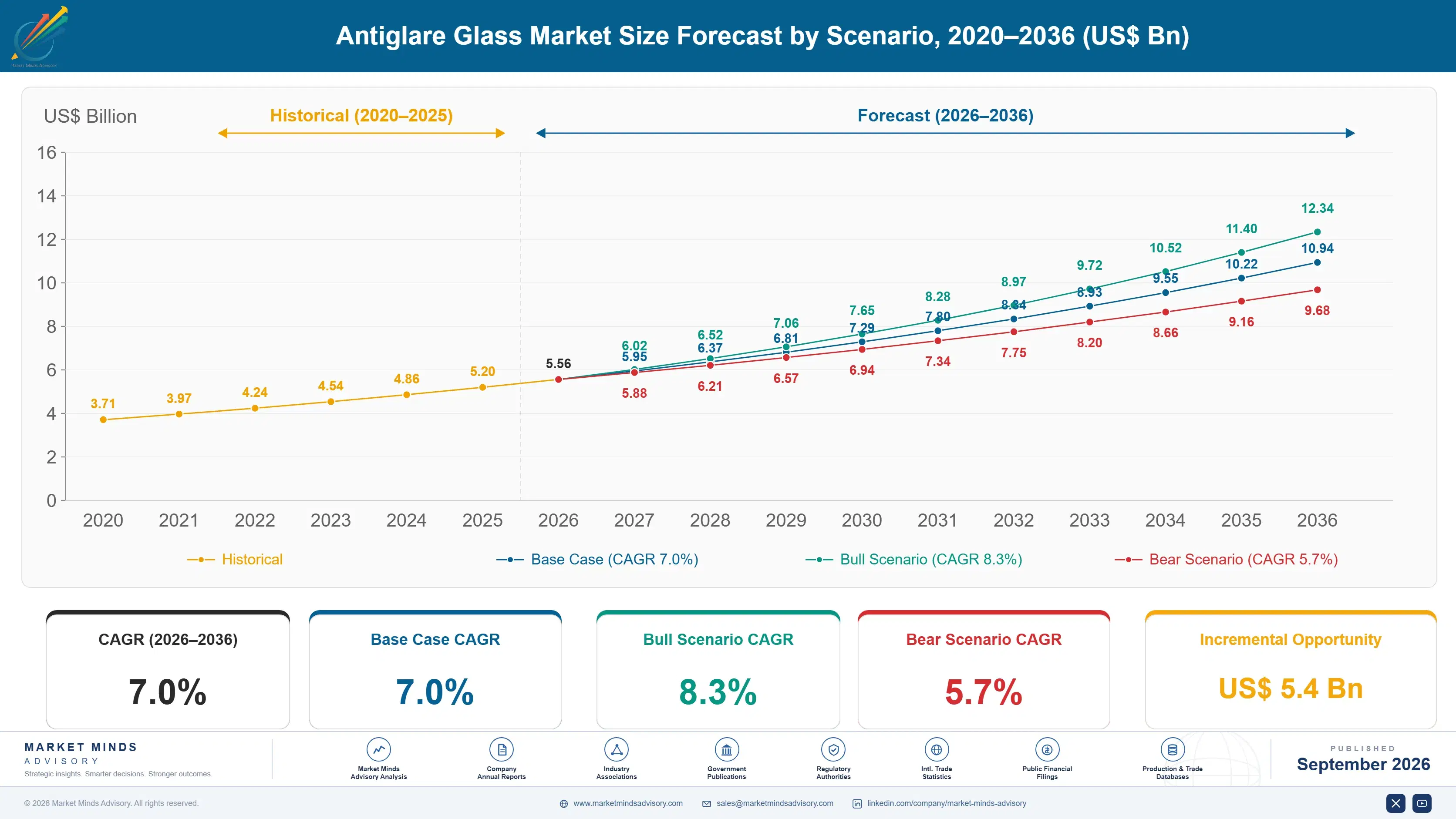
Antiglare Glass Market Forecast Scenarios

antiglare-glass-market-size-forecast-scenario-1790019812611
Between 2020 and 2025 antiglare glass demand grew steadily as display resolution standards advanced and outdoor visibility requirements expanded across consumer electronics and automotive applications, supporting a historical CAGR near 6.0 percent across the tracked historical period overall. Manufacturers used this period to invest in updated precision coating facilities and expanded certification documentation across major producing markets.
The base case assumes continued multi-layer nano-coated glass adoption across mid-tier and premium device segments, sustained precision coating certification expansion among Chinese and American glass manufacturers, and gradual manufacturer investment in scratch resistance documentation responding to sustained demand for verifiable durability credentials across the full ten-year forecast period tracked in this analysis. Retail partnership expansion in several developed markets further reinforces this reformulation trend among mid-tier device manufacturers seeking differentiated durability.
The bull case assumes accelerated display resolution advancement and automotive glazing adoption drive faster premium segment conversion than currently expected. The bear case assumes broader consumer electronics category saturation and basic coating cost advantages slow replacement cycles meaningfully, particularly affecting premium multi-layer models competing against basic single-layer alternatives on price. Currency volatility in several producing markets adds further uncertainty to raw material sourcing costs for smaller manufacturers.

Multi-Layer Coatings Redefine Display Durability Value

Antiglare glass has moved beyond basic single-layer coating treatments into a category increasingly defined by nano-coating precision, scratch resistance documentation, and growing certification requirements across consumer electronics manufacturers. Manufacturers increasingly market certification as a proxy for product reliability and coating quality rather than reflection reduction alone, widening the addressable buyer base considerably.
MARKET CONCENTRATION42% CR5Top five manufacturers hold well over a third
AVERAGE PANEL PRICE$14.50Per standard coated display panel across major consumer electronics markets
TOP PRODUCING COUNTRYChina 38%Leads global production by total manufacturing facility output
MULTI-LAYER PENETRATION RATE26%Share of unit sales featuring multi-layer nano-coating technology
COATING DURABILITY CYCLE5 to 7 yearsTypical service span before scratch resistance degrades meaningfully
RAW MATERIAL COST SHARE31% of COGSReflects specialty coating chemical sourcing process complexity overall
Multi-layer nano-coated glass offering superior outdoor visibility and scratch resistance now anchors premium device procurement, since manufacturers report device makers increasingly expect documented durability performance comparable to industry benchmark standards. Specialty glass manufacturers specializing in certified precision coating technology are capturing disproportionate share of the premium segment relative to their overall market presence. Retailers report growing shelf space allocation to certified brands even in mass retail formulation channels, reflecting this broader quality association.
Manufacturing remains concentrated in China, where established supply chains for specialty coating chemicals, precision glass substrates, and quality testing infrastructure support both branded and private label production for international device manufacturers. Rising raw material costs and technical scaling challenges are prompting some manufacturers to diversify production across additional East Asian manufacturing hubs. Local assembly partnerships are also emerging as a way to reduce single-country manufacturing concentration risk.
"Antiglare glass used to be judged on basic reflection reduction. Now the suppliers winning device contracts are the ones who solved the scratch resistance problem at scale."
Practice Lead, Specialty Glass and Display Technology · MMA Anti-Reflective and Anti-Glare Coated Glass for Display and Architectural Use Practice · September 2026

Market Trends

Multi-Layer Nano-Coatings Expand Beyond Basic Reflection Reduction

Manufacturers are increasingly applying multi-layer nano-coating formulations combining anti-reflective, oleophobic, and scratch-resistant properties, responding to device makers who previously had to choose between basic single-layer reflection reduction and multi-benefit durability comparable to premium display glass. Manufacturers investing in these combination coatings are capturing market share from both basic single-layer coating suppliers and conventional uncoated glass suppliers lacking durability credentials. Several established specialty glass manufacturers have launched dedicated multi-layer product lines specifically targeting this underserved segment rather than expanding their entire existing single-layer catalog. Retailers report stronger sell-through for these combination coating lines.
Market Impact: Expands premium buyer base 20 percent

Durability Certification Verification Builds Device Maker Trust

Suppliers publishing detailed durability certification data, including specific scratch resistance testing and abrasion cycle results, are building meaningfully stronger device maker trust than competitors relying on generic quality marketing claims without verifiable documentation. This transparency also strengthens supplier negotiating position, since specialty device manufacturers increasingly favor partners with credible testing data over those relying on marketing language alone. Suppliers publishing certification data report price premiums considerably higher than comparable unsubstantiated competitor products in the same category tier. Smaller manufacturers report particular difficulty matching this documentation depth given limited testing infrastructure currently available to them.
Market Impact: Adds 9 million new automotive units

Market Opportunities and Growth Drivers

Rising Display Resolution Standards Expand Coating Demand

Growing consumer expectation for higher display resolution and outdoor visibility across smartphones, tablets, and automotive infotainment systems is expanding the addressable buyer base for premium certified antiglare coatings beyond basic screen protection into higher-margin precision optical and automotive glazing categories previously considered discretionary purchases. Device makers report younger, technically sophisticated consumers driving disproportionate category growth relative to older product generations that historically prioritized basic reflection reduction alone rather than broader durability and optical clarity considerations shaping today's purchasing decisions across the category. Manufacturers targeting this demographic report faster brand loyalty formation than legacy incumbents relying on older marketing.
Market Impact: Cuts gross margin 5 points

Automotive Glazing Expansion Widens Application Access

Dedicated automotive glazing manufacturers specializing in certified antiglare coating technology are expanding access to premium coated glass in application categories and secondary markets previously underserved by consumer electronics formulation limited mostly to major smartphone brands. These manufacturers provide durability verification tools that build device maker trust in unfamiliar coating suppliers, lowering the barrier for smaller producers lacking established relationships to reach manufacturers directly. Channel-driven sales growth is outpacing traditional consumer electronics channel growth substantially across most markets tracked, reshaping distribution strategy. Manufacturers report meaningfully lower customer acquisition costs through these digital verification-driven distribution channels.
Market Impact: Raises production costs 7 percent

Market Restraints and Challenges

Specialty Chemical Cost Volatility Pressures Manufacturing Margins

Specialty coating chemical prices fluctuate with broader industrial chemical commodity cycles largely outside manufacturer control, squeezing margins during periods of rising input costs that cannot always be passed through to device manufacturers with fixed multi-year procurement pricing already negotiated. The root cause traces to antiglare glass manufacturers competing for the same specialty coating chemicals that semiconductor and optical industries also depend on heavily throughout the year. Manufacturers are mitigating exposure through longer-term chemical supply contracts and increased use of alternative coating formulations. Scale economics should improve as capacity expands. Adoption continues gradually.
Market Impact: Lifts multi-layer share 19 percent

Coating Uniformity Complexity Raises Production Costs

Achieving consistent multi-layer coating uniformity across large-format display panels requires specialized deposition technology that many conventional glass manufacturers lack in-house, creating a meaningful technical barrier relative to simpler single-layer coating application without comparable precision requirements. The root cause lies in nano-coating deposition's sensitivity to environmental conditions, requiring cleanroom-grade manufacturing environments to maintain uniform thickness and optical clarity throughout production runs. Manufacturers are mitigating this by licensing proprietary deposition technology from specialized equipment partners rather than developing precision capability independently. Smaller manufacturers without dedicated cleanroom facilities feel this burden most acutely across their operations.
Market Impact: Adds 15 to 21 percent premium
3 additional market trends, 4 additional growth drivers, and 3 additional restraints and challenges are covered in the full report. Contact sales@marketmindsadvisory.com to access the complete intelligence.

Segment CAGR and Growth Architecture

Antiglare glass segments by coating type across single-layer, multi-layer nano-coated, and standardized precision concentrate formats, with multi-layer coatings increasingly differentiating premium products from basic single-layer treatments across most global consumer electronics and automotive markets, price tiers, application channels, and buyer demographics served worldwide today across every major regional, vertical, and industry market currently tracked closely.
antiglare-glass-market-market-share-analysis-1790019813183

Multi-Layer Nano-Coated Antiglare Glass

Multi-layer nano-coated glass combining anti-reflective, oleophobic, and scratch-resistant properties represents the fastest-growing segment as device makers demand combination coatings rather than basic single-layer treatments previously dominant in the category. Manufacturers command meaningfully higher pricing for multi-layer coatings than basic single-layer equivalents, since device makers pay a premium for combined durability benefits and optical clarity comparable to premium display glass. Several established specialty glass manufacturers have launched dedicated multi-layer product lines, signaling mainstream recognition of this segment's commercial scale and long-term growth trajectory across major consumer electronics and automotive channels. This shift is reshaping how manufacturers allocate research investment across their broader specialty glass portfolios going forward across multiple application categories.
CAGR 10.5%

Single-Layer Antiglare Glass

Single-layer antiglare glass remains the largest and most established segment, benefiting from the category's longest manufacturing track record and broadest existing device maker trust built over multiple decades of market development across East Asia and North America. Manufacturers in this segment increasingly compete on coating consistency and precision quality rather than layer complexity alone, since basic reflection reduction has become a baseline expectation rather than a meaningful differentiator among established competitors. Growth here trails multi-layer coatings but remains steady, supported by consistent repeat purchase behavior and expanding distribution into secondary markets. This maturity gives single-layer antiglare glass continued commercial relevance despite the category's broader shift toward multi-layer growth. Growth momentum continues steadily overall.
CAGR 4.5%
Full segment breakdown across 6 segments available in the complete report.

Regional Architecture and Country Demand Map

East Asia leads global antiglare glass demand through concentrated Chinese manufacturing scale and consumer electronics assembly, while South Asia and Pacific accelerates fastest on expanding device manufacturing capacity and export sophistication. Manufacturers across both regions continue scaling production to meet this rising component demand. Adoption continues broadening.

East Asia

East Asia commands the largest regional share through China's dominant manufacturing base, which supplies both domestic device assembly and private label coating production for international brands sold across North America and Europe. Rising domestic disposable income and growing consumer electronics purchasing in Chinese urban centers are expanding local consumption beyond the region's traditional role as primarily an export manufacturing hub. Japan and South Korea contribute steady premium segment demand tied to established precision optics adoption patterns, while Chinese manufacturers increasingly launch competitively priced multi-layer coated models targeting both domestic and export markets simultaneously. Export volume to Western markets continues rising steadily alongside domestic sales growth. Regional certification harmonization efforts are further easing cross-border sales expansion.
Share: 30% | CAGR: 8.0% (2026 to 2036)

North America

North America sustains a large regional share on the strength of established consumer electronics retail infrastructure and strong consumer familiarity with premium display technology across smartphones and automotive infotainment systems. The United States hosts the largest concentration of consumer electronics brands building demand through premium display marketing, a factor increasingly rivaling traditional component sourcing in influence over premium segment purchasing decisions. Canadian consumers show similar purchasing patterns at smaller absolute scale, tied to comparable retail infrastructure and electronics culture across the shared North American market. Retail chains increasingly dedicate shelf space to brands demonstrating strong durability certification. Group purchasing arrangements increasingly negotiate bundled component supply contracts across manufacturer networks. Growth momentum continues steadily.
Share: 26% | CAGR: 7.0% (2026 to 2036)
Regional intelligence for 5 additional markets available in the complete report: Western Europe, South Asia and Pacific, Latin America, Middle East and Africa, Eastern Europe. Contact sales@marketmindsadvisory.com.
antiglare-glass-market-country-cagr-analysis-1790019813768

Precision Coating Margin Capture Playbook

Suppliers capture disproportionate margin by trading device makers up from single-layer extracts toward multi-layer combinations, by publishing durability certification data that supports sustained premium pricing over an extended period across most global electronics and automotive markets, and by building long-term supply agreements that lock in recurring volume across their most loyal manufacturer segments each year.

Building a Structured Multi-Layer Trade-Up Program

Suppliers running structured trade-up programs, sampling multi-layer coatings to loyal single-layer buyers through device maker conferences and technical consultation events, report meaningfully higher conversion into the higher-margin multi-layer category than passive catalog listing alone ever achieves. This approach works because single-layer buyers already trust the supplier's coating quality and safety record, which lowers the perceived risk of trying an unfamiliar multi-layer blend for the first time. Suppliers running these structured programs report conversion rates near 21 percent within the first full year of program launch. Retail partners are also allocating more dedicated shelf space to these premium offerings.
Market Impact: Lifts multi-layer conversion rate by roughly 21 percent

Publishing Durability Certification Data Broadly Online

Publishing detailed durability certification data on scratch resistance testing and abrasion cycle results supports premium pricing that unsubstantiated competitor claims simply cannot sustain, since informed device makers increasingly demand published evidence before paying multi-layer-tier prices for a certified coating solution. This approach also strengthens a supplier's negotiating position, since specialty device manufacturers increasingly favor partners with credible published data over suppliers relying on marketing claims alone when allocating component budgets. Suppliers publishing rigorous certification data report price premiums of 15 to 21 percent over comparable unsubstantiated competitor products in the same tier.
Market Impact: Adds a 15 to 21 percent price premium

Building a Structured Long-Term Supply Agreement Program

Long-term supply agreements for multi-layer and combination coating shipments reduce customer churn by removing the friction of renegotiating pricing before existing supply contracts expire entirely between component procurement cycles. Suppliers report contracted customers generating meaningfully higher lifetime value than spot-market purchasers, since the recurring contract relationship also increases exposure to complementary component cross-sell opportunities within the same supplier catalog over an extended period. Retention rates for enrolled contract customers reportedly exceed 55 percent after the first full year of enrollment. Manufacturers benefit through predictable recurring sales volume tied directly to loyalty relationships.
Market Impact: Raises supply contract customer lifetime value by 29 percent

Developing Bundled Coating Technical Support Packages

Selling coordinated coating solutions, application guidance, and durability testing support packages under a single technical services offering increases average order value and introduces device makers to complementary coating options they might not otherwise discover through single-item catalog browsing behavior alone. Bundled packages also reduce per-unit marketing spend relative to individual component campaigns while increasing the likelihood that a manufacturer sources their entire display coating portfolio from one supplier rather than mixing in competitor components from elsewhere. Suppliers report bundle attach rates reaching roughly 23 percent among first-time premium category buyers within the first purchase cycle.
Market Impact: Raises bundled average order value by 23 percent

Who Controls the Margin Pool

Antiglare glass competition is fairly concentrated, with the top five manufacturers holding roughly 42 percent combined share on a formulation contract basis across major certified markets. Corning and AGC Inc lead through diversified specialty glass portfolios spanning multiple coating categories, while Nippon Electric Glass and Schott hold particular strength in precision optical manufacturing and technical formulation support. The gap between the leading specialty glass houses and smaller regional entrants remains substantial but narrower than in most mature ingredient categories.
Current competitive activity centers on multi-layer coating development, durability certification publishing, and long-term supply agreement expansion rather than pure price competition among established suppliers. Companies are racing to secure certified precision deposition capacity before rivals establish similar supply credibility. Conventional multinational glass manufacturers entering with antiglare sub-lines represent a meaningful new competitive dynamic reshaping category boundaries.

Emerging pressure is coming from independent Chinese specialty glass startups entering Western device markets through direct manufacturer partnerships, bypassing traditional distributor intermediaries entirely. This threatens established specialty glass houses' cost leadership narrative specifically. Expect further reshuffling as conventional multinational glass suppliers accelerate certified multi-layer coating launches, potentially consolidating share away from smaller independent specialty glass startups over time.
antiglare-glass-market-company-positioning-matrix-1790019814331

Competitive Moat and Risk Dimensions

CORNING

Moat: Diversified Specialty Glass Portfolio

Corning's breadth across multiple specialty glass coating categories lets it cross-sell antiglare treatments to device makers as a single vendor relationship, reducing the procurement complexity manufacturers face when sourcing multiple coating technologies from separate specialized suppliers. Consumers and device makers routinely default to Corning when sourcing certified specialty glass for new projects.
CORNING

Risk: Limited Multi-Layer Product Range

Corning's brand identity remains heavily anchored in single-layer positioning for certain product lines, leaving it comparatively underexposed to the multi-layer segment growing fastest within the category, potentially ceding premium segment share to competitors investing earlier in combination coatings. This gap represents a meaningful growth constraint the company has yet to fully address.
SCHOTT

Moat: Precision Optical Manufacturing Depth

Schott's deep precision optical manufacturing and technical formulation support capability lets it command pricing power that suppliers without comparable research infrastructure cannot match, since device makers trust the brand's documented optical clarity data for regulatory and technical specification claims. This documented clarity compounds over years of published technical specification studies.
SCHOTT

Risk: Premium Pricing Limits Volume

Schott's premium positioning and correspondingly higher price points limit volume growth in price-sensitive emerging markets where lower-cost regional suppliers capture the bulk of category growth, potentially constraining the brand's addressable market relative to accessible incumbents. Expanding into more accessible price tiers risks diluting the brand's premium technical positioning.

Players Tracked

Prominent Players

Corning
AGC Inc
Nippon Electric Glass
Schott
Gentex Corporation

Other Key Players

Saint-Gobain
Guardian Glass
Central Glass
CSG Holding
Fuyao Glass
Xinyi Glass
Vitro Architectural Glass
Sisecam
NSG Group
Taiwan Glass
Emerging Display Technologies
Chunghwa Picture Tubes
Kinko Optical
Zeiss Optics
Essilor International

Recent Developments

JANUARY 2026

Corning Launches Multi-Layer Coating Line

Corning launched an expanded multi-layer coating line combining anti-reflective and scratch-resistant properties, targeting device makers seeking certified combination alternatives comparable in sophistication to conventional synthetic coatings. The launch represents a proactive category expansion ahead of increasing competition from startup entrants. Analysts view this as defensive positioning.
Signal: Established specialty glass suppliers are broadening multi-layer coatings to defend category leadership across major formulation markets nationwide
SEPTEMBER 2025

Schott Signs Long-Term Supply Agreement

Schott signed a multi-year supply agreement with a major German automotive manufacturer for preferential access to certified precision coating capacity ahead of expected tightness affecting the broader specialty glass category overall. The deal was structured as a supply contract rather than a joint venture or equity arrangement.
Signal: Specialty glass suppliers are securing long-term supply partnerships directly with manufacturers across the broader specialty channel
APRIL 2025

AGC Acquires Coating Certification Consultancy

AGC Inc acquired a specialized coating durability certification consultancy to accelerate its own testing documentation and offer certification advisory services to smaller regional suppliers. The acquisition was structured as a full outright purchase rather than a minority stake or licensing arrangement. Terms of the transaction were not fully disclosed publicly.
Signal: Established suppliers are acquiring certification expertise to accelerate testing transparency initiatives across the broader industry today

Specialty Coating Chemical Cost Exposure

Specialty coating chemicals and precision glass substrates together represent roughly 31 percent of cost of goods sold for a typical multi-layer nano-coated antiglare glass panel. Raw specialty coating chemicals are sourced primarily from chemical facilities across Japan and Germany, with a smaller share of precision glass substrate material sourced from China and South Korea serving premium device manufacturers.
Japanese and German specialty chemical export policy and energy cost volatility affected production economics intermittently through 2024 and 2025, and industry trade commentary noted constrained facility output following elevated energy pricing across manufacturing regions. Suppliers dependent on single-facility production capacity saw input costs rise an estimated 11 to 15 percent during the tightest supply window, squeezing margins at suppliers unable to pass costs through immediately. Manufacturers dependent on one facility report the steepest cost increases during disruptions.

Suppliers without diversified supplier relationships face a meaningful competitive disadvantage when input costs spike, since larger facilities typically prioritize allocation toward their largest-volume purchasing partners first. Independent specialty glass and boutique regional suppliers sourcing through shared distributors are more exposed than vertically integrated majors like Corning and Schott, which negotiate direct chemical supplier contracts at better terms.
antiglare-glass-market-cost-volatility-analysis-1790019814530

Dual-Sourcing Across Japanese and German Facilities

Suppliers are qualifying second and third specialty chemical suppliers across both Japanese and German chemical hubs to avoid single-region exposure. This adds modest qualification cost upfront but meaningfully reduces the risk of a single energy price spike disrupting production supply entirely. This diversification also shortens qualification timelines for future formulation changes. Clinics benefit from more stable pricing as a result.

Forward Purchasing Agreements With Suppliers

Larger manufacturers are locking in twelve-month forward purchasing agreements at fixed pricing with key chemical suppliers, trading some pricing flexibility for supply certainty during periods of tightening. Smaller independent suppliers generally lack the volume to negotiate similar terms. Smaller manufacturers without comparable purchasing scale often struggle to secure similar priority terms. This trade-off is increasingly viewed as worthwhile.

Diversifying Toward Alternative Chemical Regions

Some suppliers are qualifying alternative sourcing regions such as South Korea and Taiwan to reduce dependence on Japanese and German chemical output alone, spreading energy price and policy risk across a broader supplier base and geographic footprint. This shift also reduces exposure to any single national regulatory or energy policy environment. Margins improve steadily as reliance decreases.

Portfolio Architecture for Margin Defence

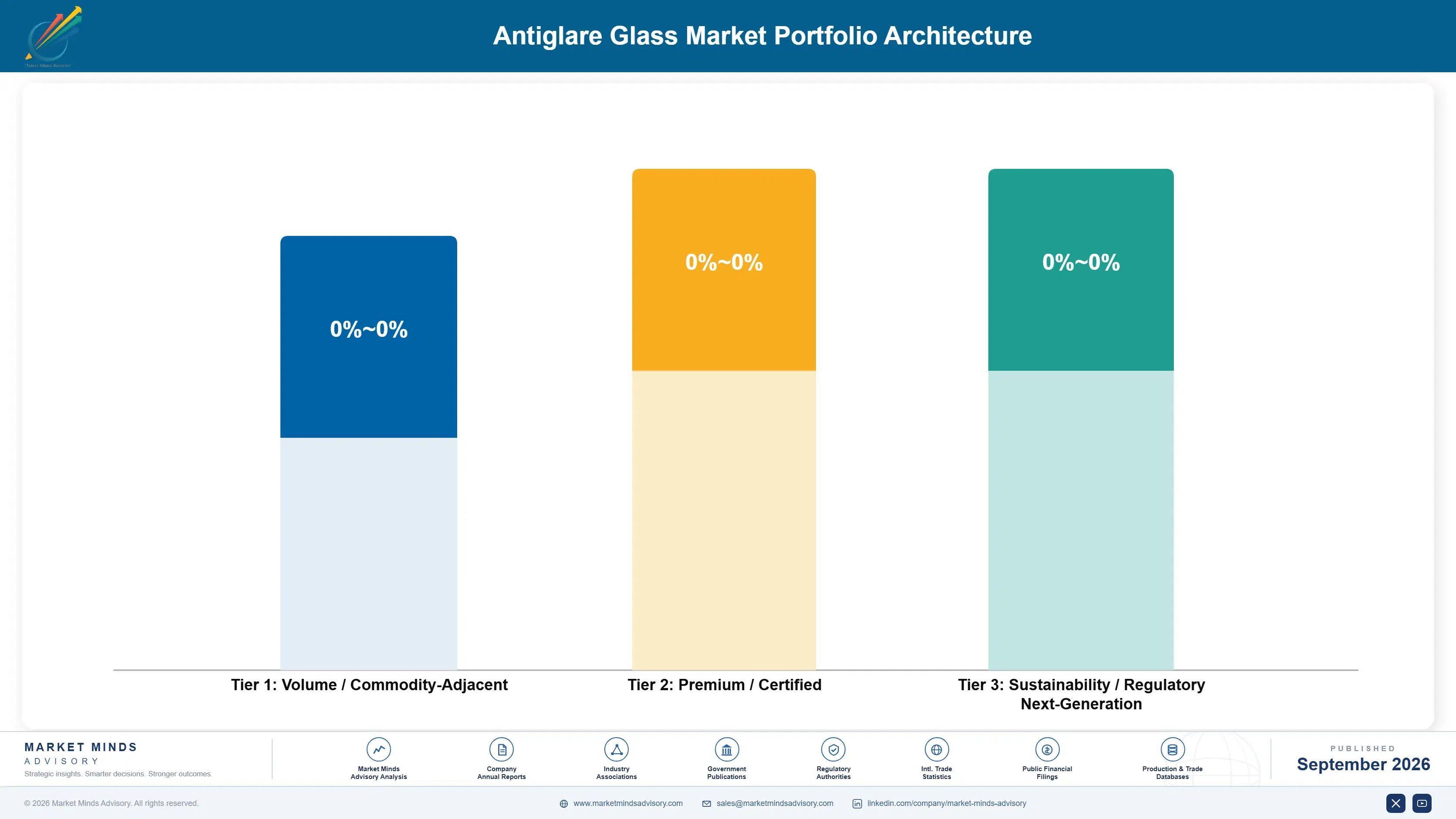
Antiglare glass margin architecture splits sharply across three tiers, with volume-oriented single-layer formats competing on price transparency while premium multi-layer and certified formulations command far wider margins on precision credibility and coating sophistication. The gap between the two ends of that spectrum keeps widening as informed device makers pay up for combination coatings backed by published durability certification data. Retail scale compounds this widening gap further.
Volume and premium tiers pull supplier strategy in opposite directions. Mass component distributors reward catalog breadth and low price points, while specialty and technical device channels reward coating depth and precision credibility. Suppliers straddling both risk diluting the positioning that justifies their premium pricing, which is why most successful players commit clearly to one lane rather than spreading resources evenly across the spectrum.

The highest-value margin pools concentrate in multi-layer and certified clean-formulation coatings sold through specialty and direct device maker channels, where suppliers control pricing and capture full margin rather than sharing it with distributor intermediaries. Sustainability and traceability-driven reformulation is smaller today but growing fastest as durability certification becomes a genuine purchase driver rather than a niche preference. Cooperative relationships increasingly participate in this margin pool by supplying documented traceable material.

Volume / Commodity-Adjacent

Basic single-layer antiglare coatings sold through bulk component distribution channels on price transparency rather than formulation sophistication or claims. Shelf placement and price promotion drive most purchase decisions in this tier.
Gross Margin: 18 to 26 percent

Premium / Certified

Multi-layer combination coatings with published durability certification data, sold through specialty device channels at meaningfully higher price points per panel. Device maker trust anchors pricing power here strongly. Retailers increasingly request this positioning.
Gross Margin: 36 to 46 percent

Sustainability / Regulatory / Next-Generation

Certified sustainable and low-emission coating formulations targeting environmentally-conscious and ingredient-transparency-focused device makers willing to pay a premium for verified credentials. Regulatory momentum favors continued expansion steadily. Adoption remains uneven across markets with differing consumer awareness levels.
Gross Margin: 32 to 42 percent
antiglare-glass-market-portfolio-architecture-1790019815037

High-value Sub-segments and Strategic Watch-out

Multi-Layer Nano-Coated Antiglare Glass

The fastest-growing and highest-value segment, combining multiple coating properties at premium price points backed by durability certification data that justifies sustained pricing power across most specialty device channels currently expanding. Manufacturers increasingly dedicate specialized production lines to this segment alone. Growth momentum here shows no sign of slowing soon.
Gross Margin: 40 to 50 percent

Automotive Precision Glazing Coatings

A large and steadily growing segment balancing optical clarity with clinical substantiation positioning, capturing meaningful specialty channel share at moderately premium price points across most regions served today. Crossover appeal to broader automotive formulators is expanding this segment's reach. Bundling drives incremental basket value across most device channels.
Gross Margin: 34 to 44 percent

Basic Single-Layer Antiglare Glass

The volume core of the category, sold at accessible price points through bulk component distribution, sustaining category awareness even as growth concentrates elsewhere in combination formats gaining specialty share. Retail promotional activity heavily influences purchasing timing in this tier. Scale efficiency remains the primary competitive differentiator here.
Gross Margin: 18 to 24 percent

Certified Next-Generation Sustainable Coatings

A strategic watch-out segment growing on sustainability demand and precision sourcing certification, currently small but positioned to gain share fastest as certification standards mature across major device markets worldwide. Early movers are building credibility with sustainability-conscious device buyers. Regulatory tailwinds should accelerate adoption over coming years.
Gross Margin: 28 to 38 percent

Contract Renewal and Retention Dynamics

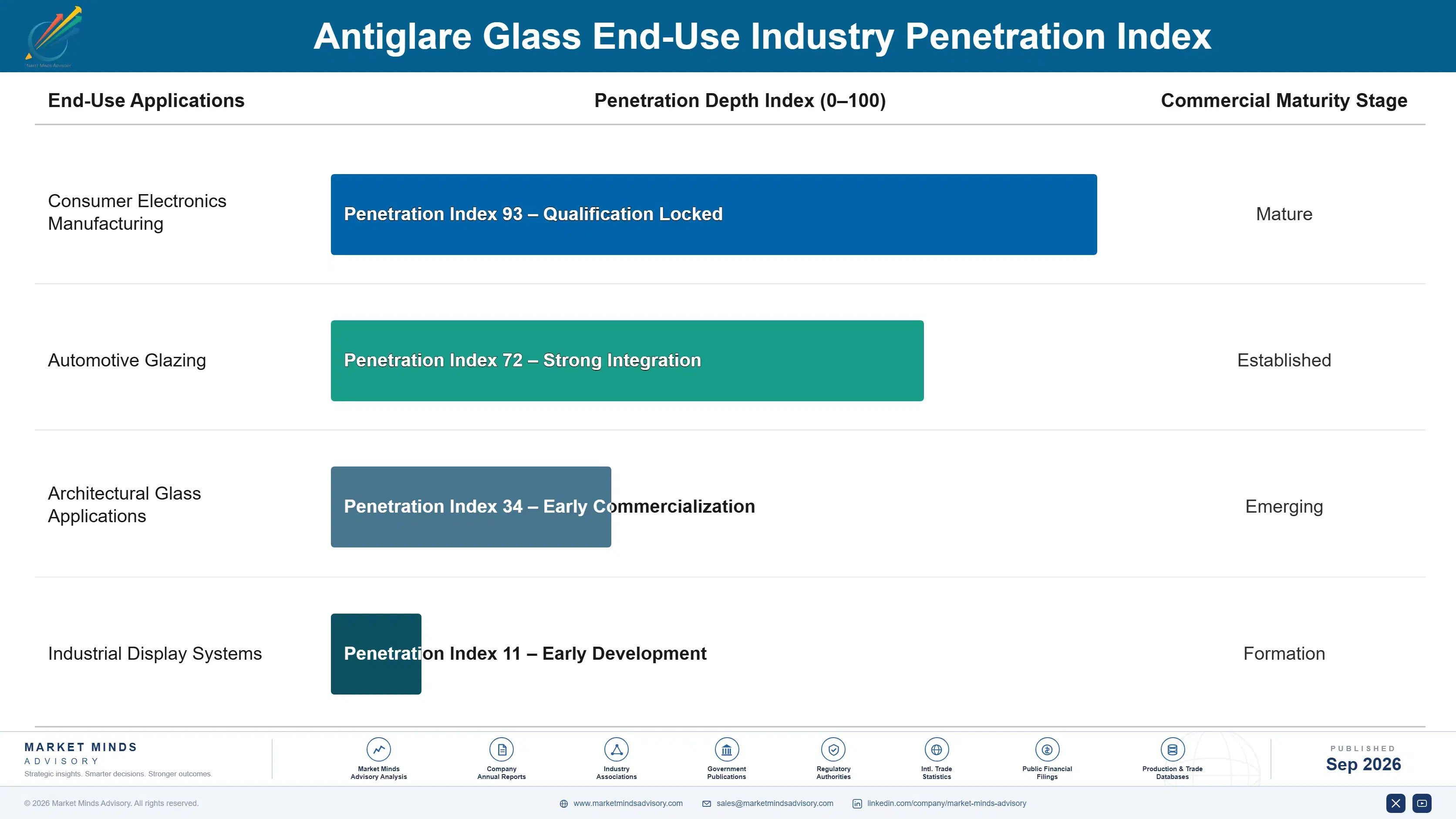
Antiglare glass behaves like an annuity relationship on the device manufacturer side of the business, since multi-year component supply contracts routinely renew based on continued qualification status and demonstrated coating reliability rather than competitive rebidding every cycle. Suppliers holding existing precision certification and established device maker relationships retain that revenue for years, and this dynamic is what makes certification investment and capacity reliability commercially durable across the sector.
Adoption depth varies meaningfully by end-use vertical. Consumer electronics and automotive procurement shows the deepest stickiness, anchored by certification requirements and established supplier qualification that new entrants struggle to match quickly. Architectural glazing buyers show shallower loyalty, often switching suppliers based on price and availability during periods of retail scarcity, though automotive manufacturers develop stronger brand preference tied to documented durability performance over repeated procurement cycles.

Generational buyer shifts are reshaping demand architecture. Younger procurement engineers increasingly research coating performance data and manufacturer reputation online before purchasing, a behavior far less common among earlier generations of buyers. Veteran component buyers still favor established reliable brands with long track records. Suppliers serving both cohorts need distinctly different marketing approaches rather than a single unified procurement strategy.
antiglare-glass-market-end-use-penetration-index-1790019815533

Where to Compete Next

These are among the four positions where our research anticipates prominent divergence between winners and laggards over the coming forecast period. Each is grounded in the demand model, the regulatory perimeter, and the announced capacity pipeline.
01 / MULTI-LAYER COATING PRIORITY

Prioritize multi-layer coating capability over standard volume expansion

Multi-layer nano-coated antiglare glass is growing at roughly 10.5 percent annually, well above the overall category rate, and device makers increasingly steer procurement toward suppliers offering multi-property coatings rather than basic single-layer treatments alone. Suppliers still organized purely around single-layer coating are losing bid volume to competitors offering combination durability and clarity under one roof. The window to build combined capability before procurement patterns solidify around integrated suppliers is closing within roughly three years across most major device procurement categories tracked.
02 / CERTIFICATION INVESTMENT FOCUS

Invest in durability certification ahead of competitors closing gap

Durability certification cost already limits meaningful market entry to well-capitalized specialty glass manufacturers, and further testing investment remains necessary given ongoing device maker skepticism around coating performance claims across the industry. Suppliers relying on unsubstantiated marketing claims face margin compression precisely when competitors with credible testing data can command premium pricing and durable long-term device maker trust. Investing in rigorous certification now, before smaller entrants close the credibility gap, costs far less than losing device maker relationships during an active competitive shift.
03 / GEOGRAPHIC EXPANSION FOCUS

Build direct manufacturing partnerships in South Asia and Pacific early

South Asia and Pacific is growing near 9.0 percent, the fastest of any region, driven by expanding electronics manufacturing capacity and rising component investment across secondary application categories. Suppliers establishing direct manufacturing and distribution partnerships now will secure favorable positioning before regional incumbents and multinational challengers consolidate sourcing agreements across the broader region entirely. Waiting until the region matures further will mean entering against entrenched local relationships instead of building those relationships from the ground up entirely on their own.
04 / RETAIL CHANNEL STRATEGY

Commit to one pricing lane rather than straddling both

Suppliers attempting to serve both bulk commodity and specialty premium channels simultaneously dilute the positioning that justifies premium pricing in the first place across every major distribution relationship they maintain. The data shows successful players committing clearly to one lane, whether volume accessibility or premium substantiation, and building operational discipline around that choice consistently. Straddling both consumes marketing resources without building durable competitive advantage in either direction over the long run for either type of targeted buyer segment across most formulation markets.

Engagement Snapshot From the Field

A live engagement with an industry participant carrying material or product regulatory and market exposure ahead of a defining policy shift, showing how our research translates into a defensible multi-year portfolio strategy.
MARKET MINDS ADVISORY · CLIENT ENGAGEMENT SUMMARY
Antiglare Glass Producer Strategic Portfolio Review and Transition Roadmap 2026·Investment Scenario on Antiglare Glass Exposure Evaluation 2025-26
CLIENT PROFILE
A mid-sized independent specialty glass supplier generating roughly $52 million in annual revenue (client-reported, unverified by MMA), with a portfolio concentrated in single-layer antiglare coatings sold primarily through bulk distribution and limited direct device maker relationships. The client had built loyal repeat buyers over nearly a decade but had not meaningfully expanded its formulation lineup since launch.
STRATEGIC CHALLENGE
Management observed slowing repeat purchase rates and rising customer acquisition costs as competitors introduced multi-layer combination formulations at comparable price points. The client needed to decide whether to reformulate its core lineup toward combination coatings, launch a separate premium sub-line, or hold its existing positioning and compete primarily on price against faster-moving rivals entering the category.
MMA APPROACH
MMA conducted primary interviews with the client's device maker customers and a targeted survey panel to quantify willingness to pay for multi-layer formulations against the existing single-layer lineup. The engagement combined competitive teardown analysis of five direct rivals with margin modeling across three repositioning scenarios, benchmarked against category-wide multi-layer adoption data gathered through MMA's primary research dataset.
KEY FINDINGS
  1. Device maker survey data showed 52 percent of the client's existing customer base would trade up to a multi-layer formulation at a 18 percent price premium if certification data were provided (client-reported, unverified by MMA).
  2. Customer interviews revealed that two major device manufacturers were actively reducing purchase allocation for single-layer coatings in favor of combination formulations from competing suppliers.
  3. Margin modeling showed a phased reformulation strategy preserved existing customer relationships while capturing incremental premium revenue, outperforming a standalone premium sub-line launch on projected three-year returns.
  4. Competitive teardown identified a specific gap in automotive glazing combination positioning that no direct competitor had yet claimed within the client's core customer base.
CLIENT PROFILE
A mid-sized independent specialty glass supplier generating roughly $52 million in annual revenue (client-reported, unverified by MMA), with a portfolio concentrated in single-layer antiglare coatings sold primarily through bulk distribution and limited direct device maker relationships. The client had built loyal repeat buyers over nearly a decade but had not meaningfully expanded its formulation lineup since launch.
STRATEGIC CHALLENGE
Management observed slowing repeat purchase rates and rising customer acquisition costs as competitors introduced multi-layer combination formulations at comparable price points. The client needed to decide whether to reformulate its core lineup toward combination coatings, launch a separate premium sub-line, or hold its existing positioning and compete primarily on price against faster-moving rivals entering the category.
MMA APPROACH
MMA conducted primary interviews with the client's device maker customers and a targeted survey panel to quantify willingness to pay for multi-layer formulations against the existing single-layer lineup. The engagement combined competitive teardown analysis of five direct rivals with margin modeling across three repositioning scenarios, benchmarked against category-wide multi-layer adoption data gathered through MMA's primary research dataset.
KEY FINDINGS
  1. Device maker survey data showed 52 percent of the client's existing customer base would trade up to a multi-layer formulation at a 18 percent price premium if certification data were provided (client-reported, unverified by MMA).
  2. Customer interviews revealed that two major device manufacturers were actively reducing purchase allocation for single-layer coatings in favor of combination formulations from competing suppliers.
  3. Margin modeling showed a phased reformulation strategy preserved existing customer relationships while capturing incremental premium revenue, outperforming a standalone premium sub-line launch on projected three-year returns.
  4. Competitive teardown identified a specific gap in automotive glazing combination positioning that no direct competitor had yet claimed within the client's core customer base.
RECOMMENDED STRATEGY
Phase 1: Phase one: reformulate the core single-layer coating into an anti-reflective and scratch-resistant combination while retaining the existing product identity. for stronger positioning. Phase 2: Phase two: introduce an automotive-grade premium variant targeting the identified competitive gap, distributed at first through specialty device partners exclusively. Phase 3: Phase three: publish durability certification data across both reformulated products to support the price premium with device maker customers directly.
OUTCOME
Within twelve months of the phased rollout, the client reported repeat purchase rates recovering to prior levels and successfully securing expanded purchase allocation with one of the two device manufacturers previously reducing its orders (client-reported, unverified by MMA). The premium variant reached meaningful specialty channel distribution within its first year.

Frequently Asked Questions

Foundational context covering the market sizes, CAGR, scope, country, region and competition that inform every finding below. This section is provided to cover basics and most often pre-purchase conversations, answered from the MMA Primary Research Dataset.

What is the current size of the Antiglare Glass Market?

The global antiglare glass market was valued at $5.2 billion in 2025. Growth is driven by rising display resolution standards and multi-layer coating innovation worldwide.

How large will the Antiglare Glass Market be by 2036?

The market is projected to reach approximately $10.94 billion by 2036. This represents a 1.97 times expansion driven primarily by multi-layer adoption and durability certification.

What is the CAGR for the Antiglare Glass Market 2026 to 2036?

The market is forecast to grow at a 7.0 percent CAGR between 2026 and 2036. Bull and bear scenarios range from 5.7 to 8.3 percent depending on formulation adoption speed.

Which segment is growing fastest?

Multi-Layer Nano-Coated Antiglare Glass leads growth at a 10.5 percent CAGR, roughly 1.50 times the overall market rate. This reflects device maker demand for combination coatings over single-layer treatments.

Who are the major companies in the Antiglare Glass Market?

Leading players include Corning, AGC Inc, Nippon Electric Glass, Schott, and Gentex Corporation, spanning specialty glass and precision optics manufacturers. Together they hold roughly 42 percent combined market share.

Which country is growing fastest?

China leads country-level growth at a 9.5 percent CAGR. Expanding manufacturing capacity and certification investment are driving faster adoption than in most other global markets.

Report Segmentation Architecture

The full report scope spans multiple orthogonal segmentation dimensions, with cross-tabulated demand data provided for each dimension pair. Coverage extends further to regional breakdowns, trend trajectories, and the competitive detail needed to support segment-level decision-making.

By Primary Market Dimension

  • Multi-Layer Nano-Coated Antiglare Glass
  • Single-Layer Antiglare Glass
  • Automotive Precision Glazing Coatings
  • Certified Next-Generation Sustainable Coatings
  • Anti-Reflective Display Coatings
  • Oleophobic Protective Coatings

By End-Use Industry

  • Consumer Electronics Manufacturing
  • Automotive Glazing
  • Architectural Glass Applications
  • Industrial Display Systems

By Commercial Dimension

  • Direct Device Maker Sales
  • Bulk Component Distribution
  • Technical Formulation Support Services
  • Long-Term Supply Contract Distribution

By Region

  • North America
  • Western Europe
  • East Asia
  • South Asia and Pacific
  • Latin America
  • Middle East and Africa
  • Eastern Europe

Scope, Methodology, and Coverage

Every figure in this report is reproducible from documented input assumptions. The scope below maps the historical period, the forecast horizon, the segmentation dimensions, and the countries covered, alongside the underlying primary and qualitative methodology.
Historical Period
2020 to 2025
Forecast Period
2026 to 2036
Base Year
2025 (USD billions; MMA Primary Research Dataset, September 2026)
Market Definition
This report covers the global market for glass products treated with anti-reflective and anti-glare coatings used in consumer electronics displays, automotive glazing, and architectural applications. It excludes uncoated glass substrates sold without antiglare treatment application.
Quantitative Units
USD billions, market share percentages, CAGR percentages
Segmentation Dimensions
Coating type, end-use industry, commercial distribution channel, region
Regions Covered
North America, Western Europe, East Asia, South Asia and Pacific, Latin America, Middle East and Africa, Eastern Europe
Countries Covered
China, Japan, South Korea, United States, Canada, Germany, France, United Kingdom, India, Australia, Brazil, Mexico, Saudi Arabia, United Arab Emirates, Poland
Key Companies Profiled
Corning, AGC Inc, Nippon Electric Glass, Schott, Gentex Corporation, Saint-Gobain, Guardian Glass, Central Glass, CSG Holding, Fuyao Glass, Xinyi Glass, Vitro Architectural Glass, Sisecam, NSG Group, Taiwan Glass, Emerging Display Technologies, Chunghwa Picture Tubes, Kinko Optical, Zeiss Optics, Essilor International
Quantitative Methodology
Primary survey, n=3,800 respondents, Q4 2025, six countries; demand-side model with trade association cross-validation
Qualitative Methodology
47 expert interviews, Q4 2025; applied to validate demand model assumptions, identify emerging dynamics, and assess competitive positioning
Report Format
PDF and XLSX data workbook (Word format preview document)
Publisher
Market Minds Advisory
Report Code
MMA-2026-TEC-228
Published
September 2026
Contact
sales@marketmindsadvisory.com | www.marketmindsadvisory.com

Purchase the full Antiglare Glass Market Report (2026 to 2036).

This report delivers a comprehensive analysis of the global antiglare glass market and its evolving coating technology landscape. It covers product segmentation, regional demand patterns, and competitive dynamics across the full forecast period from 2026 through 2036 in careful detail. The analysis combines primary survey data from 3,800 respondents across six countries with 47 expert interviews to quantify formulation adoption trends and durability certification progress across the category. Analysts examine input cost exposure, margin architecture, and revenue lever strategy across bulk and specialty component channels.
Seven-region demand share and CAGR breakdown
Five to six segment competitive positioning analysis
Twenty-company competitive landscape and moat assessment
Input cost exposure and mitigation strategy review
Revenue growth lever and margin expansion playbook
Anonymized client engagement case study analysis

Built For The People Who Decide

From boardroom strategy to bench-side execution, this report is read cover-to-cover by leaders shaping the next decade of their industry, turning demand scenarios, market dynamics and valuation benchmarks into decisions.
CXOs/ Presidents/ VPs/ Managers
M&A and Corporate Development
Strategy Teams and R&D Heads
Procurement and Product Directors
Regulatory and Compliance Leaders
Investor Relations and Equity Analysts