Market Minds Advisory
Anti-Soiling Coating Market

Anti-Soiling Coating Market: The Buyer Is Not The One Who Benefits

The glass maker pays for the coating and the plant owner collects the yield, which is why a technology with a clear economic case has taken far longer to adopt than anybody expected.

Lead Analyst

Bilal Shaikh

Published

September 2026

Make Smarter Decisions with Customized Research Insights

Request a free sample report and evaluate market opportunities, growth trends, and competitive dynamics relevant to your business needs.

2025 MARKET VALUE$0.9BMarket Size 2025
2036 FORECAST VALUE$3.4BBase Case , 2026 to 2036
CAGR 2026 TO 203612.8 %Bull 14.1% / Bear 11.5%
INCREMENTAL OPPORTUNITY$2.4BNet 10- year value creation
EXPANSION MULTIPLE3.33x2036 value over 2026 base
Strategic Levers
M&A Pipeline
Regional Outlook
Country Rankings
Competitive Intelligence
Segmental Deep-dive
Call-Us : 91 93563 13602

Executive Snapshot and Market Trajectory

Soiling costs a solar plant in the Gulf around 1.1% of output for every day it goes unwashed, and an anti-soiling coating that extends the cleaning interval is worth far more than it costs. The glass maker pays and the plant owner collects the benefit. Reputation damage here is collective.
Growth runs at 12.8% and dual-function chemistry leads it. Anti-reflective anti-soiling coatings grow at 19.2%, exactly 1.50 times the market rate, because a single layer delivering both properties resolves the incentive problem: module makers already buy anti-reflective coatings and the anti-soiling function arrives with them. Middle East and Africa holds 27%, far outside band, since soiling losses there are the highest anywhere. Penetration nonetheless sits at only 19%.
Concentration is moderate at 44% across the top five measured on coated glass area supplied, and access to glass coating lines rather than chemistry holds it. Coated glass penetration sits at only 19%, and the binding constraint is durability: a coating lasting four years on a module designed for decades leaves most of that life uncoated. Owners who saw that outcome are the hardest customers this category has. Field disappointments travel fast here.
Market Definition
This market covers anti-soiling coatings applied to glass and transparent surfaces to reduce dust and dirt adhesion, spanning hydrophobic silane and fluoropolymer coatings, hydrophilic photocatalytic coatings, nanostructured sol-gel coatings, anti-reflective anti-soiling dual-function coatings, and polymer film and laminate systems. Anti-reflective coatings without anti-soiling function, self-cleaning architectural glass sold as finished product, module cleaning robots and services, water treatment for panel washing, and anti-fouling coatings for marine or industrial surfaces fall outside scope.
Base Year Value
$0.9B in 2025 (MMA Primary Research Dataset, August 2026)
Forecast Period
2026 to 2036, eleven discrete annual values
CAGR
12.8% base case. Bull 14.1%. Bear 11.5%.
Fastest Growth Segment
Anti-Reflective Anti-Soiling Dual-Function Coatings: 19.2% CAGR
Fastest Growth Country
Saudi Arabia: 16.2% CAGR
Fastest Growth Region
South Asia and Pacific: 14.9% CAGR
Largest Region
Middle East and Africa: 27% of 2025 global value
Market Leaders
3M, PPG Industries, Fenzi Group, Nippon Sheet Glass, Sunarc Technology. Source: MMA Analysis based on company annual reports.
Primary Survey
n=3,800 procurement and R&D decision-makers, Q4 2025, six countries
Methodology
Demand-side build-up, cross-validated against public data, 47 expert interviews

Anti-Soiling Coating Market Forecast Scenarios

anti-soiling-coating-market-size-size-forecast-scenario-1787302366755
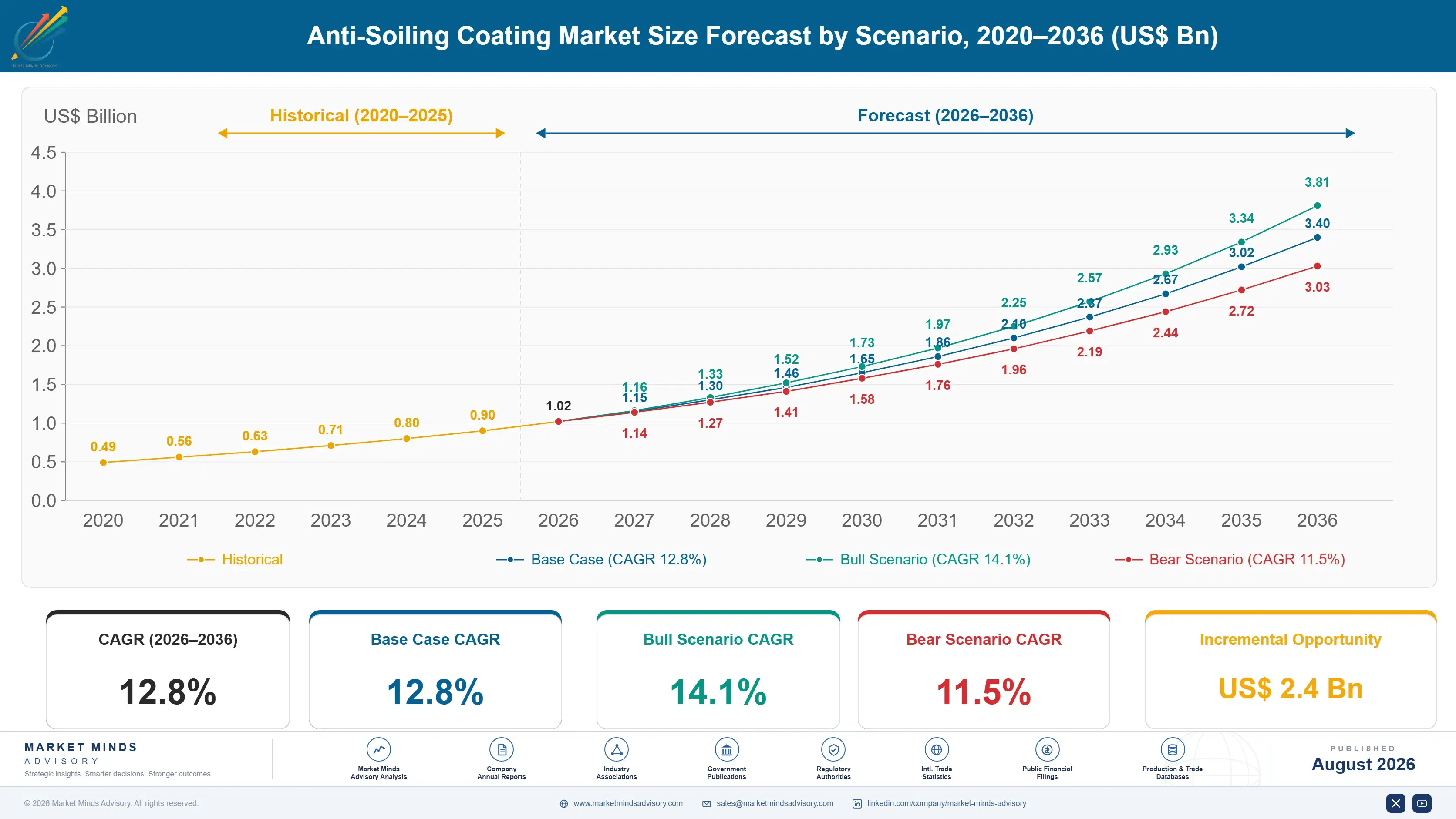
The 2020 to 2025 period ran at 11.4% and adoption was slower than the economics alone predicted throughout it. Early coatings degraded faster than claimed under real desert conditions, and several large plant owners recorded disappointing field results that set the category back across the whole region. Dual-function anti-reflective products changed the commercial picture from 2023, since module
Three mechanisms carry the 12.8% base case. Utility scale solar in high-soiling regions is the largest, since Gulf, North African, and Indian plants lose output daily at rates that make any cleaning interval extension valuable. Dual-function coating adoption is the second, at 19.2%. And water scarcity is the third, because panel washing in arid regions consumes water that is expensive or genuinely unavailable. None of the three depends on module pricing or on policy.
The 14.1% bull case rests on coating durability reaching module design life, which would let plant owners specify coated glass in procurement rather than accepting whatever the module maker chose. The 11.5% bear case is another round of field disappointment in a flagship project, since this category's adoption history shows how quickly poor results travel between plant owners in a small industry.

Split Incentives And Short Lifetimes

The economics look obvious and the adoption has not been. A plant in the Gulf loses around 1.1% of output for every day it goes unwashed, and a coating that extends the cleaning interval by a factor of 2.4 is worth many times the 0.6% of module cost it represents. Coated glass penetration nonetheless sits at only 19%. None of that depends on module pricing or on any policy change.
TOP FIVE CONCENTRATION44%Moderate, following glass coating line access rather than chemistry ownership
DAILY SOILING LOSS1.1%Of output lost per unwashed day in the dustiest regions
COATING SERVICE LIFE4 yearsAgainst a module design life measured in decades instead
CLEANING INTERVAL EXTENSION2.4 timesLonger between washes where coatings perform as specified
COATING COST SHARE0.6%Of finished module cost, borne entirely by the manufacturer
COATED GLASS PENETRATION19%Of solar glass produced carrying any anti-soiling treatment today
Two things explain that gap. The first is who pays: the coating is applied at the glass plant and charged to the module maker, while the yield and the reduced washing cost accrue to a plant owner several transactions downstream who never specified it. The second is durability, and it is the more serious of the two by a wide margin.
Coatings serve around four years against modules designed to run for decades, so a plant coated at construction spends most of its life uncoated and washing on the original schedule anyway. Several large owners recorded exactly that outcome and the category's reputation suffered accordingly. Dual-function anti-reflective products are gaining ground partly because module makers buy that layer regardless. That decision is taken for reasons unrelated to soiling entirely.
"The coating works. Everybody who has tested one agrees it works. What nobody wants to say out loud is that it stops working in year four, and the plant has another twenty-one years to run after that."
Director, Functional Coatings and Solar Materials Practice · MMA Chemicals and F

Market Trends

Dual-Function Coatings Resolve The Payment Problem

Anti-reflective anti-soiling coatings grow at 19.2% against 12.8% for the market because module makers already purchase an anti-reflective layer for transmission reasons, and combining functions puts the anti-soiling property into a purchase decision that was happening anyway. That sidesteps the split incentive entirely rather than solving it. Formulating both properties into one durable layer is genuinely difficult, and the products that manage it price well above single-function alternatives. Porosity that helps transmission also tends to trap dust, which is exactly the tension to resolve. Few suppliers have managed it. Those who have price accordingly.
Market Impact: Output falls 1.1% per day
Water Scarcity Changes The Cleaning Cost Calculation

Panel washing in arid regions consumes demineralised water that is expensive to produce and in some locations genuinely constrained, which adds a cost to cleaning that goes beyond labour and equipment. Where coatings extend intervals by around 2.4 times, that saving compounds across a plant's whole operating life. Owners in water-stressed regions now evaluate coatings against water procurement rather than against washing labour, which changes the arithmetic considerably. Demineralised water in the Atacama is trucked to site at real cost per load. Gulf plants produce it and pay for the energy. Neither cost appears in a yield model.
Market Impact: Coating is 0.6% of cost

Market Opportunities and Growth Drivers

Soiling Losses In Arid Regions Are Severe And Daily

Output falls by roughly 1.1% for every unwashed day at plants across the Gulf, North Africa, and parts of India, and dust events can remove considerably more in a single afternoon. Those losses accumulate against a fixed revenue expectation set at financial close, which makes them a direct hit to project returns. Any technology extending cleaning intervals addresses a cost that plant owners in those regions already track daily. Dust events can remove considerably more output in a single afternoon than a normal week accumulates. Owners in those regions track soiling daily. Nobody has to be persuaded it matters.
Market Impact: Coatings last about 4 years

Coating Cost Is Trivial Against The Benefit Available

An anti-soiling coating represents around 0.6% of finished module cost while addressing losses that run at percentage points of annual output in soiled conditions. No reasonable analysis makes the coating expensive. That asymmetry is why the category keeps attracting entrants despite its adoption difficulties, and why the real obstacles are durability and payment structure rather than anything resembling a price objection. That asymmetry is why the category keeps attracting entrants despite its adoption difficulties. The obstacles are durability and payment structure. Price has never been one of them. Nobody argues about the cost.
Market Impact: Penetration sits at only 19%

Market Restraints and Challenges

Coating Life Falls Far Short Of Module Life

Coatings serve around four years against modules designed to operate for decades, and the root cause is that abrasion from wind-blown dust and repeated mechanical washing removes the functional layer faster than any laboratory weathering test predicted. Commercial impact is that plants revert to original washing schedules while owners still carry the disappointment. Mitigation runs through harder sol-gel and nanostructured chemistries, recoating services applied in the field, and honest specification of expected life at the outset. Accelerated weathering has consistently overstated field life, which is how the disappointments happened. Honest specification would have cost less than the reputational damage did.
Market Impact: Dual-function grows at 19.2%

The Buyer And The Beneficiary Are Different Parties

Coating is applied at the glass plant and charged to the module manufacturer, while the yield gain and washing saving reach a plant owner several transactions downstream, and the root cause is simply where in the supply chain the process step sits. Commercial impact is that penetration stays at 19% despite compelling economics. Mitigation runs through dual-function products module makers buy anyway, owner-specified procurement, and coating applied after module assembly. Owners who write coated glass into procurement documents change the incentive at its source. Very few coating suppliers approach them at all. Most sell only through glass lines.
Market Impact: Intervals extend around 2.4 times
4 additional market trends, 3 additional growth drivers, and 2 additional restraints and challenges are covered in the full report. Contact sales@marketmindsadvisory.com to access the complete intelligence.

Segment CAGR and Growth Architecture

Segmentation follows coating chemistry and the surface mechanism it uses, because that determines durability, application route, optical effect, and which manufacturing step the coating belongs to. Application surface and climate zone both cut across every chemistry rather than separating them, which makes either a weaker primary dimension here. Chemistry decides which line applies it. Nothing else does.
anti-soiling-coating-market-size-market-share-analysis-1787302367286

Anti-Reflective Anti-Soiling Dual-Function Coatings

The fastest chemistry at 19.2%, exactly 1.50 times the market rate, delivering transmission gain and reduced dust adhesion from a single applied layer. Growth comes from commercial structure rather than technical superiority: module makers already buy anti-reflective coatings for transmission reasons, so the anti-soiling function arrives inside a purchase that was happening regardless. Formulating both properties into one durable layer is genuinely difficult, since the porosity that helps transmission tends to trap dust. Products that resolve that tension price well above single-function alternatives and few suppliers offer them. Module makers taking this layer are not making an anti-soiling decision at all, which is precisely why it works. Nobody has to justify a new line item.
CAGR 19.2%

Nanostructured Sol-Gel Coatings

Second fastest at 15.6%, using engineered surface texture rather than surface energy alone to reduce the contact area dust can adhere to. Durability is better than silane and fluoropolymer chemistries because the effect comes from structure rather than from a molecular layer that abrades away, which addresses the category's central weakness directly. Application requires controlled deposition on the glass line rather than spray application, which restricts it to glass makers with the right equipment. That restriction is also what protects the pricing. Glass makers without the deposition equipment cannot apply these coatings at all, whatever the chemistry costs. That constraint shapes formulation choices heavily. Chemists rarely welcome it. Pricing reflects that gate.
CAGR 15.6%
Full segment breakdown across 5 segments available in the complete report.

Regional Architecture and Country Demand Map

Middle East and Africa leads at 27%, far outside band, because soiling losses across the Gulf and North Africa are the highest anywhere and water for washing is scarce. Saudi Arabia grows fastest. Four regional shares sit outside their framework bands. Dust loading and rainfall explain every one.

Middle East and Africa

Twenty-seven percent, far outside the framework band, and justified because Gulf and North African plants lose roughly 1.1% of output per unwashed day, the highest soiling rates of any major solar region. Water for panel washing is expensive to produce and in places genuinely constrained, which adds a second cost that coatings address simultaneously. Saudi and Emirati utility scale projects specify coated glass more often than owners anywhere else. Growth at 13.0% sits near the market rate, tracking a build programme that is already large. Field durability disappointments were also recorded here first, since desert abrasion removes coatings faster than any other environment tested. The region taught the category both lessons.
Share: 27% | CAGR: 13.0% (2026 to 2036)

East Asia

Twenty-four percent, and Chinese solar glass production rather than Chinese plant operation accounts for most of it, since almost all coated glass anywhere originates on Chinese coating lines. Domestic plants in the northwest face real soiling from dust and industrial particulates, though less severe than Gulf conditions. Glass makers here decide what coating goes onto most of the world's modules. Growth at 13.7% runs above the market rate on domestic deployment and export module production together. Glass makers here have begun developing anti-soiling formulations internally, which puts external suppliers in an awkward position given who owns the coating lines. Integration is most attractive at these volumes. That pressure is only increasing.
Share: 24% | CAGR: 13.7% (2026 to 2036)
Regional intelligence for 5 additional markets available in the complete report: South Asia and Pacific, North America, Western Europe, Latin America, Eastern Europe. Contact sales@marketmindsadvisory.com.
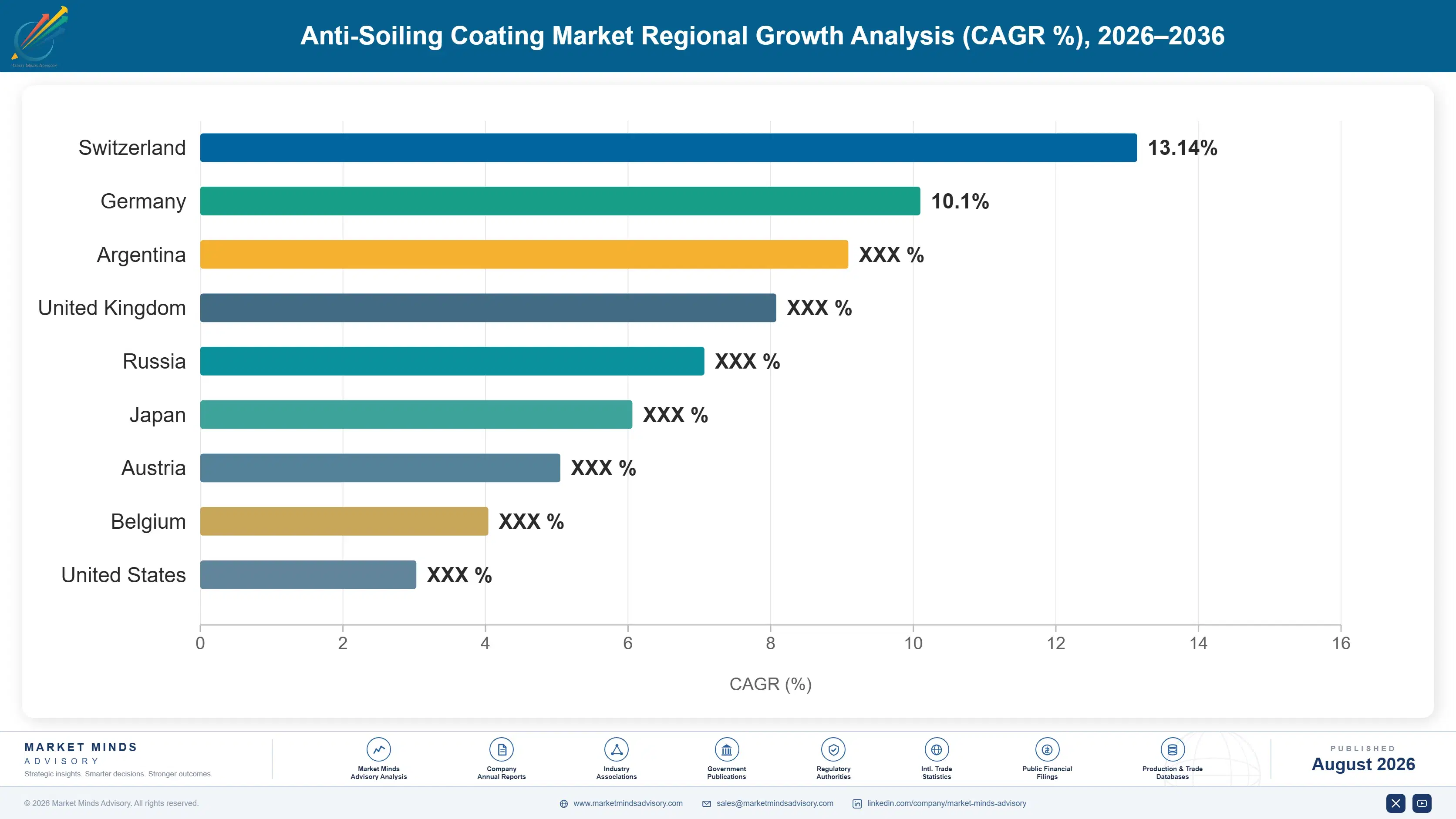
anti-soiling-coating-market-size-country-cagr-analysis-1787302367802

Durability, Dual Function And Specification

Coatings last four years against decades of module life, penetration sits at 19%, coating is 0.6% of module cost, and dual-function products grow at 19.2%. Value comes from durability, from riding purchases module makers already make, and from reaching plant owners directly. Price has never been the obstacle. Durability and structure decide everything. Nothing else does.

Solve Durability Before Solving Anything Else

Coatings serve around four years against modules designed for decades, which means a plant coated at construction spends most of its operating life uncoated and washing on the original schedule. Owners who experienced that outcome are the hardest customers this category has. Every other commercial problem here is secondary, since a coating that lasted the module's life would sell itself into procurement specifications without any of the current persuasion. Coatings serving 4 years against decades of module life leave most of that life uncoated entirely. Accelerated weathering keeps overstating field durability. Only outdoor exposure answers the question.
Market Impact: Coatings currently last for only ab

Attach To Purchases Module Makers Already Make

Anti-reflective coatings are bought by module manufacturers for transmission reasons regardless of soiling, and combining anti-soiling into that layer puts the function inside a decision already being taken. Dual-function products grow at 19.2% against 12.8% for the market as a direct result. That sidesteps the split incentive rather than resolving it, and sidestepping has worked considerably better than a decade of arguing about who should pay. Formulating both properties into one durable layer is genuinely hard, since transmission porosity traps dust. Few suppliers manage it. Those that do price well above alternatives.
Market Impact: Dual-function coatings are now grow

Sell To Plant Owners, Not Only To Glass Makers

The coating is applied at the glass plant and paid for by the module maker while the yield and washing savings reach a plant owner several transactions away, which is why penetration sits at only 19% despite economics nobody disputes. Owners who specify coated glass in procurement documents change the incentive at its source. Reaching them requires a commercial effort that coating suppliers selling through glass lines rarely make. Owners specifying coated glass in procurement change the incentive at the only point where it can change. Two of the three owners we surveyed had never been approached.
Market Impact: Coated glass penetration still sits

Quantify Against Water Cost In Arid Projects

Panel washing in the Gulf, Atacama, and northwest India consumes demineralised water that is expensive to produce and sometimes trucked in, so extending intervals by around 2.4 times saves a procurement line rather than merely labour hours. Owners in water-stressed locations respond to that argument in a way they do not respond to yield modelling. Very few suppliers frame the value that way, and it is the strongest case available. Coating cost at 0.6% of module value is trivial against a water procurement line in either location. Owners respond to that comparison. They do not respond to yield modelling.
Market Impact: Cleaning intervals extend around 2.

Who Controls the Margin Pool

Concentration is moderate at 44% across the top five measured on coated glass area supplied, and access to glass coating lines rather than proprietary chemistry holds it there. A coating has to be applied during glass production on equipment the coating supplier does not own, so the commercial position runs through relationships with a small number of solar glass makers. The leader
Competitive activity runs on three fronts. Durability is the first and the one that decides the category's future, since a coating outlasting the module would remove every other obstacle at once. Dual-function formulation capability is the second, where the growth and the pricing both sit. And glass line access is the third, which determines whether a good chemistry ever reaches a module at all.

Pressure arrives from two directions. Solar glass makers have begun developing coatings in house rather than buying them. And robotic dry cleaning systems compete for the same problem with a different answer. Rankings shift on field durability results rather than on laboratory data. Neither pressure has settled which chemistry wins, since durability data across multiple climates takes years to accumulate and nobody has enough of it yet.
anti-soiling-coating-market-size-company-positioning-matrix-1787302368323

Competitive Moat and Risk Dimensions

3M

Moat: Surface chemistry breadth and validation

Deep surface and fluorochemistry capability supports formulation work across hydrophobic, structured, and dual-function approaches rather than committing to one mechanism, which matters in a category where the winning chemistry is not yet settled. Field validation programmes across multiple climates produce durability data that laboratory testing has repeatedly failed to predict. Both take years rather than capital.
3M

Risk: Glass makers developing coatings internally

Solar glass producers have begun formulating anti-soiling layers in house, and they own the coating lines that any external supplier must reach through them. Integration is most attractive at exactly the volumes that matter commercially. That pressure grows as glass makers consolidate and their technical capability improves year on year.
PPG INDUSTRIES

Moat: Glass coating line relationships

Established positions supplying coatings applied on glass production lines give access that a chemistry developer without those relationships simply does not have, since the coating cannot reach a module any other way. Those relationships were built over decades across architectural and automotive glass before solar mattered. Replicating them requires a history rather than a product.
PPG INDUSTRIES

Risk: Durability results shaping category reputation

Field disappointments at large plants have travelled quickly between owners in a small industry and set the whole category back regardless of which supplier's product was involved. A coating rated for four years against a decades-long module life invites that outcome repeatedly. Reputation damage is collective here rather than confined to the supplier responsible.

Players Tracked

Prominent Players

3M
PPG Industries
Fenzi Group
Nippon Sheet Glass
Sunarc Technology

Other Key Players

Saint-Gobain
AGC
Guardian Glass
Xinyi Solar
Flat Glass Group
Almaden
Borosil Renewables
Kimoto
Toray Industries
Nitto Denko
Evonik
Wacker Chemie
Shin-Etsu Chemical
AkzoNobel
Sika

Recent Developments

JANUARY 2025

Plant owner specifies coated glass in procurement documents

A Gulf utility scale developer required anti-soiling coated glass in its module procurement specification rather than accepting whatever coating the manufacturer had chosen, moving the decision to the party that collects the benefit. The requirement was a procurement specification rather than any supply agreement or partnership.
Signal: Owner specification moves the coating deci
APRIL 2025

Solar glass producer develops anti-soiling layer internally

A large solar glass manufacturer began applying an internally developed anti-soiling formulation on its own coating lines rather than purchasing chemistry from an external supplier for that function. The move was internal capability development rather than any licensing arrangement, acquisition, or joint venture with a coatings company.
Signal: Glass makers own the application step and
AUGUST 2025

Field study reports coating performance decline after four years

A multi-site field study of coated modules recorded substantial loss of anti-soiling performance beyond four years of desert exposure, considerably earlier than accelerated laboratory weathering had projected for the same products. The study was independent technical research rather than any regulatory action or commercial dispute.
Signal: Laboratory weathering keeps failing to pre

Silica Precursors, Solvents and Application

Coating cost divides between silane, siloxane, and metal oxide precursors at roughly 38%, solvents and carrier systems near 19%, application equipment amortisation and line integration around 16%, quality control and field validation programmes about 15%, and packaging, freight, and overhead the balance. Field validation is unusually heavy here because laboratory weathering has repeatedly failed to predict real durability, so suppliers carry multi-year outdoor programmes.
Silane and specialty silica precursor pricing rose sharply through 2022 as energy costs affected silicon metal and downstream derivatives, and several specialty chemical producers disclosed input cost pressure in filings covering that year, with IEA data tracking the underlying energy movement. Solvent costs moved alongside. Pass-through into a coating representing 0.6% of module cost was easier than in most chemical markets, since the absolute amounts involved are small.

The competitive disadvantage mechanism runs through validation capability rather than through raw material cost. Precursors cost broadly the same for every formulator, while a supplier without multi-year field data across several climates cannot answer the durability question that decides every serious purchase. Building that dataset takes years of outdoor exposure that no laboratory shortens, which is a barrier newer entrants consistently underestimate.
anti-soiling-coating-market-size-cost-volatility-analysis-1787302368518

Run field validation across multiple climates continuously

Laboratory weathering has repeatedly failed to predict real anti-soiling durability, and field validation carries roughly 15% of coating cost as a result. Continuous outdoor programmes across desert, coastal, and temperate sites produce the only data that answers a serious buyer's durability question. Suppliers who start validation when a customer asks are already several years behind competitors who never stopped.

Qualify alternate silane precursor sources during development

Silane and metal oxide precursors carry roughly 38% of coating cost and formulations qualified against a single supplier leave no response when that supplier reprices or has an outage. Qualifying alternates during formulation development costs testing time and avoids requalifying under pressure later. Coating performance is sensitive enough to precursor variation that this work genuinely cannot be rushed afterwards.

Integrate application into existing glass line equipment

Application equipment and line integration carry around 16% of delivered cost, and a coating requiring new deposition hardware faces a capital conversation with the glass maker before any chemistry discussion begins. Formulations compatible with equipment already installed on solar glass lines reach the market considerably faster. That compatibility constraint shapes formulation choices more than most chemists would prefer.

Portfolio Architecture for Margin Defence

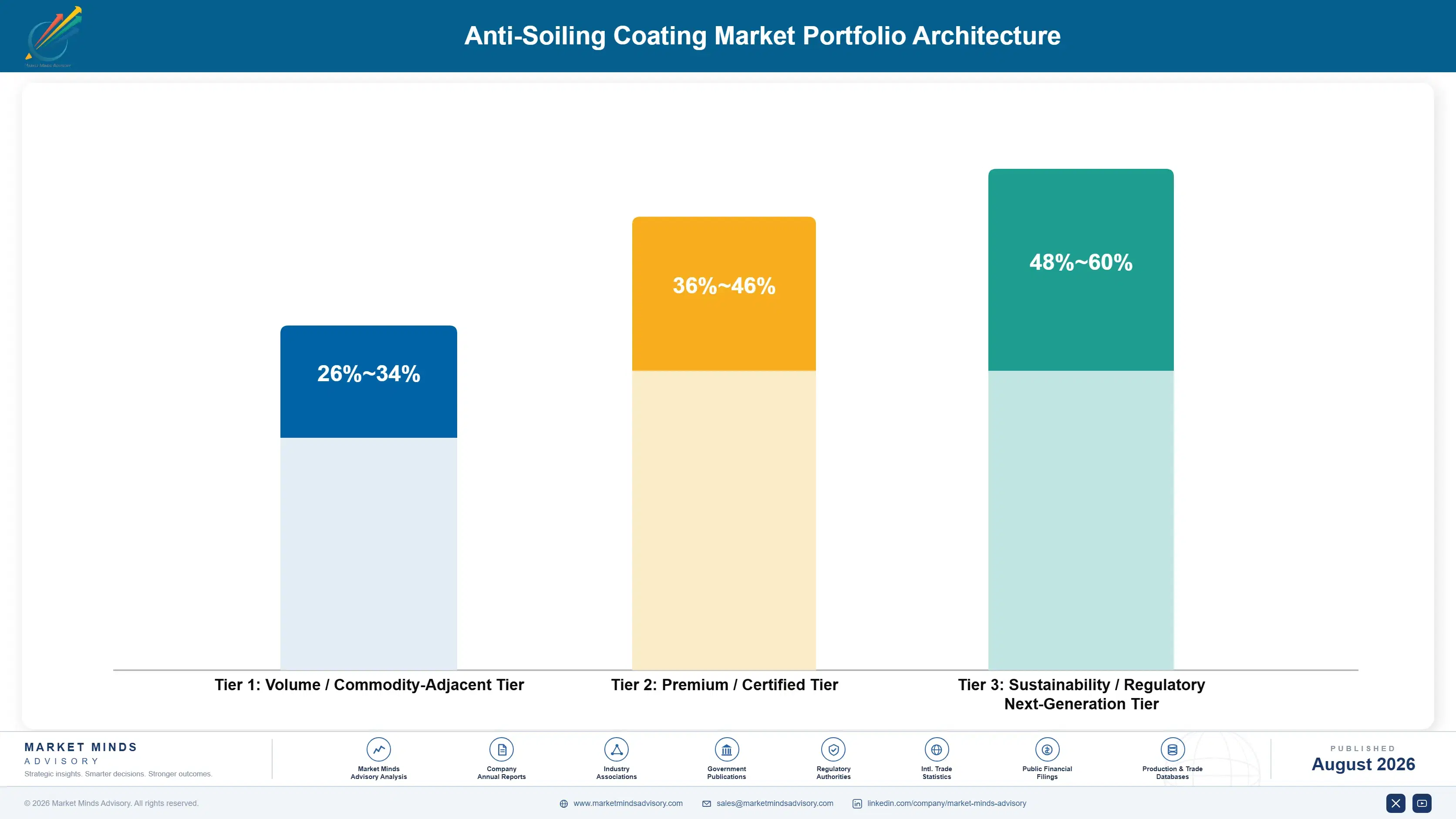
Three tiers describe this business and the spread follows durability and function count rather than volume. Single-function hydrophobic coatings sit at the bottom, where chemistry is well understood, several suppliers compete, and field life is shortest. Photocatalytic and standard sol-gel products occupy the middle. Dual-function and nanostructured coatings sit at the top, where formulation difficulty and application equipment requirements both restrict who can compete.
The tension is that the bottom tier is where most current volume sits and where the category's durability reputation was damaged, so a supplier weighted there carries the reputational cost of results it may not have produced. One weighted toward dual-function products depends on glass line access it does not own and on module makers whose purchasing decisions ignore the plant owner entirely.

High-value pools concentrate where the coating rides an existing purchase. Dual-function anti-reflective products are the clearest case, since the module maker was buying that layer regardless and the anti-soiling property arrives without needing anybody to justify a new line item at all. Nanostructured sol-gel products are the second such pool, protected by deposition equipment requirements rather than by any patent position. Neither pool competes on chemistry price.

Volume / Commodity-Adjacent Tier

Single-function hydrophobic silane and fluoropolymer coatings where chemistry is well understood and several suppliers compete. Shortest field life in the portfolio and the source of most reputational damage. Several suppliers compete on price here.
Gross Margin: 26-34%

Premium / Certified Tier

Photocatalytic and standard sol-gel coatings offering better durability through surface structure rather than molecular layers alone. Application requires controlled deposition equipment on the glass line itself. Equipment access restricts who can supply it at all.
Gross Margin: 36-46%

Sustainability / Regulatory / Next-Generation Tier

Dual-function anti-reflective anti-soiling and advanced nanostructured coatings where formulation difficulty restricts supply severely. Best margin available and the fastest growth anywhere in this category. Few suppliers formulate both properties into one layer successfully.
Gross Margin: 48-60%
anti-soiling-coating-market-size-portfolio-architecture-1787302369019

Glass Lines, Modules and Owners

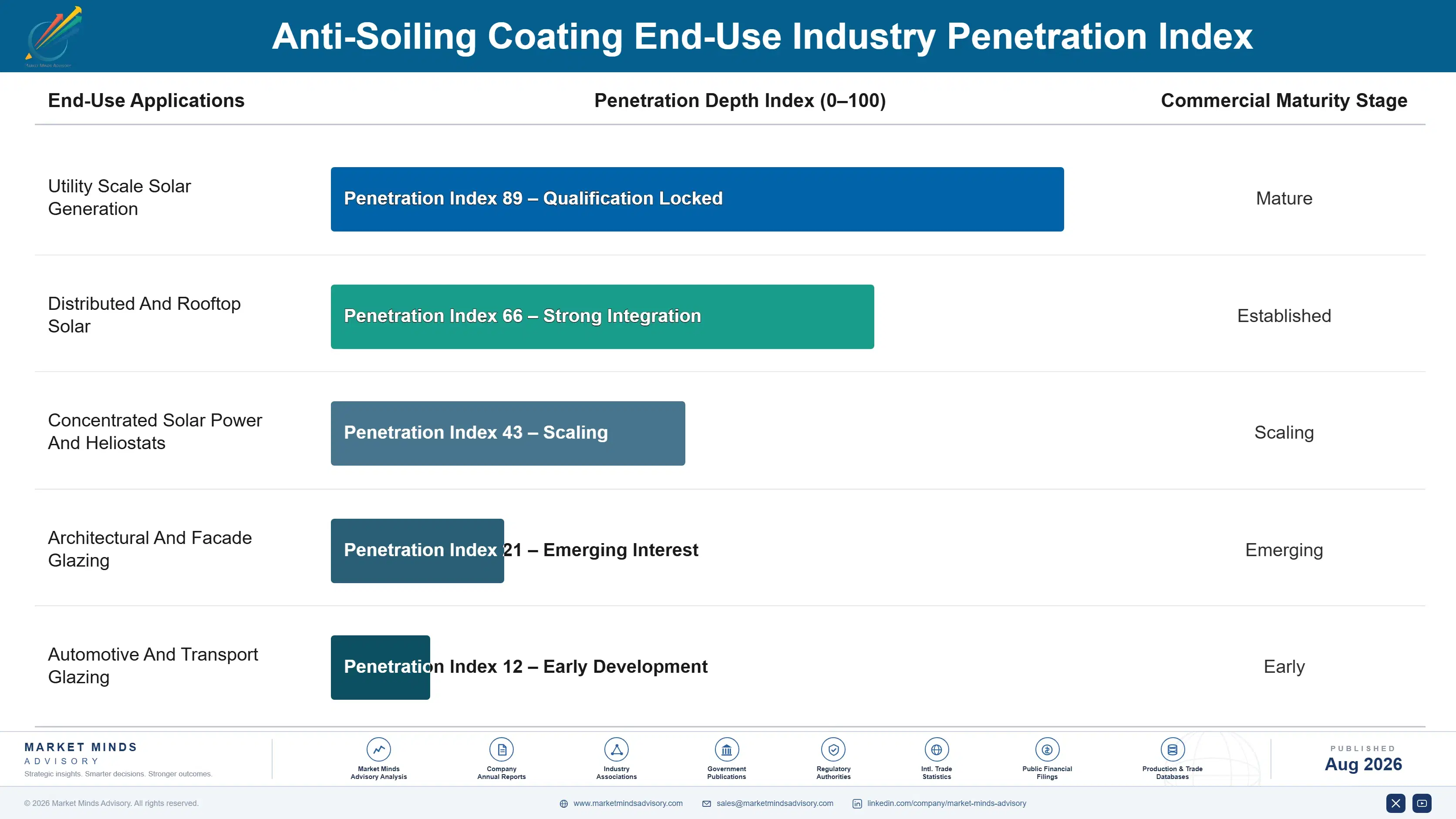
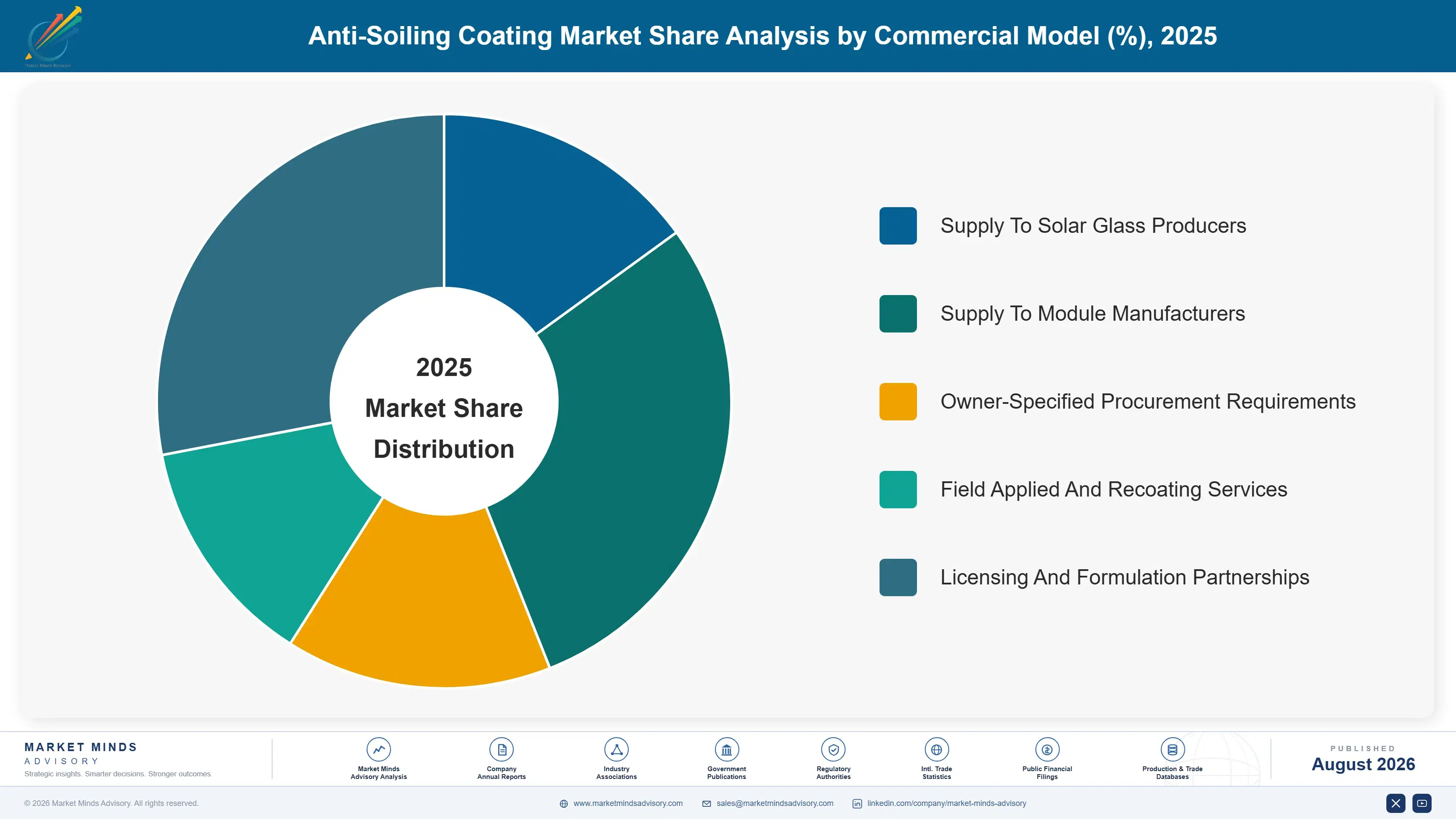
Demand reaches suppliers through solar glass producers rather than through the plant owners who benefit, which is the defining feature of this market and the source of most of its difficulty. A coating specified by a glass maker ships against that maker's production volume with no further commercial activity, so the position is won once and held until the glass maker changes its formulation or develops one internally.
Stickiness runs through line qualification rather than through performance. A coating validated on a glass production line is embedded in process parameters, quality checks, and downstream module certification, which makes changing it a manufacturing project rather than a purchasing decision. Architectural glass applications stick similarly. Owner-specified coated glass is the loosest, since owners retender each project.

Buyer profiles are beginning to shift as owners intervene. The earlier conversation was entirely with a glass maker's process engineer evaluating a coating against line compatibility and cost. The current one increasingly includes a plant owner or independent engineer writing coating requirements into module procurement, which puts a party who actually collects the benefit into the decision for the first time.
anti-soiling-coating-market-size-end-use-penetration-index-1787302369506

What We Would Tell a Board

These are among the four positions where our research anticipates prominent divergence between winners and laggards over the coming forecast period. Each is grounded in the demand model, the regulatory perimeter, and the announced capacity pipeline.
01 / DURABILITY PROGRAMME PRIORITY

Nothing else matters until the coating lasts

Coatings serve around four years against modules designed to operate for decades, so a plant coated at construction spends most of its operating life uncoated and washing on its original schedule anyway. Owners who experienced exactly that outcome at scale are now the single hardest group of customers this whole category has to sell to anywhere. A coating that genuinely lasted the module's design life would enter owner procurement specifications on its own merits, without requiring any of the persuasion this category currently needs.
02 / PURCHASE ATTACHMENT STRATEGY

Ride a decision somebody is already making

Module manufacturers already buy anti-reflective coatings for transmission reasons entirely regardless of whether soiling matters to them at all, and combining anti-soiling into that same layer places the function inside a purchase already happening. Dual-function products grow at 19.2% against 12.8% for the wider market, and that is a direct consequence of commercial structure rather than of any technical superiority. Sidestepping the split incentive entirely has worked considerably better than the decade this industry spent arguing about which party in the chain ought to pay.
03 / OWNER SPECIFICATION PUSH

Sell to the party collecting the benefit

The coating is applied at the glass plant and charged to the module maker while the yield gain and washing saving reach a plant owner several transactions downstream who never specified it. Penetration sits at only 19% despite economics that nobody in the industry actually disputes anywhere. Owners writing coated glass into their procurement documents change the incentive at the only point where it can actually change, and reaching them takes commercial effort that suppliers selling through glass lines rarely make.
04 / WATER COST FRAMING

Frame value against water, not against yield

Panel washing across the Gulf, the Atacama, and northwest India consumes demineralised water that is expensive to produce and sometimes trucked to site at real cost per load. Extending cleaning intervals by around 2.4 times therefore removes an entire procurement line rather than merely reducing labour hours somewhere in an operations budget. Owners in water-stressed locations respond to that framing in a way they have simply never responded to any yield modelling a coating supplier has put in front of them.

Engagement Snapshot From the Field

A live engagement with an industry participant carrying material or product regulatory and market exposure ahead of a defining policy shift, showing how our research translates into a defensible multi-year portfolio strategy.
MARKET MINDS ADVISORY · CLIENT ENGAGEMENT SUMMARY
Anti-Soiling Coating Producer Strategic Portfolio Review and Transition Roadmap 2026·Investment Scenario on Anti-Soiling Coating Exposure Evaluation 2025-26
CLIENT PROFILE
A functional coatings developer with approximately 45 million dollars in annual revenue (client-reported, unverified by MMA), supplying single-function anti-soiling chemistry to two solar glass producers. Field durability data existed for one climate only, no dual-function product was in development, and volume had been flat for two years despite growing regional solar deployment. Neither glass customer had committed to a renewal.
STRATEGIC CHALLENGE
The board wanted to understand why volume was not following the solar build in the client's core markets, whether the durability criticism the category faced applied to its own product, and where commercial effort should be directed instead. Nobody internally had tested whether the category's durability criticism applied to the client's own chemistry.
MMA APPROACH
We assessed the client's field data against multi-climate exposure requirements that serious buyers apply. Glass maker relationships were reviewed for line access durability. Dual-function formulation options were scoped against the client's chemistry base, and plant owner procurement practices were surveyed across three regional markets. Glass maker internal programmes were then assessed for timing.
KEY FINDINGS
  1. The client held field data from a single temperate site, while every serious buyer in its target regions required desert exposure evidence the client could not produce at all.
  2. Both glass maker customers had internal formulation programmes underway, which put the client's entire volume base at risk within a few years rather than gradually.
  3. No dual-function capability existed, leaving the client absent from the segment growing at 19.2% and taking share from single-function products in its own markets.
  4. Two plant owners surveyed had begun specifying coated glass directly, and neither had ever been approached by any coating supplier including the client.
CLIENT PROFILE
A functional coatings developer with approximately 45 million dollars in annual revenue (client-reported, unverified by MMA), supplying single-function anti-soiling chemistry to two solar glass producers. Field durability data existed for one climate only, no dual-function product was in development, and volume had been flat for two years despite growing regional solar deployment. Neither glass customer had committed to a renewal.
STRATEGIC CHALLENGE
The board wanted to understand why volume was not following the solar build in the client's core markets, whether the durability criticism the category faced applied to its own product, and where commercial effort should be directed instead. Nobody internally had tested whether the category's durability criticism applied to the client's own chemistry.
MMA APPROACH
We assessed the client's field data against multi-climate exposure requirements that serious buyers apply. Glass maker relationships were reviewed for line access durability. Dual-function formulation options were scoped against the client's chemistry base, and plant owner procurement practices were surveyed across three regional markets. Glass maker internal programmes were then assessed for timing.
KEY FINDINGS
  1. The client held field data from a single temperate site, while every serious buyer in its target regions required desert exposure evidence the client could not produce at all.
  2. Both glass maker customers had internal formulation programmes underway, which put the client's entire volume base at risk within a few years rather than gradually.
  3. No dual-function capability existed, leaving the client absent from the segment growing at 19.2% and taking share from single-function products in its own markets.
  4. Two plant owners surveyed had begun specifying coated glass directly, and neither had ever been approached by any coating supplier including the client.
RECOMMENDED STRATEGY
Phase 1: Phase 1 (months one to twelve): establish desert and coastal field exposure sites immediately, treating validation as a standing programme rather than a project. Phase 2: Phase 2 (months twelve to thirty): develop dual-function anti-reflective capability, working with an anti-reflective formulator rather than building from scratch. Phase 3: Phase 3 (months thirty to fifty-four): open direct commercial contact with plant owners and independent engineers writing procurement specifications. Treat owners as a distinct channel.
OUTCOME
Two field exposure sites were commissioned within a quarter. A dual-function development partnership was signed with an anti-reflective coating formulator, and the client made its first direct approach to a utility scale developer's engineering team (client-reported, unverified by MMA). Both glass maker relationships were reassessed against their internal development timelines.

Frequently Asked Questions

Foundational context covering the market sizes, CAGR, scope, country, region and competition that inform every finding below. This section is provided to cover basics and most often pre-purchase conversations, answered from the MMA Primary Research Dataset.

What is the current size of the Anti-Soiling Coating Market?

The market is valued at USD 0.9 billion in 2025, rising to USD 1.02 billion in 2026. Scope covers anti-soiling coatings for glass and transparent surfaces, not cleaning robots, washing services, or anti-fouling coatings.

How large will the Anti-Soiling Coating Market be by 2036?

MMA forecasts USD 3.40 billion by 2036, an increase of USD 2.38 billion over the 2026 base. That represents an expansion multiple of 3.33 times across the forecast period.

What is the CAGR for the Anti-Soiling Coating Market 2026 to 2036?

The base case CAGR is 12.8%, with a bull case of 14.1% and a bear case of 11.5%. The historical rate from 2020 to 2025 was 11.4%, held back by field durability disappointments.

Which segment is growing fastest?

Anti-reflective anti-soiling dual-function coatings at 19.2%, exactly 1.50 times the market rate. Module makers already buy the anti-reflective layer, so the anti-soiling function arrives inside an existing purchase.

Who are the major companies in the Anti-Soiling Coating Market?

3M, PPG Industries, Fenzi Group, Nippon Sheet Glass, and Sunarc Technology lead on coated glass area supplied. The top five hold 44%, following access to glass coating lines.

Which country is growing fastest?

Saudi Arabia at 16.2%, where utility scale deployment meets the highest soiling rates anywhere and washing water is expensive to produce. Owners there specify coated glass more often than elsewhere.

Report Segmentation Architecture

The full report scope spans multiple orthogonal segmentation dimensions, with cross-tabulated demand data provided for each dimension pair. Coverage extends further to regional breakdowns, trend trajectories, and the competitive detail needed to support segment-level decision-making.

By Coating Chemistry And Mechanism

  • Hydrophobic Silane And Fluoropolymer Coatings
  • Hydrophilic Photocatalytic Coatings
  • Nanostructured Sol-Gel Coatings
  • Anti-Reflective Anti-Soiling Dual-Function Coatings
  • Polymer Film And Laminate Systems

By End-Use Industry

  • Utility Scale Solar Generation
  • Distributed And Rooftop Solar
  • Concentrated Solar Power And Heliostats
  • Architectural And Facade Glazing
  • Automotive And Transport Glazing

By Commercial Model

  • Supply To Solar Glass Producers
  • Supply To Module Manufacturers
  • Owner-Specified Procurement Requirements
  • Field Applied And Recoating Services
  • Licensing And Formulation Partnerships

By Region

  • Middle East and Africa
  • East Asia
  • South Asia and Pacific
  • North America
  • Western Europe
  • Latin America
  • Eastern Europe

Scope, Methodology, and Coverage

Every figure in this report is reproducible from documented input assumptions. The scope below maps the historical period, the forecast horizon, the segmentation dimensions, and the countries covered, alongside the underlying primary and qualitative methodology.
Historical Period
2020 to 2025
Forecast Period
2026 to 2036
Base Year
2025 (USD billions; MMA Primary Research Dataset, August 2026)
Market Definition
This market comprises anti-soiling coatings applied to glass and transparent surfaces to reduce dust and particulate adhesion, measured at coating supplier revenue across glass producer, module manufacturer, owner-specified, field application, and licensing channels. Coverage spans hydrophobic silane and fluoropolymer coatings, hydrophilic photocatalytic coatings, nanostructured sol-gel coatings, anti-reflective anti-soiling dual-function coatings, and polymer film and laminate systems. Anti-reflective coatings carrying no anti-soiling function, self-cleaning architectural glass sold as a finished glazing product, robotic and waterless module cleaning systems, panel washing services and the water treatment supporting them, anti-fouling coatings for marine, industrial or medical surfaces, and encapsulants and backsheet materials fall outside scope.
Quantitative Units
USD billions (current prices); coated glass area in square metres; price per square metre by chemistry; coated share of solar glass produced
Segmentation Dimensions
By Coating Chemistry And Mechanism; By End-Use Industry; By Commercial Model; By Region
Regions Covered
Middle East and Africa, East Asia, South Asia and Pacific, North America, Western Europe, Latin America, Eastern Europe
Countries Covered
Saudi Arabia, United Arab Emirates, Oman, Egypt, Morocco, South Africa, China, Japan, South Korea, India, Australia, Vietnam, United States, Mexico, Canada, Chile, Brazil, Spain, Italy, Greece, France, Germany, Poland, Romania, Bulgaria, and additional markets relevant to this sector
Key Companies Profiled
3M, PPG Industries, Fenzi Group, Nippon Sheet Glass, Sunarc Technology, Saint-Gobain, AGC, Guardian Glass, Xinyi Solar, Flat Glass Group, Almaden, Borosil Renewables, Kimoto, Toray Industries, Nitto Denko, Evonik, Wacker Chemie, Shin-Etsu Chemical, AkzoNobel, Sika
Quantitative Methodology
Primary survey, n=3,800 respondents, Q4 2025, six countries; demand-side model with trade association cross-validation
Qualitative Methodology
47 expert interviews, Q4 2025; applied to validate demand model assumptions, identify emerging dynamics, and assess competitive positioning
Report Format
PDF and XLSX data workbook (Word format preview document)
Publisher
Market Minds Advisory
Report Code
MMA-2026-CHM-847
Published
August 2026
Contact
sales@marketmindsadvisory.com | www.marketmindsadvisory.com

Purchase the full Anti-Soiling Coating Market Report (2026 to 2036).

The full report sizes anti-soiling coatings across five chemistries, five end-use industries, five commercial models, and seven regions, with field durability data assessed separately from laboratory weathering claims throughout. The split incentive between glass makers who pay and plant owners who benefit is quantified by supply chain step, since it explains penetration better than any cost analysis does. Soiling loss rates are mapped against regional dust loading and rainfall. Competitive profiling covers twenty participants on coated glass area, and dual-function capability is assessed separately from single-function chemistry.
Field durability data assessed separately from laboratory weathering claims
Split incentive quantified across each supply chain step involved
Soiling loss rates mapped against regional dust loading and rainfall
Dual-function capability assessed separately from single-function anti-soiling chemistry
Glass coating line access evaluated as a distinct commercial constraint
Washing water cost modelled against coating value

Built For The People Who Decide

From boardroom strategy to bench-side execution, this report is read cover-to-cover by leaders shaping the next decade of their industry, turning demand scenarios, market dynamics and valuation benchmarks into decisions.
CXOs/ Presidents/ VPs/ Managers
M&A and Corporate Development
Strategy Teams and R&D Heads
Procurement and Product Directors
Regulatory and Compliance Leaders
Investor Relations and Equity Analysts