Market Minds Advisory
Anti Scratch Film Market

Anti Scratch Film Market: Self-Healing Chemistry Redraws the Category

A commercial reading of anti scratch film, where self-healing polyurethane pulls automotive paint protection demand forward, nano-coating enables thinner display protection, and multi-layer recycling rules complicate composition choices considerably worldwide.

Lead Analyst

Bilal Shaikh

Published

September 2026

Make Smarter Decisions with Customized Research Insights

Request a free sample report and evaluate market opportunities, growth trends, and competitive dynamics relevant to your business needs.

2025 MARKET VALUE$3.2BMarket Size 2025
2036 FORECAST VALUE$6.6BBase Case , 2026 to 2036
CAGR 2026 TO 20366.8 %Bull 7.9% / Bear 5.4%
INCREMENTAL OPPORTUNITY$3.2BNet 10- year value creation
EXPANSION MULTIPLE1.93x2036 value over 2026 base
Strategic Levers
M&A Pipeline
Regional Outlook
Country Rankings
Competitive Intelligence
Segmental Deep-dive
Call-Us : 91 93563 13602

Executive Snapshot and Market Trajectory

A car buyer paying extra for paint protection film is really buying insurance against the first parking lot scratch, and that specific purchase decision, repeated across millions of new vehicle deliveries each year, has quietly become one of the category's largest growth engines industry-wide.
The market stands at USD 3.2 billion in 2025 and reaches USD 6.60 billion by 2036 at a 6.8% CAGR. Self-healing polyurethane films grow fastest at 10.5%, about 1.54 times the overall rate, pulled forward by expanding automotive paint protection film adoption among new vehicle buyers everywhere. East Asia holds 30% of value on concentrated electronics and display manufacturing, while China posts the fastest national growth at 8.5% on both electronics and automotive demand.
Concentration sits at a moderate 48% among the top five, led by 3M's material science breadth and Nitto Denko's optical film integration depth built over decades of trusted relationships. Two forces reshape the field now. Self-healing polyurethane films are expanding automotive paint protection adoption beyond luxury vehicles into mainstream segments, and nano-coating technology is enabling thinner, harder display protection films that foldable smartphone designs increasingly require industry-wide.
Market Definition
The anti scratch film market covers protective films engineered to resist surface abrasion, applied to electronic displays, automotive exteriors, optical lenses, and industrial surfaces, including hardcoated, nano-coated, and self-healing polymer film types. Standalone liquid coatings applied without a film substrate and permanent surface treatments are excluded.
Base Year Value
$3.2B in 2025 (MMA Primary Research Dataset, August 2026)
Forecast Period
2026 to 2036, eleven discrete annual values
CAGR
6.8% base case. Bull 7.9%. Bear 5.4%.
Fastest Growth Segment
Self-Healing Polyurethane Films: 10.5% CAGR
Fastest Growth Country
China: 8.5% CAGR
Fastest Growth Region
South Asia and Pacific: 8.8% CAGR
Largest Region
East Asia: 30% of 2025 global value
Market Leaders
3M, Nitto Denko, Saint-Gobain, Toray Industries, SKC. Source: MMA Analysis based on company annual reports and industry association data.
Primary Survey
n=3,800 procurement and R&D decision-makers, Q4 2025, six countries
Methodology
Demand-side build-up, cross-validated against public data, 47 expert interviews

Anti Scratch Film Market Forecast Scenarios

anti-scratch-film-market-size-forecast-scenario-1787325452166
Growth from 2020 to 2025 compounded near 6.0%, supported by steady smartphone display protection demand before accelerating from 2023 onward as automotive paint protection film adoption expanded considerably and foldable display shipments grew faster than the broader smartphone category overall, particularly across premium device tiers tracked closely by manufacturers and analysts throughout that period specifically.
Three mechanisms carry the base case to 6.8%. First, rising automotive paint protection film adoption, as new vehicle buyers increasingly specify self-healing film protection at the point of purchase across more mainstream brands. Second, foldable and flexible display growth, which requires thinner, more durable nano-coated films than rigid display generations ever needed previously. Third, industrial and optical applications, which sustain steady demand for hardcoated films across established manufacturing categories tracked.
The bull case at 7.9% assumes automotive paint protection film adoption spreads faster than current dealership attach rates suggest and foldable display shipments grow faster than current manufacturer roadmaps indicate across most major markets. The bear case at 5.4% assumes high cost of self-healing films continues limiting adoption in price-sensitive segments and recycling regulation keeps complicating multi-layer film composition choices industry-wide.

Why Paint Protection Film Became a Dealership Upsell

Three forces set demand. Electronics display protection provides the steadiest layer, since every smartphone, tablet, and increasingly foldable device requires scratch-resistant film at first fit or aftermarket application. Automotive paint protection film adoption adds a fast-growing second layer, as new vehicle buyers increasingly specify self-healing film protection at the point of purchase. Industrial and optical applications add a third layer, sustaining steady demand for hardcoated films a
MARKET CONCENTRATIONCR5: 48%Moderately fragmented behind a handful of material science leaders
AVERAGE SELLING PRICEUSD 2 to 18 per square meterVaries considerably by film technology and application surface type
TOP PRODUCING REGIONEast Asia: 30% of global valueReflects concentrated electronics and display manufacturing capacity regionally
AUTOMOTIVE PPF ATTACH RATERoughly 22% of new vehiclesRising steadily as dealership upsell programmes expand nationally
REPLACEMENT CYCLE LENGTH3 to 7 years typicalReflects durable film chemistry with periodic surface renewal
COGS FEEDSTOCK SHAREAbout 38 to 50%Reflects polymer resin and coating chemical input costs by grade
The commercial character rewards material science depth and application-specific engineering over price competition alone in premium segments. A buyer choosing between comparable films increasingly weighs scratch resistance test data and optical clarity as heavily as price, since a film that yellows or hazes within months delivers no protection value regardless of its list price. 3M's material science breadth and Nitto Denko's optical integration give both a trust advantage newer entrants must earn.
The next decade turns on two things. Whether automotive paint protection film adoption expands quickly enough beyond luxury vehicles into mainstream segments where dealership upsell economics remain less established currently. And whether nano-coating technology can deliver the durability foldable display designs require without the added cost that has historically limited premium film adoption in cost-sensitive smartphone tiers.
"Nobody used to think about scratch protection until the phone screen or the car door already had one. Now it is sold before the damage happens, and that shift from repair to prevention changed the entire sales pitch."
Director, Protective Films and Coatings Practice · MMA Chemicals and Materials /

Market Trends

Self-Healing Films Expand Automotive Protection Adoption

New vehicle buyers increasingly specify self-healing polyurethane paint protection film at the point of purchase, a shift that has pushed automotive attach rates to roughly 22 percent of new vehicles from a considerably lower base a few years ago. This matters commercially because dealerships now market paint protection film as a standard upsell package rather than a niche aftermarket accessory reserved for luxury buyers. XPEL and STEK have both expanded manufacturing capacity considerably to meet rising dealership demand across multiple vehicle segments. Manufacturers without genuine self-healing polymer chemistry increasingly cannot compete for this fastest-growing application category.
Market Impact: Foldable shipments rose past 20 mil
Nano-Coating Enables Thinner Display Protection Films

Foldable smartphone and tablet designs increasingly require display protection films thin enough to fold repeatedly without cracking while still resisting everyday scratch damage, a combination nano-coating chemistry increasingly delivers where conventional hardcoating cannot. This capability lets device manufacturers specify thinner, more flexible protection without sacrificing the scratch resistance consumers expect from a premium device purchase. Nitto Denko and SKC have both expanded nano-coating production capability considerably across their most recent product generations launched. The commercial consequence is that manufacturers without genuine nano-coating capability increasingly lose specification on the fastest-growing foldable device category specifically.
Market Impact: Attach rates climbed 22% at dealers

Market Opportunities and Growth Drivers

Rising Foldable Display Shipments Drive Film Demand

Foldable smartphone and tablet shipments continue growing considerably faster than the broader rigid display category, directly requiring specialized nano-coated films engineered to withstand repeated folding cycles without cracking or losing scratch resistance over the device's service life. Every foldable device shipped requires this specialized film category regardless of which manufacturer produces the underlying display panel itself. Samsung, Huawei, and several Chinese smartphone manufacturers have all expanded foldable device production considerably, directly sustaining film demand growth. This driver continues strengthening as foldable device adoption expands further across price tiers beyond the premium segment where it currently concentrates.
Market Impact: Films cost USD 2-18/sqm

Automotive PPF Adoption Grows Among New Buyers

Automotive paint protection film adoption has grown considerably as dealerships increasingly bundle self-healing film protection into standard sales packages rather than treating it as a specialty aftermarket accessory reserved for luxury vehicle buyers specifically. New vehicle buyers increasingly view paint protection as a practical insurance purchase against parking lot damage rather than a purely cosmetic upgrade limited to enthusiast owners. Dealership attach rate programmes have expanded considerably across mainstream vehicle brands beyond their traditional luxury and performance vehicle base. This driver continues strengthening as dealership sales staff training and consumer awareness both continue expanding across most major automotive markets.
Market Impact: Compliance costs rose 18% since 202

Market Restraints and Challenges

High Cost Limits Adoption in Price-Sensitive Segments

Self-healing polyurethane films cost USD 2 to 18 per square meter depending on technology and application, a premium that remains genuinely difficult to justify in price-sensitive smartphone tiers and budget vehicle segments where every added cost faces intense competitive pressure. The root cause is the specialized polymer chemistry and multi-layer coating processes these films require, keeping unit manufacturing cost elevated compared with conventional hardcoated alternatives. Commercially this concentrates self-healing film adoption among premium smartphones and mid-range to luxury vehicles, leaving budget segments underserved by cost-optimized options. Manufacturers are responding with simplified formulations and localized production specifically targeting price-sensitive market segments.
Market Impact: Attach rates reach 22%

Recycling Rules Complicate Multi-Layer Film Composition

Multi-layer film laminates combining different polymer substrates and coating chemistries are genuinely difficult to recycle using conventional plastic recycling infrastructure, creating tension with tightening extended producer responsibility and packaging waste regulation across several major markets. The root cause is that scratch resistance, optical clarity, and self-healing properties each favour different polymer chemistries that do not separate easily during recycling processes. Commercially this exposes manufacturers to rising compliance cost and potential design constraints as regulation tightens further across more jurisdictions. Manufacturers are responding with mono-material film research aimed at delivering comparable performance from a single, more easily recyclable polymer base.
Market Impact: Foldable film demand rose 35% yearl
3 additional market trends, 4 additional growth drivers, and 3 additional restraints and challenges are covered in the full report. Contact sales@marketmindsadvisory.com to access the complete intelligence.

Segment CAGR and Growth Architecture

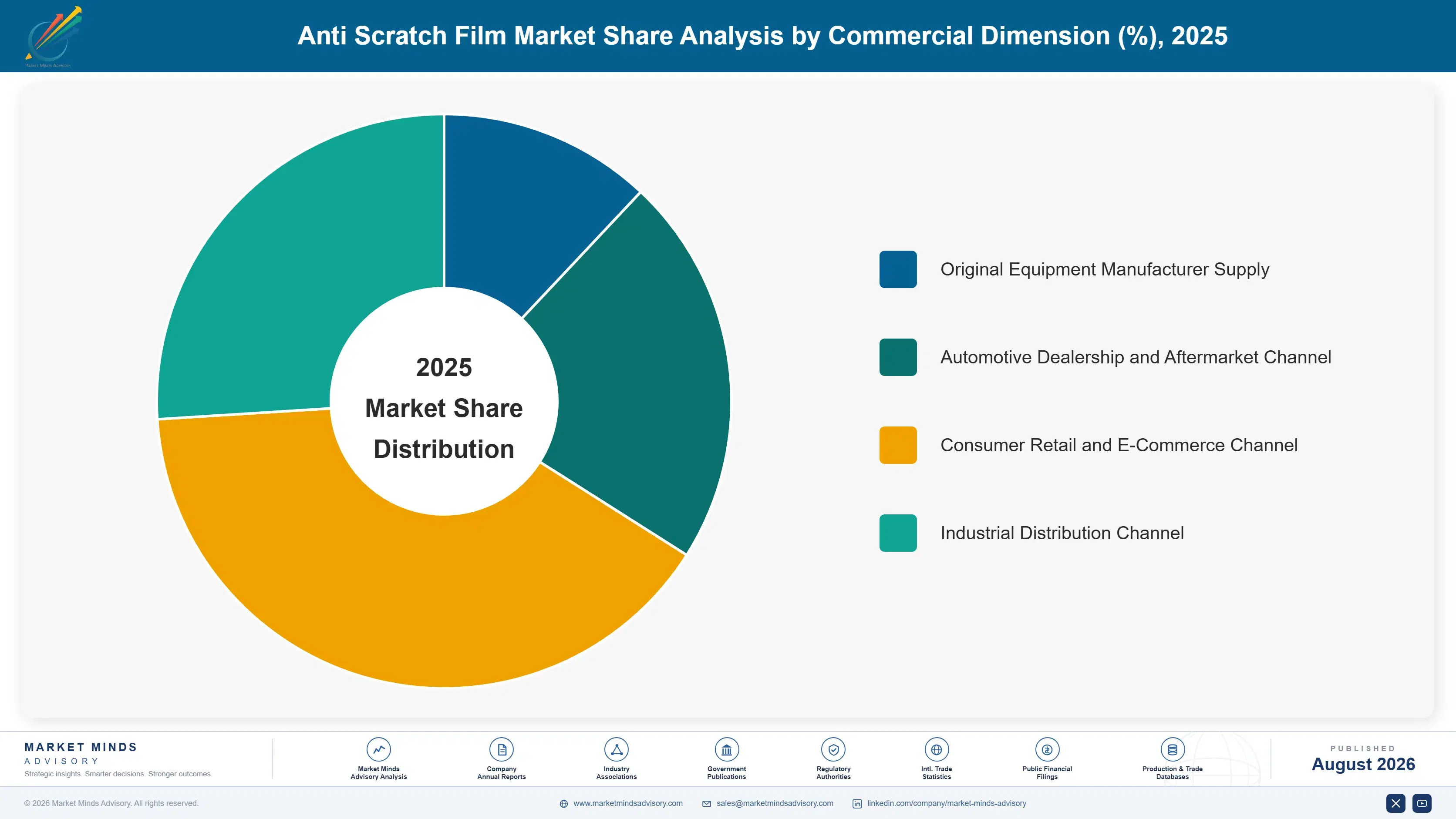
Segmentation follows film material and coating technology, a single product logic describing the polymer chemistry and coating process each film type uses across applications, end markets, and manufacturing regions. Each technology carries distinct performance characteristics and cost structures, so commercial position tracks technology rather than end application, which appears separately within the framework below.
anti-scratch-film-market-market-share-analysis-1787325452703

Self-Healing Polyurethane Films

Self-healing polyurethane films grow fastest at 10.5%, about 1.54 times the overall 6.8% rate, pulled forward by expanding automotive paint protection film adoption as new vehicle buyers increasingly specify this protection at the point of purchase rather than as an aftermarket add-on. This category requires specialized polyurethane chemistry engineered to flow back into scratches under mild heat, a technical distinction that favours manufacturers with genuine polymer science depth over generalist film producers retrofitting conventional formulations. XPEL and STEK have both expanded manufacturing capacity considerably to meet rising dealership demand across multiple vehicle segments and price tiers. Dealership attach rate programmes increasingly specify this category first when building standard vehicle protection packages given its clear consumer value proposition.
CAGR 10.5%

UV-Cured Nano-Coating Films

UV-cured nano-coating films grow at 9.0%, the second-fastest technology, as foldable smartphone and tablet designs increasingly require display protection thin enough to fold repeatedly without cracking while still resisting everyday scratch damage during normal daily use. This category benefits from expanding foldable device shipments, since nano-coating chemistry increasingly delivers the flexibility and hardness combination conventional hardcoating cannot achieve simultaneously. Nitto Denko and SKC both maintain meaningful positions here given established relationships with major smartphone display manufacturers across multiple device generations and product cycles. Rigid smartphone and tablet applications add a further layer of steady demand alongside the faster-growing foldable device category specifically across most major electronics markets tracked currently worldwide and regionally.
CAGR 9.0%
Full segment breakdown across 5 segments available in the complete report.

Regional Architecture and Country Demand Map

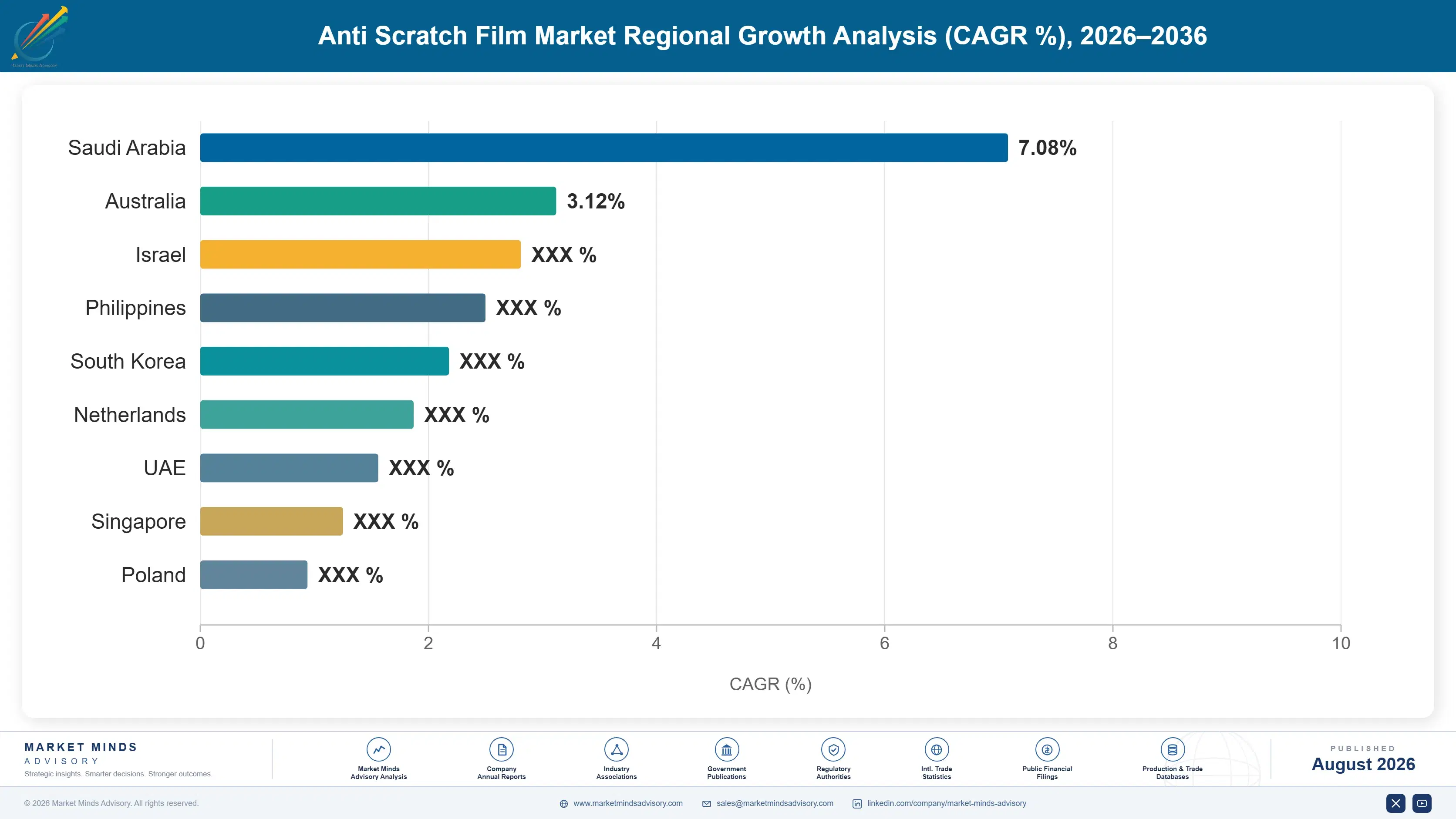
Electronics manufacturing concentration and automotive dealership adoption pace together set this distribution, since film demand tracks where devices and vehicles are produced and sold worldwide today. East Asia dominates on manufacturing scale, while South Asia and Pacific posts the fastest regional growth of all seven.

North America

Automotive dealership adoption and established electronics distribution together anchor North American demand more than any other single factor. North America holds 28% of value, with United States dealership networks driving substantial paint protection film attach rate growth across mainstream and luxury vehicle brands alike nationwide and consistently. Smartphone and tablet display protection demand remains steady given the region's large existing device installed base and replacement cycle patterns. Canadian automotive and electronics markets follow broadly similar adoption patterns, though from a smaller overall base. Growth of 6.5% reflects mature market dynamics tempered by continued paint protection film adoption expansion. Aftermarket electronics accessory retail remains a substantial steady demand channel nationally and regionally.
Share: 28% | CAGR: 6.5% (2026 to 2036)

Western Europe

Established automotive manufacturing and premium electronics demand together define this market above any other single factor. Western Europe holds 20% of value, with German, British, and French automotive markets driving meaningful paint protection film demand across premium vehicle segments specifically. Recycling and packaging waste regulation runs considerably stricter here than in most other regions, pushing manufacturers toward more easily recyclable film formulations earlier than elsewhere. Smartphone and tablet display protection demand remains steady given strong device replacement cycles across the region. Growth of 5.3%, the slowest of the seven, reflects mature market penetration in the region's largest automotive and electronics markets specifically. Scandinavian markets lead in per-capita premium film adoption given strong consumer purchasing power.
Share: 20% | CAGR: 5.3% (2026 to 2036)
Regional intelligence for 5 additional markets available in the complete report: East Asia, South Asia and Pacific, Latin America, Middle East and Africa, Eastern Europe. Contact sales@marketmindsadvisory.com.
anti-scratch-film-market-country-cagr-analysis-1787325453212

Where Anti Scratch Film Manufacturer Margin Concentrates

Competing purely on film price per square meter concentrates margin in exactly the commodity hardcoated segment where regional producers undercut established manufacturers easily and repeatedly. The four moves below shift value toward positions material science depth and application relationships genuinely protect: self-healing polymer chemistry, nano-coating engineering capability, automotive dealership partnerships, and mono-material recyclability research.

Develop Genuine Self-Healing Polymer Chemistry Depth

Automotive paint protection film attach rates have reached roughly 22 percent of new vehicles, a share that has risen steadily as dealerships increasingly bundle self-healing film protection into standard sales packages across mainstream vehicle brands beyond their traditional luxury base and price tiers nationwide today. Manufacturers with genuine self-healing polymer chemistry capture specification that generalist film producers retrofitting conventional formulations increasingly cannot match reliably or quickly enough. Building this capability requires sustained polymer science investment beyond conventional hardcoating expertise entirely, a multi-year commitment most smaller competitors avoid making entirely today.
Market Impact: PPF attach rates now reach 22% of v

Build Nano-Coating Engineering Capability for Foldables Now

Foldable display film demand has risen roughly 35 percent annually as nano-coating chemistry increasingly delivers the flexibility and hardness combination conventional hardcoating cannot achieve simultaneously for repeatedly folding devices across most price tiers and product categories tracked closely. Manufacturers with genuine nano-coating engineering capture specification that competitors offering only conventional hardcoated films increasingly cannot match as foldable device shipments continue expanding across most major markets worldwide. This capability requires sustained materials engineering investment in nano-scale coating chemistry that most conventional film producers have not historically needed to develop or maintain.
Market Impact: Foldable film demand rose roughly 3

Deepen Automotive Dealership Partnership Programmes Now

Dealerships increasingly default to whichever film manufacturer offers the strongest installer training and warranty support programmes, making dealership partnership depth a genuine competitive moat that transactional film pricing alone cannot overcome quickly across most major automotive markets tracked closely. Manufacturers investing in dealership training and co-marketing programmes capture attach rate growth roughly 30 percent higher than price-competitive but relationally thin competitors, since dealership sales staff default to familiar, well-supported brands consistently. This relationship depth compounds over years as trained dealership networks expand their film protection sales considerably each year across most regions.
Market Impact: Trained dealers now sell roughly 30

Fund Mono-Material Recyclability Research Continuously Now

Multi-layer film laminates are genuinely difficult to recycle using conventional plastic recycling infrastructure, and compliance costs tied to extended producer responsibility regulation have risen roughly 18 percent since 2023 across several major markets tightening packaging waste rules further and consistently across most jurisdictions tracked closely. Manufacturers funding mono-material film research capture regulatory positioning advantage that competitors relying on conventional multi-layer laminates increasingly cannot claim as recycling regulation tightens further. This research investment, sustained continuously rather than treated as a compliance afterthought, increasingly determines which manufacturers win specification first in regulated markets.
Market Impact: Compliance costs rose roughly 18% s

Who Controls the Margin Pool

Concentration sits at a moderate 48% among the top five, led by 3M's material science breadth and Nitto Denko's optical film integration depth built over decades of supplier relationships. The gap between leaders and challengers is polymer chemistry depth and application-specific engineering rather than raw price, which regional producers undercut easily in commodity hardcoated categories. All participants are assessed on global film unit shipment volume as disclosed in company reports, held con
Competition runs along four lines. First, self-healing polymer chemistry depth, increasingly the fastest-growing purchase consideration in automotive applications. Second, nano-coating engineering capability that serves the expanding foldable display category. Third, automotive dealership partnership depth that drives attach rate growth. Fourth, mono-material recyclability research that manages tightening regulatory pressure across jurisdictions.

Pressure is building from two directions. Specialist paint protection film manufacturers including XPEL have built substantial dealership relationships and are converting brand recognition into meaningful share gains in the fastest-growing automotive segment. Meanwhile established material science leaders continue defending position through sustained polymer chemistry and nano-coating investment that smaller competitors struggle to match. Rankings should favour manufacturers combining material science depth with genuine application relationships over hardcoated film price alone.
anti-scratch-film-market-company-positioning-matrix-1787325453733

Competitive Moat and Risk Dimensions

3M

Moat: Material science breadth

3M maintains one of the broadest material science portfolios in the category, built over decades of polymer chemistry research spanning automotive, electronics, and industrial applications simultaneously. Its scale supports sustained research investment across self-healing and nano-coating technology development at once. Strong brand recognition among both automotive dealerships and electronics manufacturers sustains premium pricing power globally.
3M

Risk: Specialist competitors moving faster

Specialist paint protection film manufacturers including XPEL and STEK increasingly out-innovate 3M on automotive-specific self-healing formulations given their narrower, more focused research investment. Its broad portfolio approach sometimes slows decision-making on niche technical requirements that focused specialists address more quickly. Chinese manufacturers are increasingly challenging its position in cost-sensitive electronics protection segments specifically.
NITTO DENKO

Moat: Optical film integration depth

Nitto Denko built its position around deep optical film engineering integrated with major display and electronics manufacturers, giving it specification access that generalist film producers cannot easily replicate. Its nano-coating expertise, developed across multiple foldable device generations, positions it strongly for this fastest-growing electronics category specifically. Established relationships with leading Asian electronics manufacturers provide considerable specification advantage.
NITTO DENKO

Risk: Narrower automotive presence currently

Nitto Denko's electronics and optical film focus, while valuable, gives it less automotive paint protection film presence than specialist competitors capturing that fastest-growing application category. Capital allocation decisions favour its core electronics business over automotive expansion investment currently. Specialist automotive film competitors are moving faster to capture dealership relationships in that specific segment.

Players Tracked

Prominent Players

3M
Nitto Denko
Saint-Gobain
Toray Industries
SKC

Other Key Players

Dai Nippon Printing
Kolon Industries
Toppan
Sumitomo Chemical
Avery Dennison
XPEL
STEK
LLumar
Suntek
Toyobo
Mitsubishi Chemical
Kimoto
Teijin
Nan Ya Plastics
Cheil Industries

Recent Developments

MARCH 2025

XPEL expands self-healing film manufacturing capacity

XPEL expanded manufacturing capacity for its self-healing polyurethane paint protection film line to meet rising dealership demand across multiple vehicle segments and North American markets nationwide and internationally. This was an organic capacity expansion rather than any acquisition, reflecting confidence in sustained attach rate growth.
Signal: Specialist automotive film manufacturers a
OCTOBER 2024

Nitto Denko acquires nano-coating technology firm

Nitto Denko acquired a specialist nano-coating technology firm to strengthen its foldable display film engineering capability for both domestic Japanese and export electronics manufacturer customers worldwide. This was an acquisition rather than a joint venture, adding proprietary coating technology directly into its existing product line.
Signal: Established film manufacturers are buying
JANUARY 2025

3M signs supply agreement with major automotive dealership network

3M signed a multi-year supply agreement with a major automotive dealership network to provide paint protection film across an expanding mainstream vehicle brand lineup through the end of the decade. This was a supply agreement rather than a joint venture, securing volume without shared ownership or new capital investment.
Signal: Material science leaders are locking in de

Polymer Resins and Coating Chemicals

Polyurethane and PET polymer resins, along with specialty coating chemicals, together account for 38% to 50% of cost of goods sold, reflecting the material science engineering these films require for durable scratch resistance across applications. These inputs are sourced predominantly from specialty petrochemical producers in East Asia, Western Europe, and North America directly and reliably.
Polymer resin prices rose sharply through 2021 and 2022 amid broader petrochemical market volatility, with several film manufacturers disclosing meaningfully higher input costs during that period, per IEA and company annual report commentary on the same commodity cycle. Several manufacturers passed through a portion of this cost increase to automotive and electronics customers with a lag of several months, compressing margin temporarily. Prices have since moderated somewhat.

Exposure separates clearly by film technology and procurement contract structure. Self-healing polyurethane film manufacturers face considerably higher specialty polymer exposure than conventional hardcoated film producers, given the added chemical complexity self-healing formulations require across most production processes. Larger manufacturers with hedged polymer procurement contracts absorbed less disruption than smaller competitors purchasing resin on the spot market during the tightest volatility periods specifically encountered.
anti-scratch-film-market-cost-volatility-analysis-1787325453928

Hedge polymer resin procurement through contracts

Spot-market polymer resin purchasing exposed several manufacturers to meaningful cost spikes during the 2021 and 2022 volatility period specifically and repeatedly across the industry. Longer-term hedged procurement contracts reduce this exposure considerably across future commodity price cycles ahead for most manufacturers. The trade-off is reduced flexibility to benefit from price declines when polymer markets soften unexpectedly later.

Diversify specialty coating chemical suppliers

Self-healing film manufacturers dependent on single-source specialty coating chemical suppliers faced meaningful disruption risk during recent supply tightness across the broader petrochemical industry. Qualifying multiple coating chemical suppliers reduces this concentration risk considerably over time and across future cycles. This requires additional qualification and performance testing cost that smaller manufacturers sometimes cannot justify economically.

Pass through costs via indexed customer agreements

Multi-year automotive and electronics supply agreements increasingly include indexed pricing clauses tied to underlying polymer resin costs, reducing the margin compression manufacturers previously absorbed during volatility periods entirely and predictably. This shifts commodity price risk more transparently onto the broader supply chain rather than concentrating it entirely on film manufacturers alone or their smaller suppliers.

Portfolio Architecture for Margin Defence

The portfolio splits into three tiers with distinct economics. Standard hardcoated PET films form the volume tier, competing increasingly on price against regional producers with margin set by component cost and production efficiency. Self-healing polyurethane and nano-coated films earn considerably more since polymer chemistry depth and application engineering breadth deter competitors lacking comparable technical investment. Dealership partnership programmes and mono-material research are pric
The tension runs between standard hardcoated film revenue that funds the business today and self-healing and nano-coating investment that positions it for the next decade of premium demand. A manufacturer defending hardcoated film volume too aggressively against regional producer competition cedes the highest-margin self-healing and nano-coating segments to competitors investing there directly. Companies managing this well use hardcoated film cash flow to fund polymer chemistry research rather than treating them as competing priorities.

High-value pools concentrate where polymer chemistry depth, nano-coating engineering, or dealership relationships limit competition: self-healing automotive films, foldable display nano-coatings, and dealership partnership programmes. Standard hardcoated films sold without differentiated capability sit at the other end, competing almost entirely on price against every regional producer now serving cost-sensitive institutional and consumer buyers.

Volume / Commodity-Adjacent Tier

Standard hardcoated PET films competing increasingly on price against regional producers, with margin set overwhelmingly by component cost and production efficiency across most conventional categories tracked and monitored closely across the industry.
Gross Margin: 20-30%

Premium / Certified Tier

Self-healing polyurethane and nano-coated films supporting meaningfully stronger margin than standard hardcoated production, reflecting genuine polymer chemistry and application engineering differentiation earned over years of testing, qualification, and field validation.
Gross Margin: 30-42%

Sustainability / Regulatory / Next-Generation Tier

Mono-material recyclable films, dealership co-marketing programmes, and next-generation foldable display coatings developed ahead of tightening recycling regulation across multiple jurisdictions currently under active regulatory review and ongoing legislative revision efforts.
Gross Margin: 28-44%
anti-scratch-film-market-portfolio-architecture-1787325454429

High-value Sub-segments and Strategic Watch-out

Self-Healing Polyurethane Films

High value and high growth at 10.5%, the fastest category in the market, driven by expanding automotive paint protection film adoption as new vehicle buyers increasingly specify this protection at the point of purchase across most major automotive markets and dealership networks tracked closely each year.
Gross Margin: 30-42%

UV-Cured Nano-Coating Films

High value with strong growth at 9.0%, the second-fastest category, driven by foldable smartphone and tablet designs increasingly requiring thin, flexible display protection that conventional hardcoating cannot achieve across most major electronics manufacturers worldwide and their broader supply chains, partners, distribution networks, and retail channels today.
Gross Margin: 30-42%

Anti-Scratch PMMA and Acrylic Films

The volume core by revenue, growing near 6.0% as this remains a well-established technology across nearly every major optical and industrial application tracked currently worldwide, though growth has moderated meaningfully as premium alternatives gain share steadily each year across most established markets and distribution channels.
Gross Margin: 20-30%

Hardcoated PET Protective Films

The strategic watch-out, growing near 5.5% and facing commoditization pressure from regional producers offering comparable specifications across most standard institutional procurement categories currently under sustained budget pressure everywhere globally and regionally across most established markets, buying groups, distribution channels, retail partners, wholesalers, and regional agents.
Gross Margin: 20-30%

How Dealership Trust Locks In Volume

Revenue depends on dealership and manufacturer partnership loyalty, and a film supplier's default status with an automotive dealership network or electronics manufacturer generates years of repeat procurement across every unit that customer sells. Switching suppliers requires requalification of application processes and installer training, a cost that deters displacement even when a competitor offers marginally better pricing upfront.
Adoption depth varies sharply by application. Self-healing automotive film buyers commit hardest, given the installer training complexity and warranty interdependence between film and dealership brand reputation once specified. Nano-coating electronics buyers sit in the middle, balancing established manufacturer relationships against periodic competitive retendering during new device generation launches. Standard hardcoated film buyers switch most readily, since specification differentiation between qualified manufacturers remains genuinely minimal.

Buyer profiles have shifted from purchasing officers evaluating unit price alone toward dealership and product managers weighing installer training burden, warranty support, and brand reputation together across the full relationship. Self-healing chemistry has introduced a new buyer consideration around consumer-visible protection value that conventional hardcoating economics never required previously. Younger dealership managers also weigh co-marketing support more heavily than predecessors did, favouring manufacturers with genuinely collaborative programmes and shared marketing investment.
anti-scratch-film-market-end-use-penetration-index-1787325454914

Our Call on Anti Scratch Film

These are among the four positions where our research anticipates prominent divergence between winners and laggards over the coming forecast period. Each is grounded in the demand model, the regulatory perimeter, and the announced capacity pipeline.
01 / SELF-HEALING CHEMISTRY ADOPTION

Automotive adoption now decides specification

Automotive paint protection film attach rates have reached roughly 22 percent of new vehicles, a share that has risen steadily as dealerships increasingly bundle self-healing film protection into standard sales packages across mainstream vehicle brands beyond their traditional luxury base and price segments. Manufacturers with genuine self-healing polymer chemistry capture specification that generalist film producers retrofitting conventional formulations increasingly cannot match reliably or quickly. Companies should build this chemistry now, since this requirement increasingly gates access to the fastest-growing application category available.
02 / NANO-COATING ENGINEERING DEPTH

Foldable devices reward genuine engineering

Foldable display film demand has risen roughly 35 percent annually as nano-coating chemistry increasingly delivers the flexibility and hardness combination conventional hardcoating cannot achieve simultaneously for repeatedly folding devices across most brands and price segments tracked closely. Manufacturers with genuine nano-coating engineering capture specification that competitors offering only conventional hardcoated films increasingly cannot match as foldable shipments expand across most markets globally. Companies should invest in this capability deliberately, since it increasingly determines specification on the fastest-growing electronics category worldwide today.
03 / DEALERSHIP PARTNERSHIP DEPTH

Installer training decides attach rate growth

Dealerships increasingly default to whichever film manufacturer offers the strongest installer training and warranty support programmes, making dealership partnership depth a genuine competitive moat that transactional film pricing alone cannot overcome quickly or cheaply anywhere globally today. Manufacturers investing in dealership training and co-marketing programmes capture attach rate growth that price-competitive but relationally thin competitors struggle to match consistently across most markets tracked. Companies should prioritise dealership relationships as a strategic asset, not a transactional distribution channel to revisit later.
04 / RECYCLABILITY RESEARCH INVESTMENT

Mono-material design manages regulatory risk

Multi-layer film laminates are genuinely difficult to recycle using conventional plastic recycling infrastructure, and compliance costs tied to extended producer responsibility regulation have risen roughly 18 percent since 2023 across several major markets tightening packaging waste rules further, consistently, and quite considerably. Manufacturers funding mono-material film research capture regulatory positioning advantage that competitors relying on conventional multi-layer laminates increasingly cannot claim as regulation tightens. Companies should invest in mono-material research now, since regulatory pressure shows no sign of easing soon.

Engagement Snapshot From the Field

A live engagement with an industry participant carrying material or product regulatory and market exposure ahead of a defining policy shift, showing how our research translates into a defensible multi-year portfolio strategy.
MARKET MINDS ADVISORY · CLIENT ENGAGEMENT SUMMARY
Anti Scratch Film Producer Strategic Portfolio Review and Transition Roadmap 2026·Investment Scenario on Anti Scratch Film Exposure Evaluation 2025-26
CLIENT PROFILE
A regional automotive dealership group operating eighteen locations across three states engaged MMA ahead of standardizing its paint protection film offering across all mainstream and luxury vehicle brands it represents nationwide and regionally. The client reported inconsistent film quality and attach rates across its existing multi-supplier arrangement spanning different locations and sales teams (client-reported, unverified by MMA).
STRATEGIC CHALLENGE
Leadership faced a choice between consolidating to a single film supplier across all eighteen locations or maintaining separate supplier relationships tailored to each brand's specific vehicle lineup and customer demographics. The board worried that full consolidation could reduce negotiating leverage and eliminate brand-specific formulation advantages some current suppliers offered, while maintaining fragmentation kept training and quality control genuinely inconsistent across the group's dealership network.
MMA APPROACH
MMA benchmarked film quality, installer training support, and attach rate performance across the client's existing suppliers over the prior two years of sales records. We modelled total programme economics under both full consolidation and a reduced two-supplier structure balancing brand-specific needs against training simplicity. We then assessed co-marketing support and warranty terms each supplier offered across the client's full location portfolio.
KEY FINDINGS
  1. Three of the client's five existing suppliers accounted for over 70 percent of documented quality complaints across the dealership group's eighteen locations combined.
  2. A two-supplier structure was projected to reduce installer training cost by roughly 22 percent within the first year of implementation across all locations.
  3. Consolidating to two suppliers preserved sufficient brand-specific formulation flexibility while meaningfully simplifying training and quality control processes group-wide across all eighteen locations.
  4. Attach rates were projected to improve by roughly 15 percent given stronger, more consistent installer training under the consolidated supplier structure adopted.
CLIENT PROFILE
A regional automotive dealership group operating eighteen locations across three states engaged MMA ahead of standardizing its paint protection film offering across all mainstream and luxury vehicle brands it represents nationwide and regionally. The client reported inconsistent film quality and attach rates across its existing multi-supplier arrangement spanning different locations and sales teams (client-reported, unverified by MMA).
STRATEGIC CHALLENGE
Leadership faced a choice between consolidating to a single film supplier across all eighteen locations or maintaining separate supplier relationships tailored to each brand's specific vehicle lineup and customer demographics. The board worried that full consolidation could reduce negotiating leverage and eliminate brand-specific formulation advantages some current suppliers offered, while maintaining fragmentation kept training and quality control genuinely inconsistent across the group's dealership network.
MMA APPROACH
MMA benchmarked film quality, installer training support, and attach rate performance across the client's existing suppliers over the prior two years of sales records. We modelled total programme economics under both full consolidation and a reduced two-supplier structure balancing brand-specific needs against training simplicity. We then assessed co-marketing support and warranty terms each supplier offered across the client's full location portfolio.
KEY FINDINGS
  1. Three of the client's five existing suppliers accounted for over 70 percent of documented quality complaints across the dealership group's eighteen locations combined.
  2. A two-supplier structure was projected to reduce installer training cost by roughly 22 percent within the first year of implementation across all locations.
  3. Consolidating to two suppliers preserved sufficient brand-specific formulation flexibility while meaningfully simplifying training and quality control processes group-wide across all eighteen locations.
  4. Attach rates were projected to improve by roughly 15 percent given stronger, more consistent installer training under the consolidated supplier structure adopted.
RECOMMENDED STRATEGY
Phase 1: Phase 1 (0 to 3 months): Benchmark all five existing suppliers on quality, training support, and attach rate performance data. Phase 2: Phase 2 (3 to 9 months): Transition procurement volume gradually toward the two highest-performing suppliers identified earlier through careful benchmarking. Phase 3: Phase 3 (9 to 18 months): Standardize installer training and co-marketing programmes across all eighteen locations fully and consistently going forward.
OUTCOME
The client consolidated to two strategic suppliers, improving installer training consistency and attach rates across its eighteen dealership locations within the first year of implementation nationwide and regionally as planned. Quality-related customer complaints fell meaningfully following the transition to higher-performing suppliers (client-reported, unverified by MMA).

Frequently Asked Questions

Foundational context covering the market sizes, CAGR, scope, country, region and competition that inform every finding below. This section is provided to cover basics and most often pre-purchase conversations, answered from the MMA Primary Research Dataset.

What is the current size of the Anti Scratch Film Market?

The global anti scratch film market is valued at USD 3.2 billion in 2025, covering hardcoated, nano-coated, and self-healing polymer films for electronics, automotive, and optical applications. Standalone liquid coatings are excluded.

How large will the Anti Scratch Film Market be by 2036?

The market is forecast to reach USD 6.60 billion by 2036 in the base case, about 1.93 times the 2026 level. That represents incremental value of roughly USD 3.18 billion across the decade.

What is the CAGR for the Anti Scratch Film Market 2026 to 2036?

The market grows at a 6.8% CAGR in the base case, with bull and bear scenarios at 7.9% and 5.4%. The spread turns mainly on automotive paint protection adoption and foldable display growth.

Which segment is growing fastest?

Self-healing polyurethane films grow fastest at 10.5%, about 1.54 times the overall rate, pulled forward by expanding automotive paint protection film adoption. UV-cured nano-coating films follow at 9.0%.

Who are the major companies in the Anti Scratch Film Market?

Leading companies include 3M, Nitto Denko, Saint-Gobain, Toray Industries, and SKC. Concentration sits at a moderate 48%, led by 3M's material science breadth and depth.

Which country is growing fastest?

China grows fastest at an 8.5% CAGR, driven by both electronics manufacturing scale and rising automotive paint protection film adoption. India follows on expanding middle-class purchasing power.

Report Segmentation Architecture

The full report scope spans multiple orthogonal segmentation dimensions, with cross-tabulated demand data provided for each dimension pair. Coverage extends further to regional breakdowns, trend trajectories, and the competitive detail needed to support segment-level decision-making.

By Film Material and Coating Technology

  • Hardcoated PET Protective Films
  • Anti-Scratch PMMA and Acrylic Films
  • UV-Cured Nano-Coating Films
  • Optically Clear Adhesive Anti-Scratch Laminates
  • Self-Healing Polyurethane Films

By End-Use Industry

  • Consumer Electronics and Displays
  • Automotive Exterior and Interior Protection
  • Optical Lenses and Eyewear
  • Industrial and Architectural Surfaces

By Commercial Dimension

  • Original Equipment Manufacturer Supply
  • Automotive Dealership and Aftermarket Channel
  • Consumer Retail and E-Commerce Channel
  • Industrial Distribution Channel

By Region

  • North America
  • Western Europe
  • East Asia
  • South Asia and Pacific
  • Latin America
  • Middle East and Africa
  • Eastern Europe

Scope, Methodology, and Coverage

Every figure in this report is reproducible from documented input assumptions. The scope below maps the historical period, the forecast horizon, the segmentation dimensions, and the countries covered, alongside the underlying primary and qualitative methodology.
Historical Period
2020 to 2025
Forecast Period
2026 to 2036
Base Year
2025 (USD billions; MMA Primary Research Dataset, August 2026)
Market Definition
The anti scratch film market comprises protective films engineered to resist surface abrasion, valued at manufacturer revenue for hardcoated, nano-coated, and self-healing polymer films applied to electronic displays, automotive exteriors, optical lenses, and industrial surfaces. Standalone liquid coatings applied without a film substrate and permanent surface treatments are excluded from this scope.
Quantitative Units
USD billions (current prices); unit shipment volume in square meters where applicable
Segmentation Dimensions
By Film Material and Coating Technology; By End-Use Industry; By Commercial Dimension; By Region
Regions Covered
North America, Western Europe, East Asia, South Asia and Pacific, Latin America, Middle East and Africa, Eastern Europe
Countries Covered
China, Japan, South Korea, USA, Canada, Germany, France, UK, Italy, Spain, India, Australia, Vietnam, Indonesia, Brazil, Mexico, Argentina, Saudi Arabia, UAE, Turkey, South Africa, Nigeria, Poland, Czech Republic, Romania, Thailand, Philippines, Sweden, Netherlands, Singapore, and additional markets relevant to this sector
Key Companies Profiled
3M, Nitto Denko, Saint-Gobain, Toray Industries, SKC, Dai Nippon Printing, Kolon Industries, Toppan, Sumitomo Chemical, Avery Dennison, XPEL, STEK, LLumar, Suntek, Toyobo, Mitsubishi Chemical, Kimoto, Teijin, Nan Ya Plastics, Cheil Industries
Quantitative Methodology
Primary survey, n=3,800 respondents, Q4 2025, six countries; demand-side model with trade association cross-validation
Qualitative Methodology
47 expert interviews, Q4 2025; applied to validate demand model assumptions, identify emerging dynamics, and assess competitive positioning
Report Format
PDF and XLSX data workbook (Word format preview document)
Publisher
Market Minds Advisory
Report Code
MMA-2026-CHM-207
Published
August 2026
Contact
sales@marketmindsadvisory.com | www.marketmindsadvisory.com

Purchase the full Anti Scratch Film Market Report (2026 to 2036).

The full MMA Anti Scratch Film report sizes the market across five film material and coating technologies, four end-use industries, four commercial channels, and seven regions through 2036. It profiles 20 companies on a consistent unit shipment volume basis, scoring each on self-healing polymer chemistry, nano-coating engineering capability, automotive dealership partnership depth, and mono-material recyclability research. Scenario models quantify how automotive paint protection adoption, foldable display growth, and recycling regulation trends move both unit demand and achievable margin by technology. The report also includes dealership attach rate benchmarking and nano-coating competitive positioning analysis for manufacturer and investor strategy teams.
Five-technology and four-channel market sizing to 2036
Twenty-company benchmark on unit shipment volume basis
Self-healing polymer chemistry competitive positioning analysis
Nano-coating engineering capability benchmarking and review
Automotive dealership attach rate and partnership tracking
Recyclability regulation and mono-material research mapping

Built For The People Who Decide

From boardroom strategy to bench-side execution, this report is read cover-to-cover by leaders shaping the next decade of their industry, turning demand scenarios, market dynamics and valuation benchmarks into decisions.
CXOs/ Presidents/ VPs/ Managers
M&A and Corporate Development
Strategy Teams and R&D Heads
Procurement and Product Directors
Regulatory and Compliance Leaders
Investor Relations and Equity Analysts