Market Minds Advisory
Anti-Fraud Management System Market

Anti-Fraud Management System Market: Anti-Fraud Management System Market. Trends and Forecast 2026 to 2036

Rising synthetic identity fraud and real-time payment adoption are pushing financial institutions toward AI-powered transaction monitoring, forcing legacy rules-based fraud vendors to defend contracts against faster-learning machine learning entrants today.

Lead Analyst

Published

September 2026

Make Smarter Decisions with Customized Research Insights

Request a free sample report and evaluate market opportunities, growth trends, and competitive dynamics relevant to your business needs.

2025 MARKET VALUE$32.5BMarket Size 2025
2036 FORECAST VALUE$97.5BBase Case , 2026 to 2036
CAGR 2026 TO 203610.5 %Bull 11.8% / Bear 9.2%
INCREMENTAL OPPORTUNITY$61.6BNet 10- year value creation
EXPANSION MULTIPLE2.71x2036 value over 2026 base
Strategic Levers
M&A Pipeline
Regional Outlook
Country Rankings
Competitive Intelligence
Segmental Deep-dive
Call-Us : 91 93563 13602

Executive Snapshot and Market Trajectory.

Anti-fraud management demand is accelerating as synthetic identity fraud and real-time payment adoption expose gaps in legacy rules-based detection systems that financial institutions built over the prior decade of transaction monitoring investment. Financial institutions report accelerating replacement timelines given the widening gap between fraud losses and detection effectiveness.
Demand concentrates around real-time transaction monitoring and identity verification, where banks and payment providers value detection accuracy and false-positive reduction over unit cost entirely. AI-powered platforms are emerging as the fastest growing category, since machine learning models adapt to evolving fraud patterns faster than static rule sets financial institutions previously maintained. Geographic concentration remains heaviest across North America's financial services technology base, though India's expanding digital payment volume is driving accelerated adoption.
Competitive intensity concentrates among five vendors holding a combined 40% revenue share, reflecting a fragmenting market where specialized fraud detection startups compete alongside established financial technology platforms. Real-time payment scheme expansion is reshaping vendor roadmaps, as instant settlement removes the delay window banks previously used to catch fraudulent transactions before funds cleared. Vendors lacking this capability lose contracts to rivals with stronger instant payment detection.
Market Definition
This report covers anti-fraud management software platforms that detect, prevent, and investigate fraudulent transactions and identity claims for financial institutions, payment providers, and e-commerce enterprises through rules-based and AI-driven analytics. It excludes general cybersecurity software not specifically designed for transaction fraud detection and identity verification hardware devices sold separately from software analytics platforms.
Base Year Value
$32.5B in 2025 (MMA Primary Research Dataset, September 2026)
Forecast Period
2026 to 2036, eleven discrete annual values
CAGR
10.5% base case. Bull 11.8%. Bear 9.2%.
Fastest Growth Segment
AI-Powered Real-Time Transaction Fraud Detection Platforms: 16.0% CAGR
Fastest Growth Country
India: 13.5% CAGR
Fastest Growth Region
South Asia and Pacific: 12.8% CAGR
Largest Region
North America: 31% of 2025 global value
Market Leaders
Leading participants include NICE Actimize, SAS Institute, FICO, ACI Worldwide, and Feedzai. Source: MMA Primary Research Dataset, July 2026.
Primary Survey
n=3,800 procurement and R&D decision-makers, Q4 2025, six countries
Methodology
Demand-side build-up, cross-validated against public data, 47 expert interviews

Anti-Fraud Management System Market Forecast Scenarios

anti-fraud-management-system-market-size-forecast-scenario-1788678235653
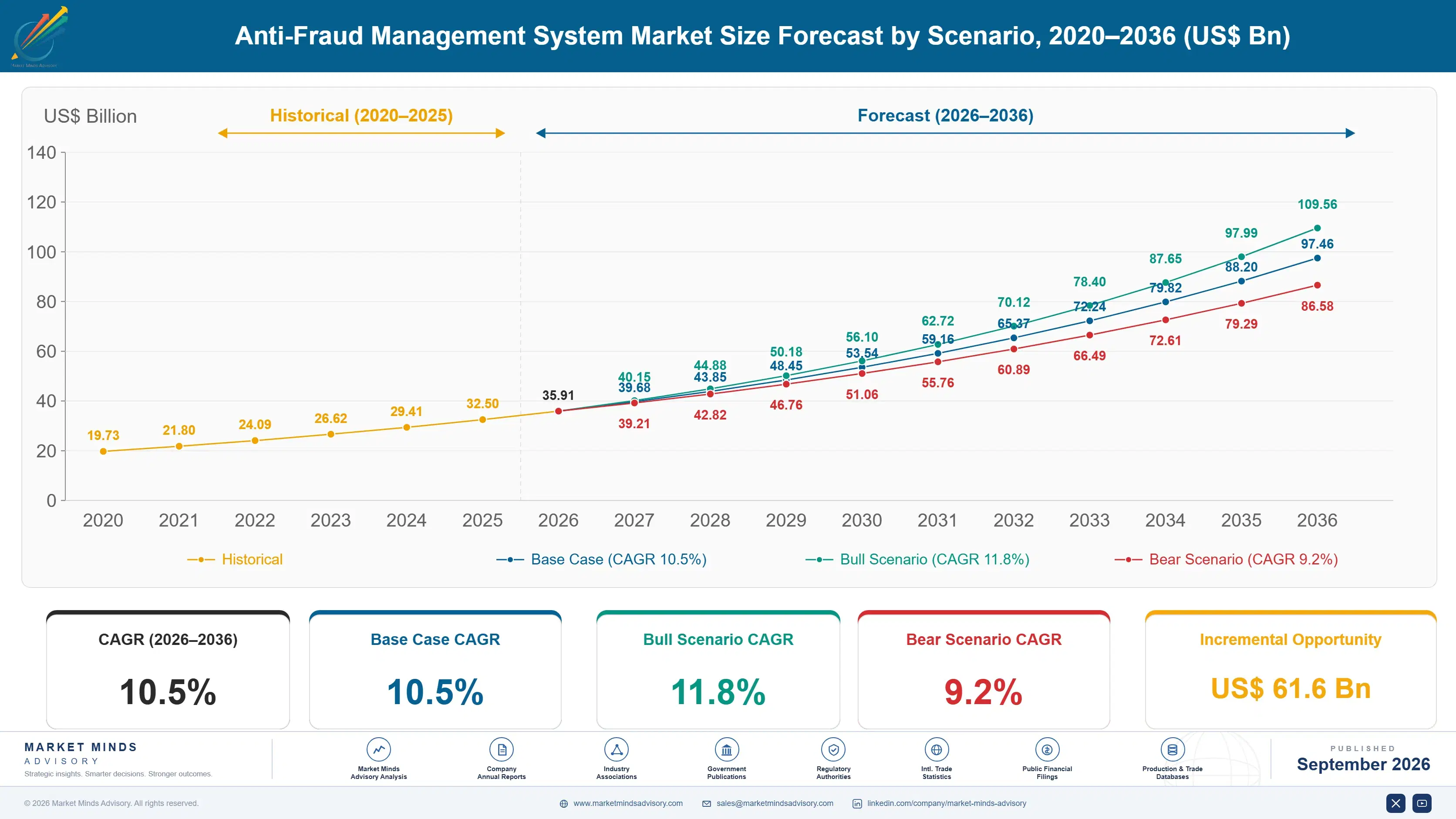
Anti-fraud management demand grew roughly 9.5% between 2020 and 2025, as pandemic-driven e-commerce and digital banking adoption expanded the attack surface fraudsters exploited across most global markets. Vendors report demand shifting from defensive rule maintenance toward proactive machine learning development as fraud patterns evolved faster than static rules could track. Vendors report demand shifting toward proactive machine learning.
The base case assumes 10.5% growth through 2036, anchored by three commercial mechanisms. First, real-time payment scheme expansion is forcing banks toward instant fraud detection operating within seconds-long settlement windows. Second, synthetic identity fraud is driving demand for AI-powered verification beyond traditional rules-based screening. Third, regulatory reporting requirements are pushing financial institutions toward platforms with stronger audit trail and case management capability. These mechanisms compound as vendors bundle transaction monitoring, identity verification, and case management into unified platforms.
The bull case centers on real-time payment adoption spreading faster than forecast across additional national payment schemes, forcing rapid detection upgrades. The bear case centers on vendor consolidation reducing competitive pressure and slowing innovation pace, potentially limiting the AI capability advancement driving recent detection accuracy improvements. Both scenarios hinge on payment scheme modernization pace and vendor consolidation activity across the largest markets MMA tracks.

Where Detection Accuracy Determines Vendor Trust

Anti-fraud vendors compete on detection accuracy and false-positive reduction rather than unit price, since financial institutions pay a considerable premium for platforms that block fraudulent transactions without frustrating legitimate customers. Vendors that cannot demonstrate this accuracy lose enterprise contracts entirely regardless of underlying cost advantages. This barrier sustains higher margins over commodity security software, since institutions rarely switch vendors once a platform clears integration and validation testing.
MARKET CONCENTRATIONCR5 40%Five vendors hold under half the total revenue
AVERAGE CONTRACT VALUE$420K annualEnterprise deals rising faster than mid-market renewals overall
TOP PRODUCING COUNTRY SHAREUnited States 30%Largest single national contributor to global spending today
FALSE POSITIVE RATEDeclining across all segmentsCustomers increasingly demand fewer legitimate transaction blocks overall
AI-POWERED SHARE OF REVENUE34% of totalMachine learning platforms command a growing share of spending
REAL-TIME DETECTION REQUIREMENTRising across all segmentsInstant payment schemes demand sub-second decisioning capability today
AI-powered platforms are displacing legacy rules-based detection systems across new deployments, since machine learning models adapt to evolving fraud patterns faster than static rule sets require manual updates. This shift favors vendors with strong data science and model training capability over those optimized purely for rule engine configuration. Vendors investing early in explainable AI and model governance are capturing design wins ahead of rivals optimized purely for black-box models.
Real-time payment scheme expansion represents an emerging competitive pressure beyond traditional batch-processed fraud screening, as instant settlement removes the delay window banks previously used to catch fraud. This dynamic is creating new competitive openings for vendors with genuine sub-second decisioning architecture. Vendors with established payment network relationships are best positioned, while batch-only screening vendors face a longer path into this capability.
"Every fraud vendor claims ninety-nine percent accuracy. What separates winners is what happens to the other one percent, and whether the customer ever finds out the hard way."
Senior Analyst, Financial Crime and Fraud Prevention Practice · MMA Technology Practice · September 2026

Market Trends

AI Detection Models Displace Static Rule Engines

Financial institutions are replacing static rule-based fraud detection engines with machine learning models that continuously adapt to evolving fraud patterns without requiring manual rule updates from fraud analysts. This transition is happening faster than most vendors' product roadmaps anticipated, since fraud rings adapted to bypass known rules within weeks of deployment, forcing institutions toward genuinely adaptive detection approaches. Vendors with mature machine learning capability are winning new enterprise contracts across banking and payments, while vendors optimized purely for rule engine configuration are being excluded from these procurement decisions entirely. This shift is accelerating across every major banking modernization program.
Market Impact: Synthetic fraud losses grew 28%

Real-Time Payment Schemes Require Sub-Second Decisioning

Central banks and payment networks in multiple countries are launching real-time payment schemes that settle transactions within seconds, eliminating the batch-processing delay window banks previously used to review transactions for fraud before funds cleared. This settlement speed requirement is large enough that several vendors are now developing dedicated sub-second decisioning architectures specifically for instant payment rails rather than adapting legacy batch-oriented platforms. Vendors able to demonstrate genuine sub-second detection accuracy are winning contracts against vendors still optimized for traditional batch-processed transaction screening. This dedicated focus is proving more profitable than adapting legacy batch systems.
Market Impact: Emerging market demand grew 33%

Market Opportunities and Growth Drivers

Synthetic Identity Fraud Drives Verification Investment

Synthetic identity fraud, where criminals combine real and fabricated personal information to create fraudulent identities, is growing faster than traditional identity theft and existing verification systems struggle to detect these blended profiles. Financial institutions carry genuine urgency here since synthetic identity losses often go undetected for months, accumulating substantial charge-off costs before discovery. Vendors with the strongest identity verification and behavioral analytics capability enjoy meaningfully stronger enterprise retention than newer entrants, since a single high-profile synthetic fraud loss can trigger an immediate vendor review process. This dynamic is only intensifying as fraud rings grow more sophisticated.
Market Impact: False positives cost 15% in revenue

Digital Payment Expansion Fuels Emerging Market Demand

Rapid digital payment adoption across emerging markets, particularly India and Southeast Asia, is driving substantial new anti-fraud platform demand as banks and payment providers protect a rapidly expanding base of first-time digital finance users vulnerable to fraud tactics. This growth is concentrated among vendors with strong local regulatory compliance capability and language support specific to each national market's fraud typology. Vendors able to adapt detection models to local fraud patterns are capturing a disproportionate share of this emerging market growth ahead of competitors. This trend is only accelerating further across the broader region.
Market Impact: Compliance reduces accuracy by 8%

Market Restraints and Challenges

False Positive Rates Frustrate Legitimate Customers

Anti-fraud platforms that flag too many legitimate transactions as suspicious create genuine customer friction, since blocked purchases and frozen accounts damage customer relationships and drive complaints to bank customer service teams. The root cause is the inherent tradeoff between detection sensitivity and false positive rate, since more aggressive fraud screening inevitably catches more legitimate transactions alongside fraudulent ones. The commercial impact is measurable customer attrition when institutions overcorrect toward aggressive blocking. Vendors are mitigating this friction by developing more sophisticated behavioral models that distinguish genuine anomalies from routine customer behavior variation.
Market Impact: AI detection adoption grew 38%

Regulatory Compliance Requirements Complicate Model Deployment

Financial regulators in multiple jurisdictions increasingly require explainable AI models that can justify individual fraud decisions, complicating deployment of the most accurate but least interpretable machine learning architectures fraud vendors have developed. This fragmentation is rooted in each regulator's independent approach to algorithmic accountability, with no international coordination mechanism forcing alignment on acceptable model transparency standards. The commercial impact is vendors sometimes deploying less accurate but more explainable models to satisfy compliance requirements. Vendors are mitigating this friction by developing explainable AI techniques that maintain accuracy while providing decision transparency.
Market Impact: Real-time fraud demand grew 30%
3 additional market trends, 4 additional growth drivers, and 2 additional restraints and challenges are covered in the full report. Contact sales@marketmindsadvisory.com to access the complete intelligence.

Segment CAGR and Growth Architecture

Anti-fraud management demand splits across six segments by fraud type and detection method, reflecting how transaction monitoring, identity verification, and case management diverge sharply across financial institution and payment provider requirements. AI-powered real-time detection platforms are growing fastest as instant payment adoption accelerates. Rules-based monitoring remains the slowest-growing category, serving established compliance requirements with limited displacement risk near term.
anti-fraud-management-system-market-market-share-analysis-1788678236196

AI-Powered Real-Time Transaction Fraud Detection Platforms

This segment covers machine learning-driven platforms that analyze transactions in real time, flagging fraudulent activity within the settlement window instant payment schemes require rather than relying on batch-processed screening completed after transactions clear. Demand is concentrated among banks and payment providers responding to real-time payment scheme expansion that eliminates the delay window previously used to catch fraud before funds settled. Vendors with mature sub-second decisioning architecture are capturing the overwhelming majority of new enterprise contracts, while vendors optimized purely for batch-processed screening struggle to compete on the settlement speed these programs increasingly specify as a baseline requirement. MMA's primary survey indicates this segment will command an increasing share of total revenue as instant payment schemes expand across more countries.
CAGR 16.0%

Identity Verification and Synthetic Fraud Detection

This segment covers systems specifically designed to detect synthetic identities combining real and fabricated personal information, addressing a fraud category traditional identity theft detection systems struggle to identify since no single victim reports the fraud. Demand is accelerating as synthetic identity losses accumulate substantial charge-off costs before institutions discover the fraudulent accounts, often months after origination. Vendors able to demonstrate strong behavioral analytics and cross-institutional data sharing capability are capturing share from vendors relying solely on traditional identity verification, creating a distinct competitive dynamic where data breadth, not just algorithm sophistication, determines detection effectiveness. Vendors serving multiple financial institutions simultaneously report meaningfully stronger revenue growth than those relying on any single customer relationship alone, reflecting broad data network value.
CAGR 13.5%
Full segment breakdown across 6 segments available in the complete report.

Regional Architecture and Country Demand Map

Regional demand tracks financial services technology investment and digital payment adoption closely. North America leads through its concentrated financial technology base, while South Asia and Pacific expands rapidly through digital payment growth and rising fraud exposure. Regulatory compliance requirements shape which vendors can compete effectively across these fastest-growing secondary markets.

North America

The United States hosts the largest concentration of financial technology and fraud detection vendor headquarters globally, anchored by NICE Actimize, SAS Institute, and FICO facilities serving domestic banks and payment providers directly. Strict regulatory requirements around fraud reporting and consumer protection shape vendor compliance investment more heavily here than in less regulated markets. Canada contributes a smaller but meaningful share through banking sector transactional fraud detection tied closely to its own financial services regulatory framework and cross-border enterprise relationships with the United States. This regulatory environment favors established vendors with dedicated compliance teams over newer entrants without comparable investment in explainable AI infrastructure. Canada's smaller supply base benefits directly from shared compliance infrastructure and cross-border enterprise relationships.
Share: 31% | CAGR: 9.7% (2026 to 2036)

Western Europe

Germany, France, and the United Kingdom maintain substantial fraud detection technology investment, though growth here trails the global average as mature markets already completed most of their initial platform adoption during the prior decade. GDPR-driven data privacy requirements push regional vendors toward stricter compliance processes than less regulated markets require. Open banking regulatory frameworks across the region have also accelerated fraud detection modernization, though at a more measured pace than emerging market digital payment expansion currently drives. Several vendors are now focusing investment on open banking-specific fraud detection rather than raw transaction volume growth, seeking genuine differentiation. Early results suggest this focus is paying off among institutions prioritizing regulatory alignment over raw volume.
Share: 21% | CAGR: 9.1% (2026 to 2036)
Regional intelligence for 5 additional markets available in the complete report: East Asia, South Asia and Pacific, Latin America, Middle East and Africa, Eastern Europe. Contact sales@marketmindsadvisory.com.
anti-fraud-management-system-market-country-cagr-analysis-1788678236716

How Vendors Grow Enterprise Contract Value

Vendors serving financial institution customers are shifting revenue strategy beyond initial platform sales toward model tuning services, adjacent fraud category upsell, and consulting engagements that deepen customer dependency and lift retained annual contract value considerably over time. Model freshness, cross-sell discipline, and compliance advisory depth now separate vendors expanding wallet share from those merely defending existing installed base contracts.

Bundle Model Tuning Services Into Core Contracts

Vendors are folding ongoing machine learning model tuning and retraining services directly into base platform pricing rather than billing separately, removing a recurring negotiation point that previously created renewal friction. This bundling raises perceived value without requiring a separate sales conversation, since customers increasingly view model freshness as a baseline expectation rather than a premium add-on. Vendors report this approach lifts average contract value by roughly 24% compared to itemized tuning billing while also reducing customer churn during model performance reviews. Several vendors now market this bundling explicitly as a performance guarantee to strengthen renewal conversations with risk-averse institutions.
Market Impact: Bundled tuning lifts contract value by roughly 24%

Cross-Sell Identity Verification Into Existing Accounts

Vendors are running structured upsell campaigns targeting existing transaction monitoring customers who have not yet adopted identity verification and synthetic fraud detection modules, rather than treating identity verification as a feature reserved for new customer acquisition alone. This approach converts an already-committed customer base into incremental revenue without the acquisition cost of a competitive sales cycle. Vendors executing disciplined cross-sell programs report identity module attach rates reaching roughly 28% of the installed base within eighteen months of launch. Vendors with dedicated customer success teams report meaningfully higher attach rates than those relying on account managers alone for this cross-sell.
Market Impact: Cross-sell campaigns reach roughly 28% of all accounts

Offer Explainable AI Consulting for Compliance Teams

Vendors are packaging explainable AI consulting services alongside core detection platforms to help financial institution compliance teams satisfy regulatory requirements around algorithmic accountability, removing the burden of navigating fragmented regulatory expectations independently. This consulting captures recurring advisory revenue that previously went uncaptured once initial platform deployment concluded. Vendors offering this bundled consulting report renewal contract value roughly 26% higher than vendors selling platforms without an attached compliance advisory commitment. Financial institutions increasingly cite this managed compliance service as a deciding factor during competitive vendor evaluations across regions. This service also deepens the vendor relationship considerably.
Market Impact: Compliance consulting lifts renewal value by roughly 26%

License Fraud Detection Models to Smaller Institutions

Vendors with mature fraud detection models are licensing their detection capability to smaller regional banks and credit unions lacking the data science investment to build comparable capability independently, capturing licensing revenue while strengthening relationships with potential future acquisition targets. This licensing arrangement also spreads fraud detection capability across a broader industry base than any single vendor could support alone. Vendors pursuing this strategy report licensing revenue capturing roughly 14% of the licensee's total fraud prevention budget. This arrangement also strengthens relationships that could lead to future acquisition opportunities as smaller institutions seek modernization partners.
Market Impact: Licensing captures roughly 14% of the licensee's budget

Who Controls the Margin Pool

Five vendors hold a combined 40% revenue share, a fragmented concentration reflecting how specialized fraud detection startups compete alongside established financial technology platforms across different customer segments. NICE Actimize and SAS Institute lead as the two largest vendors with the broadest enterprise customer bases, while the gap to smaller specialized challengers remains narrower than in more consolidated technology categories.
Current competitive activity centers on machine learning model accuracy and real-time decisioning speed rather than price, since financial institutions weight detection performance and settlement speed far above per-transaction cost in procurement decisions. Vendors are racing to demonstrate sub-second decisioning capability ahead of competitors, since being first to certify against a bank's real-time payment infrastructure often locks out rivals for that platform's entire deployment lifetime.

Emerging pressure is coming from specialized AI-native fraud detection startups capturing enterprise share faster than most analysts anticipated, aided by machine learning models trained specifically for modern fraud patterns rather than adapted from legacy rule-based architectures. Rankings could shift meaningfully if real-time payment adoption accelerates further, potentially favoring vendors with the strongest sub-second decisioning over those still optimized primarily for batch-processed screening.
anti-fraud-management-system-market-company-positioning-matrix-1788678237242

Competitive Moat and Risk Dimensions

NICE ACTIMIZE

Moat: Broadest Financial Crime Platform

NICE Actimize maintains the industry's broadest financial crime platform spanning fraud, anti-money laundering, and market surveillance from a single vendor relationship, built through years of acquisitions consolidating specialized capability into a unified suite. This breadth lets large banks manage multiple compliance functions from one integrated platform, a convenience institutions value highly during vendor consolidation.
NICE ACTIMIZE

Risk: Slower Innovation Than Startups

NICE Actimize's large platform breadth can slow adoption of newer AI-native detection techniques compared with smaller, more focused fraud startups like Feedzai moving faster on next-generation machine learning model development specifically built for modern fraud patterns. Rivals with unified, purpose-built architectures can iterate faster on new detection features without reconciling multiple legacy acquired product lines.
SAS INSTITUTE

Moat: Deep Analytics and Data Science

SAS Institute built its reputation on advanced statistical analytics decades before machine learning became mainstream, giving it deep credibility with data science teams at large financial institutions evaluating sophisticated fraud detection model architectures and validation methodologies. This heritage translates into durable multi-decade customer relationships that competitors without comparable analytical pedigree find difficult to replicate quickly.
SAS INSTITUTE

Risk: Higher Complexity Than Modern Rivals

SAS Institute's legacy analytics platform architecture can require more specialized technical expertise to deploy and maintain than newer, more modern fraud detection platforms designed from the ground up for faster implementation timelines. This gap is narrowing gradually as SAS Institute modernizes its deployment architecture to compete more directly with newer platforms.

Players Tracked

Prominent Players

NICE Actimize
SAS Institute
FICO
ACI Worldwide
Feedzai

Other Key Players

BAE Systems Applied Intelligence
Featurespace
Kount
Sift Science
Riskified
Signifyd
ThreatMetrix
GBG plc
TransUnion Fraud Prevention
LexisNexis Risk Solutions
Forter
Ravelin
Bottomline Technologies
Fiserv Fraud Solutions
ComplyAdvantage

Recent Developments

JUNE 2025

NICE Actimize acquired an AI-native fraud detection startup specializing in synthetic identity detection in June 2025, strengthening its capability against Feedzai in this segment. The acquisition closed within the same quarter and integration began immediately across existing enterprise customer accounts. Integration began immediately across the target company's existing customer base.
Signal: Signals vendors racing to capture synthetic fraud detection capability through targeted acquisition ahead of expected rival moves in this segment
SEPTEMBER 2025

SAS Institute entered a partnership with a major real-time payment network in September 2025 to co-develop sub-second fraud decisioning capability for instant settlement transactions, securing early access to a fast-growing commercial segment. The partnership targets deployment across several major banking networks and includes joint training for integration engineers.
Signal: Signals vendors pursuing payment network partnerships to secure real-time decisioning access where SAS previously had limited direct presence
DECEMBER 2025

Feedzai launched an expanded explainable AI product line in December 2025, targeting financial institutions facing tightening regulatory requirements around algorithmic accountability. The launch followed eighteen months of dedicated development aimed at closing the interpretability gap with traditional rules-based competitors across jurisdictions. Early customer adoption has already exceeded initial internal projections.
Signal: Signals vendors investing in explainable AI to meet rising regulatory scrutiny where regulatory demands are rising fastest industry-wide

AI Talent and Data Costs Pressure Margins

Machine learning engineering talent and third-party fraud intelligence data feeds together account for roughly 35 to 42% of cost of goods sold for anti-fraud vendors, a meaningfully higher share than traditional software cost structures carry. Talent is sourced primarily from concentrated technology hubs in the United States, India, and Israel, since experienced fraud detection data scientists remain scarce relative to overall industry demand.
The Semiconductor Industry Association's 2025 annual report noted sustained cloud compute capacity constraints as AI model training demand across industries competed for limited GPU infrastructure. Vendors report machine learning training compute costs rose roughly 22% between 2024 and 2025 as demand from continuous model retraining outpaced available specialized compute capacity during this period. Vendors without secured long-term compute agreements bore the brunt of this cost increase, since capacity allocation favored their largest, longest-standing customers first.

Vendors without negotiated cloud compute agreements face a genuine competitive disadvantage against larger incumbents who secured reserved capacity ahead of the current demand surge. This exposure concentrates among smaller challenger vendors attempting to compete on model sophistication, while established vendors like NICE Actimize and SAS Institute absorb cost volatility through negotiated capacity agreements accumulated over years of infrastructure relationships.
anti-fraud-management-system-market-cost-volatility-analysis-1788678237437

Secure Reserved Cloud Compute Capacity Agreements

Vendors are negotiating multi-year reserved cloud compute agreements directly with infrastructure providers to lock in pricing and guaranteed capacity ahead of anticipated demand growth from continuous model retraining requirements. These agreements shield gross margins from spot pricing volatility during periods of constrained specialized compute capacity. Several vendors report this approach delivered more stable input costs through the recent constrained-capacity period.

Build Distributed Engineering Teams Across Talent Hubs

Vendors are expanding engineering presence across multiple global talent hubs rather than concentrating hiring in a single high-cost location, reducing blended talent acquisition cost while maintaining access to specialized fraud detection data science skill required for continuous model development work. This distributed approach also improves engineering resilience during periods of concentrated regional talent shortage or competitive poaching.

Portfolio Architecture for Margin Defence

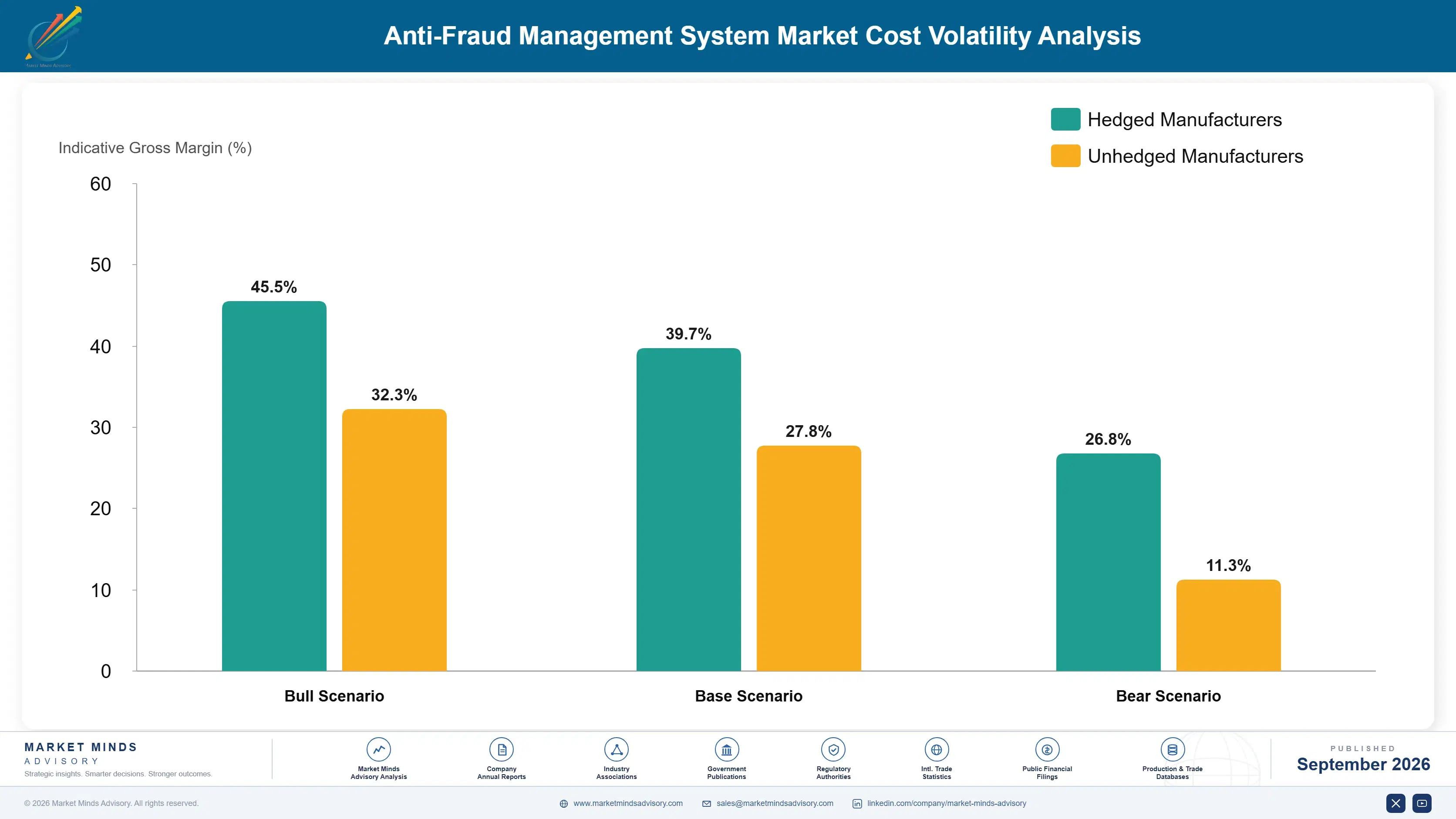
Vendor economics in this market split along three tiers. Commodity-adjacent rules-based transaction monitoring competes on price and volume, generating gross margins in the 48 to 56% range on contracts sensitive to competitive bidding pressure. Certified enterprise platforms serving established banking programs command 62 to 70% gross margins, reflecting the compliance barrier that limits switching once a platform is embedded in a customer's fraud operations.
AI-powered real-time detection and identity verification platforms occupy the premium tier, with margins reaching 75 to 82% where vendors demonstrate genuine model sophistication over legacy rule-based architectures. Volume rules-based contracts remain necessary to sustain customer base and reference accounts, but the highest-value pools concentrate where vendors sell verified detection outcomes rather than raw transaction screening capability. Vendors at this tier consolidate design wins across customer segments to justify the model development investment specialty capability requires.

This tension between volume rules-based screening and premium AI-driven detection margins defines vendor strategy today. Vendors increasingly bundle transaction monitoring, identity verification, and case management into unified contracts, pushing value capture toward platforms proving measurable fraud reduction rather than raw feature count. Vendors failing to demonstrate this depth risk displacement by rivals even where core detection technology remains competitive.

Basic rules-based transaction monitoring sold on per-account licensing with thin differentiation, competing primarily on price and screening coverage across smaller financial institution customers. Contract cycles run twelve months typically, and buyers frequently multi-source across two vendors to preserve negotiating leverage and coverage redundancy.
Gross Margin

Enterprise fraud platforms embedded in established banking compliance workflows, commanding higher retention and pricing power once procurement teams standardize on a single vendor across their organization. Expansion revenue accrues as institutions widen fraud coverage across additional product lines and business units over successive contract years.
Gross Margin

AI-powered real-time detection and identity verification platforms addressing emerging synthetic fraud typologies and evolving real-time payment settlement requirements for financial institutions. Pricing power remains strongest among vendors demonstrating both real-time speed and identity verification depth within a single unified platform.
Gross Margin
anti-fraud-management-system-market-portfolio-architecture-1788678237937

High-value Sub-segments and Strategic Watch-out

AI-Powered Real-Time Transaction Fraud Detection Platforms

Highest growth and highest value pool as instant payment adoption forces sub-second decisioning, commanding premium pricing and the strongest retention across the competitive set today. Vendors here increasingly price on decisioning speed, and financial institution buyers report willingness to pay a premium for verified sub-second performance.

Identity Verification and Synthetic Fraud Detection

Strong growth and healthy margins as synthetic identity losses accumulate substantial charge-off costs, though data science investment requirements keep the vendor base meaningfully smaller than transaction monitoring. Vendors with proprietary behavioral analytics retain pricing power even as more generic verification vendors attempt to enter this fast-growing segment.

Rules-Based Transaction Monitoring Systems

The volume core generating the bulk of installed base revenue, characterized by mature technology, thinner margins, and intense price competition among a large field of established vendors. Consolidation among smaller rules-based vendors is likely as larger platforms absorb this steady category into broader fraud management portfolios.

Case Management and Investigation Platforms

A strategic watch-out segment where growth trails the broader market, but regulatory tightening around investigation documentation could rapidly expand demand within the coming several years. Vendors positioned early around investigation workflow automation could capture disproportionate share if this shift accelerates faster than currently anticipated by most participants.

Compliance Depth Anchors Recurring Contracts

Anti-fraud platform contracts run almost entirely on annual subscription pricing tied to transaction volume, giving vendors predictable recurring revenue once a platform is embedded in a financial institution's fraud operations. Net revenue retention above 112% is common among leading vendors, driven by transaction volume growth and module attachment rather than price increases. This annuity quality supports valuation multiples well above one-time software licensing businesses common elsewhere.
Adoption depth varies by end-use vertical. Large banks and payment processors embed platforms deeply into compliance and case management workflows, producing switching costs that keep churn below 5% annually. Smaller regional banks adopt more selectively, running lighter-weight platforms for specific fraud categories rather than comprehensive deployment, which keeps churn meaningfully higher. Payment processors tie renewal decisions directly to detection accuracy, making displacement a business risk few risk teams accept.

Buyer profiles are shifting generationally as newer chief risk officers increasingly prioritize explainable AI and model governance over raw detection accuracy their predecessors specified throughout most of the prior decade. Younger risk leaders favor vendors offering transparent, auditable model architectures over black-box approaches their predecessors accepted without the same regulatory scrutiny. This shift is reshaping vendor roadmaps toward transparent reporting dashboards built for board-level audiences.
anti-fraud-management-system-market-end-use-penetration-index-1788678238422

Where MMA Sees the Advantage

These are among the four positions where our research anticipates prominent divergence between winners and laggards over the coming forecast period. Each is grounded in the demand model, the regulatory perimeter, and the announced capacity pipeline.
01 / REAL-TIME DETECTION INVESTMENT

Build sub-second decisioning ahead of batch-processing rivals

Real-time payment schemes are eliminating the batch-processing delay window banks previously used to catch fraud before funds cleared, and this transition is happening faster than most vendors' product roadmaps anticipated. Vendors still optimizing batch-processed screening are being excluded from new competitive bids entirely, regardless of established customer relationships built over years of prior program participation. Vendors investing now in sub-second decisioning architecture will keep winning these contracts as more payment schemes launch across additional countries over the coming several years.
02 / SYNTHETIC FRAUD CAPABILITY

Invest in synthetic identity detection ahead of competitors

Synthetic identity fraud losses are accumulating substantial charge-off costs before institutions discover fraudulent accounts, often months after origination, and vendors without dedicated detection capability are losing enterprise contracts to competitors who invested early. This capability gap is only widening as fraud rings become more sophisticated at blending real and fabricated personal information across jurisdictions and account types tracked by regulators. Vendors slow to build this detection capability risk ceding a fast-growing, high-value segment to more forward-positioned competitors already serving these customers across multiple institutions.
03 / EXPLAINABLE AI PRIORITY

Build model transparency before regulatory scrutiny intensifies further

Financial regulators in multiple jurisdictions are tightening requirements for explainable AI models that can justify individual fraud decisions, and vendors relying on black-box architectures are already facing deployment friction with compliance teams. Vendors investing early in explainable AI techniques that maintain accuracy while providing transparency are capturing share from vendors unable to satisfy these regulatory requirements quickly enough. Vendors slow to build this capability risk losing enterprise deals to more compliance-ready competitors already positioned well ahead of this regulatory shift across every jurisdiction MMA tracks.
04 / COMPUTE COST DISCIPLINE

Secure reserved cloud compute before capacity tightens further

Cloud compute capacity constraints are the single most cited cost pressure across this market, and vendors without reserved capacity agreements are absorbing spot-market pricing volatility that erodes margin considerably during periods of surging AI training demand. Vendors that secured multi-year compute agreements ahead of the current demand surge are protecting gross margin while competitors scramble for available capacity. Vendors slow to secure this capacity risk losing competitive bids to rivals with more predictable, contracted input costs locked in well ahead of the next demand surge.

Engagement Snapshot From the Field

A live engagement with an industry participant carrying material or product regulatory and market exposure ahead of a defining policy shift, showing how our research translates into a defensible multi-year portfolio strategy.
MARKET MINDS ADVISORY · CLIENT ENGAGEMENT SUMMARY
Anti-Fraud Management System Producer Strategic Portfolio Review and Transition Roadmap 2026·Investment Scenario on Anti-Fraud Management System Exposure Evaluation 2025-26
CLIENT PROFILE
The client is a regional retail bank with several hundred branches operating a legacy rules-based fraud detection system that had not been substantially upgraded in nearly a decade, facing rising synthetic identity fraud losses that its existing rule sets could not adequately detect. The bank had never evaluated AI-powered detection platforms against its specific fraud loss profile.
STRATEGIC CHALLENGE
The bank needed to select an AI-powered fraud detection platform capable of meeting demanding accuracy and false-positive reduction requirements while integrating with its existing core banking infrastructure without extended downtime during a critical regulatory examination period. Prior vendor sales presentations offered conflicting accuracy claims the bank needed to verify independently.
MMA APPROACH
MMA benchmarked five candidate vendors against the bank's specific fraud loss profile, false-positive tolerance, and integration timeline requirements, combining primary survey data with direct reference calls to comparable regional bank customers. The engagement produced a weighted scoring framework prioritizing integration speed alongside raw detection accuracy. Reference calls focused specifically on multi-branch deployment experience rather than single-location implementations.
KEY FINDINGS
  1. Two of the five candidate vendors lacked proven integration experience with the bank's specific core banking platform, introducing meaningful implementation risk. This risk had not been previously flagged internally.
  2. The selected vendor's platform reduced false positive rates by roughly 35% compared to the bank's existing rules-based system (client-reported, unverified by MMA).
  3. Total platform cost over five years came in approximately $1.8 million below the second-ranked alternative once integration services were included (client-reported, unverified by MMA).
  4. Insufficient internal data science evaluation capacity, not vendor availability, was the primary root cause of the bank's delayed modernization decision. Board-level urgency ultimately accelerated the modernization timeline.
CLIENT PROFILE
The client is a regional retail bank with several hundred branches operating a legacy rules-based fraud detection system that had not been substantially upgraded in nearly a decade, facing rising synthetic identity fraud losses that its existing rule sets could not adequately detect. The bank had never evaluated AI-powered detection platforms against its specific fraud loss profile.
STRATEGIC CHALLENGE
The bank needed to select an AI-powered fraud detection platform capable of meeting demanding accuracy and false-positive reduction requirements while integrating with its existing core banking infrastructure without extended downtime during a critical regulatory examination period. Prior vendor sales presentations offered conflicting accuracy claims the bank needed to verify independently.
MMA APPROACH
MMA benchmarked five candidate vendors against the bank's specific fraud loss profile, false-positive tolerance, and integration timeline requirements, combining primary survey data with direct reference calls to comparable regional bank customers. The engagement produced a weighted scoring framework prioritizing integration speed alongside raw detection accuracy. Reference calls focused specifically on multi-branch deployment experience rather than single-location implementations.
KEY FINDINGS
  1. Two of the five candidate vendors lacked proven integration experience with the bank's specific core banking platform, introducing meaningful implementation risk. This risk had not been previously flagged internally.
  2. The selected vendor's platform reduced false positive rates by roughly 35% compared to the bank's existing rules-based system (client-reported, unverified by MMA).
  3. Total platform cost over five years came in approximately $1.8 million below the second-ranked alternative once integration services were included (client-reported, unverified by MMA).
  4. Insufficient internal data science evaluation capacity, not vendor availability, was the primary root cause of the bank's delayed modernization decision. Board-level urgency ultimately accelerated the modernization timeline.
RECOMMENDED STRATEGY
Phase 1: Phase one: deploy the selected platform for the bank's highest-risk transaction categories ahead of the regulatory examination. This timing satisfied the examination's most urgent requirement. Phase 2: Phase two: extend deployment across remaining transaction categories over the following two quarters to achieve full coverage. This sequencing minimized disruption to ongoing branch operations. Phase 3: Phase three: establish quarterly model performance reviews to validate accuracy and false-positive reduction against original targets. This cadence gave leadership continuous visibility into rollout progress.
OUTCOME
The bank selected the vendor MMA's framework ranked highest and completed its highest-risk category deployment ahead of the regulatory examination, avoiding a compliance gap that risk leadership had previously considered likely. The remaining categories completed migration on the planned two-quarter schedule (client-reported, unverified by MMA).

Frequently Asked Questions

Foundational context covering the market sizes, CAGR, scope, country, region and competition that inform every finding below. This section is provided to cover basics and most often pre-purchase conversations, answered from the MMA Primary Research Dataset.

What is the current size of the Anti-Fraud Management System Market?

The market was valued at approximately $32.5 billion in 2025. Growth is being driven by rising synthetic identity fraud and real-time payment adoption across major economies.

How large will the Anti-Fraud Management System Market be by 2036?

MMA projects the market will reach approximately $97.5 billion by 2036. This reflects sustained financial institution investment in AI-powered detection and identity verification platforms worldwide.

What is the CAGR for the Anti-Fraud Management System Market 2026 to 2036?

The market is projected to grow at a compound annual growth rate of 10.5% between 2026 and 2036. This rate reflects both AI adoption and real-time payment demand.

Which segment is growing fastest?

AI-Powered Real-Time Transaction Fraud Detection Platforms is the fastest growing segment, expanding at 16.0% annually, roughly 1.52x the overall market rate. Instant payment adoption is driving this acceleration.

Who are the major companies in the Anti-Fraud Management System Market?

Leading companies include NICE Actimize, SAS Institute, FICO, ACI Worldwide, and Feedzai. These five vendors hold a combined 40% revenue share across the global market.

Which country is growing fastest?

India is the fastest growing country market, expanding at approximately 13.5% annually. Rapid digital payment adoption is driving this acceleration across the country's financial sector.

Report Segmentation Architecture

The full report scope spans multiple orthogonal segmentation dimensions, with cross-tabulated demand data provided for each dimension pair. Coverage extends further to regional breakdowns, trend trajectories, and the competitive detail needed to support segment-level decision-making.

By Primary Market Dimension

  • AI-Powered Real-Time Transaction Fraud Detection Platforms
  • Identity Verification and Synthetic Fraud Detection
  • Rules-Based Transaction Monitoring Systems
  • Case Management and Investigation Platforms
  • Credit and Application Fraud Detection
  • Merchant and E-Commerce Fraud Prevention

By End-Use Industry

  • Banking, Financial Services and Insurance
  • Payment Processors and Networks
  • E-Commerce and Retail
  • Telecommunications
  • Healthcare and Insurance
  • Government and Public Sector

By Commercial Dimension

  • Large Enterprise Financial Institutions
  • Small and Mid-Size Banks
  • Payment Service Providers
  • Direct Sales
  • Distribution Partners

By Region

  • North America
  • Western Europe
  • East Asia
  • South Asia and Pacific
  • Latin America
  • Middle East and Africa
  • Eastern Europe

Scope, Methodology, and Coverage

Every figure in this report is reproducible from documented input assumptions. The scope below maps the historical period, the forecast horizon, the segmentation dimensions, and the countries covered, alongside the underlying primary and qualitative methodology.
Historical Period
2020 to 2025
Forecast Period
2026 to 2036
Base Year
2025 (USD billions; MMA Primary Research Dataset, September 2026)
Market Definition
This report covers anti-fraud management software platforms that detect, prevent, and investigate fraudulent transactions and identity claims for financial institutions, payment providers, and e-commerce enterprises through rules-based and AI-driven analytics. It excludes general cybersecurity software not specifically designed for transaction fraud detection and identity verification hardware devices sold separately from software analytics platforms.
Quantitative Units
USD Billion, CAGR (%), 2020-2036
Segmentation Dimensions
By Primary Market Dimension, By End-Use Industry, By Commercial Dimension, By Region
Regions Covered
North America, Western Europe, East Asia, South Asia and Pacific, Latin America, Middle East and Africa, Eastern Europe
Countries Covered
United States, Canada, Germany, United Kingdom, France, China, Japan, South Korea, India, Australia, Brazil, Mexico, Saudi Arabia, UAE, South Africa, Poland
Key Companies Profiled
NICE Actimize, SAS Institute, FICO, ACI Worldwide, Feedzai, BAE Systems Applied Intelligence, Featurespace, Kount, Sift Science, Riskified, Signifyd, ThreatMetrix, GBG plc, TransUnion Fraud Prevention, LexisNexis Risk Solutions, Forter, Ravelin, Bottomline Technologies, Fiserv Fraud Solutions, ComplyAdvantage
Quantitative Methodology
Primary survey, n=3,800 respondents, Q4 2025, six countries; demand-side model with trade association cross-validation
Qualitative Methodology
47 expert interviews, Q4 2025; applied to validate demand model assumptions, identify emerging dynamics, and assess competitive positioning
Report Format
PDF and XLSX data workbook (Word format preview document)
Publisher
Market Minds Advisory
Report Code
MMA-2026-TEC-806
Published
September 2026
Contact
sales@marketmindsadvisory.com | www.marketmindsadvisory.com

Purchase the full Anti-Fraud Management System Market Report (2026 to 2036).

This report provides a comprehensive assessment of the global anti-fraud management system market, covering historical performance from 2020 to 2025 and a detailed forecast through 2036. It examines segmentation across transaction monitoring, identity verification, case management, and merchant fraud categories, alongside regional demand dynamics across all seven world regions. The competitive landscape section profiles twenty companies and benchmarks the five leading vendors on a revenue basis. Analysis includes input cost exposure, portfolio margin economics, and strategic recommendations for market participants. The report also includes an anonymized client case study demonstrating practical vendor selection in a real regional bank modernization engagement.
Ten-year market sizing and forecast model
Six-segment MECE market segmentation framework analysis
All seven world regional markets profiled fully
Twenty-company competitive benchmarking dataset included here
AI talent and compute cost risk analysis
Anonymized client case study with strategy

Built For The People Who Decide

From boardroom strategy to bench-side execution, this report is read cover-to-cover by leaders shaping the next decade of their industry, turning demand scenarios, market dynamics and valuation benchmarks into decisions.
CXOs/ Presidents/ VPs/ Managers
M&A and Corporate Development
Strategy Teams and R&D Heads
Procurement and Product Directors
Regulatory and Compliance Leaders
Investor Relations and Equity Analysts