Market Minds Advisory
Anti-Foaming Agents / Defoamers Market

Anti-Foaming Agents / Defoamers Market: Anti-Foaming Agents / Defoamers Market. Application-Specific Formulation as Competitive Edge

Industrial manufacturers race to reformulate away from silicone-based defoamers as food-grade and water treatment applications demand residue-free alternatives, while bio-based chemistry reshapes which suppliers can meet tightening environmental discharge regulations.

Lead Analyst

Published

September 2026

Make Smarter Decisions with Customized Research Insights

Request a free sample report and evaluate market opportunities, growth trends, and competitive dynamics relevant to your business needs.

2025 MARKET VALUE$5.8BMarket Size 2025
2036 FORECAST VALUE$9.5BBase Case , 2026 to 2036
CAGR 2026 TO 20364.6 %Bull 5.8% / Bear 3.4%
INCREMENTAL OPPORTUNITY$3.5BNet 10- year value creation
EXPANSION MULTIPLE1.57x2036 value over 2026 base
Strategic Levers
M&A Pipeline
Regional Outlook
Country Rankings
Competitive Intelligence
Segmental Deep-dive
Call-Us : 91 93563 13602

Executive Snapshot and Market Trajectory.

Anti-foaming agents have moved from a commodity processing aid to a formulation-critical input, as manufacturers increasingly demand application-specific defoamers rather than generic multi-purpose products across industrial processes and end-use categories spanning most major manufacturing sectors, price tiers, and geographic markets globally and consistently over time and across most price ranges.
Water treatment and food processing applications are pulling disproportionate revenue growth, concentrated among East Asian and North American manufacturers who require residue-free, regulatory-compliant formulations rather than the silicone-heavy defoamers historically dominant in industrial processing across most facility types, production scales, and end-use applications tracked. Brands investing in bio-based, readily biodegradable chemistry are capturing outsized share among buyers who previously avoided switching suppliers due to reformulation costs, validation timelines, and regulatory filing requirements.
Established specialty chemical conglomerates and regional formulators compete on distinctly different terms, as bio-based chemistry innovation and regulatory compliance testing increasingly determine which suppliers can credibly serve food-grade and water treatment end markets. Independent regional formulators increasingly partner with contract testing labs to generate the compliance documentation larger conglomerates historically monopolized through in-house regulatory affairs teams and dedicated laboratory infrastructure built over decades.
Market Definition
The anti-foaming agents and defoamers market covers silicone-based, oil-based, and water-based formulations used to prevent or reduce foam formation across industrial processing, water treatment, food and beverage, pulp and paper, and oil and gas applications. It excludes surfactants and detergents not marketed specifically for foam control functionality.
Base Year Value
$5.8B in 2025 (MMA Primary Research Dataset, September 2026)
Forecast Period
2026 to 2036, eleven discrete annual values
CAGR
4.6% base case. Bull 5.8%. Bear 3.4%.
Fastest Growth Segment
Water Treatment Defoamers: 6.8% CAGR
Fastest Growth Country
India: 7.1% CAGR
Fastest Growth Region
South Asia and Pacific: 6.6% CAGR
Largest Region
East Asia: 30% of 2025 global value
Market Leaders
Dow Inc., BASF SE, Wacker Chemie AG, Evonik Industries, Elkem ASA. Source: MMA Analysis based on company annual reports.
Primary Survey
n=3,800 procurement and R&D decision-makers, Q4 2025, six countries
Methodology
Demand-side build-up, cross-validated against public data, 47 expert interviews

Anti-Foaming Agents / Defoamers Market Forecast Scenarios

anti-foaming-agents-defoamers-market-size-forecast-scenario-1790016653092
Between 2020 and 2025, defoamer demand grew steadily as industrial production volumes recovered from pandemic disruptions, then continued expanding as water treatment infrastructure investment accelerated across developing economies facing growing industrial wastewater treatment requirements across most producing and consuming regions worldwide, with East Asian markets leading demand growth considerably ahead of most Western peers globally.
The base case rests on three commercial mechanisms operating together: water treatment infrastructure investment expanding defoamer demand in emerging markets, bio-based chemistry innovation resolving regulatory compliance concerns limiting silicone-based product adoption, and food and beverage manufacturers requiring residue-free formulations meeting tightening safety standards across multiple price tiers and end-use categories worldwide. Together these mechanisms support steady growth even as overall industrial chemical demand growth moderates from post-pandemic peaks across most consuming markets.
The bull case rests on water treatment defoamers scaling faster than expected as infrastructure investment accelerates globally across most developing economies and emerging markets nationwide. The bear case centers on raw material cost inflation outpacing manufacturers' ability to maintain competitive pricing, compressing margins across the category faster than volume growth can offset over the next several forecast years.

Application-Specific Formulation Reshapes Category Economics

Anti-foaming agents have shifted from an interchangeable processing aid to an application-specific formulation decision, as buyers increasingly require defoamers calibrated to their exact process conditions rather than generic multi-purpose products that historically dominated the category across most industrial sectors and price tiers worldwide. This shift is converging with tightening food safety and environmental discharge regulations across East Asian and North American markets.
MARKET CONCENTRATIONCR5 34%top five producers hold moderate combined market share
AVERAGE SELLING PRICE$2.80/kgblended industrial and food-grade formulation price across most markets
TOP PRODUCING COUNTRYChina 32%share of global defoamer manufacturing capacity currently installed
WATER TREATMENT END-USE SHARE24%share of global defoamer volume consumed by water treatment
SILICONE INPUT COST SHARE42% COGSsilicone and mineral oil input share of production cost
REFORMULATION CYCLE4 yearsaverage interval before manufacturers update defoamer product formulations
Commercially, water treatment and food processing buyers are driving demand for bio-based, readily biodegradable formulations that avoid the regulatory scrutiny silicone-heavy defoamers increasingly face across most consuming markets, price tiers, and application categories. Established conglomerates are responding by acquiring or partnering with bio-based chemistry specialists to close the formulation gap faster than building comparable in-house expertise from scratch, particularly in fast-growing water treatment segments and food processing verticals.
Over the next decade, regulatory compliance testing and bio-based chemistry innovation will separate suppliers who can supply credible residue-free claims from those relying on legacy silicone formulations alone, while water treatment infrastructure investment tests whether defoamer demand can sustain growth beyond mature industrial processing end markets and into emerging economies broadly, consistently, and quite profitably.
"Defoamers used to be an afterthought line item in a formulation budget. Now regulatory compliance alone can determine which suppliers get shortlisted, and most legacy silicone producers still haven't adjusted to that reality."
Director, Specialty Chemicals and Industrial Formulation Practice · MMA Chemicals and Materials Practice · September 2026

Market Trends

Bio-Based Defoamer Formulations Gain Regulatory Favor

Major food and beverage manufacturers have expanded bio-based defoamer procurement to cover roughly 27 percent of new formulation approvals, up sharply from a marginal share several years ago as regulatory bodies tighten silicone residue tolerance thresholds across most consuming markets, price tiers, and application categories tracked worldwide. This shift is normalizing bio-based chemistry as a legitimate industrial standard rather than a premium niche reserved for specialty applications. Manufacturers report bio-based defoamer lines generating meaningfully higher margin than legacy silicone formulations, even as unit volumes run comparably across most processing categories.
Market Impact: Sustains demand growth of roughly 7%
Water Treatment Infrastructure Investment Expands Defoamer Demand

Global water treatment infrastructure investment has expanded defoamer demand considerably, with roughly 24 percent of total category volume now consumed by water treatment applications compared to a smaller share a decade ago across most consuming regions, price tiers, and application categories tracked worldwide and beyond. This infrastructure-driven demand responds directly to tightening industrial wastewater discharge regulations requiring effective foam control during treatment processes across most municipal and industrial facilities. Manufacturers investing in water-treatment-specific formulations report stronger conversion rates among municipal and industrial buyers previously served by generic multi-purpose defoamer products.
Market Impact: Expands demand among 24% of processors

Market Opportunities and Growth Drivers

Wastewater Treatment Regulation Drives Compliant Demand

Rising industrial wastewater treatment regulation continues driving demand for effective, regulatory-compliant defoamers as municipalities and industrial facilities face tightening discharge standards limiting foam and residue in treated effluent across most producing and consuming regions worldwide, forecast periods, and price tiers alike. Manufacturers in particular research compliance documentation before purchase, favoring suppliers publishing third-party environmental testing results over those relying on marketing claims alone. This behavior shift is sustaining demand growth even as broader industrial chemical spending faces periodic pressure from economic uncertainty affecting comparable categories generally across most markets and price tiers.
Market Impact: Raises input costs by roughly 16%

Food Safety Scrutiny Expands Residue-Free Demand

Growing food and beverage industry safety scrutiny is driving demand for residue-free, food-grade defoamer formulations as manufacturers face increasing consumer and regulatory pressure around ingredient transparency across most processing facilities, product categories, price tiers, and geographic markets worldwide and beyond national borders. Food safety auditors increasingly require documented defoamer compliance during facility inspections, creating a professional gatekeeping channel that drives incremental purchase behavior beyond traditional procurement relationships. This audit-driven demand is proving durable rather than a passing trend, with repeat compliant defoamer purchases growing steadily among processors nationwide and internationally.
Market Impact: Extends sales cycles by 6 months

Market Restraints and Challenges

Silicone Feedstock Cost Burden on Smaller Manufacturers

Silicone and mineral oil input costs have risen steadily as global petrochemical feedstock prices remain elevated, compressing manufacturer margins across nearly every price tier of defoamer production and end-use category tracked worldwide. The root cause is manufacturers' heavy reliance on petroleum-derived silicone compounds that lack readily available lower-cost substitutes without sacrificing the foam control performance buyers require. The commercial impact concentrates among smaller manufacturers lacking pricing power to pass costs through without losing contracts to larger competitors. Some manufacturers are exploring bio-based alternatives to partially offset rising silicone feedstock costs.
Market Impact: Covers 27% of new formulation approvals

Reformulation Costs Discourage Rapid Supplier Switching

Reformulation costs and validation timelines discourage buyers from switching defoamer suppliers even when better-performing or more cost-effective alternatives become available, since process validation for a new defoamer formulation can take several months and requires extensive production trial runs across multiple shifts. The root cause is the technical complexity of confirming a new formulation performs consistently across variable production conditions without introducing unexpected process disruptions. The commercial impact includes prolonged sales cycles and switching costs that favor incumbent suppliers regardless of competitive alternatives. Some suppliers are mitigating this through extended trial support programs.
Market Impact: Consumes 24% of total category volume
3 additional market trends, 3 additional growth drivers, and 4 additional restraints and challenges are covered in the full report. Contact sales@marketmindsadvisory.com to access the complete intelligence.

Segment CAGR and Growth Architecture

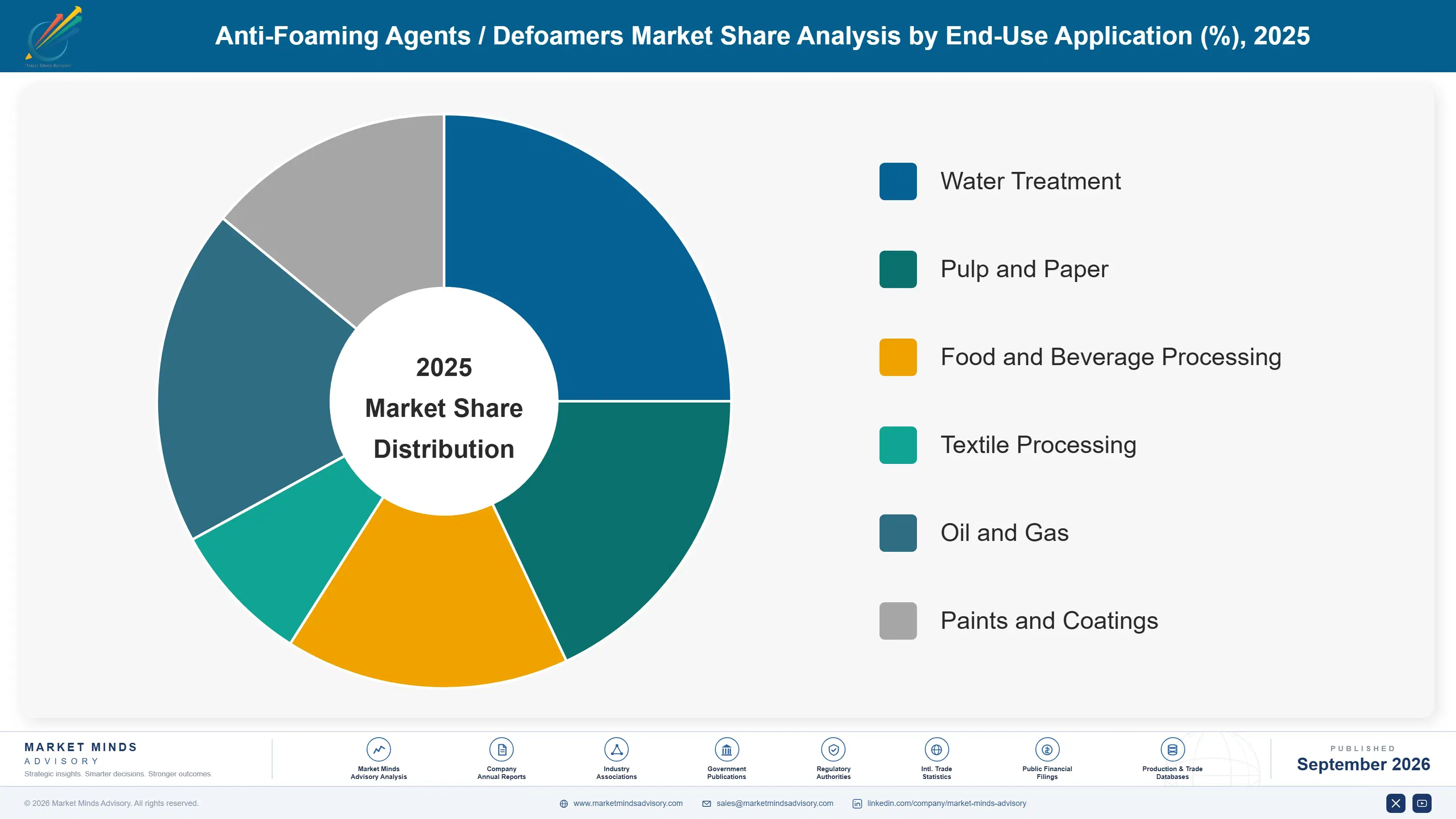
Segmentation follows end-use application, the dimension driving both formulation requirements and regulatory obligations across most industrial categories worldwide and price tiers. Water treatment, pulp and paper, food and beverage processing, textile processing, oil and gas, and paints and coatings each carry distinct performance criteria and compliance standards worth tracking separately across the full forecast period.
anti-foaming-agents-defoamers-market-market-share-analysis-1790016654724

Water Treatment Defoamers

Water treatment defoamers lead segment growth as municipal and industrial wastewater infrastructure investment accelerates globally, driven by tightening discharge regulations requiring effective foam control before treated water release across most consuming regions, price tiers, and geographic markets worldwide and across most forecast years. These formulations command steady demand growth since water treatment facility construction continues expanding across developing economies facing growing urbanization and industrial wastewater volumes. Manufacturers supplying water-treatment-specific formulations are capturing disproportionate share from generic multi-purpose defoamer suppliers, since municipal buyers increasingly specify formulations tested against local water chemistry conditions and discharge requirements. This specification-driven purchasing is reshaping competitive dynamics considerably across the broader category and price tiers nationwide.
CAGR 6.8%

Food and Beverage Processing Defoamers

Food and beverage processing defoamers remain the second-fastest-growing segment as manufacturers face increasing regulatory scrutiny around ingredient safety and residue tolerance in finished consumer products across most producing and consuming regions, price tiers, product categories, and geographic markets worldwide. Food-grade formulations command meaningful pricing premiums since achieving residue-free, non-toxic performance requires specialized chemistry that commodity industrial defoamers cannot replicate. Younger regulatory frameworks in developing markets are increasingly aligning with stricter Western food safety standards, expanding the addressable market for compliant formulations considerably and steadily each year. Manufacturers publishing third-party food safety certification are capturing disproportionate share from competitors relying on unverified safety claims and generic marketing language alone across most markets.
CAGR 6.2%
Full segment breakdown across 6 segments available in the complete report.

Regional Architecture and Country Demand Map

East Asia leads global share on China's dominant industrial manufacturing base across pulp and paper, textiles, and water treatment nationwide and beyond, followed by North America's mature industrial chemical infrastructure across most industrial sectors. South Asia and Pacific grows fastest as industrial capacity expands rapidly nationwide.

North America

North America's defoamer demand centers heavily on a mature industrial chemical infrastructure spanning water treatment, food processing, and pulp and paper applications, with roughly 23 percent of global revenue tied to established manufacturing sectors, price tiers, and end-use categories. Regulatory scrutiny from the EPA over industrial wastewater discharge continues driving strong demand for compliant, effective foam control formulations nationwide and across most sectors. Canadian demand tracks closely with US patterns, though at smaller absolute scale across comparable industrial sectors, price categories, regional markets, and application types. Domestic manufacturers with established regulatory affairs infrastructure hold a meaningful advantage over newer entrants lacking comparable compliance documentation capability, testing resources, and technical staff.
Share: 23% | CAGR: 4.2% (2026 to 2036)

Western Europe

Western Europe combines strict EU environmental regulation firmly with a mature specialty chemical manufacturing base, anchored by German and French producers whose compliance credibility commands premium pricing even as regional growth trails faster-expanding Asian markets, comparable price tiers, retail formats, and consumption patterns. Dutch and Belgian water treatment infrastructure investment continues driving steady defoamer demand across the broader European market, neighboring economies, and adjacent industrial zones. German industrial buyers increasingly favor bio-based formulations addressing tightening EU chemical regulation, narrowing the gap between legacy silicone and next-generation formulation chemistry. Regulatory leadership on chemical safety, driven by REACH compliance requirements, continues to set the benchmark other regions follow closely each year and budget cycle.
Share: 20% | CAGR: 3.0% (2026 to 2036)
Regional intelligence for 5 additional markets available in the complete report: East Asia, South Asia and Pacific, Latin America, Middle East and Africa, Eastern Europe. Contact sales@marketmindsadvisory.com.
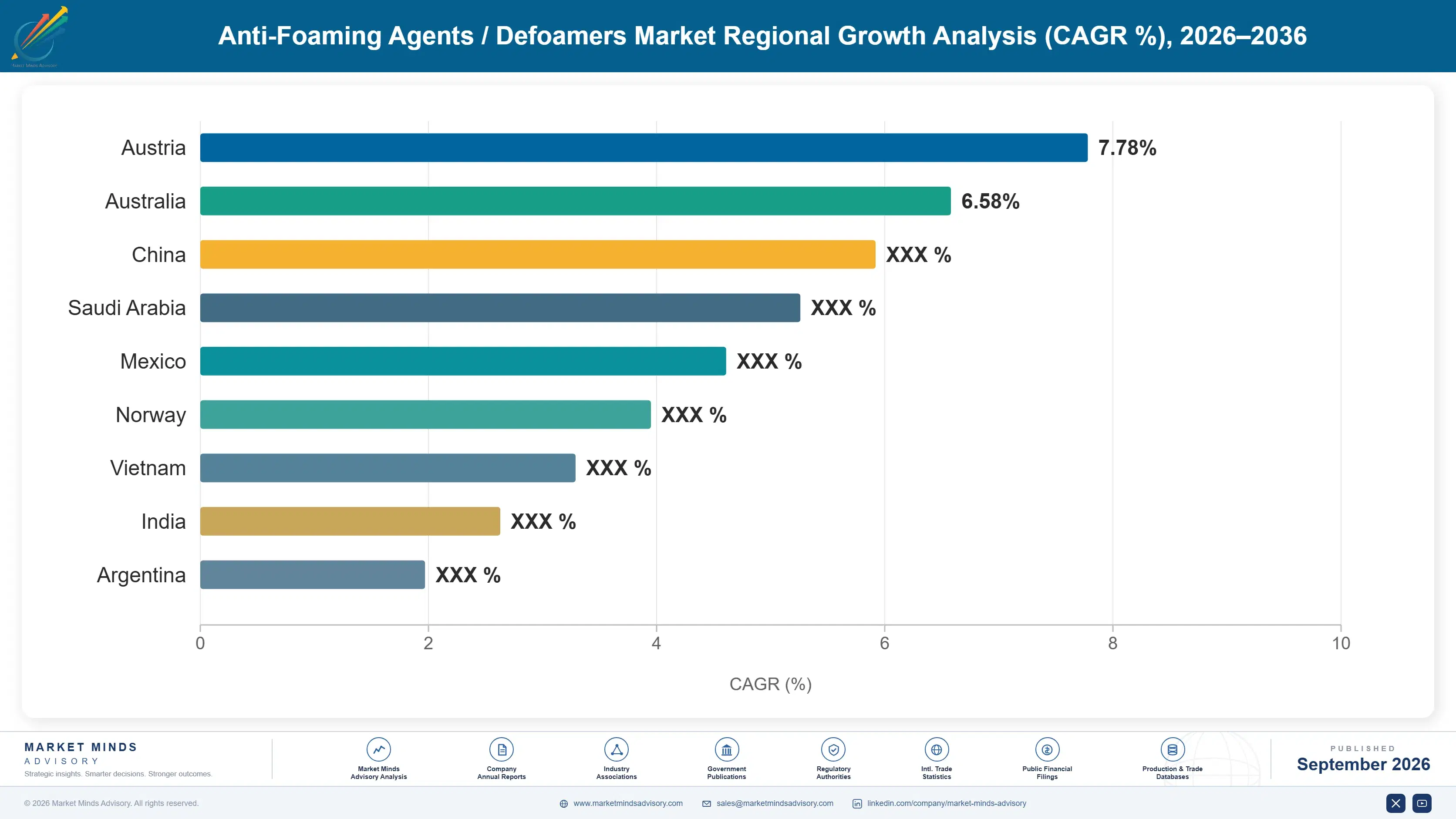
anti-foaming-agents-defoamers-market-country-cagr-analysis-1790016655871

Where Defoamer Margin Actually Concentrates

Four levers separate defoamer suppliers capturing outsized margin from those competing purely on price: bio-based chemistry investment, water treatment specification development, food-grade certification, and regional manufacturing localization. Each shifts revenue toward credibility-backed premium pricing rather than commodity price competition across most industrial end-use categories, price tiers, and geographic markets tracked closely in this report.

Invest Early in Bio-Based Chemistry Development

Suppliers investing in bio-based, readily biodegradable defoamer chemistry ahead of regulatory mandates secure premium pricing roughly 22 percent above legacy silicone formulations while avoiding the tightening environmental compliance scrutiny facing petroleum-derived products across most consuming markets, price tiers, and end-use categories tracked. Buyers increasingly favor bio-based suppliers during procurement evaluations, since adoption reduces their own regulatory exposure and future reformulation risk. Suppliers that delay bio-based investment risk losing contracts entirely once regulatory bodies formalize environmental discharge standards across their full customer base, a shift already underway across major industrial markets.
Market Impact: Commands a 22 percent price premium over legacy formulas

Develop Dedicated Water-Treatment-Specific Formulation Product Lines

Water-treatment-specific defoamer formulations command retail pricing premiums averaging 18 percent over generic multi-purpose products, driven by municipal and industrial buyers requiring formulations validated against local water chemistry conditions across most consuming regions, price tiers, facility types, and treatment methods tracked worldwide and across forecast years. Suppliers developing dedicated water treatment lines capture infrastructure investment growth before larger conglomerates fully replicate this positioning across comparable regions and price tiers worldwide. This positioning also opens municipal procurement channels that traditional industrial defoamer suppliers rarely access, creating an additional revenue stream beyond conventional distribution.
Market Impact: Commands an 18 percent pricing premium over generic formulas

Secure Food-Grade Certification Ahead of Competitors

Suppliers securing food-grade certification ahead of competitors capture food and beverage processing contracts requiring documented residue-free performance, a segment growing faster than industrial applications broadly across most consuming markets, price tiers, product categories, geographic regions, and distribution networks tracked closely, consistently, and comprehensively. Certification typically takes 6 to 9 months and also opens premium contract opportunities with multinational food manufacturers who require verified supplier compliance before qualifying new formulations for production use across most facilities and price tiers tracked. Suppliers executing certification successfully report contract win rates substantially higher than uncertified competitors submitting comparable formulations for consideration.
Market Impact: Wins food-grade contracts at rates roughly 2x higher

Localize Manufacturing Across Key Regional Markets

Suppliers localizing manufacturing across regional markets capture cost and logistics advantages that pure export-based competitors increasingly cannot match, as local production avoids tariff exposure and shipping cost volatility affecting imported formulations across most price tiers, geographic markets, end-use categories, distribution channels, and customer segments worldwide, consistently, reliably, and quite profitably. Local production typically cuts landed cost by 15 percent. This positioning also builds closer customer relationships and faster technical support response times than suppliers serving markets remotely from centralized production facilities. Manufacturers report regional production facilities generating meaningfully higher customer retention than suppliers relying solely on cross-border export relationships.
Market Impact: Improves customer retention by roughly 20 percent overall

Who Controls the Margin Pool

Ranked on global revenue from defoamer product sales, the market carries a CR5 near 34 percent, with Dow and BASF leading over Wacker Chemie, Evonik Industries, and Elkem across most tracked geographies and price tiers. The gap between the top two and the rest of the field reflects deeper formulation R&D infrastructure and regulatory affairs capability rather than manufacturing scale alone.
Current competitive activity centers on bio-based chemistry investment, water treatment specification development, and food-grade certification as regulatory scrutiny tightens across major consuming markets, price tiers, and end-use categories tracked closely. Several conglomerates are also acquiring or partnering with regional formulators to close the geographic coverage gap faster than building comparable local manufacturing from scratch, particularly in fast-growing water treatment segments.

Emerging pressure comes from Chinese and Indian domestic manufacturers exporting both finished products and cost-competitive formulation methodology, plus independent regional formulators gaining share through localized technical support that bypasses centralized multinational distribution entirely across most price tiers. Rankings could shift meaningfully if Asian manufacturers continue converting cost advantages into global market share faster than Western incumbents can respond with comparable regional infrastructure and technical support.
anti-foaming-agents-defoamers-market-company-positioning-matrix-1790016656421

Competitive Moat and Risk Dimensions

DOW INC.

Moat: Broadest Multi-Application Formulation Portfolio

Dow operates across silicone, oil-based, and water-based defoamer chemistries simultaneously, letting it serve virtually every industrial end-use application without losing customers to specialist competitors entirely. This portfolio breadth also spreads regulatory compliance testing costs across a far larger revenue base than smaller single-chemistry competitors can match.
DOW INC.

Risk: Slower Bio-Based Chemistry Transition

Dow's scale and established silicone manufacturing infrastructure can slow adoption of bio-based chemistry relative to nimbler independent formulators willing to commercialize novel chemistry faster with less extensive internal validation, potentially ceding early-mover advantage in this fast-growing segment to smaller, faster-moving competitors across every price tier.
BASF SE

Moat: Deep Regulatory Testing Infrastructure

BASF maintains extensive in-house regulatory affairs and testing infrastructure built over many decades of continuous global operation, letting it navigate complex food-grade and environmental compliance requirements much faster than smaller competitors lacking comparable regulatory expertise, documentation capability, dedicated testing laboratories, and long-standing agency relationships worldwide.
BASF SE

Risk: Vulnerable to Regional Cost Competition

BASF's premium positioning and centralized manufacturing structure leave it exposed to regional Asian manufacturers offering comparable performance at meaningfully lower price points, particularly among cost-sensitive buyers less willing to pay for global brand infrastructure they do not directly need or value across most price-sensitive markets.

Players Tracked

Prominent Players

Dow Inc.
BASF SE
Wacker Chemie AG
Evonik Industries
Elkem ASA

Other Key Players

Momentive Performance Materials
Shin-Etsu Chemical
Kemira Oyj
Solvay S.A.
Ashland Inc.
Air Products and Chemicals
Clariant AG
Ecolab Inc.
Buckman Laboratories
Munzing Chemie GmbH
PMC Biogenix
Foam Tec International
Grace Specialty Chemicals
Innospec Inc.
Trans-Chemco Inc.

Recent Developments

JANUARY 2026

Dow Launches Bio-Based Defoamer Line for Food Applications

Dow launched a bio-based defoamer line targeting food and beverage processing applications, its first fully biodegradable formulation series across the entire portfolio launched to date this year. The launch responds directly to tightening food safety regulations requiring residue-free foam control formulations across most processing facilities nationwide.
Signal: Signals major conglomerates are formalizing bio-based chemistry into core product development priorities and long-term strategies industry-wide
AUGUST 2025

BASF Acquires Regional Water Treatment Formulation Specialist

BASF acquired a mid-sized regional formulator specializing in water treatment defoamers, adding roughly 40 new municipal and industrial customer relationships across multiple European countries within a single completed transaction finalized this quarter. The acquisition strengthens the company's presence in the fast-growing water treatment infrastructure segment.
Signal: Signals major conglomerates are increasingly buying specialized water treatment expertise rather than building it entirely internally
APRIL 2026

Wacker Chemie Expands Manufacturing Capacity in India

Wacker Chemie expanded its defoamer manufacturing capacity in India to serve growing regional textile and water treatment demand, its largest capacity investment in South Asia to date by a significant margin. The expansion builds on the company's existing regional distribution network and technical support infrastructure.
Signal: Signals specialty manufacturers are aggressively prioritizing localized capacity investment in fast-growing emerging markets worldwide right now

Silicone Feedstock Supply Exposure

Silicone and mineral oil inputs account for roughly 42 percent of finished defoamer cost of goods sold, sourced from a concentrated base of petrochemical processors headquartered in the United States, Germany, and China, with specialty surfactant additives sourced from Japan and Belgium feeding downstream formulation and blending operations across most producing regions worldwide, forecast years, price tiers, and end-use categories.
Silicone feedstock prices spiked sharply during 2024 after a major German chemical facility temporarily halted production for environmental compliance upgrades, a volatility event documented in company annual reports from major specialty chemical manufacturers, forcing several mid-tier formulators to seek alternative silicone sourcing within a single production quarter and renegotiate longer-term supply contracts with alternative regional suppliers across multiple sourcing countries, manufacturing hubs, and shipping routes.

Larger manufacturers with long-term silicone supply contracts absorb this volatility more easily than smaller formulators purchasing on shorter-term spot arrangements, widening the cost gap between established and emerging manufacturers during price spikes considerably across most product categories, price tiers, and geographic markets. Import-dependent formulators face additional exposure to shipping cost volatility and tariff policy changes affecting specialty chemical imports specifically.
anti-foaming-agents-defoamers-market-cost-volatility-analysis-1790016656623

Diversify Silicone Sourcing Across Multiple Countries

Manufacturers are diversifying silicone sourcing across the United States, Germany, and China, reducing exposure to any single production facility or region for a critical formulation ingredient supply chain and manufacturing base. This flexibility lets brands substitute during supply disruptions while maintaining consistent foam control performance and avoiding costly reformulation delays under time pressure from customers.

Lock In Long-Term Silicone Supply Contracts

Larger manufacturers are signing multi-year supply agreements directly with silicone compound suppliers, bypassing volatile spot markets entirely for core ingredient volumes needed across their full product range and price tiers. These contracts lock in pricing and volume commitments years ahead, insulating formulators from facility-specific disruption that smaller competitors purchasing spot remain fully exposed to.

Portfolio Architecture for Margin Defence

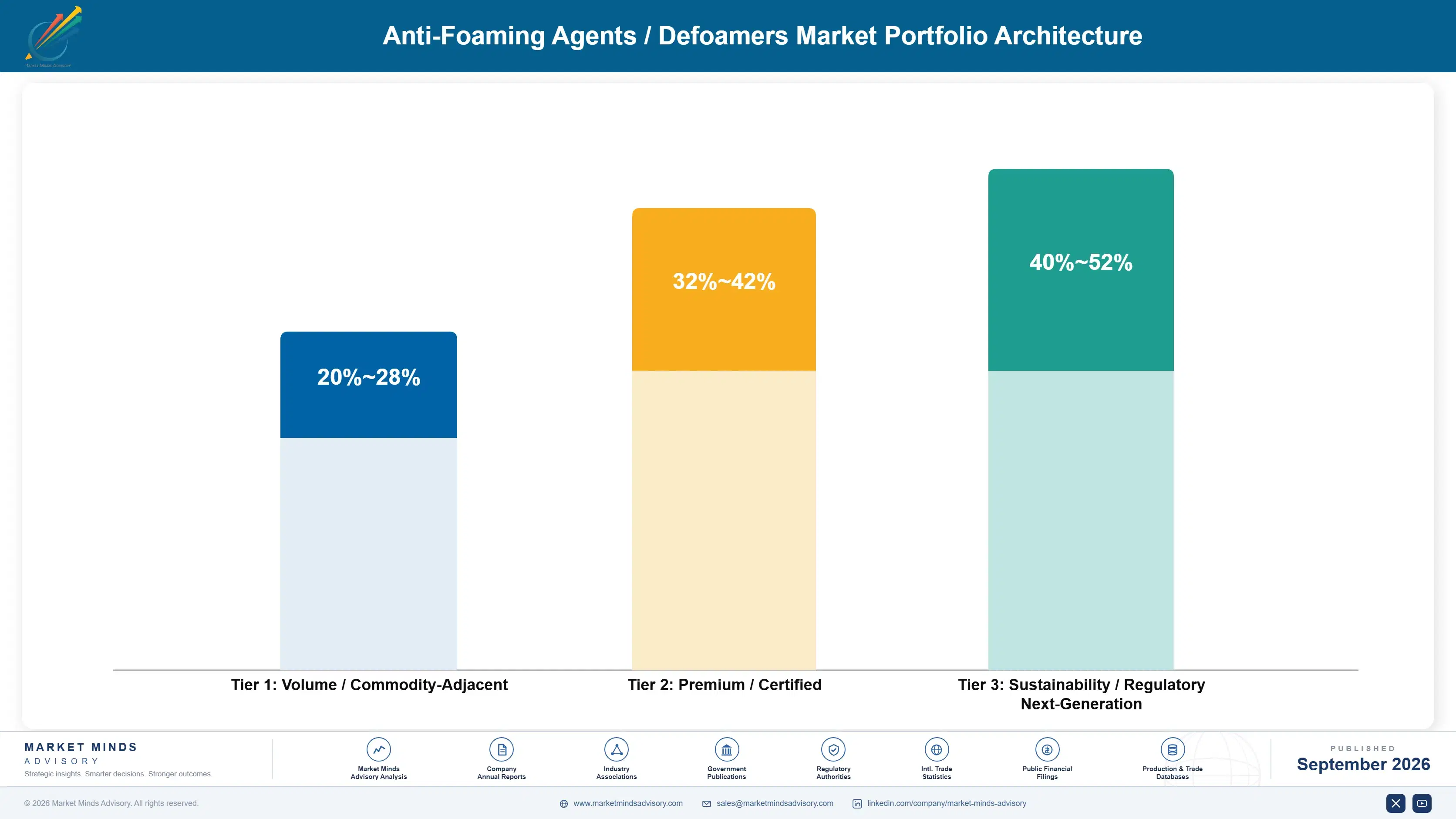
Defoamers split into three tiers by margin structure: mass-market commodity silicone products sold on price and basic performance, certified premium lines commanding trust through regulatory compliance testing premiums, and next-generation bio-based and water-treatment-specific formulas built around technical credibility across most retail and industrial formats and price tiers. Volume commodity products carry gross margins typically between 20 and 28 percent across mass channels.
Certified premium lines, backed by third-party regulatory compliance testing, command gross margins of 32 to 42 percent, reflecting trust and performance verification buyers pay for beyond raw material cost alone across most price tiers and retail formats. Bio-based and water-treatment-specific formulations sit at the top of the value pool, often exceeding 46 percent gross margin given specialized chemistry and limited early competition worldwide.

The tension between volume and premium tiers shapes capital allocation heavily, since scaling regulatory compliance credibility requires deliberate testing investment rather than manufacturing expansion alone across every product line, price tier, and geographic market tracked. High-value pools concentrate in East Asian formulation science hubs and North American water treatment specialists, where buyers consistently pay meaningfully more for verified performance and compliance documentation.

Volume / Commodity-Adjacent

Mass-market silicone defoamers sold primarily on price and basic foam control performance across commodity industrial channels, competing heavily on volume contracts, distributor relationships, and long-term supply agreements with major buyers.
Gross Margin: 20-28%

Premium / Certified

Third-party regulatory compliance certified lines sold through specialty industrial and food-grade channels, commanding trust and performance verification premiums over uncertified competitors lacking documented testing, traceable formulation records, and consistent quality assurance.
Gross Margin: 32-42%

Sustainability / Regulatory / Next-Generation

Bio-based and water-treatment-specific formulas targeting technical credibility and environmental compliance positioning, commanding outsized margins given specialized chemistry requirements and limited early-stage competition across most markets, geographic regions, and price categories.
Gross Margin: 40-52%
anti-foaming-agents-defoamers-market-portfolio-architecture-1790016657139

High-value Sub-segments and Strategic Watch-out

Water Treatment Defoamers

The fastest-growing and highest-margin segment, driven by infrastructure investment and tightening discharge regulations, sustaining premium specification-driven pricing insulated from commodity industrial competition across most consuming markets, price tiers, distribution channels, forecast years, regulatory frameworks, and municipal buyer segments tracked in this comprehensive report and dataset.
Gross Margin: 45-56%

Food and Beverage Processing Defoamers

A high-value, moderately fast-growing segment revitalized by residue-free chemistry innovation, now commanding renewed buyer trust after achieving genuinely non-toxic performance credentials across most mass and specialty retail formats worldwide, regulatory frameworks, certification standards, audit requirements, buyer expectations, quality benchmarks, testing protocols, and industry norms tracked closely.
Gross Margin: 35-46%

Pulp and Paper Defoamers

The volume core of the market, anchoring overall category revenue even as growth concentrates increasingly in water treatment and bio-based formats instead across most producing and consuming regions, price tiers, end-use categories, geographic markets, distribution channels, buyer demographics, purchase cycles, and contract structures tracked closely.
Gross Margin: 20-28%

Legacy Silicone Formulations Facing Regulatory Scrutiny

A strategic watch-out as regulatory scrutiny intensifies around silicone residue tolerance thresholds, risking costly reformulation or market exit for suppliers lacking bio-based alternatives across most consuming markets, price tiers, geographic regions, distribution channels, buyer categories, compliance timelines, enforcement mechanisms, and audit cycles tracked in this report.
Gross Margin: n/a

Continuous Procurement Loyalty Economics

Defoamer purchasing follows recurring production-cycle procurement rather than one-time capital decisions, since manufacturers consume defoamers continuously across ongoing production processes rather than periodic replacement events, generating steadier revenue than discretionary chemical categories track across comparable forecast periods and buyer cohorts worldwide, particularly among large-volume industrial contracts, long-term supply agreements, municipal procurement cycles, annual budget planning, and multi-year vendor relationships.
Adoption depth varies by vertical across the entire category. Water treatment and food processing buyers show the deepest switching resistance once a validated formulation proves effective, since reformulation validation requires extensive testing and regulatory documentation, while pulp and paper buyers switch more readily between commodity suppliers chasing lower per-unit pricing rather than maintaining consistent supplier relationships across most contract cycles, price tiers, regional markets, production scales, and end-use categories.

Generational buyer shifts favor regulatory compliance documentation and bio-based credibility over supplier heritage alone, as younger procurement teams raised on sustainability-conscious corporate mandates treat environmental compliance claims as verifiable data points rather than the marketing trust older generations extended without question, reshaping supplier loyalty economics considerably across most consuming markets, price tiers, distribution channels, and buyer demographics.
anti-foaming-agents-defoamers-market-end-use-penetration-index-1790016657644

Priority Moves for Defoamer Suppliers

These are among the four positions where our research anticipates prominent divergence between winners and laggards over the coming forecast period. Each is grounded in the demand model, the regulatory perimeter, and the announced capacity pipeline.
01 / BIO-BASED CHEMISTRY INVESTMENT

Invest in Bio-Based Chemistry Before Mandates Arrive

Regulatory bodies are already tightening silicone residue tolerance thresholds across major consuming markets, price tiers, and end-use categories, and this compliance trend shows no sign of reversing given growing environmental discharge scrutiny worldwide and across most jurisdictions tracked closely. Suppliers that invest in bio-based chemistry now secure premium pricing and buyer trust ahead of competitors still relying on legacy silicone formulations alone. Waiting until bio-based chemistry becomes mandatory risks losing contracts entirely to faster-moving, better-positioned rivals across every major market.
02 / WATER TREATMENT SPECIFICATION

Develop Water Treatment Formulations Before Rivals Do

Water treatment defoamers already command the category's fastest growth, driven by infrastructure investment and tightening discharge regulations requiring effective foam control before treated water release across most consuming regions, price tiers, and geographic markets tracked closely and consistently. Suppliers developing dedicated water treatment lines now capture infrastructure investment growth before larger conglomerates fully replicate this positioning across comparable markets and price tiers. Delaying investment risks ceding the category's most attractive growth segment to faster-moving specialty competitors already investing heavily worldwide.
03 / FOOD-GRADE CERTIFICATION PRIORITY

Secure Food-Grade Certification Ahead of Competitors

Food and beverage processing buyers increasingly require documented residue-free compliance before qualifying new formulations, and this certification requirement shows no sign of loosening as consumer safety scrutiny intensifies globally across most major consuming markets, price tiers, and product categories tracked closely and consistently. Suppliers that certify now capture contracts ahead of competitors still relying on unverified safety claims and marketing language alone. Remaining uncertified risks losing food and beverage processing contracts entirely to faster-moving, better-documented rivals across every price tier.
04 / EAST ASIAN MARKET PRIORITY

Prioritize East Asian Manufacturing Localization Now

East Asia already commands the largest regional share and is growing faster than every other tracked region, anchored by China's dominant industrial manufacturing base most Western competitors cannot easily replicate at comparable cost, scale, or speed. Suppliers localizing manufacturing in East Asia now capture cost and logistics advantages before domestic conglomerates fully consolidate their early position across comparable markets and price tiers. Remaining dependent on Western manufacturing risks ceding cost competitiveness entirely to faster-moving Asian competitors across every price tier.

Engagement Snapshot From the Field

A live engagement with an industry participant carrying material or product regulatory and market exposure ahead of a defining policy shift, showing how our research translates into a defensible multi-year portfolio strategy.
MARKET MINDS ADVISORY · CLIENT ENGAGEMENT SUMMARY
Anti-Foaming Agents / Defoamers Producer Strategic Portfolio Review and Transition Roadmap 2026·Investment Scenario on Anti-Foaming Agents / Defoamers Exposure Evaluation 2025-26
CLIENT PROFILE
The client is an independent regional defoamer formulator focused on industrial and water treatment applications, operating primarily through direct sales and regional distributors in Southeast Asia, with annual revenue of approximately $22 million (client-reported, unverified by MMA). The company had not yet secured food-grade certification or pursued multinational customer contracts despite growing buyer documentation requirements.
STRATEGIC CHALLENGE
The client faced growing difficulty securing multinational food and beverage processing contracts as buyers increasingly required documented food-grade certification the client had not yet obtained. Competitors with certification already in place were capturing contracts the client's formulation quality otherwise merited across comparable price tiers, product categories, geographic markets, and distribution networks.
MMA APPROACH
MMA conducted primary interviews with 18 multinational food processing buyers to map certification requirements and benchmarked the client's formulation safety profile against three certified competitors already supplying the region across comparable price tiers. The engagement modeled expected revenue impact from certification investment before recommending a phased certification and contract expansion sequence.
KEY FINDINGS
  1. Multinational food processing buyers required documented food-grade certification for approximately 80 percent of new supplier qualification processes during the interview process this quarter.
  2. The client's existing formulations already met or exceeded certification standards, requiring primarily documentation and testing rather than costly reformulation to qualify for supply.
  3. Certified competitors reported securing multinational contracts roughly three times faster than uncertified suppliers submitting comparable formulations for buyer consideration and detailed technical review.
  4. Buyers indicated certification alone would not guarantee contract wins, since existing supplier relationships and volume capacity remained significant additional decision factors considered.
CLIENT PROFILE
The client is an independent regional defoamer formulator focused on industrial and water treatment applications, operating primarily through direct sales and regional distributors in Southeast Asia, with annual revenue of approximately $22 million (client-reported, unverified by MMA). The company had not yet secured food-grade certification or pursued multinational customer contracts despite growing buyer documentation requirements.
STRATEGIC CHALLENGE
The client faced growing difficulty securing multinational food and beverage processing contracts as buyers increasingly required documented food-grade certification the client had not yet obtained. Competitors with certification already in place were capturing contracts the client's formulation quality otherwise merited across comparable price tiers, product categories, geographic markets, and distribution networks.
MMA APPROACH
MMA conducted primary interviews with 18 multinational food processing buyers to map certification requirements and benchmarked the client's formulation safety profile against three certified competitors already supplying the region across comparable price tiers. The engagement modeled expected revenue impact from certification investment before recommending a phased certification and contract expansion sequence.
KEY FINDINGS
  1. Multinational food processing buyers required documented food-grade certification for approximately 80 percent of new supplier qualification processes during the interview process this quarter.
  2. The client's existing formulations already met or exceeded certification standards, requiring primarily documentation and testing rather than costly reformulation to qualify for supply.
  3. Certified competitors reported securing multinational contracts roughly three times faster than uncertified suppliers submitting comparable formulations for buyer consideration and detailed technical review.
  4. Buyers indicated certification alone would not guarantee contract wins, since existing supplier relationships and volume capacity remained significant additional decision factors considered.
RECOMMENDED STRATEGY
Phase 1: Phase 1 (Months 1 to 4): Complete food-grade certification testing for the client's top three industrial defoamer product formulations sold. Phase 2: Phase 2 (Months 5 to 9): Pursue supplier qualification with two multinational food processing companies using new certification documentation obtained. Phase 3: Phase 3 (Months 10 to 15): Expand certification across the full product line and pursue additional multinational contract negotiations directly and proactively.
OUTCOME
Within 15 months, the client reported securing certification for its top three formulations and winning supplier qualification with two multinational food processing companies (client-reported, unverified by MMA). The client also reported revenue growth of approximately 24 percent over the engagement period, driven primarily by new multinational contracts.

Frequently Asked Questions

Foundational context covering the market sizes, CAGR, scope, country, region and competition that inform every finding below. This section is provided to cover basics and most often pre-purchase conversations, answered from the MMA Primary Research Dataset.

What is the current size of the Anti-Foaming Agents / Defoamers Market?

The global anti-foaming agents and defoamers market reached approximately $5.8 billion in 2025. This figure covers silicone-based, oil-based, and water-based formulations used across water treatment, food processing, pulp and paper, and oil and gas applications.

How large will the Anti-Foaming Agents / Defoamers Market be by 2036?

The market is projected to reach approximately $9.52 billion by 2036, roughly 1.57 times its 2026 value. Growth is led by water treatment and food and beverage processing defoamers expanding fastest across East Asian markets.

What is the CAGR for the Anti-Foaming Agents / Defoamers Market 2026 to 2036?

The market is forecast to grow at a compound annual growth rate of 4.6 percent between 2026 and 2036. Bull and bear scenarios range from 5.8 percent to 3.4 percent depending on raw material and regulatory factors.

Which segment is growing fastest?

Water treatment defoamers are the fastest-growing segment at a 6.8 percent CAGR, roughly 1.48 times the overall market rate. Food and beverage processing defoamers follow closely as the second-fastest segment at 6.2 percent.

Who are the major companies in the Anti-Foaming Agents / Defoamers Market?

Leading companies include Dow, BASF, Wacker Chemie, Evonik Industries, and Elkem. Together these five players hold a combined market share of roughly 34 percent, ranked on global defoamer product revenue.

Which country is growing fastest?

India is the fastest-growing country market at a 7.1 percent CAGR, driven by expanding textile manufacturing and water treatment infrastructure investment. This outpaces the broader South Asia and Pacific regional average of 6.6 percent.

Report Segmentation Architecture

The full report scope spans multiple orthogonal segmentation dimensions, with cross-tabulated demand data provided for each dimension pair. Coverage extends further to regional breakdowns, trend trajectories, and the competitive detail needed to support segment-level decision-making.

By End-Use Application

  • Water Treatment
  • Pulp and Paper
  • Food and Beverage Processing
  • Textile Processing
  • Oil and Gas
  • Paints and Coatings

By End-Use Industry

  • Municipal and Industrial Water Utilities
  • Pulp and Paper Manufacturing
  • Food and Beverage Manufacturing
  • Textile Manufacturing
  • Oil and Gas Processing

By Commercial Dimension

  • Commodity Silicone Formulations
  • Certified Food-Grade Formulations
  • Bio-Based and Biodegradable Positioning
  • Water-Treatment-Specific Positioning

By Region

  • North America
  • Western Europe
  • East Asia
  • South Asia and Pacific
  • Latin America
  • Middle East and Africa
  • Eastern Europe

Scope, Methodology, and Coverage

Every figure in this report is reproducible from documented input assumptions. The scope below maps the historical period, the forecast horizon, the segmentation dimensions, and the countries covered, alongside the underlying primary and qualitative methodology.
Historical Period
2020 to 2025
Forecast Period
2026 to 2036
Base Year
2025 (USD billions; MMA Primary Research Dataset, September 2026)
Market Definition
The anti-foaming agents and defoamers market comprises silicone-based, oil-based, and water-based formulations used to prevent or reduce foam formation across industrial processing, water treatment, food and beverage, and pulp and paper applications. It excludes surfactants and detergents not marketed specifically for foam control functionality.
Quantitative Units
USD billions (current prices); unit volume in metric tons where applicable
Segmentation Dimensions
By End-Use Application; By End-Use Industry; By Commercial Dimension; By Region
Regions Covered
North America, Western Europe, East Asia, South Asia and Pacific, Latin America, Middle East and Africa, Eastern Europe
Countries Covered
USA, China, Germany, France, UK, Japan, South Korea, India, Australia, Canada, Brazil, Mexico, Indonesia, Vietnam, Thailand, Malaysia, UAE, Saudi Arabia, South Africa, Nigeria, Turkey, Poland, Netherlands, Italy, Spain, Sweden, Switzerland, Argentina, Colombia, Singapore, and additional markets relevant to this sector
Key Companies Profiled
Dow Inc., BASF SE, Wacker Chemie AG, Evonik Industries, Elkem ASA, Momentive Performance Materials, Shin-Etsu Chemical, Kemira Oyj, Solvay S.A., Ashland Inc., Air Products and Chemicals, Clariant AG, Ecolab Inc., Buckman Laboratories, Munzing Chemie GmbH, PMC Biogenix, Foam Tec International, Grace Specialty Chemicals, Innospec Inc., Trans-Chemco Inc.
Quantitative Methodology
Primary survey, n=3,800 respondents, Q4 2025, six countries; demand-side model with trade association cross-validation
Qualitative Methodology
47 expert interviews, Q4 2025; applied to validate demand model assumptions, identify emerging dynamics, and assess competitive positioning
Report Format
PDF and XLSX data workbook (Word format preview document)
Publisher
Market Minds Advisory
Report Code
MMA-2026-CHM-121
Published
September 2026
Contact
sales@marketmindsadvisory.com | www.marketmindsadvisory.com

Purchase the full Anti-Foaming Agents / Defoamers Market Report (2026 to 2036).

The full report delivers a comprehensive analysis of the global anti-foaming agents and defoamers market, spanning water treatment, pulp and paper, food and beverage processing, textile processing, oil and gas, and paints and coatings applications across all seven world regions. It includes detailed competitive profiling of 20 major players, ten-year forecast modeling through 2036, and country-level demand analysis across major producing and consuming markets. The report examines bio-based chemistry dynamics, regulatory compliance trends, and input cost exposure across the silicone feedstock value chain. Buyers receive segmentation data across end-use application, industry vertical, and commercial positioning suitable for strategic planning and competitive benchmarking.
Ten-year market sizing and forecast model
Twenty-company competitive profiling and benchmarking analysis
Seven-region demand and growth trend analysis
Bio-based chemistry and regulatory compliance assessment
Application-based segmentation with detailed margin data
Anonymized client case study and strategy playbook

Built For The People Who Decide

From boardroom strategy to bench-side execution, this report is read cover-to-cover by leaders shaping the next decade of their industry, turning demand scenarios, market dynamics and valuation benchmarks into decisions.
CXOs/ Presidents/ VPs/ Managers
M&A and Corporate Development
Strategy Teams and R&D Heads
Procurement and Product Directors
Regulatory and Compliance Leaders
Investor Relations and Equity Analysts