Market Minds Advisory
Anti Counterfeit Packaging Market

Anti Counterfeit Packaging Market: Serialization Mandates Turn Brand Protection Into a Compliance Requirement

Pharmaceutical serialization mandates and surging e-commerce counterfeit volume are forcing brand owners to layer authentication technology into packaging faster than converters can requalify supply chains, turning a premium option into a baseline cost.

Lead Analyst

Bilal Shaikh

Published

September 2026

Make Smarter Decisions with Customized Research Insights

Request a free sample report and evaluate market opportunities, growth trends, and competitive dynamics relevant to your business needs.

2025 MARKET VALUE$5.4BMarket Size 2025
2036 FORECAST VALUE$14.8BBase Case , 2026 to 2036
CAGR 2026 TO 20369.6 %Bull 10.8% / Bear 8.3%
INCREMENTAL OPPORTUNITY$8.9BNet 10- year value creation
EXPANSION MULTIPLE2.50x2036 value over 2026 base
Strategic Levers
M&A Pipeline
Regional Outlook
Country Rankings
Competitive Intelligence
Segmental Deep-dive
Call-Us : 91 93563 13602

Executive Snapshot and Market Trajectory

Anti counterfeit packaging is shifting from a premium brand-protection option into a baseline regulatory compliance requirement as pharmaceutical serialization mandates and expanding e-commerce counterfeit volume force brand owners to layer authentication technology into packaging across nearly every product category sold worldwide today.
Track-and-trace serialization is pulling investment fastest as pharmaceutical regulators worldwide extend unit-level tracking requirements first established under the United States Drug Supply Chain Security Act and the European Union Falsified Medicines Directive. RFID and NFC tags follow closely, driven by luxury and electronics brands seeking consumer-facing verification tools rather than purely back-end tracking. East Asia carries the largest production base and fastest-growing demand, anchored by China's scale and India's expanding requirements.
Five manufacturers hold roughly 38 percent of category revenue, leaving substantial share open to specialists who move fastest on regulatory certification and brand-specific technology integration. A technology transition toward serialized digital tracking and consumer-verifiable authentication, combined with tightening pharmaceutical and luxury goods regulation, is reshaping which suppliers win the largest brand owner contracts over the coming decade of category growth.
Market Definition
The market comprises packaging technologies designed to authenticate products and deter counterfeiting, including holographic security labels, RFID and NFC authentication tags, taggants and security inks, tamper-evident seals and closures, track-and-trace serialization systems, and optical variable devices. It excludes general product traceability software not tied to physical packaging security features and standalone brand protection legal or investigative services sold separately.
Base Year Value
$5.4B in 2025 (MMA Primary Research Dataset, August 2026)
Forecast Period
2026 to 2036, eleven discrete annual values
CAGR
9.6% base case. Bull 10.8%. Bear 8.3%.
Fastest Growth Segment
Track-and-Trace Serialization: 14.5% CAGR
Fastest Growth Country
India: 13.2% CAGR
Fastest Growth Region
South Asia and Pacific: 11.7% CAGR
Largest Region
East Asia: 27% of 2025 global value
Market Leaders
Avery Dennison, 3M, CCL Industries, SICPA, Authentix. Source: MMA Analysis based on company annual reports.
Primary Survey
n=3,800 procurement and R&D decision-makers, Q4 2025, six countries
Methodology
Demand-side build-up, cross-validated against public data, 47 expert interviews

Anti Counterfeit Packaging Market Forecast Scenarios

anti-counterfeit-packaging-market-size-forecast-scenario-1787300055882
Between 2020 and 2025 the market grew at a historical pace of 8.6 percent as pharmaceutical serialization mandates phased in across major markets while e-commerce counterfeit volume climbed steadily, together pulling brand owner investment toward authentication technology faster than converters had previously planned capacity around at this scale industry-wide.
The base case rests on three commercial mechanisms holding together over the decade: continued expansion of pharmaceutical serialization mandates into additional national markets beyond the United States and European Union, growing luxury goods and electronics brand adoption of consumer-facing authentication tools as e-commerce counterfeit exposure rises across more categories, and declining per-unit cost of RFID and NFC tagging technology making authentication economically viable across a much broader range of product categories than existed previously.
A bull scenario hinges on major additional pharmaceutical markets, particularly across South Asia and Latin America, adopting comprehensive serialization mandates faster than current regulatory timelines suggest. The bear case centers on counterfeit technology itself advancing quickly enough to undermine consumer and regulator confidence in current authentication methods, slowing brand owner investment until next-generation solutions mature.

Compliance Mandate Meets Consumer-Facing Verification

Three forces are converging on this category at once: an expanding pharmaceutical serialization mandate landscape that has turned authentication from optional to legally required, a fast-growing e-commerce counterfeit problem that is pulling luxury and electronics brands toward consumer-facing verification tools, and a steady decline in RFID and NFC tagging costs that is widening the addressable market to lower-margin product categories.
MARKET CONCENTRATIONCR5 38%top five manufacturers hold roughly a third of total revenue
AVERAGE UNIT COST$0.04/unitblended average authentication feature cost per packaged item
LEADING PRODUCING REGIONEast Asia, 27% sharelargest single-region production base by total manufacturing capacity
PHARMA-DRIVEN DEMAND34% of revenueproportion of category revenue tied to serialization mandate compliance
COUNTERFEIT DETECTION RATE70 to 95%typical certified detection accuracy across leading authentication formats
SECURITY INK INPUT SHARE24% of COGStaggant and specialty pigment proportion of total goods sold
Commercially, the market increasingly splits along regulatory exposure rather than pure product-class lines. Pharmaceutical and government-regulated converters compete primarily on serialization system reliability and regulatory certification, while consumer brands in luxury goods and electronics compete more on the consumer engagement value of visible authentication features layered into packaging design.
Over the next decade, integration speed with brand owner supply chain systems will matter as much as raw authentication technology performance. Suppliers who move fastest to integrate serialization and authentication data with brand owner enterprise systems will capture a disproportionate share of the fastest-growing compliance-driven demand before the broader converter base can match that integration capability.
"Ten years ago this was a nice-to-have for luxury handbags. Now a generic drug manufacturer in a mid-size country can go to prison for shipping product without it. That is not the same market anymore."
Director, Brand Protection and Security Packaging Practice · MMA Brand Protectio

Market Trends

Pharmaceutical Serialization Mandates Expand Worldwide Fast

The United States Drug Supply Chain Security Act and the European Union Falsified Medicines Directive established unit-level pharmaceutical serialization as a legal requirement across two of the world's largest drug markets, and a growing list of additional countries, including India, Brazil, and several Gulf states, have since introduced comparable requirements. Each new mandate requires pharmaceutical manufacturers and packaging converters to integrate serialized data capture directly into production lines, a capital investment that has driven substantial demand for track-and-trace equipment and services. Generic drug manufacturers, particularly those based in India serving export markets, face mounting pressure to comply quickly given the country's role as a major global generic drug supplier.
Market Impact: Affects roughly 10% of medicines

E-Commerce Growth Fuels Consumer-Facing Authentication Demand

The rapid growth of e-commerce, particularly through third-party marketplaces where counterfeit goods have proliferated, is pushing luxury goods and electronics brands toward consumer-facing authentication features that let shoppers verify product legitimacy before or after purchase using a smartphone. NFC tags and QR-code-based verification systems have become the preferred format, since they require no specialized reader hardware beyond a standard smartphone most consumers already own. Brands report that visible authentication features also serve a marketing function, signaling quality and exclusivity, which is driving categories beyond pure counterfeit risk to adopt similar technology.
Market Impact: 55% of deployments now outside luxury

Market Opportunities and Growth Drivers

Counterfeit Pharmaceutical Trade Drives Regulatory Urgency

The World Health Organization estimates roughly 10 percent of medicines circulating in some developing regions are substandard or falsified, a public health problem that has driven the regulatory urgency behind serialization mandates far beyond simple brand protection or commercial loss prevention concerns. National drug regulators increasingly treat serialization non-compliance as a criminal enforcement matter rather than a civil regulatory issue, raising the stakes for pharmaceutical manufacturers and their packaging suppliers considerably. This regulatory urgency has proven more durable than purely voluntary brand protection spending, since it is anchored in public health policy rather than discretionary corporate security budgets.
Market Impact: Cuts refresh cycles to 2 years

Declining RFID Tag Costs Expand the Addressable Market

The per-unit cost of RFID and NFC tags has declined significantly over the past decade as semiconductor manufacturing scale has grown, making authentication technology economically viable across a much broader range of product categories than the luxury goods and high-value electronics that historically dominated early adoption. Roughly 55 percent of new RFID-based authentication deployments now occur outside the traditional luxury and electronics categories, extending into cosmetics, spirits, and premium food products, according to industry deployment tracking data. This cost decline is expanding the addressable market meaningfully faster than unit volume growth in the traditionally dominant categories alone would suggest.
Market Impact: Raises costs across 30+ markets

Market Restraints and Challenges

Counterfeiters Adapt Faster Than Some Technologies Update

Sophisticated counterfeit operations, particularly those with access to advanced printing and manufacturing equipment, have increasingly demonstrated the ability to replicate older-generation holographic and optical security features within a relatively short window after widespread deployment. The root cause is that static, unchanging security features eventually become reverse-engineerable once counterfeiters obtain sufficient sample volume to study, a vulnerability favoring technologies capable of periodic updates over fixed physical features. The commercial impact is that brand owners must budget for periodic refresh cycles rather than treating a single deployment as permanent. Suppliers mitigate this through layered authentication combining multiple technology types and remotely updatable digital features.
Market Impact: Covers 34% of category revenue

Fragmented Global Standards Complicate Multi-Market Compliance

Pharmaceutical serialization requirements vary meaningfully across jurisdictions in data format, reporting frequency, and technical specification, forcing multinational manufacturers to navigate a fragmented compliance landscape rather than implementing a single global serialization approach across all markets. The root cause is that individual national regulators developed serialization requirements somewhat independently, without full international standards harmonization comparable to other regulated product categories. The commercial impact is materially higher compliance costs for manufacturers selling across many jurisdictions, favoring larger suppliers with dedicated regulatory affairs capability able to manage multiple simultaneous compliance regimes. Manufacturers mitigate this through flexible platforms configurable to multiple national data standards from one architecture.
Market Impact: Extends into 2 new categories
3 additional market trends, 3 additional growth drivers, and 4 additional restraints and challenges are covered in the full report. Contact sales@marketmindsadvisory.com to access the complete intelligence.

Segment CAGR and Growth Architecture

Segmentation follows authentication technology type, the dimension brand owners and regulators use to classify security feature performance and integration requirements across this market. Track-and-trace serialization is treated as a distinct category given its data-driven compliance function relative to purely physical security features sold separately at retail.
anti-counterfeit-packaging-market-market-share-analysis-1787300056418

Track-and-Trace Serialization

Track-and-trace serialization is the fastest-growing product category, consisting of unique unit-level identifiers, typically two-dimensional barcodes or data matrix codes, that enable end-to-end supply chain tracking from manufacture through final sale. This category is overwhelmingly driven by pharmaceutical regulatory mandates, though adoption is expanding into tobacco and, increasingly, high-value consumer electronics facing counterfeit exposure. Demand concentrates among pharmaceutical manufacturers and their packaging converters, who must integrate serialization equipment directly into production lines rather than applying it as an afterthought. Suppliers with proven multi-jurisdiction platform capability are winning a disproportionate share of new contracts, since switching systems mid-production requires costly requalification manufacturers strongly prefer to avoid.
CAGR 14.5%

RFID and NFC Authentication Tags

RFID and NFC authentication tags form the second-fastest-growing category, valued for enabling both back-end supply chain tracking and consumer-facing smartphone verification within a single embedded technology, a dual function pure serialization codes cannot offer as effectively alone. Luxury goods and consumer electronics brands are the primary adopters, drawn by the combination of counterfeit deterrence and the marketing value of a premium, technology-forward verification experience delivered through packaging directly. Declining per-unit tag costs are extending adoption into cosmetics, spirits, and premium food categories previously cost-prohibitive at typical retail price points. Suppliers with strong semiconductor and antenna manufacturing partnerships hold a meaningful cost and reliability advantage over less integrated converters.
CAGR 10.8%
Full segment breakdown across 6 segments available in the complete report.

Regional Architecture and Country Demand Map

East Asia leads on production scale and fastest growth, anchored by China's manufacturing base and India's expanding pharmaceutical serialization requirements, while North America and Western Europe follow closely behind on established regulatory mandates already firmly in force.

North America

The United States Drug Supply Chain Security Act has driven comprehensive pharmaceutical serialization adoption across the domestic supply chain, anchoring the largest single compliance-driven demand pool in the region and sustaining ongoing system upgrade and maintenance spending. Major e-commerce marketplaces headquartered in the country have also faced sustained regulatory and legislative pressure to combat counterfeit listings, indirectly driving brand owner investment in consumer-verifiable authentication features. Canada's pharmaceutical and food safety regulatory framework mirrors many United States requirements, sustaining parallel demand at a smaller absolute scale given its smaller population. Mexico's growing pharmaceutical manufacturing sector is beginning to adopt serialization technology tied to both domestic regulation and export requirements into the United States market specifically.
Share: 24% | CAGR: 9.0% (2026 to 2036)

Western Europe

The European Union's Falsified Medicines Directive has driven comprehensive pharmaceutical serialization adoption across member states, anchoring the region's largest compliance-driven demand pool alongside a mature luxury goods sector investing in brand protection independent of mandate. France and Italy both host substantial luxury goods manufacturing, sustaining strong demand for premium consumer-facing authentication features tied to high-value handbags and apparel. Germany's pharmaceutical and industrial manufacturing base sustains steady serialization demand across regulated applications. The United Kingdom's post-Brexit framework has largely maintained European Union-aligned standards.
Share: 22% | CAGR: 8.1% (2026 to 2036)
Regional intelligence for 5 additional markets available in the complete report: East Asia, South Asia and Pacific, Latin America, Middle East and Africa, Eastern Europe. Contact sales@marketmindsadvisory.com.
anti-counterfeit-packaging-market-country-cagr-analysis-1787300056930

Where Suppliers Can Defend Category Margin

As commodity holographic labels face pricing pressure, suppliers are shifting commercial strategy toward serialization platform integration, consumer-facing authentication features, and multi-jurisdiction compliance capability to defend margin across the category's fastest-growing regulatory-driven segments over the coming decade.

Integrate Serialization Into Brand Owner Systems Deeply

Suppliers who build deep technical integration between their serialization platforms and brand owner enterprise resource planning and manufacturing execution systems are creating meaningful switching costs that pure hardware suppliers cannot replicate through product quality alone across their customer base. Suppliers with strong system integration report contract renewal rates roughly 2x higher than competitors offering standalone serialization hardware without comparable software integration depth built in. This lever requires sustained software development investment but converts into a durable, multi-year revenue relationship considerably more predictable than one-time hardware sales alone.
Market Impact: Doubles contract renewal rates to 2x

Develop Consumer-Facing Verification Mobile Experiences

Suppliers who build polished, branded smartphone verification experiences layered on top of core authentication technology are winning premium contracts from luxury and electronics brands who value the marketing and consumer engagement function alongside pure counterfeit deterrence entirely. Suppliers offering strong consumer-facing verification experiences report winning brand contracts at prices roughly 30 to 40 percent above competitors offering purely functional, unbranded verification tools lacking design investment. This lever rewards suppliers with design and consumer experience capability over pure security technology specialists lacking that complementary skill set.
Market Impact: Commands a 30 to 40 percent price premium

Build Multi-Jurisdiction Compliance Platform Capability

Suppliers who develop serialization platforms configurable across multiple national regulatory data standards from a single underlying architecture can serve multinational pharmaceutical manufacturers without requiring separate technology relationships in each market where the manufacturer operates its facilities. Suppliers with proven multi-jurisdiction capability report winning multinational manufacturer contracts at rates meaningfully higher, often exceeding a 50 percent win rate advantage, than single-market competitors bidding the same cross-border opportunities. This lever requires sustained regulatory affairs and software investment but positions suppliers to capture share as manufacturers consolidate compliance technology under fewer vendors.
Market Impact: Wins over 50% more multinational deals

Expand Layered Authentication Combining Multiple Technologies

Suppliers who offer layered authentication solutions combining physical security features, such as holograms or taggants, with digital serialization and consumer verification are providing brand owners more resilient protection against counterfeiters who might defeat any single technology in isolation entirely. Brand owners adopting layered authentication report meaningfully higher confidence in long-term counterfeit deterrence, supporting premium pricing roughly 25 percent above single-technology solutions sold independently in the market. This lever rewards suppliers with broad technology portfolios over narrow specialists focused on a single authentication method exclusively.
Market Impact: Commands roughly a 25 percent premium

Who Controls the Margin Pool

The top five manufacturers hold roughly 38 percent of revenue on a company-revenue basis, a moderately fragmented structure reflecting how regional converters and specialty authentication technology firms still compete successfully even as the largest diversified labeling and security firms control an outsized share of enterprise pharmaceutical and luxury goods contracts. The gap between Avery Dennison and SICPA, two of the largest players, and the broader field remains meaningful but leaves sub
Current competitive activity centers on three fronts: serialization platform integration races to embed technology deeply into brand owner enterprise systems, consumer-facing authentication experience development targeting luxury and electronics brands, and multi-jurisdiction compliance platform investment designed to serve multinational pharmaceutical manufacturer accounts.

Pressure is building from specialized digital authentication and semiconductor firms, particularly RFID and NFC chip manufacturers, who are moving up the value chain from component supply into branded finished authentication solutions sold directly to brand owners. Several have already won reference contracts with major luxury and electronics brands, evidence that could accelerate their move into higher-margin certified segments faster than traditional labeling incumbents currently expect.
anti-counterfeit-packaging-market-company-positioning-matrix-1787300057449

Competitive Moat and Risk Dimensions

AVERY DENNISON CORPORATION

Moat: Broadest Global Labeling Manufacturing Scale

Avery Dennison operates one of the largest global labeling and packaging materials manufacturing footprints in the industry, giving it existing brand owner relationships and production scale that narrower authentication-only specialists cannot easily match across as many product categories and geographies at once.
AVERY DENNISON CORPORATION

Risk: Small Portfolio Niche

Anti counterfeit authentication represents a comparatively small piece of Avery Dennison's overall diversified labeling and packaging materials portfolio, meaning it may receive less dedicated management attention and capital priority than it would within a more singularly focused security specialist firm.
SICPA HOLDING SA

Moat: Deepest Security Ink Expertise

SICPA holds decades of specialized security ink and taggant technology developed originally for currency and government document protection, giving it a credibility and performance advantage in high-security pharmaceutical and government applications that newer entrants would need years to credibly match at scale.
SICPA HOLDING SA

Risk: Narrow Consumer Brand Portfolio

SICPA's heritage in government and currency security applications leaves it with less consumer brand and luxury goods relationship depth than diversified labeling competitors, potentially limiting its ability to capture share in the fastest-growing consumer-facing authentication segment of this entire market.

Players Tracked

Prominent Players

Avery Dennison Corporation
3M Company
CCL Industries Inc.
SICPA Holding SA
Authentix Inc.

Other Key Players

De La Rue plc
Zebra Technologies Corporation
Systech International
Markem-Imaje
OpSec Security Group
Crane NXT Co.
Applied DNA Sciences Inc.
Impinj Inc.
NXP Semiconductors N.V.
Honeywell International Inc.
Tesa SE
Schreiner Group GmbH
AlpVision SA
YPB Group Limited
Nanotech Security Corp.

Recent Developments

MARCH 2025

Avery Dennison Acquires Specialty Digital Authentication Technology Company

Avery Dennison completed the acquisition of a specialty digital authentication technology company, adding proprietary consumer-facing verification software capability rather than continuing to license comparable technology from third-party partners for its expanding brand protection product lines.
Signal: Established labeling manufacturers are increasingly acquiring digital authentication capability to compete with specialist technology firms.
AUGUST 2025

SICPA Signs Multi-Year Supply Agreement With National Health Ministry

SICPA signed a multi-year supply agreement, not an acquisition or joint venture, with a national health ministry to provide security ink and taggant technology for the country's pharmaceutical serialization program, securing predictable long-term order volume across its full duration.
Signal: Government pharmaceutical serialization programs are increasingly securing long-term security technology supply agreements upfront.
JANUARY 2026

CCL Industries Expands RFID Tag Manufacturing Capacity

CCL Industries announced an organic capacity expansion at an existing facility dedicated to RFID and NFC authentication tag production, adding manufacturing capacity to meet growing brand owner demand without relying on capacity from its other global manufacturing sites currently operating.
Signal: Established authentication suppliers are committing dedicated new capacity to meet rising RFID and NFC tag demand.

Security Ink and Semiconductor Component Exposure

Security inks, taggants, and RFID or NFC semiconductor components together account for roughly 24 percent of cost of goods sold across the category, with substrate materials, printing, and converting labor making up most of the remainder. Specialty taggant and security pigment supply concentrates among a relatively small number of chemical producers serving the broader security printing industry beyond packaging alone.
Semiconductor component prices and lead times, including for the low-cost chips underlying RFID and NFC tags, tightened meaningfully during the broader 2021 to 2023 global chip shortage, a period several industry participants described in earnings materials as unusually disruptive for tag production planning. Several authentication technology suppliers disclosed order fulfillment delays during this period as chip supply constraints affected tag assembly timelines across the industry.

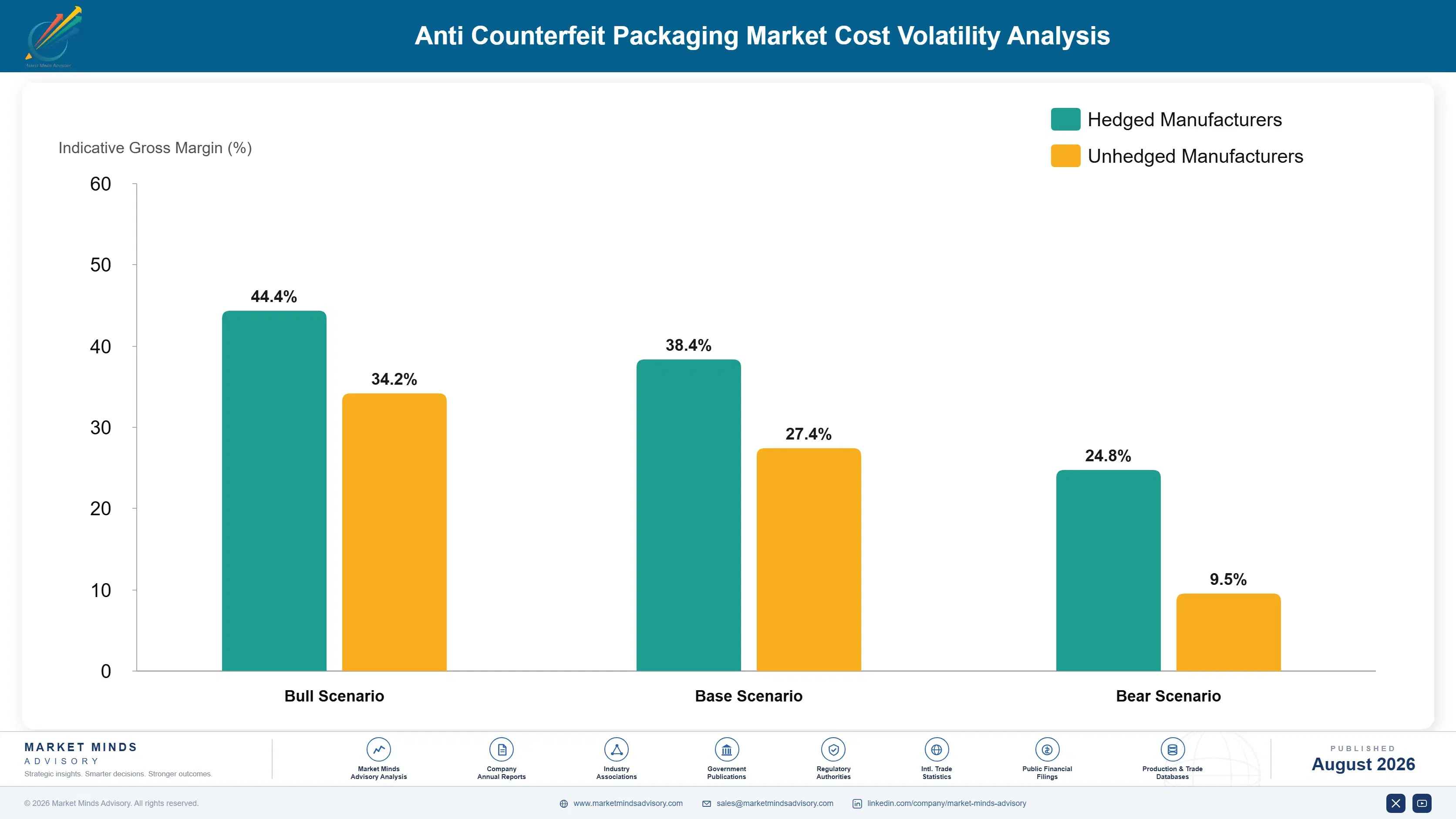
Exposure varies by company scale and vertical integration. Larger diversified suppliers with long-term semiconductor supply agreements or partial backward integration into ink and taggant production absorbed the volatility with comparatively limited disruption, while smaller specialists reliant entirely on spot-market component purchasing faced sharper cost swings that occasionally opened share for better-hedged competitors during the tightest supply quarters.
anti-counterfeit-packaging-market-cost-volatility-analysis-1787300057643

Secure Long-Term Semiconductor Supply Agreements

Leading authentication technology suppliers are increasingly securing multi-year fixed-volume agreements directly with semiconductor producers, trading some pricing flexibility for meaningfully greater supply certainty during periods of tight global chip production capacity across the broader industry.

Diversify Security Ink and Taggant Sourcing

Manufacturers are qualifying multiple taggant and security pigment suppliers rather than relying on a single source, reducing exposure to any one supplier's capacity constraints or pricing decisions during periods of tight specialty chemical market conditions globally.

Invest In Backward Integration Into Tag Assembly

Several of the largest suppliers have built or acquired captive RFID and NFC tag assembly capacity, insulating a meaningful share of production from third-party component pricing pressure and allowing faster new product development cycles across their portfolios.

Portfolio Architecture for Margin Defence

The market splits into three commercial tiers with distinct margin economics. Basic tamper-evident seals and standard holographic labels compete largely on price and manufacturing scale, certified serialization systems carry meaningfully higher margin on regulatory compliance depth, and consumer-facing RFID and NFC authentication solutions command the highest margin given their design and brand engagement value.
The tension between volume and premium positioning shapes how suppliers allocate technology development investment: basic tamper-evident features still represent the largest unit volume by a wide margin, but nearly all incremental profit growth over the forecast period concentrates in serialization and consumer-facing authentication, which is where the leading suppliers increasingly direct research and integration spending.

High-value margin pools concentrate specifically in multi-jurisdiction serialization platforms during their current compliance-mandate window and in consumer-facing authentication experiences serving luxury and electronics brands. Both pools reward suppliers who invest ahead of demand in platform integration and design capability rather than those who wait for regulatory mandates to fully mature before committing capital.

Volume / Commodity-Adjacent Tier

Basic tamper-evident seals and standard holographic labels sold largely on price and manufacturing scale across broad consumer packaging channels worldwide today.
Gross Margin: 18-28%

Premium / Certified Tier

Certified pharmaceutical serialization systems and multi-jurisdiction compliance platforms commanding meaningful premiums tied directly to regulatory depth and proven reliability record.
Gross Margin: 32-42%

Sustainability / Regulatory / Next-Generation Tier

Consumer-facing RFID and NFC authentication solutions with branded verification experiences, carrying the category's highest margins given design and integration value delivered.
Gross Margin: 42-55%
anti-counterfeit-packaging-market-portfolio-architecture-1787300058146

High-value Sub-segments and Strategic Watch-out

Track-and-Trace Serialization

Highest current margin and fastest volume growth in the category, constrained mainly by lengthy regulatory certification cycles and the small number of proven multi-jurisdiction platforms today worldwide.
Gross Margin: 44-55%

RFID and NFC Authentication Tags

Steady high-value growth tracking declining semiconductor costs and expanding brand adoption closely, increasingly favoring suppliers with strong chip manufacturing partnerships over smaller regional converters.
Gross Margin: 34-44%

Basic Tamper-Evident Seals

The volume core of the market by unit count, competing primarily on price and manufacturing scale rather than deep technical differentiation between competing regional suppliers overall.
Gross Margin: 18-26%

Static Holographic Security Labels

A strategic watch-out segment as counterfeiters increasingly replicate older-generation optical features, threatening a substantial share of currently deployed static security label formats globally.
Gross Margin: 20-30%

Regulatory Mandate Meets Brand Engagement Value

Pharmaceutical serialization behaves like a compliance-driven annuity once a mandate takes effect, generating recurring, predictable order volume from covered manufacturers who have no legal alternative to sourcing certified systems, while consumer brand authentication remains more discretionary, tied to marketing budget cycles and perceived counterfeit risk rather than legal obligation.
Adoption depth varies sharply by end-use vertical. Pharmaceutical manufacturers show the deepest supply relationship lock-in given the complexity and cost of requalifying serialization systems mid-production, luxury goods and electronics brands adopt more selectively based on perceived counterfeit exposure and marketing value, and mass-market consumer goods brands remain the slowest and most price-sensitive adopters overall.

A generational shift in buyer profile is underway as brand protection increasingly reports to digital marketing and customer experience teams rather than purely security or compliance functions, reflecting authentication technology's growing role in consumer engagement. Pharmaceutical compliance teams are also increasingly staffed by dedicated serialization specialists rather than general regulatory affairs generalists managing the requirement alongside many other unrelated compliance obligations.
anti-counterfeit-packaging-market-end-use-penetration-index-1787300058632

Where This Market Goes Next

These are among the four positions where our research anticipates prominent divergence between winners and laggards over the coming forecast period. Each is grounded in the demand model, the regulatory perimeter, and the announced capacity pipeline.
01 / SERIALIZATION PLATFORM DEPTH

System integration depth will decide pharmaceutical contract retention

Pharmaceutical manufacturers rarely switch serialization suppliers once a system is integrated into production lines, given the cost and regulatory risk of requalification, making early platform integration depth a durable competitive advantage. Suppliers with strong enterprise system integration are already reporting meaningfully higher contract renewal rates than competitors offering standalone hardware without comparable software depth. This dynamic should keep integration-focused suppliers ahead of hardware-only competitors well through the current forecast period, as switching costs continue compounding with every additional year of accumulated production history.
02 / CONSUMER VERIFICATION DESIGN

Brand experience quality now differentiates authentication vendors

Luxury and electronics brands increasingly evaluate authentication suppliers on consumer-facing design quality alongside pure security performance, rewarding suppliers who can deliver a polished verification experience that reinforces brand positioning rather than a purely functional deterrent alone. Suppliers investing in design and consumer experience capability are winning premium contracts at prices meaningfully above functional-only competitors lacking that investment. Manufacturers who treat authentication as pure security technology risk losing share to competitors who understand it as a marketing touchpoint deserving comparable design investment and attention.
03 / MULTI-JURISDICTION COMPLIANCE SCALE

Cross-border compliance platforms are winning the largest accounts

Multinational pharmaceutical manufacturers increasingly prefer consolidating serialization technology under a single vendor capable of serving every jurisdiction where they sell product, rather than managing separate certified suppliers market by market as regulatory fragmentation continues expanding across more countries. Suppliers with proven multi-jurisdiction platform capability are winning larger, more durable manufacturer contracts than single-market specialists competing for the same accounts today. This consolidation trend should accelerate as more countries introduce serialization mandates, widening the gap between broad-platform suppliers and narrow regional competitors.
04 / LAYERED TECHNOLOGY INVESTMENT

Single-technology solutions face rising obsolescence risk

Counterfeiters are adapting fast enough to older static security features that brand owners increasingly demand layered authentication combining multiple technology types rather than relying on any single feature indefinitely. Suppliers offering combined physical and digital authentication are commanding premium pricing and stronger brand owner confidence than single-technology competitors facing growing obsolescence risk. Manufacturers who continue selling only static holographic or optical features without a digital complement risk losing share as brand owners prioritize resilience against evolving counterfeit techniques over the historically lower cost of single-technology solutions.

Engagement Snapshot From the Field

A live engagement with an industry participant carrying material or product regulatory and market exposure ahead of a defining policy shift, showing how our research translates into a defensible multi-year portfolio strategy.
MARKET MINDS ADVISORY · CLIENT ENGAGEMENT SUMMARY
Anti Counterfeit Packaging Producer Strategic Portfolio Review and Transition Roadmap 2026·Investment Scenario on Anti Counterfeit Packaging Exposure Evaluation 2025-26
CLIENT PROFILE
The client is a multinational generic pharmaceutical manufacturer exporting product to more than thirty countries, each with distinct serialization requirements, generating several billion dollars in annual revenue (client-reported, unverified by MMA) across its global operations. The company operated separate serialization systems across several regional facilities, creating inefficiency and compliance risk as more destination markets introduced new requirements.
STRATEGIC CHALLENGE
Leadership needed to consolidate serialization technology under a smaller number of platforms capable of serving multiple jurisdictions simultaneously, while avoiding production disruption during the transition given the company's tight manufacturing and export shipment schedules across its full facility network worldwide.
MMA APPROACH
MMA benchmarked candidate serialization platform vendors against multi-jurisdiction certification breadth, integration complexity, and total cost of ownership, modeled the operational impact of consolidation under two distinct vendor scenarios, and recommended a phased facility-by-facility migration sequence prioritized by regulatory deadline urgency across markets.
KEY FINDINGS
  1. The client's existing serialization systems supported an average of only four national data standards each, well short of the fifteen to twenty standards required across its full export destination footprint.
  2. Consolidating under two multi-jurisdiction platforms was modeled to reduce annual serialization system maintenance costs by roughly 30 percent relative to the fragmented status quo arrangement.
  3. Facility migration sequencing by regulatory deadline urgency avoided an estimated three compliance violations that a simple alphabetical or geographic sequencing approach would have risked (client-reported, unverified by MMA).
  4. Integration testing revealed compatibility issues at two facilities that required six additional weeks of remediation work before the planned production cutover date could proceed safely.
CLIENT PROFILE
The client is a multinational generic pharmaceutical manufacturer exporting product to more than thirty countries, each with distinct serialization requirements, generating several billion dollars in annual revenue (client-reported, unverified by MMA) across its global operations. The company operated separate serialization systems across several regional facilities, creating inefficiency and compliance risk as more destination markets introduced new requirements.
STRATEGIC CHALLENGE
Leadership needed to consolidate serialization technology under a smaller number of platforms capable of serving multiple jurisdictions simultaneously, while avoiding production disruption during the transition given the company's tight manufacturing and export shipment schedules across its full facility network worldwide.
MMA APPROACH
MMA benchmarked candidate serialization platform vendors against multi-jurisdiction certification breadth, integration complexity, and total cost of ownership, modeled the operational impact of consolidation under two distinct vendor scenarios, and recommended a phased facility-by-facility migration sequence prioritized by regulatory deadline urgency across markets.
KEY FINDINGS
  1. The client's existing serialization systems supported an average of only four national data standards each, well short of the fifteen to twenty standards required across its full export destination footprint.
  2. Consolidating under two multi-jurisdiction platforms was modeled to reduce annual serialization system maintenance costs by roughly 30 percent relative to the fragmented status quo arrangement.
  3. Facility migration sequencing by regulatory deadline urgency avoided an estimated three compliance violations that a simple alphabetical or geographic sequencing approach would have risked (client-reported, unverified by MMA).
  4. Integration testing revealed compatibility issues at two facilities that required six additional weeks of remediation work before the planned production cutover date could proceed safely.
RECOMMENDED STRATEGY
Phase 1: Phase 1 (Months 1-3): Complete vendor evaluation and finalize platform selection for the two consolidated serialization systems chosen. Phase 2: Phase 2 (Months 4-9): Execute phased facility migration sequenced by regulatory deadline urgency across the entire network. Phase 3: Phase 3 (Months 10-14): Complete final facility cutovers and establish ongoing multi-jurisdiction compliance monitoring processes company-wide.
OUTCOME
Twelve months into the migration, the client reported zero compliance violations across all migrated facilities and serialization system maintenance costs down an estimated 28 percent (client-reported, unverified by MMA), tracking closely to MMA's original modeled projections.

Frequently Asked Questions

Foundational context covering the market sizes, CAGR, scope, country, region and competition that inform every finding below. This section is provided to cover basics and most often pre-purchase conversations, answered from the MMA Primary Research Dataset.

What is the current size of the Anti Counterfeit Packaging Market?

The market is valued at approximately 5.4 billion dollars in 2025, expanding to roughly 5.92 billion dollars in 2026 as pharmaceutical serialization mandates and e-commerce counterfeit exposure continue driving adoption.

How large will the Anti Counterfeit Packaging Market be by 2036?

MMA forecasts the market reaching approximately 14.8 billion dollars by 2036, roughly 2.5 times its 2026 value, driven primarily by expanding serialization mandates and declining RFID authentication costs.

What is the CAGR for the Anti Counterfeit Packaging Market 2026 to 2036?

The base-case compound annual growth rate is 9.6 percent, with a bull scenario of 10.8 percent and a bear scenario of 8.3 percent depending on regulatory expansion pace and technology adoption speed.

Which segment is growing fastest?

Track-and-trace serialization is growing fastest at a 14.5 percent CAGR, roughly 1.51 times the overall market rate, driven primarily by expanding pharmaceutical regulatory mandates worldwide.

Who are the major companies in the Anti Counterfeit Packaging Market?

Avery Dennison, 3M, CCL Industries, SICPA, and Authentix lead the market, together holding roughly 38 percent of revenue on a company-revenue basis across all technology types.

Which country is growing fastest?

India is the fastest-growing country at a 13.2 percent CAGR, driven by expanding pharmaceutical serialization requirements tied to its major role as a global generic drug exporter.

Report Segmentation Architecture

The full report scope spans multiple orthogonal segmentation dimensions, with cross-tabulated demand data provided for each dimension pair. Coverage extends further to regional breakdowns, trend trajectories, and the competitive detail needed to support segment-level decision-making.

By Authentication Technology

  • Holographic Security Labels
  • RFID and NFC Authentication Tags
  • Taggants and Security Inks
  • Tamper-Evident Seals and Closures
  • Track-and-Trace Serialization
  • Optical Variable Devices

By End-Use Industry

  • Pharmaceuticals and Healthcare
  • Luxury Goods and Apparel
  • Consumer Electronics
  • Food and Beverage
  • Government and Currency Documents

By Commercial Dimension

  • Direct Brand Owner Contracts
  • Government and Regulatory Contracts
  • Distributor and Converter Channel
  • Platform Licensing and Software Services

By Region

  • North America
  • Western Europe
  • East Asia
  • South Asia and Pacific
  • Latin America
  • Middle East and Africa
  • Eastern Europe

Scope, Methodology, and Coverage

Every figure in this report is reproducible from documented input assumptions. The scope below maps the historical period, the forecast horizon, the segmentation dimensions, and the countries covered, alongside the underlying primary and qualitative methodology.
Historical Period
2020 to 2025
Forecast Period
2026 to 2036
Base Year
2025 (USD billions; MMA Primary Research Dataset, August 2026)
Market Definition
The market covers packaging technologies designed to authenticate products and deter counterfeiting, including holographic security labels, RFID and NFC authentication tags, taggants and security inks, tamper-evident seals and closures, track-and-trace serialization systems, and optical variable devices. General product traceability software not tied to physical packaging and standalone brand protection legal services are excluded.
Quantitative Units
USD billions (current prices); unit shipments where cited
Segmentation Dimensions
By Authentication Technology; By End-Use Industry; By Commercial Dimension; By Region
Regions Covered
North America, Western Europe, East Asia, South Asia and Pacific, Latin America, Middle East and Africa, Eastern Europe
Countries Covered
USA, China, Germany, France, UK, Japan, South Korea, India, Australia, Canada, Brazil, Mexico, Indonesia, Vietnam, Thailand, Malaysia, UAE, Saudi Arabia, South Africa, Nigeria, Turkey, Poland, Netherlands, Italy, Spain, Sweden, Switzerland, Argentina, Colombia, Singapore, and additional markets relevant to this sector
Key Companies Profiled
Avery Dennison Corporation, 3M Company, CCL Industries Inc., SICPA Holding SA, Authentix Inc., De La Rue plc, Zebra Technologies Corporation, Systech International, Markem-Imaje, OpSec Security Group, Crane NXT Co., Applied DNA Sciences Inc., Impinj Inc., NXP Semiconductors N.V., Honeywell International Inc., Tesa SE, Schreiner Group GmbH, AlpVision SA, YPB Group Limited, Nanotech Security Corp.
Quantitative Methodology
Primary survey, n=3,800 respondents, Q4 2025, six countries; demand-side model with trade association cross-validation
Qualitative Methodology
47 expert interviews, Q4 2025; applied to validate demand model assumptions, identify emerging dynamics, and assess competitive positioning
Report Format
PDF and XLSX data workbook (Word format preview document)
Publisher
Market Minds Advisory
Report Code
MMA-2026-PAC-724
Published
August 2026
Contact
sales@marketmindsadvisory.com | www.marketmindsadvisory.com

Purchase the full Anti Counterfeit Packaging Market Report (2026 to 2036).

The full report delivers a complete quantitative and strategic assessment of the anti counterfeit packaging market across all seven regions and more than thirty countries covered in this study. It includes detailed segment-level forecasts through 2036, competitive benchmarking across twenty profiled manufacturers, and primary research drawn from 3,800 survey respondents and 47 expert interviews conducted in Q4 2025. Buyers receive editable data tables and full regional narrative detail beyond the two regions previewed in this summary document. A dedicated appendix covers pharmaceutical serialization mandate timelines and authentication technology certification standards by country.
Fully editable Excel data tables included
All seven full regional narratives included
Twenty-company competitive profiles included
Serialization mandate timelines appendix included
Segment-level 2026-2036 detailed forecasts
Primary survey and interview data provided

Built For The People Who Decide

From boardroom strategy to bench-side execution, this report is read cover-to-cover by leaders shaping the next decade of their industry, turning demand scenarios, market dynamics and valuation benchmarks into decisions.
CXOs/ Presidents/ VPs/ Managers
M&A and Corporate Development
Strategy Teams and R&D Heads
Procurement and Product Directors
Regulatory and Compliance Leaders
Investor Relations and Equity Analysts